THURSDAY AT PHOTOKINA
The Printing Life
 By MIKE PASINI
Editor
The Imaging Resource Digital Photography Newsletter
COLOGNE, Germany -- Today was a little different. We spent much of the day in meetings rather than on the show floor, but we learned a good bit about the photo printer market and have one pair of breakthrough printers to introduce to you.
|
First Surprise |
FIRST SURPRISE | Back to Contents
At IDC's series of presentations on the state of the digital imaging market, Paul Withington, IDC research manager for European peripherals, observed that the reason we buy cameras now is the same reason we bought them 10 years ago. "Cameras exist to print photos," he explained.
And we still like our photos, according to a recent IDC survey which asked respondents what they thought of the statement, "I get more pleasure out of seeing a good quality printed photo rather than viewing it on-screen."
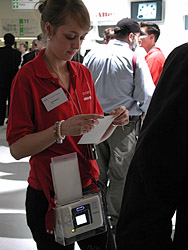
We Love Prints. A SELPHY roving the show floor mesmerizes even the Canon rep demoing it.
In 2004, 63 percent preferred a print, while today 60 percent do -- and they feel more strongly about that now with 40 percent strongly agreeing with the statement (vs. 26 in 2004). Those who disagreed in 2004 amounted to 23 percent and dropped to 19 percent in 2006.
Respondents were then asked if they agreed with this statement, "In two years time I will not see a need to print photos at all. I will share them all electronically." In 2004, 31 percent agreed and 58 percent disagreed. But in 2006, the early adopters had been joined by more mainstream users, with only 27 percent agreeing and 53 percent disagreeing. The trend, as Withington pointed out, suggests the printed photo will survive all the online sharing we can build.
Senior Analyst Nickolay Grigorov made an interesting observation about disposable income, which, after all, is what determines a customer's ability to buy any of these wonderful toys, including printers.
He compared Germany, the Czech Republic and Russia. But first he compared each of them to themselves. Income distribution in Germany before reunification is remarkably similar to what it was in 2000, where over 60 percent of the population has 40 percent of the income. The Czechs, however, show a slightly greater disparity in income distribution, where the top 20 percent have more income and the bottom 20 have less by a few percentage points. We call that the rich getting richer and the poor getting poorer.
But Russia is "a tragedy," Grigorov said. Before the fall of communism, income distribution resembled Germany, which hasn't shifted since reunification. But now 20 percent have 50 percent of the income while the other half fights over the scraps.
What that means is that today's German has to decide if a new digicam is worth parting with 9.6 percent of their average $3,390 monthly salary. And a Czech may want to discuss it with their spouse, since it means spending 35.6 percent of the average $787 salary. But in Russia? It isn't even an issue. It would cost 111 percent of the average $300 salary. Not a good place to work on commission.
NO PLACE LIKE HOME | Back to Contents
Leigh Worthing, IDC research analyst for European peripherals, shed some light on the home printing market that also surprised us. He looked at three categories of printers. The inkjet single function photo printer (at least four colors with the ability to print without a computer involved), the inkjet photo multifunction peripheral (same as above but with a scanner) and the 4x6 printer (either dye sub or inkjet).
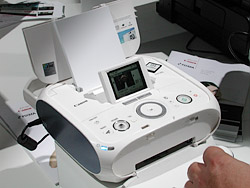
The mini 260. A PIXMA that's so cute you want to pinch it, a 9600x2400-dpi inkjet that can make a 4x6 in 59 seconds.
The fastest growing segment among those three is the multifunction peripheral, he said. Of the top 10 printers sold in Western Europe only two were not MFPs, the Canon IP4200 letter-size inkjet and the Canon SELPHY CP150 4x6 dye sub. And in the first half of 2006, of HP's roughly 2,500,000 units sold, 1,897,598 were MFPs. That dwarfs the single function and small format printers, which split the rest between them. And that pattern was true of Canon, Epson, Lexmark and Brother.
Hewlett-Packard printers are the most popular in 12 countries, Canon leads in four, Epson in Portugal and Dell in Ireland.
But still, an IDC survey revealed, the most common way people share digital images is on their computer (35 percent), followed by printed photos (28 percent), via laptop (19 percent), email (16 percent). The least popular methods were photo sharing sites and the digicam LCD screen.
IDC predicts there will be a continuing shift from home printing to retail and Internet options over the next five years, but the home will continue to be the most popular place to print images. There's no place like it.
INSIDE THE KIOSK | Back to Contents
Pixology CEO Yuval Yashiv gave an interesting presentation from the vendor's perspective, noting nine things to watch:
- Retail and online will continue to overtake home printing
- 6x4 prints are the loss leader, with margin and profits are in gifts and merchandise
- The photobook is the product of the future, as the album was the product of the past
- Kiosks will rule, including outside the retail store like ATMs
- Minilabs have plateaued but are not disappearing
- Greater role for central labs given the rising importance of photo merchandising
- Sharing increasingly dominated by non-photofinishing sites like Flickr and MySpace
- Archiving may become a viable revenue model
- Windows Vista may have a material impact on consumer behavior if Microsoft "pushes enough"
THE NEW HP Z LINE | Back to Contents
Hewlett-Packard unveiled a new line of Designjet printers at the show, the eight-ink Z2100 and the 12-ink Z3100. Both are available in either 24- or 44-inch models.
There are a couple of very interesting twists to this new line, that up the ante for large format, high quality photo printing.
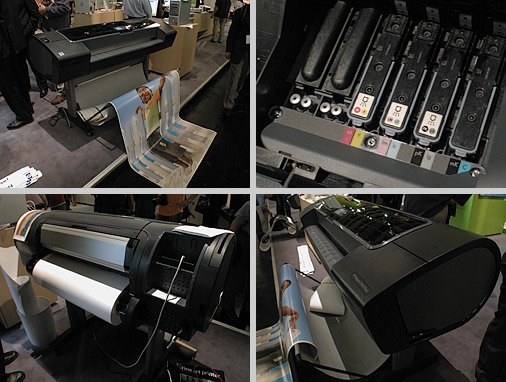
Z2100. Ink carrtridges (top right), rear view (bottom left), side view (bottom right) of this attractive printer.
First, the 12-ink Z3100 has, according to HP, the largest color gamut of any inkjet printer yet. Both printers use Vivera pigment ink (like the D9180), featuring 200+ year permanence (vs. the Epson K3 set's 150-170). But while the eight ink set of the Z2100 is comparable to the K3's color gamut, the Z3100's 12 inks surpass it.
That's a feature HP was quick to capitalize on by embedding spectrophotometer in both models. Based on GretagMacbeth's Eye-One color technology and HP's Color Center interface, you can quickly create an ICC color profile for any medium you want to print on. And you can tweak those profiles to what looks good to you, a feature HP described as "democratizing color." The built-in spectrophotometer also makes it a snap to calibrate the printer so it does what you expect every time.
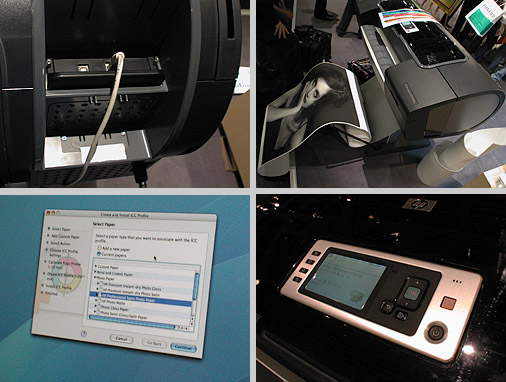
Z3100. Rear connectors (top left), side view (top right), picking a paper type while creating an ICC profile (bottom left), control panel (bottom right).
The profile creation process is very straightforward, prompting you for the type of paper you are using and printing a test pattern that can be read immediately by the spectrophotometer (with the printer automatically "rewinding" the test pattern so it can be read) or at a later time when the colors have stabilized on the sheet.
Of course, how democratic you can get depends on which of the two printers you buy. The Z2100 uses cyan, magenta, yellow, light cyan, light magenta, light gray, photo black and matte black. The Z3100 doesn't need cyan but uses magenta, yellow, light cyan, light magenta, red, green, blue, light gray, photo black, gray, matte black and gloss enhancer.
The black ink sets mean this printer is equally adept at printing black and white photography as it is color.
Both printers sport a resolution of 2400 x 1200 dpi with ink droplets of 4 or 6 picoliters depending on the ink type. The 130 ml cartridges will be bundled in twin packs but the 24-inch models will use a 69 ml starter cartridge for the first set.
The price? We were only able to confirm the Z2100 prices at $3,395 for the 24-inch model and $5,595 for the 44-inch model. Not something that's going to move very fast in Russia, apparently, but competitive with competing models on the market.
MORE TO COME | Back to Contents
There's a lot more to say about printers at photokina, of course, so we'll return to this subject before we leave. And that's a few days from now still. So stay tuned for more!
 |