SATURDAY AT PMA
Fading, But Catching Up
 By MIKE PASINI
Editor
The Imaging Resource Digital Photography Newsletter
LAS VEGAS, Nev. -- When all is said and done, hyped and debunked, PMA is about photography.
And the photographer walking up and down the aisles here will find more than a few products relevant to the enjoyment of the art and science of the craft. We took a look at several, some old and some new, this afternoon.
But first we report the award winners. There are a few surprises.

Pretty Early. You get up pretty early to catch up on the news here.
DIMA AWARDS | Back to Contents
The Digital Imaging Marketing Association awards were announced earlier this week. Olympus did extremely well, with one dSLR and two digicams getting DIMA awards. And a few products we've covered earlier were also winners.
DIMA Innovative Digital Product Award winners included:
- The Zigview S2 dSLR add-on LCD viewfinder
- Delkin's SensorScope System cleaning system for dSLRs
- Nexlab minilab with DS Tower
- Epson Stylus Photo 140
- FotoNation's FacePro for mobile phone face detection
- Fujifil IS-1 9-Mp digicam targeted to professions needing to capture both visible and infrared light
- HP Designjet Z Photo Printer Series
- Hitachi Hybrid Camcorder featuring DVD and HDD formats at the touch of a button
- Joby Gorillapod Family of flexible tripods
- Photobook Pro photo album and bookbinding system
- Lensbaby 3G
- MTI Freedom Universal with Product Finder, a "shop, gather and compare" tool
- MTI Freedom Universal with Snooze Feature
- Olympus EVOLT E-510 dSLR
- Olympus SP-550 UZ digicam with dual image stabilization, 15 fps continuous shooting speed, pre-capture of five frames before the shutter is fully depressed
- Olympus Stylus 770 SW shockproof and waterproof digicam
- Think Tank Photo rotation360 backpack
- Xerox iGen3 Digital Production Press
EXPOIMAGING | Back to Contents
Shooting under artificial light can be hazardous to your white balance. That's why every digital camera includes some sort of white balance adjustment (although it's fun to fool around with too, as a sort of built-in collection of filters).
But the one we rely on the most is Custom white balance, which requires shooting a white target under the mystery light source to get a reasonable capture of what you're seeing.
ExpoImaging (http://www.expoimaging.net) has developed the ExpoDisc, a white balance filter with three ball bearings in its mounting ring so it just snaps onto the front of your lens. Light is diffused via a honeycomb lens in front through a color neutral white optical-grade plexiglass behind it. Available sizes run from 58mm through 82mm (with prices running from $99.95 to $124.95) in two versions, a neutral and a warmer portrait.
Another interesting aspect of this tool is that, faced toward your shooting positing instead of your subject, it turns your camera into an incident light meter. Instead of measuring white balance, you can manually set your exposure.
The company also makes a pocket-sized circular calculator to quickly determine depth of field at any focal length, aperture size and sensor or film format. The $29.95 ExpoAperture Depth of Field Guide uses three tough circular plastic disc rotating against each other to work out the computation.
We're great fans of Boinx Software's Fotomagico (http://www.boinx.com) for Mac OS X. It's fun to work with and the results are always first class. There is an issue with computers that use the ATI Radeon 7500 graphics card. Those machines export an all-black video. But otherwise, we've recommended it without hesitation.
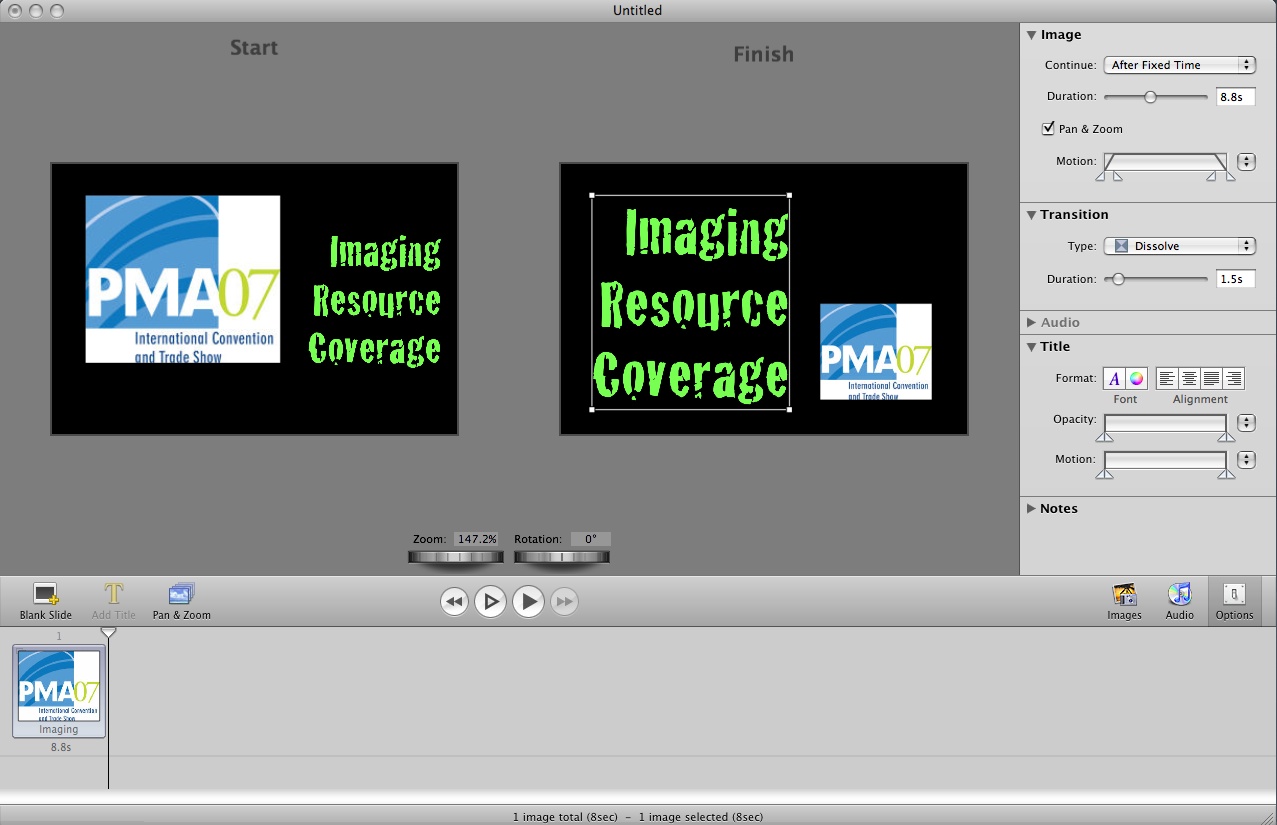
Fotomagico Express. Version 2.0 should look familiar.
The company has just released version 2.0 and made it a free upgrade to anyone with a version 1.x license. Version 2.0 is being released in two versions, the $49 FotoMagico 2 Express and the $129 FotoMagico 2 Pro. The free upgrade is to the Express version but upgrading to Pro is just $50 until May 31. There's also a 15 percent discount if you use "PMA07" as the coupon code when ordering on the Web. Which might come in handy if you're interested in the new family license that lets you use the software simultaneously on up to five computers "in a private household" at the same time.
So what's in 2.0?
The new version can create standalone players and screensavers (Mac only at the moment) with the same playback quality as the full version of FotoMagico. Since the show is rendered in real time, the file sizes remain small compared to HD video. Standalone players and screensavers start the show as soon as they are opened and can be made to time out or after quit after having been played a set number of times.
Another new feature, only available in the Pro edition, allows you to add a watermark to your presentation. Any JPEG can be used, resized and repositioned using the usual Fotomagico methods. The ghosted images appears throughout the entire show.
The Pro edition also supports Aperture libraries, HD movie export and custom export options.
PIEZOGRAPHY | Back to Contents
Another product that made us drool is Piezography's Neutral K7 archival inkset (http://www.piezography.com). It's the world's first neutral tone, archival inkset for black and white printing. Using seven shades of monochrome ink composed of carbon pigment, each perfectly neutral, color tone is cast strictly by the paper you're printing on.
But how do you tell your printer it has gray ink in it instead of color? You use QuadToneRIP, a shareware program that knows what's in each cartridge and what to do with it. Like use the very light gray rather than small dark dots in the highlights, and mix a couple of the darker grays in the shadows to build detail.
You can put this ink set in the Epson 2200, R800, R1800, 4000, 7600 and 9600. Six color printers like the Epson 7000, 7500, 9000 and 9500 can use the Neutral K6 set of six inks. The inks are sold as $16.95 cartridges or in $44 4 oz. and $120 16 oz. bottles. Starter kits for the 2200 at $124.95 and the R800/R1800 at $139.95 are also available.
To print with these inks, you just install the cartridges in your printer, install QuadToneRIP on your OS X or Windows computer, open your grayscale image, pick your paper from the list in the QuadToneRIP window and print.
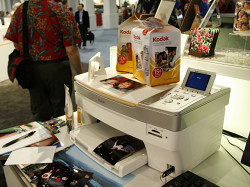
5300. Buried in ink, surrounded by sample prints (and, if you look closely, our solar-powered notebook).
At Kodak's booth we finally got a glimpse of the Goldeneye (and even learned how to spell it). Bring your Bluetooth mobile phone within range of the Goldeneye Bluetooth dongle in a Windows computer's USB port and your phone will ask you if it's OK to transfer its images to the computer.
The computer has to have paired with your phone first, so not any camphone will get that generous offer. But once paired, any time you walk by, you can automatically transfer images off your cell to your computer.
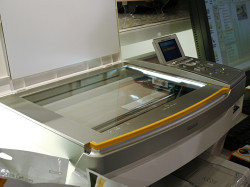
Scanner Bed. Rare look at the scanner bed. you can scan more than one print at a time and get more than one file, too.
They can even be sent automatically to the great gallery in the sky, EasyShare Gallery. Freeing them from that cell phone forever.
Kodak hasn't figured out how to market it yet, but it could just be one more Bluetooth accessory for your cell phone, like a headset.
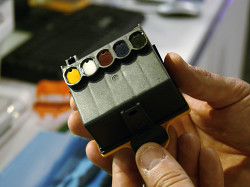
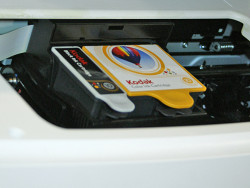
Ink Cartridges: Color cartridge (top) with 'white' (clear) gloss optimizer. They're a snap to install (bottom).
We finally got a chance to get some pictures of Kodak's new all-in-one inkjet line. The 5300 mid-range model (with the LCD that functions like a mini-kiosk) was on display with its inexpensive replacement ink cartridges.
We also learned a few more things about it.
The company won't disclose printing or scanning resolution, but apparently scanning resolution is 1200 (that's what comes up in the dialog box anyway, we were told).
We also learned the exclusive distribution deal with Best Buy is only for three months. Best Stores are setting up the displays this week and will be selling them right away. After the three month period, other distribution chains will open, although Kodak wasn't naming names.
Business Manager Steve Marzio took us through a demo that reminded us what we saw at Ketchum prior to the announcement. Easy copies (if not perfect duplicates, very very close), fast prints thanks to a half-inch wide printhead, a gloss optimizer in the ink set and a larger color gamut than even dye-based inkjets from HP and Epson.
It was quick, certainly, but there are faster printers. The quality really was stunning, but you can't really evaluate that without images of your own. We had a few test images taken in a bowling alley with flash. The background, which was more than a room away, was dark in the images and the flash did its best to burn out the people in the foreground. We were surprised to see the printer handle those tones pretty well, keeping a little detail in the highlights and opening up the dark shadows.
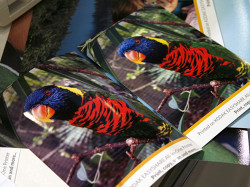
Copy. Quality (even if it is jus 1200 resolution) was quite good for this copy. The original is on the right. Copy has a bit more magenta (compare left edges).
Making a copy of a print on photo paper was as simple as it sounds. Put the original on the glass, press the copy button and a few seconds later you've got a copy. The copy showed a very slight color shift, nothing worth an adjustment, though.
At the IDC breakfast meeting, the analysts were unconvinced that people at the point of purchase would opt for a printer that costs $50 more just because the ink is cheaper. If they don't print a lot, it could take years to recoup the difference in cost, they pointed out.
Kodak isn't expecting that customer to buy. They're looking for the frequent printer, the one who knows how much ink costs, who would like to print more but restrains themselves. Some people even take the cartridges out of the printer so the kids won't waste ink, one Kodak demonstrator told me.
We'll have to test this before drawing any conclusions, but it sure is worthy of a test.
We stopped at the press room to get copies of the DIMA press releases and ran into Henry Wilhelm of Wilhelm Imaging Research (http://www.wilhelm-research.com). He gave us a copy of his latest report on the permanence of all types of 4x6 prints (http://www.wilhelm-research.com/ist/WIR_IS&T_2007_03_HW.pdf), which he just presented this week at the show.
Wilhelm took a look at how long 4x6 prints last when you display them (as a framed print or just on your refrigerator) and when your store them (say, in an album). He found that your choice of ink and paper can affect the longevity of your print by a factor of 200 times.
One of the most pernicious factors in shortening print life is what he calls "ambient ozone exposure." Also known as gas-fading (from ozone in polluted air), it does its worst damage on prints made with dye-based inks on instant-dry (porous) paper. Kodak's new all-in-ones do use instant-dry paper but with pigment-based inks. But if you buy instant-dry paper (instead of the usual swellable sheets) for your dye-based printer, you risk short print life.
Roughly speaking, framing a print behind glass doubles its life, partly by protecting it from ozone. That isn't always the case, as you can see by comparing the framed and bare bulb columns of the report, but generally true.
An even more surprising factor in print longevity is the brand of ink and paper you buy. We have argued with readers for years about the importance of buying the stuff the printer manufacturer sells. There's a superstition that this is just a way to squeeze more pennies out of your purse and that any ink and paper is about the same as any other. But Wilhelm proves dramatically the difference is significant.
Take the HP Photosmart 145 and 245 printers. He made prints on them using the highest quality, branded materials -- both ink and paper -- he could buy in January from Office Depot, Staples and HP. If you tack them up on your fridge, the Office Depot print will go two months before fading, the Staples print three months and the HP print 32 years. Frame them behind glass and you get four months from the Office Depot print, three years from the Staples print (less than a drugstore print still) and 68 years from the HP print.
Just making a print at a Photosmart Express retail kiosk will last 200 times longer than that Office Depot print made with store-brand ink in a refilled HP 57 cartridge on Office Depot Professional Photo Paper.
Wilhelm notes, "Epson, Hewlett-Packard and Lexmark now manufacture inkjet prints, inks and photo papers for home printing that have higher WIR Display Permanence Ratings than traditional silver-halide color prints." Kodak's dye sub prints (what comes out of those docks) survive the longest at 10 years unprotected and 26 years framed.
Speaking of permanence, we're beginning to fade a bit ourselves. This report was delayed by our departure from Las Vegas. We'll put together a wrap-up with some fun and intriguing images we haven't yet published in our show reports before saying goodbye to PMA. So one more time we'll recommend you stay tuned!
 |