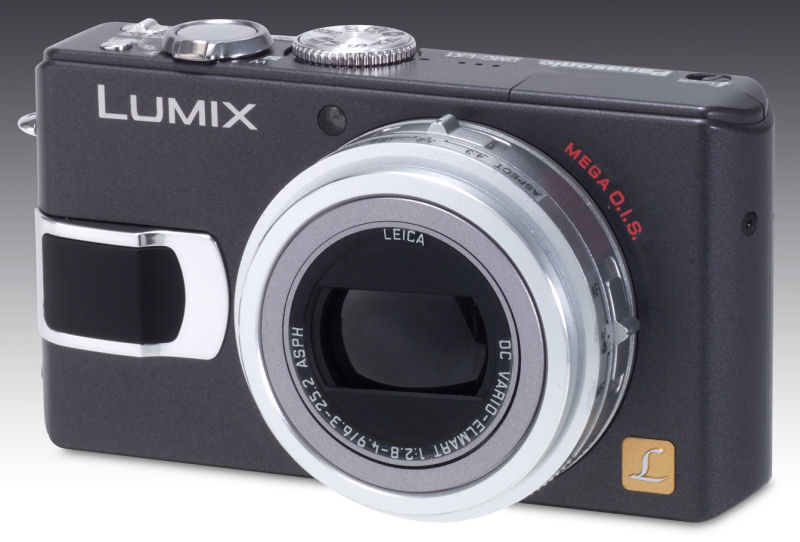
 Panasonic announces 8mpix 16:9 digicam (UPDATED)
By
Mike Tomkins
(Wednesday, July 20, 2005 - 14:08 EDT)
In its second announcement of the day, Panasonic has today unveiled its new Lumix DMC-LX1 digital camera, noteable for its use of a CCD imager with a 16:9 aspect ratio, rather than the more common 4:3 and 3:2 aspect ratio imagers found in most other digital cameras.
Of course, where 4:3 or 3:2 cameras can simply crop their output to achieve a different aspect ratio (discarding some of the image data in the process), the DMC-LX1 can do likewise, offering up 4:3 or 3:2 images from its 16:9 imager. That's not ideal on a regular basis however, because you're paying for real estate on your camera sensor that you aren't using. If you're regularly shooting 16:9 images with a 4:3 camera, 25% of your image data is being discarded. With a 16:9 sensor (all other things being equal), your camera could have been shooting images at a higher burst speed / depth since since there would be less data to transfer from the sensor, and you could have achieved better battery life since the power-hungry sensor would have been active for a shorter period. For these reasons, this could be a rather attractive camera for anybody interested in shooting 16:9 images - for example, anybody who views their images most often on a high definition television. If you often switch back and forth between aspect ratios depending on your planned output method, however, you may want to consider which aspect ratios you're planning to use the most often. When cropping from 16:9 to 3:2 you lose 15% of your image data, though, versus 11% when going from 4:3 to 3:2 - meaning that less sensor area is wasted using a 4:3 camera to shoot 3:2 images. If you regularly shoot images for all three formats, the 3:2 sensor is going to be your best bet, simply because overall you'll be discarding the least data. Other than the unusual choice of aspect ratio for the sensor, the Panasonic Lumix DMC-LX1 is also noteable for its high resolution of eight megapixels, large and high resolution 2.5" 207k pixel LCD display, and LEICA DC VARIO-ELMARIT 4x optical zoom lens. The camera offers a good range of automatic and manual controls, as well as both TIFF and RAW uncompressed formats, and stores images on Secure Digital cards. A slightly larger than average 32MB SD card in the product bundle, although this will still prove nearly useless given the likely file size of an 8 megapixel JPEG image, let alone the TIFF or RAW images. | Panasonic Lumix DMC-LX1 |  | | General | | Camera Type | Compact | | Manufacturer | Panasonic | | Model Number | DMC-LX1 | | Dimensions | 4.2 x 2.2 x 1.0"
105.7 x 55.8 x 25.6mm | | Weight | 220.0 g
7.7 oz | | Image Capture | | Sensor Type | 1/1.65" CCD
8.61 megapixels (total)
8.40 megapixels (effective) | | Filter Type | RGBG | | Aspect Ratio | 16:9, 3:2, 4:3 | | Image Dimensions | 3840 x 2160 (8.3 megapixels)
3248 x 2160 (7.0 megapixels)
2880 x 2160 (6.2 megapixels)
3072 x 1728 (5.3 megapixels)
2560 x 1712 (4.4 megapixels)
2304 x 1728 (4.0 megapixels)
1920 x 1080 (2.1 megapixels)
2048 x 1536 (3.1 megapixels)
2048 x 1360 (2.8 megapixels)
1600 x 1200 (1.9 megapixels)
1280 x 960 (1.2 megapixels) | | Capture Speed | Continuous: 3.0 frames per second for 5 frames | | Image Quality | 2 levels | | Image Preview / Review | | Viewfinder | No | | LCD | 2.5", 207,000 pixels
100% field of view | | Playback Zoom | 16.0x max | | Lens | | Lens Type | LEICA DC VARIO-ELMARIT
4x optical zoom | | Image Stabilization | Yes | | Focal Length | 6.3 - 25.2mm (actual)
28 - 112mm (35mm equivalent) | | Aperture Range | f/2.8 (wide) / f/4.9 (tele) - f/8.0 | | Focusing System | 1 / 3 / 9 point with AF assist lamp
Manual Focus possible (0) steps | | Focusing Range | Normal: 20" - infinity (50 cm - infinity)
Macro: 2.0" - infinity (5.0 cm - infinity) | | Exposure | | ISO Sensitivity | Auto, 80, 100, 200, 400 | | Shutter Speed | 60 - 1/2000 second | | Exposure Modes | Aperture, Shutter, Manual | | Metering Modes | Intelligent Multiple/ Center Weighted/ Spot | | Exposure Compensation | +/- 2.0EV in 1/3EV increments | | White Balance | Auto / Daylight / Cloudy / Halogen / White Set 1 / 2, Manual | | Internal Flash | Modes: Auto / Red eye reduction auto / Forced / Red eye reduction slow synch / Off
Range: Wide: 0.6 - 4.1m, Tele: 0.3 - 2.3m (ISO Auto) | | Flash Exposure Compensation | +/- 2.0EV in 1/3EV increments | | Creative | | Scene Modes | Portrait, Sports, Scenery, Night Scenery, Night Portrait, Fireworks, Party, Snow, Self-Portrait, Food, Baby, Soft Skin, Candle, Starry Sky | | Digital Zoom | 4x (5.6x in Extra Optical Zoom mode) | | Self Timer | Yes, 2 or 10 seconds | | Time Lapse | No | | Movie Format | QuickTime Motion JPEG with audio
848x480 and 320x240
Max. frame-rate: 30 frames per second | | Storage | | Recording Medium | SD/MMC | | File System | Complies with Design Rule for Camera File System (DCF) | | File Format | CCD-RAW, RAW, TIFF, JPEG (EXIF 2.2) | | Connectivity | | Video | Yes, NTSC / PAL switchable | | Computer | USB 1.1 | | Other | DC In | | Power | | Battery Type | Lithium Ion rechargeable | | Battery Form Factor | Proprietary 3.7v 1150mAh | | Product Bundle | | Software | LUMIX Simple Viewer, Photo Fun Studio, ArcSoft PhotoBase, ArcSoft PhotoImpression, ArcSoft Panorama Maker, USB Driver | | Battery / Charger | 1 x Proprietary Lithium Ion rechargeable battery and charger | | Flash Memory | 32.0MB SD Memory card | | Other | | Digital Print Order Format (DPOF) compliant | Yes | | PictBridge Compliant | Yes | | Internal Microphone | Yes | | Internal Speaker | Yes | | Tripod Mount | Yes | | |
UPDATED 2005-07-20 16:40ET: The Panasonic Lumix DMC-LX1 has now been announced for the US market, and this item updated with that information and the US press release. The camera will ship this September at an MSRP price of $699.95.
|
Original Source Press Release:
| PANASONIC INTRODUCES INDUSTRY FIRST 16:9 DIGITAL STILL CAMERA New DMC-LX1 Is 8-Megapixel, Widescreen Shooter With Optical Image Stabilization
SECAUCUS, NJ (July 20, 2005) - Panasonic is introducing another industry first today, the 8.4 megapixel Lumix DMC-LX1, the first digital camera to have a true 16:9 CCD for taking wide aspect pictures. This compact camera also features 4x optical zoom, equivalent to 28 to 112 mm on a 35 mm camera.
"Putting a true 16:9 CCD in the hands of photographers is an obvious move for Panasonic," says Monica Helmer, national marketing manager for the optical group. The company's goal is to provide consumers with the tools for creating a connected lifestyle. "With the LX1, consumers can capture the widescreen image, take the SD memory card from the camera and view the image on one of our widescreen displays. Movies and many TV shows are in 16:9. Now your personal pictures can be, too."
Like other cameras in the Lumix line, the LX1 features Panasonic's MEGA Optical Image Stabilization, the key to removing unintentional shaking from the picture-taking experience. With MEGA OIS, pictures come out crisp and clear.
The LX1 also features Extended Optical Zoom, which utilizes the center of the CCD to create a 5.5 megapixel, 16:9 image at 5x zoom, bring the photographer even closer to the subject.
For high-speed image processing, the LX1 utilizes the Venus Engine II LSI. It boasts quick responsiveness that realizes best-in-class level release time lag of 0.01 seconds. The LX1 also is the first digital still camera that can record moving images at 848x480 16:9 Wide VGA, as smooth as 30 frames per second.
The LX1 offers manual focus and exposure, with both adjustable by an easy-to-use joystick. A switch on the side of the lens barrel lets users quickly change the focus mode. Another switch lets users choose between 16:9 wide image mode, 3:2 image mode, and 4:3 image, in case a more traditional aspect ratio is desired.
The 2.5 inch LCD monitor is perfect for reviewing still images, movies, and up to 25 thumbnail images for quick review, turning the LX1 into a digital photo album as well as a fun image capture device.
"This camera is perfect for the person who wants a creative picture shooting experience," Helmer notes. "It's easy to use, very capable, and with MEGA OIS will make a great widescreen photographer out of anyone.
The DMC-LX1 will be available this September for an MSRP of $699.95.
###
About Panasonic
Panasonic Consumer Electronics Company, Division of Panasonic Corporation of North America, markets a broad line of digital and other consumer electronics products. Based in Secaucus, N.J., Panasonic Corporation of North America is the principal North American subsidiary of Matsushita Electric Industrial Co. Ltd. (NYSE: MC) and the hub of Panasonic's U.S. marketing, sales, service and R&D operations. Additional information on Panasonic Corporation of North America is available at www.panasonic.com. Additional company information for journalists is available at www.panasonic.com/pressroom. |
Powered by Coranto
|