Olympus C-5060 Wide ZoomOlympus makes a strong update to the top of their prosumer lineup<<Camera Modes & Menus :(Previous) | (Next): Video, Power, Software>> Page 10:Image Storage & InterfaceReview First Posted: 11/21/2003 |
Image Storage and Interface
 The
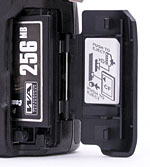
C-5060 Wide Zoom saves images on either CompactFlash Type I or II cards,
or xD-Picture Cards. The memory card compartment offers slots accommodating
both card types. A 32MB xD-Picture Card comes with the camera, and upgrades
are currently (November, 2003) available as large as 512MB size. The
CF / xD button on the camera's rear panel selects which memory card to use,
and an option on the camera's playback menu lets you copy images between
cards. The C-5060 Wide Zoom does offer individual image protection via the
Metering / Protect button, but as usual this doesn't protect against erasure
due to card reformatting. It must also be noted that the camera's Panorama
function is only available when an Olympus-brand xD-Picture Card is in use,
a policy that I've long questioned the wisdom of.
The
C-5060 Wide Zoom saves images on either CompactFlash Type I or II cards,
or xD-Picture Cards. The memory card compartment offers slots accommodating
both card types. A 32MB xD-Picture Card comes with the camera, and upgrades
are currently (November, 2003) available as large as 512MB size. The
CF / xD button on the camera's rear panel selects which memory card to use,
and an option on the camera's playback menu lets you copy images between
cards. The C-5060 Wide Zoom does offer individual image protection via the
Metering / Protect button, but as usual this doesn't protect against erasure
due to card reformatting. It must also be noted that the camera's Panorama
function is only available when an Olympus-brand xD-Picture Card is in use,
a policy that I've long questioned the wisdom of.
The C-5060 Wide Zoom can store images in RAW, uncompressed TIFF, and compressed JPEG file formats. The TIFF setting can be assigned to any one of seven resolutions through the camera's Mode Setup menu. JPEG compression levels include Super High Quality (SHQ), High Quality (HQ), and Standard Quality (SQ1 & SQ2). The myriad size options can be assigned to the camera's TIFF, SHQ, HQ, SQ1, and SQ2 quality levels via the Shooting menu, as shown in the table below. (Green table cells indicate image size options that can be assigned to each named quality setting.) Whatever image size/quality options are assigned to the five named quality settings can be quickly selected either by the "shortcut button" (see the earlier description of the user interface) or via the record setup menu. RAW format is only available for full-resolution images.
| Size Options | (Interpolated) | | | | | | | |
| | | | | | | | | |
| | | | ||||||
| | | | ||||||
| | | | | |||||
| | | | |
The table below shows all the available size/quality options (there ought to be enough here to satisfy anyone), the number of each that can be stored on the included 32MB memory card, and the amount of image compression employed for each.
| Resolution/Quality 32MB Memory Card |
RAW | (TIFF) |
|
|
|
| Enlarge
Size 3,264 x 2,448 |
Images (Avg size) |
- | - | 7 5,333KB |
15 2,000KB |
| Approx. Compression |
- | - | 5:1 | 12:1 | |
| Full Resolution 2,592 x 1,944 |
Images (Avg size) |
4 7.6MB |
2 15.1MB |
8 4,000KB |
25 1,231KB |
| Approx. Compression |
2:1 | 1:1 | 4:1 | 12:1 | |
| 2,288
x 1,712 pixels |
Images (Avg size) |
- | 2 11.8MB |
5 2,909KB |
16 1,000KB |
| Approx. Compression |
- | 1:1 | 2:1 | 6:1 | |
| 2,048
x 1,536 pixels |
Images (Avg size) |
- | 3 9.4MB |
12 2,286KB |
31 800KB |
| Approx. Compression |
- | 1:1 | 4:1 | 9:1 | |
| 1,600
x 1,200 pixels |
Images (Avg size) |
- | 5 5.8MB |
14 1,455KB |
39 500KB |
| Approx. Compression |
- | 1:1 | 2.5:1 | 7:1 | |
| 1,280
x 960 pixels |
Images (Avg size) |
- | 3.7MB |
941KB |
323KB |
| Approx. Compression |
- | |
|
|
|
| pixels |
Images (Avg size) |
- | 2.7MB |
604KB |
209KB |
| Approx. Compression |
- | |
|
|
|
| pixels |
Images (Avg size) |
- | 0.9MB |
242KB |
97KB |
| Approx. Compression |
- | |
|
|
|
The C-5060 Wide Zoom comes with interface software and cables for both Macintosh and Windows computers. It employs a USB Auto-Connect interface for high-speed computer connection. Like all of Olympus' recent digicams, the C-5060 is a USB "storage class" device. This means it can connect directly to Mac OS Version 9.0 or later (including OS 10.1 - also OS8.6, if it includes factory-installed USB Mass Storage support 1.3.5), or Windows ME, 2000, or XP computers, without separate driver software. For Windows 98 or 98SE, you'll need to load driver software to make the connection. Storage-class ("Auto-Connect" in Olympus' parlance) connections are generally faster than device-class ones, and the 5060 Wide Zoom is among the fastest cameras I've yet tested. I clocked it at 626 KBytes/second on my 15" Mac PowerBook G4 (2003 model), running Mac OS 10.2.6, and at 704 KB/s on my 2.4 GHz Sony VAIO desktop, running Windows XP. This is about as fast as v1.1 USB cameras get, but the very large files the 5060 can produce might lead you to purchase a USB 2.0 or Firewire-connected card reader.
 RAW
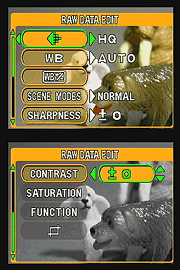
data files can be edited in-camera and saved as JPEGs. This is convenient
for quick processing, but the small size and uncertain tonal and color characteristics
of the 5060's LCD screen make it difficult to judge the impact of any image
adjustments you might make. Still, you can adjust white balance, sharpness,
saturation, etc. in-camera, without having to download the file first, which
makes it easier to print RAW files from the camera to a DPOF device.
RAW
data files can be edited in-camera and saved as JPEGs. This is convenient
for quick processing, but the small size and uncertain tonal and color characteristics
of the 5060's LCD screen make it difficult to judge the impact of any image
adjustments you might make. Still, you can adjust white balance, sharpness,
saturation, etc. in-camera, without having to download the file first, which
makes it easier to print RAW files from the camera to a DPOF device.


Follow Imaging Resource: