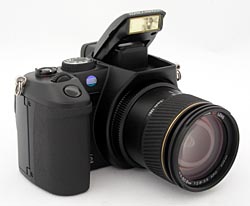
Konica Minolta DiMAGE A200Konica Minolta trims a little and adds a little relative to their top-end A2 model, delivering a strong contender in the 8-megapixel derby.(Next): Comparison with other DiMAGE cameras>> Page 1:Intro and HighlightsReview First Posted: 12/22/2004 |
 |
|
8.0-megapixel CCD delivers uninterpolated
images as large as 3,264 x 2,448 pixels. |
| |
Sharp 7x optical zoom lens covers a 28-200mm
equivalent focus range. |
|
| * | Integrated anti-shake system greatly extends usefulness of long zoom lens in lower light. | |
| |
Vari-angle LCD monitor swivels
270 degrees to face almost any shooting angle. |
EZ Print Link
Readers have requested free-formatted versions of my reviews (without the graphical accouterments of our page design), to make printing easier. I'm accommodating this request with special copies of each review, formatted to allow the text flow to be dictated by the browser window. Click here for a print-optimized page.
Introduction - The Konica Minolta DiMAGE A200
| Free Photo Lessons | |
|
Konica Minolta A200 Highlights
Article: Digital SLR or All-in-one Digicam?
By Shawn Barnett
With the price of digital SLRs finally within reach, should you stick with the All-in-one digicam or move up to an SLR? Why buy a high-end digicam when digital SLRs are so close in price? Do digicams still have a purpose? What are the pros and cons? An avid photographer, I spent some time thinking about that myself. Come see what I discovered about digital SLRs versus all-in-one digicams.
By Shawn Barnett
With the price of digital SLRs finally within reach, should you stick with the All-in-one digicam or move up to an SLR? Why buy a high-end digicam when digital SLRs are so close in price? Do digicams still have a purpose? What are the pros and cons? An avid photographer, I spent some time thinking about that myself. Come see what I discovered about digital SLRs versus all-in-one digicams.
- True 8.0-megapixel CCD delivering resolutions as high as 3,264 x 2,448 pixels.
- 12-Bit A/D conversion.
- Digital electronic viewfinder with 0.44-inch, high-resolution, internal QVGA display.
- 1.8-inch TFT color LCD monitor that swivels 270 degrees.
- 7.2-50.8mm lens (equivalent to a 28-200mm lens on a 35mm camera) with a maximum aperture of f/2.8 to f/3.5, depending on the zoom setting, and a manual zoom ring.
- Included lens hood.
- 2x digital zoom or 4x interpolated digital zoom options.
- Auto and Manual focus with focus magnification, and 11-point AF.
- Macro option at either telephoto or maximum wide angle zoom settings.
- Auto, Program AE, Aperture Priority, Shutter Priority, Manual, and four Digital Subject Program shooting modes.
- Shutter speeds from 1/3,200 to 30 seconds (1/1,600 to 30 in Shutter and Manual Modes), with Bulb setting for manual control of long exposures (up to 30 seconds).
- 256-segment Multi-Segment, Center-Weighted, and Spot metering options, with AE Lock function and Auto Exposure Bracketing.
- Adjustable ISO with five settings (Auto, 50, 100, 200, 400, 800).
- Built-in, pop-up flash with five operating modes and manually adjustable intensity.
- External flash hot-shoe for Konica Minolta accessory flash units.
- Standard, High Speed, and Ultra High Speed Continuous Advance modes, plus Movie and Night Movie shooting modes.
- Two- and 10-second Self-Timer modes.
- Color Saturation, Contrast Compensation, and Hue (color filter) adjustments.
- Adjustable White Balance with nine modes, including a manual setting and bracketing option.
- Sharpness and Color control via menu options. Color modes include Natural (sRGB), Vivid Color (sRGB), Black & White, Adobe RGB with embedded color profile, and Portrait (sRGB).
- RAW and JPEG file formats.
- Images saved on CompactFlash Type I or II memory cards, Microdrive compatible. SD/MMC cards can also be used with the CF1 adapter.
- USB cable and interface software for connecting to a computer and downloading images.
- NTSC or PAL selectable video output signal, with cable included.
- Power supplied by a single high-capacity lithium-ion battery pack or separate AC adapter (available as an accessory).
- Included wireless remote control.
- DPOF (Digital Print Order Format) and PictBridge compliant.


Follow Imaging Resource: