Olympus Stylus 1000 Exposure
Color
Saturation & Hue Accuracy
Oversaturated reds and magentas, undersaturated yellows. Fairly accurate hue, except in yellows and blues.
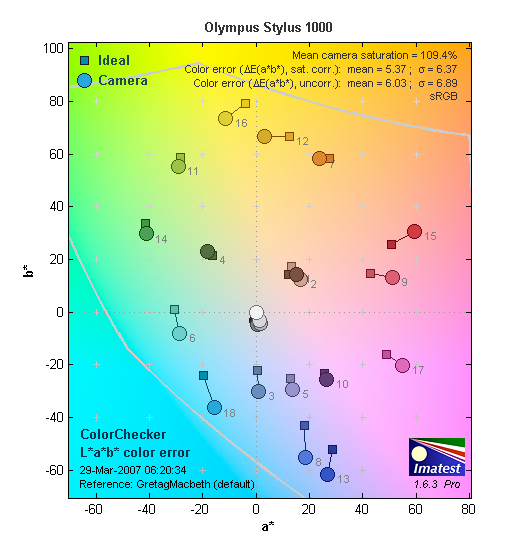 |
| In the diagram above, the squares show the original color, and the circles show the color that the camera captured. More saturated colors are located towards the periphery of the graph. Hue changes as you travel around the center. Thus, hue-accurate, highly saturated colors appear as lines radiating from the center. |
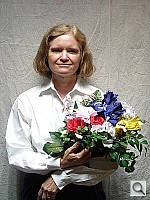
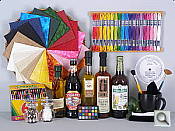
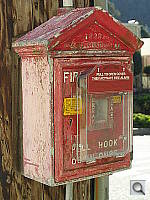
Most consumer digital cameras produce color that's more highly saturated (more intense) than found in the original subjects. This is simply because most people like their color a bit brighter than life. The Olympus Stylus 1000 does oversaturate the strong red and blue tones slightly, but undersaturates bright yellows. Greens, browns and purples are fairly accurate, though they can appear undersaturated compared to blues and reds. We found the Stylus 1000's color pleasing on a wide range of typical subjects though. Where oversaturation is most problematic is on Caucasian skin tones, as it's very easy for these "memory colors" to be seen as too bright, too pink, too yellow, etc. Here, the Stylus 1000 performed well, with only slight warmth.
The other important part of color rendition is hue accuracy. Hue is "what color" the color is. The Stylus 1000 actually rendered skin tones a little on the pale side, without any strong pink or warm casts.
 |
 |
 |
Sensor
Exposure and White Balance
Indoors, incandescent lighting
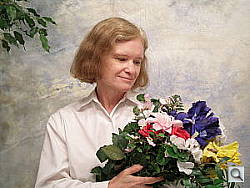
Warm casts with both Auto and Incandescent white balance settings. About average exposure compensation required.
 |
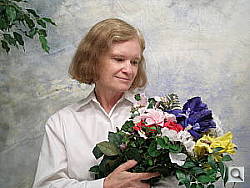 |
| Auto White Balance +1.0 EV | Incandescent WB +1.0 EV |
The Stylus 1000's Auto white balance mode produced very warm results (almost a sepia tone), but the Incandescent setting actually produced very nice color overall. Exposure accuracy was about average, with the camera requiring a +1.0 EV exposure compensation boost to get bright results. (About what most cameras we test need on this shot.) Colors are a little dark, resulting in a dark, purplish tint on the otherwise bright blue flowers. (A very common outcome for this shot.) Our test lighting for this shot is a mixture of 60 and 100 watt household incandescent bulb, a pretty yellow light source, but a very common one in typical home settings here in the U.S.
Outdoors, daylight
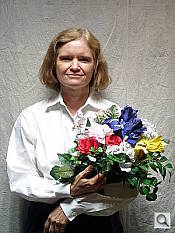
Slightly warm color balance, and slightly dark colors outdoors, but a bit better than average exposure accuracy.
 |
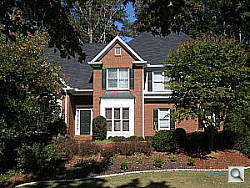 |
| Auto White Balance, +0.7 EV | Auto White Balance, Auto Exposure |
Outdoor shots showed better than average exposure accuracy, though with notably high contrast under harsh sunlight. Strong highlights tended to produce slight underexposures, as in the house shot above, with a limited midtone range, but exposure accuracy was still better than average when compared to many other consumer digicams. Overall color looked pretty good, with bright reds and blues that nonetheless didn't look too overdone.
See full set of test images with explanations
See thumbnails of all test and gallery images
Resolution
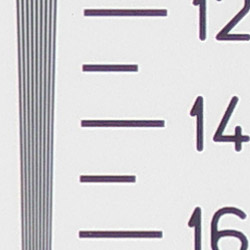
High resolution, 1,400 lines of strong detail.
 |
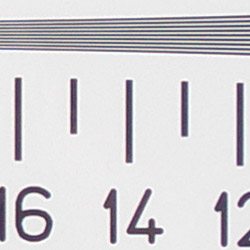 |
| Strong detail to 1,400 lines horizontal | Strong detail to 1,400 lines vertical |
Our laboratory resolution chart revealed sharp, distinct line patterns down to about 1,400 lines per picture height, with extinction beyond the range of our target. (The camera produced slight color artifacts at lower line frequencies though, visible in the full-sized res target shots.) Use these numbers to compare with other cameras of similar resolution, or use them to see just what higher resolution can mean in terms of potential detail.
See full set of test images with explanations
See thumbnails of all test and gallery images
Sharpness & Detail
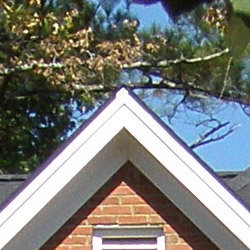
Fairly sharp images overall, though a moderate amount of edge-enhancement in high contrast shots and some noise suppression in the shadows.
 |
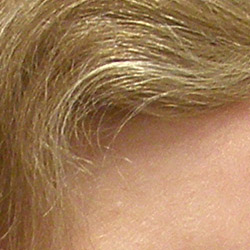 |
| Moderate definition of high-contrast elements, over-sharpening and edge-enhancement visible. | Subtle detail: Hair Noise suppression tends to blur detail in areas of subtle contrast, as in the darker parts of Marti's hair here. |
The Olympus 1000's images are fairly sharp overall, with edge-enhancemment artifacts only visible in areas of particularly strong contrast: Notice the slightly lighter "halo" in the sky where it meets the dark line at the edge of the roof in the crop above. (Edge enhancement creates the illusion of sharpness by enhancing colors and tones right at the edge of a rapid transition in color or tone.)
Noise-suppression systems in digital cameras tend to flatten-out detail in areas of subtle contrast. The effects can often be seen in shots of human hair, where the individual strands are lost and an almost "watercolor" look appears. The crop at far right shows this somewhat, with darker areas of Marti's hair showing limited, blurry detail, though individual strands are visible where a lighted strand passes in front of a darker shadow area. On balance, the OS1000 shows less detail loss to noise reduction at low ISO settings than average, but more at high ISOs.
ISO & Noise Performance
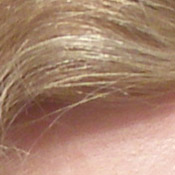
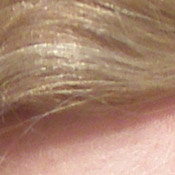
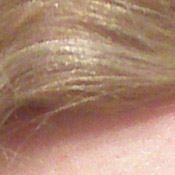
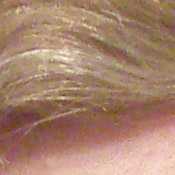
Moderate noise at the normal sensitivity settings, very high noise that blurs detail at the higher settings.
 |
 |
 |
| ISO 64 | ISO 100 | ISO 200 |
 |
 |
 |
| ISO 400 | ISO 800 | ISO 1,600 |
 |
 |
|
| ISO 3,200 | ISO 6,400 |
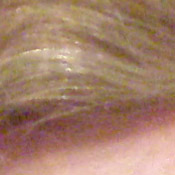
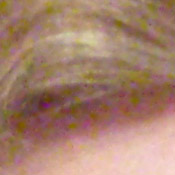
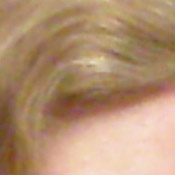
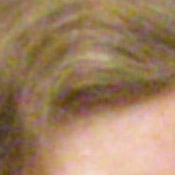
The 1000's lower ISO settings produced moderate noise, though with moderate blurring in the dark areas. As with all cameras, film or digital, the ISO setting increases, so does the noise level and the amount of blurring that results. Images at ISO 400 are soft but perhaps usable for wall display at 8x10 inches. At ISOs 800 and above, the images are very blurry, with stronger and brighter noise artifacts. ISO 800 to 1,600 shots are only usable for 4x6 inch snapshot prints, and 3,200 and 6,400 shots are unusable unless you sharpen heavily and only intend to use them at 340x480 in a Web (72dpi) application.
Extremes: Sunlit and low light tests
High resolution with good overall detail, but high contrast limits both highlight and shadow detail. Limited low-light capabilities, but sensitive enough to capture bright images under typical city street lighting.
 |
|
 |
| +0.3 EV | +0.7 EV | +1.0 EV |
Sunlight:
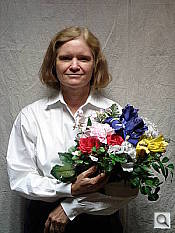
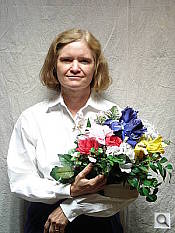
Because digital cameras are more like slide film than negative film (in that they tend to have a more limited tonal range), we test them in the harshest situations to see how they handle scenes with bright highlights and dark shadows, as well as what kind of sensitivity they have in low light. The shot above is designed to mimic the very harsh, contrasty effect of direct noonday sunlight, a very tough challenge for most digital cameras. (You can read details of this test here.)
The Stylus 1000 had a hard time with the deliberately harsh lighting in the test above. Shadow detail is actually not bad, though, but noise suppression is visible, as is heavy chroma noise. Skin tones don't come into acceptable range until the shirt and skin highlights blow out, as in the +0.7EV shot. But they're still blown out in the +0.3 shot, yet the skin tones are too dark. The camera required a slightly less than average amount of positive compensation at +0.7 EV to get the skin tones into balance, but it's still a rough compromise to choose between realistic skin tones and glowing clothes. (In "real life" though, be sure to use fill flash in situations like the one shown above; it's better to shoot in the shade when possible.)
| 1 fc 11 lux |
1/2 fc 5.5 lux |
1/4 fc 2.7 lux |
1/8 fc 1.3 lux |
1/16 fc 0.67 lux |
|
|---|---|---|---|---|---|
| ISO 64 |
 0.5 sec f2.8 |
 0.5 sec f2.8 |
 0.5 sec f2.8 |
 0.5 sec f2.8 |
 0.5 sec f2.8 |
| ISO 100 |
 0.5 sec f2.8 |
 0.5 sec f2.8 |
 0.5 sec f2.8 |
 0.5 sec f2.8 |
 0.5 sec f2.8 |
| ISO 200 |
 0.5 sec f2.8 |
 0.5 sec f2.8 |
 0.5 sec f2.8 |
 0.5 sec f2.8 |
 0.5 sec f2.8 |
| ISO 400 |
 0.5 sec f2.8 |
 0.5 sec f2.8 |
 0.5 sec f2.8 |
 0.5 sec f2.8 |
 0.5 sec f2.8 |
| ISO 800 |
 0.3 sec f2.8 |
 0.5 sec f2.8 |
 0.5 sec f2.8 |
 0.5 sec f2.8 |
 0.5 sec f2.8 |
| ISO 1600 |
 1/6 sec f2.8 |
 0.3 sec f2.8 |
 0.5 sec f2.8 |
 0.5 sec f2.8 |
 0.5 sec f2.8 |
| ISO 3200 |
 1/13 sec f2.8 |
 1/6 sec f2.8 |
 0.3 sec f2.8 |
 0.5 sec f2.8 |
 0.5 sec f2.8 |
| ISO 6400 |
 1/30 sec f2.8 |
 1/15 sec f2.8 |
 1/8 sec f2.8 |
 1/4 sec f2.8 |
 0.5 sec f2.8 |
| ISO 100 NS |
 1.3 sec f2.8 |
 2.5 sec f2.8 |
|||
| ISO 125 NS |
 4 sec f2.8 |
||||
| ISO 250 NS |
 4 sec f2.8 |
 4 sec f2.8 |
Low light:
The Olympus 1000 had limited low-light shooting capabilities. To shoot under average city street-lighting at night (about one foot-candle), you'll have to use ISO 400. The Stylus 1000's autofocus system was however able to focus down to the lowest level we test at (1/16 foot-candle) unassisted. Do keep in mind though, that the longer shutter times necessary here demand the use of a tripod or other camera support to get sharp photos. (A useful trick is to just prop the camera on a convenient surface, and use its self-timer to release the shutter. This avoids any jiggling from your finger pressing the shutter button, and can work quite well when you don't have a tripod handy.)
Flash
Coverage and Range
A fairly weak flash with a limited range. The camera underexposed our standard shots slightly, and exposure compensation had no effect on flash exposure.
 |
 |
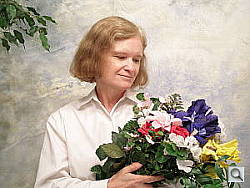
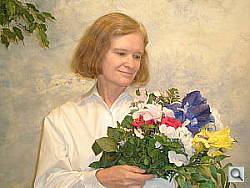
| 35mm equivalent | 105mm equivalent |
 |
 |
| Normal Flash +1.3 EV |
Night Portrait Flash +1.3 EV |
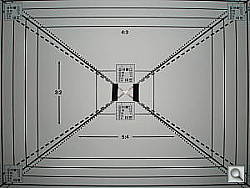
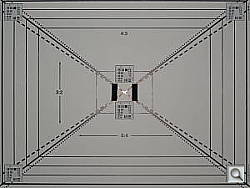
Flash coverage was somewhat uneven at wide angle, and dim though more uniform at telephoto. In the Indoor test, the flash underexposed our subject at its default setting slightly, and the exposure compensation adjustment turned out to have no effect on flash exposure. The camera's Night Portrait mode produced slightly brighter and more even results, though with a much stronger orange cast from the room lighting. The best results here were achieved with a +1.3 EV exposure boost.
| Flash Range: Wide Angle | |||||
|---|---|---|---|---|---|
| 6 ft | 7 ft | 8 ft | 9 ft | 10 ft | 11 ft |
 1/30 sec f2.8 ISO 100 |
 1/30 sec f2.8 ISO 100 |
 1/30 sec f2.8 ISO 100 |
 1/30 sec f2.8 ISO 100 |
 1/30 sec f2.8 ISO 100 |
 1/30 sec f2.8 ISO 100 |
| 12 ft | 13 ft | 14 ft | 15 ft | 16 ft | |
 1/30 sec f2.8 ISO 100 |
 1/30 sec f2.8 ISO 100 |
 1/30 sec f2.8 ISO 100 |
 1/30 sec f2.8 ISO 100 |
 1/30 sec f2.8 ISO 100 |
|
| Flash Range: Telephoto | |||||
|---|---|---|---|---|---|
| 6 ft | 7 ft | 8 ft | 9 ft | 10 ft | 11 ft |
 1/125 sec f4.7 ISO 100 |
 1/125 sec f4.7 ISO 100 |
 1/125 sec f4.7 ISO 100 |
 1/125 sec f4.7 ISO 100 |
 1/125 sec f4.7 ISO 100 |
 1/125 sec f4.7 ISO 100 |
| 12 ft | 13 ft | 14 ft | 15 ft | 16 ft | |
 1/125 sec f4.7 ISO 100 |
 1/125 sec f4.7 ISO 100 |
 1/125 sec f4.7 ISO 100 |
 1/125 sec f4.7 ISO 100 |
 1/125 sec f4.7 ISO 100 |
|
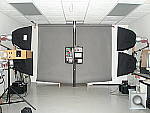
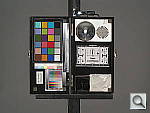
At wide angle, the on-camera flash illuminated the DaveBox well out to nine feet before falling off. Quite a different story at telephoto, where it couldn't illuminate the DaveBox adequately at even six feet.
| Manufacturer-Specified Flash Range | |
|---|---|
| Wide Angle | Telephoto |
 17.1 feet Auto ISO 320 |
 10.5 feet Auto ISO 200 |
Our standard test method for flash range uses a fixed setting of ISO 100, to provide a fair basis of comparison between cameras. We now also capture two shots using the manufacturer-specified camera settings, at the range the company claims for the camera, to assess the validity of the specific claims. In the shots above, the Stylus 1000 actually overexposes our target, blowing out the whites at wide angle with its ISO automatically set to 320. At telephoto, the Olympus Stylus 1000 underexposes the target, raising the ISO to only 200. Obviously, it would have been better for the camera to reverse its ISO decisions. We can only hope that it will respond differently depending on the target.
Output Quality
Print Quality
Good print quality, great color, crisp prints at 8x10 inches, usable ones at 11x14. ISO 800 images are soft and noisy at 8x10 inches, acceptable at 5x7, great at 4x6. Higher ISOs are not even suitable for 4x6 inch snapshot prints.
Testing hundreds of digital cameras, we've found that you can only tell just so much about a camera's image quality by viewing its images on-screen. Ultimately, there's no substitute for printing a lot of images and examining them closely. For this reason, we now routinely print sample images from the cameras we test on our Canon i9900 studio printer, and on the Canon iP5000 here in the office. (See the Canon i9900 review for details on that model.)
The Stylus 1000 produced crisp prints at 8x10 inches, and somewhat softer but still acceptable ones at 11x14. Though it's a 10 megapixel camera, this is really about 6-megapixel performance. ISO 400 shots were noisy but acceptable at 8x10. ISO 800 images were soft and noisy when printed at 8x10 inches, acceptable at 5x7 and great at 4x6. ISO 1,600 shots and above were so noisy that we question their inclusion on the camera. Even in small 4x6 inch snapshot-sized prints, ISO 3,200 and 6,400 shot were downright blurry.
Color-wise, the Stylus 1000 did pretty well, with bright but natural-looking color and good-looking skin tones across the ISO range.
The images above were taken from our standardized test shots. For a collection of more pictorial photos, see our Olympus Stylus 1000 Photo Gallery .
Not sure which camera to buy? Let your eyes be the ultimate judge! Visit our Comparometer(tm) to compare images from the Olympus Stylus 1000 with those from other cameras you may be considering. The proof is in the pictures, so let your own eyes decide which you like best!
 Fujifilm GFX 50S Review
 Fujifilm X-T3 Review
 Olympus E-M5 III Review


Follow Imaging Resource