Canon XSi Flash
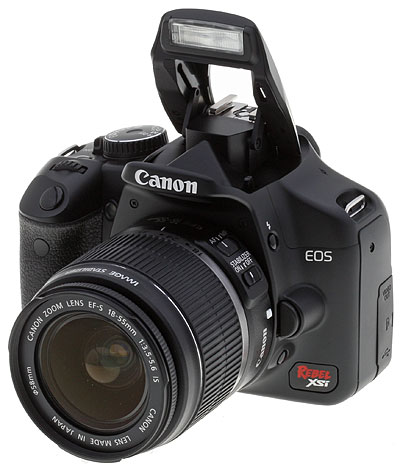
The Rebel XSi's built-in flash has a guide number rating of 43 feet (13 meters) at ISO 100, translating to a range of about 15 feet at ISO 100 with an f/2.8 lens. (Reasonably powerful, but not dramatically so.) The Canon Rebel XSi gives you a great deal of control over flash exposure, allowing you to adjust flash and ambient exposure independently of each other, in one-half or one-third EV increments. This makes it very easy to balance flash and ambient lighting for more natural-looking pictures. The Rebel XSi also uses E-TTL II control for both the built-in and compatible external flashes (according to Canon this includes the older 550EX flash, as well as the newer 580EX and 580EX II), a standard that promises, and seems to deliver, better, more balanced exposures. A Custom Function used to disable E-TTL II, but that's missing from the Rebel XSi. Instead, you select between E-TTL II Evaluative and Average modes.
Another nice touch is the Flash Exposure Lock button, which fires the flash under manual control before the actual exposure, to determine the proper exposure setting. This struck me as very handy, akin to the more conventional autoexposure lock function for handling difficult ambient lighting conditions. A Flash Exposure Compensation feature controls the flash exposure +/- 2 stops in 1/2 or 1/3-stop increments.
Several of the more impressive features of the Canon flash system depend on the dedicated 430EX II, 580EX, and 580EX II Speedlites. Among these are true FP (focal plane, referred to as HS) flash sync, flash exposure bracketing with external flash units, flash modeling, and E-TTL II exposure control. FP sync requires a flash unit to provide uniform light output for a relatively long period of time, long enough for the focal plane shutter curtain to fully traverse the sensor plane. On the Canon Rebel XSi, this requires a flash duration of 1/200-second. Uniform, long-duration flash pulses like this permit use of shutter speeds as high as the 1/4,000-second maximum that the Canon Rebel XSi is capable of. This can be invaluable when you want to exclude ambient light from the exposure.
Flash
Coverage and Range
Good flash performance, with good intensity but rather uneven coverage at wide angle. About average positive exposure compensation required.
 |  |
| 18mm equivalent | 55mm equivalent |
 |  |
| Normal Flash, +1.0 EV | Slow-Sync Mode, +1.3 EV |
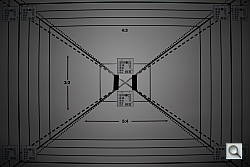
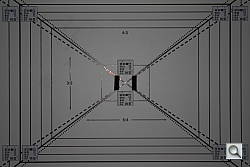
Coverage. Flash coverage was very uneven at wide angle, with falloff in the corners of the frame extending deep into the frame. Coverage at telephoto is more even. Indoors, under incandescent background lighting, the Canon XSi's flash performed quite well, requiring about average positive exposure compensation of +1.0 EV for a reasonably bright image. With the camera's slow-sync flash mode required a +1.3 EV boost, though the longer shutter time results in a warmer cast from the ambient background lighting.
| Flash Range: Wide Angle | |||||
|---|---|---|---|---|---|
| 6 ft | 7 ft | 8 ft | 9 ft | 10 ft | 11 ft |
 1/64 sec f3.6 ISO 100 |  1/64 sec f3.6 ISO 100 |  1/64 sec f3.6 ISO 100 |  1/64 sec f3.6 ISO 100 |  1/64 sec f3.6 ISO 100 |  1/64 sec f3.6 ISO 100 |
| 12 ft | 13 ft | 14 ft | 15 ft | 16 ft | |
 1/64 sec f3.6 ISO 100 |  1/64 sec f3.6 ISO 100 |  1/64 sec f3.6 ISO 100 |  1/64 sec f3.6 ISO 100 |  1/64 sec f3.6 ISO 100 | |
| Flash Range: Telephoto | |||||
|---|---|---|---|---|---|
| 6 ft | 7 ft | 8 ft | 9 ft | 10 ft | 11 ft |
 1/64 sec f5.7 ISO 100 |  1/64 sec f5.7 ISO 100 |  1/64 sec f5.7 ISO 100 |  1/64 sec f5.7 ISO 100 |  1/64 sec f5.7 ISO 100 |  1/64 sec f5.7 ISO 100 |
| 12 ft | 13 ft | 14 ft | 15 ft | 16 ft | |
 1/64 sec f5.7 ISO 100 |  1/64 sec f5.7 ISO 100 |  1/64 sec f5.7 ISO 100 |  1/64 sec f5.7 ISO 100 |  1/64 sec f5.7 ISO 100 | |
ISO 100 Range. The Canon XSi's flash was bright and powerful, with excellent intensity all the way to about 15 feet at ISO 100 at 18mm. The progression of intensity fall-off was slightly uneven, though, with 15 feet being brighter than 14 feet. At full telephoto, flash intensity started out a little dim, but didn't fall until about 9 feet at 55mm. In terms of range at the center, performance is good, but the results above show quite a bit of vignetting, so it's better to consider the Rebel XSi's flash for fill light; for greater flash coverage consider the 430EX or 430EX II external flash unit.
| Manufacturer-Specified Flash Range | |
|---|---|
| Wide Angle | Telephoto |
 12.3 feet ISO 100 |  7.7 feet ISO 100 |
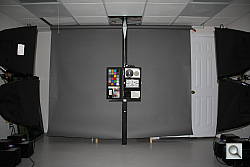
Manufacturer-Specified Flash Test. The Canon XSi's guide number is 13 meters in auto mode at ISO 100, which translates to about 12.3 feet at f/3.5 and 7.7 feet at f/5.6, the maximum apertures of the kit lens at full wide angle and telephoto respectively. In the shots above, the XSi seems to perform as well as Canon says it will, producing good exposures at the rated distances with its ISO set to 100.
Note: Our standard test method for flash range uses a fixed setting of ISO 100, to provide a fair basis of comparison between cameras. With the above test, we're also looking at whether their stated specification rings true.
 Fujifilm GFX 50S Review
 Fujifilm X-T3 Review
 Olympus E-M5 III Review


Follow Imaging Resource