 Back
to Full Olympus EVOLT E-500 Review
Back
to Full Olympus EVOLT E-500 ReviewGo to Olympus EVOLT E-500 Data Sheet
Go to Olympus EVOLT E-500 Pictures Page
Up to Imaging Resource Cameras Page
Use your browser's "Back" button to return to the previous page, or the links at the top and bottom of this page to navigate to related information. If you have difficulty fitting the text on this page onto your printer output, simply resize your browser window to a narrower width and print again.
Remember us when it's time to buy!
Dave here: Have our reviews been helpful to you? (Is this article you're reading right now useful?) Preparing this level of information on as many products as we do is incredibly hard work, not to mention expensive. Things on the Internet may look like they're free, but they're not. (As a lot of big dot.com companies are finding out these days.) Somewhere, somebody has to pay to produce worthwhile content. YOU can help us though, by remembering us when it comes time to make your purchase. Would you consider coming back to our site and clicking-through to one of our advertisers to make your purchase? Every dollar you spend with one of our advertisers helps us directly (in affiliate fees) or indirectly (the advertiser will keep renewing their ad contract with us). To make it easy for you to support us, here's a URL you can visit, to see all our current advertisers, with links to click on that will register your visit to them as having come from our site. It's up to you where you buy, but Mike, Mike, Kim, Yazmin, Marti and I would be really grateful if you'd help us out by choosing one of our advertisers to purchase from.
Thank you for your support!
Dave Etchells, Founder & Publisher
Visit our "Buy Now" Page:
https://www.imaging-resource.com/buynow.htm
Back
to Full Olympus EVOLT E-500 Review
Go to Olympus EVOLT E-500
Data Sheet
Go to Olympus EVOLT E-500
Pictures Page
Up to Imaging Resource Cameras
Page
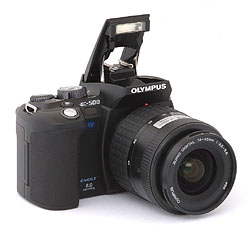
Olympus EVOLT E-5008.0 megapixels, ZUIKO DIGITAL lens mount, digital SLR design, and loads of features! Review First Posted: 09/25/2005, Updated: 12/05/2005 |
|
 |
|
8.0-megapixel resolution for 3,264 x 2,448 images. |
| |
Interchangeable lens mount fits full range of ZUIKO DIGITAL lenses. | |
| |
Larger 2.5-inch LCD monitor. | |
| |
Full range of manual and automatic exposure control. | |
| * | Accommodates both CompactFlash and xD-Picture Cards. | |
| |
Expanded exposure options for more flexibility. |
Manufacturer Overview
The Olympus EVOLT E-500 is the latest entry in a line of digital SLRs based on the "Four Thirds" standard developed jointly by Olympus and Kodak, first announced in fall of 2002. The first Four Thirds camera was the Olympus E-1 SLR, aimed at the professional market, and was followed up by the E-300, which brought the Four Thirds system down to a price range accessible to amateur and "enthusiast" shooters. The E-300 used the same lenses and sensor format as the original E-1, but offered an impressive eight-megapixel resolution, and shipped with a new ZUIKO DIGITAL 14-45mm lens.
Now, the EVOLT E-500 improves on its predecessor, offering the same eight-megapixel CCD, but expanding its exposure options to include more advanced bracketing and metering modes, a larger 2.5-inch LCD monitor, the ability to accept xD-Picture Cards, and a longer maximum exposure time. Many functions and features are the same as on the E-1 and E-300, including the unique "Supersonic Wave" filter that literally shakes dust off of the sensor's front filter, addressing a common problem with digital SLRs and the wide range of automatic and manual exposure modes. The new E-500 also comes in a dual lens kit package, featuring the ZUIKO DIGITAL 14-45mm and 40-150mm lenses. Read on for a full description of the Olympus E-500's features, operating modes, and a detailed analysis of its performance.
High Points
Comparison to the E-300
To help readers compare the EVOLT E-500 to its sibling the E-300, as well as the current entry-level competitors from other manufacturers, we've combined an in-depth comparison table:
| SLR Camera Comparison | ||||||||
Manufacturer |
Canon |
Canon |
Konica Minolta | Nikon |
Olympus |
Olympus | Pentax |
|
| Model |
EOS 300D Digital Rebel |
EOS 350D Digital Rebel XT |
Maxxum 5D | D50 |
EVOLT E-300 |
EVOLT E-500 | *ist DL |
|
| Imaging System |
Sensor Manufacturer | Canon | Canon | Sony | Sony | Kodak | Kodak | Sony |
| Sensor Type | CMOS | CMOS | CCD | CCD | CCD | CCD | CCD | |
| Color Filter Array | RGB | RGB | RGB | RGB | RGB | RGB | RGB | |
| Total Megapixels |
6.5 |
8.2 |
6.3 | 6.24 |
8.9 |
8.9 | 6.31 |
|
| Effective Megapixels | 6.3 | 8.0 | 6.1 | 6.1 | 8.15 | 8.15 | 6.1 | |
| Effective Sensor Size (mm) |
22.7 x 15.1 |
22.2 x 14.8 |
23.7 x 15.6 | 23.7 x 15.6 |
17.3 x 13.0 |
17.3 x 13.0 | 23.5 x 15.7 |
|
| Focal Length Multiplier (approx.) |
1.6x |
1.6x |
1.5x | 1.5x |
2.0x |
2.0x | 1.5x |
|
| Image Processor |
SLR-DIGIC |
DIGIC II |
CxProcess III | Not stated |
TruePic TURBO |
TruePic TURBO | Not stated |
|
| Viewfinder | Type |
Eye-level pentamirror |
Eye-level pentamirror |
Eye-level pentaprism | Eye-level pentamirror |
Eye-level Porro Mirror system |
Eye level Dach Penta Mirror | Eye-level pentaprism |
| Coverage |
95% |
95% |
95% | 95% |
94% |
95% | 96% |
|
| Magnification (-1 diopter with 50mm lens at infinity) |
0.8x |
0.8x |
0.83x | 0.75x |
1.0x |
0.9x | 0.85x |
|
| Eyepoint (mm) |
21 |
21 |
20 | 18 |
20 |
10 | Unknown |
|
| Dioptric Adjustment Range (diopters) |
-3.0 to +1.0 |
-3.0 to +1.0 |
-2.5 to +1.0 | -1.6 to +0.5 |
-3.0 to +1.0 |
-3.0 to +1.0 | -2.5 to +1.5 |
|
| Focusing Screen |
Fixed, all-matte screen |
Fixed, precision matte screen |
Spherical Acute Matte | B-type BriteView clear matte Mark V, with superimposed focus brackets |
Fixed (Matte with AF/Metering marks) |
Fixed | Natural-Bright-Matte II focusing screen |
|
| Viewfinder Info Display |
AF information (AF points, focus confirmation light), exposure information (shutter speed, aperture value, manual exposure, AE lock, exposure level), flash information (flash ready, red-eye reduction lamp on, high-speed sync, FE lock), shots remaining, CF card information |
AF information (AF points, focus confirmation light), exposure information (shutter speed, aperture value, manual exposure, AE lock, exposure level, AEB in progress, exposure warning), flash information (flash ready, red-eye reduction lamp on, high-speed sync, FE lock, flash exposure compensation), maximum burst, CF card information |
Wide focus frame, spot AF area, local focus areas, spot metering area, active focus point, flash compensation indicator, flash signal, high-speed sync indicator, wireless / remote flash indicator, AE lock indicator, focus signal, shutter-speed display, aperture display, EV scale, frames-remaining counter, camera-shake warning, anti-shake scale | AF information (AF points, focus confirmation, AF area mode, AE/AF lock indicator), exposure information (shutter speed, aperture value, manual exposure, AE/AF lock indicator, exposure level, flash exposure, exposure compensation indicator, pre-set white balance recording indicator), flash-ready indicator, shots remaining, battery level, PC mode indicator |
AF information (AF frame, focus confirmation), aperture value, shutter speed, exposure compensation amount, flash indicator, AE lock, white balance, metering mode, battery check, exposure mode, number of "storable sequential pictures" (not seen on prototype) |
AF frame, Shutter speed, Aperture value, AF confirmation mark, Flash, White balance, AE lock, Number of storable still pictures, Exposure compensation value indication, Metering mode, Battery check, Exposure mode, Record mode | (1) Flash information; (2) Picture mode (Standard, Portrait, Landscape, Macro, Action, Night scene portrait); (3) In-focus; (4) Shutter speed; (5) Aperture value; (6) Exposure compensation factor; (7) Manual white balance; (8) Manual focus; (9) Sensitivity warning;(10) Auto exposure lock signal; (11) AF.C (AF-continuous |
|
| Depth of Field Preview |
Enabled with depth-of-field preview button |
Enabled with depth-of-field preview button |
Enabled with depth-of-field preview button | Not available |
Enabled with depth-of-field preview button |
Enabled with depth-of-field preview button | Enabled with depth-of-field preview position on power switch |
|
| Recording System |
Recording Media / Quantity / Slot Type |
Type I or II CF card / Microdrive |
Type I or II CF card / Microdrive |
Type I or II CF card / Microdrive | Secure Digital card |
Type I or II CF card / Microdrive |
Type I or II CF card / Microdrive, xd-Picture Card | Secure Digital card |
| Compatible File System |
FAT 16 / FAT 32 |
FAT 16 / FAT 32 |
FAT 16 / FAT 32 | FAT 16 / FAT 32 |
FAT 16 / FAT 32 |
FAT 16 / FAT 32 | Unknown |
|
| Recording Formats |
RAW (CRW), JPEG |
RAW (CR2), JPEG |
RAW (MRW), JPEG | RAW (NEF), JPEG |
RAW (ORF), JPEG, TIFF |
RAW (ORF), JPEG, TIFF | RAW, JPEG, TIFF |
|
| Maximum Resolution |
3072 x 2048 |
3456 x 2304 |
3008 x 2000 | 3008 x 2000 |
3,264 x 2,448 |
3,264 x 2,448 | 3008 x 2008 |
|
| Reduced Resolutions (JPEG only) |
2048 x 1360; 1356 x 1024 |
2496 x 1664; 1728 x 1152 |
2256 x 1496; 1504 x 1000 | 2256 x 1496; 1504 x 1000 |
3,200 x 2,400; 2,560 x 1,920; 1,600 x 1,200; 1,280 x 960; 1,024 x 768; 640 x 480 |
3,200 x 2,400; 2,560 x 1,920; 1,600 x 1,200; 1,280 x 960; 1,024 x 768; 640 x 480 | 2400 x 1600; 1536 x 1024 |
|
| RAW + JPEG Recording |
Yes, Middle Fine JPEG only, embedded in RAW |
Yes, any resolution |
Yes, selectable JPEG resolution (fine compression only) | Yes, basic JPEG only |
Yes, Selectable JPEG resolution / compression |
RAW + JPEG | No |
|
| Color Space & White Balance |
User-Selectable Color Space |
Yes sRGB + Adobe RGB |
Yes sRGB + Adobe RGB |
Yes sRGB (eight variants) + Adobe RGB (two variants) |
Yes sRGB (two variants) + Adobe RGB |
Yes sRGB + Adobe RGB |
Yes sRGB + Adobe RGB |
Unknown |
| Processing Parameters (Contrast, Sharpness, Saturation, Color Tone) / # of Increments |
5 (Same as 10D, but new is default sets: one mimics 10D settings and one boosts contrast, saturation, and sharpening for snappier prints. This is the factory default setting) |
5 (Same as original Digital Rebel, but with the addition of a Black and White mode that includes tone and contrast adjustments.) |
8 | 6 options each for sharpness and contrast, 3 options for saturation. 7-step hue adjustment. Digital vari-programs preset various processing parameters as well, and color space III boosts saturation somewhat, particularly in greens. |
5 options each for sharpness, saturation, and contrast. Normal/Low/High-key Gradation adjustment |
5 options each for sharpness, saturation, and contrast. Normal/Low/High-key Gradation adjustment | Unknown |
|
| Preset WB settings |
6 (Daylight, Cloudy, Shade, Incandescent, Fluorescent, Flash) |
6 (Daylight, Cloudy, Shade, Incandescent, Fluorescent, Flash) |
6 (Daylight, Shade, Cloudy, Tungsten, Fluorescent, Flash) | 6 (Daylight, Cloudy, Shade, Incandescent, Fluorescent, Flash) |
14 (Auto, Custom, plus 12 Kelvin Temperature settings correlated with common light sources, such as incandescent, various types of fluorescent, etc.) |
9 (Auto, Custom, plus 7 Kelvin Temperature settings correlated with common light sources, such as incandescent, various types of fluorescent, etc.) | 10 (Auto, Daylight, Shade, Cloudy,Tungsten Light, Fluorescent Light [White, Daylight, Neutral], Flash, Manual) |
|
| Manual Color Temperature Setting Range |
None |
None |
2500 ~ 9900K in 100K increments | (No Kelvin option, but very broad Preset WB range) |
2,000 ~ 10,000K (16 settings, varying increments) |
3,000 - 7,000K | None |
|
| WB Adjustment Range |
±3 steps in 1-step increments 5 mireds per step |
±9 steps in 1-step increments 5 mireds per step |
±3 steps in 1-step increments Arbitrary step size (approx. 10 mireds per step in most modes) |
Not available |
±7 steps in 1-step increments, unknown step size |
±7 steps in 1-step increments, 2 mireds per step | Not available |
|
| Autofocus System |
Type |
TTL-CT-SIR with a CMOS sensor (TTL secondary image registration, phase detection) |
TTL-CT-SIR with a CMOS sensor (TTL secondary image registration, phase detection) |
TTL phase detection with CCD line sensors | TTL phase detection by Nikon Multi-CAM900 autofocus module |
TTL phase detection |
TTL phase detection | TTL phase-matching by SAFOX VIII |
| # of Focusing Points (Focusing Point Type) |
7 points (1 cross-type, 2 horizontal-type, 4 vertical-type) |
7 points (1 cross-type, 2 horizontal-type, 4 vertical-type) |
9 points, 8 lines with center cross-hair sensor | 5 points |
3 points |
3 points | 11 points |
|
| Superimposed Focus Point Display | Yes | Yes | Yes | Yes | Yes | Yes | Yes | |
| AF Working Range |
EV 0.5 ~ 18 (ISO 100) |
EV 0.5 ~ 18 |
EV-1 ~ EV18 (ISO 100) | EV -1 ~ 19 (ISO 100) |
EV 0 ~ 19 |
EV 0 ~ 19 (ISO 100) | EV1 to EV19 (ISO 200) |
|
| AF-assist Beam |
Yes, stroboscopic flash (Range: Approx. 4.0m / 13.1ft. at center, approx. 3.5m/11.5ft. off-center) Note: Only available when flash is enabled. |
Yes, stroboscopic flash (Range: Approx. 4.0m / 13.1ft. at center, approx. 3.5m/11.5ft. off-center) |
Yes, stroboscopic flash | Bright incandescent lamp, (Range approx. 3.0 m, 9.8 ft, depending on lens.) Not dependent on flash setting. |
With built-in flash unit, and on dedicated Olympus external flash units. Note: Only available when flash is enabled. |
With built-in flash unit, and on dedicated Olympus external flash units. Note: Only available when flash is enabled. | Unknown |
|
| Exposure Control |
Shooting Modes |
12 - Program AE (Full Auto, Portrait, Landscape, Close-up, Sports, Night Portrait, Flash Off, Program), shutter-priority AE, aperture-priority AE, depth-of-field AE, manual exposure, ETTL autoflash |
12 - Program AE (Full Auto, Portrait, Landscape, Close-up, Sports, Night Portrait, Flash Off, Program), shutter-priority AE, aperture-priority AE, depth-of-field AE, manual exposure, ETTL autoflash |
8 - Full Auto, Program, shutter-priority AE, aperture-priority AE, manual, Portrait, Sports Action, Landscape, Sunset, Night Portrait | 11 - Program, shutter-priority AE, aperture-priority AE, Manual, Auto, Portrait, Landcape, Close up, Sports, Child, Night Portrait. |
9 - Program, aperture-priority AE, shutter-priority AE, Manual, Portrait, Landcape, Close up, Sports, Night Landscape, plus:
14 Scene modes (Landscape, Landscape+Portrait, Night Scene, Night+Portrait, Fireworks, Sunset, Portrait, High Key, Macro, Documents, Museum, Sport, Beach & Snow, and Candle) |
7 - Auto, Program, aperture-priority AE, shutter-priority AE, Manual, Scene Program, Scene Select.
15 Scene modes (Portrait, Landscape, Landscape + Portrait, Night Scene, Night Scene + Portrait, Fireworks, Sunset, Macro, Sports, High-Key, Low-Key, Documents, Beach & Snow, Candle, and Children) |
6 - Auto, Programmed AE, Shutter-Priority AE, Aperture-Priority AE, Metered Manual, Bulb |
| Metering Zones |
35 |
35 |
14 | 420 |
Not stated |
49 | 16 |
|
| Metering Modes |
Evaluative (linked to any AF point), center weighted average (set automatically in manual mode), 9% partial |
Evaluative (linked to any AF point), center weighted average, 9% partial |
14-segment honeycomb-pattern metering, Center-weighted, Spot | 1) 3D color matrix metering with 420-segment RGB sensor. (2) Center-weighted: Weight of 75% given to 8mm dia. circle in center of frame. (3) Spot: Meters 2.3 mm dia. circle (about one percent of frame) centered on active focus area. |
Digital ESP (evaluative), center-weighted, spot |
Digital ESP (evaluative), center-weighted, 2% spot, highlight spot, shadow spot | Multi, Center-Weighted, and Spot |
|
| Metering System Working Range |
EV 1 ~ 20 |
EV 1 ~ 20 |
1) EV 1 ~ 20 (14-segment honeycomb-pattern or center-weighted metering) 2) EV 4 ~ 20 (spot metering) (ISO 100 equivalent, f/1.4 lens) |
1) EV 0 ~ 20 (3D color matrix or center-weighted metering) 2) EV 2 ~ 20 (spot metering) (ISO 100 equivalent, f/1.4 lens, 20°C/68°F) |
1) Digital ESP / Center Weighted Average; EV 1 ~ 20 2) Spot; EV 3 ~ 17 (50mm F2, ISO 100) |
1) Digital ESP / Center Weighted Average; EV 1 ~ 20 2) Spot; EV 3 ~ 17 (50mm F2, ISO 100) |
EV 1 ~ 21.5 |
|
| ISO Range / Extended |
100 ~ 1600 / -- |
100 ~ 1600 / -- |
100 ~ 3200 | 200 ~ 1600 / -- |
100 ~ 400 / 1600 |
100 ~ 400 / 1600 | 200 ~ 1600 / 3200 |
|
| Exposure Compensation |
+/- 2EV in 1/3EV increments |
+/- 2EV in 1/2 or 1/3EV increments |
+/- 2EV in 1/3EV increments | +/- 5EV in 1/2 or 1/3EV increments |
+/- 5EV in 1, 1/2 or 1/3EV increments |
+/- 5EV in 1, 1/2 or 1/3EV increments | ±2 EV in 1/2EV or 1/3EV increments |
|
| Automatic Exposure Bracketing |
+/- 2EV in 1/3EV increments |
+/- 2EV in 1/2 or 1/3EV increments |
3 shots, 1/3, or 2/3EV increments | 3 shots, 1/3, 1/2, 2/3 or 1 EV steps |
3 shots in +/- 1, 1/2, or 1/3 EV steps |
3 or 5 shots in +/- 1, 2/3, 1/2, or 1/3 EV steps | 3 shots in +/- 1/2, or 1/3 EV steps |
|
| Shutter Speeds, Frame Rate, Shutter Lag |
Shutter Type |
Mechanical, all speeds electronically controlled |
Mechanical, all speeds electronically controlled |
Mechanical | Combined mechanical and CCD electronic shutter |
Mechanical Focal Plane, electronically controlled |
Mechanical Focal Plane, electronically controlled | Mechanical Focal Plane, electronically controlled |
| Shutter Speed Range |
1/4000 ~ 30 sec. (1/3EV increments) and bulb |
1/4000 ~ 30 sec. (1/2 or 1/3EV increments) and bulb |
1/4000 ~ 30 sec. in steps of 1/3EV, bulb | 1/4000 ~ 30 sec. in steps of 1/3 or 1/2 EV, bulb |
1/4000 ~ 30 sec., 1/3, 1/2, 1EV step selectable, bulb |
1/4000 ~ 60 sec., bulb | 1/4000 ~ 30 sec. and bulb |
|
| Maximum Frames Per Second / Buffer depth |
2.5 fps / 4 frames |
3 fps / 14 frames |
3fps / 5 RAW frames | 2.47 fps / 16 frames |
2.58 fps / 4 frames |
2.58 fps / 4 frames | 2.8 fps (manufacturer spec) |
|
| Flash | Built-in Flash / Guide Number at ISO 100. |
Yes (13 meters / 43 feet) |
Yes (13 meters / 43 feet) |
Yes (12 meters / 39 feet) | Yes (11 meters / 36 feet) |
Yes (13 meters / 43 feet) |
Yes (13 meters / 43 feet) |
Yes (15.6 meters / 51 feet) @ ISO 200 |
| Max flash x-sync speed. (sec.) |
1/200 |
1/200 |
1/160 (anti-shake off) / 1/125 (anti-shake on) | 1/500 (!) |
1/180 |
1/180 |
1/180 |
|
| Flash Exposure Compensation |
No |
+/- 2EV in 1/2 or 1/3EV increments |
+/- 2EV in 1/3EV increments | -3 to +1 EV, 1/3 or 1/2 EV steps |
+/- 2 EV in each 1, 1/2, or 1/3 EV steps |
+/- 2 EV in each 1, 1/2, or 1/3 EV steps | -2 to +1 EV (1/2 EV steps) |
|
| Slow-sync flash |
1st curtain only |
1st or 2nd curtain |
1st or 2nd curtain | 1st or 2nd curtain |
1st or 2nd curtain |
1st or 2nd curtain | Unknown |
|
| PC Sync Terminal |
Hot shoe only |
Hot shoe only |
Hot shoe only | Hot shoe only |
Hot shoe only |
Hot shoe only | Hot shoe only |
|
| Playback System |
LCD Size / Pixel Count |
1.8 in. LCD / 118,000 pixels |
1.8 in. LCD / 115,000 pixels |
2.5 in LCD / 115,000 pixels | 2.0 in LCD / 130,000 pixels |
1.8 in LCD / 134,000 pixels |
2.5 in LCD / 215,250 pixels | 2.5 in. LCD / 210,000 pixels |
| Enlarged Playback / Scroll |
1.5~10x in 15 steps / Yes |
1.5~10x in 15 steps / Yes |
4.7x max / Yes | 1.1 - 4.7x in 10 steps / Yes |
2, 3, 4, 10x / Yes |
2, 3, 4, 6, 8, 10, 14x / Yes | Unknown |
|
| LCD Monitor Brightness Adjustment Range |
5 steps |
5 steps |
11 steps | 5 steps |
7 steps |
+ / - 7 steps | Unknown |
|
| Automatic Rotation for Vertical Shots |
Yes |
Yes |
Yes | Yes |
No |
Yes | Unknown |
|
| Other Features | Computer Connection |
Yes, PTP-compliant, USB v 1.1 |
Yes, USB 2.0, PTP-compliant |
Yes, USB 1.1 (PTP compliant) | Yes, PTP-compliant (v2.0 standard, v2.0 speed) |
Yes, PTP-compliant (v2.0 standard, v1.1 max speed) |
Yes, PTP-compliant (v2.0 standard, v1.1 max speed) | USB 2.0 High Speed (PTP compliance unknown) |
| Direct Printing (PictBridge compliant printers) |
Yes |
Yes |
Yes | Yes |
Yes |
Yes | Unknown |
|
| Menu Languages |
12 (English, German, French, Dutch, Danish, Finnish, Italian, Norwegian, Swedish, Spanish, Simplified Chinese, and Japanese.) |
15 (English, German, French, Dutch, Danish, Finnish, Italian, Norwegian, Swedish, Spanish, Simplified Chinese, Russian, Traditional Chinese, Korean,and Japanese.) |
11 (Japanese, English, German, French, Spanish, Italian, Swedish, Russian, Simplified Chinese, Traditional Chinese, Korean) | 13 (Japanese, German, English, Spanish, French, Portuguese, Russian, Korean, Italian, Traditional Chinese, Simplified Chinese, Dutch, Swedish) |
4 (English, German, Spanish, French). Add additional languages through Web |
7 (English, German, French, Spanish, Japanese, Chinese, and Korean) | Unknown |
|
| Camera Default Reset |
Yes |
Yes |
Yes | Yes |
Yes |
Yes | Unknown |
|
| Custom Functions (Quantity / Settings) |
No |
Yes (9 / 24) |
Yes (12 / 26) | Yes (6 / 20) |
No |
No | Unknown |
|
| Remote Control |
Optional, Compatible with Remote Switch RS-60E3, Remote Controller RC-5 / RC-1 |
Compatible with Remote Switch RS-60E3, Remote Controller RC-5 / RC-1 |
Optional, compatible with RC-1000S or RC-1000L | Optional IR |
Optional IR |
Optional RM-1 | Yes, details unknown |
|
| Info LCD Panel / Illumination |
Yes / Yes (dedicated button) |
Yes / Yes (dedicated button) |
No / n/a | Yes / No |
No / n/a |
No / n/a | Unknown |
|
| Ultrasonic CCD dust-removal function |
No |
No |
No | No |
Yes |
Yes | No |
|
| Body Structure | Body Cover / Chassis |
Largely Plastic, aluminum frame |
Largely plastic, aluminum frame |
Glass Fiber Plastic | Largely Plastic |
Metal Alloy |
Plastic | Largely plastic / Stainless Steel frame |
| Power System | Battery Compatibility |
Main: BP-511 / BP-512 Backup: CR2016 |
Main: NB-2LH Backup: CR2016 |
NP-400 | EN-EL3 CR2 pack is an added-cost accessory |
BLM-1 |
BLM-1 | 2 x CR-V3 or 4 x AA |
| Rated Shooting Capacity at 20C/68F |
100% AE: 600 50% Flash: 400 |
100% AE: 600 50% Flash: 400 |
CIPA standard: 550; Konica Minolta standard: 700 | 100% AE: 2000 50% Flash: 400 |
CIPA standard: 400 |
CIPA standard: 400 |
Unknown |
|
| Dimensions & Weight | Dimensions (WxHxD, mm) |
142 x 99 x 72.9 |
126.5 x 94 x 64 |
130.5 x 92.5 x 66.5 | 133 x 102 x 76 |
146 x 85 x 64 |
129 x 94.5 x 66 | 125 x 92.5 x 66 |
| Weight (body only) |
560 g |
485 g |
590 g | 540 g |
580g |
437g | 470 g |
|
| Operational Environment |
Operating Temperature Range |
0 ~ 40°C |
0 ~ 40°C |
0 ~ 40°C | 0 ~ 40°C |
0 ~ 40°C |
0 ~ 40°C | 0 ~ 40°C |
| Operating Humidity Range |
85% max. |
85% max. |
Not Stated | 85% max. |
30 - 90% |
30 - 90% | Not stated |
|
| Kit Lens | Focal length / aperture |
- |
- |
18-70mm f/3.5-5.6 AF |
18-55mm f/3.5-4.5G |
14 – 45mm f3.5 – f5.6 |
14 – 45mm f3.5 – f5.6 |
18-55mm f3.5 - f5.6 |
| Lens Compatibility | Lens Mount / Compatibility |
EF / All EOS lenses, plus EF-S lenses |
EF / All EOS lenses, plus EF-S lenses |
A-type / All A-type lenses except MD and MC series manual focus lenses. AF Macro 3x - 1x f/1.7-2.8 lens cannot be used with Anti-Shake, nor does Anti-Shake work with any lens with a macro release. |
|
Zuiko Digital, Four Thirds System Lens |
Zuiko Digital, Four Thirds System Lens | KAF / compatible with PENTAX KAF2-, KAF- and KA-mount lenses. Power zoom function not available. K-mount lenses usable with restrictions. S-mount lenses usable with adapter and restrictions. 67/645 lenses usable adapter and restrictions. |
User Report
by Shawn Barnett
It took only a few shots with the EVOLT E-500 for me to decide that this was a very different camera from the E-300 I reviewed late last year. Though the E-300 had a lot going for it, Olympus had simply tried too hard to make it different. This time they tried hard to make it work well in ways we're accustomed to, and the result is a digital SLR that I'd recommend to anyone. I have enjoyed shooting with it at least as much as my favorite digital SLR cameras, and that is saying something. (Very high praise indeed, considering the number of SLRs I've worked with in the last year or two.) The E-500 is going to make a lot of people very happy.
It was September, 2004 that Olympus announced their first SLR aimed at consumers, the EVOLT E-300. I was glad to see them back in the market with a consumer SLR, and I found that though it was an odd shape that remained difficult to accept, I liked quite a bit about the original EVOLT. It captured stunning images. Some of the images I captured with it are still hanging in my home and office. The original EVOLT E-300 had many unique features, some of which were useful. The pop-up flash could be used simultaneously with an external flash to serve as fill light. Most competing camera designs can't achieve this. But the E-300 was heavy and way off balance. Much of the weight seemed to be left of the lens, and the camera wanted to twist out of the right hand. There was also a critical metering flaw that we found, where a bright object at the center of the frame would trick even the normally excellent Olympus Digital ESP mode into underexposing the image. (For those unfamiliar with the term, Digital ESP takes readings from multiple areas of a frame to make its exposure decision and usually handles bright central objects well, without underexposing everything else; the common term is "matrix metering.")
The E-300 was frustrating. I loved the images, but not the design; and this metering problem made the camera difficult to trust (this has been addressed with a recent firmware fix). Further putting me off were all the claims the company was making about how much smaller the EVOLT was than competing designs. Technically, they were right, and their porroprism finder did flatten the top to enable that cool dual-flash trick. But the E-300 didn't seem smaller; and I've never had a problem with pentaprisms for all these years, so why were porroprisms better? It was a daring move, and no one was surprised that it was Olympus who took the chance. Other chances they've taken in the past have changed photography forever.
Though I am a long-time Olympus fan, I was ambivalent about the E-300. That's why I'm so pleased with the E-500. No more odd designs to overlook, no more unique optics for no apparent reason, no more long, heavy body that forces you into vertical shooting mode by virtue of its sheer weight. The E-500 is light and well-balanced.
True to Olympus tradition, the E-500 is smaller than most others, and tightly built. The Olympus E-500 feels like, looks like, and shoots like a nice camera. The only conclusion I can draw is that it is indeed a very nice camera.
Features
Just like the E-300, the Olympus E-500 has an 8 megapixel sensor, a Supersonic Wave Filter (SSWF) for sensor dust reduction, and access to what Olympus is calling the "largest digital lens lineup" among competing SLR systems. The list of new items includes a 2.5 inch HyperCrystal LCD, dual media card slots (xD and CF), an auto pop-up flash (the E-300's was manual), a 49 point ESP light meter, playback red-eye reduction, and a few more exposure and color options.
If you're interested in a detailed feature-by-feature comparison of the Olympus E500 with a number of its competitors, see the SLR comparison table.
Feel
Since I've said so much about the older E-300's feel, I should start with the E-500's. It has the most balanced feel of any digicam since the Nikon D70 hit the scene two years ago. This is the sort of quality you really can't describe; it has to be felt. It varies depending on the lens attached, of course, but with the 14-45mm kit lens attached, the Olympus E-500 is wonderful to hold and shoot. It weighs 1.86 pounds (846 grams) compared to the E-300's 2.06 pounds (936.8g) with a card, lens, and battery.
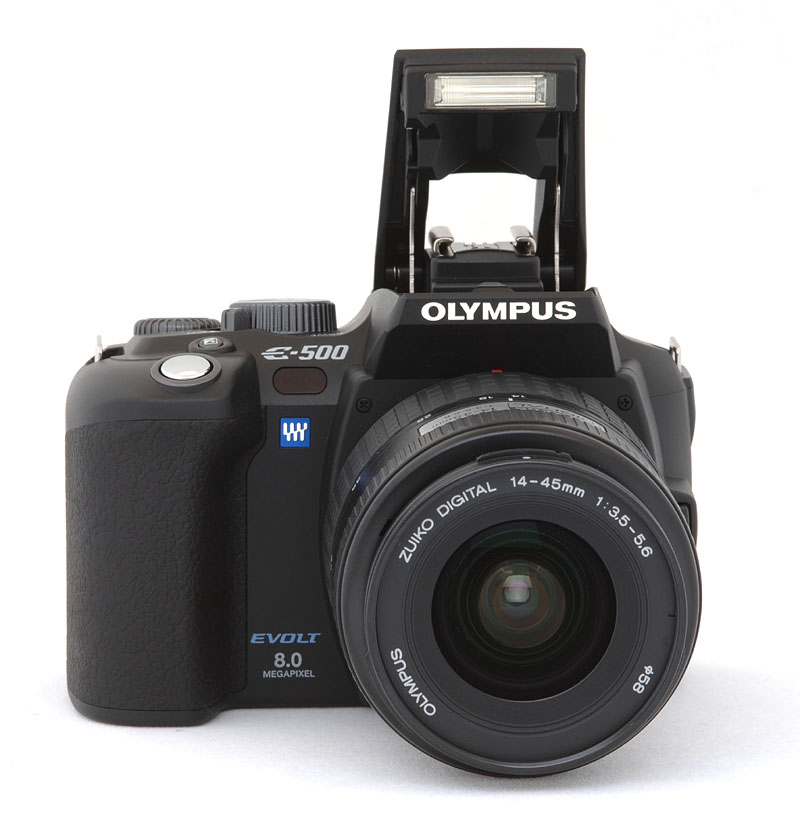
The grip isn't terribly deep, but it's wide enough that it offers a good long surface area to wrap your fingers around. The grip is nicely textured with a rubbery finish that is warm to the touch. Unlike the E-300, the Olympus E-500's grip is more conventionally cut, with a contoured trapezoidal shape, whereas the E-300 was a big round curve with a raised ridge for added traction. The butt of the grip rests perfectly in my palm, and the pads of all four fingers find a home on the inside of the grip, if only just.
My index finger rests perfectly on the shutter button, without having to twist and contort. I especially like how easy it is to reach the power switch with that same index finger while maintaining a right handed grip on the camera. This was well planned. This switch actuates much like the switch on the E-300 and the Canon Digital Rebel models, jutting out from underneath the mode dial, but it's far better placed on the Olympus E-500.
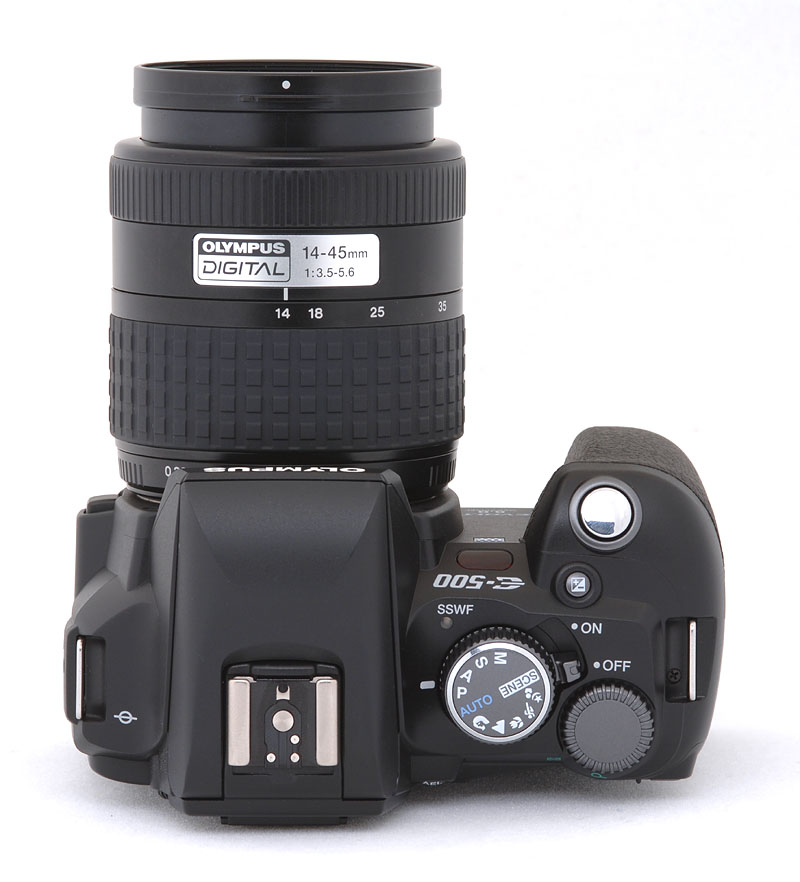
Only two dials grace the Olympus E-500 (with the exception of the diopter correction dial). The Mode dial has a look of quality, and the main command dial reminds me of the dial on the back of the EOS 20D: loose enough that its easy to turn, but sure in its detents.
The rest of the controls are buttons, and I have no complaints about their operation or placement. The traditional five left of the LCD serve the right purposes, operating the menu, flash, and playback functions. On the right is a five way nav cluster, an AE/AF Lock button, Drive mode button, AF button, and custom function button. The five way nav has dual functions, including White balance, AF, ISO, Metering mode, and OK button. On top, behind the shutter is the EV button On the front, Olympus has emulated the easier position of the lens release button as seen on competing cameras from Nikon and Canon, instead of the rather distant and small button found on the E-300. This new placement makes it a one-motion operation to press this button and begin rotating the lens.
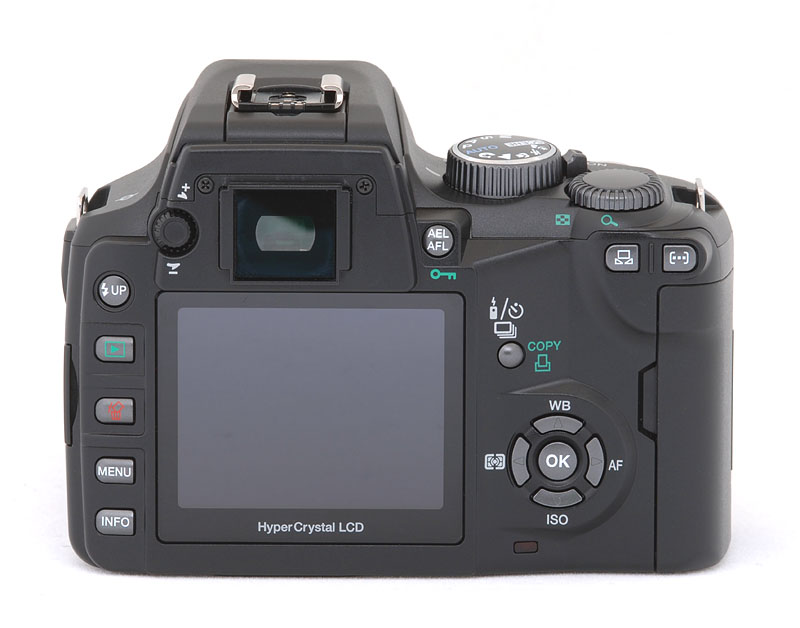
So the controls are pretty simple. Until you get to the menus. We recorded 276 menu screens on the Olympus E-500, so don't let the simple array of buttons make you think this is a camera with limited capability. Though I haven't explored every feature, I found the menu relatively navigable as Olympus menus go. More than normal, they've used full and sometimes multiple words to describe options, an excellent approach.
Getting back to the physical form of the Olympus E-500 for a moment, the door covering the dual-card slot is worth mention. It closes reasonably well with a plastic hook mechanism, and swings to lock open, much like the E-300's door. Competing models don't generally lock open, but I'd like to see it more often. Inside, the CF card releases with a button, while the xD card ejects with a push. Olympus's inclusion of xD card compatibility makes perfect sense, offering existing Olympus digicam owners the option of using their xD cards in their new digital SLR. Offering CF cards similarly allows E-300 and E-1 owners to continue using their existing stock of cards.
I was also happy to see an orange spring-loaded retaining hook holding the battery in place behind the battery door, so the expensive lithium ion battery doesn't fall free when the door is opened. Shock from a fall can very often kill a camera battery. This retention latch was missing from the E-300.
AF
With the major competition sporting between five and seven AF points at this price range, I was at first a little disappointed that the Olympus E-500 has only three. They're horizontally arranged, and the user can select any one of the three or let the camera choose to focus on the nearest object. One of the three AF dots lights red when an AF point is chosen and focus has been achieved. When shooting most multi-point digital SLRs, I actually lock them to the center point, so the E-500's lack of five to seven AF points is not a major loss.
Auto focus is reasonably fast, and though none of the performance numbers blew us away, they were respectable, and in actual shooting I saw little trouble missing a shot due to sluggishness on the camera's part. The one exception was in very low light, the kind of light only a higher-end camera is going to handle, the E-500 wasn't able to lock focus very well. I had my kids run around the living room after dark to see what the camera could do with the light of a single lamp/TV combination. Even with the camera's AF-assist, which takes the form of a pulsed flash, the camera had trouble picking them out. I tried the same experiment with a Canon EOS 20D, a $1,500 camera, and it locked focus very quickly. It's important to note, though, that the Canon Rebel XT performed about the same as the lower priced E-500 in the same test. Once I sat the kids down (not an easy prospect), the camera focused just fine.
While we're here in the viewfinder, I have to confess that I'm not crazy about the exposure information being clustered on the right side of the viewfinder window. It just seems unnatural to have to look that far off to the right to see what's going on with the camera; perhaps if the camera had a higher eyepoint, but I find myself pressing my glasses way up against the viewfinder to see what's going on.
LCD
When I first sat down to start shooting real life with the E-500, I naturally pointed the camera at my family. We sat around the table taking shots, both flash and natural light, and had a blast. Now, I'm always taking pictures of my family, and my son is always asking, "Me see!" after each shot, so they're pretty used to it; that's why it's notable that we all had so much fun with the Olympus E-500. I think the reason was that big LCD. It wasn't just the 2.5 inch size: colors were vibrant, contrast was excellent, and images were sharp. It was like we had little prints we could see right away, instead of a small, slightly washed out image like we're used to seeing from a great many cameras. It wasn't until after I got back to the promotional materials that I remembered how Olympus reps had boasted about the quality of this LCD. They're calling it a HyperCrystal LCD, and it appears to not only deliver a vibrant image around the breakfast table, with a 160 degree viewing angle, but it also performs well out in direct sunlight. We were impressed.
As I mentioned above, the E-300 had trouble in my testing when a white object was found in the center of the frame. I discovered this while test-shooting my daughter, who was wearing a white shirt under a denim jacket. When her hands were at her side, the shirt was mostly covered, and the camera exposed properly. When she put her hands on her hips, the shirt was more exposed, and the camera dramatically underexposed the image. I was simultaneously shooting with the only 8 megapixel camera we had at the time, the EOS 20D (the Rebel XT hadn't been announced yet), and it did not respond the same way. Olympus's Digital ESP metering mode was behaving more like spot metering mode, reading only the center and basing its exposure on the shirt.
The good news is that I have retested the E-500 with the same daughter in a new denim jacket and white shirt (she's grown in a year), and the E-500 performs far better, responding to the scene nearly identical to an EOS 20D. It's clear that while both cameras take the white shirt into account, they're not overwhelmed by it as was the E-300.
New modes
Much like an Olympus digicam, the EVOLT E-500 has a wide selection of Scene modes for common shooting situations. The Mode dial covers the basic Portrait, Landscape, Macro, Sports, and Night Portrait modes, but the Scene setting opens up even more. Landscape and Portrait, Children, High key, Low key, and Candle modes are among the interesting offerings that are not often seen on digital SLR cameras. Also missing from the E-300 but present on the E-500 are separate Full Auto and Program modes.
In addition to Black and White and Sepia, Olympus has added new filter and tint modes to the Black and White shooting option. Much as you can on the Rebel XT and EOS 20D, you can set modes that emulate color filters used in traditional film-based black and white photography, useful for darkening skies, for example. Filters include Yellow to darken skies, Orange to enhance sunset shots, Red to give dramatic contrast in skies, and Green to improve contrast in skin tones and foliage. Black and white images can also be tinted Blue, Purple, and Green.
Three color settings allow the user to select the type of color output they want, a common strategy among consumer SLR manufacturers. Film and digicam manufacturers have been amping the color on our images for so long that when a digital SLR comes along and gives us true color, we assume something's wrong; the color seems so dull. The human mind remembers colors more vividly than the eye sees them, so film companies like Kodak learned long ago to give our minds what they want. The E-500 does the same. The default setting is Vibrant, but you can set the camera to Natural and Muted if you like. Natural and Muted will be easier to modify later in programs like Photoshop, so experienced computer photo tweakers will want to use these settings, but consumers will probably be more happy with Vibrant mode.
Lenses
Olympus is proud of the fact that they have the largest selection of digital-specific lenses on the market, and four more have been added at the E-500's announcement. As I mentioned earlier in this review, Olympus often sets trends in photography, and they were apparently right when they said it would be better to deliver more light straight at the sensor instead of continuing to use existing 35mm lenses. Since Olympus's discussion of the topic, most manufacturers have come out with digital-specific lenses to better direct more of the light right to the sensor by tightening the image circle created by the lens.
While Olympus does indeed have more lenses, a great many of them are very expensive, built as they were for the professional using an Olympus E-1. Olympus now says they will have a total of 15 digital-specific Zuiko lenses available come late March 2006.
The kit lens is a 14-45mm, which is equivalent to a 28 - 90mm lens on a 35mm camera, due to the 2x multiplication factor that must be applied. Though they offer a lens that will take you out to a 14mm equivalent, it costs around $2,600, too much for consumers. Another option takes you out to 22mm equivalent (the 11-22mm f/2.8 Wide Zoom), but that's also around $950 SRP. For the record, wide angle is the biggest problem for modern consumer SLRs and is not unique to the Olympus line.
Concurrent with the E-500 announcement, Olympus introduced four new lenses, two that are intended for pros with a price tag to match, and two that are more in line with consumer needs and price points. The 18-180 will probably make a good vacation lens, with a 36-360mm equivalent measurement. It will retail for $499.99. The 35mm f3.5 Macro has a 1:1 magnification ratio, making it good for online auctions and other types of Macro photography. It's expected to be about $229.99. The other two cost two and a half to six times the price of the E-500: the 90-250mm f/2.8 and 35-100mm f/2.0 zoom lenses, with price tags of $2,499.99 and $5,999.99. Most prospective E-500 buyers needn't even bother looking at those, but I suppose it's nice to know that they're there if you need them.
Our review kit, currently available online for the surprising price of $700 to $800, includes two lenses, the 14-45mm and the 40 -150mm, covering from roughly 28mm to 300mm. That's a nice little lightweight kit, perfect for travel, backpacking, safari, whatever you like. Olympus SLRs have long been popular with outdoorsie types, and I think the E-500 will return the Olympus logo to the right seat of the Subaru very soon, right on top of the Patagonia jacket.
Very impressive
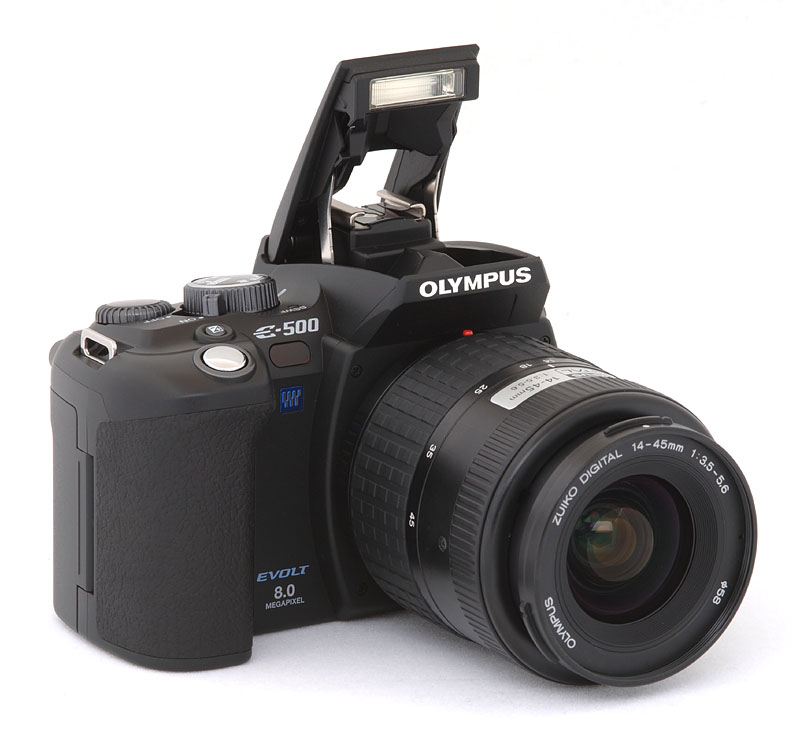 The best news is you needn't be anyone in particular to appreciate the quality images and good experience the E-500 provides. It's for anyone interested in capturing life with simplicity. It's also good for those wanting to take their photography further. I can't say how pleased I am to say that this camera should be considered right next to what I believe is the top camera in its class: the Rebel XT. They can take turns edging each other out in one way or another, but I'd feel just fine recommending either camera to just about everyone.
The Olympus E-500 is comfortable to hold, handsome, and works well. It has almost all the features I'd look for in a digital SLR, including a high enough resolution to stave off any feeling of obsolescence for the next year or so, and a number of modes to assist and enhance a user's photography as they learn (or re-learn) the craft. No other manufacturer offers a sensor that cleans itself every time you power it on, and few digital SLRs currently on the market have a screen this big and beautiful.
While it was bold, the physical design of the original EVOLT E-300 didn't do justice to the legitimate technology that lay inside. The Olympus E-500 brings the company back to basics, with a time-tested design whose familiarity combined with good image quality should attract more users. Everything about the Olympus E-500 just seems right.
Design
 One of the largest of Olympus' consumer-oriented digicams, the EVOLT E-500 is a true digital SLR, designed to please the serious photographer, but without alienating the novice. Featuring an interchangeable lens mount, a host of exposure controls (including full manual exposure control), and a wide range of 15 preset exposure modes, the E-500 is a capable option for those amateurs looking for a meatier camera, but who aren't willing to shell out the big bucks on a pro level digital SLR. A plastic and aluminum body surrounds the E-500's aluminum die-cast chassis, which weights in at just under a pound (0.95 lb or 435 grams) for just the camera body, without CF card and battery. This is actually a little lighter than the preceding E-300 model, and lighter than any other digital SLR on the market. With the 14-45mm lens, battery and card, the EVOLT's total mass comes to 1.86 pounds (846 grams). Measuring 5.8 x 3.7 x 2.6 inches (129.5 x 94.5 x 66 millimeters), the E-500 is only slightly larger than the Pentax *istD, with an excellent grip and very good balance.
The EVOLT's control layout is similar to the E-300 model, featuring a vertical array of buttons left of the LCD, a mode dial and power switch on top, and a control dial and AE/AF and Focus point selector buttons next to the thumb rest. The large Mode dial on top of the camera accesses the main exposure modes, plus a few of the more commonly used Scene modes, and a wide selection of external controls is useful for changing camera settings without the LCD menu. However, the E-500 does lack the small status display panel used on most d-SLRs to report camera settings. Instead, the camera has a startup screen mode that displays the "Control Panel," a brief, iconic display of the current settings. The optical viewfinder also features a smaller information readout on the right. A truly unique Supersonic Wave Filter prevents dust from accumulating on the CCD while changing lenses, something we'd love to see other camera manufacturers adopt. The E-500 features a 8.0-megapixel (effective) CCD, which delivers a maximum image size of 3,264 x 2,448 pixels. This is enough resolution to print quality images as large as 16x20 inches, or to 11x17 with cropping.
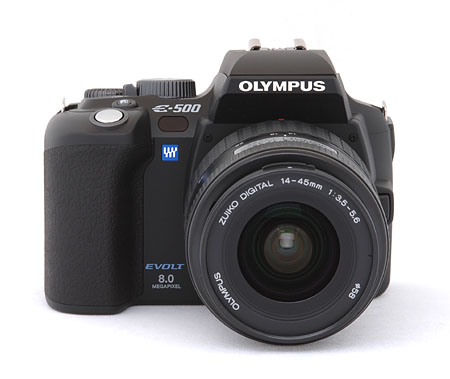
The front of the Olympus E-500 has the lens mount, self-timer LED / IR remote sensor window, and the lens release button. The medium-sized handgrip is covered with a textured, leathery material that helps improve grip.
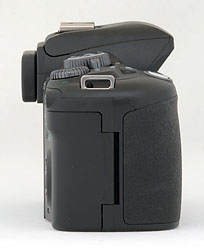
Visible on the right side of the camera is the memory card compartment, as well as one of the eyelets for attaching the neck strap. The media compartment opens from the rear panel, with a hinged, hard-plastic door that snaps shut securely.
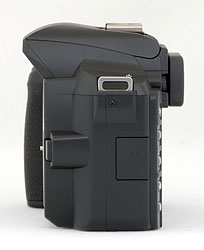
On the opposite side of the camera is the second neck strap eyelet, as well as the connector compartment, which houses the Video Out and USB shared jack. A flexible, rubbery flap protects the compartment.
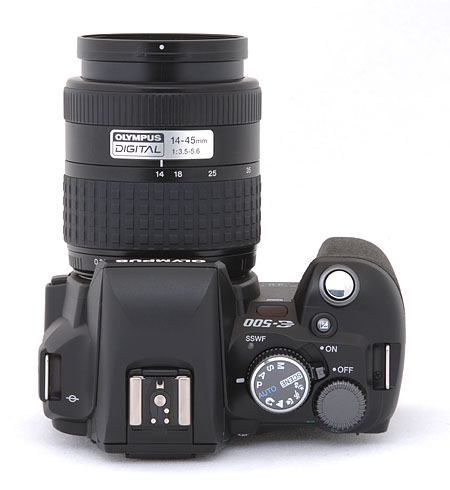
The Olympus E-500's top panel has just a few controls on it, including the Shutter button, Exposure Compensation button, Power switch, and the Mode and Control dials. Also on the top panel are the pop-up flash unit and external flash hot shoe. A small SSWF (Super Sonic Wave Filter) LED flashes blue whenever the camera is powered on, indicating that the filter is operating.
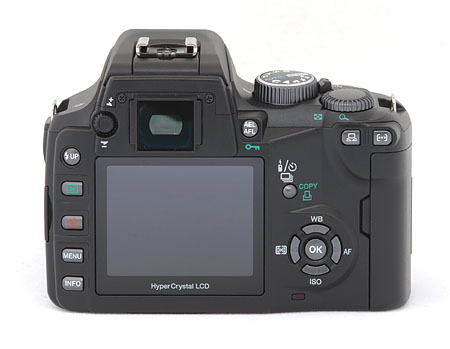
The majority of the Olympus E-500's controls are on the rear panel, and are clearly and logically laid out. A series of buttons lines the left side of the 2.5-inch LCD monitor, and includes the Flash Release, Playback, Erase, Menu, and Info buttons. The four-way arrow pad serves multiple functions depending on the camera's operating mode, and is adjacent to the right of the display. Starting with the "up" arrow and moving clockwise, the Arrow Pad buttons double as White Balance, AF, ISO, and Metering buttons. A small OK button is in the center of the Arrow Pad. Above the top right corner of the LCD display is the AE/AF Lock button, with the One-Touch WB and AF Area Selector buttons over to the far right. A Drive / Copy / Print button is above the Four-Way Arrow pad, and enables one-touch printing when the camera is connected to a printer. The optical viewfinder eyepiece is surrounded by a rubbery cup that won't scratch eyeglasses when closed, and features a dioptric adjustment dial on its left side to correct the view. (The soft eyecup is necessary, as I often found myself having to press my eyeglasses against it to see the full viewfinder frame.) Also on the rear panel is a small LED below the arrow pad that lights whenever the camera is accessing the memory card (meaning you shouldn't remove the card).
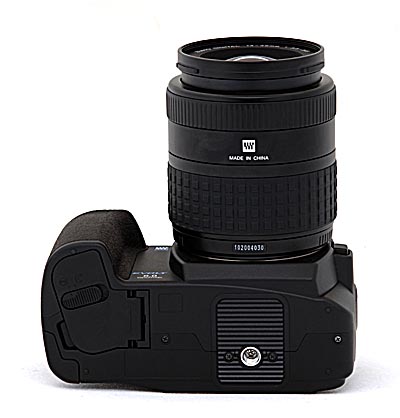
The bottom of the camera holds the battery compartment cover and a metal screw-mount tripod socket. The tripod socket is just far enough from the battery compartment to make battery changes easy when mounted on a tripod, something I always notice given the extensive amount of studio shooting I do. The battery compartment door features a sliding lock to keep it in place, as well as an internal secondary latch that prevents the battery from falling free when the door is open. This latch was missing on the E-300, so we're glad to see it here.
Viewfinder
 The Olympus E-500 is a true digital SLR design, meaning that the optical viewfinder presents a live view directly from the lens. The rear panel, 2.5-inch Hyper crystal TFT color LCD screen is just for menu and image review. The optical viewfinder accommodates eyeglass wearers with a diopter correction adjustment and a reasonably high eyepoint, leaving a modest amount of room between your eye and the finder for eyeglass lenses to fit in, although as I mentioned earlier, I generally found myself pressing my own eyeglasses up against the rubber eyecup.
Fixed in the center of the viewfinder display are central autofocus and exposure targets, but an information display lines the right side of the frame area. This (slightly cryptic) display reports basic camera settings, including aperture, shutter speed, focus confirmation, flash mode, white balance, AE lock, exposure compensation, metering mode, battery level, and the current exposure mode.
As mentioned earlier, the Olympus E-500 doesn't have the usual top-panel data readout for displaying camera settings separately from the LCD viewfinder. What it does have is one of the nicest LCD-based camera-status displays I've yet seen. This screen appears in capture mode when you press the Info button at the lower left corner of the camera's rear panel. (You can also program the camera to display it on startup.) It shows current exposure settings, main exposure mode, exposure bias and metering mode, focus mode, drive mode, image size/quality setting, ISO, White Balance and color mode settings. A slightly more detailed display adds color space and white balance compensation options as well.
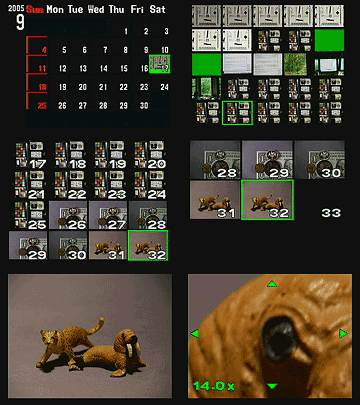 When using the LCD monitor to review captured images, you can zoom in up to 14x on displayed images by turning the Control dial, and then scroll around the enlarged image using the arrow buttons. This is very handy for small details, or precise framing, and the 14x magnification is enough that you can actually check focus on the LCD display. Another handy feature with the E-500's playback enlargement option is that you can check which portion of the image you've enlarged by pressing the Info button during enlarged playback. The full image is then displayed, with a green box highlighting the enlarged area. There's also an Index display option which shows 4, 9, 16, or 25 images at a time, by rotating the Control dial toward the Index position (left). Furthest left is a calendar display mode that displays the most recently-captured image for each date as a tiny thumbnail on a small calendar.
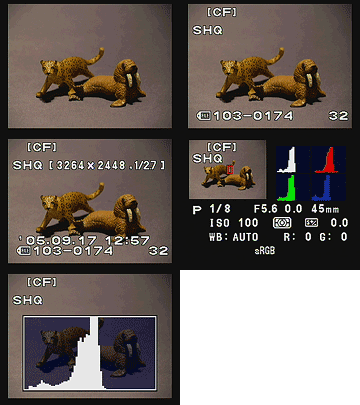 Pressing the Info button during normal image playback scrolls through a range of information and image display modes. The default display is of the image with the quality, memory card, image number, and filename. One press of the Info button increases the information overlay to include the date and time of capture, and resolution. A second press of the Info button expands the information overlay and overlays an RGB histogram for checking the tonal values. Pressing the button one more time displays the standard image histogram, while another press shows the image with the quality setting, and any blown-out highlights flashing white to black to reveal areas of overexposure. Another press blinks any extreme shadow areas, as with the highlight setting. A final press shows the image without any information at all.
Like some other Olympus digicams, the E-500 also offers the ability to resize your images post-exposure, to create smaller versions more suitable for emailing. An image editing menu option lets you change the color mode to black and white or sepia, also post-capture.
Optics
| Free Photo Lessons | |
|
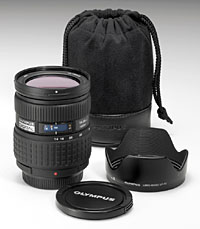
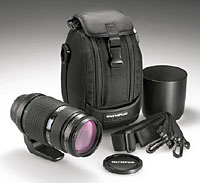
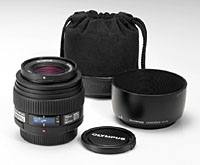
At the introduction of Olympus's original Four Thirds camera, the E-1, the ZUIKO DIGITAL lens system offered a variety of focal lengths, including 50mm and 300mm lengths, and two zoom lenses (14-54mm and 50-200mm). A 1.4x teleconverter was also available. Since then, Olympus has expanded their lens line considerably, to now include a 11-22mm f/2.8 - 3.5 wide zoom, a 40-150mm f/3.5-4.5 zoom, and a 150mm f/2.0 (!) telephoto. All of these early lenses were very much aimed at the professional market, with features, optics, build quality, and prices to match. With the introduction of the E-300 EVOLT, Olympus also brought out a 14-45mm f/3.5-5.6 lens that was quite a bit more affordable. Our E-500 evaluation unit arrived as a dual lens kit, which included two ZUIKO DIGITAL lenses: the 14-45mm f/3.5-5.6 and 40-150mm f/3.5-4.5, offered at a very attractive price for the complete package.
Note that the 22.3mm diagonal dimension of the sensor translates into a 1.94x focal-length multiplier relative to 35mm cameras. For the sake of easy math though, Olympus and most reviewers (ourselves included) simply refer to it as a 2x ratio. This means that the focal lengths mentioned above should all be multiplied by two to arrive at the equivalent focal lengths in the 35mm film world. That makes the bundled 14-45mm lens equivalent to 28-90mm lens (using the literal 1.94x multiplier, it's 27.16-87.30mm) and the 40-150mm lens equivalent to 80-300mm (or 77.6-291mm with the 1.94x multiplier).
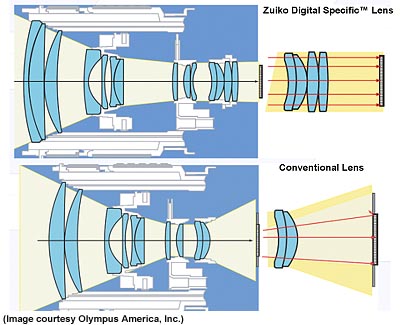
Olympus has for some time insisted that the three-dimensional structure of CCD sensors demand a radically different lens design for optimum performance. Their E10 and E20 fixed-lens SLRs embodied such a design, in which additional optical elements collimated the light, insuring that light from the subject would strike the CCD surface perpendicularly across its entire surface. By contrast, with conventional lenses, light from the subject strikes the film or sensor plane at an increasingly oblique angle, as you move toward the edges of the image circle. (See the illustration above, courtesy of Olympus.) Depending on the sensor design, this varying angle of incidence can cause problems in one of two ways. If the sensor employs microlenses to concentrate light on each pixel's active area, changes in the angle of incidence can lead to unwanted optical effects due to diffraction by the microlenses themselves. On the other hand, if no microlenses are used, collection efficiency is lower, and the decidedly three-dimensional structure of the CCD's surface can result in some of the light being shadowed from the active silicon surface by surrounding surface structures on the chip. Either case results in imperfect coupling of the light to the sensor elements.
In Olympus' "Digital Specific" lenses, an extra group of optical elements collimates the light (makes all the rays parallel), so it impinges on the CCD at right angles to its surface all across the frame.
Actually, Olympus has done a number of things in the design of their lenses for the Four Thirds system to improve image quality. To call attention to the extent of these design improvements, they've branded them as "ZUIKO DIGITAL (tm)" lenses. (I'm told that Zuiko means "Light of the Gods," presumably in Japanese.) In addition to the special "digital specific" design described above, ZUIKO DIGITAL lenses also incorporate improvements in lens molding and polishing accuracy, multi-coating, centering of the lens elements within the mounting system, increased use of ED glass and aspheric elements, and dual-sided aspheric elements, the latter of which Olympus claims as an industry exclusive. The actual impact of these enhancements remains to be seen (if/as/whenever I manage to find time to test both ZUIKO DIGITAL and third-party optics on an EVOLT or other Four Thirds camera), but the promise is that ZUIKO DIGITAL lenses will have better resolution, color rendering, and flare characteristics than even the best conventional designs. The 14-45mm "kit" lens that's bundled with the EVOLT shows moderate barrel distortion at the wide angle end of its range, but has surprisingly little chromatic aberration and excellent corner sharpness for an inexpensive optic.
Another area in which the Olympus E-500 EVOLTs capabilities exceed the general run of d-SLRs out there has to do with the in-camera lens-correction processing that it's inherited from the E-1. One of the biggest innovations embodied in the ZUIKO DIGITAL lenses is that they also support a greater degree of communication between lens and camera than has heretofore been the case, with some interesting consequences. Olympus claims that part of this increased communication will benefit autofocus speed and exposure determination, although they haven't said how this might work. It does appear though, that ZUIKO DIGITAL lenses pass information about their optical characteristics to the camera body, including information on geometric distortion. In the pro-oriented E-1 SLR, this information can be used to correct light falloff in the corners of the frame, via a menu option called "Shading Compensation." (For those of you unfamiliar with the term "shading," this phenomena is almost universally, if erroneously, referred to as "vignetting.") The E-500 also offers this correction as a menu option. Perhaps more interesting though, is that the data about geometric distortion that's captured by the camera body is written into its RAW files, so the Olympus Master software can correct for such lens defects after the fact, back on a host computer. The result can be very low distortion with relatively inexpensive lenses. (To the best of our knowledge though, only the Olympus ZUIKO DIGITAL lenses offer this capability: Third-party Four Thirds format lenses do not.)
The Olympus E-500 employs a three-point TTL Phase Difference Detection autofocus system, and the three AF points are outlined in black in the viewfinder display. Pressing the AF Area Selection button on the rear panel lets you manually select which of the AF points you'd like to base focus on, or set the AF area to automatic selection (all three AF points active). The AF button on the rear panel lets you select Manual, Single AF, or Continuous AF modes. There's also an option for Single AF + Manual Focus. When manual focus is enabled, you simply turn the focus ring around the outside of the lens to set focus. The focus indicator in the optical viewfinder (a solid green circle) lights to indicate that you've achieved accurate focus. Note that this is not a true mechanical or analog focus, however. Turning the ring simply activates the camera's focus mechanism, actuating the focus motor built into the lens. Single AF mode means that the camera only sets the autofocus when the Shutter button is halfway pressed, while Continuous AF mode continuously adjusts the focus without you having to halfway hold down the shutter release (good for moving subjects). Continuous AF uses what Olympus calls Predictive AF technology, in that the camera anticipates where the subject will move to next and adjusts focus just before it reaches that point. As far as we could tell, the Predictive AF doesn't involve following an active subject from one AF region to another, but rather simply predicts whether a subject under a single AF point is approaching or receding The mode combining Single AF and Manual focus tells the camera to set focus with a half press of the Shutter button, but leaves the manual focus ring active so that you can fine tune the setting before pressing the Shutter button the rest of the way to trip the shutter. It's also interesting to note that the E-500 has added a MF Bracketing mode, which captures either five or seven images at different focus settings, once you've established the initial manual focus.
The Olympus E-500 also lets you tell it whether to adhere to focus- or release-priority. In focus-priority mode, the shutter won't fire unless the subject is properly focused. Conversely, release-priority means that the shutter will fire whenever you tell it to, whether the subject is focused or not. In a nice touch, the E-500 lets you determine select focus or release priority independently for single-shot and continuous shooting modes. (I can imagine myself wanting to insist on focus priority for single shots, but preferring release priority for continuous shooting, to let the camera just take its best shot at tracking a moving subject, perhaps settling for slightly misfocused images, rather than missing the shot entirely.)
An AF illuminator option can be turned on through the camera's Record menu, to help the camera's AF system determine focus in dark shooting conditions. The camera actually uses light from the flash as the AF illuminator, so the flash must be upright and enabled for this option to be available. The E-500 will fire the flash for AF assist even while the flash itself is off; that is, it must still be deployed, but you can still take a long exposure sans flash.
Third-Party Four Thirds-System Lenses
One of the drawbacks to the original E-1 system was the high cost of the Olympus Zuiko Digital-Specific lenses. While of very high quality and not dramatically higher-priced than pro-grade lenses from manufacturers like Nikon and Canon, their cost could put the whole E-1 system out of reach for even well-heeled amateur photographers. (Or pros with limited budgets, for that matter.) For quite a while after the E-1's announcement and retail availability, there was no option in the marketplace for E-1 lenses other than Olympus' own offerings. Olympus is now moving to correct this issue, with the announcement of their own 14-45mm optic that I mentioned above. In Spring of 2004 though, Sigma announced Four Thirds-compatible lenses at CeBit. Sigma's announcement covered three lenses, an 18-50mm f/3.5-5.6 zoom, a 55-200mm f/4-5.6 zoom, and an 18-125mm(!) f/3.5-5.6 zoom. As of this writing (late Fall, 2005), Sigma has announced additional "DC" lenses, including a 10-20mm ultrawide zoom lens, an 18-50mm f/2.8, an 18-200mm f/3.5-6.3 zoom, and a 30mm f/1.4 fixed focal length model. (This last is particularly interesting. The 30mm focal length corresponds to 50mm focal length considered "normal" for 35mm film cameras when it's used on most d-SLRs, or a 60mm equivalent on the Olympus E-500. What's significant is that this is the first significantly new optical formulation for a "normal" lens to hit the market in many years, taking advantage of modern lens design and technology. Sigma is well-known for producing optically sharp lenses at very attractive prices, and these Four Thirds models appear to be no exception. With an independent lens manufacturer now making lenses, the Four Thirds system has taken a big step forward toward being a true multi-vendor standard. (All that's missing now is for another manufacturer to produce a Four Thirds camera body.)
Lens Tests!
Using the DxO testing technology that we developed for our lens review site SLRgear.com, we thought it would be interesting to take a look at the optical quality of the two "Kit" lenses that commonly ship with the Olympus E-500. These tests use the DxO Analyzer program from DxO Labs, together with some back-end graphing and presentation software that we wrote in-house. For details of how we conduct these tests, just what they reveal, and equally importantly, what they don't reveal, visit SLRgear.com, and check out the links covering these topics on the right hand side of the home page.
Meanwhile, the paragraphs below describe the results of our evaluation of the E-500's kit lenses. Click on any of the thumbnail images, to view either the full-size graph, or to launch an interactive viewer to see how blur and chromatic aberration vary as you change the focal length and aperture.
We need to make a very important note about the results seen here, before we actually discuss them. The Blur Index graphs are showing a measure of "softness" that's derived from MTF curves measured at multiple points across the image plane. This measure correlates very well with visual perceptions of sharpness, but is also quite susceptible to variations in the sharpening applied to an image. To remove this factor as much as possible in our measurements, we choose the sharpening setting for each camera that produces the most accurate edge profile, that shows the steepest slope as an edge transitions pixel boundaries, but with the least possible overshoot or undershoot on either side of the edge, caused by the sharpening algorithm. In the case of the Olympus E-500, the default sharpening produced a noticeable "halo" around high-contrast edges, and even the low sharpening setting didn't completely remove this artifact. The impact of in-camera sharpening is generally to generate artificially low blur numbers, so we adjusted the raw values from the DxO tests in order to achieve a good correlation with the results over on SLRgear.com. While you can never make direct 1:1 comparisons between results from different digital camera platforms, we feel confident that the normalization factor we've applied to the results form the E-500 result in a high degree of parity between the results shown here and those we've collected on other platforms in the past. (This serves to illustrate quite well the difficulty of making cross-camera comparisons with the DxO data, and the care needed in doing so.)
Olympus Zuiko Digital 14-45mm f/3.5-5.6
Blur Index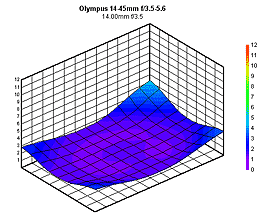 |
|
| Chromatic Aberration 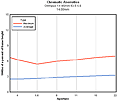 |
Vignetting (Shading) ) |
Distortion) |
(Click on the thumbnails to see full-size graphs and interactive charts.) |
This is the lens that ships in all kits with the E-500, whether they be single- or dual-lens kits. Offering a range of angular field of view equivalent to that of a 28-90mm lens on a 35mm camera, this is a good general-purpose lens to use with the camera, and the one that most users will probably keep on the camera most of the time.
Looking at the interactive blur plot, we see that the Olympus 14-45 looks a lot like other inexpensive wide angle zoom kit lenses from other manufacturers. (Over on SLRgear.com, you can find test reports for competing optics from Canon and Nikon, if you'd like to compare how they perform.)
Wide open, the 14-45 does quite well in the center of the frame, but gets soft on the edges, particularly toward the middle of its focal length range, at 25-35mm actual focal length. (Note: We think that the increased softness in the upper right corner of the frame may have been caused by a slightly cockeyed chip in the E-500 body we used to do the tests with: The 40-150mm lens showed very similar behavior.) Many inexpensive zoom lenses tend to show softness in the corners of the frame, so this isn't exactly news. What's a bit different about the 14-45 is that it actually does quite a bit better at both the wide angle and telephoto ends of its range than it does in the middle. Also like many inexpensive zooms, the 14-45 settles down quite nicely when you stop it down one or two f-stops. In fact, two stops down (f/5.6 at wide angle to f/8 at telephoto), it actually preforms quite well, comparing favorably with much more expensive lenses. As you stop down further, things stay more or less the same until you get toward f/11 at wide angle or f/16 at telephoto, at which point diffraction limiting begins to have an effect. As usual, stopped down to its minimum aperture of f/22, the entire frame is soft, but at least there's no additional softness in the corners.
Chromatic aberration in the 14-45mm ranges from moderate at wide angle to quite low at telephoto, with relatively little variation across the range of apertures at any given focal length. Matching our own experience when shooting with it, geometric distortion is quite high at wide angle, at nearly 1% barrel distortion, decreasing to almost zero at telephoto. (Interestingly, the distortion always stays slightly to the barrel side of the graph, never crossing over to pincushion distortion.) Finally, uncorrected vignetting or shading ranges from a moderate 0.3-0.4 EV at both side angle and tele focal lengths to less than 0.2 EV in the middle of the zoom range. Vignetting also decreases as the aperture is reduced, remaining below 0.2 EV at f/8 and higher for all but the longest focal lengths.
Important to note is that the in-camera shading compensation offered by the E-500 body can almost completely eliminate the shading or vignetting seen in the above tests.
Overall, this is a pretty decent lens considering the low cost of the camera body and either one or two lenses. Its performance is very much in line with that of the kit lenses for other entry-level d-SLRs that we've looked at.
Olympus Zuiko Digital 40-150mm f/3.5-4.5
Blur Index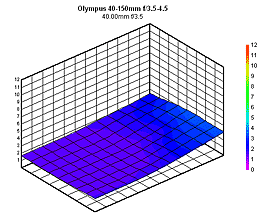 |
|
| Chromatic Aberration 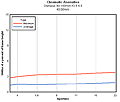 |
Vignetting (Shading) ) |
Distortion) |
(Click on the thumbnails to see full-size graphs and interactive charts.) |
This is the lens that ships in the two-lens kits with the E-500. Offering a range of angular field of view equivalent to that of an 80-300mm lens on a 35mm camera, this is a pretty good telephoto, as long as most users are likely to need for common shooting situations. Thanks to the small dimensions of the Four Thirds sensor, it's also a surprisingly light and compact lens.
Looking at the interactive blur plot, we see that the Olympus 40-150 does pretty well across most of its focal length range, but softness at maximum aperture does increase somewhat as you go from 100 to 150mm. As we've noted with many inexpensive lenses, stopping down two f-stops makes a very significant difference in sharpness across the board, and the 40-150 is actually a very good performer under that condition. As is usually the case, the lens gets softer across the entire frame and at all focal lengths when stopped down to its minimum aperture of f/22. - But the degree of softening there isn't as severe as we've often observed in other lenses.
Where the 40-150mm does get a little wild and woolly though, is in the area of chromatic aberration. Starting out from quite a low value at the 40mm end of its range, CA drops slightly at 48mm and then increases progressively (and rapidly) as you move to longer focal lengths. At 150mm chromatic aberration is rather high, although you'll mostly notice it only around the edges of the frame. Geometric distortion in the 40-150 ranges from a slight barrel distortion at the wide angle end (about 0.3%) to a fairly noticeable (also about 0.3%) pincushion distortion across much of the longer end of its range. (The inflection point of zero distortion is right around 48mm, with pincushion distortion increasing fairly rapidly up to about 68mm, and then more slowly as you zoom to 100mm.) Uncorrected vignetting or shading is pretty high a large apertures across the entire focal length range, varying from 0.25 to about 0.4 EV. The shading decreases quite rapidly as you stop down though, decreasing to less than 0.2 EV at f/5.6 for all focal lengths, and to an imperceptible 0.1EV or less from f/8 onward. (As above, it's important to note that the Olympus E-500 body can almost entirely compensate for lens shading if its shading correction option is enabled.)
Overall, this lens falls about in the middle of the range of inexpensive ~50-200mm zooms that we've tested. It falls short of the surprisingly excellent Nikon 55-200mm f/4-5.6, but beats the Canon 55-200mm f/4.5-5.6 quite handily, particularly at longer focal lengths. When you factor in the very low incremental cost of acquiring this lens as part of a bundled package with the Olympus E-500 body and the 14-45mm f/3.5-5.6, it's an exceptional bargain.
"Supersonic Wave Filter (tm)" Automatic Sensor Cleaning
Here's a feature that made me sit up and take notice on the E-300, and I'm glad to see it included on the E-500 as well: Built-in ultrasonic sensor cleaning! This was first introduced on the E-1 SLR, and has been carried forward to the E-500, despite the latter's greatly reduced cost. This is a feature that's hard to evaluate in any sort of a rigorous, quantitative way, but that appears to work quite well, based on subjective observation.
Dust has proven to be a bane for digital SLR users from the beginning. In film cameras, the imaging surface (the film) is constantly refreshed as each new frame is advanced. Any dust that might accumulate on one frame will thus not affect subsequent ones. In digital SLRs though, the sensor surface is fixed, so any dust falling on it tends to stay there, the surface becoming increasingly dirty over time. Various accessories are available to clean CCD surfaces, but their use presents an ongoing risk of accident. (That is, while the cleaning gadgets themselves may be perfectly safe, every time you open your SLR and start sticking things inside the camera body, there's a finite risk that you'll do something to damage the sensor chip.)
In the E-1, E-300, and now the E-500, every time the camera is turned on (or commanded to do so via a separate menu setting), an ultrasonic system activates, vibrating the protective cover glass over the sensor at a frequency of 350,000 cycles/second, thereby dislodging any dust particles that may have settled on the sensor's surface. (Dislodged dust is collected and trapped in an internal receptacle, so it won't float around the mirror compartment to cause more problems down the line.) A full cleaning cycle takes only 200 milliseconds. (0.2 seconds) As noted, I don't have any way to objectively measure the effectiveness of this system, but can say that I've seen virtually no evidence of dust on the sensor throughout my testing and use of both the original all three Olympus cameras that use the system.
To set appropriate expectations for Olympus' Supersonic Wave Filter system, it's important to note that it almost certainly won't be effective against grease smudges caused by fingerprints. - So continue to be careful about putting your fingers inside the mirror compartment when the sensor is exposed.
Image Sensor
The sensor chip used in the E-500 calls for special comment as well, although the test results we've seen from it and other E-series SLRs from Olympus (which use the same basic sensor technology) lead us to wonder slightly whether the special attention is in fact deserved. Its claims to fame should be lower noise and increased dynamic range, but there are a lot of system-level factors that can affect noise levels and dynamic range, regardless of sensor characteristics.
The Four Thirds initiative is a joint effort by three companies: Olympus, Kodak, and Fuji. We haven't heard anything about Fuji's possible plans yet, but Kodak was clearly a major partner of Olympus in the E-1 and now in the EVOLT, as it's their sensors that are used in both cameras. Kodak was a dominant player in the early digital SLR market, thanks largely to their advanced sensor technology. Now, with the advent of Four Thirds and their participation in the E-1 and EVOLT cameras with Olympus, they appear poised to regain significant market share for their chips. While Kodak has recently withdrawn their own pro cameras from the SLR marketplace, their CCD sensor technology has historically been second to none: Kodak's specs for quantum efficiency, electron capacity, and thermal noise levels are thoroughly state-of-the-art. They also have a very well-developed design base and semiconductor manufacturing process for creating "full-frame" CCDs, which have considerable inherent advantages over the more common interline-transfer designs used in most digital cameras currently on the market.
While considerably more difficult to manufacture than interline sensors, the full-frame design potentially provides better light sensitivity and a significantly improved signal to noise ratio. This is because almost 100% of the silicon's surface area is available for light collection, since the charge transfer off-chip occurs in the sensing elements themselves. By contrast, in an interline-transfer CCD design, the charge-transfer registers are located alongside the photodiodes, consuming considerable silicon real estate. This also means that frame-tranfer CCDs have less need for the "microlenses" commonly used with interline-transfer chips to improve light collection efficiency, although it turns out that the sensor on the Olympus E-500 still uses them to concentrate light on the area of each pixel with the best light sensitivity.
The electronic structure of full-frame CCDs also results in a much higher "saturation voltage" than that of equivalent interline-transfer designs. Combined with the low thermal noise that characterizes Kodak's chips, the overall result is that the CCDs used in the E-1, E-300, and E-500 should have nearly twice the dynamic range of competing interline-transfer units, with the same pixel dimensions. (Dynamic range is the range of light to dark values that can accurately be recorded.) Note though, the emphasis placed on the issue of pixel dimensions in the previous statement. The combination of smaller overall sensor dimensions (which result in the 2.0x focal length multiplier, vs the 1.5-1.6x that's more common in competing dSLR models) and 8 megapixel resolution means that the pixels in the E-500's CCD chip are rather small, with a 5.4 micron pitch.
In our testing of the Olympus E-500 EVOLT, we found that its image noise levels were higher than those of competing d-SLRs having the larger APS-sized sensors, but not dramatically so. (Image noise at ISO 1600 was markedly higher, but that also appears to be at least partly due to the rather conservative anti-noise processing that Olympus uses, the engineers apparently having chosen to preserve more subject detail at high ISO, at the cost of somewhat higher noise. - A choice that I personally prefer.) It's not clear whether it's a consequence of the frame-transfer design or not, but the image noise in high-ISO images from the E-500 has a rather fine "grain structure," which makes it less objectionable than it might be otherwise.
The net of all this is that Kodak's frame transfer technology seems to just about make up for the smaller pixel dimensions that result from the smaller sensor dimensions of the Four Thirds standard, and higher pixel count used in the E-500. I'd like to see significantly lower noise at ISO 1,600, but would probably find the noise levels I did encounter there acceptable for situations where the resulting images would be printed at smaller sizes. (Say, 5x7 or below.)
Exposure
| Free Photo Lessons | |
|
In Program mode, the camera is in charge of the aperture and shutter speed, while you control the remaining exposure options such as ISO, metering, and white balance. Program mode also provides access to the exposure compensation adjustment, which lets you adjust the camera's automatically determined exposure setting by plus or minus five exposure equivalent (EV) units, in steps of 0.3, 0.5, or 1.0 EV. (You can specify the level of adjustment through the Setup menu.) Also through the camera's menu system, you can program the Control dial to allow Program Shift, meaning you can sort through a small range of equivalent exposure settings for a given shot. Aperture Priority lets you set the aperture (the available range depends on the lens attached), leaving the camera to automatically determine the appropriate shutter speed. In Shutter Priority, you can select shutter speeds from 1/4,000 to 60 seconds, with the camera selecting the corresponding aperture setting. The Manual exposure option lets you control both aperture and shutter speed yourself, and the shutter speed range also includes a Bulb setting for variable length exposures as long as eight minutes In common with other Olympus cameras, a handy feature of the Manual mode is that, as you scroll through the various exposure settings, the camera indicates whether it thinks your chosen setting will produce a correct exposure. It does this by flashing the exposure differential (the difference between your settings and what the camera metering system thinks is correct) in green on the viewfinder display, up to a limit of +/- 5EV.
The 15 scene modes include Landscape, Landscape Portrait, Night Scene, Night Portrait, Children, Sport, High Key, Low Key, Macro, Candle, Evening Sun, Fireworks, Documents, and Beach & Snow modes, which optimize the camera for specific shooting situations. The five most commonly used scene settings also have places on the Mode dial, and include Portrait, Landscape, Macro, Sports, and Night Scene. (A sixth Scene setting provides access to all 15 modes.) In Portrait mode, the Olympus E-500 uses a larger lens aperture, reducing depth of field to throw distracting background elements out of focus. Landscape mode keeps foreground and background in focus, adjusting the camera's color handling to emphasize blue and green hues in the image (producing more intense foliage and sky colors). The Macro setting is for shooting small subjects, and the focus range will depend on the lens. Sports mode biases the exposure system toward faster shutter speeds, to help freeze fast-moving subjects. Night Scene employs slower shutter speeds, allowing more ambient light into the image. Limited menu options are available in the scene modes, as their purpose is to simplify camera setup for novices. (A multitude of menu choices would only add complication to what are intended to be easy-to-use camera settings.)
The Olympus E-500 lets you adjust its light sensitivity, in one or 1/3 EV steps, with options of 100, 125, 160, 200, 250, 320, and 400 ISO equivalents, or to an Auto mode in which the camera selects an ISO appropriate to the subject's brightness. An ISO step size option on the Setup menu lets you adjust the variation between ISO settings. You can also enable "boosted" ISOs through the Record menu, allowing 500, 640, 800, 1,000, 1,250, and 1,600 equivalents, and set a maximum ISO point for the Auto mode which won't risk noise in bright situations. The higher ISO settings are helpful when you want faster shutter speeds under normal lighting, to help freeze fast action. Of course, as with all digicams, the higher ISO settings produce photos with more image noise, in much the same way that higher-ISO films show more film grain. To combat this problem, the E-500 offers a Noise Reduction option through the Record menu, which reduces the amount of image noise from long exposures, particularly at the higher ISO settings.
Five metering systems are available on the E-500: Center-Weighted, Digital ESP, Spot, Spot HI, and Spot SH. All are accessed through the Metering button on the camera's back panel. Under the default Digital ESP setting, the camera takes an exposure reading from the center of the image as well as the surrounding area and chooses the best exposure based on brightness and contrast across the entire scene. Center-Weighted metering also reads from the center of the frame, but from a large area. Spot metering simply reads the exposure from the very center of the image, so you can pinpoint the specific area of the photograph you want properly exposed. (Spot metering is very handy when you have a subject that's backlit, or that has a very different brightness, either lighter or darker, than the background.) The two additional Spot options provide highlight and shadow control, whenever shooting in very bright or very dark conditions.
An AE/AF Lock button locks the current exposure settings whenever pressed, so you can independently lock exposure and focus. (AE Lock is useful when you want to base your exposure on an off-center subject. Point the camera at the subject, lock the exposure, then recompose your shot however you like. Your subject will be correctly exposed, regardless of what might be in the center of the frame when you finally snap the shutter.) Through the Setup menu, you can designate the function of the AE/AF lock button, and how it works in conjunction with the Shutter button. This button will also lock the flash exposure.
In situations where exposure compensation is necessary, simply press the Exposure Compensation button and turn the Control dial (in all exposure modes except Manual) and the EV value will display on the LCD monitor. You can increase or decrease the exposure in either 0.3, 0.5, or 1.0-step increments (selected via a menu option), up to a maximum of +/- 5 EV. Or, you can use the Auto Exposure Bracketing (AEB) function to automatically bracket an exposure in three-step increments of either 0.3, 0.7, or 1.0 EV units each. The auto bracketing will center its efforts around whatever exposure you've chosen as the starting point, including any exposure compensation adjustments you've made. AEB is handy for those times when you want to make sure you get just the right exposure for a critical subject.
White balance options include Auto, Tungsten, White Fluorescent, Neutral White Fluorescent, Daylight Fluorescent, Outdoors, Cloudy, Shade, One-Touch, and Custom, to accommodate a variety of lighting situations. Pressing the White Balance button and turning the Command dial adjusts the setting, and the Kelvin temperature is displayed in the LCD monitor. The E-500 offers a Custom setting, which lets you choose from a range of Kelvin temperature settings. The One-Touch option is useful for basing the white balance on a white card. You can also adjust the white balance, controlling the amount of red, green, blue, and magenta in the color balance, in any of the selected modes. This ability to "tweak" the white balance, called White Balance Compensation, is very helpful when dealing with difficult light sources. The E-500 also features a white balance bracketing setting, accessed through the LCD menu. If activated, the camera will take three successive images, either biasing between red and blue or green and magenta. You can set the images to vary by two, four, or six arbitrary adjustment steps.
The Olympus E-500 also offers two Self-Timer modes for self-portraits or those occasions when you don't want to risk camera shake on a long exposure by pressing the Shutter button to trip the shutter. You can choose between a two- or 12-second countdown. The two-second countdown is useful for times when you're taking a long exposure with the camera on a tripod, and you want to minimize any camera shake from pressing the Shutter button. The Drive setting also accesses the Remote Control modes, for use with the optional IR remote.
There are also options on the Record menu to set the color mode, which offers Vivid, Natural, and Muted color, as well as Monochrome and Sepia options. In addition, the Olympus E-500 has a Gradation setting to control the brightness of the entire image. You can choose between the Normal, Low, and High Key settings. A color space option under the Record menu lets you choose between sRGB (for Windows machines) and Adobe RGB (for Adobe Photoshop) color options.
Sequential Shooting Mode
The E-500 offers a Sequential mode that mimics the motor drive on a film camera, recording as many as four images at about 2.5 frames per second when you hold down the Shutter button. As is usually the case, the number of frames you can capture quickly is limited by the camera's buffer memory capacity and the frame rate is determined by the file size.
Flash
The E-500 offers a built-in, pop-up flash, with six operating modes: Auto, Auto Red-Eye Reduction, Fill-In, Off, Slow-Sync Red-Eye Reduction, Slow-Sync 1, or Slow-Sync 2 modes. Auto mode lets the camera decide when to fire the flash, while the Fill-in mode fires the flash with every shot. (Fill-in is useful for throwing light on backlit subjects, keeping their faces from being obscured in deep shadow.) The Red-Eye Reduction modes fire a brief burst of low-power flash pulses before firing the flash at full power, making the pupils of your subject's eyes contract, reducing the occurrence of the Red-Eye Effect. The Slow Sync modes allow more ambient light into the background, producing more natural lighting behind a flash-illuminated subject. The First Curtain mode fires the flash at the beginning of the exposure, while Second Curtain mode fires the flash at the end of the exposure. A button on the rear panel pops the flash up from its compartment, and a second press displays the flash menu. You can also adjust the overall flash intensity from +/-2 EV through the Record menu, in 0.3, 0.5, or 1.0 step increments. The flash option menu also offers a range of Manual flash exposures, setting the flash output to Full, 1/4, 1/16, or 1/64 of its maximum power. This mode is handy for working with studio strobe systems with slave triggers. In manual flash mode, the flash emits only a single burst, so it will trigger conventional slave circuits properly. A flash bracketing mode works similarly to standard Auto Exposure Bracketing, taking a series of three images at different flash levels when you're not sure of the best flash exposure.
The E-500 also features an external flash hot-shoe, for attaching more powerful external flash units. The Olympus FL-50, FL-36, and FL-20 flash units, as well as several other manufacturer flash units.
As noted earlier, the E-500's flash head doubles as a very powerful autofocus-assist illuminator.
Shutter Lag/Cycle Times
When you press the shutter release on a camera, there's usually a lag time or delay before the shutter actually fires. This corresponds to the time required for the autofocus and autoexposure mechanisms to do their work, and can amount to a fairly long delay in some situations. Since this number is rarely reported on (and even more rarely reported accurately), and can significantly affect the picture taking experience, I routinely measure both shutter delay and shot to shot cycle times for all cameras I test, using a test system I designed and built for the purpose. (Crystal-controlled, with a resolution of 0.001 second.) Here are the numbers I collected for the Olympus E-500:
| |
||
| |
(secs) |
|
| Power On -> First shot | |
On the slow side, but camera performs "Supersonic Wave Filter" dust reduction as part of startup. |
| Shutdown | |
First time is simple shutdown, second time is worst-case buffer-clearing time. Not bad - Worst-case time corresponds to clearing 4 TIFF format (uncompressed) files from the buffer. |
| Play to Record, first shot | |
Time until first shot is captured. Quite fast. |
| Record to play | |
First time is that required to display a large/fine file immediately after capture, second time is that needed to display a large/fine file that has already been processed and stored on the memory card. Also pretty fast. |
| Shutter lag, full autofocus | |
First time is at full wide-angle, second is full telephoto. About average for a digital SLR. |
| Shutter lag, prefocus | |
Time to capture, after half-pressing shutter button. Very fast. |
| Shutter lag, continuous autofocus | 0.43 |
As usual, no benefit to continuous AF for static subjects. (And we have no way to meaningfully measure AF performance with moving subjects.) |
| Shutter lag, manual focus | 0.32 |
A little slow for a digital SLR. |
| Cycle Time, max/min resolution | 0.90 / |
First number is for large/fine files, second number is time for "TV" mode (640x480) images. Times are averages. Shoots 6 frames this fast in large/fine mode, then slows* to about 1.9 seconds per shot, and clears the buffer* in 8 seconds. Shoots at this rate continuously in TV mode, clearing the buffer after each shot. Not too bad, but not as fast as much of its competition, and buffer capacity is rather limited. |
| Cycle Time, RAW and TIFF, max resolution | 0.88 |
Times are averages. Shoots 4 frames this fast in RAW mode, then slows* to about 2.4 seconds per shot, and clears the buffer* in 9 seconds. Shoots 4 frames this fast in TIFF mode, then slows* to about 4.5 seconds per shot, and clears the buffer* in 17 seconds. A bit slower than average performance, and limited buffer capacity. |
| Cycle Time, Flash exposures | 5 | (Flash at maximum power output) |
| Cycle Time, continuous mode, max/min resolution | 0.39 / 0.38 (2.58 / 2.62 fps) |
First number is for large/fine files, second number is time for "TV" size images. Times are averages. Shoots 4 frames this fast in large/fine mode, then stops, and clears the buffer* in 7 seconds. Shoots at this rate continuously in TV mode, clearing the buffer after each shot. Good speed, but limited buffer capacity. |
| Cycle Time, continuous mode, RAW and TIFF, max resolution | 0.38 (2.65 fps) |
Times are averages. Shoots 4 frames this fast in RAW or TIFF mode, then stops. Buffer clears in 9 seconds* in RAW mode, 17 seconds* in TIFF mode. Good speed, but limited buffer capacity. |
| *NOTE - buffer clearing times and post-buffer shot to shot cycle times will be strongly affected by the speed of the memory card used. The numbers above were measured with a Kingston 50x CF memory card. Slower cards would produce correspondingly longer clearing times and slower cycle times after the buffer has filled. | ||
The Olympus E-500 EVOLT is average to a bit slower than average, relative to other d-SLRs in its class. Full-autofocus shutter lag isn't too bad at about 0.37 second with the kit lens, and prefocus lag is good at 0.095 second, but the shutter response in manual focus mode is surprisingly slow, with a delay of 0.32 second (almost the same as for full-AF mode). Cycle times are quite modest by current SLR standards, at just under a second, for JPEG, RAW, or TIFF images. (Slow for JPEG and RAW images, fast for TIFFs.) Buffer capacity is also limited but probably adequate for a prosumer dSLR, at four RAW or TIFF images, or six large/fine JPEGs.
Operation and User Interface
The E-500's user interface is similar to its predecessors, with a multi-page menu system that's easy to navigate. The standard Olympus Shortcut menu screen has been omitted, made unnecessary by the many single-purpose buttons for major functions on the camera body. Menu layouts are straightforward. A Mode dial on top of the camera changes capture modes quickly. Once you get into the Record menu, options are organized by function, accessed by a series of tabs along the left side of the screen. This layout lets you quickly skip to the options you need without sifting through pages of menu items. In any of the manual exposure modes, aperture and/or shutter speed is adjusted externally, as is exposure compensation. Once you get the hang of things, the control layout is quite intuitive and efficient.
Control Enumeration

Lens Release Button: Tucked away next to the right side of the lens barrel (as viewed from the front), this button unlocks the lens from the mount.

Shutter Button: Located on an angled panel atop the right handgrip, the Shutter button sets focus and exposure settings when pressed halfway and triggers the shutter when fully pressed.

+/- (Exposure Compensation) Button: Behind the Shutter button, this button adjusts the exposure compensation from +5 to -5 EV in 1/3 or 1/2-step increments when pressed while turning the Control dial.
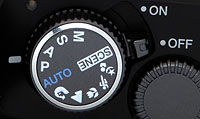
Mode Dial: The most prominent control on the top panel, this dial controls the camera's main operating mode. Choices are Manual, Shutter Priority, Aperture Priority, Program, Auto, Portrait, Landscape, Macro, Sports, Night Scene, and Scene modes.
Power Switch (see image above): Jutting out from under the Mode dial on the right side, this switch turns the camera on and off.
Control Dial: Right of the Mode dial is the Control dial, which adjusts a wide variety of settings when turned while pressing control buttons.
In Playback mode, this dial controls digital enlargement of captured images up to 14x when turned toward the right. The dial also accesses the four, nine, 16, and 25 image thumbnail index display modes, plus the calendar mode when turned to the left.

Diopter Adjustment Dial: Tucked on the left side of the viewfinder eyepiece, this dial adjusts the optical viewfinder's optics to accommodate eyeglass wearers.

Flash Release Button: The top button in a series lining the left side of the LCD monitor, this button releases the pop-up flash. A second press displays the Flash Mode menu, with options varying with the exposure mode. If set through the Setup menu, pressing this button with the +/- button lets you adjust the flash exposure compensation.

Playback Button: Below the Flash Release button, this button switches the camera to Playback mode. The E-500 is a "shooting priority" camera, so you can return to capture mode either by pressing the Playback button again, or simply by pressing the Shutter button.

Erase Button: Next in line below the Playback button, this button lets you erase the currently displayed image, with a Yes/No confirmation screen. If pressed while the camera is in a shooting mode, the most recently-captured image appears on the LCD display with an option to erase it.

Menu Button: Directly below the Erase button, this button calls up the settings menus in any camera mode.

Info Button: The final button in the series lining the LCD monitor, this button controls the amount of information displayed on the LCD monitor in Playback mode, cycling through six display modes, including a histogram display.

AE/AF Lock / Protect Button: On the right side of the viewfinder eyepiece, this button locks the exposure and/or focus setting in any record mode, and can be programmed through the settings menu.
In Playback mode, this button marks an image for write-protection.

White Balance Button: In the top right corner of the rear panel, this button can be programed to access the One-Touch WB setting, or to display a range of image preview options for double-checking the white balance setting.

AF Area Selection Button: To the right of the One-Touch WB button, this button lets you manually select the active AF point, or leave AF area selection under automatic control.

Drive / Copy / DPOF Button: Next to the top right corner of the LCD monitor, this button cycles through the E-500's available drive settings, including Single-Frame, Sequential Shooting, Self-Timer 12S, Self-Timer 2S, Remote Control 0S, and Remote Control 2S modes.
In Playback mode, this button lets you copy files from one memory card to another. If the camera is connected to a printer, pressing this button lets you instantly print selected images.
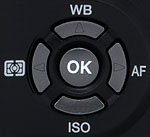
Four-Way Arrow Pad (White Balance, AF, ISO, and Metering Buttons): Made up of four buttons arranged in a circle, the Arrow Pad controls many of the camera's operations. The top arrow key controls the White Balance mode, while the right arrow selects the AF mode. The bottom arrow adjusts the ISO setting in conjunction with the Control dial, and the left arrow sets the camera's metering mode.
In Playback mode, the left and right Arrows move forward or backward through the pictures stored on the card. Up and down arrows jump through the images 10 frames at a time. All four are used to scroll around portions of the zoomed image in Zoom Playback mode.
In the LCD menu system, the Arrow buttons navigate through menu screens and select settings.
OK Button (see image above): Located in the center of the Four-Way Arrow pad, this button confirms menu and control selections.
Camera Modes and Menus

Manual Exposure Mode (M): Noted on the camera's Mode dial with an "M," Manual mode provides complete user control over the exposure, with an extended shutter speed range that includes a Bulb setting for variable length exposures up to eight minutes.

Shutter Priority Mode (S): Indicated by an "S" on the Mode dial, this mode lets the user control the shutter speed from 1/4,000 to 60 seconds, while the camera selects the best aperture setting.

Aperture Priority Mode (A): An "A" notes this mode on the Mode dial. Here, the user controls the lens aperture setting while the camera selects the best corresponding shutter speed. Aperture ranges will vary with the lens in use.

Program Mode (P): A "P" marks this mode on the Mode dial. In Program mode, the camera controls both aperture and shutter speed settings, while the user can adjust all other exposure variables.

Auto Mode: The word Auto in blue lettering notes this mode on the Mode dial, which puts all of the exposure variables under automatic control.

Portrait Mode: Indicated by an icon of a woman's head, this mode optimizes the camera for capturing portraits. A larger aperture is used, so that the subject will appear sharply focused in front of a slightly soft background.

Landscape Mode: Indicated by a mountain icon on the Mode dial. This mode is for capturing wide views of scenery, with both the foreground and background in focus, and enhances any blue or green colors in the image, for more vibrant trees, water, and skies.

Macro Mode: The traditional macro flower symbol indicates this mode on the Mode dial, which is intended for shooting close-ups of small subjects. Of course on an SLR, the closest shooting distance is determined by the abilities of the currently mounted lens, but this mode constricts the aperture for greater depth of field and sets flash power for Macro distances.

Sports Mode: An icon of a person running marks this mode, which biases the camera's exposure system toward faster shutter speeds to freeze action and moving subjects.

Night Scene Mode: This mode is best for capturing night portraits or night scenery, such as cityscapes. A slower shutter speed lets you shoot under darker conditions. A moon and star icon marks this mode on the Mode dial.

Scene Mode: Indicated by the word "SCENE" on the Mode dial, this mode accesses all 15 of the preset Scene modes. The following Scene menu automatically displays when the mode is accessed.
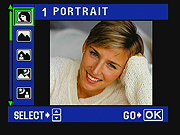 Portrait Mode: This mode optimizes the camera for capturing portraits. A larger aperture is used, so that the subject will appear sharply focused in front of a slightly soft background.
 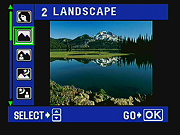 Landscape: This mode is for capturing wide views of scenery, with both the foreground and background in focus, and enhances any blue or green colors in the image, for more vibrant trees, water, and skies.
 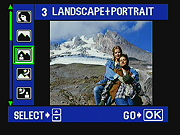 Landscape + Portrait: Similar to the above mode, this mode is for capturing portraits in front of scenery. Both the foreground and background are in sharp focus, and the camera emphasizes blues and greens.
 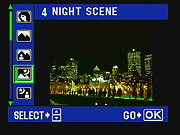 Night Scene Mode: This mode is best for capturing night portraits or night scenery, such as cityscapes. A slower shutter speed lets you shoot under darker conditions.
 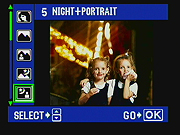 Night + Portrait: As with Night Scene mode, this mode uses a slower shutter speed to allow more ambient light into the image. However, the flash is now available in Slow-Sync mode with Red-Eye Reduction so that the subject is accurately exposed.
  Children: This mode sets the AF to Continuous mode, to make photographing busy children easier.
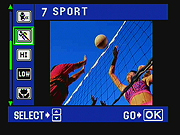 Sport Mode: This mode biases the camera's exposure system toward faster shutter speeds to freeze action and moving subjects.
 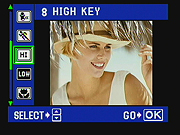 High-Key: This mode is best for capturing bright subjects. Overall image brightness is enhanced.
 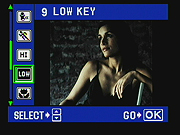 Low-Key: Optimized for dark scenes, this mode accurately reproduces dark subjects, without overdoing the shadows.
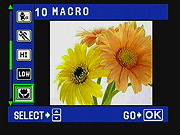 Macro Mode: This mode is intended for shooting close-ups, the minimum shooting distance determined by the lens in use.
 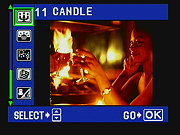 Candle: This mode uses a slow shutter speed and emphasizes a warm color balance for bright images in candlelight.
 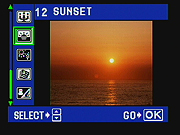 Sunset: This mode also uses a slow shutter speed for capturing vivid sunsets and sun rises. Reds and yellows are emphasized in the final image.
 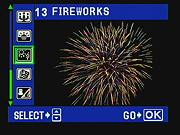 Fireworks: This mode uses a slow shutter speed to accurately capture the color and full pattern of firework displays.
 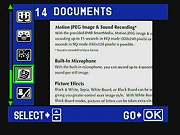 Documents: Best for shooting black and white documents, this mode increases contrast for better viewing.
 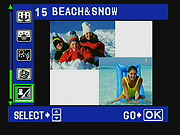 Beach and Snow: This mode is best for bright subjects such as beach and snow scenes. The camera attempts to preserve detail in the bright highlights.
Playback Mode: Accessed by pressing the Playback button on the rear panel, this mode lets you view previously captured images using the Arrow Pad to scroll through frames stored in memory. The Command dial switches the image display to Index mode when moved in the wide angle direction, and when moved in the telephoto direction, enlarges a single image. While zoomed in on an image, the Arrow buttons move the enlarged view around the full image area, allowing you to inspect all parts of it.
Still Picture Shooting Menu: In any camera mode, pressing the Menu button brings up following four-tab menu screen. Note that not all Camera menu options will be available in all modes.
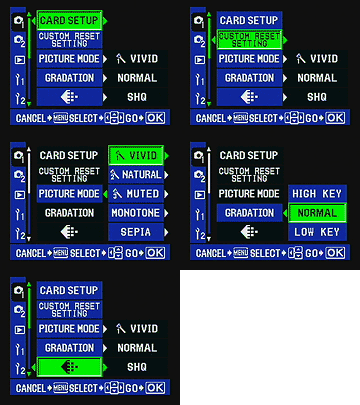 Card Setup: Erases all images on the CompactFlash or xD-Picture card or formats the card.
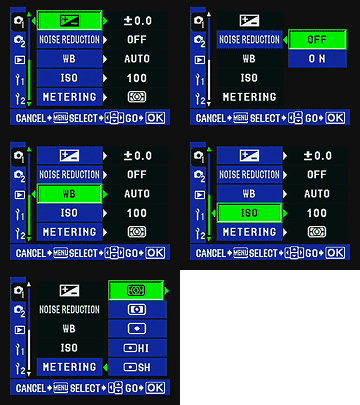 Exposure Compensation: Increases or decreases the exposure from -5 to +5 exposure equivalents (EV) in either 0.3, 0.5, or 1.0 step increments. (The step size is set in the Setup portion of the menu.)
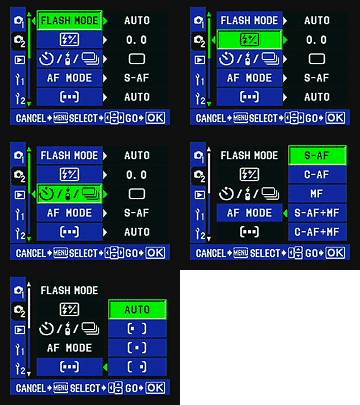 Flash Mode: Sets the built-in flash to Auto, Auto Red-Eye Reduction, Fill-In, Off, Slow-Sync Red-Eye Reduction, Slow-Sync 1, or Slow-Sync 2. There's also a range of manual flash exposure levels, in which the flash will fire at 1/64, 1/16, 1/4, or full power. This mode is handy when working with studio strobe systems with slave triggers, because in it, the flash emits only a single burst, so it will trigger conventional slave circuits properly. (Note that some flash modes will not be available, depending on the exposure mode selected.)
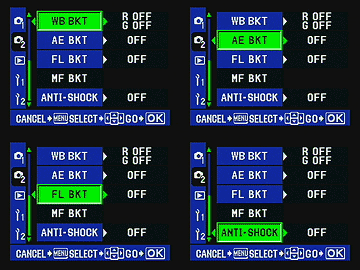 WB Bracket: Activates the white balance bracketing mode, with two, four, or six-step variable increments. Red/Blue and Green/Magenta balance can be independently controlled. (Again, an unusual level of configurability.)
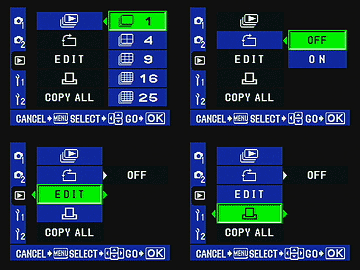 Slide Show Play: Activates an automated slide show of images stored on the memory card, in single image format, or four, nine, 16, or 25 image index display.
 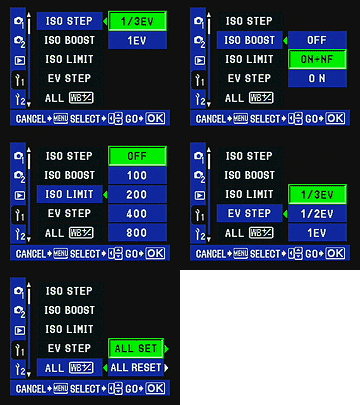 ISO Step: Sets the EV step size to 1/3 or 1 EV step size.
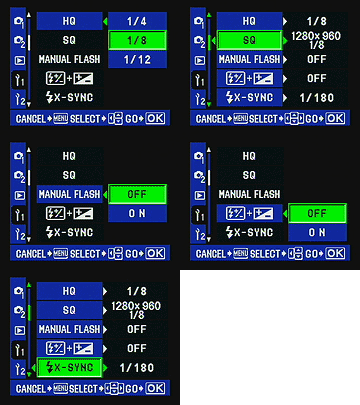 HQ: Sets the HQ JPEG compression level to 1/4, 1/8, or 1/12.
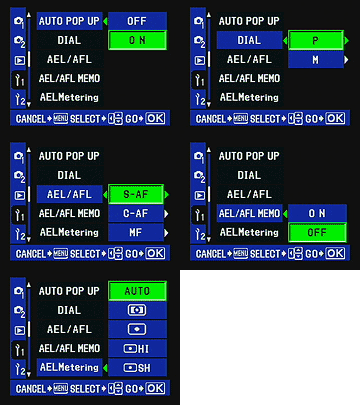 Auto Pop-up: If enabled, this option automatically pops up the built-in flash in low-lit or backlit conditions, in any of the automatic modes.
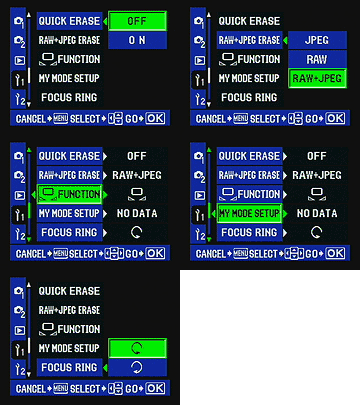 Quick Erase: If enabled, this function lets you immediately erase the captured image by pressing the Erase button.
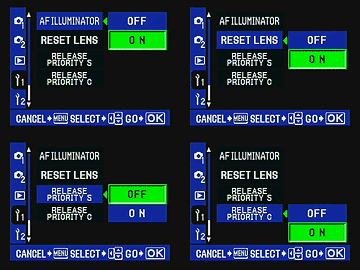 AF Illuminator: Turns the AF illuminator feature on or off. (Note that the E-500 uses the flash head as its AF illuminator, so you'll only get AF-assist illumination when the flash head is popped up; however, the flash does not necessarily need to be enabled.)
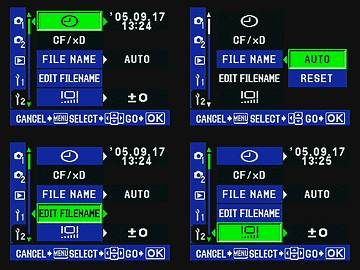 Date/Time: Sets the camera's date and time.
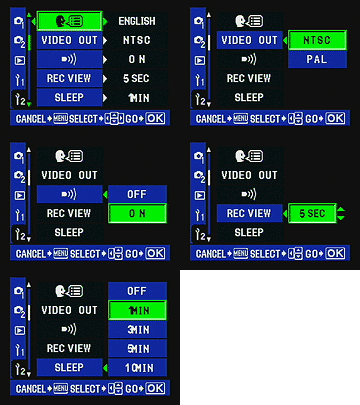 Language: Sets the menu language to English, French, German, or Spanish.
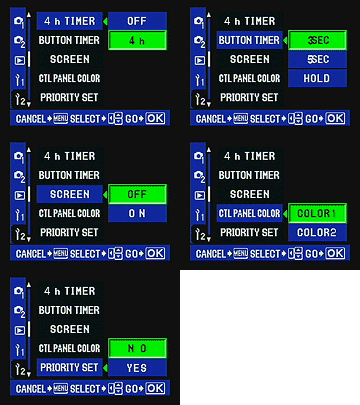 4 h Timer: Sets the power off time to four hours, or turns this function off.
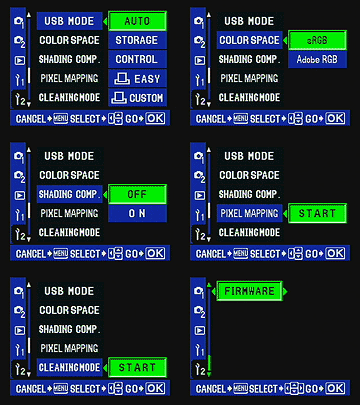 USB Mode: Sets the USB mode to Auto, Storage, Control, Print Easy, or Print Custom. Auto means that you'll need to select PC or Print in the USB connection menu when the camera is connected to a computer or printer. Storage mode allows the transfer of data from the camera to the computer. The Control setting allows you to remotely control the camera from the computer, using the included Olympus software, while the Print options are for direct printing to PictBridge or DPOF devices.
Image Storage and Interface
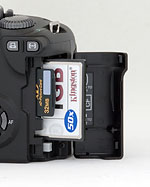 The E-500 stores images on either xD-Picture Cards or CompactFlash memory cards, and is compatible with IBM Microdrives. The E-500 does not come with a "starter" memory card, so you'll want to pick up a large capacity card right away. The camera lets you write-protect individual images from accidental erasure through the Playback menu. (Note that individually protected images can still be erased by a card format operation). (I strongly recommend buying at least a 256MB card, preferably a 1GB one, to give yourself extra space for extended outings.)
The E-500 can store images in uncompressed TIFF, RAW, and compressed JPEG file formats. JPEG compression levels include Super High Quality at 1/2.7 (SHQ), High Quality at 1/4 (HQ), and Standard Quality at 1/8 (SQ). Through the Record menu, you can set the level of compression in SQ and HQ modes. HQ can be either 1/4, 1/8, or 1/12 compression, and SQ lets you choose both compression ratio and image resolution, with compression options of 1/2.7, 1/4, 1/8, and 1/12. Resolutions include 3,264 x 2,448 (HQ and SHQ quality settings only); 3,200 x 2,400; 2,560 x 1,920; 1,600 x 1,200; 1,280 x 960; 1,024 x 768; and 640 x 480 pixels. The chart below shows how many images can be stored on a 256 MB card at each size/quality setting.
| Resolution/Quality 256 MB Memory Card |
Fine | Normal | |
|
|
|
|
|
| 3264 x 2448 | Images (Avg size) |
40 6.3 MB |
57 4.4 MB |
128 2.0 MB |
191 1.3 MB |
10 24.4 MB |
14 17.4 MB |
10 23.8 MB |
| Approx. Compression |
4:1 | 5:1 | 12:1 | 18:1 | - | 0.8:1 | - | |
| 3200 x 2400 | Images (Avg size) |
42 6.1 MB |
59 4.3 MB |
133 1.9 MB |
199 1.2 MB |
- | - | - |
| Approx. Compression |
4:1 | 5:1 | 12:1 | 18:1 | - | - | - | |
| 2560 x 1920 | Images (Avg size) |
62 4.1 MB |
104 2.4 MB |
206 1.2 MB |
306 836 KB |
- | - | - |
| Approx. Compression |
4:1 | 6:1 | 12:1 | 18:1 | - | - | - | |
| 1600 x 1200 | Images (Avg size) |
179 1.4 MB |
261 981 KB |
513 498 KB |
724 354 KB |
- | - | - |
| Approx. Compression |
4:1 | 6:1 | 12:1 | 16:1 | - | - | - | |
| 1280 x 960 | Images (Avg size) |
274 933 KB |
408 627 KB |
758 338 KB |
1138 225 KB |
- | - | - |
| Approx. Compression |
4:1 | 6:1 | 11:1 | 16:1 | - | - | - | |
| 1024 x 768 | Images (Avg size) |
419 611 KB |
612 418 KB |
1138 225 KB |
1593 161 KB |
- | - | - |
| Approx. Compression |
4:1 | 6:1 | 11:1 | 15:1 | - | - | - | |
| |
Images (Avg size) |
995 257 KB |
1448 177 KB |
112 KB |
82 KB |
- | - | - |
| Approx. Compression |
4:1 | 5:1 | |
|
- | - | - | |
The Olympus E-500 connects to a host computer via a USB interface. Downloading files to my Sony desktop running Windows XP (Pentium IV, 2.4 GHz), I clocked it at 676 KBytes/second, on the slow side by current standards, but fast enough that most users probably won't feel a need for an external card reader. (Cameras with slow USB interfaces run as low as 300 KB/s, cameras with fast v1.1 interfaces run as high as 600 KB/s. Cameras with USB v2.0 interfaces run as fast as several megabytes/second.)
Video Out
The Olympus E-500 has a Video Out port for reviewing previously captured images and movies, or running slide shows from the camera. Through the Setup menu, you can set the Video Out signal to NTSC or PAL.
Power
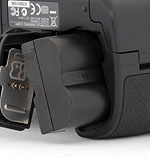 The Olympus E-500 is powered by a rechargeable BLM-1 battery pack, and a battery and charger come with the camera. Because it doesn't have a standard external power connector, we weren't able to conduct our usual power consumption tests on it. Like most digital SLRs though, the E-500 boasts excellent battery life, because it isn't dependent on the sensor and LCD for framing shots. Olympus rates the E-500's battery life at about 500 shots per charge in typical usage. If you plan to do a lot of "chimping" (looking at your photos on the LCD screen in playback mode) or expect to shoot more than 500 shots in a single outing, you'll want to get a second battery along with the camera, but for most day to day usage, a single battery should be sufficient.
Included Software
The E-500 comes with a nice complement of software on the supplied CD. Direct camera control and image downloading are provided by Olympus' Master software package for both Mac and Windows platforms (Macintosh OS 8.6-9.2/OS X, Windows 98/98SE/Me/2000 Pro/XP). USB drivers for both platforms and an Apple QuickTime reader are also included.
Olympus Master lets you download and organize images, as well as perform minor image correction and enhancement functions (such as adjusting contrast, sharpness, and color balance). It also offers utilities for printing, backing up images to hard drive or CD/DVD, and emailing, making slide shows, computer "wallpaper," albums, and for stitching shots together horizontally or vertically to make panoramas. Olympus Master's editing functions also permit you to manipulate exposure, color balance, contrast, sharpness, and saturation on images saved in the E-500's ORF "raw" file format.
Olympus also offers an optional software package, Olympus Studio, intended to be more of a professional workflow tool. Olympus Studio apparently offers more sophisticated processing of raw-format files, with a better ability to suppress color moire patterns, a sophisticated noise-reduction algorithm, and more control over image parameters than offered by Olympus Master. Studio also provides a batch processing option, to automate your workflow for raw-formatted images. Olympus Studio is an added-cost option, with a list price of $199 in the US, translating into typical "street" prices in the vicinity of $150.
In the Box
The Olympus E-500 EVOLT ships with the following items in the box:
Recommended Accessories
We ran the Olympus EVOLT E-500 through our usual battery of tests, and have summarized our findings here. To see the full set of our test images, with explanations of what to look for in them, see the Olympus EVOLT E-500 Sample Pictures page. For a complete listing of all our test and "gallery" shots, go to the Thumbnails page.
Not sure which camera to buy? Let your eyes be the ultimate judge! Visit our Comparometer(tm) to compare images from the Olympus EVOLT E-500 with those from other cameras you may be considering. The proof is in the pictures, so let your own eyes decide which you like best!
Zoom
Good performance with the 14-45mm ZUIKO lens.
 |
 |
| 14mm (28mm equivalent) |
45mm (90mm equivalent) |
The Olympus EVOLT E-500 accommodates a range of Olympus ZUIKO lenses, so performance here will really depend on the lens in use. We shot the above with the 14-45mm ZUIKO lens included with the camera, which produced very good results. (The 40-200mm telephoto furnished with the two-lens kits is also a very nice optic.)
Macro
A slightly large macro area with the kit 14-45mm kit lens, but good detail and resolution. Flash exposes fairly well, but illumination is slightly uneven up close.
 |
 |
| Standard Macro | Macro with Flash |
As with the shots above, results here will completely depend on the lens in use. However, in our testing with a 14-45mm kit lens, the E-500 captured a minimum area of 4.9 x 3.3 inches (124 x 84 millimeters). This isn't spectacular by current standards, but is fairly typical of a non-macro zoom lens. This lens does have front-element filter threads though, so it will be easy to attach add-on macro lenses to get closer. Detail is strong and resolution high, with only moderate softening in the corners from the lens. (Most cameras have some softening in the corners in macro mode.) The E-500's flash throttles down pretty well, though some falloff is visible in the corners of the frame.
Distortion
Higher than average barrel distortion at wide angle, just a small amount at telephoto.
This is the tendency for the lens to bend straight lines outward (like a barrel--usually at wide angle) or inward (like a pincushion--usually at telephoto). The 14-45mm lens included with the E-500 produced 0.9% barrel distortion at wide angle, a bit higher than average among the digital cameras we test. At the telephoto end, the lens produced about 0.07% barrel distortion, which is low.
| Barrel distortion at 14mm is 0.9% |
 |
| Barrel at 45mm is 0.07% |
 |
Chromatic aberration
Very low, small effect on images at edges.
 |
 |
| Wide: moderate, top left @ 200% | Tele: very low, top right @200% |
Chromatic aberration in the 14-45mm kit lens is moderate at wide angle, showing about 3-4 fairly bright pixels of coloration on either side of the target lines, but decreases to much lower levels at telephoto focal lengths. (This distortion is visible as a very slight colored fringe around the objects at the edges of the field of view on the resolution target.)
Corner Sharpness
Some blurring in the corners, but results improve a fair bit when stopped down.
 |
 |
| Wide Angle: Rather soft in the upper right corner. |
Wide Angle: Center, for reference. |
 |
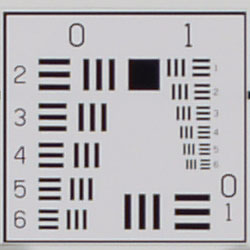 |
| Tele: Also soft in the upper right corner. |
Tele: Center, for reference. (Just slightly softer) |
Wide open (as in the shots above), the E-500's lens showed noticeable softening in the corners of the frame, the upper right corner being the worst. Thankfully, this softness decreases markedly when you decrease the aperture just one stop. Performance overall is similar to the kit lenses offered with other entry-level digital SLRs.
Coverage
Good accuracy with the optical viewfinder.
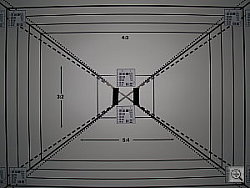 |
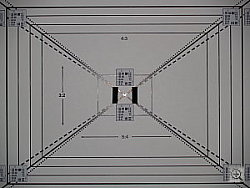 |
| 14mm eq., optical viewfinder | 45mm eq., optical viewfinder |
The E-500's optical viewfinder proved fairly accurate, showing about 96% frame accuracy at wide angle and about 95% at telephoto. This is about average for digital SLRs, as most show about 95% of the frame.
Saturation & Hue Accuracy
Good overall color and hue accuracy.
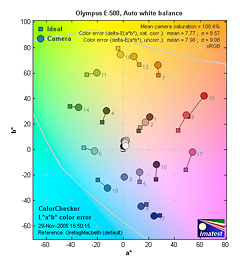 |
| In the diagram above, the squares show the original color, and the circles show the color that the camera captured. More saturated colors are located towards the periphery of the graph. Hue changes as you travel around the center. Thus, hue-accurate, highly saturated colors appear as lines radiating from the center. |
The other important part of color rendition is hue accuracy. Hue is "what color" the color is. Here, the E-500 also performed well. It does shift cyan colors toward blue (for better-looking sky colors) and magenta colors are shifted toward red a fair bit, but the rest of the hues were fairly accurate.
 |
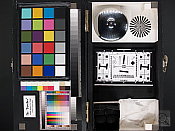 |
 |
Exposure and White Balance
Indoors, incandescent lighting
Good results with the Manual white balance setting, Incandescent and 2900K white balance settings also good, Auto quite warm-toned. Much higher exposure compensation required than usual.
 |
 |
| Auto White Balance +1.7 EV | Incandescent WB +1.7 EV |
 |
 |
| Manual White Balance +1.7 EV | 2,900 Kelvin WB +1.7 EV |
The E-500's Manual white balance setting did the best job under the incandescent lighting of this shot, producing an image that was very faithful to the original lighting. The 2,900 Kelvin and Incandescent settings also did quite well, although they both produced slight pinkish casts, while the Auto setting resulted in a very yellowish image. The camera required a hefty +1.7 EV exposure compensation boost to get a good exposure, much higher than average for this shot. (The E-500 does seem a little overly sensitive to large highlight areas near the center of the frame.) Color with the Manual white balance setting is just slightly yellowish (nicely suggesting the warmth of the original lighting, without being overpowering), but the scene colors are still pretty good. However, the blue flowers are very dark and purplish and Marti's skin tone is fairly pink. (Very common outcome for this shot.) Our test lighting for this shot is a mixture of 60 and 100 watt household incandescent bulb, a rather yellow light source, but a very common one in typical home settings here in the US.
Outdoors, daylight
Good color balance in most cases, though slightly warm with Auto white balance. Good exposure accuracy.
 |
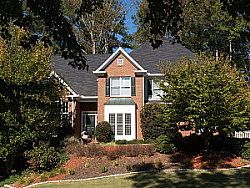 |
| Auto White Balance, +0.7 EV | Auto White Balance, Auto Exposure |
The E-500's outdoor shots were generally pretty accurate exposure-wise, though with somewhat high contrast and blown-out highlights. (The camera's contrast adjustment helped slightly, but could really stand to go further in the low-contrast direction.) Deep shadows were pretty dark, but still held onto good detail, and the camera typically required less exposure compensation than average outdoors.
See full set of test images with explanations
See thumbnails of all test and gallery images
Resolution
Very high resolution, 1,450 lines of strong detail.
Our laboratory resolution chart revealed sharp, distinct line patterns down to about 1,450 lines per picture height, with extinction at around 2,000. (The camera did produce a few slight color artifacts at lower line frequencies though, visible in the full-sized res target shots.) One could easily argue for higher resolution numbers, but we felt that the level of color artifacts that began to appear higher than 1,450 lines was such that a higher rating really wouldn't be consistent with our test standards.) Use these numbers to compare with other cameras of similar resolution, or use them to see just what higher resolution can mean in terms of potential detail.
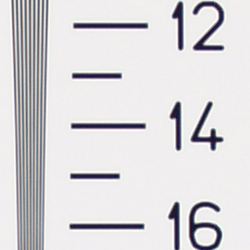 |
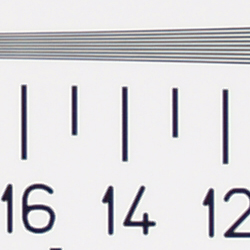 |
| Strong detail to 1,450 lines horizontal | Strong detail to 1,450 lines vertical |
See full set of test images with explanations
See thumbnails of all test and gallery images
Sharpness & Detail
Fairly good fine detail, but some coarseness from in-camera sharpening. Only slight blurring at low ISO from noise suppression in shadow areas.
 |
 |
| Good definition of high-contrast elements, but slightly coarse sharpening operator coarsens fine details. | Subtle detail: Hair Noise suppression tends to blur detail in areas of subtle contrast, as in the darker parts of Marti's hair here. |
The E-500's images are show a lot of detail overall, but the camera's sharpening algorithms tend to coarsen the very finest detail somewhat. (Edge enhancement creates the illusion of sharpness by enhancing colors and tones right at the edge of a rapid transition in color or tone.) In the detail crop above right, you can see a slight "halo" around the branches against the sky. The finest details are just a tad bulkier than in real life, and the presence of the sharpening halos precludes much improvement with unsharp masking on the computer after the fact.
Noise-suppression systems in digital cameras tend to flatten-out detail in areas of subtle contrast. The effects can often be seen in shots of human hair, where the individual strands are lost and an almost "watercolor" look appears in areas where the contrast between hair strands is low. The crop at right above shows this to a slight extent in the lower midtones, but it isn't as pronounced as we've seen in some cameras.
ISO & Noise Performance
Low noise at the low sensitivity settings, and pretty good results as high as ISO 800. However, very high noise with blurred detail at the highest setting of ISO 1600.
 |
 |
 |
| ISO 100 | ISO 200 | ISO 400 |
 |
 |
 |
| ISO 800 | ISO 1,600 | ISO 1,600 w/NR |
The E-500's lower ISO settings produced low noise, with only slightly blurred detail in the dark areas. Even at ISOs 400 and 800, while noise is a little higher, detail definition remains pretty good. At ISO 1,600, though, noise is very high, quite noticeable in 8x10 inch prints, and even 5x7 inch prints are a little marginal. The noise reduction menu option does help matters quite a bit (more apparent in prints than on-screen), at the cost of some additional loss of detail.
Extremes: Sunlit and low light tests
Some tendency to lose highlight detail under harsh lighting. Very good low-light performance, capable of capturing bright images under average city street lighting and much darker conditions.
 |
 |
 |
| +0.3 EV | +0.7 EV | +1.0 EV |
Sunlight:
Because digital cameras are more like slide film than negative film (in that they tend to have a more limited tonal range), we test them in the harshest situations to see how they handle scenes with bright highlights and dark shadows, as well as what kind of sensitivity they have in low light. The shot above is designed to mimic the very harsh, contrasty effect of direct noonday sunlight, a very tough challenge for most digital cameras. (You can read details of this test here.)
The E-500 did fairly well under the deliberately harsh lighting in the test above, but did lose more highlight detail than I'd like to see, even with its contrast control at the low setting. Still, the highlights on Marti's forehead are held in check, even though detail is lost in her shirt, and shadow detail is good, if not a little noisy. An exposure boost of +0.7 EV was just enough to brighten the overall image, without going too far and blowing out the highlights too much. (In "real life" though, be sure to use fill flash in situations like the one shown above; it's better to shoot in the shade when possible.)
| 1 fc 11 lux |
1/2 fc 5.5 lux |
1/4 fc 2.7 lux |
1/8 fc 1.3 lux |
1/16 fc 0.67 lux |
1/16fc No NR |
|
| ISO 100 |
 2 sec f3.5 |
 4 sec f3.5 |
 8 sec f3.5 |
 15 sec f3.5 |
 30 sec f3.5 |
 30 sec f3.5 |
| ISO 200 |
 1 sec f3.5 |
 2 sec f3.5 |
 4 sec f3.5 |
 8 sec f3.5 |
 15 sec f3.5 |
 15 sec f3.5 |
| ISO 400 |
 1/2 sec f3.5 |
 1 sec f3.5 |
 2 sec f3.5 |
 4 sec f3.5 |
 8 sec f3.5 |
 8 sec f3.5 |
| ISO 800 |
 1/4 sec f3.5 |
 1/2 sec f3.5 |
 1 sec f3.5 |
 2 sec f3.5 |
 4 sec f3.5 |
 4 sec f3.5 |
| ISO 1600 |
 1/8 sec f3.5 |
 1/4 sec f3.5 |
 1/2 sec f3.5 |
 1 sec f3.5 |
 2 sec f3.5 |
 2 sec f3.5 |
Low light:
The E-500 performed well here, and captured bright, usable images even at the lowest light levels we test at. With its adjustable ISO and maximum shutter time of 30 seconds, the E-500 is well-equipped for low-light shooting. The E-500's autofocus system is also capable of focusing in very dim lighting, provided that the camera and subject are both absolutely motionless. (Like most digital cameras, the E-500 is going to have a hard time focusing on moving subjects in low light, a situation where you'll be better off relying on a preset manual focus if at all possible.) It focused down to a bit under 1/8 foot-candle even with its AF illuminator turned off, and in complete darkness on nearby objects with the AF illuminator enabled. Color balance was a little warm with the Auto white balance setting, though some shots showed a slight pink cast. Noise is fairly low, even without Noise Reduction enabled. At 1,600 ISO, noise is on the high side, but is still good considering the high sensitivity setting.
Coverage and Range
Good flash capability, but a bit uneven at maximum wide angle with the kit 14-45mm lens. Our standard shots required more exposure compensation than average.
|
|
| 14mm equivalent | 45mm equivalent |
 |
 |
| Normal Flash +1.7 EV | Slow-Sync Flash +1.0 EV |
With the 14-45mm kit lens, flash coverage was rather uneven at wide angle, much more uniform at telephoto. In the Indoor test, the flash on the E-500 underexposed our subject at its default setting, requiring a +1.7 EV exposure compensation adjustment to get bright results. Most cameras underexpose this shot by about a full f-stop, so the E-500's +1.7 EV adjustment is a fair bit higher than most. In the Slow-Sync flash mode, the camera only required a +1.0 EV exposure boost, but coverage appears about the same.
| 8 ft | 9 ft | 10 ft | 11 ft | 12 ft | 13 ft | 14 ft |
 1/80 sec f5.6 ISO 100 |
 1/80 sec f5.6 ISO 100 |
 1/80 sec f5.6 ISO 100 |
 1/80 sec f5.6 ISO 100 |
 1/80 sec f5.6 ISO 100 |
 1/80 sec f5.6 ISO 100 |
 1/80 sec f5.6 ISO 100 |
The E-500's built-in flash illuminated the test target all the way to 14 feet with fairly consistent intensity, though results were slightly dim overall.
Print Quality
Good print quality, nice color. Prints at 13x19 are a little soft if viewed closely, but look great at normal viewing distances. High ISO (1600) is rough at 8x10 inches, but noise reduction helps quite a bit, albeit with some cost in sharpness.
Testing hundreds of digital cameras, we've found that you can only tell just so much about a camera's image quality by viewing its images on-screen. Ultimately, there's no substitute for printing a lot of images and examining them closely. For this reason, we now routinely print sample images from the cameras we test on our Canon i9900 studio printer, and on the Canon iP5000 here in the office. (See the Canon i9900 review for details on that model.)
With 8 megapixels of resolution and decent optics, the Olympus E-500 produces great looking prints as large as 13x19. At that size, if you squint at them close up, they look a little soft/coarse/heavy, likely from the slightly heavy-handed in-camera sharpening we commented on earlier. Interestingly though, if you step back and look at them at more normal viewing distances for prints that size (say a foot or so), the give an entirely different impression of excellent sharpness. - It seems that the sharpening we've been criticizing as being heavy-handed is actually tuned very well to typical print sizes and viewing distances.
High ISO shots seem to be the E-500's Achilles' heel though, as noise is quite apparent in ISO 1600 shots printed at 8x10 inches. The menu option for additional high-ISO noise reduction does make a very visible difference in apparent noise levels at ISO 1600, albeit at some additional cost in lost sharpness. ISO 1600 shots do look much better when printed at 5x7, especially if the noise reduction system is engaged. Overall, the E-500 is quite usable at ISO 1600, but isn't in the same league as cameras like the Canon Digital Rebel XT for such application.
Olympus EVOLT E-500 Timing
Slightly slow for a digital SLR.
|
Startup/Shutdown:
|
|
|
Power On to first shot
|
3.0 seconds
|
|
Shutter response (Lag Time):
|
|
| Full Autofocus Wide |
0.37 second
|
| Full Autofocus Tele |
0.38 second
|
| Prefocused |
0.095 second
|
|
Cycle time (shot to shot)
|
|
|
Normal large/fine JPEG
|
0.90 second
|
|
Flash recycling
|
5.0 seconds
|
|
Continuous mode
|
0.39 second
2.58 frames/second (4 large/fine frames) |
|
Download speed
|
|
|
Windows Computer, USB 2.0
|
676 KBytes/sec
|
The Olympus E-500's performance ranges from average to a bit slower than average, depending on what you're trying to do. Startup time is a little slow for an SLR at 3.0 seconds, but keep in mind that camera is performing its Supersonic Wave Filter operation, which many might argue is a worthwhile wait. Shutter lag is good at both wide angle and telephoto, and gets very fast when the camera is prefocused (when the shutter button is halfway pressed and held prior to the shot). Shot to shot cycle times are acceptable but by no means category-leading, at about 0.9 seconds for large/fine JPEGs, though Continuous-mode speed is average, at about 2.58 frames/second, but a smallish buffer memory limits you to bursts of only four large/fine JPEG images at that speed. The flash takes about five seconds to recharge after a full-power shot, also slightly slow for an SLR. Connected to a computer, download speeds are fast enough that you shouldn't feel a need for a separate card reader, but nonetheless aren't as fast as many cameras currently on the market.
Battery
Typical (good) battery life for a digital SLR.
The Olympus E-500 uses a custom rechargeable LiIon battery for power. Because it doesn't have a standard external power connector, we weren't able to conduct our usual power consumption tests on it. Like most digital SLRs though, the E-500 boasts excellent battery life, because it isn't dependent on the sensor and LCD for framing shots. Olympus rates the E-500's battery life at about 500 shots per charge in typical usage. If you plan to do a lot of "chimping" (looking at your photos on the LCD screen in playback mode) or expect to shoot more than 500 shots in a single outing, you'll want to get a second battery along with the camera, but for most day to day usage, a single battery should be sufficient.
Storage
No card is included with the Olympus EVOLT E-500, but it accepts both CompactFlash and xD-Picture Cards.
| 256MB Memory Card |
Fine | |
| 3,264 x 2,448 | Images | 40 |
| File Size | 6.3MB | |
| 3,200 x 2,400 | Images | 42 |
| File Size | 6.1MB | |
| 2,560 x 1,920 | Images | 62 |
| File Size | 4.1MB | |
| |
Images | 179 |
| File Size | 1.4MB | |
| |
Images | 274 |
| File Size | 933K | |
| |
Images | 419 |
| File Size | 611K | |
| |
Images | 995 |
| File Size | 257K | |
We strongly recommend that you buy a large capacity CompactFlash memory card, at least 512 MB, and preferably a full gigabyte, to give you ample space for extended shooting sessions.
| Pro: | Con: |
|---|---|
|
|
| Free Photo Lessons | |
|
The Olympus E-500's combination of very extensive Scene modes with full-featured exposure and creative control suit it to situations where both novice and experienced shooters need to share the same camera. While easy enough for pure novices to use in its fully automatic "green zone" mode, the E-500's more advanced exposure options will also be appealing to more experienced digital photographers, as it's arguably the most configurable camera anywhere close to its price class.
The camera itself is priced quite competitively, but the bundled kit consisting of the camera body and Olympus 14-45mm and 40-150mm lenses make for a bargain that's just unbeatable in the current market. (This review is being written in late November, 2005) The availability of high-quality, affordable lenses is important to any entry-level SLR, and this has been addressed both by Olympus themselves in the form of the two lenses just mentioned, as well as by third-party lens maker Sigma, who now has an extensive and growing line of Four Thirds-compatible lenses available.
The E-500's image quality is generally quite good, with pleasing color and image noise matching that of the competition at all but its highest ISO setting. If you're shopping for a digital SLR, and don't already own a bagful of Canon or Nikon lenses, the Olympus E-500 EVOLT deserves a very close look indeed. It will be interesting to see how the E-500 fares in the market, but our prediction is that its going to be one of the hottest SLRs going, both in the upcoming holiday season and throughout 2006 as well. Highly recommended, and one of the standout bargains in the entire SLR field.
<<E-500 Sample Images | Additional Resources and Other Links>>
Reader Comments!
Questions, comments or controversy on this product? Click
this link to see what other Imaging Resource readers have had to say about
the Olympus EVOLT E-500, or add comments of your own!