CES PANEL DISCUSSION
A Glimpse Into the Digital Imaging Future
 By MIKE PASINI
Editor
The Imaging Resource Digital Photography Newsletter
Hosted by Mike McNamara, Popular Photography & Imaging executive technology editor, the Tuesday panel titled "A Glimpse Into the Digital Imaging Future" delivered on its promise. The topic got a thorough going over by an all-star panel of what McNamara called "visionists," which included:
|
|
- Nancy Carr, Kodak vice president of consumer imaging and director of strategic relationships. Before joining Kodak, Nancy was general manager of Nikon, Inc., responsible for launching the consumer digital camera business. Earlier at Apple Computer, she was marketing manager for the Publishing Group, directing marketing activities targeted at publishing firms and was an early advocate of Internet publishing.
- Chuck Westfall, Canon director/media & customer relationships
- Bob Gove, vice president of Micron Technology
- Tanya Chuang, SanDisk senior worldwide retail product marketing manger for the digital imaging market
- Mikko Pilkama, Nokia vice president and director of media experiences. Responsible for managing Nokia Nseries solutions, services, applications and partners globally, he holds a Master of Science degree in International Economics from the Helsinki School of Economics and Business Administration and is a Fellow of Helsinki School of Economics and IMD Business School in Lausanne.
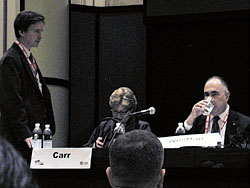
McNamara, Carr, Westfall
Their job was to address questions about "the next great product." But "product" didn't just mean camera. Also under the microscope were systems and services. What, the panel was asked over and over, do consumers want?
We settled into a plush chair and took out our pen and notepad, a relic of simpler times. But with no clock to reset, no batteries to recharge, no storage space to run out of and the virtue of our impossible-to-crack encrypted handwriting allied with amble space to doodle, it was just the multimedia thing. Apologies in advance for omissions and misrepresentations (based no doubt on the sound system).
THE MEGAPIXEL WARS | Back to Contents
McNamara's warm-up question was whether anyone thought the megapixel wars would continue.
Carr remembered wondering if two megapixels would be enough and here we are at 10 megapixels. Now, she believes, the war will never end. Consumers think more is better even if it doesn't mean better quality. Manufacturers will have to invest in software that runs in the camera to handle the problems higher Mp counts bring with them.
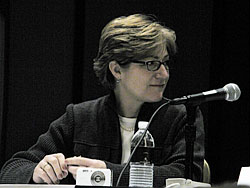
Carr
Pilkama showed Nokia's new 5-Mp camphone, unimaginable only a little while ago and a reality today, citing its robustness and durability. So the race will continue, he predicted. He expects more advances in lens technology to make thinner devices with more megapixels possible.
Picking up on Carr's point, Westfall pointed out that picture quality means more than megapixels. Noise reduction, for example, is a essential software requirement as the pixel count goes up. But there is a physical limit to the size of a pixel and we're very near it. That's 1.4 microns and we're at 1.9 microns now with 10-Mp sensors. But lenses can only resolve a larger size dot, so the optical info is larger than the electronic info. So the direction of technology needs to go in is more than just the pixel and more than just the lens to improve picture quality.
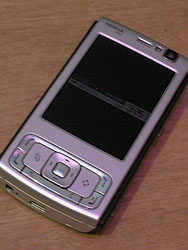
Nokia's 5-Mp Camphone. Nokia's camphone optimized for stills.
Grove added that Micron has achieved 1.4 micron pixels in the lab now. He expects the war to continue "forever." It will get more difficult but that's the point of all the technology we've ever developed, he said. Each advance crosses new boundaries. If flat lenses distort images, as Pilkama had said, then extremely advanced image processing is the solution. But we can do more with the current resolutions.
IMAGE PROCESSING | Back to Contents
McNamara pushed the panel further on the issue of image processing, asking if it was a key issue.
Carr explained consumers just want better pictures, period. They want facial smoothing, for example, in portrait mode for older people, minimizing wrinkles. Scene recognition, automatic tagging, easy operation, perfect pictures are all winners with users. In fact, users expect them.
Chuang pointed out consumer education at the retail level identifies certain features as must-haves. Image stabilization, for example, becomes a must-have feature when the consumer hears about it at the retail counter, even if they don't understand it. Consumers discover these must-have features and shop for them.
That phenomenon is an issue with multimedia computers, Pilkama noted. The trick is to convince the consumer it's an all-in-one device. Ease of use, he said, is paramount for such devices. They want an easy way to tell their story, especially with video.
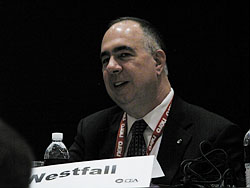
Westfall
Gove illustrated the easy-of-use concept with a camphone that can scan a business card on its screen and store the information in the device's address book. It's simple to use and when people see it, they go, "Wow!"
McNamara asked the panel if new product offerings were suffering featuritis. Do we need things like GPS and imaging processing in our handheld devices?
Carr said people used to take a picture "to remember something." But now it's about "visual communications," especially in the youth market. It's not about remembering something but communicating constantly. Text messaging is big now but it will be replaced by images soon.
Westfall agreed that in-camera image processing is important but of some concern. He's seen cases where tone curve manipulation is unreal, creating a kind of auto distortion. Do customers want that? Canon is looking at that, he said, but believes in the purity of an image as its most important quality.
BATTERY LIFE | Back to Contents
Are we going to see any advances in battery life, McNamara asked.
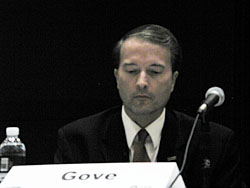
Gove
Westfall said power consumption is improving but battery technology will improve, too. He expects to see improvements of 10 to 20 times in the future.
Pilkama revealed that several technological advances beyond the lith-ion battery are taking place now, it's just a matter of which will mature first. The need for more capacity is clear, though.
FLASH MEMORY | Back to Contents
McNamara wondered if the declining price of flash memory will mean we'll see more built-in memory, perhaps as much as a gigabyte.
Chuang thought we would, especially for certain applications. She said consumers will lead companies in the right direction, deciding how that capacity will be used.
Gove agreed there's a need for more memory, especially for video. He mentioned the 8-GB Apple iPhone introduced that morning as an example. It becomes your computer, not just your phone, he observed.
Westfall thought demand for solid state memory will be particularly high in the camcorder business as we move away from tape and older video formats to HDTV.

Chuang
Gove added that our video-based culture demands instant video technology. The power demands have to be satisfied but it's a system design issue. He cited Bluetooth as an example. The device can leave it on all the time, draining the battery or it can enable it just when transmitting.
Carr thought there's no need to store everything on every device, but that ideally storage should be "in the sky." By uploading your images to servers, you can instantly share them and not be burdened with storing them on your local device.
SHARING IMAGES| Back to Contents
So, McNamara wondered, how do we share those images?
Carr predicted the home of the future will be wire free. Access will be the key issue. And you'll get access to your images from a central server much like you get access to your cash from an ATM. You'll just need a password on a card to get them from any kiosk. And when you create the image, you'll be able to send it to the server automatically so it's immediately available for sharing. Tagging will be the key to managing this but Bluetooth is the technology for recognizing devices and transmitting images.
Pilkama
Pilkama observed that radio technologies like Bluetooth and WiFi are standard now. The big players have to agree on future standards. Then manufacturers can hide the technology from the consumer, making them easy to use.
Is the print in jeopardy, McNamara asked. With flat screen TVs and online sharing services, are prints relevant any more?
Chuang said sharing technologies just give consumers more options. Being in the tech world, we have a distorted view of what people want, though. In some places, she said, consumers have no idea what you're talking about when you mention some of these things. They still want their prints.
Westfall said that while there are more and more output options, it's important to remember that the number of images being captured has increased significantly and continues to grow. Consequently, the volume of prints "is pretty good these days." Moreover, he added, there is a value to a print that can't be replaced.
Pilkama suggested that "connected cameras" are what people want. Devices that by nature share and can retrieve shared images. Nokia, he said, is number one in the number of pictures uploaded. In the developing world, the phone is the only screen in the house, providing Web browsing as well as still and video capture.
Westfall cited some figures on the evolution of the camera market. At its height, still camera units in the U.S. sold 20 million units a year. In 2007, we expect to sell 32-35 million combined digicam and dSLR units in the U.S. The market for camphones is expected to break one billion units in 2009.
Carr said there are two reasons to make a print. The first is to create a visual record of something. The second is to create a specialty product. She used to take 12 rolls of film a year, she said. Now she spends no less than $50 every time she turns a photo into some photo gift online. Showing your photos on your flat screen TV will be commonplace, she predicted.
MANAGING IMAGES | Back to Contents
So how are we going to keep track of all those images, McNamara wanted to know.
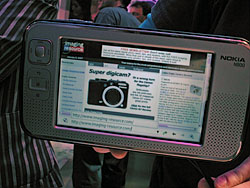
Nokia N800. A Web browser (displaying the Imaging Resource home page) and Internet phone.
Pilkama said that right now in 2007 metadata is the biggest help in managing images. GPS will be a big help, too. And there are already online services that tap into that data.
Westfall described Microsoft's PhotoSynth project as "absolutely astounding." Images are organized by location so you can click on a place to see more images of it, no matter when they were taken or by whom.
Pilkama added that this provides a way to build "metadata communities."
And Grove observed that "swath photography," which sweeps over a large scene for processing as individual images later, makes it possible to delay the solution past the moment of capture.
The question and answer session that followed brought up a couple of interesting observations:
- Gove said the demand for CMOS chips will continue to be high thanks to the security industry. But there are new markets emerging in motion detection like automotive uses (backing up, parking assistance). Carr agreed, noting that at Kodak sensors are a big part of the picture.
- The credibility of images has taken a hit with digital photography. Everybody knows they can be manipulated. But we never should have trusted images anyway, McNamara observed. Carr added that nobody likes the recorded sound of their voice or the way they look in pictures. They want to look better than they actually do.
- Westfall acknowledged that the still camera vs. camcorder battle is still an issue. Historically, he said, still has had to be higher resolution than video but the consumer wants the convenience of both. The conversion from traditional video to HD video is an opportunity to resolve this. Gove noted that video's fixed frame rate requires a large aperture on a large lens to gather light.
 |
