ON THE FLOOR
The 35.2 Billion Dollar Pixel
 By MIKE PASINI
Editor
The Imaging Resource Digital Photography Newsletter
ORLANDO, Fla. -- In his keynote, Hewlett Packard's V.J. Joshi let it slip that the photo industry is a $35.2B piece of pie. As pieces of pie go, it's got a nice flaky silver halide crust and sweet digital filling. But the digital component is what has everyone's taste buds watering these days.
That's the macro view, but as we went booth to booth and watched one presentation after another, we found ourselves reconsidering the micro view. What, we kept trying to picture, is happening to that poor little pixel that, with a few million of its friends, make our pictures?
Quite a lot is happening from capture to automatic in-camera processing to pre-transfer optional enhancements to image manipulation on a computer. Not long ago, the camera's job was just to capture some light. The computer did the rest.
But software is a salmon that swims upstream. And we're seeing it infiltrate everything from pre-capture lens operation to post-capture image manipulation. Everything, that is, from deciding what to shoot to fixing what you shot.
A HYBRID LENS | Back to Contents
Optical design has always been constrained by the physical limits of optical science and the practical limits of expense. But DxO Labs (http://www.dxo.com) has jumped both hurdles by tossing software into the mix.
As DxO's Nicolas Touchard explained in an Imagining Resource video interview (http://www.imaging-resource.com/EVENTS/PMAS06/PMAS06VIDEO.HTML#pma07), inexpensive cameras can enjoy advanced features when they combine image processing with optics.
The first thing it achieves, he said, is taking pictures in very low light (3-4 lux). A wider aperture can be used without introducing more lens elements.
The second trick is getting rid of the autofocus actuator, mimicking autofocus in software. Even with no moving parts, the lens can still autofocus via software.
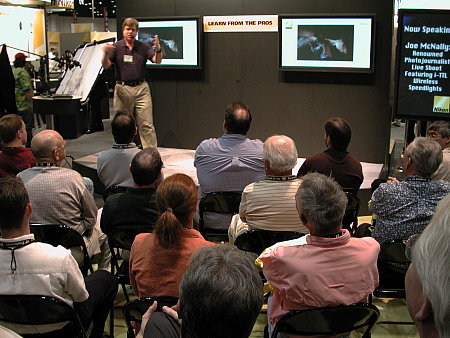 |
| Photographer Joe McNally Illuminating wireless flash at the Nikon booth |
The upshot is that you can take photos in situations darker than city street lighting at night (11 lux) that are perfectly focused. The IR video actually has a test showing the difference between current technology and a prototype of DxO's hybrid lens. The hybrid looks as bright as if it were taken in daylight.
UPOINT TECHNOLOGY | Back to Contents
At the other end of the process, the recent collaboration between Nik Software (http://www.niksoftware.com) and Nikon (http://www.nikonusa.com) has produced an image editing program unlike any we've seen. Capture NX, based on what Nik calls UPoint technology, edits an image by adjusting the properties of as many color control points you set in the image.
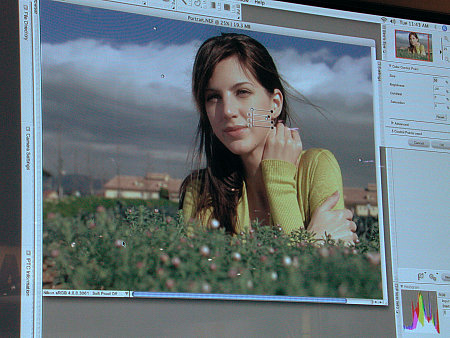 |
| A Color Control Point Note the 'E'-shaped sliders on her face |
Nik's Josh Haftel demoed the UPoint aspect of Capture NX by opening an image of a woman in a field of flowers with a blue, cloudy sky behind her. The sky was a bit dull, so he clicked in it. A small graphic similar to a capital E with one more horizontal bar was overlaid on the image where he had clicked.
The bars of the E were, in fact, sliders for Brightness, Contrast and Saturation. In addition, each color control point can have Hue Red, Green, Blue and White Balance sliders.
Adjust the sliders and you are also adjusting every other pixel in the image with the same characteristics as the color control point's single pixel (and those characteristics include the surrounding pixels).
Yes, that's a little too far reaching. In fact, the clouds became a little too blue when he adjusted the sky's color control point to be brighter.
The solution is to add another control point to adjust the clouds. Control points negotiate between themselves whenever you add them and adjust their sliders to decide who controls which pixels. They remain visible so you can find them as you work, too.
While the technology works on NEF, JPEG and TIFF files, there is no support for DNG files in Capture NX.
We stopped by the Bellamax booth (http://www.bellamax.com) to have a look at UpShot, an image editing program designed for consumers that borrows from the company's pro lab offerings.
The Java program will be released as a public beta for Windows in April. We liked the automatic corrections it made to the sample images we saw, but what caught our eye was something we haven't seen in an image editing application since Asiva. UpShot can mask an image by selecting not regions of pixels but tones.
This can be a very powerful and simple way to mask a complex image. It can also be confusing. But the trick is to sample the part of the image you want to be selected, noting the luminance values. Then you adjust a tone range graph to show which values should be selected. No meticulous, mind-numbing drawing.
Somewhere between DxO and Nik Software, FotoNation has been hard at work to put some smarts in your camera.
They're the guys behind the explosion in WiFi digicams. Canon, Kodak and Nikon all use FotoNation PTP software to do WiFi communications.
But they also dabble with in-camera image editing, like red-eye detection and correction. You can find this technology in a number of digicams, printers, photo kiosks and image editing applications.
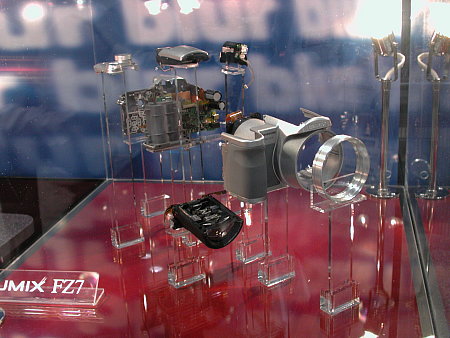 |
| Exploded Lumix FZ7 Where's the software? |
And they've written software to recognize faces in a scene. Face Tracker identifies and locks onto human faces in the preview image, tracking them as they move around the frame. A box is drawn around each face to indicate it is being tracked. And it works in profile, too. That helps automatically establish the correct image orientation (landscape or portrait) and adjust the white balance to capture good skin tones.
Finally, they've developed software to remove dust that inevitable accumulates on dSLR sensors. Using a dust map, the software can "clean" away the debris from each shot, taking into account the effect of focal length and aperture. It can even determine when the camera is too dirty and the sensor has to be swabbed.
IVIEW SURVEY | Back to Contents
At the iView Multimedia booth, we learned the results of its survey Understanding Professional Photography Workflow, in which over 700 photographers participated. The message was loud and clear: speed up the workflow.
Commercial photographers, the majority of survey respondents, defined workflow as "a broad, complex and inclusive process from shooting images to archiving them." While all agreed the benefit of having an effective workflow was it "saves time," the majority (73 percent) admitted their workflow "could be better." And 71 percent felt that their workflow processes were lacking or included significant problem areas.
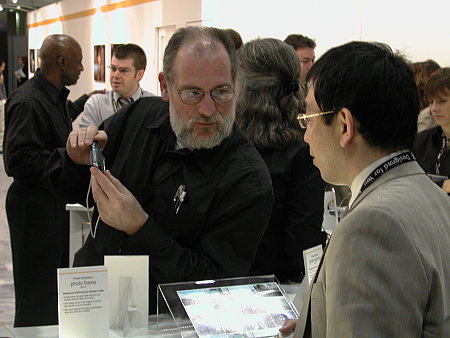 |
| Help from an Expert. One nice thing about these sort of events is the chance to handle the products and talk to people who know how to use them |
The group was divided nearly in half on whether or not they had implemented a consistent process or felt they had the proper tools to do the job. Forty percent said they use a "consistent process" while 53 percent say they are "working on it." On whether they owned the proper tools to enable an effective workflow, 52 percent said they did not, while 47 percent replied they did.
Most described Raw file conversion and color correction/touch up as the most time- consuming step in their workflow. They also characterized this step as causing the "most frustrating delays." Next in line was adding metadata to images.
The final survey question had asked, "What is the one 'silver bullet' that would eliminate the main frustration associated with your workflow?"
The one consistent response -- "speed" -- was defined in many ways, from a faster computer, compatibility between related applications or more automated features within applications. Answers reflected the individuality of respondents, from, "I don't believe in silver bullets," to "more training and review of training I've already had."
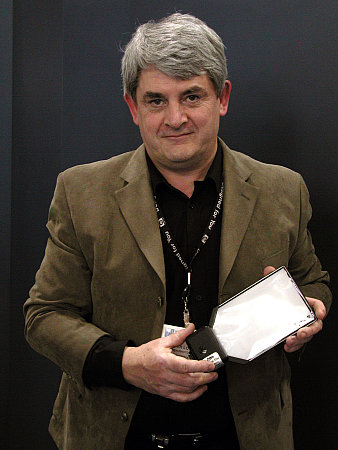 |
| Peter Louden. Seen here with his Zenon MagneFlash 57, the idea that started it all |
We had the fortune to run into Peter Louden of Louden Photographic in Ipswich, U.K. and his U.S. representative Bill Stocks. Peter describes himself as "an electrical engineer but perhaps not a photographer." Which is probably the secret to his success.
We're in the midst of reviewing one of Peter's latest creations, a copy table that uses three flash panels based on his Zenon technology (http://www.imaging-resource.com/ACCS/ZMF/ZMF.HTM).
As many lighting booths as there are, there is nothing at the show like Peter's copy table. The acrylic flash panels transmit most of the light passing through them, which is scattered by physical patterns in the panels. They consequently use very little power (one or two AA rechargeables per panel, depending on its size) and have very even and very fast (1,000 of second, roughly) illumination.
A brighter, faster light makes it possible to hand-hold a camera to shoot product shots. And it also means they're much sharper, as well.
But Peter pointed out it's easier to capture metallic subjects (like camera bodies) and other high-key subjects with flash than with the more common nylon tent setup, illuminated by floodlights from the outside.
He's made a few revisions to the construction of the copy table since he sent the review unit and we were glad to hear about each one of them. We had had a rough time with the battery compartments, finally giving up entirely on replacing their covers. The problem, Peter explained, is that rechargeable AAs are often a bit bulkier than normal alkalines. He's using a more forgiving battery compartment now.
THE DUCKS CALL IT A DAY | Back to Contents
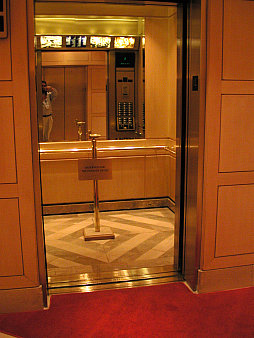
We've had the pleasure of staying at the Peabody Hotel just across the street from the convention center. The hospitality has been wonderful. But when we returned to the hotel today we thought they'd really outdone themselves. There was a red carpet laid out right to our elevator and the door was open, waiting for us.
 |
 |
|
| Royal Treatment But not, apparently, for us (as the sign suggests) |
||
Well, no, not us, it turns out. The elevator was reserved for the ducks who live in the penthouse and come down daily to water themselves in the courtyard fountain.
We took a clue from the ducks and called it a day. It's tough work covering a $35.2 billion business.
 |