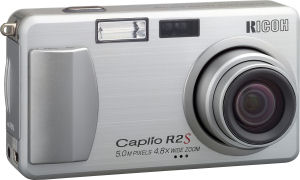
 Ricoh Japan updates the Caplio R2
By
Mike Tomkins
(Thursday, June 30, 2005 - 13:33 EDT)
A press release distributed by office automation / consumer electronics company Ricoh Co. Ltd. of Japan announces that it has released an updated version of its Caplio R2 digital camera in that market.
The Ricoh Caplio R2, announced four months ago, offered a 28 - 135mm zoom range coupled with a five megapixel CCD image sensor and 2.5" LCD display (but no optical viewfinder). The new Ricoh Caplio R2S shares exactly the same hardware and a nearly identical body, the only noticeable styling differences being a rearrangement of the silk-screened text on the camera's front panel, and the removal of the engraved product name from the handgrip. The bulk of the changes are instead related to the camera's firmware. Probably the most significant change is that the Caplio R2S' shutter can now be remotely controlled over its USB connection, allowing camera shake to be minimized. It is also now possible to store a group of custom settings in the camera, which are then automatically used when the R2S is powered on. These settings can include the zoom position, focus position, scene mode, burst mode, exposure compensation, white balance, image quality / size, focusing and metering area, ISO sensitivity, flash mode, macro mode, and quite a few more besides. Ricoh is also promoting the camera as compatible for direct printing to its IPSiO CX8800 and CX9800 color laser printers, although it is unclear whether this is actually a new feature using some proprietary connection type, since the original Caplio R2 and both of the printers are apparently PictBridge compatible. One last new feature is the ability to tag images with text or audio clips. Text can either be entered ahead of time over the USB connection, or entered using the camera's menu system and controls. The Ricoh Caplio R2S is available immediately in Japan, at a price of ¥58,000 (approximately equivalent to US$523 / CAD$642 / £292 / €433, ignoring exchange rate fluctuations, taxes and duties). Monthly production is apparently set at 2,000 units. | Ricoh Caplio R2S | 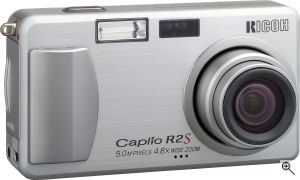 | | General | | Camera Type | Compact | | Manufacturer | Ricoh | | Model Number | R2S | | Dimensions | 3.9 x 2.2 x 1.0"
100.2 x 55.0 x 25.8mm | | Weight | 195.0 g
6.8 oz | | Planned Availability | Jun 2005 | | Image Capture | | Sensor Type | 1/2.5" CCD
5.19 megapixels (total)
5.02 megapixels (effective) | | Filter Type | RGBG | | Aspect Ratio | 4:3 | | Image Dimensions | 2560 x 1920 (4.9 megapixels)
2048 x 1536 (3.1 megapixels)
1280 x 960 (1.2 megapixels)
640 x 480 (0.3 megapixels) | | Image Quality | 2 levels | | Image Preview / Review | | Viewfinder | No | | LCD | 2.5", 114,000 pixels | | Lens | | Lens Type | 4.8x optical zoom | | Image Stabilization | No | | Focal Length | 4.6 - 22.2mm (actual)
28 - 135mm (35mm equivalent) | | Aperture Range | f/3.3 (wide) / f/4.8 (tele) - ??? | | Focusing System | with AF assist lamp
Manual Focus possible (0) steps | | Focusing Range | Normal: 12" - infinity (30 cm - infinity)
Macro: 0.4" - infinity (1.0 cm - infinity) | | Exposure | | ISO Sensitivity | Auto, 64, 100, 200, 400, 800 | | Shutter Speed | 8 - 1/2000 second | | Metering Modes | 256-segment multi, center-weighted, spot | | Exposure Compensation | +/- 2.0EV in 1/3EV increments | | White Balance | Image Sensor - Auto, Daylight, Cloudy, Incandescent 1 / 2, Fluorescent, One Touch, Manual | | Internal Flash | Modes: Auto, Red-Eye Reduction, Forced, Slow Sync, Off
Range: ISO Auto: 0.2 - 2.7m (wide); 0.13 - 2.1m (tele) | | Creative | | Scene Modes | Portrait, Sport, Landscape, Night, Text, High Sensitivity | | Digital Zoom | 3.6x | | Self Timer | Yes, 2 or 10 seconds | | Time Lapse | Yes | | Movie Format | AVI (Open DML Motion JPEG) with audio
320x240 and 160x120
Max. frame-rate: 15 frames per second | | Storage | | Recording Medium | SD/MMC, Built-in | | File System | Complies with Design Rule for Camera File System (DCF) | | File Format | TIFF, JPEG (EXIF 2.21) | | Connectivity | | Video | Yes, NTSC / PAL switchable | | Computer | USB 1.1 | | Other | DC In | | Power | | Battery Type | Rechargeable | | Battery Form Factor | 2 x AA or 1 x proprietary DB-50 | | Product Bundle | | Software | Ricoh Gate La, Image Mixer 1.6, USB / WIA drivers, Mounter, Caplio Rescue, Acrobat Reader, DirectX, Ridoc Desk 2000 Lt, Caplio Transfer Software | | Battery / Charger | 1 x Proprietary DB-50 rechargeable battery and charger | | Flash Memory | 28.0MB built-in memory | | Other | | Digital Print Order Format (DPOF) compliant | Yes | | Internal Microphone | Yes | | Remote Control | Yes, USB tethered | | Operating System Compatibility | Windows, MacOS | | |
|