The Imaging Resource
Quick Review
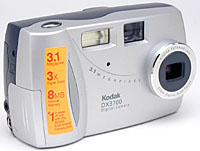
Kodak EasyShare DX3700 Digital Camera
 |
Camera QuickLook | |
|
Review Date
|
|
|
|
User Level
|
|
|
|
Product Uses
|
|
|
|
Digicam Design
|
|
|
|
Picture Quality
|
Good, 3.1-megapixel CCD | |
|
Print Sizes
|
4x6, 5x7, 8x10 inches | |
|
Availability
|
2001 | |
|
Suggested Retail Price
|
|
|
|
||||||||||
Introduction
Eastman Kodak Company has a long history of bringing professional imaging processes
to the everyday consumer. Kodak's EasyShare System is the company's digital
equivalent to its turn-of-the-century Brownie box camera, which came with preloaded
film and no manual controls (once users shot all their film, they simply sent
the boxes back to Kodak for processing and printing). While the first two Kodak
EasyShare digicams, the DX3500 and DX3600, were much more sophisticated than
a Brownie, they did feature the same "just press the button" simplicity,
with fully automatic controls and an optional docking station that takes all
of the guesswork out of digital image manipulation, management, and sharing.
As Kodak evolved the line, they've introduced more advanced cameras that do
offer a few user options. The subject of the current review though, is the EasyShare
DX3700, a 3-megapixel camera that reverts to the "one button" roots
of the line, offering little in the way of user controls, and a fixed focal-length
lens (although it does offer a "digital zoom" option).
Kodak's Picture Software is also extremely easy to use -- walking you through every step of the uploading, enhancing, and emailing process -- and has a more graphically intuitive interface than almost any other consumer imaging software I've seen. It automatically sizes the images for printing or emailing, stores copies, applies simple effects, and allows you to make image corrections, such as color, brightness, and contrast adjustments. Taken as a group, the DX3700 and its lower- and higher-end cousins are some of the simplest, most goof-proof cameras currently available. In the DX3700, Kodak's created a bare-bones three megapixel camera that still manages to snap good photos under a surprising range of shooting conditions.
Camera Overview
At about the same size as a compact, point-and-shoot film camera, the Kodak EasyShare DX3700's design should feel familiar to most novice users. The slightly chunky body style is substantial enough to provide a good hold on the camera, while at the same time maintaining a light weight. The two-toned charcoal and silver body is all plastic, keeping the camera's weight down to just 7.4 ounces (210 grams) without batteries, lens cap, or memory card. The DX3700 has very minimal exposure controls, making camera operation smooth and quick, with a pared-down LCD menu that covers only the basics (such as file size, macro mode, etc.). The DX3700's 3.1-megapixel CCD delivers good quality images, which can be printed as large as 8x10 inches with great detail, as well as smaller files better suited for emailing. Although a little large for a standard shirt pocket, the DX3700 is compact enough for larger coat pockets and purses, and comes with a wrist strap for toting. Like the rest of the EasyShare line, the DX3700 works with Kodak's EasyShare camera dock, which acts as a battery charger, AC adapter, and PC connection tool. A plastic insert comes with the camera fitting bottom of the DX3700 to the standard camera dock.
The DX3700 is equipped with a 7.9mm lens, equivalent to a 37mm lens on a 35mm camera. (This equates to a moderately wide angle field of view.) The camera automatically controls the lens aperture, offering f/3.3 and f/5.6 settings. Focus ranges from 1.6 feet (50 centimeters) to infinity in normal AF mode, and from 6.0 to 20.0 inches (15 to 50 centimeters) in Macro mode. Though the camera's focal length is fixed, the DX3700 does offer as much as 3x digital zoom. As always though, keep in mind that digital zoom decreases the overall image quality because it simply enlarges the center pixels of the CCD image. If you need to be able to zoom while preserving sharp details and high image quality, consider spending the extra money for a true optical zoom lens, as on the DX3700's sibling, the DX3900. For composing shots, the DX3700 has both a real-image optical viewfinder and 1.6-inch color LCD monitor. (In my testing, the DX3700's optical viewfinder wasn't very accurate, but the LCD monitor was almost 100% accurate. You'll need to learn to compensate for the optical viewfinder, to avoid cutting off parts of your subjects.) The LCD monitor also displays (very) basic camera information, including the current battery charge level, quality setting, flash mode, and number of images that can be stored on the memory card at the current quality setting.
As befits its EasyShare name, the DX3700 offers purely automatic, point-and-shoot operation. Kodak doesn't state the DX3700's shutter speed range anywhere in the documentation, but the camera seems to handle typical shooting situations fairly well. A Mode switch on the back panel puts the camera into either Record, Playback, or Setup modes, with the LCD menu system only available in Setup mode. (The LCD is active in other modes, but the menu options only appear in Setup mode.) The DX3700 can vary its ISO sensitivity (light sensitivity) from 100 to 200, but this setting is made automatically, with no option for the user to express a preference. White balance, exposure compensation, and metering are also completely automatically controlled, leaving only the flash, image quality, and macro mode selections up to the user. A Flash button on the back panel activates either the Auto, Fill, Off, or Red-Eye Reduction flash modes, an icon for each mode appearing on the LCD display as it's selected.
The DX3700 has eight megabytes of internal memory, meaning you can snap a few pictures without needing a memory card. The camera also has an SD / MMC memory card slot, but does not come with a card. I highly recommend picking up a larger memory card, given the DX3700's 2,160 x 1,440 maximum resolution, particularly given how cheap memory cards are getting these days. (Get at least a 32 megabyte card - They're currently available in sizes up to 128 MB, and will likely get even larger as time goes by.) The camera uses either two AA-type batteries or one CRV3 battery for power. A Kodak CRV3 battery comes with the camera (though the manual notes that some cameras may ship with a pair of lithium AA batteries instead). If you purchase the accessory camera dock, it includes a set of two NiMH rechargeable batteries, which can be charged in the camera while the camera is in the dock. If you do buy the dock, I strongly advise getting an additional set of rechargeables, and keeping a freshly-charged set on-hand. If you don't purchase the dock, the definitely buy a couple of sets of high-power NiMH rechargeable batteries and a good charger. For more information, read my "NiMH shootout" article, and the review of my favorite battery charger. The DX3700 will automatically shut itself down after a brief period of inactivity, in order to save battery power. (The delay before the camera goes to sleep is fixed, and can't be changed by the user.) The DX3700 features a USB jack for downloading images to a computer, though you can also connect the camera to the dock (which in turn is connected to your computer) and download files with the press of a button. A software CD accompanies the camera, loaded with Kodak's unusually easy-to-use Picture Software, compatible with Windows 98/98SE/ME/2000/XP and Macintosh OS 8.6-X. For connecting to a television set, the DX3700 has a Video Out jack and US versions come with an NTSC video cable. (I assume the European counterpart ships with the appropriate PAL cable, given the PAL option in the camera's menu system.) The DX3700 is DPOF (Digital Print Order Format) compatible, letting you set the number of prints you'd like of each picture in Playback mode. - These settings are only pertinent when you're printing with a DPOF-compatible output device.
Basic Features
- 3.1-megapixel CCD.
- 1.6-inch color LCD monitor.
- Real-image optical viewfinder.
- Glass, 37mm lens, with apertures from f/3.3 to f/5.6.
- 3x digital zoom.
- Automatic exposure control.
- Automatic ISO rating of 100 and 200.
- Built-in flash with four operating modes.
- SD / MMC or internal 8MB memory storage.
- Power supplied by two AA batteries, one CRV3 battery, or optional AC adapter via camera dock accessory.
Special Features
- DPOF (Digital Print Order Format) compatibility.
- USB cable for connection to a computer (driver software included).
- Compatible with the Kodak EasyShare camera dock, for quick connection to a PC or Mac.
- Video Out jack for connection to a television set.
Recommendation
The DX3700 is a very basic point & shoot camera, ideal for people wanting sharp 8x10 prints with an absolute minimum of fuss, but probably not a first choice for an "enthusiast" user. Like the DX3500 and 3600 before it, the DX3700 manages to capture surprisingly good photos under a wide variety of conditions. (Surprising, that is, given the complete lack of exposure adjustment controls.) While I personally prefer a camera with a zoom lens (like the DX3900), the DX3700 will be perfect for the person who literally wants to "point & shoot." A good "family" camera because it's literally goof-proof. Great for anyone who's technology-averse, but still wants to take good digital photos.
Design
Though slightly bulkier than other models in the EasyShare line, the DX3700
is compact enough for travel. Measuring 4.7 x 2.7 x 1.8 inches (118.7 x 69.5
x 45.8 millimeters), the DX3700 will fit well into larger coat pockets and average-size
purses. The camera's wrist strap is convenient when holding the camera in-hand,
but I'd still recommend a small camera bag for better protection when traveling.
An all-plastic body keeps the DX3700's weight down, at just 7.4 ounces (210
grams), without batteries, lens cap, or memory card.
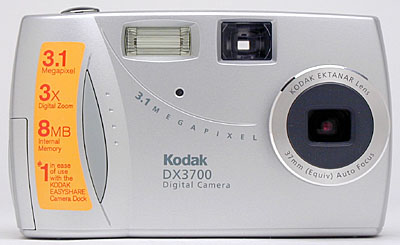
The DX3700's front panel has only a couple of protrusions, the largest being the lens barrel. The fixed-focal length lens remains in place when the camera is powered on, and is protected by a removable plastic lens cap. A small strap tethers the lens cap to the camera body, making it less likely to get lost. A very slight bulge around the right side of the camera body (as viewed from the back) provides a subtle hand grip, with a soft, rubbery grip pad for your fingers to cling to. Also on the front panel are the flash, optical viewfinder window, and a tiny light sensor, just under the flash.
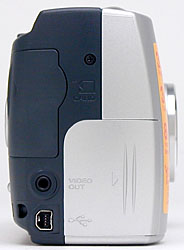
On the right side of the camera is the memory card compartment, battery compartment, Video Out jack, and USB jack. Both connector jacks are uncovered, making them easily accessible, but also exposing them to dust and dirt. The battery compartment cover slides toward the front of the camera before opening on hinges, and the pressure of the door keeps the batteries locked securely in place. The SD / MMC memory card slot opens from the back of the camera, sliding outward before flipping open.
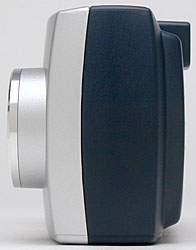
The left side of the camera is plain and smooth, with no features or controls.
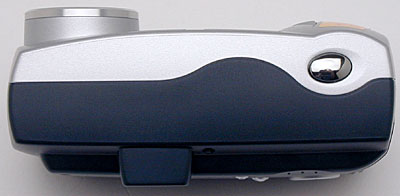
The top of the DX3700 is empty apart from the silver, oblong Shutter button.
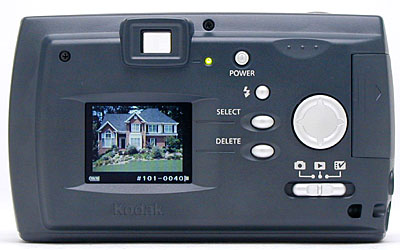
All remaining camera controls are on the back panel, along with the optical viewfinder eyepiece and LCD monitor. An eyelet for attaching the wrist strap is in the lower right corner of the back panel, just below the door of the memory card slot. The DX3700's optical viewfinder has a medium-high eyepoint, so most eyeglass thicknesses should be accommodated. (I still found it slightly awkward to look through with my glasses on though.) A small LED next to the viewfinder lights to indicate the camera's status, such as when focus is set or when the flash is charging. Camera controls are limited to the Power, Flash, Select, and Delete buttons, as well as the Four Way Arrow pad and Mode switch.
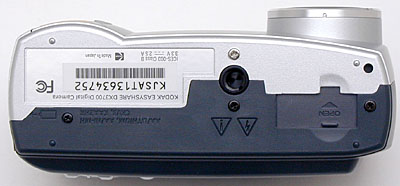
The DX3700 has a flat bottom panel, which holds the dock connector jack (protected by a sliding plastic cover) and slightly off-center plastic tripod mount.
Camera Operation
With just a few control buttons and very limited exposure controls, the DX3700's user interface shouldn't take long to master. Flash and digital zoom are the basic exposure options, and are controlled externally. A single LCD menu, activated in Setup mode, accesses Record, Playback, and basic camera setup functions, making it quick and uncomplicated to change settings. The Mode switch on the camera simplifies operation as well, offering only three modes (Record, Playback, and Setup). Even with a brief glance at the instruction manual, it shouldn't take more than a few minutes to get the DX3700's operation down, even for complete novices.
External Controls
Shutter Button: With a smooth, elliptical shape, the Shutter button protrudes just slightly from the camera's top panel. Pressed halfway, it triggers the autofocus and exposure mechanisms. A full press fires the shutter.

Power Button: The top button on the back panel, this button turns the camera on or off.

Flash Button: Located diagonally beneath the Power button and slightly to the right, this button controls the flash operating mode. Pressing it sequentially cycles through Auto, Fill, Flash Cancel, and Red-Eye Reduction modes, with large, friendly explanations displayed on the LCD screen for each option.

Select Button: Just below the Flash button, this button controls the digital zoom in Record mode. In Playback mode, this button enlarges the current image, and returns to the normal display. When in any settings menu, this button confirms menu selections.

Delete Button: Directly beneath the Select button, this button pulls up the Delete menu, with options of deleting the current image, all images, or no images.
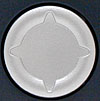
Four Way Arrow Pad: Located on the far right side of the back panel, this large button toggles left and right or up and down. In Record mode, the up arrow activates the LCD display, while the down arrow cancels it.
In Playback mode, the left and right arrows can be actuated to scroll through captured images on the card. When images have been saved to an external memory card, the up and down arrows select the number of prints to be made for the current image. When an image has been enlarged, all four arrows move around within the view.
In Setup mode, the left and right arrow keys navigate through menu selections, while the up and down arrows highlight choices.
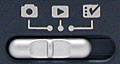
Mode Switch: Just below the Four Way Arrow pad, this switch controls the camera's operating mode, placing it into Record, Playback, or Setup modes.
Camera Modes and Menus
Record Mode: Designated on the Mode switch by a small camera symbol, this mode sets up the camera for capturing still images. The user can adjust flash mode and digital zoom. No menu is available in this mode.
Playback Mode: This mode lets you review captured images on the memory card or in the camera's internal memory, as well as erase them. If images are saved to an external memory card, the user can set the number of DPOF prints to be made. No menu options are available in this mode.
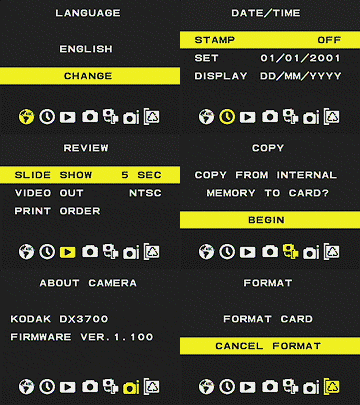 Setup Mode: The final position on the Mode switch, this mode displays the camera's settings menu, which is divided into categories. A series of icons along the bottom of the screen specify the type of setting, and are navigated with the right and left arrow keys. The following options are available:
- Language: Changes the camera's menu language to English, French, Japanese, German, Italian, Spanish, or Portuguese.
- Date/Time Set: Sets the camera's internal calendar and clock. There is also an option to stamp the date and/or time on recorded images.
- Review: Offers two Review mode options:
- Slide Show: Plays back all images on either the memory card or saved in the internal memory as an automatic slide show. You can select the time delay between shots, from five to 60 seconds.
- Video Out: Sets the camera's video-out signal to PAL or NTSC timing.
- Capture: Displays the following Record mode options:
- Image Quality: Sets the file size/quality to Best / Enlargements (2,160 x 1,440 pixels), Better / Snapshots (2,160 x 1,440 pixels), or Good / Email (1,088 x 720 pixels).
- Macro: Turns the Macro shooting mode on or off.
- Quickview: Turns the automatic Quickview function on or off, which automatically displays the most recently captured image for a few seconds after capture.
- Copy: (Only appears when an external memory card is in the camera.) This lets you copy images from the internal memory to a memory card. Images cannot, however, be copied from the memory card to the internal memory.
- About Camera: Displays the camera's firmware information.
- Format: Formats either the internal memory or SD / MMC memory card, which erases all files.device.
Sample Pictures
See our sample pictures and detailed analysis here. The thumbnails below show a subset of our test images. Click on a thumbnail to see the full-size photo.
 |
 |
 |
|
|
|
|
|
|
|
|
|
|
|
|
|
|
|
|
|
|
|
|

Specifications
See the specifications sheet here.
Picky Details
Information on shooting speed, battery life, etc. can be found here.
Test Results
For a full analysis of all the test photos I shot with the DX3700, check its Pictures Page. Here's a brief synopsis of my major findings though:
- Color: The DX3700 produced bright, pleasing, and mostly accurate color throughout my testing, both outdoors and under the studio lights. It also did surprisingly well under household incandescent lighting, a very tough light source for most digicams to deal with. It's default exposures indoors were a little dim, but turning on the flash produced exceptionally nice results, the flash blending with the room light to produce very even illumination. Overall, the DX3700 produced very good color under a wide range of lighting conditions.
- Exposure: The DX3700 accurately exposed most shots, but tended to overexpose high-contrast subjects slightly. (Seen in my "outdoor portrait" shot, the far-field house shot, and to a lesser extent on my "Davebox" target.) That said though, the camera generally produced nice midtone values, which is what casual photographers most often are looking for, even at the expense of highlight or shadow detail. Although I don't have a lot of shots posted to show it, other than the indoor portrait test, I found that leaving the flash on in fill-flash mode all the time did a lot to boost image brightness and make the 3700's rather high contrast more manageable.
- Sharpness: Image sharpness was average to a bit below average for a three megapixel camera. While other, higher-end three megapixel models will outperform it, the images from the DX3700 are more than sharp enough to make good-looking 8x10 prints. Optical distortion was a little above average for a fixed focal length lens, showing about 0.7 percent barrel distortion. Chromatic aberration was moderate as well.
- Closeups: With its fixed focal length, wide-angle lens, the DX3700 is only an average to slightly below average macro shooter. It captures a macro area of 5.67 x 3.78 inches (144 x 96 millimeters), somewhat larger than average among the digicams I've tested. Details are pretty sharp in the center of the frame, but the corners get fairly soft. (Corner softness is a very common lens failing in macro photography with many digicams.) The camera's flash throttled down pretty well for the macro area, but was quite a bit off-center. (If you could back off a bit, the flash might be a bit more even.) Overall though, the DX3700 probably isn't the camera to get if you need to do a lot of close-up shooting. (The DX3900 would be a much better choice.)
- Night Shots: Well, I guess the DX3700 had to have at least real one achilles heel, and low light performance is it. The camera takes bright pictures only down to about 8 foot-candles, which is about eight times brighter than a typical city night scene under normal street lighting. If you have to shoot after dark, plan on using the flash.
- Battery Life: Two-cell cameras like the DX3700 suffer somewhat from short battery life when the LCD is turned on, and the DX3700 is no exception to that rule. With the LCD off though, battery life is reasonable, as long as you use good-quality NiMH rechargeable batteries. (Don't even think about running digicams from standard AA alkaline cells.) I do strongly recommend buying and carrying along an extra set or two of rechargeable batteries.s.
In the Box
The DX3700 arrives with the following items:
- Wrist strap.
- Lens cap with strap.
- CRV3 lithium battery.
- USB cable.
- NTSC video cable (US models).
- Dock insert (for use with accessory camera dock).
- Software CD.
- Instruction manual, software guide, and registration kit.
Recommended Accessories
- Large capacity SD / MMC memory card.
- Dock kit (which includes rechargeable batteries).
- Additional set of rechargeable batteries.
- Soft case.
Conclusion
Compact, light weight, and portable, the EasyShare DX3700 is a pure point-and-shoot style digital camera that requires almost no effort or thought to operate. Depending on your interests, its simplicity will make it either perfect for or completely uninteresting to you. - Perfect for novices and technophobes, but of little interest to sophisticated shooters. As with several other cameras in Kodak's EasyShare line, I was really surprised by how well the camera did with absolutely no input from the user. (The one unusual piece of advice I have for users is to shoot with the flash on all the time, with any subjects closer than about 15 feet, even if it's daytime. The fill-flash really helps brighten the shots and reduce the camera's somewhat high contrast.) While not as sharp as most higher-end 3 megapixel cameras, the DX3700 captures print-quality images with good color, and the automatic exposure control handles average shooting situations quite well. It's not great for low-light or macro work, but if simplicity is what you want in a camera, the DX3700 is for you. I see this as being a great point & shoot camera for families (even ones with small children who'd like to take pictures), grandparents, or anyone else who really doesn't want to get into all the technology normally associated with digital photography. I always strongly recommend spending the extra money to get a camera with a zoom lens, but if you can't swing the extra cash for a DX3900, the DX3700 will give you good photos with little fuss or muss.


Follow Imaging Resource: