The Imaging Resource
Quick Review
Minolta Dimage Xi Digital Camera
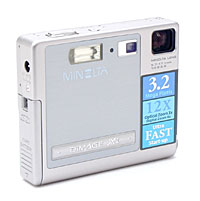 |
Camera QuickLook | |
|
Review Date |
|
|
|
User Level |
|
|
|
Product Uses |
|
|
|
Digicam Design |
|
|
|
Picture Quality |
Very Good, 3.2-megapixel CCD | |
|
Print Sizes |
4x6 to 11x14 inches | |
|
Availability |
(now) | |
| Suggested Retail
Price |
$499 | |
|
||||||||||
Minolta really turned heads last year when they introduced the diminutive Dimage X, a two megapixel camera in the form of a square block of metal, just barely over three-quarters of an inch thick. The Dimage X's clever "folded" optical system not only enabled the super-thin design, but made for rapid startup times, since there was no need to wait for the lens assembly to telescope out when the camera was turned on.
This year, Minolta has updated the popular Dimage X, by increasing the resolution of its CCD to a full 3.2 megapixels, and adding sound capabilities as well. Based on my tests, I'd say that they've also improved the camera's color handling too. The net result is a nice boost in image quality in one of my favorite subcompact camera models. Read on for all the details, but if you're looking for a super-portable, stylishly different camera, the Dimage Xi deserves a close look.
Camera Overview
With its unique, vertical lens design, Minolta's Dimage Xi, like the Dimage
X before it, has a tiny, extraordinarily thin all-metal body. Measuring a mere
3.3 x 2.8 x 0.78 inches (84.5 x 72 x 20 millimeters) and
weighing only 5.4 ounces (153 grams) including the
battery and SD memory card, the Dimage Xi is one of the smallest multi-megapixel
digicams on the market. With the extremely compact design, there's no excuse
for leaving it behind, as the camera can tag along in even the smallest shirt
pocket, or be quickly tucked into an evening bag or pants pocket. The sleek
design includes a built-in lens cover which conveniently slides out of the way
whenever the camera is powered on, eliminating any concern over misplacing a
lens cap. An all-metal case is rugged and solid-feeling, and should withstand
the wear and tear of daily use better than most cameras. The 3x zoom lens, combined
with the full automatic exposure control makes the camera suitable for most
common shooting conditions. The 3.2-megapixel CCD produces high resolution images
for printing, as well as lower resolution images better suited for email.
The Dimage Xi has a 3x, 5.7-17.1mm lens, the equivalent of a 37-111mm lens on a 35mm camera. The autofocus covers a range from 9.8 inches (0.25 meters) to infinity. Depending on the lens zoom position, the maximum aperture ranges from f/2.8 to f/3.6. In addition to the optical zoom, the Dimage Xi offers 4x digital zoom. (Although I always remind readers that digital zoom always decreases the overall image quality because it simply enlarges the central pixels of the CCD's image.) You can choose between the real-image optical viewfinder or the 1.5-inch, color TFT LCD monitor to compose images, although as usual, the LCD monitor provides the most accurate framing.
Exposure is automatically controlled at all times, with only a few exposure options available. An On/Off button on top of the camera powers the camera on, and a Mode switch lets you select between Record and Playback modes. Thanks to the all-internal lens design, there's no need to wait for the lens to extend before you can shoot, so startup times are very short. (A bit under three seconds.) Most exposure options are controlled through the LCD's on-screen menu system, which offers very straightforward navigation. That said, you can control flash mode, exposure compensation, and the lens zoom externally, via buttons and controls on the camera's rear panel. Shutter speeds range from 1/1,000 to two seconds, though the chosen value is not reported to the user. The right and left arrow keys on the camera's back panel control the Exposure Compensation, adjusting it from -2 to +2 exposure equivalents (EV) in one-third step increments. Sensitivity is adjustable to values of 50, 100, 200, or 400, with an Auto setting as well. White Balance is adjustable through the settings menu, with options for Auto, Daylight, Cloudy, Incandescent, and Fluorescent light sources. The Dimage Xi's built-in flash operates in Auto, Red-Eye Reduction, Forced, Suppressed, or Slow Sync modes.
In addition to the basic exposure options, the Dimage Xi also offers a few extra shooting modes, controlled through the settings menu. In Movie exposure mode, the camera captures 320 x 240-pixel resolution moving images with sound, in 35-second segments. (The included 16MB SD card should hold a total of approximately 41 seconds worth of movies, larger cards will store proportionately more.) A Self-Timer mode provides a 10-second delay between the time the Shutter button is pressed and when the camera actually takes the picture, allowing you to get into your own shots. For shooting fast action subjects, the Dimage Xi's Continuous Shooting mode captures a rapid series of images when you hold down the Shutter button, much like a motor drive on a traditional 35mm camera. Provided that there's enough space remaining on the memory card, the camera can capture up to 7 large/fine images, or over a hundred small/economy mode ones before having to pause to write the image data to the memory card. Details like image size and shutter speed can affect the shooting interval, but it averages approximately two frames per second. Finally, Audio Recording mode lets you record sound clips as long as 30 minutes (without an image), although the maximum recording time may also be limited by the amount of available memory card space. (A full 30-minute recording will occupy about 14 megabytes of card space, depending on the content being recorded.) The Dimage Xi also features a Voice Memo option, for recording short sound clips to accompany recorded images.
The Dimage Xi stores its images on an SD memory card, and a 16MB card accompanies the camera. (The camera also works with the slightly less expensive MMC cards.) Connection to a host computer for image download is via USB. The Dimage Xi is a "storage-class" device, which means that it doesn't require any separate driver software for Windows 2000 and XP, or for Mac OS 8.6 and later. (Download speed is also quite good, in the range of 500-575 KBytes/second.) The camera utilizes an NP-200 rechargeable lithium-ion battery for power, one of which is included with the camera, along with the necessary battery charger. While the Dimage Xi's battery life is better than most subcompact cameras, I still highly recommend picking up an additional battery pack and keeping it freshly charged. The optional AC adapter is also useful for preserving battery power when reviewing and downloading images, or when viewing images and movies on a television, via the supplied A/V cable.
Basic Features
- 3.2-megapixel CCD.
- Real-image optical viewfinder.
- 1.5-inch color TFT LCD monitor.
- Glass, 3x, 5.7-17.1mm lens, equivalent to a 37-111mm lens on a 35mm camera.
- 4x digital zoom.
- Automatic exposure control.
- Shutter speeds from 1/1,000 to two seconds.
- Maximum aperture f/2.8 to f/3.6, depending on lens zoom position.
- Built-in flash.
- SD/MMC memory card storage, 16MB card included.
- Images saved as JPEG or uncompressed TIFF files.
- Power supplied by one NP-200 rechargeable lithium-ion battery or optional AC adapter.
- Dimage software and USB drivers included for both Windows and Mac platforms.
Special Features
- Movie mode with sound.
- Continuous Shooting mode.
- 10-second Self-Timer for delayed shutter release.
- Voice Memo mode for recording captions.
- White balance (color) adjustment with five modes.
- Adjustable ISO.
- DPOF (Digital Print Order Format) compatibility.
- Video cable for connection to a television set.
- USB cable for connection to a computer (driver software included).
Recommendation
|
||||||||||||||||||||||||||||
The Dimage Xi is very small and compact. Its full automatic exposure control suits standard point-and-shoot operations, although the user does have a few options for brightening or darkening the image, or adjusting the color balance. The 3.2-megapixel CCD delivers good quality images, with enough resolution to make sharp 8x10 prints, and a low resolution option for email purposes. The Dimage Xi's tiny size and rugged case design make it a natural for "anywhere/anytime" photography. With its point-and-shoot appeal and ease of use, the Dimage Xi is perfect for novice users who simply want to take good pictures without getting too involved in the technicalities. Even sophisticated users will appreciate its exceptional portability and good picture-taking capabilities though. It'd thus do well as a "second camera" for enthusiasts, too.
Design
Like the Dimage X before it, the Dimage Xi has an amazingly thin, tiny case.
Its almost-square body shape and lack of protrusions make the Dimage Xi one
of the most portable cameras I've seen. Measuring just 3.3 x 2.8 x 0.78 inches
(84.5 x 72 x 20 millimeters), the Dimage Xi fits just about anywhere, including
the smallest of shirt pockets. Matching its diminutive size, the Dimage Xi is
also very light weight at just 5.4 ounces (153 grams) including
the battery and SD memory card. The secret to the Dimage Xi's compact
design is its internally-mounted lens, which stretches vertically up the side
of the camera rather than protruding from the camera's front. An internal prism
reflects light from the subject down into the lens itself, almost like a periscope.
The internal lens mounting means that there's no wait for the lens barrel to
extend when you power up the camera, making startup times very quick. (Less
than three seconds from power on to the first shot captured.)
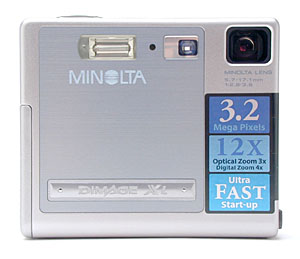
The front of the camera holds the lens window, flash, optical viewfinder window, and self-timer lamp. A shutter-like, retractable lens cover protects the lens window whenever the camera is powered off, sliding quickly out of the way when the camera is turned on. The front of the Dimage Xi is very flat, without any finger grips, meaning you'll want to keep the provided strap securely around your wrist when holding the camera.
The design of the Dimage Xi almost dictates a one-handed grip, something that took me a little getting used to. I realized that I almost always hold a camera with both hands, for a more stable shooting platform, minimizing camera shake. With the Dimage Xi, when I steadied the camera with my left hand, I at first frequently found myself putting a finger over the lens opening. Not a big deal, as I quickly got used to just using a couple of fingers on the bottom left corner of the camera, but something to watch for when you first start shooting with it.
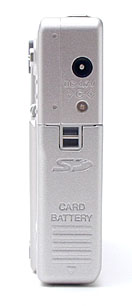
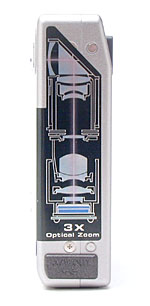
On the right side of the camera (as viewed from the rear) is the SD memory card and battery slot, as well as the DC In power jack and a wrist strap attachment eyelet. A sliding door protects the battery/card compartment, with a few ridges on it to make it easier to open. Beneath the compartment door, the battery and SD card fit side-by-side. I thank Minolta for providing side access to both the battery and memory card slots, meaning you don't need to dismount from a tripod to change out either one. (Although I frankly doubt the Dimage Xi will be used on a tripod very often.)
The opposite side of the camera is featureless except for the A/V Out jack, protected by a soft, rubbery flap. This view of the camera shows the decal that illustrates the clever lens design Minolta is so justifiably proud of. Be reassured though, that the label can be easily removed after purchase, to result in a very sleek, elegant case design.
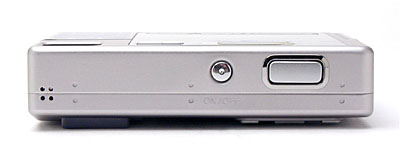
The Dimage Xi's top panel is sleek and smooth, with only a minor protrusion from the Shutter button. Also on the top panel are the microphone (just barely visible as four tiny holes in the panel cover at left) and Power button.
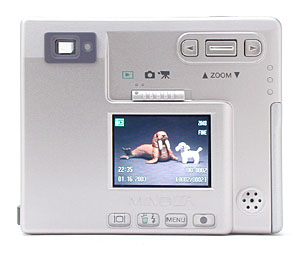
The remaining camera controls are on the back panel, along with the optical viewfinder eyepiece and 1.5-inch color LCD monitor. A single LED lamp next to the optical viewfinder reports the camera's status, such as when focus is set, when the flash is charged, etc. To the right of the viewfinder eyepiece are three multi-function buttons, which access different settings in Playback and Record modes, also serving as navigation arrows in the menu system (the rocker button in the center serves for up and down menu navigation). A slide switch controls the camera's operating mode, selecting between Playback or Record modes. Arranged under the LCD monitor are the Display, Flash / Erase, Menu, and OK buttons. A small speaker in the lower right corner plays back recorded sounds.
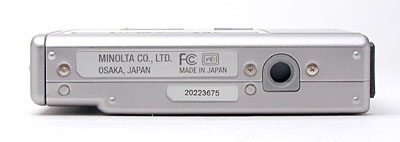
The bottom panel of the Dimage Xi reveals only the plastic, threaded tripod mount, slightly off center from the lens.
Camera Operation
The Dimage Xi's user interface is very straightforward, as the camera employs
automatic exposure at all times. While zoom setting, flash mode, and exposure
compensation can be adjusted via the rear-panel controls, all the other features
and functions are controlled through the LCD menu system. In both capture and
playback modes, the camera's menu system is divided into three pages, delineated
by subject tabs at the top of the screen. The Mode switch lets you quickly switch
between Playback and Record modes. Considering the camera's automatic exposure
control and limited user options, most users should be able to become familiar
with the camera's operation in 30 minutes to an hour. (And experienced users
may not even need to crack the manual.)
External Controls

Power Button: Unobtrusively located near the center of the camera's top panel, this button turns the camera on and off.

Shutter Button: Directly to the right of the Power button, this button sets focus and exposure when pressed halfway, and fires the shutter when fully pressed.
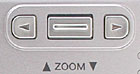
Right and Left Arrow Keys: Located in the top right corner of the back panel, these buttons control exposure compensation while in Record mode. (Pressing the OK button accepts the adjustment.) In any settings menu, these buttons navigate through menu choices.
Zoom Toggle Button (Up and Down Arrow Key): Centered between the Right and Left Arrow keys, this control adjusts the optical and digital zoom in any record mode. It also serves as the up/down control when navigating LCD menu choices.
In Playback mode, this button cancels the information overlay, as well as accesses the nine-image index display mode.
Mode Switch: Just below the Arrow keys, this sliding switch sets the camera's operating mode, placing it in either Playback or Record mode.

Display Button: The first control button in a series beneath the LCD monitor, this button controls the LCD display. In Record mode, pressing this button once disables the information overlay. A second press cancels the image display altogether and shuts off the LCD monitor (great for saving battery power), while a third press recalls both the information and image displays.
In Playback mode, pressing the Display button displays or dismisses the same information display as in record mode. A third press switches to a 2x3 display of thumbnail images for rapidly reviewing photos in the camera.

Flash / Erase Button: To the right of the Display button, this button cycles through the available flash modes in any Record mode. Options include Auto, Red-Eye Reduction, Forced, Suppressed, and Slow Sync.
In Playback mode, this button lets you delete the displayed image.

Menu Button: Adjacent to the Flash button, this button calls up the settings menu in both Record and Playback modes.

OK Button: The final button in the series beneath the LCD monitor, this confirms menu selections in any mode.
Camera Modes and Menus
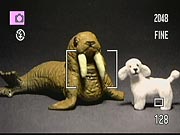 Record-Mode Viewfinder
Display: In record mode, options for the LCD display are off, on with
no information overlay, and on with a limited amount of camera information
displayed. Information shown includes flash status, exposure compensation
(if a compensation adjustment has been made), white balance setting (if something
other than "Auto" is selected), image size and quality setting,
drive mode (single, continuous, movie, etc), and number of shots remaining
on the memory card. Exposure information such as shutter speed and aperture
are not reported to the user.
Record-Mode Viewfinder
Display: In record mode, options for the LCD display are off, on with
no information overlay, and on with a limited amount of camera information
displayed. Information shown includes flash status, exposure compensation
(if a compensation adjustment has been made), white balance setting (if something
other than "Auto" is selected), image size and quality setting,
drive mode (single, continuous, movie, etc), and number of shots remaining
on the memory card. Exposure information such as shutter speed and aperture
are not reported to the user.
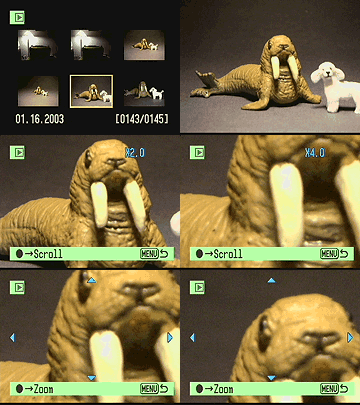 Playback-Mode
Viewfinder Display: In playback mode, the LCD screen can show an "index"
view of images stored on the memory card, the current image with or without
information overlay (which includes the date and time of image capture, as
well as image number/file name), and a zoomed view of the current image. You
can zoom in up to 4x to check fine details, focus and framing, and can scroll
the enlarged viewing window around the image using the camera's arrow keys
and zoom toggle.
Playback-Mode
Viewfinder Display: In playback mode, the LCD screen can show an "index"
view of images stored on the memory card, the current image with or without
information overlay (which includes the date and time of image capture, as
well as image number/file name), and a zoomed view of the current image. You
can zoom in up to 4x to check fine details, focus and framing, and can scroll
the enlarged viewing window around the image using the camera's arrow keys
and zoom toggle.
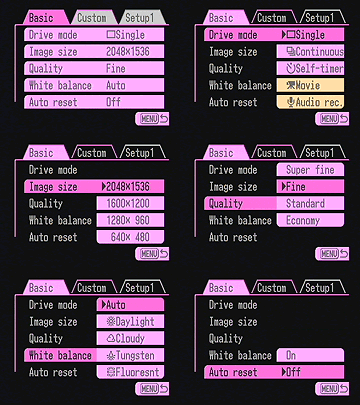
Record Mode: In Record mode, the camera can capture still images, movie or audio files. The Record menu is displayed by pressing the Menu button in any of these exposure modes, and the following options are available:
-
 Basic
Basic
- Drive Mode: Sets drive mode to Single, Continuous, Self-Timer, Movie, or Audio Record.
- Image Size: Adjusts the image resolution to 2,048 x 1,536; 1,600 x 1,200; 1,280 x 960; or 640 x 480 pixels.
- Quality level: Sets the image compression level to Super Fine (uncompressed TIFF file format), Fine, Standard, or Economy (JPEG file formats).
- White Balance: Adjusts the overall color balance of the scene. Options include Auto, Daylight, Cloudy, Incandescent, and Fluorescent.
- Auto Reset: Resets all menu options to the default settings.
-
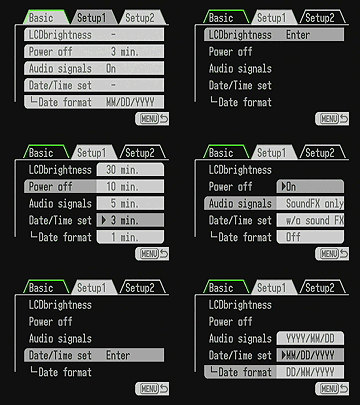 Custom
- Digital Zoom: Turns the 2x or 4x digital zoom on and off. (Digital zoom only engages after the lens has been zoomed all the way to its max telephoto.)
- Instant Playback: Turns the instant image review function on or off.
- Voice Memo: Activates the Voice Memo recording mode, which records sound clips to accompany images.
- Sensitivity: Sets the camera's sensitivity to Auto, or to 50,100, 200, or 400 ISO equivalents.
- Date Imprint: Turns on or off a capture date overlay.
-
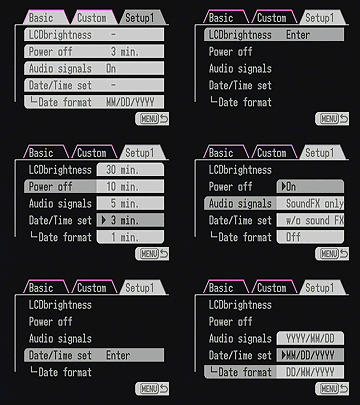 Setup
Setup
- LCD Brightness: Adjusts the brightness of the LCD display.
- Power Off: Sets the camera to automatically shut off after 1, 3, 5, 10, or 30 minutes of inactivity.
- Audio Signals: Turns the camera's beep sounds on or off.
- Date Time Set: Sets the camera's internal calendar and clock.
- Date Format: Cycles through available date and time formats.
Playback Mode: This mode allows you to review captured images on the memory card, erase them, protect them, set them up for printing, etc. Pressing the Menu button displays the following options:
-
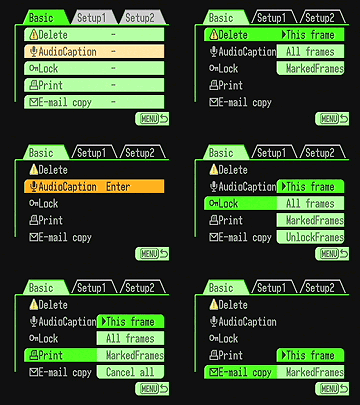 Basic
Basic
- Delete: Erases the current frame, all frames, or marked frames from the memory card.
- Audio Caption: Allows you to record a short sound clip to accompany a previously recorded image.
- Lock: Write-protects specific images or all images, preventing them from being manipulated or erased (except via card formatting). An option also exists to Unlock images.
- Print: Allows you to specify images for printing, or mark all images on the card for printing. You can also cancel print settings.
- Email Copy: Makes a low-resolution (640x480) copy of the selected image. You can make copies of either the current image alone, or of multiple images you've marked separately. Email copy images are stored in a separate "EM" folder on the memory card.
-
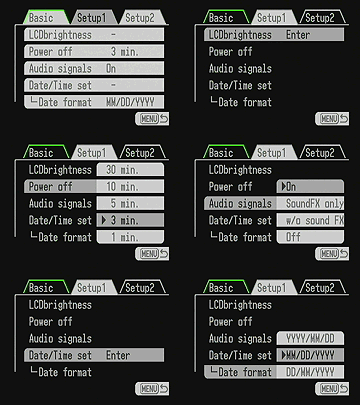 Setup
1
Setup
1
- LCD Brightness: Adjusts the brightness of the LCD display.
- Power Off: Sets the camera to automatically shut off after 1, 3, 5, 10, or 30 minutes of inactivity.
- Audio Signals: Turns the camera's beep sounds on or off.
- Date Time Set: Sets the camera's internal calendar and clock.
- Date Format: Cycles through available date and time formats.
-
 Setup
2
Setup
2
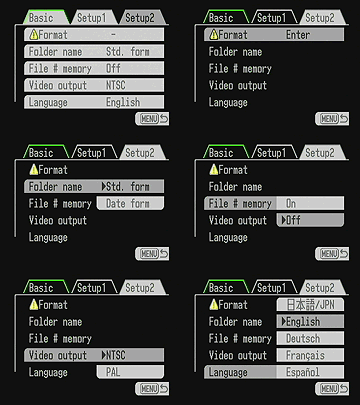
- Format: Formats the SD card, erasing all files, including protected ones.
- Folder Name: You can have the camera name the folders it stores its images in on the memory card using either the camera's standard scheme, or by Date. (The latter being a handy way to keep track of photos you've shot over a period of time.)
- File # Memory: Specifies whether file numbering starts over with new folders, or continues regardless of folder.
- Video Output: Sets the video output signal to NTSC or PAL timing.
- Language: Changes the menu language to English, Japanese, German, French, or Spanish.
Test Images
See the full set of my test images and detailed analysis
here. The thumbnails below show a subset of
my test images. Click on a thumbnail to see the full-size photo.
 |
 |
 |
| |
|
|
|
|
|
|
| |
|
|
|
|
|
|
| |
|
|



Specifications
See the specifications sheet here.
Picky Details
Information on shooting speed, battery life, etc. can be found here.
Test Results
I was pleasantly surprised by the quality of the images from the Dimage
Xi. Although I suspect the lens and most components are the same as those
used in the original Dimage X, I felt that the Xi overall produced noticeably
better pictures, and it showed less of the corner softness I observed in the
original Dimage X as well. See the Dimage Xi's test
images page for the full results of my testing, but meanwhile, here's
a summary of my findings:
- Color: Color was accurate and appropriately saturated in my various standard test subjects. I was particularly impressed by how well the camera did with even quite dim incandescent lighting indoors. Both auto and incandescent white balance settings did a better job handling the strong color cast of the household incandescent lighting so common in the US than most cameras I've worked with. I wouldn't go so far as to call the DXi's color "stunning", but it was quite accurate and pleasing.
- Exposure: Like the Dimage X before it, the Dimage Xi did pretty well in the exposure department. It tends to lose some highlight detail in contrasty scenes under sunlit conditions, but not more than I'm accustomed to seeing in other digicams. The biggest surprise I found was how well it did under even fairly dim indoor shooting conditions, where it could produce sharp, well-exposed images even under rather inadequate living-room lighting. I did find though, that it needed a fair bit of positive exposure compensation in interior shots, but that could largely be a consequence of the large expanses of white walls in most of my indoor shots. The flash also did a very good job of filling in the shadows without blowing out the rest of the images, and the slow-sync exposure mode produced a very appealing balance between room lighting and the onboard flash. Very nice.
- Resolution/Sharpness: :Like most subcompact cameras, the Dimage Xi's
were just a little soft when compared with the best full-sized three-megapixel
digicams. It also showed some softness in the corners of the frame, although
I didn't feel that it intruded as far into the picture as that of the original
Dimage X. (Odd, since the two cameras almost certainly share the same lens
system.)(A note added later: It appears that corner softness is somewhat
variable on the Dimage Xi, depending on the particular unit in question. Some
readers have emailed with examples of images showing corner softness more
equivalent to the original Dimage X, so take my comments above with a grain
of salt. - Your mileage may vary...)
- Closeups: The Dimage Xi's macro capabilities were about average, with a minimum capture area of 3.47 x 2.61 inches (88 x 66 millimeters). One positive point though, is that its flash does a good job of throttling down for closeup work, something that many cameras can't manage.
- Night Shots: A two-second maximum exposure time and fully automatic exposure control limit the Dimage Xi's low-light shooting capabilities slightly, but the adjustable ISO with a maximum setting of 400 lets it do a surprisingly good job in dim shooting conditions, down to a limit of about 1/4 foot-candle (2.7 lux), or light level roughly 1/4 that of typical urban street lighting. An automatic noise-reduction feature keeps image noise under control, even with fairly long exposures at high ISO. On the downside though, the Xi had some trouble focusing at the darkest light levels, and it lacks a manual focus option to overcome this.
- Viewfinder Accuracy: The Dimage Xi's optical viewfinder is tighter than average, showing 80 percent frame accuracy at wide angle, and only 77 percent at telephoto. Images framed with the optical viewfinder also have extra space at the top and left sides of the frame, which is something to consider when framing images. The LCD monitor is actually just slightly loose, as the darker measurement lines I typically use were just cut off in the final images. Given that I like LCD monitors to be as close to 100 percent accuracy as possible, the Dimage Xi's LCD monitor does quite well in that respect. - I'd really like to see a more accurate optical viewfinder though.
- Optical Distortion: Optical distortion on the Dimage Xi is about average at the wide-angle end, where I measured an approximate 0.8 percent barrel distortion. (This is about average among cameras I've tested, but I'd really like to see much less geometric distortion in digicam images overall.) The telephoto end fared only slightly better, as I measured a 0.5 percent pincushion distortion, higher than most cameras I've tested. Chromatic aberration is a mixed bag, as there's relatively little color showing, but what's there is spread out quite a bit by the corner softness. (This distortion is visible as a slight colored fringe around the objects at the edges of the field of view on the resolution target.)
- Battery Life: Like most subcompact digicams, the Dimage Xi's battery life is a bit limited. In its worst-case power drain mode (record mode with the LCD enabled), battery life is only about 60 minutes, extending to about 97 minutes in playback mode. The real plus though, is that the camera takes almost no power in capture mode when the LCD is turned off. - It's a shame that the optical viewfinder isn't more accurate, as that'd make it more feasible to shoot with the LCD off, greatly extending battery life. As always, despite the excellent performance with the LCD turned off, I still strongly advise purchasing a second battery when you buy the camera.
In the Box
Packaged with the Dimage Xi are the following items:- Wrist strap.
- Video cable.
- USB cable.
- 16MB SD memory card.
- NP-200 lithium-ion battery pack.
- Battery charger.
- Dimage software CD.
- Operating manual and registration card.
- Large capacity SD memory card.
- Additional NP-200 lithium-ion battery pack.
- AC adapter.
- Small camera case.
Recommended Software: Rescue your images!
Just as important as an extra memory card is a tool to rescue your images when one of your cards fails at some point in the future. I get a lot of email from readers who've lost photos due to a corrupted memory card. Memory card corruption can happen with any card type and any camera manufacturer, nobody's immune. A surprising number of "lost" images can be recovered with an inexpensive, easy to use piece of software though. Given the amount of email I've gotten on the topic, I now include this paragraph in all my digicam reviews. The program you need is called PhotoRescue, by DataRescue SA. Read our review of it if you'd like, but download the program now, so you'll have it. It doesn't cost a penny until you need it, and even then it's only $29, with a money back guarantee. So download PhotoRescue for Windows or PhotoRescue for Mac while you're thinking of it. (While you're at it, download the PDF manual and quickstart guide as well.) Stash the file in a safe place and it'll be there when you need it. Trust me, needing this is not a matter of if, but when... PhotoRescue is about the best and easiest tool for recovering digital photos I've seen. (Disclosure: IR gets a small commission from sales of the product, but I'd highly recommend the program even if we didn't.) OK, now back to our regularly scheduled review...Midrange Point & ShootsIf you're interested in the camera in this review, here are some competing models that may also interest you. (Camera names that aren't links are those we haven't reviewed yet. - Stay tuned.) Three Megapixel, 3x zoom Canon A70 Prices Fuji A303 Prices Kodak DX4330 Prices Minolta Xi (subcompact) Prices Nikon 3100 Prices Olympus 560 Prices Olympus 550* Prices Pentax 330GS Prices Sony P72 Prices * - model phasing out Confused?
Check out Dave's Picks!
Overall, I was quite impressed with the Dimage Xi, even more so than with the original Dimage X. Ultra-compact digicams often seem to involve a lot of compromises and tradeoffs, but the Dimage Xi takes great photos under a wide range of conditions, offers a decent range of exposure control (exposure compensation and white balance adjustments), and has a surprisingly long battery life when the LCD is left off. You do give up a little image sharpness, relative to the best full-sized three megapixel cameras, but there's plenty of resolution here to make sharp 8x10 prints. Its compact size, decent feature set, and rugged all-metal case make the Dimage Xi a great "take anywhere" camera, appealing to both non-techies and enthusiasts alike. For the non-techies, it's very easy to use and takes nice pictures. For the enthusiasts (taking myself as an example), it makes a great "second camera", something that you'd just toss in your pocket without thinking. Another personal confession: As much as I rant about "cameras in drawers not taking pictures", that's exactly where my digicams tend to live most of the time. With the Dimage Xi, I at least have a fighting chance of having the camera along with me wherever I go. Bottom line, it's not going to be the ultimate camera for Ansel Adams types, but if you want to have no excuse for not having your camera long with you, the Dimage X makes a great companion. I definitely put the Dimage Xi in the "highly recommended" category.Free Photo Lessons 
Simple pro lighting and use tips let you snap stunning photos. Check out our free Photo School area!
- Optical Distortion: Optical distortion on the Dimage Xi is about average at the wide-angle end, where I measured an approximate 0.8 percent barrel distortion. (This is about average among cameras I've tested, but I'd really like to see much less geometric distortion in digicam images overall.) The telephoto end fared only slightly better, as I measured a 0.5 percent pincushion distortion, higher than most cameras I've tested. Chromatic aberration is a mixed bag, as there's relatively little color showing, but what's there is spread out quite a bit by the corner softness. (This distortion is visible as a slight colored fringe around the objects at the edges of the field of view on the resolution target.)


Follow Imaging Resource: