The Imaging Resource
Quick Review
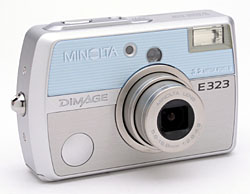
Konica Minolta DiMAGE E323 Digital Camera
 |
Camera QuickLook | |
|
Review Date |
03/17/2004 | |
|
User Level |
Novice to Experienced | |
|
Product Uses |
Family / Travel | |
|
Digicam Design |
Point and Shoot | |
|
Picture Quality |
Very Good, 3.2-megapixel CCD (with interpolation to 6.0 megapixels) | |
|
Print Sizes |
4x6 to 8x10 inches, 11x17 inches with interpolation | |
|
Availability |
Now | |
| Suggested
Retail Price (At introduction) |
$249 | |
|
||||||||||
Camera Overview
Housed in a compact, lightweight case, Konica Minolta's
DiMAGE E323 is one of the smaller members of the DiMAGE line (though not
as tiny as the DiMAGE X series). With a stylish, silver body accented by
a light blue front panel, the E323 is fashionable as well as portable. Measuring
3.9 x 2.4 x 1.4 inches (99 x 62 x 35 millimeters) and weighing 5.1 ounces
(145 grams) without the battery or SD memory card, the E323 should fit into
shirt pockets and most purses. A wrist strap comes with the camera, to provide
a little extra security when leaning over railings or taking pictures on
unstable ground. The E323 features a 3.2-megapixel CCD that interpolates
to 6.0 megapixels for printing larger images. (There are also smaller resolution
settings more friendly for general purpose photography and email attachments.)
The camera's 3x telescoping lens is protected by a built-in, shutter-like
lens cover, that automatically opens when the camera is powered on. With
its fairly flat body panels and trim design, the E323 should be quick on
the draw, less likely to hang on pockets.
Built into the DiMAGE E323 is a 3x, 5.6-16.8mm lens (the equivalent of a 36-108mm lens on a 35mm camera), made up of seven elements in six groups. Maximum aperture ranges from f/2.8 to f/4.9, depending on the lens zoom position. Focus ranges from 4.3 inches (11 centimeters) to infinity in normal mode, with the macro setting ranging from 4.3 to 19.7 inches (11 to 50 centimeters). The E323 uses a multi-area AF system, which automatically bases focus on the part of the subject closest to the lens. The selected area is then highlighted on the LCD display when the Shutter button is halfway pressed. There's also a Landscape mode, which fixes focus at infinity. In addition to the 3x optical zoom, the E323 also offers as much as 4x digital zoom, effectively increasing the camera's zoom capabilities to 12x. (Although I always remind readers that digital zoom always decreases the overall image quality because it simply enlarges the central pixels of the CCD's image; you can get the same result by simply cropping the image in a computer after capture.) The E323 has a real image optical viewfinder, as well as a 1.6-inch LCD monitor for composing images. The LCD display reports the frame number, camera mode, selected focus area, and battery level.
Exposure remains under automatic control on the E323, though the camera does offer a handful of scene modes for special shooting situations. A basic Mode switch on the rear panel controls whether the camera is in Playback or Record modes, as well as whether or not the LCD display is on. By default, the camera is automatically placed into Auto record mode when powered on. Through the Record menu, however, you can select Sports, Portrait, Landscape, Night View, Cosmetic, or Slim preset scene modes. Regardless of mode, the camera remains in charge of aperture and shutter speed (which ranges from 1/2,000 to two seconds). Sports mode employs faster shutter speeds, to freeze fast moving action. Portrait mode uses a larger aperture setting for decreased depth of field, which results in a sharply-focused subject in front of a slightly blurred background. Landscape mode fixes focus at infinity and increases the depth of field so that the background and foreground are in sharp focus. Night View mode balances the flash with the ambient exposure to get good night portraits with plenty of background detail. (You can disable the flash as well, for night scenes.) Cosmetic mode optimizes the camera for more appealing portraits, and lowers the in-camera sharpening just slightly, for softer skin tones. Finally, Slim mode changes the horizontal or vertical proportions of the subject, using digital zoom to "stretch" the image, thus making your subjects look like they lost a few pounds. (This is the first time I can recall seeing this particular feature on a digicam - Makes me want to keep an E323 in my bathroom, next to the scales!)
Though you can't directly select the shutter speed or aperture, you can increase or decrease the exposure from -2 to +2 exposure equivalents (EV) in one-third-step increments by pressing the right and left arrow keys on the rear panel. (You can also change the setting through the Record menu.) The E323 doesn't offer a manual sensitivity setting, but the camera automatically adjusts the ISO value from 50 to 200, depending on the available light. White Balance options include Auto, Daylight, Cloudy, Incandescent, and Fluorescent settings, which adjust the color balance for most commonly-encountered lighting conditions. The DiMAGE E323's built-in flash operates in Auto, Red-Eye Reduction, Fill-Flash, or Suppressed. (In Night View mode, the camera automatically times the flash with the slower exposure, similar to the Slow-Sync setting on other digicams.) Konica Minolta rates the E323's flash as useful from 0.4 to 9.8 feet (0.11 to 3.0 meters), depending on the lens zoom position.
In Movie exposure mode, the camera captures 320 x 240 or 160 x 120-pixel resolution moving images (without sound), for as long as the memory card has available space. The camera's Self-Timer mode provides either a two- or 10-second delay between the time the Shutter button is pressed and the time that the camera actually takes the picture, allowing you to get into your own shots. For shooting fast action subjects, the DiMAGE E323's Standard and Best Select Continuous Advance modes capture a rapid series of images while you hold down the Shutter button, much like a motor drive on a traditional 35mm camera. The number of images in a series and the actual frame rate of capture will vary depending on the resolution and quality settings, as well as the amount of available memory card space. The Best Select option captures a maximum of four images in quick succession, then lets you select the best one of the four to save. (The remaining three are deleted.) Both Movie and Continuous Advance modes offer a limited selection of preset scene modes as well.
The DiMAGE E323 stores its images on SD/MMC memory cards, and a 16MB SD card accompanies the camera. I highly recommend picking up a larger capacity card right away, so you don't miss any important shots, especially given the camera's 6.0-megapixel interpolated resolution setting. This card will only hold five to six images at this setting. Connection to a host computer for image download is via USB, and the necessary cable accompanies the camera. The camera utilizes either two AA-type batteries or a single CR-V3 battery for power, and a set of single-use alkaline batteries accompanies the camera. As always, I recommend picking up an additional set of rechargeable NiMH batteries and a good charger, and keeping a set freshly charged at all times. Click here to read my "battery shootout" page to see which batteries currently on the market are best, or here for my review of the Maha C-204F charger, my long-time favorite. That said, the E323 does offer extensive power-save settings, letting you select separate shutdown times for when the camera's in record mode, playback mode, and when using the optional AC adapter. The optional AC adapter is also useful for preserving battery power when reviewing and downloading images, or when viewing images and movies on a television via the supplied video cable.
Basic Features
- 3.2-megapixel CCD for a maximum resolution of 2,048 x 1,536 pixels (interpolates to 6.0 megapixels, or 2,880 x 2,160 pixels).
- Real-image optical viewfinder.
- 1.6-inch color TFT LCD monitor.
- 3x, 5.6-16.8mm lens, equivalent to a 36-108mm lens on a 35mm camera.
- 4x digital zoom.
- Automatic exposure control, plus six preset scene modes.
- Shutter speeds from 1/2,000 to two seconds.
- Maximum aperture f/2.8 to f/4.9, depending on lens zoom position.
- Built-in flash with four modes.
- SD/MMC memory card storage, 16MB SD card included.
- Images saved as JPEG files.
- Power supplied by two AA-type batteries, one CR-V3 battery, or optional AC adapter.
- DiMAGE Viewer software, QuickTime Viewer, and USB drivers included for both Windows and Mac platforms.
Special Features
- Movie recording mode (without sound).
- Standard and Best Select Continuous Advance shooting modes.
- Two- and 10-second Self-Timer modes for delayed shutter release.
- White balance (color) adjustment with five modes.
- USB Direct-Print capability.
- Video cable for connection to a television set.
- USB cable for connection to a computer (driver software included).
Recommendation
Small, sleek, and very portable, the DiMAGE E323 is
the newest addition to the point-and-shoot end of Konica Minolta's DiMAGE
line. With automatic exposure control, the E323's point-and-shoot style will
appeal to novices who want to keep things simple, while offering a range
of preset scene modes for more challenging situations. The 3.2-megapixel
CCD delivers good quality images, with enough resolution to make sharp 8x10
prints, and interpolates to 6.0 megapixels for prints as large as 11x17 inches,
although the interpolated images don't really gain any additional resolution.
Smaller image size settings are available for general use or email distribution.
The E323 is compact enough for travel, and has enough flexibility to handle
most average shooting situations well.
Design
Konica Minolta's DiMAGE series of digicams is known for quality and technological
innovation, offering an array of digital cameras to suit a wide range of
experience levels and price points. Coming in at the point-and-shoot end
of the line is the DiMAGE E323, with full automatic exposure control and
only a handful of features. Though not as compact as the DiMAGE X series
of digicams, the E323 is small and sleek, with smooth panels to make it pocket
friendly. The E323's rectangular body doesn't offer much of a hand grip,
but a raised bump on the front panel provides a small finger grip, balanced
by a series of smaller raised bumps on the rear panel. Measuring 3.9
x 2.4 x 1.4 inches (99 x 62 x 35 millimeters), the DiMAGE E323 should
fit into larger shirt pockets without trouble. The camera's plastic body
helps keep the weight down, at 5.1 ounces (145 grams)
without the batteries and memory card. A wrist strap accompanies the
camera for easy toting, but I'd recommend picking up a small camera case
to protect the matte-silver finish when traveling.
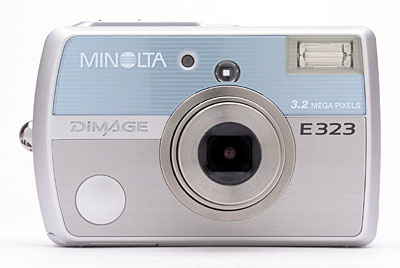
The E323's front panel is distinguished by a light blue accent piece at the very top, which blends well with the light silver body and gives it a retro 1960's or 70's feel. The lens, flash, optical viewfinder window, and self-timer LED are the only features on the front panel. When powered on, the lens extends just a little over half an inch from the camera front, but retracts flush with the front panel when powered off. A shutter-like lens cover automatically slides out of the way to reveal the lens, and eliminates the need for a lens cap. In the lower right corner is the raised bump that serves as a moderately effective finger grip.

The right side of the E323 (as viewed from the rear) simply features the wrist strap attachment eyelet.
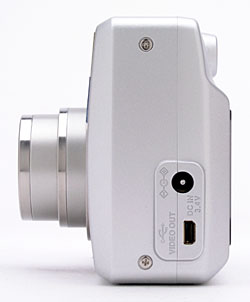
On the opposite side of the camera are the DC In and Video Out/USB jacks. They are not protected by a rubber door, as has become common among digital cameras, so it should be protected from dust, dirt, and debris with a case if it's going to ride around in a bag or backpack.

The DiMAGE E323's top panel holds only the Power and Shutter buttons, both on a slightly raised panel.
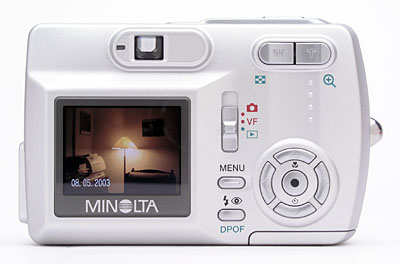
The remaining camera controls are on the rear panel, along with the optical viewfinder and 1.6-inch color LCD monitor. Lining up on the right side of the LCD monitor are the Mode switch, Menu, and Flash / DPOF buttons. The Zoom buttons are in the top right corner, with the Four-Way Arrow pad and OK button directly below. A small LED light next to the viewfinder eyepiece lights or flashes to indicate camera status, such as when the flash is charging or the autofocus system is having trouble. Also on the rear panel is a line of raised bumps that serves as a mild thumb grip when holding the camera in your right hand.
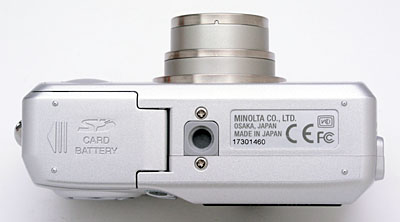
The E323's bottom panel is flat, with a plastic threaded tripod mount just about center, and the battery and memory card compartment on the right. Unfortunately, the tripod mount is too close to the battery compartment to allow quick battery changes while working on a tripod. Though this won't likely pose a problem for most of the E323's users, I do generally appreciate being able to quickly change out batteries or the memory card when working with a tripod. Still, the side access of the DC In jack means you could quickly connect the accessory AC adapter when in a bind. The battery door is a little on the cheap side, with molded plastic parts for retention, so users should be careful when opening and closing this door.
Camera Operation
With only a handful of external controls and a concise LCD menu system, the
DiMAGE E323's user interface is straightforward and easy to grasp, with nice
little assistant windows to more fully explain a given item. The Mode switch
on the rear panel controls the camera's main operating mode (as well as the
status of the LCD display), while a very short LCD menu offers basic camera
settings. Features like optical zoom, flash mode, Exposure Compensation,
Macro mode, and the Self-Timer can be accessed externally, while the remaining
settings require the LCD menu. Once activated, the LCD menu is actually quite
short, and doesn't require too much effort to navigate. Additionally, the
Setup menu is available at all times, so you can quickly access main camera
settings. Given the camera's straightforward setup and user-friendly design,
most users should be able to operate the camera right out of the box, referring
to the manual only for more complex operations. I especially like how easy
it is to change EV settings in any record mode: just press the left and right
nav buttons and the EV selector bar appears across the bottom of the screen.
If other cameras had this feature so readily available, photographers would
be more likely to use it.
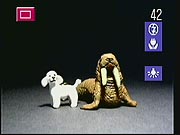 Record-Mode
Viewfinder Display: In Record mode, options for the LCD display are simply
on or off:, there are no options for more or less information in the display.
With the mode selector switch at the top, you're in LCD capture mode; with
it set in the middle, or "VF" mode, you're in optical viewfinder
only mode, meaning that the LCD will be off. Information shown in LCD capture
mode includes camera mode, exposure mode, flash status, exposure compensation
(if a compensation adjustment has been made), white balance setting (if something
other than "Auto" is selected), image size and quality setting,
drive mode (single, continuous, movie, etc.), and the number of shots remaining
on the memory card. The selected AF area appears when the Shutter button
is halfway pressed. Overall, the viewfinder display information is clear
and smartly arrayed for a very good interface.
Record-Mode
Viewfinder Display: In Record mode, options for the LCD display are simply
on or off:, there are no options for more or less information in the display.
With the mode selector switch at the top, you're in LCD capture mode; with
it set in the middle, or "VF" mode, you're in optical viewfinder
only mode, meaning that the LCD will be off. Information shown in LCD capture
mode includes camera mode, exposure mode, flash status, exposure compensation
(if a compensation adjustment has been made), white balance setting (if something
other than "Auto" is selected), image size and quality setting,
drive mode (single, continuous, movie, etc.), and the number of shots remaining
on the memory card. The selected AF area appears when the Shutter button
is halfway pressed. Overall, the viewfinder display information is clear
and smartly arrayed for a very good interface.
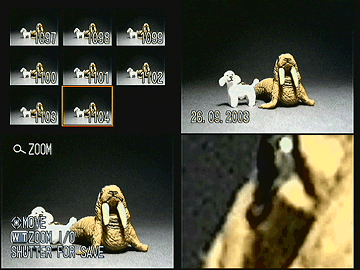 Playback-Mode
Viewfinder Display: In Playback mode, the LCD display reports only the
date of the captured image. You can use the Zoom buttons to enlarge the captured
image, or display a nine-image index of the images on the memory card. (Image
numbers are displayed during the index display.) You can also capture a snapshot
of an image by zooming in as far as you like and pressing the shutter button.
A new image is then saved.
Playback-Mode
Viewfinder Display: In Playback mode, the LCD display reports only the
date of the captured image. You can use the Zoom buttons to enlarge the captured
image, or display a nine-image index of the images on the memory card. (Image
numbers are displayed during the index display.) You can also capture a snapshot
of an image by zooming in as far as you like and pressing the shutter button.
A new image is then saved.
External Controls

Power Button: Located on the top panel, next to the Shutter button,
this tiny button turns the camera on and off.

Shutter Button: This elongated button on the top panel sets focus and
exposure when pressed halfway, and fires the shutter when fully pressed. It
is also used in Playback mode to create a new cropped image from an existing
image when zoomed in.
Zoom ("W" and "T") Buttons: Situated in the top
right corner of the rear panel, these buttons control the optical and digital
zoom in Record mode. In Playback mode, the "T" button zooms in on
captured images for closer inspection, while the "W" button zooms
back out, or accesses a nine-image index display.
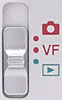
Mode Switch: Next to the top right corner of the LCD monitor, this
sliding switch controls the camera mode, as well as whether or not the LCD
monitor is active. The top position turns on the LCD display, while the center
position turns off the display for shooting with the optical viewfinder only.
The bottom position puts the camera into Playback mode for image review. The
switch itself has firm detents and a reasonable quality feel.

Menu Button: Directly below the Mode switch, this button calls up the
settings menu in both Record and Playback modes. It also dismisses the settings
menu without making changes.

Flash/DPOF Button: Below the Menu button, this button cycles through the
available flash modes in any Record mode. Options include Auto, Red-Eye Reduction,
Fill Flash, and Suppressed. In Playback mode, this button accesses the DPOF
settings, letting you mark images for printing on a DPOF-compatible printer,
as well as specify the number of copies and whether or not the date and time
print on top of the image.
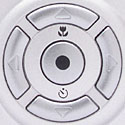
Four-Way Arrow Pad and OK Button: Located in the lower right corner of
the rear panel, this set of five buttons serves as the camera's main navigational
tool. The four exterior buttons navigate through settings menus, moving the
selection up, down, left, or right. The center button acts as the "OK"
to confirm any changes. Pressing the OK button in Record mode, outside of
a menu, pulls up a quick review of the most recently captured image. In Record
mode, the left and right buttons adjust the Exposure Compensation, while the
up arrow access Macro mode, and the down arrow accesses the two Self-Timer
modes.
In Playback mode, the right and left arrow keys scroll through captured images. When an image has been enlarged, all four keys pan the view.
Camera Modes and Menus
Single Image Record Mode: Here, the camera can capture still images, with a range of options available through the settings menu. The LCD menu provides the following exposure options:
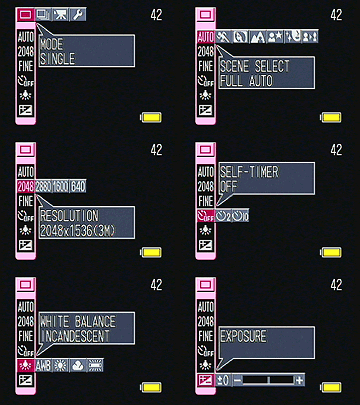 Mode:
Sets main record mode to Single, Continuous Advance, Movie, or Setup. (The
following menu options change with each setting, and are detailed below.)
Mode:
Sets main record mode to Single, Continuous Advance, Movie, or Setup. (The
following menu options change with each setting, and are detailed below.)
- Scene Selection: Sets the preset scene mode to one of
the following;
- Auto: Places the camera in control of the entire exposure, including aperture and shutter speed, with the user only in control of flash mode, zoom, macro mode, file size, and quality settings.
- Sports: This mode uses faster shutter speeds to "freeze" fast-paced action.
- Portrait: The camera employs a larger lens aperture setting, which decreases the depth of field. Thus, the subject is sharply focused in front of a slightly blurred background.
- Landscape: Here, the camera uses a smaller lens aperture, so that both the background and foreground are in sharp focus. The camera may also enhance colors in landscape mode.
- Night View: This mode sets up the camera for capturing good color and exposure in low-light situations. Because the camera is using a slower shutter speed here, a tripod is recommended for the best results. (You can turn the flash on or off for night portraits.)
- Cosmetic: In this mode, the camera softens skin tones and enhances color slightly for more flattering portraits.
- Slim: Gives you the option of "stretching" the image horizontally or vertically, distorting the proportions of the subject slightly. Cannot be used with interpolation. Good for removing the ten pounds people often complain that the camera adds.
- Resolution: Adjusts the image resolution to 2,880 x 2,160 (interpolated); 2,048 x 1,536; 1,600 x 1,200; or 640 x 480 pixels.
- Compression: Sets the JPEG compression to Fine or Normal.
- Self-Timer: Turns the Self-Timer mode off, or selects the two- or 10-second Self-Timer modes.
- White Balance: Adjusts the overall color balance of the scene. Options include Auto, Daylight, Cloudy, Incandescent, and Fluorescent.
- Exposure Compensation: Increases or decreases the exposure from -2 to +2 EV in one-third-step increments.
Continuous Advance Record Mode: In this mode, the camera captures a rapid series of images at quick frame intervals. The total number of images in the series and the interval rate depend on the resolution and quality settings, as well as the amount of available space on the memory card. The LCD menu offers the following options:
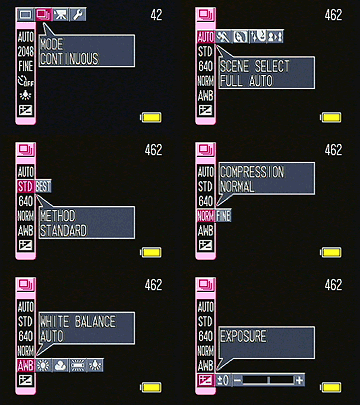 Mode:
Sets main record mode to Single, Continuous Advance, Movie, or Setup.
Mode:
Sets main record mode to Single, Continuous Advance, Movie, or Setup. - Scene Selection: Sets the preset scene mode to one of the
following;
- Auto: Places the camera in control over the entire exposure, including aperture and shutter speed, with the user only in control of flash mode, zoom, macro mode, and file size and quality settings.
- Sports: This mode uses faster shutter speeds to "freeze" fast-paced action.
- Portrait: The camera employs a larger lens aperture setting, which decreases the depth of field. Thus, the subject is sharply focused in front of a slightly blurred background.
- Cosmetic: In this mode, the camera softens skin tones and enhances color slightly for more flattering portraits.
- Slim: Gives you the option of stretching the image horizontally or vertically, distorting the proportions of the subject slightly.
- Continuous Advance Mode: Sets the mode to Best Select or Standard.
- Resolution: Adjusts the image resolution to 2,880 x 2,160 (interpolated); 2,048 x 1,536; 1,600 x 1,200; or 640 x 480 pixels.
- Compression: Sets the JPEG compression to Fine or Normal.
- White Balance: Adjusts the overall color balance of the scene. Options include Auto, Daylight, Cloudy, Incandescent, and Fluorescent.
- Exposure Compensation: Increases or decreases the exposure from -2 to +2 EV in one-third-step increments.
Movie Record Mode: This mode records moving images without sound. The following LCD menu options are available:
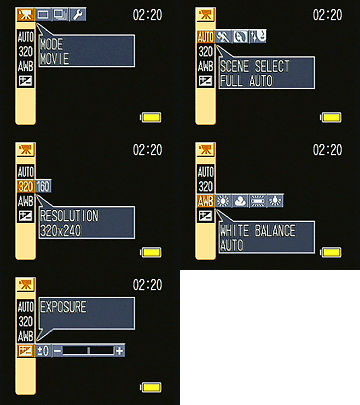 Mode:
Sets main record mode to Single, Continuous Advance, Movie, or Setup.
Mode:
Sets main record mode to Single, Continuous Advance, Movie, or Setup.- Scene Selection: Sets the preset scene mode to one of the
following;
- Auto: Places the camera in control over the entire exposure, including aperture and shutter speed, with the user only in control of flash mode, zoom, macro mode, and file size and quality settings.
- Sports: This mode uses faster shutter speeds to "freeze" fast-paced action.
- Portrait: The camera employs a larger lens aperture setting, which decreases the depth of field. Thus, the subject is sharply focused in front of a slightly blurred background.
- Cosmetic: In this mode, the camera softens skin tones and enhances color slightly for more flattering portraits.
- Resolution: Adjusts the image resolution to 320 x 240 or 160 x 120 pixels.
- White Balance: Adjusts the overall color balance of the scene. Options include Auto, Daylight, Cloudy, Incandescent, and Fluorescent.
- Exposure Compensation: Increases or decreases the exposure from -2 to +2 EV in one-third-step increments.
Playback Mode: This mode allows you to review captured images and movies on the memory card, erase them, protect them, set them up for printing, etc. Like the Record mode menus, the following menu options change depending on the main mode selected (Single Frame, Continuous Advance, or Movie). Rather than list each individual menu here, I've indicated options that only apply to specific modes:
-
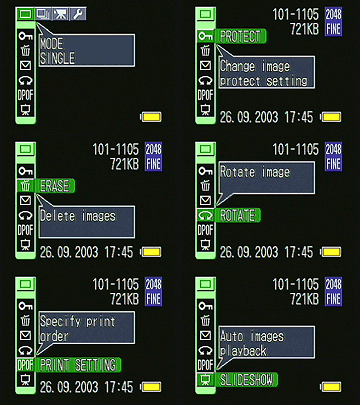 Mode:
Sets the Playback mode to Single Frame, Continuous Advance, Movie, or Setup.
Mode:
Sets the Playback mode to Single Frame, Continuous Advance, Movie, or Setup.
- Protect: Write-protects the currently-displayed image, preventing it from being manipulated or erased (except via card formatting). An option also exists to Unlock the image.
- Erase: Erases the current frame or all unprotected frames from the memory card.
- Email Copy: (Single Frame mode only.) Makes a low-resolution (either 640 x 480 or 320 x 240 pixels) copy of the selected image, suitable for email transmission.
- Copy Images: (Continuous Advance and Movie modes only.) Makes a single frame copy of Continuous Advance or Movie files. This and the email copy above are both impressive functions that other manufacturers would do well to adopt.
- Rotate: Flips the selected image to the left or right.
- DPOF Set: Allows you to specify images for printing, or mark all images on the card for printing. You can also cancel print settings, or indicate an index print.
- Slide Show: Automatically plays back files on the memory card as a slide show, with options to control the duration, start time, and transition effect. Effects include various wipes, fade, and a unique checkerboard wipe.
Setup Mode: The following Setup menu options are accessible through both the Record and Playback menu screens, as part of the Mode option at the top of the menu screen:
 Clock
Set: Sets the camera's internal clock and calendar.
Clock
Set: Sets the camera's internal clock and calendar.
- Operation Beep: Adjusts the camera's beep sounds and volume:
- Mute: Turns off all sound effects except the self-timer beep.
- Shutter: A beep indicates when the Shutter button is pressed halfway or fully.
- Key Switch: An operation beep confirms when a button or key is pressed, with the exception of the Shutter button.
- Help Display: Turns the help display on or off in the LCD menu system. If on, a small description of each menu option appears as it is highlighted.
- Language: Changes the menu language to Japanese, English, German, Spanish, French, or Italian.
- TV System: Designates the video signal as NTSC or PAL.
- Reformat: Formats the memory card, erasing all files (even write-protected ones).
- Auto Power Save: Offers an extensive menu for controlling the camera's power save function. (When the camera is connected to a computer, it will automatically shut off after 12 hours of inactivity.) Options are:
- Batt/Cam: Sets the power save mode when operating the camera off of batteries. Times include 1, 3, 5, or 10 minutes.
- Batt/PB: Sets the power save time when the camera is in Playback mode, while operating on batteries. Times are 1, 3, 5, 10, or 30 minutes.
- Ext. Pwr./Cam.PB: Sets the power save for Record and Playback modes, when using the AC adapter. Times are 1, 3, 5, 10, or 30 minutes.
- File Number Reset: If set to On, this function resets file numbering with each new memory card. If Off, the camera continuously numbers frames from card to card.
- LCD Brightness: Adjusts the brightness of the LCD display.
- Reset: Resets all camera settings to their defaults.
In the Box
Packaged with the DiMAGE E323 are the following items:
- Wrist strap.
- Video cable.
- USB cable.
- 16MB SD memory card.
- Two single-use AA alkaline batteries.
- DiMAGE software CD-ROM.
- Operating manuals and registration card.
- Large capacity SD memory card.
- Set of rechargeable AA batteries and battery charger.
- AC adapter.
- Small camera case.
Recommended Software: Rescue your images!
Just as important as an extra memory card is a tool to rescue your
images when one of your cards fails at some point in the future. I get a lot
of email from readers who've lost photos due to a corrupted memory card. Memory
card corruption can happen with any card type and any camera manufacturer,
nobody's immune. A surprising number of "lost" images can be recovered
with an inexpensive, easy to use piece of software though. Given the amount
of email I've gotten on the topic, I now include this paragraph in all my
digicam reviews. The program you need is called PhotoRescue, by DataRescue
SA. Read our review
of it if you'd like, but download the program now, so you'll have it.
It doesn't cost a penny until you need it, and even then it's only $29, with
a money back guarantee. So download PhotoRescue
for Windows or PhotoRescue
for Mac while you're thinking of it. (While you're at it, download
the PDF manual
and quickstart
guide as well.) Stash the file in a safe place and it'll be there when you
need it. Trust me, needing this is not a matter of if, but when...
PhotoRescue is about the best and easiest tool for recovering digital
photos I've seen. (Disclosure: IR gets a small commission from sales of
the product, but I'd highly recommend the program even if we didn't.)
OK, now back to our regularly scheduled review...
Specifications
See the specifications sheet here.
Picky Details
Information on shooting speed, battery life, etc. can be found here.
- Minolta
DiMAGE E323 user reviews on PriceGrabber.com
- Minolta
DiMAGE E323 user reviews on PC PhotoREVIEW
Sample Pictures
See the full set of my test images and detailed analysis
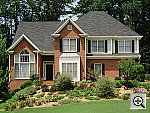
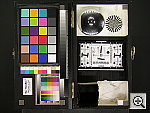
here. The thumbnails below show a subset of
my test images. Click on a thumbnail to see the full-size photos.

|

|

|
| |
|
|
|
|
|
|
| |
|
|
|
|
|
|
| |
|
|


Test Results
In keeping with my standard test policy, the comments given here summarize
only my key findings. For a full commentary on each
of the test images, see the DiMAGE E323's "pictures" page.
As with all Imaging Resource product tests, I encourage you to let your own eyes be the judge of how well the camera performed. Explore the images on the pictures page, to see how the E323's images compare to other cameras you may be considering.
Not sure which camera to buy? Let your eyes be the ultimate judge! Visit our Comparometer(tm) to compare images from the E323 with those from other cameras you may be considering. The proof is in the pictures, so let your own eyes decide which you like best!
- Color: Very good color under daylight, minor problems
with incandescent lighting. Overall, the E323 produced nearly accurate
color, though I often noticed a slight warm cast with the Automatic white
balance setting. Outdoors, both the Auto and Daylight white balances produced
good results, with pretty good skin tones and a very good rendering of the
blue tones in the flower bouquet. Indoors (without the flash), both the
Auto and Incandescent settings had some trouble with the incandescent lighting.
Results were within the acceptable range, particularly with the Auto white
balance option, but I'd personally prefer to see less color cast than the
E323 left in the images. Still, not a bad job overall.
- Exposure: Better than average exposure accuracy, but
again, minor problems with incandescent lighting. The E323 handled my
test lighting pretty well, though the Indoor portraits (both with and without
the flash) required more exposure compensation than most camera. That said,
the Outdoor Portrait shot required less exposure adjustment than average.
The camera tended to lose detail in bright highlights under harsh lighting,
but otherwise showed good tonal characteristics, and shadow detail was generally
good.
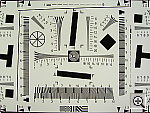
- Resolution/Sharpness: Good resolution, but less sharpness
and detail than the best three-megapixel models. The E323 performed
moderately well on the "laboratory" resolution test chart. (The
camera has a 3.2-megapixel CCD that interpolates to 6.0 megapixels.) It
started showing artifacts in the test patterns at resolutions as low as
600-650 lines per picture height, in both horizontal and vertical directions.
I found "strong detail" out to at least 1,050 lines. "Extinction"
of the target patterns occurred around 1,250 lines.
- Image Noise: Average image noise under normal lighting, but
very noisy images under low light conditions. The E323 produced reasonably
"clean" images under good lighting conditions, but the automatic
ISO boost it applies under very dim lighting results in very noisy images
under those conditions.
- Closeups: Very good macro performance. The E323
performed very well in the macro category, capturing a minimum area of only
1.63 x 1.22 inches (41 x 31 millimeters). Resolution was very high, with
excellent detail in the dollar bill. The coins and brooch were soft due
to the very shallow depth of field, but that's not the camera's fault. There
was a fair bit of softness in the corners of the macro shots, a common failing
of digicam macro modes. The E323's flash throttled down fairly well for
the macro area, just barely overexposing the top left corner.
- Night Shots: Surprisingly good low light capability,
but very high image noise at the lowest light levels. The E323 operates
under automatic exposure control at all times, but does offer a Night View
exposure mode with shutter times as long as two seconds. Surprisingly, the
E323 produced bright, usable images down to the 1/8 foot-candle (1.3 lux)
light level, though you could arguably use the image taken at the 1/16 foot-candle
(0.67 lux) light level. Color was pretty good, without any strong color
casts, but image noise was quite high at the lowest light levels, caused
by the E323's automatic ISO boost under dim lighting conditions.
- Viewfinder Accuracy: A tight optical viewfinder, but
very accurate LCD display. The E323's optical viewfinder was a bit tight,
showing only 81 percent frame accuracy at wide angle, and about 83 percent
at telephoto. The LCD monitor proved much more accurate, showing pretty
much 100 percent of the frame at both zoom settings. Given that I like LCD
monitors to be as close to 100 percent accuracy as possible, the E323's
LCD monitor is essentially perfect in that regard.
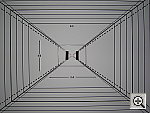
- Optical Distortion: Very low barrel and pincushion
distortion, but higher than average chromatic aberration. Optical distortion
on the E323 was lower than average at the wide-angle end, where I measured
an approximate 0.4 percent barrel distortion. The telephoto end fared even
better, as I measured only a 0.2 percent pincushion distortion. Chromatic
aberration is moderately high though, showing a fair bit of coloration on
either side of the target lines. (This distortion is visible as a very slight
colored fringe around the objects at the edges of the field of view on the
resolution target.)
- Shutter Response: Sluggish autofocus performance, so-so cycle
times. Speed isn't the E323's strong suit, with shutter lag times ranging
from 1.1 to 1.3 seconds, and shot to shot cycle times of 2.2 to 2.4 seconds.
Not a first choice for sports or other fast action.
- Battery Life: Good battery life. With a worst-case runtime of a bit over 2 hours with 1600 mAh NiMH cells (proportionately longer with higher-capacity batteries), the E323 does pretty well in the battery-life department. I still strongly recommend purchasing at least two sets of high-capacity NiMH cells and a good charger, but the E323 does better than average in this area.
Conclusion
I've always been impressed with the DiMAGE line of digital cameras and the ease
of use and functionality they provide. Though the DiMAGE E323 is aimed more
at the novice user with its full automatic exposure control and limited exposure
options, it has enough flexibility to handle most average shooting situations
and even a few more challenging ones (with the preset scene modes). It has a
3x optical zoom lens and 3.2-megapixel CCD for high-resolution images, with
an option to interpolate the resolution up to six megapixels. Small, compact,
and stylish, the DiMAGE E323 is a good candidate for novice digicam users or
anyone looking for a portable, point-and-shoot style digicam. The E323 just
missed being made a "Dave's Pick" because its images were less sharp
than some of its competition at the same price point, it had a little trouble
with incandescent lighting (an important light source in US households), and
its shutter response was somewhat sluggish. On the plus side though, it had
a very accurate exposure system, did well under low light conditions, and turned
in an excellent performance on the macro test. Overall, a pretty decent camera,
it could be a good choice if you find it at an attractive price.
Free Photo Lessons

Simple pro lighting and use tips let you snap stunning photos. Check out our free Photo School area!


Follow Imaging Resource: