Digital Cameras - Ricoh i700 Test Images
(Original test posting: 6/22/2001)
| We've begun including links in our reviews to a Thumber-generated index page for our test shots. The Thumber data includes a host of information on the images, including shutter speed, ISO setting, compression setting, etc. Rather than clutter the page below with *all* that detail, we're posting the Thumber index so only those interested in the information need wade through it! ;) |
Outdoor portrait:
(1143 k)  The extreme tonal range of this image makes it a tough shot for many digicams, which is precisely why we set it up this way. The object is to hold highlight and shadow detail without producing a "flat" picture with muddy colors, and the i700 had a bit of a hard time. The shot at right has the exposure compensation boosted by 0.5EV, which lightened the midtones, giving reasonably good skin tones, but blew out the white shirt quite a bit. We shot this with the Daylight white balance setting, feeling that it was a bit more natural-looking than the Auto white balance. Both were a bit bluish though. The color is good, with good blues in the flowers (a tough color, tends to go purplish), but the skin tones are a bit magenta for our liking. Shadow detail is very good. We'd have liked to see smaller EV steps on the i700, as we sometimes had a hard time getting just the right exposure. The table below shows an exposure series. The extreme tonal range of this image makes it a tough shot for many digicams, which is precisely why we set it up this way. The object is to hold highlight and shadow detail without producing a "flat" picture with muddy colors, and the i700 had a bit of a hard time. The shot at right has the exposure compensation boosted by 0.5EV, which lightened the midtones, giving reasonably good skin tones, but blew out the white shirt quite a bit. We shot this with the Daylight white balance setting, feeling that it was a bit more natural-looking than the Auto white balance. Both were a bit bluish though. The color is good, with good blues in the flowers (a tough color, tends to go purplish), but the skin tones are a bit magenta for our liking. Shadow detail is very good. We'd have liked to see smaller EV steps on the i700, as we sometimes had a hard time getting just the right exposure. The table below shows an exposure series.Exposure Compensation Settings:
|
||||||||||||||||||||||||||||||||||||||
Closer portrait:
(1099 k)  Very similar results to the longer portrait shot above. The 3x zoom helps prevent distorting the model's features, and detail is very good. Flesh tones are again a little too magenta. Contrast is again a bit higher than we'd like, as the highlights tend to disappear when you get the midtones right. Not bad, but not at the top of the 3 megapixel field, either. The table below shows the results of a range of exposure settings from zero to +1.0 EV. Very similar results to the longer portrait shot above. The 3x zoom helps prevent distorting the model's features, and detail is very good. Flesh tones are again a little too magenta. Contrast is again a bit higher than we'd like, as the highlights tend to disappear when you get the midtones right. Not bad, but not at the top of the 3 megapixel field, either. The table below shows the results of a range of exposure settings from zero to +1.0 EV.Exposure Compensation Settings:
|
||||||||||||||||||||||||||||||||||||||
| Indoor Portrait, Flash:
(1134 k) The i700's flash does a pretty good job. It's quite powerful, perhaps even a bit too much so at close quarters. Fortunately, it has intensity settings, that let you set the flash exposure to low, medium (normal) or high. On our indoor portrait test, we got the best results using the low setting, as seen below. The slow-sync setting combines the flash with a slower shutter speed, to let in more of the ambient light, eliminating some of the harsh glare of typical flash shots. (Actually, it did pretty well in that respect with just the normal non-slow-sync setting.) We chose the normal flash mode, low intensity photo as the exemplar for this test.
|
||||||||||||||||||||||||||||||||||||||
Indoor portrait, no flash:
(1012 k)
|
||||||||||||||||||||||||||||||||||||||
House shot: (991
k)  We shot this image with the automatic (1017 k) and daylight (991 k) white balance settings, choosing the daylight setting for our main selection. (Although the res series below was shot with the automatic setting.) Auto white balance was a bit cool, daylight perfectly neutral. Color was quite good here, with appropriate saturation. Detail was ok, but we felt it wasn't in the top range of three megapixel digicams. As is often the case, the very corners of the image are a little soft, but the softness doesn't extend very far into the picture. A good performance, just a little low on the resolution/detail scale. The table below shows our standard resolution and quality series. We shot this image with the automatic (1017 k) and daylight (991 k) white balance settings, choosing the daylight setting for our main selection. (Although the res series below was shot with the automatic setting.) Auto white balance was a bit cool, daylight perfectly neutral. Color was quite good here, with appropriate saturation. Detail was ok, but we felt it wasn't in the top range of three megapixel digicams. As is often the case, the very corners of the image are a little soft, but the softness doesn't extend very far into the picture. A good performance, just a little low on the resolution/detail scale. The table below shows our standard resolution and quality series.Resolution Series
|
||||||||||||||||||||||||||||||||||||||
Far-Field Test (952
k)  This image is shot at infinity to test far-field lens performance. NOTE that this image cannot be directly compared to the other "house" shot, which is a poster, shot in the studio. The rendering of detail in the poster will be very different than in this shot, and color values (and even the presence or absence of leaves on the trees!) will vary in this subject as the seasons progress. In general though, you can evaluate detail in the bricks, shingles and window detail, and in the tree branches against the sky. Compression artifacts are most likely to show in the trim along the edge of the roof, in the bricks, or in the relatively "flat" areas in the windows. This image is shot at infinity to test far-field lens performance. NOTE that this image cannot be directly compared to the other "house" shot, which is a poster, shot in the studio. The rendering of detail in the poster will be very different than in this shot, and color values (and even the presence or absence of leaves on the trees!) will vary in this subject as the seasons progress. In general though, you can evaluate detail in the bricks, shingles and window detail, and in the tree branches against the sky. Compression artifacts are most likely to show in the trim along the edge of the roof, in the bricks, or in the relatively "flat" areas in the windows.
This is our ultimate "resolution shot," given the infinite range of detail in a natural scene like this. The i700 again did "ok", but didn't perform quite as well as other three megapixel cameras we've tested. There's quite a bit of detail there, but the fine foliage has an overly-regular "crosshatched" look to it. On the artificial surfaces though (bricks, shingles), this apparent preference for right angles results in superior sharpness. In other aspects, the i700 did a good job though. Color is good, although the camera appears a bit over-fond of bright greens, rendering them in slightly electric hues. The tonal range and shadow noise is excellent. |
||||||||||||||||||||||||||||||||||||||
| Lens Zoom Range We've received a number of requests from readers to take shots showing the lens focal length range of those cameras with zoom lenses. Thus, we're happy to present you here with the following series of shots, showing the field of view with the lens at full wide angle, the lens at full 3x telephoto, and the lens at full telephoto. The i700's lens covers a range equivalent to a 35 to 105 mm zoom on a 35 mm film camera. This is pretty typical of consumer digicams we've tested. Following are the results at each zoom setting.
|
||||||||||||||||||||||||||||||||||||||
Musicians Poster (1117
k)  For this test, we shot with the automatic (1117 k) and daylight (1119 k) white balance settings, which produced nearly identical results, the daylight setting a bit magenta, the daylight a bit green. The large amount of blue in the image often tricks digicams into overcompensating, but the i700 did a pretty good job. The i700 slightly overexposed the shot, resulting in a rather pale-looking Caucasian model. Other color is good though, and the blue of the Oriental model's robe is well-saturated and shows no tendency to go purple, a common problem with digicams. For this test, we shot with the automatic (1117 k) and daylight (1119 k) white balance settings, which produced nearly identical results, the daylight setting a bit magenta, the daylight a bit green. The large amount of blue in the image often tricks digicams into overcompensating, but the i700 did a pretty good job. The i700 slightly overexposed the shot, resulting in a rather pale-looking Caucasian model. Other color is good though, and the blue of the Oriental model's robe is well-saturated and shows no tendency to go purple, a common problem with digicams. |
||||||||||||||||||||||||||||||||||||||
Macro Shot (1153 k)  The did very well in the macro category, capturing a minimum area of just 1.22 x 0.91 inches (31.0 x 23.2 millimeters). Resolution is high, with great detail visible throughout the image, and good sharpness even in the corners. We didn't bother testing the flash in macro mode, as its position on the far side of the camera kept it from shedding any significant light up this close. (Note that the large separation between flash and lens is actually a good thing, as it does a great deal to prevent red-eye in portrait shots. The did very well in the macro category, capturing a minimum area of just 1.22 x 0.91 inches (31.0 x 23.2 millimeters). Resolution is high, with great detail visible throughout the image, and good sharpness even in the corners. We didn't bother testing the flash in macro mode, as its position on the far side of the camera kept it from shedding any significant light up this close. (Note that the large separation between flash and lens is actually a good thing, as it does a great deal to prevent red-eye in portrait shots. |
||||||||||||||||||||||||||||||||||||||
"Davebox" Test Target
(1108 k) 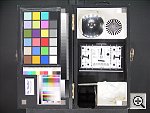 We shot samples of this target using the automatic (1108 k) and daylight (1122 k) white balance. The two white balance options actually were very close in their results, the daylight option being just slightly warmer-toned. The camera overall overexposed the image just a little, resulting in slightly washed-out color and lost highlight detail. Shadow detail and noise is excellent though. We shot samples of this target using the automatic (1108 k) and daylight (1122 k) white balance. The two white balance options actually were very close in their results, the daylight option being just slightly warmer-toned. The camera overall overexposed the image just a little, resulting in slightly washed-out color and lost highlight detail. Shadow detail and noise is excellent though. |
||||||||||||||||||||||||||||||||||||||
| Low-Light Tests The i700 did a passably good job in the low light arena, but didn't approach the current top of the market for 3 megapixel digicams. It provided usable images down to about one foot-candle, the level of lighting you'd find on a well-lit city street at night. It could capture images quite a bit darker than that, but the noise levels became unacceptably high. Even at one foot-candle, there was more "stuck pixel" noise than we'd like to see. (We refer interested readers to Mike Chaney's Qimage Pro software for a program that does an excellent job of removing noise of this sort without overly disturbing the underlying picture information.) The table below shows the best exposure we were able to obtain for each of a range of illumination levels, at all three ISO settings. Images in this table (like all of our sample photos) are untouched, exactly as they came from the camera.
|
||||||||||||||||||||||||||||||||||||||
| Flash Range Test In our testing, we found the i700's flash to be fairly powerful, doing a good job of illuminating our test target all the way out to 14 feet. (We'd thus say that Ricoh's official rating of 8.1 feet (2.5 meters) is pretty conservative.) Below is our flash range series, with distances from eight to 14 feet from the target.
|
||||||||||||||||||||||||||||||||||||||
ISO-12233 (WG-18) Resolution Test
(1132 k) 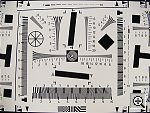 The i700's results on our "laboratory" resolution test chart were a bit of a mixed bag. It started showing artifacts in the test patterns at resolutions as low as 550 lines per picture height, in both horizontal and vertical directions. This is a level you'd normally see on a two megapixel camera. On the other hand though we found "strong detail" out to at least 900 lines, which is very much a 3 megapixel level of performance. "Extinction" of the target patterns didn't occur until about 1150 lines. The conclusion? Overall quite good resolution, but with a tendency toward artifacts. The i700's results on our "laboratory" resolution test chart were a bit of a mixed bag. It started showing artifacts in the test patterns at resolutions as low as 550 lines per picture height, in both horizontal and vertical directions. This is a level you'd normally see on a two megapixel camera. On the other hand though we found "strong detail" out to at least 900 lines, which is very much a 3 megapixel level of performance. "Extinction" of the target patterns didn't occur until about 1150 lines. The conclusion? Overall quite good resolution, but with a tendency toward artifacts.
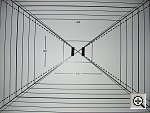
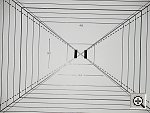
Optical distortion on the i700 is just a bit above average at the wide angle end, where we measured an approximate 0.88 percent barrel distortion. The telephoto end fared much better, as we measured a barely visible 0.15 percent pincushion distortion. Chromatic aberration is quite low, at most a couple of lightly-colored pixels in the far corners. (This distortion is visible as a very slight colored fringe around the objects at the edges of the field of view on the resolution target.) We'd like to see less geometric distortion in the lens, but it turns in a good performance otherwise.
Resolution Series, Telephoto
Sharpness Series
|
||||||||||||||||||||||||||||||||||||||
|
Viewfinder Accuracy/Flash Uniformity
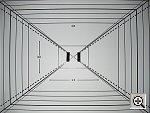
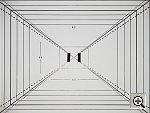
The i700's optical viewfinder is a quite tight, showing approximately 81.3 percent frame accuracy at wide angle, and about 79.3 percent at telephoto. Images framed with the optical viewfinder were slanted quite a bit (a tilt of about 1.5 degrees) toward the left corner, and shifted a bit to the right in position. The LCD monitor fares a bit better, showing approximately 85.5 percent of the image area at wide angle setting, and approximately 83.0 percent at telephoto. Since we generally like to see LCD monitors as close to 100 percent accuracy as possible, we felt that the i700's LCD viewfinder was a bit lacking in this respect. Flash distribution is fairly even at wide angle, with some falloff at the corners of the frame. At the telephoto setting, flash distribution is very even.
|
||||||||||||||||||||||||||||||||||||||












Jump to Comparometer(tm) to compare with other cameras
Or, up to Imaging Resource Cameras Page.


Follow Imaging Resource: