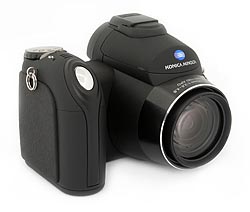
Konica Minolta DiMAGE Z5By: Dave Etchells & Mike TomkinsKonica Minolta existing Z3 model gets an updated sensor, larger LCD and slightly updated control layout. (Next): Comparison with previous DiMAGE cameras>> Page 1:Intro and HighlightsReview First Posted: 03/28/2005 |
 |
|
5.0-megapixel CCD delivers uninterpolated
images as large as 2,560 x 1,920 pixels. |
| |
Powerful 12x optical zoom lens covers a
35-420mm equivalent focus range. |
|
| * | Integrated anti-shake system greatly extends usefulness of long zoom lens in lower light. | |
| |
Large 2.0" LCD monitor
makes it easier to share just-captured photos, or confirm fine details. |
Introduction - The Konica Minolta DiMAGE Z5
| Free Photo Lessons | |
|
Like its predecessors, the Konica Minolta Z5 offers a combination of ease of use, features, and retail price that are squarely aimed at the bulk of "point & shoot" users. At the same time though, the Z5 offers optional advanced exposure modes (including full-manual operation and a flash hot shoe) that appeal to more advanced users. As such, it makes a great camera for situations where users of widely varying experience levels need to share the same camera. It's also a great choice for novices who want a camera with features that they can "grow into" as their photographic abilities mature. The most important feature though, is its anti-shake technology. Long-zoom cameras are currently one of the most popular categories of digicams, but few people realize just how hard it is to hold a 12x zoom lens steady on a distant subject. Unless you're shooting in very bright light, or have the camera mounted on a solid tripod, it can be very difficult to avoid blurring caused by camera shake. By contrast, with its advanced anti-shake technology, the Konica Minolta Z5 is able to compensate for a surprising amount of jiggling, delivering sharp photos across a much wider range of conditions than would be possible otherwise. All in all, the new Konica Minolta DiMAGE Z5 delivers an amazing amount of technology in a very approachable package, at a very attractive price. Read on for all the details!
Konica Minolta Z5 Highlights
By Shawn Barnett
With the price of digital SLRs finally within reach, should you stick with the All-in-one digicam or move up to an SLR? Why buy a high-end digicam when digital SLRs are so close in price? Do digicams still have a purpose? What are the pros and cons? An avid photographer, I spent some time thinking about that myself. Come see what I discovered about digital SLRs versus all-in-one digicams.
- 5.0 effective megapixel CCD.
- Electronic optical viewfinder (EVF).
- 2.0-inch color TFT LCD monitor.
- 12x, 5.83-69.9mm lens, equivalent to a 35-420mm lens on a 35mm camera.
- 4x digital zoom.
- Automatic, Program AE, Aperture Priority, Shutter Priority, and Manual exposure modes, plus five preset Digital Subject Program modes.
- Shutter speeds from 1/1,000 to 4 seconds.
- Maximum aperture f/2.8 to f/4.5, depending on lens zoom position.
- Built-in flash with five modes.
- External flash hot shoe for Konica Minolta accessory flash units.
- SD/MMC memory card storage, 16MB card included.
- Images saved as JPEG files.
- Power supplied by four AA-type batteries or optional AC adapter.
- DiMAGE Viewer software and USB drivers included for both Windows and Mac platforms.
- Optional Anti-Shake technology reduces blurring from camera movement.
- Movie and Night Movie modes with sound recording.
- Optical zoom can be used in Movie mode (but is clearly audible in recorded movies)
- Standard and Ultra High Speed Continuous Advance shooting modes.
- Progressive Capture mode for capturing images before you release the shutter.
- Auto Exposure Bracketing.
- Two- or 10-second Self-Timer for delayed shutter release.
- White balance (color) adjustment with seven modes, including a manual setting.
- Adjustable ISO with four sensitivity settings and an Auto mode.
- Multi-Segment, Center-Weighted, and Spot metering options.
- Spot and Full-time AF modes.
- Single, Continuous with Predictive Focus, and Manual AF modes, with an adjustable AF area.
- Color, Sharpness, and Contrast adjustments.
- USB Direct-Print and PictBridge capability.
- A/V cable for connection to a television set.
- USB cable for connection to a computer (driver software included).


Follow Imaging Resource: