


Overview
Sony A380 Overview
Reviewed by Shawn Barnett, Dave Etchells, and Zig Weidelich
Preview Posted: 05/18/09
Review Posted: 10/31/09
Bucking the trend toward greater complexity and higher resolution, Sony has revamped their consumer digital SLR line with a new focus on even greater simplicity, lower-cost cameras, and more affordable beginner optics. Indeed, the three new SLRs, the Sony A230, A330, and A380 share more specifications in common with their predecessors than they do differences, with the main changes occurring in the size, weight, and shape categories.
Resolution for all three bodies is unchanged. The Sony A230 and A330 both have a 10.2-megapixel sensor, and the A380 has a 14.2-megapixel sensor. And though the A330 and A380 both have the fastest Live View mode available, they have no built-in movie mode in any model.
The Sony A380's new body design features fewer buttons to avoid confusing the user, and a few tweaks to the Function menu and the Status display. All three cameras are also bundled with a new 18-55mm lens to replace the 18-70mm lens previously used as a kit lens. The new lens design is shorter and lighter, and is the first of the company's new SAM lens line. Standing for Smooth Autofocus Motor, the new electronically linked lenses are designed to be less expensive than Sony's current offerings, while still offering high optical quality.
The Sony A380 includes support for both Memory Stick Duo and Secure Digital cards, with a manual switch to select between the two. Gone is support for CompactFlash, as is now true for most consumer SLRs.
A new Help system joins the improved DRO brought over from the A900 and the Sony A380 and its new brothers have the SteadyShot Inside feature. There are a number of other feature improvements in the Sony A380, including bigger AF points, a new self-timer mode, and even a new optional flash, all of which we'll get to in the User Report below.
The Sony A380 started shipping in June 2009, initially priced at $849 with the 18-55mm kit lens, and $1,049 with the 18-55mm and 55-200mm lenses, covering an 11x zoom range. Be sure to check prices by clicking on the links above right and in the shopping pods below for the latest prices on the Sony A380!
Note: Because these three cameras -- the Sony A230, A330, and A380 are so similar, each of their reviews is a slight rewrite of the other. All test and gallery shots, however, are from each camera. Oddly enough, it turns out that they're each pretty unique in their color rendering, autofocus abilities, and a few other aspects. Of the three, we found the Sony A330 to be the best overall choice.
Sony A380 User Report
by Shawn Barnett
It's been just over a year since Sony shipped their last trio of consumer Alpha digital SLR cameras, the A200, A300, and A350, and already they've revamped the line with a new external design and a greater emphasis on economical features and accessories. The revamped models are the Sony A230, A330, and A380.
 Company representatives told us that extensive focus-group research revealed that people wanted simpler SLRs that didn't cost too much, and were lighter and easier to bring along. And among those who bought an SLR, many expressed a desire to buy at least one additional lens for their fancy interchangeable-lens digital camera, but few ever made the purchase, largely due to cost.
These studies clearly had an effect on the company's plans for their consumer digital SLR line, because the new cameras reflect significant change in the areas of weight, size, and simplicity, while the internal specifications remain mostly the same. Company representatives also noted that nearly each item in the cameras was redesigned to improve efficiency and reduce weight, and though the sensors are indeed the same, the new Alphas include a new image processing system.


Revamped: Side-by-side, it's easy to see how the new small Alpha body and lens are different from the old, largely Konica-Minolta-based Alphas. The grip is smaller, the lens shorter (in both size and focal length), and the shutter button is further back on the camera's top deck.


Competitive: Sony has achieved their goal of making the new Alphas smaller and lighter than their predecessors, though they are not significantly smaller or lighter than the competition. Fortunately for Sony, Canon and Nikon's latest consumer SLRs have gotten taller, so the Sony Alphas look shorter overall, and the new lens brings the camera's length front-to-back closer to the Canon T1i.
Look and feel. The flagship of Sony's consumer line, the Alpha A380 is the same weight and size as the A330, and weighs about 40 grams more than the A230. The weight is well-balanced, partly thanks to the new lens, but the bodies feel somewhat hollow compared to other digital SLRs in this class.

Much of the weight reduction is due to the significantly trimmed grip on the Sony A380, as well as its smaller Lithium-ion battery. Unlike most SLR grips, the Sony A380's stops well short of the camera's shutter release, and the shutter button now appears on the camera's top deck. Everyone on the staff but me disliked this new design; and I only accept it because you can easily adjust your grip by balancing the camera's base into the palm of your hand, which puts your index finger in better position to reach the grip, while your pinkie and ring fingers curl around the grip. After a bit of use with one of the heavier Sony lenses, like the Carl Zeiss 24-70 f/2.8 lens, though, I can tell you it puts a strain on these latter two fingers, and makes you miss the rest of the grip. If you don't hold the Sony A380 as I outline above, getting your index finger up to the shutter button is a strain.
It seems Sony was aiming for a more retro look with this design, harking back to gripless film SLRs of days gone by, with their metallic tops and leather-covered bodies. The look is appealing once you get used to it, and those who use a camera strap and the new light SAM lenses will hardly notice the smaller grip.
The Control dial now faces forward, just beneath the Sony A380's Shutter release button. The lens release button and AF/MF switch are in the same positions relative to past models. The Sony A380's Alpha logo is now smaller, embossed into the gunmetal-colored top of the two-toned body design. Above that, the mode dial is partially concealed, recessed into the top deck to reduce the chance of accidental activation.
There is still no depth-of-field preview button on the Sony A380.

The Sony A380's new shorter lens includes a bayonet mount for a lens hood, but Sony did not include a lens hood in the samples we received. The mode dial is only accessible from the rear and left side of the Sony A380. Sony moved the Power switch from the rear left of the camera's back to a better position surrounding the Shutter release button, a method also used by Nikon and Pentax on their SLRs. Gone is the flash activation button to the left of the lens mount, where it appears on most other digital SLRs. Sony said too many customers never thought to look there, so they've moved it to the rear navigation disk. It's a little more cumbersome to activate now: you have to press the flash button (the right side of the nav disk), then use the up and down arrows to select an active flash mode. Then, once you half-press the shutter release, the flash will pop up.
Also note the Live View/Optical Viewfinder (OVF) switch, which manually moves the front mirror of the pentamirror arrangement inside the Sony A380 optical viewfinder assembly, directing the light to the Live View sensor inside. A shutter also covers the optical viewfinder at this point, preventing light from entering and affecting the light meter. More on this in the Live View section below.
Just right of that switch is the Smart Teleconverter button, which activates the Sony A380's digital zoom, only available in Live View mode, which zooms the view by 1.4x and 2x with successive presses of this button. The resulting image is cropped from the full image when it is saved to the card, but not upsampled, resulting in a smaller, pre-cropped image.
Note also the substantial thumb grip, which really does help when holding the Sony A380 as I've described.

What also helps your grip is the soft taper Sony applied to the bottom right of the A380, which makes resting the camera in your palm more comfortable.

The back of the Sony A330 shows just how far Sony has gone toward simplifying the interface of these new cameras. The Display, Drive mode, ISO, and Flash buttons are now integrated into the four-way navigator, and the AE-Lock button no longer exists. That's a clear sign that these cameras are aimed at consumers.
The rubber eyecup looks more integrated into the body, but it's still removable like any other eyecup, with an upward tug. The infrared sensor is also still in play, offering both the option to turn off the display when you bring the Sony A380 to your eye, as well as to start up autofocus before you even press the shutter button.
Recessed more deeply into the back of the Sony A380, the articulating LCD tilts a little further up and down than it did on previous models. The card write lamp now juts out left of the LCD. Though it's an odd position, it beats being under the thumb, as it was on the A350. Note also the ambient light sensor on the lower right of the tilting LCD, which reads the light directionally and turns up the LCD's brightness in bright sunlight.
On the LCD itself is the new display screen, designed to help new users understand the relationship between shutter speeds and aperture.

Ports. All but the power port on the Sony A380 are on the camera's left side, including the HDMI Out and USB ports, as well as the SD and Memory Stick HG Duo card slots. Note also the Memory Stick/SD switch, a manual-only switching method. The whole array is concealed by a sliding pocket door that ducks down and slips inside the Sony A380's body.
Having the memory card slots on the left makes inserting and removing cards a little easier, because you don't have to let go of the grip to make the change, as you do on nearly every other digital SLR on the market. The choice of a pocket door also makes using the video and USB port much easier, thanks to the lack of a rubber door. It's also worth considering, though, that the door is not weather-sealed.

On the camera's right is another port door, covering the DC-IN port. It's much more difficult to open than the pocket door, being of the rubber variety. Note also the camera strap lug, recessed so that it doesn't stick into the palm of your hand.
Viewfinder. Optical viewfinders are usually preferable on most digital SLRs, but the Sony Alpha series has had its shortcomings, most notably it's difficult-to-see AF points. I've always liked how they were angled to match the orientation of each autofocus sensor, but that also made them harder to see in some situations.

Sony has replaced them in the new SLRs, though, with larger round dots. The array is the same, but the visual effect is quite different, and it's now easier to see each point illuminate to indicate the in-focus areas.
Because of the secondary live-view sensor, the Sony A380 and A330's viewfinder magnification is smaller than the A230's: 0.74x vs 0.83x, respectively.
Live View. But you can also turn to the Live View mode by sliding the switch on the top deck, which, thanks to the interplay of mirrors and lenses, grabs the exact view from the viewfinder and displays it on the LCD. As I mentioned above, the view can be zoomed with the Smart Teleconverter button on the top deck; though it's important to remember that this mode will crop your image, not just zoom in to aid in focus, as we often see on other live-view SLRs.


Because the Sony A380's Live View is through-the-viewfinder and through-the-lens, there is no delay for the mirror to flip down to autofocus, nor is there a longer delay while the camera employs contrast-detect autofocus on the scene. Autofocus and metering are just as fast as they are while you're looking through the optical viewfinder.
Live View is a little softer than it could be, as it was in the A300 and A350, especially in low light. Also, there is some manufacturing variability inherent in the A380's Live View system, and if the mirrors, lens, or sensor are out of perfect alignment, what you see in Live View can differ from the optical viewfinder and the captured image; as it is, the view is clipped even from what you see through the optical viewfinder. Still, it's hard to discount the advantage you get with the A380's version of Live View in terms of performance.
One disadvantage to Sony's current Live View design is that they weren't able to add a movie capture mode to the new cameras. Current manufacturers making digital SLRs that record movies, Canon, Nikon, and Panasonic, all draw their Live View record mode displays from the actual imaging sensor, so it's less mechanical and programming work for them to repurpose their live-view feed for video recording. Sony's viewfinder sensor is of fairly low resolution, and would also record the AF points, since the sensor is behind the focusing screen.
That's not to say that Sony couldn't add a movie mode by simply introducing a new mode that flips up the mirror and uses contrast-detect to focus, but they haven't chosen to do that.
Sony A380 Interface

Menu. The Sony A380's menu is very easy to use, functioning like a tabbed menu and a scrolling menu. When you get to the bottom of the first tab's list, it automatically switches to the top of the next tab. This design makes it easy to scan through the items looking for what you need. If you see that a given tab isn't what you need, regardless of where you are in the list, you can press the left or right arrow to move between tabs. It's a little confusing if you've been using a Nikon, where pressing the right arrow often selects a menu item, but it's not hard to get used to using the center button instead.
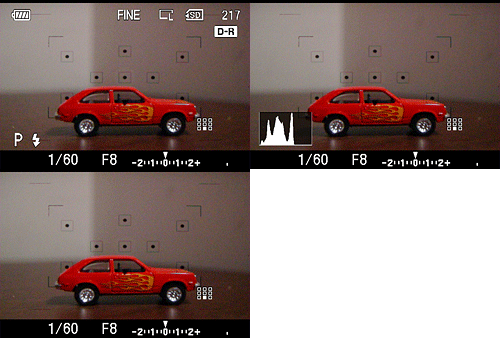
Live View LCD. In Live View mode, the viewfinder shows most of the information that the optical viewfinder shows, but since there's more room, the information is spread out over more of the screen area, rather than only across the bottom. The most critical component, besides the shutter speed and aperture, is the Super SteadyShot meter, which appears in the lower right corner of the screen, just as it does in the viewfinder.
Pressing the Display button brings up the histogram view, which includes a small, semi-translucent histogram in the lower left corner along with basic information across the bottom. There's also a mode with almost nothing overlaying the image area.

Function Menu and Help Guide display. Pressing the Fn (Function) button brings up a simple menu for adjusting most of the important items in both Record mode and Playback. Just use the Arrow pad to navigate to the desired option and press the center button to select your mode. If you stay on a given item for a moment, a plain-text explanation of each item pops up.
Likewise, as you turn the Mode dial, an onscreen display wheel appears on the left, with text and a sample image to explain each mode. The Help Guide display can be disabled in Setup menu 1.
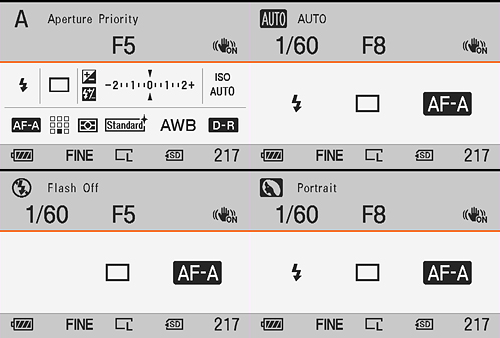
Status display modes. Sony has also added several display modes to the Status display. In addition to the standard display, which includes a large selection of camera settings, the Sony A380 has a simplified version, available when in full Auto modes, giving you only the small amount of information you need. (Screenshots at right were taken from the HDMI output, so they appear different from some of the others here.)
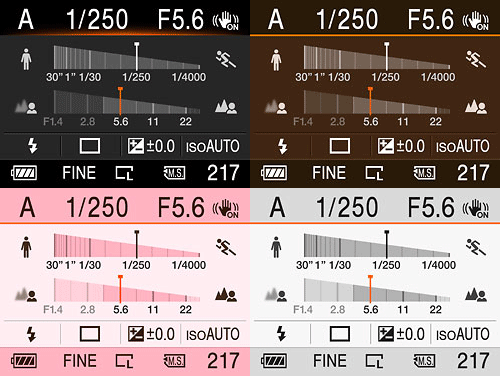
A new graphical display on the Sony A380 attempts to illustrate how moving in either direction on the shutter speed or aperture scale will affect your images, with a scale that changes in size from large to small as you move from long and large settings to shorter and smaller settings, respectively. You can also change screen colors. Finally, when you turn the Sony A380, the display rotates with it, re-orienting the entire arrangement (not shown).
Sony A380 Lens options
The Sony A380 is compatible with an array of new Sony lenses, and also with all Maxxum and Alpha lenses.

Twenty-six, plus two, plus four. Sony Alpha cameras are backed up by 26 current lenses, plus two teleconverters. This photo doesn't include the four new lenses announced with these cameras, three of which appear below.

The three, plus yet another. Sony has announced four new lenses, labeled SAM for their Smooth Autofocus Motor. They're marked with a silver band around the barrel. Only three of the lenses are new: the 18-55mm f/3.5-5.6 and the 50mm f/1.8 (expected to retail for $150); the 55-200mm f/4-5.6 is a re-release of an older lens. Not pictured is the 30mm Macro lens.
Accessories. Sony has also continued to expand their accessory offerings for the Alpha line, with new cases, wraps, lens bags, grip straps, an LCD cover, and an LCD shade.

New Alpha accessories.

Our favorite accessory is the new small flash, which lays flat across the camera top for easy storage, and powers on when flipped up. The flash head inside the unit turns to face upward for bounce shots, and a diffuser pivots into place for wider shots. Called the HVL-F20AM, the new flash retails for $129, and uses two AAA batteries to keep the weight down. The Sony Alpha cameras have full control of the flash for through-the-lens exposure.
Another good idea is the thick cloth wrap with a shock cord that protects the camera while it's in a bag. Just lay the camera in the cloth with the lens facing the corner with the shock cord, and start folding the rear and side corners in. Finish with the shock cord, and wrap it around the back, under the body and stretch it around the lens. Viola! A protected camera. I think I'll buy several of these to protect review cameras, as well as my own personal cameras.

The lens cap pocket seems a little fastidious to me, but it's not a bad idea if you like a place for everything and everything in its place. The handstrap is probably the most important new accessory, given the Sony A380's minimized front grip. It's quite similar to a camcorder handstrap, with a soft, spongy fabric against the back of your hand; the only bit I don't like is the large mounting block that screws into the tripod socket on the bottom, which makes the A380 a little less stable when placing the camera on a flat surface.
Missing from the accessory list for the new cameras is any mention of a battery grip, and there are no additional contacts up inside the battery compartment. That's unfortunate, because battery life from the internal battery has dropped compared to the Sony A350, due to a new, smaller NP-FH50 battery pack. CIPA rating for the A380 is 500 shots with the optical viewfinder, and 230 when using Live View. That's down significantly from the A350's 730 shots with the OVF and 410 in Live View.
Shooting with the Sony A380

Good color. Not oversaturated.
After spending a little time with all three of Sony's consumer Alphas, I was more impressed with the pictures than I was with the user experience. It's not that it was a bad experience. There's a lot I like about the Sony A380 from a design perspective, like the recessed Mode dial, the power switch surrounding the shutter button, and the fairly simple button layout. And the card/connector door on the left side is inspired. Overall it's a simple camera to use.
But getting the flash activated is about as cumbersome as I've ever seen, and Menu and AV buttons are mounted on the slant between the back panel and top deck, requiring you to adjust your hold completely and use your right or left index finger to activate them.
Though I do appreciate the light weight of all three cameras, they also feel hollow and plastic, not the more rock-solid feel I'm used to from other digital SLRs in this class. The shutter sound is at least quiet, and the shutter button breaks nicely, so you can feel when its about to go off.
The Sony A380's tilting screen is handy at times, but because I shoot vertically most of the time, I really couldn't use it as often as I'd like. The screen shiny outer bezel is also prone to scratching.

Telephoto. The Sony 55-200mm vignettes a fair bit at 200mm, and there's a little lens flare, but it's not bad for an inexpensive lens. I was surprised by the sharpness of my soccer shots.
While it is tighter, the Sony A380's viewfinder worked fine; and when I needed a larger view, I just switched to the Sony A380's Live View mode. Here's where the Sony A330 and A380 really shine, because their Live View modes introduce almost no autofocus shutter lag. And thanks to the built-in Super SteadyShot image stabilization, you can feel comfortable holding the A380 out in front of you, because the camera will make up for a good deal of the unsteadiness you'd otherwise get.
In the lab we discovered that the Live View mode shows less of the image area even than the optical viewfinder, which is a first. Because Live View is usually drawn from the actual imaging sensor, it's usually 100 percent. The Sony A380's optical viewfinder shows 95 percent of the image area, and the Live View shows only 92 percent. Both the viewfinder and the Live View were also tilted relative to the sensor, which should vary by sample, but will certainly make it harder to get a straight horizon line.
The grip is just fine once you learn to rest the right side of Sony A380 in your right palm and wrap your last two fingers around the grip. Fine, that is, with the reasonably lightweight 18-55 and 55-200mm kit lenses. Snick on something heavier, and you'll quickly be looking around for a monopod to support the imbalanced combination. So if you're thinking of one of those nice Carl Zeiss optics, check out the Sony A500 or A550, whose bodies are larger and have a full grip.
I shot a little soccer with the camera, and its maximum framerate of 1.7 frames per second was too slow for the job. It's amazing how much slower 1.7 is than the 5 and 8 fps I'm used to shooting. You can't get even the same formation as kids move across the field at that speed, and these are five-year-old kids. The camera just wasn't built for that, and you won't really find much better performance at the competition's 3 fps, so let's just say that these cameras really aren't meant for sports photography. You can do anything if you're good, of course, and have excellent timing, but if you're looking to catch the right moment by holding down the shutter, you'll be disappointed.
Autofocus did fairly well tracking my soccer subjects. There were a few blurry moments, where the camera focused on the background, but surprisingly few compared to some cameras I've used.
The autofocus system was reasonably good at getting the AF point right in most of my shots, but we didn't have as much luck in the lab, where a few targets had to be reshot over and again to get the focus set properly. Not only did the Sony A380 have a tendency to back focus by an inch or two, it also jumped around randomly.

Exposure. This shot came out slightly underexposed thanks to the brighter background, but it's a good demonstration of the 55-200mm telephoto lens's ability.
My shooting around town was easy and relatively predictable. I like the menus and general ease of the Sony Alphas. They just work and get out of your way. The menus are straightforward, tabbed designs that work just a little differently than some, but though they're tabbed, they also wrap around to the next tab once you get to the bottom of the first; it functions like one long menu.
Regardless of your mode, the Sony A380 is easy to shoot with. Eye-start AF, while a smart feature that turns on the autofocus system as you bring the camera to your eye, just wastes battery when I use the camera, because I either hold it in my right hand or switch from left to right, which keeps the lens buzzing to life all the time. Thankfully you can turn it off.
I'm happy that they changed the AF points inside the viewfinder, because they're much easier to see. They used to tell you something about the orientation of the outer points, which was technically helpful, but they were harder to see. When you're trying to compose an image, nothing's more important than positive confirmation of focus before you press the shutter.
The new 18-55mm kit lens is a closer match to the competition's lens, and reduces the overall length of the Sony A380 when compared to the old kit with the 18-70mm lens, but I do miss the optical quality of the older lens. We got three different copies of the 18-55mm lens, and one stood out with better performance in the corners and the center, so naturally I shot with that one.
Ultimately, I think the Sony A380 is a pretty good starter digital SLR, though I think the A330 is probably still the sweet spot in terms of price and performance. Given the retail price of $799 for the A380, the Sony A500 might be a better deal for the enthusiast photographer. Starting at $750 it has a better grip and still includes Live View and the tilting LCD, along with a few more advanced modes; though you'd take a step down from 14 megapixels to 12. Still, if you want the highest resolution with the added convenience of Live View in a lightweight body, the Sony A380 is a good choice.
Image Quality
Most digital SLRs will produce a reasonable ISO 100 shot, so I like to push them and see what they can do at ISO 1,600 with the extra noise reduction off. Recent advances in sensor technology and noise reduction have made ISO 1,600 look a lot more like ISO 100, but there are still cameras whose quality starts to fall apart at this setting. I also chose 1,600 because I like to be able to shoot at this level when indoors and at night, and I prefer to do my noise reduction on the computer.
Sony A380 versus Canon T1i at ISO 1,600
 |
 |
 |
 |
 |
 |
|
Sony A380 at ISO 1,600 |
Canon T1i at ISO 1,600
|
|
The Sony A380 has trouble with overaggressive noise reduction starting at ISO 800, even with the extra noise reduction off, so it's no surprise to see that it's a little softer than the 15-megapixel Canon XS at ISO 1,600. Despite its efforts, the Sony A380 still shows quite a bit of chroma noise, especially in the dark areas and shadows. The Canon takes a less aggressive approach, and seems to start out with finer-grained noise coming from the sensor, resulting in greater detail overall. |
|
Sony A380 versus Nikon D5000 at ISO 1,600
|
 |
|
 |
|
 |
|
Sony A380 at ISO 1,600 |
Nikon D5000 at ISO 1,600 |
|
The Nikon D5000, 12-megapixel digital SLR, eliminates most chroma noise, even with its extra noise suppression turned off. Though it's lower resolution than the 14-megapixel Sony A380, the Nikon captures more detail in the tone-on-tone areas of the image. |
|
Sony A380 versus Sony A330 at ISO 1,600
|
 |
|
 |
|
 |
|
Sony A380 at ISO 1,600 |
Sony A330 at ISO 1,600
|
|
Comparing the Sony A330 to the 14.1-megapixel A380 reveals some interesting information. Though the A380 technically records more data per image, the overall quality isn't that much better at ISO 1,600. In fact, some of the data, like the red swatch, has less of the original detail thanks to overactive noise suppression in the red channel. In the shadows and darker areas, the A380 may do a little better suppressing chroma noise, but the detail in color areas is not so much better that you couldn't get the same result by simply raising the resolution of the A330's images, at least at ISO 1,600. |
|
Detail: Sony A380 vs Canon T1i, Nikon D5000, and Sony A330
 |
 |
 |
 |
 |
 |
 |
 |
|
Sony A380 |
Canon T1i |
Nikon D5000
ISO 100 ISO 3,200 12mp |
Sony A330
ISO 100 ISO 3,200 10mp |
|
Detail comparison. An ISO 1,600 comparison is only so helpful; a camera's ISO 100 performance is also of value, as is its ISO 3,200 detail, so I've pitted the same set of cameras against each other in the high-contrast detail department. At ISO 100, the Sony A380 does a good job rendering the lines inside the letters without significant oversharpening. The higher-resolution Canon T1i does the same with a little better contrast, but it also oversharpens noticeably. The Nikon D5000's detail is a little softer overall, with only some of the lines showing up on its 12-megapixel image. The Sony A330 also finds some of the lines with its 10-megapixel sensor, though it's clear that this part of the image could not be magnified to equal the ISO 100 shot of the A380. At ISO 3,200, the Sony A380 renders the black letters with lots of demosaicing errors, which shows up as chroma noise inside those letters. The Canon T1i does a little better, but color noise is still present, and the detail of the red letters on top is better. The Nikon D5000 also produces slightly smoother detail, though the lens are harder to make out. And the Sony A330 can no longer find the lines, but the demosaicing error still produces color noise inside the letters. |
|||
Sony A380 Print Quality
The Sony A380's printed output is surprisingly good, with a fairly even approach across the ISO spectrum. ISO 100 shots are quite good at 16x19, great for wall display.
ISO 200 shots are softer, and though they're still fine at 16x20, they look better at 13x19 inches. ISO 400 shots also looked good at this size. ISO 800 shots are also quite usable, if only a touch soft at 13x19, though with a smattering of chroma noise in the shadows. Not bad for wall display, though. They look better at 11x14.
ISO 1,600 shots are usable at 11x14, but the chroma noise gets quite a bit larger and more noticeable; going down to 8x10 is much better. ISO 3,200 was a little rough at 8x10, though, yet quite usable at 5x7.
So overall, the Sony A380 made very good quality prints with low noise and good color, coming out significantly better than we expected from the onscreen analysis.
For more on image quality, see this review's other tabs, particularly the Image Quality and Optics tabs.
Analysis. Describing the Sony Alpha A380 and its siblings comes down to a relatively short list of what's new: a smaller, simpler body design, a new kit lens, a few tweaks to the menus and display screens, a new Self-timer mode, and a few other feature tweaks, plus some new accessories pretty well sums it up. The most surprising omission from Sony, one of the world's largest image-sensor manufacturers, is any new technology in the sensors, let alone a resolution increase. We don't believe that's a requirement, as 10 and 14 megapixels is just fine in this market, it's just surprising.
If Sony really is intent on changing the kind of consumer they attract and serve, drawing more people into the art of SLR photography, concentrating on affordable lenses and accessories makes a lot of sense. Sony may also try to stick to a schedule of annual upgrades in an effort to stay ahead of the competition, whose products are on an 18-month product cycle.
Shortcomings of the Sony A380 include the small grip, lack of a depth-of-field preview method, no movie mode, shorter battery life than its predecessor, and a very slow continuous capture rate of 1.7 frames per second, which makes it a poor choice for action photography.
In technological terms, the Sony A380 doesn't make any monumental leaps, but their Live View technology is in many ways miles ahead of the competition. The onscreen image may be a little softer, but Sony's Live View autofocus is much faster than any other digicam or SLR with live view, bringing digital SLR shutter-lag times to the world of live view. Sony's Live View method does not make adding video capture easy, however, so though they've announced three new consumer SLRs at once, none of them can compete with the Canon T1i or Nikon D5000 in the video capture column.
Sony A380 Basic Features
- 14.2 MP Super HAD CCD delivering resolutions as high as 4,592 x 3,056 pixels
- 3x Kit lens, 18-55mm (27-82.5mm equivalent), f/3.5-5.6
- Optical viewfinder
- 2.7-inch Clear Photo LCD Screen mounted on a tilting base
- ISO Sensitivity: 100 to 3,200
- Shutter speeds: 30 seconds to 1/4,000 second
- 1.7 frames per second continuous capture
- Secure Digital or Memory Stick Pro Duo memory card slots
- NP-FH50 Lithium-ion battery
- Dimensions: 5.03 x 3.8 x 2.8 inches (128 x 97 x 71.4 millimeters)
- Weight: 17.2 ounces (489g) without lens, battery or card
Sony A380 Special Features
- Tilting LCD, with auto brightness control
- Live View mode
- Super SteadyShot in-camera image stabilization offers from 2.5 to 3.5 stops of compensation
- Bionz Image Processor
- Dynamic Range Optimizer: Normal DRO improves detail using standard gamma curves for fast shot-to-shot response time. Advanced DRO adjusts dynamic range area-by-area. Improved algorithm from Sony A900
- Anti-Dust Technology
- Auto Pop-Up Flash with four main operating modes and a variable Slow-Sync function
- External, proprietary flash hot-shoe for Sony accessory flash units
- Built-in support for wireless TTL flash exposure with certain Sony flashes
- Eye-Start Autofocus System
- 9-Point Center Cross AF Sensor
- Auto and Manual focus options with Single and Continuous AF modes
- 40-segment honeycomb metering system, plus Center-Weighted and Spot metering options, with AE Lock function
- Scene Selection Modes: Portrait, Landscape, Macro, Sports, Sunset, Night Portrait, and Flash-off
- Creative Style Settings
- sRGB and Adobe RGB color space options
- RAW and JPEG file formats
- Contrast, saturation, and sharpness adjustments
- Adjustable White Balance setting with presets and a manual option
- Index and Slide Show Display
- High-Resolution Thumbnails for PhotoTV HD Viewing
- Help features explain Function menu items and capture modes
- USB 2.0 High-Speed cable and interface software for connecting to a computer and downloading images
- HDMI output
- DPOF (Digital Print Order Format), Exif 2.2, Print Image Matching III and PictBridge compliant
In the Box
The Sony A380 ships with the following items in the box:
- DSLR-A380 body
- DT18-55mm f/3.5-5.6 SAM zoom lens (if purchased as a kit)
- Body cap
- Lens caps
- Lithium-ion battery (NP-FH50)
- Battery charger
- USB cable
- Eyepiece cover
- Shoulder strap
- CD-ROM
- Instruction manual
- Warranty card
Recommended Accessories
- Extra battery pack for extended outings
- Large capacity Memory Stick Duo PRO or SDHC/SD memory card. These days, 2-8GB cards are inexpensive.
- Small camera case for outdoor and in-bag protection
Model Differences
The table below summarizes the differences between the three new models.
|
Summary of Differences
|
|||
|
Feature
|
Sony A230
|
Sony A330
|
Sony A380
|
|
Total Megapixels
|
10.8
|
10.8
|
14.9
|
|
Effective Megapixels
|
10.2
|
10.2
|
14.2
|
|
Maximum Resolution
|
3872 x 2592
|
3872 x 2592
|
4592 x 3056
|
|
Reduced Resolutions
|
3:2
2896 x 1936, 1920 x 1280 16:9 3872 x 2176, 2896 x 1632, 1920 x 1088 |
3:2
2896 x 1936, 1920 x 1280 16:9 3872 x 2176, 2896 x 1632, 1920 x 1088 |
3:2
3408 x 2272, 2288 x 1520 16:9 4592 x 2576, 3408 x 1920, 2288 x 1280 |
|
Viewfinder Magnification
|
0.83x
|
0.74x
|
0.74x
|
|
Viewfinder Eyepoint (mm)
|
16.5
|
19.7
|
19.7
|
|
Metering Sensitivity
(f/1.4 lens, ISO 100) |
EV 1 ~ 20
(Spot: EV 3 ~ 20) |
EV 2 ~ 20
(Spot: EV 4 ~ 20) |
EV 2 ~ 20
(Spot: EV 4 ~ 20) |
|
Burst Speed (Tested)
|
2.4 fps
|
2.4 fps
|
1.7 fps
|
|
Live View Mode
|
No
|
Yes
|
Yes
|
|
Tilting LCD
|
No
|
Yes
|
Yes
|
|
LCD Brightness Adjustment
|
5 steps manual
|
2 steps auto +
5 steps manual |
2 steps auto +
5 steps manual |
|
Battery Life (CIPA shots)
|
510 (OVF)
|
510 (OVF)
230 (Live View) |
500 (OVF)
230 (Live View) |
|
Dimensions (WxHxD, mm)
|
128 x 97 x 67.5
|
128 x 97 x 71.4
|
128 x 97 x 71.4
|
|
Weight (body only)
|
452 g
|
491 g
|
489 g
|
|
MSRP with 18-55mm lens
|
$549
|
$649
|
$849
|
Sony A380 Conclusion
| Pro: | Con: |
|---|---|
|
|
Sony's complete physical redesign of the A200 and A300 series digital SLRs brought with it a slight weight loss, a new card/connector door, and a good power switch relocation, but also came with a significantly reduced grip and the loss of the easy-to-use flash activation button. The redesign also included a new 18-55mm zoom lens, whose shorter length reduces the overall profile of the cameras.
Internally, there were few enough changes that we didn't expect a lot, but were nevertheless pleasantly surprised by the high print quality across the Sony A380's ISO range, with its 14-megapixel images capable of producing very good 16x20-inch prints at the lowest ISOs. Viewed onscreen at 100%, the image quality seemed to drop off pretty dramatically from ISO 800 up, but our printing showed the ISO 800 shots were still usable printed at 13x19 inches. That's quite good. ISO 1,600 and 3,200 shots were also usable straight out of the camera, producing good 8x10 and 5x7-inch prints, respectively.
The new autofocus screen on the Sony A380 is a welcome change, and we also like the new graphical status screen that shows the available range of shutter speeds and apertures for a given scene. We're also happy to see that the menu is about as simple as it was in last year's models, because they were just right. Autofocus speed is fast, but the frame rate is too low for sports shooting, at 1.7 frames per second.
Sony's unique Live View mode increases the value of the feature in the A380, whose autofocus functions just as fast in Live View as it does when autofocusing via the optical viewfinder, while most digital SLRs with live view slow down quite a bit. And though it doesn't have quite the full range of other digital SLRs, the tilting LCD design works well when shooting horizontally from overhead and down low. It also handles vertical shooting around corners or backed up against a wall quite well.
One thing missing from the Sony A380 is a movie mode, something some of its main competition at this price point have. It's important to remember that movie mode in most of those cameras isn't as easy to use as your standard camcorder, and most of them don't autofocus while you shoot, so it's not as big a strike as you'd imagine, but still worth considering.
Compared to the other two Alphas in this series, the Sony A380 would be our second choice after the A330. The Sony A380 scores lower than the A330 in the areas of low-light autofocus and flash power. For $200 less, you get better indoor performance than you'll get from the Sony A380, both with and without flash.
Unless you plan to make enlargements up to 16x20 inches, you won't need the Sony A380's 14-megapixel image size, because the Sony A330 is able to output 13x19-inch prints with no trouble at all. While we like the A380 for its simplicity and good image quality, you get more bang for your buck with the Sony A330, the only one of Sony's three consumer cameras to earn a Dave's Pick.

Design
Sony A380 Design
This page coming soon!
Operation
Sony A380 Operation
This page coming soon!
Optics
Sony A380 Optics
The Sony A380 features a bayonet lens mount, which accommodates a range of Sony and Konica Minolta lenses. The Sony A380 comes bundled with a Sony 18-55mm f/3.5-5.6 SAM kit lens. A separate kit comes with both the 18-55mm and a 55-200mm f/4-5.6 telephoto zoom lens. A small button on the front of the camera releases the lens from its mount, so it can be turned and removed. The A380's CCD is smaller than a 35mm frame, so the angle of view at any given focal length will not be the same as on a 35mm camera. To find the approximate 35mm equivalent focal length, multiply the focal length of the lens by 1.5. (Thus, a 50mm lens will provide about the same view as a 75mm lens on a 35mm camera.)

Alpha lens mount. The Sony A380's Alpha lens mount is compatible with the full array of Alpha lenses, both screw-drive and electronic autofocus models.
The Sony A380 provides both manual and automatic focus control modes, set by the Focus Mode switch on the left side of the camera body. You can select between Auto and Manual focus modes. The Function button provides access to additional AF modes and AF Area options. The Autofocus Mode option under the Function menu offers Single-shot AF, Automatic AF and Continuous AF settings. Single-shot sets focus with each half-press of the Shutter button, while Continuous mode is constantly adjusting the focus, whether the Shutter button is pressed or not. The Automatic setting will lock focus on a still subject or continually adjust focus on a moving subject, for as long as the Shutter button is halfway pressed.
Autofocus Area also has three options available through the Function menu: Wide, Spot, and Local (manual setting). The default option is a nine-point Wide Focus area, indicated by an array of square focus areas inset within four widely-spaced brackets in the viewfinder image. (Note that only the center point utilized a cross-type sensor sensitive to detail in both the horizontal and vertical axis. The other 8 sensors are line-type, sensitive to detail in one direction only, although the four line sensors at the corners of the AF array are angled, so they'll respond to both horizontal and vertical detail.)
You can override the chosen AF mode by pressing the Spot AF / OK button in the center of the Multi-controller on the camera's rear panel, which defaults to the more accurate center AF point (the latter indicated by a target box in the center of the viewfinder). Wide AF bases its focus on the most prominent subject detail in the portion of the image that falls within the AF brackets. Spot mode bases its focus on the very center of the frame, where the square target resides. The Local setting is Sony's terminology for a manual AF area selection, and lets you manually set the main AF point by using the Multi-controller to highlight one of the nine AF points. The active AF area is briefly illuminated in the viewfinder.
Sony didn't include a depth-of-field preview button on the A380, nor on any of its new consumer models announced early 2009. Admittedly, that feature is less useful with such a small viewfinder, but this factor might put off some macro and landscape photographers.
Sony A380 AF Assist
The Sony A380 uses its built-in flash head as a very bright AF-assist light for better focusing in dim lighting. This has the advantage that the light from the flash is very bright, but the downside is that you can only get AF assist when the flash head is raised. This is a real limitation for available-light photography, as the camera can expose at light levels well below those it can focus at. (Although its low-light focusing ability is much better than average.) If the camera is fixed on a tripod, you can work around this limitation, but it's somewhat awkward: With the flash head up, half-press the shutter button to make the camera focus. Then switch the focus mode to manual focus, being careful not to touch the focus ring on the lens. Stow the flash head, and then take your picture. (But don't forget to switch back to AF mode for the rest of your shooting!)
Sony A380 Anti-Shake
The Sony A380 also employs Sony's Super SteadyShot anti-shake technology, which uses a highly sensitive accelerometer and Smooth Impact Drive Mechanism (SIDM) to move the CCD assembly itself to counteract camera movement, rather than the more common approach of moving an optical element inside the lens.
Sony claims that the Super SteadyShot anti-shake system in the A380 provides a 2.5 to 3.5-stop reduction in the blurring produced by camera shake. Translating that into real-world shutter speeds, a two-stop improvement means that a shutter speed of 1/30 second would give you the same resistance to blur from camera shake that a speed of 1/120 would without anti-shake. A 3.5-stop improvement would mean you could shoot as slow as 1/11 second and get the same results (blur-wise) as when shooting at 1/120 second unaided. Even the lower end of the specified range of effectiveness means a pretty significant improvement in one's ability to hand-hold long exposures.
When Super SteadyShot is activated, the SteadyShot scale on the right side of the viewfinder display indicates the degree of stabilization. A downside to Sony's body-based SteadyShot approach is that while you can see the results of stabilization on competing lens-based designs, you have only this scale to tell you how the A380's SteadyShot mechanism is doing. The upside, though, is that the SteadyShot scale does give you a very good idea of how hard the SteadyShot mechanism is working, so you can choose a moment when the camera is moving less to snap the shutter, thus maximizing your chances for a sharp image.
Sony A380 Anti-Dust Technology
To help combat dust particles on the CCD from changing lenses, Sony included both an anti-static coating on the CCD filter and anti-dust vibrations to automatically shake the CCD with the anti-shake mechanism each time the camera is shut off. There is also a manual cleaning mode, where the camera lifts the mirror and opens the shutter, allowing access to the sensor for use with a blower or other cleaning device. We've generally found dust-removal systems based on cameras' anti-shake systems less effective than those that use an vibrate the sensor ultrasonically, but it bears noting that no dust removal system completely eliminates the need for occasional manual sensor cleaning. Copper Hill Images is an advertiser of ours, but we'd recommend their wet/dry cleaning system even if they weren't (it's what we use in our own lab): See the Copper Hill website for details.
Sony A380 Optical Test Results
Below are the results of our optical tests on the Sony A380. We used the 18-55mm kit lens as the benchmark, since most people will buy and use the camera in this configuration.
Kit Lens
Zoom
Good performance with the 18-55mm kit lens, but some variability from sample to sample.


The Sony Alpha 380 comes with an 18-55mm kit lens, which has a typical optical zoom range of ~3x. Details were a bit soft in the center of the frame at full wide-angle, with relatively low levels of coma distortion in the corners, but some noticeable blurring and chromatic aberration in the corners of the frame. Results at full telephoto were a better, with lower corner softness and chromatic aberration, but still a hint of softness across the frame. The Sony A380 also offers up to 2x digital zoom when in Live View mode (not shown), rare among SLRs. Detail is very good because it uninterpolated and simply a 3.9-megapixel crop from the center (no loss of detail associated with digital enlargement, but it's still only a 3.9-megapixel image, vs the 14-megapixel full sensor resolution).
The particular sample of the 18-55mm kit lens used for the shots above was pretty good, so we used that lens for all our kit-lens shots with the Spring 2009 A-series models. We did find some variation between the lenses we received with the three cameras, though: It's always a good idea to check that newly-bought lenses are focusing well and evenly across the frame, but the variation we saw among the Sony 18-55mm samples we had in our lab is good reason to remind our readers of this. (Note that, other than the wide/tele/digital tele examples, other images of this subject were shot with the excellent Sony 24-70mm f/2.8 Carl Zeiss lens, to better show the capabilities of the camera itself.)
Macro
A slightly large macro area with the kit lens, with slightly soft detail. Flash throttles down pretty well.


The Sony A380 captured a slightly larger macro area than average with the standard 18-55mm kit lens, measuring 2.38 x 1.59 inches (61 x 40 millimeters). Detail was a touch soft at the center of the frame, and corners were very soft. (Most lenses have some softening in the corners at macro distances.) You can also enable up to 2x digital zoom which essentially crops from the center, resulting in a smaller coverage area (1.25 x 0.83 inches or 32 x 21 millimeters), but at a lower resolution (3.9 megapixels). The A380's flash throttled down for the macro area pretty well, producing only slight overexposure, although coverage was a little uneven, with the top of the frame noticeably brighter. Still, better than average macro performance for an on-board flash.
Geometric Distortion
High barrel distortion at wide-angle with the 18-55mm kit lens, though hardly any distortion at telephoto.
| Barrel distortion at 18mm is 1.0 percent |
 |
| Almost no distortion at 55mm |
 |
The Sony A380's 18-55mm kit lens produced about 1.0 percent barrel distortion at wide-angle, which is higher than average and fairly noticeable in its images. At the telephoto end, there was only about 1 pixel of barrel distortion; for all practical purposes, none at all. This is the tendency for the lens to bend straight lines outward (like a barrel -- usually at wide-angle) or inward (like a pincushion -- usually at telephoto).
Chromatic Aberration
Moderate at wide-angle, but low at telephoto with the 18-55mm kit lens.


Chromatic aberration is moderate at the full wide-angle setting of the Sony A380's 18-55mm kit lens, showing about 7-9 pixels of bright coloration on either side of the target lines, and extending fairly far into the frame. At telephoto, chromatic aberration is much lower and hardly noticeable. (This distortion is visible as a slight colored fringe around the objects at the edges of the field of view on the resolution target.)
Corner Sharpness
Some blurring in the corners of the frame with the kit lens.


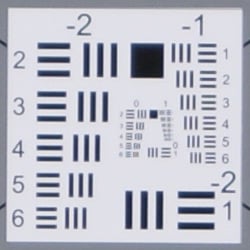
The Sony A380's 18-55mm kit lens produced slightly soft images in the corners of the frame at full wide-angle, noticeable in a few shots. The corners on the right-hand side on this particular lens were a little softer than the left, but the softness didn't extend very far into the frame. (A different sample we saw of the same lens was softer along the right side of the frame than this one was.) At telephoto, corners weren't quite as soft as wide-angle, but the lens was slightly softer overall. There's also a bit of vignetting (corner shading) at full wide-angle, which you can see in the crops above, where the crop from the corner of the frame at wide angle is so much dimmer than the one from the center. Still, pretty good results for a kit lens, especially considering the aperture here was wide-open. (Corner sharpness and vignetting typically improve as the lens is stopped-down from maximum aperture.) Other samples we had of the 18-55mm kit lens were just average in their performance.
The images above were taken from our standardized test shots. For a collection of more pictorial photos, see our Sony Alpha DSLR-A380 Photo Gallery .
Exposure
Sony A380 Image Quality
Color
Saturation & Hue Accuracy
Very good overall accuracy and saturation, with only minor shifts in hue and intensity.
 |
| In the diagram above, the squares show the original color, and the circles show the color that the camera captured. More saturated colors are located toward the periphery of the graph. Hue changes as you travel around the center. Thus, hue-accurate, highly saturated colors appear as lines radiating from the center. Click for a larger image. |
Saturation. The Sony A380 pushes strong reds, dark blues and some greens just a little, but actually undersaturates bright yellows, light greens, and cyan tones slightly. Its overall color saturation is a bit higher than the A330 and A230, but still more true to life than that of most consumer SLRs. Most consumer digital cameras produce color that's more highly saturated (more intense) than found in the original subjects. This is simply because most people like their color a bit brighter than life.
Skin tones. Here, with the color balanced properly for the light source, the Alpha A380's skin tones looked just about right. There were some slight red tints in places, but overall skin tone looked natural. Where oversaturation is most problematic is on Caucasian skin tones, as it's very easy for these "memory colors" to be seen as too bright, too pink, too yellow, etc.
Hue. The Alpha 380 showed only a few small color shifts relative to the mathematically precise translation of colors in its subjects, but had overall pretty good accuracy. Most noticeable were shifts in reds toward orange, cyan toward blue, as well as some shifts in yellows, blues and purples. Still, color accuracy was quite good. Hue is "what color" the
color is.
Saturation Adjustment
The Sony A380 has a total of seven saturation settings available, three above and three below the default saturation. This covers a pretty wide range of saturation levels, about as wide a range as you're likely to find photographically relevant, apart from special effects that are arguably better achieved in software. The fine steps between settings mean you can program the camera to just the level of saturation you prefer, a feature we look for in cameras.
| Saturation Adjustment Examples | ||||
 |
 |
 |
 |
 |
| -3 | -1 | 0 | +1 | +3 |
The table above shows results with several saturation settings, see the Thumbnails index page for more (look for the files named A380OUTBSATx.JPG). Click on any thumbnail above to see the full-sized image.


Sensor
Exposure and White Balance
Indoors, incandescent lighting
Good color with Incandescent and Manual white balance settings, though warm results with Auto white balance. About average positive exposure compensation required.


Indoors, under normal incandescent lighting, the Sony Alpha 380 produced overly warm color with its Auto white balance setting. Both the Incandescent and Manual settings produced more accurate results. It was a bit of a toss-up between them, as the Manual setting was just slightly cool and the Incandescent option a little warmer; We suspect most users would prefer the slight warmth of the results with the Incandescent white balance setting, as being more representative of the original lighting, without the very warm cast of the Auto setting. At +0.3 EV, the exposure compensation required was average for this shot. Color looks good throughout the frame, with only the slightest purplish tints in the blue flowers. (Many digital cameras reproduce these flowers with a dark, purplish tint, so the Alpha 380 actually performs a little better than average here.) Our test lighting for this shot is a mixture of 60 and 100 watt household incandescent bulbs, a pretty yellow light source, but a very common one in typical home settings here in the U.S.
Outdoors, daylight
Very good results under harsh lighting, with good handling of contrast, detail, and color.

Outdoors, the Sony Alpha 380 performed well, but required slightly higher than average exposure compensation of +1.0 EV for our "sunlit" portrait shot to keep the face bright. The average among the cameras we've tested is +0.7 EV. Contrast is a little high, as you might expect under such harsh lighting, but the camera does a very good job of holding onto detail in both the deep shadows and bright highlights. Despite the apparent brightness, there are actually very few clipped highlights in the model's face and shirt, with most of the clipping occurring in the pendant and flowers. Only a few highlights were blown in the House shot at the default exposure as well, also a very good result. Color balance is good as well, with good saturation considering the bright lighting. Finally, the camera's contrast adjustment did a very nice job of toning down the exposure without creating any strong color variations in the skin (though skin tone did change slightly - See the Contrast series under the Extremes section below). Overall, very good performance.
See full set of test images with explanations
See thumbnails of all test and gallery images
Resolution
Very high resolution, 1,800 ~ 2,000 lines of strong detail.


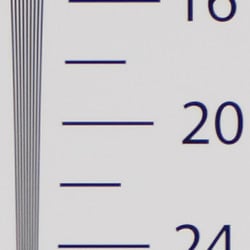

Our laboratory resolution chart revealed sharp, distinct line patterns down to about 2,000 lines per picture height in the horizontal direction, and about 1,800 in the vertical direction. Complete extinction didn't occur until around 2,800 lines in the horizontal direction, and over 3,200 lines in the vertical. Unusually, we weren't able to do much better with Adobe Camera RAW processed RAW files, which says that the camera is doing a pretty good job here. Use these numbers to compare with other cameras of similar resolution, or use them to see just what higher resolution can mean in terms of potential detail.
See full set of test images with explanations
See thumbnails of all test and gallery images
Sharpness & Detail
Very good detail and sharpness, with relatively minor edge-enhancement on high-contrast subjects. Minimal noise suppression visible at base ISO.


Sharpness. The Sony A380 produced very good detail, but softness in its kit lens didn't show off the camera's abilities to best advantage. The crop of the house and trees above is from an image shot with Sony's 24-70mm f/2.8 Carl Zeiss zoom, a really excellent optic, and shows the very good detail the A380 body is capable of. Some minor edge enhancement artifacts are visible on high-contrast subjects such as the crop above left, but overall results are still quite good. (Best results in post-processing would still be obtained by dialing down the in-camera sharpening an using strong/tight unsharp masking in Photoshop or other image editing software.) Edge enhancement creates the illusion of sharpness by enhancing colors and tones right at the edge of a rapid transition in color or tone.
Detail. The crop above right shows only minimal noise suppression, as the darker areas of the model's hair show a lot of detail. Individual strands are still distinguishable even in the lighter shadows, though they begin to merge as shadows deepens. All in all, a very good performance here, especially considering the high resolution. (Sony seems to have made real strides in their noise-reduction processing in the last year, as this round of Alphas do a much better job of holding onto subtle subject detail than did last year's models.) Noise-suppression systems in digital cameras tend to flatten-out detail in areas of subtle contrast. The effects can often be seen in shots of human hair, where the individual strands are lost and an almost "watercolor" look appears.
RAW vs In-Camera JPEGs
As noted above, the Sony A380 does a pretty good job at balancing between sharpness and visible sharpening artifacts in camera JPEGs. A little more detail can be obtained from carefully processing RAW files though, without introducing additional artifacts. Take a look below, to see what we mean:

In the table above, mousing over a link at the bottom will load the corresponding crop in the area above, and clicking the link will load the full resolution image. Examples include in-camera Fine JPEG, RAW file processed through Sony's Image Data Converter SR version 2 software, and RAW file processed through Adobe Camera Raw version 5.5, then sharpened in Photoshop. For the Sony A380's images shot with sharp primes or high-end zooms, I found best results with strong but tight 300% unsharp masking with an 0.3 pixel radius. (As above, this shot of the house & trees was captured with the Sony 24-70mm f/2.8 Carl Zeiss lens, to show the camera's detail rendering when not limited by the kit lens.)
Note: ACR renders colors somewhat differently than either the A380 or the Sony software, so the greens in the trees and blues in the sky are a bit different. There's no mistaking the increase in detail though, regardless of changes in color or tone.
ISO & Noise Performance
Low noise at the lower sensitivity settings, with very good results up to ISO 400. However, big jumps in noise at the highest settings.
| Noise Reduction = On (Default) | ||
 |
 |
 |
| ISO 100 | ISO 200 | ISO 400 |
 |
 |
 |
| ISO 800 | ISO 1,600 | ISO 3,200 |
The Sony Alpha 380 produced images with low noise at its lower sensitivity settings, with noise increasing and detail degrading progressively as you move to higher ISO settings. We like the way Sony's made the choice between noise and subject detail, and that the two trade off against each other in a smooth progression as you move from low ISOs to high ones, at least up to about ISO 400. At ISO 800, subject detail seems to take a bigger drop, and there's another change when you step up to 1,600, in that noise is held down, but at greater cost to subtle subject detail. Images at 1,600 and ISO 3,200 are notably less detailed than those at lower sensitivity levels. Of course, the impact of noise and detail loss are highly dependent on the size the photos are printed at, and pixel-peeping on-screen has surprisingly little relationship to how the images look when printed: See the Print Quality section below for recommended maximum print sizes at each ISO.
A note about focus for this shot: We shoot this image at f/4, using one of three very sharp reference lenses (70mm Sigma f/2.8 macro for most cameras, 60mm f/2.8 Nikkor macro for Nikon bodies without a drive motor, and Olympus Zuiko 50mm f/2.0 for Four Thirds and Micro Four Thirds bodies). To insure that the hair detail we use for making critical judgements about camera noise processing and detail rendering is in sharp focus at the relatively wide aperture we're shooting at, the focus target at the center of the scene is on a movable stand. This lets us compensate for front- or back-focus by different camera bodies, even those that lack micro-focus adjustments. This does mean, though, that the focus target itself may appear soft or slightly out of focus for bodies that front- or back-focused with the reference lens. We know this; if you click to view the full-size image for one of these shots and notice that the focus target is fuzzy, you don't need to email and tell us. :-) The focus target position will have been adjusted to insure that the rest of the scene is focused properly.
Extremes: Sunlit and low light tests
Very high resolution with excellent highlight and shadow detail. Good low-light performance, capable of capturing bright images in near darkness, however manual exposure was required and autofocus struggled at lower light levels.


Sunlight:
The Sony Alpha 380 handled the deliberately harsh lighting in the test above very well. Though contrast is a little high, shadow and highlight detail are both very good. The camera's contrast adjustment also did a good job of decreasing overall contrast without producing strong color variations; see the section below. The +1.0 EV exposure did the best job here, as the model's face was a bit too dim at +0.7 EV and we felt that too many highlights were lost at +1.3 EV. These shots were captured with the Sony A380's DRO (Dynamic Range Optimizer) control set to its default of "Standard." This seemed to help quite a bit with both exposure accuracy and highlight/shadow preservation on this difficult shot. Be sure to use fill flash in situations like the one shown above; it's better to shoot in the shade when possible.
Because digital cameras are more like slide film than negative film (in that they tend to have a more limited tonal range), we test them in the harshest situations to see how they handle scenes with bright highlights and dark shadows, as well as what kind of sensitivity they have in low light. The shot above is designed to mimic the very harsh, contrasty effect of direct noonday sunlight, a very tough challenge for most digital cameras. (You can read details of this test here.)
Contrast Adjustment
We really like it when a camera gives us the ability to adjust contrast and saturation to our liking. It's even better when those adjustments cover a useful range, in steps small enough to allow for precise tweaks. Just as with its saturation adjustment, the Sony A380's contrast setting meets both challenges.
| Minimum Contrast, default D-R setting | |
 |
 |
| Contrast set to lowest, +1.0 EV |
Contrast set to lowest, Auto Exposure |
At its lowest contrast setting, the A380 did a really excellent job of preserving highlight detail, maintaining natural-looking skin tones, and holding nice detail in the shadows. The A380 captures good color outdoors, though just slightly on the warm side. Overall, very good results here, especially when the contrast setting is tweaked. (This is a really tough shot; the Sony A380 does a much better than average job handling it.)
| Contrast Adjustment Examples | ||||
|
 |
 |
 |
 |
| -3 | -1 | 0 | +1 | +3 |
The series of shots above shows results with several different contrast adjustment settings, showing the minimum step size around the default, as well as both extremes. While you can see the extremes, it's hard to really evaluate contrast on small thumbnails like these, click on any thumbnail to go to the full-size image.
One very nice feature of Sony's contrast adjustment is that it has very little effect on color saturation. Contrast and saturation are actually fairly closely coupled, it's a good trick to be able to vary one with out the other changing as well. Sony did a good job here.
Sony's DRO (Dynamic Range Optimization)
While the Sony A380's contrast adjustment feature works very well, their Dynamic Range Optimization system is a critical part of it. This system analyzes the range of brightness of each image, and adjusts the camera's image processing parameters accordingly, to make the best use of the available dynamic range. Three options are available on the A380: DRO Off, Standard D-R, and D-R Advanced (Plus). The default in most camera modes is Standard, but in Auto exposure mode, or in Portrait, Landscape or Macro, DRO is automatically set to Advanced. In Sports mode, DRO is set to Standard. DRO is set to Off in Sunset and Night Portrait/View mode. Unlike some higher-spec Sony SLRs, the A380 does not allow you choose the strength for the D-R effect. Standard D-R looks at the entire image and effectively adjusts contrast and brightness across the entire image for best effect. D-R Advanced analyzes everything, but makes local adjustments to bring out shadow detail and preserve highlights.
| DRO Examples | |||
 |
 |
 |
 |
| DRO Off +0 EV |
DRO Off +1.0 EV |
DRO Standard +0 EV |
DRO Advanced +0 EV |
 |
 |
 |
 |
| Highlight Retention | |||
 |
 |
 |
 |
| Shadow Detail / Noise | |||
As you can see from the crops above, to get a similarly exposed image without DRO enabled, exposure compensation of +1.0EV is required. Other than that, the effect of DRO is quite subtle (in this case anyway). You can see a bit more highlight detail with DRO set to Advanced versus Off, but DRO Standard seems to clip slightly more highlights than when DRO is set to Off. Shadow detail is similar in all three similarly exposed cases, but there is an increase in noise in the deepest shadows with DRO enabled. Note: the shadow crops have had levels adjusted equally (by sliding Photoshop's highlight slider to 100) on the right side of each to reveal the increase in shadow noise with DRO active.
| 1 fc 11 lux |
1/2 fc 5.5 lux |
1/4 fc 2.7 lux |
1/8 fc 1.3 lux |
1/16 fc 0.67 lux |
1/16fc No NR |
|
|---|---|---|---|---|---|---|
| ISO 100 |
 2 sec f2.8 |
 4 sec f2.8 |
 8 sec f2.8 |
 15 sec f2.8 |
 30 sec f2.8 |
 30 sec f2.8 |
| ISO 200 |
 1 sec f2.8 |
 2 sec f2.8 |
 4 sec f2.8 |
 8 sec f2.8 |
 15 sec f2.8 |
 15 sec f2.8 |
| ISO 400 |
 0.5 sec f2.8 |
 1 sec f2.8 |
 2 sec f2.8 |
 4 sec f2.8 |
 8 sec f2.8 |
 8 sec f2.8 |
| ISO 800 |
 1/4 sec f2.8 |
 0.5 sec f2.8 |
 1 sec f2.8 |
 2 sec f2.8 |
 4 sec f2.8 |
 4 sec f2.8 |
| ISO 1600 |
 1/8 sec f2.8 |
 1/4 sec f2.8 |
 0.5 sec f2.8 |
 1 sec f2.8 |
 2 sec f2.8 |
 2 sec f2.8 |
| ISO 3200 |
 1/15 sec f2.8 |
 1/8 sec f2.8 |
 1/4 sec f2.8 |
 0.5 sec f2.8 |
 1 sec f2.8 |
 1 sec f2.8 |
Low light. The Sony A380 was able to capture bright images at the lowest light level with the lowest sensitivity setting (ISO 100), but required the use of manual exposure mode. The A380's auto exposure (metering) did not work well at all at lower light levels, resulting in very underexposed images (by as much as 4 stops, at the darkest level tested here). Noise is relatively low up to ISO 800, and at higher ISOs consists mainly of chroma blotches. There's no sign of any banding issues or uncorrected hot pixels. Color balance looked good with the Auto white balance setting, though chroma noise impacts the color of darker midtones and shadows at higher ISOs.
The camera's autofocus system was able to focus on the subject down to just below the 1/4 foot-candle light level unassisted. This is a rather poor performance for an SLR, though the A380 was able to focus in complete darkness with the AF assist enabled. Since the Sony A380 doesn't use contrast detection for Live View, low-light AF performance was identical in Live View mode. Keep in mind that the longer shutter speeds here demand the use of a tripod to prevent any blurring from camera movement, Sony's Super SteadyShot not withstanding. (A useful trick is to just prop the camera on a convenient surface, and use its self-timer to release the shutter. This avoids any jiggling from your finger pressing the shutter button, and can work quite well when you don't have a tripod handy.)
How bright is this? The one foot-candle light level that this test begins at roughly corresponds to the brightness of typical city street-lighting at night. Cameras performing well at that level should be able to snap good-looking photos of street-lit scenes.
NOTE: This low light test is conducted with a stationary subject, and the camera mounted on a sturdy tripod. Most digital cameras will fail miserably when faced with a moving subject in dim lighting. (For example, a child's ballet recital or a holiday pageant in a gymnasium.) Digital SLRs like the Sony A380 do much better than point & shoots, but you still shouldn't expect a quick autofocus lock with moving subjects.
Output Quality
Print Quality
Great print quality, good color, sharp 16 x 20-inch prints at ISO 100.

The Sony A380's printed output is surprisingly good, with a fairly even approach across the ISO spectrum. ISO 100 shots are quite good at 16x20, great for wall display.
ISO 200 shots are softer, and though they're still fine at 16x20, they look better at 13x19 inches. ISO 400 shots also looked good at this size. ISO 800 shots are also quite usable, if only a touch soft at 13x19, though with a smattering of chroma noise in the shadows. Not bad for wall display, though. They look better at 11x14.
ISO 1,600 shots are usable at 11x14, but the chroma noise gets quite a bit larger and more noticeable; going down to 8x10 is much better. ISO 3,200 was a little rough at 8x10, though, yet quite usable at 5x7.
So overall, the Sony A380 made very good quality prints with low noise and good color, coming out significantly better than we expected from the onscreen analysis.
Testing hundreds of digital cameras, we've found that you can only tell just so much about a camera's image quality by viewing its images on-screen. Ultimately, there's no substitute for printing a lot of images and examining them closely. For this reason, we now routinely print sample images from the cameras we test on our Canon Pro9000 Mark II studio printer, and on the Pixma MP610 here in the office. (See the Canon Pixma Pro9000 Mark II review for details on that model.)
The images above were taken from our standardized test shots. For a collection of more pictorial photos, see our Sony Alpha DSLR-A380 Photo Gallery .
Not sure which camera to buy? Let your eyes be the ultimate judge! Visit our Comparometer(tm) to compare images from the Sony Alpha DSLR-A380 with those from other cameras you may be considering. The proof is in the pictures, so let your own eyes decide which you like best!
Performance
Sony A380 Performance
Timing and Performance
Very good to below average speed for a consumer digital SLR.
| Startup/Shutdown |
||
| Power on |
0.6 second | Time it takes for camera to turn on and take a shot. |
| Shutdown |
2.0 seconds | How long it takes to turn off. (Slightly slow, due to dust-removal sensor shake on shutdown.) |
| Buffer clearing time |
5 seconds * after 20+ L/F JPEGs |
Worst case buffer clearing time. -- This is the delay after a set of shots before you can remove the card. Some cameras won't shut down until the buffer is cleared. |
| 10 seconds * after 10 RAW frames |
||
| 12 seconds * after 4 RAW + JPEG frames |
||
| *Note: Buffer clearing times measured with a SanDisk Extreme III 8GB SDHC memory card. Slower cards will produce correspondingly slower clearing times. |
||
Startup time is about average for an SLR, but shutdown is a little slow (probably due to sensor cleaning). Buffer clearing time depends on the image size and quality, burst length and how fast the card can be written to. Clearing times are pretty good for a consumer camera.
| Mode Switching | ||
|---|---|---|
|
Play to Record, |
0.4 second
|
Time until first shot is captured. |
|
Record to Play |
1.3 seconds
|
Time to display a large/fine file immediately after capture. |
|
Display |
0.3 second
|
Time to display a large/fine file already on the memory card. |
Mode switching is pretty fast for a consumer SLR, though switching from Record to Play immediately after capture was a bit on the slow side.
| Shutter Response (Lag Time) | ||
|---|---|---|
|
Full Autofocus |
0.198 second
|
Time from fully pressing shutter button to image capture (with Sigma70mm f/2.8 prime). |
|
Full Autofocus |
0.204 second
|
Time from fully pressing shutter button to image capture (with Sigma70mm f/2.8 prime). |
|
Full Autofocus |
0.285 second
|
Time from fully pressing shutter button to image capture (with Sigma70mm f/2.8 prime), Auto Flash enabled. |
|
Pre-focused |
0.107 second
|
Time to capture, after half-pressing and holding shutter button. |
|
Continuous AF
|
0.195 second
|
This mode usually shows no speed increase with our static subject; we have no way to measure performance with moving subjects.
|
|
Manual focus
|
0.192 second
|
For most cameras, shutter lag is less in manual focus than autofocus, but usually not as fast as when the camera is "pre-focused."
|
|
Full Autofocus
Single Area AF Live View mode |
0.196 second
|
Time from fully pressing shutter button to image capture (with Sigma70mm f/2.8 prime). |
|
Pre-focused |
0.107 second
|
Time to capture, after half-pressing and holding shutter button. |
Looking at the A380's ability to determine that it's properly focused when shooting the same target multiple times, its speed is faster than average for a consumer model. The A380 required about 0.198 second for full AF using the center focus point. This increased slightly to 0.204 second in wide-area AF mode. Enabling the flash raised the lag to 0.285 second, still quite fast. Continuous autofocus mode lag time was 0.195 second and manual focus was only slightly faster at about 0.192 second. When prefocused, shutter lag dropped to 0.107 second.
The nice thing about Sony's Live View implementation is that shutter lag in Live View mode is just as fast as when using the optical viewfinder. (In this case, full AF was slightly faster, at 0.196 second.) This is because the second image sensor located in the A380's viewfinder housing alleviates the need for the additional mirror flips required by most other phase-detect Live View implementations. Other phase-detect systems need to drop the mirror, focus, and raise it again to before taking a shot in Live View mode, or employ a slower contrast-detect autofocus method using the main image sensor. Since the image sensor feeding the A380's live preview is located above the mirror, the mirror stays down until the final exposure, exactly as it does in optical viewfinder mode. As noted elsewhere, though, the downside of this type of Live View implementation is lower accuracy for the Live View viewfinder display.
To minimize the effect of different lens' focusing speed, we test AF-active shutter lag with the lens already set to the correct focal distance. We also use the same Sigma 70mm f/2.8 macro with every camera (on all platforms except Four Thirds/Micro Four Thirds and Nikon consumer models lacking an in-body focus motor), to further reduce variation, and because our tests showed that focus-determination time with this lens was close to the fastest, across multiple camera bodies from different manufacturers. Being an older design with a non-ultrasonic motor, it wouldn't be the fastest at slewing from one focus setting to another, but that's exactly the reason we measure focus determination speed, which is primarily a function of the camera body, vs focus adjustment speed, which is primarily a function of the lens.
| Cycle Time (shot-to-shot) | ||
|---|---|---|
|
Single Shot mode
Large Fine JPEG |
0.74 second
|
Time per shot, averaged over 20 shots. |
|
Single Shot mode |
0.67 second
|
Time per shot, averaged over 9 shots, then slows to 1.29 seconds for subsequent shots. |
|
Single Shot mode |
0.66 second
|
0.66 second for 2 shots, then slows to 2.10 seconds for subsequent shots. |
|
Early shutter |
YES
|
Some cameras refuse to snap another shot if you release and press the shutter too quickly in Single Shot mode, making "No" the preferred answer. |
| Continuous mode Large Fine JPEG |
0.58 second (1.73 frames per second);
50+ frames total; 5 seconds to clear |
Time per shot, averaged over 20 shots. Buffer takes 5 seconds to clear, but seemed to be able to keep up, no matter how many frames we shot. (We stopped at ~50)
|
|
Continuous mode |
0.58 second (1.73 frames per second);
10 frames total; 10 seconds to clear |
0.58 second for the first 10 frames, then 1.27 seconds (0.79 fps) for subsequent shots. |
|
Continuous mode |
0.58 second (1.73 frames per second);
4 frames total; 12 seconds to clear |
0.58 second for the first 4 frames, then 1.99 seconds (0.50 fps) for subsequent shots. |
| Flash recycling |
4.0 seconds
|
Flash at maximum output. |
| *Note: Buffer clearing times measured with a SanDisk Extreme III 8GB SDHC memory card. Slower cards will produce correspondingly slower clearing times. Slow cards may also limit length of bursts in continuous mode. ISO sensitivity and other settings such as DRO or NR can also affect cycle times and burst mode performance. |
||
Shot-to-shot cycle times were a little slow for an SLR, at 0.74 seconds per frame for large/fine JPEGs, 0.67 second for RAW and 0.66 second for RAW + JPEG frames. Continuous mode speeds are also quite slow for an SLR these days (but not too surprising given the large files), at about 1.73 frames-per-second for any quality. Buffer depths are pretty good for a consumer model though, with essentially no limit (50+) for JPEG frames with a fast card, 10 RAW frames and 4 RAW + JPEG frames. The flash takes 4 seconds to recharge after a full-power shot, which isn't bad. As noted earlier, buffer clearing times are pretty fast as well.
| Download speed | ||
|---|---|---|
|
Windows Computer, USB 2.0 |
6,719 KBytes/sec
|
Typical Values: |
Connected to a computer or printer with USB 2.0, download speeds are quite speedy, although the A380 for some reason tested out with slower download times than the Sony A230 and A330, which we reviewed at roughly the same time.
Bottom line, the Alpha 380 is a very responsive camera when it comes to autofocus, but slower than average in continuous mode. The A380 is very similar in speed to the A230 and A330, except in cycle times where it's slower, due no doubt to its higher resolution and the larger image files that result. It should be fine for most family shots, but you're very likely to notice the slower shooting speed with sports subjects.
Battery and Storage Capacity
Battery
Slightly below average battery life for a lithium-ion design.
| Operating Mode | Number of Shots |
|---|---|
|
Optical Viewfinder,
(CIPA standard) |
500
|
|
Live View LCD,
(CIPA standard) |
230
|
The Sony Alpha 380 uses a custom rechargeable lithium-ion battery for power, and ships with a charger. Since its battery life is a bit below average even when using the optical viewfinder, we recommend you pick up a spare battery and keep it freshly charged and on-hand for extended outings. If you plan to use Live View much, you'll definitely want to have a spare battery to bring along.
The table above shows the number of shots the camera is capable of (on either a fresh set of disposable batteries or a fully-charged rechargeable battery as appropriate), based on CIPA battery-life and/or manufacturer standard test conditions.
(Interested readers can find an English translation of the CIPA DC-002 standards document here. (180K PDF document))
Storage
The Sony Alpha A380 accepts SD/SDHC or Memory Stick Duo memory cards, and no card is included with the camera.
|
Image Capacity vs Resolution/Quality 1GB Memory Card |
Fine | Normal |
RAW
|
RAW
+ JPEG |
|
| 4,592 x 3,056 |
Images
(Avg size) |
199 5.1 MB |
277 3.7 MB |
45 22.7 MB |
36 28.0 MB |
|
Approx.
Comp. |
8:1 | 11:1 | 0.9:1 | - | |
| 3,408 x 2,272 |
Images
(Avg size) |
265 3.9 MB |
362 2.8 MB |
- | - |
|
Approx.
Comp. |
6:1 | 8:1 | - | - | |
| 2,288x 1,520 |
Images
(Avg size) |
462 2.2 MB |
588 1.7 MB |
- | - |
|
Approx.
Comp. |
5:1 | 6:1 | - | - | |
We strongly recommend buying either a large capacity SDHC, or a large capacity Memory Stick Pro Duo card, at least a 2GB card, preferably a 4-8GB one, to give yourself extra space for extended outings. (Check the shopping link above, cards are really cheap these days, so no reason to skimp.)
Viewfinder
Sony A380 Viewfinder
The Sony A380 features a digital SLR design, so the optical viewfinder offers a true, through-the-lens (TTL) display. A dioptric adjustment dial to the right of the eyepiece accommodates eyeglass wearers, letting them adjust the viewfinder optics between -3.0 to +1.0 diopters. The viewfinder eyepiece has a fairly typical eyepoint (specified at 19.7mm from the eyepiece, 14.1mm from the eyepiece frame with the dioptric adjustment set to -1 diopter). Magnification is pretty low at only 0.74x for a 50mm lens and -1 diopter of dioptric correction. This is likely due to the room needed for the Live View sensor. Coverage is specified at 95%, typical for non-pro SLRs.
Like the Sony A330, the A380's viewfinder uses a pentamirror design. The advantage of a pentamirror is it's lighter and less expensive; however an all-glass pentaprism design delivers more light to the viewfinder eyepiece, thanks to its more efficient internal reflection. A solid pentaprism isn't compatible with Sony's tilting-mirror Live View mechanism, though.

The Sony A380's extensive information display features a series of focus target marks in the center of the view that highlight briefly when the AF system is activated. Note that the line-type AF-Point displays from previous generations of Sony SLRs have been replaced by boxes, however only the center AF sensor is a cross-type. Markers are provided for 16:9 shooting area, as well as the general AF area.
Camera information appears beneath the image area in a small strip, and reports all of the major camera settings, such as shutter speed, aperture, flash mode, EV compensation, etc. To the far right side of the strip is the Super SteadyShot (anti-shake) scale, indicating the degree of stabilization whenever anti-shake mode is activated. The information readout in the viewfinder activates whenever you half-press the Shutter button, and remains active for a few seconds afterward.
 A pair of horizontal infrared sensors just below the viewfinder detect your eye as it approaches the viewfinder, and deactivates the LCD information display if you have the Auto Off w/ VF option enabled in the Custom menu. (Note: our camera picked-up the IR beam in the image at right. The beam is invisible to the naked eye.) You can also set these sensors to initiate autofocus whenever your eye is in range of the eyepiece (Eye-Start AF), which makes the A380's autofocus seem even more responsive.
Viewfinder Test Results
Coverage
Good accuracy from the optical viewfinder, but Live View on the LCD was less accurate.


The Sony Alpha 380's optical viewfinder showed about 95 percent coverage accuracy with our Sigma 70mm f/2.8 prime lens, matching Sony's specification. The image does however appear slightly tilted and shifted relative to the imaging sensor, which we're unfortunately seeing more and more frequently in consumer SLRs these days. The amount of tilt and shift on the Sony A380's finder isn't as bad as many we've seen. Live View mode had slightly less coverage at about 92%, but was also tilted and shifted very slightly. We're used to seeing close to 100% coverage from cameras' LCDs in Live View mode, but Sony's approach of using a secondary image sensor for Live View rather than the main imager means that lower coverage and minor misalignments like this can occur. (The upside, of course, is much faster shutter response than most Live-View SLRs that use the main image sensor for the Live View viewfinder display.)
Live View
Sony A380 Live View
This page coming soon!
Flash
Sony A380 Flash

The Sony A380 features a built-in, pop-up flash, which operates in either Auto, Fill-Flash, Slow-sync, Rear Sync, Wireless, and Flash-off modes. To release the flash from its compartment, press the button on the left side of the pentamirror housing. Close it again by pushing the flash head back down.
The Flash mode is changed from the Function screen. In Auto flash mode (available only in the camera's Auto or Scene Selection modes), the camera automatically determines when to fire the flash based on the existing lighting, and will pop-up the flash automatically. In Fill-Flash mode, the flash fires with every exposure, regardless of lighting conditions. Slow-sync mode fires the flash for foreground fill exposure, while allowing the background to burn in. The Rear Flash Sync mode fires the flash at the end of the shutter time, rather than the beginning. If you have moving objects in the scene with lights, as with a car, this will produce a sharp image of your subject, with a "motion trail" following behind it when shooting at slower shutter speeds. The flash is off when Flash Off mode is selected, or when the flash is down in non Auto exposure mode.
 Flash exposure compensation can be set via the Camera 1 menu, measuring two stops lower or greater, in 1/3-stop increments.
The A380's built-in flash has a Guide Number (GN) of 10 meters or 32.8 feet at ISO 100. That's a bit below the average of about 12 meters for Consumer SLRs we've tested. Maximum sync speed is 1/160s. High Speed Sync (HSS) shooting with shutter speeds up to 1/4,000s is available with Sony HVL-F58AM and HVL-F42AM external flash units.
A Red-Eye Reduction option is available through the Custom 1 menu. When Red-Eye reduction is enabled, the camera will fire a few low-power flash pulses before it actually snaps the picture, to make the pupils of your subjects' eyes contract.
The A380 also has a top-mounted hot shoe for attaching an external flash unit. The shoe design and contact arrangement are set up for Sony's own dedicated flash units.
 The Wireless mode lets the Sony A380 work with compatible remote flash units with wireless capability, specifically the Sony HVL-F58AM and HVL-F42AM. Four separate control channels are available for wireless operation, to allow multiple photographers to work wirelessly in the same area without interfering with each other. You're limited to a single external flash unit vs the 3 groups that you can control with Sony's higher-end models, but it still opens a lot of creative possibilities, when the flash doesn't have to be attached to your camera. The ability for the A380's internal flash to act as a controller for a single group of wireless flash units is an upgrade relative to last year's A200/300/350, and relatively rare among entry-level SLR models. Operating in Wireless mode with a compatible external flash unit, the Sony A380's flash exposure compensation adjustment can adjust the intensity of the external flash remotely, once the camera and flash unit have been initially synched to each other.
Flash Test Results
Coverage and Range
Inconsistent flash performance with uneven coverage at wide-angle. Our standard shot required average exposure compensation.


Coverage and Exposure. Flash coverage was uneven at wide-angle (18mm), but much more uniform at telephoto (55mm). The Indoor test was a bit underexposed at the default setting, but +0.3 EV was a bit too bright. (Most cameras we've tested required about +0.7 EV for this scene.) The camera's Slow-Sync flash mode produced bright, more even results without any compensation, though with a stronger pinkish-orange cast from the room lighting.
| Flash Range: Wide Angle | |||||
|---|---|---|---|---|---|
| 6 ft | 7 ft | 8 ft | 9 ft | 10 ft | 11 ft |
 1/60 sec f3.5 ISO 100 |
 1/60 sec f3.5 ISO 100 |
 1/60 sec f3.5 ISO 100 |
 1/60 sec f3.5 ISO 100 |
 1/60 sec f3.5 ISO 100 |
 1/60 sec f3.5 ISO 100 |
| 12 ft | 13 ft | 14 ft | 15 ft | 16 ft | |
 1/60 sec f3.5 ISO 100 |
 1/60 sec f3.5 ISO 100 |
 1/60 sec f3.5 ISO 100 |
 1/60 sec f3.5 ISO 100 |
 1/60 sec f3.5 ISO 100 |
|
| Flash Range: Telephoto | |||||
|---|---|---|---|---|---|
| 6 ft | 7 ft | 8 ft | 9 ft | 10 ft | 11 ft |
 1/80 sec f5.6 ISO 100 |
 1/80 sec f5.6 ISO 100 |
 1/80 sec f5.6 ISO 100 |
 1/80 sec f5.6 ISO 100 |
 1/80 sec f5.6 ISO 100 |
 1/80 sec f5.6 ISO 100 |
| 12 ft | 13 ft | 14 ft | 15 ft | 16 ft | |
 1/80 sec f5.6 ISO 100 |
 1/80 sec f5.6 ISO 100 |
 1/80 sec f5.6 ISO 100 |
 1/80 sec f5.6 ISO 100 |
 1/80 sec f5.6 ISO 100 |
|
ISO 100 Range. At wide-angle, flash shots at ISO 100 started out pretty bright at 6 feet, increased in brightness at 7 feet and then remained fairly bright out to a distance of 11 feet. At full telephoto and ISO 100, the target started out a bit dim at 6 feet, increased intensity at 7 feet, but lost intensity gradually from there.
| Manufacturer-Specified Flash Range | |
|---|---|
| Wide-angle | Telephoto |
 9.4 feet ISO 100 |
 5.9 feet ISO 100 |
Manufacturer Specified Flash Test. The Sony A380's built in flash is rated with a Guide Number of 10m at ISO 100. That works out to about 9.4 feet at f/3.5 and 5.9 feet at f/5.6, the maximum apertures of the kit zoom lens. In the shots above, the Alpha 380 performs as Sony says it will, producing a good exposure at the rated distance with its ISO set to 100 at wide angle, though results are a little dim at telephoto, as were our ISO 100 range shots at telephoto. Our standard test method for flash range uses a fixed setting of ISO 100, to provide a fair basis of comparison between cameras. We've now also begun shooting two shots using the manufacturer-specified camera settings, at the range the company claims for the camera, to assess the validity of the specific claims.
Imatest Results
Sony A380 Imatest Results
We routinely use Norman Koren's excellent "Imatest" analysis program for quantitative, thoroughly objective analysis of digicam test images. I highly recommend it to our technically-oriented readers, as it's far and away the best, most comprehensive analysis program I've found to date.
My comments below are just brief observations of what we see in the Imatest results. A full discussion of all the data Imatest produces is really beyond the scope of this review: Visit the Imatest web site for a full discussion of what the program measures, how it performs its computations, and how to interpret its output.
Here's some of the results produced by Imatest for the Sony A380:
| sRGB Accuracy Comparison |
||||
With very similar color to the other A-series models announced at the same time (the A230 and A330), the Sony A380 pushes strong reds, dark blues and some greens just a little, but actually undersaturates bright yellows, light greens, and cyan tones slightly, but overall saturation is closer to real life than that of most consumer SLRs we test. Average saturation was 107.9% (7.9% oversaturated). Average "delta-C" color error was only 5.15 after correction for saturation, which is very good. (Delta-C is the same as the more commonly referred to delta-E, but delta-C takes into account only color differences, ignoring luminance variation.) Overall, a very good color response for an SLR, especially a consumer oriented model. Mouse over the links below the illustration above to compare results with competing models.
Adobe RGB Accuracy Comparison |
||||
Like most other cameras, the Sony A380 delivers more highly saturated colors when using the Adobe RGB color space (which provides a much wider gamut, or range of colors that can be expressed). Average saturation was 109.8%, just slightly higher than the sRGB results. Average saturation-corrected hue error was 4.86 "delta-C" units, a little more accurate than the sRGB results. Again, mouse over the links below the illustration above to compare results with other consumer SLRs.
Sony A380 Color Analysis

This image shows how the Sony A380 actually rendered the colors of the MacBeth chart, compared to a numerically ideal treatment. In each color swatch, the outer perimeter shows the color as actually captured by the camera, the inner square shows the numerically correct color after correcting for the luminance of the photographed chart (as determined by a second-order curve fit to the values of the gray swatches), and the small rectangle inside the inner square shows the numerically correct color, without the luminance correction. This image shows the very good hue accuracy of the Sony A380, and also a tendency to boost the brightness (luminance) of highly saturated colors. We we've observed this brightness boost in many cameras we've tested; it seems to be a way to get brighter-looking color without completely overdoing the saturation. In the neutrals, the A380 holds back the highlights slightly, but increases contrast by pushing the shadows a bit deeper than the numerically exact numbers. Overall, the colors are impressively close to their "correct" values.
Sony A380 Noise Analysis

There's a lot in this particular graph, a lot more than we have room to go into here. (This set of plots has also changed a few revisions back in Imatest. Some of the plots that were once shown here are now shown in other Imatest output. Since we largely focus on the Noise Spectrum plot, we only show the graphic above, which includes that plot.)
In comparing these graphs with those from competing cameras, we've found that the Noise Spectrum graph at lower right is the most important. Cameras that manage to shift their noise spectrum to higher frequencies have much finer-grained noise structures, making their noise less visually objectionable. In the graph above, this would show up as a noise spectrum curve that remained higher on the right side, representing higher noise frequencies.
The Sony A380 does a fair job of keeping much of the luminance noise energy at high frequencies, so what little low-ISO image noise that's there is pretty fine-grained as a result. The color channels are much noisier than the luminance, though, especially at lower frequencies, but this is quite common these days. This manifests itself as small, colored blotches in monochromatic midtones and shadows, and is only visible at ISO 100 when pixel-peeping to a pretty extreme extent. Overall noise levels (the graph at the lower left of the graphic above) are roughly on par with other 14- to 15-megapixel cameras we've tested (a little higher than those of the Canon T1i, a little lower than those of the Pentax K-7, both of which are more expensive cameras).
As we saw with previous Sony SLRs, there are spikes that occur in the Noise Spectrum plot every 0.125 or 1/8 cycles per pixel. The source of the noise spikes appears to be the sometimes slightly lighter pixels along the edges of the 8x8 pixel blocks used in the A380's JPEG encoding. Overall noise levels are so low however that the noise spikes aren't really visible at ISO 100 under normal conditions.

Here's the same set of noise data at ISO 1,600. Here, the Noise Spectrum graph is shifted towards the left-hand, lower-frequency side than it was at ISO 100. (Interestingly, the red and blue channels' noise spectrum is still much higher at low frequencies, something most noise reduction systems tend to minimize at higher ISOs.) This indicates a coarsening of the "grain" of the image noise patterns by quite a bit, and indeed that's what we see when inspecting the A380's ISO 1,600 images. Noise levels at ISO 1,600 are a little higher than other 14- to 15-megapixel cameras we've tested.

Here's the same set of noise data at ISO 3,200. The Noise Spectrum graph is similar, though the A380's noise reduction has further reduced the chroma noise to more closely follow luminance noise, but it's still higher, especially at low frequencies. Notice also that the total noise levels are much higher. (Particularly evident in the pixel noise plot in the upper right corner of the illustration, and in the midtones and below in the graph in the lower left hand corner.) Chroma noise levels (especially red-channel noise) are quite a bit higher than what we've seen in other 14- to 15-megapixel cameras at ISO 3,200.

This chart compares the Sony A380's luminance noise performance at midtone grey density over a range of ISOs against that of other current, similarly priced consumer models. While we continue to show noise plots of this sort because readers ask for them, we each time point out that the noise magnitude is only a small part of the story, the grain pattern being much more important. Here, we can see that the Sony A380's luminance noise magnitude follows that of its predecessor, the A350, extremely closely (the values are almost identical). The Sony A380's noise starts out average relative to its "competition", and remains about average to slightly above average compared to the others up to ISO 800. Like most other Sony SLRs, the A380's graph takes a deep dip at ISO 1,600, down to below the ISO 400 level, indicating strong noise reduction has kicked in (and having the effect you'd expect on fine subject detail). At ISO 3,200, the A380's graph is still much lower than most of the competition (the Nikon D5000 being the exception). This may seem like good performance, but examining high ISO images from the A380 reveals that a substantial price has been paid, as much fine detail has been blurred away by noise reduction. Do keep in mind these measurements are at default settings, so the shape or position of the curve is influenced by the settings you choose to use. Turning off the high ISO noise reduction (the Sony A380 has only Off and On options) would have certainly raised the values in the graph above, but would also result in more detail retention. Note that the Sony A380 forces high ISO noise reduction off when in continuous mode, and forces it on in some exposure modes, such as Auto or Scene Selection.
Sony A380 Dynamic Range Analysis
A key parameter in a digital camera is its Dynamic Range, the range of brightness that can be faithfully recorded. At the upper end of the tonal scale, dynamic range is dictated by the point at which the RGB data "saturates" at values of 255, 255, 255. At the lower end of the tonal scale, dynamic range is determined by the point at which there ceases to be any useful difference between adjacent tonal steps. Note the use of the qualifier "useful" in there: While it's tempting to evaluate dynamic range as the maximum number of tonal steps that can be discerned at all, that measure of dynamic range has very little relevance to real-world photography. What we care about as photographers is how much detail we can pull out of the shadows before image noise becomes too objectionable. This, of course, is a very subjective matter, and will vary with the application and even the subject matter in question. (Noise will be much more visible in subjects with large areas of flat tints and subtle shading than it would in subjects with strong, highly contrasting surface texture.)
What makes most sense then, is to specify useful dynamic range in terms of the point at which image noise reaches some agreed-upon threshold. To this end, Imatest computes a number of different dynamic range measurements, based on a variety of image noise thresholds. The noise thresholds are specified in terms of f-stops of equivalent luminance variation in the final image file, and dynamic range is computed for noise thresholds of 1.0 (low image quality), 0.5 (medium image quality), 0.25 (medium-high image quality) and 0.1 (high image quality). For most photographers and most applications, the noise thresholds of 0.5 and 0.25 f-stops are probably the most relevant to the production of acceptable-quality finished images, but many noise-sensitive shooters will insist on the 0.1 f-stop limit for their most critical work.
The graphic below shows the test results from Imatest for an in-camera JPEG file from the Sony A380 with a nominally-exposed density step target (Stouffer 4110), and the A380's contrast and other exposure-related settings at their default values. Note that the A380 selects different levels of DRO depending on the exposure mode, so we've included plots from all three settings (Off, Standard and Advanced or Plus) here.


Here, we can see that the tone curves show pretty good gradation in the highlights but the shadows trail off more abruptly for all three settings. (The order above, from top to bottom is Off, Standard and Advanced/Plus). As is usually the case with dynamic-range enhancement modes on consumer cameras, the total dynamic range actually remains constant (the camera just flattens the highlight end of the tone curve a little) and is pretty good, remaining in a fairly tight range between 10.1 and 10.4 f-stops. The scores at the highest level are all similar (7.29 to 7.36 f-stops), and about average for an SLR with an APS-C size sensor.

Processing the Sony A380's RAW (.ARW) files through Adobe Camera Raw (ACR) version 5.5 increased dynamic range by more than 1.25 f-stops at the highest quality level (8.62 f-stops), compared to the best in-camera JPEG (7.36 f-stops) while total dynamic range reported increased from 10.4 to 12.5 f-stops. These results were obtained by using ACR's automatic settings; then manually tweaking from there. It's worth noting here that ACR's default noise reduction settings reduced overall noise (see the plot in the lower left-hand corner) relative to the levels in the in-camera JPEG, which would tend to boost the dynamic range numbers for the High Quality threshold. Also, the extreme highlight recovery being performed by ACR here would likely produce color errors in strong highlights of natural subjects.
Dynamic Range, the bottom line:
The net result was that the Sony A380's JPEGs scored about average in Imatest's dynamic range analysis when compared against other current APS-C sensor models. Sony A380 RAW files converted with ACR did much better, scoring near the top 10 cameras we've tested to date.
To get some perspective, here's a summary of the Sony A380's dynamic range performance, and how it compares to other digital SLRs that we also have Imatest dynamic range data for. (Results are arranged in order of decreasing dynamic range at the "High" quality level.):
| Dynamic Range (in f-stops) vs Image Quality (At camera's base ISO) (Blue = RAW via ACR, Yellow=Camera JPEG, Green=Current Camera) |
||||
| Model | 1.0 (Low) |
0.5 (Medium) |
0.25 (Med-High) |
0.1 (High) |
| Nikon D3X (Adobe Camera Raw 5.3b) |
-- | -- | 11.1 | 9.64 |
| Nikon D700 (Adobe Camera Raw 4.5) |
12.1 | 11.6 | 10.6 | 9.51 |
| Sony A900 (Adobe Camera Raw 4.6b) |
-- | 12.1 | 10.7 | 9.36 |
| Nikon D90 (Adobe Camera Raw 4.6b) |
12.1 | 11.8 | 10.7 | 9.27 |
| Fujifilm S3 Pro (Adobe Camera Raw 2) |
12.1 | 11.7 | 10.7 | 9.00 |
| Sony A230 (Adobe Camera Raw 5.5) |
11.7 | 11.1 | 10.1 | 8.95 |
| Nikon D40x (Adobe Camera Raw 4.1) |
12.0 | 10.9 | 10.3 | 8.90 |
| Canon 5D Mark II (Adobe Camera Raw 5.2) |
-- | 10.8 | 10.0 | 8.89 |
| Sony A330 (Adobe Camera Raw 5.4) |
-- | -- | 10.1 | 8.86 |
| Canon EOS-1Ds Mark III (Adobe Camera Raw 4.5) |
11.5 | 10.7 | 9.96 | 8.84 |
| Nikon D3 (Adobe Camera Raw 4.5) |
11.7 | 11.0 | 10.0 | 8.75 |
| Canon EOS-1D Mark III (Adobe Camera Raw 4.5) |
11.7 | 10.7 | 9.99 | 8.73 |
| Sony A380 (Adobe Camera Raw 5.5) |
11.8 | 10.9 | 10.1 | 8.62 |
| Nikon D3000 (Adobe Camera Raw 5.5) |
-- | 10.8 | 10.1 | 8.61 |
| Pentax K20D (Adobe Camera Raw 4.5) |
11.4 | 10.6 | 9.82 | 8.56 |
| 8.5 Stops | ||||
| Nikon D300 (Adobe Camera Raw 4.3.1) |
11.4 | 10.9 | 9.87 | 8.45 |
| Sony A200 (Adobe Camera Raw 4.3.1) |
11.6 | 10.4 | 9.82 | 8.43 |
| Nikon D60 (Adobe Camera Raw 4.4.1) |
11.6 | 10.5 | 9.74 | 8.31 |
| Nikon D40 (Adobe Camera Raw 4.1) |
11.9 | 10.9 | 9.89 | 8.30 |
| Canon EOS-1Ds Mark III (Camera JPEG) |
10.9 | 10.2 | 9.71 | 8.23 |
| Pentax K100D (Adobe Camera Raw 3.6) |
11.3 | 10.3 | 9.51 | 8.23 |
| Pentax K200D (Adobe Camera Raw 4.4.1) |
-- | 10.5 | 9.54 | 8.19 |
| Pentax K10D (Adobe Camera Raw 3.7) |
10.6 | 10.0 | 9.29 | 8.19 |
| Sony A100 (Adobe Camera Raw 3.4) |
11.3 | 10.5 | 9.69 | 8.16 |
| Canon EOS-1Ds Mark II (Adobe Camera Raw 3) |
11.2 | 10.3 | 9.40 | 8.14 |
| Canon EOS 50D (Adobe Camera Raw 4.6) |
11.2 | 10.5 | 9.49 | 8.06 |
| Nikon D40x (Camera JPEG) |
10.8 | 10.0 | 9.42 | 8.04 |
| Olympus E-P1 (ISO 200, Adobe Camera Raw 5.5) |
11.5 | 10.4 | 9.26 | 8.04 |
| Canon Rebel XSi (Camera JPEG) (ALO on by default) |
11.3 | 10.1 | 9.34 | 8.01 |
| 8.0 Stops | ||||
| Fujifilm S3 Pro (Camera JPEG) |
-- | 9.90 | 9.40 | 7.94 |
| Nikon D3X (Camera JPEG) Advanced D-Lighting=Low) |
-- | -- | -- | 7.91 |
| Sony A350 (Adobe Camera Raw 4.4) |
11.6 | 10.5 | 9.61 | 7.89 |
| Canon EOS-1D Mark III (Camera JPEG) |
-- | 10.2 | 9.70 | 7.88 |
| Canon Rebel XS (Adobe Camera Raw 4.5) |
-- | 10.3 | 9.27 | 7.88 |
| Nikon D3 (Camera JPEG) |
-- | -- | -- | 7.87 |
| Canon Digital Rebel XTi (Adobe Camera Raw 3.6) |
10.8 | 9.88 | 9.18 | 7.84 |
| Canon EOS 5D (Adobe Camera Raw 3) |
11.0 | 10.4 | 9.21 | 7.83 |
| Canon EOS 50D (Camera JPEG) (ALO Off ) |
-- | 9.64 | 9.17 | 7.83 |
| Nikon D90 (Camera JPEG) |
-- | -- | -- | 7.77 |
| Panasonic DMC-GH1 (Adobe Camera Raw 5.4b) |
9.88 | -- | 9.30 | 7.76 |
| Panasonic DMC-GH1 (Camera JPEG iExposure=Standard) |
8.76 | -- | -- | 7.76 |
| Nikon D5000 (Camera JPEG), (Advanced D-Lighting=Low ) |
-- | -- | 9.28 | 7.75 |
| Canon Rebel T1i (Adobe Camera Raw 5.4b) |
11.2 | 10.2 | 9.16 | 7.73 |
| Canon EOS 40D (Adobe Camera Raw 4.2) |
11.2 | 10.1 | 9.26 | 7.72 |
| Canon Rebel XSi (Adobe Camera Raw 4.4.1) |
10.6 | 9.95 | 9.10 | 7.68 |
| Canon EOS 50D (Camera JPEG) (ALO STD by default) |
-- | -- | 8.90 | 7.68 |
| Nikon D700 (Camera JPEG) |
-- | -- | 9.05 | 7.67 |
| Canon 5D Mark II (Camera JPEG) (ALO STD) |
10.6 | 9.68 | 8.98 | 7.66 |
| Nikon D5000 (Camera JPEG), (Advanced D-Lighting=Off) |
-- | -- | 8.96 | 7.65 |
| Canon EOS-5D (Camera JPEG) |
10.2 | 9.68 | 8.82 | 7.65 |
| Olympus E-3 (Adobe Camera Raw 4.3) |
10.3 | 10.1 | 9.29 | 7.64 |
| Canon 5D Mark II (Camera JPEG) (ALO Off) |
-- | 9.67 | 8.96 | 7.62 |
| Nikon D60 (Camera JPEG) |
10.5 | 9.62 | 8.89 | 7.62 |
| Nikon D200 (Adobe Camera Raw 3) |
10.6 | 9.65 | 8.96 | 7.61 |
| Nikon D80 (Adobe Camera Raw 3.6) |
11.1 | 10.4 | 9.42 | 7.51 |
| 7.5 Stops | ||||
| Olympus E-500 (Adobe Camera Raw 3) |
10.7 | 9.97 | 8.90 | 7.46 |
| Olympus E-510 (Adobe Camera Raw 4.1) |
10.0 | 9.43 | 8.64 | 7.46 |
| Pentax K10D (Camera JPEG) |
-- | 9.49 | 8.88 | 7.44 |
| Nikon D300 (Camera JPEG) |
-- | -- | 8.70 | 7.44 |
| Olympus E-420 (Adobe Camera Raw 4.1.1) |
10.0 | 9.61 | 8.65 | 7.44 |
| Canon Rebel T1i (Camera JPEG) (ALO=STD by default) |
11.3 | 10.1 | 9.34 | 7.43 |
| Nikon D2Xs (Adobe Camera Raw 3.6) |
10.6 | 9.90 | 8.93 | 7.42 |
| Canon EOS 40D (Camera JPEG) |
10.6 | 9.52 | 8.78 | 7.42 |
| Nikon D3X (Camera JPEG) (Advanced D-Lighting=Off) |
-- | -- | -- | 7.37 |
| Sony A380 (Camera JPEG) (DRO Off) |
-- | 9.58 | 8.81 | 7.36 |
| Nikon D50 (Camera JPEG) |
10.7 | 9.93 | 8.70 | 7.36 |
| Sony A380 (Camera JPEG) (DRO Standard by default) |
-- | 9.54 | 8.84 | 7.32 |
| Panasonic DMC-G1 (Adobe Camera Raw 5.2) |
10.7 | 9.78 | 8.70 | 7.32 |
| Nikon D3000 (Camera JPEG) |
10.2 | 9.64 | 8.69 | 7.31 |
| Sony A900 (Camera JPEG) (DRO off by default ) |
10.2 | 9.75 | 8.49 | 7.31 |
| Sony A330 (Camera JPEG) (DRO Standard by default) |
10.1 | 9.37 | 8.59 | 7.30 |
| Sony A200 (Camera JPEG) (DRO on by default) |
10.4 | 9.43 | 8.91 | 7.29 |
| Canon EOS 20D (Camera JPEG) |
10.3 | 9.66 | 8.85 | 7.29 |
| Canon EOS 30D (Camera JPEG) |
10.3 | 9.50 | 8.57 | 7.29 |
| Sony A380 (Camera JPEG) (DRO Plus) |
-- | 9.31 | 8.54 | 7.29 |
| Nikon D40 (Camera JPEG) |
10.4 | 9.80 | 8.89 | 7.28 |
| Sony A230 (Camera JPEG) (DRO Standard by default) |
10.1 | 9.51 | 8.51 | 7.26 |
| Sony A900 (Camera JPEG) (DRO on) |
10.1 | 9.76 | 8.47 | 7.26 |
| Canon Rebel XS (Camera JPEG) |
10.3 | 9.4 | 8.61 | 7.22 |
| Olympus E-520 (Adobe Camera Raw 4.5) |
11.0 | 9.46 | 8.70 | 7.20 |
| Sony A350 (Camera JPEG) (DRO on by default) |
10.3 | 9.55 | 8.85 | 7.19 |
| Panasonic DMC-GF1 (Adobe Camera Raw 5.5) |
10.2 | 9.62 | 8.62 | 7.16 |
| Nikon D80 (Camera JPEG) |
10.1 | 9.43 | 8.48 | 7.12 |
| Canon Digital Rebel XT (Camera JPEG) |
10.3 | 9.51 | 8.61 | 7.11 |
| Nikon D200 (Camera JPEG) |
-- | 9.07 | 8.36 | 7.11 |
| Panasonic DMC-G1 (Camera JPEG, iExposure = Low) |
-- | 9.29 | 8.50 | 7.09 |
| Panasonic DMC-G1 (Camera JPEG, iExposure = Standard) |
-- | 9.30 | 8.54 | 7.07 |
| Olympus E-300 (Camera JPEG) |
10.8 | 9.26 | 8.48 | 7.07 |
| Olympus E-410 (Adobe Camera Raw 4.1) |
10.2 | 9.40 | 8.24 | 7.05 |
| Olympus E-500 (Camera JPEG) |
10.0 | 9.14 | 8.16 | 7.05 |
| Canon Digital Rebel XTi (Camera JPEG) |
9.83 | 9.10 | 8.27 | 7.04 |
| Canon EOS-1Ds Mark II (Camera JPEG) |
10.3 | 9.38 | 8.60 | 7.04 |
| Panasonic DMC-G1 (Camera JPEG, iExposure = High) |
10.3 | 9.23 | 8.54 | 7.04 |
| Panasonic DMC-G1 (Camera JPEG, iExposure = Off) |
-- | 9.33 | 8.52 | 7.03 |
| Pentax K200D (Camera JPEG) |
-- | 9.50 | 8.30 | 7.01 |
| 7.0 Stops | ||||
| Panasonic DMC-GF1 (Camera JPEG, iExposure = Off) |
-- | 9.33 | 8.44 | 6.99 |
| Canon Digital Rebel (Camera JPEG) |
10.1 | 9.11 | 8.47 | 6.97 |
| Nikon D2Xs (Camera JPEG) |
9.82 | 8.98 | 8.23 | 6.97 |
| Panasonic DMC-L10 (Adobe Camera Raw 4.2) |
10.4 | 9.34 | 8.48 | 6.91 |
| Sigma DP1 (Camera JPEG) |
-- | 8.95 | 8.13 | 6.91 |
| Pentax *istDs (Camera JPEG) |
10.2 | 10.0 | 8.87 | 6.90 |
| Sony A100 (Camera JPEG) |
10.2 | 9.24 | 8.39 | 6.89 |
| Pentax K100D (Camera JPEG) |
10.3 | 9.30 | 8.39 | 6.73 |
| Pentax K20D (Camera JPEG) |
10.2 | 9.21 | 8.09 | 6.66 |
| 6.5 Stops | ||||
| Nikon D2x (Camera JPEG) |
-- | 8.93 | 7.75 | 6.43 |
| Olympus E-3 (Camera JPEG) |
9.32 | 9.06 | 8.50 | 6.42 |
| Panasonic DMC-L10 (Camera JPEG) |
-- | 8.94 | 8.00 | 6.38 |
| Olympus E-420 (Camera JPEG) |
9.18 | 8.82 | 7.93 | 6.37 |
| 6.0 Stops | ||||
| Olympus E-410 (Camera JPEG) |
-- | -- | 7.60 | 5.99 |
| Nikon D70s (Camera JPEG) |
9.84 | 8.69 | 7.46 | 5.85 |
| Nikon D70 (Camera JPEG) |
9.81 | 8.76 | 7.58 | 5.84 |
| Olympus E-520 (Camera JPEG) |
9.32 | 8.68 | 7.74 | 5.74 |
| Olympus E-P1 (Camera JPEG, ISO 200, Gradation = Normal) |
-- | 8.85 | 7.74 | 5.47 |
Comparing the Sony A380 to the rest of the field, its dynamic range in camera-produced JPEGs is about in line with competing models. Adobe Camera Raw managed to boost the DR pretty significantly, but as noted above, the extreme processing it's applying in the highlights would almost certainly result in color errors in strong highlights in highly-colored natural subjects; the actual dynamic range of the sensor is likely much closer to what we see in the JPEGs.
Sony A380 Resolution Chart Test Results
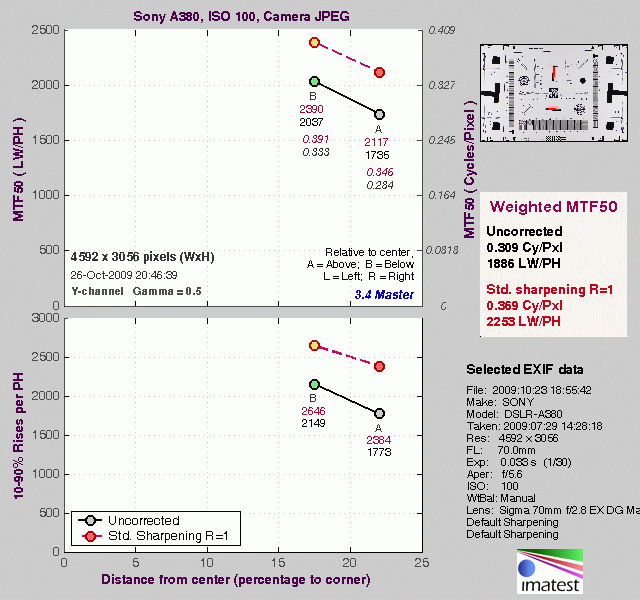
The chart above shows consolidated results from spatial frequency response measurements in both the horizontal and vertical axes. The "MTF 50" numbers tend to correlate best with visual perceptions of sharpness, so those are what we focus on here. The uncorrected resolution figures are 1,735 line widths per picture height in the horizontal direction (corresponding to the vertically-oriented edge), and 2,037 lines along the vertical axis (corresponding to the horizontally-oriented edge), for a combined average of 1,886 LW/PH. Correcting to a "standardized" sharpening with a one-pixel radius only changed the resolution score by quite a bit, for an average of 2,253 LW/PH. The corrected numbers are quite good for a 14-megapixel APS-C SLR.
To see what's going on, refer to the plots below, which show the actual edge profiles for both horizontal and vertical edges, in both their original and corrected forms. Here, you can see that a conservative amount of in-camera sharpening is applied in the horizontal direction (undersharpened by 13.9 %), while in the vertical direction, Imatest reports undersharpening of 7.58%. This is why standardized sharpening improved the MTF 50 numbers by so much. The conservative in-camera sharpening means that camera-produced JPEGs will take unsharp masking in Photoshop or other image-editing software better than most.
These are very good results. Still, (as is almost always the case), you'll extract the most detail from the Sony A380's images by careful processing of its ARW RAW files.


Shooting Modes
Sony A380 Modes & Menus
This page coming soon!
Press Release
SONY INTRODUCES THREE MAINSTREAM ALPHA CAMERAS
DESIGNED FOR FIRST-TIME DIGITAL SLR BUYERS
SAN DIEGO, May 17, 2009 – Sony is making it easy for first-time digital SLR buyers to step up from point-and-shoot digital still cameras with the introduction today of three new easy-to-use α (alpha) cameras (models DSLR-A380, DSLR-A330 and DSLR-A230), four new lenses, a flash and accessories.
Uniquely Matched to Customers’ Needs
The new cameras are designed to overcome challenges faced by many customers taking their first steps in DSLR photography. Without compromising performance and versatility, the new models are smaller, lighter, easier to use and offer innovative expansion options not found in other systems.
“Our new alpha cameras, lenses and accessories make it easier for new users to get the great photos they expect without the steep learning curve that DSLRs have traditionally required,” said Kristen Elder, senior manager for the alpha business at Sony Electronics Inc. “By overcoming the obstacles, we’ve made it much easier for newcomers to take great pictures with DSLRs.”
Light and Compact
The 10.2 megapixel α230 camera is the lightest, most compact alpha DSLR camera body ever at 15.9 ounces. The 10.2 megapixel α330 and the 14.2 megapixel α380 cameras are also smaller and lighter than their predecessor models (the DSLR-A300 and DSLR-A350, respectively). These cameras are also more compact and feature an intuitive control layout that allows for easy single-handed operation.
SteadyShot INSIDE™ in-camera image stabilization is built into each camera body, so every α-mount lens benefits from the ability to minimize blur due to camera shake.
Quick AF Live View System
Both the α380 and α330 cameras offer Sony’s Quick Autofocus (AF) Live View technology, so you can frame photos on the camera’s LCD screen as well as in the optical viewfinder. Through the use of a dedicated image sensor, Quick AF Live View maintains the rapid response of a DSLR, while avoiding the focus delay common to other live view systems.
The new cameras feature a 2.7-inch (diagonally) Clear Photo LCD™ screen that is easy to view even in bright sunlight. Additionally, the LCD on the α380 and α330 models can be tilted up or down, making it easy to frame your subject from high or low positions, otherwise difficult to see using an eye-level viewfinder. The range of adjustment has been increased from their predecessors, making it even easier to get shots from difficult angles.
By combining Quick AF Live View and an adjustable LCD, users can frame the scene without holding the camera in front of their face, allowing parents, for example, to maintain eye-contact when photographing their children for more natural expressions.
An HDMI™ terminal gives you the option of connecting your camera to a compatible HDTV and playing back your images in high definition quality (HDMI cable required, sold separately). Additionally, BRAVIA® Sync™ works with compatible Sony® BRAVIA HDTVs to let you control camera playback using the television’s remote (HDMI cable and BRAVIA Sync capable HDTV required, sold separately).
The new cameras include dedicated slots for high-capacity Memory Stick PRO Duo™, Memory Stick PRO-HG Duo™ and SD/SDHC media (sold separately).
Built-in Help Guide
The α380, α330 and α230 models are Sony’s first DSLR cameras to feature a graphical user interface (GUI) with built-in on-screen Help Guide.
The Help Guide offers clear, concise explanations of various modes and settings, while the Graphic Display helps you understand the relationship between aperture and shutter speed, as well as the effect each has on photographic results.
Systems, Lenses and Flash
Making it easier for first-time DSLR users to get started, the new Sony cameras come in camera-and-lens packages. In addition to the two new standard zoom and telephoto lenses that are offered with the camera bodies, the company introduced new portrait and macro lenses. These purpose-built lenses make it much easier to obtain professional-looking, creative results.
Optimized for use with APS-C sized image sensors, these lenses feature a Smooth Autofocus Motor (SAM) that enables in-lens auto focus (AF) drive for smooth, quiet operation, and high optical performance in a compact size. The DT 18-55mm F/3.5-5.6 standard zoom lens (model SAL-1855) incorporates aspherical and Extra-low Dispersion (ED) elements to provide an all purpose lens with outstanding image quality. The DT 55-200mm F/4-5.6 telephoto zoom lens (model SAL-55200/2) features an ED glass element and helps bring distant subjects closer, ideal for capturing sports. Both the SAL-1855 and SAL-55200 lenses are available separately, or packaged as kits with the new cameras.
To make the benefits of portrait and macro photography easier and more accessible, Sony is introducing a DT 50mm F/1.8 portrait lens (model SAL-50F18) and DT 30mm F/2.8 (model SAL-30M28) macro lens. The wide aperture SAL-50F18 lens helps users capture beautiful portraits with gently defocused backgrounds while the SAL-30M28 macro lens captures intricate close-ups. Both techniques are difficult to achieve with standard lenses.
To help users take better shots with flash, Sony offers an affordable, compact external flash unit (model HVL-F20AM) that is simple to operate. Unlike a camera’s built-in flash, this external flash provides higher output (Guide Number 20), and enables users to bounce light off the ceiling to eliminate harsh shadows and achieve more even illumination when shooting indoors.
Pricing and Availability
Pre-orders will begin on May 18, 2009 at www.sonystyle.com/retail and at selected retailers nationwide. The cameras and a range of accessories will be available in July at Sony Style® retail stores (www.sonystyle.com/retail), at military base exchanges and at authorized dealers nationwide.
The α380L, α330L and α230L will cost about $850, $650 and $550, respectively. The L series one-lens kit comes with the SAL-1855 standard zoom lens.
The α380Y, α330Y and α230Y will cost about $1050, $850 and $750, respectively. The Y series two-lens kit comes with both the SAL-1855 standard zoom and SAL-55200 telephoto zoom lenses.
• The SAL-1855 standard zoom lens will cost about $200.
• The SAL-55200 telephoto zoom lens will cost about $230.
• The SAL-50F18 portrait lens will cost about $150.
• The HVL-F20AM flash will cost about $130.
###