
Pro Tips with Gary Bernstein: Leno, Cropping and Scrapbooks

Imaging Resource is reader-supported. When you buy through links on our site, we may earn an affiliate commission. How this works.
From the Imaging Resource archive, first published April 2005. Prices, availability and software versions may have changed since.
(Editor’s Note: Gary Bernstein is an internationally acclaimed photographer,
who’s made a particular specialty of shooting celebrities. Besides a broad and
successful career as a commercial photographer, he has over 200 celebrity “shoots”
to his credit, including names like Jay Leno, Sophia Loren, Kay Sutton, Bjorn
Borg, Margaux Hemingway, Robert Duvall, and Paul Newman, among many others.
Gary’s graciously agreed to be the monthly judge for our photo contest, and
will also be sharing some of his tips and experiences with our readers in a
monthly column. Here’s his first column, but be sure to also check out his fascinating
collection of celebrity portraits at www.garybernsteinstudio.com,
and the amazing array of live video photo lessons he and his colleagues have
put together at www.zugaphoto.tv.)
Leno, Cropping and Scrapbooks
By Gary Bernstein
I am thrilled to be part of the Imaging-Resource.com family.� This is the first
of many columns written for the photographers who hang out at this ultra cool
website.� As you can tell from the title�most of my columns will be a mixed
bag�hopefully something for every photographer!� I will tell you how I personally
do things�the way the pictures are made–the products I like�the companies that
help me, etc. etc.� My credo has always been total disclosure.
Although it was never my desire to be a celebrity photographer, I�ve seen my
share over the years.� I just always wanted to take pictures of people�and more
than that�I wanted to thrill people with their own image.� As you know
from personal experience, that�s quite a challenge.� Trust me�nobody is more
difficult to please than a celebrity!� So we�ll cover some of the techniques
and tricks you can use to make your pictures stronger�and not just for people
photography�for all sorts of photography.
I started like most photographers�shooting �everything��at a time before digital,
when it was truly expensive to shoot everything!!� And while I shoot assignments
for product and furniture companies and environmental companies, and editorial
layouts for magazines like Architectural Digest�I always concentrated
my efforts on people photography.�
I learned a long time ago to treat all my subjects as though they were
celebrities�whether it was a 80 year old grandma or a newcomer who was just
�hoping� to break in the entertainment biz. �One of those newcomers was a guy
named Jay Leno; and I�ve photographed Jay from the days when nobody knew him�right
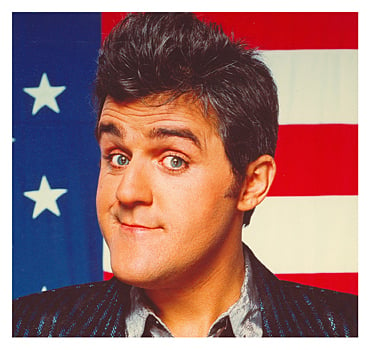
through his stint at the Tonight Show.� Here�s an early Leno shot from my collection
of images at www.GaryBernsteinStudio.com.

The image was taken on Kodachrome with a 105mm lens on a Nikon SLR (www.nikonusa.com)
.� I used 3 lights; a main light, and two lights illuminating the flag in the
background (placed at 45-degree angles), and a small silvered reflector (www.photogenicpro.com)
was positioned below Jay�s face to fill in the shadows.
I am not big on rules for photography.� If it looks good I shoot it (as long
as it works�more on that coming up).� But throughout my columns, I will
give you suggestions�places from which to start your experimentation
in this wonderful art of ours.� One suggestion is that you don�t position the
subject in the center of the frame.� Wow�Leno is positioned dead center in this
photograph!� So rules are meant to be broken apparently.� What I did do�is crop
in very tight and surround Jay with the American Flag as a graphic element that
forces you only to his face.� Does it work?� That�s up to my client�which in
the case of most of my sessions is the celebrity and/or advertiser who’s using
their image.� I guess in this case, you are my client.� If this image
holds your attention�if you enjoy it�then I have succeeded.� If not, it at least
gives you something to contemplate!
Please DO remember this:�� Cropping is very, very important in all types of photography.�
Indeed less is often more. (If you have a favorite photo that you’d like to submit
to the Imaging
Resource or ZugaTV
photo contests, take a close look at it before you send it in: Is there anything
that can be left out? You’d be surprised how many photos we see that are
“near misses” for prizes, simply because the photographer didn’t take
time to crop away extraneous detail.)
This next image�a recent father-daughter photograph�was made as part of a holiday
family photo session.� The image was made with my Olympus E-1 digital and a
14-54 Zuiko Digital lens ( www.OlympusAmerica.com
) using two Lowel Pro-lights (www.lowel.com
) in Chimera softboxes (www.chimeralighting.com)
as a double main light (www.chimeralighting.com).��
One box was placed about 3 feet high to camera left, with the second at 6 feet
to camera right.� Again notice how tight the crop is on the faces.

Next, check out this recent product (furniture) shot.� Talk about tight cropping
telling the story!� This image was made using the Olympus E-1 Digital Camera
with their newest �toy� the amazing 150mm Zuiko f/2 Digital tele�an incredible
piece of glass, without a doubt.� As for the lighting�this is all morning sunlight
coming through a window.� I always have my camera set for half-step brackets�and
never even bother about white balance (hey, I have Photoshop).

Last but not least�
I have another favorite new toy�
I am in the middle of putting together new family albums.� I�m shooting digital
copies of old prints, scanning Polaroids from years ago (on an HP Scanjet 8200),
and I�m printing the every shot with the HP Photosmart 375 (www.hp.com)
printer that has its own 2.5� LCD�so I can edit right on the printer.� I really
picked up the printer for quick prints while I�m shooting on location (as it
has an optional battery), but it also has an optional print cartridge that I
use that gives me true black and white.� Those techies out there know that there�s
a lot of talk about the lack of stability of certain digital media (yes,
we were lied to(!)).� The cool thing is that the prints keep getting better
and better (and more long-lasting).� For example, this printer uses HP paper
that is light fast for more than 87+ years.� How did I find all this out?� I
went to CompUSA (www.compusa.com)
�and they spent the time educating me as to what I want and why I want it.�
A fact.� The point though, is that the current generation of desktop photo inkjet
printers can actually deliver excellent image quality that’ll actually stand
the test of time. – Perhaps a good choice for a family holiday present?
This image was made soon after one of my daughters was born…with a Nikon
and an 85mm Nikkor lens on Kodak Plus-X film. The lighting was a single flash
bounced into an 8-foot piece of white paper-hence the even lighting and huge
catchlights in the baby’s eyes. You can create the same lighting with any flash
source-even a portable flash (or a continuous light source)-. Just remember
to keep the light source higher than the eye level of your subjects.

OK.� That�s it until next time.� Keep on shooting and happy holidays.� If you
have any questions�or anything you�d like to talk about, read about�please just
send your emails to the website, at [email protected],
and the folks at IR will forward them on to me.
More in Tips & Techniques
 ArchiveCloning Around: Do It Yourself Reality…3 Oct 1999
 ArchiveImages, Email, and Internet Mysteries3 Oct 1999ArchivePixels, Dots, and Inches: How Big Can I Print It3 Oct 1999ArchiveTroubleshooting PC Serial Port Camera Connections!3 Oct 1999