


Overview

The change is, it would seem, now official. Sony's NEX camera brand is no more, folded into the company's overall Alpha ecosystem with no distinction made any longer between mirrorless and Translucent Mirror camera models -- at least, in terms of product naming or model numbers. The rumor mill had predicted as much after the debut of the full-frame, FE-mount Alpha A7 and A7R compact system cameras, neither of which sported NEX branding, but the 20.1 megapixel Sony A5000 is the first compact, crop sensor-shod, E-mount camera to forego the moniker. (Technically, the A3000 is also a crop-sensor, E-mount model without a mirror, but it features SLR / SLT-like styling, which made the lack of a NEX badge more understandable.)
Were the NEX brand still extant, though, there's little doubt that the 20.1 megapixel Sony A5000 would sit squarely within its confines. It's a mirrorless camera just like its NEX forebears, after all. Sony tells us that it considers the new model to sit above the existing NEX-3N and Alpha A3000 in its model line, while the NEX-5T and Alpha A58 are still further up the line.
So... that's where it fits into the rejigged Alpha family, but what does it bring to the table? Conceptually, it's quite similar to the NEX-3N, although it features styling more reminiscent of the NEX-5T, including a generous hand grip. Like the 3N, the Sony A5000 has a built-in popup flash and a 180-degree tilting LCD monitor. It also has a very similar control layout, including a rocker control for power zoom lenses, although there is one new control -- a rear-panel delete button.
But the A5000 does manage to shoehorn in the Wi-Fi wireless networking connectivity of the NEX-5T, despite being near-identical in size and weight to the NEX-3N. (That, says Sony, makes this the smallest and lightest APS-C interchangeable-lens camera on the market with Wi-Fi.) Wireless features include remote live view and control, as well as transfer of images and movies. You'll need to use Sony's PlayMemories Mobile app -- available for Android and iOS devices -- for this purpose.
The Sony A5000 also supports in-camera apps that let you do things like timelapse photography, in-camera retouching, and so on, although some apps are come with an extra fee, typically in the region of US$5-10.
Fans of Android devices will be pleased to see Near Field Communications connectivity present, allowing automatic Wi-Fi connection setup simply by holding the camera close to your smartphone or tablet. Apple users will miss out, though, as no Apple device has yet provided for NFC support.
On the inside, the Sony A5000 pairs a new APS-C sized, 20.1 effective megapixel Exmor APS HD CMOS image sensor, and the same BIONZ X-branded image processor that debuted with the full-frame Sony A7 and A7R, as well as their fixed-lens sibling, the RX10.

Despite the modest step up in resolution from the 16.1 megapixel sensor of the NEX-3N, the new sensor and processor pairing allows the exact same sensitivity range of ISO 100 to 16,000 equivalents. And it yields much the same performance, too, allowing a manufacturer-rated 2.5 frames per second burst shooting, or 3.5 fps with focus locked in Speed Priority Continuous mode.
The Sony A5000's sensor might offer higher resolution than that in the NEX-5T, but it lacks that camera's on-chip phase detection autofocus support. That means you're limited solely to contrast detection autofocus, with 25 points on offer, just as in the NEX-3N.
On the rear panel, the tilting LCD is also much like that of the NEX-3N. It has a three-inch diagonal, and a total resolution of 460,800 dots, half that of the NEX-5T's equally-sized panel. And the articulation mechanism is a simple 180-degree upward flip, unlike the more complex mechanism of the NEX-5T, which allows 180-degree upward or 50-degree downward tilt.
In one respect, the A5000 is curiously bested by both of its forebears. We mentioned that it features a built-in, popup flash as in the NEX-3N, but it has a guide number of just 4 meters at ISO 100. That's a lot less than the 6 meters of the NEX-3N's built-in strobe, let alone the external (but bundled) strobe of the NEX-5T, which carries a 7 meter rating. Bear in mind that to get the actual maximum range at the stated sensitivity, you'll need to divide by the aperture you plan to shoot at.
With the f/3.5-5.6 maximum aperture of the Sony A5000's kit lens and when shooting at ISO 100, you can expect at best a working range of 3.6 feet (1.1m) at wide angle, and 2.3 feet (71cm) at telephoto. You'll thus need to crank up the sensitivity to get a truly useful range from the popup flash, although that's not terribly unusual on smaller cameras.
Video capture capabilities of the Sony A5000 are much the same as the cameras it sits in between: You can shoot at up to Full HD (1080i / 1,920 x 1,080 pixel resolution), but a 60p progressive-scan frame rate isn't available. Instead, you can choose either interlaced 60i video from 30p sensor data, or 24p video.
We've already discussed its new wireless connectivity, but like the NEX-3N before it, the Sony A5000 is more limited on the wired connectivity front. There's no hot shoe for external strobes, and connections are limited to just what Sony calls the Multi Terminal -- essentially a USB port which also supports certain accessories such as wired remote controls -- plus a standard HDMI Type D micro connector for high definition video output. The latter, though, is relatively unusual in supporting 4K still image output, if you happen to have the ultra high def display to which to connect it.

Like earlier models, the Sony A5000 stores images on Secure Digital cards, including SDHC, SDXC, and UHS-I types which have higher capacity and speed. It can also accept Sony's proprietary Memory Stick PRO Duo, PRO-HG Duo, and XC-HG Duo types. The A5000 draws power from an InfoLithium NP-FW50 lithium-ion battery pack, exactly the same type used in the NEX-3N and NEX-5T. Battery life falls pretty squarely in between the two, with a CIPA-rated 420 shots on a charge, versus 480 shots for the NEX-3N, and 330 shots for the NEX-5T.
The A5000 ships with a Sony E PZ 16-50mm F3.5-5.6 OSS lens, a stabilized, power zoom optic which covers everything from a 24mm-equivalent wide angle to a 75mm-equivalent telephoto. Available from March 2014 in white, black, and silver-bodied versions, the Sony A5000 kit is priced at US$600.
Order the Sony A5000 from one of Imaging Resource's trusted affiliates:
- Adorama: Sony A5000 16-50mm kit: Black | Silver | White
- Amazon: Sony A5000 16-50mm kit: Black | Silver | White
- B&H: Sony A5000 16-50mm kit: Black | Silver | White
Follow Imaging-Resource.com on Twitter!
Optics
The A5000 is available bundled with the Sony E PZ 16-50mm f/3.5-5.6 OSS kit lens. Please see our Sony A6000 Optics page for optical test results, and/or read our full review of this lens on SLRgear.com. See below for our Sony A5000 viewfinder coverage test results.
Viewfinder Test Results
Coverage
Excellent coverage accuracy from LCD monitor.

The Sony A5000's LCD monitor shows just over 100% coverage in record mode in our tests. This is excellent performance, though not a surprise given the image is derived from the main imaging sensor.
The images above were taken from our standardized test shots. For a collection of more pictorial photos, see our Sony Alpha ILCE-A5000 Photo Gallery .
Exposure
Color
Saturation & Hue Accuracy
Typical saturation levels and hue accuracy.
 |
||
|
ISO Sensitivity
|
||
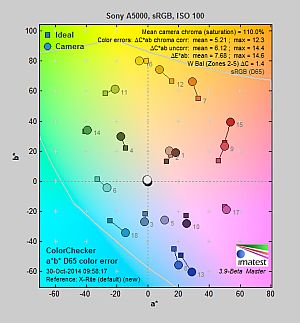
| In the diagram above, the squares show the original color, and the circles show the color that the camera captured. More saturated colors are located toward the periphery of the graph. Hue changes as you travel around the center. Thus, hue-accurate, highly saturated colors appear as lines radiating from the center. Mouse over the links to compare ISOs and click on links for larger images. | ||
Saturation. The Sony A5000's overall default color saturation is oversaturated by 10% (110%) at base ISO, which is about average these days. Mean saturation falls slightly as ISO increases, reaching a low of 107.7% at ISO 12,800, but rebounds slightly to 108.8% at ISO 16,000. Reds, dark green and dark blues are boosted the most, but not as much as we often see. Most other colors are pushed just a bit or pretty close to ideal, though cyans are slightly undersaturated. Overall, saturation levels are quite pleasing to our eyes at low to moderate ISOs, and you can of course tweak them more to your liking. Most consumer digital cameras produce color that's more highly saturated (more intense) than found in the original subjects. This is simply because most people like their color a bit brighter than life.
Skin tones. The Sony A5000 does fairly well with Caucasian skin tones when using Manual white balance in simulated daylight. Brighter flesh tones have a healthy pinkish tint, though darker areas are nudged toward orange. With Auto white balance, results are still good, though slightly warmer. Where oversaturation is most problematic is on Caucasian skin tones, as it's very easy for these "memory colors" to be seen as too bright, too pink, too yellow, etc.
Hue. Like many cameras, the Sony A5000 shifts cyan toward blue, red toward orange, orange toward yellow and yellow toward green, however shifts are minor to fairly moderate. (The cyan to blue shift is very common among the digital cameras we test; we think it's a deliberate choice by camera engineers to produce better-looking sky colors.) With an average "delta-C" color error of 5.21 after correction for saturation at base ISO, overall hue accuracy is about average, with very minor fluctuations across the ISO range. Hue is "what color" the color is.


Sensor
Exposure and White Balance
Indoors, incandescent lighting
Warm cast with Auto, but good color with Incandescent and Manual. Average exposure compensation required.


Indoors, under normal incandescent lighting, color balance is too warm and orange with the Auto white balance setting. Results with the Incandescent setting are much better, just a touch warm and yellow. The Manual setting is quite accurate, just slightly on the cool side, while the 2,600 Kelvin setting which should match our lights is too cool. The Sony A5000 required +0.3 EV positive exposure compensation here, about average for this shot, though the images are a bit on the bright side (while zero exposure compensation is a touch dim). (Our test lighting for this shot is a mixture of 60 and 100 watt household incandescent bulbs, a pretty yellow light source, but a very common one in typical home settings here in the U.S.)
Outdoors, daylight
Very good results under harsh lighting, with good handling of contrast, color, along with above average exposure accuracy.
Outdoors, the Sony A5000 performed very well. +0.3 EV exposure compensation was required to keep the mannequin's face bright in our "Sunlit" Portrait shot, which is better than average among the cameras we've tested. (Most cameras require about +0.7 EV here.) Contrast is a little high as you might expect under such harsh lighting, but despite the bright appearance, only a few highlights were blown, even without the help of Dynamic Range Optimization (DRO -- see below). There are some dark shadows, but shadow detail is quite good and noise is low except in deep shadows where false color tints and noise can be seen when significantly boosted. Both Auto and Manual white balance produced decent skin tones, but we preferred Manual for its slightly pinker response. Default exposure is quite good for our Far-field shot (above right), just a touch underexposed but with almost no highlights blown (just specular highlights) or shadows lost, again with DRO disabled. The Far-field shot with Auto white balance has very good color, just a touch on the cool side. Overall, a very good performance in harsh lighting, especially considering DRO was off for these shots.
See full set of test images with explanations
See thumbnails of all test and gallery images
Resolution
Very high resolution, ~2,700 lines of strong detail from both JPEGs and RAW files.
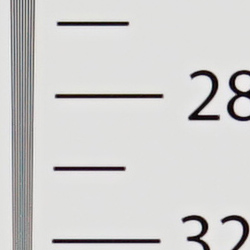
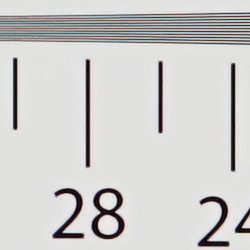
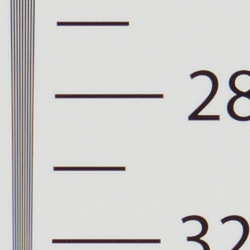
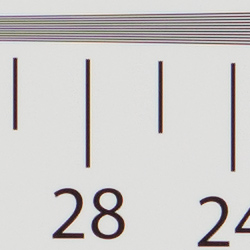
In-camera JPEGs of our laboratory resolution chart reveal sharp, distinct line patterns down to about 2,700 lines per picture height in the horizontal direction, and to about 2,700 lines in the vertical direction. Some may argue for higher numbers, but aliasing artifacts and false colors start to interfere at these resolutions. Complete extinction of the pattern doesn't occur until about 3,300 lines. Some color moiré is evident in JPEGs, though that's not uncommon. Adobe Camera Raw wasn't really able to extract more lines of resolution here from a matching RAW file, and it generated stronger color moiré (different colors as well), so the Sony A5000 does a good job holding on to high contrast detail at base ISO in its JPEGs. Use these numbers to compare with other cameras of similar resolution, or use them to see just what higher resolution can mean in terms of potential detail.
See full set of test images with explanations
See thumbnails of all test and gallery images
Sharpness & Detail
Very good default sharpness, with only minor sharpening artifacts. Moderate noise suppression visible in the shadows and areas of low contrast.


Sharpness. The Sony A5000 captures fairly sharp, crisp images at lower ISOs, with few visible edge enhancement artifacts. We often see some fairly bright or thick sharpening halos around high-contrast elements such as the lettering and lines in our bottle labels, but the A5000's default sharpening is very good at making details pop without obvious sharpening artifacts. Very good results here, at least at low ISO. Edge enhancement creates the illusion of sharpness by enhancing colors and tones right at the edge of a rapid transition in color or tone.
Detail. The crop above right shows moderate noise suppression in the darker areas of the mannequin's hair. A number of low-contrast strands are smudged together, though higher contrast strands are still distinct. Overall, pretty good results here, though noise reduction takes its toll on fine low-contrast detail. Noise-suppression systems in digital cameras tend to flatten-out detail in areas of subtle contrast. The effects can often be seen in shots of human hair, where the individual strands are lost and an almost "watercolor" look appears.
RAW vs In-Camera JPEGs
As noted above, the Sony A5000 produces in-camera JPEGs with very good detail and few sharpening artifacts, at least at low ISOs. Additional detail can often be obtained from carefully processing RAW files with a good converter, though. Let's see how base ISO compares here:
| Base ISO (100) | |
 |
 |
 |
 |
 |
 |
|
Camera JPEG, defaults
|
RAW via Adobe Camera Raw
|
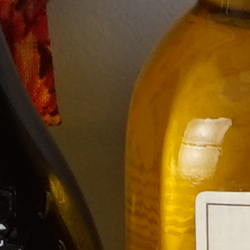
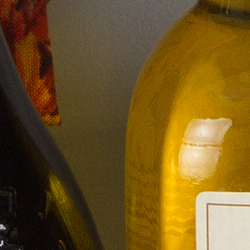
In the table above, we compare a best quality in-camera JPEG taken at base ISO using default noise reduction and sharpening (on the left) to the matching RAW file converted with Adobe Camera Raw 8.7 using default noise reduction with some strong but tight unsharp masking applied in Photoshop (300%, radius of 0.3 pixels, and a threshold of 0).
Looking closely at the images, we cam see that ACR extracts additional detail that isn't present in the JPEG from the camera, particularly in the red-leaf swatch where the fine thread pattern is likely treated as noise by the JPEG engine. Fine detail in the mosaic is also slightly improved, but as is often the case, more noise can be seen in the bottle crop. You can of course apply stronger noise reduction (default ACR NR used here) to arrive at your ideal noise versus detail tradeoff. That being said, the Sony A5000's in-camera JPEG processing (at least at low ISOs) is pretty good with generally excellent detail and very few sharpening artifacts.
ISO & Noise Performance
Very good detail versus noise tradeoff up to ISO 1600.
|
Default High ISO Noise Reduction
|
 |
 |
 |
| ISO 100 | ISO 200 | ISO 400 |
 |
 |
 |
| ISO 800 | ISO 1600 | ISO 3200 |
 |
 |
 |
| ISO 6400 | ISO 12,800 | ISO 16,000 |
Image quality is excellent at ISOs 100 through 400, with only a slight drop in fine detail at 400 where stronger noise reduction kicks in. ISO 800 is the first sensitivity that shows some significant softening due to noise reduction, but fine detail is still very good. ISO 1600 is of course softer, but still pretty good. ISO 3200 has a fair amount of fine detail intact, but flatter areas start to take on a hammered look. Fine detail rapidly deteriorates from ISO 6400 on, with obvious noise reduction artifacts and chroma blotches that become obtrusive at ISO 12,800 and 16,000.
Overall, though, these are good results especially considering the A5000's size and price point, though noise reduction processing is a bit clumsy-looking and heavy-handed at higher ISOs. As always, see the Print Quality section below for maximum recommended print sizes at each ISO, as printed performance often doesn't correlate well to what's seen on-screen at 100%, and check out our Comparometer to see how the Sony A5000's JPEGs compare to other cameras we've tested.
A note about focus for this shot: We shoot this image at f/4, usually using one of our very sharp reference lenses. To insure that the hair detail we use for making critical judgements about camera noise processing and detail rendering is in sharp focus at the relatively wide aperture we're shooting at, the focus target at the center of the scene is on a movable stand. This lets us compensate for front- or back-focus by different camera bodies, even those that lack micro-focus adjustments. This does mean, though, that the focus target itself may appear soft or slightly out of focus for bodies that front- or back-focused with the reference lens. We know this; if you click to view the full-size image for one of these shots and notice that the focus target is fuzzy, you don't need to email and tell us. :-) The focus target position will have been adjusted to insure that the rest of the scene is focused properly.
Extremes: Sunlit, dynamic range and low light tests
Very high resolution with excellent highlight and shadow detail. Very good low-light performance, capable of capturing bright images in near darkness.


Sunlight. The Sony A5000 handled the deliberately harsh lighting in the test above very well. We preferred the +0.3 EV exposure here as the face is bright while only a few highlights were clipped in the white shirt. The default (0 EV) exposure is just a tad dim in the face, while the +0.7 EV exposure is definitely too bright. As mentioned previously, contrast is a little high, but both highlight and shadow detail is very good at +0.3 EV.
For best results, be sure to use fill flash in situations like the one shown above; it's better to shoot in the shade when possible. See below for results with Dynamic Range Optimization and High Dynamic Range features enabled.
Because digital cameras are more like slide film than negative film (in that they tend to have a more limited tonal range), we test them in the harshest situations to see how they handle scenes with bright highlights and dark shadows, as well as what kind of sensitivity they have in low light. The shot above is designed to mimic the very harsh, contrasty effect of direct noonday sunlight, a very tough challenge for most digital cameras. (You can read details of this test here. In actual shooting conditions, be sure to use fill flash in situations like the one shown here; it's better to shoot in open shade whenever possible.)
|
Outdoor Portrait DRO Comparison (0 EV)
|
|
 |
DRO Setting: Auto (Default) Off Level 1 Level 2 Level 3 Level 4 Level 5 |
 |
|
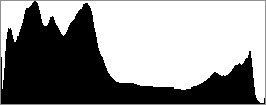
Dynamic Range Optimization is Sony's name for their dynamic range enhancement technology. DRO divides the image into small areas, analyzes the range of brightness of each area, and adjusts the camera's tone curve and other processing parameters accordingly to make the best use of the available dynamic range. DRO does not boost ISO for the entire image like some systems, so increased noise is less of an issue, though existing noise may be more visible in raised shadows. Auto DRO is enabled by default on the Sony A5000. You can also set the level manually, from 1 ("weak") to 5 ("strong"), or turn it off. As one would expect, DRO is only applied to JPEG files however RAW files are tagged for similar processing by Sony's IDC software.
The above thumbnails and histograms show the effects of the available levels of DRO on our "Sunlit" Portrait shot with no exposure compensation. Mouse over the links to load the associated thumbnail and histogram, and click on the links to visit the full resolution image. As you can see from the thumbnails and histograms, DRO worked as expected, boosting shadows and mid-tones without blowing additional highlights, yielding more balance exposures. The Auto DRO setting did a good job here, and the five manual levels give quite a bit of control over the effect.

Above, you can see the effects of DRO settings on our Far-field shot. The default Auto setting produced a nicely balanced exposure, despite the harsh lighting. A useful feature.

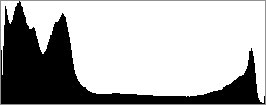


High Dynamic Range. The Sony A5000's HDR mode takes three images in rapid succession, one nominally exposed , one underexposed, and one overexposed, then combines them into one high dynamic range JPEG automatically (RAW images are not supported). Lighter areas from the underexposed image are combined with darker areas from the overexposed image to produce an image with compressed tonal range. The camera then saves a single composite image, as well as the nominally exposed image. The overlaid images are micro-aligned by the camera, but it can only correct for so much movement. If it can't micro-align successfully, an icon indicating HDR capture failed will appear. For best results, the subject should not move or blink, so it's not really intended for portraits. There is also a manual mode where you can select 1 EV ("weak") to 6 EV ("strong") difference in exposures.
Mouse over the links to load the associated thumbnail and histogram, and click on the links to visit the full resolution image. As you can see, the Auto setting did a decent job boosting shadows and mid-tones while reigning back highlights, however we prefer the lower manual settings for this subject. The higher the manual setting, the more highlights are toned-down and shadows opened up, but higher settings can produce flat and unnatural results with this scene. Still, it's nice that Sony provides six manual levels, giving quite a bit of control over the effect.
Above, you can see the effects of HDR settings on our Far-field shot. Watch out for ghost images from movement within the scene during the capture sequence, though, as can be seen in some of the shots above. Still, a useful feature, and Sony has one of the better in-camera HDR implementations we've seen.
Dynamic Range Analysis (RAW mode)
While we once performed our own dynamic range measurements based on in-camera JPEGs as well as converted RAW images (when the camera was supported by Adobe Camera Raw), we've switched to using DxO Labs' results from their DxOMark website. As technology advanced, the dynamic range of modern high-end cameras in some cases exceeded the range of the Stouffer T4110 density scale that we used for our own measurements. DxO's approach based on RAW data before demosaicing is also more revealing, because it measures the fundamental dynamic range of the sensor, irrespective of whatever processing is applied to JPEGs, or to RAW data by off-the-shelf conversion software.
In the following, we use DxO's "Print" dynamic range results, which are scaled based on camera resolution. As the name suggests, this scaling corresponds to the situation in which you print at a given size, regardless of how many megapixels the camera might have. (In other words, if you've decided to make a 13x19 inch print, that's the size you're printing, whether the camera's resolution is 16 or 300 megapixels.) For the technically-minded, you can find a discussion of the reasoning behind this here on the DxOMark website. Also note that DxO Labs uses a signal-to-noise (SNR) threshold of 1 when defining the lower boundary of acceptable luminance noise in their dynamic range measurements, which corresponds to the "Low Quality" threshold of the Imatest software we used to use for this measurement.

We decided to compare the Sony A5000's dynamic range other entry-level mirrorless models with similar list prices: the Micro Four Thirds Olympus E-PL5 and the APS-C Samsung NX2000. You can always compare other models on DxOMark.com.
As you can see from the above graph (click for a larger image), the Sony A5000's dynamic range scored a little better than the Olympus E-PL5 at base ISO (13.0 vs 12.3 EV), but the two cameras produced very similar DR scores, with either one taking a slight lead compared to the other depending on the ISO setting. Compared to the Samsung NX2000, the Sony performs between 0.25 and 0.75 EV better across the ISO range, with the largest difference at base ISO (13.0 vs 12.3 EV).
Overall, good dynamic range performance from the Sony A5000 though some other APS-C cameras do better. Click here to visit the DxOMark page for the Sony A5000 for more of their test results and additional comparisons.
| 1 fc 11 lux |
1/2 fc 5.5 lux |
1/4 fc 2.7 lux |
1/8 fc 1.3 lux |
1/16 fc 0.67 lux |
1/16 fc No NR |
|
|---|---|---|---|---|---|---|
| ISO 100 |
 2 s f2.8 |
 4 s f2.8 |
 8 s f2.8 |
 15 s f2.8 |
 30 s f2.8 |
 30 s f2.8 |
| ISO 200 |
 1 s f2.8 |
 2 s f2.8 |
 4 s f2.8 |
 8 s f2.8 |
 15 s f2.8 |
 15 s f2.8 |
| ISO 400 |
 0.5 s f2.8 |
 1 s f2.8 |
 2 s f2.8 |
 4 s f2.8 |
 8 s f2.8 |
 8 s f2.8 |
| ISO 800 |
 1/4 s f2.8 |
 0.5 s f2.8 |
 1 s f2.8 |
 2 s f2.8 |
 4 s f2.8 |
 4 s f2.8 |
| ISO 1600 |
 1/8 s f2.8 |
 1/4 s f2.8 |
 0.5 s f2.8 |
 1 s f2.8 |
 2 s f2.8 |
 2 s f2.8 |
| ISO 3200 |
 1/15 s f2.8 |
 1/8 s f2.8 |
 1/4 s f2.8 |
 0.5 s f2.8 |
 1 s f2.8 |
 1 s f2.8 |
| ISO 6400 |
 1/30 s f2.8 |
 1/15 s f2.8 |
 1/8 s f2.8 |
 1/4 s f2.8 |
 0.5 s f2.8 |
 0.5 s f2.8 |
| ISO 12800 |
 1/60 s f2.8 |
 1/30 s f2.8 |
 1/15 s f2.8 |
 1/8 s f2.8 |
 1/4 s f2.8 |
 1/4 s f2.8 |
| ISO 16000 |
 1/80 s f2.8 |
 1/40 s f2.8 |
 1/20 s f2.8 |
 1/10 s f2.8 |
 1/5 s f2.8 |
 1/5 s f2.8 |
Low Light. The Sony A5000 was able to capture bright images down to the lowest light level we test at (1/16 fc) even at base ISO. Noise is very low at base ISO and well-controlled at ISO 3200, though as expected, but noise and noise reduction artifacts are quite high and objectional at ISOs higher than 6400.
Auto white balance did a very good job here, producing a fairly neutral, just slightly cool color balance across ISOs and light levels.
We didn't detect any significant banding (pattern noise) or heat blooming, however we did spot some hot pixels at higher ISOs, even with default noise reduction.
The Sony A5000's autofocus system was able to focus on our test subject down to the 1/8 foot-candle light level unassisted with an f/2.8 lens, which is good. And the A5000 was able to focus in complete darkness with its built-in focus assist lamp enabled (with the subject in range).
How bright is this? The one foot-candle light level that this test begins at roughly corresponds to the brightness of typical city street-lighting at night. Cameras performing well at that level should be able to snap good-looking photos of street-lit scenes.
NOTE: This low light test is conducted with a stationary subject, and the camera mounted on a sturdy tripod. Most digital cameras will fail miserably when faced with a moving subject in dim lighting. (For example, a child's ballet recital or a holiday pageant in a gymnasium.) Thanks to their larger pixels, compact system cameras like the Sony A5000 tend to do much better than point & shoots, but you still shouldn't expect a quick autofocus lock with moving subjects. (A useful trick is to just prop the camera on a convenient surface, and use its self-timer to release the shutter. This avoids any jiggling from your finger pressing the shutter button, and can work quite well when you don't have a tripod handy.)
Output Quality
Print Quality
 We haven't printed images from the A5000, so we have no print quality results to share with you. Print sizes should however be very similar to the Sony A3000's which we have printed, so please jump on over to our Sony A3000 Print Quality results to get a good idea of what maximum size you can expect at each ISO from the Sony A5000.
The images above were taken from our standardized test shots. For a collection of more pictorial photos, see our Sony Alpha ILCE-A5000 Photo Gallery .
Not sure which camera to buy? Let your eyes be the ultimate judge! Visit our Comparometer(tm) to compare images from the Sony Alpha ILCE-A5000 with those from other cameras you may be considering. The proof is in the pictures, so let your own eyes decide which you like best!
Performance
Timing and Performance
Sluggish to average performance for an entry-level model.
| Startup/Play to Record | ||
|---|---|---|
| Power on |
~2.0 seconds
|
Time it takes to turn on and capture a shot. |
|
Play to Record, |
~1.0 second
|
Time until first shot is captured. |
The Sony A5000's startup time (power on to first shot) was slower than most CSCs, and much slower than most DSLRs. Switching from Play to Record mode and taking a shot was reasonable, though.
| Shutter Response (Lag Time) | ||
|---|---|---|
|
Full Autofocus, |
0.304 second
|
Time from fully pressing shutter button to image capture, with the lens already at the proper focal distance setting. (All AF timing performed with Sony E 16-50mm kit lens.) |
|
Full Autofocus, |
0.291 second
|
Time from fully pressing shutter button to image capture, with the lens already at the proper focal distance setting. |
|
Full Autofocus, |
0.396 second
|
Time from fully pressing shutter button to image capture, with the lens already at the proper focal distance setting, TTL Auto flash enabled. |
| Manual Focus |
0.129 second
|
For most cameras, shutter lag is less in manual focus than autofocus, but usually not as fast as when the camera is "prefocused". |
|
Prefocused |
0.022 second
|
Time to capture, after half-pressing and holding shutter button. |
The Sony A5000's full-autofocus shutter lag (with the subject at a fixed distance) was 0.3 second in both Single-area (Center) and 0.29 second in Multi-area (Wide) AF modes with the 16-50mm kit lens at a medium focal length. That's about average performance for a mirrorless camera.
Enabling the flash added significant delay for preflash metering, increasing lag to about 0.4s. When manually focused, the Sony A5000's shutter lag was about 0.13s, which is pretty good, though not as fast as some competitors. The A5000's prefocused shutter lag was only 22 milliseconds, much faster than most CSCs and faster than any DSLR -- we have the camera's lack of a mirror and electronic front curtain shutter to thank for that.
To minimize the effect of different lens' focusing speed, we test AF-active shutter lag with the lens already set to the correct focal distance.
| Cycle Time (shot to shot) | ||
|---|---|---|
|
Single Shot mode |
0.78 second
|
Time per shot, averaged over 20 shots, 1 second to clear.* |
|
Single Shot mode |
0.81 second
|
Time per shot, averaged over 20 shots, 1 second to clear.* |
|
Single Shot mode |
1.04 seconds
|
Time per shot, averaged over 20 shots, 2 seconds to clear.* |
|
Early shutter |
No
|
Some cameras don't snap another shot if you release and press the shutter too quickly in Single Shot mode, making "No" the preferred answer. |
|
Continuous Speed Priority Mode |
0.30 second (3.33 frames per second);
15 frames total; 6 seconds to clear* |
Time per shot, averaged over 15 frames, then slowed to an average of about 0.57s or 1.76 fps when buffer was full. |
|
Continuous Mode |
0.40 second (2.48 frames per second);
20+ frames total; 6 seconds to clear* |
Time per shot, averaged over 20 frames, with no signs of slowing. |
|
Continuous Mode |
0.40 second (2.50 frames per second);
9 frames total; 3 seconds to clear* |
Time per shot, averaged over buffer length of 9 frames, then slowed to an average of about 0.59s or 1.69 fps when buffer was full. |
|
Continuous Mode |
0.41 second (2.46 frames per second);
6 frames total; 5 seconds to clear* |
Time per shot, averaged over buffer length of 6 frames, then slowed to 1.02s or 0.98 fps when buffer was full. |
|
Flash Recycling |
2.4 seconds
|
Flash at maximum output. |
|
*Note: Buffer clearing times measured with a SanDisk Extreme Pro 95 MB/sec UHS-I SDHC card. Slower cards will produce correspondingly slower clearing times. Slow cards may also limit length of bursts in continuous mode. ISO sensitivity and noise reduction settings can also affect cycle times and burst mode performance.
|
||
Single-shot cycle times were about average for a mirrorless ILC camera, at 0.78 second for large/fine JPEGs, 0.81 second for RAW files and 1.04 seconds for RAW+JPEG frames.
Continuous burst mode performance was sluggish, at just over 3.3 frames per second in Speed Priority Continuous mode (autofocus is fixed at first frame of a burst in this mode), dropping to about 2.5 frames per second in standard continuous mode (where continuous autofocus is available).
Buffer depth for large/fine JPEGs in Speed Priority Continuous mode was fair for its class at 15 frames before the camera slowed. Note that our test target for this was designed to be difficult to compress, so burst lengths should be longer with typical subjects. Buffer depth increased to over 20 L/F JPEGs when shooting in the slower, standard continuous mode. When shooting RAW files, buffer depth dropped to 9 frames, and to 6 frames with RAW+L/F JPEG files, also fair for its class. Buffer clearing after max-length bursts was pretty fast though, ranging between 3 seconds after a max-length burst of RAW files to 6 seconds after a burst of large/fine JPEGs.
The built-in flash was able to recycle from a full discharge in 2.4 seconds on average, which is pretty fast.
| Download Speed | ||
|---|---|---|
| Windows Computer, USB 2.0 |
15,496 KBytes/sec
|
Typical Values: |
Download speeds were very good, fast enough that you likely won't feel the need for a separate card reader, even with large memory cards. (Note that this test was performed with a SanDisk Pro 95MB/sec UHS-I SDHC card: Slower cards would likely show slower transfer times.)
Bottom line, the Sony A5000's performance is sluggish to just average, even for an entry-level model. Still, it's quick enough for most general purpose photography and even a bit of sports, but you might want to consider other models if capturing fast action is a priority.
Battery
Battery Life
Good battery life for a mirrorless ILC.
| Operating Mode | Battery Life |
|---|---|
|
Still Capture,
(CIPA standard) |
420 shots
|
The Sony A5000 uses a custom NP-FW50 rechargeable lithium-ion battery pack for power, and comes with both a single battery and an AC adapter for charging in-camera via USB. Battery life is rated at 420 shots per charge which is well above average for a compact mirrorless camera. As is usually the case, though, we still recommend getting a second battery for your A5000 if you plan any extended outings.
The table above shows the number of shots the camera is capable of (on a fully-charged rechargeable battery), based on CIPA battery-life and/or manufacturer standard test conditions.
(Interested readers can find an English translation of the CIPA DC-002 standards document here. (180K PDF document))
Flash
Sony A5000 Flash

Built-in Flash Test Results
Coverage and Range
A weak flash with very narrow and uneven coverage at wide angle. Our standard indoor portrait shot required more than average exposure compensation and still came out dim.


Coverage. Flash coverage is very narrow and uneven at wide angle (16mm), leaving very dark corners in our flash coverage test image. Coverage at full telephoto is of course much more even (though quite dim at ISO 200 here.)


Exposure. Our Indoor Portrait test scene came out dim with +1.0 EV flash exposure compensation at ISO 200, and flash exposure compensation didn't make much difference except +1.0 EV was oddly a bit dimmer than +0.7 EV, so +0.7 EV is shown above. The average amount of flash exposure compensation required for this scene is +0.7 EV, thus the A5000's built-in flash performed below average here, and there's no hot shoe to connect a more powerful flash. The camera's Slow-Sync flash mode produced very bright results with no flash exposure compensation, though with a strong orange cast from the ambient room lighting.
| Flash Range: Wide Angle | |||||
|---|---|---|---|---|---|
| 6 ft | 7 ft | 8 ft | 9 ft | 10 ft | 11 ft |
 1/60 sec f3.5 ISO 200 |
 1/60 sec f3.5 ISO 200 |
 1/60 sec f3.5 ISO 200 |
 1/60 sec f3.5 ISO 200 |
 1/60 sec f3.5 ISO 200 |
 1/60 sec f3.5 ISO 200 |
| 12 ft | 13 ft | 14 ft | 15 ft | 16 ft | |
 1/60 sec f3.5 ISO 200 |
 1/60 sec f3.5 ISO 200 |
 1/60 sec f3.5 ISO 200 |
 1/60 sec f3.5 ISO 200 |
 1/60 sec f3.5 ISO 200 |
|
| Flash Range: Telephoto | |||||
|---|---|---|---|---|---|
| 6 ft | 7 ft | 8 ft | 9 ft | 10 ft | 11 ft |
 1/60 sec f5.6 ISO 200 |
 1/60 sec f5.6 ISO 200 |
 1/60 sec f5.6 ISO 200 |
 1/60 sec f5.6 ISO 200 |
 1/60 sec f5.6 ISO 200 |
 1/60 sec f5.6 ISO 200 |
| 12 ft | 13 ft | 14 ft | 15 ft | 16 ft | |
 1/60 sec f5.6 ISO 200 |
 1/60 sec f5.6 ISO 200 |
 1/60 sec f5.6 ISO 200 |
 1/60 sec f5.6 ISO 200 |
 1/60 sec f5.6 ISO 200 |
|
ISO 200 Range. With the 16-50mm kit lens, flash exposures started out bright at 6 feet at wide-angle but brightness fell off from there. At full telephoto, flash exposures started out dim at 6 feet and decreased in brightness from then on.
| Manufacturer-Specified Flash Range | |
|---|---|
| Wide Angle | Telephoto |
 5.4 feet ISO 200 |
 3.3 feet ISO 200 |
Manufacturer Specified Flash Test. The Sony A5000's built-in flash is rated with a Guide Number of 4 meters or 13.1 feet at ISO 100. At ISO 200, that works out to about 5.4 feet at f/3.5 and 3.3 feet at f/5.6, the maximum apertures of the kit zoom lens at wide angle and full telephoto. In the test shots above taken at the aforementioned distances and settings, the A5000's flash produced bright flash exposures, which confirms Sony's rather weak flash power rating is at least credible.
Our standard test method for flash range uses a fixed setting of ISO 200, to provide a fair basis of comparison between cameras. We also shoot two shots using the manufacturer-specified camera settings, at the range the company claims for the camera, to assess the validity of the specific claims.