


Overview
Sony Alpha A65 Hands-on Preview

The new camera also supports the new AVCHD progressive video capture, capable of Full HD 1080p at 60 frames per second, and includes Sony's suite of unique capture modes, including Sweep Panorama, 3D, and Handheld Twilight modes. And instead of an optical viewfinder, the Sony A65 has a large, smooth OLED electronic viewfinder.
The Sony A65 doesn't have several of the A77's other unique features, like the more elaborate swiveling LCD (though it still has a swiveling LCD), the 19-point autofocus (instead it has 15), and no vertical grip is designed for it, but it still has quite a lot to offer compared to competing SLRs on the market.

A nicely sculpted grip graces the front, with a comfortable finger divot for the middle finger to find home quickly. An infrared port peeks out from that divot. The Depth-of-field Preview button is positioned lower left of the lens in this shot, and the autofocus switch is on the right. The front control dial and shutter button are just above the grip, well-positioned for easy activation.
Like the A77, the Sony A65 is an attractive camera, with flowing, organic-friendly lines that better meld with competing SLR designs. The camera fits my hand so well, it makes me want to go take pictures, and that's always a good feeling.

The Sony A65 will be kitted with the 18-55mm SAM lens, and the model that arrived with our prerelease sample image actually looked a lot better than we expected with the 24.3-megapixel sensor. It's a simple, light weight lens that works well. The mode dial is plastic with a knurled ring around the outside. Though the dial lacks the A77's Memory Recall setting, it does have a No-flash Auto mode in its place.
Nestled between the proprietary hot shoe and pop-up flash is the stereo microphone. Sony says the fancy curved grille is designed to minimize focus-motor noise from the lens. Left of the pop-up flash is the electronic flash release button. There's no status LCD on the top deck, but most consumer users won't miss it at all. Videographers note: I prefer the wide steel strap lugs on the A65 to the D-ring design on the A77, as they reduce rattle that can get into your videos.

Even the back of the Sony A65 is attractive and inviting. I love how the Mode dial pops up so high from the camera body, making it easy to grasp and turn. The detents are firm enough that I haven't had any trouble with unintended mode changes, and yet it's not hard to turn either. The rubber eyepiece is quite a bit harder than the one on the A77, making it not quite as nice against my glasses, but it's still soft enough that I don't expect it would scratch them either. An infrared proximity sensor is positioned just above the viewfinder window, telling the camera when you're looking through the viewfinder. It also turns it on when you have the camera against your chest, so it doesn't save as much power as it could.
The Movie button is a little easier to reach than it is on the A77, but that's to be expected on a smaller camera. The zoom button on the far right crops your image by 1.4x or 2x. The ISO button on the top and AEL button are also programmable to 23 different functions.
The LCD is a 921,600-dot design that works great indoors or out; indeed, we preferred it outdoors over the EVF, which is unusual. Though the OLED EVF is very smooth and works well indoors, out in bright sunlight it's too dim when you first look through it; and then when leave the viewfinder, your eye has to adjust again. Thankfully the LCD is indeed that good in bright sunlight, and its simple articulating hinge works well enough in most handheld situations, even if it does get hung up on some tripods.
Overall, the Sony A65 is a star in plain clothes. If you'd like to see what the image quality looks like, check out our Sony A77 review, which has sample crops aplenty.
Sony A65 Technical Info
by Mike Tomkins and Dave Etchells

Sensor and processor. At the heart of the Sony SLT-A65 is an impressively high-resolution 24.3 megapixel Exmor APS HD CMOS image sensor, whose output is handled by the latest version of the company's proprietary Bionz image processing engine. Total pixel count is some 24.7 megapixels, and the sensor's dimensions are 23.5 x 15.6mm, yielding a 1.5x focal length crop when compared with 35mm lenses. The SLT-A65's sensor has a standard RGB Bayer color filter.
With a 3:2 aspect ratio, the SLT-A65 can provide maximum image dimensions of 6,000 x 4,000 pixels at full resolution. Two further 3:2 aspect ratio resolutions are available: 4,240 x 2,832 pixels, or 3,008 x 2,000 pixels. The SLT-A65 also provides a choice of three 16:9 aspect ratio shooting modes, each of which has the same pixel width as its 3:2 aspect counterpart, but with heights of 3,376, 2,400 or 1,688 pixels respectively.
The Sony SLT-A65 offers a wide sensitivity range of ISO 100 to 16,000 equivalents set manually. Sensitivities between 100 and 1,600 equivalents are also available through an Auto ISO setting. High ISO noise reduction cannot be disabled altogether, but provides three adjustable operating strengths: High, Normal, or Low. Using the Multi-frame Noise Reduction function, you can specify the ISO sensitivity manually within an expanded range of ISO 100 to 25,600 equivalents, and the camera will average multiple exposures to create a single image with reduced noise levels.
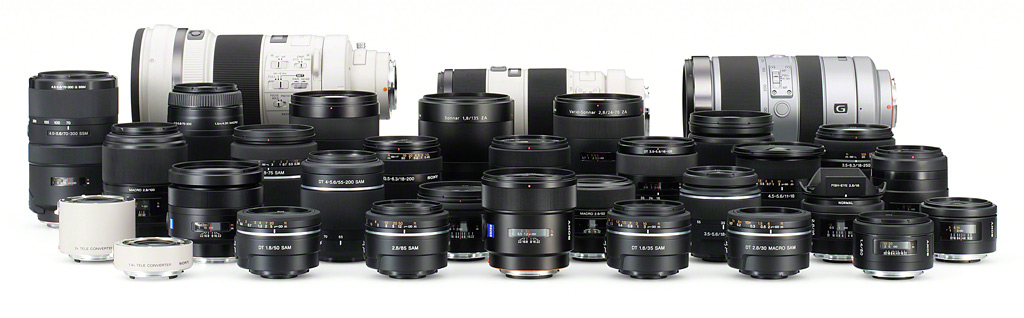
Optics. The Sony A65 retains the same Alpha lens mount and translucent mirror design seen in the previous A33, A35, and A55 models. The company currently offers a selection of 33 Alpha mount interchangeable lenses, all compatible with the A65, and the camera will also accept historic Minolta or Konica Minolta Maxxum lenses.
The defining feature of the Sony SLT-series cameras, the translucent (or pellicle) mirror, allows most light to pass through to the imaging surface beneath, while a small portion is reflected for use by the camera's phase-detect autofocus sensor. This unusual design brings three main advantages over a traditional SLR: full-time phase detection autofocusing (even during video capture), improved burst shooting performance, and a modest reduction in camera body size.
The translucent mirror design has two main drawbacks, both related to its fixed transmission / reflection ratio. It requires use of an electronic viewfinder, since only 30% of incoming light is reflected by the mirror, and so a true optical viewfinder would be unusably dim. Also, with only 70% of incoming light received by the image sensor, Sony's SLT-series cameras aren't able to offer equal sensitivity / noise performance characteristics of a traditional SLR using the same sensor and image processing.
For photographers seeking high burst speeds or the ability to use phase detection AF during video capture, this is likely a tradeoff they'll be willing to make, however. Some photographers may also consider the electronic viewfinder, which provides the ability to preview not only framing, but also functions such as white balance and creative effects, to be a positive as compared to an optical viewfinder.
Stabilization. As with its predecessors, the Sony A65 includes the company's SteadyShot sensor-shift image stabilization system. The current iteration of the system is now said to be good for a 2.5 - 4.5 stop correction, and is available with any mounted lens, regardless of focal length. (Some competitors rely on in-lens stabilization, which can provide better results at longer focal lengths, but which also potentially adds to the cost and size / weight of each lens purchased.)
Lens correction. When shooting in JPEG mode, the Sony SLT-A65 includes the ability to automatically correct lens shading (vignetting), lateral chromatic aberration, and distortion in-camera, as images are captured. This feature is currently only available for four specific lens models: the SAL1650, SAL1855, SAL55200-2, and SAL18250, although the company says that it intends to add support for further lens models via firmware updates.

Electronic viewfinder. As in its predecessors, the Translucent Mirror design necessitates use of an electronic viewfinder, rather than an optical one. Long time IR readers know that we've always been a little lukewarm toward electronic viewfinders (EVFs). To date, the tonal range, clarity, brightness, resolution, and update lag/refresh rates of EVFs have generally made them poor substitutes for the tried and true optical versions.
As technology continues to advance, though, many limitations of earlier EVFs are being addressed, and the OLED (Organic Light-Emitting Diode) technology used in the "TruFinder" found in Sony's latest Alpha and NEX models makes another large step in the right direction.
There's really more to say about the A65's OLED viewfinder than would fit here in this overview, so we've put a more complete discussion on its own page. A few quick notes are clearly in order here, though, as the viewfinder is such a large part of the Sony A65 experience.
Big, Sharp, Accurate. The first thing that strikes you about the A65's viewfinder is how big it is. If you're used to shooting with normal subframe SLRs, you're in for a pleasant surprise the first time you look through the A65's EVF. It's really more a size you'd expect to see on a high-end full-frame SLR selling for thousands of dollars more. It's also incredibly sharp; the first EVF we've seen with XGA (1,024 x 768) resolution; a staggering 2.4 million RGB dots. It also shows 100% of the frame area that the camera will capture; another feature more commonly associated with very high-end professional cameras.
Other Improvements, a couple of gripes. One of our biggest EVF gripes has been poor handling of highlight detail: It's often impossible to see what's going on with sky detail if you're shooting a landscape. The A65's TruFinder has some of the best highlight handling we've seen to date, but unfortunately gets into trouble at the other end of the tonal scale, with a tendency to plug dark areas of the image badly. Also, even at maximum brightness, the TruFinder isn't nearly as bright as a sunny day, so we found that our eyes sometimes took a few moments to adapt when we first looked through it when the surroundings were very bright.

Rich Information. The Sony A65's OLED "TruFinder" makes good use of its ample area. This is the view showing the most information; you can choose from a variety of displays, including one with no overlays on the image area.
We did feel that the TruFinder's update lag and refresh rate were considerably better than we saw on last year's A33 and A55, although it's still not quite up to the zero millisecond lag provided by an optical finder.
Finally, of course there are the things no optical viewfinder can do: For one, provide a true preview of the shot you're about to capture (including white balance and exposure), and for another offer an incredibly rich information display.
Bottom line, while we still like the visual experience of looking through an optical viewfinder, the Sony A65's TruFinder addresses a number of traditional EVF issues, and brings such a host of other benefits that we'd be happy to make the optical/EVF switch with it.
As noted, the foregoing is only a brief discussion of all the pros and cons of Sony's new OLED TruFinder; check out our A65 viewfinder page for all the details.
Displays. Like the A33 and A55 before it, the Sony SLT-A65 includes a bottom-mounted, articulated TFT LCD panel. The display tilts down 180 degrees and then swivels 270 degrees, allowing it to face any direction except to the front right (handgrip) quadrant. The design not only allows easy framing of high- and low-angle shots, but also allows subjects in front of the lens to see themselves, so long as somebody's available to hold the camera. Since the display tilts downwards, it will be blocked from view when mounted on a tripod, and can't be extended beyond the 90-degree position with the camera placed on a flat surface, so the only way to use it for self-portraits is to hold the camera at arm's length. For that reason, we prefer the more traditional side-mounted tilt/swivel screens found on some competitors, although the Sony A65's articulated LCD is still far more versatile than a fixed position panel. (It also allows the LCD to be folded facing inwards, providing some degree of protection against minor knocks and smudges when traveling and when you're content to use the EVF instead.)

As for the panel itself, the basic specifications are unchanged, with a three-inch diagonal, and a total resolution of 307,200 pixels (921,600 dots). The design includes Sony's TruBlack anti-glare technology, which couples a reinforced glass cover plate with anti-reflective film, and a resin filling that removes the air gap beneath the cover plate, thus improving contrast and reducing glare under harsh sunlight. There's also still an automatic brightness control with five-step manual override.
As well as its built-in LCD panel, the Sony SLT-A65 is also compatible with the company's optional CLM-V55 LCD panel accessory, a five-inch, 800 x 480 pixel display that attaches via the HDMI port, and includes a detachable hood to improve daylight visibility.
Focusing. The Sony A65 features the same 15-point CCD phase detection autofocus sensor as its predecessors, which includes three cross-type focus points. The A65's autofocus system has a working range of EV -1 to 18 at ISO 100 equivalent, with an f/2.8 lens attached.
As mentioned previously, one of the main advantages of Sony's Translucent Mirror cameras -- including the A65 -- is that this sensor can be used at all times, even during video capture. (Traditional DSLRs must switch to the slower contrast detection autofocus method during live view and video capture, or must interrupt the video feed to flip mirrors for a phase detect operation. Contrast detection is also used by all compact system cameras, with the exception of Sony's own NEX-series models when using Alpha-mount lenses with the optional LA-EA2 mount adapter.)
15 AF points, three of which are cross-type.
The SLT-A65 provides single-servo and continuous-servo autofocus operation, as well as an Automatic AF mode which switches between single and continuous types as the camera deems necessary, depending upon the subject. There's also both AF tracking and predictive control. A built-in LED autofocus illuminator helps the SLT-A65 to achieve a focus lock on nearby subjects in low ambient lighting conditions. The A65 also provides the ability to start autofocus operation instantly that you bring your eye to the electronic viewfinder, potentially reducing the time taken to achieve a focus lock
As you'd expect, it's also possible to focus manually with the Sony SLT-A65. When focusing manually, Sony offers two Focus Magnifier zoom levels to aid in determining the precise point of focus, either 5.9x or 11.7x. Also included is the "focus peaking" display which was introduced in the NEX-C3. This makes it easier to identify the point of focus by highlighting the areas of strongest image contrast. When enabled, three highlight colors are available (white, red, or yellow), and the peaking function can operate at one of three sensitivity levels (high, mid, or low.)
Performance. As well as allowing full-time AF during live view and movie capture, the translucent mirror design of the Sony SLT cameras brings another important advantage. During burst shooting with continuous autofocus, a traditional SLR has to drop its mirror between each frame, wait just long enough for any mirror vibration to settle, perform the AF measurement, and then raise the mirror again so that the next frame can be captured. Using a pellicle mirror, there's no reflex mirror to raise, and so the only delay required is to wait for the lens aperture to open after the exposure has been completed. For even swifter burst shooting, the aperture can be locked at either F3.5, or the maximum aperture of the lens, whichever is smaller, removing the delay required to set and reset the aperture to allow focusing between shots.
Last year's SLT-A55 was already quite swift, especially with the aperture locked, but the SLT-A65 makes another significant step forwards in shooting speed where it counts most. With the aperture locked in Continuous Priority AE mode, burst shooting speed is unchanged from the A55's ten full-resolution frames per second, according to Sony, despite an increase in resolution from 16.2 to 24.3 megapixels. The standard Continuous Advance drive mode provides two burst-shooting speeds, the higher of which is manufacturer-rated at eight frames per second, up from six frames per second in the A55. (The lower-speed Continuous Advance mode is fixed at three frames per second, slightly faster than the 2.5 fps offered in the A55.)
Maximum raw burst depth in the Continuous Hi and Continuous Priority AE modes is rated by Sony as 13 frames, while for Standard-quality JPEG the burst depth climbs to 18 frames, and for raw+JPEG the burst depth is 11 frames, according to manufacturer specs. The Continuous Hi mode offers one more frame than is available for Continuous Priority AE mode when shooting Fine-quality JPEGs, achieving 18 frames in Continuous Hi, and 17 frames in Continuous Priority AE. No information was available on Continuous Lo burst depth at press time.
The SLT-A65 also offers a prefocused shutter release lag of just 0.05 seconds, and although that doesn't quite match the 0.02 second release lag of the latest NEX-series compact system cameras in this area, that's again an exceptionally swift performance, should the manufacturer spec be borne out in our own testing.
Dust reduction. Like the rest of Sony's SLT-series cameras, the Sony A65 includes a two-pronged dust abatement and removal system. First, a charge-protection coating on the low-pass filter aims to prevent dust adhering in the first place. Second, the sensor shift mechanism that's used to provide SteadyShot image stabilization also doubles as a shake mechanism to try and free stubborn dust particles that settle on the low-pass filter, although at much lower frequencies than the vibration induced by cameras using a piezoelectric element. From what we can tell, there is no strategy for keeping dust off the translucent mirror, except to blow the surface gently with air; it cannot be cleaned, and should never be touched. A fingerprint would require replacement at a service center.
The SLT-A65's dust reduction system operates when the camera is switched off, which helps to reduce the startup time, while not relying entirely on the user remembering to manually trigger a dust reduction cycle. It is, however, possible to perform a cycle manually through the menu, if desired.

Exposure. The Sony SLT-A65 offers a choice of twelve basic operating modes, unchanged from the A55: AUTO, AUTO Advanced (AUTO+), Programmed AE, Aperture-priority, Shutter-priority, Manual, Flash Off, Scene Selection, Sweep Panorama, 3D Sweep Panorama, Continuous Advance Priority AE, and Movie. Scene Selection will automatically set the camera up for one of eight common scene types, as selected by the photographer. Available scene modes are Portrait, Landscape, Macro, Sports Action, Sunset, Night Portrait, Night View, and Hand-held Twilight.
As in Sony's recent cameras, the Hand-held Twilight mode captures six sequential frames with higher sensitivity / shutter speeds to prevent blurring, and then combines them in-camera to yield a single frame with reduced noise levels. The Sweep Panorama modes each capture a burst of images for as long as the shutter button is held down, then automatically stitch them into a panorama. (The 3D mode generates a single image with separate left-eye and right-eye views of the scene, as the subject passes across the field of view).
As with all Sony's Translucent Mirror cameras, the SLT-A65's performs exposure metering using its image sensor. The metering system in the SLT-A65 assesses the metered scene as 1,200 separate zones, and has a working range of EV -2 - 17 at ISO 100 equivalent, with an f/1.4 lens attached. Available metering modes include Multi-segment, Center-weighted, and Spot. As well as locking the metered exposure along with the focus when using multi-segment metering, there's also a dedicated Auto Exposure Lock button. Exposure compensation is available within a range of 3.0 EV on either side of the metered exposure, in 1/3 EV steps. Additionally, the SLT-A65 can perform three-frame bracketed exposures with a step size of 1/3 or 2/3 EV between shots.
The Sony SLT-A65 offers a generous selection of thirteen white balance modes, including Auto, nine presets (Daylight, Shade, Cloudy, Incandescent, Warm White Fluorescent, Cool White Fluorescent, Day White Fluorescent, Daylight Fluorescent, and Flash), a direct color temperature setting (2,500 to 9,900 Kelvin), a color filter setting (15-steps of green to magenta bias, and 15-steps of blue to amber bias), plus a Custom white balance mode. There's also a white balance fine adjustment function available.
Available drive modes include Single-shot, Continuous Hi, Continuous Lo, Self-timer (with a delay of two or ten seconds), Continuous Bracketing, Single Bracketing, White Balance Bracketing, and Remote Control (for use with the optional RM-DSLR1 infrared remote control unit). The aforementioned 10-frames-per-second Continuous Priority AE mode gets it own dial position.
Shutter speeds from 1/4,000 to 30 seconds are possible, and the SLT-A65 also offers a bulb shutter function that will hold the shutter open for as long as the shutter button is depressed. Flash sync is at 1/160 second. An optional long-exposure noise reduction function is available for exposures shot with shutter speeds longer than 1 second.
Sony tells us that the A65's shutter is now rated for a life of 150,000 cycles. This is very welcome; with its top continuous-exposure rate of 10 frames/second, those 150,000 cycles will go by faster than you might expect. (Just over four hours of full-tilt 10fps continuous action.) The 150,000 cycle shutter life is on par with cameras like the Canon 7D and Nikon D7000 that the A65 is designed to compete with.
The most noticeable change in the A65's exposure system is its use of an "electronic first curtain." This improves performance while reducing noise and vibration, and overall is a very welcome addition.
Sony A65 Electronic First Curtain: Fast and quiet. A key technology in all Sony's August 2011 Alpha and NEX announcements is the "electronic first curtain" exposure capability. This greatly speeds the shutter release on live-view cameras, and significantly reduces shutter-generated vibration as well. A little explanation is perhaps in order.
In a conventional SLR, the focal-plane shutter is composed of two leaves or "curtains" that work together to control the exposure time. Think of your camera's sensor as a window with two windowshades; one rolling up from the bottom, the other rolling down from the top. The first curtain starts the exposure by dropping down to uncover the sensor. The second curtain ends the exposure by dropping down to cover it again. After each exposure, the shutter curtains are returned to their original positions in preparation for the next shot. Very short exposures are made by having the two curtains move together, moving a small slit across the focal plane.
To help you visualize, here are a couple of animations showing the action described above, one for a longer exposure, the other for a short one; once the graphic loads, click the button to see the shutter animation. (These animations are from Photocourse.com; check out their excellent Textbook of Digital Photography.)
In a live-view camera, the shutter curtains are initially open, so light can reach the sensor to create the live viewfinder display. In live view mode with a conventional mechanical shutter, the bottom curtain has to be raised first, before the exposure can begin. This of course takes time, increasing the shutter lag before the exposure can begin. The closing of the first curtain can also introduce additional vibration, affecting image sharpness at some shutter speeds. (See our detailed discussion of the blur anomaly in the original Olympus E-P1 for an example. The same issue exists to a greater or lesser degree in most mirrorless cameras, though it's all but invisible in some.)
What's new in this latest crop of Sony cameras is that the "first curtain" function is performed electronically. Rather than having to raise the shutter curtain before the exposure, the A77, A65, NEX-5N, and NEX-7 all begin the exposure electronically, manipulating voltage levels on the sensor array to enable light-gathering in a progressive wave, sweeping down the sensor's surface.
The most noticeable result of this is that shutter lag in live view mode is very brief: Sony claims only 50 milliseconds (0.05 second), a number closely matching the 53.5 milliseconds we measured electro-optically in our lab for the A77. (We haven't tested an A65 yet.) The reduced curtain movement also reduces shutter-induced camera vibration, and makes for a much quieter shutter release as well: The A65's shutter sound is unusually quiet.
This isn't the first time we've seen an electronic first-curtain on an SLR: The Canon 40D introduced the concept back in August of 2007, and as far as we know, Canon live-view-capable SLRs still employ the technology. There's a significant difference in what we call prefocused release lag, though, with Canon's SLRs in Live View mode measuring in the range of 80-90ms, vs the 53.5ms of the Sony A77. In fact, the Sony A77's prefocused lag is very much on par with the fastest conventional SLRs, regardless of price range. Sampling a range of high-performance SLRs, we find shutter release times of 43ms for the Nikon D3s, 49ms for the Canon 1DmkIV, and 53ms for the Nikon D300s. While the Sony A65 probably won't have the absolute shortest release lag, it's very clearly in the top tier, regardless of price.
Tilt level. The Sony A65 includes a dual-axis level gauge, which helps ensure level horizons and prevent converging verticals in photos. The gauge is displayed in a style reminiscent of an aircraft attitude indicator, but with a separation of the roll and pitch indicators. When the camera is perfectly level, the pitch indicators and markings at the end of the roll indicator are illuminated in green.
Built-in GPS. Another less common feature of the Sony SLT-A65 is its built-in GPS receiver, which allows both images and movies to be tagged with information regarding capture location, such as latitude, longitude, altitude, etc. Tagged images can be displayed on a map showing their capture locations, either on a PC using the bundled Picture Motion Browser software, or on the Photo Map function of compatible Sony Bravia TVs. Of course, you can always use third-party software such as Adobe Lightroom or Picasa.
Face detection. Even among SLRs, face detection during live view is a fairly common feature these days. The Sony SLT-A65 goes a step further, though, in offering the ability to register the faces of eight specific individuals, who will then be automatically recognized and prioritized over other faces when determining focus, exposure, and flash output, as well as during post-exposure image processing. The SLT-A65 is capable of simultaneously detecting and accounting for up to eight faces in any given scene, and also includes a Smile Shutter function with three-step sensitivity, which will automatically capture an image when your subject is smiling. Of course, face detection can be disabled, should you wish.

Flash. The Sony SLT-A65 includes an auto-popup flash strobe, slightly improved from that in the A55. The guide number is still 10 meters at ISO 100, and coverage is unchanged at 18mm, but the recycle time is now three seconds, as compared to the A55's four-second recycle. As with the earlier SLT-series cameras, the A65 also includes a proprietary flash hot shoe.
Available flash modes include Off, Auto, Fill, Rear-sync, and Slow-sync, and an optional red-eye reduction function is available. Flash metering modes include ADI and pre-flash TTL. +/-2 EV of flash exposure compensation is available, in 1/3 EV steps. The A65's popup flash can also serve as a wireless controller. Some external strobes including the HVL-F36AM, HVL-F42AM, HVL-F56AM, and HVL-F58AM support high-speed sync and wireless shooting.
Creative. The Sony SLT-A65 includes quite a range of creative controls to help photographers get the look they're after, with a minimum of time spent in the digital darkroom. A selection of eleven Picture Effect modes are available, five of them new since the SLT-A33 (with one mode having been removed.) The new modes include Soft High-key (which replaces the A33's High-key mode), plus Soft Focus, HDR Painting, Rich-tone Monochrome, and Miniature. The Posterization (color or black & white), Pop Color, Retro Photo, Partial Color (red, green, blue , or yellow), High Contrast Mono, and Toy Camera modes are all held over from the earlier camera. (The A55 and A35 also have the same Picture Effect modes as the A33 in current firmware, but didn't ship with this feature at launch.)
In addition, the SLT-A65 provides the same Creative Style choices as in the A55, each of which offers +/- three-step control over contrast, saturation, and sharpness. Creative Style modes include Standard, Vivid, Portrait, Landscape, Sunset, and Black & White.
A Dynamic Range Optimizer function aims to open up the shadows while maintaining highlight detail, and can be left under automatic control, or set to one of five preset levels. There are also several multi-shot modes, including Hand-held Twilight (which allows faster shutter speeds with reduced image noise), and an Auto HDR mode. This last creates a single high dynamic range image from three sequential shots, whose exposure level varies anywhere from 1 - 6 EV in 1 EV steps, controlled automatically or manually.
The SLT-A65 also offers an in-camera Sweep Panorama function, which captures and stitches together multiple images as you sweep your lens across a panoramic scene. When set to Wide mode, Sweep Panorama can create a horizontal scene with a resolution of 12,416 x 1,856 pixels, or a vertical scene with a resolution of 2,160 x 5,536 pixels. In standard mode, the horizontal dimensions are 8,192 x 1,856 pixels, while vertical panoramas occupy 2,160 x 3,872 pixels.
3D Imaging. In addition to the standard Sweep Panorama function, the SLT-A65 includes a 3D Sweep Panorama mode. Since it only has objective lens, the stereo effect is created using some clever mathematics to reconstruct a 3D image as the subject passes across the lens' field of view. The result is saved as a single multi-picture object file that contains two separate JPEG images, one for each eye, allowing it to be viewed on 3D-capable Sony Bravia displays. In Wide mode, 3D Sweep Panoramas occupy 7,152 x 1,080 pixels, while in Standard mode the resolution is 4,912 x 1,080 pixels. There's also a 16:9 mode, which saves a 1,920 x 1,080 pixel panorama suitable for full-screen HDTV viewing.

Video. The Sony SLT-A65 also offers Full HD (1,920 x 1,080 pixel) video capture capabilities, and according to Sony, is the world's first interchangeable-lens camera (along with other Sony models simultaneously announced) able to record Full HD off the sensor at 60 frames per second. (We've seen cameras previously which recorded 60 interlaced fields per second at Full HD resolution, but these either clocked the data off the sensor at 30 frames per second and then split each frame across two interlaced fields, or they clocked the data at 60 frames per second but discarded alternating fields, to be compliant with the original AVCHD 1080 60i specification.)
The SLT-A65's Full HD video is recorded using AVCHD Version 2.0 compression, with Dolby Digital (AC-3) audio, and a wide range of progressive-scan and interlaced frame rates are available. When set to NTSC mode, the available progressive-scan rate are 60 fps (28Mbps) or 24 fps (24 Mbps or 17 Mbps), and you can also opt for an interlaced 60 fps (24 Mbps or 17 Mbps). If you switch to PAL mode, the options are the same, except that the 60 fps rates are replaced by 50 fps equivalents, and the 24 fps rates by 25 fps ones.
It's also possible to record at a high-def resolution of 1,440 x 1,080 pixels (12 Mbps), or a standard-definition VGA (640 x 480 pixel, 3Mbps) resolution. These are all available at 30 fps in NTSC mode, or 25 fps in PAL mode, and are captured using MPEG-4 AVC (H.264) compression with MPEG-4 AAC-LC audio. Note that no 720p recording mode is available on the SLT-A65.
The most unusual capability of the Sony A65's video mode is enabled by its translucent mirror. The Sony A65 can continue to use phase detection autofocusing during movie recording, allowing swift adjustments to focus as your subject moves. Since standard Alpha-mount lenses are used, this focusing action is accompanied by significant levels of autofocus drive noise, although Sony notes that it has included a new noise reduction algorithm intended to suppress this AF drive noise. For consumers, any remaining drive noise is likely a relatively small price to pay for sharply focused video, however, given that manually pulling focus during video capture is a difficult art to learn.
Also unlike many competing cameras, the Sony SLT-A65 provides full control over movie exposure, with a choice of Program, Aperture-priority, Shutter-priority, or fully Manual recording. It also allows Tracking autofocus, as well as use of Creative Style and some Picture Effect modes during movie capture. Recording is started and stopped with a dedicated Movie button on the SLT-A65's rear panel, and audio is captured by default with a built-in stereo microphone. There's also an external stereo microphone jack, compatible with microphones including Sony's own ECM-CG50 Shotgun Mic and ECM-ALST1 Stereo Mic. A built-in monaural speaker caters to movie playback, and has an eight-step adjustable volume setting.
Playback. To let you immediately judge composition, exposure, and the like, the Sony SLT-A65 provides an optional Auto Review function that can display images on-screen for two, five, or ten seconds immediately post capture. (There's also a Shot Result Preview function in Record mode which lets you see an image as it would be captured with the current settings, including shutter speed, DRO settings, etc.) After capture, Playback mode lets you review single images, with optional shooting information, RGB histogram, or blinking highlight/shadow warning. In addition, images can be enlarged up to 13.6x to confirm fine details. Two index views are available, showing either four or nine frames at once.

Connectivity. The Sony SLT-A65 includes a USB 2.0 High Speed data connection, allowing for transfer of images and movies to a personal computer. Two operating modes are available for the USB connection, either USB Mass Storage Class, or Microsoft's Media Transfer Protocol. Catering for high-definition video output, the SLT-A65 also provides a Type-C Mini HDMI connection, with support for Bravia Sync, Sony's brandname for the Consumer Electronics Control standard. This allows certain playback functions such as switching between images to be performed using the attached display's remote control unit. There's no standard-definition video output on the SLT-A65, though, so photographers who've yet to switch to a high-def display will need a third-party device with which to view images on a standard TV.
Other connectivity on the SLT-A65 includes a DC Input for the optional AC adapter, a hot shoe, and jacks for both an external stereo microphone, and a wired remote control unit.

Storage. As well as Sony's proprietary Memory Stick PRO Duo and Memory Stick PRO-HG Duo flash cards, the SLT-A65 can also write images and movies to Secure Digital cards, including not only the higher-capacity SDHC and SDXC types, but also the higher-speed UHS-I compliant cards.
2D images can be saved either in Sony ARW 2.3 raw format, or as standard JPEG files (DCF Ver. 2.0, Exif Ver. 2.3, MPF Baseline compliant). 3D images are saved as Multi Picture Object files (MPF Extended compliant).
Battery. The Sony SLT-A65 draws power from a proprietary NP-FM500H lithium-ion battery pack, which is rated by Sony for 510 shots when using the electronic viewfinder, and 560 shots with the LCD monitor, to CIPA testing standards. As mentioned above, the Sony SLT-A65 includes a DC Input for use with an optional AC adapter.

Operation
Sony A65 OLED Viewfinder

Hidden beauty. The new OLED-based "TruFinder" on the Sony A65 is key to its operation, addressing many limitations of past electronic viewfinders.
Long time readers know that we at IR always been lukewarm toward electronic viewfinders (EVFs). Happily, though, EVF technology continues to improve steadily, and the OLED (organic light-emitting diode) viewfinders on the A65, A77, and forthcoming NEX-7 represent another solid advance in the field. Optical viewfinders still can't be beat for clarity and brightness in some environments, but the OLED technology in Sony's latest viewfinders narrows that gap, and there are undeniably many ways in which Sony's new EVFs offer dramatically greater capabilities.
As we've looked back and edited this section, it struck us that there's an awful lot of discussion here about what is, after all, "just" a viewfinder. In defense of this, we think the EVF on Sony's translucent-mirror technology (TMT) and mirrorless NEX models will be a critical factor for a lot of traditionalists in deciding whether to make the move away from their old-style SLRs. Their electronic viewfinders are much more a key component of TMT cameras' value propositions than optical finders ever were in conventional models.
Tonal Range
One of our biggest gripes with EVFs has always been their limited tonal reproduction, particularly in highlight areas: It's enormously frustrating trying to frame a landscape shot with no idea of where the clouds are in the sky. Overall high-key subjects were always a challenge as well.
Sony's new OLED technology does a dramatically better job with highlights than most any EVF approach we've seen in the past, but we found that the tonal problem has now moved to the shadows: In scenes with a wide tonal range, it can be tough to see any detail in shadow areas without momentarily re-framing to get the viewfinder to gain-up a little.
We're optimistic, though, that this issue with tonal range might be addressed in firmware, perhaps even by the time the A65, A77, and certainly the NEX-7 reach market. A big feature OLED has going for it is an incredibly wide dynamic range. At the high end, you're of course limited with how brightly the little LED pixels can shine (more on that in a moment), but at the low end, when an LED is off, it's off: Zero current in means zero light out. By contrast (no pun intended), LCDs work by filtering light coming from a constant-brightness backlight, and so never get really black. So with an OLED, you have much more dynamic range to work with in the first place.
It seems to us that the problem with plugged shadows could be addressed fairly simply by just applying the right tone curve to image data being sent to the OLED unit. On the image-capture side, Sony has a very effective DRO (dynamic range optimizer) option that does a good job of balancing brightness between highlights and shadows. It even works when recording live video. Why not apply the same technology to these new OLED viewfinders, to boost shadow area brightness a little so you can see details?
We say we're optimistic that a firmware patch could better manage the OLED's tonal range, but it's possible that the camera hardware just isn't wired to provide for massaging the data flowing to the OLED chip. Let's all cross our fingers, and see what happens...
Brightness
Before turning to all the positive aspects of EVFs, I'll raise one other area where they lag behind optical viewfinders, namely image brightness compared to bright daylight. While I really fell in love with the Sony A65's EVF, it shared one remaining foible with lesser EVFs of the past. Even with the brightness adjustment set to maximum, when I brought the viewfinder to my eye while shooting under bright sunlight, the EVF display was significantly less bright than the surroundings. I often found it taking a moment for my eyes to adjust to the dimmer view, and I was conscious of pressing the camera particularly closely against my face in an attempt to block out as much ambient light as possible.
I don't know what the brightness limits of OLEDs are, so it's possible that Sony could change the settings to let the EVF get even brighter, but my guess is they'd already have done so if it were feasible. I personally didn't feel that the limited brightness was a major issue, but other IR team members who used the camera in bright sunlight found it rather distracting. (Happily, the transflective rear-panel LCD does well in bright surroundings; it worked very well, even in glaring direct sunlight.)
Sensitivity
Having spent more than my share of time griping, it's time now to turn to the positive aspects of EVFs, as evinced by Sony's OLED technology. One very useful improvement over optical viewfinders comes at the opposite end of the light scale, when shooting under dark conditions. The Sony A65's EVF does an excellent job of gaining-up when the light gets dim. There's no free lunch, in that the trade-offs are that the image gets a bit grainy looking, and the refresh rate drops dramatically, but the net result is I was much more able to see what I was shooting after dark with the A65 than I've ever been with any optical-viewfinder camera I've used in the past.

Wide open spaces. The Sony A65's OLED-based "TruFinder" really raises the bar on electronic viewfinders as a class. It offers a huge viewing area, with super-high XGA (1,024 x 768) resolution, and improved tonal range and refresh rate.
Size, Resolution, and Accuracy
The first thing you'll notice right off when first looking into the Sony A65's viewfinder is how big it is. Compared to the viewfinders on any other subframe camera, the view through the A65's is enormous. The view has to be a good 30-40% larger in both height and width than what you'll see on most any other subframe camera on the market.
Surprisingly, though, even with its extra-wide viewing angle, the Sony A65 maintains a surprisingly high eyepoint of 27mm from the eyepiece lens and 22mm from the eyepiece frame. As an eyeglass-wearer, I always appreciate a high eyepoint, and with the A65, I didn't feel that I had to mash the camera against my glasses to be able to see the full display. (I did find myself wishing that the A65's viewfinder projected a little further beyond the back of the camera, though: I was quite conscious of how much my nose pressed against the back of the camera. If I left the LCD screen facing outward, huge nose-prints were an ongoing fact of life.)
The second thing you may notice about the Sony A65's viewfinder is its incredibly high resolution. With XGA resolution (1024x768) and 2,359,296 dots, this is easily the highest-resolution EVF we've ever seen. I found I could make out pixels in the text and icons of the information displays if I squinted hard enough, but never had any sense of pixelation in the viewfinder image itself.
The third important visual characteristic of the Sony A65's viewfinder is its 100% frame accuracy. This is absolutely a what-you-see-is-what-you- get viewfinder; it shows you exactly what the sensor is seeing. This is a feature you just don't see in SLRs below professional-grade models, selling for a couple thousand dollars a pop. Making an optical viewfinder with 100% accuracy requires incredibly exacting tolerances, the kind of tolerances that really drive up manufacturing costs. With an electronic viewfinder, it's a relatively simple matter to show the full image that the sensor is seeing. You can get pretty close (98% based on our measurements) with high-end prosumer or low-level pro models like the Canon 7D or Nikon D7000, but they're still not 100% unless you switch to live view mode and accept the AF speed trade-offs that implies. While it's rarely a critical issue in the sort of shots I take personally, I find it annoying that the "through the lens" viewfinder doesn't show me exactly what the camera is going to capture. - So I'm a huge fan of 100% viewfinders, as long as it doesn't cost me another $1,000 in cost of the camera to get one.
Sony A65 Viewfinder Responsiveness: Update Lag and Refresh Rate
Sony's A55 and A33 translucent-mirror SLRs were true breakthrough devices when it came to high-speed continuous shooting at affordable prices, and the Sony A65 and A77 take that capability up another notch, with maximum frame rates of 10 and 12 frames/second respectively. (The second-string A65 now matches the frame rate of the former top gun, the A55.)
Despite their very high frame rates, though, we found it difficult to track and frame fast-breaking action with the A33/55, because the image displayed in the viewfinder was always that of the last frame captured, not what was currently happening in front of the lens. Looking through the viewfinder, we were thus always reacting to where the subject was 1/7 second (A33) or 1/10 second (A55) in the past. A tenth of a second may not sound like much, but with a fast-moving subject (and shooters as unskilled at sports and action photography as we are), it was enough to cause major problems with framing and tracking.
As I'm writing this, we don't have an A55 on hand to compare against the A65, but it appears to us that in high-speed mode, the A65 is still showing the last image captured, rather than the current "live" view. That said, we haven't been as aware of the update-lag problem as much with the A65; we felt more able to track fast-moving subjects with it than was the case with the A33/55. We'd have to spend more time with it in a sports-shooting environment to say for sure how much improved the A65 is over the A55 in this regard: If it's still just displaying the last shot captured, there may not be that much difference – but it'll still be ahead of the 7fps A33.
When not in continuous shooting mode, viewfinder responsiveness is a function of refresh rate; essentially the frame rate of the "live movie" that constitutes the viewfinder image. Specs for this are almost never published, in part because the refresh rate is usually a strong function of the amount of light falling on the camera's sensor. In dim lighting, the camera needs longer exposure times for each frame of the movie it's capturing and playing into the viewfinder display, setting an upper limit on the viewfinder's refresh rate. Indeed, as noted above, the Sony A65's refresh rate drops pretty dramatically when faced with very dim shooting conditions. (A trade off we're happy to accept, given that the resulting viewfinder image is much more visible than that from an optical viewfinder under similar circumstances.)
We don't have any way to measure the Sony A65's viewfinder refresh rate under bright lighting conditions, but our sense is that it's quite high: Motion was very smooth and fluid, and we had no sense of a delay or lag between the subject's motion and what we were seeing in the viewfinder.
Low refresh rates were often a bugaboo of early EVFs, but the problem seems pretty completely banished with the combination of the Sony A65's sensor, fast processor, and OLED EVF technology.
Sony A65 Information Display
The area where EVFs completely crush optical viewfinders is of course in on-screen information display. With the whole viewfinder area a full-color high-resolution image display, readout, status and other information can be displayed anywhere you please. Not only that, but full menu displays are a button-press away, so your eye never need leave the viewfinder while operating the camera.
Another often unrecognized advantage of an EVF is that, because the same display is being used for both the viewfinder image and AF point indicators, there's never a problem with ambient light washing out illuminated AF-point displays, or conversely there not being enough light to see ones that are just an LCD overlay. We found the AF point indicators on the A65's EVF particularly well designed. The Sony A65's AF point markers consist of open green squares with thin black outlines around them. The combination of bright and dark elements means active AF points are easy to see regardless of subject brightness: In bright areas, the black outlines make them stand out, while in dark areas, the green lines are easily visible.
Like the A33 and A55 before it, the Sony A65 makes great use of its EVF for information display. A host of basic camera setting and status information is always visible above and below the image area, and thanks to the unusually large viewing angle, the info displays don't cramp the viewfinder image at all. A lot of optional information that can be displayed as well: A shooting display mode provides data for 13 other camera settings overlaid on the viewfinder image, down the left and right sides; a histogram option displays an exposure histogram overlay in the lower right; a graphic display mode overlays virtual shutter speed and aperture indicators, also in the lower right; and a digital level gauge option overlays a red/green two-axis tilt meter in the center of the frame.


My response to the rich information environment of a well-constructed high-resolution EVF like the Sony A65's reminds me a little of my initial transition to all-digital photography 8 or 9 years ago now. Back then, I didn't realize how much I'd come to appreciate and even depend on the immediate feedback digital offered until I tried taking a trip with only my trusty film SLR in hand. With all my images locked up in film cans, I felt crippled and resolved "never again:" The next trip and ever after, it's been digital all the way.
I'm finding my experience with Sony's rich EVF environment somewhat similar. My everyday SLR (now an incredible 5 years old; definitely time for an upgrade) is a conventional optical-finder model. After using the Sony A65 for a few days, it feels crippling and archaic to go back to the sparse information provided by an old-style optical viewfinder.
Image Preview
Another feature that's of course not even possible with an optical viewfinder is true image preview. Not only are optical viewfinders generally limited in their framing accuracy, they have no way to show what sort of image the camera is about to record: You have no idea in advance of the shot whether the white balance is suitable, how the exposure is looking, etc. And while an optical viewfinder can give you a pretty good depth of field preview, if you're stopping down the lens much at all, the view will likely be too dark to make out the subject, let along judge relative focus.
The Sony A65 Viewfinder: Bottom Line
Much though I'm sure Sony would like me to agree with them that the A65's EVF finally matches all the desirable characteristics of an optical viewfinder, I'm afraid that time hasn't yet arrived: While great progress has been made, even the A65's OLED display doesn't come close to providing the dynamic range of a purely optical system. Likewise, update lag during continuous shooting is still at least somewhat an issue.
That said, though, I can confidently say that all the benefits the Sony A65's EVF brings over optical systems would leave me entirely comfortable switching over to it from my old-school optical-VF SLR without looking back.
Ultimately, the choice of optical vs EVF will come down to personal preferences, so you'll probably want to look through one yourself before making a final decision. For most people, though, I think the benefits of an EVF like the Sony A65's will far outweigh the few remaining limitations.
Performance
Note: The following performance data was obtained from a production unit running v1.03 firmware.
Timing and Performance
Excellent autofocus and burst speeds, but sluggish power-on, power-off, mode switching and buffer clearing.
| Startup/Shutdown |
||
| Power on |
~2.8 seconds
|
Time it takes to turn on and capture a shot. |
| Shutdown |
~6.0 seconds
|
How long it takes camera to turn off before you can remove the memory card. |
|
Buffer clearing time
|
12 seconds after 18 large/fine JPEGs*
|
Worst case buffer clearing time. -- This is the delay after a set of shots before you can remove the card.
|
|
20 seconds after 14 RAW files*
|
||
|
26 seconds after 13 RAW+ L/F JPEG files*
|
||
|
*Note: Buffer clearing times measured with a SanDisk Extreme Pro 45MB/sec UHS-I SDHC card. Slower cards will produce correspondingly slower clearing times. Slow cards may also limit length of bursts in continuous mode. ISO sensitivity and noise reduction settings can also affect cycle times and burst mode performance.
|
||
Startup and shutdown times were much slower than typical SLRs, and buffer clearing times were slow especially with RAW files.
| Mode Switching | ||
|---|---|---|
| Play to Record, |
~1.2 seconds
|
Time until first shot is captured. |
| Record to Play |
~1.8 seconds
|
Time to display a large/fine JPEG file immediately after capture. |
| Display |
~0.6 second
|
Time to display a large/fine JPEG file already on the memory card. |
Mode switching performance was sluggish, though displaying a previously captured image was reasonably fast.
| Shutter Response (Lag Time) | ||
|---|---|---|
|
Full Autofocus |
0.138 second
|
Time from fully pressing shutter button to image capture. (All timing measurements made with a Sigma 70mm f/2.8 lens) |
|
Full Autofocus |
0.130 second
|
Time from fully pressing shutter button to image capture. |
|
Full Autofocus,
Single-area AF mode Auto Flash Enabled |
0.285 second
|
Time from fully pressing shutter button to image capture, with the lens already at the proper focal distance setting, Auto flash enabled. |
|
Continuous AF
|
0.132 second
|
This mode usually shows no speed increase with our static subject; we have no way to measure performance with moving subjects.
|
|
Manual focus
|
0.081 second
|
For most cameras, shutter lag is less in manual focus than autofocus, but usually not as fast as when the camera is "pre-focused."
|
|
Pre-focused |
0.054 second
|
Time to capture, after half-pressing and holding shutter button. (Electronic first curtain shutter enabled.) |
Looking at the Sony A65's ability to determine that it's properly focused when shooting the same target multiple times, its autofocus speed is very good. The SLT-A65 required only 0.138 second for full AF using the center focus point. This decreased slightly to 0.130 second in wide-area AF mode. With the flash enabled, the A65's full AF shutter lag increased to 0.285s, to account for the preflash metering, which is still pretty fast.
Continuous autofocus mode lag time was 0.132 second, and manual focus was fast at about 0.081 second. When prefocused, shutter lag was 0.054 second which is very good for an enthusiast model. These timing results were obtained with the Sony A65's electronic first curtain shutter active, which is the default setting.
| Cycle Time (shot-to-shot) | ||
|---|---|---|
|
Single Shot mode
Large fine JPEG |
0.47 second
|
Time per shot, averaged over 15 shots. |
|
Single Shot mode
RAW |
0.41 second
|
Time per shot, averaged over 5 shots. |
|
Single Shot mode
RAW + L/F JPEG |
0.46 second
|
Time per shot, averaged over 5 shots. |
|
Early shutter |
No
|
Some cameras refuse to snap another shot if you release and press the shutter too quickly in Single Shot mode, making "No" the preferred answer. |
|
Continuous Hi mode Large fine JPEG |
0.13 second (7.98 frames per second);
18 frames total; 12 seconds to clear* |
Time per shot, averaged over buffer depth of 18 shots, then slowed to an average of 0.72 seconds, or 1.39 fps.
|
|
Continuous Hi mode
RAW |
0.13 second (7.98 frames per second);
14 frames total; 20 seconds to clear* |
Time per shot, averaged over buffer depth of 14 shots, then slowed to an average of 1.47 seconds, or 0.68 fps.
|
|
Continuous Hi mode
RAW + L/F JPEG |
0.13 second (7.89 frames per second);
13 frames total; 26 seconds to clear* |
Time per shot, averaged over buffer depth of 13 shots, then slowed to an average of 2.10 seconds, or 0.48 fps.
|
|
Continuous Advance Priority AE mode
L/F JPEG |
TBD
|
TBD
|
|
Flash Recycling |
2.0 seconds
|
Flash at maximum output. |
| *Note: Buffer clearing times measured with a SanDisk Extreme Pro 45MB/sec UHS-I SDHC memory card. Slower cards will produce correspondingly slower clearing times. Slow cards may also limit length of bursts in continuous mode. ISO sensitivity and other settings such as DRO or NR can also affect cycle times and burst mode performance. |
||
Shot-to-shot cycle times were good for an SLR-class camera, ranging from 0.41 to 0.47 second depending on the file type. Continuous mode speeds were excellent, especially for the extreme resolution, at about 8 frames-per-second in standard continuous mode. Continuous Advance Priority AE mode is rated by Sony at 10 frames per second, however we did not test that mode yet.
Buffer depths were good for the size of files, ranging from 13 to 18 frames per burst before slowing down in our tests. You should be able to do better with typical subjects when shooting JPEGs (our target for this test is designed to be difficult to compress).
Buffer clearing was sluggish with our fast 45MB/s SanDisk Extreme Pro UHS-I compliant SDHC card, at 12 seconds after a maximum-length large/fine JPEG burst, 20 seconds after a RAW burst, and 26 seconds after RAW + large/fine JPEG burst. We have been told that unlike the A77, the A65 does not take advantage of faster UHS-compliant cards. Also, the Sony A65 does not support the Extra Fine JPEG setting found on the A77, offering just Fine and Normal compression settings.
The flash was able to recycle from a full discharge in 2.0 seconds, which is very fast.
| Download Speed | ||
|---|---|---|
| Windows Computer, USB 2.0 |
11,771 KBytes/sec
|
Typical Values: |
Download speeds were very fast, quick enough that you won't feel the need for a separate card reader, even with large memory cards. (Note that this test was performed with a SanDisk Extreme Pro 45 MB/sec UHS-I SDHC card: Slower cards would likely show slower transfer times.)
Bottom line, the Sony Alpha SLT-A65's autofocus, shutter lag, and burst performance were excellent, though not quite as fast as the A77. Buffer depths were good for its class given the large files, though buffer clearing was slow. Startup, shutdown, and mode switching times were sluggish.
Battery
Battery Life
Good battery life for an interchangeable lens camera with EVF, but below average compared to a traditional SLR with optical viewfinder.
| Operating Mode | Number of Shots |
|---|---|
|
Electronic Viewfinder,
(CIPA standard) |
510
|
|
Live View LCD,
(CIPA standard) |
560
|
The Sony A65 uses a custom rechargeable NP-FM500H lithium-ion battery for power, and ships with a charger. Battery life is a below average compared to an SLR using an optical viewfinder, but pretty good for one equipped with an electronic viewfinder. We recommend you pick up a spare battery and keep it freshly charged and on-hand for extended outings or shooting video.
The table above shows the number of shots the camera is capable of (on either a fresh set of disposable batteries or a fully-charged rechargeable battery as appropriate), based on CIPA battery-life and/or manufacturer standard test conditions.
(Interested readers can find an English translation of the CIPA DC-002 standards document here. (180K PDF document))
Pricing and availability
The Sony SLT-A65 should be available in the US market from October 2011. Body-only pricing is set at approximately US$900, while a kit version including the Sony DT 18-55mm F3.5-5.6 SAM standard zoom lens will be priced at around US$1,000.