


Overview

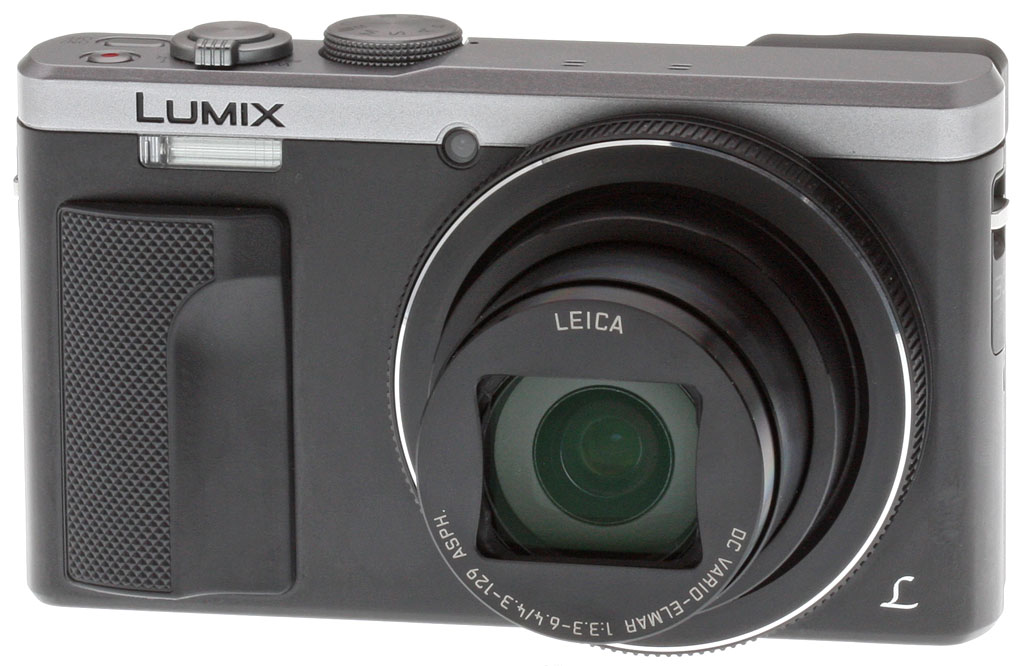
Are you looking for a camera with a powerful zoom lens in a pocket-friendly package? In 2015, Panasonic catered to this need with its Lumix ZS50 digital camera. A year later, it follows up with the Panasonic ZS60, offering a far-reaching 30x optical zoom lens in a pocket-friendly body weighing just under 10 ounces (282 grams), ready to shoot with battery and memory card.
The Panasonic ZS60 is based around an 18 megapixel, 1/2.3-inch High Sensitivity MOS sensor and the company's Venus Engine image processor. That's a fair step up in resolution from the 12-megapixel sensor of the ZS50, and returns to the same resolution as the earlier ZS40.
As in that camera from the 2014 model year, the Panasonic ZS60 looks to offer fairly swift performance. Together, the image sensor and processor yield a manufacturer-rated full-resolution burst speed of five frames per second with autofocus between frames, or as much as 10 fps without. And if you're willing to switch to an electronic shutter, you can push this even further to as fast as 40 fps, though at an unspecified lower resolution.

Catering to your need for zoom, the Panasonic ZS60 offers up a Leica DC Vario-Elmar-branded 30x optical zoom lens which provides everything from a generous 24mm-equivalent wide angle to a very powerful 720mm-equivalent telephoto. Maximum aperture falls from f/3.3 at wide angle to f/6.4 at telephoto. If this optic seems familiar, that's for good reason: With a total of 12 elements in 9 groups, including five double-sided aspherics, it looks to be the exact same optic used in both earlier models.

Also retained from the earlier ZS-series models is the Panasonic ZS60's five-axis image stabilization system, which helps to reduce the impact of blur from camera shake -- something that will be pretty important towards the telephoto end of the lens' range. But where the earlier cameras had a 23-area Light Speed-branded autofocus system, the ZS60 upgrades this with a new 49-point Light Speed AF system. As well as being more point-dense, this contrast detection-based autofocus system now includes Panasonic's clever Depth from Defocus technology to speed focus acquisition. Also provided are both face and eye-tracking functions.

On the rear panel of the Panasonic ZS60, you'll find an electronic viewfinder based around a 0.2", 389k-dot dot LCD panel with a field-sequential design. What this means is that every pixel switches between red, green and blue colors alternately at high speed, providing full color information at every pixel location and thereby increasing the perceived resolution (1,166k-dot equivalent, according to Panasonic). If you prefer to frame at arm's length, the rear-panel LCD monitor is still a three-inch, 3:2-aspect type with a resolution of 1,040k-dots. Both the viewfinder and display look to be unchanged from those in the ZS50.

As with its predecessor, the Panasonic ZS60 boasts integrated Wi-Fi connectivity with which to get photos onto your Android or iOS smartphone or tablet. However, Android fans will miss the NFC radio of the ZS50, because the ZS60 no longer offers this feature for quick Wi-Fi connection setup. Instead, Android users will use the same QR code pairing as do iPhone users. It's certainly better than pairing manually, but requires a bit more user intervention than the earlier NFC pairing solution.

Of course, ultra high-def video is the latest must-have feature, and the Panasonic ZS60 doesn't disappoint in this area. Not only can you now shoot 4K video at a rate of 30 frames per second in MP4 format, but also Full HD video at 60 fps. And for the first time in its megazoom lineup, the ZS60 also offers up both 4K Photo and Post Focus functions.

The 4K Photo function allows easy extraction of 8.3-megapixel stills from 4K videos. If rolling shutter isn't a concern for your subject, this can be a huge advantage as it takes your reflexes out of the equation almost entirely. The Post Focus function, meanwhile, varies focus during 4K video capture, and then lets you indicate which subject should have the sharpest focus post-capture. The video is then analyzed, and the frame with the sharpest focus in this area retained.

Available from mid-March 2016, the Panasonic ZS60 will be sold in either silver or black body colors. Pricing in the US market is set at around US$450 or thereabouts.
Performance
Timing and Performance
Generally very good performance for long-zoom compact.
| Startup/Play to Record | ||
|---|---|---|
|
Power on |
~1.4 seconds
|
Time it takes to turn on and capture a shot. |
|
Play to Record, |
~0.6 second
|
Time until first shot is captured. |
Startup time was faster-than-average for a long-zoom compact and switching from Play to Record and taking a shot was very quick.
| Shutter Response (Lag Time) | ||
|---|---|---|
|
Full Autofocus, |
0.149 second
|
Time from fully pressing shutter button to image capture, with the lens already at the proper focal distance setting. |
|
Full Autofocus, |
0.142 second
|
Time from fully pressing shutter button to image capture, with the lens already at the proper focal distance setting. |
|
Full Autofocus |
0.614 second
|
Time from fully pressing shutter button to image capture. Auto Flash enabled. |
|
Manual Focus |
0.142 second
|
For most cameras, shutter lag is less in manual focus than autofocus, but usually not as fast as when the camera is "prefocused". |
|
Prefocused |
0.020 second
|
Time to capture, after half-pressing and holding shutter button. |
The Panasonic ZS60's autofocus speeds were excellent in our tests, especially for a camera that uses contrast detection only. The ZS60 produced full-autofocus shutter lag (with the subject at a fixed distance) of 0.149 second at full wide angle and 0.142 second at full telephoto using 1-area (center) AF. That's faster than most DSLRs. Enabling the flash increased lag to 0.614 second, to account for preflash metering. When manually focused, the ZS60's lag time was 0.142 second, about the same as autofocus. The ZS60's prefocused shutter lag time of 0.020 second was very quick.
To minimize the effect of different lens' focusing speed, we test AF-active shutter lag with the lens already set to the correct focal distance.
| Cycle Time (shot to shot) | ||
|---|---|---|
|
Single Shot mode |
0.53 second
|
Time per shot, averaged over a few frames (we no longer test for buffer depths in single-shot mode). |
|
Single Shot mode |
0.53 second
|
Time per shot, averaged over a few frames (we no longer test for buffer depths in single-shot mode). |
|
Early shutter |
No
|
Some cameras refuse to snap another shot if you release and press the shutter too quickly in Single Shot mode, making "No" the preferred answer. |
|
Continuous H |
0.10 second (10.42 frames per second);
60 frames total; 7 seconds to clear* |
Time per shot, averaged over buffer length of 60 frames, then slows to an average of 0.16s or 6.16 fps. |
|
Continuous H |
0.10 second (9.63 frames per second);
14 frames total; 8 seconds to clear* |
Time per shot, averaged over buffer length of 14 frames, then slows to an average of 0.61s or 1.65 fps. |
|
Continuous H |
0.10 second (9.68 frames per second);
13 frames total; 14 seconds to clear* |
Time per shot, averaged over buffer length of 13 frames, then slows to an average of about 1.19s or 0.84 fps. |
|
Super HS mode |
0.03 second (40.0 frames per second);
60 frames total; 8 seconds to clear* |
Time per shot, averaged over fixed buffer length of 60 frames. |
|
Flash Recycling |
2.8 seconds
|
Flash at maximum output. |
|
*Note: Buffer clearing times measured with a SanDisk Extreme Pro 95MB/sec UHS-I SDHC card. Slower cards will produce correspondingly slower clearing times. Slow cards may also limit length of bursts in continuous mode. ISO sensitivity and noise reduction settings can also affect cycle times and burst mode performance.
|
||
Single-shot cycle times were good. We measured about 0.5 second for large/fine JPEGs and RAW+L/F JPEGs. (We no longer test single-shot mode with just RAW files, as the result is usually somewhere in between.)
Continuous High Speed "H" mode burst rate was fast at 10.4 frames per second for best quality JPEGs, slightly exceeding Panasonic's 10 fps spec with AFS (focus locked at the first frame). When shooting RAW or RAW+JPEG files, the frame rate reduced slightly to 9.6 and 9.7 fps respectively. With continuous focus enabled, the top frame rate drops to 5 fps according to Panasonic, however we did not test with continuous AF in the lab.
In Continuous High Speed "H" mode full-resolution buffer depths were generous for Large/Fine JPEGs at 60 frames, but when shooting RAW files buffer size dropped to 14 frames, or 13 frames when shooting RAW+JPEG.
The ZS60 also features a "Super HS" mode which captures 4-megapixel images at 40 fps for up to 60 frames using the electronic shutter. There is also a 4K burst mode, allowing you to shoot 8-megapixel stills at 30 fps continuously, however we did not test that mode in the lab.
Buffer clearing was reasonable with a fast UHS-I card, ranging from 7 to 14 seconds depending on the file type and mode.
Flash recycling after full-power discharge took an average of 2.8 seconds.
Bottom line, the Panasonic ZS60's performance is very good to excellent for its class. Startup and mode switching are fast, autofocus speeds are quick, and prefocused shutter lag is very low. Burst performance is very good to excellent depending on the mode. Buffer depths are excellent when shooting JPEGs in Continuous High Speed mode, though not nearly as generous with RAW files, and buffer clearing was reasonable given the buffer depths.
Battery Life
Below average battery life.
| Operating Mode | Battery Life |
|---|---|
|
Still Capture,
(LCD, CIPA standard) |
320 shots
|
|
Still Capture,
(EVF, CIPA standard) |
280 shots
|
The Panasonic ZS60 uses a custom rechargeable lithium-ion battery pack for power, and comes with a single battery and an AC adapter for in-camera charging via USB. The CIPA-rated 320 shots per charge when using the LCD and 280 shots when using the EVF is below average for its type though perhaps not a surprise given the camera's size and performance. Still, we definitely recommend getting a second battery for your ZS60 if you plan any extended outings.
The table above shows the number of shots the camera is capable of (on a fully-charged rechargeable battery), based on CIPA battery-life and/or manufacturer standard test conditions.
(Interested readers can find an English translation of the CIPA DC-002 standards document here. (180K PDF document))