

Overview
Updates:
07/30/2019: First Shots posted
08/23/2019: Performance posted

Announced alongside the G5X Mark II, you may at first glance not be able to tell the two cameras apart. They both share a long list of features in common, but the G7X Mark III has a short list of very specific additions that clearly position it as a vlogging camera and separate it from the G5X II's more "all around" companion camera design.
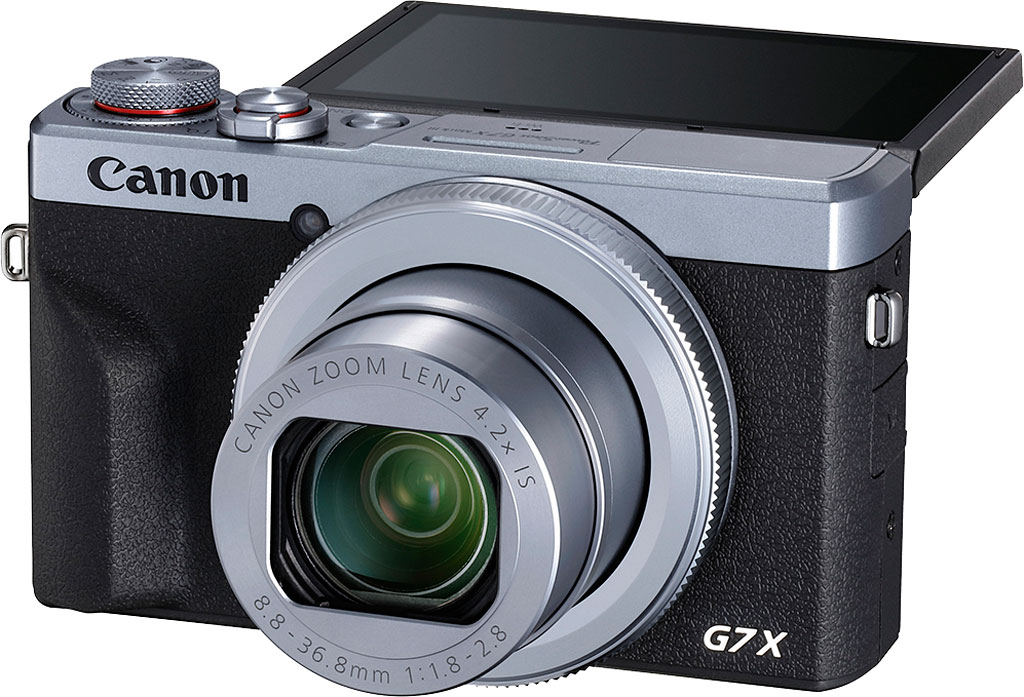
The G7X Mark III is the same size as the previous generation model, but weighs 14 grams less than the Mark II and features the same 24-100mm-equivalent f/1.8-2.8 lens. Furthermore, the Canon G7X III also looks very similar to its predecessor, save for some minor styling changes. It maintains the lack of a viewfinder and keeps the small, pop-up flash on the left-side corner of the top deck.
Imaging & Performance
When it comes to the imaging pipeline, the G7X III uses a new 20.1 megapixel 1.0-inch stacked CMOS sensor which is coupled to Canon's DIGIC 8 processor (an upgrade over the DIGIC 7-powered G7X Mark II). That stacked CMOS sensor is another improvement over the Mark II iteration of the camera, enabling enhanced performance features, such as full-res 20 frames-per-second bursts in high speed shooting mode (using fixed focus, one-shot AF mode).

An even faster 30 fps RAW-only burst mode is available, and a pre-record feature has also been added, allowing you to start capture about half a second before the shutter button is fully pressed, with about 2-3 seconds of total image capture time before the buffer fills.
The 20 and 30 fps burst modes are a dramatic increase in performance over the Mark II, which maxed out at just 8 fps in single-shot AF mode. With the new DIGIC 8 processor and thanks to the stacked sensor design, the G7X Mark III can now exceed the Mark II's top burst rate while using Servo AF mode, at 8.3fps, according to Canon's specifications. Support for Canon's newer compressed RAW (C-RAW) .CR3 format has also been included.
Buffer depths are generous, too. Canon claims 89 C-RAW, 55 RAW or 118 JPEG frames in 20 fps mode, and up to 70 frames in 30 fps RAW burst mode.

The G7 X Mark III also features an electronic shutter speed of up to 1/25,600s in Tv, M and Manual Movie modes (mechanical shutter speed maxes-out at 1/2000s), and a maximum native ISO of 12,800 (expandable to 25,600). Canon has also added an in-camera panoramic photo feature, and made improvements to the Star Mode. You can now shoot star trails with an electronic shutter that will result in very little vibration in the camera, and star time-lapse is also available for capture and export in-camera at 4K resolution.
Canon has also added focus bracketing, a feature found on the EOS RP. The user interface on the G7X III has also been improved, with a focus on making the camera function more like EOS cameras than ever before.
Video Recording Features
As nice as these still image improvements are, Canon's stated main focus of advancement on the G7X III was video performance, stating "really high-end video capabilities from a small compact camera." In fact, they are "calling all YouTube creators" to their "next-generation vlogging camera."

That video performance includes 4K UHD video capture at 30p, HDR movie capture, 1080p120 slow motion, and no crop at any resolution on the aforementioned 1-inch sensor. These video enhancements greatly improve on the max 1080p60 of the previous generation, though it is worth noting that the G7X Mark III's 4K has no 24p option. Continuous video recording is limited to 9 minutes, 59 seconds for 4K, 7:29 for Full HD at 120fps, or 29:59 for the remaining Full HD and HD recording options.
Canon has also added 4K frame grabs exported as JPEGs, a feature akin to Panasonic's 4K Photo mode. They have also enabled USB-C charging and power delivery on the G7X Mark III, allowing you to continue shooting even when plugged in to an external power source. The camera also features an external mic jack, but no headphone jack. Note that there is no sensor-shift image stabilization on the G7X II, however, the lens does feature optical image stabilization.
The G7X Mark III can also be controlled via Bluetooth, and lets you geotag locations via your mobile device using that connection.

The G7X III seriously differentiates itself from the G5X Mark II and changes the trajectory of its target market when it comes to connected video capabilities. The G7X III introduces direct connection to YouTube using a hotspot or Wi-Fi, allowing for live streaming to YouTube Live from the camera basically from any location. You can also schedule live streams ahead of time on YouTube, and then choose those slotted times directly from the camera. This livestream connectivity is the G7X Mark III's greatest differentiation point from the G5X Mark II, which sees many if not all of the sensor and processor-based improvements the G7X Mark III has received that are mentioned above.
Additionally, while in "selfie mode," you now have a record button located on the LCD itself to make starting and stopping video recording easier (you no longer have to look on the back of the camera as you did in the previous iteration). The G7X Mark III can now also record and playback video in vertical orientation for use on Instagram, etc. You cannot enter YouTube Live in vertical video format, however.

Storage, Connectivity & Battery
The G7X III offers a single SD card slot with UHS-I support. As mentioned above, the Canon G7X III does include a 3.5mm stereo mic input, but no headphone jack. Additional wired connectivity includes a USB Type-C port (with Power Delivery support) and a Type-D Micro HDMI port (and you can completely disable information displayed on the screen for clean HDMI output). Wireless features include built-in Wi-Fi and Bluetooth.
When it comes to battery life, the G7X III is powered by a NB-13L lithium ion battery pack, which is the same rechargeable battery as the previous model. According to CIPA battery ratings, the estimated battery life is slightly less than the predecessor, at approximately 235 shots or ~320 shots in ECO Mode. The G7X II, on the other hand, was rated at approximately 265 shots (or ~355 shots using ECO Mode).
In addition to supporting in-camera battery charging, the G7X III can now be powered via USB-C as well. Canon sells the PD-E1 USB Power Adapter for both functions, but it lists for a pricey US$190. Less expensive third-party USB power adapters (and power banks) should also work with the appropriate cable, but we believe they may need to be USB PD (Power Delivery) compliant to power or charge the G7X III (details from Canon on minimum requirements for USB power sources and cables are unfortunately few and far between). A dedicated (standalone) battery charger is included in the bundle.

Canon G7X III Pricing & Availability
The Canon G7X Mark III will be available in early August 2019 at an MSRP of US$749.99, and will come in silver or black.
Performance
Timing and Performance
Very good to excellent performance for its type.
| Startup/Play to Record | ||
|---|---|---|
| Power on |
~1.5 seconds
|
Time it takes for LCD to turn on and lens to deploy and capture a picture. |
|
Play to Record, |
~0.8 second
|
Time until first shot is captured. |
Startup to first shot time was about average for a compact camera, and switching from Play to Record and taking a shot was fairly quick.
| Shutter Response (Lag Time) m-shutter/e-shutter |
||
|---|---|---|
|
Full Autofocus |
0.149 / 0.178
second |
Time from fully pressing shutter button to image capture, zoom lens at wide angle position. |
|
Full Autofocus |
0.156 / 0.186
second |
Time from fully pressing shutter button to image capture, zoom lens at telephoto position. |
|
Full Autofocus |
0.250 / NA
second |
Time to capture while forcing flash to fire, zoom lens at medium focal length. |
|
Manual Focus |
0.165 / 0.191
second |
For most cameras, shutter lag is less in manual focus than autofocus, but usually not as fast as when the camera is "prefocused". |
| Prefocused |
0.024 / 0.053
second |
Time to capture, after half-pressing and holding shutter button. |
The Canon G7X III's full autofocus shutter lag when shooting the same target multiple times was quite fast for a compact camera, with similar or better lag times compared to the Mark II. The G7X III's full AF-S shutter lag clocked in at 0.149 second at wide angle using center AF mode. Full AF-S shutter lag was just slightly slower at full telephoto, at 0.156 second. Enabling the flash raised shutter lag to 0.250 second, to account for the metering preflash. In comparison, the G7X II tested at 0.176, 0.153 and 0.494 second respectively.
Manual focus shutter lag was 0.165 second while prefocused shutter lag was 24 milliseconds, compared to 0.177 second and 35 milliseconds respectively for the Mark II.
We also tested lag times in electronic shutter mode but as you can see above, they were slower than with the mechanical shutter, as they usually are.
| Cycle Time (shot to shot) | ||
|---|---|---|
|
Single Shot mode |
< 0.3 second
|
Average time per shot. |
| Single Shot mode |
< 0.3 second
|
Average time per shot. |
| Early shutter |
No
|
Some cameras don't snap another shot if you release and press the shutter too quickly in Single Shot mode, making "No" the preferred answer. |
|
Continuous Hi |
0.05 second
(20.0 fps); 125 frames total; 14.3 seconds to clear* |
Average time per shot. Slows to an average of 0.17s or 5.8 fps when buffer is full, with a lot of variation. |
|
Continuous Hi |
0.05 second
(20.0 fps); 94 frames total; 17.8 seconds to clear* |
Average time per shot. Slows to an average of 0.25s or 3.9 fps when buffer is full, with a lot of variation. |
|
Continuous Hi |
0.05 second
(20.0 fps); 59 frames total; 16.0 seconds to clear* |
Average time per shot. Slows to an average of 0.56s or 1.8 fps when buffer is full, with a lot of variation. |
|
Continuous Hi |
0.05 second
(20.0 fps); 91 frames total; 29.8 seconds to clear* |
Average time per shot. Slows to an average of 0.40s or 2.5 fps when buffer is full, with a lot of variation. |
|
Continuous Hi |
0.05 second
(20.0 fps); 57 frames total; 18.7 seconds to clear* |
Average time per shot. Slows to an average of 0.43s or 2.3 fps when buffer is full, with a lot of variation. |
|
RAW Burst Mode |
0.03 second
(30.0 fps); 76 frames total; 9.2 seconds to clear* |
Average time per shot. Camera won't let you shoot again until buffer is cleared. |
| Flash recycling |
1.6 seconds
|
Flash at maximum output. |
| *Note: Buffer clearing times measured with a Sony 64GB SF-G UHS-II SDXC card (R:300MB/s, W:299MB/s). Slower cards will produce correspondingly slower clearing times. Slow cards may also limit length of bursts in continuous mode. ISO sensitivity also affects cycle times and burst mode performance, with higher ISOs generally increasing cycle times and reducing burst performance. |
||
Shot-to-shot cycle times were excellent in single-shot mode, at under 0.3 second for Large/Fine JPEGs or RAW + Large/Fine JPEG files.
The Canon G7X III's Continuous Hi mode burst rate was very impressive at 20.0 fps regardless of file type and much faster than the G7X II which topped out at about 8.0 fps. The G7X III also offers a Continuous Lo setting at 3.0 fps which had an unlimited buffer in our tests. The G7X Mark III also features a special RAW Burst Mode which captures only raw images at a whopping 30.0 fps for 76 frames and saves them all to a single CR3 file. Note that focus is locked at the first frame at 20 fps and in RAW Burst Mode. With Servo AF (continuous autofocus), the G7X III's top burst speed is rated at 8.0 fps, but we didn't test that mode in the lab.
Buffer depths were quite generous even in the high speed modes, coming in at 125 best quality JPEGs, 94 compressed RAW, 59 lossless compressed RAW, 91 C-RAW+JPEG and 57 RAW+JPEG files at 20 frames per second. And as mentioned, in Continuous Lo mode, buffer depths were essentially unlimited.
Buffer clearing was reasonably quick considering the buffer depths with our fast Sony SF-G SDXC card (note that the G7X III does not support the card's faster UHS-II interface mode), ranging from 9.2 seconds after a max-length RAW Burst Mode burst at 30 fps to 29.8 seconds after a max-length C-RAW+JPEG burst at 20 fps. The camera will let you change settings while the buffer is clearing, though you can't view just-shot images until the buffer is cleared.
The built-in flash took an average of 1.6 seconds to recharge after a full-power discharge, which is very quick.
Bottom line, the Canon G7X Mark III's performance is excellent in most respects, and burst mode is vastly improved over its predecessor. Autofocus is fast, shutter lag is low, single-shot cycle times are very quick and burst speeds go up to an incredible 20 fps no matter the file type (30 fps in RAW Burst Mode). Buffer depths are also very generous with reasonable clearing times when using a fast card.
Battery
Battery Life
Below average battery life for its class.
| Operating Mode | Number of Shots |
|---|---|
|
Still Capture,
(LCD Monitor, CIPA standard) |
265
|
The Canon G7X Mark III uses a custom NB-13L rechargeable lithium-ion battery for power and a dedicated battery charger is included, but the battery can also be charged in-camera via the USB port. CIPA battery life is rated at 265 shots per charge which is below average and the same as the G7X Mark II. There is an Eco mode which can boost battery life to 320 shots, but we strongly recommend you pick up a spare battery for extended outings.
The table above shows the number of shots the camera is capable of (on a fully-charged rechargeable battery as appropriate), based on CIPA battery-life and/or manufacturer standard test conditions.
(Interested readers can find an English translation of the CIPA DC-002 standards document here. (180K PDF document))