


Overview

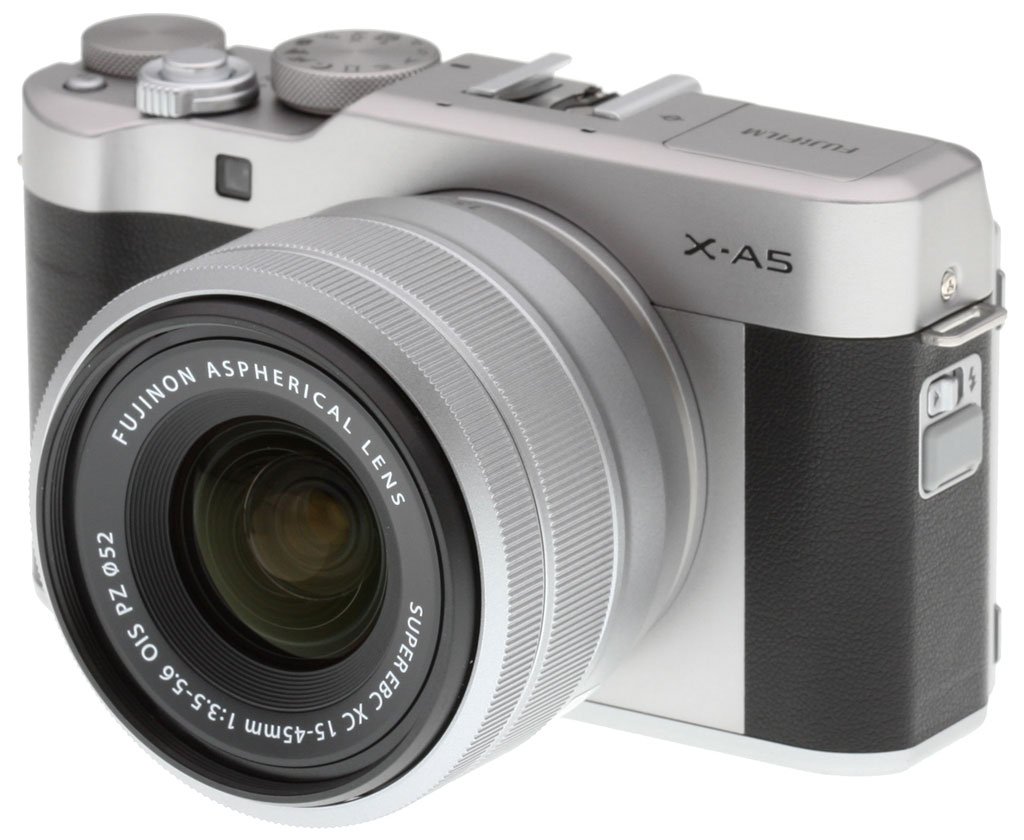
Following in the footsteps of the affordable X-A3, the Fuji X-A5 is aimed at entry-level photographers wanting a reasonably capable camera on a tight budget. It might look a whole lot like its predecessor externally, but a major update awaits on the inside, as we'll soon find out!
A very familiar body with a couple of changes
The only externally-obvious changes from the earlier camera are a new cover on the left side of the X-A5's plastic body -- behind which you'll find a new 2.5mm mic / remote jack -- and the lack of a focus mode switch on the front deck. (If you look more closely, you'll also spot a new Motion Panorama position on the mode dial, replacing the earlier camera's Custom position.)

A brand-new power zoom kit lens shoots wider and closer
On the front deck of the 24.2-megapixel Fuji X-A5, you'll find a Fuji X-mount on which to attach the bundled Fujinon XC15-45mm F3.5-5.6 OIS PZ lens, an optic which replaces the earlier 16-50mm OIS II kit lens that shipped with the X-A3. This new lens has the same maximum aperture as did its predecessor across the range, but its focal length ranges a little wider. Shooting with the new lens on the X-A5 yields an effective focal range of about 23-68mm, as compared to the 24-77mm-equivalent range of its predecessor.
More importantly, though, it now features not just optical image stabilization, but also a power zoom function, a first for a Fuji X-mount lens. And it boasts a minimum working distance of just two inches, with a slightly improved 0.24x maximum reproduction ratio compared to 0.2x for the 16-50 II for closer macros. It is sold separately as well, priced at US$300 / CA$380.

It's still selfie-friendly, but with a new touch-screen GUI
And while its body looks much the same as before, the X-A5 offers a better shooting experience courtesy of a new and improved graphical user interface on the 3.0-inch touch-screen LCD. The screen itself can still fold upwards some 180 degrees to allow for selfie shooting, a feat many more expensive cameras can't manage.
Here, too, ease of use was clearly key. Simply folding the screen upwards puts the camera in selfie mode automatically, with the rear command dial controlling zoom and shutter release functions, and with eye autofocus enabled for you. And if you're concerned about your selfie appeal matching up to the X-A5's image quality, you'll be happy to hear that you can add a three-step portrait enhancer effect for more attractive results.

A brand-new image sensor and faster processor allow hybrid autofocus
But it's on the inside where the most important changes can be found. We already alluded to the Fuji X-A5's 24.2-megapixel resolution, which is unchanged from that of the X-A3. However, the APS-C-sized, Bayer-filtered CMOS image sensor is actually a new design featuring on-chip phase-detection autofocus pixels. That allows the addition of a hybrid autofocus mode, a first for an X-A-series camera and a noticeable step forwards from the earlier contrast-detection system.
And results from the new sensor are handled by a brand-new image processor said to have about 1.5x the performance of that in the X-A3. According to Fuji, this new processor coupled with the hybrid AF system has allowed autofocusing times to be slashed in half, however in our lab tests, the X-A5's AF speed was only slightly improved over the X-A3's. Burst capture rates are unchanged, at a moderately swift 6.0 fps max. to manufacturer ratings. JPEG buffer depth has improved, however raw file buffer is still only six frames.

Another stop of sensitivity for the low-light lovers
Image quality, too, is said to have been improved, especially in terms of skin tone reproduction and a more accurate scene recognition system can now better take advantage of that greater image quality. Where the X-A3 offered a sensitivity range of ISO 200-6400, expandable to encompass ISO 100-25,600, the upper end of that range has been expanded by one stop. (That'll take you up to ISO 12,800 by default, or ISO 51,200 with expansion enabled.)
As you'd expect of a Fujifilm camera, the X-A5 includes a generous selection of 11 film simulation modes that replicate the look of classic Fuji emulsions. And there are also 17 Advanced Filter functions, including two new additions: Fog Remove and HDR Art. You can now adjust exposure compensation across a wider +/-5 stop range. And if you like to shoot raw but want an occasional JPEG after the fact, you'll be happy to hear that you can still process raw files in-camera, a feature added in the X-A3.

4K video capture, but with a major catch
Admittedly, with a clip length of just five minutes and a capture rate of just 15 frames per second for ultra high-def capture, you're not going to want to use it as a video mode unless you're a fan of slideshows or quick-motion video.
Its real utility is actually for stills, not video: It could still prove very useful to still shooters thanks to what Fuji is terming the Burst Function, an analog of Panasonic's 4K Photo mode. What this does it to record 15 fps 4K video -- hopefully, with a shutter speed suitable for still capture -- and then allow you to simply extract high-res 8.3-megapixel still frames. You can also stack 4K images with variant focusing distances in multi-focus mode, again for an 8.3-megapixel final result.

And while 4K video is a decided disappointment for video shooters, in other respects the Fuji X-A5 does have some improvements. There's a new mic jack as mentioned previously, and touch autofocus based on a hybrid system is also available. Both Full HD and HD video offer frame rates of 23.98, 24, 50 or 59.94 fps. There's also a high-speed video mode which captures HD footage at 100 fps that plays back at 25 (1/4x), 29.97 (1/3.3x), 50 (1/2x) or 59.94 (1/1.6x) fps.
Better battery life and easier wireless sharing
The Fuji X-A5 still draws power from an NP-W126S battery pack, but battery life has been improved by around 10% to some 450 frames. Like its predecessor, the Fuji A5 includes a Wi-Fi radio for wireless image transfer, but this is now supplemented with a Bluetooth 4.1 Low Energy radio for quick-and-easy pairing as needed. Once the Bluetooth radio is used to establish a Wi-Fi connection, you can use the Android or iOS-compatible Fujifilm Camera Remote app to transfer images and control the camera remotely.

Fuji X-A5 price and availability
The Fujifilm X-A5 kit with 15-45mm OIS PZ lens began shipping in February 2018 with a retail price of US$600 (CA$750). The camera is available in three colors in the US market, all of them silver bodied, and varying only in the color of their black, brown or pink faux-leather trim.
In the Box
The Fuji X-A5 with 15-45mm lens retail kit as tested contains the following items:
- Fujfilm X-A5 Camera Body
- Fujinon XC 15-45mm f/3.5-5.6 OIS PZ Lens
- NP-W126S Battery Pack
- AC-5VF AC Adapter
- USB Cable
- Shoulder Strap
- Body Cap
- Lens Caps
- Lens Hood
- Owner's Manual
- Fujifilm 1 Year Limited Warranty
Optics
We plan on doing a full lab test of the new Fujinon 15-45mm f/3.5-5.6 OIS PZ kit lens, so we have no lens test results for you here. We do however present our viewfinder accuracy test results below.
Viewfinder Test Results
Accuracy
Good accuracy from the LCD monitor in record mode.

The Fuji X-A5's LCD monitor proved fairly accurate in terms of coverage, with the LCD showing close to 99% coverage (98.8%) in record mode, though that's a bit short of Fuji's approximately 100% coverage specification.
The images above were taken from our standardized test shots. For a collection of more pictorial photos, see our Fujifilm X-A5 Photo Gallery .
Exposure
Color
Saturation & Hue Accuracy
Bright colors with good hue accuracy.
 |
||||
| In the diagram above, the squares show the original color, and the circles show the color that the camera captured at base ISO using sRGB color space. More saturated colors are located toward the periphery of the graph. Hue changes as you travel around the center. Thus, hue-accurate, highly saturated colors appear as lines radiating from the center. Click for a larger version. |
Saturation. The Fuji X-A5 produces images with fairly bright, pleasing colors using the standard film simulation (Provia) at default settings. The camera pushes reds by quite a bit, dark greens and blues moderately and most other colors by small amounts, but undersaturates yellow and aqua by just a bit. Default mean saturation at the base ISO of 200 was 114.2% (14.2% oversaturated), which is a little higher than average these days. You can of course tweak saturation and/or select a different film simulation if the default saturation is not to your taste. Most consumer digital cameras produce color that's more highly saturated (more intense) than found in the original subjects. This is simply because most people like their color a bit brighter than life.
Skin tones. The Fuji X-A5 rendered pleasant, pinkish Caucasian skin tones when using Auto white balance in the lab using default settings. Manual white balance produced skin tones that were a bit too reddish and Daylight white balance produced skin tones that were a bit too yellow. (Here, too, the X-A5's saturation and/or film simulation options may come into play for some users, letting them tweak the color of skin tones if they find the default rendering a bit too saturated for their personal tastes. Note that Fujifilm claims their Astia film simulation produces "true-to-life" skin tones.) Where oversaturation is most problematic is on Caucasian skin tones, as it's very easy for these "memory colors" to be seen as too bright, too pink, too yellow, etc.
Hue. The Fuji X-A5 produced a few color shifts relative to the ideal reproduction of hues, though it has good hue accuracy overall. The largest shift is in cyan toward blue, however we think that's a deliberate choice by camera engineers to produce better-looking sky colors. Average "delta-C" color error after correction for saturation at base ISO was 4.95 (lower numbers are better), which is good. Hue is "what color" the
color is.
See full set of test images with explanations
See thumbnails of all test and gallery images
Sensor
Exposure and White Balance
Indoors, incandescent lighting
Auto and Incandescent white balance were quite warm, but very good results with the Manual setting. Average exposure compensation required.


Indoors, under typical incandescent lighting, color balance was quite warm using the Auto setting, with a fairly strong red/pink cast. Results with the Incandescent white balance setting were also very warm, with a strong yellow/orange cast. The Manual white balance setting was quite accurate, though, just slightly on the cool side. The Fuji X-A5 required +0.3 EV exposure compensation here, which is about average for this scene. Our test lighting for this shot is a mixture of 60 and 100 watt household incandescent bulbs, a pretty yellow light source, but a very common one in typical home settings here in the U.S.
Outdoors, simulated daylight
Very good color and exposure outdoors, though high default contrast.

In simulated daylight, the Fuji X-A5 produced nice color at default settings, with pleasing skin tones that had a healthy-looking pinkish tint with Auto White Balance. Manual WB was a bit cool with more reddish skin tones, while Daylight WB was too warm with more yellowish skin tones. The X-A5's required +0.7 EV exposure compensation for our "Sunlit" Portrait shot. That's about average exposure accuracy as most cameras need +0.7 EV to keep the face bright for this shot, but that did lead to a lot of blown highlights in the mannequin's shirt and flowers while still producing some very dark shadows that abruptly clip to black. See the "Extremes: Sunlit..." section below to see how the X-A5's Highlight/Shadow Tone and D-Range settings help deal with harsh lighting like this.
See full set of test images with explanations
See thumbnails of all test and gallery images
Resolution
~2,800 lines of strong detail from JPEGs, about the same from ACR converted RAW.


Our in-camera JPEG resolution chart shot revealed sharp, distinct line patterns up to just over 2,800 lines per picture height in the horizontal direction, and to just over 2,800 lines per picture height in the vertical direction as well. Some may argue for higher numbers, but lines begin to merge and are not very distinct at higher resolutions, and some strong aliasing already occurred at as low as 2,300 lines. Complete extinction of the pattern didn't occur until about 3,500 lines in both directions. Adobe Camera Raw wasn't able to extract any additional resolution, however it did produce lower amounts of luma moiré near the limits of resolution (in part due to less aggressive sharpening), though it did produce higher levels of chroma moiré (false colors) than the camera's default processing. Use these numbers to compare with other cameras of similar resolution, or use them to see just what higher resolution can mean in terms of potential detail.
See full set of test images with explanations
See thumbnails of all test and gallery images
Sharpness & Detail
Very sharp images at default settings, with obvious edge-enhancement halos appearing around high-contrast subjects. Mild noise suppression is visible in the shadows at base ISO.


Sharpness. The Fuji X-A5 produces very sharp images by default, with obvious and often obtrusive sharpening "halos" around high-contrast edges such as the lines and letters in the bottle label above left. This leads to very crisp and detailed-looking images that are sure to please less discriminating users, but we would recommend turning sharpening down and perhaps sharpening in post to reduce the haloing. Edge enhancement creates the illusion of sharpness by enhancing colors and tones right at the edge of a rapid transition in color or tone.
Detail. The crop above right shows fairly low levels of luminance noise suppression, as the darker areas of the model's hair still show a very good amount of detail. Some individual strands do merge together when local contrast is low and as shadows deepen, but performance here is excellent for an APS-C sensor. Like most recent Fujifilm cameras, the X-A5 also does a great job at keeping chrominance noise very low. Noise-suppression systems in digital cameras tend to flatten-out detail in areas of subtle contrast. The effects can often be seen in shots of human hair, where the individual strands are lost and an almost "watercolor" look appears.
RAW vs In-Camera JPEGs
As noted above, the Fuji X-A5 produces very crisp, detailed images but with obvious sharpening halos at default settings. Let's see how an Adobe Camera Raw conversion with relatively strong unsharp mask sharpening compares.
|
Base ISO (200)
|
|
 |
 |
 |
 |
 |
 |
|
Camera JPEG, defaults
|
RAW via Adobe Camera Raw
|
In the table above, we compare an in-camera JPEG taken at base ISO (200) using default noise reduction and sharpening (on the left) to the matching RAW file converted with Adobe Camera Raw 9.1 via DNG Converter 10.2 using default noise reduction with quite strong but tight unsharp masking applied in Photoshop. (In this case, we used USM of 400%, radius of 0.3 pixels, and a threshold of 0.)
As you can see, results from the Adobe Camera Raw are quite different than the X-A5's default in-camera processing. Colors from the camera are more saturated and contrast is higher, giving in-camera JPEGs more "pop". Although strong sharpening was applied to the ACR conversion, we get much less obtrusive sharpening artifacts. Fine detail is better from the ACR conversion as well, especially in our tricky red-leaf swatch where the camera's noise reduction has blurred away most of the fine thread pattern. The strong sharpening required to keep images sharp does tend to exacerbate noise, though, as can be seen in the background of the first set of crops, however that can be mitigated by experimenting with different sharpening settings and techniques, and/or by using some luminance noise reduction (default ACR NR used here).
Bottom line: the camera's default in-camera processing is likely quite pleasing to the target market for an entry-level model like the X-A5, however better detail and fewer sharpening artifacts are possible by shooting in RAW mode and processing them in a good RAW converter. Note that the X-A5 does not support RAW file capture for extended low (ISO 100) and extended high (25,600 and 51,200) ISOs.
ISO & Noise Performance
Excellent high ISO performance for an APS-C sensor.
|
Default High ISO Noise Reduction
|
 |
 |
 |
| ISO 100 | ISO 200 | ISO 400 |
 |
 |
 |
| ISO 800 | ISO 1,600 | ISO 3,200 |
 |
 |
 |
| ISO 6,400 | ISO 12,800 | ISO 25,600 |
 |
||
| ISO 51,200 | ||
The Fuji X-A5's images are quite clean and detailed up to ISO 800, with low, fine-grained luma noise and almost no chroma noise. At ISO 1,600, noise reduction efforts are a little stronger causing some minor smudging, but fine detail is still very good with almost no chroma noise. ISO 3,200 shows a stronger increase in noise causing more blurring and some subtle noise reduction artifacts, but fine detail remains pretty good, and chroma noise remains low. At ISO 6,400 luminance noise becomes more noticeable, though noise is still fairly fine-grained, and chroma noise is still well-controlled. Image quality drops off more rapidly at ISO 12,800 and above, with progressively more visible noise grain, stronger blurring and more noticeable noise reduction artifacts. ISO 12,800 is quite grainy but detail is not too bad, however ISOs 25,600 and 51,200 are quite soft with heavy luminance noise accentuated by sharpening artifacts, as well as chroma noise in the form of large but fairly subtle purple blotches in darker areas. Still, noise performance in high ISO JPEGs is excellent, among the best we've seen from an APS-C sensor.
We're pixel-peeping to the extreme here though, which isn't always representative of what you see in prints. As always, see the Print Quality section below for maximum recommended print sizes at each ISO.
Extremes: Sunlit, dynamic range and low-light tests
Mediocre dynamic range in JPEGs at default settings, though provided options help. Good low-light performance.


Sunlight. The Fuji X-A5 struggled with the harsh lighting of this test at default settings at the base ISO of 200 (which should be best case). We preferred the +0.7 EV exposure overall, because the default exposure and +0.3 EV were too dim in the face, and +1.0 EV exposure compensation was too bright with far too many clipped highlights. Even at +0.7 EV, quite a few highlights were blown in the mannequin's shirt and flowers. There are quite a few dark shadows as well, and very deep shadows are somewhat posterized and clip to black rather abruptly, likely in an attempt to hide noise. Overall, the Fuji X-A5's JPEGs performed below average here without any highlight and shadow adjustments, nor any dynamic range enhancement (see below).
The good news is the blown highlights and clipped shadows in the above test scene were easily recoverable in the RAF RAW files, even at +0.7 EV, so dynamic range captured in the X-A5's RAW files appears to be excellent.
Because digital cameras are more like slide film than negative film (in that they tend to have a more limited tonal range), we test them in the harshest situations to see how they handle scenes with bright highlights and dark shadows, as well as what kind of sensitivity they have in low light. The shot above is designed to mimic the very harsh, contrasty effect of direct noonday sunlight, a very tough challenge for most digital cameras. (You can read details of this test here.)
Face/Eye Detection
The Fuji X-A5 has the ability to detect faces and eyes, and adjust exposure and focus accordingly. Options available are Face On / Eye Off, Face On / Eye Auto, Face On / Right Eye Priority, Face On / Left Eye Priority and Face Off / Eye Off.
| Face Detection | ||
 |
 |
 |
| Aperture Priority Face Off / Eye Off: 0 EV |
Aperture Priority Face On / Eye Auto 0 EV |
Full Auto Mode 0 EV |
As you can see in the examples above, the center image with face and eye detection enabled is slightly better exposed for the face compared to the left image where face detection was not employed, as using it dropped the shutter speed from 1/80s to 1/50s. Full Auto mode (right) is is even better exposed, and the camera elected a much wider aperture of f/4, a faster shutter speed of 1/320s, a higher ISO (400) and used the DR Auto setting for lower contrast.
Contrast Adjustment
The Fuji X-A5 does not offer a traditional contrast adjustment. Instead, it offers Shadow and Highlight Tone settings, which let you adjust contrast in highlights and shadows independently. There are five settings each on the X-A5, ranging from -2 to +2.

Shadow and Highlight Tone. Above you can see the effects the five settings for Highlight and Shadow Tone control on our high-contrast "Outdoor Portrait" shot. Mouse over the links to load the associated thumbnail and click on the links to visit the full resolution image.
Notice how the Highlight settings mainly affect the brighter portions of the image, while the Shadow settings impact the darker areas. Both settings can be used simultaneously, giving more flexibility to tune the tone curve at both ends compared to a single contrast setting. Nice.

D-Range is Fuji's name for their dynamic range enhancement technology. D-Range designed to preserve hot highlights, by exposing for highlights and then boosting mid-tones and shadows. There are three levels: DR100 100% (default), DR200 200%, DR400 400%, as well as an Auto mode which can select DR100 or DR200. DR200 is available at ISO 400 and above, while DR400 is available at ISO 800 and above. Mouse over the links above to load the corresponding thumbnail image. Click on the links to get to the full resolution images.
As you can see the images above, the Fuji X-A5's 200% and 400% D-Range settings were effective at toning down highlights in "Outdoor Portrait" shot. As they say, though, there's no free lunch, because improved highlight retention comes at a cost of increased noise. This is because the camera's sensitivity needs to be raised to take advantage of the D-Range feature, though that's not much of penalty because the X-A5's high ISO performance is so good.

HDR. The Fuji X-A5 has an in-camera HDR mode which takes an undisclosed number of shots at different exposures and combines them to make a high dynamic range image. Options available are Auto, 1.0 EV, 1.5 EV, 2.0 EV, 2.5 EV and 3.0 EV. Mouse over the links above to compare the Auto and full EV settings, and click on the links to access full resolution versions. The X-A5 also offers an over-the-top HDR Art filter, which you can see by clicking here.
Low-light Autofocus
The Fuji X-A5's hybrid autofocus system was able to focus on our legacy low-contrast AF target down to about -1.9 EV unassisted with an f/2.8 lens. With our new high-contrast AF target, the X-A5 was able to autofocus down to about -2.5 EV unassisted, which is not bad for the class. The Fuji X-A5 also has a built AF assist lamp, which lets it autofocus in complete darkness as long as the subject is in range and has sufficient contrast.
NOTE: This low-light AF test is conducted with a stationary subject, and the camera mounted on a sturdy tripod. Most digital cameras will fail miserably when faced with a moving subject in dim lighting. (For example, a child's ballet recital or a holiday pageant in a gymnasium.) Thanks to its larger sensor and Hybrid AF, mirrorless cameras like the Fuji X-A5 tend to do better than point & shoots, but you still shouldn't expect a quick autofocus lock with moving subjects.
Built-in Flash
A small, weak built-in flash typical of the class.

Our Indoor Portrait test scene was well exposed with +0.7 EV flash exposure compensation using Auto ISO, though the camera boosted ISO to 6400. (Note that we used to shoot this shot with a 60mm lens, but the longer 90mm lens used here means results are not comparable.) The camera used a fast 1/125s shutter speed, but because of the high sensitivity, white balance was quite warm and pinkish from the ambient room lighting.
Output Quality
Print Quality
Very nice 30 x 40 inch prints up to ISO 400; Pleasing 11 x 14 inch print at ISO 6400; Usable 4 x 6 at ISO 51,200.
 ISO 100/200/400 prints all look more or less identical and display tons of crisp, fine detail and vibrant, nicely saturated colors. With this level of detail and despite "just" having a 24MP APS-C sensor, the X-A5 allows for large, wall-sized 30 x 40-inch prints up to ISO 400. Even at ISO 400, prints show no visible noise and lots of detail. There is a hint of pixelation if you examine these large prints closely, but at typical viewing distances, it shouldn't be a concern. It therefore goes without saying that 24 x 36 inch prints up to ISO 400 look fantastic.
ISO 800 prints work wonderfully up to 24 x 36 inches. It's a tough call because the noise performance is really quite excellent here. Very little visible noise at all, and we only observe a slight decrease in fine detail. One might do fine with a 30 x 40 inch print with careful processing.
ISO 1600 prints begin to show visible evidence of noise and anti-noise processing with some detail reduction. That said, the X-A5 still manages to produce a very nice 20 x 30-inch print at this ISO.
ISO 3200 prints top-out at 16 x 20 inches. We see a little more detail degradation, particularly in our tricky red-leaf fabric (though we don't call the print size based on that fabric swatch alone). Elsewhere in the print, detail is quite impressive to this size, and colors remain vivid.
ISO 6400 prints show an expected increase in noise and noise reduction processing, thus reducing fine detail further. Overall detail, as well as contrast and color, all remain pleasing up to 11 x 14 inches.
ISO 12,800 prints are tricky! The image quality is quite good, all things considered, though it's clear that noise is taking its toll on fine detail. To our eyes, an 8 x 10 inch print at this ISO just passes the mark to be considered good.
ISO 25,600 prints are quite noisy and display a lack of fine detail. Still, we managed to get a usable 5 x 7-inch print from the X-A5 here.
ISO 51,200 prints are very noisy, and anything above a 4 x 6-inch print is not recommended.
Well, despite its entry-level positioning and price point, the non-X-Tran-based Fujifilm X-A5 does an excellent job overall in the print quality department. At lower ISOs, you're pretty much limited to the sensor's resolving power; the X-A5 tops our max print size of 30 x 40 inches up to ISO 400. At ISO 800, you can still get a very nice 24 x 36-inch print, which is still impressively large. As ISO sensitivity rises, we see only sublet increases in noise and drops in detail. The camera still manages a large 16 x 20 inch print at ISO 3200, and you can print an 8 x 10 at ISO 12,800 -- not many entry-level APS-C cameras can do that! Even the highest ISOs manage to just squeeze past the "good" mark, with the expanded max ISO of 51,200 offering a usable 4 x 6-inch print.
The images above were taken from our standardized test shots. For a collection of more pictorial photos, see our Fujifilm X-A5 Photo Gallery .
Not sure which camera to buy? Let your eyes be the ultimate judge! Visit our Comparometer(tm) to compare images from the Fujifilm X-A5 with those from other cameras you may be considering. The proof is in the pictures, so let your own eyes decide which you like best!
Performance
Timing and Performance
Generally slower-than-average performance for a mirrorless camera.
| Startup/Play to Record | ||
|---|---|---|
| Power on |
~3.1 seconds
|
Time it takes to turn on and capture a shot. |
|
Play to Record, |
~1.4 seconds
|
Time until first shot is captured. |
Power on to first shot was much slower-than-average for a mirrorless camera these days, at just over three seconds. That's significantly slower than the X-A3's startup time of two seconds, thanks to the new Fujinon XC 15-45mm f/3.5-5.6 OIS PowerZoom kit lens which needs to extend first when powered on. Switching from Play to Record mode and taking a shot was also somewhat sluggish at about 1.4 seconds, but a bit faster than the X-A3's 1.5 seconds.
| Shutter Response (Lag Time) Mechanical / Electronic Shutter |
||
|---|---|---|
|
Full Autofocus, |
0.328 / 0.399
second |
Time from fully pressing shutter button to image capture, with the lens already at the proper focal distance setting. (All timing performed with the Fujinon XC 15-45mm f/3.5-5.6 OIS PZ kit lens.) |
|
Full Autofocus, |
0.463 / N/A
second |
Time from fully pressing shutter button to image capture, with the lens already at the proper focal distance setting, TTL Auto flash enabled. |
| Manual Focus |
0.154 / 0.324
second |
For most cameras, shutter lag is less in manual focus than autofocus, but usually not as fast as when the camera is "prefocused". |
|
Prefocused |
0.043 / 0.172
second |
Time to capture, after half-pressing and holding shutter button. |
The Fuji X-A5's full autofocus shutter lag was slower than average for a mirrorless camera, though there is a "Pre-AF" option which should help by continuously focusing even when the shutter button is not pressed half way (that does however reduce battery life). The Fuji X-A5's full-autofocus shutter lag (with the subject at a fixed distance) was 0.328 second using Single Point AF mode (center) with the kit lens (without Pre-AF enabled). This is marginally improved over X-A3's 0.374 second, but we were hoping the upgrade from a contrast-detect to hybrid AF system would yield significantly faster results. We tried multiple lenses including some fast primes, but they produced similar results in this test.
With the built-in flash enabled, the X-A5's full AF shutter lag increased to 0.463 second to account for preflash metering, slightly slower than the X-A3's 0.434 second.
Manual focus shutter lag was a bit faster than the X-A3, at 0.154 vs 0.194 second, and Prefocused shutter lag was quite quick, at only 0.043 versus 0.048 second.
We retested the X-A5's lag times using electronic shutter mode to see how using it impacts performance. As you can see it actually increased lag times.
To minimize the effect of different lens' focusing speed, we test AF-active shutter lag with the lens already set to the correct focal distance.
| Cycle Time (shot to shot) | ||
|---|---|---|
| Single Shot mode |
1.33 seconds
|
Time per shot, averaged over a few frames (we no longer test for buffer depths in single-shot mode). |
|
Single Shot mode |
1.22 seconds
|
Time per shot, averaged over a few frames (we no longer test for buffer depths in single-shot mode). |
| Early shutter |
Yes
|
Some cameras don't snap another shot if you release and press the shutter too quickly in Single Shot mode, making "No" the preferred answer. |
|
Continuous High |
0.17 second
(5.79 fps); 22 frames total; 3.7 seconds to clear* |
Time per shot, averaged over buffer length of 22 frames. Then slows to an average of 0.22s or 4.52 fps when buffer is full. |
| Continuous High |
0.18 second
(5.68 fps); 6 frames total; 3.7 seconds to clear* |
Time per shot, averaged over buffer length of 6 frames. Then slows to an average of 0.59s or 1.68 fps when buffer is full. |
|
Continuous High |
0.18 second
(5.68 fps); 6 frames total; 4.1 seconds to clear* |
Time per shot, averaged over buffer length of 6 frames. Then slows to an average of 0.81s or 1.23 fps when buffer is full with a lot of variation. |
|
4K Burst Mode |
0.07 second
(14.93 fps); Unlimited(?); 1.5 seconds to clear* |
Time per shot, with no apparent limit other than card space or video recording limit. |
| Flash Recycling |
1.9 seconds
|
Flash at maximum output. |
|
*Note: Buffer clearing times measured with a 64GB Lexar Pro 2000x UHS-II SDXC card. Slower cards will produce correspondingly slower clearing times. Slow cards may also limit length of bursts in continuous mode. ISO sensitivity and noise reduction settings can also affect cycle times and burst mode performance.
|
||
Single-shot cycle times were also slower than average at well over one second, and the X-A5 has a pre-press penalty (if you press the shutter button too soon after a previous shot, the camera ignores it and you need to press it again).
The highest speed full-resolution "Continuous H" burst rate was decent for an entry-level model, clocking in at about 5.8 frames per second for best quality JPEGs, which is pretty close to Fujifilm's 6 fps spec. The frame rate dropped just slightly to about 5.7 fps for RAW or RAW+JPEG files. The Fuji X-A5 also offers a "Continuous L" mode rated at 3 fps, but we didn't test that mode in the lab. We did however test the X-A5's new 4K Burst mode which worked as expected, capturing 8-megpaixel JPEGs at very close to the camera's 15 fps 4K video frame rate. Note that the electronic shutter is used in 4K Burst mode, so there can be some distortion and/or banding depending on subject/camera motion or artificial lighting.
Buffer depth was a decent 22 frames for best quality JPEGs which is much better than Fujifilm's ten frame spec, and much improved over the 9 frames we got with the X-A3. The buffer-full frame rate was also pretty good, at about 4.5 fps. When shooting RAW or RAW+JPEG files, buffer depth dropped to a paltry six frames, the same as its predecessor. Buffer clearing was fairly quick at 3.7 seconds after shooting a max-length burst of JPEGs, 3.7 seconds after a RAW burst, and 4.1 seconds after a RAW+JPEG burst.
Recycling the flash after full power discharges took an average of 1.9 seconds which is good and noticeably faster than the X-A3's 3.4 seconds, however the X-A5 has a weaker flash (GN 4 (meters at ISO 100), versus GN 5 for the X-A3).
Bottom line, much like its predecessor, the Fuji X-A5's performance was underwhelming, with slower than average startup time, mode switching and cycle times, and while AF lag has improved slightly, it is still slower than average. Full-res burst speed was decent for its class and JPEG buffer depth has improved significantly, however RAW buffer depths remain very shallow. Prefocused shutter lag was pretty good, though, and the new 4K Burst mode can capture 8MP JPEGs at a pretty swift 15 fps, however some competing models offer the same feature at 24 or 30 fps.
Battery
Battery Life
Good battery life for a mirrorless camera.
| Operating Mode | Battery Life |
|---|---|
|
Still Capture,
(CIPA standard) |
450 shots
|
The Fuji X-A5 uses a custom rechargeable lithium-ion battery pack for power, and comes with a single battery and an AC adapter for charging in-camera via the USB port. The CIPA-rated 450 shots per charge is above average for a mirrorless camera and slightly improved over the X-A3's 410 shots (at least partially because of the weaker flash), but still much lower than most DSLRs. As is usually the case, we recommend getting a second battery for your X-A5 if you plan any extended outings.
The table above shows the number of shots the camera is capable of (on a fully-charged rechargeable battery), based on CIPA battery-life and/or manufacturer standard test conditions.
(Interested readers can find an English translation of the CIPA DC-002 standards document here. (180K PDF document))
Image Quality
Below are crops from our laboratory Still Life target comparing the Fuji X-A5's image quality to its predecessor's, the X-A3, as well as against several competing entry-level mirrorless cameras at similar price points: the Canon EOS M6, Olympus E-PL9, Panasonic GX850 and Sony A6000.
NOTE: These images are from best quality JPEGs straight out of the camera, at default settings including noise reduction and using the camera's actual base ISO (not extended ISO settings). All cameras in this comparison were shot with our very sharp reference lenses. Clicking any crop will take you to a carrier page where you can click once again to access the full resolution image as delivered straight from the camera. For those interested in working with the RAW files involved, click these links to visit each camera's respective sample image thumbnail page: Fuji X-A5, Fuji X-A3, Canon M6, Olympus E-PL9, Panasonic GX850, and Sony A6000 -- links to the RAW files appear beneath those for the JPEG images, wherever we have them. And remember, you can always go to our world-renowned Comparometer to compare the Fuji X-A5 to any camera we've ever tested!
Fujifilm X-A5 vs Fujifilm X-A3 at Base ISO
 |  |
 |  |
 |  |
Fujifilm X-A5 at ISO 200 | Fujifilm X-A3 at ISO 200 |
Above we compare X-A5 image quality at base ISO to its predecessor, the X-A3, which also uses a 24-megapixel Bayer-filtered APS-C sensor, though without integrated PDAF pixels. As expected, image quality is very similar at ISO 200 with both cameras providing very crisp, detailed images but that contain really obvious sharpening halos around high-contrast edges, as well as the exaggeration of subtle textures and details. This is especially noticeable in the solid background of "Mas Portel" bottle label where it appears "noisy", and even the subtle label adhesive pattern is amplified to the point of being readily visible. Default sharpening is definitely very aggressive from both cameras. The X-A5's image is a bit sharper, but this is mostly due to the different lenses used, as we had to retire our Fujinon 60mm f/2.4 lens used with the X-A3 as it was no longer manually focusing reliably. We will probably switch to the Fujinon 56mm f/1.2 in the long term, but in the meantime the X-A5 shots here were taken with the Fujinon 90mm f/2 which is a bit sharper than the 60mm lens at f/8. Still, it appears Fuji has tweaked default JPEG processing as well, producing slightly higher contrast and revising noise reduction to do a better job at preserving fine detail. Colors are also a bit warmer from the X-A5, but that just appears to be due to slightly better custom white balance. | |
Fujifilm X-A5 vs Canon EOS M6 at Base ISO
|  |
|  |
|  |
Fujifilm X-A5 at ISO 200 | Canon EOS M6 at ISO 100 |
Above we compare the X-A5 to the Canon M6, another 24-megapixel APS-C mirrorless camera. Both images show noticeable sharpening halos along high-contrast edges, but the X-A5's are much more obtrusive, however the Fuji image is much crisper and more detailed. When looking closely at the images, you can see that the X-A5 image has higher luma noise than the M6 in the shadows, but keep in mind its higher base ISO. The X-A5 image however has lower chroma noise than the M6. Contrast is much higher from the Canon in our tricky red-leaf swatch giving the impression of greater detail, however the two cameras capture about the same amount of subtle detail. Both cameras produce pleasing color but the Fuji's colors are warmer and generally more saturated. | |
Fujifilm X-A5 vs Olympus E-PL9 at Base ISO
|  |
|  |
|  |
Fujifilm X-A5 at ISO 200 | Olympus E-PL9 at ISO 200 |
Here we compare the X-A5 to the 16-megapixel Micro Four Thirds Olympus E-PL9. Both cameras produce very sharp images with visible sharpening artifacts here at base ISO, though again the halos are more obvious from the Fuji around high-contrast elements. The 24-megapixel X-A5 out-resolves the E-PL9 though the Olympus offers somewhat higher contrast which helps it to appear a little crisper than the X-A5 in some areas. Noise is actually lower from the E-PL9 however its JPEG engine does generate a few unwanted artifacts while smoothing it out. Both cameras produce pleasing color, though the Fuji's are a little brighter. | |
Fujifilm X-A5 vs Panasonic GX850 at Base ISO
|  |
|  |
|  |
Fujifilm X-A5 at ISO 200 | Panasonic GX850 at ISO 200 |
Here we compare the X-A5 to another entry-level mirrorless camera, the Panasonic GX850. The 24-megapixel X-A5 easily out-resolves the 16-megapixel GX850 while offering lower noise levels, however the GX850 produces a somewhat more natural-looking image with less noticeable sharpening halos. Contrast and detail are also better from the GX850 in our tricky red-leaf swatch, however overall contrast is higher from the Fuji, with brighter and more pleasing colors as well. | |
Fujifilm X-A5 vs Sony A6000 at Base ISO
|  |
|  |
|  |
Fujifilm X-A5 at ISO 200 | Sony A6000 at ISO 100 |
Both these rivals use similar 24-megapixel APS-C sensors and thus resolve very similar amounts of detail, however Fuji's processing produces a crisper, sharper image with strong haloing while the Sony's sharpening algorithm produces almost no sharpening halos. The X-A5's colors are more vibrant, warmer and more accurate, though the Sony retains some of the offset printing coloration in the mosaic crop that the Fuji pretty much eliminates. The Sony also produces much higher contrast and better detail in our tricky red-leaf fabric. | |
Fujifilm X-A5 vs Fujifilm X-A3 at ISO 1600
 |  |
 |  |
 |  |
Fujifilm X-A5 at ISO 1600 | Fujifilm X-A3 at ISO 1600 |
Fairly similar image quality from the two Fuji siblings here at ISO 1600, though again, the X-A5 image appears a little sharper, contrastier and slightly more detailed, likely at least in part because of the better lens. Luma noise levels appear a little higher from the X-A5, though, perhaps the result of somewhat stronger default sharpening as noise levels in RAW files appear quite similar. Still, these entry-level Fujis offer some of the best high ISO performance we've seen from an APS-C camera. | |
Fujifilm X-A5 vs Canon EOS M6 at ISO 1600
|  |
|  |
|  |
Fujifilm X-A5 at ISO 1600 | Canon EOS M6 at ISO 1600 |
The Fuji X-A5 produces a much sharper, crisper, cleaner and more detailed image here at ISO 1600 compared to the Canon M6. Colors continue to be brighter and more vibrant from the Fuji as well. | |
Fujifilm X-A5 vs Olympus E-PL9 at ISO 1600
|  |
|  |
|  |
Fujifilm X-A5 at ISO 1600 | Olympus E-PL9 at ISO 1600 |
The X-A5 continues to out-resolve the E-PL9 here at ISO 1600, though its luma noise levels are higher in flatter areas. The E-PL9 works hard at smoothing away noise while still doing a good job of holding onto fine detail, however it does generate more noise reduction artifacts. | |
Fujifilm X-A5 vs Panasonic GX850 at ISO 1600
|  |
|  |
|  |
Fujifilm X-A5 at ISO 1600 | Panasonic GX850 at ISO 1600 |
The X-A5 pulls further away from the GX850 here at ISO 1600, with lower noise, more detail, higher contrast and better color, although sharpening halos remain more obvious from the Fuji. | |
Fujifilm X-A5 vs Sony A6000 at ISO 1600
|  |
|  |
|  |
Fujifilm X-A5 at ISO 1600 | Sony A6000 at ISO 1600 |
The X-A5 produces a crisper, more detailed image sharper but with noticeable haloing and slightly higher noise levels than the A6000. The Sony produces much higher contrast in our tricky red-leaf swatch, however it's starting to distort the pattern more than the Fuji. The X-A5's colors remain more vibrant, warmer and more accurate. | |
Fujifilm X-A5 vs Fujifilm X-A3 at ISO 3200
 |  |
 |  |
 |  |
Fujifilm X-A5 at ISO 3200 | Fujifilm X-A3 at ISO 3200 |
Once again, we see a sharper, crisper and better detailed image from the X-A5 compared to its predecessor here at ISO 3200. Again, much of the improvement is likely due to the sharper lens, but it appears the tone curve and default processing have been improved as well. | |
Fujifilm X-A5 vs Canon EOS M6 at ISO 3200
|  |
|  |
|  |
Fujifilm X-A5 at ISO 3200 | Canon EOS M6 at ISO 3200 |
There's really no contest here at ISO 3200, with the X-A5 producing a much crisper, detailed image with better color and lower noise levels, at least in the shadows and mid-tones. In brighter areas, the Canon is actually cleaner, likely in part due to its far less aggressive sharpening. The M6 also produces better contrast in our troublesome red-leaf swatch, though fine detail is actually a bit better from the Fuji. | |
Fujifilm X-A5 vs Olympus E-PL9 at ISO 3200
|  |
|  |
|  |
Fujifilm X-A5 at ISO 3200 | Olympus E-PL9 at ISO 3200 |
Similar to what we saw at ISO 1600, the X-A5 retains more detail and produces a crisper, more vibrant image with fewer noise reduction artifacts. Noise levels are similar in flatter areas, however the Fuji's grain pattern has a less consistent nature than the E-PL9's. | |
Fujifilm X-A5 vs Panasonic GX850 at ISO 3200
|  |
|  |
|  |
Fujifilm X-A5 at ISO 3200 | Panasonic GX850 at ISO 3200 |
The X-A5 still comes out ahead here at ISO 3200 with much better detail in most areas, lower noise with a tighter and more natural-looking "grain" pattern, and more pleasing colors. Both cameras really struggle with fine detail in our tricky red-leaf swatch, blurring most of it away, but the GX850 renders slightly better contrast. | |
Fujifilm X-A5 vs Sony A6000 at ISO 3200
|  |
|  |
|  |
Fujifilm X-A5 at ISO 3200 | Sony A6000 at ISO 3200 |
This is an easy win for the Fuji, producing a much crisper, clearer and more vibrant image than the Sony. The A6000's heavy-handed noise reduction smears away a lot of fine detail, and what appears to be better detail in our red-leaf swatch is heavily distorted and false. | |
Fujifilm X-A5 vs. Fujifilm X-A3, Canon EOS M6, Olympus E-PL9, Panasonic GX850, Sony A6000
 |  |  |  |  |  |
 |  |  |  |  |  |
 |  |  |  |  |  |
| Fujifilm X-A5 ISO 200 ISO 3200 ISO 6400 | Fujifilm X-A3 ISO 200 ISO 3200 ISO 6400 | Canon EOS M6 ISO 100 ISO 3200 ISO 6400 | Olympus E-PL9 ISO 200 ISO 3200 ISO 6400 | Panasonic GX850 ISO 200 ISO 3200 ISO 6400 | Sony A6000 ISO 100 ISO 3200 ISO 6400 |
| Detail comparison. High-contrast detail is also important, pushing the camera in different ways, so we like to look at it, too. Here, we can see the X-A5 outperforms its predecessor, the X-A3, with better sharpness and contrast across the ISO range, though keep in mind the slightly sharper lens. The X-A5 performs very well compared to the Canon M6, with better sharpness and contrast, and less of a drop-off in image quality is sensitivity rises. The Olympus E-PL9 does well with high-contrast detail, almost keeping pace with the Fuji, though it can't quite compete in terms of resolution. The Panasonic GX850 isn't as sharp or contrasty and also can't quite compete in terms of resolving power. The Sony A6000 arguably does better than the X-A5 at base ISO due to its more refined processing and lack of sharpening haloes, but the X-A5 pulls away at higher ISOs with better clarity and fewer false colors. | |||||
Very nice 30 x 40 inch prints up to ISO 400; Pleasing 11 x 14 inch print at ISO 6400; Usable 4 x 6 at ISO 51,200.
ISO 100/200/400 prints all look more or less identical and display tons of crisp, fine detail and vibrant, nicely saturated colors. With this level of detail and despite "just" having a 24MP APS-C sensor, the X-A5 allows for large, wall-sized 30 x 40-inch prints up to ISO 400. Even at ISO 400, prints show no visible noise and lots of detail. There is a hint of pixelation if you examine these large prints closely, but at typical viewing distances, it shouldn't be a concern. It therefore goes without saying that 24 x 36 inch prints up to ISO 400 look fantastic.
ISO 800 prints work wonderfully up to 24 x 36 inches. It's a tough call because the noise performance is really quite excellent here. Very little visible noise at all, and we only observe a slight decrease in fine detail. One might do fine with a 30 x 40 inch print with careful processing.
ISO 1600 prints begin to show visible evidence of noise and anti-noise processing with some detail reduction. That said, the X-A5 still manages to produce a very nice 20 x 30-inch print at this ISO.
ISO 3200 prints top-out at 16 x 20 inches. We see a little more detail degradation, particularly in our tricky red-leaf fabric (though we don't call the print size based on that fabric swatch alone). Elsewhere in the print, detail is quite impressive to this size, and colors remain vivid.
ISO 6400 prints show an expected increase in noise and noise reduction processing, thus reducing fine detail further. Overall detail, as well as contrast and color, all remain pleasing up to 11 x 14 inches.
ISO 12,800 prints are tricky! The image quality is quite good, all things considered, though it's clear that noise is taking its toll on fine detail. To our eyes, an 8 x 10 inch print at this ISO just passes the mark to be considered good.
ISO 25,600 prints are quite noisy and display a lack of fine detail. Still, we managed to get a usable 5 x 7-inch print from the X-A5 here.
ISO 51,200 prints are very noisy, and anything above a 4 x 6-inch print is not recommended.
Well, despite its entry-level positioning and price point, the non-X-Tran-based Fujifilm X-A5 does an excellent job overall in the print quality department. At lower ISOs, you're pretty much limited to the sensor's resolving power; the X-A5 tops our max print size of 30 x 40 inches up to ISO 400. At ISO 800, you can still get a very nice 24 x 36-inch print, which is still impressively large. As ISO sensitivity rises, we see only sublet increases in noise and drops in detail. The camera still manages a large 16 x 20 inch print at ISO 3200, and you can print an 8 x 10 at ISO 12,800 -- not many entry-level APS-C cameras can do that! Even the highest ISOs manage to just squeeze past the "good" mark, with the expanded max ISO of 51,200 offering a usable 4 x 6-inch print.
Field Test
A solid starter camera with impressive image quality

The Fujifilm X-A5 follows 2016's X-A3 and is one of Fujifilm's most affordable X series interchangeable lens cameras. In the year and a half between the X-A3 and X-A5, not a lot has changed in its appearance, but the X-A5 does have a few new features that help make it a solid entry-level camera. Let's see how the X-A5 fares in the field.
Key features and specs
- Same compact, sleek design as the X-A3
- 3-inch selfie-friendly touchscreen
- New touch-based user interface
- New 24-megapixel APS-C sensor with on-chip phase detect autofocus pixels
- Non-X-Trans-style sensor (traditional Bayer-filtered CMOS sensor)
- Hybrid autofocus system
- Up to 6 frames per second continuous shooting
- 4K video at 15 fps
- Full HD video at 60 fps
- Built-in Wi-Fi and Bluetooth
- $600 USD for the camera and new 15-45mm Power Zoom kit lens
Camera body and design
The Fujifilm X-A5 looks nearly identical to the X-A3. Why remake a good design, right? The X-A5 is a stylish camera with a nice faux-leather cover on the grip areas. It's reasonably compact and lightweight. Although it's a nice-looking camera, I found a few downsides to its design.
The ergonomics are good and the camera is comfortable to hold, but some of the controls do not feel solidly-built. The shutter release, for example, wobbles a bit and can feel a little off for lack of a better term. The buttons on the camera are also loud when pressed.

The control layout is quite good, the buttons and dials are all easy to reach and in good locations. Another nice aspect of the camera's design is the rear display. The display tilts all the way forward to easy-to-shoot selfies. To ensure that the display isn't obstructed by the camera when tilted up, it also slides out a bit, which is a nice touch. You cannot tilt it all the way down though, meaning that the camera is not as easy to use when holding it over your head; it doesn't have a full 180-degree range. The display can be somewhat difficult to see in bright light, too, which is an issue exacerbated by the camera's lack of viewfinder.

Overall, the Fujifilm X-A5 is a sleek, generally well-designed camera that performs quite well in most situations. The lack of a viewfinder will be an issue for some, and the display could certainly stand to be easier to see in bright light.
Image quality
Considering its price point, the X-A5 produces very impressive images. The megapixel count is unchanged from the X-A3 at 24.2 megapixels, but the image sensor is new and now has on-chip phase detection autofocus pixels -- more on that in a bit. It has an improved ISO range as well, going from 200 to 12,800 natively (up from 200-6400) and is expandable to ISO 51,200 now (up from ISO 25,600).

Sharpness and color
Regarding sharpness and color reproduction, the sensor does a great job. You're unlikely to get the most from the sensor using the new kit lens (although it is a solid kit lens), but if you pair the X-A5 with very sharp glass, you can get images with excellent detail. I do find that the camera applies a bit too much sharpening in-camera, which can lead to some unnatural-looking out of focus areas and artifacts. Generally speaking, though, the camera's sensor delivers a good amount of detail for an APS-C sensor.
Regarding color, I don't find the images quite as pleasing as those from an X-Trans sensor, but the Provia Film Simulation does a good job reproducing colors without going too far overboard with the saturation, which is a common problem for many cameras, particularly entry-level ones. People often want the very rich greens and blues, and you can certainly get those with the Velvia Film Simulation if that's the look you're going for.

RAW file versatility
The RAW files from the X-A5 are not only quite detailed, they also offer great versatility and flexibility. I've included a few examples below -- see the captions to see the edits I've made in Adobe Camera Raw. You can see that the X-A5 offers impressive highlight recovery and shadow recovery while continuing to maintain a good overall appearance. For a camera in this class, I was very pleasantly surprised with how much you can do with the RAW files from the X-A5. In my opinion, the camera's greatest strength is its image quality.

 |
| Fuji XF 10-24mm f/4 R OIS lens at 10mm (15mm equiv.), f/7.1, 1/120s, ISO 400. This image has been modified with -100 Highlights adjustment in Adobe Camera Raw, all other settings left set to default. Click for full-size image. Click here for RAW image. |

 |
| Fuji XF 10-24mm f/4 R OIS lens at 10mm (15mm equiv.), f/6.4, 1/1250s, ISO 800. This image has been modified with +100 Shadows adjustment in Adobe Camera Raw, all other settings left set to default. Click for full-size image. Click here for RAW image. |


Shooting Experience
Generally, the Fujifilm X-A5 offers a good user experience. The camera's performance is decent, autofocus is reasonably fast and it's an easy camera to use. The touchscreen functionality is well-integrated, making it a nice choice for someone who is purchasing their first non-smartphone camera. If this is the case, it will provide greater versatility while being somewhat familiar.
New kit lens: XC 15-45mm f/3.5-5.6 OIS PZ
The X-A5's new kit lens has some nice things going for it. It's compact and matches well with the camera. It also delivers pretty good image quality in many situations and offers a decent f/3.5 maximum aperture. It also has a useful 23-69mm-equivalent focal length range. On the downside, the power zoom feature is iffy, at best, due to its fairly sluggish, jumpy feel when trying to zoom. Image quality from the kit lens is pretty good. Throughout the focal length range, the lens performs well in the center, and the corner performance isn't bad when stopped down. Given its compact size and wallet-friendly inclusion in the X-A5 kit option, it's a decent lens.


Autofocus
The biggest upgrade to the X-A5 is arguably its new image sensor with on-chip phase detection. Along with new processing power, the X-A5 promises to deliver autofocus that is up to twice as fast as its predecessor. That sounds great on paper, but how is it in practice?
It's a mixed bag. When the autofocus performs well, it feels pretty quick. The touchscreen autofocus works well, the modes are versatile and the camera routinely delivers sharp images. However, when autofocus struggles, it fails in puzzling and frustrating ways. Even in good light, there were numerous occasions when the camera thought it was focused when it wasn't; in fact, it missed focus badly at times. During continuous shooting, the focus sometimes shifted inexplicably as the camera falsely thought it needed to make unnecessary adjustments.
Fortunately, these oddities were not a frequent occurrence when shooting with the X-A5. Nonetheless, despite feeling faster than the X-A3, the X-A5 also frustrated in ways that the X-A3 didn't and sometimes didn't deliver in what were fairly normal shooting situations.

Performance
The Fuji X-A5 includes a new image processor alongside its newly-designed image sensor. Fujifilm claims that it offers 1.5 times the performance of the X-A3. Without getting too bogged down in specifics, suffice it to say that in many cases, the camera feels plenty quick. Startup time is said to be improved, from 1.3 to 0.8 seconds which sounds impressive, except the new power zoom kit lens needs to extend before you can use it. However, the X-A5's Continuous High burst mode is still rated at 6.0 frames per second which is no faster than the X-A3, and the RAW buffer remains shallow at only 6 frames. JPEG buffer depth has however increased in our lab testing, from 9 to 22 frames.
I also found that at times, scrolling through images during playback and trying to navigate menus can feel a little sluggish. However, when shooting, the camera is generally snappy and many of its processing tasks are handled well. Further, battery life has been improved by 10 percent, bringing the rated total shots per charge to 450, which is quite good for a small mirrorless camera.
Overall, the X-A5 is a decent performer for the price and is quick enough for many different types of shooting situations.
Shooting modes
Per usual, the Fujifilm X-A5 includes a number of Film Simulations. In total, there are 11 presets, three of which are different color filters for the Monochrome Film Simulation. They are varied in appearance and each have strengths. I personally tend to use the Provia/Standard, Velvia/Vivid and Monochrome + Red filters the most. I do wish that the X-A5 had Fujifilm's more recent Acros black and white Film Simulation, as it's my favorite monochrome filter, but nonetheless, the X-A5 offers plenty of options to get different and appealing images.
In addition to Film Simulations, the camera also offers 17 Advanced Filter functions, which are accessible via a dedicated setting on the mode dial. These include a couple of new additions, such as Fog Remove and HDR Art. I find many of the filters to be tacky, but one person's "tacky" is another person's "cool," so it's good that the options are there for those who want them.
Fujifilm X-A5 Timelapse Test Video #1 3840 x 2160, 30fps. Fuji 10-24mm: 13.2mm (20mm eq.), f/8, ISO 800 2.5s exposure per frame, 360 total frames Download Original (149.9 MB .MOV File) |
The X-A5 includes a built-in timelapse shooting mode, which works quite well. You can shoot timelapse videos at 4K resolution up to 30 frames per second, and it's easy to select your settings. After choosing the timelapse resolution in a dedicated setting menu, you then go to the camera's self-timer interval shooting setting in the same sub-menu and select the frames and interval. When you are ready to start the shooting, the camera will tell you how long the final timelapse will be, which is useful. I used the feature to shoot a couple of different timelapse videos and compiled them in-camera while also saving the original stills so I could work with them later if I wanted to. The processing was quite quick and the final results were good, it's certainly a neat feature.
Fujifilm X-A5 Timelapse Test Video #2 3840 x 2160, 30fps. Fuji 10-24mm: 13.2mm (20mm eq.), f/11, ISO 200 1/35s exposure per frame, 360 total frames Download Original (149.8 MB .MOV File) |
In addition to the built-in timelapse mode, the X-A5 also has a built-in panorama feature. I don't find this feature quite as impressive as the maximum resolution is not nearly as good as it would be if you stitched together shots using software, but it is certainly simple to use and produces fine results, which has value. There are 120 and 180-degree options and you can shoot vertical or horizontal. With vertical panoramas, the maximum size is 2160 x 9600 pixels and horizontal offers a maximum resolution of 6400 x 1440.
Wireless
The Fujifilm X-A5 offers built-in Wi-Fi and Bluetooth. The connection process is quite simple with an iPhone. It requires you to go into the camera's shooting menu and enable wireless communication, then select the camera in your phone's Wi-Fi connections list and then open up the Fujifilm Camera Remote application. Once you have approved the connection, you're all set. One somewhat odd aspect is that you have to re-establish the connection if you want to switch from image transfer to remote control functions; it's not a persistent connection between the app and the camera.

The connection speeds and quality are quite good. There are some frame drops during the live video feed on your phone, even if you're close to the camera, but the level of detail is good. Changing the shooting mode on the camera is not recognized within the app until you disconnect and reconnect, which is frustrating. The app does offer control over some shooting parameters, including ISO, Film Simulation, white balance and more, which is nice. It's good for shooting a group photo or operating the camera from a difficult angle, but it's not going to offer the same level of control as you'd get if you were physically using the camera itself. Overall, it's serviceable, and it should work well for many scenarios, including shooting images and sharing them with your phone.
Video
As an entry-level mirrorless camera, it may come as a pleasant surprise that the X-A5 offers 4K video recording. However, it becomes quickly apparent that it's really only a 4K camera in spirit rather than in any practical sense because the frame rate is limited to just 15 frames per second. Who shoots video at 15 fps? Even 24 fps would've been a massive step up in terms of quality and usability. There's hardly any point in even having 4K video if it isn't going to be better than 15 fps.
Fujifilm X-A5 4K Test Video 3840 x 2160 video at 15 frames per second. Recorded with Fujifilm 15-45mm lens, ISO 400 Download Original (171.4 MB .MOV File) |
An area of weakness, besides the aforementioned 4K video limitations, is with respect to the camera's autofocus during video recording; it is simply not very good. It does feel improved when compared to the X-A3, but it still is not going to prove very fast or reliable in numerous situations. As mentioned earlier, the power-zoom feature of the kit lens also leaves a lot to be desired, with sluggish performance and a jumpy/jerky zooming motion.
Fujifilm X-A5 Autofocus Test Video 1920 x 1080 video at 60 frames per second. Recorded with Fujifilm 15-45mm lens, ISO 1000 Download Original (80.9 MB .MOV File) |
The Full HD video quality is decent for what it is, but not fantastic. Quality at higher ISOs is okay as well. However, the video from the X-A5 exhibits odd compression-like artifacts, similar to what we've seen from other Fujifilm cameras (both X-Trans and non-X-Trans models). That said, Full HD video is certainly more versatile and more useful than the 4K option, given the latter's limited framerate. If you intend to shoot much video with the X-A5, I suspect you'd do most of it at the 1920 x 1080 resolution.
Overall, while technically a 4K video camera, the X-A5 is severely hampered at its highest resolution, and it's not particularly well-equipped for video in general with its mediocre autofocus performance. It's worth noting as well that the base ISO when recording video is 400 rather than 200. More positively, capturing video is easy and the tilting screen proved useful as well, so there's certainly some video features to like with the X-A5, even if it is unspectacular overall.
Fujifilm X-A5 Slow-Motion Test Video 1280 x 720 video at 24 frames per second, 5x slow motion. Recorded with Fujifilm 15-45mm lens Download Original (37.2 MB .MOV File) |
Fujifilm X-A5 Field Test Summary
A nice step up from a smartphone for beginner photographers
What I like:
- Very good image quality
- Improved autofocus performance
- Camera looks nice
- Built-in timelapse mode works well
What I dislike:
- No electronic viewfinder
- Inconsistent autofocus performance
- 4K video is capped at 15 frames per second
The Fujifilm X-A5 does a lot of things well. It's a stylish, entry-level camera with a lot of features and very good image quality. At times, the performance is very good as well, including decent autofocus speeds. However, there are also some downsides to the camera. The lack of a built-in electronic viewfinder is disappointing as the screen is hard to use in bright light, and the new hybrid autofocus system with on-chip phase-detect AF is not without its quirks. Further, the 4K video is capped at 15 frames per second, which is a very odd choice.

All in all, the X-A5 is a good compact camera if you care most about still image performance. You can get a lot of quality out of the files, which is more than you can say about other similarly-priced cameras. It is also a pretty easy camera to pick up and use and won't overwhelm users new to interchangeable lens cameras.
Conclusion
Although Fujifilm makes some expensive X Series cameras, it hasn't forgotten about the entry-level or budget-conscious out there. Coming in right at $600 with a kit lens, the Fujifilm X-A5 is one of Fuji's most affordable X Series mirrorless cameras. However, despite the low price, the little camera packs quite a punch when it comes to image quality. The camera also has some new tricks up its proverbial sleeve compared to the predecessor, including a new sensor with on-sensor phase-detect AF as well as a new image processor. We were already impressed by the sheer image quality from earlier X-A series models, particularly given their price points, but does the new X-A5 continue that tradition and do the new hardware upgrades improve the camera's speed and performance? Read on below for our full review conclusion...
Image Quality
As we've seen from previous X-A models, image quality from this entry-level camera is certainly impressive for this class of camera. For $600, this 24MP APS-C camera is one of the best ones out there now in terms of image quality performance, even at higher ISOs.
Like its predecessor, the X-A5 doesn't use Fuji's unique "X-Trans" CMOS sensor but rather sticks to a traditional Bayer-filtered CMOS sensor -- a 24MP APS-C chip, much like the X-A3. Nevertheless, image quality from the X-A5 is excellent, both at low and higher ISOs. In fact, compared to many other similarly-priced competitors, the X-A5 displays better image quality, with more fine detail and cleaner, more pleasing higher ISO images.
Overall, for an APS-C camera, the Fuji X-A5 displays excellent high ISOs, and its RAW files deliver very good dynamic range as well. In addition, color and hue accuracy are both quite good, and of course, the X-A5 features most of Fuji's popular Film Simulation presets that let you customize the look and tone of your photos instantly, in-camera.
Performance
The Fuji X-A series isn't known for top-notch performance, but for an entry-level camera, it's not all that surprising. The previous X-A3 used contrast-detect AF, which proved to be only decent overall and struggled with fast subjects, low-contrast subjects and in low-light situations. The new X-A5, however, sports a new hybrid autofocus system with on-sensor phase detect AF pixels, much like many of their higher-end X Series cameras. We'd hoped this would result in more nimble AF performance, but sadly the X-A5 still shows slower than average AF speed. Lab testing showed sluggish shutter lag numbers, and in the field, the AF system proved inconsistent. When the camera *could* lock focus, it was reasonably quick, but other times, our reviewer reported the camera indicating the subject was in focus when it clearly wasn't.
There's a new image processor inside the X-A5, too, which again, should deliver improved performance over the earlier model. However, in many cases, the X-A5's performance is again underwhelming -- it's not terrible, by any means, but we don't see many improvements over the X-A3. For starters, the camera is really slow to startup, in part due to the new Power Zoom kit lens, for which you have to wait until the lens automatically extends to begin shooting (your mileage, therefore, might vary if you're using a different lens).
On other metrics, such as continuous burst rate, the X-A5 clocks-in at more or less similar rates to the X-A3, ~6fps for JPEG and slightly slower for RAW or RAW+JPEG. The buffer depth for JPEGs has been improved, however, going from a meager nine frames to 22 shots in our tests. RAW buffer depth, however, remains very shallow, at just six frames.
When it comes to video, the X-A5 offers 1080p video up to 60fps, just like the X-A3. However, the X-A5 also offers 4K, but it's severely limited, with a framerate of only 15fps. This makes the X-A5 rather awkward to use for general videography if you want 4K, as typical video frames rates are higher at 24p or 30p, for example.
Design
Design-wise, the X-A5 looks extremely similar to the X-A3. There are a few minor tweaks, but overall, it's a familiar look and feel to its predecessor. This isn't a bad thing; the design is stylish, comfortable and easy to operate, making it a great choice for first-time users of an interchangeable lens camera. There are a number of physical buttons and controls, too, for those wanting to dabble with more advanced, manual operation. The main downside to the camera body's design is the lack of an electronic viewfinder, which can be a big deal for many photographers. If an EVF is important to you, take a look at the recent Fuji X-T100, which offers a built-in EVF along with similar internals to the X-A5 and at a similar price point.
The X-A5 features a new kit lens, the XC 15-45mm F3.5-5.6 OIS PZ, which uses, for the first time in a Fuji lens, a power zoom design. The lens is compact and fits well on this small camera body. Image quality is pretty good (though we've yet to lab-test it thoroughly), and the focal length range is slightly wider than the previous 16-50mm kit. However, we found the power zooming mechanism a bit frustrating to use; zooming action wasn't smooth nor very fast.

Summary
For beginner photographers and those looking to step up from a smartphone without a significant investment in gear, the Fujifilm X-A5 is a good option. For sheer image quality performance, this camera is a terrific value. Low ISO photos are excellent with lots of detail and resolution, and high ISO shots, similarly, are very good with well-controlled noise.
Performance-wise, the X-A5 struggles a bit in a number of areas. As an entry-level camera, we aren't expecting tip-top performance, but it's a little disappointing that the X-A5 doesn't at least show a noticeable improvement over the previous iteration. AF performance is decent, but not great nor consistent, and continuous shooting is unchanged from the X-A3. Buffer depth is limited with RAW, though it's better with JPEGs than on the predecessor. And while 4K video is a nice addition, in theory, limiting the framerate to just 15fps makes it all but unusable for real videographers.
All in all, if you want or need a faster or more nimble camera or something with sturdier build quality, it might be best to look elsewhere. But, if you primarily care about image quality first and foremost and don't want to break the bank on your first ILC, the Fuji X-A5 is a fantastic choice and a pretty nice bang for your buck.
Pros
- Impressive overall image quality
- Excellent high ISO performance for APS-C sensor
- Very good dynamic range from RAW files
- Bright colors with good hue accuracy
- Separate highlight and shadow tone adjustments
- D-Range and HDR modes help with high contrast scenes
- Fuji's famous Film Simulation modes
- Compact kit lens is wider than most and offers decent optical performance
- Full HD video at 60 fps
- Good battery life
- Built-in flash
- Flash hot shoe
- External mic/remote jack
- Built-in Wi-Fi and Bluetooth
- 3-inch selfie-friendly touchscreen
- Stylish, lightweight design with comfortable ergonomics
- Decent number of physical controls
Cons
- Default sharpening and contrast too high
- Slower-than-average AF speed despite new hybrid AF system
- Inconsistent AF performance (missed focus, unnecessary focus shifts during continuous shooting)
- RAW buffer depth only 6 frames
- Very slow startup to first shot time with new power-zoom kit lens (needs to extend first when powered on)
- Sluggish single-shot cycle times
- Shutter pre-press penalty
- 4K videos are only 15 fps
- No EVF (new X-T100 addresses that)
- No headphone jack
- Some buttons and controls don't feel solidy built
- Display can be difficult to see in bright light