


Overview
Kodak EasyShare V570 Introduction
By: Stephanie Boozer
Shawn Barnett,
and Dave Etchells
Review Date: 04/07/06
The Kodak EasyShare V570 is a compact 5.0-megapixel design that provides a wide spectrum of preset shooting modes, an easy-to-understand interface, and a handful of creative exposure options. Its big feature is its dual lens design which combines a 3x zoom with an impressive 23mm wide angle lens. Part of the Kodak "Pocket Series," the Kodak V570 is very compact, with low-profile controls that won't snag pockets.
Kodak's EasyShare Software is another big part of the story. Especially in its latest implementation, it walks you through every step of uploading, enhancing, and emailing your photos, and has about the most graphically intuitive interface of any consumer imaging software I've seen. It automatically sizes the images for printing or emailing, stores copies, applies simple effects, and allows you to make image corrections, such as color, brightness, and contrast adjustments. The entire line of EasyShare cameras has some of the most goof-proof digital cameras out there, and the V570 and Kodak's latest Picture Software carry on that tradition admirably.
Kodak V570 Overview
by Shawn Barnett & Dave Etchells
When you review the sheer number of cameras we do, it's nice when something unique comes along. When it also actually answers a need in the marketplace, it's even better. Kodak's V570 is just such a surprise, from a company that offered up plenty of surprises last year.
At first blush the Kodak V570 is just another small, stylish digital camera with a 5.0 megapixel imager. Closer inspection reveals a 2.5 inch LCD screen, a slim, lightweight body, and a retro, almost console-TV design sensibility. It's when you power the camera up and that lens cover slices out of the way that the uniqueness begins to show. No lens comes out--but that's not unusual. Many digital cameras have folded optics where the entire lens is inside the camera body. The surprise is that there are two lenses. The one on top is not just an artistically-placed optical viewfinder, it's another lens. Two folded optics, each with their own 5.0 megapixel sensor. The Kodak V570's top lens is wide angle, fixed at 23mm, and the bottom lens is a 39-117mm zoom.
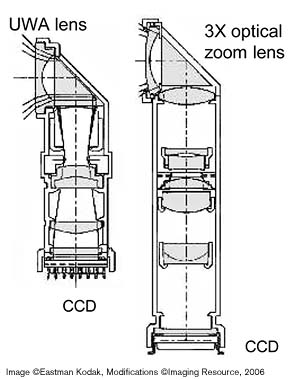
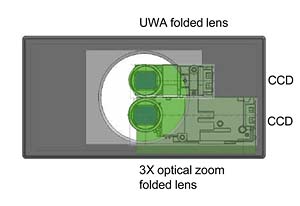
Kodak has answered a need that has gone un-met in the point-and-shoot camera world since before the advent of digital: true wide-angle photography in a small space. Before the Kodak V570, the widest you could get in a small camera was 28mm in the larger Canon S60, S70, and S80. 24mm was available elsewhere, but in only in a few, far larger cameras (including Kodak's own EasyShare P880).
| How wide is wide? | |
 |
 |
| The numbers themselves don't really convey just how big a difference 23mm makes compared to the more normal 39mm wide end of the zoom range. Here's an example showing the common "self-portrait" trick of holding the camera at arms' length while pressing the shutter. The photo on the left was shot with the zoom set at 39mm, the one on the right with the 23mm lens. (Both photos courtesy Eastman Kodak Company.) |
|
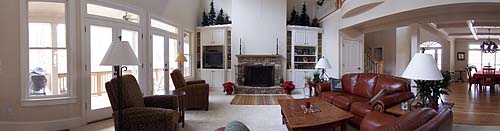
The EasyShare V570's 23mm is wider than we anticipated. But they didn't just make it wide, they compensated for at least some of its faults (barrel distortion) at the same time that they extended its ability to capture wide vistas with a surprisingly capable in-camera panorama mode. This latter feature has been most impressive. Though it is limited to three shots, it's capable of producing a big, 180 degree panorama, processed in the camera; and with some care in capturing the initial shots, it does a very good job of stitching, removing the need to fiddle with images on a computer. Our first thought when we took our first shots with Kodak V570 was that realtors are going to flock to this camera for its innate ability to capture more of a room than any other. This quick and simple panorama mode makes it even more compelling. (If you're a realtor, you can stop reading now and just go out and buy a Kodak V570: If you need any convincing, just check out the ultrawide and panorama samples below.)
| How wide is wide, part II | |
 |
 |
| Here's another example of the difference between 39mm (left) and 23mmm (right). Sometimes, you just don't have the option of backing up any further (street traffic, an obstacle, a cliff, etc). The ultrawide 23mm focal length does introduce some perspective distortion (objects closer to the lens appear disproportionately larger than those further away), but if you're dealing with tight quarters, there's no beating it. | |
Many unique ideas come with unique problems though, and the Kodak V570 is no exception. I think most users needing a very wide angle lens on a small camera will tolerate most of these problems well, but you should know about them before you consider the V570.
The problem of duality
Before we go any further, let us share the following important advice: When you buy a Kodak V570, the first thing you should do (after unpacking it and inserting the battery) is to go to the Setup menu, and turn off the digital zoom option. As we'll explain below, this will save you a lot of frustration and possibly very poor image quality when shooting at intermediate wide angle focal lengths. [Note: it is our understanding that after our preview was posted, Kodak decided to ship the V570 with the digital zoom disabled, at least for US models, so you may not need to follow this suggestion.]
As we mentioned, the top lens is the wide angle lens, and it is fixed at 23mm. The fixed focal length is probably to help maintain optical quality and save space in the camera, as it's very difficult to control distortion and optical artifacts in ultrawide zoom lenses, and they tend to be quite bulky as well. Like most digital cameras, the EasyShare V570 starts up at its widest angle, which is too wide for most people shots. You'll need to zoom in. The catch is that in order to make the smooth transition from 23mm to 39mm that people expect, that first bit of zoom has to be digital. Digital zoom means that the 5.0 megapixel image will be cropped and then sampled up, a proposition that always means fuzzier images. For small amounts of digital zoom (say, to an equivalent focal length of 30mm or less), the degradation of the image quality won't be all that noticeable on 4x6 or possibly even 5x7 inch prints. In the range from 30-39mm (before the camera switches to using its optical zoom lens) though, Kodak V570's image quality progressively degrades, and at 38mm or so, it's downright awful. (No surprise really, the camera is cropping the sensors image so much that it's only using 1.78 megapixels to form the images at that point.)
Once you reach the top of the wide-angle digital zoom (marked red on the zoom indicator), the zooming stops. This is to allow you to decide whether you want to switch to the Kodak V570's other lens. You must release the zoom button and press it again to switch to the 39-117mm lens and return to the world of true 5 megapixel images. Honestly, it's a pain. Since we distrust digital zoom, we opt to turn it off on all cameras, including the V570. The idea that we're going to take lower quality images if we just zoom in a bit bothers us, so we prefer to just switch from 23mm to 39mm in a single jump. You still have to release and press again to go from 39mm to 23mm, but that's probably good to keep you from slipping into ultra-wide by accident, and the delay in doing so is strictly minimal.
The other important factor about the 23mm ultrawide lens is that it doesn't change its focus. That makes for faster shot-to-shot times at full wide angle, as well as while in digital zoom mode under 39mm, but it is always a compromise. Kodak is depending on this “hyperfocal” lens's great depth of field to keep everything in focus. (According to the camera's specs, the 23mm lens should render subjects in focus at distances from 31.5 inches to infinity.) This seemed to work for the most part, but we felt that a lot of our closer-range shots captured with the Kodak V570's 23mm lens were less sharp than similar ones from the zoom lens at 39mm. The one careful comparison that we did with the same subject framed similarly with both lenses actually gave a slight edge in sharpness to the 23mm, but that was for a subject 20-30 feet away from the camera.
Again, we don't think the above mentioned items are deal-breakers, but the Kodak V570's operating mode is different, and prospective buyers should consider how--and whether--they can use a camera like this. More to the point, the 39 to 117mm lens is actually a 3x optical zoom lens, and the camera covers the advertised 5x range between 23 and 117mm with either one sizeable jump at the low end or a smooth ramp there, but employing varying degrees of digital zoom. We think that it's unfortunate Kodak chose to bill the V570 as a 5x zoom camera rather than as the 3x-zoom-plus-ultrawide-lens that it is. Calling it a 5x zoom is liable to leave a lot of people dissatisfied with its performance over the range from roughly 30-39mm, because consumers these days pretty well expect the "x" rating of a camera to refer only to optical zoom capability. It would be a shame if people are turned off by the confusing labeling, because the camera really does offer some unique capabilities that are likely to be obscured in the furor over its "zoom" performance.
Shooting with the V570
Startup time with the Kodak V570 is a little slower than we've been seeing from some competing models these days, but shutter lag figures are right in line with the rest of the market. The best lag numbers are naturally turned in by the non-focusing 23mm mode, averaging a somewhat variable fifth of a second (quite fast indeed). In the optical zoom mode, the shutter lag goes up to 0.3 and 0.5 second for wide and telephoto settings respectively. Not terrible, about average in a market where most are getting a little faster.
In use, shutter lag is not the noticeable impediment to getting good shots; it's the slow digital zoom. The more we used the Kodak V570, the more annoyed we became when shooting with the digital zoom enabled. As I mentioned earlier, we disable it by default, but this wouldn't be much of a user report without mention of the camera's standard operating mode. Since the camera always starts up at 23mm, you always have to step through the very slow digital zoom to get to the 39mm "real" lens for better composition and higher quality. Quickly composing a shot of kids is difficult when your zoom can't keep up with their rapid changes. Kodak would do well to release a firmware update that allows users to set the 3x zoom lens as the default startup lens, because this would place the camera in its fastest mode, and allow the user to zoom in or out. Starting with the highest optical quality by default would make the V570 much easier to use. Alternatively, do as we did in relatively short order: Turn off the digital zoom via the setup menu option. This will let the camera jump very quickly between 23 and 39mm. That's a pretty big jump in focal length, but in indoor shooting situations, you'll be close enough to the subject anyway that framing by moving closer or further away isn't at all difficult, and takes less time than this very slow digital zoom.
It's also important to note that the Kodak V570's ultrawide lens can only focus as close as 31 inches. That's not too close, so you have to actually zoom out of UW mode to be able to use Macro or Landscape Scene modes. Yet another reason to start out with the 3x lens instead of the ultrawide.
Another quirk we didn't like was how the Kodak V570 behaved between shots. We generally like a camera to have an image preview mode, but we prefer for the camera to abandon the preview when we've pressed on the shutter or started to zoom. The Kodak V570 does the former, but not the latter: If you press the zoom toggle immediately after snapping a shot, the camera will zoom without showing how far, further frustrating us when it's zoomed too far. You can sidestep this by lightly tapping the shutter button to kill the review mode, but really, the camera should do so itself as soon as you touch the zoom toggle.
Image quality-wise, we felt that images from the V570 showed excellent color, but were softer than we'd normally expect from a 5-megapixel digital camera. - We think that its practical resolution (that is, what you actually see in prints) is closer to that of a three or four megapixel model than a five megapixel one. Its noise-suppression algorithms are also prone to obscuring fine detail, particularly when the contrast levels of that detail are low. All digital cameras do this to some degree, but we felt that we noticed it more in the Kodak V570's shots than we're accustomed to.
Shooting panoramas is so easy and fun with the Kodak V570, we found ourselves doing quite a few. In panorama mode, the camera shows you a small rectangular crop of the previous exposure to act as a guide in lining up the next shot. If you're reasonably careful to keep the camera straight and level, and rotate it around the center of its body, this worked quite well. (If you have large enough hands, holding the camera with your thumb and middle finger centered top and bottom on the camera body, and then pivoting it around that axis between shots can work pretty well.) As usual in these types of shots, we had some trouble lining up the shot so that we didn't lose the horizon line. The trick is to keep the camera perfectly horizontal -- Resist the temptation to tilt it up to take in a taller subject, or tilt it down to shoot more of the ground. Rather, to whatever extent possible, adjust vertical framing by raising or lowering the camera, while keeping it level. Better by far is to put the camera on a tripod. The Kodak V570's tripod socket is just a millimeter or two off the centerline of both lenses, which is close enough to perfect centering to produce excellent panoramas. You do have to be fairly accurate when lining up the images, or else you will find a seam or duplicated elements where the camera stitched the images together. But it's still quick enough that we could see ourselves creating more than a few panoramas to show friends and families where we visited, with something more dramatic than a snapshot.
| The ultimate Real Estate camera? | |
 |
 |
| At 39mm, you don't see much of the room, even backed up against the far wall. | The 23mm lens really opens up the scene, letting you see both sides of the room, from about 8 feet on out. |
 |
|
| In a 180 degree panorama, the scene changes completely, revealing a large open entryway and dining area to the right. Without a panorama like this, it would be almost impossible to adequately convey the spatial relationships shown in this photo. There are a couple of minor stitch errors in the image above, but they're really quite unobtrusive (to the point of being hard to pick out). Certainly an excellent job, for having been done entirely in the camera. | |
Video
Finally, the V570's video is good enough that we used it extensively at the PMA 2006 trade show to record "mini videos" for posting on our site. We used a big Canon camcorder for the produced pieces, but I found it very efficient to run around with the Kodak V570 and capture small product videos. The two lenses allowed for in-camera cropping that would have been impossible with any other camera. I usually started at 23mm and then zoomed in when the presenter started talking about the product. All of these videos were done in one take and just drag-and-dropped up on the site. Phanfare, the site we used for posting all this material, then converted the very good quality MPEG4 output into very good quality Flash, and the video began streaming as the show went on. There were some pops introduced into the video that seemed to appear after I switched sensors, which leads me to believe that Kodak didn't really intend for the camera to be used this way; so be warned. Otherwise, video quality was excellent, and the 23mm lens was great for tradeshow pictures. Go to http://pma2006.phanfare.com to see some of the images and videos we made with the Kodak V570.
Dock and other features
Accompanying the Kodak EasyShare V570 is a round, and likewise very thin, Photo Frame dock that escapes the boxier designs of previous EasyShare docks. The Photo Frame dock turns the camera into a picture frame when attached, displaying captured images either as a slide show or individually. (The dock also provides the same battery charging and image downloading functions as the standard EasyShare camera docks.) The Kodak V570 boasts a 5.0-megapixel CCD and very large, 2.5-inch LCD monitor, with a very user-friendly point-and-shoot format. Measuring a mere 3.7 x 2.2 x 0.9 inches (94 x 56 x 22 millimeters), and weighing only 5.71 ounces (162 grams) with the card and battery, the V570 is quite at home in a shirt pocket or tiny purse, excellent for travel.
The camera's autofocus mechanism uses a multi-zone system to "find" the primary subject closest to the lens. The AF area is highlighted in the LCD display with a set of brackets. You can change the AF area to read only the center of the frame through the Record menu. Additionally, you can choose between Continuous and Single AF modes. The Kodak V570 has a maximum aperture ranging from f/3.9 to f/4.4 on the 3x zoom lens, depending on the zoom position, and a maximum setting of f/2.8 on the 23mm lens. Focus ranges from 24 inches (60 centimeters) to infinity in normal mode, with a Macro mode ranging from 2 to 28 inches (5 to 70 centimeters). (The minimum Macro focus distance depends on the zoom setting.) A Landscape focus mode fixes focus at infinity, for distant subjects and scenery. Because of the V570's very wide 23mm lens, a Distortion Compensation feature is available through the Setup menu, which attempts to reduce the amount of barrel distortion visible. In our testing, the Distortion Compensation feature reduced the amount of barrel distortion at the 23mm lens setting from 1.4% to 0.7%, about half. In addition to the total 5x optical zoom, the Kodak V570 also offers as much as 4x digital zoom, which effectively increases the camera's zoom range to a total of 20x. Keep in mind though, that digital zoom decreases the overall image quality, since it just stretches the center pixels of the CCD image. For composing images, the V570's 2.5-inch color LCD monitor is clear and bright.
The Kodak V570 offers Auto and SCN (Scene) exposure modes, with the SCN setting offering no less than 22 preset shooting modes. Auto mode is best for general photography, leaving all of the exposure decisions up to the camera. The 17 preset shooting modes are accessible by pressing the SCN button on top of the camera until the Scene menu appears, and include Panoramic L-R, Panoramic R-L, Sport, Landscape, Night Portrait, Night Landscape, Snow, Beach, Fireworks, Manner/Museum, Party, Children, Backlight, Panning Shot, Candlelight, Sunset, Close-up, Text, Flower, Self-portrait (for pointing the camera back at you), and Custom. The available scenes appear at the bottom of the LCD display upon entering the mode, and the Multi-Controller selects the scene. The Custom option lets you save a bank of exposure settings, for recall later. Though the Kodak V570 doesn't offer any manual exposure control, you can access a Long Exposure mode through the Record menu, for exposures as long as eight seconds.
The Kodak EasyShare V570 employs a Multi-Pattern metering system, which bases the exposure on several light readings taken throughout the frame. Also available are Center-Weighted and Center-Spot modes. You can increase or decrease the overall exposure from -2 to +2 exposure equivalents (EV) in one-third-step increments. White balance options include Auto, Daylight, Tungsten, Fluorescent, and Open Shade settings, which take advantage of Kodak's proprietary Color Science technology to achieve an accurate color balance under most lighting. An ISO setting offers equivalent settings of 64, 100, 200, 400, and 800 (with the 800 setting only available at the 1.8-megapixel resolution). An Auto setting is also available, and ranges from 64 to 160. The Kodak V570 also offers a range of color settings (High, Natural, and Low color), as well as Black and White and Sepia modes. You can also adjust the in-camera sharpening. The built-in flash is effective from 2.0 to 7.9 feet (0.6 to 2.4 meters) depending on the setting of the zoom lens, and features Auto, Fill, Red-Eye Reduction, and Off operating modes. A 10-second Self-Timer mode provides a delay between the time the Shutter button is pressed and when the shutter actually opens, so you can get into your own shots. The Kodak V570 also provides an optional histogram display, which reports the tonal distribution of the image, so that you can graphically see any areas of over- or underexposure.
In addition to its still photography modes, the Kodak EasyShare V570 also offers a Movie recording mode for capturing moving images with sound. Recording stops and starts with a brief, full press of the Shutter button, but if you hold the button down for more than a second or two, the camera will automatically stop recording when you let it back up again. As you record, the duration of the movie appears in a running counter on the LCD monitor. Maximum movie lengths can be set through the Record menu. (The 32 megabytes of internal memory will let you record movies up to two minutes and 18 seconds in length at the lowest quality setting.) Movies can be recorded at 320 x 240 or 640 x 480 pixels, at 30 frames-per-second. A 640 x 480 (Long) setting is available as well, which records at a lower quality to increase recording time. Also available for movies is an image stabilizer mode, which reduces the amount of blurring from slight camera movement. (A tripod is still recommended for the most steady shots, however.) A Burst photography mode lets you capture as many as four frames in rapid succession while you hold down the Shutter button. The four-frame maximum number applies regardless of resolution, but may be hindered depending on how much available space is on the memory card or internal memory. An interesting feature on the Kodak V570 is the camera's Blur Warning setting. If enabled, the camera reports via a series of color-coded shaking hand icons whether an image will be sharp enough for a 4x6-inch print. For example, green indicates an acceptable sharpness level, while a red icon indicates that the image is too soft.
The V570 is compatible with Kodak's EasyShare camera and printer docks, which offer hassle-free image downloading and printing. You simply put the camera into the dock and press a button to connect the camera and initiate image downloading. Included with the Kodak V570 is the EasyShare Photo Frame Dock 2, which, when connected to the camera, essentially turns the camera's LCD monitor into a picture frame. The dock also allows you to transfer images to a computer, and serves as an AC adapter and in-camera battery charger. Built into the V570 is 32 megabytes of internal memory, but the camera also features an SD/MMC memory card slot so you can expand the camera's memory capacity. I highly recommend picking up at least a 256MB card right away, given the camera's 2,576 x 1,932-pixel maximum resolution size, though cards are available as large as 512MB. For power, the V570 uses a Kodak EasyShare Li-Ion battery pack, or the optional AC adapter. Since the camera does not accommodate AA-type batteries, I highly recommend picking up a spare battery pack and keeping it on-hand and freshly charged. It is noteable, however, that one does not need the dock to charge the V570; just plugging the power supply into the side of the camera begins the charging process, great for traveling. Also packaged with the Kodak V570 are USB and AV cables, as well as a software CD loaded with the EasyShare software for downloading and managing images.
Like the rest of Kodak's EasyShare line, the V570 boasts a simple-to-understand user interface that keeps the fun in point-and-shoot digital photography. The Kodak V570's unique, stylish design should please most fashion-oriented folks, and its tiny size is perfect for anyone on the go. The V570's edge in the marketplace is its dual-lens design, offering a very wide lens setting at 23mm (35mm equivalent). Featuring a full complement of preset exposure modes, an Auto setting, and the flexibility of a long-exposure mode, the V570 is perfect for point-and-shoot enthusiasts who don't want to worry over exposure decisions. With the range of preset shooting modes, the Kodak V570 produces good exposure in almost any situation. Like Kodak's other EasyShare cameras, when combined with the included camera dock, the V570 ranks among the easiest digital cameras I've seen; the integrated 23mm lens is the standout feature, bringing the advantages of wide angle to the EasyShare crowd.
Basic Features
- 5.0-megapixel CCD delivering images as large as 2,576 x 1,932 pixels.
- 2.5-inch color LCD monitor.
- Dual lens design includes 23mm Ultra Wide Angle and 3x 39-117mm Schneider-Kreuznach C-Variogon lenses.
- 4x digital zoom.
- Auto exposure mode, plus 22 preset Scene modes.
- Multi-pattern, Center-spot, and Center-weighted metering modes.
- White Balance with five settings.
- Maximum aperture of f/2.8 (23mm lens), or f/3.9-4.4 depending on 39-117mm lens zoom position.
- Shutter speeds from 1/1,400 to eight seconds, depending on exposure mode.
- Built-in flash with four modes.
- 32MB internal memory.
- SD/MMC card storage (optional, card not included).
- Power supplied by one Kodak EasyShare Li-Ion pack (included), or optional AC adapter.
- Compatible with optional Kodak EasyShare camera and printer docks.
- Kodak EasyShare Photo Frame Dock 2 included.
- Kodak EasyShare software included for both Windows and Mac platforms.
Special Features
- Movie mode (with sound).
- Image Stabilization mode.
- Burst photography mode.
- Custom exposure mode for saving frequently-used settings.
- Long Exposure mode for shutter speeds up to eight seconds.
- Black and White, Sepia, and three color modes.
- Adjustable ISO from 64 to 800, with an Auto setting.
- 10-second Self-Timer for delayed shutter release.
- Image sharpness adjustment.
- Optional histogram display.
- Three AF area modes, plus Single and Continuous AF modes.
- Macro (close-up) lens setting.
- DPOF (Digital Print Order Format) compatibility.
- PictBridge support.
- USB cable for connection to a computer (driver software included).
In the Box
In the box are the following items:
- Kodak EasyShare V570 digital camera.
- Kodak EasyShare Photo Frame Dock 2
- Kodak Li-Ion battery pack.
- USB cable.
- A/V cable.
- Wrist strap.
- Small carry case.
- EasyShare printer dock insert.
- Software CD-ROM.
- Operating manual and registration card.
Recommended Accessories
- Large capacity SD/MMC memory card. (These days, 128 - 512 MB is a good tradeoff between cost and capacity.)
- Additional battery pack.
- Battery charger.
- Kodak EasyShare Printer Dock.
Conclusion
| Pro: | Con: |
|---|---|
|
|
The Kodak V570 presents an interesting problem for us. It's a camera with a lot in the plus column and a lot in the minus column; yet it still nets out as a positive experience. We really like the camera for its unique dual lens arrangement that includes a surprisingly useful 23mm wide angle lens, but its image quality really isn't as good as it could be for a 5 megapixel camera. Its fully automatic exposure control performs very well in a wide variety of conditions, requiring less exposure adjustment or tweaking than do most competing models. Auto white balance wasn't quite as good as it could be, however, and shot-to-shot speed didn't break any records. But for more difficult shooting conditions, a wide range of preset "Scene" modes extends the camera's capabilities nicely, perfect for the target market. The V570's video capabilities are also very good, both sound and video quality are quite good. While sophisticates may prefer more subdued color, we suspect that most consumers will love the bright, vibrant photos the V570 produces. But there's still that quandary. The V570 has a 5x zoom that's really a 3x plus a fixed 23mm; and it has two 5 megapixel sensors that produce images that really look more like they came from a 4 megapixel sensor. But we still really like the camera, so if you know these "exceptions" and still like the camera as we do, you'll be very happy with the performance and quality you get from the Kodak EasyShare V570. At the end of the day, we had more outright fun with the V570 than any other camera we've reviewed for a long while. Tiny, compact, and super-stylish, the Kodak EasyShare V570 is a perfect choice for novices, as well as more experienced users looking for a capable, yet travel-worthy "fun" digital camera that can give them a wider view than ever before. All things considered, the Kodak V570 earns a Dave's Pick.
Design
Kodak V570 Design
The V570 is an eye-opener in the Kodak EasyShare lineup, featuring a dual-lens design that offers an extremely wide, 23mm lens setting. Its stylish black metal panels, low-profile controls, and very thin size rank the V570 among the more fashionable digital cameras in the marketplace. Included with the V570 is Kodak's newest generation EasyShare Photo Frame Dock 2, with a round, thin design equally as stylish. Measuring only 4.0 x 1.9 x 0.8 inches (10 x 4.9 x 2.0 centimeters), and weighing only 4.4 ounces (125 grams) without the card or battery, the V570 is at home in shirt pockets and small purses, and comes with a teensy wrist strap to save it from damage should it slip out of your hands.

The Kodak V570's dual lens platform is dead center on the camera's front panel, with an automatic sliding lens cover that remains just below flush with the front panel so that there are no protrusions to hang on pockets. The lens remains behind the front panel when powered on, keeping the camera extremely low-profile, even while shooting. In addition to the lenses, underneath the lens cover are the camera's microphone and a tiny Self-timer/AF assist lamp. The only other elements on the front panel are the flash and a teensy-tiny raised bump for a fingergrip.

On the right side of the camera (as viewed from the rear) is the SD/MMC card slot, covered by a minimal flap that simply pops in and out of place with your fingernail. The compartment door remains tethered to the camera body via a small plastic strap. If not replaced securely, it can work loose and flop around; one of our least favorite aspects of the design. Below the compartment is the exposed DC In terminal, great for dock-less charging. Also on this side of the camera is a tiny eyelet for the wrist strap.

The opposite side of the camera is featureless.

The Kodak V570's top panel is flat with low-profile controls. From left to right, the Favorites, Movie, Auto/SCN, Power, and Shutter buttons remain flush with the panel. Cool blue LEDs light the mode buttons when the camera is powered on. When the V570 is plugged into a power supply or sitting in the cradle, these lights serve as a gauge of how the charge is progressing, starting with one, and ending with all three lights illuminated. It's a nice touch.

The rest of the camera controls are on the rear panel, along with the 2.5-inch LCD monitor. A Zoom rocker button in the top right corner controls optical and digital zoom. Directly below that is the multi-controller, which actuates up, down, left, or right, and navigates menu options. Pressing the center of the button acts as the OK button. The up and down controls also adjust the monitor display and focus modes, respectively. Lining up on the left side of the LCD monitor are the Flash, Delete, Menu, Review and Share buttons. A tiny LED lamp above the Flash button lights to indicate camera focus or flash status.

On the bottom panel of the Kodak V570 are the tripod mount, dock port, and battery compartment. The metal, threaded tripod mount is just off-center and too close to the battery compartment for quick battery changes while working with a tripod. The battery compartment features a locking, hinged door, which slides forward to open. Inside, a small ejection lever locks the battery in place or releases it. The dock connection jack connects the camera directly to the EasyShare dock for quick image downloading.
Kodak V570 External Controls

Shutter Button: Located on the far right of the Kodak V570's top panel, this button sets focus and exposure when halfway pressed, and fires the shutter when fully pressed. In Playback mode, pressing this button returns the camera to the selected Record mode.

Power Button: Just left of the Flash button, this button turns the camera on and off.

Auto/SCN Mode Button: To the left of the Kodak V570's Power button, this button enters the Auto exposure mode when pressed once. A second press enters SCN mode and displays the SCN menu. Options in this mode are Panoramic L-R, Panoramic R-L, Sport, Landscape, Night Portrait, Night Landscape, Snow, Beach, Fireworks, Manner/Museum, Party, Children, Backlight, Panning Shot, Candle light, Sunset, Close-up, Text, Flower, Self-portrait, and Custom preset shooting modes.

Movie Mode Button: Directly to the left of the Auto/SCN button, this button enters Movie mode, for recording short video clips with sound.

Favorites Button : The final button in the series on the Kodak V570's top panel, this button puts the camera into Favorites mode, which lets you view images tagged as "Favorites" in a type of digital photo album.

Zoom Rocker Button: In the top right corner of the camera's rear panel, this two-way rocker button controls the optical and digital zoom in any record mode. In Playback mode, the lever controls the amount of digital enlargement applied to captured images, to a maximum of 8x.

Multi-Controller and OK Button : Located in the lower-right corner of the Kodak V570's rear panel, this joystick-like rocker button navigates through menu screens and options. Pressing down the center confirms menu selections. Outside of the menu system, the right and left buttons adjust the exposure compensation. The up button controls the LCD display mode, while the down button cycles between Normal AF, Macro, and Landscape focus modes.
In Playback mode, the controller scrolls through captured images, when moved left and right. Pressing the button down activates the index display mode.

Flash Button : The top button in a series lining the Kodak V570's LCD monitor, this button cycles through the Auto, Fill, Red-Eye Reduction, and Off flash modes.

Delete : Below the Flash button, this button calls up the Delete menu in Review mode. You can delete individual images or all images on the card. There's also an option to cancel.

Menu Button : Next in line below the Delete button, this button displays the settings menu in Playback or Record modes.

Review Button : Beneath the Menu button, this button activates Playback mode when pressed in any record mode. Once in Playback mode, pressing the button again, or the Shutter button, returns to the Record display.

Share Button : The final button in the series on the left of the LCD monitor, this button lets you tag images for printing, emailing, or as a favorite image. (A heart icon appears on "favorite" images.) Pressing this button in Record mode automatically enables Playback mode, and displays the Share menu with the following options:
- Print: Designates the number of copies of the current image to be printed.
- E-Mail: E-mails a low-resolution copy of the image to a recipient, based on a saved address book.
- Favorite: Marks the current image as a "favorite."
- Print All: Prints one copy of each image on the memory card or internal memory.
- Cancel Prints: Cancels a print order.
Operation
Kodak V570 Operation
True to its EasyShare name, the Kodak V570 has a user-friendly interface with limited control options that keeps camera operation simple. The camera's automatic systems do an excellent job of capturing good-looking photos, with a well-rounded range of preset shooting modes to handle a wide range of scenes. The LCD menu system is short and simple to navigate, and the plain-English descriptions of menu items are a welcome change from the too-common cryptic icons on so many other cameras. The flat mode buttons across the top panel let you change camera modes quickly, and once again, plain-English descriptions flashed along the top of the LCD screen make operation straightforward for even rank beginners. Given the simple interface and limited controls, you should be able to snap images right away, with hardly a glance at the manual. Though for more advanced functions, it shouldn't take more than a half an hour or so to get the gist of things.
Record-Mode Display
 Depending on the exposure mode, the Kodak V570's LCD display shows the currently-selected options for image size/quality, macro and flash mode, exposure compensation, the number of images of the current size and quality that can be stored in the remaining space on the memory card. Pressing the up arrow on the multi-controller once in a record mode cancels the information display, while a second press brings back the information display with framing guidelines. A third press adds a histogram display, and a fourth cancels the grid and histogram displays (leaving the information overlay).
Playback-Mode Display
 In Playback mode, you can use the Kodak EasyShare V570's Zoom lever to zoom in or out on an image, with a maximum enlargement of 8x. A thumbnail display of the images on the card is also available, through the camera's Playback menu (or you can press the down arrow). Pressing the up arrow offers a more detailed information display, reporting the set exposure variables for the current image. The normal Playback display reports the image number, and any shared settings information. As in Record mode, the Kodak V570's Display button also enables a small histogram, for checking the overall exposure of the image.
Kodak V570 Modes and Menus
Auto Mode: Accessed by pushing the Auto/SCN button once, this mode enables the camera's photo capture and review functions.
Scene Mode: A second press of the Auto/SCN button enters Scene mode, and displays the menu of 22 available scene selections. Choices here include Panoramic L-R, Panoramic R-L, Sport, Landscape, Night Portrait, Night Landscape, Snow, Beach, Fireworks, Manner/Museum, Party, Children, Backlight, Panning Shot, Candle light, Sunset, Close-up, Text, Flower, Self-portrait, and Custom.
Video Mode: This mode is accessed by pressing the Video button (movie camera icon) on top of the camera. In this mode, the Kodak V570 can record moving images with sound.
Favorites Mode: An album icon with a heart on its cover indicates this mode on the Favorites button on top of the camera. Here, any images that have been designated as "favorites" are displayed (though they have to be synced to the desktop, resized, and synced back before they appear in this mode). You can opt to view images in a slide show or index format, or view exposure information for individual images. You can also access the camera's Setup menu.
Record Menu: The following menu items appear whenever the Menu button is pressed in any Record mode. However, not all menu options are available in all modes.
 Self-Timer: Activates the 10-second Self-Timer, or disables it.
- Burst: Enables or disables the camera's Burst photography mode, for capturing a rapid series of images.
- Picture Size: Sets the resolution for still images. Choices are 5.0 MP (2,576 x 1,932 pixels), 4.4 MP 3:2 Ratio (2,576 x 1,716 pixels), 4.0 MP (2,304 x 1,728 pixels), 3.1 MP (2,048 x 1,536 pixels), or 1.8 MP (1,552 x 1,164 pixels).
- Video Size (Movie mode only): Sets the pixel resolution for Movie mode. Choices are 320 x 240, 640 x 480, or 640 x 480 (long) pixels.
- White Balance: Sets the color balance to Auto, Daylight, Tungsten, Fluorescent, or Open Shade settings.
- ISO Speed: Sets the sensitivity to Auto (ISOs 64 to 160), or to 64, 100, 200, 400, or 800 equivalent settings. (ISO 800 is only available at the 1.8 MP resolution.)
- Color Mode: Allows you to record images in High, Natural, or Low Color, or in Black and White, or Sepia tones.
- Sharpness: Controls the in-camera sharpening, with options of High, Normal, or Low.
- Exposure Metering: Designates the camera's metering mode as Multi-Pattern, Center-Weighted, or Center-Spot.
- AF Control: Sets the autofocus to Continuous or Single modes.
- Focus Zone: Controls where the camera's AF system determines focus from. Choices are Multi-Zone and Center-Zone.
- Long Time Exposure: Accesses longer exposure times, from 0.5 to eight seconds.
- Set Album (Still): The Kodak V570 lets you set up albums through its interface software on a computer. If albums have been set up and downloaded to the camera, you can associate images with an album as they are recorded.
- Image Storage: Dictates where images are stored, either in the 32MB internal memory or SD card. If Auto is selected, the camera automatically stores images to a memory card if one is present.
- Reset to Default: (Scene Custom mode only.) Resets all camera settings to their defaults.
- Video Length: (Movie mode only.) Sets the default video length to Continuous, or to 5, 15, or 30 seconds.
- Image Stabilizer: (Movie mode only.) Turns the image stabilization function on or off for movies.
- Setup Menu: Displays the following Setup options:
- Return: Returns to the main menu display.
- Camera Sounds: Selects among the Kodak V570's operating sounds. You can choose a theme of sounds, or set sounds individually for specific camera operations.
- Sound Volume: Sets the volume to Low, Medium, or High, or turns sound off.
- Digital Zoom: Turns digital zoom on or off.
- LCD Dimmer: Sets the period of inactivity before the LCD dims. Choices are 10, 20, or 30 seconds, or Off.
- Auto Power Off: Specifies the period of inactivity before the camera shuts itself off. Choices are 1, 3, 5, or 10 minutes.
- Date & Time: Sets the camera's internal clock and calendar.
- Video Out: Specifies PAL or NTSC as the Video Out signal.
- Photo Frame: Sets the Photo Frame Dock 2 settings for image display. Options are Interval (between slide show frames), Loop, Transition (between slide show frames), Image Source (Album, Internal or Favorites), and Run Time.
- Distortion Compensation: If activated, this setting reduces the amount of barrel distortion visible in wide angle shots.
- Orientation Sensor: Controls the camera's orientation sensor, which detects when the camera is held vertically. Vertical-format images captured when the Orientation Sensor is enabled are rotated to their correct orientation on-screen when they're played back.)
- Red-Eye Pre-Flash: If activated, this function fires the Red-Eye pre-flash before the full flash. If off, no pre-flash occurs. In either mode, the camera automatically corrects Red-Eye.
- Date Stamp: Turns the date stamp function on or off, which records the date over the image. You can choose from a selection of date formats as well.
- Video Date Display: Like the Date Stamp option above, imprints the date and time on video files, with a choice of display formats.
- Blur Warning: Turns on the camera's blur warning, or disables it. If on, the camera displays the shaking hand icon during quickview, with a range of colors to indicate the level of blur. For example, a green hand indicates that the picture is sharp enough for a good 4x6-inch print. Yellow shows that the image may be sharp enough for 4x6-inch prints, or that sharpness hasn't been determined. (In other words, check the image on a computer before printing.) A red icon means that the picture is not sharp enough for a 4x6-inch print. White indicates that the camera is still assessing the image file.
- Language: Sets the menu language to one of 19 languages.
- Format: Formats the SD memory card or internal memory.
- About: Displays the camera's firmware information.
 Self-Timer: Activates the 10-second Self-Timer, or disables it.
 ISO Speed: Sets the sensitivity to Auto (ISOs 64 to 160), or to 64, 100, 200, 400, or 800 equivalent settings. (ISO 800 is only available at the 1.8 MP resolution.)
 AF Control: Sets the autofocus to Continuous or Single modes.
 Image Storage: Dictates where images are stored, either in the 32MB internal memory or SD card. If Auto is selected, the camera automatically stores images to a memory card if one is present.
 Return: Returns to the main menu display.
 LCD Dimmer: Sets the period of inactivity before the LCD dims. Choices are 10, 20, or 30 seconds, or Off.
 Photo Frame: Sets the Photo Frame Dock 2 settings for image display. Options are Interval (between slide show frames), Loop, Transition (between slide show frames), Image Source (Album, Internal or Favorites), and Run Time.
 Date Stamp: Turns the date stamp function on or off, which records the date over the image. You can choose from a selection of date formats as well.
 Format: Formats the SD memory card or internal memory.
Playback Menu:
- View By: Lets you choose how images are viewed. Options are All, Date, or Album.
- Album: Adds images to an image album, created on a computer with the camera's interface software.
- Crop: Lets you crop an image and save it as a separate image file.
- Slide Show: Enables a slide show of captured images, with user-adjustable intervals between images.
- Multi-Up: Enables a index display of images on the memory card or stored in the internal memory.
- Copy: Copies files from the internal memory to the SD card, or the reverse.
- Protect: Write-protects the displayed image, preventing it from being accidentally erased or manipulated (except via memory or card formatting). Also removes protection.
- Image Storage: Selects between the internal memory or the SD card for image storage.
- Setup Menu: Displays the same settings as under the Record menu.
 View By: Lets you choose how images are viewed. Options are All, Date, or Album.
 Multi-Up: Enables a index display of images on the memory card or stored in the internal memory.
Optics
Kodak V570 Optics
Lens
Zoom
A very good 3x optical zoom range, with the benefit of a super wide angle setting.


The Kodak V570 zooms over the equivalent of a 39-117mm range in its normal operation, but features a dual-lens design that offers a 23mm Ultra Wide setting. While the 39-117mm range is fairly typical among consumer digital cameras, the 23mm Ultra Wide setting is a definite plus, offering a much larger maximum wide angle than most cameras in the V570's class would even attempt. Fine detail is a little soft overall at the Ultra Wide setting, and a small amount of coma distortion is visible in the top corners, but results are quite good. The 39mm setting also produced slightly soft details, though still pretty good results. Contrary to what you might expect, results are also quite good at the 4x digital telephoto setting. Details are a little soft, with lower resolution, but the 4x digital zoom image is actually quite usable.
Macro
A small macro area with good detail and high resolution. Flash had trouble up close though.


The Kodak V570's macro setting performed very well, capturing a small minimum area of only 1.79 x 1.34 inches (45 x 34 millimeters). Detail is strong and resolution high, with moderately blurring in the corners from the lens. (Most cameras have some softening in the corners in macro mode.) The flash throttled down a little too much, resulting in a hot spot in the top left corner, and dark shadow throughout the rest of the frame. (Plan on using external lighting for your closest macro shots with the V570.)
Distortion
Very high barrel distortion at Ultra Wide setting, though much less at the normal wide angle. Moderate pincushion at telephoto.
This is the tendency for the lens to bend straight lines outward (like a barrel--usually at wide angle) or inward (like a pincushion--usually at telephoto). The Kodak EasyShare V570's Ultra Wide 23mm lens showed about 1.4% barrel distortion without the Distortion Compensation feature enabled, which is very high. With Distortion Compensation enabled, however, barrel distortion decreased to about 0.7%, which is moderate among digital cameras, but still a little on the high side for me personally. At the normal wide angle setting (39mm), the lens showed 0.3% barrel distortion, which is actually quite low. At the telephoto end, the V570's 0.2% pincushion is moderate for digital cameras.
| Barrel distortion at 23mm is 1.4% without Distortion Compensation |
 |
| Barrel distortion at 23mm is 0.7% with Distortion Compensation |
 |
| Barrel distortion at 39mm is 0.3% |
 |
| Pincushion at 117mm is 0.2% |
 |
Chromatic aberration
Moderately high, small effect on images at edges.
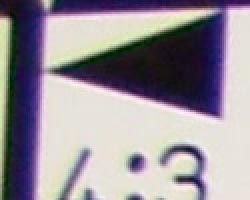
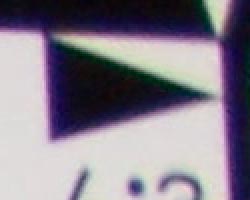
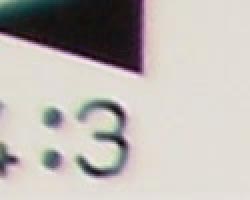
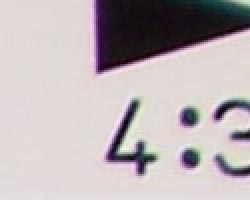
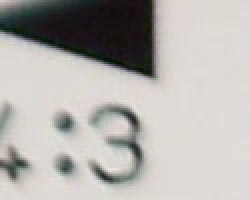
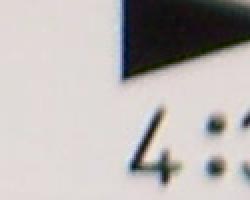
Chromatic aberration is rather high at the 23mm Ultra Wide Angle lens setting, showing several pixels of very bright coloration on either side of the target lines. (This distortion is visible as a very slight colored fringe around the objects at the edges of the field of view on the resolution target.) At the 39mm wide angle setting, chromatic aberration is less, but still fairly bright. The effect almost disappears at full telephoto, and what pixels are visible are increased partly from strong blurring in the corners here.
Corner Sharpness
Strong blurring in the left and right corners of the frame, strongest effect in the lower right corner.
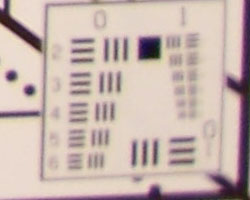
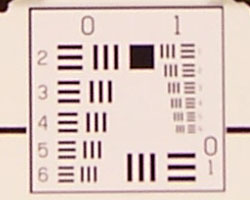
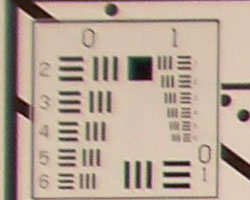
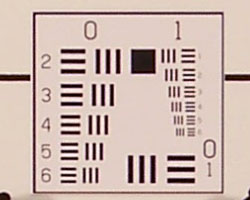
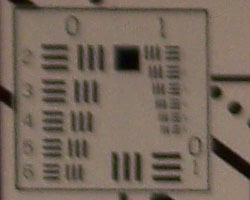
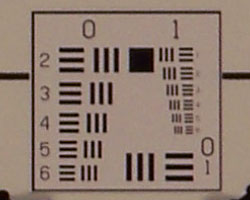
The Kodak V570 produced very soft corners in quite a few shots, with the most extreme softening at the 23mm Ultra Wide Angle setting and at full telephoto.
Viewfinder
Coverage
Very good accuracy from the LCD monitor.


The V570's LCD monitor showed close to about 100 percent frame accuracy at the 23mm Ultra Wide Angle setting, as well as the 39mm and 117mm zoom settings.
The images above were taken from our standardized test shots. For a collection of more pictorial photos, see our Kodak EasyShare V570 Photo Gallery .
Exposure
Kodak V570 Exposure
Color
Saturation & Hue Accuracy
Vibrant, slightly oversaturated color (especially reds and blues), often a slight warm cast.
 |
| In the diagram above, the squares show the original color, and the circles show the color that the camera captured. More saturated colors are located towards the periphery of the graph. Hue changes as you travel around the center. Thus, hue-accurate, highly saturated colors appear as lines radiating from the center. |
Most consumer digital cameras produce color that's more highly saturated (more intense) than found in the original subjects. This is simply because most people like their color a bit brighter than life. The Kodak V570 oversaturates red, blue, and green tones quite a bit, though many consumers may be pleased with such bright color. Where oversaturation is most problematic is on Caucasian skin tones, as it's very easy for these "memory colors" to be seen as too bright, too pink, too yellow, etc. Here, the V570 also fell victim, producing pinkish skin tones in many cases.
The other important part of color rendition is hue accuracy. Hue is "what color" the color is. The Kodak V570 performed pretty well in this regard, though there was often a slight warm cast to its images.


Sensor
Exposure and White Balance
Indoors, incandescent lighting
Pretty good color with the Incandescent white balance setting, though warmer results with Auto. About average exposure compensation required.


Color balance indoors under incandescent lighting was warm and reddish in Auto white balance mode, though the Incandescent setting resulted in more pleasing results (though still with a slight reddish cast). The Kodak V570 required a +1.0 EV exposure compensation boost for a good exposure, about average for this shot. Overall color is a bit dark and a hint red here, making the blue flowers very dark and purplish, and Marti's skin tone a little too pink. Our test lighting for this shot is a mixture of 60 and 100 watt household incandescent bulb, a pretty yellow light source, but a very common one in typical home settings here in the US.
Outdoors, daylight
Pretty good color balance, with bright colors, though slightly reddish overall. Some overexposure under high-contrast lighting.


Outdoor shots generally showed a slightly bright exposure with heightened contrast under harsh lighting. Shadow and highlight detail were a little limited, but still fairly good. The camera typically required less exposure compensation than average, as the default exposure was usually best outdoors.
See full set of test images with explanations
See thumbnails of all test and gallery images
Resolution
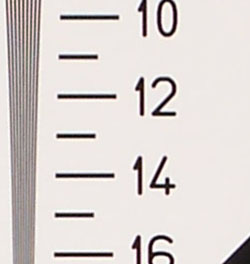
High resolution, 1,100 lines of strong detail.
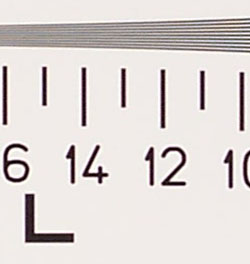
Our laboratory resolution chart revealed sharp, distinct line patterns down to about 1,100 lines per picture height, with extinction at around 1,600. (Slight color artifacts were visible in the full-sized res target shots, beginning with the lower line frequencies.) Use these numbers to compare with other cameras of similar resolution, or use them to see just what higher resolution can mean in terms of potential detail. Beware that while you might be able to make out what looks like distinct lines at numbers higher than those we've mentioned here, the camera is just doing its best to continue interpreting the lines. If you zoom in and follow them from the wider portions, you'll see the lines converge and reappear several times, so the lines you see at 1,400 and higher are really only artifacts generated by the camera's imaging system.
See full set of test images with explanations
See thumbnails of all test and gallery images
Sharpness & Detail
Slightly soft images overall, with some noticeable blurring from noise suppression, though no strong over-sharpening from the camera.
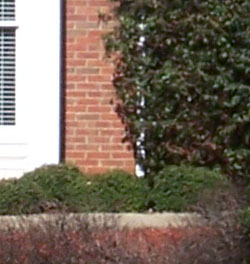
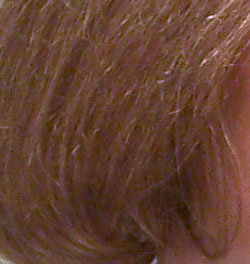
The Kodak V570's images are slightly soft overall. Even under high contrast lighting, the camera doesn't attempt any strong edge enhancement or over-sharpening. (Edge enhancement creates the illusion of sharpness by enhancing colors and tones right at the edge of a rapid transition in color or tone.)
Noise-suppression systems in digital cameras tend to flatten-out detail in areas of subtle contrast. The effects can often be seen in shots of human hair, where the individual strands are lost and an almost "watercolor" look appears. The crop at far right shows this, with darker areas of Marti's hair showing blurred details. Only highlighted individual strands are visible here.
ISO & Noise Performance
Moderate to high noise, even at the normal sensitivity settings. Very high noise that blurs detail at the higher settings.





The Kodak V570's lower ISO settings produced moderate to high noise, with pronounced blurring even at ISO 200. At ISO 400, blurring is much stronger, and the noise pixels brighter. ISO 800 is available only at the lowest resolution setting, and noise pixels are much brighter and more distracting here.
Extremes: Sunlit and low light tests
Moderately high resolution with good overall detail, though high contrast and limited shadow detail. Limited low-light performance, though capable of capturing bright images under average city street lighting and slightly darker conditions.


Sunlight:
Because digital cameras are more like slide film than negative film (in that they tend to have a more limited tonal range), we test them in the harshest situations to see how they handle scenes with bright highlights and dark shadows, as well as what kind of sensitivity they have in low light. The shot above is designed to mimic the very harsh, contrasty effect of direct noonday sunlight, a very tough challenge for most digital cameras. (You can read details of this test here.)
The Kodak V570 had some difficulty with the deliberately harsh lighting in the test above, producing very high contrast with washed-out highlights and deep shadows, even at the default exposure setting. Noise suppression is strong in the shadows, contributing to the loss of detail. Even at the default exposure, the overall exposure is a bit bright. (In "real life" though, be sure to use fill flash in situations like the one shown above; it's better to shoot in the shade when possible.)
| 1 fc 11 lux |
1/2 fc 5.5 lux |
1/4 fc 2.7 lux |
1/8 fc 1.3 lux |
1/16 fc 0.67 lux |
|
| ISO 64 |
 6 sec f3.9 |
 8 sec f3.9 |
 8 sec f3.9 |
 8 sec f3.9 |
 8 sec f3.9 |
Low light:
Our low light testing revealed some limitations in the lens and sensor's ability to gather and process light, as the Kodak EasyShare V570 captured bright images only to about 1/2 foot-candle, about half as bright as average city street lighting at night. Color balance was slightly warm from the Auto white balance setting, but still pretty good. The camera's autofocus system functioned quite well to just about the lowest light level we test at with the AF assist lamp, but the exposure was much too dark for use here. Do keep in mind though, that the very long shutter times associated with camera's night mode absolutely demand the use of a tripod or other camera support to get sharp photos. (A useful trick is to just prop the camera on a convenient surface, and use its self-timer to release the shutter. This avoids any jiggling from your finger pressing the shutter button, and can work quite well when you don't have a tripod handy.) Normally we show all the ISO settings, but most fully-automatic Kodaks won't let us set a long exposure at whatever ISO we like. Thus we have only the above samples.
NOTE: This low light test is conducted with a stationary subject, and the camera mounted on a sturdy tripod. Most digital cameras will fail miserably when faced with a moving subject in dim lighting. (For example, a child's ballet recital or a holiday pageant in a gymnasium.) For such applications, you may have better luck with a digital SLR camera, but even there, you'll likely need to set the focus manually. For information and reviews on digital SLRs, refer to our SLR review index page.
Flash
Coverage and Range
The V570's small flash has a limited range, though it produced good results at the default exposure setting.


Flash coverage was rather uneven at wide angle, and still slightly uneven at telephoto. In the Indoor test, the flash on the V570 underexposed our subject slightly at its default setting, though even a small exposure adjustment of +0.3 EV produced too bright of an image. The background incandescent lighting results in a slight pink cast, but overall color is still pretty good.
| 8 ft | 9 ft | 10 ft | 11 ft | 12 ft | 13 ft | 14 ft |
 1/125 sec f4.4 ISO 100 |
 1/125 sec f4.4 ISO 100 |
 1/125 sec f4.4 ISO 100 |
 1/125 sec f4.4 ISO 100 |
 1/125 sec f4.4 ISO 100 |
 1/125 sec f4.4 ISO 100 |
 1/125 sec f4.4 ISO 100 |
Even at eight feet, our closest test range, flash power is a little dim. Intensity continues to decrease with each foot of distance, resulting in very low power at 14 feet.
Output Quality
Print Quality
Good print quality, great color, very usable 11x14 inch prints. ISO 400 images are very soft at 8x10, acceptable at 5x7, good at 4x6. ISO 800 images are unusable at any size.
Testing hundreds of digital cameras, we've found that you can only tell just so much about a camera's image quality by viewing its images on-screen. Ultimately, there's no substitute for printing a lot of images and examining them closely. For this reason, we now routinely print sample images from the cameras we test on our Canon i9900 studio printer, and on the Canon iP5000 here in the office. (See the Canon i9900 review for details on that model.)
With the Kodak EasyShare V570, we found that it had enough resolution to make very crisp 8x10 inch prints at low ISO, and acceptable up to ISO 200. At 11x14, its prints were a bit softer looking, but more than adequate for wall or table display. ISO 400 ones are marginal even at 5x7 inches, but look fine at 4x6. ISO 800 images really aren't even worth a 4x6, unfortunately. Color-wise, the Kodak V570's images looked great when printed on the i5200, with bright, vibrant color. Users who prefer more subdued, technically accurate color saturation levels may find the V570's images a little too bright, but most consumers will probably find the V570's bright, snappy images very appealing.
The images above were taken from our standardized test shots. For a collection of more pictorial photos, see our Kodak EasyShare V570 Photo Gallery .
Not sure which camera to buy? Let your eyes be the ultimate judge! Visit our Comparometer(tm) to compare images from the Kodak EasyShare V570 with those from other cameras you may be considering. The proof is in the pictures, so let your own eyes decide which you like best!
Performance
Kodak V570 Performance
Timing and Performance
Average to slightly slow speed for a consumer camera.
| Operation |
Time (secs) |
Notes |
|
Power On -> First shot
|
2.2 |
LCD turns on and lens cover opens.
|
|
Shutdown
|
1.8 - 21 |
First time is simple shutdown, second time is worst-case buffer-clearing time.
|
|
Play to Record, first shot
|
0.6 |
Time until first shot is captured.
|
|
Record to play
|
1.5 / 0.3 |
First time is that required to display a large/fine
file immediately after capture, second time is that needed to display
a large/fine file that has already been processed and stored on the
memory card.
|
|
Shutter lag, full autofocus
|
0.33 / 0.54 |
First time is at full wide-angle,
second is full telephoto.
|
|
Shutter lag, prefocus
|
0.091 |
Time to capture, after half-pressing shutter button.
|
|
Shutter lag, continuous autofocus
|
1.28
|
-
|
|
Cycle Time, max/min resolution
|
2.14 / 2.52
|
First number is for large/fine files, second number is time for lowest resolution images. Times are averages. In large/fine mode, shoots only 2 frames this fast, then slows to about 4.6 seconds per shot. In lo-res mode, shoots 2 frames this fast, then slows to about 3.7 seconds per shot. Buffer clears after each shot in either mode.
|
|
Cycle Time, Flash exposures
|
11
|
(Flash at maximum power output)
|
|
Cycle Time, continuous mode, max/min resolution
|
0.80 / 0.50
(1.25 / 2.00 fps) |
First number is for large/fine files, second number is time for lowest resolution images. Times are averages. In either mode, shoots 3 frames this fast and stops to clear the buffer. This pause lasts 19 seconds for large/fine shots, 15 seconds for "TV" sized images.
|
|
Download speed
|
||
|
Windows Computer, USB 2.0
|
558 KBytes/sec
|
Typical Values: Less than 600=USB 1.1; 600-770=USB 2.0 Low; Above 770=USB 2.0 High |
The V570's performance ranges from better than average to slightly slow, depending on what you're trying to do. It starts up fairly quickly, and has a quick shutter response at both wide angle and telephoto. "Prefocusing" the camera by half-pressing and holding down the shutter button before the final exposure, it's very fast, with a shutter delay of only 0.091 second. Shot to shot cycle times are on the slow side though, at about 2.14 seconds for large/fine JPEGs, and it can only capture two shots this quickly before it has to slow down (a lot) and wait for the memory card to catch up. Continuous-mode speed is also a little slow, at a bit over one frame/second, for up to three shots in succession. The flash takes about 11 seconds to recharge after a full-power shot, also on the slow side. Connected to a computer, download speeds are fast enough that you probably won't feel a need for a separate card reader, but nonetheless aren't as fast as many cameras currently on the market. Bottom line, while not a first choice for sports or other fast-paced action, the V570 is responsive enough to handle most family photo opportunities.
Battery and Storage Capacity
Battery
Short battery life, recommend keeping spare battery on-hand.
| Operating Mode | Battery Life |
| Still-image capture mode |
81 minutes
|
| Still-image capture mode Half-press Shutter |
79 minutes
|
| Image playback |
279 minutes
|
The Kodak EasyShare V570 uses a custom rechargeable LiIon battery for power. The table above shows maximum run times based on our power measurements and the rated performance of its battery. Given the short run time, you should definitely consider purchasing a second battery to pack along on extended outings.
Storage
No card is included with the Kodak EasyShare V570, although it accepts SD/MMC cards; 28MB RAM is built into the camera.
|
Image Capacity with 28MB Internal Memory |
Fine | |
| 2,576 x 1,932 | Images | 17 |
| File Size | 1.7MB | |
| 2,304 x 1,728 | Images | 21 |
| File Size | 1.4MB | |
| 2,048 x 1,536 | Images | 26 |
| File Size | 1.1MB | |
| 1,552 x 1,164 | Images | 43 |
| File Size | 675K | |
I strongly recommend buying at least a 256MB card, preferably a 512MB one, to give yourself extra space for extended outings and videos.