


Overview
Olympus E-420
Overview
by Alex Burack
Review Date: 06/03/08
Basing its digital SLR offerings on the Four-Thirds System, Olympus has produced a whole line of unusually compact digital SLRs suited to entry-level users. The new Olympus E-420 will replace last year's E-410 in the market. As is generally the case with new digital camera models, the E-420 sports a number of enhancements relative to the previous model. Here's a brief list of notable improvements found in the new Olympus E-420:
- Auto Focus in Live View by depressing the shutter release button halfway (Contrast-Detect autofocus)
- New grip on the front of the body for a more secure hold
- Face Detection Technology (Taking advantage of contrast-detect AF)
- Shadow Adjustment Technology for greater detail in the shadows
- Larger 2.7" HyperCrystal II LCD Display - Twice the contrast for better viewing in extreme lighting conditions, broader color gamut displays a greater range of color detail, wider view up to 176 degrees off center
- Perfect Shot Preview - Live exposure effects displayed in a thumbnail view on the LCD for easy selection/adjustment prior to capturing the image
- 10MP Live MOS sensor with improved dynamic range - more detailed images
- Improved Auto WB (white balance) performance with a new algorithm for more accurate color - Similar color reproduction to the Flagship E-3 model
- Increased sequence shooting speed up to 3.5fps
- Wireless flash capability with the FL-36R or FL-56R
The Olympus E-420 began shipping from May 2008.
Olympus E-420
User Report
by Alex Burack
 The 10-megapixel Olympus E-420 is a versatile digital SLR, yet is principally point-and-shoot-oriented. Aimed at general shooters upgrading to a more capable camera, its deep feature set emphasizes point-and-click functionality, adding Contrast-Detect autofocus in Live View, and Face Detection Technology; though it also extends aptly to more hands-on shooters. Tagged the "World's smallest digital SLR," the Olympus E-420 body spans just 5.1 x 3.6 x 2.1 inches, and weighs well under a pound. Its condensed frame, however, may be hard for some to grip.
Applying Olympus's new 25mm f/2.8 pancake lens (equivalent to a 50mm lens on a 35mm SLR), transforms the E-420 into a true pocket-sized digital SLR that you can stow in your jacket and take to the streets. With the "normal" field of view (loosely equivalent to what your eye naturally sees) of the pancake lens, along with the camera's wireless flash control, dust reduction, and +/-5 EV compensation range, the E-420 is also poised to appeal to seasoned photographers in search of a affordable walk-around digital SLR. Starting at just $499.99 (body-only), the Olympus E-420 is priced within reach for both demographics. Two kits are available. The standard kit includes a 14-42mm f/3.5-5.6 ED glass lens that performs very well, for $599.99. And a third kit includes the new 25mm f/2.8 pancake lens for $699.99.
Look and Feel. The Olympus E-420 has a low profile and flat form that sits in the hand similarly to a 35mm SLR. The key difference is the weight: at just 13.4 ounces (16 oz with battery and card), the Olympus E-420 is so light it feels a bit toy-like. Trumpeted as "The World's Smallest" digital SLR by Olympus, the E-420 spans 5.1 x 3.6 x 2.1-inches, though it's actually slightly heavier than the E-410. I found the additional heft, marginal as it may be, to be beneficial, as the Olympus E-420's lightweight frame presents more handling issues for me than its slight frame/dimensions/diminutive form. The weight becomes particularly problematic when long, heavy lenses are attached, throwing the camera off-balance and forcing your hand to compensate.

Pancakes. Olympus's new 25mm f/2.8 lens is quite short, easily rivaling the nice Pentax pancake lenses, like this nice 40mm shown mounted on the Pentax K200D.
Despite the handling challenges, with the application of the 25mm pancake lens, the Olympus E-420 is essentially a pocketable digital SLR system, something a collection of digital SLR shooters have been yearning for. Though the E-420's feature set is clearly tailored to help point-and-shooters step-up to a digital SLR, the inverse is also true: the size of the system (E-420 with pancake lens) puts a highly-capable, interchangeable-lens camera into the pockets of knowledgeable shooters.
Handling and Grip. The Olympus E-420 lacks when it comes to handling. Along with the small frame, the camera's lack of a substantial grip takes a lot away from the shooting experience. Unlike flatter 35mm SLRs, digital SLRs have embraced large, bulbous grips that afford users a sturdy, comfortable grasp on the camera. Beyond just comfort, the grip can actually be the difference between getting a sharp or slightly blurred shot when shooting on the threshold of handheld shutter speeds (e.g. Shooting at 1/40th of a second with the 25mm pancake lens).

Grip. If you don't like camera straps, you'll find the Olympus E-420's grip insufficient; if you're used to an OM-1, however, you'll think of it as an improvement.
A scalloped rubber protrusion (Olympus calls it a "double crescent line") on the front face of the E-420 is an improvement from the E-410's grip. It is strikingly similar to Fujifilm's higher-end F-series point-and-shoots, and only slightly more effective. For many shooters with average-to-large-sized hands, the Olympus E-420's grip still won't cut it.
The curved rubber applied to the front isn't that tall or wide; I found myself often shifting my grip to hold it with the ends of my fingers, rather than grasping it a little further down in a more controlled position. The grip is intended to support the inner portion of your finger as it curls against the camera; however, for it to do so, you'll need to have large hands or long fingers. And in all likelihood if that's the case, the short body will be problematic since your pinky and possibly your ring finger will dangle off the camera body below.
Olympus does balance the rubber contour on the front with a flared segment on the back of the camera, which is coated with textured rubber to help secure your hold.
The main gripe shooters will have with the body is the short frame and small grip. Many will find their pinky finger (and for some, their ring finger as well) dangles off the bottom and leads to a less-than-stable hold. Consumers considering the Olympus E-420 as a primary body should give this some consideration and would be advised to handle the camera with a couple of different lenses prior to purchasing. Unfortunately, the E-420's underdeveloped grip is what helps make it pocketable; there are other small digital SLR bodies out there, but they have a larger grip; and though they're pleasant to shoot with, many prevent these digital SLRs from slipping easily into a pocket.

Right side controls.
Controls. The external controls strewn across the Olympus E-420 are styled in a fashion typical of entry-level digital SLRs and almost identical to the E-410. Notable, however, is the lack of icons or text around the navigational pad. Also, the flash button is on the camera's top deck, rather than on the flash/viewfinder hump.
The power switch on the Olympus E-420 is sculpted around the mode dial, just behind and to the side of the shutter button. The mode dial is one of three major controls on the top right portion of the camera. The other two are the exposure dial and the shutter button.
The placement of the power control makes it easier to access than if it were on the camera's back, though not as fast as wrapping the power button around the shutter release, which is common on Nikon and Pentax cameras. The close proximity of the exposure dial makes turning the E-420 on and off a little more difficult, unlike when it's integrated into the shutter release. It may sound subtle, but for me it meant the difference between walking around with the camera off, confident I could turn it on and snap off a shot, or just leaving it on constantly for fear that I'd miss that shot, and draining the battery.

Card Door. Like the E-410, the Olympus E-420's card door opens to expose the two memory card slots. The door is not reinforced by rubber or additional sealants, but it does snap shut with an assuring fit. With the dual-media setup, you can record to either card, transfer files between them, or shoot RAW+JPEG, recording each on separate media.
Storage and Power. No longer relegated to just professional digital SLRs, the Olympus E-420 is graced with dual card slots for CompactFlash and xD media. CompactFlash is the conventional form of storage for digital SLRs, typically offering the most in the way of speed and capacity, while the additional xD slot supplies a nice backup for overflow or to split media when shooting RAW + JPEG. I appreciate the inclusion of both media options, and expect previous Olympus shooters, who likely own xD cards, will as well. I'd recommend stocking up on a couple moderately-large (2GB or larger) CompactFlash cards for longer outings, though.
The Olympus E-420 fits a lithium-ion battery with decent stamina, though not stellar, achieving roughly 500 shots on a charge when using the optical viewfinder exclusively. Its endurance drops dramatically when relying on the Live View mode, however. Consumers drawn to the Olympus E-420 for constant, point-and-shoot-like Live View may want to consider an additional battery for longer shoots.
Viewing. Optical viewfinders were a hallmark of SLRs. This is still true, though live-view LCDs are becoming prevalent. The optical viewfinder is still the means by which you get the best speed and performance (response), though it's somewhat subjective which one gives the best view of the scene. There are many users who appreciate the inclusion of a live view LCD, because it allows them to perceive the scene from a slightly more distanced perspective and approximates looking at a print. For many shooters, this will be preferred, and could help visualization prior to the shot. Conversely, there are many photographers who prefer the intimacy of an eyecup. In a sense, it gets closer to the roots of photography, in the spirit of pin-hole cameras, view cameras with cloth hoods, viewing boxes, and even zoetropes. Personally, I prefer this type of interaction with the scene because it lets me filter out the distractions of the surroundings and concentrate only on the image, moving the lens to isolate the action I want to capture. The beauty of the Olympus E-420, and all live view digital SLRs to date, is that they provide both alternatives, and allow the user to select which approach is preferred for a given shot.
Viewfinder. A common knock to previous Olympus digital SLRs in the line are their small, somewhat dim viewfinders. While various technologies have been used (E-330), only the E-3 really puts forth a bright, large viewfinder that meets the demands of enthusiasts. The E-420 follows more in line with previous consumer digital SLR designs. Its Eye-level single-lens reflex viewfinder carries 0.92x magnification and shows about 95% of the captured frame. Its backed by a fixed Mat screen with decent contrast.
Olympus places all of the shooting information within the viewfinder off to the right, and with a 14mm eyepoint, I found I had to push my eye into the cup to see all of the shooting info. The eyecup isn't particularly deep, or particularly comfortable, though Olympus does offer other cups. I didn't have an opportunity to look at those, but the ME-1 in particular looks much more comfortable: it's a circular, Nikon-like cup that magnifies the view an additional 1.2x.

Transflective LCD. Even when the backlight goes out, the Olympus E-420's transflective LCD keeps working, albeit with a metallic sheen that is better for text than for images.
LCD Screen. The Olympus E-420 is primed for Live View functionality. With a 2.7-inch LCD screen composed of 230,000 pixels, the display on the E-420 is ostensibly similar to most contemporary digital SLRs. The screen, however, has been primed to excel in bright overhead conditions, and is endowed with a wide angle of view, purportedly visible to up to 176-degrees off axis. These last two elements are of particular importance when using the Live View to compose images.
With a live feed that comes directly off the sensor, the Olympus E-420's LCD screen can be used to gauge exposure (though using the live histogram is strongly recommended) or white balance adjustments. I found the highly-touted screen had good contrast and tonal response. True to Olympus's advertising, it also performed better than previous models in the line in direct sunlight, remaining visible even with light glaring down from directly overhead. The screen does show an odd, metallic-like sheen in direct light though, the mark of a transflective screen, which can also be quite distracting when you're trying to gauge proper exposure in direct sunlight. The upshot is that it's great for making settings, but difficult to trust when checking images after in direct sunlight.

Live View. Live View mode has a few views, most valuable of which is the histogram mode. Another view, borrowed from recent Olympus digicams, will give you a live thumbnail preview of what will happen at different Exposure Compensation or White Balance settings.
Live View. Olympus took the lead in bringing Live View capabilities to digital SLRs with the introduction of the E-330 in early 2006. With the E-420, they introduce a hybrid AF system and forge a strong attempt to improve upon it. Unlike the E-330, the E-420's 2.7-inch screen is affixed to the back of the camera body and does not extend and tilt on axis. Articulated displays go a long way toward realizing the potential of Live View on digital SLRs, helping users see areas they themselves can't squirm into, and capture images that would be otherwise unattainable. For instance, if you're trying to get a shot of a speaker at a crowded event and are unable to muscle your way to the front of the crowd, the articulated screen enables you to hold the camera above your head, compose the image, and capture the shot from a higher vantage point. Likewise, you can put the camera on the ground and flip up the screen for an bug's-eye-view, adding interest to otherwise banal scenes. The LCD on the Olympus E-420 does have a wide angle of view, particularly when viewed from above and below the center-point, but it's not the same as an articulated display, which would have made the camera body much deeper and less portable.
With a 100% field-of-view and increased comfort at stake, there's also something to be said about the advantages of using Live View for tripod shooting. Most LCD screens these days show 100% of the recorded composition during framing, while the majority of digital SLR optical viewfinders are in the 95-96% range. For most shooters, the variance will be mostly academic, and is likely to go largely unnoticed; however, for a small portion of tripod shooters, sensitive to the perimeters of their compositions, the 100% coverage offers a significant advantage. Composing images on the LCD screen will also allow you to zoom in on details and inspect areas of the frame in detail without having to zoom the lens in.
Olympus promotes the E-420's Live View foremost to point-and-shooters looking to step up into a digital SLR yet retain a familiar shooting experience. The E-420 marks the first time Contrast-Detect autofocus has graced an Olympus digital SLR camera. It enables point-and-shoot-like autofocusing in Live View mode, with focus engaged by partially depressing the shutter release button. The Olympus E-420 is not the first digital SLR to implement Contrast-Detect autofocus, however: Panasonic's L10, also a Four-Thirds digital SLR, along with Nikon's prosumer-grade D300, and the Canon Rebel XSi all carry it in some capacity. You can expect to see more digital SLRs integrating it in future releases.
Olympus packages the Imager setting with two other Live View AF modes: AF Sensor (phase-detection) and Hybrid AF (a combination of the two), giving you the option to choose the method that works best for a given shot.
In practice, the Olympus E-420's Contrast-Detect setting isn't really all that similar to using a current point-and-shoot camera with the degree of shutter lag that's introduced by the SLR's mirror system. It's a small irritant for casual shooting, though in low light the delay is enough for movement to be introduced and blur the subject. If the subject's moving, it's not likely they will be in the same place in the captured image as they were when you saw the shot on the LCD screen (particularly if shooting sports, or kids), so the real time element of the live view needs to be taken with a grain of salt. Ironically, its inclusion also compromises a core advantage of shooting with a digital SLR: speed.
One of the Olympus E-420's intelligent features in Live View is its auto gain in low light. In dark settings, the LCD goes monochromatic to improve visibility. The black and white appearance helps to remove colored or chroma noise that would be distracting, particularity when the view is magnified. The feature worked to design and did not bother me too much. However, I expect some point-and-shooters who purchase the Olympus E-420 for its compact-like visualization will find it unsettling at first.
Another core benefit of Live View is the availability of a live histogram. The live histogram is really one of the great gifts of digital photography. It gives you true insight to the shot's actual tonal information, as it would be captured. A histogram is always a much better means of judging exposure than using the LCD display. Since the screen itself has variable brightness levels, it isn't calibrated to the exposure and will often mislead shooters to believe the highlights are protected when in fact they are not, or that detail is visible in the shadows when the shot is actually going to be underexposed.
Autofocus (Viewfinder). The discussion of necessary autofocus points usually goes in two directions: those who believe more is always advantageous, feeling the expanded coverage gives you increased speed and control, and those who contend that a single AF point is sufficient for most types of shooting; any more just gives some room for comfort.
With the E-420, Olympus sticks with a three-point AF system that's seemingly less dynamic than some competing digital SLRs in terms of number of points and coverage. By contrast, Canon's XSi supplies nine focus points, while Pentax's K10D has 11. The Olympus E-420's AF sensors are placed horizontally across the frame. The center point was more sensitive than the two side points, though all three were effective in bright conditions, and reliably locked in on subjects with moderate contrast. It was also reasonably quick when using its viewfinder, though not the fastest in its class. Point-and-shooters stepping up from a compact camera, however, will find it offers a pleasant upgrade.
In low light, the autofocus was frustrating. Shooting with a 50mm f/2.0 lens with minimal available light, I found the camera often struggled to find focus, hunting to no success. Also, with some of the Zuiko lenses (I was using Olympus's 50mm f/2.0 Macro ED), focusing was quite loud. Though the camera is small, you can forget about being inconspicuous.

Control panel. Changing most settings is as easy as selecting it on the Control panel. Just press the OK button to activate the panel, and move the highlight to the item you want to change. Press the OK button again and use the left and right arrows or the dial to make the change.
Interface. The Olympus E-420's primary control panel is a virtual status display, overlaid on the LCD screen in most shooting modes except for Live View. In Live View, pushing the select/OK button calls it up. The status display functions more like a monochromatic LCD on a higher-end digital SLR than a camera settings menu, housing primary shooting settings. It's well-organized and intuitive; push the select button to call up the display or to gain access to it, then use the directional buttons to navigate. This setup is becoming more common among entry-level digital SLRs with Live View, positioning the LCD screen as the camera's main control hub (composition, review, setting adjustments), as it is on point-and-shoots. I found the Olympus E-420's design to be consistent with most entry-level consumer digital SLRs, offering convenient and intuitive access to shooting settings, but clearly oriented toward consumers. The interface favors accessibility over speed. Though the settings are displayed on the same screen that shows the composition, the camera needs to flip down the mirror and exit Live View to display them. Conversely, shooting through the viewfinder allows users to render setting adjustments without taking their eye off the scene, but negates the purpose of the status display.

Menu system. The E-420 has a large number of custom settings and setup options for an entry-level model.
I've found the menu structures on Olympus's digital SLRs have always been bit confounding. The Olympus E-420 unfortunately doesn't innovate enough in this regard; it has a more complicated menu structure than it should for the camera's target user. I will say that the E-420's menus are much more intuitive and will be more immediately familiar to most users than designs integrated into older Olympus cameras, where the initial menu screen just had a few icons that may or may not be familiar to you, leading to all other adjustments. Those who purchase the E-420 will obviously become familiar with the menus over time, though it may take a little longer to work out some of the settings on the E-420 (do they really have to call "mirror lock-up" "anti-shock?") than it would on competing digital SLRs.
An element of the camera's digital interface I greatly value is the ability to tag/mark images in Playback mode. This allows you to batch or globally delete groups of images without having to erase them individually or wipe out the entire card or folder's worth of photos all at once. It's a brilliant feature with seamless integration, drastically simplifying operation and begging the question: why don't all cameras have this?
Features. You can count on Olympus digital SLRs to pack in a dense feature set and well considered control selection, and the E-420 follows suit. It stocks a full array of manual controls: aperture and shutter speed, metering, white balance, ISO, flash exposure compensation, and file size are all adjustable by the user. Accompanying its manual control suite is a collection of intelligent automatic features tailored to point-and-shooters. Notably, Face Detection and Shadow Adjustment Technology make their first appearance on Olympus's consumer-oriented digital SLRs, to go along with 18 Scene Modes. Other key features include a wireless flash system, in-camera editing (including basic RAW conversions), and of course, dust reduction. These are discussed in greater detail below.
Face Detection. Olympus's digital-specific mantra gains further credence with the arrival of Face Detection technology, ushered in with Contrast-Detect autofocus in Live View. Similar to most other digital camera manufacturers, Face Detection has established a presence within Olympus's point-and-shoot line, and with the E-420, it migrates up to higher-end offerings.
Panasonic was first to bring the consumer-oriented feature to Four-Thirds digital SLRs with the L10; the E-420 contemporizes it. The near-pocketable E-420's take on the technology is designed to focus and expose on up to eight faces in the frame at the depression of the shutter. Face Detection is a nice transitional feature for those stepping up to their first digital SLR, and in many ways helps to characterize the E-420 as a point-and-shoot digital SLR.
Face Detection has always struck me as a significant benchmark for digital photography, marking a starker divergence from 35mm photography and further embrace of the computer element of the medium (a bit ironic that it's geared to technophobics, though).
The Olympus E-420's Face Detection system performed well in use. It recognized, focused, and exposed on visible faces in the frame, though only a few. I tested the claim of eight faces on a two-dimensional photo (admittedly, I could only get four real people at most to play along). The two-dimensional faces were all looking directly at the camera and were amply lit. It recognized all eight in the image, but not immediately, or without prodding. This is to be expected to an extent; most digital cameras -- digital SLRs and point-and-shoots -- struggle to recognize more than a handful of faces in a large group at once. You can angle and manipulate the camera to guide it to the specific faces you want, but it will still require a little bit of work. It's up to shooters to determine if this is an issue for them. I suspect it won't be; the E-420's face detection system is quite responsive to a single person or even a few in the frame when they're facing the camera. However, the E-420's system wasn't as effective as competing designs with people in profile, though it didn't struggle a bit with blinking eyes. All-in-all, point-and-shooters drawn to the E-420 for the feature won't be disappointed.
Whether you use Live View or not, the Olympus E-420's Face Detection system is still active, recording at least one face location so that you can zoom in and check focus after capture, a very helpful feature.

Shadow Adjustment Technology. Accessible within the Olympus E-420's short editing suite in Playback mode, Shadow Adjustment Technology offers a one-button solution to brighten underexposed areas and retrieve shadow information in captured images. The setting was introduced to Olympus's digital SLR line on the E-3, though the E-420 is the first consumer-oriented offering to carry the feature. Functionally, it bears some resemblance to Nikon's D-lighting system, which is intended to yield similar results (though D-Lighting is designed to retain detail in both the shadow and highlight areas).
In my testing, the E-420's Shadow Adjustment effectively boosted shadow areas, but the adjustment wasn't as controlled as I would have liked, bleeding over to the mid-tones a bit too liberally. Corrections seemed to affect the majority of the tone curve, except the brightest highlights, without appearing to extend the tonal range of the image. The feature seems better fit for a quick, in-camera fix on slightly underexposed images.
In-Camera Conversion. Olympus provides an opportunity for users to convert RAW files to JPEGs in-camera and apply some basic image effects. It's a nice inclusion, though it's not as flexible or intuitive as Pentax's in-camera RAW processor on some of its digital SLRs. Provisions are given to adjust the white balance and sharpness, but to do so, you need to move the camera's current settings to the corrections you want applied to the JPEG. After executing the conversion, a preview of the adjustment is displayed, along with a dialogue box, inquiring if you would in fact like to render the effect, "yes" or "no." Toggling between these two options works as a sort of before and after comparison, overlaying the original image with the adjusted photo. If you select "yes," the altered image is saved as a separate image on the card. In all, it's a clumsy adjustment, but it's nice to have on hand in a pinch. At this point, Pentax seems to be leading the pack in this department.
Wireless Flash. Arguably the most advanced upgrade in the Olympus E-420, from the E-410, is the addition of wireless remote flash. Like Nikon's Commander mode, the Olympus E-420's pop-up flash can trigger up to 3 groups of remote flashes (Olympus FL-50R, FL36R), with the output power, ratios, and operating modes of each controllable in the camera.
As compact as the Olympus E-420 is, carrying a couple additional flashes gives you a powerful, flexible lighting system that's capable of adding depth and dimensionality to your images with little extra weight. Most seemingly complex lighting setups -- well-lit glamour shots, dramatic portraits, or moody interiors -- can be created with two or three light sources.
The wireless flash system holds tremendous potential for a range of photographers. First time digital SLR owners or beginning photographers can take the Olympus E-420 out of the box the first day, set it to Auto or Program mode and open up three FL-50R flashes (should they be so fortunate) and set those to "TTL" and go. When the remote flashes are in TTL mode, various lighting ratios can be set by merely dialing the exposure compensation on each flash group up or down, just as you would on a camera. Right in the camera, users can set the compensation for each group, removing the burden of having to get to the flash units to change the power level or use a wire to sync the camera to a power supply. It's really an amazingly flexible system that I'd love to see in all digital SLRs down the road.
Dust Reduction. Staying in the all-digital theme, dust reduction, a hallmark of Olympus digital SLRs, shows up once again in the E-420. The camera's Supersonic Wave Filer vibrates 35,000 times per second to shake dust free of the imaging path. Consistent with previous Olympus digital SLRs, the E-420's dust reduction system is quite effective. Having pioneered this feature, Olympus's iteration seems to be slightly more effective than competing manufacturers' digital SLRs. It does a pretty good job of removing the bulk of the dust from the sensor glass; however, as we noted in previous reviews, it's no panacea. There are still particles that settle on the face of the sensor and need to be manually removed at times. This is to be expected; all digital SLRs will suffer from this, it's just part of the medium; however, rest assured, Olympus's digital SLRs seem to suffer the least.
Performance Speed. Olympus upped the top-end speed on this generation's entry-level digital SLR, boosting the E-420's maximum capture rate to 3.5 frames per second (fps) in continuous mode. This is plenty quick for casual shooting and even most events, but it won't cut it for sports (maybe golf) or quick action. It is on the faster end of entry-level digital SLRs, however; the E-410 and Nikon's D60 both max-out at 3 fps, while Canon's XSi keeps pace at 3.5 fps as well.
13-14 JPEG files can be stored in the Olympus E-420's buffer before it needs to pause and write the data to one of its cards. It drops/falls to nine shots when shooting RAW, and to seven shots when capturing both RAW + JPEG (Large/Super Fine).
The Olympus E-420 plays both extremes when it comes to response speeds, with very quick shutter response when using the viewfinder, but slowing significantly in Live View. When using the default 11-point "Imager AF" mode, as much as 2.6 seconds can fall between the time the shutter is pressed and the image is captured. With that much lag, I found it was nearly impossible to capture moving subjects with the Live View (particularly my four-year-old nephew). This might frustrate point-and-shooters upgrading to a digital SLR for its performance speeds; however, this can be easily remedied by switching over to the viewfinder. The Hybrid mode does improve the experience, making time more like a slow digicam, turning in times like 0.7 seconds. That's still slow, but considerably better than the system on the E-410.

Low light. ISO 1,600 at one foot-candle illumination, about the brightness of typical street-lighting at night.
Low Light. I do some shooting of bands and performances, sets that often rely on lighting for ambiance, with little overall illumination. In these situations, the Olympus E-420's unobtrusive and pocketable form are ideal (particularly at a sporting event or at a venue that only allows "snapshot" cameras). If you're shooting an event that restricts flash shooting, higher ISO settings will be required. I often find myself at ISO 800 or 1,600, and rely on solid performance near the camera's boundaries. The Olympus E-420 seemed to hold its own among entry-level digital SLRs up through ISO 800, striking a good balance in the amount of noise and detail retained, but at ISO 1600 the limitations of its smaller, Four-Thirds sensor emerged.
Editing images I shot at 1,600, I was able to remove a good amount of the chroma noise, but it was again at the expense of detail. Likewise, the E-420 contains two adjustable in-camera noise reduction settings, one for high ISO and one for long exposures, but pushing them too far will sacrifice a lot of fine detail the camera is capable of rendering.
Tone Curve, Dynamic Range. As was the case with preceding models in Olympus's digital SLR arsenal, the E-420 produces bright, high-contrast images that pose some challenges during post-processing. The E-420's "stock" look using its default settings is prone to losing highlight detail, and thus I found myself often underexposing images to compensate (-2/3 or -1-EV) and protect them. This approach, however, would yield images with deep, thick shadows that were then difficult to open up without blowing out the highlights. I found it was necessary to really break my corrections, working on different portions of the files' tonal distribution separately; it was difficult to render global changes to the levels to good effect. The images also didn't take well to Auto Levels, frequently pushing highlights over the edge and skewing the otherwise reliable/accurate color balance.
Compounding the issue is the limited tonal range in the mid-tone values. For me this meant creating three different curve adjustment layers (one per channel - RGB) and trying to manually "flatten" the mid-tones some to smooth out tonal transitions to the highlights or shadows. Involved post-processors can also bracket the sequence (use a tripod for this) and make a composite of the various images. With the E-420's +/-5 EV range, it's quite flexible in this capacity, however, this degree of involvement during post-processing requires patience, and I suspect most people interested in the E-420's simplicity and automation will likely want to spend more time shooting than processing.
Correcting the mid-tones was much more demanding of my efforts than altering the peak tones (extreme highlights/shadows), and seemed to also have a greater overall effect on the images. Most point-and-shoot cameras produce high-contrast images like the E-420 with limited dynamic range; however, the subtle tonal transitions in the mid-tone areas have an impactful, emotional effect on the images and do require some treatment with the E-420. Unfortunately, most editing software doesn't provide a quick fix for this.

Color accuracy is a strong point with the E-420, but note the blown highlight on the top of the orange boat, one of its weak points.
With effort, I was able to tweak many of images I took with the E-420 to good effect, and come away with prints I was quite pleased with. However, bear this in mind, particularly if you're interested in making black and white images (in-camera or converting); the limited tonal range is particularly apparent on monochromatic images, which come across as a bit lackluster because of it. Strong black and whites revolve around tonality, and from an image quality perspective, this seems to be the Olympus E-420's weakest area.
Olympus does include an in-camera contrast adjustment setting on the E-420 with a healthy range; however, it's unlikely that users are going to switch over to Face Detection AE/AF and then fiddle with the contrast adjustment. It is a nice inclusion and I found it worked to good effect, though it would be nice to see more options on the low-contrast end of the setting. Fortunately, the adjustment also had little effect on the overall saturation of the image.
The Essentials: Color and Sharpness. The Olympus E-420 is at its best when it comes to color accuracy and sharpness -- conventional characteristics of photographs that seem to consciously matter most to the majority of people. Hues are rendered with spot-on accuracy with impressive overall resolution. Add in the impressive edge-to-edge performance of Olympus's digital-specific lens line and general shooters, which Olympus markets the E-420 to, will likely find the E-420's images pleasing to their eyes. Saturation levels, however, are equally neutral, but may come across as dull or lackluster to those upgrading from a point-and-shoot.

Overall the Olympus E-420 will serve quite well as small outdoor camera, especially if you know how to handle its foibles.
Appraisal. At $499 (body only), the Olympus E-420 will appeal to point-and-shooters stepping up to an interchangeable lens system and advanced shooters awaiting an inexpensive, pocketable digital SLR. Headlining features on the 10-megapixel, Live View E-420 include Face Detection AF/AE, Shadow Adjustment Technology, Wireless Flash control, and Dust reduction. Image quality improves on previous models in the line with excellent color accuracy and resolution, though evidence of its small Four-Thirds sensor is pronounced at its highest ISO settings. Photos suffer from limited dynamic range and high-contrast mid-tones, as did the E-410. This presents challenges in post-processing, and lends images a "consumer-like" aesthetic. However, feature-shoppers are likely to find the E-420's eclectic selection of automation worthy of the sacrifices.
In all, the E-420 aims big, striving for a digital SLR with mainstream accessibility and the utmost in portability, and to a large extent, it succeeds. However, prosumers and professional shooters hungry for a pocketable digital SLR will be better served by the image-stabilized E-520 and Olympus's new 25mm pancake lens. But if small's what you need, the Olympus E-420 is the smallest on the block.
Olympus E-420 Features
- 10.0-megapixel Live MOS image sensor
- Interchangeable lens mount accommodates Olympus Zuiko four thirds Digital lenses
- Live View with hybrid AF system (Phase-Detect, Contrast-Detect)
- 2.7-inch 230,000 pixel LCD screen
- 3-point TTL phase-difference detection AF
- Supersonic Wave Filter (dust reduction)
- 49-zone TTL metering (Center-weighted, Spot with Highlight control, Spot with Shadow control)
- 18 Scene modes
- ISO 100 -1600
- +/- 5 EV compensation range
- 3 frame exposure bracketing
- Adobe RGB and sRGB color space options
- Face Detection AE/AF
- Shadow Adjustment technology
- Eye-level viewfinder: 0.92x magnification, 95% accuracy
- Eyepiece shutter EP-4
- Interchangeable eyecups (comes with 1)
- Optional remote control RM-1
- Analog video cable for connection to a television set
- Shoots RAW (12-bit), JPEG, and RAW + JPEG
- Contrast, Saturation, Monochrome (Sepia, Blue, Purple or Green tone), and Gradation image adjustments
- In-camera RAW conversion
- Pop-up flash with six operating modes, flash exposure compensation adjustment
- Hot Shoe for attaching external flash units - compatible with Olympus's line of dedicated flashes
In the Box
- When you get the E-420 home and unbox it, you'll find the following items:
- Olympus E-420 digital SLR body
- Olympus Zuiko Digital 14-42mm f/3.5-5.6 ED Lens (kit only)
- Lens hood (kit only)
- Shoulder strap
- PS-BLS1 lithium-ion battery
- PS-BCS-1 battery charger
- USB cable
- Video cable
- Software CD containing Olympus Master and USB drivers
- Manual (CD)
- Warranty registration information
Recommended Accessories
- Additional battery pack
- Large capacity CompactFlash memory card or large capacity xD memory card. (At least 2GB cards are recommended.)
Olympus E-420 Conclusion
| Pro: | Con: |
|---|---|
|
|
The Olympus E-420 picks up where the E-410 left off, advancing the feature set and underlying characteristics within Olympus's line. While the addition of Face Detection and Contrast-Detect autofocus clearly target point-and-shooters, the introduction of a 25mm pancake lens and incorporation of Wireless Flash control shows potential for a new digital SLR design. Up to this point, small, compact digital SLRs have been relegated to entry-level offerings with point-and-shoot interests in mind. The Olympus E-420 still very much fits into this camp, though it alludes to the prospect of a full-featured, pocketable digital SLR line with rangefinder-sized optics. If Olympus continues to develop additional pancake-styled primes and tailor the feature set to more hands-on shooters, at this price point, I could see the Olympus E-420 garnering wide appeal. I presume even a number of Canon and Nikon shooters would be willing to pick one up as an everyday, walk-around camera.
For the time being, though, the Olympus E-420 will primarily resonate with snapshooters exploring the digital SLR space. And while it lacks image stabilization, the incredibly small camera packs familiar features and solid image quality at an impressively low price point.

Design
Olympus E-420 Design
Roll-over the various controls and features with your mouse for a brief description.

Front View.

Left View.

Right View.

Top View.

Back View.

Bottom View.
Optics
Olympus E-420 Optics

Lens mount. The Olympus E-420's lens mount is compatible with the full array of Four-Thirds mount lenses.
The Olympus E-420 is equipped with an interchangeable lens mount that accommodates the full range of Olympus Zuiko Digital or third party Four-Thirds lenses. A lens release button to the right of the lens mount releases the lens, and a set of alignment marks on the mount itself helps you line up the lens appropriately. Because the camera is compatible with a range of lenses, focal lengths and aperture ranges will vary with the lens in use.
The Olympus E-420's N-MOS sensor is about half the size of a 35mm frame, so the angle of view at any given focal length will not be the same as on a 35mm camera. To find the approximate 35mm equivalent focal length, multiply the focal length of the lens by 2. (Thus, a 50mm lens will provide about the same view as a 100mm lens on a 35mm camera.)
The Olympus E-420 employs a three-point TTL Phase-Contrast Detection autofocus system, and the three AF points are outlined in black in the viewfinder display. Through the LCD menu, you can manually select which of the AF points you'd like to base focus on, or set the AF area to automatic selection (all three AF points active). The LCD menu lets you select Manual, Single AF, or Continuous AF modes. There are also options for Single AF and Continuous AF with Manual Focus.
When manual focus is enabled, you simply turn the focus ring around the outside of the lens to set focus. The focus indicator on the right of the optical viewfinder (a solid green circle) lights to indicate that you've achieved accurate focus. Note that this is not a true mechanical or analog focus, however. Turning the ring simply activates the camera's focus mechanism, actuating the focus motor built into the lens. Single AF mode means that the camera only sets the autofocus when the Shutter button is halfway pressed, while Continuous AF mode continuously adjusts the focus without you having to halfway hold down the shutter release (good for moving subjects).
Continuous AF uses what Olympus calls Predictive AF technology, in that the camera anticipates where the subject will move to next and adjusts focus just before it reaches that point. The modes combining Single and Continuous AF with Manual focus tell the camera to set focus with a half press of the Shutter button, but leaves the manual focus ring active so that you can fine tune the setting before pressing the Shutter button the rest of the way to trip the shutter.
Like the E-410, the Olympus E-420 always operates in focus-priority mode, where the shutter won't fire unless the subject is properly focused.
Olympus E-420 Live View AF modes
Arguably the biggest advance in the Olympus E-420's design comes in its autofocus system. Olympus pioneered the development of "Live View" in digital SLRs, which has since become a must-have feature for many users upgrading from conventional digicams. While the attraction of an SLR (Single-Lens Reflex) is that the optical viewfinder lets you look through the same lens the camera will take the picture with, digicam users are loathe to give up their big rear-panel LCD viewfinders. Conventional SLR design precludes this, but various manufacturers have found various ways around the issue.
A limitation of Live View in digital SLRs is that the reflex mirror must be raised to expose the main image sensor for viewfinder use. The problem is that this disables the SLR's normal autofocus system, which relies on a secondary mirror and a sensor in the bottom of the mirror box. (It must be noted that Olympus' original Live View DSLR (the E-330) and Sony's most recent Live View models use a secondary image sensor inside the viewfinder optics to avoid this necessity.) As a result, Live View DSLRs have tended to have very sluggish shutter response, because the mirror must be dropped before the exposure in order for the lens to focus. While Live View is an attractive from a convenience and familiarity standpoint, the sluggish shutter response eliminated one of the most important features of SLRs; namely, low shutter lag.
In the E-420 though, Olympus has included an option for contrast-detect autofocus, the same type of autofocus system used in digicams. This may be slower than the phase-detect system the E-420 and other SLRs use for normal focusing, but is likely to be a good bit faster than the conventional Live View system.
Live view in the Olympus E-420 should perhaps come as no surprise: Olympus and Panasonic are partners in subsystem design for Four-Thirds SLRs, and the Panasonic DMC-L10 offered a contrast-detect AF option when it was announced a little while ago. Nikon also introduced contrast-detect AF in their D300, announced last summer. On the D300 though, contrast-detect AF can only shift the lens position rather slowly, leading Nikon to refer to it as "tripod" AF mode.

In fact, via a menu option, the Olympus E-420 offers three different AF options: Phase Detection (the conventional SLR AF technique), Contrast Detection (the normal digicam method), and Hybrid AF (a combination of the two).

The illustration above (click on the image to see a slightly larger view) shows Phase-Detect operation while in Live View mode. Note that the mirror must be dropped every time the focus is adjusted: Once whenever you press the AEL button, and again when you fully press the shutter button to snap the picture.

This set of diagrams illustrates what happens when the Olympus E-420 uses contrast-detect autofocus. The lens can be focused without dropping the mirror, so Live Viewing isn't interrupted to achieve focus: Just half-press the shutter button, and the lens focuses, using signals coming straight from the main image sensor. When you finally do fully press the shutter, the mirror will drop and raise again, but there's no additional time required for focus operation.

Finally, this last set of drawings illustrates Hybrid AF operation: You can focus the lens by half-pressing the shutter button in Live View mode, but when the shot is actually taken, the phase-detection AF sensor will be used.
One benefit of contrast-detect autofocus on DSLRs may not be apparent in the above diagrams: When you're using the main image sensor for focus determination, suddenly you can autofocus on subjects anywhere in the frame, not just where the AF sensors are located. Even more dramatically, main-sensor AF opens the possibility of more intelligent AF modes, such as Face Detection -- which is exactly what Olympus has implemented in the E-420.
Olympus E-420 AF Assist
An AF illuminator option can be turned on through the camera's Custom menu, to help the camera's AF system determine focus in dark shooting conditions. The camera actually uses light from the flash as the AF illuminator, so the flash must be upright for this option to be available. The flash can however be disabled, so that natural light images can be captured with AF assist enabled, however this is not as convenient as a dedicated AF assist lamp.
Olympus E-420 Anti-Dust Technology
The built-in Supersonic Wave Filter was first introduced on the E-1 SLR, and has been carried forward to newer models including the E-420. This is a feature that's hard to evaluate in any sort of a rigorous, quantitative way, but that appears to work quite well, based on subjective observation.
Dust has proven to be a bane for digital SLR users from the beginning. In film cameras, the imaging surface (the film) is constantly refreshed as each new frame is advanced. Any dust that might accumulate on one frame will thus not affect subsequent ones. In digital SLRs though, the sensor surface is fixed, so any dust falling on it tends to stay there, the surface becoming increasingly dirty over time. Various accessories are available to clean CCD surfaces, but their use presents an ongoing risk of accident. (That is, while the cleaning gadgets themselves may be perfectly safe, every time you open your SLR and start sticking things inside the camera body, there's a finite risk that you'll do something to damage the sensor chip.)
In the E-420, every time the camera is turned on, and when starting and stopping live view, an ultrasonic system activates, vibrating the protective cover glass over the sensor, thereby dislodging dust particles that may have settled on the sensor's surface. (Dislodged dust is collected and trapped in an internal receptacle, so it won't float around the mirror compartment to cause more problems down the line.)
To set appropriate expectations for Olympus' Supersonic Wave Filter system, it's important to note that it almost certainly won't be effective against grease smudges caused by fingerprints. -- So continue to be careful about putting your fingers inside the mirror compartment when the sensor is exposed.
Olympus E-420 Optical Test Results
Below are the results of our optical tests on the Olympus E-420. We used the 14-42mm kit lens as the benchmark, since most people will buy and use the camera in this configuration.
Lens
Zoom
Very good performance from the 14-42mm, 3x zoom lens that comes with the Olympus E-420 kit.


The Olympus E-420 digital SLR comes with an Olympus Zuiko Digital ED 14-42mm f/3.5-5.6 lens in the bundled kit, equivalent to a 28-84mm lens on a 35mm camera, about the same equivalent range covered by the 18-55mm kit lenses on SLRs with 1.5x crop factor sensors. Results were very good at 14mm, with minimal corner softness and good detail throughout the frame; though it is slightly soft overall, it's consistent across the frame, and sharpens well. Coma distortion in the trees was quite low, although there is some minor chromatic aberration visible in the corners and edges. Results were even better at the 42mm setting, with no signs of visible coma distortion or chromatic aberration.
Macro
An average-sized macro area with the kit lens, though good detail and high resolution. Flash exposure was uneven up close.


The Olympus E-420's kit lens performed well, though macro performance will vary with the lens in use. With the 14-42mm kit lens, the E-420 captured an average minimum area of 2.72 x 2.04 inches (69 x 52 millimeters). Detail and resolution were both good, though details are a bit soft overall, with moderate softening in the corners. (Most kit lenses have some softening in the corners at macro distances.) You'll get much better results with a dedicated macro lens. The built-in flash produced a dim, uneven exposure here, partially blocked by the lens barrel, so plan on using external lighting for macro shots with this lens.
Distortion
Moderate barrel distortion with the 14-42mm kit lens at wide angle, though very low distortion at telephoto.
| Barrel distortion at 14mm is 0.7 percent |
 |
| Distortion at 42mm is virtually nonexistent |
 |
The Olympus E-420's 14-42mm kit lens produced about 0.7 percent barrel distortion at wide-angle. Though this is slightly below average among the cameras we've tested, we still find it a little high to our eyes. At the telephoto end, the distortion was so low, it was difficult to measure. This is the tendency for the lens to bend straight lines outward (like a barrel -- usually at wide-angle) or inward (like a pincushion -- usually at telephoto).
Chromatic aberration
Moderate and bright at wide-angle, but very low at telephoto with the 14-42mm kit lens.


Chromatic aberration is moderate at the full wide-angle setting of the Olympus E-420's 14-42mm kit lens, showing 6-8 pixels of bright coloration on either side of the target lines. The effect was only slightly noticeable in some images. At full telephoto, this distortion is much fainter and not very evident at all. (This distortion is visible as a slight colored fringe around the objects at the edges of the field of view on the resolution target.)
Corner Sharpness
Minor softening in the corners of the frame at wide angle with the 14-42mm kit lens.


The Olympus E-420's 14-42mm kit lens produced slightly soft corners in a few shots, but to a lesser extent than we're accustomed to seeing in cameras we test. Corners at wide angle were a little bit softer than at and full telephoto, but the center was also softer at wide angle. Overall, a very good result.
Olympus E-420 Viewfinder
 The E-420 has an optical viewfinder, although it's a little cramped. Still, you get something better than Live View mode on the LCD: a true live view of what you're about to shoot, with no electronic delay. A dioptric adjustment dial to the right of the viewfinder accommodates eyeglass wearers, letting them adjust the viewfinder optics between -3.0 to +1 diopters. According to Olympus, coverage is approximately 95%, and our test results agree. The viewfinder has a magnification of 0.92x for a 50mm lens and -1 diopter of dioptric correction. The eyepoint is fairly low: 14mm at -1 diopter.
Three autofocus points are arrayed across the center of the screen. At the right of the screen, the E-420 keeps you posted about its settings and status, including Aperture, Shutter speed, Focus confirmation, Flash status, Exposure compensation, Metering mode, Battery status, and Exposure mode. See the complete list below.

1 |
AF Targets
|
7 |
Auto Exposure Lock
|
2 |
Aperture Value
|
8 |
Exposure Compensation Value
|
3 |
Shutter Speed
|
9 |
Metering Mode
|
4 |
AF Confirmation
|
10 |
Battery Status
|
5 |
Flash Status
|
11 |
Exposure Mode
|
6 |
White Balance
|
Viewfinder Test Results
Coverage
Good accuracy with both the optical viewfinder and LCD monitor's Live View mode.
 |
 |
|
14mm, Optical
|
42mm, Optical
|
 |
 |
|
14mm, LCD
|
42mm, LCD
|
The Olympus E-420's optical viewfinder proved fairly accurate, at just over 95% at both wide angle and telephoto (with the 14-42mm kit lens), though it's not quite centered with respect to the image sensor. The camera's Live View LCD mode was very accurate, with about 100% accuracy at both wide angle, and telephoto.
The images above were taken from our standardized test shots. For a collection of more pictorial photos, see our Olympus E-420 Photo Gallery .
Exposure
Olympus E-420 Exposure
Color
Saturation & Hue Accuracy
Accurate color and saturation, with only minor shifts in hue and intensity.
 |
| In the diagram above, the squares show the original color, and the circles show the color that the camera captured. More saturated colors are located toward the periphery of the graph. Hue changes as you travel around the center. Thus, hue-accurate, highly saturated colors appear as lines radiating from the center. |
Saturation. The Olympus E-420 pushes strong reds, blues and some greens just a little, but actually undersaturates other greens, and cyan tones slightly. Thus, color saturation is a little truer to life than many consumer cameras. Most consumer digital cameras produce color that's more highly saturated (more intense) than found in the original subjects. This is simply because most people like their color a bit brighter than life.
Skin tones. In this case, the E-420 did render skin tones a bit on the pale, pink side in most cases. Still, results are quite reasonable, well within an acceptable range. Where oversaturation is most problematic is on Caucasian skin tones, as it's very easy for these "memory colors" to be seen as too bright, too pink, too yellow, etc.
Hue. The E-420 showed only a few small color shifts relative to the correct mathematical translation of colors in its subjects, but had pretty good accuracy overall. Most noticeable was a shift in reds toward orange, and orange toward yellow, with some shifts in cyans and blues as well. Hue is "what color" the
color is.
Saturation Adjustment
The Olympus E-420 lets you adjust the image saturation, contrast, and sharpness in five steps each. As can be seen below, the saturation adjustment worked moderately well, providing a reasonably fine-grained adjustment over a fairly useful range of control. The saturation adjustment also has almost no impact on contrast. That's how it should work, but we've often found interactions between saturation and contrast (and vice versa) on the cameras we test.
| Saturation Adjustment Examples | ||
 |
 |
 |
| -2 | 0 | +2 |
The table above shows results with the default as well as lowest and highest available saturation settings. See the Test Shots or Thumbnails index page for more (look for the files named E420OUTSAT0x.JPG). Click on any thumbnail above to see the full-sized image.


Sensor
Exposure and White Balance
Indoors, incandescent lighting
Auto white balance is quite warm, but Incandescent, Manual and 2,700 Kelvin white balance settings produce good color. Slightly above average positive exposure compensation required.


Indoors, under normal incandescent lighting, the Olympus E-420 produced very warm color with its Auto white balance setting. The Incandescent setting wasn't too far off the mark, but had a slightly warm cast to it. Both the Manual and 2,700-degree Kelvin settings produced more accurate results. It was a bit of a toss-up between them, as the Manual setting was a hint warm and the Kelvin option a little more true to white value. Though the Manual setting did preserve a touch of the original mood, the 2,700-degree Kelvin mode produced the most accurate overall color. At +1.3 EV, slightly above average amount of positive exposure compensation was required for this shot. Color looks good throughout the frame, with only the slightest purplish tints in the blue flowers. (Many digital cameras reproduce these flowers with a dark, purplish tint, so the E-420 actually performs a little better than average here.) Our test lighting for this shot is a mixture of 60 and 100 watt household incandescent bulbs, a pretty yellow light source, but a very common one in typical home settings here in the U.S.
Outdoors, daylight
Good colors overall, though a tendency toward a warm cast and high contrast hurts both highlight and shadow detail. Above average exposure accuracy outdoors.

Outdoors, the Olympus E-420 tended to lose highlight detail under harsh lighting while requiring a lower than average amount of positive exposure compensation of +0.3 EV. Contrast was quite high, resulting in clipped highlights in Marti's shirt and some of the flowers, and lost shadow detail in the darker areas. (This reinforces our dynamic range measurements, which showed that the E-420 has less dynamic range than most SLRs currently on the market.) The outdoor house shot has good exposure and natural looking color.
See full set of test images with explanations
See thumbnails of all test and gallery images
Resolution
Very high resolution, 1,650 ~ 1,700 lines of strong detail.


Our laboratory resolution chart revealed sharp, distinct line patterns down to about 1,700 lines per picture height in the horizontal direction, and about 1,650 in the vertical direction. Extinction didn't occur until past the 2,000 line limit of this chart. Use these numbers to compare with other cameras of similar resolution, or use them to see just what higher resolution can mean in terms of potential detail.
See full set of test images with explanations
See thumbnails of all test and gallery images
Sharpness & Detail
Pretty good detail, but images are a little soft overall. Some noise suppression visible in the deep shadows.


Sharpness. The Olympus E-420 captured a lot of detail, but its images straight from the camera are slightly soft overall. Even in the high contrast shot above, there's only slight edge enhancement visible along the edges of the house and thicker branches. These images take unsharp masking fairly well, however. Edge enhancement creates the illusion of sharpness by enhancing colors and tones right at the edge of a rapid transition in color or tone.
Detail. The crop above right shows some visible noise suppression in the shadows, though quite a bit of fine detail in the strands of hair remains visible. Noise-suppression
systems in digital cameras tend to flatten-out detail in areas of subtle
contrast. The effects can often be seen in shots of human hair, where the
individual strands are lost and an almost "watercolor" look appears.
RAW vs In-Camera JPEGs
As noted above, Olympus E-420 JPEGs are pretty detailed, but a little soft. As expected, more detail can be obtained from carefully processing RAW files, though, without additional sharpening artifacts. Take a look below, to see what we mean:
 |
|||
In the table above, mousing over a link at the bottom will load the corresponding crop in the area above. Examples include in-camera Super Fine JPEG, RAW file processed through Olympus' Studio software, and the same file with sharpness increased by 2. Note the increase in overall contrast. The fourth crop was processed in Adobe Camera Raw 4.4.1, using 300% unsharp masking with an 0.3 pixel radius.
ISO & Noise Performance
Low noise at ISO 100 and 200. Noise visible from ISO 400 up, but fine-grained. Good subtle detail retention, even at ISO 1,600.


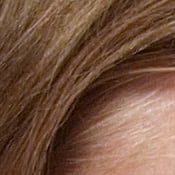
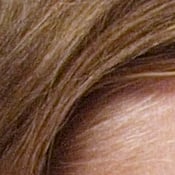

The Olympus E-420 produced low noise at its lower sensitivity settings, however we start to see some fine-grained noise at ISO 400. As you'd expect, noise becomes more apparent at ISO 800, but noise is still quite fine-grained and not much detail has been lost to noise reduction. There is also very little sign of chroma noise, which some find more objectional. Even at ISO 1,600, the highest sensitivity supported by the E-420, though noise pixels are quite bright, noise remains fairly fine-grained, and there is still quite a bit of subtle detail to work with. Chroma noise is still low, but you can see some yellow and magenta blotches in the shadows. See the Print Quality section to find out what the recommended maximum size print is at each ISO setting.
Extremes: Sunlit and low light tests
High resolution with strong overall detail, though details are slightly soft. High contrast and limited shadow detail, however. Fairly good low-light performance, capable of capturing bright images under average city street lighting, and much darker conditions with manual intervention.


Sunlight. The Olympus E-420 had a hard time with the deliberately harsh lighting of the above test, producing rather high contrast with washed-out highlights and deep shadows. Though Marti's face still looks a little dark at +0.3 EV, I preferred that shot to the image at +0.7 EV, which had too many blown highlights for my preference. (In "real life" though, be sure to use fill flash in situations like the one shown above; it's better to shoot in the shade when possible.) Be sure to use fill flash in situations like the one shown above; it's better to shoot in the shade when possible.
Because digital cameras are more like slide film than negative film (in that they tend to have a more limited tonal range), we test them in the harshest situations to see how they handle scenes with bright highlights and dark shadows, as well as what kind of sensitivity they have in low light. The shot above is designed to mimic the very harsh, contrasty effect of direct noonday sunlight, a very tough challenge for most digital cameras. (You can read details of this test here.)
Contrast Adjustment
We really like it when a camera gives us the ability to adjust contrast and saturation to our liking. It's even better when those adjustments cover a useful range, in steps small enough to allow for precise tweaks. While the E-420 gives you five settings each for contrast, saturation and sharpness, we wished it had a little more range on the low side for the contrast adjustment.
| Minimum Contrast, Normal Gradation | |
 |
 |
| Contrast set to lowest, +0.3 EV |
Contrast set to lowest, Auto Exposure |
At its lowest contrast setting, the E-420 did a fairly good job of preserving highlight detail (some were still blown, hence the desire for more range on the low end of the settings), maintaining natural-looking skin tones, and holding nice detail in the shadows. The E-420 captures good color outdoors, though just slightly on the warm side. Overall, very good results here, especially when the contrast setting is tweaked.
| Contrast Adjustment Examples | ||
|
 |
 |
| -2 | 0 | +2 |
The series of shots above shows results with several different contrast adjustment settings, showing the default as well as both extremes. While you can see the extremes, it's hard to really evaluate contrast on small thumbnails like these, click on any thumbnail to go to the full-size image.
One very nice feature of Olympus's contrast adjustment is that it has very little effect on color saturation. Contrast and saturation are actually fairly closely coupled, it's a good trick to be able to vary one with out the other changing as well. Olympus did a good job here.
Olympus's Gradation Settings
Similar to dynamic range optimization systems from other manufacturers, the E-420's Auto Gradation setting applies local contrast adjustments in an attempt to preserve shadow detail and prevent highlight clipping. Below are examples of the various settings available applied to our outdoor portrait shot.
| Gradation Examples | |||
 |
 |
 |
 |
| Normal | Auto | Low Key | High Key |
 |
 |
 |
 |
| Highlight Detail | |||
 |
 |
 |
 |
| Shadow Detail | |||
As you can see by comparing to the crops from the Normal setting, the Auto setting does a very good job of preserving most of the highlights in the flowers, while simultaneously lightening the shadows below the bouquet. Shadow noise is more apparent; however, this is quite normal when darker tones are lightened. The Low Key setting applies Gradation for dark subjects (in the crops above, you can see that it preserved the highlights but didn't lighten the shadows), while the High Key setting does the opposite for bright subjects (preserving shadow detail but not toning down the highlights). Note that the Contrast setting is ignored when Gradation is set to anything other than Normal.
| 1 fc 11 lux |
1/2 fc 5.5 lux |
1/4 fc 2.7 lux |
1/8 fc 1.3 lux |
1/16 fc 0.67 lux |
1/16fc No NR |
|
|---|---|---|---|---|---|---|
| ISO 100 |
 2 sec f3.5 |
 4 sec f3.5 |
 6 sec f3.5 |
 13 sec f3.5 |
 15 sec f3.5 |
 15 sec f3.5 |
| ISO 200 |
 1.3 sec f3.5 |
 2.5 sec f3.5 |
 5 sec f3.5 |
 8 sec f3.5 |
 8 sec f3.5 |
 8 sec f3.5 |
| ISO 400 |
 0.6 sec f3.5 |
 1.3 sec f3.5 |
 2.5 sec f3.5 |
 4 sec f3.5 |
 4 sec f3.5 |
 4 sec f3.5 |
| ISO 800 |
 0.3 sec f3.5 |
 0.6 sec f3.5 |
 1.3 sec f3.5 |
 2 sec f3.5 |
 2 sec f3.5 |
 2 sec f3.5 |
| ISO 1600 |
 1/6 sec f3.5 |
 0.3 sec f3.5 |
 0.6 sec f3.5 |
 1 sec f3.5 |
 1 sec f3.5 |
 1 sec f3.5 |
Low light. The Olympus E-420 performed reasonably well on the low-light test, capturing usable, if not bright images at the lowest light level with the lowest sensitivity setting (ISO 100). Images are a little dim at the lower light levels though. This appears to be an issue with the E-420's metering, as one would expect the exposure duration to double for each decrease in light level in the table above, as the aperture is constant. You can always add exposure compensation or use manual mode to get around this limitation. Color balance is just a bit warm from the Auto white balance setting. Noise was fairly low up to ISO 400, but as expected, became more noticeable with higher ISOs. Some slight horizontal banding was evident at higher ISOs as well. There were also a few bright pixels visible when noise reduction was turned off at the lowest light level, but that's quite normal. The camera's autofocus system was able to focus on the subject almost down to the 1/8 foot-candle light level unassisted (and in complete darkness with the AF assist enabled). Keep in mind that the longer shutter speeds here demand the use of a tripod to prevent any blurring from camera movement. (A useful trick is to just prop the camera on a convenient surface, and use its self-timer to release the shutter. This avoids any jiggling from your finger pressing the shutter button, and can work quite well when you don't have a tripod handy.)
How bright is this? The one foot-candle light level that this test begins at roughly corresponds to the brightness of typical city street-lighting at night. Cameras performing well at that level should be able to snap good-looking photos of street-lit scenes.
NOTE: This low light test is conducted with a stationary subject, and the camera mounted on a sturdy tripod. Most digital cameras will fail miserably when faced with a moving subject in dim lighting. (For example, a child's ballet recital or a holiday pageant in a gymnasium.) Digital SLRs like the Olympus E-420 do much better than point & shoots, but you still shouldn't expect a quick autofocus lock with moving subjects.
Output Quality
Print Quality
Good print quality, great color, great 13x19-inch prints. ISO 1,600 images are surprisingly good at 8x10, even better at 5x7.
 Output from the Olympus E-420 was good enough to produce sharp 13x19-inch prints. At 16x20, its prints were softer looking, but perfectly fine for wall or table display. ISO 200 images are a bit soft for 13x19, but better at 11x14 inches. ISO 400 images held together for very good 11x14-inch prints, and ISO 800 also withstood 11x14-inch print size; it's a little soft, but not at all bad. ISO 1,600 made good 8x10-inch prints, barely distinguishable from ISO 800 at the same size. They clean up more at 5x7, but would serve well at 8x10. Overall, pretty impressive printed performance from the Olympus E-420.
Testing hundreds of digital cameras, we've found that you can only tell just so much about a camera's image quality by viewing its images on-screen. Ultimately, there's no substitute for printing a lot of images and examining them closely. For this reason, we now routinely print sample images from the cameras we test on our Canon i9900 studio printer, and on the Canon iP5200 here in the office. (See the Canon i9900 review for details on that model.)
The images above were taken from our standardized test shots. For a collection of more pictorial photos, see our Olympus E-420 Photo Gallery .
Not sure which camera to buy? Let your eyes be the ultimate judge! Visit our Comparometer(tm) to compare images from the Olympus E-420 with those from other cameras you may be considering. The proof is in the pictures, so let your own eyes decide which you like best!
Performance
Olympus E-420 Performance
Timing and Performance
The E-420's timing performance ranges from below average to slightly above average speed for a consumer SLR.
|
Startup/Shutdown
|
||
|
Power on
to first shot |
0.8 second
|
Time it takes for camera to turn on and take a shot.
|
|
Shutdown
|
~0 second
|
How long it takes to turn off.
|
|
(Timings with 266x CF Card)
|
||
|
Buffer clearing time
Large Super Fine JPEG |
4 seconds
(after 13 LSF JPEGs) |
Worst case buffer clearing time. -- This is the delay after a set of shots before you can remove the card. Some cameras won't shut down until the buffer is cleared. (*See note about memory card speeds at bottom of cycle time table below.)
|
|
Buffer clearing time
Small Basic JPEG |
1 second
(after 20 SB JPEGs) |
|
|
Buffer clearing time
RAW |
6 seconds
(after 9 RAW frames) |
|
|
Buffer clearing time
RAW + LSF JPEG |
9 seconds
(after 7 RAW + LSF JPEG frames) |
|
Startup time was a bit slow for an SLR, due in part to the ultrasonic sensor cleaning that takes place each power-up. Shutdown was very fast (difficult to measure). Buffer clearing time depends on the image size and quality, burst length and the speed of memory card used.
|
Mode Switching
|
||
|
Play to Record,
first shot |
0.3 second
|
Time until first shot is captured.
|
|
Record to Play
|
1.0 second
|
Time to display a large/super fine file immediately after capture.
|
|
Display
recorded image |
0.5 second
|
Time to display a large/super fine file already on the memory card.
|
Mode switching is reasonably fast, except for Record to Play, which is slower than average.
|
Shutter Response (Lag Time)
|
||
|
Full Autofocus
Optical Viewfinder Wide Angle |
0.138 second
|
Time from fully pressing shutter button to image capture using optical viewfinder with lens at full wide angle (all AF timing done with 14-42mm kit lens).
|
|
Full Autofocus
Optical Viewfinder Telephoto |
0.133 second
|
Time from fully pressing shutter button to image capture using optical viewfinder with lens at full telephoto.
|
|
Full Autofocus
Optical Viewfinder, Flash enabled |
0.158 second
|
Time from fully pressing shutter button to image capture using optical viewfinder, with flash enabled.
|
|
Full Autofocus
Live View Imager AF |
2.588 seconds
|
Time from fully pressing shutter button to image capture, using Live View mode and Imager AF (contrast-detect) mode.
|
|
Full Autofocus
Live View AF Sensor |
0.635 second
|
Time from fully pressing shutter button to image capture, using Live View mode and AF Sensor (phase-detect) mode.
|
|
Full Autofocus
Live View Hybrid Mode |
0.711 second
|
Time from fully pressing shutter button to image capture, using Live View mode and Hybrid AF mode.
|
|
Prefocused
Optical Viewfinder |
0.082 second
|
Time to capture, after half-pressing and holding shutter button.
|
|
Prefocused
Live View |
0.569 second
|
Time to capture, after half-pressing and holding shutter button, using Live View mode.
|
|
Prefocused
Live View, Flash enabled |
0.596 second
|
Time to capture, after half-pressing and holding shutter button, using Live View mode, with flash enabled.
|
|
Continuous AF
Optical Viewfinder |
0.183 second
|
This mode usually shows no speed increase with our static subject; we have no way to measure performance with moving subjects.
|
|
Manual focus
Optical Viewfinder |
0.110 second
|
For most cameras, shutter lag is less in manual focus than autofocus, but usually not as fast as when the camera is "prefocused".
|
In terms of the E-420's ability to determine that it's properly focused when shooting the same target multiple times, its speed is above average for a consumer model when using the optical viewfinder. The E-420 measured 0.133 to 0.138 second for full AF shutter lag, depending on the zoom position. Continuous autofocus mode lag time was a bit slower at 0.183 second, and manual focus was slightly faster at about 0.11 second. When prefocused, shutter lag dropped to 0.082 second.
Autofocus performance drops considerably in Live View mode however. Full AF shutter lag in the default "Imager AF" (contrast-detect) mode is a whopping 2.588 seconds, much longer than even the slowest point & shoot digicam these days. Switching to "AF Sensor" (phase-detect) mode and holding down the AEL/AFL button while fully depressing the shutter release improved lag to 0.635 second, which is still quite slow for an SLR. Lag with "Hybrid AF" mode, which uses a combination of contrast-detect and phase-detect AF was 0.771 second. Even prefocused, Live View shutter lag is a relatively pokey 0.569 second.
|
Cycle Time (shot to shot)
|
||
|
Single Shot mode
Large Super Fine JPEG |
0.50 second
|
Time per shot, averaged over 20 shots, 3 seconds to clear.
|
|
Single Shot mode
Small Basic JPEG |
0.49 second
|
Time per shot, averaged over 20 shots, 1 second to clear.
|
|
Single Shot mode
RAW |
0.50 second
|
Time per shot, averaged over 14 shots, 5 seconds to clear.
|
|
Early shutter
penalty? |
No
|
Some cameras refuse to snap another shot if you release and press the shutter too quickly in Single Shot mode, making "No" the preferred answer.
|
|
Continuous mode
Large Super Fine JPEG |
0.29 second
(3.48 frames/sec); 13 frames total; 4 seconds to clear |
Time per shot, averaged over 13 shots. Then slows to about 0.48 seconds per frame or 2.10 fps.
|
|
Continuous mode
Small Basic JPEG |
0.29 second
(3.48 frames/sec); 20+ frames total; 1 second to clear |
Time per shot, averaged over 20 shots.
|
|
Continuous mode
RAW |
0.28 second
(3.56 frames/sec); 9 frames total; 6 seconds to clear |
Time per shot, averaged over 9 shots. Then slows to about 0.38 seconds or 1.46 fps.
|
|
Continuous mode
RAW+ LSF JPEG |
0.28 seconds
(3.59 frames/sec); 7 frames total; 9 seconds to clear |
Time per shot, averaged over 7 shots. Then slows to about 1.66 seconds or 0.60 fps.
|
|
Flash recycling
|
3.43 seconds
|
Flash at maximum output.
|
|
*Note: Buffer clearing times measured with a Kingston 266x Ultimate CompactFlash card. Slower cards will produce correspondingly slower clearing times. Slow cards may also limit length of bursts in continuous mode. Settings such as ISO sensitivity can also affect cycle times and burst mode performance, with higher ISOs generally increasing JPEG cycle times and reducing burst performance.
|
||
Single-shot cycle time performance is about average for a consumer SLR, at about 0.5 second between shots in any quality mode. Buffer depth is quite good though, at over 20 JPEG frames or 14 RAW frames. Continuous mode is about average at about 3.5 frames per second, but buffer depth was quite good for an entry level SLR, at 13 large/super fine JPEGs or 9 RAW files. Flash recycling after a full power shot is 3.43 seconds, which is fairly quick.
|
Download Speed
|
||
|
Windows Computer, USB 2.0
|
6,851 KBytes/sec
|
Typical Values:
Less than 600=USB 1.1; 600-770=USB 2.0 Low; More than 770=USB 2.0 High |
Download speeds were also quite fast, fast enough that you probably won't feel the need for a separate card reader.
Bottom line, the Olympus E-420 is generally a very responsive camera, able to handle average family shots as well as some faster action. A very good performance for an entry-level model.
Battery and Storage Capacity
Battery
Average battery life when using the optical viewfinder.
| Test Conditions | Number of Shots |
|
Lithium-ion rechargeable battery,
(CIPA standard) |
500 |
|
Lithium-ion rechargeable battery,
Live View |
unknown |
The Olympus E-420 uses a custom rechargeable lithium-ion battery pack for power, and comes with both a single battery and charger. The rated 500 shots per charge using the optical viewfinder is about average for an SLR. Olympus doesn't publish battery life for Live View mode, but you can expect it to be lower, so we recommend getting a second battery.
The table above shows the number of shots the camera is capable of on fully-charged battery, based on CIPA battery-life and/or manufacturer standard test conditions.
(Interested readers can find an English translation of the CIPA DC-002 standards document here. (180K PDF document))
Storage
The Olympus E-420 stores its photos on Compact Flash and/or xD memory cards, and no card is included with the camera. The table below shows average file size and capacity figures, as well as approximate compression ratios.
|
Image Capacity vs Resolution/Quality 1GB Memory Card |
Super Fine | Fine | Normal | Basic | RAW | RAW + LSF JPEG | |
| 3648 x 2736 |
Images
(Avg size) |
125 8.2 MB |
181 5.6 MB |
395 2.6 MB |
585 1.7 MB |
57 17.8 MB |
39 25.9 MB |
|
Approx.
Compression |
4:1 | 5:1 | 12:1 | 17:1 | 0.8:1 | - | |
| 3200 x 2400 |
Images
(Avg size) |
160 6.4 MB |
228 4.5 MB |
507 2.0 MB |
761 1.3 MB |
- | - |
|
Approx.
Compression |
4:1 | 5:1 | 11:1 | 17:1 | - | - | |
| 2560 x 1920 |
Images
(Avg size) |
239 4.3 MB |
400 2.6 MB |
780 1.3 MB |
1,171 874 KB |
- | - |
|
Approx.
Compression |
3:1 | 6:1 | 11:1 | 17:1 | - | - | |
| 1600 x 1200 |
Images
(Avg size) |
676 1.5 MB |
982 1.0 MB |
1,903 538 KB |
2,768 370 KB |
- | - |
|
Approx.
Compression |
4:1 | 6:1 | 11:1 | 16:1 | - | - | |
| 1280 x 960 |
Images
(Avg size) |
1,050 975 KB |
1,522 673 KB |
2,768 370 KB |
4,350 235 KB |
- | - |
|
Approx.
Compression |
4:1 | 6:1 | 10:1 | 16:1 | - | - | |
| 1024 x 768 |
Images
(Avg size) |
1,602 639 KB |
2,342 437 KB |
4,350
235 KB |
6,253 164 KB |
- | - |
|
Approx.
Compression |
4:1 | 5:1 | 10:1 | 14:1 | - | - | |
| 640 x 480 |
Images
(Avg size) |
3,806 269 KB |
5,685 180 KB |
8,933 115 KB |
9,782 105 KB |
- | - |
|
Approx.
Compression |
3:1 | 5:1 | 8:1 | 9:1 | - | - | |
The Olympus E-420's images are pretty large. We strongly recommend buying a large capacity Compact Flash or xD-Picture card, at least a 1GB one, preferably a 2 or 4GB one, to give yourself extra space for extended outings. (Check the shopping link above, cards are really cheap these days, so no reason to skimp.)
Flash
Olympus E-420 Flash

The Olympus E-420 features a built-in, pop-up flash, which operates in either Auto, Red-eye reduction, Red-eye reduction slow synchronization, Fill-in, Slow synchronization, Manual, or Off mode. Flash control modes consist of TTL Auto (TTL pre-flash mode), Auto, and Manual (with full, 1/4, 1/16, 1/64 power output settings). First or second curtain synchronization options are available. To release the flash from its compartment, press the flash button on the top panel to the left side of the pentamirror housing. Close it again by pushing the flash head back down. The E-420 also has a top-mounted hot shoe for attaching an external flash unit.
Flash exposure compensation can be set to three stops lower or greater, in 1/3-stop increments.
The Olympus E-420's built-in flash has a Guide Number (GN) of 12 meters or 39 feet at ISO 100. Maximum sync speed is 1/180s. Super FP shooting with shutter speeds up to 1/4,000s is available with Olympus FL-50R, FL-36R, FL-50, and FL-36 external flash units.
A Wireless mode lets the Olympus E-420 work with compatible remote flash units with wireless capability, specifically the Olympus FL-50R and FL-36R. Four separate control channels are available for wireless operation, to allow multiple photographers to work wirelessly in the same area without interfering with each other. There is also support for controlling three separate groups with individual control for flash mode and flash intensity per group. Wireless remote flash operation has generally been the province of professional photographers, but is now coming decidedly down-market. And it should, as it can dramatically simplify multi-flash shooting and make it accessible to the interested amateur.
Canon, Nikon, and Sony all make wireless flash systems, with Nikon's arguably being the most flexible of the three. With their FL-36R and FL-56R flash units, Olympus has joined the wireless-flash club, taking a page from Nikon's playbook in the mode of operation and considerable flexibility of their system. A full discussion is really beyond the scope of this brief overview, but since Olympus provided us with such great illustrations, we'll take a quick swing at it anyway.

The central idea behind all of these wireless flash systems is to use very rapid pulses of the flash tube to convey digital data between the camera and the various flash units. The illustration above (click to see a slightly larger view) shows the steps in the process, all of which happen in a surprisingly short period of time, well under a second. The sequence begins with camera's flash sending out a series of pulses to wake up the remote units, tell them what exposure mode they'll be operating in, and configure them for the upcoming exposure. It then triggers a pre-flash from all the remote units, measuring the light coming back from each group (there can be as many flashes as you like, configured in up to three control groups). The camera's CPU performs some exposure calculations, then uses its own flash head to transmit power-level commands back to each flash group. Finally, a last pulse from the camera's head triggers all the remotes to fire at their assigned power levels.
The beauty of this system is that the power and operating modes of each of the groups of remote flashes can be controlled from the camera itself. This can come in very handy when one of the flash groups is mounted up in a tree, behind a window on a set, or in some other inaccessible location. Even when the flashes are readily accessible, the ability to adjust settings without running around the room each time is far more pleasant than the alternative.

The screen shot above shows the different modes the various groups can be operated in: TTL (Through The Lens metering), Manual, or Auto. The column of figures to the right of the flash modes shows the exposure compensation adjustments (in the case of TTL and Auto modes) or power level (in the case of Manual mode) selected. The next two columns show the options for flash sync speed (x-sync or Focal Plane sync), the intensity of the AF-assist illumination cast by the flash units, and the channel they're operating on. Four separate control channels are provided, to allow multiple photographers to work in the same area without interfering with each other.
The flexibility of the Olympus E-420's flash system is quite remarkable, given the camera's entry level status and price. Entry level models from Nikon for instance don't support wireless functionality unless an expensive controller flash is attached, and don't support high speed sync ("Super FP") mode at all.
Flash Test Results
Coverage and Range
A fairly powerful flash, but with narrow coverage. Our standard shots required slightly higher than average exposure compensation.


Coverage. Flash coverage was very uneven at wide-angle (14mm), but much more uniform at telephoto (42mm). In the Indoor test, the Olympus E-420's flash underexposed our subject a little at its default setting, requiring a +1.3 EV exposure compensation adjustment to get good results (perhaps slightly overexposed, but +1.0 EV was a bit too dim), which is slightly above average for this shot. The camera's Slow-Sync flash mode produced more even results, though with a stronger pinkish-orange cast from the room lighting. The Slow-Sync flash required exposure compensation of +1.0 EV.
| Flash Range: Wide Angle | |||||
|---|---|---|---|---|---|
| 6 ft | 7 ft | 8 ft | 9 ft | 10 ft | 11 ft |
 1/60 sec f3.5 ISO 100 |
 1/60 sec f3.5 ISO 100 |
 1/60 sec f3.5 ISO 100 |
 1/60 sec f3.5 ISO 100 |
 1/60 sec f3.5 ISO 100 |
 1/60 sec f3.5 ISO 100 |
| 12 ft | 13 ft | 14 ft | 15 ft | 16 ft | |
 1/60 sec f3.5 ISO 100 |
 1/60 sec f3.5 ISO 100 |
 1/60 sec f3.5 ISO 100 |
 1/60 sec f3.5 ISO 100 |
 1/60 sec f3.5 ISO 100 |
|
| Flash Range: Telephoto | |||||
|---|---|---|---|---|---|
| 6 ft | 7 ft | 8 ft | 9 ft | 10 ft | 11 ft |
 1/80 sec f5.6 ISO 100 |
 1/80 sec f5.6 ISO 100 |
 1/80 sec f5.6 ISO 100 |
 1/80 sec f5.6 ISO 100 |
 1/80 sec f5.6 ISO 100 |
 1/80 sec f5.6 ISO 100 |
| 12 ft | 13 ft | 14 ft | 15 ft | 16 ft | |
 1/80 sec f5.6 ISO 100 |
 1/80 sec f5.6 ISO 100 |
 1/80 sec f5.6 ISO 100 |
 1/80 sec f5.6 ISO 100 |
 1/80 sec f5.6 ISO 100 |
|
ISO 100 Range. Flash power remains pretty strong to about 14 feet at wide angle. At telephoto, flash exposures were very uneven and started out quite dim at 6 feet. Maximum brightness was at about 9 feet where it was still a bit dim, dropping off gradually from there.
| Manufacturer-Specified Flash Range | |
|---|---|
| Wide Angle | Telephoto |
 11.2 feet ISO 100 |
 7.0 feet ISO 100 |
Manufacturer Specified Flash Test. The Olympus E-420's built-in flash has a Guide Number (GN) of 12 meters at ISO 100. That works out to about 11.2 feet at f/3.5 and 7 feet at f/5.6, the maximum aperture of the kit zoom lens at wide angle and telephoto respectively. In the wide-angle shot above, the E-420 performs as Olympus says it will, producing good exposures at the rated distances. The telephoto shot at 7 feet was quite dim, as it was in our ISO 100 series. Our standard test method for flash range uses a fixed setting of ISO 100, to provide a fair basis of comparison between cameras. We've now also begun shooting two shots using the manufacturer-specified camera settings, at the range the company claims for the camera, to assess the validity of the specific claims.
Imatest Results
Olympus E-420 Imatest Results
We routinely use Norman Koren's excellent "Imatest" analysis program for quantitative, thoroughly objective analysis of digicam test images. I highly recommend it to our technically-oriented readers, as it's far and away the best, most comprehensive analysis program I've found to date.
My comments below are just brief observations of what we see in the Imatest results. A full discussion of all the data Imatest produces is really beyond the scope of this review: Visit the Imatest web site for a full discussion of what the program measures, how it performs its computations, and how to interpret its output.
Here's some of the results produced by Imatest for the Olympus E-420:
| sRGB Accuracy Comparison |
|||
The Olympus E-420 showed very good color accuracy, as well as fairly accurate saturation levels. Hue accuracy was quite good, with most of the hue shift occurring in the cyans, blues and yellows through oranges. Average saturation was 107.3% (7.3% oversaturated) and average "delta-C" color error was only 5.04 after correction for saturation, which is also very good. (Delta-C is the same as the more commonly referred to delta-E, but delta-C takes into account only color differences, ignoring luminance variation.) Overall, a very good color response for an SLR, especially a consumer oriented model. Mouse over the links below the illustration above to compare results with other recent models.
Adobe RGB Accuracy Comparison |
|||
As is true of most SLRs, when using the Adobe RGB color space (which provides a much wider gamut, or range of colors that can be expressed), the Olympus E-420 delivers more highly saturated color, with an average saturation of 113.9% and average saturation-corrected hue error of 5.00 "delta-C" units. Again, mouse over the links below the illustration above to compare results with other recent SLRs.
Olympus E-420 Color Analysis

This image shows how the Olympus E-420 actually rendered the colors of the MacBeth chart, compared to a numerically ideal treatment. In each color swatch, the outer perimeter shows the color as actually captured by the camera, the inner square shows the numerically ideal color, after correcting for the luminance of the photographed chart (as determined by a second-order curve fit to the values of the gray swatches), and the small rectangle inside the inner square shows the numerically ideal color, without any luminance correction. This image shows the very good hue accuracy, as well as a contrast curve that results in slight overexposure of the darker swatches and slight underexposure of lighter ones. Overall though, the colors are impressively close to their "correct" values.
Olympus E-420 Noise Analysis

There's a lot in this particular graph; as always, a lot more than we have room to go into here. (This set of plots has also changed a little in the more recent versions of Imatest. Some of the plots that were shown here previously are now shown in other Imatest output. Since we largely focus on the Noise Spectrum plot, we'll only show the graphic above, which includes that plot.)
In comparing these graphs with those from competing cameras, I've found that the Noise Spectrum graph at lower right is the most important. Cameras that manage to shift their noise spectrum to higher frequencies have much finer-grained noise structures, making their noise less visually objectionable. In the graph above, this would show up as a noise spectrum curve that remained higher on the right side, representing higher noise frequencies. The champion at this was the Canon EOS-1Ds Mark II, which produced remarkably fine-grained image noise, even at very high ISOs.
While overall noise levels are a bit higher than most competing models, the Olympus E-420 does a very good job of keeping plenty of the noise energy at high frequencies and is in fact better than most cameras in this respect, at least at lower ISO settings. What little low-ISO image noise that's there is more fine-grained as a result. The red and especially blue channels are a little noisier than the others, but that's not at all unusual , and not visible even when closely inspecting low ISO shots.
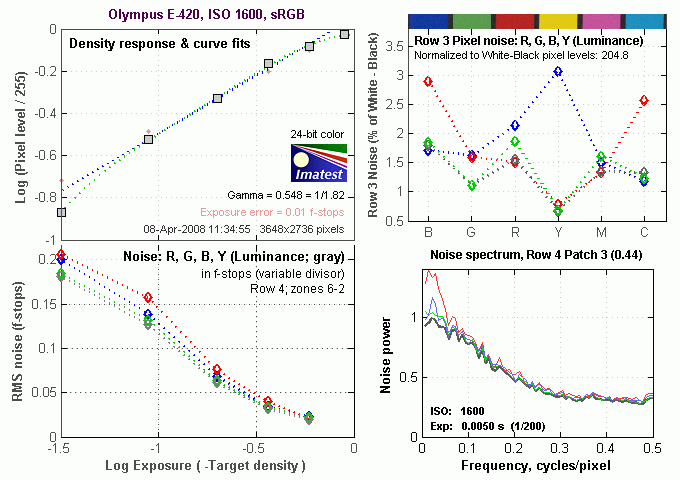
Here's the same set of noise data at ISO 1,600. Here, the Noise Spectrum graph is shifted quite a bit more toward the left-hand, lower-frequency side than it was at ISO 100 (note how the whole graph is piled up on the left side of the plot), coarsening the "grain" of the image noise patterns quite a bit. However, this is an improvement over the E-410, which had a distribution shifted even more to the left. In the E-420 though, the overall noise amplitude remains quite low, lower than that of most of the competition. The overall effect is actually quite pleasing: ISO 1,600 images are quite detailed with a tight grain structure which for the most part manages to not appear blotchy. (There is more blotchiness in the red channel, which may appear in some images but not others, depending on the colors of particular objects you might be looking at.) A good job, and improvement on the earlier E-410.

This chart compares the Olympus E-420's noise performance over a range of ISOs against that of other cameras. While I continue to show noise plots of this sort because readers ask for them, I each time point out that the noise magnitude is only a small part of the story, the grain pattern being much more important. Here, we can see that the Olympus E-420's luminance noise starts out a bit high compared to the competition, reduces a bit at ISO 200, then increases at roughly the same rate as the others to ISO 400. It doesn't rise much at ISO 800, where where it is lower than the others. Then we see E-420 noise levels increase again at ISO 1600, although still remaining at or below most of the competition (with the notable exception of the Sony A200, which is applies more aggressive noise reduction). Do keep in mind these measurements are taken with each camera set at default settings, so the shape or position of the curve could be influenced by the settings you choose to use. The Pentax K200D's plot is a good example of this. Its noise magnitude is higher than the others, but that's partly because the K200D's default contrast and sharpness settings are a bit on the high side.
Olympus E-420 Dynamic Range Analysis
A key parameter in a digital camera is its Dynamic Range, the range of brightness that can be faithfully recorded. At the upper end of the tonal scale, dynamic range is dictated by the point at which the RGB data "saturates" at values of 255, 255, 255. At the lower end of the tonal scale, dynamic range is determined by the point at which there ceases to be any useful difference between adjacent tonal steps. Note the use of the qualifier "useful" in there: While it's tempting to evaluate dynamic range as the maximum number of tonal steps that can be discerned at all, that measure of dynamic range has very little relevance to real-world photography. What we care about as photographers is how much detail we can pull out of the shadows before image noise becomes too objectionable. This, of course, is a very subjective matter, and will vary with the application and even the subject matter in question. (Noise will be much more visible in subjects with large areas of flat tints and subtle shading than it would in subjects with strong, highly contrasting surface texture.)
What makes most sense then, is to specify useful dynamic range in terms of the point at which image noise reaches some agreed-upon threshold. To this end, Imatest computes a number of different dynamic range measurements, based on a variety of image noise thresholds. The noise thresholds are specified in terms of f-stops of equivalent luminance variation in the final image file, and dynamic range is computed for noise thresholds of 1.0 (low image quality), 0.5 (medium image quality), 0.25 (medium-high image quality) and 0.1 (high image quality). For most photographers and most applications, the noise thresholds of 0.5 and 0.25 f-stops are probably the most relevant to the production of acceptable-quality finished images, but many noise-sensitive shooters will insist on the 0.1 f-stop limit for their most critical work.
The image below shows the test results from Imatest for an in-camera JPEG file from the Olympus E-420 with a nominally-exposed density step target (Stouffer 4110), and the E-420's contrast and DRO settings at their default positions.

While better than the E-410, these are still disappointing numbers for a current-model DSLR, and reflect the tendency for the E420's contrasty tone curve to plug deep shadows pretty badly. This is somewhat apparent in the tone curve above, revealed by the way the shadow end of the curve tails off with large spacing between the steps, and odd "tail" as it approaches black. This behavior of the E-420 was also observed by the testers and reviewers, who complained that the E-420's images sometimes took a lot of tweaking to compensate for the overly-contrasty tone curve.
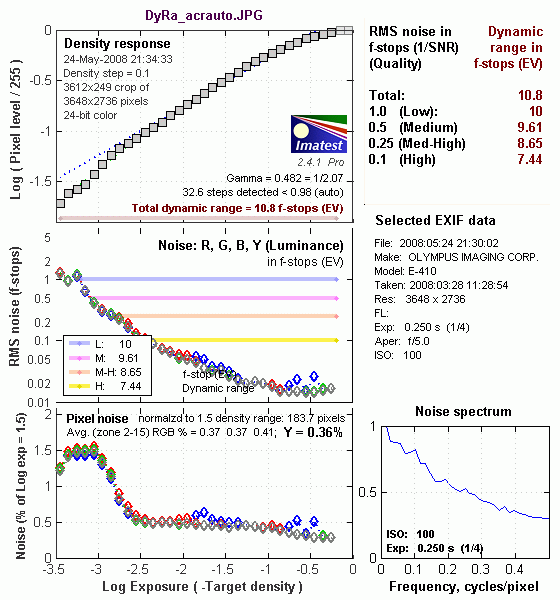
Processing the E-420's RAW (ORF) files through Adobe Camera Raw (ACR) version 4.4.1 improved dynamic range by more than a full stop at the highest quality level. (It bears noting though, that extreme manipulation of RAW files to extend dynamic range can introduce severe color shifts in the resulting files: This dramatically increased dynamic range may only be really usable when converting the images to black and white. - As is the case with most cameras.) These results were obtained by using ACR's automatic settings; slightly better results may be possible by adjusting the sliders manually. (Note: ACR version 4.4.1 supported the E-410 but not the E-420. We edited the file header to trick ACR 4.4.1 into processing the E-420's files as if they came from the E-410, which worked quite well.)
Dynamic Range, the bottom line:
The net result was that the E-420 performed rather poorly when compared against most current DSLR models, positioning it near the bottom of the current crop of DSLRs.
To get some perspective, here's a summary of the Olympus E-420's dynamic range performance, and how it compares to other digital SLRs that we also have Imatest dynamic range data for. (Results are arranged in order of decreasing dynamic range at the "High" quality level.):
| Dynamic Range (in f-stops) vs Image Quality (At camera's minimum ISO) |
||||
| Model | 1.0 (Low) |
0.5 (Medium) |
0.25 (Med-High) |
0.1 (High) |
| Fujifilm S3 Pro (Adobe Camera Raw 2) |
12.1 | 11.7 | 10.7 | 9.0 |
| Nikon D40x (Adobe Camera Raw 4.1) |
12.0 | 10.9 | 10.3 | 8.9 |
| Nikon D300 (Adobe Camera Raw 4.3.1) |
11.4 | 10.9 | 9.87 | 8.45 |
| Sony A200 (Adobe Camera Raw 4.3.1) |
11.6 | 10.4 | 9.82 | 8.43 |
| Nikon D40 (Adobe Camera Raw 4.1) |
11.9 | 10.9 | 9.89 | 8.3 |
| Pentax K-100D (Adobe Camera Raw 3.6) |
11.3 | 10.3 | 9.51 | 8.23 |
| Pentax K10D (Adobe Camera Raw 3.7) |
10.6 | 10.0 | 9.29 | 8.19 |
| Sony A100 (Adobe Camera Raw 3.4) |
11.3 | 10.5 | 9.69 | 8.16 |
| Canon EOS-1Ds Mark II (Adobe Camera Raw 3) |
11.2 | 10.3 | 9.4 | 8.14 |
| Nikon D40x (Camera JPEG) |
10.8 | 10.0 | 9.42 | 8.04 |
| Fujifilm S3 Pro (Camera JPEG) |
-- | 9.9 | 9.4 | 7.94 |
| Sony A350 (Adobe Camera Raw 4.4) |
11.6 | 10.5 | 9.61 | 7.89 |
| Canon Digital Rebel XTi (Adobe Camera Raw 3.6) |
10.8 | 9.88 | 9.18 | 7.84 |
| Canon EOS-5D (Adobe Camera Raw 3) |
11.0 | 10.4 | 9.21 | 7.83 |
| Canon EOS-40D (Adobe Camera Raw 4.2) |
11.2 | 10.1 | 9.26 | 7.72 |
| Canon EOS-5D (Camera JPEG) |
10.2 | 9.68 | 8.82 | 7.65 |
| Olympus E-3 (Adobe Camera Raw 4.3) |
10.3 | 10.1 | 9.29 | 7.64 |
| Nikon D200 (Adobe Camera Raw 3) |
10.6 | 9.65 | 8.96 | 7.61 |
| Nikon D80 (Adobe Camera Raw 3.6) |
11.1 | 10.4 | 9.42 | 7.51 |
| Olympus E-510 (Adobe Camera Raw 4.1) |
10.0 | 9.43 | 8.64 | 7.46 |
| Pentax K10D (Camera JPEG) |
-- | 9.49 | 8.88 | 7.44 |
| Nikon D300 (Camera JPEG) |
-- | -- | 8.70 | 7.44 |
| Olympus E-420 (Adobe Camera Raw 4.1.1) |
10.0 | 9.61 | 8.65 | 7.44 |
| Canon EOS-40D (Camera JPEG) |
10.6 | 9.52 | 8.78 | 7.42 |
| Nikon D50 (Camera JPEG) |
10.7 | 9.93 | 8.70 | 7.36 |
| Sony A200 (Camera JPEG) |
10.4 | 9.43 | 8.91 | 7.29 |
| Canon EOS 20D (Camera JPEG) |
10.3 | 9.66 | 8.85 | 7.29 |
| Nikon D40 (Camera JPEG) |
10.4 | 9.8 | 8.89 | 7.28 |
| Sony A350 (Camera JPEG) |
10.3 | 9.55 | 8.85 | 7.19 |
| Nikon D80 (Camera JPEG) |
10.1 | 9.43 | 8.48 | 7.12 |
| Canon Digital Rebel XT (Camera JPEG) |
10.3 | 9.51 | 8.61 | 7.11 |
| Nikon D200 (Camera JPEG) |
-- | 9.07 | 8.36 | 7.11 |
| Olympus EVOLT (Camera JPEG) |
10.8 | 9.26 | 8.48 | 7.07 |
| Olympus E-410 (Adobe Camera Raw 4.1) |
10.2 | 9.4 | 8.24 | 7.05 |
| Canon Digital Rebel XTi (Camera JPEG) |
9.83 | 9.10 | 8.27 | 7.04 |
| Canon EOS-1Ds Mark II (Camera JPEG) |
10.3 | 9.38 | 8.6 | 7.04 |
| Canon Digital Rebel (Camera JPEG) |
10.1 | 9.11 | 8.47 | 6.97 |
| Panasonic DMC-L10 (Adobe Camera Raw 4.2) |
10.4 | 9.34 | 8.48 | 6.91 |
| Pentax *istDs (Camera JPEG) |
10.2 | 10 | 8.87 | 6.9 |
| Sony A100 (Camera JPEG) |
10.2 | 9.24 | 8.39 | 6.89 |
| Pentax K-100D (Camera JPEG) |
10.3 | 9.3 | 8.39 | 6.73 |
| Nikon D2x (Camera JPEG) |
-- | 8.93 | 7.75 | 6.43 |
| Olympus E-3 (Camera JPEG) |
9.32 | 9.06 | 8.5 | 6.42 |
| Panasonic DMC-L10 (Camera JPEG) |
-- | 8.94 | 8.00 | 6.38 |
| Olympus E-420 (Camera JPEG) |
9.18 | 8.82 | 7.93 | 6.37 |
| Olympus E-410 (Camera JPEG) |
-- | -- | 7.60 | 5.99 |
| Nikon D70s (Camera JPEG) |
9.84 | 8.69 | 7.46 | 5.85 |
| Nikon D70 (Camera JPEG) |
9.81 | 8.76 | 7.58 | 5.84 |
| Olympus E-510 (Camera JPEG) |
7.70 | 7.16 | 5.87 | 3.55 |
The results shown in the table are interesting. One of the first things that struck me when I initially looked at test data for a wide range of d-SLRs, was that here again, purely analytical measurements don't necessarily correlate all that well with actual photographic experience. There's no question that the Fuji S3 Pro deserves its place atop the list, as its unique "SR" technology does indeed deliver a very obvious improvement in tonal range in the highlight portion of the tonal scale. I was surprised to see the analytical results place the Olympus EVOLT as highly as they did, given that our sense of that camera's images was that they were in fact noisier than those of many other d-SLRs that we looked at. In the other direction, I was quite surprised to see the Nikon D2x place as low on the listings as it did, given that we found that camera's shadow detail to be little short of amazing.
One thing that's going on here though, is that we tested each camera at its lowest ISO setting, which should produce best-case noise levels. This is in fact what many photographers will be most interested in, but it does perhaps place some of the Nikons (like the D40) at a disadvantage, as their lowest ISO setting is 200, as compared to the ISO 100 settings available on most other models.
Olympus E-420 Resolution Chart Test Results

The chart above shows consolidated results from spatial frequency response measurements in both the horizontal and vertical axes. The "MTF 50" numbers tend to correlate best with visual perceptions of sharpness, so those are what I focus on here. The uncorrected resolution figures are 1,980 line widths per picture height in the horizontal direction (corresponding to the vertically-oriented edge), and 1,836 lines along the vertical axis (corresponding to the horizontally-oriented edge), for a combined average of 1,908 LW/PH. Correcting to a "standardized" sharpening with a one-pixel radius increased both vertical and horizontal resolution slightly, resulting in an average of 2,028 LW/PH, just a bit below the best we've seen for a 10-megapixel camera.
To see what's going on, refer to the plots below, which show the actual edge profiles for both horizontal and vertical edges, in both their original and corrected forms. Here, you can see that there's a significant amount of in-camera sharpening applied (the large bump at the top ends of the black curves), that the standard sharpening operator reduces slightly. (Imatest complained that we were clipping the shadows a bit here (which would actually tend to improve the apparent edge sharpness somewhat), but that's just a consequence of the E-420's high contrast. We couldn't eliminate the shadow clipping without clipping the highlights instead.)


Rawindex
Digital Cameras - Olympus E-420 RAW Test Images
The tables below show selected representative images from our test shot series that were shot in RAW mode.
Depending on your browser, you can download the images by clicking on the links, or by right-clicking on the links and selecting "Save Target As...", or similar. Some browsers change the file extension to .TIFF. In that case, just rename to .ORF after downloading. You can see the full set of in-camera JPEG shots, including exposure information extracted from the EXIF file headers, on the Thumbnail index page.
NOTE: These are very large files (10+ megabytes each). They're here for you to use, but please be considerate of our bandwidth; don't just download everything willy-nilly. - Thanks!
Still Life
| Still Life ISO Series, RAW | |||
| ISO 100 | ISO 200 | ISO 400 | ISO 800 |
| ISO 1600 | |||
Multi-Target
| Multi Target Series, RAW | |||
| ISO 100 | ISO 200 | ISO 400 | ISO 800 |
| ISO 1600 | |||
Far-Field
| Far-Field ISO Series, RAW | |||
| ISO 100 | ISO 200 | ISO 400 | ISO 800 |
| ISO 1600 | |||
Press Release
Olympus E-420 Press Release
OLYMPUS E-420: WORLD'S SMALLEST AND LIGHTEST CONSUMER DIGITAL SLR DELIVERS ENHANCED AUTOFOCUS LIVE VIEW
Compact Size Makes It the Ultimate DSLR to Take Anywhere, Next-Generation Live View Ensures It Performs Better When You Get There
CENTER VALLEY, Pa., March 5, 2008 - Olympus today announces the extremely portable E-420 - perfect for everyone who wants to step up to the power and performance of a digital SLR (single lens reflex) yet enjoy the ease of use and ability to compose images on the LCD common to point-and-shoot cameras. Weighing a mere 380 grams (13.4 ounces), the E-420 is 20 to 40 percent lighter than competing DSLRs. Good things come in this small package, including Live View, which enables users to hold the camera away from their faces and interact with their subjects - ideal when capturing photos of children, for example.
This lightweight 10-megapixel DSLR offers heavyweight technologies, including a bigger, more viewable 2.7-inch LCD and consumer-friendly fast On-Screen Autofocus, Face Detection, Shadow Adjustment Technology and Perfect Shot Preview to get the most out of the Live View experience. Additionally, when it comes to Live View, not all LCDs are created equal. At 2.7-inches, the portable E-420 LCD is large enough for users to compose and review images without squinting. The small camera's LCD is not just larger, it is part of a camera with technologies intelligent enough to take advantage of the Live View photography experience. These innovative technologies include:
- On-Screen Autofocus works as seamlessly as a point-and-shoot to display subjects in focus on the LCD the instant the shutter is pressed half way;
- Face Detection Technology targets and locks on up to eight faces to ensure they are in focus and crystal clear for amazing portraits;
- New and Improved HyperCrystal II™ Technology delivers twice the contrast and better viewing in extreme lighting conditions, a broader range of color detail, and a wider angle of view on the LCD so you and your friends can see it up to 176 degrees off-center;
- Shadow Adjustment Technology captures detail in the bright areas of a frame and opens up detail in the shadows that other cameras would render too dark or underexposed; and
- Perfect Shot Preview enables you to view and select your favorite effect right on the LCD, and see how the image will look before you even capture it, so you know that what you see is what you get.
"The Olympus E-420 delivers the professional-grade image quality of a digital SLR with the simple operation of a point-and-shoot camera," said John Knaur, senior marketing manager - DSLR, Olympus Imaging America Inc. "Thanks to the camera's small size and lightweight body, users can take the E-420 everywhere, and they will never miss another shot because the of the camera's straightforward controls. Additionally, our innovative technologies help consumers get more from Live View."
World's Smallest Digital SLR
A camera designed to be held away from the face lets you take great photographs without weighing you down. The E-420 is small enough to fit into a purse or a jacket pocket and light enough to shoot with comfortably all day. Measuring 5.1 inches by 3.6 inches by 2.1 inches (excluding protrusions), it is the world's smallest digital SLR. And at a featherweight 13.4 ounces, only its predecessor (E-410) weighs less. The E-420's new ergonomic grip on the front of the body allows for easier one-handed operation and ensures a secure hold in the most challenging shooting conditions.
One of the World's Thinnest Lenses Meets the World's Most Compact DSLR
The world's smallest DSLR deserves a similarly compact lens, and Olympus has it: the ultra compact Zuiko 25mm f2.8 digital specific lens. This 0.9 inch-thick lens offers a fixed 50mm equivalent angle of view. Together with the E-420, the Zuiko 25mm f2.8 lens will offer the ultimate combination of ease of use and portability.
Photographers can also purchase the E-420 in a kit with a compact, Zuiko Digital 28-84mm equivalent (ED 14-42mm Four Thirds) f3.5-f5.6 lens that perfectly matches the imager so light strikes the sensor directly to ensure rich, accurate colors and edge-to-edge sharpness. Both lenses (Zuiko 25mm f2.8 and 28-84mm f3.5-f5.6) are part Olympus' expanding line of 100 percent digital lenses - designed specifically for digital photography. Unlike other camera companies, Olympus does not rely on old film lenses, which often result in images with soft edges or other imperfections.
The Live View Experience
Olympus was the first to bring Live View to a consumer DSLR (the E-330 in 2006), and Live View has revolutionized DSLR photography. Anyone who has photographed young children knows that you get the best reactions when you hold the camera away from your face and maintain eye contact and an engaging smile. If you have tried to take photos high above the heads in a crowd or low near the ground, you will appreciate that it is easier to use a swivel LCD screen than to climb a ladder or lie on your stomach.
The E-420 solves these problems with its Live View LCD, which enables photographers to hold the camera away from their faces and at angles they just cannot reach by using the optical viewfinder alone. The E-420's new Live View autofocus functionality now simplifies the process by working just like a point and shoot. By simply pressing the shutter button halfway, your subjects come into focus on the LCD, so when the perfect moment occurs it is easy to capture sharp images.
A viewable LCD is where a great Live View experience begins. Few things are more annoying for a photographer than squinting to see an image on an LCD screen in bright sunlight or a dimly lit room. The E-420 solves this problem with its large, bright 2.7-inch LCD display that incorporates new HyperCrystal II technology. This display offers twice the contrast for better viewing in extreme light conditions (i.e. when the sun is at your back), a broader color gamut that displays a greater range of color detail, and a 176-degree viewing angle.
Always Find a Face in the Crowd
A camera this consumer-friendly is perfect for taking portraits of friends and family while out and about. The E-420's Face Detection feature distinguishes between people's faces and the background. It tracks up to eight faces within the image area and automatically focuses and optimizes exposure for sharp, brilliant portrait pictures. Even if your subjects are moving, the camera continuously tracks their faces.
Bright Day or Deep Shadow, Never Miss a Detail
Shooting scenes with shadows can be tricky because of the extreme contrast between dark and bright areas. The E-420 addresses this challenge with Shadow Adjustment Technology that compensates for extreme contrast when shadow areas are underexposed and lack visible detail. Now users can preview and capture images with the same fine contrast they see with their own eyes.
Preview All the Possibilities
With 18 pre-set scene-select modes for every imaginable shooting scenario and full manual controls, the E-420 offers a world of possibilities to photographers. Additionally, Perfect Shot Preview enables users to preview and select various photographic effects on a live, multi-window screen on the LCD before snapping the shot. This feature shows photographers what their images will look like beforehand under various settings, ensuring that they capture exactly what they want. It is an ideal way for novice users to learn about the effects of different photography techniques, such as exposure compensation, white balance and metering.
Enlarge Your Photos
Capturing, enlarging and displaying amazing images on your wall is a snap thanks to the E-420's 10 million pixels for high-resolution photos. The 10-megapixel sensor gives users the flexibility to enlarge prints to the sizes supported by many of today's printers, or crop the image to print only a part of the image that is important to them. The high-performance Live MOS image sensor in the E-420 delivers excellent dynamic range for accurate color fidelity and a new state-of-the-art amplifier circuit dramatically reduces noise and captures fine image details in the highlight and shadow areas.
Improved Auto White Balance
Many digital SLR users want to focus their attention on things other than white balance while they are on the move. As a result, the E-420 features an improved automatic white balance performance with a new algorithm for more accurate color.
TruePic III for Image Clarity & Speed
Olympus' TruePic III Image Processor produces crystal clear photos using all the pixel information for each image to provide the best digital images possible for every photo with accurate color, true-to-life flesh tones, brilliant blue skies and precise tonal representation in between. TruePic III also lowers image noise by one step to reduce graininess in images shot at higher ISO settings, enabling great results in low-light situations.
Worried about missing the winning goal at the soccer game? The image processor on the E-420 enables it to shoot up to 3.5 frames per second in sequenced shooting mode, which means that photographers will be able to capture fast-paced action as it happens.
Dust Reduction System for Spot-Free Images
Life moves too fast to spend time worrying about dust ruining your images. Olympus' proven Dust Reduction System produces spot-free photos with the exclusive Supersonic Wave Filter™. The patented ultrasonic technology vibrates to remove dust and other particles from the front of the image sensor and captures it on a special adhesive membrane every time the camera is turned on. These spot-free photos liberate users from hours spent retouching photographs at the computer or sending their cameras back to the manufacturer to remove dust trapped inside.
Media Versatility
Accepting both CompactFlash Type I & II, Microdrives, and xD-Picture Cards, the E-420 provides a choice of data storage options for enhanced flexibility, and it is possible to transfer image files from one card to the other right inside the camera.
Wireless Flash Capability
If you decide to venture into the arena of advanced lighting, the E-420 is ready to meet the challenge. The E-420 is compatible with the Olympus FL-50R and FL-36R wireless electronic flashes that are designed exclusively for digital photography. When these flashes are used in combination with the E-420, wireless multi-flash photography is possible. The E-420 can control up to three wireless flash groups independently, with several flash units per group.
Availability
The Olympus E-420 Digital SLR will be available in May 2008. It includes: E-420 Body, USB Cable, Video Cable, Li-Ion Battery Pack (BLS-1), Li-Ion Battery Charger (BCS-1), Shoulder Strap, OLYMPUS Master Software CD-ROM, Manuals and Warranty Card.
U.S. Pricing / Product Configurations
E-420 body Estimated Street Price: $499.99
E-420 with ED 14-42mm f3.5/5.6 Zuiko Digital Zoom Lens Estimated Street Price: $599.99
E-420 with ED 25mm f2.8 Zuiko Digital Lens Estimated Street Price: $699.99