


Overview
Olympus E-620
Hands-On Preview
by Shawn Barnett
Date: 02/24/09
Whether you consider it trying to find a niche market or truly exploring what's possible in the world of digital photography, Olympus is not relenting in its quest to make ground-breaking digital SLR cameras. Their latest SLR camera proves that they're not going away, and they're not running out of ideas. Indeed, each new Olympus SLR I use impresses me more, as they not only keep introducing intelligent, sometimes painfully obvious features that nonetheless appear on no other digital SLRs, but the cameras are also built well, designed with a lot of thought.
The Olympus E-620 in particular is a great example of how the company delivers more of what photographers want in a single package. The E-620 pulls most of the important features found in the company's high-end SLRs into one compact, more affordable camera. First, the E-620's body is small, not much bigger than the E-420. Second, the camera has an articulating LCD like the E-3 and E-30. Third, the E-620 has most of the software features found in the E-30, including the Art Filters and multiple exposure capabilities. Finally, the E-620 combines most of the Live View improvements found in the latest round of Olympus SLRs, including greater speed, multiple AF modes, and face detection. It even borrows something from automotive design, with backlit buttons, one of those painfully obvious features that are found nowhere else, at least not on an SLR.
 We got to spend a little time with the Olympus E-620 and enjoyed it. It's not that it's so very different from the company's other offerings, but the E-620's core benefit is that it combines so many of Olympus's key innovations into one camera.
Look and feel. Though it's not much bigger in stature than the E-420, the Olympus E-620 weighs more. The E-420 comes in at 1.42 pounds (648g) with the kit lens, hood, battery, and CF card, while the E-620 weighs 1.63 pounds (740g) identically equipped. Without the lens and hood, the cameras weigh 0.97 pounds (440g) and 1.15 pounds (524g) respectively. The E-420 feels better balanced in the hand, despite the E-620's larger grip. That's probably due to both the swiveling LCD and image stabilization built into the E-620's body. As a result, the E-620 feels like a bigger camera, regardless of the actual size, and the whole body has a tendency to twist away out of my hand. It's definitely a two-hand camera. Dimensions are 5.1 x 3.7 x 2.3 inches (130 x 94 x 60mm), not far off from the E-420's 5.1 x 3.6 x 2.1 inches (130 x 91 x 53mm).

Similarity to the E-420 is clear right away, especially with the shutter button and EV adjustment button, which are further back on the top deck, while the equivalents on Olympus's other SLRs are out on the grip (see top view below for more). The grip is a little bigger than the E-420, but still less substantial than the grip on the E-520. That's a shame, because I'd prefer a bigger grip. However, I think the reason is that the Olympus lens lineup includes some fairly fat lenses, and your fingers would have a hard time fitting between the grip and lens if the grip were any bigger. Indeed, with the E-520 and the 150mm f/2, if I rotate the tripod mount ring to the right so I can handhold the combo, my fingers are pinched between the mount and grip. That's just a theory, but it makes sense.
Also missing from the front of the E-620 when compared to the E-420 are those swivel/lug camera strap mounts from yesteryear, now replaced by the top-mounted metal lugs that make so much more sense. For one, when you're not using a strap, these permanent lugs don't rattle, and they're always tucked away so they don't cut into your hands.

From the top you get a better picture of the grip's small size, as well as the relatively small kit lens included with the E-620. The ED 14-42mm f/3.5-5.6 Zuiko Digital zoom lens is the same terrific performer that shipped first with the E-410, and is a great match for the E-620.
I like that the shutter button is just slightly more forward on the larger top deck, making for a more relaxed finger position when holding the camera. Everything else here is pretty much the same as the E-420, save for the addition of the ART/SCN position on the mode dial, which used to be just SCENE. Note that the E-620 isn't an upgrade to the E-420, according to Olympus, but the body size is similar enough that it's worth comparing the two.

The large hinge on the left forces all the four buttons from the left to new positions. The LCD is actually the same size as all the other SLRs in the line, 2.7 inches. All of the buttons on the right have tightened up toward the right, and they're all fairly small, but not so small that I have trouble activating any of them.

Backlit buttons. Another first from Olympus.
The best part, though, is that many of the buttons are backlit for easier use in low light or darkness. This feature is long overdue; after all, it was old when my 1994 pickup was brand new. On the prototype we saw, the buttons light up brightly at first, then dim. I've not been able to tell whether there's a sensor that's supposed to adjust them based on the ambient light, but in general room light, only the blue playback button is noticably lit.
The power switch is easy to activate with the flip of a thumb, and the Control dial rapidly scrolls through options, and zooms in playback mode. The USB/Video out port is also here on the back, covered by a rubber door, leaving the left side of the camera feature-free. The right memory card cover door finally features a slide to the rear before it'll open, instead of the simple friction fit of past models.

Think of the possibilities. No other articulating design is so versatile. The Olympus E-620's implementation is smooth and sturdy as well.
Articulating LCD. For the creative photographer used to digicams, the Olympus E-620's most desirable feature is the tilt/swivel LCD. Of all designs conceived thus far, this one is the most versatile. It swings out 180 degrees, and swivels 270 degrees to face up, down, and forward. It can even be turned to face inward to avoid scratches when in a bag. No other design makes Live View so useful, because SLRs that don't have some kind of articulating screen only allow so much versatility over the optical viewfinder when it comes to accurately framing a photograph from overhead or at ground level. The LCD also has a 176 degree viewing angle, good for sharing your photos with others.

Viewfinder. Seven AF points and a display across the bottom that's much easier to read than the displays on the E-420 and E-520. (Click image for callouts.)
Viewfinder. One of our chief complaints when using Olympus's older SLRs is the placement of the status display on the right hand side of the viewfinder. It requires you to take your eye from the main portion of the frame, and look off to the right to see a rather wide display. Thankfully, the Olympus E-620's viewfinder incorporates the new display used in the E-3 and E-30, which runs along the bottom. It's a little taller than displays from competitors, and a little further down, but it's a lot easier to peer down and back up to your subject than to look off to the right.

Points. Olympus uses the same analysis chart that they used on the E-3 to show why they chose the seven AF point array.
Eyepoint is decent, but I still have to press my glasses against the rubber eyecup to see the full frame. The E-620 has a new 7-point autofocus array with twin AF points on the outer two, and five twin cross-type (biaxial) AF points in the center.
Stabilization. Though it's not new to Olympus SLRs, the E-620 is the smallest of their digital SLRs to integrate the company's sensor-shift Image Stabilization, for up to four stops of greater stability in low light. There are three operating modes for the system. I.S. 1 compensates for shake in all directions, while I.S. 2 restricts the compensation to vertical shake only (allowing for horizontal panning). Finally, I.S. 3 compensates for horizontal shake only (and hence allows for vertical panning).

Stabilization. Here's a shot of the E-620's stabilization mechanism, which both makes the extra weight understandable, and the camera's small size that much more impressive.
As you'd expect, the Olympus E-620 also includes the company's "Super-Sonic Wave Filter" Dust Reduction system, which when activated vibrates a filter in front of the image sensor at 30KHz to shake off dust. The removed dust then settles onto an adhesive strip below the filter, preventing its return. The filter also serves a dual purpose by holding dust further away from the sensor to minimise its effect in images, and the area between filter and sensor is hermetically sealed to dust from getting onto the sensor itself. It's a system that has been in every Olympus digital SLR since the initial E-1 model.

12.3 megapixel Live MOS sensor.
Sensor. The E-620's sensor resolution of 12.3 effective megapixels is a little higher than the 10 megapixels offered by the E-3 and E-520. The Olympus E-620 uses the same Four Thirds-format Live MOS image sensor that was introduced in the E-30, which we're told should yield similar noise levels to the previous generation (despite the necessarily smaller pixels), thanks to improvements in the microlens and photo diode design.
Burst shooting is possible at up to four frames per second with an unlimited burst depth with JPEG, and up to 5 RAW frames, and lower burst speeds can also be set between 1 and 3 frames per second.
Aspect ratio. While most SLRs are 3:2 aspect ratio, which fits nicely into a 4x6-inch print, but doesn't translate well to an 8x10, the Olympus E-620 has a few optional aspect ratios you can select. Which aspect ratio you've selected is only visible when you're in Live View mode, as there's no ability to put a mask in the optical viewfinder, as is available on the Nikon D3, for example; but the camera does put a note about which crop to use in the EXIF header that the camera's software can read and crop the image accordingly. The Olympus E-620 doesn't support the full range of possibilities available in the E-30, but it does offer 3:2, 16:9, and 6:6.
Shadow Adjustment Technology. The Olympus E-620 also offers Shadow Adjustment Technology, Olympus' name for dynamic range expansion which adjusts contrast to prevent loss of detail in highlight and shadow areas of contrasty scenes. The effect can be previewed on the Live View LCD display, as can the effects of white balance, exposure compensation, and depth of field preview (with the gain being boosted during this latter function so as to keep the brightness of the preview the same).
Modes. The Olympus E-620 has the basic modes you'd expect on a modern consumer digital SLR, including a few that you'll not see anywhere else. The basic Program, Aperture, Shutter, and Manual modes are there, plus Auto, Portrait, Landscape, Flower, Sports, and Night Shot modes, but the Art Filter options are built around the new processor, outlined below.
TruePic III. Built into the Olympus E-620 is the same processor found in the E-30, the TruePic III+. The processor incorporates some special hardware features to accelerate the "Art Filter" processing offered by the E-620.
Rather than simply applying a canned effect to whatever it receives from the sensor, the new Art Engine adjusts exposure, tonal range, color rendering, and perhaps even focus to achieve the final effect. Depending on the effect, it can take a little time to save each image to the card, Grainy Film and Pin Hole among the longer times. The chosen effect is also displayed on the LCD in Live View mode, in real time, which is fairly impressive, given the relatively rapid refresh rate of the LCD display.
| Olympus E-620 Art Filter Options | ||
 |
 |
 |
|
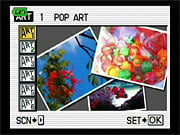
Pop art: Boosts colors, but it's more than just a saturation bump, the effect is something different, "pop art" is as good a description as any.
|
Soft Focus: Just what it says. It wasn't clear in the briefing to what extent the prototype was actually shifting focus optically vs just applying a filter.
|
Pale & Light Color: From Olympus: "Uses muted color tonalities to create a mood embraced in a gentle light."
|
 |
 |
 |
|
Light Tone: Tones down highlights, opens shadows. (Kind of like the Highlight/Shadow filter in Photoshop.)
|
Grainy Film: Wow, this one was nostalgic for us: It really brought back memories of souping Tri-X black & white film in the darkroom. It may go overboard, though.
|
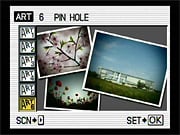
Pin Hole: Softer focus, vignetting, and skewed color to evoke the feeling of images shot with a pinhole or toy camera.
|
I shot a bit with the Art Effects enabled, and found Pop Art and Pin Hole to be the more compelling modes. Pop art was able to turn a flat Winter day into a warmer Fall day, as it found and amplified oranges in particular. It also turned my faded old catamaran into a bit of Americana. Pin Hole mode produces shots that remind me more of images from an old Brownie camera, with shaded corners and slightly aged colors. Grainy film had too many plugged shadows and blown highlights to be usable in daylight; perhaps it would be better in the shade.
Art Filters: Students at the University of the Arts in Philadelphia try out Olympus's new in-camera effects.
It's nice and appropriately digital to have these capture modes on a digital SLR. I'd like to see more modes, though, and it would be better to have them also built into the Olympus Master software so you could apply the filters after capture. Olympus rightly points out that some of the modes aren't possible after capture, because they tweak things like exposure and focus, which can't easily be done after the fact, but surely they could do some of it with the capacity of RAW files. Better would be the ability to download effects that you want to create and upload them into your E-620. Creating an engine on the computer that could help people create Art Filters, much like Canon's Picture Styles software, and copy them back to their camera would make a promising feature even more valuable.
Art Filter effects are applied only to JPEG images. If you're shooting in JPEG mode, the images saved to the card will have the chosen effect applied to them. If you're in RAW+JPEG mode, though, the JPEGs will have the chosen filter applied, while the RAW files will be undisturbed. That's actually great, because if you decide you don't like the effect of the filter, you still have the RAW image, provided you shot in RAW + JPEG mode.
Live View. The Olympus E-620, like its recent predecessors, has three AF modes in Live View. The first, called AF Sensor, uses the more traditional AF method: dropping the mirror to use the traditional autofocus sensors. The unfortunate side-effect of this is that you lose Live View while the camera tries to focus, which often makes the process slow. The next mode, however, is a blend of the contrast-detect mode most people are used to on their old digital cameras and the traditional SLR AF method mentioned above. The E-620 uses contrast detect to get the focus inline while you watch, then when you press the shutter, it drops the mirror, focuses with the AF sensors, and takes the shot. Provided you or your subject doesn't move much, this is a pretty good compromise that gives you the interface you're used to from point-and-shoot digital cameras, combined with the accuracy inherent in SLRs. If you'd rather get shots faster, and don't mind relying on contrast-detect autofocus alone, you can set the E-620 to Imager AF. In this mode, you can move the AF box around the screen or let the E-620 select from among 11 areas on the screen.
It all works pretty well, if a little slowly at times. The fastest option in most situations is to not use Live View at all and shoot with the viewfinder, which automatically puts you in AF sensor mode. But Live View has its advantages, especially with the articulating screen.
Multiple exposure. Like the E-30, the Olympus E-620 can either capture or combine multiple images into one and save the resulting image to the card. Unlike the E-30, the E-620 can only combine two images at once. (Screens below are from the E-30).
| Olympus E-620 Multiple Exposure Feature Menu Screens | ||
 |
 |
 |
|
Select Multiple Exposure via Shooting Menu #2.
|
Choices are number of frames, auto gain setting for merging images and overlay image selection.
|
You can choose to combine only two images into a single image.
|
 |
 |
|
|
Auto gain adjusts the brightness of each shot as you merge them, so all images are combined equally in the final frame.
|
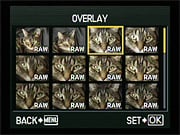
The third option on the menu lets you choose a single RAW file from the memory card to use as the first image of your composite.
|
|
This first image will appear on the LCD screen while you're shooting the first new image, and will be merged into the final image just as if you'd shot it as part of the series. You can only merge-in one image from the memory card, and it must be a RAW file.
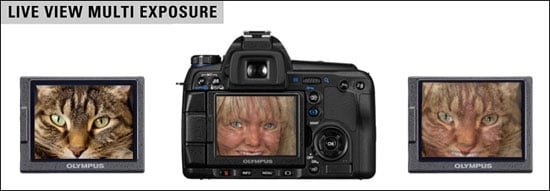
Because the Olympus E-620 has both a CompactFlash and an xD card, you can use one card to store a bunch of RAW images, say of the moon, as a PR person we know has done, and then you can combine that moon with any image you choose to take, inserting and blending in the moon into any sky you like. It's a trick from the old days of film that's continuing to make its way back into modern SLRs.
 Storage and battery. The Olympus E-620 offers both xD Picture Card and CompactFlash card slots. Images can be copied between cards. The E-620 uses the BLS-1 lithium-ion battery used in the E-420, and is capable of capturing 500 shots using the optical viewfinder, according to CIPA standards. The E-620 comes with the BCS-1 battery charger and one BLS-1 battery.
Battery grip. The new HLD-5 battery grip mounts to the E-620 for easier vertical shooting and additional battery capacity. The grip holds two battery packs, and uses a tower-style connectivity system that reaches up into the E-620's battery compartment. Pricing on the HLD-5 was not known at press time.
 Availability and pricing. The Olympus E-620 digital SLR will be available from May 2009. The E-620 body has an estimated street price of US$699.99, while the E-620 body bundled with the ED 14-42mm f3.5/5.6 Zuiko Digital Zoom lens has an estimated street price of US$799.99.
Underwater housing. Olympus being who they are, they've been sure to create an underwater housing for the E-620. Called the PT-E06, the housing allows you to use all the camera's controls and can handle submersion to 130 feet.
Shooting. Since it's only a prototype, there's not much I can report from shooting with the E-620 that I haven't already mentioned. It feels more like an E-520, despite the smaller size, which is likely due to the greater weight. It shoots about as fast as the E-520, with the added benefit of a 7-point autofocus system. Shooting with the articulating screen is quite a bit more versatile, more fully realizing Olympus's long progress in Live View SLR photography, and advancing the E-620 beyond the other major SLR manufacturers who have mostly caught up in other areas.
Analysis. Overall, the Olympus E-620 is the best of the company's consumer SLRs, offering a feature-set that is superior to the E-420 and E-520. It has more autofocus points, higher resolution, a faster frame rate, an articulating screen, and the built-in art filters, just to name a few points. Though it's heavier than the E-420, its small size helps mitigate that; and the available battery grip means users can have a compact photography solution with as little or as much capability as they need at the time. We'll have to reserve judgement on the image quality and timing at this point, since what we saw was not final, but the E-620 seems to meet or exceed the E-520's functionality. And there's no question that the Olympus Zuiko Digital lenses have a lot to offer in terms of optical quality. Each of them will be stabilized, thanks to the E-620's built-in stabilization, which somewhat makes up for the high price you'll have to pay for some of this fine glass.
As it has been from the advent of the SLR -- with the brief exception of the OM-10 -- Olympus SLR quality and unique utility remains the secret of the company's longtime fans. With each new camera, though, Olympus gets harder to ignore. Considering its features against its low price, the Olympus E-620 is easy to admire, and certainly worth a closer look.
Comparison
Olympus E-620 Comparison
The chart below compares the E-620 with other current Olympus DSLRs. We've used color tints in the cells to highlight differences. A red cell means that the the camera involved has lesser specs than the others, a green cell that it has better, and a yellow cell that its specification is somewhere between.
Note: if you're having trouble seeing the entire width of the table, try the "Print this Page" link near the bottom of the page.
| E-620 versus other current Olympus DSLRs | |||||
|
Manufacturer
|
Olympus |
Olympus
|
Olympus | Olympus | |
|
Model
|
E-30 |
E-620
|
E-520 | E-420 | |
|
Imaging
System |
Sensor Manufacturer
|
Panasonic | Panasonic | Panasonic | Panasonic |
|
Sensor Type
|
Live MOS (NMOS) | Live MOS (NMOS) | Live MOS (NMOS) | Live MOS (NMOS) | |
|
Color Filter Array
|
RGB | RGB | RGB | RGB | |
|
Total Megapixels
|
13.1 |
13.1
|
11.8 | 11.8 | |
|
Effective Megapixels
|
12.3 | 12.3 | 10.1 | 10.1 | |
|
Effective Sensor Size (mm)
|
17.3 x 13.0 |
17.3 x 13.0
|
17.3 x 13.0 | 17.3 x 13.0 | |
|
Focal Length Multiplier (approx.)
|
2.0x |
2.0x
|
2.0x | 2.0x | |
|
Image Processor
|
TruePic III+ |
TruePic III+
|
TruePic III | TruePic III | |
|
Viewfinder
|
Type
|
Eye-level pentaprism |
Eye-level pentaprism
|
Eye-level pentamirror | Eye-level pentamirror |
|
Coverage
|
98% |
95%
|
95% | 95% | |
|
Magnification (-1 diopter with 50mm lens at infinity)
|
1.02x |
0.96x
|
0.92x | 0.92x | |
|
Eyepoint (mm)
|
24.2 |
18
|
14 | 14 | |
|
Dioptric Adjustment Range (diopters)
|
-3.0 to +1.0 |
-3.0 to +1.0
|
-3.0 to +1.0 | -3.0 to +1.0 | |
|
Focusing Screen
|
Fixed (Matte with AF/Metering marks) |
Fixed (Matte with AF/Metering marks)
|
Fixed (Matte with AF/Metering marks) | Fixed (Matte with AF/Metering marks) | |
|
Viewfinder
Info Display |
AF points, Spot metering area, Super FP flash mode, Metering mode, Shutter speed, Aperture value, Exposure mode, Number of storable sequential pictures, Image stabilizer, Auto ISO sensitivity, Flash status, AF confirmation mark, Flash, exposure compensation, AE lock, WB, Exposure level / compensation indicator, Auto bracket, ISO sensitivity value, Battery status |
AF points, Spot metering area, Super FP flash mode, Metering mode, Shutter speed, Aperture value, Exposure mode, Number of storable sequential pictures, Image stabilizer, Auto ISO sensitivity, Flash status, AF confirmation mark, Flash, exposure compensation, AE lock, WB, Exposure level / compensation indicator, Auto bracket, ISO sensitivity value, Battery status
|
AF points Shutter speed, Aperture value, AF confirmation mark, Flash, WB, AE lock, Number of storable still images, Exposure compensation value, Metering mode, Battery warning, Exposure mode, Record mode, IS activating mode | AF points, Shutter speed, Aperture value, AF confirmation mark, Flash, White balance, AE lock, Number of storable still pictures, Exposure compensation value indication, Metering mode, Battery check, Exposure mode, Record mode | |
|
Depth of Field Preview
|
Yes (Preview Button) |
Yes (Fn Button Customization)
|
Yes (Fn Button Customization) | Yes (Left Arrow Button Customization) | |
|
Recording
System |
Recording Media / Quantity / Slot Type
|
Type I or II CF card / Microdrive, xD-Picture Card |
Type I or II CF card / Microdrive, xD-Picture Card
|
Type I or II CF card / Microdrive, xD-Picture Card | Type I or II CF card / Microdrive, xD-Picture Card |
|
Compatible File System
|
FAT 16 / FAT 32 |
FAT 16 / FAT 32
|
FAT 16 / FAT 32 | FAT 16 / FAT 32 | |
|
Recording Formats
|
RAW (12-bit ORF), JPEG |
RAW (12-bit ORF), JPEG, TIFF
|
RAW (12-bit ORF), JPEG | RAW (12-bit ORF), JPEG | |
|
Maximum Resolution
|
4032 x 3024 |
4032 x 3024
|
3648 x 2736 | 3648 x 2736 | |
|
Reduced Resolutions (JPEG only)
|
3200 x 2400, 2560 x 1920, 1600 x 1200, 1280 x 960, 1024 x 768, 640 x 480 |
3200 x 2400,
2560 x 1920, 1600 x 1200, 1280 x 960, 1024 x 768, 640 x 480 |
3200 x 2400, 2560 x 1920, 1600 x 1200, 1280 x 960, 1024 x 768, 640 x 480 |
3200 x 2400, 2560 x 1920, 1600 x 1200, 1280 x 960, 1024 x 768, 640 x 480 |
|
|
RAW + JPEG Recording
|
Yes, Selectable JPEG resolution / compression |
Yes, Selectable JPEG resolution / compression
|
Yes, Selectable JPEG resolution / compression | Yes, Selectable JPEG resolution / compression | |
|
Color Space &
White Balance |
User-
Selectable Color Space |
Yes sRGB + Adobe RGB |
Yes
sRGB + Adobe RGB |
Yes sRGB + Adobe RGB |
Yes sRGB + Adobe RGB |
|
Processing Parameters
(Contrast, Sharpness, Saturation, Color Tone) / # of Increments |
5 options each for sharpness, saturation, and contrast. Auto, Normal/Low/High-key Gradation adjustment |
5 options each for sharpness, saturation, and contrast. Auto, Normal/Low/High-key Gradation adjustment
|
5 options each for sharpness, saturation, and contrast. Auto, Normal/Low/High-key Gradation adjustment | 5 options each for sharpness, saturation, and contrast. Auto, Normal/Low/High-key Gradation adjustment | |
|
Preset WB settings
|
9 (Auto, 4 Custom, plus 7 Kelvin Temperature settings correlated with common light sources, such as incandescent, various types of fluorescent, etc.) |
9 (Auto, Custom, plus 7 Kelvin Temperature settings correlated with common light sources, such as incandescent, various types of fluorescent, etc.)
|
9 (Auto, Custom, plus 7 Kelvin Temperature settings correlated with common light sources, such as incandescent, various types of fluorescent, etc.) | 9 (Auto, Custom, plus 7 Kelvin Temperature settings correlated with common light sources, such as incandescent, various types of fluorescent, etc.) | |
|
Manual Color Temperature Setting Range
|
2,000 - 14,000K |
2,000 - 14,000K
|
2,000 - 14,000K | 2,000 - 14,000K | |
|
WB Adjustment Range
|
+/- 7 steps in each R-B/G-M axis (in Auto WB / Preset WB mode / One touch WB) |
+/- 7 steps in each R-B/G-M axis (in Auto WB / Preset WB mode / One touch WB)
|
+/- 7 steps in each R-B/G-M axis (in Auto WB / Preset WB mode / One touch WB) | +/- 7 steps in each R-B/G-M axis (in Auto WB / Preset WB mode / One touch WB) | |
|
Autofocus
System |
Type
|
TTL phase detection |
TTL phase detection
|
TTL phase detection | TTL phase detection |
|
# of Focusing Points (Focusing Point Type)
|
11 points, all twin cross-type |
7 points, 5 cross-type
|
3 points, 1 cross-type | 3 points, 1 cross-type | |
|
Super-
imposed Focus Point Display |
Yes | Yes | Yes | Yes | |
|
AF Working Range
|
EV -2 ~ 19 (ISO 100) |
EV -1 ~ 19 (ISO 100)
|
EV 0 ~ 19 (ISO 100) | EV 0 ~ 19 (ISO 100) | |
|
AF-assist Beam
|
With built-in flash unit, and on dedicated Olympus external flash units. Note: Only available when flash is enabled. |
With built-in flash unit, and on dedicated Olympus external flash units. Note: Only available when flash is enabled.
|
With built-in flash unit, and on dedicated Olympus external flash units. Note: Only available when flash is enabled. | With built-in flash unit, and on dedicated Olympus external flash units. Note: Only available when flash is enabled. | |
|
Exposure
Control |
Shooting Modes
|
7 - Auto, Program, Aperture-Priority, Shutter-Priority, Manual, Scene Program, Scene Select.
11 Scene modes |
7 - Auto, Program, Shutter-Priority, Aperture-Priority, Manual, Scene Program, Scene Select.
13 Scene modes |
7 - Auto, Program, Aperture-Priority, Shutter-Priority, Manual, Scene Program, Scene Select.
20 Scene modes |
7 - Auto, Program, Aperture-Priority, Shutter-Priority, Manual, Scene Program, Scene Select.
18 Scene modes |
|
Art Filters
|
6 | 6 | No | No | |
|
Metering Zones
|
49 |
49
|
49 | 49 | |
|
Metering Modes
|
Digital ESP (evaluative), Center -weighted Average, 2% Spot, Highlight Spot, Shadow Spot |
Digital ESP (evaluative), Center -weighted Average, 2% Spot, Highlight Spot, Shadow Spot
|
Digital ESP (evaluative), Center -weighted Average, 2% Spot, Highlight Spot, Shadow Spot | Digital ESP (evaluative), Center -weighted Average, 2% Spot, Highlight Spot, Shadow Spot | |
|
Metering System Working Range
|
Digital ESP, Center-weighted, Spot; EV 1 ~ 20 |
Digital ESP , Center-weighted, Spot;
EV 1 ~ 20 |
Digital ESP, Center-weighted, Spot; EV 1 ~ 20 |
Digital ESP, Center-weighted, Spot; EV 1 ~ 20 |
|
|
ISO Range / Extended
|
100 ~ 3200 |
100 ~ 3200
|
100 ~ 1600 | 100 ~ 1600 | |
|
Exposure Comp.
|
+/- 5EV in 1, 1/2 or 1/3EV increments |
+/- 5EV in 1, 1/2 or 1/3EV increments
|
+/- 5EV in 1, 1/2 or 1/3EV increments | +/- 5EV in 1, 1/2 or 1/3EV increments | |
|
Automatic Exposure Bracketing
|
3 or 5 shots in +/- 1, 0.7 0.5 or 0.3 EV steps |
3 or 5 shots in +/- 1, 0.7 0.5 or 0.3 EV steps
|
3 shots in +/- 1, 0.5 or 0.3 EV steps | 3 shots in +/- 1, 0.5 or 0.3 EV steps | |
|
Multiple Exposure
|
Yes, 4 images
|
Yes, 2 images
|
No
|
No
|
|
|
Shutter Speeds,
Frame Rate, Shutter Lag |
Shutter Type
|
Mechanical Focal Plane, electronically controlled; rated to 150K cycles |
Mechanical Focal Plane, electronically controlled
|
Mechanical Focal Plane, electronically controlled | Mechanical Focal Plane, electronically controlled |
|
Shutter Speed Range
|
1/8000 ~ 60 sec., bulb |
1/4000 ~ 60 sec., bulb
|
1/4000 ~ 60 sec., bulb | 1/4000 ~ 60 sec., bulb | |
|
Maximum Frames Per Second
|
5 fps |
4 fps
|
3.5 fps | 3.5 fps | |
|
Shutter lag, full AF (sec.)
|
TBD | TBD | 0.135 | 0.138 | |
|
Shutter lag, prefocus (sec.)
|
TBD | TBD | 0.080 | 0.082 | |
|
Startup time (sec.)
|
TBD | TBD | 1.4 | 0.8 | |
|
Flash
|
Built-in Flash / Guide Number at ISO 100.
|
Yes (13 meters / 43 feet) |
Yes (12 meters / 39 feet)
|
Yes (12 meters / 39 feet) | Yes (12 meters / 39 feet) |
|
Max flash x-sync speed. (sec.)
|
1/250 (Super FP up to 1/8000) |
1/180
(Super FP up to 1/4000) |
1/180 (Super FP up to 1/4000) |
1/180
(Super FP up to 1/4000) |
|
|
Flash Exposure Comp.
|
+/- 3 EV in 1, 0.5, 0.3 EV steps |
+/- 3 EV in 1, 0.5, 0.3 EV steps
|
+/- 3 EV in 1, 0.5, 0.3 EV steps | +/- 2 EV in 0.3 EV steps | |
|
Slow-sync flash
|
1st or 2nd curtain |
1st or 2nd curtain
|
1st or 2nd curtain | 1st or 2nd curtain | |
| Wireless support | Yes, 4 channels, 3 groups |
Yes, 4 channels, 3 groups |
Yes, 4 channels, 3 groups |
Yes, 4 channels, 3 groups |
|
|
PC Sync Terminal
|
Yes |
Hot shoe only
|
Hot shoe only | Hot shoe only | |
|
Playback
System |
LCD Size / Pixel Count
|
2.7 in LCD / 230,000 pixels |
2.7 in LCD / 230,000 pixels
|
2.7 in LCD / 230,000 pixels | 2.7 in LCD / 230,000 pixels |
|
Swivel LCD
|
Yes | Yes | No | No | |
|
Enlarged Playback / Scroll
|
2 - 14x / Yes |
2 - 14x / Yes
|
2 - 14x / Yes | 2 - 14x / Yes | |
|
LCD Monitor Brightness Adjustment Range
|
15 steps, plus 15 steps color balance |
15 steps,
plus 15 steps color balance |
15 steps, plus 15 steps color balance |
15 steps, plus 15 steps color balance |
|
|
Automatic Rotation for Vertical Shots
|
Yes |
Yes
|
Yes | Yes | |
|
Other Features
|
Computer Connection
|
Yes, PTP-compliant (USB 2.0 High Speed) |
Yes, PTP-compliant (USB 2.0 High Speed)
|
Yes, PTP-compliant (USB 2.0 High Speed) | Yes, PTP-compliant (USB 2.0 High Speed) |
|
Direct Printing (PictBridge compliant printers)
|
Yes |
Yes
|
Yes | Yes | |
|
Menu Languages
(varies by region; others downloadable via software) |
4 (English, French, Spanish, Portuguese) |
4 (English, French, Spanish, Portuguese)
|
4 (English, French, Spanish, Portuguese) | 4 (English, French, Spanish, Portuguese) | |
|
Camera Default Reset
|
Yes |
Yes
|
Yes | Yes | |
|
Custom Functions
|
Yes |
Yes
|
Yes | Yes | |
|
Remote Control
|
Optional RM-1 |
Optional RM-1
|
Optional RM-1 | Optional RM-1 | |
|
Info LCD Panel / Illumination
|
Yes / Yes |
No / n/a
|
No / n/a | No / n/a | |
|
Articulating LCD
|
Yes | Yes | No | No | |
|
Backlit Buttons
|
No | Yes | No | No | |
|
Ultrasonic CCD dust-removal
|
Yes |
Yes
|
Yes | Yes | |
|
Live View
|
Yes | Yes | Yes | Yes | |
|
Digital Level
|
Yes
|
No
|
No
|
No
|
|
|
Image Stabilization
|
Yes, 3-mode CCD-shift type, 5-stops |
Yes, 3-mode CCD-shift type, 4-stops |
Yes, 3-mode CCD-shift type, 4-stops |
No | |
|
Body Structure
|
Body Cover / Chassis
|
Mostly Plastic |
Mostly Plastic
|
Mostly Plastic | Mostly Plastic |
|
Splash & Dust proof
|
No | No | No | No | |
|
Power System
|
Battery Compatibility
|
BLM-1 |
BLS-1
|
BLM-1 | BLS-1 |
|
Rated Shooting Capacity at 20°C/68°F
|
750 shots CIPA standard (Live View off) |
500 shots
CIPA standard (Live View off) |
650 shots CIPA standard (Live View off) |
500 shots CIPA standard (Live View off) |
|
|
Battery Holder
|
Yes, HLD-4 |
Yes, HLD-5 |
No | No | |
|
Dimensions & Weight
|
Dimensions (WxHxD, mm)
|
141.5 x 107.5 x 75 |
130 x 94 x 60
|
136 x 91.5 x 68 | 129.5 x 91 x 53 |
|
Weight (body only)
|
655g |
475g
|
475g | 380g | |
|
Oper.
Env. |
Operating Temperature Range
|
0 ~ 40°C |
0 ~ 40°C
|
0 ~ 40C | 0 ~ 40°C |
|
Operating Humidity Range
|
30 - 90% |
30 - 90%
|
30 - 90% | 30 - 90% | |
|
Kit Lens
|
Focal length / aperture
|
14 - 54mm f/2.8 - 3.5 II |
14 - 42mm
f/3.5 - 5.6 |
14 - 42mm f/3.5 - 5.6 |
14 - 42mm f/3.5 - 5.6 |
|
Lens Compatibility
|
Lens Mount / Compatibility
|
Zuiko Digital, Four Thirds System Lens |
Zuiko Digital, Four Thirds System Lens
|
Zuiko Digital, Four Thirds System Lens | Zuiko Digital, Four Thirds System Lens |