

Overview

2012 was an important year for the camera market. Not only was it the first in which the compact camera sales started their death plunge, as snapshooters shunned standalone cameras in favor of those built into their shiny new smartphones. It was also the year in which Olympus launched a camera series with which it has offered a compelling reason to put down that phone and shoot with a real camera: The Olympus Tough TG-series.
Of course, the company was already a specialist in the so-called "lifestyle camera" market, offering many ruggedized and weather-proofed models long before the debut of the TG-series. But with the original TG-1, Olympus took a different tack than with its past lifestyle models (not to mention those of its rivals), emphasizing not just their rugged, go-anywhere bodies, but also their image quality.
|
Olympus TG-6 Hands-on Tour
|
The TG-series focus on image quality remains
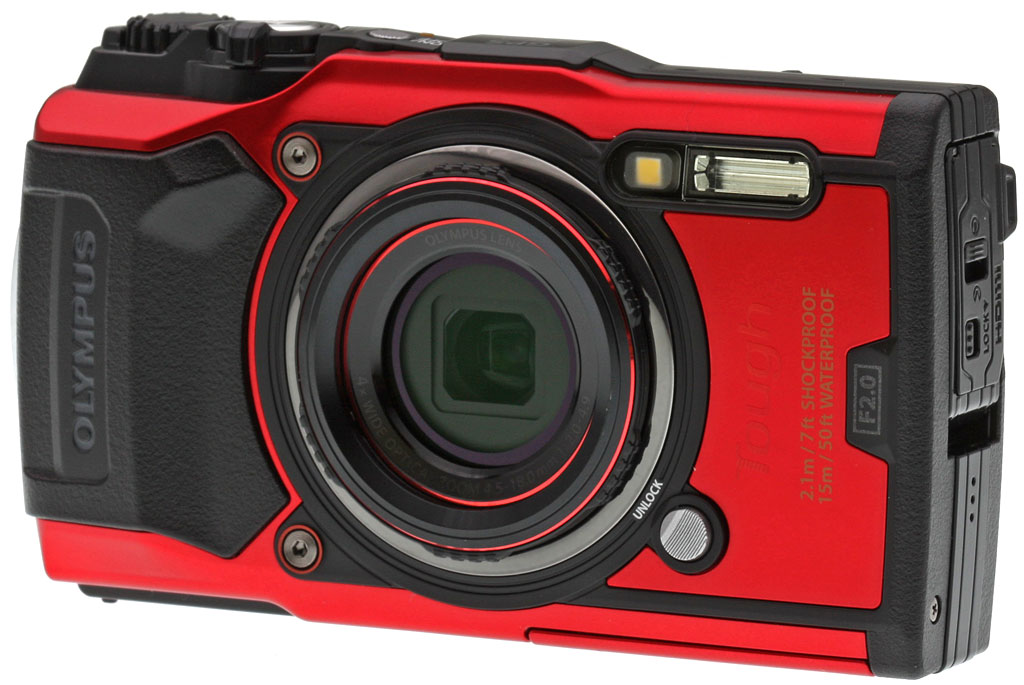
Fast-forward to the present day, and while it's largely a new camera inside and out, the Olympus TG-6 nevertheless still looks remarkably similar to the original TG-1, as well as to the four generations which have followed in between times. Up front, it still sports the same prism-folded, 25-100mm equivalent, 4x optical zoom lens as in the TG-1, and as in that camera, it still sits behind a 12-megapixel, 1/2.3-inch image sensor.

The keys to the original TG-1's focus on image quality were the significantly larger pixels allowed by its lower-than-average sensor resolution, and a lens which included some more exotic items like dual super aspheric, high definition and high refractive index elements, as well as a much brighter than average maximum aperture of f/2.0 -- at wide angle, at least. (Zoom in, though, and the aperture fell to an eventual f/4.9 by the telephoto position.)
So does the rugged, go-anywhere body
Both of these keys remain for this latest generation, too, so you can expect image quality that's better overall than a typical compact, go-anywhere camera. And you can also expect to take the TG-6 just about anywhere you might reasonably want to go yourself, without too much worry. Just like its most recent predecessor, the TG-5, this is one seriously solid camera.
The Olympus TG-6 is waterproof to 50 feet (15 m), dustproof, freezeproof to 14°F (-10°C), able to withstand 220 pounds (100 kg) of crushing force, and is even capable of surviving a drop from seven feet (2.1 m). And it still boasts a hermetically sealed, dual-pane cover glass over the lens. The cavity between the two panes is filled with nitrogen, which helps avoid the lens fogging up when the temperature suddenly changes.

Much the same body, but with tweaks and a new display
But enough of what's unchanged. What's new in this latest generation of the TG-series? Starting on the outside, the most immediately obvious change is a toning down of the branding, with the bold, white fonts of the previous camera replaced with more subtle, near-body colored lettering instead. It makes for a less busy, more mature aesthetic that, to our eyes at least, is a good bit more handsome as a result.
A rather more subtle change is the addition of a grooved texture to the top-deck power button, which mirrors that of the lens ring release button on the camera's front surface. And that's about it for the visual changes, at least until you power the camera on. Do so, and the switch to a much higher-resolution 1,040k-dot LCD panel from the earlier 460k-dot panel is also immediately obvious.
Between these and some internal changes which we'll come to in a moment, there's been an essentially unnoticeable increase of 0.1 ounces (3g) in weight, leaving the TG-6 tipping the scales at around 8.92 ounces (253g), loaded and ready to shoot. Body depth has also increased by a half-millimeter, a change so small you'd be unable to notice it even comparing both cameras side-by-side. (Overall dimensions are now 4.43 x 2.6 x 1.23 inches, or 113 x 66 x 32.4mm.)

Improved image quality thanks to anti-reflective coatings on the sensor cover glass
On the inside, you'll find not only the same sensor as in the TG-5, but also the same TruePic VIII-branded image processor. And yet despite retaining the same sensor, processor and lens as in the previous generation, you can expect a decided step forward in image quality in some shooting situations.
How so? Well, Olympus has added an anti-reflective coating to both sides of the cover glass which overlies the sensor surface. This change should lead to reduced flare and ghosting, an improvement which will be especially noticeable on high-contrast edges.
Several improvements for underwater shooters, too
Another area which has clearly been a point of focus for Olympus is underwater shooting. There are several improvements in this respect which should make the TG-6 a more capable shooter for the diving fans amongst us.
First of all, you now have a choice of three different underwater white balance modes: Shallow, mid-range or deep. Each of these is tuned to account for variations in how the light filters down through the water. Using the shallow position, you'll see an improvement in red colors, while the deep position will improve the blues. (The mid-range position mirrors the previous, single underwater white-balance mode of the TG-5.)

You'll also find that when you switch between the five different underwater shooting modes available, that the camera will automatically set itself up as Olympus recommends in each scenario, although you can override these defaults if you choose. For example, switching to underwater snapshot mode will also select the shallow underwater white balance setting. Underwater HDR, meanwhile, will opt for mid-range white balance.
Microscope mode now brings crazy-close macros underwater, as well
So too will the underwater wide, macro and microscope modes. Yes, you read that right: Microscope mode now works underwater, not just above the surface as in past models. Not familiar with the this function? Well, it allows focusing to as little as just 0.4 inches (1cm), so if your subject won't flee if you get right up in its face, then you can get some really up close and personal macros!
Underwater wide mode will also zoom out to the wide-angle position for you when selected, while underwater macro will switch to telephoto. Finally, underwater microscope mode will require macro focusing in a range from 1 to 10cm, and will default to a 2cm focus distance if a focus lock can't be achieved.
There are a couple of other points underwater photographers will want to make note of, which we'll come to in the accessories section towards the end of the piece, incidentally, so do keep reading!

Focus crazy-close in other modes also, or even stack focus in-camera
Incidentally, Microscope mode -- which is still accessed via a dedicated position on the rear-panel mode dial -- no longer has dibs on the ultra-close 04.-inch (1cm) minimum focusing distance. You can now also focus this close using the super macro AF mode with both program and aperture-priority autoexposure. (Somewhat sadly, for a camera aimed at enthusiast use, shutter-priority and manual exposure still aren't offered in this model, likely because the lens continues to only implement three aperture settings at any given focal length, one of which is achieved via an ND filter. You do get two custom modes and a healthy choice of scene modes, plus an intelligent auto mode for quick snapshots, though.)
But I digress. Returning to focusing, you can also both bracket focus, and focus-stack images in-camera, as you could in the TG-5. However, the focus stacking function now works a little differently to how it did in the past. Previously, eight frames were captured automatically, and then the camera would save both the first unstacked frame, and the result of stacking all eight frames, selecting only the sharpest areas from any available image to create one shot with much greater depth of field. Now, the function is much the same from an end user standpoint, but the number of frames per stacked shot varies from three to 10, as the camera deems necessary.

Some other firmware tweaks, as well
These aren't the only changes that Olympus has made in firmware between the TG-5 and TG-6, by any means. Other tweaks include new bleach bypass and instant film art filters, in addition to the dozen-plus other art filter effects that were already available.
There's also a new 2x digital teleconverter (ie. digital zoom) function, and perhaps more usefully for enthusiasts, you can now set a minimum shutter speed beyond which the TG-6 should ramp up its sensitivity, if possible instead. Both of these options are available only for program, aperture-priority stills. (Digital teleconverter is also applicable for movie capture.)
Olympus has also added back the date imprinting function which was removed in an earlier model, citing a need from government and law enforcement for the feature. (You can, once more, have either date, time, or both recorded permanently in the image data, rather than just in the EXIF header of the image. Sure, it could still be modified post-capture, but not quite as easily as could the EXIF headers.)

And one last notable change is the addition of a Full HD resolution option for time-lapse movie capture, where previously the TG-5 only allowed either 4K or HD time-lapses. Capture frame rate options for the Full HD time-lapse mode are the same as for HD, with the exception of the 30fps option: 5, 10 or 15 fps. For 4K, there's still a fixed 5 fps capture rate.
Ultra-high def and high-speed video capture as in the TG-5
And that's about it for the new features of the camera itself. In most respects, the Olympus TG-6 is pretty similar to the TG-5 which preceded it. (Including its movie capture capabilities, which we might as well finish discussing as we're already on the topic.)
The TG-6 can still record ultra-high definition or high definition footage in-camera. For 4K (3,840 x 2,160 pixel) content, Olympus is using the entire sensor width without pixel binning or skipping, and with a fixed, fairly high 102Mbps bitrate and a choice of 25 or 30 frames per second capture rates. That's far better than the typical compact camera, let alone an underwater model.

Drop the resolution to Full HD (1,920 x 1,080 pixels), and you'll have a choice of 25, 30, 50 or 60 fps capture. Finally, at HD (1,280 x 720 pixel) resolution, there's a choice of 25 or 30 fps capture. Full HD and HD video allows bitrates from 52 to 18 Mbps.
As well as the aforementioned standard and time-lapse movies, the TG-6 can also capture high-speed movies at Full HD, HD or SD (640 x 360 pixel) resolution. Full HD high-speed movies can be captured at 120 fps, while HD allows 240 fps and SD can reach a maximum of 480 fps capture.
Performance, sensitivity and most creative options are unchanged, too
Not surprisingly, given that it bears the same sensor and processor as its predecessor, the Olympus TG-6 also mirrors the TG-5 in terms of performance and sensitivity. The TG-6 has a base sensitivity of ISO 100, and can roam as high as a maximum of ISO 12,800 under either manual or automatic control. (By default, the auto mode is capped at ISO 1600, however.)

Full-res burst capture rate is possible at five frames per second with a mechanical shutter, or you can shoot at 10 or 20 fps --even with raw files -- when using an electronic shutter. You can also shoot at 10 fps with electronic shutter in Pro Capture mode, which can shoot bursts of frames constantly until you press the shutter button, then lets you reach back in time as long as ten seconds before the shutter was tripped to find the perfect capture. Buffer depth at 20 fps is essentially unlimited for large/normal JPEGs, and up to 14 frames for raw files.
There's also still a live composite mode that continuously records and combines images, discarding all but the brightest pixel for any given pixel location, and thereby allowing some really fun effects like light painting, or recording of light trails behind vehicles, fireworks, stars moving across the sky, and so forth. And the TG-6 can also shoot HDR imagery in-camera, both underwater and above the surface.

The Field Sensor System takes location awareness to the next level
Also retained from the TG-5 is Olympus' unusual (and very cool, if you're a data nerd) Field Sensor System, which comprises a GLONASS and QZSS-compliant GPS receiver and electronic compass, and an external temperature sensor that's isolated from the camera's own internal warmth so as to allow air / water temperature measurement to an accuracy of 1.8°F (1°C). There's also a manometer which allows measurement of altitude to an accuracy of 33 feet (10m) and underwater depth to an accuracy of three feet (1m).
All of this information can be displayed on-screen and recorded in-camera, and Olympus' free OI.Track app for Android or iOS phones and tablets can also be used to display images alongside a map of the capture location or an altitude / water depth graph. It can also overlay GPS track log, distance, speed, altitude / depth, compass direction, azimuth and date/time information on videos which can be shared with friends and family.
Connectivity and Wi-Fi
All of the requisite connectivity options you'd expect in a modern camera are presented and accounted for in the Olympus TG-6. You can transfer images to your smartphone or tablet for sharing online via its built-in 802.11 b/g/n Wi-Fi wireless networking radio.
You can also transfer data to your PC or Mac via a standard USB 2.0 Micro-B connector, or send it to a high-definition display via a Type-D Micro HDMI terminal.

Power and charging
The Olympus TG-6 accepts the same LI-92B lithium-ion battery pack as its predecessors since the TG-3, which is a nice touch if you're considering upgrading from an earlier model. Battery life is unchanged, with a maximum of 340 shots on a charge to CIPA testing standards.
Although the battery pack and power consumption aren't changed, a new optional dedicated battery charger is available, which carries a list price of US$70 / CAD$75 or thereabouts. The compact UC-92 battery charger can fully charge an LI-92B battery in two hours by drawing power from a USB port. The TG-6 ships with the same F-5AC USB-AC adapter as the TG-5, for in-camera charging via USB.
Storage and raw capture
The Olympus TG-6 is compatible with SD, SDHC or SDXC memory cards, including high-speed UHS-I types. SD cards with a speed class 10 or higher rating are recommended for movie capture, while 4K and high-speed movies require a UHS-I speed class 3 or higher card.
Very unusually for a compact camera -- but quite logically, in one aimed at enthusiasts -- you can opt to store your images not only as lossily-compressed JPEG files, but also as 12-bit losslessly-compressed raw files. You can also choose to have both formats recorded for every frame captured.

Accessories
Several new accessories are available alongside the Olympus TG-6. First of all, there's the CSCH-127 silicone jacket, which is as-yet unpriced, but allows use of both LG-1 LED light guide (US$41 / CAD$41) and FD-1 flash diffuser (US$52 / CAD$65) accessories without removal, and prevents your camera from scratches while improving grip.
There's also a PT-059 underwater case which can withstand depths of 148 feet (45m), tripling the distance you can roam beneath the surface, and besting the capabilities of recreational scuba divers by a good 18 feet (5m). Priced at around US$300 (CAD$330), the housing allows use of the control dial for exposure compensation, supports two optional, external flash strobes, and has a black finish on the front of the case to prevent reflections.

There's also a new FCON T-02 circular fisheye converter lens which supports both circular and diagonal fisheye photography, depending on the lens' focal length. The fisheye converter can be used on land or underwater, although obviously for the latter it will not provide as wide a field of view as it would on land. You'll also need the separately-available converter adapter CLA-T01 to attach the lens to your TG-6. The two will be sold together in a kit for about US$225 (CAD$293).
Finally for the new accessories, there's a new LB-T01 lens barrier, which protects the front lens element from scratches and dirt. It's designed so you can easily open and close it with gloves on, too, which is important given the freezeproof nature of the camera. Pricing for the lens barrier is set at about US$50 (CAD$60).
Other available accessories include the FCON-T01 fisheye converter (US$140 / CAD$140 with CLA-T01 adapter), TCON-T01 teleconverter (US$130 / CAD$130 with CLA-T01 adapter), the CLA-T01 adapter by itself (US$20 / CAD$20), the LC-40.5 lens cap (US$7.50 / CAD$10 and requires CLA-T01), and finally the PRF-D40.5 Pro lens filter (US$52 / CAD$52).

Olympus TG-6 price and availability
We've talked about the accessories, but what of the camera itself? Well, just like the TG-5 before it, the Olympus TG-6 carries a list price of US$450 (CAD$580). Available from late June 2019, it will be offered in a choice of red or black body colors in the North American market.
Performance
Timing and Performance
Very good to excellent performance for its class.
| Startup/Play to Record | ||
|---|---|---|
| Power on |
~0.9 second
|
Time it takes for LCD to turn on and lens to deploy and capture a picture. |
|
Play to Record, |
~0.6 second
|
Time until first shot is captured. |
Startup to first shot time was quite quick for a compact camera at about 0.9 second, and faster than the TG-5's 1.3 seconds. Play to Record mode switching was also faster at about 0.6 second vs 0.7 second for the TG-5.
| Shutter Response (Lag Time) | ||
|---|---|---|
|
Full Autofocus |
0.148 second
|
Time from fully pressing shutter button to image capture, zoom lens at wide angle position. |
|
Full Autofocus |
0.177 second
|
Time from fully pressing shutter button to image capture, zoom lens at telephoto position. |
|
Full Autofocus |
0.294 second
|
Time to capture while forcing flash to fire, zoom lens at medium focal length. |
|
Manual Focus |
0.081 second
|
For most cameras, shutter lag is less in manual focus than autofocus, but usually not as fast as when the camera is "prefocused". |
| Prefocused |
0.043 second
|
Time to capture, after half-pressing and holding shutter button. |
The Olympus TG-6's full autofocus shutter lag when shooting the same target multiple times was very fast for a rugged compact camera. The TG-6's full AF shutter lag clocked in at about 0.15 second at wide angle using center AF mode. Full AF shutter lag was just a bit slower at full telephoto at about 0.18 second, though that's still fast. Enabling the flash raised shutter lag to 0.29 seconds, to account for the metering preflash. Manual focus shutter lag was pretty quick at about 81 milliseconds, and prefocused shutter lag was fast at 43 milliseconds. Apart from AF lag with flash enabled, all of these times are slightly faster than the TG-5.
| Cycle Time (shot to shot) | ||
|---|---|---|
| Single Shot mode |
0.38 second
|
Average time per shot. |
| Single Shot mode |
0.38 second
|
Average time per shot. |
| Early shutter |
No
|
Some cameras don't snap another shot if you release and press the shutter too quickly in Single Shot mode, making "No" the preferred answer. |
|
Sequential High |
0.05 second
(20.0 fps); 27 frames total; 4.2 seconds to clear* |
Time per shot, averaged over 27 frame buffer, then slows down to 0.21s or 4.7 fps when buffer is full with a lot of variation. |
|
Sequential High |
0.05 second
(20.0 fps); 18 frames total; 4.5 seconds to clear* |
Time per shot, averaged over 18 frame buffer, then slows down to 0.29s or 3.5 fps when buffer is full with a lot of variation. |
|
Sequential High |
0.05 second
(20.0 fps); 15 frames total; 6.1 seconds to clear* |
Time per shot, averaged over 15 frame buffer, then slows down to 0.45s or 2.2 fps when buffer is full with a lot of variation. |
|
Sequential Low |
0.20 second
(5.0 fps); Unlimited; 0.5 second to clear* |
Time per shot, with no apparent limit other than available card capacity. |
|
Sequential Low |
0.20 second
(5.0 fps); 34 frames total; 5.0 seconds to clear* |
Time per shot, averaged over 34 frame buffer, then slows down to 0.32s or 3.2 fps when buffer is full with a lot of variation. |
|
Sequential Low |
0.20 second
(5.0 fps); 22 frames total; 7.7 seconds to clear* |
Time per shot, averaged over 22 frame buffer, then slows down to 0.44s or 2.3 fps when buffer is full with a lot of variation. |
| Flash recycling |
4.7 seconds
|
Flash at maximum output. |
| *Note: Buffer clearing times measured with a 64GB Lexar Pro 2000x UHS-II SDXC memory card. Slower cards will produce correspondingly slower clearing times. Slow cards may also limit length of bursts in continuous mode. ISO sensitivity also affects cycle times and burst mode performance, with higher ISOs generally increasing cycle times and reducing burst performance. |
||
Shot-to-shot cycle times were very fast in single shot mode, at about 0.4 second for Large/Super Fine JPEGs or RAW+LSF JPEG files. We no longer test just RAW file cycle time in single-shot mode, as it's usually somewhere in between JPEG and RAW+JPEG.
The Olympus TG-6's full-res Sequential High shooting mode (which uses an electronic shutter) was very fast at 20 frames per second (a 10 fps option is also available), and best quality JPEG buffer depth was 27 frames compared to 21 frames for its predecessor. Like the TG-5, the TG-6 supports bust RAW capture. Buffer depths of course were less than JPEGs at 18 RAW and 15 RAW+JPEG frames, but that's still not bad, and improved over the TG-5's 15 and 11 frames respectively. In Sequential Low mode which uses the mechanical shutter, the TG-6 shoots at 5.0 fps. JPEG buffer depth was unlimited at this speed, while RAW and RAW+JPEG buffers increased to 34 and 22 frames respectively, also improved over the TG-5.
The TG-6 also offers a Pro Capture mode at 10 fps which begins to take photos as soon as you half-press the shutter release but discards them except for up to 4 frames just before fully pressing the shutter, and of course it keeps the ones captured while the shutter is fully depressed. This helps capture fleeting moments that would be difficult to react in time for.
Buffer clearing was pretty swift with our Lexar Pro 2000x UHS-II card, taking at most 7.7 seconds after max-length bursts of RAW+JPEG frames, and you can adjust settings and take additional shots while it's clearing, though you can't view just-shot images until after they are flushed to the card.
The built-in flash took an average of 4.7 seconds to recharge after a full-power discharge which is a bit on the slow side.
Bottom line, the Olympus TG-6's performance is very good to excellent for its class, with many slight to moderate improvements over its predecessor.
Battery
Battery Life
Good battery life.
| Operating Mode | Number of Shots |
|---|---|
|
Still Capture
(CIPA standard, LCD Monitor) |
340
|
The Olympus TG-6 uses a custom LI-92B rechargeable lithium-ion battery for power (the same as the TG-5 and TG-4) and the battery is charged in-camera via the USB port. CIPA battery life is the same as the TG-5 which is good for its class, at 340 shots per charge. Still, we recommend you pick up a spare battery for extended outings.
The table above shows the number of shots the camera is capable of (on a fully-charged rechargeable battery as appropriate), based on CIPA battery-life and/or manufacturer standard test conditions.
(Interested readers can find an English translation of the CIPA DC-002 standards document here. (180K PDF document))