


Overview

---
The Panasonic FZ1000 is one of the most capable cameras available this side of $1,000. Curious to read about other options in this space? Check out our best compact camera for $1,000 article!
---
Finally, the large-sensor, superzoom camera category has a battle on its hands! The 20.1-megapixel Panasonic FZ1000 is a camera whose competitor is clear: This is a challenger for the Sony RX10's crown, and it's a mighty impressive one indeed.
At heart, both cameras are quite similar. The Panasonic FZ1000 and Sony RX10 are each based around 20-megapixel, 1.0-inch type CMOS image sensors. But the FZ1000 differs from -- and looks in some ways to better -- the RX10 in a number of key ways.
It's more affordable, yet has a significantly longer 16x zoom range, a noticeably-faster 12 frames-per-second burst capture rate and 4K video support. It also has a more versatile tilt/swivel LCD monitor, a much higher-resolution electronic viewfinder, and a wider shutter speed range.
On the flip side of the coin, it's rather bigger than its rival, especially in terms of depth. And perhaps not surprisingly, given the much greater zoom reach, it can't boast a constant aperture lens. Instead, its aperture lags that of the RX10 just slightly across most of the range where both lenses overlap. Nor does it provide quite the same wide-angle shooting opportunities, and battery life looks to be rather lower.
In most respects, though, the Panasonic FZ1000 looks to give you a similar feature-set to its incredibly popular rival, just with a more affordable price tag and a whole lot more zoom range in a slightly bigger package.

Place your order for the Panasonic FZ1000 at one of Imaging Resource's trusted affiliates:
- Adorama: Panasonic FZ1000 - $897.99
- B&H: Panasonic FZ1000 - $897.99
Hands-on with the Panasonic FZ1000
Initial thoughts on Panasonic's first large-sensor bridge camera
by Dave Etchells | Posted: 06/12/2014
I've always been a fan of so-called "bridge" cameras, those long-zoom models with higher-end capabilities that substitute for an SLR for many people. At some point, though, their low-light/high-ISO limitations frustrated me. For a while I carried a DSLR everywhere; more recently it's been a compact mirrorless model of one sort or the other. Both solutions were pretty limited in terms of focal length, unless I wanted to lug some heavy glass with me. The mirrorless cameras were better in this regard, but I still missed the all-in-one efficiency of a good bridge camera.

In the fall of 2013, though, Sony shook up the camera world with the release of their RX10. Finally, here was a camera with a reasonably large sensor (a "1.0-inch type"), and a wide-ratio f/2.8 zoom lens on the front! And it shot really great HD video, too! I first got hands-on with it at a Sony press event where we were also shooting with their full-frame mirrorless models, the A7 and A7R.
As amazing as the full-frame cameras were, I found myself gravitating towards the RX10; it was just so much fun to shoot with. It wasn't by any means a compact, but was definitely smaller than a typical SLR, and it gave me a zoom range from 28-200mm equivalent. For an extended vacation, I might still pack a DSLR or Micro Four Thirds camera alongside the RX10, but chances are that I'd end up using the latter almost exclusively.
The biggest drawback with the RX10 is its price; at US$1,300, it's a serious investment.
Now comes the Panasonic FZ1000 to send another shockwave through the camera world -- including Sony. Compared to the RX10, the Panasonic FZ000 zooms 2x longer (all the way out to 400mm equivalent), while keeping nearly the same wide-angle focal length (25mm vs 24mm eq.) and shoots 4K video (also allowing "4K Photo" use -- more on this later).
And it shoots up to 12fps at full resolution, or at 50fps at a five-megapixel image size, vs the Sony's 10fps, with both cameras having focus locked from the first frame. The FZ1000 also has a full tilt-swivel LCD screen, vs the tilt-only one on the Sony. About the only significant shortcoming on the spec sheet is that the Panasonic FZ1000's maximum aperture goes from f/2.8 to f/4.0, while the RX10's is a constant f/2.8. All this for US$900 or thereabouts, a whopping $400 less than the RX10.
Let's take a bit of an extended walkaround of the camera.

In the hand. My first impression of the Panasonic FZ1000 is that it's big, easily as bulky as a mid-sized consumer SLR. Interestingly, though, while it looks a lot bigger than the RX10, it's actually within a third-inch or so in width and height, the main difference being in its length. The FZ1000's eyepiece projects further back, and the lens a little further forwards, making it about 1.2 inches deeper. (The FZ1000 has a depth of 5.2 inches, versus 4.0 inches for the RX10.)
But while it's a fair bit bigger overall, the FZ1000 is almost indistinguishable from its competitor in terms of weight, at 831 grams (1.8 pounds) versus 813 grams, loaded and ready to go. So, while it looks a good bit bigger, the difference is such that it wouldn't affect my decision on which to carry.

Nice grip! What you do get from the Panasonic FZ1000 in exchange for its size (beyond the longer lens, of course), is a considerably more comfortable grip. The FZ1000 feels great in the hand. I actually quite liked the grip on the RX10, but I guess this is a case of not knowing what you're missing 'til you've tried it.
The FZ1000's grip is a whole lot more comfortable, and the camera as a whole is better-balanced than the Sony. It's really hard to say enough about this; it's just an entirely different experience holding the FZ1000. Go to a brick-and-mortar store and hold one in your hand -- once they're available, of course -- and you'll see what I'm talking about. Or just take my word for it, and get your preorder in now. ;-)
One place where the RX10 does win, though, is in how solid it feels. Being both smaller and yet almost as heavy as the FZ1000, it just feels solid. Some of the difference in feel is down to materials choices made on the FZ1000. Both cameras have a textured, rubbery coating covering their grip areas, but more plastic is left exposed in various places on the FZ1000's body. Its rubber coating stops short of the camera's base, doesn't extend quite as close to the lens on the left side, and doesn't cover the connector port door and surrounding area on the camera's right.
None of this has any impact on the FZ1000's "grip-ability", but it does mean that your fingernails are more likely to come in contact with the plastic body shell. When that happens, you get the usual higher-pitched, plasticky resonance, which makes the camera seem less solid than it probably is.
When it comes to shooting with the FZ1000, I find that the larger grip and slightly wider body make a noticeable difference in ease of operation. With the RX10, I'd complained about having to pull my index finger back so sharply to hit the shutter button. On the FZ1000, the shutter button is positioned further away from the right edge of the camera, and that combined with the thicker grip makes it much more comfortable to trip the shutter. My fingers aren't as scrunched on the grip, so the FZ1000 feels much more balanced and pleasant to shoot with.
The other top-panel controls are also much easier to operate, and I really like having the movie button on the top deck, versus the rear panel as in the RX10. Positioned as it is, the FZ1000's movie-record button is just a quick slide back from the shutter button, and impossible to miss. It might be a personal preference thing, but I really like the way the designers positioned the FZ1000's shutter and movie buttons.

Zoom and focus control. The FZ1000's aperture is electronically controlled, unlike the mechanically-coupled one on the RX10, so there's only one control ring on the FZ1000's lens barrel. A switch on the side of the lens lets you choose to control either focus or zoom with it. The only other control on the lens is the IS on/off selector.
Focus and zoom via the control ring are typical for fly-by-wire systems -- that is, not nearly as responsive as purely mechanical couplings. I have the same complaint about the FZ1000 here as I did about the RX10: Why not make the control ring velocity-sensitive, so it would make large adjustments when turned quickly, and smaller ones when rotated slowly.
I guess it's possible that the zoom motor just can't rack the lens any faster than it does currently, but I'd sure like the ability to zoom a little quicker, and with less movement of the ring to accomplish it when I'm making large changes.

Manual focusing. When focusing manually, you can choose to have either a magnified display or focus peaking enabled, or to have both at once. Initially, I was a little disappointed with the enlarged view, as I found it only zoomed up to 6x; not enough for precise focus adjustment, at least not in my book. Checking the manual, though, I discovered that pressing in on the control wheel at the top of the camera's rear panel toggled between a picture-in-picture magnified display, and one covering the entire screen.
In full-screen mode, the MF-assist zoom goes all the way to 10x, a much more useful level of magnification. (I have to wonder, though, why not allow it to zoom that much in the partial-frame display? If it's too hard to hold the camera on the subject, users could always just drop back to a lower magnification factor.)

EVF and LCD. The Panasonic FZ1000's image displays are just amazingly sharp and crisp. I suspect that the rear-panel LCD is the same 921K-dot one that everybody else seems to be using these days, but it seemed unusually sharp to my eye. Because it's a WhiteMagic RGBW panel, the RX10's display has more dots (1,229K), but both FZ1000 and RX10 have the same number of actual pixels (307K).
Despite the extra white dots on the RX10's panel, which are intended to increase brightness or reduce power consumption, details on the FZ1000 seemed sharper, at least to my eyes. I think that subtle gradations on the FZ1000's LCD were also rendered more smoothly. But having said that, the RX10's screen was noticeably brighter outdoors. I've not had a chance to try both cameras side-by-side under full noon sunlight, but at least in late afternoon sun, the difference between both was very clear.
Be that as it may, though, the Panasonic FZ1000 has a gorgeous screen -- and its electronic viewfinder is even more of a treat. I'd say that it's the best-looking EVF I've seen to date, except that I've also seen the EVF in the Panasonic GH4, and the same OLED screen and optics are used in both.
It has a fairly wide field of view, but the downside to that is that eyeglass wearers like me do need to press their lenses tight against the viewfinder bezel to be able to see everything. Once you manage to look through it, though, the view is unbelievably smooth and sharp. (Well, OK, maybe it's believably smooth and sharp, but it is pretty amazing.) I'm not generally one for counting either dots or megapixels, but the OLED screen in the FZ1000 has 2,359K dots, to the Sony's 1,440K. The difference isn't subtle at all: It's immediately and pretty dramatically visible when looking through first one, then the other.

While not directly related to the EVF or LCD, this seems like as good a place as any to mention the FZ1000's HDMI output capability. Of course, it supports standard 1080 output (both progressive and interlaced), but it can also output still images at 4K resolution if you're lucky enough to have a HDMI 1.4a-compliant TV or monitor capable of displaying that. We have a 28" 4K monitor here at IRHQ, and I have to admit that there's maybe something to this 4K thing after all, unlike the 3D TV fiasco. Looking at high-res still images on a 4K monitor is really an entirely different experience than viewing at standard 1,920 x 1,080.
User interface. The Panasonic FZ1000's user interface is a pretty rich one, given all the configurable buttons, and there's a fair bit of depth to it. I can usually pick up a camera and find my way around pretty easily, but it's been a while since I've really exercised the user interface on a Panasonic camera, so it took me a little bit to sort out the FZ1000's UI. It's not that there's anything particularly obtuse about it, it's just that there's a lot there, and there's always the question of initially figuring out where to look for everything.
One of the things I really liked about the RX10 (and a number of other high-end cameras from Sony) was the extent to which the UI is configurable. There are a number of buttons or controls you can assign functions to, and a very broad range of functions that you can assign.

I think the two cameras come out pretty close to even in this regard, although the FZ1000 ends up with more available buttons: There are five separate Fn buttons, plus separate, dedicated buttons for AF/AE lock, focus mode, display options, ISO, white balance, Macro AF, and Focus Area Mode. Four of the Fn buttons (1, 2, 3, and 5) can also have different function assignments in Playback vs Record mode. Both cameras have 12 settings available in their Quick Menu displays. The functions of the rear 5-way control pad are predefined and fixed on the FZ1000, while on the Sony, all but the up-arrow (which is dedicated to display mode cycling) are configurable. I found this oddly liberating with the RX10 and other similarly-configured Sony cameras, in that the lack of labeling on the 5-way controller encouraged me to assign my own functions to them. (And out of the box, several of the configurable buttons have no function assigned to them at all.)
While the RX10 wins in the number of configurable buttons (seven vs five on the FZ1000), the fact many of the predefined buttons have functions I'd want to assign to configurable ones (ISO, white balance, and AF area mode in particular) means that I ultimately end up with more control on the FZ1000. One positive point in Sony's favor, though, is the presence of a dedicated exposure-compensation dial, a function I use a lot, and that I suspect is very frequently used by other photographers as well. It occupies space that could be used for another function button, but I'd always have one button somewhere assigned to exposure compensation, so the fact that it takes up a potential button position is moot, and I really like the fact that exposure compensation is always available, without having to call it up on the display screen.
Overall, the Panasonic FZ1000 has a highly configurable and very powerful user interface, but also one that could be a little confusing to the neophyte. On the other hand, this isn't a camera aimed at the neophyte, and the RX10 forces you to configure a number of the controls for them to have any utility at all. As much as I like the RX10's UI, and despite what I perceive as a steeper learning curve with the FZ1000, I think I have to give Panasonic the nod when it comes to user interface.
Scene modes. Just a very brief mention here, but the Panasonic FZ1000 has quite a rich collection of scene modes, including a couple of my personal favorites that were first introduced by Sony, namely Handheld Night Shot and Panorama (called Sweep Panorama by Sony). Handheld Night Shot captures a rapid sequence of shorter exposures, then micro-aligns them and combines them into a single image. This cuts blur from camera motion, but also gives much cleaner images than simply using a higher ISO would. Panorama mode lets you pan the camera in front of you, while holding down the shutter button. The camera will capture a large number of shots, then align and splice them together into a panorama. Various camera companies have emulated these modes with varying degrees of success, but Sony's always had the best implementations. I'll reserve final judgment until we can test these modes in a production model, but in my little bit of playing with them, they seemed to work pretty well. In Handheld Night Shot mode, the camera is pretty much in full auto mode so you in particular have very limited control over white balance. You can make the two-axis adjustments you can do in any white balance mode, but settings like incandescent or Kelvin white balance aren't available. Why, oh why is this? It seems like this would be a very easy option to add, and would make these modes much more appealing to enthusiast users.
Overall, there are no fewer than 25 different scene modes. I personally rarely use a scene mode, but looking over the assortment the FZ1000 offers, I could see myself getting into playing with them a little.
Video. The Panasonic FZ1000 and the Sony RX10 are both designed to be video machines, as much as they're excellent still cameras. The RX10's video quality is unusually high, thanks to full sensor-width readout and firmware downsampling for its Full HD video. At its maximum 4K resolution, the FZ1000 records using pixels from an eight-megapixel area at the center of the sensor, increasing the focal length crop by 1.48x, for a rather tight 35mm-equivalent focal range of 37-592mm -- good news if you shoot at telephoto, but not if you're a fan of wide-angle video. At Full HD resolution, however, the FZ1000 uses the full sensor width and then bins pixels on-sensor, potentially achieving a similar result to that of the RX10. Stay tuned for our eventual video tests to see which camera wins, but it's nice to see cameras doing something other than simple line-skipping, which can introduce a lot of aliasing and moiré artifacts.

A standout feature of the FZ1000 is its ability to shoot 4K video completely in-camera, providing that capability of the GH4, but at a much lower price point. We suspect few of our readers will care a whole lot about shooting 4K video in and of itself, but there's perhaps a different way to think about it for still shooters. Consider this: Each frame of a 4K video clip is an 8 megapixel image. Rather than thinking in terms of recording and playing back video, consider the prospect of an 8-megapixel camera with a 30fps continuous shooting mode and no buffer limits. Panasonic calls this use case "4K Photo", and we think they may actually be onto something.
The FZ1000 makes it relatively easy to shoot 4K video and then extract 8 megapixel images from it. Just play back the video, pause it where you want to grab a frame, and press the center button of the 5-way controller. The current interface isn't perfect, as you'd ideally like to be able to step through the video frame by frame to choose your shot, but when we were briefed on the camera, Panasonic told us that they'll have an improved interface for this coming via a firmware update in the near future.

This could really be a game-changer, and it feels to me like a stronger justification for 4K video than any of the video things you can do with it. (Like using the 4K to sample down for super high-quality FHD, or being able to pan an FHD window around within the scene in post production.) It's not video, it's a super-duper motor drive! I'm sure that a lot of video buffs will be all over 4K, purely for its video-related advantages, but I really think it could open a whole new world for still shooters as well. And not just sports shooters, but also ordinary Moms and Dads. What a great way to shoot the kids, especially the babies and toddlers. You can shoot video, and keep that for posterity, but at the same time, you'll be able to pick exactly the right moment for that perfect expression or pose. People tend to think of continuous-mode shooting only in the context of sports, but it can be every bit as important for family photos, too. By combining video and adequate-resolution still images, 4K could really open a whole new realm of capability for everyday still shooters. (Eight megapixels is more than enough to make a sharp 8x10 print with.)
Place your order for the Panasonic FZ1000 at one of Imaging Resource's trusted affiliates:
- Adorama: Panasonic FZ1000 - $897.99
- B&H: Panasonic FZ1000 - $897.99
Comparison shopping? Clicking on any of the following will take you to our new comparison pages where you can see features, pros and cons listed for virtually any pair of cameras you'd like to compare. Here are a few obvious choices to compare to the Panasonic FZ1000:
Panasonic FZ1000 vs Sony RX10 |
Panasonic FZ1000 vs Olympus Stylus 1 |
Panasonic FZ1000 vs Panasonic GH4 |
Panasonic FZ1000 vs Panasonic FZ200 |
Optics
Lens Test Results
Zoom
A 16x zoom, with very good performance overall.


The Panasonic FZ1000 is equipped with a 9.1-146mm lens, offering an optical zoom ratio of 16x, translating to a 35mm-equivalent focal range of about 25-400mm. The lens is very fast (bright) for its type, with a maximum aperture ranging from f/2.8 at wide angle to f/4.0 at telephoto, which is excellent for low-light shooting and provides reduced depth-of-field for better subject isolation. As is often the case with fast, compact lenses though, maximum aperture does fall-off rather quickly as you zoom, already reaching f/4 at around 170mm equivalent. The following table reflects the maximum and minimum apertures as reported by the camera at various focal lengths:
|
Focal length (mm eq.)
|
25 |
26 |
30 |
35 |
47 |
58 |
71 |
107 |
170 |
Max. aperture |
f/2.8 |
f/2.9 |
f/3.0 |
f/3.1 |
f/3.3 |
f/3.5 |
f/3.7 |
f/3.9 |
f/4.0 |
|
Min. aperture
|
f/8 at all focal lengths | ||||||||
Far-field performance is good at both full wide angle and telephoto at f/8 as shown above, with good sharpness and contrast across the frame, low chromatic aberration (like most cameras, the FZ1000 suppresses it) and only minor flare from very bright highlights at full wide angle. Performance at 53mm equivalent is even better with very good sharpness and contrast across the frame. (Note that f/8 is not optimal for a 20MP 1"-type sensor, causing a touch of softness due to diffraction, so we'll retake these at a wider aperture when we get the chance. Still, these shots are useful to illustrate optical zoom range.)
See below for lab results on macro performance, geometric distortion, corner softness, etc.
Macro
About average minimum coverage area, with very good detail. Flash had trouble at minimum focus distance.


The Panasonic FZ1000 captured an average sized minimum area measuring 2.74 x 1.83 inches (70 x 46 millimeters). Sharpness over much of the frame is pretty good, but corners show quite a bit of softness even at its smallest aperture of f/8 (most lenses show some softening in the corners at macro distances), and there's also some noticeable vignetting in extreme corners. Exposure with the flash is very uneven with the top portion of the frame severely overexposed, while the lens cast a shadow from the bottom keeping the rest of the frame reasonably well exposed. You'll likely want to use external lighting for the closest FZ1000 macro shots.
Geometric Distortion
Very low distortion in camera JPEGs, but very high in uncorrected RAW files at wide angle.
| Camera JPEGs |
| Barrel distortion at wide angle is about 0.3% |
 |
| Barrel distortion at telephoto is less than 0.1% |
 |
| Uncorrected RAW |
| Barrel distortion at wide angle is about 3.6% |
 |
| Barrel distortion at telephoto is less than 0.1% |
 |
Thanks to in-camera distortion correction, there's low geometric distortion in the FZ1000's JPEG files at wide angle. At full wide angle, we measured just over 0.3% barrel distortion which is pretty low and not very noticeable. At full telephoto, distortion was very low, at just under 0.1% barrel distortion. This is the tendency for the lens to bend straight lines outward (like a barrel -- usually at wide-angle) or inward (like a pincushion -- usually at telephoto).
To see how much correction is taking place in the camera, we converted RAW files from the above shots with RawDigger, which does not correct for distortion. As you can see at wide angle, barrel distortion is very high, at about 3.6%, while telephoto shows about the same very low distortion as JPEGs.
This is not unusual, though. We expect to see fairly significant distortion in uncorrected RAW files in fast, compact lenses allowing lens designers greater flexibility in optimizing center sharpness and other aberrations, as well as in reducing cost, size, and weight. The downside is that the distortion correction contributes additional blurring to the corners of the frame where pixels are "stretched" during correction and where lenses are usually already a bit soft. Note that most RAW converters are capable of applying distortion correction automatically, as specified by the manufacturer.
Chromatic Aberration and Corner Sharpness
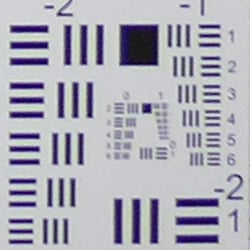
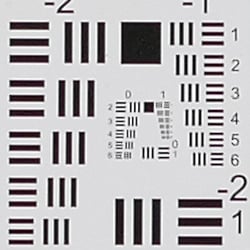
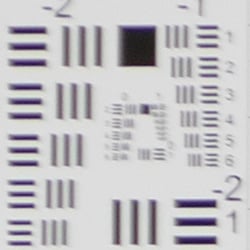
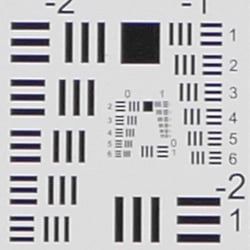
Moderately low to very low chromatic aberration in JPEGs. The lens produces some soft corners wide-open at telephoto though corner sharpness improves stopped-down.
|
Aperture: maximum
|
|
 |
 |
| Wide at f/2.8: Lower right C.A.: Moderately low Softness: Slightly soft |
Wide at f/2.8: Center C.A.: Very low Softness: Very sharp |
 |
 |
| Tele at f/4.0: Upper left C.A.: Low Softness: Soft |
Tele at f/4.0: Center C.A.: Very low Softness: Sharp |
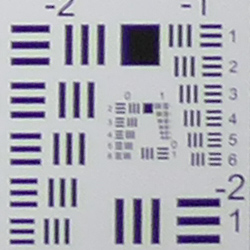
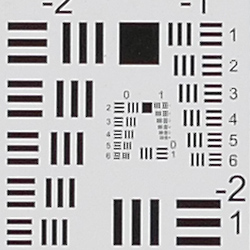
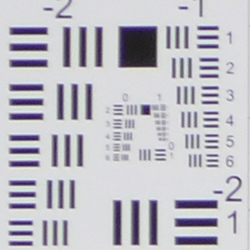
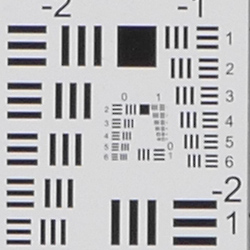
Chromatic Aberration. Thanks to in-camera chromatic aberration suppression, there's moderately low CA in the corners at wide angle in JPEGs, and CA is quite low at full telephoto. As expected, though, uncorrected RAW files (see below) show much more CA than seen in the JPEG crops above.
Corner Softness. Wide-open at full wide angle, the FZ1000's lens shows remarkable performance in the corners with just a bit of softness, despite the strong distortion correction. However at full telephoto, the lens shows some de-centering with the left corners quite soft, and the softness extends about a third of the way into the frame. The top-right corner is however fairly sharp, though the bottom-right isn't as sharp.
Vignetting. There's some minor vignetting (corner shading) but only at wide angle, as shown by how much darker the corner crop is compared to the center. It amounts to less than 1/4 EV, though, so quite minor.
|
Aperture: f/4 (W) and f/6.3 (T)
|
|
 |
 |
| Wide at f/4: Lower right C.A.: Low Softness: Slightly soft |
Wide at f/4: Center C.A.: Very low Softness: Very sharp |
 |
 |
| Tele at f/6.3: Upper left C.A.: Low Softness: Slightly soft |
Tele at f/6.3: Center C.A.: Very low Softness: Sharp |
Stopped Down: Stopping down a click or two (in this case to f/4 at wide angle and f/6.3 at telephoto) improved corner sharpness and contrast slightly at wide angle but dramatically at telephoto, however corners were still not as sharp as the center. Stopping down further at telephoto only made very marginal additional gains in the corners, however the rest of the frame started to become slightly softer due to diffraction, so you'll likely want to avoid apertures smaller than f/6.3 unless you need the additional depth of field or run out of shutter speed.
Chromatic Aberration Correction
| In-camera JPEG | Uncorrected RAW |
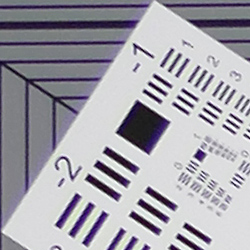 |
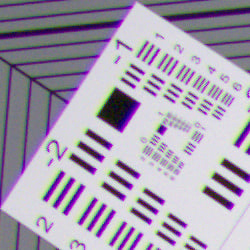 |
| Wide (f/2.8): Upper left CA: Low |
Wide (f/2.8): Upper left CA: Moderately high |
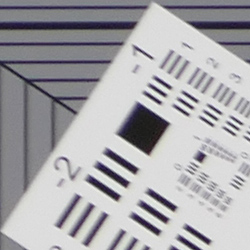 |
 |
| Tele (f/4.0): Upper left CA: Low |
Tele: (f/4.0): Upper left CA: Moderately high |
As you can see in the crops from uncorrected RAW images on the right (taken from RW2 files converted with RawDigger), the FZ1000's lens produces moderately high and bright lateral chromatic aberration at both maximum wide angle and full telephoto. But the FZ1000's processor does a great job suppressing CA in camera JPEGs (crops on the left). Note that most RAW converters should also automatically suppress CA when converting the FZ1000's RW2 files.
Overall, very good performance from the FZ1000's lens when considering its zoom ratio and how fast (bright) it is.
Viewfinder Test Results
Coverage
Very good accuracy from the LCD monitor and electronic viewfinder.


The Panasonic FZ1000's LCD monitor and EVF both provide just a touch over 100% coverage. This is very good performance, especially considering the amount of geometric distortion correction taking place at wide angle, though accurate framing at full telephoto can be tricky.
The images above were taken from our standardized test shots. For a collection of more pictorial photos, see our Panasonic Lumix DMC-FZ1000 Photo Gallery .
Exposure
Color
Saturation & Hue Accuracy
About average saturation levels, with slightly below average hue accuracy.
 |
| In the diagram above, the squares show the original color, and the circles show the color that the camera captured. More saturated colors are located toward the periphery of the graph. Hue changes as you travel around the center. Thus, hue-accurate, highly saturated colors appear as lines radiating from the center. Click for a larger image. |
Saturation. Overall, mean saturations levels are about average from the Panasonic FZ1000 using default settings, at 9.7% oversaturated. The FZ1000 pushes dark blues and greens quite a bit, but only oversaturates red and orange by small amounts, and it undersaturates yellow and aqua tones moderately. Most consumer digital cameras produce color that's more highly saturated (more intense) than found in the original subjects. This is simply because most people like their color a bit brighter than life.
Skin tones. Here, the Panasonic FZ1000 did fairly well, producing reasonably natural-looking Caucasian skin tones that were a bit on the warm side, though they can sometimes appear overly pink or a bit yellow depending on the ambient lighting. Where oversaturation is most problematic is on Caucasian skin tones, as it's very easy for these "memory colors" to be seen as too bright, too pink, too yellow, etc.
Hue. The Panasonic FZ1000 shifts cyan toward blue by quite a bit, but most other shifts like red toward orange, orange toward yellow, and yellow toward green are by small amounts. The cyan to blue shift is very common among the digital cameras we test; we think it's a deliberate choice by camera engineers to produce better-looking sky colors. The FZ1000's handling of yellows is one of its weaknesses: Yellows are undersaturated, and shifted slightly toward green. With a mean "delta-C" color error of 5.87 after correction for saturation, hue accuracy is slightly below average, but still pretty good overall since there are no major shifts in one particular color except for cyan (quite common). Hue is "what color" the color is.
Sensor
Exposure and White Balance
Indoors, incandescent lighting
The Auto setting produced cool results and Incandescent was quite warm. Manual was pretty accurate, just slightly cool. No exposure compensation required.


Indoors, under normal incandescent lighting, color balance was cool and magenta with the Auto white balance setting, while results with the Incandescent setting were very warm and orange. The Manual setting was by far the most accurate, just slightly on the cool side with a very minor cyan shift. (Note: The FZ1000 also has a Kelvin Temperature White Balance option, however we did not test that mode.) The Panasonic FZ1000 required no exposure compensation while most cameras require about +0.3 EV for this scene, so the camera performed better than average in terms of exposure here. (Our test lighting for this shot is a mixture of 60 and 100 watt household incandescent bulbs, a pretty yellow light source, but a very common one in typical home settings here in the U.S.)
Resolution
Very high resolution, ~2,500 to ~2,600 lines of strong detail from JPEGs, a little higher from RAW.
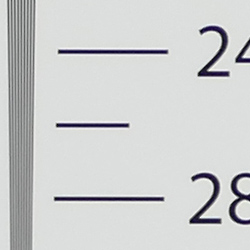
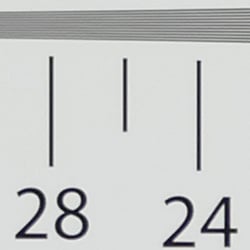
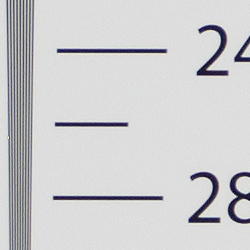
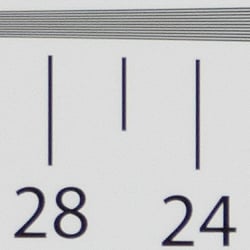
In-camera JPEGs of our laboratory resolution chart revealed sharp, distinct line patterns down to about 2,600 lines per picture height in the horizontal direction, and about 2,500 lines per picture height in the vertical direction. Some may argue for more, but aliasing artifacts start to interfere at that point. Complete extinction of the pattern didn't occur until about 3,200 to 3,400 lines. Adobe Camera Raw produced slightly better results, about 100 lines more in both directions, and complete extinction of the pattern didn't occur before the limits of our chart, but color moiré was more visible. Use these numbers to compare with other cameras of similar resolution, or use them to see just what higher resolution can mean in terms of potential detail.
Sharpness & Detail
Crisp images with very good detail, but some sharpening artifacts are visible. Moderate noise reduction at base ISO.


Sharpness. The FZ1000 produces very crisp, sharp looking images but with some obvious sharpening haloes around high contrast transitions, as can be seen around the lines and text in the crop above left. Edge enhancement creates the illusion of sharpness by enhancing colors and tones right at the edge of a rapid transition in color or tone.
Detail. The crop above right shows good detail for the class of camera, with moderate levels noise suppression in the darkest areas of the mannequins's hair, and almost no chroma noise. A few individual strands are smudged together in areas of low contrast at base ISO, but performance here is actually quite good considering the size and resolution of the sensor. Noise-suppression systems in digital cameras tend to flatten-out detail in areas of subtle contrast. The effects can often be seen in shots of human hair, where the individual strands are lost and an almost "watercolor" look appears.
RAW vs In-Camera JPEGs
As noted above the Panasonic FZ1000 produces sharp, crisp and clean images. Let's see how an Adobe Camera Raw conversion at base ISO compares.
|
Base ISO (125)
|
|
 |
 |
 |
 |
 |
 |
|
Camera JPEG, defaults
|
RAW via Adobe Camera Raw
|
In the table above, we compare an in-camera JPEG taken at base ISO using default noise reduction and sharpening (on the left) to a matching RAW file converted with Adobe Camera Raw 8.6 using default noise reduction with strong but tight unsharp masking applied in Photoshop (in this case 300% USM with a radius of 0.5 pixels and a threshold of 0).
As you can see, ACR produced additional detail that isn't present in the JPEG from the camera, though the FZ1000's JPEG rendering is pretty good here at base ISO. The biggest increase in detail is in the fabric crop, where ACR was able to resolve much of the thread pattern in the red-leaf swatch which the camera's JPEG engine presumably treats as noise, and ACR also did a bit better reproducing fine detail in the pink fabric, as well as more accurate color. But as is usually the case, more noise can be seen in the RAW conversion particularly in flat areas as shown in the bottle crop, thanks to ACR's light default noise reduction and the relatively strong sharpening required to keep RAW images crisp-looking. You can of course apply stronger noise reduction (default ACR NR used here) to arrive at your ideal noise versus detail tradeoff. Bottom line: As is almost always the case, you can do noticeably better than the camera with a good RAW converter, provided you're willing to apply your own noise reduction and sharpening to taste.
ISO & Noise Performance
Very good high ISO performance for its class.
|
Default High ISO Noise Reduction
|
 |
 |
 |
| ISO 80 | ISO 125 | ISO 200 |
 |
 |
 |
| ISO 400 | ISO 800 | ISO 1600 |
 |
 |
 |
ISO 3200 | ISO 6400 | ISO 12,800 |
 |
||
| ISO 25,600 | ||
ISO 80s through 200 produce similar results, with detailed, crisp images containing low levels of fine-grained luma noise and almost no chroma noise. ISO 400 shows a very minor drop in image quality as noise reduction ramps, but fine detail is still quite good. ISO 800 shows another small step down in detail but still very good overall image quality, though fine-grained luminance noise is more visible in some flatter areas. ISO 1600 is noticeably softer thanks to stronger noise reduction and more visible luma noise, but chroma noise is still fairly low. At ISO 3200, image quality takes a larger hit with higher noise, both luma and chroma, and the camera's aggressive sharpening produces images with a somewhat crystalline look. Image quality drops off very quickly from here, with ISOs 6400 through 25,600 being quite noisy with strong luma noise and chroma blotching.
Overall, though, high ISO performance is much better than average for a long zoom. We're of course pixel-peeping to an extraordinary extent here, since 1:1 images on an LCD screen often have little to do with how those same images will appear when printed. See the Print Quality section below for our evaluation of maximum print sizes at each ISO setting.
Dynamic Range Analysis (RAW mode)
While we once performed our own dynamic range measurements based on in-camera JPEGs as well as converted RAW images (when the camera was supported by Adobe Camera Raw), we've switched to using DxO Labs' results from their DxOMark website. As technology advanced, the dynamic range of modern high-end cameras in some cases exceeded the range of the Stouffer T4110 density scale that we used for our own measurements. DxO's approach based on RAW data before demosaicing is also more revealing, because it measures the fundamental dynamic range of the sensor, irrespective of whatever processing is applied to JPEGs, or to RAW data by off-the-shelf conversion software.
In the following, we use DxO's "Print" dynamic range results, which are scaled based on camera resolution. As the name suggests, this scaling corresponds to the situation in which you print at a given size, regardless of how many megapixels the camera might have. (In other words, if you've decided to make a 13x19 inch print, that's the size you're printing, whether the camera's resolution is 16 or 300 megapixels.) For the technically-minded, you can find a discussion of the reasoning behind this here on the DxOMark website. Also note that DxO Labs uses a signal-to-noise (SNR) threshold of 1 when defining the lower boundary of acceptable luminance noise in their dynamic range measurements, which corresponds to the "Low Quality" threshold of the Imatest software we used to use for this measurement.

Here, we compare the FZ1000's dynamic range (in orange) to its closest rival, the Sony RX10 (red) which features a similar if not the same sensor, and to the Panasonic FZ200 (yellow), an older superzoom based on a much smaller and more common 1/2.3" sensor size. You can always compare other models on DxOMark.com.
As you can see from the above graph (click for a larger image), the Panasonic FZ1000's dynamic range isn't quite as good as the Sony RX10's at low or high ISOs, ranging from about 11.7 EV at the lowest ISO, to just over 5 EV at the highest (and oddly, the highest ISO setting of 25,600 measured less sensitive than the 12,800 setting). The Sony RX10 which uses a similar sensor managed 12.6 EV at its lowest ISO, and 6.85 at its highest, though the two 1-inch sensors are fairly evenly matched between ISO 400 and 1600 in terms of dynamic range.
Not surprisingly, compared to the Panasonic FZ200 the FZ1000 offers significantly better dynamic range across all ISOs they have in common, with up to about a 1-2/3 EV advantage, but keep in mind the FZ200's significantly lower 12-megapixel resolution also puts it at a disadvantage when comparing "printed" results like these to the two 20-megapixel models.
Click here to visit the DxOMark page for the Panasonic FZ1000 for more of their test results and additional comparisons.
Built-in Flash Test Results
Coverage, Exposure and Range
Good flash performance overall.

Coverage. Flash coverage was a little narrow at wide angle, leaving dim corners and vertical edges in our flash coverage test image, but not as bad as some cameras we've tested. We no longer test flash coverage at telephoto, as it is invariably better, making wide angle the worst case scenario.

Exposure. Our Indoor Portrait test scene came out quite bright in auto mode, and the camera didn't have to boost ISO from the base of 125. It also used a decently quick shutter speed of 1/60s. (Some cameras reduce shutter speed to 1/40s or below when using the flash, which can be problematic and lead to subject motion blur.)
| Manufacturer-Specified Flash Range |
|---|
| Telephoto |
 ~32 feet ISO 1000, f/4 |
Manufacturer Specified Flash Range Test. The Panasonic FZ1000's flash range is rated at 13.5m or 44 feet at wide angle, and 9.5m or 31 feet at telephoto, with ISO sensitivity set to Auto. As you can see from the test shot at full telephoto above, the Panasonic FZ1000 produced a well-exposed flash target at about 32 feet, though it boosted ISO to 1000 to achieve that result. We shoot this test shot using the manufacturer-specified camera settings, at the range the company claims for the camera, to assess the validity of the specific claims.
Output Quality
Print Quality
Good 24 x 36 inch prints at ISO 80/125/200; a fairly good 11 x 14 at ISO 1600 and a good 4 x 6 at ISO 6400.
 ISO 80/125 prints are nice and sharp at 24 x 36 inches, with good color reproduction and general detail. 30 x 40 inch prints are certainly fine for wall display purposes as well.
ISO 200 images are also quite good at 24 x 36 inches, an impressive sized print for ISO 200 in this class.
ISO 400 delivers a very good 20 x 30 inch print. There is mild softening that occurs in our test target red swatch and a mild trace of noise in a few shadow areas, but still a really good print.
ISO 800 yields a solid 13 x 19 inch print. There is a fairly substantial loss of contrast detail in our red swatch, but that's common for most cameras at this ISO and higher for this class of camera.
ISO 1600 produces an 11 x 14 inch print similar to the 13 x 19 at ISO 800. Noise is actually well-controlled in flatter areas, a nice sized print here all things considered.
ISO 3200 is notoriously difficult for cameras with relatively small sensors (compared to APS-C and full-frame), and the FZ1000 succumbs to the difficulties like so many others. 8 x 10's here are simply too lacking in fine detail to make our "good" grade, likely the result of fairly high noise and aggressive noise reduction processing, but we can rate the 5 x 7 inch print good here.
ISO 6400 prints a 5 x 7 that almost passes our good grade, but it's a bit drab and undersaturated to officially call good, so we'll rate the 4 x 6 inch print good here.
ISO 12,800/25,600 settings do not yield good prints and are best avoided.
The Panasonic FZ1000 delivers solidly in the print quality department up to ISO 1600, which is the highest ISO we recommend for this sensor size. It slightly outperforms its biggest competition, the Sony RX10, at ISO 200 and 400 by one print size. Looking side-by-side, Sony's default JPEG processing generates too much in the way of unwanted artifacts, and thus the print size difference. At higher ISOs, however, the RX10 pulls slightly ahead, allowing for one print size larger at ISO 6400 and 12,800. A fairly close race, but if you remain at ISO 1600 and below the FZ1000 is the better choice for JPEGs at default settings in print.
The images above were taken from our standardized test shots. For a collection of more pictorial photos, see our Panasonic Lumix DMC-FZ1000 Photo Gallery .
Not sure which camera to buy? Let your eyes be the ultimate judge! Visit our Comparometer(tm) to compare images from the Panasonic Lumix DMC-FZ1000 with those from other cameras you may be considering. The proof is in the pictures, so let your own eyes decide which you like best!
Performance
Timing and Performance
Generally excellent performance in our tests, though RAW+JPEG burst mode buffer clearing is glacial.
| Startup/Play to Record/Buffer Clearing | ||
|---|---|---|
| Power on |
~1.2 seconds
|
Time it takes to turn on and capture a shot. |
|
Play to Record, |
~1.0 second
|
Time until first shot is captured. |
|
Buffer clearing time
|
~10 seconds
(after 73 Large/Fine JPEGs) |
Worst case buffer clearing time. -- This is the delay after a set of shots before you can remove the card. |
|
~10 seconds
(after 11 RAW files) |
||
|
~60 seconds
(after 12 RAW+JPEG files) |
||
|
*Note: Buffer clearing times measured with a SanDisk Extreme Pro 250 MB/sec UHS-II card. Slower cards will produce correspondingly slower clearing times. Slow cards may also limit length of bursts in continuous mode. ISO sensitivity and noise reduction settings can also affect cycle times and burst mode performance.
|
||
The Panasonic FZ1000 took about 1.2 seconds to power on and take a shot in our tests. That's much faster than average for its class. Switching from Play to Record mode and taking a shot took almost as long, though, at about a second. Buffer clearing times for JPEGs or RAWs were pretty good for its class, but was very slow when shooting RAW+JPEG files.
| Shutter Response (Lag Time) | ||
|---|---|---|
|
Full Autofocus, |
0.101 second
|
Time from fully pressing shutter button to image capture, with the lens already at the proper focal distance setting, at the wide-angle end of the lens' range. |
|
Full Autofocus, |
0.112 second
|
Time from fully pressing shutter button to image capture, with the lens already at the proper focal distance setting, at the telephoto end of the lens' range |
|
Full AF with Flash |
0.218 second
|
Using the flash slows the shutter release because the metering pre-flash has to occur before the shutter opens. Compare this number to the Full AF Wide Angle case above. |
| Manual Focus |
0.053 second
|
For most cameras, shutter lag is less in manual focus than autofocus, but usually not as fast as when the camera is "prefocused". |
|
Prefocused |
0.029 second
|
Time to capture, after half-pressing and holding shutter button. |
Looking at the Panasonic FZ1000's ability to determine that it's properly focused when shooting the same target multiple times using AF-S (single-shot AF) mode using the center AF point (our standard test), full autofocus shutter lag was very fast at 0.101 second at wide angle, and 0.112 second at telephoto. Enabling the flash increased full autofocus shutter lag to 0.218 second, which is still pretty fast. Manual focus lag was a very fast 0.053 second, and prefocused shutter lag was only 0.029 second, also quite fast.
To minimize the effect of different lens' focusing speed, we test AF-active shutter lag with the lens already set to the correct focal distance.
| Cycle Time (shot to shot) | ||
|---|---|---|
| Single Shot mode |
0.34 second
|
Time per shot, averaged over 20 shots with no signs of slowing, 1 second to clear.* |
|
Single Shot mode |
0.34 second
|
Time per shot, averaged over 17 shots, 10 seconds to clear.* |
|
Single Shot mode
RAW + L/F JPEG |
0.45 second
|
Time per shot, averaged over 15 shots, 17 seconds to clear.* |
| Early shutter |
No
|
Some cameras don't snap another shot if you release and press the shutter too quickly in Single Shot mode, making "No" the preferred answer. |
|
Continuous H mode |
0.11 second (9.48 frames per second);
73 frames total; 10 seconds to clear* |
Time per shot, averaged over 73 shots. |
| Continuous H mode |
0.11 second (9.02 frames per second);
11 frames total; 10 seconds to clear* |
Time per shot, averaged over buffer length of 11 frames, then slows to an average of 1.45 fps when buffer is full. |
|
Continuous H mode |
0.11 second (9.02 frames per second);
12 frames total; 60 seconds to clear* |
Time per shot, averaged over buffer length of 12 frames, then slows an average of 0.73 fps when buffer is full. |
Continuous SH mode |
0.02 second (48.8 frames per second); 60 frames total; 10 seconds to clear* |
Time per shot, averaged over fixed buffer length of 60 shots. |
| Flash Recycling |
5.8 seconds
|
Flash at maximum output. |
|
*Note: Buffer clearing times measured with a SanDisk Extreme Pro 250 MB/sec UHS-II card. Slower cards will produce correspondingly slower clearing times. Slow cards may also limit length of bursts in continuous mode. ISO sensitivity and noise reduction settings can also affect cycle times and burst mode performance.
|
||
Single-shot cycle times were excellent, averaging 0.34 second for Large/Fine JPEGs or RAW files, and 0.45 second for RAW+Large/Fine JPEG pairs.
In Continuous H mode (the FZ1000's highest-speed full-res burst mode), the FZ1000 captured 73 Large/Fine JPEG frames at about 9.5 frames-per-second, 11 RAW frames at 9 fps, and 12 RAW+JPEG frames at 9 fps. That's quite fast, but falls significantly short of Panasonic's 12 fps spec with AF-S. Note that we do however shoot all our cycle timing tests at ISO 200, so faster results may be possible at a lower ISO.
Continuous SH mode which captures ~5MP JPEGs clocked in at almost 49 frames-per-second, pretty close to Panasonic's 50 fps spec, with a fixed buffer limit of 60 frames.
Buffer clearing was reasonably fast with JPEG and RAW files, but slowed down significantly when shooting RAW+JPEG files. We measured about 10 seconds after a max-length burst of Large/Fine JPEGs or RAW files, but that increased to a whopping 60 seconds when shooting a max-length burst of RAW+JPEG pairs. To see if a fast UHS-I card would do better, we retested with our SanDisk Extreme Pro 95MB/s UHS-I card, but got results identical to our SanDisk Extreme Pro 250 MB/sec UHS-II card.
The Panasonic FZ1000's flash recycled in about 5.8 seconds after a full-power discharge on average, which is a little slow.
Bottom line, the Panasonic FZ1000's performance is generally excellent for a high-resolution all-in-one camera. Startup time is very good for its class, autofocus speeds are faster than most DSLRs, prefocused shutter lag is very fast, single-shot cycle times are excellent, and Continuous Hi mode is faster than most DSLRs as well (though the FZ1000 won't track focus in that mode). Buffer depths are excellent with full-res JPEGs at over 70 frames, though with RAW files buffer depth drops to about a dozen frames. Buffer clearing when shooting JPEGs or RAW files was good, but very slow after a max-length RAW+JPEG burst, requiring a full minute to finish writing even with our fastest SD card.
Battery
Battery Life
Below average battery life for its class.
| Operating Mode | Battery Life |
|---|---|
|
Still Capture,
(CIPA standard, LCD monitor) |
360 shots
|
|
Still Capture,
(CIPA standard, EVF) |
300 shots
|
The Panasonic FZ1000 uses a custom rechargeable lithium-ion battery pack for power, and comes with a single battery and dedicated battery charger. Battery life is CIPA-rated for 360 shots per charge when using the LCD, which includes 50% flash shots. When using the electronic viewfinder, the number of shots per charge decreases to only 300.
Battery life is below average for its type, so we definitely recommend getting a second battery for your FZ1000 if you plan any extended outings or shoot a lot of video.
The table above shows the number of shots the camera is capable of (on a fully-charged rechargeable battery), based on CIPA battery-life and/or manufacturer standard test conditions.
(Interested readers can find an English translation of the CIPA DC-002 standards document here. (180K PDF document))
Image Quality
Below are crops from our laboratory Still Life target comparing the Panasonic FZ1000 against the Sony RX10 at base ISO as well as at ISO 1600 and 3200. We originally had FZ1000 crops from images shot with version 0.3 pre-production firmware here, but they have been updated to version 1.0 with very little change.
NOTE: These images are best quality JPEGs straight out of the camera, at default settings including noise reduction and using the camera's actual base ISO (not extended ISO settings).
Panasonic FZ1000 versus Sony RX10 at Base ISO
 |
 |
 |
 |
 |
 |
Panasonic FZ1000 at ISO 125 |
Sony RX10 at ISO 125 |
The battle of the 1-inch-sensor long-zoom cameras! Both cameras show an impressive amount of fine detail at base ISO, with both the Panasonic and Sony displaying excellent, crisp detail in the mosaic crop. Even at base ISO (these images are shot with default noise reduction enabled), you can still make out some noise reduction processing ever-so-slightly in the shadow areas. The biggest difference is in the difficult fabric swatches, with the edge leaning to the Panasonic FZ1000. The Sony pops the contrast more, but if you look very closely, you can see some of the very fine, diagonal thread detail in the FZ1000's rendering of the red swatch, that the RX10 doesn't pick up. The contrast of that swatch in real life is probably somewhere between what the two cameras are showing us here. Both cameras, again, do great here, but the Panasonic displays just a bit more fabric detail compared to the Sony. The pink fabric is also a very close comparison, but the Panasonic looks a little more natural. |
|
Panasonic FZ1000 versus Sony RX10 at ISO 1600
 |
 |
 |
 |
 |
 |
Panasonic FZ1000 at ISO 1600 |
Sony RX10 at ISO 1600 |
At ISO 1600, both do very well here for this class of camera, with relatively low noise and a fair amount of fine detail. While both show signs of noise reduction processing, the Panasonic's is a bit more aggressive, but does a great job at removing noise and grain, especially in the shadows. Both cameras, again, do well with fine detail, as seen in the mosaic crop. Once again, the Sony's contrast pops the image more, but the Panasonic doesn't thicken the lines in the mosaic pattern the way the RX10 does. The big difference at ISO 1600 is in the fabric swatches, with the Sony taking the prize there. The Sony RX10 show at least some of the leaf pattern in the red fabric, while the Panasonic FZ1000 looks quite smeary and smudged. |
|
Panasonic FZ1000 versus Sony RX10 at ISO 3200
 |
 |
 |
 |
 |
 |
Panasonic FZ1000 at ISO 3200 |
Sony RX10 at ISO 3200 |
At ISO 3200, both cameras struggle with the balance between fine detail and noise. The Sony shows more luminance noise in the background shadows than the Panasonic, though you can see some odd darker specs and splotchiness in the Panasonic's image as well. Both cameras can still produce decent detail at this ISO, however, as seen in the mosaic crops, the Panasonic just edges out the Sony. Finally, unlike at ISO 1600, both cameras now struggle significantly to produce detail in the fabric swatches, particularly the red-leaf fabric. Different from the background, the Sony's rendering of the red swatch shows less luminance noise than the FZ1000, despit the latter's heavy noise-reduction processing. |
|
Good 24 x 36 inch prints at ISO 80/125/200; a fairly good 11 x 14 at ISO 1600 and a good 4 x 6 at ISO 6400.
ISO 80/125 prints are nice and sharp at 24 x 36 inches, with good color reproduction and general detail. 30 x 40 inch prints are certainly fine for wall display purposes as well.
ISO 200 images are also quite good at 24 x 36 inches, an impressive sized print for ISO 200 in this class.
ISO 400 delivers a very good 20 x 30 inch print. There is mild softening that occurs in our test target red swatch and a mild trace of noise in a few shadow areas, but still a really good print.
ISO 800 yields a solid 13 x 19 inch print. There is a fairly substantial loss of contrast detail in our red swatch, but that's common for most cameras at this ISO and higher for this class of camera.
ISO 1600 produces an 11 x 14 inch print similar to the 13 x 19 at ISO 800. Noise is actually well-controlled in flatter areas, a nice sized print here all things considered.
ISO 3200 is notoriously difficult for cameras with relatively small sensors (compared to APS-C and full-frame), and the FZ1000 succumbs to the difficulties like so many others. 8 x 10's here are simply too lacking in fine detail to make our "good" grade, likely the result of fairly high noise and aggressive noise reduction processing, but we can rate the 5 x 7 inch print good here.
ISO 6400 prints a 5 x 7 that almost passes our good grade, but it's a bit drab and undersaturated to officially call good, so we'll rate the 4 x 6 inch print good here.
ISO 12,800/25,600 settings do not yield good prints and are best avoided.
The Panasonic FZ1000 delivers solidly in the print quality department up to ISO 1600, which is the highest ISO we recommend for this sensor size. It slightly outperforms its biggest competition, the Sony RX10, at ISO 200 and 400 by one print size. Looking side-by-side, Sony's default JPEG processing generates too much in the way of unwanted artifacts, and thus the print size difference. At higher ISOs, however, the RX10 pulls slightly ahead, allowing for one print size larger at ISO 6400 and 12,800. A fairly close race, but if you remain at ISO 1600 and below the FZ1000 is the better choice for JPEGs at default settings in print.
Field Test
Field Test Part II
Panasonic's mighty megazoom takes on the Tomato Festival!
By Michael Tomkins | Posted: 08/07/2014

The Panasonic FZ1000 is a camera that interests me greatly. Last year, I reviewed the Sony RX10, and this is about as clear and direct a competitor to that camera as one could ask for. And both cameras speak to me, because now that I have a five year old son, I'm finding that when traveling I seldom have space to bring my DSLR kit.
Whenever I'm headed on an overseas trip, there are just too many little essentials, toys, and whatnot that need to be packed in my carry-on. Something invariably has to give, and it's usually my DSLR and lenses that have to make way, swapped for a more compact camera. Mirrorless certainly saves some heft with the body, but quality lenses generally aren't radically smaller than their DSLR counterparts. And while a compact camera like my Sony RX100 is undeniably portable, I sacrifice a lot in terms of versatility for its pocket-friendly nature.
The Sony RX10 appealed to me a lot, because while not pocket-friendly, it's still much smaller than an interchangeable-lens camera outfit with similar coverage. The same is true of the Panasonic FZ1000, and while it's a little bigger, it offers almost double the zoom range. I've yet to see both cameras side by side -- I expect to do so before my second shooter's report -- but the FZ1000 is of similar size to my Pentax K-5 DSLR with 18-55mm kit lens mounted, even if you count the FZ1000's deeply-protruding viewfinder.

Ignore the EVF protrusion, and the FZ1000 is actually a fair bit smaller than that combination, despite having more than five times the zoom range, and a brighter lens to boot. Of course, the tradeoff is there, and it's the fact that the Panasonic FZ1000 has a much smaller sensor than my APS-C DSLR. But then, that was true of the RX10 and my Sony RX100, and I'm actually pretty happy with the image quality of both in all but relative low-light conditions, when I find myself reaching for the SLR.

But I'll come back to that thought in a little bit. The first thing I wanted to get a feel for when I took the Panasonic FZ1000 out of the box was its build quality and construction. I'd heard that build -- while pretty solid and creak-free -- didn't feel quite as nice as that of the RX10, and I have to agree.

The Panasonic's body panels do feel quite plasticky, an impression that's reinforced by the hard, rubber trim inserts and the covers over the various connectors. The cover for the USB / HDMI / AV Out / Remote compartment, in particular, is fiddly to open and close, and I'm not a fan of it at all.
But by the liberal use of plastic, Panasonic's designers managed to keep weight down to almost exactly the same as the RX10, loaded and ready to go -- despite the much greater zoom range on offer. And while it doesn't exude quality in quite the same way as that camera, the FZ1000 nevertheless feels comfortable and reassuring in-hand.
Most controls are well-located and give reasonable feedback in use, as well, although I do wish the four-way controller was a little larger. The Fn2 button is also a little tricky to locate by touch, but that's probably by design, given that its default function is to enable Wi-Fi -- not something you want to do by accident.
As I mentioned when I uploaded my Panasonic FZ1000 gallery recently, my first shooting experience with the camera came at the Grainger County Tomato Festival in rural Rutledge, Tennessee. It was a baking-hot Sunday afternoon with thunderstorms and tornadoes in the forecast, but we were lucky to get a good couple of hours at this delightfully colorful festival before the threat of severe weather sent us on our way back home.

It didn't take long at all to find the first quirk of the FZ1000's design, however. Literally the first time I brought the viewfinder to my eye, there was no image. I checked, and the Power light was illuminated, but on returning to the viewfinder, again there was nothing visible. And then I realized -- with it being so bright and sunny, I was wearing polarizing sunglasses. Rotate the camera to portrait orientation and the viewfinder became visible. Turn it back to landscape, and the viewfinder vanished again. Shoot without my sunglasses, and all was fine.

This isn't something I've gone out of my way to check on past cameras, but it's not that unusual for me to shoot through my sunglasses, as my eyes are quite sensitive to bright light. I can't recall a viewfinder that was set up in this manner before -- typically it's the other way around. (Portrait invisible through glasses, and landscape fine.) It's not really an issue that the FZ1000 operates in the opposite manner, per se, just something that takes a little getting used to.

Given how bright and sunny it was at the festival -- and even on the way home, since we left before the storms arrived -- I didn't get an opportunity to shoot at higher sensitivities on this first shoot. I'll be doing so before my next shooter's report, but at or near base sensitivity I'm very impressed with the FZ1000's image quality. Photos from this camera are packed with detail and rich in color.
At default settings, colors are perhaps just a little oversaturated, but that's part of what helps them pop. (And truth be told, many consumers like this.) If you prefer a more natural look, that's easily achieved through the handsome and responsive menu system, and specifically the Photo Style option. Seven styles are available, and each can be adjusted for various settings such as contrast, sharpness, noise reduction and saturation -- or you can just shoot in raw format for maximum control, which is what I'd do myself.
I found shooting with the FZ1000 to be very freeing, with its lens providing as much reach as it does between a generous wide-angle and a very powerful telephoto. Shooting with a DSLR or mirrorless camera, I'd have continuously been switching between lenses, fumbling for lens caps, and the camera bag I'd have needed to carry all the gear would've been weighing me down. Yet it would likely still have been more limiting. For my Pentax K-5, the most versatile lens I own is a 7.5x zoom, my 18-135mm f/3.5-5.6; I don't own a lens beyond 300mm-equivalent.
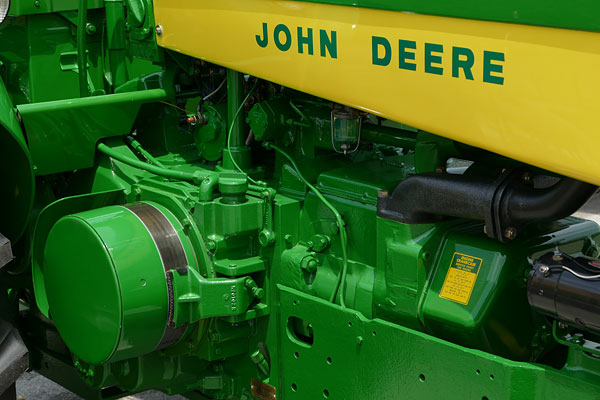
Here, I felt like I was carrying just a DSLR with kit lens, yet I had so many more possibilities for framing. And on balance, image quality was better than that 18-135mm kit zoom for my DSLR. In good light, I really didn't feel that I was giving anything significant up in terms of image quality. And autofocus was swift and confident -- it felt much like that of my DSLR, in other words.
That's not to say that everything was perfect, however. I stumbled across something which I found frustrating compared to shooting with my DSLR. Apparently, this also applies to the Sony RX10, although I don't remember noticing when I had access to that camera. (I don't have the RX10 in-hand at the moment, but had one of my colleagues check, and its behavior is the same.)

The problem cropped up when I was trying to shoot some kids and adults throwing overripe tomatoes at each other. Because my subjects were running around, ducking and dodging as they threw tomatoes at each other, I wanted to shoot with continuous autofocus.
This functions only while the shutter button is at least half-pressed. However, I also wanted to adjust zoom during the burst of shots, because with my subjects moving around so much, my framing options were continuously changing.
The trouble I had was that the Panasonic FZ1000 (much like the RX10) won't allow you to adjust the zoom position while the shutter button is being pressed. That's likely because the lens isn't parfocal -- that is, when the zoom position is adjusted, focus can change at the same time.
Still, with a fixed lens it strikes me that this isn't really an issue -- you know how much focus will change for any given adjustment, after all, so the camera could correct for this on the fly. (My very first digicam, a Sony Cyber-shot DSC-D770, did just this if I remember correctly.)
And even with a varifocal lens, the camera could be trying to correct focus while zoom was adjusted, if it were just possible to make that adjustment during focus operation. But sadly, that's not the case -- my only option was to release the shutter button before adjusting the zoom, whether I was using the zoom rocker or lens ring. Then after adjusting zoom, I'd half-press the shutter button and focusing would start all over again.

That meant my delay in reacting and releasing / pressing the shutter button before and after zooming was added to the time needed to refocus, greatly increasing the time between shots. Did I miss shots because of this? Definitely. And speaking of the zoom ring, even for more static subjects, I mostly avoided it and used the zoom rocker simply because adjusting focal length with the fly-by-wire ring was so slow, and made it hard to keep the camera steady.

Between these two issues, I longed for a mechanical zoom linkage like that on my DSLR, rather than this fly-by-wire design. Still, my DSLR wouldn't have offered me the same zoom reach that this lens does, nor its relatively less bulky, more lightweight nature.
And truth be told, having to release the shutter button to adjust zoom isn't anywhere near as irksome as having to change lenses. So while this certainly was frustrating, it's not a showstopper by any means.
For my next shooter's report, I'm expecting things to get rather interesting. For one thing, I'll hopefully be shooting the Panasonic FZ1000 side-by-side with its arch-rival, the Sony RX10. For another, I'm planning to do some low-light shooting, and here I'd expect my DSLR to show a larger advantage.
I also want to take a look at stabilization, macro shooting, 4K video, and the FZ1000's built-in Wi-Fi connectivity. (And perhaps some reader requests, if you have anything in particular you'd like me to look into, or any particular aspects of the FZ1000's operation that you'd like to see me discuss.)
Watch this space for part II of my Field Test, and if you have any questions or requests, please be sure to leave them in the comments below. And if you've not already done so, check my Panasonic FZ1000 gallery for even more images from this mighty megazoom camera!

Field Test Part III
It's time for a large-sensor, long-zoom head-to-head!
By Michael Tomkins | Posted: 11/11/2014

With fall colors in full swing, I visited downtown Knoxville for a head-to-head comparison of the Panasonic FZ1000 with its main rival, Sony's RX10.
(1/50th sec. @ ISO 1600, 115mm equiv., f/3.9)
Shortly before the biennial Photokina tradeshow, we kicked off our review of the Panasonic FZ1000 with a real-world shoot at a nearby tomato festival. We'd planned on this second part of the report following rather sooner, but the flood of tradeshow work -- among other things -- threw a spanner in the works.
Still, the delay meant that we had another chance for a splash of vibrance, as I recently went shooting the fall colors in downtown Knoxville, Tennessee. And for this second and final Field Test, I had the Panasonic FZ1000's main rival -- the Sony RX10 -- along for a side-by-side comparison in the real world. It was interesting, to say the least!
Getting to grips with the FZ1000 -- and its main rival
Until I shot with them side by side, I must admit that I was expecting to favor the handling of the Sony RX10 over its longer-zoomed rival. I was absolutely taken by the RX10 when I first shot with it last year, and as I said in my Sony RX10 review, it was a very well-built, comfortable camera with a lot to recommend it. And in terms of materials, fit and finish, it certainly has more of a premium feel than does the Panasonic FZ1000.
But with that said, I very quickly found myself preferring to shoot with the FZ1000, and not just because of its significantly greater zoom reach. In quite a few ways, shooting with the Panasonic was a nicer experience than the already-enjoyable RX10. And the Sony's size advantage -- while certainly noticeable side-by-side with the Panasonic -- is nowhere near as significant in the real world as it seems on paper.




For one thing, I found the Panasonic FZ1000 significantly more comfortable to hold for long periods, and so did friends who I asked to compare both cameras side-by-side. Partly, that was thanks to a more generous, more deeply-sculpted handgrip. Partly, it was down to the fact that the FZ1000 feels better-balanced.
Both cameras weigh exactly the same as each other, but with the Sony RX10, more of that weight seems to be concentrated around the optical path of the lens -- and well away from the handgrip -- making it more comfortable with a two-handed grip than as a single-handed shooter. The Panasonic FZ1000, by contrast, is very comfortable when shooting single-handed.

(1/80th sec. @ ISO 320, 93mm equiv., f/3.8)
Both cameras have good controls, but Panasonic has more of them
The external controls of each camera struck me as better in different ways. Really, a hybrid of the two would have been ideal, but on balance I think I prefer the FZ1000's control scheme.
Sony gives better emphasis to the main exposure controls, with a dedicated lens ring for aperture control, a dedicated dial for exposure compensation, and a rear dial for shutter speed. And it's a nice touch that you can disable the click detents on the aperture dial in movie shooting, but enable them for stills.
However, the presence of this switch to control on-demand aperture clicks is far too easy to forget, although its somewhat awkward position does fall nicely under a fingertip with a two-handed grip, and probably makes it less likely to be accidentally bumped. Still, for these main exposure controls, the design is definitely preferable to the single clickable rear-dial of the FZ1000, which is pressed in to switch between different control of the applicable variables, depending on the exposure mode.
I also preferred the Sony RX10's power switch, which sits behind the shutter button, making it easy to flick without adjusting your grip as you walk around shooting photos. (I like to turn the camera off to conserve power while I walk, then flick it back on as an opportunity presents itself.) Panasonic's switch is just a little further away, requiring my grip to be adjusted or the use of both hands to turn the power on.
Both cameras have an equal number of customizable controls, although I found it interesting that the FZ1000's zoom rocker can be reassigned to provide dedicated exposure compensation control, if you prefer to stick to the lens ring for zoom control. And speaking of zoom control, both cameras also provide stepped or stepless zoom, but Panasonic provides more steps even just within the range covered by the Sony RX10's lens, which makes it more likely you'll find one of the steps to your liking.
And it's worth noting that the Panasonic FZ1000 provides more external controls in the first place. Features that the RX10 either hides in the menu, or which caused me to use up one of the customizable buttons, had their own dedicated control on the FZ1000. There's a dedicated drive mode control, for example, and both zoom/focus selection for the lens ring plus an image stabilizer control on the lens barrel. And focus mode, focus area, ISO sensitity and white balance have dedicated controls, as does AF/AE lock -- the last of which is a default control on the RX10, but actually one among its allotment of programmable buttons. Oh, and I preferred the location of Panasonic's focus mode selection switch, which works better for single-handed shooting, too.
The greater number of controls made the Panasonic the more enjoyable camera to shoot with, in my book. Sure, it was more complex initially, but it allowed me to do more without needing to resort to the menu system, and once I got used to my setup, operation became second nature. Time spent hunting for menu options is time in which you're potentially losing a photo, so while both cameras have worthwhile control advantages over their rival, I have to give this one to Panasonic.

(1/80th sec. @ ISO 800, 107mm equiv., f/3.9)
Panasonic has the better viewfinder and display
Another win for the Panasonic FZ1000 over its Sony rival can be found in the image framing and review department. The FZ1000's built-in electronic viewfinder is both larger and brighter than that of the Sony, and subjectively speaking, I thought its color was better. Both finders seemed to have similar lag and good refresh rates, but that in the FZ1000 was significantly easier on the eye overall. It also has a more generous eyecup, although I think both cameras could benefit from a softer, deeper cup.
Both LCD monitors on the Panasonic FZ1000 and Sony RX10 are of the same size and resolution, but Sony has a higher dot count and improved brightness / power consumption, thanks to its WhiteMagic-branded, four-dot-per-pixel design.
However, arguably the Panasonic FZ1000's display is more versatile regardless, for two reasons. One, it has a side-mounted tilt/swivel mechanism that allows viewing from a much greater range of angles than Sony's vertical-tilt-only display. It can also be closed inwards, helping to keep it clean and provide a degree of protection against minor knocks and scuffs, where the RX10's display always faces outwards. Both displays are, however, fairly resistant to smudging from touches, which somewhat offsets this latter point.
But Sony provides a quick reference to basic settings
However, Sony chalks up a win in a different respect, providing a small top-mounted LCD info display, a feature the Panasonic FZ1000 completely lacks. Sure, only relatively basic info is provided here, and only when the camera is switched on, but particularly if you're an EVF shooter it lets you save power from the main LCD panel, while being able to quickly confirm setup without raising the camera to your eye.
It's a nice touch from Sony, and a shame that the FZ1000 lacks an equivalent display. (But there's really no room to have included one without removing some of its excellent array of external controls.)

And the RX10 also wins on battery life
Battery life is a point that's rather harder to judge, as it depends on your shooting style. CIPA testing involves a scenario of zoom racking and flash usage that's perhaps a bit unrealistically harsh for this style of camera. In real-world usage, I thought both cameras fairly reasonable, easily getting enough for a good few hours of very regular shooting spread across several days without needing to recharge. (In fact, as I write this, both cameras report a significant amount of battery life remaining).
However, I have to give this one to Sony for two reasons. One, the RX10 wins the CIPA battery life tests, whether using the LCD monitor or electronic viewfinder. (As usual, and somewhat counterintuitively, the EVF actually uses more power than the LCD.) It's not a huge win, but the 13-18% margin is certainly worthwhile.

Second, and perhaps more importantly, Sony provides an actual percentage figure for remaining battery life, where Panasonic offers up just a segmented battery icon that gives much less information as to how long you can expect the battery to last.
Different lenses; different purposes.
And so, we come to the lens. It's actually the most obvious difference between these two cameras, but I've saved it almost to last simply because the decision as to which is better is largely one of personal taste and shooting style.
Both of these cameras sport seriously impressive optics, unrivaled by anything else on the market. Given that they're near-identical in size, we think the FZ1000 is perhaps the more technically impressive though -- and here's why.

In Sony's case, the key feature is a constant f/2.8 aperture across the entire zoom range, complemented by the availability of a built-in, on-demand neutral density filter. And Sony's lens also has just slightly better wide-angle coverage, as well as a more powerful macro capability.
Panasonic's lens, though, provides significantly more zoom range, and it's all at the telephoto end of the scale, where you're most likely to want it. Sure, you don't get a constant aperture, but all things considered, with an f/4.0 aperture at telephoto it doesn't really fall that far from the f/2.8 wide-angle (matching the Sony's constant f/2.8), either. And for that somewhat-smaller aperture, you get close to double the zoom range of the Sony: A 16x optical zoom for the Panasonic FZ1000, compared to just 8.3x on the Sony RX10.

That is not a minor difference, and it completely changes the possibilities when shooting with this camera. Personally, I found myself strongly preferring the much greater telephoto reach of the FZ1000, rather than the maximum aperture of the RX10. However, I did miss the competing model's built-in neutral-density filter when shooting long-exposures with both cameras.
At base sensitivity and with the aperture set as I wanted it, the RX10 could give me a far longer exposure, helped just a little more by the fact that base sensitivity is ISO 80 for Sony, as compared to ISO 125 for Panasonic.

But on balance, I found myself shooting towards the tele end of the range much more frequently than using that ND filter, and both cameras offer up filter threads for external accessory filters anyway.
So in my book, this one too has to be called for the Panasonic FZ1000 -- but if you value a constant, bright aperture and better macro shooting capability, you may prefer the Sony RX10.

The Panasonic FZ1000 is incredibly responsive
Before I come to the most important feature of any enthusiast-friendly camera, its image quality, there's just one more point to touch on from my real-world experience of both cameras side by side.
In almost every respect, performance of the Panasonic FZ1000 simply blows the Sony RX10 out of the water. There are a couple of small chinks in its armor -- raw+JPEG buffer clearing is surprisingly slow, and the Sony RX10 will also shoot just a bit quicker when prefocused, as well as charging its flash faster. The FZ1000 just slightly trails the RX10 in burst rate if the latter is shooting JPEG-only with AF locked from the first frame, too.

However, where it really counts -- autofocus performance and burst rate with AF enabled -- the difference is simply night and day. The Panasonic FZ1000 consistently focuses in around half the time of the Sony according to our lab testing, and my real-world experience agrees. And where burst performance of the Sony RX10 with AF enabled is pedestrian, the Panasonic FZ1000 feels like a high-end professional DSLR, rattling off incredibly quick bursts.
Add in that the RX10 will punish you with a longer delay if you press the shutter button before it is ready when in single-shot mode while the FZ1000 doesn't, and that startup / shutdown times of the Sony are around double those of the Panasonic, and this is an impressively clear win for the Panasonic FZ1000. And I have to say, it makes it a much, much more pleasurable camera to shoot with, especially when shooting bracketed series of exposures as I routinely do for review shooting.
And so, we come to image quality...
As I've mentioned, I shot quite a bit with both cameras side by side, and spent a fair while comparing their image quality with identical scenes, many of them shot with as close as possible to identical settings on each.
The result of all that shooting and image reviewing was, perhaps, not surprising. Both of these cameras yield great image quality compared to the small-sensor long-zoom camera competition, but both lag larger-sensored interchangeable-lens cameras, especially at higher sensitivities.









Both are good enough, though, that when one takes into account the selection of lenses you'd need to replicate their zoom range with your DSLR or mirrorless camera, it's pretty easy to see the value in switching to a smaller 1"-type sensor, as these use.
Choosing between them, though, is much, much harder.
For my money, Panasonic wins in the daytime...
For my money, the Panasonic FZ1000 has a slight edge when shooting in the daytime. With that said, its images are perhaps a touch less vibrant by default, and that coupled with occasionally lower contrast than the Sony sometimes made them seem just a little flat, but it was only a subtle difference. (And one you can tweak to your tastes using the Panasonic's Photo Style settings.)


The FZ1000's lens is also just slightly softer in the corners, with slightly more noticeable vignetting. But then, these are both very subtle differences, and truth be told, out-of-camera JPEGs from both cameras will have been heavily corrected -- that's just the compromise you have to make for lenses like these that still have relatively compact proportions.
So why do I say the FZ1000 is the better camera in terms of daytime image quality, even if it perhaps lags its rival slightly in these ways? Well, it does have a slight but noticeable advantage in terms of very fine detail. Again, it's not going to make a huge difference to your shooting, but it's there and might be handy, particularly if you need to crop significantly.





But that's not the answer, really. In my quest to choose a champ, I actually tried giving myself a blind test. (Or at least as blind as is possible when I shot the images -- I just focused on an aspect of each image, control-tabbed back and forth in Photoshop until I forgot which camera was which, then called a winner.) It was often very difficult to guess which camera a given shot was made with, until I checked the filename.
And that, for me, is key. None of these differences are actually noticeable enough for me to call either camera the winner in the IQ department at lower sensitivities. The real differentiator, then, is the optic used to capture each camera's photos. The lens provided by the Panasonic FZ1000 simply provides greater possibilities, thanks to the fact that it has double the zoom range.


I'm relying on a technicality to call the winner, certainly, but I think it's a valid one. When both cameras have near-identical image quality, the one that provides the better image is the one that's more likely to be able to compose the image you want!
(Want more daytime and nighttime comparisons? As well as our dozens of pre-existing shots, I captured almost 30 images with the FZ1000 and RX10 side-by-side, to compare various aspects of their image quality. Look in our Panasonic FZ1000 gallery and our updated Sony RX10 gallery for the shots, but remember to pay attention to aperture, shutter speed and sensitivity before drawing conclusions in either direction!)
...but at night, Sony has the edge
But that's all low-sensitivity shooting in the daytime. What about in low light, shooting at night, or perhaps some long exposures? I gave that a try too, and again, compared the results from both cameras side by side, trying to keep from myself the identity of the winner until I'd made the call.
Interestingly, the result showed something of a reversal of fortune. At higher sensitivities, the effects of noise reduction seemed a bit stronger from the FZ1000 than the RX10. And yet noise remaining in the FZ1000's images was a bit blotchier and less film-like) and there was just a little less detail than offered up by the Sony.


However, where Sony had led the way with its color in the daytime, its night shots under artificial lighting -- especially at higher sensitivities -- sometimes took on a somewhat sickly green cast. The Panasonic FZ1000 seemed to handle these difficult lighting situations with more aplomb, yielding white balance that was a tad warm, but without that green cast of the RX10, much more natural-looking.
On balance, though, as a JPEG shooter I'd probably still slightly prefer the FZ1000's results purely in terms of image quality. The occasional color casts of the RX10 were more objectionable to me than the slightly lesser detail / higher noise, because let's face it, I don't really expect to pixel-peep my high ISO shots. The overall look of the image is more important than the finest details for low-light photography.




But once again, as for daytime shooting, this low-light difference was really quite modest. Far more important to me are the Sony's brighter maximum aperture across much of the zoom range, which increases the chances of a sharp handheld exposure, or potentially allows you to drop the sensitivity and reduce noise for the same given shutter speed. And the presence of a built-in ND filter in the Sony also saves you from needing to buy (and carry) an extra ND filter, making long-exposure photography more fun. (So, too, does the RX10's lower minimum sensitivity.)
I think together, these conspire to make the Sony RX10 a better night and low-light shooter than the FZ1000 -- at least, unless you have to shoot at a significant distance from your subject, and so need the FZ1000's longer zoom.
 |
 |
Top: Panasonic FZ1000. Bottom: Sony RX10. Both shots taken moments apart from the same location with aperture-priority autoexposure at f/8 and ISO 125. The Panasonic shot is 2/3 stop under the metered exposure, and the Sony shot with 2/3 stop over the metered exposure. The FZ1000 had just 1.3 seconds to get the shot, while the Sony RX10 got longer light trails with an eight second exposure, thanks to its built-in ND filter. (And it could have gone even longer at ISO 80, and arriving at the same scene brightness as that provided by the FZ1000.) |
The Panasonic FZ1000 makes much better use of Wi-Fi
Both the Panasonic FZ1000 and Sony RX10 provide Wi-Fi connectivity with easy NFC setup for Android users. (iOS users, even though the latest devices for their operating system now support NFC, are still left out in the cold, but that's a result of Apple's decision.)
It takes a little while to notice the non-standard NFC logo on the base of the FZ1000, against which you must tap your phone to pair if you choose this route, as it is tiny and merely imprinted without any silk-screening or painted lines. It works nicely though, directing you first to Google Play for app install, and then pairing on a subsequent tap post-installation. If your phone doesn't support NFC, the FZ1000 also provides for connection via QR code. This again works well, but requires the company's Image App be installed manually first, or you'll just be shown the contents of the code, which aren't a whole lot of help to you in pairing manually.

(1/30th sec. @ ISO 3200, 83mm equiv., f/3.7)
My first thought on using remote control via Wi-Fi was that it's a bit of a shame that the live view feed occupies only a very small portion of phone screen, with no way to hide most overlays and maximize the live view. Even with my Sony Xperia Z2 smartphone's very large 5.2-inch screen, the actual on-screen area of the live view was almost exactly the same as that on the camera's smaller three-inch screen.
On a more typical smartphone screen, you'll actually be doing your image framing on a smaller live view than that provided by the camera itself! And too many settings are hidden behind a slightly unintuitive pullout menu that sits beside the live view feed, and whose presence it took me a while even to notice. Still, it's nice that the Image App interface works in either landscape or portrait orientation -- so many apps force a choice on you, which is a pet peeve of mine.
I found there to be about a half-second lag on the live view feed when set to its higher VGA resolution, but when near the camera, it provided a nice steady frame rate that made this feel quite reasonable. Range was quite good, too, at perhaps 30 feet or so without walls or floors in between phone and camera. And you can shoot both still or video footage, although remote 4K capture isn't possible.
The Panasonic FZ1000 offers up a reasonably comprehensive Wi-Fi remote control feature set, although some things like exposure mode do require that you make a change on-camera. (I rather liked that the on-camera controls remained active even when the Wi-Fi session was live, though; too many cameras -- including the RX10 -- disable controls as soon as Wi-Fi is active.)
You can alter all the main exposure variables, but I find it a little odd that aperture and shutter speed are referred to as F and SS in Image App, respectively. Why not just use A and S, as on the camera's Mode dial? I was also somewhat befuddled that I couldn't find any way to focus in live view without also capturing a picture. Tapping on the screen selects a focus point, but the camera never tried to focus until a photo is captured. Because of this, I had to shoot plenty of throwaway images just to set focus and confirm I was happy with everything before making my final exposure.

The great news is that image review can be accessed directly without having to disconnect, and it transfers full-resolution images quickly and easily in just a few seconds. You also have a choice of two lower-res sizes, as well as options for web use. And as well as my phone, I tested with my Google Nexus 10 tablet, which also worked nicely. I don't have an iPhone or iPad, so unfortunately couldn't test with iOS devices, but we've found similarly decent functionality from Image App on iOS in the past.
Overall, I found the Panasonic FZ1000's Wi-Fi functionality much more useful than that of the Sony RX10. For one thing, the RX10 is much more limited when under Wi-Fi remote control. Its physical buttons and dials cease to function, and from the remote app, very few features are available for control.
Basically, you're limited to zoom, shutter, self-timer, flash, and movie capture -- all using completely automatic exposure. You can't even select a subject for focus, as you can with the FZ1000. And it's frustrating that with the Sony, you have to keep disconnecting and reconnecting the Wi-Fi to jump between remote capture and review / image transfer, where the Panasonic allows the connection to remain established as you switch modes.
So although the result is a much cleaner screen display than that provided by Panasonic -- and indeed, a much larger one, because it almost fills your phone's screen -- the Sony RX10 provides almost none of its newer rival's versatility. And I have to say, if I had to choose between a more complicated screen and smaller viewfinder image, or very limited functionality as provided by Sony, I'd choose Panasonic's approach every time.

Panasonic provides 4K future-proofing
NOTE: We're having some problems getting our Panasonic FZ1000 videos uploaded to YouTube at the moment. In the meantime, you can grab three night videos at 4K and 1080p resolution directly from our server at the links below:
4K MP4 (159MB) | 1080p60 MP4 (36MB) | 1080p60 MTS (42MB)
And finally, for this second Field Test, we come to video. Here, the Panasonic FZ1000 offers a compelling advantage over its Sony rival, if you live on the cutting edge or favor a future-proof camera. Where the RX10 is limited to Full HD movie capture, the FZ1000 can shoot 4K video at 30 frames per second.
Even if you don't have a 4K monitor now, if you can justify the storage space and have a sufficiently powerful computer to reencode 4K video -- and bear in mind, a 4K 30p clip takes about 3.6 times as much storage space as an equivalent 1080p60 clip -- then you may still find a benefit in shooting with the FZ1000. Simply shooting at 4K and then downsampling to 1080p with a good algorithm yields a significantly crisper, more detail-rich image than either camera provides when shooting at 1080p.
(And that despite the fact that the RX10 and FZ1000 both use full-sensor readout at 1080p, which rather surprised me -- I'd have expected them to attain close to the maximum possible from 1080 pixel video, but it seems their downsampling algorithms -- which must operate in real time -- aren't nearly the match of a 4K downsample on a powerful PC.)
Nor is that all. There's also Panasonic's 4K Photo mode, which was introduced via a firmware update in early October 2014. This allows one to shoot 4K videos with the intent of extracting still frames at 8-megapixel resolution. And the frames you extract even include EXIF data, unlike those pulled directly from a standard 4K video.
There is, however, a catch which for my money makes the function rather less useful: You'll want to choose ahead of time whether you're going to use the camera for 4K video or stills, because while a shutter speed that matches the frame rate is desirable for video (providing a degree of motion blur that makes the final video seem less stuttery), the last thing you want in your 8-megapixel stills is motion blur. Hence, 4K Photo mode aims for a high shutter speed that gives better photos, but jerky, unnatural looking video.
Still, it's cool that you can access shutter speeds as fast as 1/16,000 second and then choose stills you want to keep from what are, effectively, truly epic bursts of 30 fps, 8-megapixel stills. Just bear in mind that with an electronic shutter, your stills will be subject to rolling shutter effects, much the same as are your videos...
In most other respects, the FZ1000's video feature set is quite similar to that of the RX10. Both cameras allow for uncompressed HDMI video output that can be captured on an external recorder, and feature manual or automatic exposure control, built-in and external stereo mic support, manually-adjustable audio levels, and enthusiast / pro-friendly features like zebra striping and focus peaking.
The Sony RX10 does win in one area, though, with a truly silent, almost shake-free aperture control during video capture if the click detents on the aperture ring are disabled. However, this isn't quite as useful as it might seem, given that the aperture still moves in discreet steps during video capture. This results in slight but noticeable changes in brightness as the video is recording.
Final thoughts on the Panasonic FZ1000 vs. Sony RX10
It's often the case that with two competing cameras that share similar designs -- but with a few key differences -- there's no clear winner or loser. Typically, each camera ends up being better for a different kind of photography.
To an extent, that's true here as well, but I have to say that I ended up very surprised by my side-by-side comparison of the Panasonic FZ1000 and Sony RX10. I loved Sony's camera so much when I reviewed it last year that I fully expected it to still hold my affections in many areas, even despite the clear advantages of its new rival. Doubly so when I noticed the somewhat plasticky build of the Panasonic FZ1000.
But once I shot them head-to-head with the same subjects, time and again I came away favoring the FZ1000, far more often than I felt the same towards the Sony. Its greater performance and more attractive viewfinder make it a pleasure to shoot with, and I think its ergonomics work better as well.
Add in a more versatile LCD monitor and a much more useful zoom range in a body that really isn't very much larger than that of the Sony RX10, and bear in mind that image quality is near-indistinguishable between the two unless you really concentrate and start pixel-peeping, and I think there's a pretty clear winner here.
The Panasonic FZ1000 just gives you more camera for the money, and it's worth bearing in mind that it's actually the less expensive of the pair, as well. Not to mention the fact that I really loved -- and still love -- the Sony RX10, which is also an astoundingly impressive camera. It's just not quite as impressive to me as is the Panasonic FZ1000.
Panasonic has really hit the ball out of the park here, and I've been truly thrilled to shoot with the FZ1000!
Technical Info
by Mike Tomkins | Posted: 06/12/2014
Sensor
At the core of the Panasonic FZ1000 is a 1.0-inch type CMOS image sensor, described by the company as a High Sensitivity MOS chip. It's approximately the same size as used by the Sony RX10, and with an effective resolution of 20.1 megapixels (20.9 megapixels total), it has roughly the same resolution as well.
In terms of surface area, a 1-inch chip is approximately four times the size of the 1/2.3-inch sensors used in most compact cameras, and about 7-10 times the size of a typical sensors used in camera phones. At the same time, though, it's only half the size of the sensors used in Micro Four Thirds mirrorless cameras, and 31-35% of the APS-C sensors used in many interchangeable-lens cameras.
Processor
Providing the power necessary to capture 4K video and shoot full-res stills at high speed, the FZ1000 pairs its sensor with a newly-developed, quad-core Venus Engine image processor. Developed specifically for the FZ1000, the processor includes various algorithms for handling noise in different ways, including Multi Process NR (variable according to component frequency), Random Filter (fights chroma noise), and Aperture Filter (controls sharpness based on frequency).
Sensitivity
The Panasonic FZ1000 provides a sensitivity range of ISO 125 to 12,800 equivalents ordinarily, which can be expanded to encompass everything from a low of ISO 80 to a maximum of ISO 25,600. By way of comparison, the Sony RX10's single-shot sensitivity range spans everything from ISO 80 to 12,800 equivalents.
Performance
The FZ1000 also bests the RX10 in terms of burst-shooting performance, at least according to manufacturer specifications.
The Sony will allow 10 frames per second with autofocus locked from the first frame, or 2.5 to 3.1 fps with focus adjustment (depending on file type). By contrast, Panasonic rates its challenger as capable of a whopping 12 frames per second at full resolution with AF locked, or seven frames per second with AF tracking. Using an electronic shutter, it's possible to increase the capture rate still further, to a jaw-dropping 50 fps, albeit with a reduced five-megapixel resolution.
Startup time is manufacturer-rated at around 0.66 seconds.
Lens
Perhaps the most significant single feature of the Panasonic FZ1000, though is its lens. (And it's the key feature with which Panasonic will do battle for the hearts and minds of photographers, too.)
In a package only a quarter deeper than that of the Sony RX10, Panasonic has managed to provide double the zoom range of that camera, while retaining almost the same wide-angle possibilities. Contrast the Sony RX10's 24-200mm equivalent, 8.3x zoom Zeiss optic against the 25-400mm-equivalent, 16x zoom Leica DC Vario-Elmarit lens in the FZ1000, and it's clear that the latter is going to bring distant subjects a whole lot closer.
Yet despite all that extra reach, Panasonic hasn't had to make too much of a compromise in other areas, on paper at least. As we've mentioned, the FZ1000's body is only around 1.1 inches deeper, and some of that difference is down to a viewfinder eyepiece that projects further from the camera body. Weight of the two cameras is so close as to be indistinguishable in the hand. And while the Panasonic model doesn't sport the continuous maximum aperture of its rival, it remains reasonably bright across the entire zoom range.
Maximum aperture
At the 25mm-equivalent wide angle, the lens boasts an f/2.8 maximum aperture, the same as that of the RX10 across the zoom range. It does fall behind (if only slightly) quite soon, though, closing down to f/2.9 at 26mm, f/3.0 at 30mm, and f/3.5 by around 57-58mm. From there, it remains constant until 180mm, at which point it finally drops to f/4.0 for the remainder of the zoom range.
Interestingly, shutter speed is also tied to the lens' focal length, as we'll see in a minute -- and not in the way you might expect.
Optical formula
Like the RX10 before it, the Panasonic FZ1000's lens is extremely complex in terms of its optical design. There are 15 elements in 11 groups, including four ED lenses, and five aspherics, of which three are double-sided aspheres.
Power zoom
Also much like the RX10, the Panasonic FZ1000's lens zoom is controlled electronically. There's a five-step speed control, and the mechanism continues to work even during video capture.
Stabilization
Not surprisingly, optical stabilization is included, just as in the competing Sony camera. It's even more important here, though, given the much greater telephoto reach of the FZ1000. In all but 4K movie capture, it provides five-axis stabilization, and it also offers up an Active Mode for greater stabilization of sub-4K movies.
Focusing
The FZ1000 is Panasonic's second camera to use Depth From Defocus technology, the clever technique first introduced in the Lumix GH4. In a nutshell, what this does is to use a full understanding of the lens' bokeh characteristics to determine both how far the subject is from being in focus, and in which direction focus must be shifted. Two frames are captured with slightly variant focus, and the change in bokeh between the pair is analysed to calculate the actual focus position.
Until DFD technology was introduced with the GH4, you needed a phase-detection autofocus system (either with a dedicated sensor or on-chip PDAF pixels) to get this information. Now, contrast detection autofocus as in the Panasonic FZ1000 has access to much the same info as phase-detection autofocus, erasing the latter's advantages.
What this means in the real world is that focusing speed and accuracy of the FZ1000's autofocus should be noticeably improved over those of an equivalent camera using standard contrast detection alone. Panasonic is claiming a focus time of 0.09 seconds at wide angle to CIPA testing standards, and 0.17 seconds at telephoto to in-house standards, with a focus adjustment from infinity to two meters.
Macro
The Panasonic FZ1000's AF system relies on a linear motor, and allows focusing to as close as three centimeters at wide-angle, the same distance as in the Sony RX10. At telephoto, focusing is possible to as close as 100 centimeters. That's triple the distance of the RX10 at telephoto, but it's worth bearing in mind that the RX10's full telephoto position is only halfway thru the zoom range for the FZ1000.
Neither company specifies a maximum magnification for their cameras, so watch this space for our macro testing in the lab to see how the FZ1000 compares to its rival in this area. Other autofocus features include pinpoint AF and low-light AF. The latter, as you'd expect, allows focusing in more difficult ambient lighting.
If you prefer to focus manually, you'll be happy to see a focus peaking function on offer. Sadly, like Sony's RX10, there's no mechanical focus linkage, so you'll be using fly-by-wire AF.
Shutter speed
Another area in which the Panasonic bests the RX10 is in its selection of shutter speeds. While the Sony is limited to a shutter speed range of 1/1,600 to 30 seconds (or 1/3,200 when stopped down to f/8 or narrower), the Panasonic FZ1000 allows shutter speeds from 1/4,000 to 60 seconds wide-open and at wide-angle. A bulb position is also available, and limited to a maximum of 120 seconds. With an electronic shutter, the fastest shutter speed is 1/16,000 second.
Curiously, though, the available shutter speeds vary with focal length. That 1/4,000 shutter speed is only available from wide-angle to the 31mm position. From 32mm to full telephoto, the fastest shutter speed drops to 1/3,200, but that's still fast enough to match the best the RX10 is capable of.
We're not quite sure why shutter speeds behave like this as yet, but rest assured we'll endeavor to find out. It's not simply due to the narrower aperture as you zoom in -- shooting at wide-angle allows a 1/4,000 shutter speed, regardless of aperture.
Electronic viewfinder
Like the RX10, the Panasonic FZ1000 provides both an electronic viewfinder and an articulated LCD monitor. Starting with the EVF, this is actually quite a lot nicer than its equivalent in the Sony, and note here that we actually praised that camera's viewfinder as being among the top tier.
This one, though, is even more special, and essentially identical to the EVF in the Panasonic GH4. It has an extremely high resolution of 2,359K dots, double the total dot count of the EVF in the Sony. It's based around a 0.39-inch Organic LED panel, and has a magnification of 1.88x (35mm-equivalent: 0.7x), as well as a 4:3 aspect ratio. And of course, there's a 100% field of view as you'd expect in this class of camera.
Tilt/swivel display
And then there's the LCD monitor. We mentioned that it's articulated, as is the RX10's display, but the manner in which Panasonic achieves this is significantly more versatile. Sony uses a tilt-only design, and it's limited to an 84-degree upward tilt or a 45-degree downward tilt. By contrast, the Panasonic FZ1000 has a side-mounted tilt/swivel mechanism, complete with a 270-degree swivel.
Unlike Sony's design, this allows viewing from most angles -- even from in front of the camera, a handy feature for selfie fans. And it also means there's an added degree of protection for the LCD, as well as a way to avoid unsightly smudges. Simply swivel the monitor to face inwards towards the camera body when closed. This isn't possible on the Sony.
The display itself is based around a 3.0-inch RGB LCD panel with an anti-reflective coating and wide viewing angles. Total resolution is around 921K dots, or approximately a VGA (640 x 480 pixel) array with each pixel comprised of separate red, green and blue dots. That's about par for the course.
Note that while the dot count is lower than that of the RX10, pixel resolution is identical. Sony simply uses four dots per pixel, with the extra dot being a white one used to increase brightness, or to reduce power consumption for a given brightness.
Flash
Using Auto ISO sensitivity, the built-in, popup flash on the Panasonic F1000 has a working range of one to 44.3 feet (0.3 to 13.5m) at wide angle, or 3.3 to 31.2 feet (1.0 to 9.5m) at telephoto.
Courtesy of a standard flash hot shoe, you can also attach external strobes to the FZ1000. Alongside the camera, Panasonic has introduced a new strobe, the DMW-FL580L, with a guide number of 58 meters and a recharging time of 1.7 seconds. This strobe allows both wireless control and LED video light functions.
Creative
The Panasonic FZ1000 offers a range of creative options, all the way from approachable automatic modes for beginners thru to more sophisticated, manual control for experienced shooters.
At the fully-automatic end of the scale is an Intelligent Auto mode capable of using functions such as intelligent scene selection, intelligent ISO control, autofocus tracking, face recognition, and even food recognition, all automatically as needed.
At the other end of the scale, there are Program, Aperture-priority, Shutter-priority and Manual modes, as well as 22 Creative Control filter effects, nine Photo Styles, a Creative Panorama function, and the ability to process raw files in-camera. You can also adjust highlight and shadow levels separately using the front and rear dials, with a preview shown in the live view feed.
Level gauge
Just as does the RX10, the FZ1000 features a dual-axis level display function, which helps you avoid tilted horizons and converging verticals. Since it also has an electronic viewfinder, the function is particularly helpful, letting you see and account for pitch and roll even when framing against your eye.
Movies
The Panasonic FZ1000 is the world's first compact digital camera to provide 4K video recording, according to its maker. As well as 4K (3,840 x 2,160) video capture at a rate of 30 progressive-scan frames per second in MP4 format, the FZ1000 can also shoot Full HD (1,920 x 1,080), HD (1,280 x 720), or VGA (640 x 480) video.
At Full HD resolution, you have a choice of 60p, 60i, 30p, or 24p frame rates. 60p and 30p video can be recorded with either AVCHD or MP4 compression. For HD or VGA video, the only available frame rate is 30p, and MP4 compression is used. Full HD bitrates vary from 17 to 28Mbps depending on frame rate and compression type, while 4K video has a set 100Mbps bitrate.
Maximum clip length is 29 minutes and 59 seconds, regardless of resolution and frame rate. In addition, all MP4 video has a file size limit of 4GB. And all of the above, of course, applies to US cameras. In other markets, 60p/60i rates may be replaced with 50p/50i, and 30p with 25p.
The optical zoom lens can be used during video capture, with a five-step speed control available. A five-axis stabilization system with Active mode also remains available for movies at sub-4K resolution.
The FZ1000 also provides a range of creative video functions. These include a High Speed video mode shot at Full HD resolution with a capture rate of 120fps, and a playback rate of 30fps. This yields a 4x slow-motion effect. There's also a time-lapse shot mode, and a stop-motion animation function.
Audio
Movies shot with the FZ1000 include stereo audio from a built-in microphone, or via a standard 3.5mm stereo audio jack for external mics. (Panasonic offers its own DMW-MS2 stereo / shotgun microphone with a switch to change between stereo and shotgun modes.) There's also an auto wind cut function, as well as a zoom noise canceller for the internal mic.
High-res movie stills
Even if you're not a movie shooter and don't own a 4K display, there's a very good reason to shoot 4K video with the Lumix FZ1000. Why? Because you can extract high-quality still images from the video, effectively turning your camera into an 8.3 megapixel model with a 30 frames-per-second drive mode and a 53,970-frame buffer depth. (That's the resolution of a single 4K frame, and the number of frames in 29 minutes, 59 seconds of 30p video.)
If you're shooting sports or other subjects where timing is key, the ability to shoot a video and then pull high-res, print-worthy frames could be a pretty big deal!
Movie crop
There is, however, a downside to this. 4K movie is captured using only the center of the image sensor at a 1:1 pixel resolution, and discarding everything beyond. That is to say that of the sensor's effective 5,472 x 3,648 pixel resolution, everything in an 816 pixel-wide column at frame left and right is discarded, as are the top and bottom 744 rows of sensor data. That means a fairly extreme 1.48x focal length crop, and a rather tight 35mm-equivalent focal range of 37-592mm -- good news if you shoot at telephoto, but not if you're a fan of wide-angle video.
Full HD video doesn't face this same limitation. Here, almost the entire sensor width is used, with only a very slight 1.04x focal length crop identical to that used for 16:9-aspect stills. A 2x pixel binning operation further reduces the amount of data to be read off the sensor, and then the pixel-binned video is downsampled further to get to the output resolution.
If you enable image stabilization or the level shot function, a 1.12x or 1.24x focal length crop are applied, providing the space necessary for digital stabilization and rotation of the window used to capture video from the sensor.
Wireless networking
To help get your photos onto your phone (and from there, social networks), the Panasonic DMC-FZ1000 includes built-in wireless data connectivity, as do many cameras these days. And it's not just the relatively commonplace Wi-Fi, either: The FZ1000 sports both 802.11 b/g/n Wi-Fi and Near-Field Communication support.
The latter allows communication over very short distances -- up to eight inches depending upon signal strength, although in practice it's typically in the region of an inch or less -- and at relatively low speed. This might not sound terribly conducive to photo sharing, but here's where it gets clever. The NFC connectivity isn't used for sharing photos directly; instead the camera and remote device (be it a smartphone, tablet, or other NFC-compliant device with Wi-Fi connectivity) communicate via NFC for long enough only to automatically set up a Wi-Fi connection, with the minimum of user intervention. Data is then transferred via the much faster Wi-Fi connection.
In essence, you get the best of both worlds -- the ease of NFC, which uses its short range as a security boon, coupled with the speed of Wi-Fi. But sadly, you'll get it only with Android devices. That's not Panasonic's fault, though -- Apple still stubbornly refuses to adopt the otherwise-commonplace standard in its own hardware. If you're an iOS user or have an older Android phone without NFC, your choices will be to pair manually, or using a QR code displayed on the camera's monitor, which you "scan" using your phone's camera.
Panasonic supplies a free application -- Panasonic Image App -- for both Apple iOS and Google Android devices, and once paired this is used to transfer images. It also allows a remote live view feed, and remote control of shutter, zoom, focus, shutter speed, aperture, and exposure compensation.
Wired connectivity
The FZ1000 supplements its wireless connectivity with USB 2.0 High Speed, Type-D Micro HDMI, and standard-definition monaural audio/video outputs. The latter is NTSC-only in the US; NTSC/PAL connectivity may be provided elsewhere. Note that the FZ1000 can output clean 4:2:2 4K video over HDMI, however it cannot record to the memory card simultaneously.
Storage
The Panasonic FZ1000 stores images and movies on Secure Digital cards, and supports both the higher-capacity SDHC / SDXC types, as well as the higher-speed UHS-I cards.
For shooting 100Mbps 4K video, Panasonic recommends use of a UHS-I Speed Class 3-badged card with a minimum write speed of 30MB/second.
Battery
Power comes courtesy of a proprietary 7.2V, 1,200mAh, 8.7Wh lithium-ion rechargeable battery pack, part number DMW-BLC12. The Panasonic FZ1000's battery life is rated at 360 shots on a charge to CIPA testing standards when using the LCD monitor.
That trails the 420-shot rating of the Sony RX10 by quite some distance, and indeed is barely any higher than the 340-shot life of the RX10 when using its electronic viewfinder. It seems counterintuitive, but EVFs almost always use more power in operation than do much larger LCD monitors. Panasonic doesn't state battery life when using the EVF, but expect it to be correspondingly lower.
The FZ1000 is also compatible with Panasonic's optional DMW-AC10 AC adapter via a DMW-DCC8 DC coupler (dummy battery).
Conclusion
| Pros: | Cons: |
|---|---|
|
|
The Panasonic FZ1000 is an extremely interesting camera, and one built with a very clear rival in mind. Like the Sony RX10 before it, the FZ1000 offers SLR-like styling, yet promises to free you from the hassle of choosing, buying, and carrying a plethora of lenses to cover every possible shooting situation.
Unlike an interchangeable-lens camera, the FZ1000 provides a single built-in lens that covers all the bases, and does so with a bright f/2.8-4.0 maximum aperture which ensures you capture as much light as possible. And like the RX10, the Panasonic FZ1000 provides a roomy 1"-type image sensor that offers much greater sensitivity and noise characteristics than typical of long-zoom, fixed-lens cameras.
We were fortunate in our review to be able to compare the Panasonic FZ1000 side-by-side against what is, essentially, its sole rival, and it made for a very interesting comparison indeed. Sony set an extremely high standard with the RX10, and when we reviewed that camera last year, we found a whole lot to like. Panasonic has clearly risen to that challenge, though, because in quite short order we found ourselves liking the Panasonic FZ1000 even more than its Sony rival.
Clearly, the most exciting feature for us was the Panasonic FZ1000's lens. It might not have the fixed aperture of the RX10's optic, nor quite the same wide-angle possibilities, but with twice as much telephoto reach that is very easy to forgive. Shooting with such a powerful zoom and yet having access to the possibilities provided by a 1"-type sensor makes for a whole lot of fun, and we shot some really great photos with the FZ1000.
That's not to say that it's perfect, but then no camera is. In particular, we found ourselves wishing for greater battery life, and a more generous buffer depth in raw shooting. And as we've noted, the build of the Panasonic FZ1000 does feel just a bit on the plasticky side, although that pays dividends in keeping body weight down -- and it really is remarkable that there is so little difference in weight and size between the FZ1000 and its Sony rival, despite the much more powerful zoom of the Panasonic.
But at the end of the day, we just found ourselves wanting to reach for the Panasonic FZ1000 more often when a photo opportunity presented itself. Its body was more comfortable in hand, its performance was excellent all around, and it could deliver much more tightly-framed shots of distant subjects than could the Sony RX10. And if you want to pack light for travel, the advantage over a mirrorless or DSLR camera kit is very clear, as well. You'd need a bag full of lenses just to match the built-in optic of the Panasonic FZ1000, and you'd spend half your time switching between them -- and likely missing some of those unanticipated photo opportunities in the process.
Really, either of these two cameras makes an excellent choice, and your decision between the pair may come down to a handful of specific features that you need, such as the built-in neutral density filter that's only provided by Sony, or the 4K movie capture of the Panasonic. At the end of the day, though, we'd choose to spend our hard-earned cash on the Panasonic FZ1000, and we think you'd do well to make the same choice unless there's a feature of the RX10 that you plan to use regularly.
We really can't say enough to recommend the Panasonic FZ1000. It's an exceptionally fun camera to shoot with, and its far-reaching lens presents photo opportunities that you'd simply have missed with a lesser camera. There's no question about it -- this is a very clear Dave's Pick, and a clear contender for our annual Camera of the Year awards as well. If you like to travel light and want to keep your photographic opportunities open, we highly recommend adding the Panasonic FZ1000 to your camera bag!
Follow Imaging-Resource.com on Twitter!
Pros
- Extremely compact compared to interchangeable-lens camera with similar lenses
- Comfortable grip and controls
- Bright, far-reaching 16x zoom lens
- Excellent electronic viewfinder
- Versatile tilt/swivel LCD
- Excellent performance
- Great image quality
Cons
- Body materials feel a bit plasticky
- Connector compartment door is fiddly
- Limited raw buffer depth
- Battery life below average for class
- No built-in neutral density filter