


Overview
Update: The Panasonic FZ2500 was named our Best Enthusiast Zoom of 2016 in our annual Camera of the Year Awards.

In mid-2014, Panasonic launched an impressive rival to Sony's popular RX10 large-sensor, long-zoom camera. The Panasonic FZ1000 might have lacked the RX10's constant-aperture zoom lens, but in many ways the longer-zoomed FZ1000 bested its rival, despite a far lower pricetag. An exceptionally versatile camera sold at an aggressive price, we don't doubt that Panasonic sold the FZ1000 at a spectacular rate. Now, the Panasonic FZ2500 follows in the footsteps of that camera, and while the basic concept is similar, it boasts a wide range of significant upgrades throughout.
(We should note here that if you're not in the North American market, you may know the FZ2500 by a different name. It's known as the Panasonic FZ2000 in Europe, and the Panasonic FZH1 in Asian markets. So if you're considering an FZ2000 or FZH1, well -- the information in this review is applicable to the variant of the FZ2500 sold in your market, too.)
So what's new in the Panasonic FZ2500? Quite a bit; enough so that one could almost think of the new model as being a fixed-lens Panasonic GH4, but in a smaller body with a 1"-type sensor. We'll start off with one thing that's essentially unchanged, though. At the heart of the FZ2500 is a 20.1-megapixel, 1"-type CMOS image sensor which is much the same as that in the FZ1000, yielding the same resolution and ISO 125 to 12,800-equivalent range, expandable to encompass everything from ISO 80 to 25,600-equivalents.

But where the FZ1000 placed that sensor behind a 16x optical zoom lens, the Panasonic FZ2500 boasts a brand-new, significantly further-reaching 20x optical zoom. Offering everything from a very generous 24mm-equivalent wide angle to a powerful 480mm-equivalent telephoto, it's a rather more versatile optic than that in the FZ1000, although it does still trail the 25x optical zoom of the Sony RX10 III in terms of telephoto reach. Sony's lens is also a little brighter, with a maximum aperture of f/2.4 to f/4 across the zoom range, where the FZ2500 has an f/2.8-4.5 maximum aperture, and the FZ1000 was an f/2.8-4.0 lens.
In extending the reach of its new lens, Panasonic revised the optical formula significantly, adding one more element for a total of 16 elements in 11 groups. Of these, there is now one ultra-high refractive index lens element and a total of five aspheric lenses. That's one more than in the FZ1000, although the total number of aspheric surfaces remains unchanged at eight.
We found the FZ2500's new lens performs well near the center of the frame across the zoom range, but corners can be soft even stopped down, especially at the wide end. Chromatic aberration can also be an issue with high-contrast subjects, particularly at the telephoto end. See our Optics page for lens test results.

One of the few shortcomings of the original Panasonic FZ1000 compared to its rivals was the lack of a built-in neutral density filter, a point we raised in our review of the camera. Not so the FZ2500, which sports not one but two ND filters built-in -- and better still, these can be combined for an even stronger neutral density effect!
Between the duo of filters, you can opt for a two-stop, four-stop or a combined six-stop ND effect. For stills and videos alike, that means you can shoot wide-open for reduced depth of field in bright light, or opt for a slower shutter speed. The latter is particularly useful for video capture, where a shutter speed that's too fast can lead to choppy, unattractive-looking movies.
At the same time, Panasonic has also switched from a seven-bladed aperture to a nine-bladed one, a change that will help the FZ2500 capture more attractive, better-rounded bokeh in out-of-focus image areas. And not just that, either. Panasonic has simultaneously changed to a galvanometer type actuator as the drive mechanism for the lens' iris, a change which allows entirely stepless aperture control. That means the aperture can be varied during video capture without unsightly sudden shifts in the exposure level or depth of field.

Once extended on powerup, the new lens also has an inner-zooming design. Coupled with a switch to moving the lens on rails and cams rather than cams alone, that change has allowed Panasonic to keep the camera's center of gravity steadier, and to reduce blur and image shifting while zooming.
And a new coreless zoom drive motor allows the lens to zoom smoothly even at a slow speed, a change which the Panasonic FZ2500 takes advantage of with a slow zoom function that will gradually and steadily zoom in or out for as long as 30 seconds while filming, lending a subtle sense of motion and more visual interest to your shots.

The lens has 67mm filter threads and the camera comes with a lens hood that can be stored on the lens by installing it backwards when not in use. A lens cap with tether string is also included.
Impressively, despite this laundry-list of changes in its new, further-reaching lens, the Panasonic FZ2500 has only grown just ever so fractionally compared to its sibling. Width and height have increased by just a few hundredths of an inch, and depth by about 0.15 inches. Compared to the Sony RX10 III, the FZ2500 is just a couple of tenths larger in all dimensions.
At the same time, weight has risen by around 16% since the FZ1000. The Panasonic FZ2500 weighs about 2.1 pounds, loaded and ready to shoot. And while, yes, its heavier than its sibling, the FZ2500 is still about 12% lighter than the Sony RX10 III, so the increase in weight is certainly not unreasonable.

Like the FZ1000 before it, the Panasonic FZ2500 features a built-in electronic viewfinder. Resolution is unchanged from the earlier camera, at a generous 2,360,000 dots. 35mm-equivalent magnification has increased from 0.7x to 0.74x, though, so the finder feels a little roomier and more generously-proportioned.
On its rear deck, the Panasonic FZ2500 still sports a side-mounted, tilt/swivel LCD monitor, just as did its predecessor. We far prefer this articulation mechanism to the more commonplace tilt-only screens found on rival cameras, as it is more versatile, allowing framing from awkward angles not just for shots in landscape orientation, but also for portrait-orientation shots, as well.
Although the articulation type hasn't changed, and the Panasonic FZ2500's LCD monitor still has the same 3.0-inch diagonal size, the display itself is a new one. Resolution has increased just slightly to 1,040,000 dots, and there's a new touch-screen overlay. That means the screen itself can serve as an input device, making light work of things like selecting a subject on which to autofocus.

With its Lumix GH4, Panasonic put a lot of effort into attracting videographers to its Micro Four Thirds interchangeable-lens camera system. Now, the company is doing the same with its 1"-sensored, fixed-lens cameras with the Panasonic FZ2500. There are a whole raft of changes in this area, and together they should make for a much more attractive proposition if video is a primary focus for you.
We've already mentioned the new lens, with its smoother-zooming design, stepless aperture and selection of neutral density options. On top of that, Panasonic has also added a new 3.5mm headphone jack on which to monitor audio levels, and upgraded the FZ2500 to allow 4K video capture at up to 30 frames per second, where its predecessor topped out at 25 fps capture in 4K resolution.
Panasonic LUMIX DMC-FZ2500 Video Shooting Features |
That's far from all, though. For one thing, you can now choose between UHD 4K (3,840 x 2,160 pixels) or DCI 4K (4,096 x 2,160 pixels) capture, although if you opt for the latter, your movies will be limited to the DCI 4K-prescribed capture rate of 24 frames per second.
Also, where the FZ1000 could only output eight-bit 4:2:2 video on its HDMI port for external recording, the FZ2500 now allows 10-bit 4:2:2 output via HDMI. And unlike the FZ1000, which didn't allow internal recording and 4:2:2 HDMI output at the same time, the FZ2500 will now allow eight-bit 4:2:2 output to an external recorder while simultaneously recording video to the camera's own memory card. Nor will disconnecting the HDMI port cause capture to cease, as it did in the FZ1000.

Additionally, the FZ2500 now allows unlimited video recording for as long as storage space and battery remain, where the FZ1000 was limited to just 29 minutes and 59 seconds of video per clip. At the Full HD (1,920 x 1,080 pixels) resolution, it also allows high-quality 100Mbps IPB or 200Mbps All-I capture. And you can opt for either an MP4 or MOV container for your videos, where the FZ1000 provided only MP4 output.
And there's plenty else besides. Rec Run / Free Run timecode are supported in the FZ2500, and as well as the FZ1000's zebra pattern and center marker functions, the new model can also allow you to adjust the photo style (Cinelike D / V, Hue and V-Log L), select one of three luminance levels (16-255, 16-235 or 0-255), or output color bars and an audio test tone. (V-log L support requires an optional upgrade key which is sold separately for about US$99.)
Panasonic LUMIX DMC-FZ2500 (VFR / Quick & Slow / Dolly Zoom) |
Throw in a wide range of quick- and slow-motion capture options (Full HD from 2 to 120 fps), plus the aforementioned slow zoom function which can gradually rack the zoom for 10, 20 or 30-second periods, not to mention a dolly zoom function and more, and it's clear that there's plenty here to tempt the keen videographer.
Of course, we've only called out the key points here but there are plenty of other changes besides, not least of which are the post-focus and focus stacking functions seen in other recent Panasonic cameras. See our in-depth Field Test for more details as well as real-world photo and sample videos.

Often, new features come accompanied by those which have simultaneously vanished, but there's not too much evidence of that in the FZ2500. The most obvious omission was the subtraction of NFC from the feature list, a change that will only be noticed by Android users, since Apple has never allowed third-parties to make use of NFC in the first place. If you're using Android, initial pairing of your phone and camera may be slightly more complex, but the important bit -- the 2.4GHz Wi-Fi wireless networking connectivity -- remains intact.
So too does the impressive performance of the earlier camera. Like the FZ1000 before it, the Panasonic FZ2500 is capable of shooting at seven frames per second with autofocus active between frames, or as fast as 12 fps with focus locked from the first frame. (In the lab, we clocked the FZ2500 at about 11.4 fps for best quality JPEGs and at about 10.6 fps for RAW files while the FZ1000 "only" managed 9.5 fps for JPEGs and about 9 fps for RAW frames.) Buffer depths are significantly improved over the FZ1000, but buffer clearing can still be sluggish as there is no UHS-II card support. See our Performance page for details.
Perhaps not surprisingly, given that it uses the same battery type as its predecessor but sports a longer-zooming lens, battery life has reduced just slightly. (The standard CIPA battery life test requires frequent racking of the entire zoom range, and since the FZ2500 has a longer zoom lens, that means more time and power spent racking the lens between shots, after all.) The change isn't terribly significant, though, with the FZ2500 said to be good for 350 shots on its LCD panel, or 270 shots on the electronic viewfinder. That's just 10 frames less on the LCD monitor, or 30 fewer with the EVF.

The Panasonic FZ2500 began shipping in the US market from December 2016. List price is around US$1,200, which is about US$400 more than was the FZ1000, but is still some $300 more affordable than the competing Sony RX10 III.
In the Box
The Panasonic FZ2500 retail package contains the following items:
- Panasonic Lumix DMC-FZ2500 digital camera
- DMW-BLC12B 7.2V 1200mAh lithium-ion battery pack
- Battery charger
- Lens cap
- Lens cap string
- Lens hood
- Shoulder strap
- Hot shoe cover
- USB cable
- One-year limited warranty
Recommended Accessories
- Large capacity SDHC/SDXC memory card. We recommend at least 32GB capacity, with a minimum UHS Speed Class 3 rating for recording 4K video.
- Extra DMW-BLC12B battery pack for extended outings (~US$55)
- Camera case
Optics
Lens Test Results
Zoom
A generous 20x zoom, with decent to very good far-field performance.


The Panasonic FZ2500 is equipped with a 8.8-176mm lens, offering a zoom ratio of 20x for a very versatile 35mm-equivalent focal range of about 24-480mm.
Maximum aperture is a relatively fast f/2.8 at wide angle but that drops to f/4.5 at telephoto, starting from about 250mm equivalent. The following table reflects the maximum and minimum apertures as reported by the camera at various focal lengths:
|
F.L. (mm eq.)
|
24
|
27
|
35
|
43
|
50
|
80
|
250+ |
|
Max.
|
f/2.8
|
f/3.0
|
f/3.3
|
f/3.5
|
f/3.6
|
f/4.0
|
f/4.5
|
|
Min.
|
f/11 at all focal lengths | ||||||
Far-field performance appears to be decent to very good at f/5.6, with sharpness and contrast ranging from very good at wide angle to good at telephoto near the center of the frame, though there is some softening, chromatic aberration and coma distortion visible in the corners particularly at the wide end.
The camera also offers standard digital zoom up to 4x (shown above), a higher quality Intelligent Zoom up to 2x, and Extended Optical zoom which just crops the image to the image size selected.
The above series is meant primarily to show zoom range so it isn't great for judging optical performance. See below for our lab results on macro performance, geometric distortion, corner and center sharpness, etc.
Macro
A slightly larger-than-average sized minimum coverage area, with very good detail near the center. Flash is mostly blocked by the lens at minimum focus distance.


The Panasonic FZ2500 captured a slightly larger-than-average sized minimum area in Macro mode, measuring 2.68 x 1.78 inches (68 x 45 millimeters) at full wide angle. (Maximum reproduction ratio is specified at the wide end.) Detail is excellent across much of the frame although corners are quite blurry even at f/8 (most lenses show some softening in the corners at macro distances but the FZ2500's corner blurring appears to be higher than average). The lens blocked the flash across the majority of the frame, casting a large shadow. You'll likely need to use external lighting for your closest macro shots.
Geometric Distortion
Low to moderate distortion in camera JPEGs, very high in uncorrected RAW files at wide angle.
|
Camera JPEGs
|
| Barrel distortion at 24mm eq. is about 0.5 percent |
 |
| Barrel distortion at 480mm eq. is less than 0.3 percent |
 |
Geometric distortion in JPEGs is fairly well corrected, with about 0.5% barrel distortion at wide angle, and less than 0.3% of barrel distortion at at full telephoto. Note that some intermediate focal lengths may produce a bit of pincushion distortion. This is the tendency for the lens to bend straight lines outward (like a barrel -- usually at wide-angle) or inward (like a pincushion -- usually at telephoto).
|
Uncorrected RAW
|
| Barrel distortion at 24mm eq. is about 3.9 percent |
 |
| Barrel distortion at 480mm eq. is less than 0.3 percent |
 |
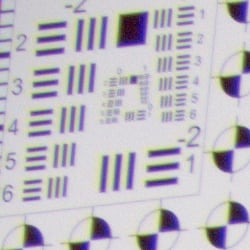
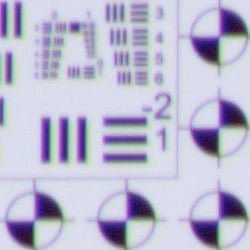
Uncorrected RAW files show high geometric distortion at wide angle. We measured almost 3.9% barrel distortion at maximum wide angle which is one of the higher distortion results we've seen. The image circle also doesn't cover the entire frame, so there's a lot of correction and interpolation applied to in-camera JPEGs at wide angle. At full telephoto, barrel distortion appears to be identical to in-camera JPEGs, so there's no geometric distortion correction being performed at the tele end. Note that most RAW converters will automatically correct for distortion, however strong correction can lead to interpolation artifacts and additional softness away from the center.
Chromatic Aberration and Corner Sharpness
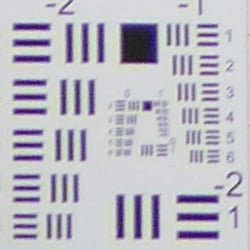
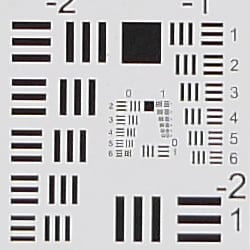
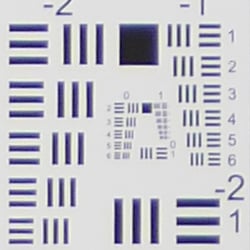
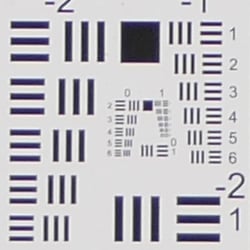
Low to moderately high chromatic aberration in the corners. The lens produces soft corners across the focal range, even stopped down.
|
Aperture: Maximum
|
|
 |
 |
| 24mm eq. at f/2.8: Lower left C.A.: Moderately high Softness: Soft |
24mm eq. at f/2.8: Center C.A.: Very low Softness: Very sharp |
 |
 |
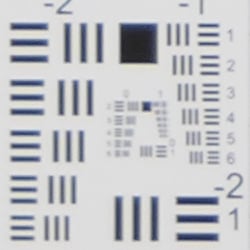
| 70mm eq. at f/3.9: Lower left C.A.: Moderate Softness: Slightly soft |
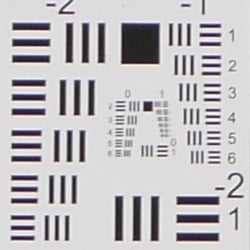
70mm eq. at f/3.9: Center C.A.: Low Softness: Sharp |
 |
 |
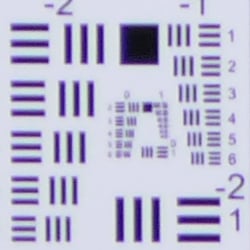
| 200mm eq. at f/4.3: Lower left C.A.: Low Softness: Soft |
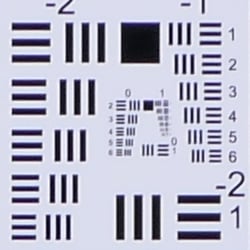
200mm eq. at f/4.3: Center C.A.: Low Softness: Sharp |
 |
 |
| 480mm eq. at f/4.5: Upper right C.A.: Moderately high Softness: Soft |
480mm eq. at f/4.5: Center C.A.: Low Softness: Sharp |
Chromatic Aberration. Lateral chromatic aberration in camera JPEGs is fairly well corrected at intermediate focal lengths, though some moderately high amounts amounts are visible in the corners at both maximum wide angle and maximum telephoto when wide open. The center shows very low to low levels of chromatic aberration.
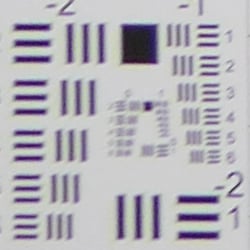
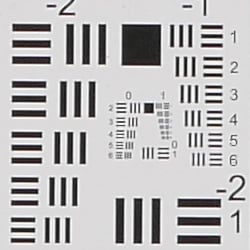
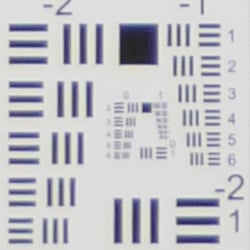
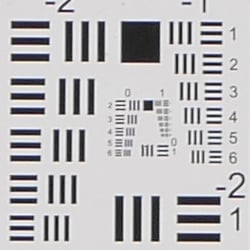
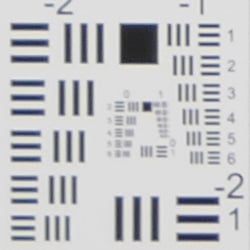
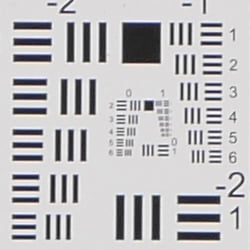
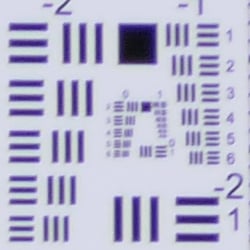
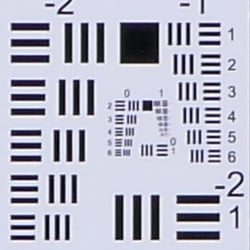
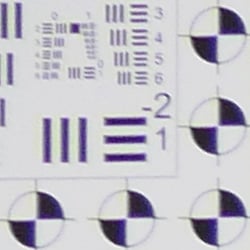
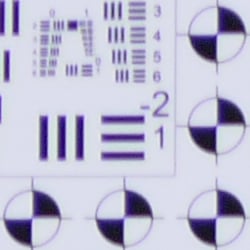
Corner Softness. Sharpness in the center is very good for the type and speed of lens, though corners show some significant softness at most focal lengths we tested when wide open. At maximum wide angle, all four corners are soft, with the left corners just slightly softer than the right, and softening extends fairly deep into the frame. This is no surprise, though, considering the amount of the distortion correction being applied. The center however is very sharp when wide open. All four corners performed quite well at 70mm equivalent, only being slightly softer than the center which itself is fairly sharp, though not quite as sharp as maximum wide angle (though it's difficult to compare as the camera applies stronger sharpening at wide angle). At 200mm equivalent, the center is again fairly sharp, but corners are noticeably softer with lower contrast. It's a similar story at full telephoto (480mm eq.), with the center being reasonably sharp, but all four corners showing some softness, but this time the right side is the softest. (Be aware that our telephoto target for long-zoom cameras like the FZ2500 is smaller than our wide-angle target, so resolution between wide and tele isn't directly comparable. Also note that the corner USAF resolution chart in our long-zoom telephoto target isn't in the extreme corners for 3:2 cameras like it is for 4:3 cameras, and the color is cooler than our standard target.)
Vignetting. As you can see from the slightly darker crops, there's some minor corner shading ("vignetting") at full wide angle when wide open, but it's negligible at longer focal lengths.
|
Aperture: f/5.6 - f/6.3
|
|
 |
 |
| 24mm eq. at f/5.6: Lower left C.A.: Moderate Softness: Very soft |
24mm eq. at f/5.6: Center C.A.: Very low Softness: Very sharp |
 |
 |
| 70mm eq. at f/5.6: Lower left C.A.: Moderately low Softness: Soft |
70mm eq. at f/5.6: Center C.A.: Very low Softness: Sharp |
 |
 |
| 200mm eq. at f/5.6: Lower left C.A.: Low Softness: Soft |
200mm eq. at f/5.6: Center C.A.: Very low Softness: Sharp |
 |
 |
| 480mm eq. at f/6.3: Upper right C.A.: Moderately high Softness: Soft |
480mm eq. at f/6.3 Center C.A.: Very low Softness: Sharp |
Stopped-down: Stopping down to f/5.6 at 24mm equivalent unfortunately didn't improve corner performance, but actually degraded sharpness a bit (f/4 isn't quite a bad, but still not as good as wide open). The center also degraded a bit compared to wide open due to diffraction, but was still quite sharp. Corners also degraded at 70mm equivalent, although sharpness in the center improved slightly. At 200mm equivalent, corners did improve when stopped down to f/5.6, but not by much. The center was also a bit sharper stopped down. At maximum telephoto, stopping down to f/6.3 improved corners and the center very slightly, but again corners are not as sharp as the center, and the center is not quite as sharp as at wide angle. Interestingly, there is still some minor corner shading visible at wide angle.
|
In-camera JPEG
|
Uncorrected RAW
|
 |
 |
| 24mm eq. @ f/2.8: Upper left: Camera JPEG |
24mm eq. @ f/2.8: Upper left: Uncorrected RAW |
 |
 |
| 480mm eq. @ f/4.5: Upper left: Camera JPEG |
480mm eq. @ f/4.5: Upper left: Uncorrected RAW |
Chromatic Aberration Correction. As you can see from the uncorrected RAW crops (above right), lateral chromatic aberration is actually quite high and bright at maximum wide angle when wide open, and a little higher at full telephoto wide open (the worse-case scenarios), so the Panasonic FZ2500's processor does a pretty good job suppressing a lot of it in JPEGs, but it still leaves some visible fringing behind, especially at the telephoto end. Also notice how much distortion correction and sharpening is being applied to JPEGs.
Overall, good though not great performance for a reasonably fast 20x lens. Performance near the center of the frame is quite good across the focal length range, however corners are weak even when stopped down, and color fringing is visible at both ends of the zoom, especially at full telephoto.
Viewfinder Test Results
Coverage
Excellent accuracy from the electronic viewfinder and very good from the LCD monitor.


The Panasonic FZ2500's electronic viewfinder showed just under 100% coverage at wide angle and at full telephoto in our tests, which is excellent, especially given the amount of geometric distortion correction that is being applied at wide angle. Interestingly, the LCD was a little looser at closer to 99% coverage in our tests, thought that's still very good.
The images above were taken from our standardized test shots. For a collection of more pictorial photos, see our Panasonic Lumix DMC-FZ2500 Photo Gallery .
Exposure
Color
Saturation & Hue Accuracy
Typical saturation levels and hue accuracy.
 |
||
|
ISO Sensitivity
|
||
|
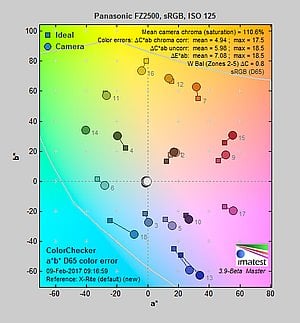
In the diagram above, the squares show the original color, and the circles show the color that the camera captured. More saturated colors are located toward the periphery of the graph. Hue changes as you travel around the center. Thus, hue-accurate, highly saturated colors appear as lines radiating from the center. Mouse over the links to compare results at different ISOs, and click on the links for larger images.
|
||
Saturation. Overall, saturation levels are about average from the Panasonic FZ2500 using default settings, with a mean saturation of 110.6% (10.6 oversaturated) at base ISO. The FZ2500 pushes dark blues the most, but also oversaturates red, orange, brown and dark green by smaller amounts, while it undersaturates yellow and aqua tones. Like most cameras, mean saturation tends to decline as sensitivity rises, to a minimum of 99.9% at ISO 25,600 in our tests. Most consumer digital cameras produce color that's more highly saturated (more intense) than found in the original subjects. This is simply because most people like their color a bit brighter than life.
Skin tones. Here, the Panasonic FZ2500 did fairly well, producing reasonably natural-looking pinkish Caucasian skin tones with auto white balance, but they were a bit warmer and yellow with the manual white balance setting under simulated daylight. Where oversaturation is most problematic is on Caucasian skin tones, as it's very easy for these "memory colors" to be seen as too bright, too pink, too yellow, etc.
Hue. The Panasonic FZ2500 shifts cyan toward blue by quite a bit, but most other color shifts are quite small. (The cyan to blue shift is very common among the digital cameras we test; we think it's a deliberate choice by camera engineers to produce better-looking sky colors.) The FZ2500's handling of yellows isn't as problematic as some cameras; yellows are undersaturated and shifted slightly toward green which can make them look a bit dingy, but we have seen much worse. With a mean "delta-C" color error of 4.94 after correction for saturation, overall hue accuracy is about average at base ISO, but as usual, hue error does increase as ISO rises, though not dramatically so. Hue is "what color" the color is.


Sensor
Exposure and White Balance
Indoors, incandescent lighting
The Auto white balance setting produced warm results and Incandescent was quite warm, however Manual was pretty accurate. Average exposure compensation required.


Indoors, under normal incandescent lighting, color balance was a bit warm with the Auto white balance setting, while results with the Incandescent setting were very warm and orange. The Manual setting was by far the most accurate and pretty neutral. (Note: The FZ2500 also has a Kelvin Temperature White Balance option, however we did not test that mode.) The Panasonic FZ2500 required +0.3 EV exposure compensation which is about average for this scene. (Our test lighting for this shot is a mixture of 60 and 100 watt household incandescent bulbs, a pretty yellow light source, but a very common one in typical home settings here in the U.S.)
Outdoors, daylight
Good color and exposure accuracy under harsh lighting, though with high contrast.
Outdoors, the Panasonic FZ2500 performed fairly well for its class. +0.7 EV exposure compensation was required to keep the mannequin's face reasonably bright in our "Sunlit" Portrait shot, which is about average among cameras we've tested. However default contrast is a quite high and the camera ended up clipping some highlights in the white shirt and flowers, and also produced some very dark, discolored shadows, though they are fairly clean for the class. Auto color balance performed well in our "Sunlit" Portrait shot, though skin tones are perhaps just a touch yellow. Manual and Daylight white balance produced slightly warmer skin tones. The Far-field shot with Auto white balance looks a bit cool, and default exposure is slightly underexposed producing some deep shadows that are noisy and discolored, however almost no highlights were blown as a result.
See full set of test images with explanations
See thumbnails of all test and gallery images
Resolution
~2,500 to ~2,550 lines of strong detail.
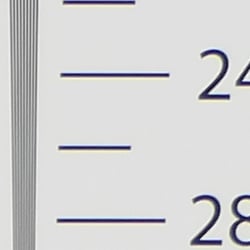
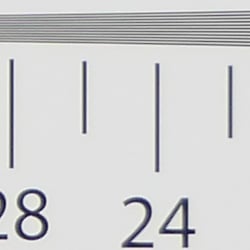
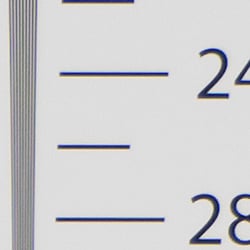
An in-camera JPEG of our laboratory resolution chart revealed sharp, distinct line patterns up to about 2,550 lines per picture height in the horizontal direction, and to about 2,500 lines per picture height in the vertical direction. Some may argue for more, but aliasing artifacts begin to interfere and lines begin to merge at that point. Complete extinction of the pattern didn't occur until about 3,000 to 3,100 lines. An Adobe Camera Raw conversion produced similar results, but complete extinction of the pattern was extended to about 3,100 to 3,200 lines and color moiré is more visible. Use these numbers to compare with other cameras of similar resolution, or use them to see just what higher resolution can mean in terms of potential detail.
Sharpness & Detail
Slightly soft images but with very good detail; some sharpening artifacts are visible. Moderate noise reduction at base ISO.


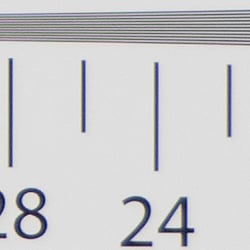
Sharpness. The FZ2500 produces slightly soft-looking images at base ISO though with very good detail, however sharpening halos can still be seen around high contrast transitions, such as the lines and text in the crop above left. The camera appears to adjust sharpening based on focal length and aperture, so the visibility of sharpening halos can vary. Edge enhancement creates the illusion of sharpness by enhancing colors and tones right at the edge of a rapid transition in color or tone.
Detail. The crop above right shows good detail for the class of camera, with moderate levels noise suppression in the darkest areas of the mannequins's hair, and almost no chroma noise. Some individual strands are smudged together in areas of low contrast at base ISO, but performance here is actually quite good considering the size and resolution of the sensor. Noise-suppression systems in digital cameras tend to flatten-out detail in areas of subtle contrast. The effects can often be seen in shots of human hair, where the individual strands are lost and an almost "watercolor" look appears.
RAW vs In-Camera JPEGs
As noted above the Panasonic FZ2500 produces images with very good detail but they can appear slightly soft despite showing noticeable sharpening halos. Let's see how an Adobe Camera Raw conversion at base ISO compares.
|
Base ISO (125)
|
|
 |
 |
 |
 |
 |
 |
|
Camera JPEG, defaults
|
RAW via Adobe Camera Raw
|
In the table above, we compare an in-camera JPEG taken at base ISO using default noise reduction and sharpening (on the left) to a matching RAW file converted with Adobe Camera Raw 9.1 via DNG Converter 9.9 using default noise reduction, then sharpened in Photoshop.
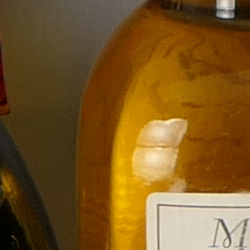
As you can see, ACR produced additional detail that isn't present in the JPEG from the camera. Perhaps the most dramatic increase in detail is in the fabric crop, where ACR was able to resolve much more of the thread pattern in the red-leaf swatch which the camera's JPEG engine presumably treats as noise. ACR also did a bit better reproducing fine detail in the pink fabric, as well as producing more accurate color. But as is usually the case, much higher levels of luminance noise can be seen in the RAW conversion particularly in flat areas as shown in the bottle crop, thanks to ACR's light default noise reduction and the relatively strong sharpening required to keep the soft RAW images crisp-looking (we used 300% USM with a radius of 0.5 pixels and a threshold of 0). You can of course apply stronger noise reduction (default ACR NR used here) to arrive at your ideal noise versus detail tradeoff. Bottom line: As is almost always the case, you can do noticeably better than the camera with a good RAW converter, provided you're willing to apply your own noise reduction and sharpening to taste.
ISO & Noise Performance
Good high ISO performance for its class.
|
Default High ISO Noise Reduction
|
 |
 |
 |
| ISO 80 | ISO 100 | ISO 125 |
 |
 |
 |
| ISO 200 | ISO 400 | ISO 800 |
 |
 |
 |
ISO 1600 | ISO 3200 | ISO 6400 |
 |
 |
|
| ISO 12,800 | ISO 25,600 | |
ISOs 80 through 200 produce similar results, with detailed images containing low levels of fine-grained luma noise and almost no chroma noise. ISO 400 shows a more noticeable drop in image quality as noise reduction ramps, but fine detail is still quite good. ISO 800 shows another step down in image quality with additional blurring of fine detail and stronger luminance noise, but is still pretty good. ISO 1600 is noticeably softer thanks to much stronger noise reduction and more visible luma noise, however chroma noise is still fairly low. At ISO 3200, image quality takes a larger hit with higher noise, both luma and chroma, and the camera's processing starts to produce images with a somewhat crystalline look. Image quality drops off very quickly from here, with ISOs 6400 through 25,600 being quite noisy with strong luma noise and chroma blotching.
Overall, though, high ISO performance is pretty good for its class, and the FZ2500's default noise reduction does a good job balancing detail with noise. We're of course pixel-peeping to an extraordinary extent here, since 1:1 images on an LCD screen often have little to do with how those same images will appear when printed. See the Print Quality section below for our evaluation of maximum print sizes at each ISO setting.
Note: We used to shoot this series at f/4 because of the relatively low light, but we now shoot it at f/5.6 or f/8 for 1"-type and larger sensors, as lens performance well away from center where we take the above crops is often not optimal at wider apertures. The added depth of field for a scene with this depth is also a better compromise than the potentially slightly sharper but shallower focus depth that a larger aperture would produce.
Extremes: Sunlit, dynamic range and low light tests
Decent dynamic range for its class in JPEGs. Good low-light performance, capable of capturing bright images and focusing in fairly dark conditions.


Sunlight. The Panasonic FZ2500 fared fairly well under the deliberately harsh lighting in the test above. To keep facial tones reasonably bright, +0.7V compensation was required, which led to some clipped highlights in the mannequin's shirt and flowers, though not as many as we often see in this shot. Detail is quite good in moderate shadows at +0.7 EV, though very deep shadows are a little noisy and discolored.
Because digital cameras are more like slide film than negative film (in that they tend to have a more limited tonal range), we test them in the harshest situations to see how they handle scenes with bright highlights and dark shadows, as well as what kind of sensitivity they have in low light. The shot above is designed to mimic the very harsh, contrasty effect of direct noonday sunlight, a very tough challenge for most digital cameras. (You can read details of this test here.)
| Face Detection | ||
 |
 |
 |
| Aperture Priority, f/5.6, 0 EV Face Detection Off |
Aperture Priority, f/5.6, 0 EV, Face Detection On |
iAuto, f/3.9, 0 EV |
Face Detection. Like most cameras these days, the Panasonic FZ2500 has the ability to detect faces (up to 15 in a scene), and adjust exposure and focus accordingly. As you can see from the examples above, face detection improved exposure in both Aperture Priority at f/5.6, and in iAuto mode where the camera had control over aperture, choosing f/3.9 (the maximum aperture at the focal length used).
|
Far-field Highlight/Shadow Examples
|
|||
 |
|||
Highlight/Shadow Adjustment
The above shots are examples of Panasonic's Highlight/Shadow adjustments at work on our high-contrast Far-field subject, with no exposure compensation. There are four settings: Standard (default), Higher Contrast, Lower Contrast and Boost Shadows, along with 3 Custom settings which allow you to modify and recall your own custom tone curves. As you can see the defaults worked as expected. It's a nice feature that offers much more control over highlights, midtones and shadows than the camera's basic contrast settings.


Intelligent Dynamic Range
The above shots are examples of Panasonic's Intelligent Dynamic Range Control (or iD-Range) at work, with no exposure compensation. Note that the camera does not take multiple shots and merge them as HDR mode does (see below). It's a system that adjusts local contrast and exposure more akin to Nikon's Active D-lighting, Canon's Automatic Lighting Optimization or Sony's Dynamic Range Optimization.
There are three levels of iD-Range available on the Panasonic FZ2500: Low, Standard and High, plus Auto and Off. It's automatically invoked in iAuto and some scene modes and manually selectable in PASM modes. As you can see, manual levels of iD-Range progressively attenuated highlights without impacting shadows and midtones, however the Auto setting produced very little change compared to Off (disabled).
|
Far-field HDR Examples
|
||||
|
|
||||
HDR mode
Here, you can see the Panasonic FZ2500's High Dynamic Range mode at work with our Far-field shot. HDR mode takes three images at different exposures and combines them to increase dynamic range. Mouse over the links, and click on them the view the full resolution files.
Auto mode chose +/-1 EV for this scene according to EXIF, however results don't match the +/-1 EV manual setting. +/-1 and +/2 EV produced very similar results, while +/-3 dimmed the entire image. Oddly, the +/-1 and +/-3 settings show more noise than the +/-2 and Auto settings. There were very few blown highlights to begin with, though, so this isn't the best subject to test HDR mode. Notice the double images and ghosting of the flag or people moving between frames; something to be aware of. Also notice the angle of view is narrower in the HDR images, likely because the images have been cropped and upsized during the optional auto alignment process.
| 1 fc 11 lux |
1/16 fc 0.67 lux |
1/16 fc No NR |
|
|---|---|---|---|
| ISO 125 |
 1.6s, f2.8 |
 25s, f2.8 |
 25s, f2.8 |
| ISO 3200 |
 1/15s, f2.8 |
 1s, f2.8 |
 1s, f2.8 |
| ISO 12800 |
 1/60s, f2.8 |
 1/4s, f2.8 |
 1/4s, f2.8 |
Low Light. The Panasonic FZ2500 performed well in our low-light tests thanks to its reasonably fast lens at wide angle coupled to a 1"-type sensor, capturing bright images at the lowest light level (1/16 foot-candle), even at the lowest native sensitivity setting (ISO 125). As expected for a 1"-type sensor, luma noise is a little high at ISO 3200, but fairly fine-grained, while chroma noise is well-controlled. The FZ2500's highest native ISO of 12,800 is quite grainy with noticeable noise reduction artifacts and is thus not recommended, but that's no surprise.
Color balance is quite good with Panasonic FZ2500's Auto white balance setting, just a touch cool. We didn't notice any significant issues with pattern noise or heat blooming, however quite a few bright pixels can be seen in darker areas at base ISO even with long exposure noise reduction active; high ISO noise reduction takes care of them at the higher ISOs.
Low-light AF: The camera's AF system was able to focus unassisted on our low-contrast AF target down to -1.0 EV (1/8 foot-candle) and on our high-contrast AF targets unassisted down to -3.3 EV light level (less than 1/32 foot-candle) at wide angle, which is good. And with the AF assist lamp enabled, the FZ2500 can focus in complete darkness. Performance with the AF assist lamp of course will vary with subject and distance, though.
How bright is this? The one foot-candle light level that this test begins at roughly corresponds to the brightness of typical city street-lighting at night. Cameras performing well at that level should be able to snap good-looking photos of street-lit scenes.
NOTE: This low light test is conducted with a stationary subject, and the camera mounted on a sturdy tripod. Most digital cameras will fail miserably when faced with a moving subject in dim lighting. (For example, a child's ballet recital or a holiday pageant in a gymnasium.) For such applications, you may have better luck with a digital SLR camera, but even there, you'll likely need to set the focus manually. For information and reviews on digital SLRs, refer to our SLR review index page.
Output Quality
Print Quality
Very nice, large 24 x 36 inch prints up to ISO 200; Good prints up to 13 x 19 inches until ISO 800; A usable 5 x 7 inch print at ISO 6400.
 ISOs 80 through 125 yield very nice prints up to 24 x 36 inches, with fine detail and bright colors. 30 x 40 inch prints are also possible for wall display purposes given the 20-megapixel resolution.
ISO 200 also delivers a good print at 24 x 36 inches, still retaining crisp detail while not yet introducing any signs of noise into the print.
ISO 400 prints at 24 x 36 inches are fine for less critical applications, but a reduction in size to 20 x 30 inches is recommended to ensure against noise, of which we experienced only a trace of at this size in a few flatter areas of our test target.
ISO 800 produces a fairly good 13 x 19 inch print, with enough fine detail to pass our good grade here. There is a hint of mild noise in a few areas of our test target, but it is still well-controlled.
ISO 1600 shots are good at up to 11 x 14 inches. At that size we see a trace of softening occurring in the red channel, and similar mild noise reported at some larger print sizes from lower sensitivities, but not enough to warrant a further size reduction here.
ISO 3200 delivers an 8 x 10 that is usable for less critical applications, but is a bit too noisy to warrant our overall good seal. The 5 x 7's tighten up here, and are fine for most general print purposes.
ISO 6400 also delivers a good 5 x 7 inch print that just passes our good seal. Noise is well-controlled and there is still enough color saturation to pass the grade here. Anything larger is simply too noisy to be usable.
ISO 12,800 yields a muted 4 x 6 inch print that may be usable for less critical applications, but for reasonable prints this setting is not recommended.
ISO 25,600 does not deliver usable prints and is best avoided.
Given the 1"-type sensor housed within, the Panasonic FZ2500 delivers print sizes we've come to expect from this sensor size. You can expect reasonably large prints with good fine detail and well-controlled noise up to about ISO 1600, after which the sensor and processor can't keep pace with the rising ISO and noise and softening both take their toll on the prints.
The images above were taken from our standardized test shots. For a collection of more pictorial photos, see our Panasonic Lumix DMC-FZ2500 Photo Gallery .
Not sure which camera to buy? Let your eyes be the ultimate judge! Visit our Comparometer(tm) to compare images from the Panasonic Lumix DMC-FZ2500 with those from other cameras you may be considering. The proof is in the pictures, so let your own eyes decide which you like best!
Performance
Timing and Performance
Generally very good performance for its class, though buffer clearing is sluggish.
| Startup/Play to Record | ||
|---|---|---|
|
Power on |
~2.3 seconds
|
Time it takes to turn on and capture a shot. |
|
Play to Record, |
~0.7 second
|
Time until first shot is captured. |
Startup time was good for its class. Switching from Play to Record mode and taking a shot was very quick.
| Shutter Response (Lag Time) | ||
|---|---|---|
|
Full Autofocus, |
0.103 second
|
Time from fully pressing shutter button to image capture, with the lens already at the proper focal distance setting. |
|
Full Autofocus, |
0.098 second
|
Time from fully pressing shutter button to image capture, with the lens already at the proper focal distance setting. |
|
Full Autofocus |
0.453 second
|
Time from fully pressing shutter button to image capture. Auto Flash enabled. |
|
Manual Focus |
0.129 second
|
For most cameras, shutter lag is less in manual focus than autofocus, but usually not as fast as when the camera is "prefocused". |
|
Prefocused |
0.039 second
|
Time to capture, after half-pressing and holding shutter button. |
The Panasonic FZ2500's autofocus speeds were excellent in our tests, especially for a camera that uses contrast detection only. The FZ2500 produced full-autofocus shutter lag (with the subject at a fixed distance) of 0.103 second at full wide angle and 0.0.098 second at full telephoto using 1-area (center) AF. That's faster than most DSLRs. Enabling the flash increased lag to 0.453 second, though, to account for preflash metering.
When manually focused, the FZ2500's lag time was 0.129 second, which is odd as that's a bit slower than with autofocus. The FZ2500's prefocused shutter lag time of only 0.039 second was very quick.
To minimize the effect of different lens' focusing speed, we test AF-active shutter lag with the lens already set to the correct focal distance.
| Cycle Time (shot to shot) | ||
|---|---|---|
|
Single Shot mode |
0.45 second
|
Time per shot, averaged over a few frames (we no longer test for buffer depths in single-shot mode). |
|
Single Shot mode |
0.68 second
|
Time per shot, averaged over a few frames (we no longer test for buffer depths in single-shot mode). |
|
Early shutter |
YES
|
Some cameras refuse to snap another shot if you release and press the shutter too quickly in Single Shot mode, making "No" the preferred answer. |
|
Continuous H |
0.09 second
(11.36 fps); 100 frames total; 13 seconds to clear* |
Time per shot, averaged over buffer length of 100 frames, then slows to 0.15s or 6.54 fps when buffer is full. |
|
Continuous H |
0.09 second
(10.63 fps); 35 frames total; 21 seconds to clear* |
Time per shot, averaged over buffer length of 35 frames, then slows to 0.58s or 1.73 fps when buffer is full. |
|
Continuous H |
0.09 second
(10.65 fps); 32 frames total; 32 seconds to clear* |
Time per shot, averaged over buffer length of 32 frames, then slows to 0.99s or 1.02 fps when buffer is full. |
|
Flash Recycling |
4.7 seconds
|
Flash at maximum output. |
|
*Note: Buffer clearing times measured with a SanDisk Extreme Pro 95MB/sec UHS-I SDHC card. Slower cards will produce correspondingly slower clearing times. Slow cards may also limit length of bursts in continuous mode. ISO sensitivity and noise reduction settings can also affect cycle times and burst mode performance.
|
||
Single-shot cycle times were pretty fast, ranging between 0.45 second for best quality JPEGs to 0.68 second for RAW+JPEG, however there was a pre-press penalty (if you press the shutter release too soon after taking a shot, the camera will ignore it and you have to press again to take another shot).
Continuous High Speed "H" mode burst rate was fast at 11.4 frames per second for best quality JPEGs, almost matching Panasonic's 12 fps spec with AFS (focus locked at the first frame). When shooting RAW or RAW+JPEG files, the frame rate reduced to about 10.6 or 10.7 fps, though that's still quite fast. We also tested "H" mode using the electronic shutter, and got very similar results to those above taken with the mechanical shutter. With continuous autofocus enabled, the top frame rate drops to 7 fps according to Panasonic, however we do not test with continuous AF in the lab.
In Continuous High Speed "H" mode full-resolution buffer depths were very generous for Large/Fine JPEGs at 100 frames. When shooting RAW or RAW+JPEG files buffer sizes dropped to 35 and 32 frames respectively, though that's still pretty good.
Buffer clearing was however sluggish with a fast UHS-I card, ranging from 13 seconds after a max-length burst of best quality JPEGs to 32 seconds after a max-length burst of RAW+JPEG files, but you can continue shooting (at a much slower rate; see table above) or change settings while the buffer is clearing. However, you can't view just-shot images until the buffer is flushed to the card.
Flash recycling after full-power discharge took an average of 4.7 seconds which is a bit on the slow side, but the flash appears to be reasonably powerful.
Bottom line: Except for buffer clearing, the Panasonic FZ2500's performance is very good to excellent for its class. Startup and mode switching are fast, autofocus speeds are quick, and prefocused shutter lag is low. Burst performance is excellent and buffer depths are good, however buffer clearing is sluggish with a fast UHS-I card and the FZ2500 unfortunately doesn't support faster UHS-II cards.
Battery Life
Fair battery life for its class.
| Operating Mode | Battery Life |
|---|---|
|
Still Capture,
(LCD, CIPA standard) |
350 shots
|
|
Still Capture,
(EVF, CIPA standard) |
270 shots
|
The Panasonic FZ2500 uses a custom rechargeable lithium-ion battery pack for power, and comes with a single battery and a dedicated battery charger. The CIPA-rated 350 shots per charge when using the LCD and 270 shots when using the EVF is fair for its class, but we definitely recommend getting a second battery for your FZ2500 if you plan any extended outings.
The table above shows the number of shots the camera is capable of (on a fully-charged rechargeable battery), based on CIPA battery-life and/or manufacturer standard test conditions.
(Interested readers can find an English translation of the CIPA DC-002 standards document here. (180K PDF document))
Image Quality
Below are crops from our laboratory Still Life target comparing the Panasonic FZ2500's image quality to its shorter-zoom sibling, the FZ1000, as well as to its nearest 1"-sensor rivals, the Canon G3X, Sony RX10 III and Sony RX10 II. We've also included the Panasonic FZ300 as an example of a smaller-sensored camera based on a 1/2.3" sensor, to illustrate the advantages of the larger 1"-type sensor the FZ2500 and others in this group have.
NOTE: These images are from best quality JPEGs straight out of the camera, at default settings including noise reduction and using the camera's actual base ISO (not extended ISO settings). All cameras in this comparison have fixed zoom lenses. Clicking any crop will take you to a carrier page where you can click once again to access the full resolution image as delivered straight from the camera. For those interested in working with the RAW files involved: click these links to visit each camera's respective sample image thumbnail page: Panasonic FZ2500, Panasonic FZ1000, Panasonic FZ300, Canon G3X, Sony RX10 III, and Sony RX10 II -- links to the RAW files appear beneath those for the JPEG images, wherever we have them. And remember, you can always go to our world-renowned Comparometer to compare the Panasonic FZ2500 to any camera we've ever tested!
Panasonic FZ2500 vs Panasonic FZ1000 at Base ISO
 |  |
 |  |
 |  |
Panasonic FZ2500 at ISO 125 | Panasonic FZ1000 at ISO 125 |
Here we compare the FZ2500 with its 20x 24-480mm eq. f/2.8-4.5 zoom to the Panasonic FZ1000 which has a 16x 25-400mm eq. f/2.8-4 zoom lens. These two siblings share the same or very similar sensors, so the slight differences we see here at base ISO are mostly due to revised processing, as the FZ2500 uses a newer processor. Noise levels look slightly lower from the FZ2500 but so is detail in our tricky red-leaf swatch, however that's mostly due to updated noise processing as noise in the matching RAW files looks nearly identical. The FZ2500 also produces more pleasing colors also due to updated processing. | |
Panasonic FZ2500 vs Panasonic FZ300 at Base ISO
|  |
|  |
|  |
Panasonic FZ2500 at ISO 125 | Panasonic FZ300 at ISO 100 |
Above we compare the FZ2500 to its baby brother, the FZ300. The later has a 24x 25-600mm eq. f/2.8 lens coupled to a much smaller 12-megapixel 1/2.3"-type sensor. As you can see, the 20-megapixel FZ2500 clearly out-resolves the FZ300 here at base ISO, and it also produces lower noise levels even though base ISO is a bit higher. Colors are also more pleasing from the newer FZ2500. | |
Panasonic FZ2500 vs Canon G3X at Base ISO
|  |
|  |
|  |
Panasonic FZ2500 at ISO 125 | Canon G3X at ISO 125 |
The Canon G3X also uses a 20-megapixel 1"-type sensor, but it's coupled to a 25x 24-600mm eq. f/2.8-5.6 zoom lens. Here at base ISO, image quality is comparable between these two rivals, however the FZ2500's image is a little cleaner as well as a bit crisper and contrastier, though the G3X does a better job with the subtle detail in our troublesome red-leaf swatch. Interestingly, the FZ2500 does better with the pink fabric. | |
Panasonic FZ2500 vs Sony RX10 III at Base ISO
|  |
|  |
|  |
Panasonic FZ2500 at ISO 125 | Sony RX10 III at ISO 100 |
This is a comparison with another camera sporting a 1"-type 20-megapixel sensor, the Sony RX10 III. It has a 25x 24-600mm eq. f/2.4-4 lens which is both faster and longer than the FZ2500's. Here at base ISO, both resolve about the same amount of detail in most areas, but the Sony produces a crisper, more contrasty image, however fine detail appears a little more natural from the Panasonic in the mosaic crop. Noise levels from the Sony are a bit lower, but notice the slightly lower base ISO as well. The Sony also does noticeably better in our tricky red-leaf fabric, and colors are arguably more pleasing from the Sony as well. | |
Panasonic FZ2500 vs Sony RX10 II at Base ISO
|  |
|  |
|  |
Panasonic FZ2500 at ISO 125 | Sony RX10 II at ISO 100 |
The Sony RX10 II has a 1"-type 20-megapixel sensor as well, however with only an 8.3x 24-200mm eq. f/2.8 zoom, it has by far the shortest zoom range of the group, and is thus not a direct competitor for some. It's still a DSLR-styled all-in-one in roughly the same price category, though, so we thought we'd include it anyway. Unsurprisingly, the Sony RX10 II's image quality is very similar to its bigger brother, the RX10 III, and so the differences compared to the FZ2500 are also very similar. | |
Panasonic FZ2500 vs Panasonic FZ1000 at ISO 1600
 |  |
 |  |
 |  |
Panasonic FZ2500 at ISO 1600 | Panasonic FZ1000 at ISO 1600 |
Here at ISO 1600, the FZ2500's revised processing does yield marginally better detail as well as more pleasing color, however image quality is otherwise very similar. Both cameras really struggle with our tricky red-leaf swatch, blurring out almost all detail. | |
Panasonic FZ2500 vs Panasonic FZ300 at ISO 1600
|  |
|  |
|  |
Panasonic FZ2500 at ISO 1600 | Panasonic FZ300 at ISO 1600 |
Above at ISO 1600 we can see the FZ2500's much larger sensor is paying major dividends in terms of image quality, producing much better detail as well as lower noise and fewer noise reduction artifacts. Color also remains better from the newer FZ2500. | |
Panasonic FZ2500 vs Canon G3X at ISO 1600
|  |
|  |
|  |
Panasonic FZ2500 at ISO 1600 | Canon G3X at ISO 1600 |
Luminance noise is noticeably higher from the G3X here at ISO 1600, which gives the Canon image a very grainy look. The higher noise from the G3X also interferes with the rendering of fine detail in the mosaic crop, as the FZ2500 is able to hold onto more detail there. The Canon however does better than the Panasonic in the red-leaf fabric, but the Panasonic manages a bit better with the pink fabric. | |
Panasonic FZ2500 vs Sony RX10 III at ISO 1600
|  |
|  |
|  |
Panasonic FZ2500 at ISO 1600 | Sony RX10 III at ISO 1600 |
The Panasonic does a much better job at retaining fine, fairly crisp detail in our mosaic crop while producing much lower noise levels in flatter areas here at ISO 1600. And while the Sony appears to do better in the red-leaf fabric, much of the detail is badly distorted and false. The Sony does however continue to produce better contrast and more neutral colors. | |
Panasonic FZ2500 vs Sony RX10 II at ISO 1600
|  |
|  |
|  |
Panasonic FZ2500 at ISO 1600 | Sony RX10 II at ISO 1600 |
Again, a very similar comparison between the FZ2500 and RX10 II here with the Panasonic producing a cleaner, more detailed image except in the red-leaf fabric. | |
Panasonic FZ2500 vs Panasonic FZ1000 at ISO 3200
 |  |
 |  |
 |  |
Panasonic FZ2500 at ISO 3200 | Panasonic FZ1000 at ISO 3200 |
Apart from improved contrast and colors, image quality from these two siblings is similar, with both obviously struggling to retain fine detail at ISO 3200. | |
Panasonic FZ2500 vs Panasonic FZ300 at ISO 3200
|  |
|  |
|  |
Panasonic FZ2500 at ISO 3200 | Panasonic FZ300 at ISO 3200 |
There's just no contest here at ISO 3200, with the FZ2500 producing a much more usable image than the FZ300 in every regard. | |
Panasonic FZ2500 vs Canon G3X at ISO 3200
|  |
|  |
|  |
Panasonic FZ2500 at ISO 3200 | Canon G3X at ISO 3200 |
High luminance noise continues to hold the Canon G3X back, with a much grainer, blurrier image than the FZ2500 here at ISO 3200. | |
Panasonic FZ2500 vs Sony RX10 III at ISO 3200
|  |
|  |
|  |
Panasonic FZ2500 at ISO 3200 | Sony RX10 III at ISO 3200 |
The Sony RX10 III's noise reduction algorithm renders fine detail as very soft and blotchy while leaving behind more luma noise in flatter areas. Contrast is generally better from the Sony, but otherwise the Panasonic comes out ahead in this battle. | |
Panasonic FZ2500 vs Sony RX10 II at ISO 3200
|  |
|  |
|  |
Panasonic FZ2500 at ISO 3200 | Sony RX10 II at ISO 3200 |
Similar to the previous comparison, it's the Panasonic that produces a better image here, although both are stretched in terms of usable sensitivity for a 1"-sensor. | |
Panasonic FZ2500 vs. Panasonic FZ1000, Panasonic FZ300, Canon G3X, Sony RX10 III, Sony RX10 II
 |  |  |  |  |  |
 |  |  |  |  |  |
 |  |  |  |  |  |
| Panasonic FZ2500 ISO 125 ISO 3200 ISO 6400 | Panasonic FZ1000 ISO 125 ISO 3200 ISO 6400 | Panasonic FZ300 ISO 100 ISO 3200 ISO 6400 | Canon G3X ISO 125 ISO 3200 ISO 6400 | Sony RX10 III ISO 100 ISO 3200 ISO 6400 | Sony RX10 II ISO 100 ISO 3200 ISO 6400 |
| Detail comparison. High-contrast detail is also important, pushing the camera in different ways, so we like to look at it too. Here, the FZ2500 performs very similarly to the FZ1000, though the latter looks perhaps marginally more contrasty because of a slightly dimmer exposure. As you can see, the 12-megapixel FZ300 struggles to resolve any of the fine lines within the lettering even at base ISO, and image quality degrades very quickly at the higher ISOs. The FZ2500 compares nicely with the Canon G3X at base ISO, however as ISO rises, the Panasonic pulls ahead with better contrast, detail and fewer false colors. The Sony RX10 III arguably performs the best at base ISO and it produces the best contrast as ISO rises, however the Panasonic FZ2500 and FZ1000 hold on to more detail at higher ISOs. The Sony RX10 II is very similar to the RX10 III, except contrast isn't quite as high. | |||||
Very nice, large 24 x 36 inch prints up to ISO 200; Good prints up to 13 x 19 inches until ISO 800; A usable 5 x 7 inch print at ISO 6400.
ISOs 80 through 125 yield very nice prints up to 24 x 36 inches, with fine detail and bright colors. 30 x 40 inch prints are also possible for wall display purposes given the 20-megapixel resolution.
ISO 200 also delivers a good print at 24 x 36 inches, still retaining crisp detail while not yet introducing any signs of noise into the print.
ISO 400 prints at 24 x 36 inches are fine for less critical applications, but a reduction in size to 20 x 30 inches is recommended to ensure against noise, of which we experienced only a trace of at this size in a few flatter areas of our test target.
ISO 800 produces a fairly good 13 x 19 inch print, with enough fine detail to pass our good grade here. There is a hint of mild noise in a few areas of our test target, but it is still well-controlled.
ISO 1600 shots are good at up to 11 x 14 inches. At that size we see a trace of softening occurring in the red channel, and similar mild noise reported at some larger print sizes from lower sensitivities, but not enough to warrant a further size reduction here.
ISO 3200 delivers an 8 x 10 that is usable for less critical applications, but is a bit too noisy to warrant our overall good seal. The 5 x 7's tighten up here, and are fine for most general print purposes.
ISO 6400 also delivers a good 5 x 7 inch print that just passes our good seal. Noise is well-controlled and there is still enough color saturation to pass the grade here. Anything larger is simply too noisy to be usable.
ISO 12,800 yields a muted 4 x 6 inch print that may be usable for less critical applications, but for reasonable prints this setting is not recommended.
ISO 25,600 does not deliver usable prints and is best avoided.
Given the 1"-type sensor housed within, the Panasonic FZ2500 delivers print sizes we've come to expect from this sensor size. You can expect reasonably large prints with good fine detail and well-controlled noise up to about ISO 1600, after which the sensor and processor can't keep pace with the rising ISO and noise and softening both take their toll on the prints.
Field Test
High-zoom camera is a great blend of performance and features

The Panasonic FZ2500 is an all-in-one enthusiast zoom camera that offers a 20x optical zoom and a 20.1-megapixel 1-inch type sensor. While the still imaging features are strong, the FZ2500 also offers a lot for videographers, including 4K video recording and a smooth, camcorder-inspired zooming lens. Compared to its predecessor, the FZ1000, the FZ2500 makes several key improvements to the camera body, lens and overall performance. How good is this camera? Read on to find out.
- 20.1-megapixel 1-inch type CMOS sensor
- 20x zoom 24-480mm equivalent f/2.8-4.5 lens
- 125-12800 native ISO range
- DSLR-style camera body with tilt/swivel touchscreen
- Full-resolution image capture at up to 12 frames per second
- Can capture lower-resolution images up to 30fps
- 4K video recording
- 4K Photo
- Built-in Wi-Fi
- $1,200 price

FZ2500 body is comfortable with excellent touchscreen display
Given its high-zoom capabilities, it's unsurprising that the FZ2500 is a large camera. It has a DSLR-style camera body, measuring about 5.4 x 4.0 x 5.3 inches (138 x 102 x 135 millimeters) and weighing in at 34.1 ounces (966 grams) with battery and memory card. The body has a good, deep contoured grip that helps the FZ2500 feel nice in my hands.
Buttons are in convenient locations, including both control dials. The focal length control around the shutter release works well, but doesn't offer precise control. However, you can use the main control ring around the lens to control focal length as well, and that offers very fine control, allowing you to change the focal length by only a few millimeters at a time across the entire focal length range. By default, using the top two function buttons on the side of the lens allows you to move the focal length up and down by single millimeter increments.
Redesigned internal-zooming lens keeps camera steady and balanced
Speaking of the lens, as soon as you power the camera on, the lens becomes fully extended. No matter the focal length, the physical length of the lens remains the same. I like this a lot as it keeps the body very balanced. In addition to the larger, main zoom ring on the lens, there's a second, narrower ring toward the end of the lens. The narrower ring controls focus, while in manual focus mode, but will serve to adjust aperture otherwise. The lens also has three programmable function buttons on the side, which is excellent. Next to the function buttons is a switch for the neutral density filter, set to auto, 1/64, 1/16, 1/4 and off.
Taking a quick look at the top deck of the camera, the button and control layout is well organized and overall, resembles other modern Panasonic cameras. There's a drive mode dial to the left of the viewfinder and to the right is a mode dial, the two command dials, function button, shutter release and movie record button. The FZ2500 also includes a built-in flash, which offers an auto ISO range of 0.3 to 13.2 meters at wide focal lengths and 1.0 to 7.9 meters at telephoto.
Moving to the rear of the camera, we come to one of the FZ2500's best features, its excellent articulating touchscreen display. The 3-inch rear display has 1,040,000 dots and can tilt and swivel. While the articulating mechanism is like that of its predecessor, the FZ1000, the FZ2500's touchscreen functionality is new. The articulation works very well as does the touchscreen itself. Besides the excellent display, there isn't much of note on the rear of the FZ2500. It has plenty of buttons, including a useful autofocus mode switch.
The FZ2500's electronic viewfinder has a bit more magnification than the FZ1000's did, 0.74x compared to 0.70x (35mm equivalent), but has the same resolution, 2.36 million dots. The 0.39-inch XGA OLED viewfinder works very well, as does its eye sensor, and offers a sharp image. However, I would prefer more depth to the rubber cup around the viewfinder as it can be hard to keep all ambient light.
Overall, the FZ2500 has a great body design with ample controls and features. While I would certainly welcome weather-sealing on the camera body, I have no major issues with it otherwise. Its buttons are responsive, the display is great, its ports (particularly the memory card slot on the side) are easily accessible even when mounted to a tripod, and it's comfortable to hold and use.

Panasonic FZ2500's built-in 20x optical zoom lens offers good performance
Compared to its predecessor, the FZ2500's built-in lens is much improved. The FZ2500 has a 20x optical zoom lens compared to the 16x zoom lens of the FZ1000, for starters, but it also has an improved optical formula and a new aperture design.
With a 35mm equivalent focal length range of 24-480mm and an aperture range of f/2.8-4.5, the FZ2500 offers a lot of reach for the price. With this greater zoom range, the FZ2500 does weigh 12% more than the FZ1000, but that's a worthy trade-off for the clear majority of photographers. Across the entire focal length range, I found the FZ2500 to offer impressive performance.
Its good optical performance is likely due in part to its new optical design. The FZ2500 has one more element than the FZ1000 and includes a new ultra-high refractive index. It also includes an additional aspherical lens, although total aspherical surfaces remain unchanged at eight. In total, the lens has 16 elements in 11 groups.
Aperture: New mechanism leads to good bokeh, but be careful not to stop down too much
The new aperture mechanism features a 9-bladed diaphragm, compared to the 7-bladed one found in the FZ1000. The lens can create some very nice bokeh considering the sensor size; I was impressed. Out of focus areas are smooth and not distracting, especially when shooting at the telephoto end of the lens. You won't be able to create a super soft background as easily as you could with a larger sensor camera and same equivalent focal length, all else equal, but it still offers users very pleasing images in a wide variety of situations.

Regarding aperture, you will want to avoid stopping down much with the FZ2500 as diffraction rears its ugly head quickly. I found diffraction to become most noticeable around f/8.0 and then continues to degrade at f/11. When shooting wide open at 24mm, the lens is a bit soft but stopping down to f/4.0 improves sharpness considerably. On the other hand, at the telephoto end of the lens, it performs well wide open and gets slightly softer as you stop down. Generally, the lens is best between f/4-5.6 throughout its entire focal length range.
When shooting with the lens stopped down, there is a diffraction compensation option that applies to JPEG files, and it works quite well. It sharpens the images without introducing artifact issues. I recommend having it set to 'Auto' and letting the camera work its magic as it sees fit, particularly if you intend to use JPEG files.
Built-in neutral density filter works well
If you want to reduce your shutter speed, say for shooting video or creating stills with motion blur, rather than stopping down, you can utilize the FZ2500's built-in neutral density filter, another new feature compared to its predecessor. There are two built-in ND filters which offer varying strengths of 1/4 (3 stops), 1/16 (4 stops) and 1/64 (6 stops). The ND filter is controlled via a switch on the side of the lens barrel.

Macro capabilities are good, although corner softness is excessive
The FZ2500 can focus impressively close at wide-angle, as close as 1.2 inches (3 centimeters) when using the macro focus mode. The normal focus range is 11.8 inches (30 centimeters) to infinity.


Light falloff is handled well across the focal length range
Vignetting control across the lens's focal length and aperture ranges is handled nicely by the camera's processing for both JPEG, as well as RAW files, which do receive in-camera corrections. There was more falloff at 24mm than 480mm, but in neither case is the situation particularly bad.


Edges are soft at both extremes, but particularly at 24mm
At both extremes of the lens, there is some edge softness that doesn't go away by stopping down. What does improve when stopping down is chromatic aberration around fine details at the edge, although that occurs across the entire aperture range, especially at 24mm. For whatever reason, the left edge of the frame at 24mm was softer than the right edge, but that situation reversed at the telephoto end of the lens, with the right edge instead being slightly softer. This might be an issue with sample variation, and this exact behavior might not be present on other FZ2500 units.
24mm equivalent, f/2.8, 100% JPEG crops |
|
 |
 |
Top left corner |
Top right corner |
Overall: The 20x zoom lens provides very good performance considering its versatility
All in all, the built-in lens is very impressive both for its versatility and its performance. While it displays some optical weakness, particularly at the wide end of the lens, it is still a great performer overall given its focal length range and this class of camera.
20.1MP sensor helps the FZ2500 capture sharp, detailed images
The Panasonic FZ2500 uses a 20.1-megapixel 1-inch-type CMOS sensor with a native ISO range of 125 to 12,800, which can be extended down to ISO 80 and up to ISO 25,600. This same sensor was used in the FZ1000 and is found in many cameras and offers very good performance for the sensor size.
The FZ2500 produces sharp, vibrant JPEGs at default settings, and its RAW files are versatile, albeit dull and soft straight from the camera, as is par for the course with RAW files. Importantly, if you don't want to fiddle with camera settings, you'll be able to get nice images with the FZ2500 right out of the box. With that said, default sharpening is perhaps a bit excessive to my eye, but that isn't unusual for default JPEG settings and is easy to adjust in the camera.

ISO performance: Both RAW and JPEG images fare well at higher ISO settings
When considering RAW images, I already mentioned that they're soft across the board, but they also perform quite well at higher ISOs and are amenable to fine-tuned noise reduction processing. Through ISO 1600, RAW images don't show all that much noise and maintain good sharpness. Noise distribution is smooth and easy to reduce using post-processing. However, at ISO 3200, noise is harder to deal with. Nonetheless, there is still decent detail (although fine detail will be lost after reducing that noise) and colors are generally accurate. At ISO 6400, 12800 and the extended setting of 25600, colors become washed out and there are a lot of hot pixels that appear in images. Noise is not as evenly distributed and there is banding. Further, dynamic range is severely limited as highlights become heavily banded and black areas become a charcoal gray.
Panasonic FZ2500 ISO Comparison (RAW) 100% center crops from RAW images processed with Adobe Camera RAW default settings. (Click to access the .RW2 RAW files.) |
|
 |
|
ISO 125 Full Scene |
|
 |
 |
ISO 80 (extended) |
ISO 100 (extended) |
 |
 |
ISO 125 |
ISO 200 |
 |
 |
ISO 400 |
ISO 800 |
 |
 |
ISO 1600 |
ISO 3200 |
 |
 |
ISO 6400 |
ISO 12800 |
 |
|
ISO 25600 (extended) |
|
Looking at JPEG images, they are very sharp at ISO 125, 200 and 400. At ISO 800, sharpness decreases a bit, and you lose some of the very fine detail due to the camera's noise reduction. At ISO 1600, not only is there a further loss of fine detail, but the noise reduction introduces artifacts around soft edges, giving them a blocky appearance. Colors are slightly washed out at ISO 3200, but there is still some decent detail. ISO 6400 is usable at small sizes, but the artifacts and overall fuzziness limits their usability for large prints or viewing. ISO 12800 and ISO 25600 are useless in my opinion due to their severe lack of saturation and detail.
Panasonic FZ2500 ISO Comparison (JPEG) 100% center crops from JPEG images captured using default settings and 'Standard' Picture Style. (Click for full-size images.) |
|
|
|
ISO 125 Full Scene |
|
 |
 |
ISO 80 (extended) |
ISO 100 (extended) |
 |
 |
ISO 125 |
ISO 200 |
 |
 |
ISO 400 |
ISO 800 |
 |
 |
ISO 1600 |
ISO 3200 |
 |
 |
ISO 6400 |
ISO 12800 |
 |
|
ISO 25600 (extended) |
|
Overall: Image quality is very good
I am generally very pleased with the image quality performance of the Panasonic FZ2500. JPEG images are sharp, vibrant and look good across an impressive range of ISO settings, given the camera's sensor size.
Panasonic FZ2500 user experience: Very good across the board
User experience is certainly subjective, but in my opinion, the FZ2500 is very user-friendly and enjoyable to shoot with. One of the biggest reasons for this is the wealth of physical controls on the camera and the impressively useful touchscreen display. Additionally, the camera offers good performance across the board with no major shortcomings.
Touchscreen work very well, and menus are decently organized
A good menu system is critical for minimizing frustrations when using a camera and fortunately Panasonic's is mostly good. Settings are in their expected sub-menus, although I would prefer even further separation of menu items because you sometimes must scroll through as many as ten pages of items. On the positive side, the menus work well with touch and traditional button controls. Further, there is a separate menu just for movie settings, which is nice.
Another good usability feature of the FZ2500 is its "Q. Menu," accessed via the Fn5 button above the top right corner of the rear display. Within the Q. Menu, you can adjust, via touch or physical controls: picture style, flash, movie recording quality, picture size, image quality, focus drive mode, focus area mode, metering, aperture, shutter speed, exposure compensation, ISO and white balance.
Autofocus: Reliable, accurate and fast
The Panasonic FZ2500 uses a contrast detect autofocus system but adds Panasonic's Depth from Defocus (DFD) technology, which boosts speed and performance. You can read more about DFD technology here. The FZ2500's 49-point AF system proved to work very well in the field. When considering single shot autofocus and stationary objects, autofocus is very quick and accurate, especially at shorter focal lengths. When shooting at the telephoto end of the lens, focus speeds are slightly slower, which is typical behavior for a camera in this class, but I was still impressed with how quick the focus remained, even when shooting at 480mm. Further, in low light, the FZ2500's AF performance remained quick.

AF performance remains mostly positive when considering moving subjects, although the FZ2500 can become sluggish when continually focusing at the telephoto end. The camera has a slight tendency to hunt and have focus come in and out very quickly, which can create a slight wobbling effect through the viewfinder or on the display -- which is characteristic of contrast-detect AF systems -- but it otherwise doesn't negatively impact shooting performance for photos.
I was impressed with the subject tracking autofocus mode, which lets you tap on the subject on the display and the camera will automatically follow it around. In my experience, the FZ2500 could successfully lock onto the subject even after it exited and then re-entered the frame again. It can't maintain a great lock with a fast subject, but it is nonetheless capable of shooting many moving subjects.
Of the FZ2500's various AF point configurations, I enjoyed the custom multi AF mode. It allows you to select from three pre-made AF areas: horizontal pattern, vertical pattern and central pattern, all of which you can move around the frame. The real magic is in the three custom area slots. You can tap any of the 49 AF area rectangles on the display, and the camera will then use those as its autofocus area. Say that you know you will want to shoot a subject that will always be placed in the rightmost third of the frame, you can select only those AF areas. Or perhaps you're shooting a subject with a distinct shape, like an 'X,' you can make that shape as well. It's a neat feature, albeit one that many users might not need.

The best part about autofocusing with the FZ2500, besides its reliable and quick performance, is its touchscreen. Being able to look through the viewfinder and then tap on the display where you want the camera to focus when using the 1-point AF mode is excellent. Rather than needing to move the point around using a directional pad, you can simply tap your subject on the display. This is something that neither the FZ1000 offered nor the FZ2500's steepest competition, the Sony RX10 series.
Metering: Consistent results with both exposure and white balance
The fact that I don't have much to say about the FZ2500's metering performance is very much a good thing. It offers intelligent multiple, center-weighted and spot metering modes, and they all work well. It is worth noting that the spot metering mode is tied to the autofocus area, meaning it is adjustable depending on where you place the AF point, which I find is an excellent feature. Exposure compensation is available via the Fn4 button on the top of the camera or through the Q. Menu, but I rarely needed to use it. The exception to that is when shooting scenes with snow, but that is normal behavior for shooting that type of subject. White balance metering was similarly impressive, and the camera didn't give me any issues in its auto white balance mode.
 |
8.8mm (24mm equivalent), f/5.6, 1/5s, ISO 125. I used +0.67 exposure compensation for this image. Besides shooting snowy scenes, I very rarely needed exposure compensation. Importantly, the FZ2500 was consistent with its metering. I could have even used a full stop of exposure compensation for this particular scene. This image has been modified. Click for full-size image. |
Plenty of shooting modes, including panorama shooting
In addition to the standard assortment of shooting modes -- P, A, S and M -- the FZ2500 also offers a handful of special shooting modes such as panorama, scene modes and creative filters. There is not a lot to say about the creative modes, but there are a lot of filters and effects for users to choose from, which can, in some cases, vastly change the appearance of your images.
Performance: Fast capture and good buffer depth
The Panasonic FZ2500 offers good performance across the board with very few exceptions. Addressing the shutter first, the FZ2500 has a mechanical shutter and an electronic shutter. The mechanical shutter offers shutter speeds ranging from 60 seconds to 1/4000s, although there are some limits to this. For example, at f/2.8, the maximum mechanical shutter speed is 1/2000s. It isn't until f/4.5 that you can shoot at 1/4000s using the mechanical shutter. Regarding the electronic shutter, the slowest shutter speed available when using it is a full second. Shutter speed limits also affect the maximum flash sync speeds. At f/2.8-4.0, the max flash sync speed is 1/2000s because of the mechanical shutter constraints. At f/4.5 and higher, you can shoot with flash at up to 1/4000s. Further, you cannot use the flash with the electronic shutter. The FZ2500 includes a hot shoe as well.

Regarding continuous shooting speeds, I tested the FZ2500 with a Sony 32GB SDHC card, which we tested to have write speeds around 45 MB/s with occasional drops to 30 MB/s. The FZ2500 is not UHS-II compatible, by the way. When shooting RAW + JPEG frames, I could capture 32 frames in 12 frames per second mode. The buffer, while exhibiting good depth, did take around 35 seconds to clear. When shooting JPEG 'Fine'-quality images, the speeds were similar, but the buffer depth is essentially infinite; it's limited by battery life and memory card storage. If you want to use continuous autofocus and live view, the camera is limited to continuous shooting at 7fps, which is still quite fast. Overall, performance is quite good. The camera is fast, even when shooting RAW images, and buffer depth is good, particularly when shooting JPEG images.
Wireless: No more NFC, but Wi-Fi works well
Wireless features are the only area where the FZ2500 comes up short against its predecessor, but not in any particularly critical way. The FZ2500 includes built-in Wi-Fi, but not NFC, a feature the FZ1000 had. Nonetheless, the wireless functionality remains the same overall.
Using Panasonic's Image App on my iOS device, I could easily connect my phone to the camera. I had to turn on Wireless functionality on the camera itself, connect to the ad-hoc network generated by the camera through iOS's Settings and then open the application itself. When in the app, you can view and transfer images, remotely operate the camera, view a photo collage, geotag images and more.

Regarding remote operation, it works very well and offers a lot of functionality. You can change settings such as image quality, white balance, ISO, focus mode, drive mode, metering and more, as well as other exposure settings like aperture and shutter speed, depending on your shooting mode. You can also change settings on the camera itself on the fly as well, although sometimes the app takes a long time to refresh and allow you to continue remotely operating the camera after changing a setting on the camera. The live view on my phone looked good, and the connection was stable and reliable.
4K-capable FZ2500 is an excellent video camera
The Panasonic FZ2500 shares many video features with the Panasonic GH4, which means that the FZ2500 is an excellent multimedia camera with many videographer-friendly features. In addition to the built-in neutral density filters, the FZ2500 also includes a large variety of features aimed at videographers: A headphone jack, 30fps 4K UHD video recording, a new DCI 4K recording option, 10-bit 4:2:2 output via HDMI (compared to 8-bit) simultaneous 8-bit internal and external recording, unlimited video recording duration (practically limited by battery life and storage space), 100Mbps IPB and 200MBps All-I capture, MOV file format option, photo style adjustments (including Cinelike), luminance level adjustments, output color bars and audio test tone, slow motion and high speed video, rack zoom and dolly zoom. Further, if you disconnect the HDMI port, a video recording won't pause. This is a very long list of video features, especially for an all-in-one enthusiast zoom camera.
Speaking of the zoom, when recording 4K video, the built-in lens offers 35mm equivalent focal lengths of 36-720mm due to the crop factor. When recording Full HD video, you get the full width of the frame, but the top and bottom is cut off for the 16:9 aspect ratio, giving an equivalent focal length of 25-500mm. You can see a comparison of the image area below.


I was particularly impressed with how smooth zooming is with the FZ2500. Panasonic has engineered the lens to be as smooth as possible by incorporating an inner-zooming design borrowed from their pro camcorders that uses rails and cams rather than just cams. The center of gravity is steadier and more balance as a result, too. The design pays large dividends as the zoom is very smooth, and the image barely shifts when zooming. It's quite impressive, especially given the amount of zoom range offered in the camera.
Panasonic FZ2500 4K UHD Video Sample: Zooming - 36mm to 720mm eq. 3840 x 2160, 30 frames per second (fps), ISO 400. Download Original (177.1 MB .MP4 File) |
Moving on to the video quality itself, it's quite good. 4K UHD video is sharp and detailed, even at higher ISOs. The ISO limit is 6400 when recording video, but I think that the entire range is mostly usable. Granted, video does get softer and noisier at the higher ISOs, but it isn't bad.
Panasonic FZ2500 4K UHD Video Sample 3840 x 2160, 30 frames per second (fps), ISO 125. Download Original (170.8 MB .MP4 File) |
Image stabilization works quite well and allows for smooth, stable panning and handheld video recording. Unlike the recent Panasonic G85, which had an issue with image stabilization and video recording (which has since been addressed via a firmware update), the FZ2500 works as expected.
Panasonic FZ2500, Handheld, Stabilization ON 1920 x 1080, 60 frames per second (fps), ISO 6400, 98mm equivalent focal length. Download Original (32.6 MB .MP4 File) |
Panasonic FZ2500, Handheld, Stabilization OFF 1920 x 1080, 60 frames per second (fps), ISO 6400, 91mm equivalent focal length. Download Original (34.5 MB .MP4 File) |
One aspect of the camera's performance which does not work particularly well is its autofocus at telephoto focal lengths. Even in decent light, I found that the FZ2500 was quite slow to focus when zoomed in, sometimes failing to lock on to a subject at all. After acquiring focus, it still had a slight tendency to hunt. Autofocus performance was great when shooting at the wide end of the lens, but I was surprised, given how well autofocus worked at all focal lengths when shooting stills, that the camera struggled when recording video.
Panasonic FZ2500 4K UHD Video Sample, Autofocus Test 3840 x 2160, 30 frames per second (fps), ISO 125, 720mm equivalent focal length. Download Original (260.7 MB .MP4 File) |
When recording Full HD video, the FZ2500 offers a variety of neat creative video features. You can record using slow/quick (allows switching between slow or quick motion during recording), dolly zoom (allows the angle of view to change during recording and playback is at 2x speed), 4K live cropping (Full HD video frame that pans and zooms inside a 4K frame) and variable frame rate recording. There are a few restrictions, which can be viewed in the user manual, but basically you need to record in AVCHD, MP4(LPCM) or MOV file format with FHD recording quality at 30p or lower to be able to use these features, otherwise they are grayed out in the menu.
The FZ2500 records video in MOV, MP4 and AVCHD formats and offers HD video out via HDMI. Additional ports include microphone and headphone jacks. It is a full-featured and very capable video camera. If you're looking for an affordable all-in-one camera with great zoom capabilities to record 4K video, the FZ2500 looks to fit the bill.
4K Photo: Fast JPEG shooting at 8 megapixels and fun features
In addition to an excellent suite of 4K video features, the FZ2500 includes a variety of 4K Photo modes just like a number of recent Panasonic models. Here, you can capture 8-megapixel JPEG images at up to 30fps. In addition to the impressive burst capabilities, 4K Photo also offers Post Focus, which allows you to shoot a burst of images at different focal distances and then select the desired focus point after shooting. Similarly, you can also focus stack a series of images to create a final composite with a greater depth of field than you could achieve with a single frame.
What I like:
- Comfortable camera body with a good grip
- Excellent tilt/swivel touchscreen display
- Good autofocus performance overall, especially during stills recording
- Fast continuous shooting performance
- Huge array of video features and very good video performance overall
What I dislike:
- Camera body is a little bulky
- Continuous autofocus can be sluggish at times

If you're looking for the ultimate all-in-one zoom camera, the Panasonic FZ2500 is it. Its 24-480mm equivalent lens proves to be a capable optic, and it is paired with a good 20.1-megapixel sensor. The camera body is highlighted by its excellent touchscreen display, good electronic viewfinder and a large amount of physical controls . In addition to its very good stills imaging features, the FZ2500 includes a lot of video performance, especially for the price. This hits on the general theme of the FZ2500, value. The Panasonic FZ2500 is an excellent mix of performance and usability. In a category where cameras often include lots of compromises, the FZ2500 makes very little.

Flash
Panasonic FZ2500 Flash

Built-in Flash Test Results
Coverage, Exposure and Range
A reasonably powerful flash, with narrow coverage.

Coverage. Flash coverage was very narrow and uneven at wide angle, leaving dim corners and edges as well as uneven vertical illumination in our flash coverage test image, though that's fairly typical of the type. We no longer test flash coverage at telephoto, as it is invariably better, making wide angle the worst case scenario.

Exposure. Our standard Indoor Portrait test scene came out well-exposed at f/4 with +0.7 EV of flash exposure compensation and ISO didn't need to be boosted above 200 as it often is for smaller cameras. The camera selected a shutter speed of 1/60s, which is good and should help avoid subject motion blur for typical portraits.
| Manufacturer-Specified Flash Range |
|---|
| Telephoto |
 25.9 feet ISO 800, f/4.5 |
Manufacturer Specified Flash Range Test. The Panasonic FZ2500's flash range is rated at 13.2m or 43.3 feet at wide angle, and 7.9m or 25.9 feet at telephoto, with ISO sensitivity set to Auto. As you can see from the test shot at full telephoto above, the Panasonic FZ2500 produced a fairly well-exposed flash target at the rated 25.9 feet, though it boosted ISO sensitivity to 800 to achieve that result. We shoot this test shot using the manufacturer-specified camera settings, at the range the company claims for the camera, to assess the validity of the specific claims.
Conclusion
The Panasonic FZ2500 is the company's newest enthusiast-grade all-in-one zoom camera, and it offers a wider and longer lens than its predecessor plus a bevy of attractive video features. The camera utilizes a 20.1-megapixel sensor paired to a 24-480mm equivalent lens that produces good overall imaging performance. The 4K-capable camera includes numerous advanced video features borrowed from the Panasonic GH4 and offers 4K Photo (8-megapixel JPEG images) recording at 30 frames per second.
Is the Panasonic FZ2500 a worthy follow-up to the FZ1000 and a great option for photographers looking for an all-in-one enthusiast zoom camera? Read on for our final word.
Typical image quality for a 1"-type sensor with solid all-around performance
The FZ2500 uses a 20.1-megapixel 1-inch type CMOS sensor, which is a similar sensor to that found in its predecessor and many other cameras these days. This sensor delivers good results for the FZ2500 and works well for its size. The camera produces detailed JPEG images at default settings with vibrant, saturated colors. The camera shoots RAW files as well, providing additional flexibility for exposure, sharpness and noise characteristics.
Exposure and white balance results for the FZ2500 were impressive, typically showing accurate color and exposure metering even in harsh lighting conditions, however auto white balance tended to be on the warm side. As for resolving power, the camera delivered around 2,500 lines of strong detail, which resulted in slightly soft images with good detail and some visible sharpening artifacts. You can bring out additional detail with good RAW processing, however.
Compared to its predecessor, the FZ1000, the FZ2500 offers similar image quality, which is to say that images are good, showing a clean, crisp image with pleasing contrast and colors. Compared to the Canon G3X and Sony RX10 III, the Panasonic compares very favorably, yielding better images than both competitors at higher ISOs. The difference at base ISO is less apparent, and the Sony does perform better with our lab's red-leaf fabric, which always poses a serious challenge to cameras.
When considering the Panasonic FZ2500 in our print quality analysis, the FZ2500 performs as well as we would expect for a 1"-type sensor camera. A 24 x 36 inch print looks great at base ISO, and you could even get away with a 30 x 40 print if it were viewed from a distance, as this size does test the limits of the sensor. Up through ISO 1600, you can expect good print quality with acceptable detail at sizes as large as 11 x 14, and 8 x 10 prints work up to ISO 3200. At these higher ISOs, noise and softening become much more noticeable, and ISO 6400 and 12,800 will require reasonably small print sizes, while ISO 25,600 is not usable at all.
Compared to the FZ1000, the FZ2500 offers more zoom range. The Panasonic FZ2500 has a 24-480mm equivalent lens (8.8 - 176mm actual focal length) for a 20x optical zoom overall, compared to the 16x zoom of the FZ1000. The FZ2500's aperture range is f/2.8-4.5, which is quite fast at the wide end and not bad at the telephoto end.
The lens has a new optical design, including one more element than the FZ1000's lens, and there is also a new aperture mechanism that uses nine blades compared to the seven blades of its predecessor. The FZ2500 has been engineered with bokeh in mind and the camera produces a very pleasing out of focus area.
The 20x zoom lens showed good far-field performance, although it does have very high geometric distortion when viewing uncorrected RAW images at wide angle. The camera applies a considerable amount of in-camera correction for distortion and chromatic aberration.
When considering sharpness, the lens is generally quite sharp in the center across the focal length range, but it exhibits significant corner softness, particularly at the two extremes focal lengths. Vignetting occurs at 24mm equivalent, but it's not a noticeable issue at longer focal lengths.
Relying on a contrast-detect autofocus system, the FZ2500 is surprisingly quick to autofocus. The camera uses Panasonic's Depth from Defocus (DFD) technology, and it worked well in the field, especially when photographing still or slow-moving subjects. Autofocus speeds are very fast at wide angle and pretty quick at telephoto, although we did find that the FZ2500 had a slight tendency to hunt for focus at the long end of the lens. When shooting moving subjects, autofocus performance remained generally good, although the camera's subject tracking autofocus didn't lock on quickly with fast-moving subjects. The primary takeaway is that focus speeds are good across the entire focal length range. We also found that the camera's autofocus performed well in low light.
|
| 8.8mm (24mm equivalent), f/5.6, 1/5s, ISO 125. I used +0.67 exposure compensation for this image. Besides shooting snowy scenes, I very rarely needed exposure compensation. Importantly, the FZ2500 was consistent with its metering. I could have even used a full stop of exposure compensation for this particular scene. This image has been modified. Click for full-size image. |
It is worth pointing out how well the touchscreen works when autofocusing. You can tap on the subject when using subject tracking, but you can also easily move a single AF point around the frame, even when using the viewfinder. This is a great feature and it helps set the Panasonic FZ2500 apart from the stiff competition the Sony RX10 series presents.
Overall, the Panasonic FZ2500 offers fast, accurate autofocus performance in a wide array of situations across the entire focal length range. The contrast-detect system is surprisingly quick and worked very well during our testing.
The Panasonic FZ2500 offers very good performance overall for its class. Both startup and autofocus times proved to be quick. Despite relying only on contrast-detect autofocus, as we noted above, the FZ2500 offers excellent single-shot autofocus speeds. Full-autofocus shutter lag was very impressive as well, being only 0.103 second at wide angle and 0.098 second at full telephoto, which is faster than many DSLR cameras.
For continuous shooting, the FZ2500 is a speedy camera. It cycles single shots quickly, but its continuous high shooting speed is particularly impressive. When recording large/fine JPEG images, the camera topped-out in our lab at 11.36 frames per second for 100 total frames. Shooting RAW images decreased speed only slightly to 10.63fps, but the buffer depth dipped dramatically to 35 total frames. Buffer clearing times were somewhat slow at 13 and 21 seconds for JPEG and RAW, respectively. Shooting RAW and JPEG maintains the RAW shooting speeds and nearly the same buffer, but buffer clearing time does increase to 32 seconds, which is slow.
It is worth noting that if you want to use continuous autofocus, the fastest possible continuous shooting speed is 7fps. While slower than the fastest shooting speed, that's still excellent for the camera's class.
Overall performance is very impressive. With the exception of buffer clearing times, which are sluggish, the camera is fast across the board and offers very good to excellent performance for its class.
Panasonic FZ2500 video: 4K quality is excellent, offers lots of video features
Like many recent Panasonic cameras, the FZ2500 can record 4K video, but that's not all the tricks it has up its sleeve. In many ways, the FZ2500 is a similar to the Panasonic GH4 in terms of video features. Compared to its predecessor, the FZ2500 now includes a headphone jack, 30fps 4K UHD video recording (versus just 25fps), a DCI 4K (4096 x 2160) recording option, 10-bit 4:2:2 output via HDMI (compared to 8-bit), simultaneous 8-bit internal and external recording, unlimited video recording duration, 200MBps All-I capture and more.
Video quality itself is impressive. 4K video is sharp, especially at lower ISO settings. You can record video up to ISO 6400, which remains usable for many applications, but is noticeably softer and noisier than video recorded at lower ISOs.
On the topic of the zoom, the equivalent focal length range changes to 36-720mm when recording 4K UHD video due to the crop factor. The zooming action itself proved to be very smooth thanks to the unique camcorder-inspired design of the FZ2500's zoom lens. When zooming from wide to the maximum focal length, the image barely shifts and remains steady. In addition to smooth zooming, handheld video recording is feasible thanks to good image stabilization.
4K video doesn't provide all the fun, however, as Full HD video comes with its own set of interesting features. You can switch between slow or quick motion video during recording, utilize a digital dolly zoom, use 4K Live Cropping and more.
One of the few downsides we found with the FZ2500 and recording video was slow autofocus performance at telephoto focal lengths. Panasonic's DFD autofocus technology worked mostly well for still images, but the camera tends to hunt at longer focal lengths, which can be distracting during video recording.
The FZ2500 is a very capable multimedia camera. The FZ2500's exhaustive list of video features and overall video performance is impressive, if not more so when considering the FZ2500's price and its in-class competition.
Build Quality: A bit bulky, but the FZ2500 handles well
The Panasonic FZ2500 is by no means a small camera, which makes perfect sense considering its zoom capabilities and DSLR-style body. In total, the camera weighs 34.1 ounces (966 grams) with the battery and a memory card inserted. This is fairly heavy, but the deep grip helps make the FZ2500 easy and comfortable to hold nonetheless. The camera is also well-balanced with the lens, partially because when you power the camera on, the lens becomes fully extended and doesn't change length while zooming.
The large 3-inch touchscreen display on the rear of the FZ2500 is one of its best features. We were very impressed with its tilt swivel mechanism and the touchscreen functionality. The earlier FZ1000 doesn't employ a touchscreen nor does the FZ2500's primary competitor, the newest Sony RX10, so this feature helps set the camera apart in the user experience department. The FZ2500's electronic viewfinder offers a bit more magnification than the FZ1000's EVF, 0.74x versus 0.70x 35mm equivalent. The resolution remains the same at 2.36 million dots, which helps the FZ2500's EVF offer a nice, sharp image. The 0.39-inch XGA OLED EVF worked well in the field, but the rubber cup around the viewfinder didn't do a great job keeping ambient light out when looking through the viewfinder.
There are lots of buttons on the FZ2500, including three function buttons on the lens barrel itself. There are also two command dials as well as more function buttons, a dedicated movie record button and more. Overall, it's a nice camera body that feels comfortable to hold and is easy to operate, with all the physical controls you need for adjusting important settings on the fly.
Review Summary: The FZ2500 offers something for everyone with great imaging and video performance
The Panasonic FZ2500 is an excellent enthusiast long-zoom camera that offers great performance across the board and a good, versatile zoom lens. Image quality from the 20-megapixel sensor is impressive, and the camera offers very good 4K video plus a number of advanced video recording features. This all-in-one camera is a powerful multimedia camera for users seeking out a high-zoom camera. It's no wonder, then, that it earned the top spot as our pick for Best Enthusiast Zoom of 2016 in our annual Camera of the Year Awards as well as a solid Dave's Pick.
Pros
- Versatile 24-480mm eq. f/2.8-4.5 20x zoom with good though not great optical performance
- Balance, smooth zooming mechanism
- Stepless 9-bladed aperture
- Two built-in ND filters
- Generally excellent image quality and high ISO performance for its class; much better than typical long-zooms
- Fast power-up for a long-zoom
- Very fast single-shot autofocus speeds
- Very low shutter lag
- Excellent single-shot cycle times
- Fast full-res burst mode (10.6-11.4 fps) with generous buffers
- Excellent image stabilization
- 4K video quality is very good
- DCI 4K video capture at 24p and UHD 4K at 30p
- No time limit for video recording
- 10-bit 4:2:2 output via HDMI (8-bit 4:2:2 when recording internally)
- Many advanced video recording (Cinelike D/V photo styles, luminance level adjust, timecode, zebras)
- V-Log L Photo Style is available, though it's a paid upgrade
- Useful 4K Photo modes, including Post Focus and Focus Stacking features
- External mic and headphone jacks
- Excellent viewfinder coverage accuracy
- Tilt/swivel touchscreen display works very well
- Built-in Wi-Fi
- Good physical controls
Cons
- Lens produces soft corners at most focal lengths, even stopped down
- Maximum aperture falls off to f/4.5 already at about 250mm eq.
- Chromatic aberration can be an issue
- High uncorrected distortion at wide angle (not uncommon)
- Sluggish buffer clearing, with no UHS-II support
- Some competitors offer better zoom range and/or faster apertures
- Continuous AF can be sluggish, especially at full telephoto and on fast-moving subjects
- NFC connectivity is absent