


Overview
---
Special update: The Panasonic GF7 was named Best Entry Level Mirrorless Camera in our 2015 Camera of the Year awards!
---

With a consumer-friendly body, the Panasonic GF7 shares much with more expensive models from Panasonic's Micro Four Thirds mirrorless camera line, but lands at a price point identical to the entry-level GF6 when it was introduced, making it quite an attractive offering.
Perhaps the most significant difference from that camera is a new body that's both smaller and significantly lighter, a difference achieved in part due to more generous use of plastic throughout. The 16-megapixel GF7 still isn't quite as compact as the GM5 -- it's both a couple of tenths of an inch wider and taller -- but it's pretty close. And given that you're more likely to have a smaller camera with you when it's needed, that's definitely good news.
And unlike the GM5, the Panasonic GF7 retains the selfie-friendly tilting, touch-screen display of the GF6, making it more versatile when shooting low-to-the-ground, too. For selfie shooting, it's now easier to use thanks to some face-detection based tools that trip the shutter for you at the ideal moment.

The Panasonic GF7 features much the same imaging pipeline as the higher-end GX7 coupled to the shooting speed of the mid-range GM5, giving you access to good performance and image quality at a significantly more affordable price point.

The Panasonic GF7's suggested retail price is around US$600, and it arrived in the US market in March in two body colors -- silver with black or pink leatherette wraps. Both are sold in this market with a 12-32mm kit lens. In overseas markets, other colors include brown and white variants, and other lenses may be included in the bundle.

In the Box
The Panasonic GF7 retail kit (as reviewed) contains the following items:
- Panasonic Lumix DMC-GF7 camera body
- Panasonic Lumix G Vario 12-32mm f/3.5-5.6 ASPH lens
- Lens cap
- DMW-BLH7 rechargeable lithium-ion battery pack (7.2V, 680mAh)
- Battery charger
- USB cable
- Shoulder strap
- Software CD-ROM
Recommended Accessories
- Large capacity SDHC/SDXC memory card. 16GB Class 4 should be a minimum, UHS-I type recommended.
- Extra Panasonic DMW-BLH7 battery pack (7.2V, 680mAh) (~US$40)
- Small to medium camera case
Optics
The Panasonic GF7 is sold bundled with the very compact Lumix G VARIO 12-32mm f/3.5-5.6 OIS lens. This is the same lens sold with the GM1, so please refer to our GM1 Review Optics page, and our full test on SLRgear.com to see how this lens performs. Below, we present our GF7 viewfinder accuracy test results.
Viewfinder Test Results
Accuracy
Excellent coverage from the LCD monitor.

The Panasonic GF7's LCD monitor proved quite accurate in record mode, showing essentially 100% coverage with our Olympus 50mm f/2 reference lens. Excellent results here.
The images above were taken from our standardized test shots. For a collection of more pictorial photos, see our Panasonic Lumix DMC-GF7 Photo Gallery .
Exposure
Color
Saturation & Hue Accuracy
Slightly lower than average mean saturation levels, with about average hue accuracy.
 |
||
|
ISO Sensitivity
|
||
| In the diagram above, the squares show the original color, and the circles show the color that the camera captured. More saturated colors are located toward the periphery of the graph. Hue changes as you travel around the center. Thus, hue-accurate, highly saturated colors appear as lines radiating from the center. Mouse over the links to compare results at different ISOs, and click on the links for larger images. | ||


Saturation. The Panasonic GF7 produces images with slightly muted colors compared to most cameras at default settings. Mean saturation is 107.2% (7.2% oversaturated) at the base ISO of 200, which falls to a minimum of 100.5% at ISO 25600. The Lumix GF7 pushes dark red and dark blues moderately and some other colors slightly, but undersaturates yellow, light green, aqua and cyan. Most consumer digital cameras produce color that's more highly saturated (more intense) than found in the original subjects. This is simply because most people like their color a bit brighter than life.
Skin tones. Here, the Panasonic GF7 does fairly well, producing reasonably natural-looking Caucasian skin tones with a slight push towards pink when either Auto or Manual white balance is used, giving a healthy appearance. Darker skin tones have a small nudge towards orange, but overall results are pretty good. Where oversaturation is most problematic is on Caucasian skin tones, as it's very easy for these "memory colors" to be seen as too bright, too pink, too yellow, etc.
Hue. The Panasonic GF7 shifts orange toward yellow and cyan toward blue, but most other hue shifts are quite minor. The typical Panasonic yellow to green shift and desaturation is still present, though not as pronounced as some prior Lumix models. The GF7's mean "delta-C" color error after correction for saturation is 5.11 for JPEGs at the base ISO of 200 (100 is an extended ISO). That's about average these days, and color error remains quite stable throughout the ISO range. Hue is "what color" the color is.


Sensor
Exposure and White Balance
Indoors, incandescent lighting
Warm colors with Auto and Incandescent white balance setting. Good color balance with the Manual setting. Average positive exposure compensation required.


Indoors, under normal incandescent lighting, color balance is warm with the Auto white balance setting. Results with the Incandescent setting are also too warm, with a slightly stronger orange-yellow cast. The Manual setting produced accurate results, just a hair on the cool side. The Panasonic GF7 required +0.3 EV exposure compensation here, about average for this shot. (Our test lighting for this shot is a mixture of 60 and 100 watt household incandescent bulbs, a pretty yellow light source, but a very common one in typical home settings here in the U.S.)
Outdoors, daylight
Natural colors overall, with a tendency toward high contrast under harsh lighting. About average exposure accuracy.
Outdoors, the Panasonic GF7 performed well, with natural-looking though slightly cool color in the Far-field shot. Skin tones are fairly realistic in our "Sunlit" Portrait shot, with a healthy-looking push of pinks and reds which is preferable to too flat or yellow. Exposure accuracy is about average, as the camera required +0.7 EV compensation for our "Sunlit" Portrait shot to keep facial tones reasonably bright. That's typical for this shot. Despite the bright appearance, only a few highlights were actually blown in the mannequin's white shirt which is quite good, though there are some very deep shadows that are a bit noisy and posterized. The default exposure is good, just slightly dim for the Far-field shot, but as a result there are very few blown highlights, though again there are some very deep shadows that are a bit noisy and posterized. Default contrast is on the high side, but that's how most consumers prefer their photos.
See full set of test images with explanations
See thumbnails of all test and gallery images
Resolution
~ 2,350 to ~2,450 lines of strong detail.


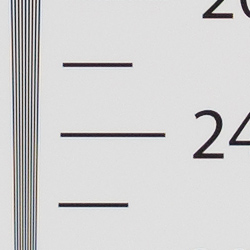

In camera JPEGs, our laboratory resolution chart reveals sharp, distinct line patterns to about 2,450 lines per picture height horizontally, and about 2,350 lines in the vertical direction. (Some might argue for higher, but aliasing artifacts begin to interfere at these limits.) Complete extinction of the pattern occurs just after 3,000 lines horizontally and about 2,800 vertically. We weren't able to extract significantly more high-contrast resolution by processing the Panasonic GF7's RW2 file using Adobe Camera Raw, and the ACR conversion also shows some color moiré which is practically nonexistent in the camera JPEG.
Use these numbers to compare with other cameras of similar resolution, or use them to see just what higher resolution can mean in terms of potential detail.
See full set of test images with explanations
See thumbnails of all test and gallery images
Sharpness & Detail
Good sharpness overall, with minor edge-enhancement artifacts on high-contrast subjects. Mild to moderate noise suppression visible in the shadows even at base ISO.


Sharpness. The Panasonic GF7 captures reasonably sharp images overall. Some fairly minor edge enhancement artifacts are visible on high-contrast subjects such as the sharpening "halos" along the lines and text in the crop above left, but default sharpening here is fairly typical for consumer-oriented models, and not too overdone. Edge enhancement creates the illusion of sharpness by enhancing colors and tones right at the edge of a rapid transition in color or tone.
Detail. The crop above right shows the effect of noise suppression in the form of smudging of individual strands together in the darker areas of the model's hair, as well as in areas with low local contrast. The GF7 also leaves behind a little more chroma noise than some other brands. Still, this is good noise versus detail processing performance for a 16-megapixel Micro Four Thirds model, leaving plenty of detail intact instead of blurring much of it away in an attempt to hide noise. Noise-suppression systems in digital cameras tend to flatten-out detail in areas of subtle contrast. The effects can often be seen in shots of human hair, where the individual strands are lost and an almost "watercolor" look appears.
RAW vs In-Camera JPEGs
As noted above, the Panasonic GF7 produces fairly sharp in-camera JPEGs with good detail. As is almost always the case, better detail can be obtained from carefully processing RAW files than can be seen in the in-camera JPEGs, with fewer sharpening artifacts to boot. Take a look below, to see what we mean:
|
Base ISO (200)
|
|
 |
 |
 |
 |
 |
 |
|
Camera JPEG, defaults
|
RAW via Adobe Camera Raw
|
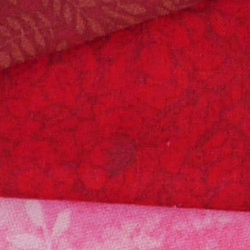
In the table above, we compare an in-camera JPEG taken at base ISO using default noise reduction and sharpening (on the left) to a matching RAW file converted with Adobe Camera Raw 9.0 using default noise reduction with some strong but tight unsharp masking applied in Photoshop (300%, radius of 0.3 pixels, and a threshold of 0).
As you can see, the in-camera JPEG contains pretty good detail, however ACR extracted additional detail, particularly in the red-leaf fabric where it managed to resolve some of the thread pattern. The ACR conversion also shows less chroma noise at default settings, though it shows more luminance noise after sharpening, especially in areas with flat detail. You can always turn up the luminance noise reduction (default of zero was used here), or process the files in your favorite noise reduction program or plugin if you find the noise objectionable. Bottom line, though, as is usually the case shooting in RAW mode provides better detail, color, and control than in-camera JPEGs when using a good converter.
ISO & Noise Performance
Good high ISO performance for a Micro Four Thirds model.
|
Default Noise Reduction
|
||
 |
 |
 |
| ISO 100 | ISO 200 | ISO 400 |
 |
 |
 |
| ISO 800 | ISO 1600 | ISO 3200 |
 |
 |
|
| ISO 6400 | ISO 12,800 | ISO 25,600 |
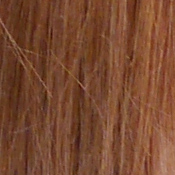
The Panasonic GF7's images are detailed and clean at ISOs 100 (extended) and 200, with only minor luminance and chrominance noise detectable in the shadows. ISO 400 is also quite detailed, though a touch more noise can be seen. ISO 800 shows stronger noise reduction blurring some very fine detail in the process, though overall detail remains very good. ISO 1600 is of course a little noisier, but fine detail still pretty good. What looks to be a sudden increase in sharpening likely to make up for stronger noise reduction makes luminance noise more obvious with a bit of a crystalline peppered effect at ISO 3200. At ISO 6400 and above, the crystalline effect becomes progressively stronger while fine detail is reduced to the point where very little fine detail is left in the hair at ISO 25,600. Chroma noise also becomes progressively stronger and objectionable at ISO 6400 and above.
Overall, high ISO performance is quite similar to recent Panasonic Micro Four Thirds models, as expected, which is to say pretty good. We're of course pixel-peeping to an extraordinary extent here, since 1:1 images on an LCD screen have little to do with how those same images will appear when printed. See the Print Quality section below for our evaluation of maximum print sizes at each ISO setting.
A note about focus for this shot: We shoot this image at f/4, usually using one of three very sharp reference lenses (70mm Sigma f/2.8 macro for most cameras, 60mm f/2.8 Nikkor macro for Nikon bodies without a drive motor, and Olympus Zuiko 50mm f/2.0 for Four Thirds and Micro Four Thirds bodies). To insure that the hair detail we use for making critical judgements about camera noise processing and detail rendering is in sharp focus at the relatively wide aperture we're shooting at, the focus target at the center of the scene is on a movable stand. This lets us compensate for front- or back-focus by different camera bodies, even those that lack micro-focus adjustments. This does mean, though, that the focus target itself may appear soft or slightly out of focus for bodies that front- or back-focused with the reference lens. We know this; if you click to view the full-size image for one of these shots and notice that the focus target is fuzzy, you don't need to email and tell us. :-) The focus target position will have been adjusted to insure that the rest of the scene is focused properly.
Extremes: Sunlit, dynamic range and low light tests
Somewhat high default contrast but with decent dynamic range. Very good low-light performance.


Sunlight. The Panasonic GF7 did fairly well with the deliberately harsh lighting of this test. Contrast is a little high at its default setting, but dynamic range is decent in JPEGs. We felt the +0.7 EV exposure is the best compromise here. Although skin tones around the eyes are a bit dark, we prefer it to the +1.0 EV exposure overall, because there are fewer clipped highlights. It's really the photographer's choice here as to which direction to go in. For those Panasonic GF7 owners that are going to want to just print an image with little or no tweaking, the +1.0 image would probably produce a better-looking face uncorrected. The bottom line though, is that the Panasonic GF7 performed fairly well with the wide dynamic range of this shot, though not as good as some competitors. See below for how the Panasonic GF7's sensor performs (RAW mode) in terms of dynamic range.
Because digital cameras are more like slide film than negative film (in that they tend to have a more limited tonal range), we test them in the harshest situations to see how they handle scenes with bright highlights and dark shadows, as well as what kind of sensitivity they have in low light. The shot above is designed to mimic the very harsh, contrasty effect of direct noonday sunlight, a very tough challenge for most digital cameras. (You can read details of this test here.)
| Face Detection | ||
 |
 |
 |
| Aperture Priority, 0 EV, f/8 Face Detection Off |
Aperture Priority, 0 EV, f/8 Face Detection On |
iAuto, 0 EV, f/4 |
Face Detection. Like most cameras these days, the Panasonic GF7 has the ability to detect faces (up to 15 in a scene), and adjust exposure and focus accordingly. As you can see from the examples above, face detection made a huge difference to exposure in Aperture Priority mode at f/8. iAuto mode where the camera had control over aperture was also improved, but not as much. It also automatically applied Intelligent D-Range (see below).
Panasonic's Intelligent Dynamic Range
The above shots are examples of Panasonic's Intelligent Dynamic Range Control (or iD-Range) at work, with no exposure compensation. Note that the camera does not take multiple shots and merge them as HDR mode does (see below). It's a system that adjusts local contrast and exposure more akin to Nikon's Active D-lighting, Canon's Automatic Lighting Optimization or Sony's Dynamic Range Optimization.
There are three levels of iD-Range available on the Panasonic GF7: Low, Standard and High, plus Auto and Off. It's automatically invoked in iAuto and some scene modes and manually selectable in PASM modes. Here, you can see darker midtones and shadows were progressively boosted as the strength was increased, without blowing many highlights in the process. As a result, though, noise is more visible, especially noticeably in areas with little detail such as the sky.
|
Far-field HDR Examples
|
||||
|
|
||||
HDR mode
Here, you can see the Panasonic GF7's High Dynamic Range mode at work with our Far-field shot. HDR mode takes three images at different exposures and combines them to increase dynamic range. Mouse over the links, and click on them the view the full resolution files.
Auto did a decent job, producing results similar to +/-1 EV, while +/-3 dimmed the entire image. Notice the double images and ghosting of the flag or people moving between frames. Also notice the angle of view is narrower in the HDR images, likely because the images have been cropped and upsized during the optional auto alignment process.
Dynamic Range Analysis (RAW mode)
While we once performed our own dynamic range measurements based on in-camera JPEGs as well as converted RAW images (when the camera was supported by Adobe Camera Raw), we've switched to using DxO Labs' results from their DxOMark website. As technology advanced, the dynamic range of modern high-end cameras in some cases exceeded the range of the Stouffer T4110 density scale that we used for our own measurements. DxO's approach based on RAW data before demosaicing is also more revealing, because it measures the fundamental dynamic range of the sensor, irrespective of whatever processing is applied to JPEGs, or to RAW data by off-the-shelf conversion software.
In the following, we use DxO's "Print" dynamic range results, which are scaled based on camera resolution. As the name suggests, this scaling corresponds to the situation in which you print at a given size, regardless of how many megapixels the camera might have. (In other words, if you've decided to make a 13x19 inch print, that's the size you're printing, whether the camera's resolution is 16 or 300 megapixels.) For the technically-minded, you can find a discussion of the reasoning behind this here on the DxOMark website. Also note that DxO Labs uses a signal-to-noise (SNR) threshold of 1 when defining the lower boundary of acceptable luminance noise in their dynamic range measurements, which corresponds to the "Low Quality" threshold of the Imatest software we used to use for this measurement.
Sorry, DxOMark has not tested the GF7 at timing of writing. We'll to come back and fill this section in after they do.
| 1 fc 11 lux |
1/16 fc 0.67 lux |
1/16fc No NR |
|
|---|---|---|---|
| ISO 200 |
 1s, f2.8 |
 15s, f2.8 |
 15s, f2.8 |
| ISO 3200 |
 1/15s, f2.8 |
 1s, f2.8 |
 1s, f2.8 |
| ISO 25600 |
 1/125s, f2.8 |
 1/8s, 1 f2.8 |
 1/8s, f2.8 |
Low Light. The Panasonic Lumix DMC-GF7 performed well in our low light tests, able to capture bright images down to the lowest light level we test at. The darkest level equates to about 1/16 the brightness of average city street lighting at night, so the Panasonic GF7 should be able to take well-exposed photos in almost any environment in which you can see well enough to walk around in.
Using default noise reduction setting, noise is low at ISO 200 and well-controlled at ISO 3200, though as you'd expect, noise is quite high at the maximum ISO of 25,600. We didn't notice any significant issues with hot pixels, though with long exposure noise reduction turned off (rightmost column) there were a lot of slightly brighter pixels in the shadows at base ISO. We didn't detect any issues with heat blooming or pattern noise.
Automatic color balance is just a touch cool particularly at lower light levels, but pretty neutral.
The camera's autofocus system was able to focus on our subject down to below the 1/16 foot-candle light level unassisted with an f/2.8 lens, which is excellent, especially for a camera with contrast-detect autofocus. The Panasonic GF7 also has a focus-assist light which allows it to autofocus in total darkness, as long as the subject is within range and has sufficient contrast.
How bright is this? The one foot-candle light level that this test begins at roughly corresponds to the brightness of typical city street-lighting at night. Cameras performing well at that level should be able to snap good-looking photos of street-lit scenes.
NOTE: This low light test is conducted with a stationary subject, and the camera mounted on a sturdy tripod. Most digital cameras will fail miserably when faced with a moving subject in dim lighting. (For example, a child's ballet recital or a holiday pageant in a gymnasium.) Thanks to their phase-detect AF systems, digital SLRs tend to do much better than point & shoots, but you still shouldn't expect a quick autofocus lock with moving subjects. The GF7 uses contrast-detect autofocus, as is found in most point & shoot cameras, so its low-light focusing ability may be less than that of some SLRs with phase-detect systems. That said, though, the larger, more sensitive pixels of the GF7's sensor do better under dim lighting than do the tiny pixels of most point & shoots.
Output Quality
Print Quality
Very nice 24 x 36 inch prints at ISO 100/200; a good 8 x 10 inch print at ISO 3200; a quite usable 4 x 6 at ISO 12,800.
 ISO 100 and 200 prints look practically identical to each other, and both ISOs print very nicely up to 24 x 36 inches. You can see very minor softness and extremely subtle pixelation if you look closely, but at typical viewing distances for prints of this size, they look very good with lots of detail and bright colors.
ISO 400 images look very similar to the previous ISOs, but with just the slightest hint of softness compared to ISO 200. That being said, we don't feel this impacts the print size at this sensitivity, and we're comfortable calling it at 20 x 30 inches here, as well.
ISO 800 prints top out at 16 x 20 inches. At this ISO sensitivity, images are now showing a bit more softness due to noise, but it's all very well controlled. Colors are still bright and pleasing, but lower contrast areas like our tricky red-leaf fabric are showing a drop in detail, for example.
ISO 1600 images show a further decrease in fine detail, making 11 x 14 inches the largest we're really comfortable with recommending. However, a 13 x 19 inch print could work for less critical applications.
ISO 3200 prints could perhaps work at 11 x 14 inches for less crucial shots, but the subtle increase in noise makes an 8 x 10 inch print the size we're calling for this sensitivity.
ISO 6400 images make for a nice 5 x 7 inch print. An 8 x 10 is a risky proposition, but it's not too bad -- just a bit too soft for our tastes. At 5 x 7 inches, detail and colors are quite nice at this ISO.
ISO 12,800 prints max out at 4 x 6 inches. Impressive for such a small camera, and noise appears well controlled at this print size, but any larger and it's a bit too noisy and soft.
ISO 25,600 images are too soft and noisy for our liking and should be avoided for prints.
Like its GM5 and GX7 cousins, the 16-megapixel Panasonic GF7 performs well in our print quality testing for a Micro Four Thirds model. The camera manages to impress with large, nicely detailed prints all the way up to 24 x 36 inches at ISOs 100 and 200, though they are just a touch soft. Towards the mid-range of ISOs, the GF7 manages to keep noise very well controlled, offering a nice 11 x 14 inch print at ISO 1600 or a solid 8 x 10 at ISO 3200. At the top end of the ISO scale, the GF7 manages to squeak out a usable 4 x 6 at ISO 12,800, but we'd recommend avoiding ISO 25,600 entirely for prints.
Testing hundreds of digital cameras, we've found that you can only tell just so much about a camera's image quality by viewing its images on-screen. Ultimately, there's no substitute for printing a lot of images and examining them closely. For this reason, we now routinely print sample images from the cameras we test on our Canon Pro9000 Mark II studio printer, and on the Canon Pixma MP610 here in the office. (See the Canon Pixma Pro9000 Mark II review for details on that model.)
The images above were taken from our standardized test shots. For a collection of more pictorial photos, see our Panasonic Lumix DMC-GF7 Photo Gallery .
Not sure which camera to buy? Let your eyes be the ultimate judge! Visit our Comparometer(tm) to compare images from the Panasonic Lumix DMC-GF7 with those from other cameras you may be considering. The proof is in the pictures, so let your own eyes decide which you like best!
Performance
Timing and Performance
Generally good performance for an entry-level mirrorless ILC.
| Startup/Play to Record | ||
|---|---|---|
|
Power on |
~1.1 seconds
|
Time it takes to turn on and capture a shot. |
|
Play to Record, |
~0.8 second
|
Time until first shot is captured. |
Startup time was a little faster-than-average for a mirrorless camera and switching from Play to Record and taking a shot was reasonably quick.
| Shutter Response (Lag Time) | ||
|---|---|---|
|
Full Autofocus, |
0.238 second
|
Time from fully pressing shutter button to image capture, with the lens already at the proper focal distance setting. |
|
Full Autofocus |
0.412 second
|
Time from fully pressing shutter button to image capture. Auto Flash enabled. |
|
Manual Focus |
0.134 second
|
For most cameras, shutter lag is less in manual focus than autofocus, but usually not as fast as when the camera is "prefocused". |
|
Prefocused |
0.126 second
|
Time to capture, after half-pressing and holding shutter button. |
The Panasonic GF7's autofocus speed was good our tests, especially for a camera that uses contrast detection only. The GF7 produced full-autofocus shutter lag (with the subject at a fixed distance) of 0.238 second using 1-area (center) AF. That's good for a mirrorless camera and competitive with most consumer DSLRs. Enabling the flash increased lag to 0.412 second, to account for preflash metering. When manually focused, the GF7's lag time dropped to 0.134 second, also good. The GF7's prefocused shutter lag time of 0.126 second was however slow compared to most other cameras, but still responsive.
To minimize the effect of different lens' focusing speed, we test AF-active shutter lag with the lens already set to the correct focal distance.
| Cycle Time (shot to shot) | ||
|---|---|---|
|
Single Shot mode |
0.51 second
|
Time per shot, averaged over a few frames (we no longer test for buffer depths in single-shot mode). |
|
Single Shot mode |
0.77 second
|
Time per shot, averaged over a few frames (we no longer test for buffer depths in single-shot mode). |
|
Early shutter |
No
|
Some cameras refuse to snap another shot if you release and press the shutter too quickly in Single Shot mode, making "No" the preferred answer. |
|
Continuous H |
0.19 second (5.16 frames per second);
50+ frames total; 1 second to clear* |
Time per shot, averaged over 50 shots, with no signs of slowing. |
|
Continuous H |
0.09 second (11.1 frames per second);
7 frames total; 2 seconds to clear* |
Time per shot, averaged over buffer length of 7 frames, then slows to an average of about 0.20s or 4.98 fps, but with a lot of cycle time variation. |
|
Continuous H |
0.22 second (4.50 frames per second);
10 frames total; 4 seconds to clear* |
Time per shot, averaged over buffer length of 10 frames, then slows to an average of 0.55s or 1.83 fps. |
|
Continuous H |
0.22 second (4.55 frames per second);
7 frames total; 7 seconds to clear* |
Time per shot, averaged over buffer length of 7 frames, then slows to an average of about 1.05s or 0.95 fps. |
|
Super HS mode |
0.03 second (40.0 frames per second);
39 frames total; 7 seconds to clear* |
Time per shot, averaged over buffer length of 39 frames. |
|
Flash Recycling |
3.1 seconds
|
Flash at maximum output. |
|
*Note: Buffer clearing times measured with a SanDisk Extreme Pro 95MB/sec UHS-I SDHC card. Slower cards will produce correspondingly slower clearing times. Slow cards may also limit length of bursts in continuous mode. ISO sensitivity and noise reduction settings can also affect cycle times and burst mode performance.
|
||
Single-shot cycle times were good. We measured 0.51 second for large/fine JPEGs and 0.77 second for RAW+L/F JPEGs. (We no longer test single-shot mode with just RAW files, as the result is usually somewhere in between.)
Continuous High Speed "H" mode burst rate was fair for its class at 5.2 frames per second for best quality JPEGs, though that's a little short of Panasonic's 5.8 fps spec with AFS (we shoot our timing tests at ISO 200 so that could be why). When shooting RAW or RAW+JPEG files, the frame rate dropped to 4.5 and 4.6 fps respectively. Please note that Live View is not available during a burst in H mode.
The GF7 also has an all-electronic shutter mode which boosts the full-resolution frame rate to about 10 fps or up to 40 fps at 4 megapixels in Super High Speed mode. In the lab, the GF7 actually managed 11.1 frames per second for large/fine JPEGs using the electronic shutter, but for only 7 frames before slowing down. (Sorry, we did not test RAW or RAW+JPEG mode with the e-shutter.) In Super High Speed mode, the GF7 captured 39 4-megapixel JPEGs at precisely 40 fps, exactly meeting Panasonic's spec for frame rate and buffer size.
In Continuous High Speed "H" mode full-resolution buffer depths were generous for Large/Fine JPEGs at over 50 frames (likely only limited by the card), but when shooting RAW files buffer size dropped to 10 frames, or 7 frames when shooting RAW+JPEG.
Buffer clearing was very quick with a fast UHS-I card, ranging from one to seven seconds depending on the file type and mode.
Flash recycling after full-power discharge took an average of 3.1 seconds.
Bottom line, the Panasonic GF7's performance is good for an entry-level mirrorless camera. Startup and mode switching are reasonably fast, and autofocus speed is good. Burst performance is fair to very good depending on the mode. Buffer depths are excellent when shooting JPEGs in Continuous High Speed mode, though somewhat shallow with RAW files. Prefocused shutter lag was a bit slow compared to other cameras, though, but still very responsive.
Battery Life
Below average battery life for a mirrorless camera.
| Operating Mode | Battery Life |
|---|---|
|
Still Capture, CIPA standard
(with H-FS12032 lens) |
230 shots
|
The Panasonic GF7 uses a custom rechargeable lithium-ion battery pack for power, and comes with both a single battery and dedicated charger. The CIPA-rated 230 shots per charge when using the 12-32mm kit lens is well below average for a Compact System Camera (thanks to its small size), and much lower than a typical DSLR when using an optical viewfinder. We strongly recommend getting a second battery for your GF7 if you plan any extended outings.
The table above shows the number of shots the camera is capable of (on a fully-charged rechargeable battery), based on CIPA battery-life and/or manufacturer standard test conditions.
(Interested readers can find an English translation of the CIPA DC-002 standards document here. (180K PDF document))
Image Quality
Below are crops from our laboratory Still Life target comparing Panasonic GF7 image quality to its predecessor, the GF6, well as against several competing mirrorless and DSLR models at similar price points or in similar categories: the Canon T5, Fuji X-A2, Nikon D3300 and Olympus E-PL7.
NOTE: These images are from best quality JPEGs straight out of the camera, at default settings including noise reduction and using the camera's actual base ISO (not extended ISO settings). All cameras in this comparison were shot with our very sharp reference lenses. Clicking any crop will take you to a carrier page where you can click once again to access the full resolution image as delivered straight from the camera. For those interested in working with the RAW files involved, click these links to visit each camera's respective sample image thumbnail page: Panasonic GF7, Canon T5, Fuji X-A2, Nikon D3300 and Olympus E-PL7 -- links to the RAW files appear beneath those for the JPEG images, wherever we have them. And remember, you can always go to our world-renowned Comparometer to compare the Panasonic GF7 to any camera we've ever tested!
Panasonic GF7 vs Panasonic GF6 at Base ISO
 |  |
 |  |
 |  |
Panasonic GF7 at ISO 200 | Panasonic GF6 at ISO 160 |
Sharing a similar 16MP chip and Venus Engine processor, it's not all that surprising that the GF7 and its predecessor display similar image quality at base ISO. Very fine detail is a little more crisp and cleaner from the GF7, though there are subtle contrast differences in the two images. | |
Panasonic GF7 vs Canon T5 at Base ISO
|  |
|  |
|  |
Panasonic GF7 at ISO 200 | Canon T5 at ISO 100 |
Both cameras resolve a lot of detail, but the GF7 edges out with slightly more fine detail in the mosaic crop and the fabric swatches. | |
Panasonic GF7 vs Fujifilm X-A2 at Base ISO
|  |
|  |
|  |
Panasonic GF7 at ISO 200 | Fujifilm X-A2 at ISO 200 |
The X-A2's bottle crop is impressively clean and crisp, though the GF7's mosaic crop appears more natural. The X-A2 struggles with the fabrics swatches, especially with the pink, whereas the GF7 captures a lot of fine detail in this area. | |
Panasonic GF7 vs Nikon D3300 at Base ISO
|  |
|  |
|  |
Panasonic GF7 at ISO 200 | Nikon D3300 at ISO 100 |
The D3300 has a much higher-res sensor (24MP vs 16MP) and does not have an optical low-pass filter, and as a result easily captures much more detail than the GF7. | |
Panasonic GF7 vs Olympus E-PL7 at Base ISO
|  |
|  |
|  |
Panasonic GF7 at ISO 200 | Olympus E-PL7 at ISO 200 |
Though different manufactures, both of these Micro Four Thirds cameras utilize a 16MP sensor, and as such, they capture a similar level of fine detail at base ISO -- though with a noticeable difference in the degree of in-camera sharpening in these default-settings JPEG crops. | |
Panasonic GF7 vs Panasonic GF6 at ISO 1600
 |  |
 |  |
 |  |
Panasonic GF7 at ISO 1600 | Panasonic GF6 at ISO 1600 |
Bumping up the ISO, you can see the difference in the noise reduction characteristics between the newer model and the old one. The GF7 bottle crop appears cleaner with less noise, and the mosaic crop also has a bit more detail from the GF7. The GF7's default NR processing, however, takes more detail from the tricky red-leaf fabric than the GF6. | |
Panasonic GF7 vs Canon T5 at ISO 1600
|  |
|  |
|  |
Panasonic GF7 at ISO 1600 | Canon T5 at ISO 1600 |
Though the GF7's default NR does well to remove a lot of noise, especially in the shadows, it leaves behind some subtle visible artifacts while the T5 takes a less aggressive approach to NR. Detail is good from both cameras, but the GF7 has the edge with cleaner, more natural detail in the mosaic crop. Both cameras struggle with the red-leaf fabric, though the GF7 handles the pink fabric much better. | |
Panasonic GF7 vs Fujifilm X-A2 at ISO 1600
|  |
|  |
|  |
Panasonic GF7 at ISO 1600 | Fujifilm X-A2 at ISO 1600 |
The X-A2 shows impressive high ISO performance! The bottle crop from the Fuji is practically devoid of noise, and there's still quite a lot of detail remaining in the mosaic crop, despite the seemingly strong NR processing. The red-leaf fabric proves tricky for both cameras, though, but the GF7 captures more detail in the pink fabric. | |
Panasonic GF7 vs Nikon D3300 at ISO 1600
|  |
|  |
|  |
Panasonic GF7 at ISO 1600 | Nikon D3300 at ISO 1600 |
Nikon typically takes a lighter approach when it comes to noise reduction. Noise is much stronger from the D3300 compared to the GF7, however it allows for sharper, finer detail to remain. There's also a hint more definition to the leaf pattern in the red fabric from the Nikon than from the Panasonic. | |
Panasonic GF7 vs Olympus E-PL7 at ISO 1600
|  |
|  |
|  |
Panasonic GF7 at ISO 1600 | Olympus E-PL7 at ISO 1600 |
The E-PL7's NR processing appears more aggressive compared to that from GF7. The Olympus does well removing noise, but the NR interferes with fine detail, which is quite evident when comparing the mosaic crops and pink fabric. | |
Panasonic GF7 vs Panasonic GF6 at ISO 3200
 |  |
 |  |
 |  |
Panasonic GF7 at ISO 3200 | Panasonic GF6 at ISO 3200 |
Bumping the ISO sensitivity even further, the improvements with the GF7 are even clearer. The new model has more refined NR processing, which removes a lot of noise, but allows for much cleaner detail. | |
Panasonic GF7 vs Canon T5 at ISO 3200
|  |
|  |
|  |
Panasonic GF7 at ISO 3200 | Canon T5 at ISO 3200 |
As with the prior ISO, the Canon shows a lighter touch with NR processing. However, the GF7 does quite well at balancing noise removal and detail, and in fact, has the edge over the Canon with detail in the mosaic crop to our eyes, if only slightly. Again, both cameras have a tough time resolving detail in the fabric swatches, though the GF7 does better with the pink fabric. | |
Panasonic GF7 vs Fujifilm X-A2 at ISO 3200
|  |
|  |
|  |
Panasonic GF7 at ISO 3200 | Fujifilm X-A2 at ISO 3200 |
At this higher ISO, we can better see the aggressive NR processing from the Fuji. Its bottle crop appears nearly devoid of noise again, but there a subtle over-processed look. The GF7, on the other hand, looks a bit overprocessed as well and yet displays more noise artifacts. Props to Fuji. The X-A2 also resolves more detail in the mosaic crop, though both struggle with the fabrics. | |
Panasonic GF7 vs Nikon D3300 at ISO 3200
|  |
|  |
|  |
Panasonic GF7 at ISO 3200 | Nikon D3300 at ISO 3200 |
A light touch once again from the Nikon with noise reduction. More natural detail comes through, however more visible grain and noise is apparent compared to the Panasonic. Though clear detail isn't visible in either red fabric swatches, the Nikon crop appears more natural and less "mushy" than the Panasonic's. | |
Panasonic GF7 vs Olympus E-PL7 at ISO 3200
|  |
|  |
|  |
Panasonic GF7 at ISO 3200 | Olympus E-PL7 at ISO 3200 |
The Olympus image is more contrasty, and its bottle crop looks a bit cleaner with less noise than the Panasonic's. Fine detail in the mosaic crop, however, looks more pleasing and natural from the Panasonic, as does detail in the pink fabric. | |
Panasonic GF7 vs. Panasonic GF6, Canon T5, Fujifilm X-A2, Nikon D3300, Olympus E-PL7
 |  |  |  |  |  |
 |  |  |  |  |  |
 |  |  |  |  |  |
| Panasonic GF7 ISO 200 ISO 3200 ISO 6400 | Panasonic GF6 ISO 160 ISO 3200 ISO 6400 | Canon T5 ISO 100 ISO 3200 ISO 6400 | Fujifilm X-A2 ISO 200 ISO 3200 ISO 6400 | Nikon D3300 ISO 100 ISO 3200 ISO 6400 | Olympus E-PL7 ISO 200 ISO 3200 ISO 6400 |
| Detail comparison. Comparing high-contrast detail, the clear champion in this comparison array is the Nikon D3300 -- a higher-res sensor than all the competition and no low-pass filter makes for cleaner detail at both low and higher ISOs. Comparing the rest of the field, most do rather well at base ISOs, though interestingly, the Fuji X-A2 performs rather poorly at all ISOs. The Panasonic GF7 does well throughout, though not showing significant improvements compared to its predecessor. These two and the Olympus E-PL7, however, trump the Canon T5 at low and higher ISOs. | |||||
Very nice 24 x 36 inch prints at ISO 100/200; a good 8 x 10 inch print at ISO 3200; a quite usable 4 x 6 at ISO 12,800.
 ISO 100 and 200 prints look practically identical to each other, and both ISOs print very nicely up to 24 x 36 inches. You can see very minor softness and extremely subtle pixelation if you look closely, but at typical viewing distances for prints of this size, they look very good with lots of detail and bright colors.
ISO 400 images look very similar to the previous ISOs, but with just the slightest hint of softness compared to ISO 200. That being said, we don't feel this impacts the print size at this sensitivity, and we're comfortable calling it at 20 x 30 inches here, as well.
ISO 800 prints top out at 16 x 20 inches. At this ISO sensitivity, images are now showing a bit more softness due to noise, but it's all very well controlled. Colors are still bright and pleasing, but lower contrast areas like our tricky red-leaf fabric are showing a drop in detail, for example.
ISO 1600 images show a further decrease in fine detail, making 11 x 14 inches the largest we're really comfortable with recommending. However, a 13 x 19 inch print could work for less critical applications.
ISO 3200 prints could perhaps work at 11 x 14 inches for less crucial shots, but the subtle increase in noise makes an 8 x 10 inch print the size we're calling for this sensitivity.
ISO 6400 images make for a nice 5 x 7 inch print. An 8 x 10 is a risky proposition, but it's not too bad -- just a bit too soft for our tastes. At 5 x 7 inches, detail and colors are quite nice at this ISO.
ISO 12,800 prints max out at 4 x 6 inches. Impressive for such a small camera, and noise appears well controlled at this print size, but any larger and it's a bit too noisy and soft.
ISO 25,600 images are too soft and noisy for our liking and should be avoided for prints.
Like its GM5 and GX7 cousins, the 16-megapixel Panasonic GF7 performs well in our print quality testing for a Micro Four Thirds model. The camera manages to impress with large, nicely detailed prints all the way up to 24 x 36 inches at ISOs 100 and 200, though they are just a touch soft. Towards the mid-range of ISOs, the GF7 manages to keep noise very well controlled, offering a nice 11 x 14 inch print at ISO 1600 or a solid 8 x 10 at ISO 3200. At the top end of the ISO scale, the GF7 manages to squeak out a usable 4 x 6 at ISO 12,800, but we'd recommend avoiding ISO 25,600 entirely for prints.
Field Test Part I
Field Test Part II
Big on features, not on bulk

The Panasonic LUMIX DMC-GF7 promises to pack a whole lot of performance into a very small package. Can it fulfill that promise in the real world? Let's find out.
A whole lot of camera, without all the heft

The small package part is certainly no lie, especially when the Panasonic GF7 is paired with the LUMIX G Vario 12-32mm / F3.5-5.6 ASPH retractable kit lens that I got with it. I also received a LUMIX G 42.5mm / F1.7 ASPH to test, and it's surprisingly compact as well, despite its relatively large maximum aperture. The small size and light weight of the GF7 and its lenses make the package a breeze to carry, which I appreciated on my first walk with it, a long circuit around Greenwich Village and Chelsea in New York City. This camera, with the kit lens, is smaller than many point-and-shoot digicams that I reviewed ten years ago.
The flip side to the light weight of the Panasonic GF7 is its lighter, more plastic construction, and I certainly noticed this as I used the camera. It's not flimsy or cheap feeling, but its entry-level build quality is apparent. Another potential issue with small cameras is cramped controls and handling, and I did encounter a little of this on my first long outing with the GF7. That said, I was using the camera for street photography, which requires fairly nimble handling, and the closely spaced controls never really got in the way of my shooting.

For this type of shooting, I was able to quickly compose, adjust my settings, and grab a shot. This was just one of many pictures that I grabbed quickly without any trouble. I'm noting the small controls, though, because photographers who do have problems with that kind of thing might run into an issue with the GF7.

Expansive features & customization can make menus daunting
When I receive a camera for review, one of the first things I do is cycle through the menus and set things up the way I like them. With the Panasonic GF7, this was more confusing than I'm used to, partly because the menus are extensive and the layout and labeling isn't as clear as I'd like it to be. On the other hand, the menus are so extensive because the camera offers a lot of features and customization options, and that's a big plus overall.

That said, I didn't read the longer, advanced features instruction manual carefully before my first shoot in Hudson River Park, and it almost bit me. When I initially set up the Panasonic GF7, I selected the electronic front curtain shutter, which, unbeknownst to me, tops out at a speed of 1/500. This was causing me to overexpose a shot I was trying to make of a docked fireboat. I ultimately puzzled out the solution a half hour later -- switch the shutter type to fully electronic -- but I had to circle back and repeat the shot.

Now, I can't really blame Panasonic for my ignorance of the GF7 features, but I felt like there are some potential gotchas lurking in the complex, but minimally informative, menu and control system. Still, this is likely to be a small issue for any GF7 owner -- it might take a little longer to come to grips with the menu system, but once you do, you'll be all set.
Logical, manageable control layout


The Panasonic GF7 has a fairly typical control setup for an entry-level interchangeable-lens camera, meaning only one main control dial and a relatively small number of additional external buttons. The Panasonic's system is reasonably logical, however, and I was able to get proficient with it in my first hour shooting with the camera. To me, the ability to change ISO quickly is very important, so I assigned that setting to the programmable function button. Unfortunately, that button is badly positioned on the top left of the camera -- I've found this mildly annoying on every one of the dozens of times I've changed ISO during several shoots with the GF7.

Handy, flip-out touchscreen is great for selfies
The flip-out feature of the Panasonic GF7's LCD came in handy when I needed to do some careful waist-level framing for a shot of a grove of trees in Pelham Bay Park near sunset. I find the waist-level shooting posture very comfortable and stable for situations like that where I worked a range of different exposure and framing options over several minutes as the light was changing. On other pictures during that same walk, I shot into the sunset and had no real difficulty seeing the LCD. I've only tested the touch functions at my desk -- I don't tend to use touch functionality when I'm shooting -- but the screen response to my touches was predictable and precise.
As we noted above, the LCD on the Panasonic GF7 is easy to flip 180 degrees to vertical for selfies. I tested out the new selfie triggering option that you can use in this mode -- if you wave your hand in front of your face, the camera will fire after a short delay. It worked quite well, correctly detecting my wave most of the time, and I imagine many selfie-enthusiast photographers may find this feature useful.

Up Next in Part II...
In part 2 of this report, I'll talk about the performance of the Panasonic GF7, its movie and Wi-Fi features, and my impressions of the two lenses I tested with it.
Field Test Part III
Performance in a small package

Quick and nimble operation so you don't miss a shot
I mentioned in Part 1 of this field test that the Panasonic GF7's controls are a tad small and spaced closely together, but I didn't feel that hampered my shooting in any significant way. The same has been true of the camera's general responsiveness in all my outings with the GF7 -- it has responded quickly, without any noticeable delays, whenever I've needed it. That came in handy one evening when I stepped out onto a terrace overlooking Eastchester Bay completely unaware that a blue moon (the second full moon within a given month) was just rising in the magenta-tinted twilight. I ran inside, grabbed the camera, and was able to get it turned on, set, and shooting before the light changed, the color left the sky and the boats sailed out of frame.
Fast, accurate AF in both good and dim lighting
I also found the autofocus on the Panasonic GF7 to be pretty capable. It acquires focus on stationary subjects very quickly in good light and maintains fairly good speed and decisiveness down to about EV 3 (it slows down noticeably when light levels fall lower than that). It worked very well for another shot that I made of Eastchester Bay, this one through a dark and rainy bedroom window in the late afternoon, when light levels were about EV 7.

For moving subjects, it's best to pre-focus than use C-AF
The position and size of the AF patch on the GF7 are also highly adjustable, and I used both features to make a shot of some joggers on a running track. By setting the AF patch to a very small rectangle and moving it to the lower part of the frame, I was able to pre-focus on just one particular lane in the track and wait for the runner to enter my frame.

I also tested out the Panasonic GF7's ability to continuously focus on moving subjects on the same running track as well as on bicyclists on 2nd Ave. during another shoot. My results were pretty hit-and-miss -- the GF7 was not useless for follow-focusing on moving subjects, but I wouldn't rely on it if I needed to get good pictures of sports or action on any kind of regular basis. This is pretty common for entry-level mirrorless ILC cameras, in my experience.
Kit lens offers good versatility and helpful stabilization
I already mentioned that the collapsible LUMIX G Vario 12-32mm / F3.5-5.6 ASPH kit lens that is typically bundled with the Panasonic GF7 is remarkably small. Its focal-length range -- 24-64mm equivalent in 35mm terms -- is also a good fit for the kind of shooting I like to do. Check out our review of this lens to get more information on its excellent optical performance, which is very impressive for such a small and inexpensive optic.

Testing the Mega O.I.S. image stabilization, I found that I could pretty reliably get sharp handheld pictures at shutter speeds that were two stops slower than I had to use with O.I.S. turned off. I relied on O.I.S. when I came across an interesting stained glass window in the lobby of an apartment building one day, but I didn't have a tripod. I used a 50mm equivalent focal length and 1/15 shutter speed, and the picture came out quite sharp.

Small, light 42.5mm f/1.7 lens pairs nicely with tiny GF7
I also had a LUMIX G 42.5mm / F1.7 ASPH lens, and I shot more than 300 pictures with it over half a dozen outings. We reviewed this lens earlier this year and found it to be optically excellent, surprisingly compact and a great bargain. I concur on all fronts -- and I especially loved the small size and light weight of this lens. It's been simply a breeze to carry and use, yet I made no sacrifices in image quality. I've used it for street shooting, landscapes (the blue moon shot, for example), landscape details, and action shots. Obviously, many photographers would think of it as primarily a portrait lens, and I used it for that, too, including a picture that I liked of two lifelong friends who arrived at a birthday party wearing the same color dress. I stopped the lens down to f/2.5, which gave me a gentle blur in the background just behind the two ladies but provided enough depth-of-field to keep them sharp. I was pleased with the smooth bokeh in this image and all my other shots taken at wide apertures. The lens just never let me down in any way. It's a great optic for the Micro 4/3 system.

Wi-Fi take a few moments to setup, but reliable and robust
I tested the Wi-Fi features of the Panasonic GF7 with my iPhone 5. I was able to make reliable connections between the camera and my phone using the standard connection method where I connected my phone to the Wi-Fi network created by the camera. In this mode, using the Panasonic Image App, I could remotely control the camera from my phone and also easily transfer pictures from camera to phone. The Image App's remote control feature gives you access to many of the camera's features and worked seamlessly for me.

Connecting the camera to an iPhone takes a few steps and just isn't as dead-simple easy as I'd like Wi-Fi connectivity to be, but it works more consistently and reliably on the Panasonic GF7 than on several other cameras I've tested in the past year or two. That said, there is a connectivity method using a QR code that the camera is supposed to display and which is supposed to be a bit quicker. Unfortunately, I could not get that to work, and Panasonic's instructional material was next to useless for figuring out why. In fact, Panasonic's instructions on the entire Wi-Fi system, both in the printed manual and online, are terrible -- incomplete, unclear and written in very poor English. All in all, the GF7 is as good at camera-to-smartphone connectivity as any other camera I've tested recently, and better than some, but that's not saying much.
Decent quality video with a typical featureset
To test the video capabilities of the Panasonic GF7, I took it to Washington Square Park on a late afternoon. The camera's video setup is typical of many mirrorless ILC cameras these days: it has a dedicated video recording button and gives you a great deal of control over exposure and focus settings, as well as many other video and camera parameters. I used the GF7 in manual exposure and focus modes, and set my shutter speed to twice the frame rate for my video clips of activity around the park's fountain. My footage looks good to my eye: sharp and low in artifacts other than some moiré here and there.

Field Test Summary: utilitarian, but reliable and very compact
I think there's a lot to recommend about the Panasonic GF7. It's utilitarian rather than glamorous, but Panasonic has packed a whole lot of features and very reliable performance into a really small package in the GF7. Very few interchangeable-lens cameras are this small and light, and yet it can efficiently and reliably take great pictures in a wide variety of situations.
Flash
Panasonic GF7 Flash

Built-in Flash Test Results
Coverage and Range
A very weak flash with narrow coverage. Above average positive exposure compensation required.
| Coverage |
 |
| 12mm, f/3.5, ISO 200 |
Coverage. Flash coverage is rather uneven at wide angle, leaving the corners of our flash target image quite dark at 12mm, thought that's not unusual, especially for a wider than average kit lens. Some of the corner shading can also attributable to the lens itself. We no longer test flash coverage at telephoto, as it is invariably better.


Exposure. Indoors under incandescent background lighting, the Panasonic GF7's flash underexposed our indoor portrait scene at ISO 200, despite the +1.0 EV flash exposure compensation used. (An average of +0.7 EV is normally needed for this shot.) You'll likely need to boost ISO (or enable Auto ISO) for typical indoor shots. The camera's slow-sync flash mode required no compensation to produce a bright shot, though the longer shutter time (1/6s vs 1/50s) resulted in a strong orange cast from the ambient background lighting.
| Manufacturer-Specified Flash Range |

|
| Telephoto (f/5.6) 9.2 feet (Auto ISO 1250) |
Manufacturer-Specified Flash Range Test. The Panasonic GF7's built-in flash has a Guide Number of only 4m at ISO 100, or 5.6m at ISO 200. With the kit lens and ISO set to Auto, Panasonic rates the flash's range at 15 feet at wide angle, and 9.2 feet at telephoto. As you can see above, the Panasonic GF7 produced a well-exposed target at the rated distance at full telephoto, which means Panasonic's flash range spec is credible. Our standard test method for flash range uses either a fixed setting of ISO 200, to provide a fair basis of comparison between camera, or uses manufacturer-specified camera settings, at the range the company claims for the camera (at Auto ISO if so specified), to assess the validity of the specific claims.
High ISO Noise Reduction
Panasonic GF7 Noise Reduction
The Panasonic GF7 offers no fewer than 11(!) noise reduction levels, offering very fine granularity on noise reduction strength, however there doesn't appear to be a way to assign different NR levels to specific ISO ranges as we've seen on some cameras. The Panasonic GF7 user manual doesn't say when noise reduction kicks in, so we've included crops from the entire range of ISOs in the tables below.
See for yourself how the Panasonic GF7's default and -5 (lowest) noise reduction settings compare to RAW without noise reduction under daylight-balanced lighting. (Note that these RAW images also have no sharpening applied, so they're a little softer than camera JPEGs at low ISOs.) Click on any of the crops below to see the corresponding full-sized image.
| High ISO Noise Reduction Comparison Daylight-balanced illumination |
|||
|
Default
|
-5
|
RAW (no NR)
|
|
|
I
S O 1 0 0 |
 |
 |
 |
 |
 |
 |
|
 |
 |
 |
|
|
Default
|
-5
|
RAW (no NR)
|
|
|
I
S O 2 0 0 |
 |
 |
 |
 |
 |
 |
|
 |
 |
 |
|
|
Default
|
-5
|
RAW (no NR)
|
|
|
I
S O 4 0 0 |
 |
 |
 |
 |
 |
 |
|
 |
 |
 |
|
|
Default
|
-5
|
RAW (no NR)
|
|
|
I
S O 8 0 0 |
 |
 |
 |
 |
 |
 |
|
 |
 |
 |
|
|
Default
|
-5
|
RAW (no NR)
|
|
|
I
S O 1 6 0 0 |
 |
 |
 |
 |
 |
 |
|
 |
 |
 |
|
|
Default
|
-5
|
RAW (no NR)
|
|
|
I
S O 3 2 0 0 |
 |
 |
 |
 |
 |
 |
|
 |
 |
 |
|
|
Default
|
-5
|
RAW (no NR)
|
|
|
I
S O 6 4 0 0 |
 |
 |
 |
 |
 |
 |
|
 |
 |
 |
|
|
Default
|
-5
|
RAW (no NR)
|
|
|
I
S O 1 2 8 0 0 |
 |
 |
 |
 |
 |
 |
|
 |
 |
 |
|
|
Default
|
-5
|
RAW (no NR)
|
|
|
I
S O 2 5 6 0 0 |
 |
 |
 |
 |
 |
 |
|
 |
 |
 |
|
The Panasonic GF7's default noise reduction setting provides a good tradeoff between noise and detail at lower ISOs to our eye, but it has quite an impact on our difficult red-leaf swatch atlready at low ISOs, and turning noise reduction down to the lowest strength doesn't help that much. Still, we'd probably shoot with the lowest setting at higher ISOs and reduce noise ourselves in post-processing (or just shoot RAW).
As you can see, the GF7 already applies noise reduction at its lowest (extended) ISO of 100. At the other end of the ISO range, you can see that the GF7 is quite effective at reducing chroma noise, even at the lowest NR setting.
Technical Info
by Mike Tomkins
Sensor
At its core, the Panasonic GF7 has the same 16-megapixel Live MOS image sensor used in the GX7, a camera that costs almost twice as much as the GF7. Compared to earlier designs, Panasonic says this chip improves saturation thanks to use of what it terms Semiconductor Fine Technology -- essentially, larger wells that can collect more photons. It also sports more efficient microlenses that increase light-gathering capabilities -- and hence sensitivity. Finally, signal to noise ratio is improved further thanks to in-pixel and digital signal readout tweaks.

Processor
Data from the sensor is processed by a Venus Engine-branded image processor which includes Panasonic's Multi-process Noise Reduction technology.
Sensitivity
The base sensitivity range of ISO 200 to 25,600 equivalents is identical to that provided by the GX7. Interestingly, the GF7 actually bests its more expensive sibling just slightly in terms of expanded range, though, able to reach down to ISO 100 equivalent where the GX7 stops at ISO 125.
Performance
Performance is much the same as that of the Panasonic GM5, with a manufacturer-rated 5.8 frames per second when using single autofocus, or five fps when using continuous autofocus in single-point mode. When using an electronic shutter, it's possible to boost this to an extremely swift 40 frames per second at 4-megapixel resolution or 10 frames per second at full resolution. See our Performance page for actual lab test results.
Autofocus
Although it lacks phase-detection autofocus or the clever Depth From Defocus technology found in some of Panasonic's higher-end models, the GF7's contrast-detection autofocus is nevertheless pretty capable. Panasonic says that its new model will focus down to an impressive -4EV, and provides five frames-per-second shooting with autofocus tracking. This is achieved with 240 frames-per-second info from the image sensor, and the company also says the system can determine a focus lock in just 0.06 seconds.
Autofocus modes on offer include face detection (including eye detection to focus specifically on your subject's eyes), pinpoint, low-light and one-shot, and for manual focus both an assist and focus peaking function are provided. Interestingly, the eye-detection function shows a picture-in-picture display of your subject's face, allowing you to choose which eye to focus on.
Display
Images are framed and reviewed on a high-resolution 1,040,000-dot LCD monitor with a diagonal size of 3.0 inches. It's the same display as used in the GF6, and just as in that camera, it's both a touch-screen for input, and mounted on a 180-degree upwards-tilting articulation mechanism for selfies.
Flipping the monitor up all the way automatically launches selfie-shooting mode, and selfies can be triggered using face detection. For a single person, you can wave your hand in front of your face to trip the shutter once your hand is back out of the way, and for two people you can have the shutter tripped when your faces are close together. A variety of beautification tools are also offered to give your selfies some pep: Soft Skin, Defocusing mode, and Slimming mode.
Exposure
The Panasonic GF7 uses the same shutter mechanism as the GM5, and as in that camera couples it with an electronic shutter. That means that it has the same range of shutter speeds -- 1/16,000 to 60 seconds -- as well as the same, rather slow flash sync speed of 1/50 second.
Exposures are metered using a 1,728-zone multi-pattern metering system, and a generous +/-5EV of exposure compensation is available in 1/3EV steps. Exposure modes include Program, Aperture-priority, Shutter-priority or Manual as you'd expect, and there are also Panorama, Scene, Portrait, Child and Landscape modes provided. Exposure bracketing is also possible within a 3, 5, or 7-frame range with a 1/3, 2/3 or 1EV step size.
Flash
As a camera aimed at consumers, it's not a surprise that there's no external flash connectivity on the Lumix GF7. There is, however, a built-in popup flash strobe with a guide number of 5.6 meters at ISO 200. That's quite a bit weaker than the GF6's strobe, though, which had a guide number of 7.1 meters at the same sensitivity. And as noted previously, maximum flash sync is at just 1/50 second.
Creative
Like to keep your creative options open? The Panasonic GF7 has quite a few to choose from, including one pretty unusual option: Jump Snap mode. This relies on the accelerometer in your paired smartphone. Set everything up, jump in the air, and at the moment the phone detects that you're reached the top of your jump, the camera will snap a shot. (Just be careful that your phone doesn't fall out of your pocket while jumping!)
There's also an Intelligent Auto mode for no-fuss shooting, plus a Scene Guide that helps you sort through the selection of scene modes on offer to make your picks. And there are a total of 22 different filters to choose from, including monochrome (a new option), plus stop motion animation, time lapse and clear retouch.


Wireless communication
Like the GF6 before it, the Panasonic GF7 includes 802.11b/g/n Wi-Fi wireless networking that helps get your photos off the camera, onto your Android or iOS smartphone or tablet (using the Panasonic Image App that's provided free of charge), and from there online. Although there's no NFC support, the pairing process has been smoothed to no longer require a password be entered.
Once paired, you can control your camera remotely (complete with a live-view feed to help with framing), transfer photos automatically after shooting, or transfer them at will after the face. You can also connect to your home wireless router, and have images and videos transferred automatically for archival on your network.
Although there's no built-in GPS radio for geolocation, the GF7 can also piggyback on your phone's GPS radio to geotag images with the location at which they were captured, so long as you can live with the hit on your phone's battery life.

Movie
As well as still images, the Panasonic GF7 can shoot high-definition Full HD (1,920 x 1,080 pixel) movies at rates of up to 60 progressive-scan frames per second. You have a choice of 28Mbps AVCHD Progressive or MPEG-4 / H.264 capture with Dolby Digital stereo sound, and a native, cinema-like 24 frames-per-second mode is also available at 24Mbps.
Full-time autofocus is available during movie capture, including the ability to touch to select subjects on which to focus. That's a great way for relative beginners to handle smooth rack focusing between subjects, and autofocus tracking is also possible during capture.

There's also a new Snap Movie mode, which allows you to shoot short clips of two, four, six or eight seconds, and then have them assembled in-camera to create a movie with your choice of fade effects. Time-lapse or stop-motion videos are also possible, and a wind cut filter is provided.
Note that European models have a 30-minute clip length limit for tax reasons; in other markets there's no such limit.
Connectivity
As well as the Wi-Fi wireless networking connectivity of the GF7, several wired communication options are available. There's a USB 2.0 High Speed data connection, a high-definition Type-D Micro HDMI video output, and an NTSC / PAL composite video output. Note, though, that there is no external flash or microphone connectivity.
Storage
The Panasonic GF7 stores images on Secure Digital cards, including both the higher-capacity SDHC / SDXC types, and the higher-speed UHS-I types.

Power
Power comes courtesy of a proprietary 7.2V, 680mAh, 4.9Wh lithium-ion rechargeable battery pack. The Panasonic GF7 is rated as good for 230 shots on a charge with the H-FS12032 kit lens, or 210 shots on a charge with the H-PS14042 14-42mm power-zoom lens to CIPA testing standards.
Conclusion
Lightweight in size, but not on features
Though not very flashy, the super-small Panasonic GF7 brings a lot to the table for those looking for a compact, lightweight, and easy-to-use interchangeable lens camera. Sitting in the entry-level position in Panasonic's Micro Four Thirds lineup, this GF6 replacement borrows a lot from the similarly-sized GM5 model, including the same 16-megapixel sensor and image processor -- which is to say the same basic imaging pipeline as the impressive GX7.
Unlike the GM5, which features a fixed LCD screen and small built-in EVF, the Panasonic GF7 borrows the same basic design cue from the GF6 and forgoes an EVF and makes room for a 180°-tilting LCD panel. The included 12-32mm retractable kit zoom lens is the same model that's shipping alongside the GM1 and GM5. This excellent little kit lens -- and we put strong emphasis on little -- allows the entire GF7 package to be very compact and certainly pocketable in a jacket or small bag.
The trade-off with its impressively small size is the rather cramped and tiny controls and buttons. It's not a major issue with the GF7 luckily, though photographers with larger hangs could potentially find the smaller buttons and the thin rear dial, in particular, troublesome. Similarly, a trade-off Panasonic made to keep not only weight down, but also the price, is the increased use of plastic in the body construction in place of magnesium, like in the GM5. Thankfully, you can allay your fear of this camera feeling "cheap." The Panasonic GF7 feels quite solid and well built, and certainly not flimsy or plastic-y.
Despite its entry-level positioning and price-point, the GF7 is rather feature-filled with lots of options, modes and customization for various shooting styles and preferences. Being a smaller camera, it therefore makes heavy use of the menus, which can be a little overwhelming at first given all the various options. Using a similar menu system and on-screen touch interface to the GM-series and even the GH4, the GF7 feels rather impressively advanced for a consumer-level camera.
Like the GM5, it captures high quality photos without the bulk
The Panasonic GF7 offers very good image quality for its size, at both low and higher ISOs. Images pack a lot of fine detail, and for in-camera JPEG processing, the GF7 does a nice job of balancing detail resolving power with noise reduction as the ISO climbs. For higher ISO performance, the GF7 does quite well up to ISO 3200, which is similar to other recent 16MP Micro Four Thirds cameras. At ISO 6400 and above, chroma noise becomes troublesome as well as a big drop in detail thanks to in-camera noise reduction. Overall, though, impressive IQ from a very compact camera.
Nimble performance with quick AF & fast JPEG burst speeds
On a similar front, the Panasonic GF7 also displayed rather impressive performance. Autofocus was quick and nimble in laboratory and real-world testing with both proper lighting and in dim, low-light situations -- despite the lack of on-sensor phase detect AF or Panasonic's nifty DFD focusing tech. However, while single-shot AF mode works very well, the GF7 struggles with continuous AF. C-AF performance was rather hit-or-miss when it came to continuously focusing on moving subjects.
Though its continuous AF performance felt lacking, the camera nevertheless offers a variety of burst shooting modes to help you capture the decisive moment. Continuous High Speed burst clocked-in slightly under the manufacturer's claimed 5.8fps when using JPEGs (adding RAW slows the burst rate down a bit further). However, using just the camera's electronic shutter allowed for a continuous burst rate of about 11fps (faster than Panasonic's 10fps spec), but only for about 7 frames before slowing down. The GF7 also offers an even faster burst option called Super High Speed mode, which drops the image resolution down to 4 megapixels but fires at a blazing 40fps!
Buffer performance was also decent for its class. When using just JPEGs, the buffer depth was very good, at over 50 frames (based on our lab tests, but likely limited simply to memory card capacity). However, when shooting RAW or RAW+JPEG, the buffer filled very quickly -- after about 7 frames for RAW+JPEG.
Summary: A lot of camera for under $500
All in all, the little Panasonic GF7 packs a lot of performance into a small, lightweight and easy to use package. It may be billed as an entry-level camera and comes in at an affordable, entry-level price, but the GF7 offers a lot of camera for the money. As with many of the other 16MP Micro Four Thirds cameras out there, the image quality is impressive. The GF7 sports numerous options, shooting modes, and lots of user customization to fit your shooting style, making it not only easy to use for beginner photographers, but more advanced ones as well. Given that all these qualities are packed into an ultra-portable design, the GF7 is a great choice for step-up users looking to expand beyond a point-and-shoot but still want something small, light and easy to operate. It also can fit the bill for more seasoned photographers as a very capable travel-sized or secondary camera to their larger gear.
All told, the Panasonic GF7 gets the nod as a Dave's Pick in our book.
Pros
- Very good image quality for its size
- Good autofocus speeds for its class
- Able to autofocus in very low light
- Up to 11fps full-res burst mode with electronic shutter
- Electronic shutter allows shutter speeds up to 1/16,000s; includes a silent mode
- Super fast 40fps 4-megapixel SH burst mode
- Great value
- Built-in Wi-Fi & NFC with remote shooting capabilities
- Very compact design; fits easily into jacket pocket
- Lightweight build yet solid construction
- No issues with smaller controls, but could be issue for larger hands
- Touch-screen interface is easy to use and customizable on-screen Function buttons make for easy settings changes on customizations
- Responsive, tilting touchscreen LCD
Cons
- Maximum mechanical second-curtain shutter speed of 1/500s
- Maximum flash sync is 1/50s
- Electronic shutter artifacts
- Continuous AF felt hit-or-miss
- Shallow buffers with RAW files
- JPEG colors could be better
- Below average battery life
- Weak internal flash; no hot shoe
- Auto and Incandescent white balance too warm in tungsten light
- No EVF
- No sensor-shift image stabilization like GX7; relies on lens-based OIS
Follow Imaging-Resource.com on Twitter!