


Overview

As predicted by the rumor mill at the start of 2011, Pentax didn't only plan the diminutive Pentax Q compact system camera, but also a second mirrorless camera with a larger sensor. And here it is: the Pentax K-01. Featuring a tweaked version of the sensor from the excellent Pentax K-5, the K-01 is also marked by a unique modern design. With a 16-megapixel sensor capable of shooting 1080p video, and body-based image stabilization, the Pentax K-01 is fairly up-to-date in the specs department. Because it uses an APS-C sensor and accepts standard K-mount lenses, the design is a lot thicker than most of the competition, as you can see in the top shot below.
Looking into its depths with the lens off, it is immediately obvious why the Pentax K-01 is so thick: the company had to maintain the same backfocus distance for compatibility with existing lenses. Essentially, it still has the same mirror box as an APS-C DSLR, even if there's no mirror inside it. (And the lack of a mirror emphasizes its cavernous nature.) Other mirrorless manufacturers have chosen to create a new lens mount and a whole new range of lenses to allow for a shorter backfocus distance. Pentax preferred to keep compatibility with their existing lens line while simply removing the mirror mechanism from the equation. As with the Q, Pentax has thought outside the box. One wonders if they may have missed the reason companies started producing mirrorless cameras: to make the overall camera and its lenses smaller, however.
Seeing the camera in person, as well as holding it, you don't get quite the same impression these photos give. For a mirrorless camera, the Pentax K-01 is large, heavy, and chunky. It's about as wide as the Olympus E-P3, but quite a bit thicker, at 2.3 inches compared to the E-P3's 1.4 inches. Dimensions are 4.8 x 3.1 x 2.3 inches (122 x 79 x 58mm) and weight is 19.8 ounces (1.2 pounds; 561g) with a battery and card, only 1.3 ounces lighter than the Pentax K-r. The prime 40mm kit lens that ships with it, shown above right, is quite slim and light, weighing just 1.8 ounces (51g).

The bold, wide curves and large elements don't do much to make the Pentax K-01 seem smaller, either. Going over the controls, the pop-up flash button is on the left, the large aluminum-alloy Mode dial is just right of the small flash housing. An aluminum-alloy control dial is behind that, flanked by green and red multi-function buttons that can be customized via the Button Customization menu, and the EV button. The red button is for movie recording by default, and the green button functions like the green-dot button on Pentax SLRs, recentering the exposure to what the meter would pick by default. The shutter button/power switch is near the front, inset from the grip area. The Pentax K-01's hot shoe accepts Pentax's current line of digital flashes, and the strap lugs are neatly integrated into the design, requiring no D-rings, for more quiet video recording.

There's plenty of room on the back for the 3-inch TFT LCD, sporting 921,000 dots and a 170-degree viewing angle. The Flash pop-up button on the top does double-duty as the Delete button in Playback mode. The other buttons and controls really need no explanation. The AF/AE-Lock button is well placed, as is the Playback button. Even the card write lamp is distinct and easy to understand. The yellow card door opens with a pull to the right.

Returning to the front, there's an AF-assist lamp beneath the Mode dial, an infrared remote port in the grip, and a lens release button is built into the lens bezel, which you can see right next to the SR (Shake Reduction) logo. On the lower right side of the lens is the MF/AF switch.
The yellow or black grip surfaces are soft and tacky, and the cameras are available in three color schemes at launch, including a white body with black grips, a black body with black grips, or a black body with yellow grips, as seen at right.
The pop-up flash springs up fairly high considering the size of its silo, and the Mode dial is very tall, making it easy to grip and turn. Regardless what you think of its looks, the Pentax K-01 is straightforward to use. Simplicity was clearly the goal, and I think the designer, Marc Newson, achieved that.
Sensor. We understand that the Pentax K-01's image sensor is closely related to that used in the company's flagship enthusiast SLR, the Pentax K-5. It's still an APS-C sized (23.7 x 15.7mm) RGB CMOS chip, approximately the same size as that used in all of the company's SLRs to date. The 16.28 megapixel effective pixel count stated for the K-01's imager is also identical to that of the K-5. Total resolution falls ever so slightly to 16.49 megapixels, from the 16.93 megapixels of the earlier camera's sensor.

Although the K-01's body is much thicker than its competitors, its sensor is no larger than those used by several compact system camera competitors including Sony's E-mount, Samsung's NX-mount, Fujifilm's X-mount, and several lens modules for the Ricoh GXR. It's quite a bit larger than the sensors used in Olympus and Panasonic's Micro Four Thirds mount, Nikon's 1-mount, and Pentax's own Q-mount, and significantly smaller than the sensors used by Leica's M-mount cameras.
The Pentax K-01 offers a native image resolution of 4,928 x 3,264 pixels with a 3:2 aspect ratio, identical to that of the K-5 SLR. Three lower-resolution options are also available, all of which are rather higher resolution than those offered by the K-5: 4,224 x 2,816, 3,456 x 2,304, and 2,688 x 1,792 pixels.
The K-01 also offers three alternative aspect ratios, all of which have a choice of four resolutions, and work by simply cropping the sensor data and discarding the unused pixels. The highest resolutions on offer in these modes are 4,352 x 3,264 in 4:3 aspect, 4,928 x 2,776 in 16:9 aspect, and 3,264 x 3,264 in 1:1 aspect.
Processor. Pentax has debuted a brand-new image processor in the K-01, which offers greater movie capture performance. Dubbed "PRIME M"--a contraction of Pentax Real IMage Engine, with the M presumably standing for Movie--the new processor replaces the rather long-in-the-tooth PRIME II model, which has featured in all Pentax interchangeable-lens cameras since the K-7, with the sole exception of the Pentax Q.
Where the company's flagship K-5 relies on less space-efficient Motion JPEG compression, and is limited to 25 frames-per-second capture at its maximum 1080p resolution, the K-01 now offers 1080p at 30 frames per second, with H.264 /MPEG-4 AVC compression. That's actually the same as was offered by the Pentax Q, although interestingly, the processor in that camera is unbranded in most markets*. The higher frame rate and new compression type aren't the only change in the K-01's movie capabilities, however. We'll come back to that in a moment...
*As an aside, we're aware that Pentax UK brands the Q's processor as "Q Engine". We've yet to see that designation in press materials from other markets, though.

Sensitivity. Although the Pentax K-01 has a similar image sensor to that of the K-5, and its processor is more powerful, it has a slightly narrower sensitivity range than its SLR sibling. At the bottom end, the difference is only slight, with the Pentax K-01's base sensitivity being ISO 100 equivalent, where the K-5 can manage ISO 80 when ISO expansion is enabled. At the top end, there's a more significant variation between the two. Both cameras are ordinarily limited to ISO 12,800 equivalent, and the Pentax K-01 can manage a maximum of ISO 25,600 with expansion enabled. By contrast, the K-5 can reach as high as ISO 51,200 equivalent if ISO expansion is active.
Just like the company's other interchangeable-lens cameras, the Pentax K-01 also offers an Auto ISO function, whose range can be adjusted to encompass any available sensitivity.
Burst speed. Performance of the Pentax K-01 also trails the company's enthusiast SLR slightly in another area, although for JPEG shooting, it's still reasonably swift compared to many compact system cameras. Unfortunately, if you're a raw shooter, burst speed is decidedly subpar. Where the K-5 was rated by its manufacturer as capable of shooting at seven frames per second regardless of file type--we found a slightly more modest 6.5 fps in our in-house testing--the K-01's burst performance is rather lower. In JPEG mode, Pentax rates its APS-C system camera as capable of burst shooting at around six frames per second in Continuous Hi mode, pretty close to our measured speed of 5.93 frames per second. Unfortunately, for raw shooting this plummets to a lethargic 1.02 frames per second. Large / Fine JPEG buffer depths are around nine frames, while there is effectively no buffer at all for raw shooting. There's also a Continuous Lo mode offering three frames per second JPEG shooting.
The K-5 was already pretty quiet by SLR standards, but the K-01's burst shooting is even more so, thanks to the removal of the reflex mirror from the equation. It's certainly still audible, but you won't turn heads as you would with some competing models.
Lens mount. On its front panel, the Pentax K-01 features a stainless steel, KAF2 bayonet lens mount, which is also compatible with KAF3, KAF, and KA mount lenses. Both in-body and in-lens AF mechanisms are supported, but power zoom isn't possible with the K-01. Pentax K mount lenses can also be attached, as can 35mm screwmount and 645/67 medium format lenses using optional adapters, although there may be restrictions depending on the lens type used.

The decision to retain the same lens mount is a bold one, and makes the Pentax K-01 truly unique. As of this writing, every other compact system camera on the market has a new mount, and a relatively limited selection of optics from which photographers can choose. Most competitors have provided adapters to allow use of historic glass from their earlier SLR cameras, but these typically either have limitations in terms of focusing and exposure that may make their use less attractive. There are options such as Sony's Translucent Mirror-based adapter for NEX cameras that are fully-featured, but they're quite expensive and add significantly to the camera's bulk. The K-01, by contrast, can be used out-of-the-box with a vast selection of Pentax glass produced over a period of decades, as well as third-party glass for the Pentax K-mount.

Unfortunately, the decision is something of a double-edged sword: it also means that while the K-01 no longer has a mirror, it must still cater to lenses that were designed with one in mind. The flange focal distance of these lenses dictate the depth of the K-01's body, which is much the same as the company's smallest SLR cameras, if one excludes their hand grip. Had Pentax followed in its rivals' footsteps with a new mount for the K-01, it could still have provided backwards compatibility for its existing lenses via an adapter, and simultaneously offered a new line of lenses optimized for a smaller flange focal distance as an alternative to the older glass. This would have allowed a significant reduction in body depth, as well as some reduction in the size of dedicated lenses for the system. That's not the path Pentax chose, however, and so the K-01 has only a very modest advantage in size and weight over a full-fledged SLR camera, and no advantage in the size and weight of lenses at all.
Perhaps there is a reason other manufacturers haven't already gone down this road. We find ourselves struggling to see an advantage to the path Pentax has chosen for the K-01, beyond the initial savings in cost of designing another new mount and related optics.
Kit lens. Alongside the K-01, Pentax launched a new variant of its existing smc Pentax DA 40mm F2.8 Limited pancake lens. It's available to purchase separately, but it was clearly created with the K-01 in mind (and indeed, is available in a bundle with the camera.) Like the K-01 itself, the external styling of the new smc PENTAX-DA 40mm F2.8 XS lens is said to have been created by Australian industrial designer Marc Newson. Pentax bills this new optic as being "the world's thinnest interchangeable lens" as of this writing, and we believe them. It really is incredibly compact.


Our sister site SLRgear.com has published a detailed review of the new 40mm XS lens, but given that it's the only kit lens option for the K-01, it bears looking at briefly here too. The diameter, optical formula and SP coating are unchanged from the existing lens, but the new lens is significantly smaller and lighter than the previous version. The depth of the lens--already pretty impressively short in the existing version--has been sliced almost in half, though. Where the earlier lens was 0.6 inches long, the new one is just 0.36 inches deep. Weight has also been cut almost in two, with the new lens weighing 1.8 ounces, where the older version weighs 3.2 ounces.

The reduction in size and weight were achieved by trimming off most of the lens barrel beyond the front element of the lens, making the new version arguably rather more prone to flare--and there's no longer any support for a lens hood to combat this. That change was most likely made because the filter threads are no longer placed near the edges of the lens' circumference. Instead, they're located nearer to the front lens element. This means that the new lens uses much smaller 27mm filters, rather than the 49mm filters of the earlier version, and would likely cause vignetting if you use deep or stacked filters. Of course, a simple step-up ring to a larger filter size would help here.
There are a couple of other notable differences. The markings for focus distance have been removed, so if you find yourself relying on these when focusing manually, you'll likely prefer to use the older version of the lens. Also, there's a new rubber lens cap that--while much faster in use than the screw-on metal cap of the original design--is a bit fiddly to seat properly, and quite easily knocked off by mistake even when properly seated.

Although the optical formula is unchanged, our testing for the SLRgear lens review found the new version to be significantly less sharp than the existing Limited version, and with noticeably better control of chromatic aberration. The screw-drive autofocus is however slightly quieter, although focus speed doesn't seem to differ on the K-01 body, even though there's much less mass to be shifted during focus operation.
The main difference, though, is the price: compared to the original Limited version, the XS variant costs literally half as much. And that, at the end of the day, is the reason to go for this lens rather than the original version. With the exception of size, the other differences are relatively slight, and largely favor the more expensive version. Given that the K-01 has a much larger body than is the norm for a compact system camera, size is unlikely to be of huge significance to anyone buying this lens, especially given that the Limited version itself is already one of the smaller pancakes around. That difference in price could put another lens in your camera bag, though.

Autofocus. Like almost all mirrorless cameras, the Pentax K-01 relies on a contrast detection autofocus system, which operates based on data provided by the image sensor. The same technique has been the default for focusing in live view mode on Pentax cameras since the K-7, and indeed, it's the only option on the Pentax Q. Phase detection autofocusing isn't possible with the K-01.
Although there aren't physical focus points per se, the Pentax K-01's contrast detection operates as if there was an 81-point array, a significant step up from the 25-point AF of the Pentax Q. (This differs from live view on the company's SLRs, however, which didn't offer predefined focus points, but rather allowed the focus point to be positioned almost anywhere within the image frame.)
The K-01's autofocus system is said to have a working range of EV 1 to 18, at ISO 100 equivalent. By way of comparison, the dedicated SAFOX IX+ phase detection autofocus sensor in the K-5 has a working range of EV -1 to 18 at ISO 100, making it theoretically able to focus in lower lighting conditions than could the K-01. Of course, phase detection AF systems have their own issues of focus accuracy, where contrast detect systems don't typically suffer issues with front- or backfocusing.
Autofocus modes on offer in the Pentax K-01 include single, face detection, and tracking. The face detection system is capable of identifying up to 16 faces within the image frame simultaneously. Focus points can be selected automatically or manually, or the camera fixed to use only the centermost point. To help out with autofocusing in low light conditions, the K-01 includes an LED autofocus assist lamp. Autofocus accuracy can be confirmed via a 2x, 4x, or 6x AF autozoom function.

Focus Peaking. Of course, it's also possible to focus manually, if you prefer. Here, there's a significant addition to the K-01's repertoire when compared to Pentax's previous cameras, and one that makes manual focusing without an optical viewfinder a much easier proposition. The new Focus Peaking function is something we've seen from other manufacturers previously, for example in Sony's NEX-series compact system cameras. This highlights the areas of highest microcontrast within the image frame, adding a lighter halo similar to an overzealous unsharp mask. As you rack focus back and forth, this peaking indication lets you see where the in-focus areas of your image lie. The implementation differs from other manufacturers, who typically highlight with a specific color. Pentax's method makes it easy to see which image areas are closest to being correctly focused in most conditions, but can be a bit subtle when trying to manually focus on a dark subject, appearing as a very faint shimmer.

Shake Reduction. Just like all of the company's interchangeable-lens cameras with the exception of the medium format 645D, the Pentax K-01 includes in-body image stabilization. The K-01's image sensor assembly is mounted on a ball-bearing supported moveable platter, allowing for sensor-shift image stabilization, or Shake Reduction, in Pentax parlance. The system is compatible with all Pentax interchangeable lenses produced to date. Pentax claims that four stops of correction can be achieved by the K-01's sensor shift system, the same level as in the company's recent SLR models. We believe Pentax's Shake Reduction mechanism is limited solely to horizontal and vertical shake, as are most such systems. (Only a few, such as those in the Pentax K-5 and K-7 SLRs, can correct for rotation around the axis of the lens barrel.)
One of the main disadvantages of sensor shift stabilization--as compared to lens-based stabilization--is the fact that there's no way to offer a stabilized viewfinder view. With no optical viewfinder in its design, the Pentax K-01 neatly sidesteps that issue. Since the view on the camera's LCD monitor comes from the image sensor, the live view feed can be stabilized, letting you preview the framing you'll get when you trip the shutter.
Dust removal. The Pentax K-01 has a dual-pronged approach to dust reduction. The K-01's low-pass filter is overlaid with Pentax's Super Protect (SP) coating, which aims to prevent dust particles from adhering in the first place. Should any dust particles adhere, the K-01 uses motion of its sensor shift mechanism in an attempt to shake them free. Much the same system is used by most Pentax SLRs, as well as in some competitors' cameras, but we've typically found that cameras using dedicated piezoelectric elements to provide the vibration are more effective at dust removal, perhaps due to the higher frequencies that are possible.

(No) Viewfinder. Like all mirrorless cameras, the Pentax K-01 lacks an optical viewfinder. Unlike some, it also lacks any provision for an electronic viewfinder--either built-in, or as an external accessory. It's a decision that has allowed the company to skim a little bit off the height of the camera body compared to its smallest SLR models, but it's also one that means you'll be doing all of your interaction through the LCD panel.
LCD. The K-01's LCD is unchanged from that featured in the K-7, K-r, and K-5 SLRs. It has a 3.0-inch diagonal, and offers 921,000 dots of resolution. This equates to an array of roughly 640 x 480 pixels, with each pixel comprising separate red, green, and blue dots. The display offers wide 170 degree horizontal and vertical viewing angles, and has both a brightness and color adjustment.

Metering. For much the same reasons that it lacks a dedicated autofocus sensor--the lack of anywhere in the optical path to place one--there's also no dedicated metering sensor in the Pentax K-01. Like any compact system camera, exposures are metered using the image sensor itself.
Pentax's recent SLR cameras have all featured either 16-segment or 77-segment metering sensors, and the Pentax Q followed suit with a 16-segment metering system, albeit derived from the image sensor. The K-01 bucks that trend with a much finer-grained 1,024 segment metering system, however. The K-01's metering system has a working range of EV -1 to 21 at ISO 100 with a 50mm f/1.4 lens. By way of comparison, the dedicated 77-segment metering chip in the K-5 has a working range of EV 0 to 22 under the same conditions.
As well as the 1,024 area multi-segment metering mode, the K-01 also offers both center-weighted and spot metering. A dedicated AF/AE-L button lets you lock the metered exposure, useful for spot metering on a particular subject before composing your final image.

Exposure compensation is available within a range of +/-3.0 EV, in either 1/3 or 1/2 EV steps. It's also possible to bracket exposures across three frames, within the same range of +/-3.0 EV, but with a fixed 1/2 EV step size. Bracketed exposures are captured with a single press of the shutter button, and there's no preview between frames. That can make it challenging to keep framing exactly the same between shots without using a tripod; indeed it's near-impossible to do if you also have a digital filter active as there's around a second between shots.

Exposure Modes. Although it shares much of its DNA with the enthusiast-oriented K-5 SLR, a glance at the Pentax K-01's Mode dial reveals a rather different target customer. Gone are the more obscure exposure modes from the K-5, like Sensitivity Priority or Shutter-and-Aperture Priority. There are also no User or X-sync modes. In their place are two friendlier offerings which an amateur photographer might seek out: Auto Picture, and Scene. There are no less than 19 scene modes on offer, including Portrait, Landscape, Macro, Moving Object, Night Scene Portrait, Sunset, Blue Sky, Forest, Night Scene, Night Scene HDR, Night Snap, Food, Pet, Kids, Surf & Snow, Backlight Silhouette, Candlelight, Stage Lighting, and Museum. If you find that overwhelming, the Auto Picture mode can automatically select from a subset of these: Standard, Portrait, Landscape, Macro, Moving Object, Night Scene Portrait, Night Scene, Blue Sky, or Forest.
Enthusiasts will spend most of their time in the Program, Aperture- and Shutter Priority, Manual, and Bulb modes, however, all of which also merit their own positions on the Mode dial. There's also a separate Movie mode, even though the K-01 now has a dedicated Movie button on its top deck. (Videos recorded from modes other than the Movie mode use Program autoexposure.) Two final Mode dial offerings are HDR, and Flash Off.

HDR. Pentax has included an updated version of its HDR mode in the K-01. As in earlier models, this allows capture of images with greater dynamic range than the sensor is capable of detecting, by taking multiple images with varied exposure, and then combining them to produce a single shot with increased dynamic range. Since it involves multiple exposures, it's only useful for relatively static subjects, although as in the Pentax K-5, the function is capable of performing some microalignment, and hence is able to be used handheld. (Some cameras don't attempt to align the source images, making HDR photography impossible unless the camera is tripod-mounted.)
The K-01's HDR mode still saves images in JPEG format only, but now offers three different step sizes between exposures: either one, two, or three EV. There are also three choices for the look of the effect, which control whether you get a flatter, more natural-looking image, or one with a crunchy, high-contrast feel. Additionally, the K-01 can automatically choose the look based on the scene being photographed. HDR images can also be captured from other exposure modes via a menu option, but this doesn't provide control over exposure steps.

Drive Modes. In addition to the previously described 6 frames-per-second Continuous Hi and three fps Continuous Lo modes, the Pentax K-01 offers a variety of other drive mode options. These include a 2 and 12-second self-timer, as well as an immediate or three second delayed infrared remote release. The remote modes require an optional remote control unit, and the K-01 is compatible with the same two IR remotes as other recent Pentax cameras: the tiny Remote Control F, or the weather-sealed Remote Control WP. The former has only one button with which to trip the shutter. The latter has three buttons, one of which trips the shutter, and one of which can be used to perform an AF cycle without releasing the shutter.
Shutter. The Pentax K-01 has an electronically controlled, focal plane shutter unit, capable of a maximum 1/4,000 second shutter speed, just half the 1/8,000 limit of the K-5 SLR. Minimum shutter speed is 30 seconds, and as noted previously, a Bulb position is also available.

White balance. The K-01 offers a fairly wide range of white balance settings. As well as Automatic and Manual modes, there are no less than ten white balance presets (Daylight, Shade, Cloudy, Daylight Color Fluorescent, Daylight White Fluorescent, Cool White Fluorescent, Warm White Fluorescent, Tungsten, Flash, and Color Temperature Enhancement). This last option was first introduced on the Pentax K-7, and has since been mimicked by the company's competitors. It's used to retain and enhance the lighting tone - for example, to enhance a sunset.
All white balance modes in the K-01 offer a fine adjustment function that lets you tweak the white balance, if the standard result isn't quite to your liking. There are also two Custom functions related to white balance. One lets you override the configured setting with either Auto or Flash white balance when the flash is active, and the other determines whether auto white balance in Tungsten light should retain some warmth or not.

Flash. As well as a P-TTL-compatible hot shoe for external flash strobes, the Pentax K-01 includes a built-in popup flash. With a guide number of 12 meters at ISO 100, the K-01's onboard flash is the same as that of the K-r SLR, and just slightly weaker than those of the K-5 and K-7, which have a guide number of 13. The K-01's popup flash offers 28mm coverage, and includes red-eye reduction capability.
X-sync is at 1/180 second, just like the company's SLRs, and the K-01 supports High Speed Sync with Pentax's external strobes. It also offers -2 to +1EV of flash exposure compensation, and can provide both first- and second-curtain flash. The internal strobe does not support Pentax's wireless flash system.
Movie mode. When Pentax debuted the K-7 SLR back in 2009, it was a little ahead of the game, being the first to offer aperture control for video capture. Since then, the company's video functionality hasn't developed as quickly as the rest of the market, and recent models have rather lagged the competition when it came to video capture capabilities. The company has clearly put quite a bit of work into resolving that for the K-01, and its movie-mode functionality has received quite an overhaul.
Like the tiny Pentax Q, the K-01 now records videos with more modern H.264/MPEG-4 AVC compression, which is rather more space-efficient than the archaic Motion JPEG compression used in its SLR cameras. (Of course, it also takes a more powerful computer to edit, and some might argue that Motion JPEG has the potential for higher image quality, but with the Pentax K-5 requiring as much as 600MB of storage per minute of video captured, it was clear that a more modern compression format was needed.)

The K-01 also bests Pentax's enthusiast flagship in terms of video frame rate, being able to capture Full HD (1,080p; 1,920 x 1,080 pixel) video at a rate of 30 frames per second, where the K-5 was limited to 25 frames per second. Better still, it's possible to opt for frame rates of 25 or 24 frames per second, if that better suits your target for the recorded video. In addition, at 720p (1,280 x 720 pixel) resolution, it's now possible to record at 50 or 60 frames per second. There's still a VGA (640 x 480 pixel) mode, as well, if you prefer to capture in standard-def, and this offers the same frame rate options as the Full HD mode.
That's not all, though. The K-01 now offers a choice of either program, aperture-priority or manual capture, where--with the exception of the Pentax Q, which offered a choice of Program or Manual exposure--previous Pentax models have been limited to only program or aperture-priority. (Shutter-priority capture is still not available though.) It's also now possible to change shutter speed, aperture, and ISO sensitivity during movie capture, but only by using the E-dial, which has such a firm detent that it leaves a fairly loud noise on the audio portion of your movie with each click, if recording with the internal mics.) You can also choose either a manual or automatic control of ISO sensitivity in Manual exposure mode, providing something akin to the shutter-and-aperture priority (TAv) mode of Pentax SLRs. Unlike in still image shooting, you can't adjust the range of sensitivities available to the Auto ISO function, however.
The K-01 also inherits the Pentax Q's ability to create time-lapse movies in-camera, great for making a video of a flower opening, tides ebbing and flowing, or weather patterns in a cloud-scattered sky.
Movie audio has also been revisited, with a built-in stereo microphone in place of the monaural mics of past models, plus a stereo mic jack for external mics. There's also both a wind noise suppression filter, and a manual audio gain control. The latter provides five-step control over internal mic levels, and ten-step control over levels of external mics, and also allows either mic type to be disabled if preferred.

Pentax has also rethought its movie-mode interface, and now offers not only a separate Movie position on the Mode dial, but also a dedicated Movie record button. Movie capture is now possible from other modes, as well, although the movie crop is not indicated until capture starts. Still, that change along is a very worthwhile improvement, as having to change modes makes it less likely you'll be fast enough to grab a spontaneous clip, when an unanticipated opportunity presents itself.
The Pentax K-01 also includes limited in-camera movie editing functionality. It's possible to split videos in-camera, extract still frames from movie clips, or delete frames from videos.
See the Video page for sample clips and more details.
GPS. Although the K-01 doesn't offer built-in GPS functionality, it is compatible with Pentax's hot-shoe mounted O-GPS1 accessory. This offers the ability to geotag your images with information about the capture location, including capture direction from an electronic compass. It can also be used to automatically correct the camera's internal clock. Sadly, it doesn't support Pentax's clever Astrotracer function, which allows some models to freeze star motion during long exposures, preventing star trails from forming. Nor does it support the simple navigation function.

Power. The Pentax K-01 accepts the exact same D-LI90 lithium-ion battery pack as the Pentax K-5 and K-7. The D-LI90 is a 7.2V pack rated at 1,860 mAh / 14Wh. Showing how much power full time live view requires, battery life is 500 shots to CIPA testing standards (including 50% flash usage), down from 740 shots with the Pentax K-5 using the same battery. Pentax also rates the K-01 as good for 320 minutes of playback on a charge, down from 440 minutes in the K-5. For studio shooting, or while offloading data via USB, the K-01 can also draw power from Pentax's optional K-AC1202 AC adapter kit. This interfaces with the camera using a dummy battery, which attaches to the AC adapter via a cable. A small rubber flap in the battery door allows it to be closed with the dummy battery inserted.

Storage. The Pentax K-01 stores images and movies on Secure Digital cards. Not only does it support the higher-capacity SDHC and SDXC cards, but it now also supports higher-speed UHS-I Class 1 cards. Images can be saved in either JPEG or raw formats, although the K-01's raw files are 12-bit, rather than the 14-bit raws of the company's enthusiast SLRs. As in the Pentax Q, the company has dropped its proprietary .PEF raw format, in favor of Adobe's more open .DNG raw files. (Earlier Pentax models allowed the user to select their choice of format.)
Connectivity. Interface options in the Pentax K-01 include high definition Type-C mini-HDMI video output, standard definition NTSC / PAL switchable composite video output, and USB 2.0 high speed data connectivity. As mentioned previously, there's also a 3.5mm stereo microphone jack for recording movie audio from an external microphone. Note that neither standard-def or high-def video cables are included in the product bundle.

Creative. The Pentax K-01 offers the same selection of Custom Image modes found in the earlier Pentax Q compact system camera. These include Bright, Natural, Portrait, Landscape, Vibrant, Radiant, Muted, Bleach Bypass, Reversal Film, Monochrome, and Cross Process modes. All except Cross Process can be tweaked to the user's tastes, while Cross Process effects are random, but if you get a random effect you particularly like, you can save it for later recall.
The K-01 also offers a variety of pre- and post-capture filter effects. Before capture, you can select from Extract Color, Toy Camera, Retro, High Contrast, Shading, Invert Color, and Color filters. After exposure, there's a much greater range of effects on offer, including Monochrome, Extract Color, Toy Camera, Retro, High Contrast, Shading, Invert Color, Color, Tone Expansion, Sketch Filter, Watercolor, Pastel, Posterization, Miniature, Soft, Starburst, Fisheye, Slim, and Base Parameter Adjustment. Post-capture effects can be stacked, so that for example you could have a Watercolor filter combined with the Extract Color filter, yielding a largely monochromatic, painted effect with one color range retained.
The K-01 also retains the multiple exposure and interval timer effects seen in the Pentax K-5 SLR. The latter allows you to capture as many as 999 shots, at intervals of one second to one day, while the former provides the ability to overlay anywhere from two to nine exposures into a single final image.

Copyright. Another handy feature retained from earlier models allows you to specify a copyright holder for storage in the EXIF header of photographs. This is entered via the camera's menu system, unlike some competing cameras, which require it to be set via an attached computer.
Software. Like the Pentax Q before it, the K-01 now ships with Silkypix Developer Studio 3.0 software, providing for image editing and raw file development on both the Windows and Macintosh platforms.
Pentax K-01 Comparisons
Pentax K-01 vs Pentax K-r


Pentax K-01 versus Nikon V1


Pentax K-01 versus Olympus E-PM1 Pen Mini


Pentax K-01 Field Test
by Mike Tomkins

As you'd expect given that its sensor is similar to that in the much-praised K-5 DSLR, the Pentax K-01's images show lots of detail. In this shot, almost every brick in the 1930s apartment building is distinguishable.
I'd be remiss if I didn't start my thoughts on the Pentax K-01 with a discussion of its Mark Newson-designed body. Mr. Newson is apparently a rather famous industrial designer, and Pentax has gone to great lengths to emphasise his involvement, after all. The unusual styling is, of course, the first thing you notice when you take the camera out of the box. Newson's signature is right next to the compartment door when you flip the K-01 over to insert the battery. On switching the camera on, you're reminded once more with the Newson-autographed boot screen. The company's marketing materials also highlight his connection to the project.
Frankly, I'm the kind of photographer who values function over form. A lot of cameras cross my desk, and while I favor the styling of some more than others--the Pentax K-01 falling squarely in the latter camp--I am most certainly not going to make the choice of which camera will accompany for a day's shooting based on its looks. Even if I mightn't be the target customer for the K-01's chunky design ethic, I'd gravitate towards it naturally were the shooting experience great.
The problem is that to me, the design places the cart before the horse. To achieve its blocky aesthetic, function has taken a very distant back seat. The Pentax K-01 is not a camera that feels comfortable in my hands for any length of time. That's in part due to its greater mass than is typical for a mirrorless camera. More than that, though, it's because of its sharp angles, its extremely shallow hand grip compared to the body thickness, and the fact that even with only the incredibly light 40mm XS lens mounted, it doesn't feel well balanced. Nor are some of the controls well placed. Pentax's ubiquitous (and oh-so-useful) Green button is hard to reach without adjusting my grip, and that's even with my larger-than-average hands. It's also far too close to the rear of the camera, as are the Exposure Compensation and Video buttons. I found the latter near-impossible to press without jostling the camera at the start and end of every video clip, unless shooting two-handed.

On a bright day, you'll want to remove your sunglasses before framing portrait shots. Polarized glasses turn the K-01's LCD completely dark in portrait orientation.
Perhaps even more annoying, though, was the rubber flap over the card compartment and most of the connectors. (A second, smaller flash card door beneath is required to ensure the camera stops writing before you pull the card out.) It's too easily opened by mistake, easily catching on a shirt button if you have the camera around your neck, for example. Worse, it's far, far too fiddly to close when you're done. Even using index fingers and thumbs of both hands to press it back in place, you generally have to go back and adjust the flap at a couple of points to get it to sit true. Pentax doesn't officially claim Eye-Fi card support for the K-01, but if I ever saw a design that was an argument for sticking one of these WiFi-capable flash cards in the body and then gluing the compartment shut, this would be the one.
The form factor of the Pentax K-01 doesn't entirely make sense to me, either. While it does offer the unique ability to mount a huge selection of historic Pentax glass without an adapter or feature limitations, it keeps most of the bulk of an SLR camera in the process. That negates the main advantage of a mirrorless camera, which is the ability to reduce size and weight of both camera and lenses. Other than the addition of a small viewfinder hump, I see no reason why Pentax couldn't offer an SLR camera of almost the exact same size as the K-01, and indeed they've actually come close in the past. And that SLR could be made to offer literally every feature of the K-01, simply by lifting the mirror.
In removing that mirror, though, you throw away some really useful features. For a modest increase in size, the optical viewfinder can provide you with a great view of the scene you're framing, without using any battery power at all. By contrast, the K-01 is hoovering up power the whole time you're even considering shooting an image. Switch it off, and you've no way to consider framing beyond using your imagination. Like most polarized LCDs, the K-01's display also turns dark the minute you try and frame a portrait shot, if you're wearing polarized sunglasses. (I lost count of the number of times I went to take a portrait shot on a sunny day, and double-checked that the camera was switched on, before the "Eureka" moment. And of course, you lose the phase detection autofocus sensor. That means you must rely on slower contrast detection AF.
The Pentax K-01's contrast detection autofocus isn't just slower than phase detection, either. I also found it to be significantly less reliable, both with the 40mm XS kit lens that shipped with the camera, and with my own stock of lenses, including a 21mm f/3.2 Limited pancake, an 18-55mm kit zoom, and a 50-200mm telephoto zoom. On far too many shots, the K-01 indicated a focus lock, took the picture, but actually missed focus entirely. Sometimes it was by a significant margin, and I could reshoot immediately. Other shots looked fine on the camera's LCD, but were visibly out of focus once I got them onto my PC back home. The 50-200mm lens also had an annoying tendency to rack through the entire focus range before even attempting to focus for a shot, adding a second or two of waiting around, and causing me to miss spontaneous exposures. All of these lenses work just fine on my own K-5 and K-7 camera bodies, both using phase detection and contrast detection autofocus modes.
 |
 |
| Default | Extract Color |
 |
 |
| Toy Camera | Retro |
 |
 |
| High Contrast | Shading |
 |
 |
| Invert Color | Color |
Digital filters can be a lot of fun if you're the type who prefers to avoid post-processing on your computer. The Pentax K-01 offers plenty, and most are adjustable. Above is just the pre-capture selection; there are lots more applicable only after capture. |
|
The Pentax K-01's unsatisfying autofocus actually made me want to use manual focus more often, something that was made significantly more enjoyable by the new focus peaking function. In fact, I'd very much like to see the same function on my K-5 body. I'm definitely going to miss having a peaking function on hand...
When I'm shooting for myself, I'm exclusively a raw shooter. I typically shoot raw+JPEG when I'm shooting galleries for our camera reviews, so you can see both raw and out-of-camera JPEG shots as your own preferences dictate. Unfortunately, the K-01's raw performance is disappointing. There is effectively no buffer at all: the K-01 will shoot raws at the same speed until the cows come home (or your flash card is filled), but it will do so at barely one frame per second. If you're a JPEG shooter, things aren't so dire. The JPEG burst depth is admittedly rather limited, but burst performance doesn't trail too far behind Pentax's best SLRs.

The Pentax K-01 isn't well-suited to sports shooting, thanks to slow burst shooting in raw mode, and slow contrast detection autofocus. Switch to JPEG mode and you can get nice results so long as subject distance isn't changing too fast, though.
One situation in which I found even JPEG shooting to be less than fun, however, was capturing bracketed exposures with a digital filter enabled. With bracketing active, the K-01 captures all three frames with a single press of the shutter button, and doesn't return to live view between frames. That's fine for both raw and JPEG shooting--the one situation in which the K-01 does seem to be able to hold more than one raw image in its buffer--but if you enable a digital filter, the processing is done between frames. The filters typically take around a second to apply, so by the time the third frame is captured, you've been trying to hold the camera steady for over two seconds without any way to see your framing. If you're using filters, you're better off bracketing your shots manually, rather than using the exposure bracketing function.
JPEG burst performance also wasn't great if using focus tracking, thanks to the rather sedate contrast detection autofocus, and the time it takes to tweak focus between frames. For subjects moving towards or away from me at any significant speed, burst shooting slowed to a crawl, and the Pentax K-01 struggled to achieve a focus lock even more than usual. This is not a camera for sports shooters, sorry to say. That's not to say you can't get sports shots with it: on the contrary, as my jet ski shot above demonstrates. You'll just need to rely either on focusing manually, prefocusing, or on shooting only subjects whose motion is predominantly lateral across your field of view. And of course, you'll need to disable raw mode.

Low-light shooting is one area in which the K-01 shines. This handheld shot was taken fifteen minutes after sunset, on a dimly lit street.
It may seem that I'm being a bit unkind to the K-01, but I must admit, I can forgive many of its quirks for its imager. It's closely-related to the much-praised sensor in the Pentax K-5, and that is definitely a good thing. While the tweaks that have been made--I believe to achieve a higher live view refresh rate and more capable video capture--do seem to have brought about a slight reduction in image quality when compared to the K-5, the Pentax K-01 is still capable of some mighty pleasing images. And I do see the advantage of shooting with my existing glass, rather than needing to buy (and learn the foibles of) an entirely new stock of lenses.
In particular, the Pentax K-01 shines for low, available light shooting, something I've also greatly enjoyed with my K-5. Even dim street lighting is plenty to get handheld shots you can be pleased with, without resorting to ugly on-camera flash or bulky, ungainly external strobes. The profusion of in-camera filter effects are also a lot of fun, as are the more unusual functions like multiple exposure and interval shooting, in-camera HDR, and the like. Perhaps having been trained by the HDR function that hides in the menu of my K-5, I did tend to forget the dedicated HDR mode on the Mode dial. You can't control the exposure step size from the menu's HDR mode, though, something I'd like to see change. While the dedicated HDR mode allows the step size to be changed, it simultaneously prevents you dialing in your chosen aperture for the HDR series, preventing any depth-of-field effects.
The changes that Pentax has made to the video mode of the K-01 are also welcome. I'm the first to admit that I'm not much of a videographer, mind you. I simply don't have the mindset to plan and capture a story across multiple shots, then stitch everything together in an editor when I get back home. Instead, I tend to shoot single clips documenting a specific moment I'm interested in, and let them stand alone. Even I could appreciate the ability to manually control all three main exposure variables, though. I also found manual focus during video capture with the new 40mm XS lens to be a joy, providing for some fun effects. I'd wager that a talented videographer could do quite a lot with this camera, and if I owned one the video functionality would probably get quite a bit more use than does that of my K-5.
 |
 |
| Standard exposure | Auto HDR |
 |
 |
| HDR 1 | HDR 2 |
 |
|
| HDR 3 | |
The K-01's HDR mode is usable handheld if your subject is relatively static. These shots at 300mm-equivalent were micro-aligned in-camera. I tended to forget there was an HDR mode on the Mode dial, though, which would've allowed me to adjust the exposure step size. I'd have liked to see this option available regardless of exposure mode. Note that the last shot is more saturated because it used Color Temperature Enhancement (CTE) white balance. I shot a series with each, but didn't lock focus from the first shot, and at least one shot in each series missed the focus slightly. By the time I realized, the sunset was gone... |
|
The shame is that with the same processor and imager, Pentax could have offered these same advantages in an SLR body not much larger than that of the K-01, without the sacrifices that are made, essentially, just to remove the viewfinder. Such an SLR wouldn't be much bigger than the K-01, and I doubt it would be that much more expensive either. With the mirror locked up, the SLR would be able to provide the same feature set as the K-01, and with it dropped it would retain the much more usable phase detection AF and a proper viewfinder.
While I think it was mighty bold of Pentax to offer two completely separate mirrorless camera systems, I feel they've missed the mark with the K-01. Unless you absolutely cannot stand shooting with an optical viewfinder, or you need the smallest possible body with a K-mount on the front, I would recommend looking at one of the company's other SLR models instead. The flagship Pentax K-5 is mighty tempting at its current street price, and the early signs are that the upcoming Pentax K-30 will be offering a a lot of camera for the price, as well.
Pentax K-01 Image Quality
Most CSCs and SLRs will produce very good base ISO shots, so we like to push them and see what they can do at ISO 1,600. Recent advances in sensor technology have made ISO 1,600 look a lot more like ISO 100, but there are still cameras whose quality starts to fall apart at this setting. I also choose 1,600 because I like to be able to shoot at least at this level when indoors and at night.
NOTE: These images are best quality JPEGs straight out of the camera, at default settings including noise reduction. All cameras in this comparison were shot with our very sharp reference lenses.
Pentax K-01 versus Pentax K-5 at ISO 1,600
 |
 |
 |
 |
 |
 |
|
Pentax K-01 at ISO 1,600
|
Pentax K-5 at ISO 1,600
|
|
Noise suppression seems more active with in the K-01, with artificially smooth areas in the shadows, and our tough red leaf swatch is noticeably more obliterated than it is in the K-5. More sharpening and processing is also evident in the mosaic image and even the Mas Portel bottle.
|
|
Pentax K-01 versus Olympus E-P3 at ISO 1,600
|
 |
|
 |
|
 |
|
Pentax K-01 at ISO 1,600
|
Olympus E-P3 at ISO 1,600
|
|
The Olympus E-P3 leaves a little more chroma noise in the shadows, but itself does a little too much processing in the mosaic swatch; it also has less information to work with, considering its 12-megapixel resolution. Still, the E-P3 retains a sense of the leaves in the red leaf swatch.
|
|
Pentax K-01 versus Panasonic G3 at ISO 1,600
|
 |
|
 |
|
 |
|
Pentax K-01 at ISO 1,600
|
Panasonic G3 at ISO 1,600
|
|
With both sensors about 16 megapixels, the Pentax K-01 does fairly well overall, with better color and better contrast, but more noise suppression than the Panasonic G3. For its part the G3's sensor is quite a bit smaller, but it still retains more detail in the red leaf swatch.
|
|
Pentax K-01 versus Samsung NX200 at ISO 1,600
|
 |
|
 |
|
 |
|
Pentax K-01 at ISO 1,600
|
Samsung NX200 at ISO 1,600
|
|
Despite larger image elements thanks to its 20-megapixel sensor, the Samsung NX200's image is about as processed as the K-01, especially the Mosaic image. Though the NX200 gets credit for retaining more of the appearance of the red leaf swatch.
|
|
Pentax K-01 versus Sony NEX-5N at ISO 1,600
|
 |
|
 |
|
 |
|
Pentax K-01 at ISO 1,600
|
Sony NEX-5N at ISO 1,600
|
|
Sony's approach also includes heavy noise suppression, but they do a better job with detail, including threads in the pink swatch and detail in the red leaf swatch. Note the sharpening halos in the NEX-5N's rendering of the Mas Portel label, though.
|
|
Today's ISO 3,200 is yesterday's ISO 1,600 (well, almost), so below are the same crops at ISO 3,200.
Pentax K-01 versus Pentax K-5 at ISO 3,200
 |
 |
 |
 |
 |
 |
|
Pentax K-01 at ISO 3,200
|
Pentax K-5 at ISO 3,200
|
|
Though its sensor is said to be closely related to that in the K-5, there's still noticeable difference to the K-01's approach to noise suppression. Overall, we prefer the K-5's more even-handed approach.
|
|
Pentax K-01 versus Olympus E-P3 at ISO 3,200
|
 |
|
 |
|
 |
|
Pentax K-01 at ISO 3,200
|
Olympus E-P3 at ISO 3,200
|
|
The Olympus E-P3 starts to lose color saturation at ISO 3,200, and chroma noise is a little louder in the shadows. The E-P3 also sharpens a bit more than the K-01. It's almost a draw, but I'd call slightly in favor of the K-01 given the stronger detail.
|
|
Pentax K-01 versus Panasonic G3 at ISO 3,200
|
 |
|
 |
|
 |
|
Pentax K-01 at ISO 3,200
|
Panasonic G3 at ISO 3,200
|
|
A slightly different aspect ratio makes the G3's image elements a little larger, giving it a bit of an advantage in this comparison. However, it's darker rendering doesn't help matters much.
|
|
Pentax K-01 versus Samsung NX200 at ISO 3,200
|
 |
|
 |
|
 |
|
Pentax K-01 at ISO 3,200
|
Samsung NX200 at ISO 3,200
|
|
Samsung's NX200 has a lot more trouble overcoming chroma noise at ISO 3,200. As a result, we prefer the K-01's rendering.
|
|
Pentax K-01 versus Sony NEX-5N at ISO 3,200
|
 |
|
 |
|
 |
|
Pentax K-01 at ISO 3,200
|
Sony NEX-5N at ISO 3,200
|
|
It's pretty clear that the Sony NEX-5N looks quite a bit better than the K-01.
|
|
Detail: Pentax K-01 versus Pentax K-5, Olympus E-P3, Panasonic G3, Samsung NX200, and Sony NEX-5N
 |
 |
 |
 |
 |
 |
 |
 |
 |
 |
 |
 |
 |
 |
 |
 |
 |
 |
|
Pentax K-01 ISO 100 ISO 3,200 ISO 6,400 |
Pentax K-5 ISO 100 ISO 3,200 ISO 6,400 |
Olympus E-P3 ISO 200 ISO 3,200 ISO 6,400 |
Panasonic G3 ISO 160 ISO 3,200 ISO 6,400 |
Samsung NX200 ISO 100 ISO 3,200 ISO 6,400 |
Sony NEX-5N ISO 100 ISO 3,200 ISO 6,400 |
| Detail comparison. High-contrast details are often sharper as ISO rises, so they're worth a look as well. The K-01's contrast suffers a bit as ISO rises, especially noticeable when compared to the K-5. Sharpening halos are about as pronounced as most of the other cameras in the lineup. The K-01 maintains the lines inside the letters fairly well compared to the E-P3 and NX200 at ISO 6,400. The red letter, however, appear softer and darker than most. | |||||
Pentax K-01 Print Quality
 Good color and detail at ISO 100, easily making 20 x 30-inch prints; ISO 3,200 images make a good 13 x 19-inch print; ISO 25,600 shots are good for a 5x7.
ISO 80 looks very crisp at 20x30 inches, with good color and detail.
ISO 100 images looked pretty good printed at 20 x 30 inches with good color and detail overall.
ISO 200 shots also looked good at 20 x 30.
ISO 400 images looked better at 16 x 20.
ISO 800 images had sufficient detail for 16 x 20, but reds were slightly softer, particularly our red leaf fabric swatch. Just a hint of luminance noise dances in the shadows.
ISO 1,600 shots had sufficient detail for 16 x 20 inches, though reds were blurrier (a very common outcome).
ISO 3,200 shots were good printed at 13 x 19 inches, though color was noticeably faded, with a very blurry red leaf swatch, which we'll stipulate from here on out.
ISO 6,400 shots were usable at 11 x 14, but looked better at 8 x 10.
ISO 12,800 files still looked good at 8 x 10.
ISO 25,600 images made a good 5x7.
Overall, a very good performance from the Pentax K-01. Shadow noise was well-controlled throughout the series at the sizes stated, which can be really distracting on other cameras.
In the Box
- Pentax K-01 digital camera body
- Body mount cap K
- SMC Pentax-DA 40MM f/2.8 XS lens with front and rear caps (in kit version)
- O-ST120 shoulder strap
- D-LI90 lithium ion rechargeable battery
- D-BC90 battery charger with AC cable
- I-USB7 USB cable
- Fk Hot shoe mount cover
- Quick guide
- Instruction manual
- S-SW120 software CD-ROM
- Warranty card
Recommended Accessories
- Extra battery pack (or two) for extended outings
- Protective case (in some markets, Pentax offers a dedicated, Marc Newson-designed leather case, model-number O-CC120)
- O-ST991 hand strap if you're not a fan of shoulder straps
- I-AVC7 AV cable for audio/video output (note I-VC28 cable offers video-only output)
- Remote control F if small size is a priority, or O-RC1 if you want separate buttons for remote focus and shutter release
- K-AC1202 AC adapter kit if you plan on doing much studio shooting, or lengthy reviewing sessions near a power point
- External flash strobe (the AF540FGZ pairs nicely with larger lenses; the AF360FGZ or AF200FG for smaller lenses, and the AF160FC offers macro ring flash)
- Hot shoe adapter Fg for connection to studio strobes
- O-GPS1 GPS receiver for geotagging (but note Astrotracer and mapping functions are not supported)
- Large capacity, high-speed SDHC/SDXC memory card. 8-16GB or larger makes sense if you plan on shooting lots of HD video. Look for a speed grade of at least Class 6 for HD video capture.
Pentax K-01 Conclusion
| Pro: | Con: |
|---|---|
|
|
With the Pentax K-01, the company treads new ground. It's a bold move, making Pentax the only manufacturer to offer two distinct mirrorless product lines, and the only one to offer a way to use existing SLR glass on mirrorless without an adapter. We can't help thinking that there's a reason other manufacturers haven't been down this road, however. In retaining support for existing K-mount lenses, Pentax has presented a camera that still has most of the size of an SLR, but loses its most important advantages over mirrorless cameras: the fast phase-detect autofocus, and the optical viewfinder. In their place, the Pentax K-01 has slow and too-often unreliable contrast detection autofocus, and offers no viewfinder at all--not even an external accessory. The lack of a viewfinder is a shame, but to some extent made up for by above-average battery life thanks to a full-sized battery the same as in Pentax's SLRs. The autofocus issues, though, are very disappointing indeed, and lead to entirely too many missed shots.
That's a great shame, because the best feature of the Pentax K-01 has to be its image quality. The sensor used is closely-related to that much-lauded in the company's flagship K-5 SLR, and it shows. While the K-01 doesn't quite match that camera for image quality, it comes fairly close. Images shot with the K-01 are pleasing indeed, when they're in focus, and the low-light / high ISO performance is excellent. Add in a great mix of creative features, and an updated movie mode that now allows fully manual exposure control, and you have a camera that could've provided a lot of fun, along with some great photographic results. Of course, you can focus manually, and the new focus peaking function makes light work of this.
As we conclude this review, we're left wondering what niche, exactly, that the Pentax K-01 is supposed to fill. Its chunky body seems to couple the main disadvantages of a mirrorless camera with the main disadvantage of an SLR. It doesn't help that the Marc Newson-designed body places form before function. It's simply too uncomfortable in-hand, and design choices like poorly-placed controls and the clumsy rubber compartment cover subtract still further from the enjoyment of shooting with the K-01. For a relatively slight increase in size and weight, we'd much rather shoot with one of the company's well-designed DSLR cameras than the Pentax K-01.
Follow Imaging-Resource.com on twitter!
Optics
Kit Lens Test Results
40mm Prime
Excellent performance with the Pentax 40mm f/2.8 XS kit lens.

The Pentax K-01 is usually bundled with the new smc PENTAX-DA 40mm f/2.8 XS "pancake" prime lens, providing a 60mm equivalent focal length. Sharpness and contrast are very good across the frame stopped-down to f/8, with low levels of coma distortion and chromatic aberration in the corners (though the K-01 does suppress lateral chromatic aberration in its JPEGs), and little sign of flare. Excellent results here.
Macro
Larger-than-average macro area with the 40mm lens, with slightly soft detail. Flash has trouble up close.


With the Pentax 40mm f/2.8 XS pancake lens, the K-01 captured a much larger-than-average macro area, measuring 6.89 x 4.56 inches (175 x 116 millimeters). This is definitely not a macro lens. Detail was good but a little soft in the center of the frame, and a little softer in the extreme corners. (Most lenses have some softening in the corners at macro distances.) The Pentax K-01's built-in flash didn't throttle down well in auto mode overexposing the image by quite a bit, though some negative flash exposure compensation may have helped here.
Geometric Distortion
Fairly low distortion with the 40mm lens.
| Barrel distortion is 0.25 percent |
 |
The Pentax 40mm lens produced about 0.25 percent barrel distortion which is fairly low, though keep in mind that this is slightly telephoto prime lens. Geometric Distortion is the tendency for the lens to bend straight lines outward (like a barrel -- usually at wide-angle) or inward (like a pincushion -- usually at telephoto).
Distortion Correction
The Pentax K-01 offers optional Distortion Correction when using DA, DA L, and DFA lenses, as well as several of the company's FA Limited lenses.
| Distortion Correction On: Pincushion distortion is less than 0.1 percent |
 |
The Pentax K-01 does not apply any geometric distortion correction to JPEGs by default. There is however a menu option to turn Distortion Correction on. RAW files are not corrected, but are tagged to have the same correction applied when using a RAW converter that supports the embedded parameters. The crop above shows a JPEG taken with the 40mm kit lens with Distortion Correction enabled. The 0.25% barrel distortion in the uncorrected file has been eliminated, with a slight over-correction to about 0.05% complex pincushion distortion.
Chromatic Aberration and Corner Sharpness
Low levels of lateral chromatic aberration from the 40mm lens, though the K-01 suppresses it in JPEGs. Slightly soft corners wide-open, but good corner sharpness stopped-down.
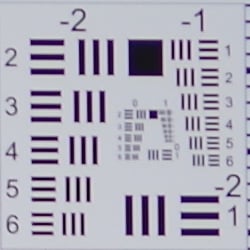
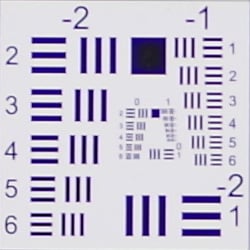
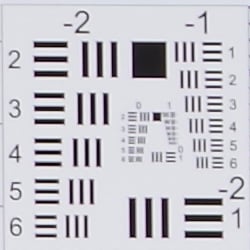
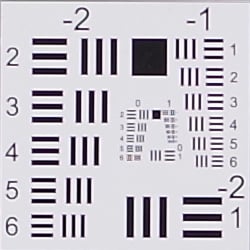
Chromatic Aberration. Chromatic aberration is moderately low and dull in the corners of the Pentax 40mm lens wide-open, but the K-01 suppresses lateral chromatic aberration by default (see below). There's some moderate longitudinal chromatic aberration in the center at f/2.8, but that will likely vary with focus. At f/8, chromatic aberration is much lower and hardly noticeable. (This distortion is visible as a slight colored fringe around the objects at the edges of the field of view on the resolution target.)
Corner Sharpness. The Pentax 40mm lens produced slightly soft corners at the top of the frame at maximum aperture, but bottom corners were sharper. Softness extended pretty far into the frame, though the center was fairly sharp. Corner sharpness was pretty good when stopped-down to f/8. Some vignetting was noticeable at f/2.8 as well, but negligible at f/8.
Chromatic Aberration Reduction
The Pentax K-01 offers optional lateral chromatic aberration reduction for the same lenses that are supported for distortion correction.
| Camera JPEGs, Lateral Chromatic Aberration Reduction | |
 |
 |
| f/8: Enabled (default) | f/8: Disabled |
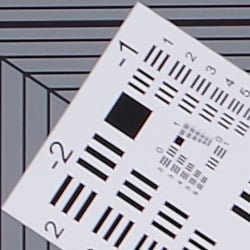
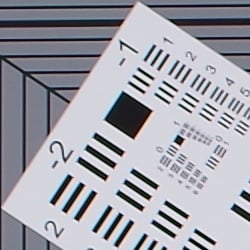
As illustrated in the crops above, the Pentax K-01 removed much of color fringing from the 40mm kit lens with Lateral Chromatic Aberration Adjustment enabled (default), though it still leaves some minor chromatic aberration behind, especially along diagonal edges. Note that longitudinal chromatic aberration does not appear to be suppressed (from the center crop at f/2.8).
Overall, very good performance from a pancake lens. Only macro performance is somewhat disappointing, but that's not a surprise given how compact the lens is.
Pentax K-01 Viewfinder
Viewfinder Test Results
Coverage
Very good accuracy from the LCD.

The Pentax K-01's LCD showed about 101 percent coverage with our Sigma 70mm f/2.8 prime lens. This is very good performance compared to most SLRs, but we like to see 100% coverage from an LCD.
The images above were taken from our standardized test shots. For a collection of more pictorial photos, see our Pentax K-01 Photo Gallery .
Exposure
Color
Saturation & Hue Accuracy
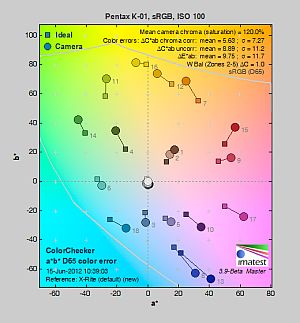
Most colors are highly saturated at default settings, with about average hue accuracy.
 |
||||
|
ISO Sensitivity
|
||||
| In the diagram above, the squares show the original color, and the circles show the color that the camera captured. More saturated colors are located toward the periphery of the graph. Hue changes as you travel around the center. Thus, hue-accurate, highly saturated colors appear as lines radiating from the center. Mouse over the links to compare ISOs and click for larger versions. | ||||
Saturation. The Pentax K-01's default image tone setting of "Bright" pushes most colors by quite a bit at base ISO, especially blues, greens, and reds. Overall, images were very bright and punchy, with color that was a little over the top, but typical for Pentax. Saturation remains higher than average throughout the ISO range. You can of course always select a different image tone preset and/or turn down settings such as saturation and contrast to suit your own tastes. Most consumer digital cameras produce color that's more highly saturated (more intense) than found in the original subjects. This is simply because most people like their color a bit brighter than life.
Skin tones. Caucasian skin tones from the Pentax K-01 were a touch yellow using auto white balance, while manual white balance produced a more pinkish, "healthier" appearance. Where oversaturation is most problematic is on Caucasian skin tones, as it's very easy for these "memory colors" to be seen as too bright, too pink, too yellow, etc.
Hue. With an mean "delta-C" color error of 5.63 after correction for saturation, the Pentax K-01's overall hue accuracy was about average for a compact system camera. Most noticeable were moderate shifts in orange toward yellow and cyan toward blue, with minor shifts and some reds, yellows, and greens. (The cyan to blue shift is very common among the digital cameras we test; we think it's a deliberate choice by camera engineers to produce better-looking sky colors.) Hue is "what color" the color is.
Saturation Adjustment
The Pentax K-01 lets you adjust the image Saturation and Contrast in nine steps each (Hue, High/Low Key and Sharpness are also adjustable in nine steps.) As can be seen below, the saturation adjustment worked well, providing a reasonably fine-grained adjustment over a useful range of control. The saturation adjustment also has almost no impact on contrast. That's how a saturation control should work, but we've often found interactions between saturation adjustments and image contrast (and vice versa) on the cameras we test.
| Saturation Adjustment Examples | ||||
 |
 |
 |
 |
 |
| -4 | -2 | Default | +2 | +4 |
The series of shots above shows results with several different saturation adjustment settings including both extremes. See the Thumbnails index page for more (look for the files named K01OUTBSATx.JPG). Click on any thumbnail above to see the full-sized image.


Sensor
Exposure and White Balance
Indoors, incandescent lighting
Very warm results with Auto white balance and too cool with Incandescent, but good color with Manual white balance setting. Average exposure compensation required.


The Pentax K-01's Auto White Balance had a difficult time with the very warm color balance of the household incandescent bulbs used in this shot, though there is an option to increase the color correction in AWB mode to "Strong" (default is "Subtle Correction"). Results with the Incandescent setting were too cool with a blue tint. The Manual setting produced the most accurate color balance, though a touch yellow. Note that a Color Temperature Enhancement (CTE) white balance option is also available (not shown), which exaggerates the temperature of the ambient light. The Pentax K-01 required an average amount of exposure compensation of +0.3 EV for this shot. Our test lighting for this shot is a mixture of 60 and 100 watt household incandescent bulbs, a pretty yellow light source, but a very common one in typical home settings here in the U.S.
Outdoors, daylight
Bright colors with very good exposure and good highlight/shadow detail preservation.
The Pentax K-01 handled tough outdoor lighting under harsh sunlight pretty well, producing bright colors with good exposure. Default contrast was on the high side (as most users prefer), resulting in some clipped highlights in the model's shirt and some of the flowers, as well as some lost shadows in the flowers and the background, though remaining shadow detail is unusually clean as we found with the K-5. +0.3 EV exposure compensation was required to keep the model's face reasonably bright, which is better than the average of +0.7 EV usually required for this scene. Skin tones were just a touch yellow using auto white balance, so we preferred manual white balance for outdoor portraits. Our Far-field shot was well exposed at 0 EV, again with bright colors. Very few highlights were clipped, while shadow detail was quite good. Very good results overall here.
See full set of test images with explanations
See thumbnails of all test and gallery images
Resolution
Very high resolution, ~2,100 lines of strong detail from JPEGs, about the same from converted RAW files.
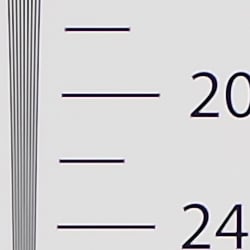
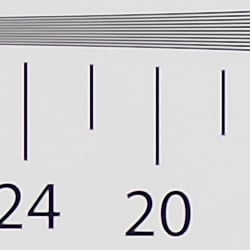
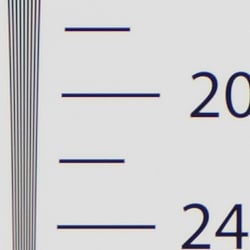
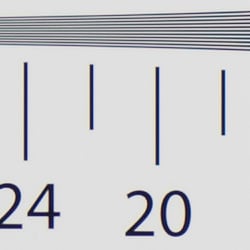
Our laboratory resolution chart revealed sharp, distinct line patterns down to about 2,100 lines per picture height in both the horizontal and vertical direction in JPEGs. Complete extinction didn't occur until around 2,800 lines in both directions. We weren't able to extract any more resolution from RAW files processed through Adobe Camera Raw in this high-contrast target, though complete extinction of the pattern extended to around 3,000 lines. The ACR processed RAW images didn't show as many jagged edges on fine diagonal lines as the camera JPEGs did, though color moire was higher. Use these numbers to compare with other cameras of similar resolution, or use them to see just what higher resolution can mean in terms of potential detail.
See full set of test images with explanations
See thumbnails of all test and gallery images
Sharpness & Detail
Sharp images overall, though moderate edge-enhancement on high-contrast subjects. Minor noise suppression visible at base ISO.


Sharpness. The Pentax K-01 produced sharp images with very good detail at default settings. Some edge enhancement artifacts are visible on high-contrast subjects such as the sharpening halos around thicker branches and the pine codes in the crop above left, but overall results are still good (albeit with a bit too much contrast and saturation for our tastes). Edge enhancement creates the illusion of sharpness by enhancing color and tonal differences right at the edge of a rapid transition in color or tone.
Detail. The crop above right shows only minimal detail loss due to noise suppression, as the darker areas of the model's hair show a lot of detail. Individual strands are still distinguishable even in the lighter shadows, though they begin to merge as shadows deepen, and in places where the tone and color of adjacent strands is very close. Very good performance here. Noise-suppression systems in digital cameras tend to flatten-out detail in areas of subtle contrast. The effects can often be seen in shots of human hair, where the individual strands are lost and an almost "watercolor" look appears.
RAW vs In-Camera JPEGs
As noted above, the Pentax K-01 does a pretty good job at capturing lots of detail, but more detail can be obtained from carefully processing RAW files, without introducing additional artifacts. Take a look below, to see what we mean:



In the table above, mousing over a link at the bottom will load the corresponding crop in the area above, and clicking the link will load the full resolution image. Examples are shot at ISO 100, and include in-camera Best quality JPEG as well as the matching RAW file processed through Adobe Camera Raw (ACR) version 6.7, then sharpened in Photoshop. For the Pentax K-01's RAW files, we found best results with strong but tight 450% unsharp masking with a 0.3 pixel radius.
As is frequently the case, the demosaicing and sharpening in Adobe Camera and Photoshop deliver finer detail than the camera. Looking very closely at the images, ACR extracts quite a bit more detail that wasn't present in the JPEGs, but there's also a bit more noise visible. You can always adjust noise reduction to your liking, though, which is one of the advantages of shooting RAW and processing the images yourself.
ISO & Noise Performance
Very good handling of noise versus detail to ISO 1,600.
| Noise Reduction = Auto (Default) | ||
 |
 |
 |
| ISO 100 | ISO 200 | ISO 400 |
 |
 |
 |
| ISO 800 | ISO 1,600 | ISO 3,200 |
 |
 |
 |
| ISO 6,400 | ISO 12,800 | ISO 25,600 |
The Pentax K-01's images were very clean at ISO 100 through 800, which just a touch of luminance noise becoming more visible in the shadows and darker midtones as ISO increases. Detail was still very good at ISO 1,600, with a tight film-like noise "grain" and very little fine detail lost to noise reduction. At ISO 3,200, there's increased blurring and more visible noise "grain", but fine detail is still generally quite good, though subtle detail in reds take a larger hit. ISO 6,400 shows stronger luminance and chrominance noise as well as increased blurring, though there's still a fair amount usable detail left. As expected, images at ISOs 12,800 and 25,600 are noticeably noisier and less detailed than those at lower sensitivity levels, and chroma noise in the form of purple and yellow blotching is quite strong at ISO 25,600.
Default noise reduction seems stronger than the K-5's, but otherwise image quality appears to be similar which is to say very good. Note that these images were shot using the Pentax K-01 "Auto" noise reduction setting. The Pentax K-01 offers an unusually flexible amount of control over noise reduction applied to its JPEGs. In addition to "Auto", you can adjust how much NR is applied ("Off", "Low", "Medium" or "High") at all ISOs, or you can select "Custom" which allows you to choose from the same four options at each ISO sensitivity setting (in whole EV increments). Of course, the impact of noise and detail loss are highly dependent on the size the photos are printed at, and pixel-peeping on-screen has surprisingly little relationship to how the images look when printed: See the Print Quality section below for recommended maximum print sizes at each ISO.
A note about focus for this shot: We shoot this image at f/4, using one of three very sharp reference lenses (70mm Sigma f/2.8 macro for most cameras, 60mm f/2.8 Nikkor macro for Nikon bodies without a drive motor, and Olympus Zuiko 50mm f/2.0 for Four Thirds and Micro Four Thirds bodies). To insure that the hair detail we use for making critical judgements about camera noise processing and detail rendering is in sharp focus at the relatively wide aperture we're shooting at, the focus target at the center of the scene is on a movable stand. This lets us compensate for front- or back-focus by different camera bodies, even those that lack micro-focus adjustments. This does mean, though, that the focus target itself may appear soft or slightly out of focus for bodies that front- or back-focused with the reference lens. If you click to view the full-size image for one of these shots and notice that the focus target is fuzzy, you don't need to email and tell us about it; we already know it. :-) The focus target position will simply have been adjusted to insure that the rest of the scene is focused properly.
Extremes: Sunlit, dynamic range, and low light tests
Very high resolution with very good highlight and shadow detail. Very good low-light performance, capable of capturing bright images in near darkness, though autofocus really struggled in low light.


Sunlight:
The Pentax K-01 handled the deliberately harsh lighting very well in the above test. Though default contrast is quite high, highlight and especially shadow detail are very good. (The K-01's contrast adjustment also did a good job of decreasing overall contrast though it did impact saturation; see the section below.) The +0.3 EV exposure did the best job here, as we thought that too many highlights were lost at +0.7 and 0 EV was a tad dim in the face. Some highlights were blown in the model's shirt and bright flowers at +0.3 EV, but not as many as we're used to seeing, while very good detail was preserved in the shadows with unusually low levels of noise. Note that these shots were captured with the Pentax K-01's D-Range control set to "Off."
Because digital cameras are more like slide film than negative film (in that they tend to have a more limited tonal range), we test them in the harshest situations to see how they handle scenes with bright highlights and dark shadows, as well as what kind of sensitivity they have in low light. The shot above is designed to mimic the very harsh, contrasty effect of direct noonday sunlight, a very tough challenge for most digital cameras. (You can read details of this test here. In actual shooting conditions, be sure to use fill flash in situations like the one shown here; it's better to shoot in open shade whenever possible.)
Dynamic Range Analysis
A key parameter in a digital camera is its Dynamic Range, the range of brightness that can be faithfully recorded. At the upper end of the tonal scale, dynamic range is dictated by the point at which the RGB data "saturates" at values of 255, 255, 255. At the lower end of the tonal scale, dynamic range is determined by the point at which there ceases to be any useful difference between adjacent tonal steps. Note the use of the qualifier "useful" in there: While it's tempting to evaluate dynamic range as the maximum number of tonal steps that can be discerned at all, that measure of dynamic range has very little relevance to real-world photography. What we care about as photographers is how much detail we can pull out of the shadows before image noise becomes too objectionable. This, of course, is a very subjective matter, and will vary with the application and even the subject matter in question. (Noise will be much more visible in subjects with large areas of flat tints and subtle shading than it would in subjects with strong, highly contrasting surface texture.)
What makes most sense then, is to specify useful dynamic range in terms of the point at which image noise reaches some agreed-upon threshold. To this end, Imatest computes a number of different dynamic range measurements, based on a variety of image noise thresholds. The noise thresholds are specified in terms of f-stops of equivalent luminance variation in the final image file, and dynamic range is computed for noise thresholds of 1.0 (low image quality), 0.5 (medium image quality), 0.25 (medium-high image quality) and 0.1 (high image quality). For most photographers and most applications, the noise thresholds of 0.5 and 0.25 f-stops are probably the most relevant to the production of acceptable-quality finished images, but many noise-sensitive shooters will insist on the 0.1 f-stop limit for their most critical work.
JPEG. The graph at right (click for a larger version) was generated using Imatest's dynamic range analysis for an in-camera Pentax K-01 JPEG file with a nominally-exposed density step target (Stouffer 4110). At the base ISO of 100 (the optimal ISO), with D-Range Expansion set to Off and default Contrast, the graph shows 10.6 f-stops of total dynamic range, with 7.73 f-stops at the "High" Quality level. These are are good results for an APS-C model. Compared to the Pentax K-5, the K-01 actually scored a bit better with its JPEG producing 7.73 versus 7.22 f-stops at the highest quality level, and 10.6 vs 10.5 f-stops total dynamic, though some of that improvement in the high quality number is due to slightly stronger default noise reduction. Note though that this measurement has a margin of error of about 1/3 f-stop, so differences of less than 0.33 can be ignored.
RAW. The graph at right is from the same Stouffer 4110 stepchart image captured as a RAW (.DNG) file, processed with Adobe Camera Raw using the Auto setting. As can be seen, the score at the highest quality level increased just over 2 f-stops from 7.73 to 9.74 f-stops, while total dynamic range increased just over one f-stop from 10.6 to 11.7. These results are good, though not as good as the K-5 which managed 10.5 f-stops at the highest quality level, though total dynamic range was similar at 11.7 f-stops versus the K-5's 11.5. It's also worth noting here is that ACR's default noise reduction settings reduced overall noise somewhat (see the plot in the lower left-hand corner) relative to the levels in the in-camera JPEG, which would tend to boost the dynamic range numbers for the higher quality thresholds.
Contrast Adjustment
Just as with its saturation adjustment, the Pentax K-01's contrast adjustment offers a fairly wide range of settings (-4 to +4), and the contrast steps are actually a little finer than those for saturation, which is even more to our liking.
| Minimum Contrast | |
 |
 |
| Contrast set to lowest, 0 EV |
Contrast set to lowest, 0 EV |
At its lowest contrast setting, the K-01 did a really excellent job of bringing nice detail out of the shadows as well as preserving more highlight detail in the model's shirt and flowers, but skin tones in the "Outdoor" Portrait were a bit too flat for our tastes, and colors in general in the Far-field shot were noticeably less saturated.
| Contrast Adjustment Examples | ||||
|
 |
 |
 |
 |
| -4 | -2 | Default | +2 | +4 |
The series of shots above shows results with several different contrast adjustment settings, showing the minimum step size around the default, as well as both extremes. The camera's contrast adjustment had quite an effect on color saturation, reducing it along with contrast. Contrast and saturation are actually fairly closely coupled, so this is unfortunately not unusual. While you can see the extremes, it's hard to really evaluate contrast on small thumbnails like these, click on any thumbnail to go to the full-size image.
D-Range Settings
The Pentax K-01 offers three Shadow Correction levels (Low, Medium, and High, plus Off and Auto) as well as one Highlight Correction level (Auto/On/Off). Auto is the default setting for both. As the name implies, Shadow Correction works to raise shadow levels while attempting to keep highlights and midtones as they are, and likewise, Highlight Correction attempts to reduce highlights without darkening shadows and midtones. Both can be used simultaneously. See the images below to see their effect on our high contrast "Sunlit" Portrait test shot.
|
Outdoor Portrait D-Range Examples (0 EV)
|
|||
|
|
D-Range Off |
||
| Shadow Low |
|||
| Shadow Medium |
|||
| Shadow High |
|||
| Shadow Auto |
|||
 |
Highlight On |
||
| Highlight Auto |
|||
Mouse over the links to see how the various settings for D-Range affects our "Outdoor" Portrait shot. Click on a link to get to the full-res image. (The effect can be a little subtle in shots like those above, so we decided to use a mouse-over to better show how each setting compares to Off.)
Shadow Correction. Above, we see a gradual lightening of shadows as the Shadow Correction setting is increased, but there is also a slight increase in highlight clipping with the Auto setting. If you look closely at the shadow detail, you will notice an increase in noise as the setting is turned higher, but that's to be expected and noise levels are still pretty low. The camera reports an ISO of 100 for all three settings of Shadow Correction.
Highlight Correction. Highlight Correction set to On did reduce the number of bright highlights, but it raised ISO to 200. Auto decided no highlight correction was necessary, producing results practically identical to Off.
|
Far-field D-Range Examples
|
|||
|
|
|||
Here are the results with our Far-field shot. Again, we see a lightening of shadows as the Shadow Correction setting is increased. Highlight Correction worked as expected though there weren't many highlights clipped in the first place, so again, the Auto setting had little effect.
HDR Capture
The Pentax K-01 has a High Dynamic Range (HDR) capture mode where the camera takes three images (underexposed down to -3 EV, normal, and overexposed up to +3 EV) in quick succession and combines them in-camera into one image. If performed properly, this method should result in much higher dynamic range, without the additional noise penalty that comes with boosting sensitivity. (In fact, it can reduce shadow noise by combining shadows from the overexposed shot.) There are four HDR settings available, one less than the K-5: Off (default), Auto, and HDR 1/2/3.
|
Far-field HDR Examples
|
||
|
|
||
|
|
||
The lowest manual HDR setting worked reasonably well on our Far-field test shot, reducing both clipped highlights and bringing out shadow detail. Higher settings were too much for this scene, resulting in very flat and unnatural looking images with strong halos, and the Auto setting decided HDR wasn't required for this shot. As with most HDR systems, watch out for the ghosting that occur when subjects are moving between exposures. The K-01 has an Auto Align function which should let you shot HDR images without the use of a tripod, but we didn't test that feature in the lab.
| 1 fc 11 lux |
1/2 fc 5.5 lux |
1/4 fc 2.7 lux |
1/8 fc 1.3 lux |
1/16 fc 0.67 lux |
1/16fc No NR |
|
|---|---|---|---|---|---|---|
| ISO 100 |
 2 s f2.8 |
 4 s f2.8 |
 8 s f2.8 |
 15 s f2.8 |
 30 s f2.8 |
 30 s f2.8 |
| ISO 200 |
 1 s f2.8 |
 2 s f2.8 |
 4 s f2.8 |
 8 s f2.8 |
 15 s f2.8 |
 15 s f2.8 |
| ISO 400 |
 0.5 s f2.8 |
 1 s f2.8 |
 2 s f2.8 |
 4 s f2.8 |
 8 s f2.8 |
 8 s f2.8 |
| ISO 800 |
 1/4 s f2.8 |
 0.5 s f2.8 |
 1 s f2.8 |
 2 s f2.8 |
 4 s f2.8 |
 4 s f2.8 |
| ISO 1600 |
 1/8 s f2.8 |
 1/4 s f2.8 |
 0.5 s f2.8 |
 1 s f2.8 |
 2 s f2.8 |
 2 s f2.8 |
| ISO 3200 |
 1/15 s f2.8 |
 1/8 s f2.8 |
 1/4 s f2.8 |
 0.5 s f2.8 |
 1 s f2.8 |
 1 s f2.8 |
| ISO 6400 |
 1/30 s f2.8 |
 1/15 s f2.8 |
 1/8 s f2.8 |
 1/4 s f2.8 |
 0.5 s f2.8 |
 0.5 s f2.8 |
| ISO 12800 |
 1/60 s f2.8 |
 1/30 s f2.8 |
 1/15 s f2.8 |
 1/8 s f2.8 |
 1/4 s f2.8 |
 1/4 s f2.8 |
| ISO 25600 |
 1/125 s f2.8 |
 1/60 s f2.8 |
 1/30 s f2.8 |
 1/15 s f2.8 |
 1/8 s f2.8 |
 1/8 s f2.8 |
Low Light. The Pentax K-01 performed well here, able to capture usable images down to the 1/16 foot-candle light level (about 1/16 as bright as average city street lighting at night), at all ISO settings. The K-01's metering system struggled a bit with getting the exposure correct at the lowest levels though, so we used manual exposure for these shots.
Color balance with Auto white balance was pretty good even at lower light levels, with just a slightly cool bias. At very high ISOs, chroma noise shifted overall color balance, sometimes towards magenta or green.
Noise was quite low up to ISO 1,600, and even a higher ISOs there's still a lot of detail to work with especially when high ISO NR is set to "Off". As mentioned previously, the Pentax K-01 gives you four options for high ISO noise reduction: Auto, Off, Low, Normal, and High, and you can choose the level of noise reduction for each ISO, so you have a lot of flexibility in deciding how much noise to trade for detail. Except for the "No NR" shots in the table above, these were all shot using the default Auto NR settings.
There are a few hot pixels that become more visible as light levels fall at lower ISOs, but the K-01 does have a pixel mapping feature that should correct for those. We did not detect any banding issues except for a hint of horizontal banding at very high ISOs.
The Pentax K-01's contrast-detection autofocus system was only able to focus on the subject down to just below the 1/2 foot-candle light level using an f/2.8 lens with its AF assist light turned off. This is poor performance compared to most SLRs and even most CSCs. The camera was however able to focus in total darkness with the focus assist lamp enabled.
(Keep in mind that the longer shutter speeds here demand the use of a tripod to prevent any blurring from camera movement. A useful trick is to just prop the camera on a convenient surface, and use its self-timer to release the shutter. This avoids any jiggling from your finger pressing the shutter button, and can work quite well when you don't have a tripod handy.)
How bright is this? The one foot-candle light level that this test begins at roughly corresponds to the brightness of typical city street-lighting at night. Cameras performing well at that level should be able to snap good-looking photos of street-lit scenes.
NOTE: This low light test is conducted with a stationary subject, and the camera mounted on a sturdy tripod. Most digital cameras will fail miserably when faced with a moving subject in dim lighting. (For example, a child's ballet recital or a holiday pageant in a gymnasium.) Thanks to their larger sensors, compact system cameras like the Pentax K-01 tend to do better than point & shoots, but you still shouldn't expect a quick autofocus lock with moving subjects. (A useful trick is to just prop the camera on a convenient surface, and use its self-timer to release the shutter. This avoids any jiggling from your finger pressing the shutter button, and can work quite well when you don't have a tripod handy.)
Output Quality
Print Quality
Good color and detail at ISO 100, easily making 20 x 30-inch prints; ISO 3,200 images make a good 13 x 19-inch print; ISO 25,600 shots are good for a 5x7.
 ISO 80 looks very crisp at 20x30 inches, with good color and detail.
ISO 100 images looked pretty good printed at 20 x 30 inches with good color and detail overall.
ISO 200 shots also looked good at 20 x 30.
ISO 400 images looked better at 16 x 20.
ISO 800 images had sufficient detail for 16 x 20, but reds were slightly softer, particularly our red leaf fabric swatch. Just a hint of luminance noise dances in the shadows.
ISO 1,600 shots had sufficient detail for 16 x 20 inches, though reds were blurrier (a very common outcome).
ISO 3,200 shots were good printed at 13 x 19 inches, though color was noticeably faded, with a very blurry red leaf swatch, which we'll stipulate from here on out.
ISO 6,400 shots were usable at 11 x 14, but looked better at 8 x 10.
ISO 12,800 files still looked good at 8 x 10.
ISO 25,600 images made a good 5x7.
Overall, a very good performance from the Pentax K-01. Shadow noise was well-controlled throughout the series at the sizes stated, which can be really distracting on other cameras.
Testing hundreds of digital cameras, we've found that you can only tell just so much about a camera's image quality by viewing its images on-screen. Ultimately, there's no substitute for printing a lot of images and examining them closely. For this reason, we now routinely print sample images from the cameras we test on our Canon Pro9000 Mark II studio printer, and on the Pixma MP610 here in the office. (See the Canon Pixma Pro9000 Mark II review for details on that model.)
The images above were taken from our standardized test shots. For a collection of more pictorial photos, see our Pentax K-01 Photo Gallery .
Not sure which camera to buy? Let your eyes be the ultimate judge! Visit our Comparometer(tm) to compare images from the Pentax K-01 with those from other cameras you may be considering. The proof is in the pictures, so let your own eyes decide which you like best!
Performance
Timing and Performance
Generally slow performance for a compact system camera, though good JPEG burst speed.
| Startup/Shutdown |
||
| Power on |
~2.4 seconds
|
Time it takes to turn on and capture a shot. |
| Shutdown |
~0.3 second
|
How long it takes camera to turn off before you can remove the memory card. |
|
Buffer clearing time
|
3 seconds after 9 large/fine JPEGs*
|
Worst case buffer clearing time. -- This is the delay after a set of shots before you can remove the card.
|
|
1 second after 20 RAW files*
|
||
|
2 seconds after 20 RAW + LF JPEG files*
|
||
|
*Note: Buffer clearing times measured with a SanDisk Extreme Pro 45MB/sec UHS-I SDHC card. Slower cards will produce correspondingly slower clearing times. Slow cards may also limit length of bursts in continuous mode. ISO sensitivity and noise reduction settings can also affect cycle times and burst mode performance.
|
||
Startup was slow at 2.4 seconds, though shutdown was fast. With a 45MB/s UHS-I SDHC card, the Pentax K-01's buffer clearing times were quite fast.
| Mode Switching | ||
|---|---|---|
| Play to Record, |
~1.3 seconds
|
Time until first shot is captured.
|
| Record to Play |
~2.3 seconds
|
Time to display a large/fine JPEG file immediately after capture.
|
| Display |
~0.2 second
|
Time to display a large/fine JPEG file already on the memory card.
|
Play to Record mode switching was a bit slow, while Record to Play mode was quite slow, though displaying a captured image was fast.
| Shutter Response (Lag Time) | ||
|---|---|---|
|
Full Autofocus,
Single-area AF mode |
0.803 second
|
Time from fully pressing shutter button to image capture, with the lens already at the proper focal distance setting. (All AF timing performed with Pentax 40mm f/2.8 XS kit lens unless otherwise noted.)
|
Full Autofocus,
Single-area AF mode |
0.967 second
|
Time from fully pressing shutter button to image capture, with the lens already at the proper focal distance setting. (Tested with Pentax 17-70mm f/4 SDM lens at medium focal length.)
|
|
Full Autofocus,
Multi-area AF mode |
0.768 second
|
Time from fully pressing shutter button to image capture, with the lens already at the proper focal distance setting.
|
|
Full Autofocus,
Single-area AF mode Auto Flash Enabled |
0.853 second
|
Time from fully pressing shutter button to image capture, with the lens already at the proper focal distance setting, TTL Auto flash enabled.
|
|
Continuous AF
|
N/A
|
This mode usually shows no speed increase with our static subject; we have no way to measure performance with moving subjects.
|
|
Manual Focus
|
0.105 second
|
For most cameras, shutter lag is less in manual focus than autofocus, but usually not as fast as when the camera is "prefocused".
|
| Prefocused |
0.120 second
|
Time to capture, after half-pressing and holding shutter button.
|
Not surprisingly, the Pentax K-01's full autofocus lag times were quite slow for a current compact system camera, at about 0.8 second with the 40mm kit lens. That's also slower than the vast majority of point & shoot cameras these days. Manual focus shutter lag was good though, at only 0.105 second. Oddly, prefocused shutter lag was slower than manual focus, at 0.120 second.
We thought perhaps a Pentax 17-70mm f/4 SDM (Supersonic Drive Motor) lens would focus faster, but found it was even slower on average than the 40mm kit lens. Full AF lag with the SDM lens averaged almost one second, and it varied a lot, between 0.57 and 1.74 seconds. (AF lag with the kit lens was very consistent, varying only 3% over multiple trials.)
To minimize the effect of different lens' focusing speed, we test AF-active shutter lag with the lens already set to the correct focal distance.
| Cycle Time (shot to shot) | ||
|---|---|---|
| Single Shot mode |
1.91 seconds
|
Time per shot, averaged over 20 shots, 1 second to clear*. |
|
Single Shot mode |
2.24 seconds
|
Time per shot, averaged over 20 shots, 1.5 seconds to clear*. |
|
Single Shot mode
RAW + LF JPEG |
2.34 seconds
|
Time per shot, averaged over 20 shots, 1.5 seconds to clear*. |
| Early shutter |
Yes
|
Some cameras don't snap another shot if you release and press the shutter too quickly in Single Shot mode, making "No" the preferred answer. |
|
Continuous High Mode |
0.17 second (5.93 frames per second);
9 frames total; 3 seconds to clear* |
Time per shot, averaged over 9 shots, then slows to an average of about 0.25s or 3.96 fps when buffer is full, with about 32% variation. |
| Continuous Mode |
0.98 second (1.02 frames per second);
20+ frames total; 1 second to clear* |
Time per shot, averaged over 20 frames with no signs of slowing. |
|
Continuous Mode |
0.98 second (1.02 frames per second);
20+ frames total; 2 seconds to clear* |
Time per shot, averaged over 20 frames with no signs of slowing. |
| Flash Recycling |
4.0 seconds
|
Flash at maximum output. |
|
*Note: Buffer clearing times measured with a SanDisk Extreme Pro 45MB/sec UHS-I SDHC card. Slower cards will produce correspondingly slower clearing times. Slow cards may also limit length of bursts in continuous mode. ISO sensitivity and noise reduction settings can also affect cycle times and burst mode performance.
|
||
Single-shot cycle times were very sluggish, ranging from 1.91 seconds for large/fine JPEGs to 2.34 seconds for RAW + large/fine JPEG frames. Continuous High mode was however pretty good at 5.93 frames per second, though it's only available when shooting JPEGs. When RAW files were captured, continuous mode speed was only about one frame per second. Buffer depth was mediocre in Continuous High mode, at 9 large/fine JPEGs, though our test target was designed to be difficult to compress, so JPEG burst lengths should be longer with typical subjects. The Pentax K-01 does manage about 4 fps with the buffer full, though, which is not bad. Buffer depths when shooting with RAW files were quite good at over 20 frames, but keep in mind the slow 1 fps burst speed. Flash recycle time was about average, at 4 seconds after a full power discharge.
| Download Speed | ||
|---|---|---|
| Windows Computer, USB 2.0 |
5,596 KBytes/sec
|
Typical Values: |
Downloads speeds via USB 2.0 were slower than average these days. (Tested with a SanDisk Extreme Pro 45MB/sec UHS-I SDHC card.)
Bottom line, the Pentax K-01's performance is generally pretty slow when compared to most other cameras including CSCs and digicams, though Continuous High burst speed is good. Unfortunately, only JPEGs are supported in that mode.
Battery
Battery Life
Very good battery life for a CSC.
| Operating Mode | Number of Shots |
|---|---|
|
Still Capture,
(CIPA standard) |
500
|
The Pentax K-01 uses a custom rechargeable lithium-ion battery pack for power, and comes with both a single battery and charger. The rated 500 shots per charge is well above average for a compact system camera. Still, we recommend getting a second battery for extended outings or shooting a lot of video.
The table above shows the number of shots the camera is capable of (on a fully-charged rechargeable battery), based on CIPA battery-life and/or manufacturer standard test conditions.
(Interested readers can find an English translation of the CIPA DC-002 standards document here. (180K PDF document))
Video
Check out the links below for more sample images, videos and image quality analysis:
- Pentax K-01 Optics page (Crops from images shot with the camera's kit lens, if sold as a kit)
- Pentax K-01 Sample Images page (Index to all standard test shots, with explanations)
- Pentax K-01 Thumbnails page (Thumbnails of all shots, including RAWs, with EXIF data)
- Pentax K-01 Gallery page (Regular photos taken with the Pentax K-01)
High-definition video capture is now ubiquitous in current interchangeable-lens cameras, and all of the major manufacturers now provide some form of video capture in their compact system cameras. The Pentax K-01 offers a reasonably rich feature set, although it does lack a couple of consumer-friendly features found on some models. Videos can be recorded at up to Full HD resolution using H.264 compression, but there's no support for full-time autofocusing during movie capture, and nor does the K-01 have a wind cut function, both options that consumer videographers might typically expect to see. The K-01 does however support manual exposure control, manual audio levels control, external microphones, and adjustable frame rates, all functions that professional use typically demands. For those who like to cater to their creative side, the K-01 does offer a generous selection of pre-capture video filters.
Overall, we found the Pentax K-01's video feature set to be a worthwhile step forward from past Pentax interchangeable-lens models. Consumers may mourn the lack of full-time autofocus, but given its relatively slow and hesitant operation, it probably wouldn't have been terribly useful regardless. If you're willing to live without it and either focus manually or plan your shots around your depth of field, you should be able to achieve good results with the K-01.
Pentax K-01 Basic Video Specs
- 1,920 x 1,080 (Full HD / 1080p), 1,280 x 720 (720p), and 640 x 480 (VGA) recording
- MPEG-4 H.264/AVC compression at all resolutions; MOV file format; three quality levels
- A choice of 29.97, 25, or 23.976 frames per second at all resolutions; for 720p mode only there's also a choice of 59.940 or 50 fps
- Automatic or manual focus possible before or during movie capture, but only single AF operations are available while recording, not full-time AF
- Manual focus peaking before capture starts, but not during capture
- Optional infrared remote controls can start or stop recording; one model can also trigger AF operations remotely
- Auto, aperture-priority, or full manual exposure, but no shutter-priority
- Automatic or manual ISO sensitivity control in manual mode
- Available exposure variables can be adjusted both before and during movie capture
- Exposure compensation adjustment is available before recording starts
- Digital image stabilization supported during video recording
- Stereo audio recording via built-in, two-port microphone on front panel, or external stereo mic jack
- Separate controls over levels from internal mic (5 step) or external mic (10 step); audio capture can also be disabled
- Custom Image / Digital Filter functions are available in movie mode
- Interval movie function can record timelapse movies at anywhere from one frame per second to one frame per hour
- Playback functions include the ability to split videos at up to four different points, and extract still frames
Pentax K-01 Video: Image Size, Frame Rate, and Encoding
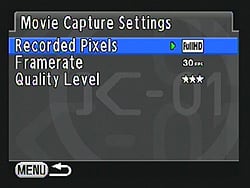
Full HD video. The Pentax K-01 offers three resolution levels for video recording, topping out at a maximum resolution of 1,920 x 1,080 pixels (commonly known as 1080p or Full HD).
The Pentax K-01's CMOS image sensor records high definition video at a maximum resolution of 1,920 x 1,080 pixels--otherwise known as Full HD or 1080p--with a 16:9 aspect ratio. In addition, there are two lower resolution options. The 720p mode is likewise 16:9 aspect, and captures high-def video at 1,280 x 720 pixels. A standard definition mode further downsamples the video stream to produce 640 x 480 (VGA or 480p) movies with a 4:3 aspect ratio. All resolutions offer an adjustable recording rate of 29.97, 25, or 23.976 frames per second. Additionally, in the 720p mode, you can opt for rates of 59.940 or 50 fps. All resolutions and frame rates provide a choice of three quality levels, ranging from one to three stars.
Unless audio capture is disabled, all movies include PCM stereo audio. No spec is provided for the audio sampling rate, though video players report 16-bit audio at a 32 kHz sample rate, with a bit rate of 1,024 Kbps.
The Pentax K-01 is the company's first K-mount camera to ditch inefficient Motion JPEG video compression in favor of MPEG-4 AVC / H.264 compression. This yields significantly smaller file sizes than in older Pentax digital SLRs, but also requires much greater processing power to play back or edit. The more sophisticated encoding used in the H.264 standard requires quite a bit of processor power to pull it apart and put it back together again, so frame-accurate editing of H.264 requires a fast processor and capable editing program.
The table below shows the specs for various video recording options.
|
Pentax K-01 Video Options
|
|||
|---|---|---|---|
|
MPEG-4 H.264/AVC Format (.MOV files)
|
|||
|
Resolution |
Aspect Ratio |
Frame Rate (fps)
|
Approx. Bit Rate
(*** Quality) |
1,920 x 1,080 |
16:9 |
29.97 |
22-25 Mbps |
25 |
20-22 Mbps |
||
23.976 |
18-20 Mbps |
||
1,280 x 720 |
59.940 |
22-25 Mbps |
|
50 |
20-21 Mbps |
||
29.97 |
14-15 Mbps |
||
25 |
12-13 Mbps |
||
23.976 |
11-12 Mbps |
||
640 x 480 |
4:3 |
29.97 |
8-10 Mbps |
25 |
7-9 Mbps |
||
23.976 |
7-9 Mbps |
||
Continuous movie recording is limited to approximately 25 minutes regardless of the capture settings, and maximum movie file size is 4GB. Pentax doesn't provide a recommended Secure Digital card speed rating to avoid issues with write speeds during video capture, but other manufacturers typically specify at least a Class 6 card, and the same is likely true with the K-01.
Here are some examples of video from the Pentax K-01, showing typical results under daylight and night conditions.
|
Pentax K-01: Video Samples
|
|---|
Pentax K-01 Video-Mode Focusing
For a consumer audience used to camcorders that can automatically focus during video capture (and who don't necessarily have the time and patience to learn to pull focus manually), autofocus is typically considered to be a pretty critical feature. The Pentax K-01 offers the ability to autofocus during capture, but only provides for single autofocus operations. You can trigger the autofocus system to operate before recording with either a half-press of the shutter button, or by pressing the AF button. Once recording starts, only the latter operates.
When focusing during video capture, depending on the lens and microphone in use, the audio levels, and the degree of focus adjustment required, AF noise is likely to be picked up on the audio track. With the 40mm XS kit lens and the K-01's internal microphone, AF noise is picked up very clearly as a strong buzzing, and this is a relatively quiet lens, for a screw drive type. SDM and DC-motor lenses will be much quieter. (We didn't have an SDM lens on hand during testing, but the 18-135mm DC travel zoom caused only a very faint buzz with the camera's internal mic.)
You can also manually focus the lens during a recording, and the true manual operation of AF on Pentax's K-mount lenses means you can do this more or less silently, simply by being careful about turning the focus ring. (Some interchangeable-lens cameras we've tested use "fly by wire" focusing, whereby the focus ring only instructs the camera to move the lens elements rather than moving them directly via a mechanical coupling, which can mean that small clicks can be heard on the audio track every time the focus setting is changed, regardless of how slowly you turn the focus ring. With true manual operation of its lenses, the Pentax K-01 doesn't have this problem, although it's possible that a third-party or older Pentax lenses might produce audible noise while their focus was adjusted.)
As we've noted in other SLR reviews, the good news with focusing for video is that you can get surprisingly good depth of field in video mode if the lens is stopped down, thanks to the relatively low resolution of the video image. With a pixel resolution of only 2.1 megapixels even in the Pentax K-01's 1080p Full HD video mode, images that would be unacceptably blurred as 16 megapixel still shots look perfectly fine as video frames. This not only provides greater depth of field at any given aperture, but is also more forgiving of diffraction limiting at very small lens apertures. Diffraction at small apertures means you'd usually want to avoid f/16 or f/22 for still images, but again, the results generally look perfectly fine at video resolutions. Given that you can manually specify the aperture, you may be surprised by how little focus adjustment is required when using a higher ISO sensitivity and slower shutter speed.
Pentax K-01 Video Exposure Control
|
Pentax K-01: Video Samples
|
|---|
The Pentax K-01 is the first K-mount camera from Pentax that offers fully manual exposure control during shooting, and also offers the Aperture-priority mode that's been found in past Pentax cameras. Unlike some competitors, there's still no Shutter-priority mode. There is, however, an optional auto / manual ISO sensitivity control in the Manual mode, effectively giving you something akin to the Shutter and Aperture Priority (TAv) mode found on Pentax's SLRs. This is great, because it lets you set both exposure variables as you choose, and the camera can adjust the sensitivity automatically to attain the metered exposure.
While the absence of shutter priority is a bit of a shame, this is still a big step forward from the video feature set of past K-mount cameras, which offered only Program or Aperture-priority modes. (The K-01 does, of course, allow Program autoexposure as well.) Interestingly, it's possible to adjust shutter speed, aperture, and ISO sensitivity during video capture, although with its very stiff E-dial, you can't really accomplish much with this feature unless using an external mic or a separate audio capture device. The E-dial makes a fairly strong clicking noise that's picked up by the camera's internal mics, when turned.
Surprisingly, the K-01's upper sensitivity limit is ISO 3,200 equivalent for video capture. We say that's surprising because the tiny Pentax Q, which has a much smaller sensor--albeit backside-illuminated--will roam as high as ISO 6,400 equivalent. In Program and Aperture-priority modes, +/-2.0EV of exposure
compensation is available in 0.3 EV steps, and white balance settings also carry over to video mode.
Pentax K-01 In-Camera Image Adjustment for Movies
Catering to those who really want to express their creative side without relying on computers and complicated post-processing, the Pentax K-01 also includes some pre-capture functions that change the look of videos, in some cases quite radically.
The Custom Image effects are the more subtle, changing saturation, toning / hue, high / low-key adjustment, contrast, and sharpness, as well as filter effect for monochrome videos, to yield eleven different user-adjustable presets. These include Bright, Natural, Portrait, Landscape, Vibrant, Radiant, Muted, Bleach Bypass, Reversal Film, Monochrome, and Cross Processing.
The Digital Filter functions bring a more radical difference to the look of videos. For example, you can capture a video that's completely desaturated other than one chosen color, with the look of a film negative, or even with a quasi-fisheye effect added in software. In full, the list of Digital Filter effects in the K-01 includes Extract Color, Toy Camera, Retro, High Contrast, Invert Color, and Color. The Shading filter that's available for still images is not available in video mode. Note that Pentax states movies recorded with digital filters active may have dropped frames, likely due to the processing power required for the effects.
In addition to the filter functions, the Pentax K-01 has an unusual interval movie mode, which captures images for a preset length of time, at a preset interval. You can opt for an interval of 1, 5, 10, or 30 seconds, or of 1, 5, 10, or 30 minutes, and the maximum interval period of one hour. The recording time can run anywhere from four seconds to 99 hours, although the upper limit varies with the selected interval, and so it's not possible to configure an interval movie of more than a few hundred frames. Interval movies play back at an accelerated rate, and don't include sound. The video can be set to start immediately that the shutter button is pressed, or at a predetermined start time. For longer clips, you'll want to use the optional K-AC1202 AC adapter kit.
Pentax K-01 Video: Image Stabilization
Although the Pentax K-01's incorporates a sensor shift-type image stabilization system, this is disabled during video recording, in favor of what Pentax calls 'Movie SR'; in essence, digital image stabilization. Unlike a mechanical system, this allows completely silent operation, but there's no such thing as a free lunch. The system works by creating the video feed from a 'window' of pixels in one particular location on the sensor, with the location of the window moved around the sensor as needed to correct for motion. For this system to function, you need to leave a band of "spare" pixels around the periphery of the sensor, and in the process, the K-01 effectively increases the effective focal length crop significantly. While for telephoto videos this may in fact be desirable, it means that if you want the widest possible field of view, you'll want to disable image stabilization.
Note that even if you disable Movie SR, you don't recoup the wide-angle capabilities. The crop is increased at all times when in movie mode.
Pentax K-01 Video: Audio recording
Audio recording in movies is optional with the Pentax K-01. Audio can be turned on or off using the Sound function located in the Movie menu. Audio is recorded as 16-bit, 32 kHz stereo PCM, with a bit rate of 1,024 Kbps, captured via two microphones near the top of the front panel, with each channel having a separate single-hole grille on either side of the lens mount. External microphones can also be connected via a standard 3.5mm stereo jack, and thankfully this is located beneath a small rubber flap on the left-hand side of the camera's body that is easily reseated, not the large, ungainly and fiddly flap on the other side of the body.
Audio recorded with the camera's internal mic sounded clear, but we do no tests to measure frequency response or sensitivity, so can't comment quantitatively. The level of hiss recorded on audio tracks in relatively quiet environments was somewhat more noticeable than we're accustomed to on competing models, however.
Unlike many of its competitors, the Pentax K-01 provides for manual audio level control. There's a five-step control for the internal microphone, and a ten-step control for external mics. Unfortunately, there's no audio level display, nor any way to monitor audio from the camera body, and so you have no way to know whether you're in the ballpark or not without playing back a recorded video. (And even then, you're going to want to listen on an external device, as the camera's internal speaker is quite weak.) Nor is there a wind cut function, something which may be slightly more of an issue for the K-01's primary target buyers; we noticed a fairly significant amount of wind noise picked up in our own clips, shot in a light breeze.
Audio capture is automatically disabled for interval movies.
Pentax K-01 Movie Recording User Interface
The Pentax K-01's movie mode can be accessed via a separate position on the camera's mode dial. However, unlike past Pentax cameras, there's also a separate, dedicated Video button. In all modes, pressing this button will start / stop movie recording, although there's no way to preview the focal length crop of your movie before capture starts unless you're in Movie mode. Here, not only can you shoot with the dedicated Video button, but you can also start or stop capture with the regular Shutter button. The addition of a movie button, even without a crop preview, is a very positive change. It improves the ability to quickly grab spontaneous, unanticipated video clips, as you don't have to pay attention to changing the camera's operating mode before you can switch from still to video capture, or vice versa.
A few movie-specific setting adjustments are made in a dedicated Movie Menu, which has relatively few options. Other settings applicable to both still and video shooting are made in the still image menus. Options on the Movie Menu for video recording are:
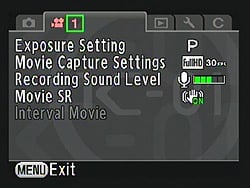
| Pentax K-01 Record Mode Menu Movie Options | ||
|
Top-Level
Selection |
Second-Level
|
Notes
|
Exposure Setting |
- Program (P) - Aperture-priority (Av) - Manual (M) |
Manual mode allows Auto or manual ISO; other modes use Auto ISO. |
Movie Capture Settings |
- Recorded pixels - Framerate - Quality level |
|
Recording Sound Level |
- Internal microphone - External microphone |
Five step control for internal mic; ten step for external mic
|
Movie SR |
- On - Off |
|
Interval Movie |
- Interval - Recording time - Start interval - Start time |
|
Rolling Shutter Artifacts
|
Pentax K-01: Rolling Shutter Artifacts
|
|---|
Essentially every video capable digital SLR/CSC currently on the market exhibits some level of motion-related distortion called rolling shutter artifacts. These are caused because the image data is captured and then read off the chip sequentially by rows, rather than each frame's data being captured all at once. In the case of the Pentax K-01, this means that image data for the last row of a given frame is captured and read out as much as 1/24th second after the data for the top row was captured. The effect on moving objects is like that of a focal plane shutter in an SLR, but more pronounced, because the video frame is read out much more slowly than the slit of a focal plane shutter moves across the sensor.
For a camera that scans video frames vertically (as all do that we're aware of), rolling shutter artifacts will be most noticeable for subjects that are moving rapidly side to side, or when the camera itself is being panned horizontally. Verticals in the scene will appear tilted to the right or left, depending on the direction of camera motion. As an example, consider the case of a camera being panned from left to right, with a flagpole or other vertical object in the middle of the scene when recording for a particular frame begins: If the top of the object was centered horizontally when the first line of the video frame is acquired, by the time the last line of the frame has been captured, the bottom of the object will have shifted to somewhere left of center: As a result, the vertical object would appear to be leaning to the right.
Computer Requirements for Viewing HD Video
A typical computer these days has little trouble dealing with still images, but high-definition video can be another matter. Depending on the file format involved, it can take a pretty beefy computer to handle HD-resolution video playback without stuttering or dropping frames. The MPEG-4 H.264/AVC image compression used by the Pentax K-01 is a fairly compute-intensive format, and its high maximum resolution of 1,920 x 1,080 pixels resolution means there's a lot of data in each frame to deal with. The net result is that you'll need a reasonably recent computer to play the K-01's Full HD video files smoothly, and will want a pretty powerful machine for Full HD video editing.
You can of course view your movies on a high definition TV via the Type-D HDMI output, or a standard-def TV via the combined USB / Video output. Note that neither cable is included in the product bundle, however.
Flash
Pentax K-01 Flash

As well as a P-TTL-compatible hot shoe for external flash strobes, the Pentax K-01 includes a built-in popup flash. With a guide number of 12 meters at ISO 100, the K-01's onboard flash is the same as that of the K-r SLR, and just slightly weaker than those of the K-5 and K-7, which have a guide number of 13. The K-01's popup flash offers 28mm coverage, and includes red-eye reduction capability.
X-sync is at 1/180 second, just like the company's SLRs, and the K-01 supports High Speed Sync with Pentax's external strobes. It offers -2 to +1 EV of flash exposure compensation and available flash modes are: Auto, Auto with Red-eye Reduction, Manual (forced on), Manual with Red-eye Reduction, Slow-speed Sync, Slow-speed Sync with Red-eye Reduction, and Trailing Curtain Sync.
Flash Test Results
Coverage and Range
A fairly powerful flash, with slightly uneven coverage. Lower than average exposure compensation required.


Coverage and Exposure. Flash coverage was a little uneven with the 40mm kit lens, though that's not unusual, and much of the corner shading is likely due to the lens itself. Keep in mind that 40mm isn't a wide-angle lens (60mm equivalent), so coverage is likely poorer with wider lenses. In the Indoor Portrait test, the Pentax K-01's flash required a less than average +0.3 EV exposure compensation adjustment to produce bright results, and chose a reasonably fast 1/50s shutter speed. (Most cameras we've tested required about +0.7 EV for this scene.) The camera's Slow-Sync flash mode at 1/8s produced brighter results with no exposure compensation, though with a stronger pinkish-orange cast from the room lighting.
ISO 200 Range. We hope to add a flash range series here in the near future.
| Manufacturer-Specified Flash Range |
|---|
 10.0 feet ISO 200 |
Manufacturer Specified Flash Test. The Pentax K-01's flash is rated with a Guide Number (GN) of 12 meters at ISO 100. That translates to about 10.0 feet at f/5.6 and ISO 200. In the shot above at those parameters, the K-01's flash produced a bright image indicating it meets Pentax's specification. Our standard test method for flash range uses a fixed setting of ISO 200, to provide a fair basis of comparison between cameras. We've now also begun shooting two shots using the manufacturer-specified camera settings, at the range the company claims for the camera, to assess the validity of the specific claims.
Pricing and availability
The Pentax K-01 shipped in the US market from March 2012. Pricing is set at around US$750 body-only, or US$900 in a kit with the new smc PENTAX-DA 40mm F2.8 XS lens. The latter bundle represents a US$100 discount over the cost of buying camera and lens separately, given that the lens alone has a list price of about US$250. The K-01 kits are offered in three versions: yellow with black and silver detailing, white with black detailing, or black with silver detailing. Each kit also includes a special neckstrap and packaging created by industrial designer Marc Newson.