


Overview
Updated:
01/25/2017: Tech Info posted!
02/10/2017: First Shots posted!
03/15/2017: Performance test results posted!
04/14/2017: Field Test Part I posted!
05/16/2017: Field Test Part II posted!

For many years now, we've been big fans of Ricoh's Pentax brand, and the oftentimes superb DSLRs it produces. The Pentax brand has a long history of making exceptionally fully-featured cameras that come complete with equally aggressive price tags. And while it's not necessarily true of every model the company has produced, Pentax has also earned itself something of a reputation for making cameras that are surprisingly compact by DSLR standards, given their feature-rich designs.
The 24-megapixel Pentax KP takes all of that to the next level, paring off as much of its remaining DSLR heft as possible to better compete with its smaller mirrorless camera rivals, while still offering up an extremely well-specified camera in that newer, smaller envelope. Obviously, since it's still a DSLR and so must make room for a DSLR-sized mirror box, there's a limit to how far this approach can be taken. What's impressive, though, is just how much Ricoh has been able to cram into the Pentax KP despite its compact proportions.
Want to read our full overview for a rundown of the Pentax KP's new features? If so click here, or read on for our real-world field test!
Low light, special features and video: Ricoh's compact DSLR heads into the real world again!
By Mike Tomkins | Posted: 05/16/2017
 58mm-equiv., 1/100 sec. @ f/4.5, ISO 200
Last month, I posted the first part in my two-part field test of the Pentax KP. If you've not already read my earlier report, you'll want to do so now before continuing, as I'll be covering different ground in the second part. Briefly though, for those who've already perused my first report and just need a refresher, I'll hit the high points again.
A quick recap of my first Pentax KP Field Test
The Pentax KP's body is surprisingly comfortable in-hand, and I liked the controls for the most part too, although I did miss the optional Mode dial lock function of the K-3 II. Performance was good both in terms of burst capture and autofocus, although I didn't notice a particular improvement on the autofocus front, and the buffer depth was rather on the limited side.
And as for image quality, well I'd thus far predominantly shot in good light, but in the daytime at least came away impressed with image quality. If there was a weak spot, it was perhaps a slight tendency to overexpose, but otherwise the Pentax KP has thus far proven capable of capturing really great, detailed and lifelike images even at default settings. (If you want the most realistic color, though, switch to the Natural custom image mode.)
Much more detail on this and more plus loads of gallery images can be found in my earlier field test.
But enough of the earlier test, what's slated for coverage in this one? Well, obviously getting some night shooting in was key, both for long-exposure and high-sensitivity images. The latter in particular was an area I was keen to test, given the Pentax KP's astounding sensitivity range of 100 to 819,200-equivalents.
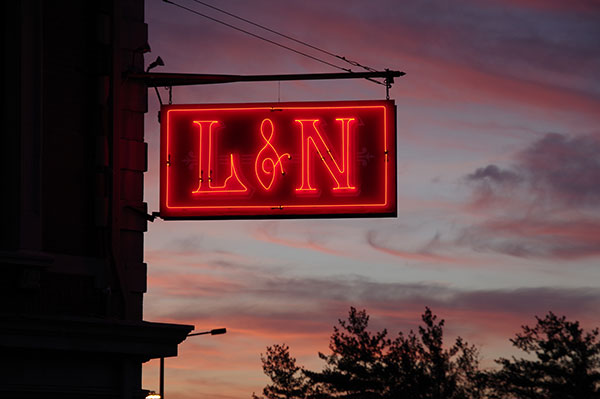
I also wanted to try out the Pentax KP's electronic shutter to see how prone it was to rolling shutter effect, as well as testing the new aperture and shutter-bracketing functions. And I was also keen to get some movies shot and see how the KP looked in an area that's traditionally been a rare weak spot for Pentax DSLRs. And now I've done all of that, so let's get right down to it!
The Pentax KP's tilting LCD is much more versatile than the K-3 II's fixed one
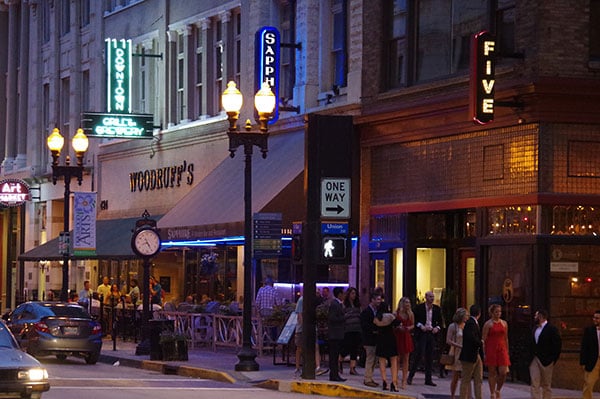
With lots of shooting to do, I headed towards downtown Knoxville, Tennessee, a subject I know very well as I've lived in the vicinity for close to two decades now. That's something of a mixed blessing. After spending so much time here, I know my way around town very well, but Knoxville's not a huge place, and I've shot much of downtown many times over.

I like to try and find new shots, though, and am always looking for new angles on familiar subjects. And that's where the Pentax KP's tilting LCD monitor comes in really handy. The now rather long-in-the-tooth flagship Pentax K-3 and K-3 II both have fixed-position screens, which makes framing shots over your head, from the hip or low to the ground much harder. By contrast, I could easily angle the KP's tilting LCD monitor to help get the shots I was after without having to prostrate myself or become a contortionist just to be able to see the LCD.
 79mm-equiv., 1/100 sec. @ f/4.5, ISO 1600
Of course, the tilt-only screen only helps out when shooting in landscape orientation. For that reason, I still prefer the even more versatile side-mounted, tilt/swivel screens found on some cameras including the recent Pentax K-70. Here, not only can you tilt the screen towards your eye for landscape-orientation shots, but also for portrait shots. But as I said, the KP's screen articulation is still infinitely preferable to the fixed screen used in the flagships, and I really hope we see either a tilting screen or better still a tilt/swivel type in a future Pentax APS-C flagship model.
But I digress. Let's come back to the Pentax KP, and my evening photo shoot. I arrived downtown shortly before sunset, as I had some daylight movies to capture as well, then grabbed a quick dinner at Stock & Barrel, my favorite local burgers and bourbon joint, before heading out into the quickly-fading final embers of sunset for some more shooting. And very quickly, it was dark enough for me to get a feel for the Pentax KP's low-light autofocus capabilities.
And I have to say, I came away rather impressed. Just as I'd have expected, since the dedicated autofocus module is physically identical to that in the K-3 II, the Pentax KP proved admirably capable at focusing in low light. The overwhelming majority of the time, if I was capable of discerning my subject through the KP's bright pentaprism viewfinder, the camera was capable of achieving an accurate focus lock on the first attempt.
As for daytime capture, I didn't notice an improvement in AF speed or accuracy versus the K-3 II, even when shooting side-by-side with identical lens models on both bodies. However, as I noted in my first field test, that's likely because the K-3 II already received the same algorithmic tweaks in its firmware updates that the Pentax KP boasts right out of the box.

When it was first announced, perhaps the single bullet item on the Pentax KP's spec sheet which drew the most attention was its jaw-dropping maximum sensitivity limit of ISO 819,200-equivalent. And from the get go, let's be clear here: You won't want to be shooting at that maximum sensitivity unless you have absolutely no other way to get the shot, or you're intentionally looking for a noisy image for artistic effect.
But that's hardly surprising, and has been the case in past models too. Unlike some manufacturers who require that you first enable ISO expansion to access the higher sensitivities which veer beyond each company's in-house definition of acceptable noise levels, Ricoh simply lets you make the choice in its cameras, providing access to the whole range by default. And we've seen in past models that the highest sensitivities are an option of last resort, with the real-world limit being rather lower for most purposes.
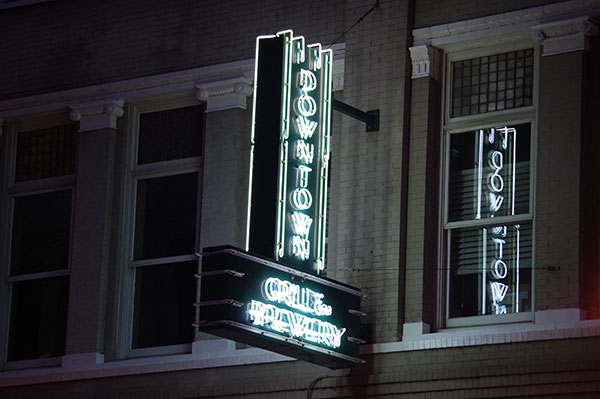
The K-3 II for example tops out at ISO 51,200-equivalent, but I felt that from ISO 12,800 and beyond, noise levels started to get rather too high. And with the more recent K-70 which has a maximum sensitivity of ISO 102,400-equivalent, I felt that ISO 25,600 was the upper limit beyond which noise levels were simply too high for anything but a last resort when all else fails. (With both cameras, though, I recommended staying at ISO 6400 or below for pleasingly tight and film-like grain.)
And now, with the Pentax KP, I'm seeing another definite step forward at the higher sensitivites. Everything up to ISO 6400-equivalent remains very usable indeed, with plenty of fine detail and tight, film-like grain. And while once again, I noticed coarser grain at ISO 12,800, I continued to remain pretty satisfied nevertheless until ISO 51,200-equivalent.
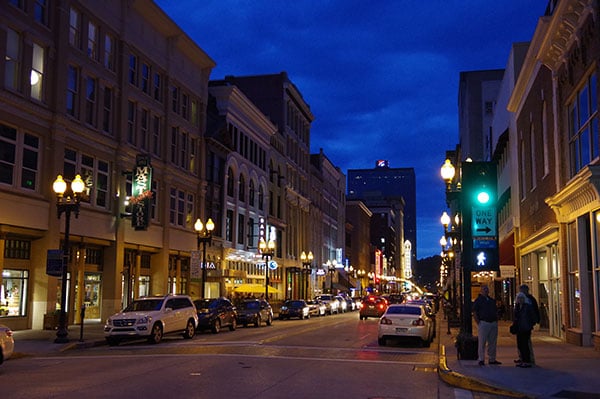
Considering that the KP is now truly usable across what was the full sensitivity range of the now two-year old K-3 II (which, admittedly, shares its imaging pipeline with the 3.5-year old K-3), I'd have to say I'm thoroughly impressed. Once you get to ISO 102,400-equivalent, grain starts to get rather more intrusive, and colors become more muted, but even this high sensitivity struck me as useful in a pinch.
ISO 204,800 and above, though, were a step too far for my tastes, at least unless you have no other choice. Images are decidedly soft and noisy, with much of the fine detail lost to noise reduction, and grain starting to become quite intrusive. ISO 409,600-equivalent was even noisier and prone to muddy shadows, while the maximum of ISO 819,200-equivalent was extremely noisy and soft with muddy shadows. I also saw some fairly strong color casts at this maximum sensitivity which varied from shot to shot.
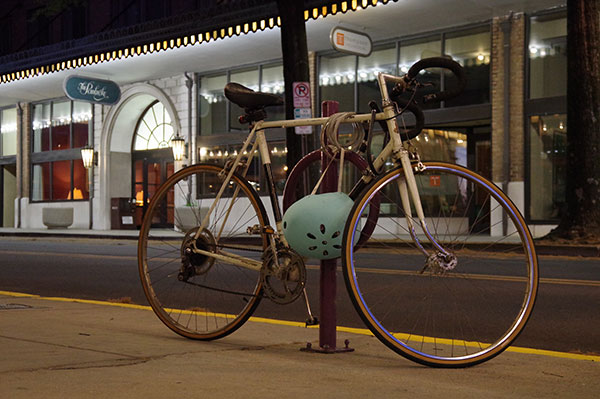
But while I would recommend staying as low down the sensitivity range as possible just as with any camera, I have to say I that I'm coming away from my review very impressed with the KP's low-light capabilities. Especially in concert with some brighter glass like the 31mm f/1.8 Limited, the ultra-compact 40mm f/2.8 Limited or 43mm f/1.9 Limited, and the affordable 50mm f/1.4, the Pentax KP makes for a great available-light street shooter, allowing you to capture sharp images handheld long after the sun has gone down.
Of course, if you've got a tripod handy and your subject is relatively static -- or you don't mind some motion blurring and light trails -- then you'll get much lower noise from a long exposure. I shot some myself, and was very pleased with the results! You'll find exposures as long as eight seconds in the gallery, and I shot some as long as 20-30 seconds with great results too, although they didn't make the cut for inclusion in the gallery.
 31mm-equiv., 1/50 sec. @ f/4.0, ISO 6400
Coming to the end of the low-light shooting, there are a couple more points I'd like to address in the Pentax KP's user interface, one of which I meant to raise in my previous field test but am only now remembering to return to.
First of all, let's hit the one I noticed previously. Unlike the earlier K-3 and K-3 II, the Pentax KP no longer indicates a 1:1 ratio between image pixels and screen pixels. The K-3 and K-3 II called attention to this nicely with a "100%" indication on-screen alongside the playback zoom indication when you reached an 8.3x playback zoom, which on those cameras equated to 1:1 on-screen viewing. However, with the Pentax KP, there's not a 100% indication at any zoom level, so you're not quite sure when you've reached 1:1 viewing.
That's the bad news, and is perhaps something Ricoh could add back courtesy of a firmware update, if it hears calls from customers to do so. The good news is that in between long-exposure shots I was playing with the Night Vision display mode, and discovered that it pairs nicely with another feature. If you're not familiar with Night Vision mode, it turns the KP's entire LCD display red, a color that's intended to disturb your night vision as little as possible. (And that applies even to image review -- you'll see a monochromatic, red-toned representation of your images in playback mode, uness you first exit Night Vision mode.)
Night Vision and the Outdoor View function might not seem like they'd go hand in hand, as the latter sounds like it would be useful only under bright sunlight. It turns out, though, that you can dial in a negative Outdoor View adjustment for a much, much dimmer screen that, coupled with the all-red Night Vision mode, should have very little impact at all on your night vision.
This wasn't something I actually needed to use in my downtown shoot, because even in the dead of night, Knoxville doesn't really get dark enough for night vision to be a concern. But for astrophotography and the like, take that as a pro tip from me: Dial the Outdoor View brightness down as well as switching to Night Vision mode.
Another cool new feature of the Pentax KP is its electronic shutter function. This allows completely silent, vibration-free shooting at shutter speeds that are far, far faster than the mechanical shutter mechanism is capable of. Where the mechanical shutter offers everything from 1/6,000 to 30-second exposures plus a bulb position allowing exposures as long as 20 minutes, the Pentax KP's electronic shutter will provide a working range from 1/24,000 to 30 seconds.
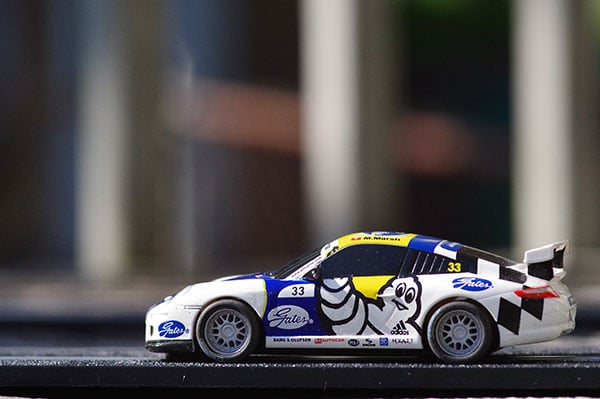
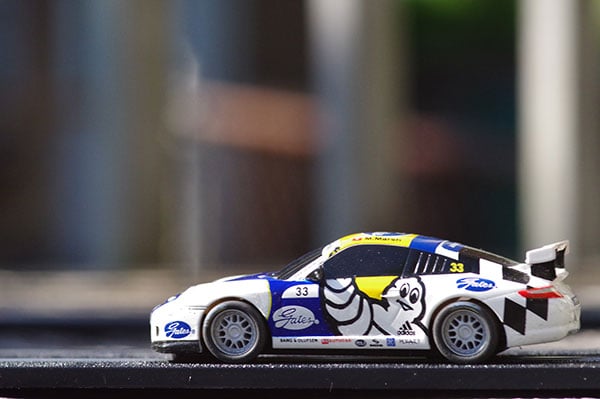
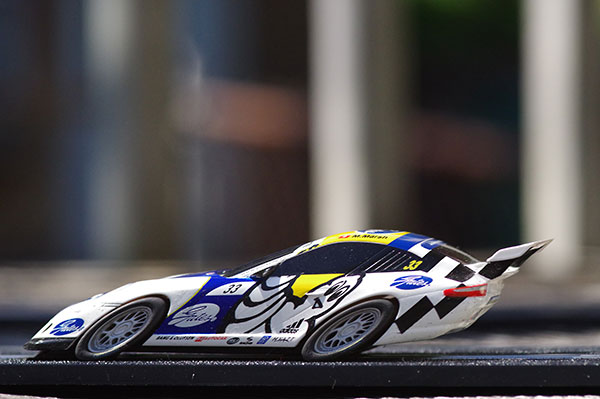
Of course, there are some tradeoffs to be made for this much faster shutter speed. First of all, shake reduction is disabled, meaning that your images won't be stabilized. Secondly, flash output is also disabled for exposures with electronic shutter. The third concern is likely the most significant, though, as it means that the electronic shutter function isn't well-suited to fast-moving subjects like sports.
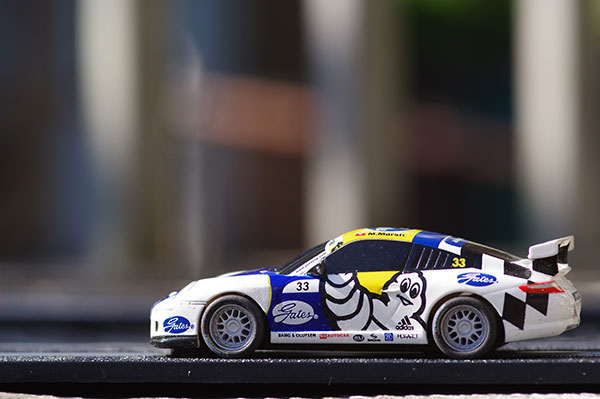
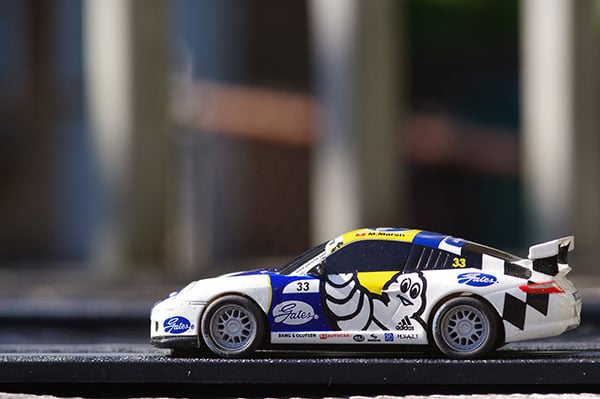
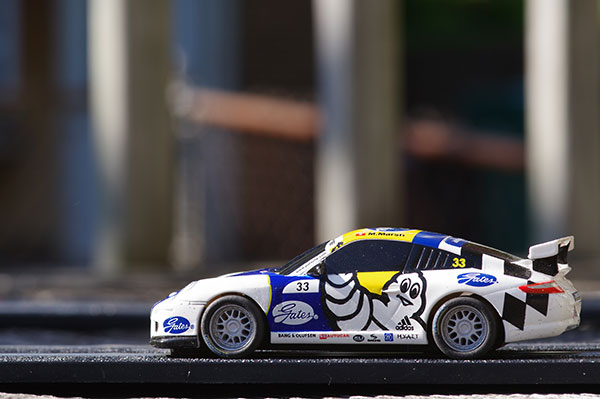
To test the severity of the rolling shutter with a reasonably consistent subject, I borrowed my son's Scalextric slot car set and assembled it outdoors under full sunlight, shorting out the controllers and instead controlling the speed by powering the track from a benchtop power supply, the voltage control adjusting the car's speed around the track.
And let's be clear here, this is a pretty extreme example, as even with the voltage turned down to somewhere around eight or nine volts, the slot car still took only around 1/10th of a second to traverse the entire image frame. (And to make matters worse, I couldn't use the top mechanical shutter speed of 1/6,000 second because there isn't a matching electronic shutter speed, so I had to drop back to 1/5,000 second.)
But as you can see from the adjacent sample images, showing the car captured at the same shutter speed at rest, with the mechanical shutter and with the electronic shutter, the latter is clearly prone to rolling shutter effect (often called jello effect), which is caused by the car's position changing during image capture and readout. It's worth remembering that even the mechanical shutter can exhibit the same effect because the shutter curtains take some time to traverse the image frame themselves, but they're much, much faster at doing so than is the mechanical shutter.
Where the car in the mechanical shutter image has only very slight distortion, most noticeable in the slightly elliptical rendering of the wheels, the one in the electronic shutter image is quite radically distorted. In the 1/5,000-second taken to capture the picture, the car moved forwards by almost 1/4 of its length as the image was read out from top to bottom.
So you won't be wanting to use electronic shutter for sports, at least unless skewed verticals are your intent for artistic reasons. But the function should nevertheless prove handy when you need absolute silence, vibration-free capture, you want to avoid wear and tear to the Pentax KP's mechanical components, or when you need a higher shutter speed than the mechanical shutter can provide so as to avoid having to stop down the aperture instead when shooting at base sensitivity.
Another couple of closely-related additions to the Pentax KP are its aperture and shutter speed-bracketing functions, which Ricoh refers to as "depth-of-field bracketing" and "motion bracketing" to give you a sense of each function's purpose. Each is available through the drive mode screen, but only when in the relevant aperture- or shutter-priority mode. You can select the aperture or shutter speed step size between frames in 1/3 or 1/2 EV increments, and then with one press of the shutter button, the camera will capture three frames, varying the appropriate exposure variable between each frame.
This is an excellent addition if you aren't sure what the best shutter speed or aperture for your subject will be, and want to experiment with a minimum of fuss. The only real downside is that you only get to choose when to trip the shutter for the first frame, as the following frames will be captured immediately at the Continuous High burst shooting rate, and you can't opt for single-frame capture instead.
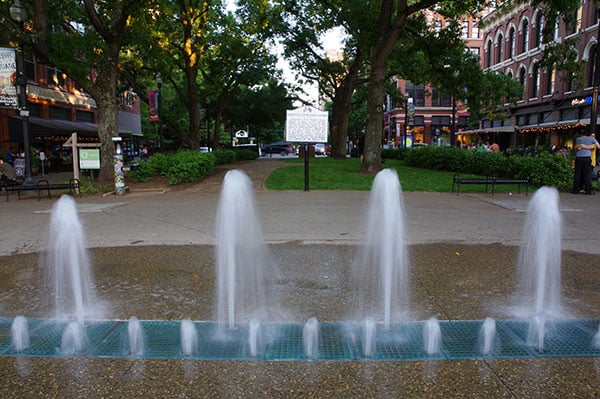
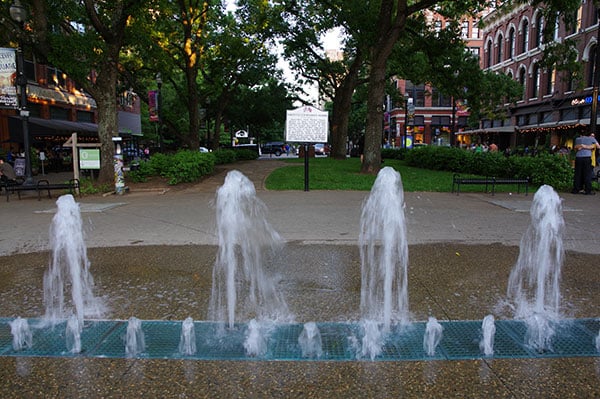
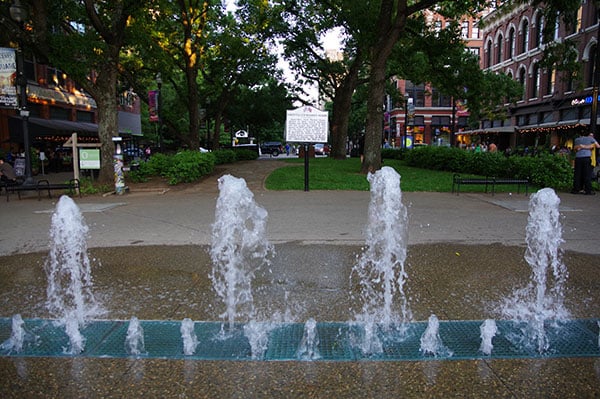
For portraits or other relatively static scenes that's usually fine, but if you want to time the moment at which you trip the shutter for each frame yourself to get the pose or framing you're after, it'd be nice if Ricoh would also provide the ability to trip the shutter for each of the three bracketed frames in a future firmware update.
Movies are still a bit of an afterthought for the Pentax KP
To date, Ricoh hasn't put quite the same emphasis on video capture that its rivals have, and the Pentax KP doesn't change that fact. Its movie capture functionality is quite similar to that of the K-3 and K-3 II, but with a few omissions and a couple of additions, one of which is of very limited value right now unless you happen to own the right lens to take advantage of it. (You probably don't, as the requisite lens hasn't yet been on sale for a full year.)
Daytime video, 1,920 x 1,080 pixels @ 60 fields per second (top) / 30 frames per second (bottom)
|
Although the Full HD frame rate options are identical in all three cameras, the Pentax KP offers only 50/60 frames per second capture at HD resolution, where the K-3 and K-3 II also allowed 24, 25 or 30 frames per second HD capture. There's also no headphone jack for audio levels monitoring, although there is an external microphone jack, and a levels control is provided. Manual and priority exposure control are also available, and ISO sensitivity control is also provided when in manual mode.
So what are the new features? Well, one is that the Pentax KP now has a built-in stereo microphone, rather than the monaural mics of the K-3 and K-3 II. The other relates to movie autofocus, something we saw recently (and to not-so-great effect) in our Pentax K-70 review. That camera had on-chip phase detection autofocus pixels, but despite that addition, its movie autofocus function was prone to visible hunting around the point of focus, and had an annoyingly frequent tendency to lose focus altogether and rack through the entire focus range trying to get it back.
Nighttime video, 1,920 x 1,080 pixels @ 60 fields per second (top) / 30 frames per second (bottom)
|
The Pentax KP lacks the on-chip phase-detection AF pixels, and relies instead on contrast detection autofocus. However, I can't tell you how well it performs. "Why's that?", I hear you asking. Well, when I first tried to autofocus during movie capture when shooting with the HD PENTAX DA 16-85mm f/3.5-5.6 ED DC WR lens mounted, I was immediately warned that autofocus wasn't available during movie capture.
That struck me as odd, as the 16-85mm has a fast and near-silent DC autofocus motor, so I turned to the manual only to find a note that movie AF is only available when "a compatible lens is attached to the camera." It took some digging, but I was eventually able to turn up the list of compatible lenses... or should I say lens.
Although it's missing from the English-language FAQ for the Pentax KP on Ricoh's global website, the Japanese-language version has a question which translates roughly as "Does autofocus work during movie capture?" And the answer, as in the manual, is that it does so long as a compatible lens is attached. But for this point, there's an asterisk calling your attention to a footnote, and therein, the answer: "Compatible lens: HD PENTAX - DA 55 - 300 mm F - 4.5 - 6.3 ED PLM WR RE".
So, unless you own that optic, it seems that you're out of luck for movie AF, something which is broadly available from rivals. I'm sure most Pentax KP owners will never even notice the function's absence for other optics, as were interchangeable-lens video a priority they'd likely have chosen another brand and camera in the first place. To make a long story very short, yes the Pentax KP can shoot good-quality videos, but for the most part you're going to need to pull focus manually or set up your shots so as to allow for fixed focus, and really you'll find the movie capture useful mostly for brief clips, switching to another camera if you want more capable video capture.
Closing thoughts on the Pentax KP
A weak video capture mode aside, I have to say that I've really enjoyed shooting with the Pentax KP. It's a very capable camera in an impressively compact package. With the best will in the world, an APS-C DSLR is never going to be quite as compact as a mirrorless camera, even one with a full-frame sensor.
But that's not really the point, as a mirrorless camera at this price point just isn't going to give you the connection to your subject that you'll get from a pentaprism-based, thru-the-lens optical viewfinder. I'd say the Pentax KP is plenty small enough to make a great travel camera, especially when paired with some of Ricoh's impressively compact, high-quality Pentax Limited lens lineup.
Honestly, the biggest argument against purchasing the Pentax KP is its sibling, the K-3 II. (As would be the closely-related K-3, were it still on the market.) Although in some respects -- and especially in terms of its high ISO performance -- the KP manages to best the K-3 series cameras, it's actually currently a more expensive model than the flagships, even though the KP itself isn't a flagship camera.
That's just an artifact of the K-3 II's age, however. It's coming to the end of its life on the marketplace, and so is being heavily discounted. It can be picked up new for just US$850 as of this writing, where the Pentax KP retails for US$1,100 because it's new and still selling at around list pricing. And that's not inconsequential: It's a big enough difference to score an entry-level lens or some accessories.

Were I in the market for a new camera today, I think personally I'd probably still opt for the K-3 II over the Pentax KP. If you're looking for an enthusiast-grade camera, you'd be wise to consider the same. But if you need the smallest possible camera body, do enough live view shooting to justify the extra cost for a tilting LCD, or really need the maximum image quality at higher sensitivities, the Pentax KP would make a very solid choice indeed!

By Mike Tomkins | Posted: 01/25/2017
To date, the smallest true DSLR we've reviewed has been the Canon SL1, a camera which is aimed at entry-level shooters rather than the more experienced photographers Ricoh is courting with the Pentax KP. Ricoh's new camera sports a body that's not a whole lot bigger than that of the Canon SL1. At 5.2 x 4.0 x 3.0 inches (W x H x D), it's barely 10-12% larger in each dimension, yet the Pentax KP packs in far more features than did the SL1. (And if anything, those dimension figures read as being misleadingly high. Much of the KP's body is far slimmer and less tall than the numbers suggest, with only the central mirror box portion of the camera occupying the full height and depth.)

The Pentax KP sports a feature-packed, weather-sealed mag-alloy body
The magnesium alloy-bodied Pentax KP has a glass pentaprism viewfinder with near-100% coverage, for example, where the Canon SL1 instead opted for a smaller, dimmer and less accurate pentamirror finder. The Pentax KP also boasts a twin-dial design with full dust, weather and freeze-proofing, a tilting LCD monitor, an uprated in-body shake reduction system and in-camera Wi-Fi -- all features that Canon's smallest DSLR lacked -- as well as plenty else besides.
Admittedly, the Pentax KP is also 50% heavier than was the Canon SL1 when loaded and ready to shoot, but without the lens. That's a difference which is pretty easy to understand, though, when one considers that Canon's beginner-friendly design lacked so many of the Pentax KP's features, and placed them inside a predominantly plastic body. The Pentax KP, by contrast, has magnesium-alloy panels at front, back and on the bottom, relying on polycarbonate only on its top deck.

So how has Ricoh been able to achieve this degree of miniaturization while retaining so many features, and how does the Pentax KP handle? Well to answer that second question first, the answer is very well -- surprisingly so given its compact size. The KP has been redesigned from the ground-up, with Ricoh rethinking the positions of controls and internal components to make best use of available space.
Externally, this is most noticeable in the change to a vertically-mounted front control dial, rather than the near-horizontal front dial of past models. I found this new dial to be quite comfortable in use, and it's paired with a new interchangeable hand-grip design, with a total of three grip options available. (Grips are exchanged by simply loosening a socket-head screw with a provided hex key.) At launch, Pentax will be including all three grips in the product bundle in the US market, although in other markets it's possible that some of the grips may instead be sold separately from the camera.

Tune the Pentax KP to your tastes with its clever interchangeable grips
In my hands-on time with the Pentax KP, I was able to try out the most compact of the trio, the Grip S (shown attached). Despite its relatively shallow profile and my larger-than-average hands, I felt this pairing was quite secure in my grip, and my fingers didn't really feel unnecessarily cramped. I'm definitely looking forward to trying out the medium and large-sized Grip M and Grip L, though, as for a slight increase in weight and grip depth, these look to provide even more purchase for a more secure hand-hold. While I've not yet gotten a chance to try these on the camera (the required hex key having gotten misplaced), I can say that each of these accessory grips felt sturdy, and had a good-sized piece of metal inset in their back surface to help ensure a tight, creak-free fit against the camera body.

Also new to the Pentax APS-C camera line is the Smart Function Dial which was introduced on the Pentax K-1. This clever control saves you delving through the menu system, keeping more than just the exposure basics handy for quick adjustments. Sadly, there's not space on the Pentax KP's top deck to include the Smart Function Dial alongside of an LCD info display, and so this model relies solely on its viewfinder and rear-deck 3.0-inch tilting LCD monitor to provide information on camera setup.

A brand-new sensor should give the Pentax KP spectacular high ISO performance
But enough of the body, what's new under the skin? Perhaps the most important change of the bunch is a brand-new APS-C sized 24-megapixel image sensor which we're told is an improved version of that featured previously in the Pentax K-70. This is said to bring with it improved high ISO noise performance, and according to Ricoh's reps, should allow the Pentax KP to come "very close" to the image quality of the full-frame Pentax K-1, even as high as ISO 51,200-equivalent. And that's nowhere near the upper limit of this camera's range, incidentally. The Pentax KP offers everything from ISO 100 to 819,200-equivalents, a truly staggering range for an APS-C sensor-based camera.
And as if that broad sensitivity range wasn't already enough to ensure blur-free shots in low-light shooting, the Pentax KP also debuts a newly-uprated, five-axis image stabilization system dubbed Shake Reduction II. (We've seen this SR II system previously in the full-frame Pentax K-1, but it's never been featured in an APS-C based camera body before now.) Ricoh's new SR II system corrects for pitch, yaw, roll, and both horizontal and vertical motion, and now has a claimed five-stop corrective strength to CIPA testing standards when using the smc PENTAX-DA 18-135mmF3.5-5.6ED AL [IF] DC WR lens at the telephoto position.

The uprated Shake Reduction II system includes automatic panning detection, and the sensor shift assembly which sits at its heart can also be used for a wide variety of purposes beyond image stabilization. Pentax's Pixel Shift Resolution function, for example, uses the SR II system to boost per-pixel resolution for relatively static scenes by capturing and combining several shots, while very precisely moving the sensor in between captures. The Pentax KP also retains the clever AA Filter Simulator function which recreates the moiré and false color-fighting effects of an optical low-pass filter by precisely moving the image sensor during exposure.
And like its predecessors, the Pentax KP can also automatically level horizons for you if you're holding the camera just slightly off-kilter, let you fine-tune your image composition when shooting with the camera mounted on a tripod, and even freeze star trails in long exposures, functions which are achieved using the same sensor shift mechanism that helps stabilize your shots at slower shutter speeds. (You'll need to pick up the optional O-GPS1 GPS receiver accessory if you want to use the star trail-freezing AstroTracer system though, as the camera itself lacks a built-in GPS receiver.)

Burst performance, while not manufacturer-rated as being quite as fast as the company's APS-C flagship Pentax K-3 and K-3 II -- which remain on sale alongside the KP which slots in underneath them in the lineup -- is still very generous. Ricoh rates the Pentax KP as capable of up to seven frames per second for as many as 28 full-resolution JPEG, eight raw or seven raw+JPEG frames. That's just a touch slower than the 8.3 fps manufacturer rating of the K-3 and K-3 II, although the much more abbreviated buffer of the Pentax KP will make these flagships the better option for sports shooters. (The K-3 and K-3 II are capable of 60 JPEG or 23 raw frames in a burst, double to triple the burst depth of the Pentax KP.)
The Pentax KP brings some worthwhile tweaks to autofocus and exposure
Exposure options are in most respects similar to the Pentax K-3 and K-3 II, with the Pentax KP using the same 27-point SAFOX 11 autofocus systems as in those cameras, complete with 25 cross-type points that are sensitive to detail on both horizontal and vertical axes. And the KP also retains the same 86,000 pixel RGB metering system as in its flagship siblings. However, there are some important differences.

Perhaps most significantly, Ricoh notes that it has improved its autofocus algorithms such that the Pentax KP should offer noticeably better AF performance and accuracy than past models using the same AF sensor. And while the Pentax KP has a fastest mechanical shutter speed of 1/6,000-second, not quite as swift as the 1/8,000-second shutter of the K3-series models, it also now sports an electronic shutter function which tops out at 1/24,000-second.
The Pentax KP also brings with it some new bracketing functionality not seen in past models. For example, Depth-of-Field bracketing allows you to bracket the camera's selected aperture value, while Motion Bracketing allows you to do much the same with shutter speeds.
Another piece of great news is that the Pentax KP will support remote tethered shooting using the company's optional Pentax Image Transmitter 2 software and its related Lightroom plugin. That's huge news, as until now the software has been reserved for Pentax's medium-format and full-frame DSLR models, with APS-C shooters having to rely on reverse-engineered third-party solutions for tethered shooting. We're thrilled to see Ricoh has decided to bring tethering back for subframe shooters, as it's something we've been asking about for years!

Available since February 25th, 2017, the Pentax KP is sold in the US market at a list price of around US$1,100 body-only. The D-BG7 battery grip is priced at around US$230, and will ship from May 2017 in the US market.
Performance
Timing and Performance
Mixed performance for its class.
| Startup/Play to Record | ||
|---|---|---|
| Power on |
~1.4 seconds
|
Time it takes for camera to turn on and take a shot. |
|
Play to Record, |
~0.2 second
|
Time until first shot is captured. |
The Pentax KP's power on to first shot time was slow for a DSLR, but switching from Play to Record and taking a shot was quite fast.
| Shutter Response (Lag Time), Optical Viewfinder | ||
|---|---|---|
|
Full Autofocus |
0.089 second
|
Time from fully pressing shutter button to image capture. (All AF timing measured with a Pentax 35mm f/2.8 lens). |
|
Full Autofocus |
0.396 second
|
Time from fully pressing shutter button to image capture, Auto Flash enabled. |
|
Manual focus |
0.083 second
|
For most cameras, shutter lag is less in manual focus than autofocus, but usually not as fast as when the camera is "pre-focused." |
|
Pre-focused |
0.083 second
|
Time to capture, after half-pressing and holding shutter button. |
| Shutter Response (Lag Time), Live View mode | ||
|
Pre-focused |
0.284 second
|
Time to capture, after half-pressing and holding shutter button. |
The Pentax KP's full autofocus shutter lag when shooting the same target multiple times was much faster than average for a prosumer DSLR when using the optical viewfinder. The KP required only 0.089 second for full AF using the center focus point with a Pentax 35mm f/2.8 lens. Enabling the built-in flash raised shutter lag to 0.396 second, reflecting the added delay caused by the metering preflash. Manual focus shutter lag was even faster than autofocus as expected, at 0.083 second. When prefocused, shutter lag remained at 0.083 second which is about average for a DSLR.
When prefocused in Live View mode, shutter lag was 0.284 second, which is not bad. We no longer test full AF lag in Live View mode, because contrast-detect AF speed tends to be very lens dependent for DSLRs.
To minimize the effect of different lens' focusing speed, we test AF-active shutter lag with the lens already set to the correct focal distance.
| Cycle Time (shot-to-shot) | ||
|---|---|---|
|
Single Shot mode |
< 0.3 second
|
Time per shot, averaged over a few frames (we no longer test for buffer depths in single-shot mode). |
|
Single Shot mode |
< 0.3 second
|
Time per shot, averaged over a few frames (we no longer test for buffer depths in single-shot mode). |
|
Early shutter |
No
|
Some cameras refuse to snap another shot if you release and press the shutter too quickly in Single Shot mode, making "No" the preferred answer. |
| Continuous H mode |
0.14 second
(7.10 fps); 35 frames total; 15 seconds to clear |
Time per shot, averaged over 35 frame buffer, then slows to an average of 0.19 second or 5.37 fps when buffer is full with a lot of variation. |
|
Continuous H mode |
0.14 second
(7.03 fps); 10 frames total; 15 seconds to clear |
Time per shot, averaged over 10 frame buffer, then slows to an average of 0.68 second or 1.47 fps when buffer is full with a lot of variation. |
|
Continuous H mode |
0.14 second
(7.07 fps); 8 frames total; 16 seconds to clear |
Time per shot, averaged over 8 frame buffer, then slows to an average of 1.08 seconds or 0.93 fps when buffer is full with a lot of variation. |
| Flash recycling |
1.4 seconds
|
Flash at maximum output. |
| *Note: Buffer clearing times measured with a SanDisk Extreme Pro 95MB/s UHS-I SDHC memory card. Slower cards will produce correspondingly slower clearing times. Slow cards may also limit length of bursts in continuous mode. ISO sensitivity and other settings such as highlight/shadow corrections or NR can also affect cycle times and burst mode performance. |
||
Single-shot cycle times were so fast that they were difficult to accurately measure as they depend on the tester's dexterity and ability to maintain an optimum rhythm, so your results may vary. (Note that we no longer test single-shot mode with just RAW files, as the results are usually somewhere in between JPEG and RAW+JPEG.)
Continuous H burst mode speeds were quite good at just over seven frames per second regardless of file type, easily meeting Pentax's spec. There is also a Continuous M mode rated at 3.0 fps and an L mode rated at 0.8 fps, but we did not test those speeds.
Buffer depth in Continuous H mode was fair when shooting just JPEGs at 35 Large Best Quality JPEG frames before the camera slowed, though with RAW (.DNG) files buffer depths were much shallower at 10 RAW frames or 8 RAW+L/B JPEG frames. While these buffer depth results exceed Pentax's specs for the KP, such shallow buffers when shooting RAW files is rather disappointing for an APS-C DSLR with a list price of about US$1,100 these days.
Buffer clearing was a bit sluggish even with our fast UHS-I SDHC card, taking 15 seconds to clear after a max-length burst of JPEGs or RAW files and 16 seconds after a max-length RAW+JPEG burst. The Pentax KP does however let you change settings, take additional shots or view just-shot photos while the buffer is clearing.
The KP's built-in flash took an average of 1.4 seconds to recharge after full-power shots, which is very fast.
Bottom line, the Pentax KP's performance was mixed for its class, ranging from very fast for autofocus speeds, cycle times, burst speeds and flash recycling to slow startup time, shallow RAW buffer depths and sluggish buffer clearing times.
Battery
Battery Life
Poor battery life for a DSLR.
| Operating Mode | Number of Shots |
|---|---|
|
Optical Viewfinder,
(CIPA standard) |
390
|
The Pentax KP uses a custom rechargeable D-LI109 lithium-ion battery for power, and ships with a dedicated charger. Battery life when using the optical viewfinder is well below average for a DSLR, and Pentax does not specify battery life for Live View mode, which will certainly be a lot lower. We strongly recommend you pick up a spare battery and keep it freshly charged and on-hand for extended outings.
The table above shows the number of shots the camera is capable of (on either a fresh set of disposable batteries or a fully-charged rechargeable battery as appropriate), based on CIPA battery-life and/or manufacturer standard test conditions.
(Interested readers can find an English translation of the CIPA DC-002 standards document here. (180K PDF document))
Field Test Part I
Field Test Part II
Compact, capable and customizable: Ricoh's alternative to mirrorless gets a real-world test!
By Mike Tomkins | Posted: 04/14/2017

Regular readers will know that I've long been a fan of Ricoh's Pentax DSLR lineup. In fact, when I don't have anything in hand to review -- admittedly, a somewhat rare occurrence -- and I want to shoot an interchangeable-lens camera, it's usually my own Pentax K-5 or K-3 II that I'll reach for, and I've been a K-series shooter for close to a decade now, all the way back to 2009's Pentax K-7. So when the Pentax KP arrived at Imaging Resource headquarters, there was no question who'd be handling the real-world portion of our testing!
I've been eagerly looking forward to reviewing the Pentax KP ever since I first had the chance to handle a pre-production camera early this year. In particular, I've found myself intrigued by its clever interchangeable handgrip design, which is one of the key factors behind the KP's compact size, by DSLR standards. I've also been keen to try out its high ISO capabilities, as well as its evolution of the Smart Function dial first seen in the K-1. And of course I've also been looking forward to trying out its uprated stabilization, autofocus and exposure options. And I'm thrilled with its new tethering capabilities, something I've been asking the company for over the course of more than a few reviews.
How the Pentax KP compares to its siblings
But before we get to all of that, let's start with a quick look at where the Pentax KP sits in the company's lineup. If you're not familiar with the Pentax brand, that can be a little less than obvious.
Looking at Ricoh's current lineup, probably the nearest models to the KP in terms of capabilities are the Pentax K-3 II and Pentax K-70, both of which I've previously reviewed. The K-3 II is technically the flagship sub-frame Pentax DSLR, although it's now rather long-in-the-tooth. It's fast approaching its second birthday, and the basic design is almost 3.5 years old, as it's a relatively modest update of the preceding Pentax K-3. The K-70, meanwhile, has been on the market for less than a year as of this writing (April 2017), but is aimed more at affordability than is the Pentax KP.
So what do you gain or lose over those cameras by opting for the Pentax KP? Let's find out! (If you want a little more detail than you'll find in the summaries below, click the links to see a more in-depth comparison against either model.)
Pentax KP vs. Pentax K-3 II
Compared to the flagship K-3 II, there are a fair few significant enthusiast or pro-friendly features that the KP lacks. The K-3 II sports an in-camera GPS receiver for geotagging photos, as well as dual SD card slots for redundancy or better organisation, a somewhat higher burst capture rate with a much deeper buffer, a slightly larger and higher-res (and subjectively, brighter and richer) rear-deck LCD, a top-deck LCD info display for quick confirmation of basic setup, and more connectivity options including an HDMI video output and a headphone jack for levels monitoring. And yet because of its age, the K-3 II now lists for around US$100 less than does the KP, which is a spectacular deal if you don't need to be on the cutting edge.
But the Pentax KP bests the earlier model in several ways too, with a much higher maximum sensitivity despite the same resolution and sensor size, as well as a tilting LCD monitor instead of a fixed-position one, a built-in flash (something the K-3 II dropped from the earlier K-3 to make room for its GPS receiver), and built-in Wi-Fi connectivity instead of the somewhat clumsy Eye-Fi or FluCard-based Wi-Fi connectivity that was optional on the K-3 II. The Pentax KP also adds a swift 1/24,000-second electronic shutter (but the K-3 II's mechnical shutter is faster than that of the KP), and it's said to have better stabilization and autofocus than the flagship model, to boot. It also adds exposure features like such as depth-of-field or motion bracketing.
Pentax KP vs. Pentax K-70
In a head-to-head comparison with the K-70, meanwhile, the Pentax KP fares rather better. The newer camera shoots images a bit faster than its mid-range sibling, has more sophisticated autofocus and (especially) metering systems, an uprated stabilization system, a much higher maximum sensitivity and a speedy electronic shutter option. It's also significantly lighter when loaded and ready to shoot, offers interchangeable handgrip options and an available portrait / battery grip, and has more exposure options including depth-of-field and motion bracketing.
But the K-70 still manages to best its higher-priced sibling in some respects. For example, it sports a more versatile side-mounted tilt/swivel display instead of the Pentax KP's tilt-only screen, adds on-chip phase-detection AF pixels for live view and movie shooting (although we didn't find movie AF on the K-70 to be terribly usable regardless), and also sports an HDMI port for high-definition video output. Its JPEG-mode buffer depth is also rather greater, although that's likely in part due to its slower capture rate. And of course, it's also quite a bit more affordable.
But enough of the on-paper spec comparisons, how does the Pentax KP handle in the real world? On taking the Pentax KP out for some real-world shooting, I have to say the answer is pretty darned well. It's surprisingly comfortable to shoot with, especially when paired with smaller, lighter optics like the excellent Pentax Limited prime lens lineup, even when shooting single-handed.
With somewhat larger optics like the 18-135mm travel zoom, I definitely preferred to shoot two-handed for better stability, but still found it perfectly comfortable to do so. The unusual vertically-mounted front dial might not look like the most ergonomic idea ever, but it's actually pretty easy to reach. And while it's not quite as comfortable as the more traditional front dial of the K-3 II, it's doubtless a contributor to the Pentax KP's much slimmer body.
For my review, I had all three handgrips available to me, and although I didn't have access to the optional portrait / battery grip with which the largest of the handgrip options is supposed to pair best, I gave all three a try. Of the trio, I found the mid-sized grip to be the most comfortable for my larger-than-average hands, its ergonomic counters allowing my middle finger to wrap around comfortably beneath the front control dial.
The smallest grip option was also perfectly comfortable with smaller lenses like the Limited primes, but with my larger hands I felt that it didn't give me as much purchase on the camera body, leading me to grip the camera tighter instead. For smaller hands, though, this might be the best option of the bunch.

Finally, the largest of the three grips was, for my money, the least comfortable because it lacks the mid-sized grip's contouring for your middle finger. In fairness, though, I didn't get to try this bundled front handgrip with the Pentax KP's optional portrait / battery grip accessory, with which it's really supposed to be paired. And its generous depth certainly gave it the most secure handhold of the trio.
With its smaller-than-typical body for a DSLR, the Pentax KP debuts a new control layout compared to past models. There are almost as many physical controls as there are on the K-3 II -- 24 for the Pentax KP, vs. 27 for the earlier flagship model, not counting the lens mount release button -- but the KP aims to make up for its slightly lesser selection of physical controls through the use of a Smart Function dial similar to that seen first on the full-frame Pentax K-1.
However, where the K-1 almost overloaded us with no less than nine different preset functions for this top-mounted control, the Pentax KP simplifies things by providing three preset functions, and a further three programmable functions. The presets are for exposure metering, HDR capture and continuous burst shooting speed, options which struck me as sensible to make easier to access.
And by default, these are joined by Custom Image mode, AA filter simulation and Outdoor View controls on the custom positions, which again seem to eminently sensible choices. If there's something else you'd prefer to control with the dial, though, there are a total of 15 different functions which can be assigned to these custom positions. And as in the K-1, there's also a Disable position on the dial to prevent accidental function changes if you turn the adjacent Set dial by mistake.
And as for the remainder of the control layout, I found everything positioned pretty well, and with good button feel. I definitely liked the new Live View / Movie lever, which sits under the Smart Function dial, as it's a little easier to use by touch than the equivalent control on the K-3 II, and the combined AE-L / AF button is also rather easier to reach than is the corner-mounted, dedicated AE-L button of the earlier flagship camera.
But I did miss the ability to temporarily disable the locking mechanism for the Mode dial, one of my favorite features of the K-3 II, since it prevents accidental mode changes most of the time, but lets me jump back and forth between modes more quickly and easily should the need arise. And I personally preferred the dedicated top-deck ISO button and decoupled AE-L / AF buttons of the K-3 II. Given the Pentax KP's much slimmer body though, that's pretty easy to overlook if wanting to travel light.
And it's worth noting that the Raw/FX, horizon correction and exposure compensation buttons are all programmable, so if like me you want to see a dedicated control for ISO sensitivity rather than simply placing it as a secondary function of the four-way controller's Up button where it's harder to locate by feel, well... you can fix that. And I have to say that I thought it was rather cool to see the horizon correction function surfaced on its own control. In the past, I've tended to leave this on all of the time, but now it's much quicker and easier to enable or disable on the fly by default.

Among the features Ricoh called particular attention to when unveiling the Pentax KP was its autofocus system. It's based around the same 27-point SAFOX 11 autofocus system as used in the flagship K-3 II, and it offers up a generous 25 cross-type AF points that are sensitive to detail on both the horizontal and vertical axes. (Basically, there's a five-by-five grid of cross-type AF points at frame center, with a single linear AF point to the left and right of this main array.)
As in past models, I found the Pentax KP to have swift and confident autofocus that was able to achieve an accurate focus lock on the first attempt the overwhelming majority of the time, even in surprisingly low light. If I was able to see my subject through the viewfinder well enough to accurately frame it, the camera was usually able to focus on it too, even if I'd have struggled to do so manually without switching to live view mode.) Continuous autofocus performance isn't quite up to the best from Canon and Nikon at this price point, but it's pretty close, and should satisfy most users, I'd say.

But as for that autofocus improvement, which was said to have been achieved in software through updated algorithms... Well, I struggled to notice any difference, if I'm honest. Even shooting the Pentax KP and K-3 II side-by-side with the same lens model on both cameras, I really didn't think there was a significant difference in AF speed or accuracy, with both cameras managing about equally well.
I should note, though, that it's quite possible that the K-3 II itself has already achieved the same improvements in firmware updates issued since its release, given that the improvements apparently don't involve hardware tweaks. If so, I wouldn't have expected to notice a difference. Either way, I think the Pentax KP does pretty well in this area.
The Pentax KP also shares its 86,000-pixel RGB metering sensor with the K-3 II, while the K-70 relies on a much coarser-grained 77-segment metering system. I found that exposures were metered pretty accurately most of the time, with perhaps a slightly greater tendency to overexpose than the K-3 II, but only by perhaps 1/3 to 2/3 EV. (And I was frequently shooting under late afternoon sunlight with a mixture of bright skies and partly-shaded subjects, conditions under which many cameras would've faced similar issues.)
In terms of performance, the Pentax KP sits nicely in between the K-3 II and K-70. Its burst capture rate tested at around 7.0-7.1 frames per second which is right on the money for Ricoh's claimed performance, just a tad slower than the K-3 II's 8.1-8.2 fps, but equally a tad ahead of the K-70's 6.1 fps. Depending upon the file format, though, buffer sizes were about 1/2 to 2/3 less than for the K-3 II, and the KP actually trailed the K-70 a little in JPEG mode as well. (Although in fairness, it was shooting more images than that camera in any given timeframe.)
If you're a sports shooter -- and especially if you shoot raw files -- I'd recommend looking to the K-3 II instead because of this. The limited buffer size is not ideal if you're needing to keep up with the action, or you're a fan of the spray-and-pray approach. But for most other purposes, or for lighter sports fare like the kids' football games or something along those lines, the KP should offer plenty of performance and seldom keep you waiting. Buffer clearing times are still a weak spot as is usually the case for Pentax DSLRs, but that's less of a concern since you can change settings and keep shooting without first having to wait for the buffer to clear entirely as in some cameras.
Thus far, my shooting with the Pentax KP has predominantly been in the daytime with good lighting, so my verdict on high sensitivity capture is still to come in my second Field Test. However, thus far I'm really liking what I'm seeing from the Pentax KP. With a sharp lens mounted on the camera, it delivers clean, attractive images with loads of detail, and if your subject is amenable to a multi-shot approach, its Pixel Shift Resolution function can deliver even more fine detail straight out of the camera.

Colors are pretty lifelike, too, if perhaps a little on the consumer-friendly (read: oversaturated) side by default. (Pro tip from a long-time Pentaxian: If you want more realistic color straight out of the camera, then try changing the custom image mode to "natural".) And I thought the white balance system did a great job almost all of the time, with no untoward color casts and keeping hold of just enough golden hour warmth without going overboard.
Of course, before I can render a final verdict, I'll want to do some high ISO / low light / long exposure shooting, something I've not yet finished with. You can expect to hear more on this front, as well as a look at the new electronic shutter function, bracketing functions and the Pentax KP's movie capture capabilities. Watch this space for my second field test, coming soon!

Technical Info
by Mike Tomkins
Posted: 01/26/2017
At the heart of the Pentax KP is a brand-new image sensor based on that featured previously in the Pentax K-70. It's a 24.32-megapixel CMOS image sensor with a Bayer RGBG color filter array. Dimensions are 23.5 x 15.6mm, and total resolution is 24.96 megapixels. Maximum image size is 6,016 x 4,000 pixels.
Note that both the total and effective resolution counts are just slightly higher than their K-70 counterparts, although the output image resolution is unchanged. We're speculating here, but our guess is that the difference comes down to one feature subtraction from the K-70: The Pentax KP forgoes that camera's on-chip phase-detection autofocus pixels, meaning that it relies solely on contrast-detection autofocus during live view or movie shooting. Freeing up those pixels for imaging instead of phase-detect AF likely answers why the pixel counts have increased, however.
Like all of the company's recent DSLR cameras, the Pentax KP doesn't include an optical low-pass filter. It does, however, feature an on-demand mechanical antialiasing function. More on that in a moment. (Or read Dave Etchells' "Geek's Guide to On-Demand Low-Pass Filtering" from our Pentax K-3 review for the full story; the feature is unchanged from that camera with the exception of the added ability to bracket the AA Filter Simulation function.)
The Pentax KP is the company's first APS-C sensor-based camera to include its latest-generation PRIME IV image processor, which was previously featured only in the full-frame Pentax K-1. (The "PRIME" in the name is a contraction of "Pentax Real IMage Engine", if you're curious.)
Ricoh hasn't stated what performance gains or other tweaks are to be found in the newer variant of the processor, and nor can any obvious conclusions be drawn from the camera's burst-capture performance. It seems pretty logical to presume that PRIME IV offers more performance and likely contains updated algorithms, versus its predecessor, though.
The Pentax KP takes the crown from the earlier K-70 when it comes to its sensitivity range, and offers far in excess of that provided by the flagship K-3 and K-3 II cameras.
The Pentax K-3 and K-3 II weren't exactly slouches themselves, with an overall sensitivity range of ISO 100 to 51,200 equivalents, while the K-70 offered everything from ISO 100 to 102,400-equivalent. The Pentax KP stands head and shoulders above the crowd, though, with its ability to provide a truly spectacular range from ISO 100 to 819,200-equivalents. The entire range is available without needing to enable ISO expansion as in some competing cameras, and step sizes of 1/3, 1/2, or 1EV are available.
There's also an Auto ISO sensitivity function with configurable upper and lower limits. And as in past cameras, you can configure the Pentax KP to raise sensitivity more or less quickly than the default.
In many respects, the Pentax KP matches or bests its flagship siblings, the K-3 and K-3 II. In the burst shooting department, though, those cameras are still the better option, especially if you have a tendency towards longer bursts.
Ricoh rates the Pentax KP as capable of around 7.0 full-resolution frames per second, which is just a touch behind the 8.3 fps ratings of the K-3 and K-3 II. Burst depth for the KP at its maximum speed is around 28 JPEG, eight raw or seven raw+JPEG frames, quite some distance from the 60 JPEG or 23 raw frame burst depth of the K-3 and K-3 II.
There are two reduced-speed burst shooting rates available: either 3.0 or 0.8 fps. That will prove helpful in situations where you don't need the full 7.0 fps, but you're still shooting faster than you'd want to by rapidly pressing the shutter button. (Although we'd still like to see the ability to manually dial in your own chosen speed for reduced-rate capture.)
As you'd expect, the lower-speed burst modes have even greater burst depths. At 3.0 frames per second, Ricoh claims a depth of 70 JPEG 15 raw or 10 raw+JPEG images. Drop the speed to 0.8 fps, and the company predicts a depth of 100 JPEG, 100 raw or 25 raw+JPEG frames.
If burst performance isn't the be-all and end-all for you, though, then there are plenty of reasons to consider the Pentax KP over its flagship siblings. One of these is image stabilization, with the KP being the first sub-frame Pentax DSLR to include Ricoh's newer Shake Reduction II technology, as seen previously in the full-frame Pentax K-1.
Where the K-3 and K-3 II used a three-axis Shake Reduction stabilization system, the Pentax KP sports a more sophisticated five-axis system which can correct for vertical and horizontal motion, yaw, pitch and roll. It also has a higher corrective strength of five stops to CIPA testing standards, where the K-3 had a 3.5-stop range and the K-3 II a 4.5-stop range.
Like the Pentax K-3 II before it, the Pentax KP includes a panning detection function, which determines that you're panning to follow a moving subject and then automatically ceases its attempt to stabilize motion on that axis, but still stabilizes the other axes. This will prove handy for the most typical panning motion in most sports.
The Shake Reduction system is also used for various functions such as Pixel Shift Resolution, AA Filter Simulation, AstroTracer, Horizon Correction and Composition Correction, all of which we'll come back to in a minute.
The Pentax KP's KAF2 lens mount is a variant of the K-mount that has been used in all Pentax digital SLRs to date, as well as the K-01 mirrorless camera.
In all, there are 40 Pentax K-mount lens models currently on the market, ignoring converters and adapters, variants of existing lenses such as DA-L vs. DA (plastic vs. metal mount), WR vs. non-WR (weather sealed vs. non-weather sealed), and HD vs. non-HD (newer versus older anti-flare coatings). Of these 40, all but five are DA, DA*, DA Limited or D FA-lenses, with the D in their names indicating that they were designed specifically for use on digital cameras rather than film.
And of course, as well as these 40 current optics, you can use older Pentax K-mount glass (some with restrictions), as well as the company's historic 35mm screwmount and 645/67 medium format lenses with an adapter (and again, with restrictions.) You can also mount a wide selection of third-party K-mount lenses from the likes of Sigma, Tamron, and more, and optics from a healthy variety of other mounts with adapters (and limitations).
If you regularly change lenses -- or use consumer-grade glass that sucks air in and blows it back out every time you rack the focus or zoom -- you can expect dust to get inside your camera sooner or later. (Most likely, sooner.)
Ricoh has retained the same DR II dust removal system used in its recent flagship models for the new Pentax KP. It uses a piezoelectric element that vibrates at higher frequencies than a sensor shift system can, and in our experience systems like these typically do a better job of shaking free dust that's stuck to the sensor's protective cover glass.
Also unchanged from other recent Ricoh DSLRs is the Pentax KP's lens correction functionality. This can correct for lens distortion, lateral chromatic aberration, vignetting and diffraction in-camera when using DA, DA-L and D-FA lenses, as well as with most FA lenses.
The Pentax KP retains the same 86,000 pixel RGB CCD metering sensor which debuted in the K-3, replacing the earlier 77-segment metering sensor of models going all the way back to the K-7 in 2009. If you have one of those earlier cameras and are considering an upgrade, this new sensor should allow for much more precise metering measurements. And since it's an RGB chip, it can also recognize color information, allowing it to help out with subject identification.
The KP's metering system has a wide working range of -3 to 20 EV with a 50mm f/1.4 lens at ISO 100. Metering modes on offer include Multi-segment, Center-weighted and Spot, and an exposure lock function is available, accessed with the AE-L button at the top right corner of the camera's rear. You can also specify up to +/-5EV of exposure compensation, or bracket 2, 3, or 5 exposures with up to 2EV between exposures. For either compensation or bracketing, you can specify your adjustment in 1/3 or 1/2 EV steps.
At first glance, the Pentax KP's SAFOX 11 autofocus system would appear to be identical to that of the K-3 and K-3 II. However, Ricoh tells us that it has upgraded its autofocus algorithms, and that the Pentax KP should now offer noticeably better AF performance and accuracy than in past models using the SAFOX 11 sensor.
In total, the Pentax KP provides 27 autofocus points, of which the 25 central points in a 5x5 array are all cross-types, sensitive to detail in both the horizontal and vertical axes. Only two points, located in the vertical center at far left and right of the array, are linear points sensitive on just one axis. The centermost sensor as well as the points directly above and below it are precision points, capable of focusing with an f/2.8 aperture. The autofocus sensor has a working range of -3 to +18EV at ISO 100.
Autofocus mode choices include AF.S (single-servo), AF.C (continuous-servo), and automatic selection (AF.A). You can also switch from the default 27-point auto selection, with provision for Spot, Select, small / medium / large expanded area or zone-select modes. For single-servo autofocus, Select allows only a single point to be chosen, rather than the fixed center point of Spot AF. Zone Select is similar, but allows a nine-point area to be selected, with the camera making the final determination of which points to use. Finally, Expanded Area works only in continuous-servo mode, and allows you to select a 3x3 array, a 5x5 array, or the entire AF array. Focus starts from the center point, but will be tracked anywhere within your selected array.
Ricoh has included an autofocus hold setting for use in tracking, which will let you control how quickly the camera will react to a radical change in detected subject distance, such as you might get when shooting through a fence, or if somebody walked between camera and subject. You have four options: either the change will be near-instant with Hold AF Status set to off, or you can choose one of three durations (Low, Medium or High) after which the change in focus will be made.
You can also define whether a focus lock or a full shutter button press should be of greater importance to the Pentax KP. In single-servo mode, you can configure the camera in focus priority mode, such that it will wait to trip the shutter until a focus lock is achieved, or shutter priority mode to take the image as soon as you fully press the shutter button. In continuous or AF.A modes, you can opt for focus priority or frame rate priority, which takes another photo as soon as the shutter has recycled and there is available buffer space to do so. You can also select a different option for the first frame in an AF.C burst, for example to require a focus lock on the first frame and then switch to frame rate priority for subsequent frames.
Of course, you can focus manually as well, and if you shoot in live view mode, there's a focus peaking display to help you ascertain the exact point of focus. You have a choice of highlight edge or extract edge modes when using focus peaking.
A built-in, popup flash strobe is included in the Pentax KP's design, as is a hot shoe for external strobes. Flash sync is at 1/180 second, and flash exposure compensation is within a -2 to +1EV range.
The built-in flash has a guide number of six meters at ISO 100, and has coverage sufficient for a 28mm-equivalent lens. Flash modes include auto, on, slow-sync, second-curtain sync, manual and wireless. The built-in flash can act as a controller for remote strobes using this last option.
The standard hot shoe on the top deck includes both support for a locking pin, and intelligent connections that allow for Pentax's P-TTL flash metering system. Unlike in the K-3 and K-3 II, there's no PC sync socket, though, so you'll have to buy a hot shoe to PC terminal adapter if you want to hook up your studio strobes.
The Pentax KP shares the exact same viewfinder design used in all of the company's flagship models from the K-7 until the K-3 II, as well as more than a few of its mid-range and even entry-level cameras. It's pentaprism-based and has a manufacturer-rated 100% coverage. Magnification is said to be 0.95x, and the viewfinder accepts interchangeable focusing screens. The bundled screen is a Natural-Bright-Matte III type. Also unchanged is the dioptric adjustment range of -2.5 to +1.5m-1.
The Pentax KP's rear-panel LCD monitor is identical to that in the K-70, although the manner in which it is articulated differs. It has a 3.0-inch diagonal, a 3:2 aspect ratio, and a total dot count of around 921,000 dots. And helping it to combat glare and low contrast, the monitor has a gapless design overlaid with a tempered glass front panel.
Where the K-70 and K-S2 used a side-mounted tilt/swivel mechanism, though, the Pentax KP opts instead for a vertically-tilting design. The precise tilting range isn't stated in Ricoh's press materials, but looking at the mechanism, it appears to offer just a little more than a 90-degree upwards tilt, and around a 45-degree downwards tilt. Extensive selfie shooters may want to consider the K-70 or K-S2 instead, though, as those cameras' side-mounted tilt/swivel allow for viewing from in front of the lens, which the KP's articulation mechanism doesn't do.
The KP offers all of the main exposure modes you'd expect to find in a Pentax DSLR. As well as fully Automatic exposure, Program (with program shift), Shutter priority (Tv), Aperture priority (Av), Manual, and Bulb, there are a couple of Pentax exclusives: Sensitivity priority (Sv), and Shutter-and-Aperture priority (TAv). In these latter two modes, you can either dial in a sensitivity and let the camera select aperture and shutter speed, or dial in the aperture and shutter speed, then let the camera select the sensitivity. There are also no less than five separate User modes (U1, U2, U3, U4 and U5), allowing you to quickly recall settings groups you'd saved for particular shooting situations.
And you can opt for various program lines when using automatic or semi-automatic exposure. As well as the default program line, you can bias the camera in favor of higher shutter speeds, a shallow or deep depth of field, or towards the MTF sweet spot of the lens. Alternatively, you can let the camera choose between these program lines on your behalf.
Drive mode options in the Pentax KP include single, continuous (high [7 fps], medium [3 fps], or low [0.8 fps]), self-timer (two or 12 second plus continuous), exposure bracketing, aperture bracketing, shutter bracketing, mirror lockup, multiple exposure, interval shooting, interval composite, interval movie record and star stream. The bracketing mode allows 2, 3, or 5 shots; we don't yet know what the maximum step size between exposures is.
The Pentax KP's mechanical shutter speed range is a little more abbreviated than that of recent flagships. The shutter mechanism itself has a rated lifetime of 100,000 cycles (half that of the K-3 series cameras), and is pretty quiet for an APS-C DSLR. Available shutter speeds range from 1/6,000 to 30 seconds in 1/3 or 1/2 EV steps, plus bulb / timed exposure. Enabling the electronic shutter extends this range to encompass everything from 1/24,000 to 30 seconds, and timed exposures are possible within a range from 10 seconds to 20 minutes.
The Pentax KP offers all the white balance choices you'd expect in a Ricoh DSLR, including the clever Multi Auto WB mode, which aims to neutralize color casts from multiple different light sources in the same scene. As well as Automatic and Manual modes, the KP provides nine white balance presets (Daylight, Shade, Cloudy, Daylight Color Fluorescent, Daylight White Fluorescent, Cool White Fluorescent, Warm White Fluorescent, Tungsten, and Color Temperature Enhancement). This last option is used to retain and enhance the lighting tone -- for example, to enhance a sunset.
White balance can also be measured from a neutral target, or a specific color temperature can be dialed in manually. Three custom white balance values of each type can be stored in-camera. And finally, you can adjust white balance within a +/- 7-step range on both amber-blue and green-magenta axes.
For a mid-range DSLR, the Pentax KP offers up a huge wealth of creative options.
HDR mode captures multiple images, then microaligns them in camera and blends them to create a single image with greater dynamic range. You have a choice of automatic blending, one of three effect strengths, or Advanced HDR mode. These range from fairly natural to a bolder, crunchier feel. (And since the images are microaligned, the mode can be used handheld.)
Multiple exposure mode also creates a single image from multiple exposures. There are three methods of merging the source images: additive, average or bright mode. The first two are self-explanatory, while the third takes the brightest pixel at any given location in the source images, and uses that in the final image. You can merge up to 2,000 frames, allowing for some pretty cool effects.
There's also a time-lapse function, which allows shots at 2-second to 24-hour intervals. Again, you can capture as many as 2,000 shots in a series. Here, you have a choice of saving each image separately, combining them all into a single composite image, or saving them as a 4K, Full HD or HD movie. For movie capture, you can also choose whether or not you want star trails in the clip.
Custom image and digital filter effects in the Pentax KP are unchanged from other recent models. Custom image modes include Bright, Natural, Portrait, Landscape, Vibrant, Radiant, Muted, Flat, Bleach Bypass, Reversal Film, Monochrome and Cross Processing. Digital filters include Extract Color, Replace Color, Toy Camera, Retro, High Contrast, Shading, Invert Color, Unicolor Bold and Bold Monochrome.
You can also enable a Cross Process function, which can either adjust its effect automatically and randomly, or you can choose from one of three presets, or one of three favorite Cross Process effects that you've previously saved.
Ricoh has also provided a +/- four-step clarity control, and an optional skin tone correction function with two operating modes.
Like all of the company's recent DSLRs, the Pentax KP can optionally embed copyright data into its raw and JPEG image files. You can enter both a photographer and copyright holder name from the camera body, and the headers of images will be tagged with both. It's not a permanent tag, and so you can't rely on it to protect your images from copyright theft, but it does make it so that you can easily identify who shot a particular image in your library.
The Pentax KP includes a dual-axis level gauge function. This detects both side-to-side roll, and front-to-back pitch. Roll is displayed in the viewfinder, and on the rear-panel LCD monitor. Pitch can be displayed only on the LCD.
Ricoh's Pixel Shift Resolution function, which is achieved using the sensor-shift mechanism that's also used for image stabilization, was huge news when it first hit the scene with the Pentax K-3 II. It's been around for a while now, but it's still a huge boon for still-life shooters and anybody else with static subjects. We've covered the function in quite some detail on our news page in the past, and with that being the case, we'll just give you the nutshell overview here.
Pixel Shift Resolution has some similarities to -- and some key differences from -- the High Res Mode introduced by Olympus in the OM-D E-M5 II compact system camera. Like that system, Ricoh's Pixel Shift Resolution mode combines multiple sequential images with very slight adjustments of the image sensor position to create a single output image of higher quality.
Where Pentax's approach differs is that it takes four shots with full-pixel steps instead of eight shots with half-pixel steps, and it outputs each image at the sensor resolution, rather than at a significantly higher resolution. The downside is that there's more scope to improve detail using Olympus' methodology, but the upside is that file sizes can be much smaller the way Ricoh is doing things, and there's less time and processing power expended, too.
And while the output resolution is no different to that of a standard, single-shot image, there's little question that by getting full color information at every pixel, Ricoh can still significantly improve detail. (You only need to look at images from the Foveon X3 sensor-based cameras from Sigma, which actually record full color at every pixel in a single shot, to see that.)
Nor is it just improved detail and a reduced incidence of moiré, false color and jaggies that makes the Pixel Shift Resolution function worthwhile. It also reduces image noise and yields a finer-grained noise structure, since the additive exposures for each pixel can be used to average out luminance noise, and the remaining noise isn't interpolated outwards to surrounding pixels.
The function does now include a Motion Correction feature, as seen previously in the Pentax K-70. Our experience with this feature in that camera was that it works well for reasonably clear and distinct subjects such as people or vehicles moving around the image frame, but struggles with more subtle motion such as leaves rustling ripples in water and the like.
Another feature making clever use of the image stabilization system of the Pentax KP is what Pentax calls the AA Filter Simulator, or in layman's terms, on-demand low-pass filtering. Launched with the original K-3, this feature is a very cool way of combating moiré, false color, and jaggies when needed, yet maximizing sharpness the rest of the time. Instead of the resolution-robbing optical low pass filter used by some cameras, Ricoh achieved the same thing with a very fine motion of the image stabilization system during exposure.
For those who want to know the nuts and bolts, we have again explained the Anti-Aliasing Filter Simulator function in great detail in a past article entitled "Geek's Guide to On-Demand Low-Pass Filtering", as a part of our Pentax K-3 review. If you're already familiar with the system, which has since appeared in several other Pentax DSLRs, you know everything you need to about how it works in the KP: It's functioning is identical to other models that are running the latest firmware.
The importance of the system for your photography can't be overstated. It places control back in your hands, letting you decide what's most important for you on any given shot: maximum image detail, or resistance to objectionable artifacts. However, there are a couple of limits to bear in mind.
First of all, the system reaches its limits at exposures of 1/1,000 second or faster, so you'll find that the strength of its effect is diminished beyond this point, regardless of your choice. Secondly, it won't work with flash exposures, because the brief moment of illumination from your strobe isn't long enough for the required motion to take place. If you want to take advantage of the AA Filter Simulator to avoid artifacts in the studio, you'll need to use hot lights or available light.
But that's still better than the alternative from other DSLR manufacturers: Either using a full-time low-pass filter, or foregoing one altogether and relying on software techniques to combat moiré.
Nor is that all for the much-loved sensor-shift assembly in the Pentax KP. Courtesy of the optional O-GPS1 GPS Unit accessory, the KP can combine location and direction information with the camera's own knowledge of it orientation and lens type to determine how quickly stars will be moving across the night sky, and in which direction. It can then use the Shake Reduction II system to counteract their motion, allowing for much longer exposures than would normally be possible without causing star trails to form.
The result is that you can get better results as an astrophotographer, without the need for any accessories beyond a good, sturdy tripod and the aforementioned O-GPS1 GPS unit. The actual exposure time you'll be able to achieve will depend on the focal length of the lens you're using, and of course you won't be able to include foreground subjects without blurring them instead, but this function -- dubbed AstroTracer -- really is unique in the marketplace.
We already mentioned that the Pentax KP includes a built-in dual-axis level gauge. As in several of its other recent DSLRs, though, Ricoh goes a step further than simply showing the degree of side-to-side roll, though. The Pentax KP can also automatically correct for up to 1.5 degrees of roll in either direction if Shake Reduction is disabled, or one degree if it's enabled. If you're driven to distraction by tilted horizons, it's a great feature to have. (Note that the same feature on the K-3 and K-3 II can provide an even greater corrective range of up to two degrees with Shake Reduction disabled, however.)
All of these many features take advantage of Pentax's sensor-shift system for other purposes, and so to does composition correction. This is handy when you're shooting on a tripod, and want to make very slight adjustments to composition. You can move the sensor left, right, up, or down by a millimeter (or half a millimeter if rotated), and rotate it by up to a degree. That adjustment range might not sound like much, but it can really help you to fine-tune your composition to perfection!
The Pentax KP's Movie mode is somewhere between that of the flagship K-3 or K-3 II, and that of the subsequently-launched K-70.
The good news is that, just as in the K-70, there's no more dated, inefficient Motion JPEG compression. Instead, the Pentax KP uses more modern MPEG-4 AVC / H.264 compression in a .MOV container. (OK, that's not entirely true -- interval movies, which we'll come to in a second, are still shot with Motion JPEG compression. All real-time movies are shot with H.264 compression, though.)
The bad news, though, is that the Pentax KP returns to a reliance solely on contrast-detection autofocus for movie capture, skipping the on-chip phase-detection autofocus system which was used previously in the K-70. Interestingly, though, Ricoh says that continuous autofocus is now available even though this model lacks phase-detection AF in live view mode. (And given the K-70's rather flaky movie phase-detect implementation, perhaps returning to contrast-detect for the time being isn't such a bad thing anyway.)
The Pentax KP captures movies at up to Full HD (1,920 x 1,080 pixel; 1080p/i) resolutions, with a generous selection of frame rates. These include interlaced 60i / 50i or progressive-scan 30p / 25p / 24p at Full HD resolution. At the lower 720p resolution, you'll find that the only choices are progressive scan 60p / 50p rates.
Sound comes courtesy of a built-in stereo microphone by default, or you can connect an off-camera microphone courtesy of a standard 3.5mm stereo mic port. Unlike the K-3 series cameras, however, there's no provision for audio levels monitoring during capture.
There's still a 25-minute / four gigabyte clip length limit in the Pentax KP, and so if you need to have longer continuous shooting, you'll need to look for another solution.
And we mentioned that the Pentax KP supports interval movie capture. This works much as it did in the K-3 and K-3 II, and shoots at up to 4K resolution (3,840 x 2,160 pixels). If your clips are lengthy, you can expect some seriously colossal file sizes -- around 3GB per minute -- at this resolution, thanks to the Motion JPEG / AVI compression. That said, the ability to shoot ultra high-def time-lapse video is nevertheless pretty cool.
Pentax's enthusiast-grade DSLRs have a reputation as among the best-sealed in the business, and the Pentax KP's body, too, is comprehensively dustproof and weatherproof, thanks to seals at all controls and body seams. The number of seals is listed as 67 in total. The KP is also freezeproof to 14°F / -10°C, and works reliably in temperatures up to 104°F / 40°C.
And it's not just the body that's weatherproof, either. Regardless of whether you're shopping for consumer or enthusiast-grade gear, weather-sealed options are now available to you. The optional D-BG7 portrait / battery grip is sealed to the same standard as the camera body. Likewise all DA* lenses, and several affordable WR lenses covering everything from 18mm to 300mm are also available for all-weather shooting.
Add in Pentax's weather-resistant strobes, and there isn't a link in the chain that can't be used in dust and rain. If you plan to shoot in inclement conditions, rest assured: this is truly part of a take-anywhere system.
The Pentax K-S2 was the company's first DSLR to include in-camera Wi-Fi wireless networking connectivity, a feature that's retained for the Pentax KP. What isn't retained is the NFC function, a decision which will have no impact whatsoever on iOS users (since Apple steadfastly refuses to let third parties use the NFC radios in its phones), but it's rather a shame for Android folks. The NFC antenna in the K-S2 made pairing much quicker and easier; Pentax KP users will need to pair manually instead.
Through a free "Image Sync" app for both Android and iOS smartphones and tablets, the KP can be controlled remotely, complete with a live view feed and the ability to adjust variables such as shutter speed, aperture and ISO sensitivity. The Pentax KP supports 2.4GHz 802.11b/g/n wireless networks with WPA2 AES encryption, just as did the K-70.
Wired connectivity in the Pentax KP includes USB 2.0 High Speed data using a Micro-B connector, and the aforementioned 3.5mm microphone jack and flash hot shoe. Although there's not a separate HDMI port, the USB port supports the SlimPort standard which allows output of an HDMI signal via USB courtesy of an optional SlimPort-HDMI adapter. The microphone jack, meanwhile, doubles as an input for an optional cabled remote release.
Power comes courtesy of a proprietary D-LI109 lithium-ion battery pack, the same type used in the earlier Pentax K-S1, K-S2, K-50, K-70 and others. Battery life is rated at 390 shots on a charge to CIPA testing standards, some 20 shots less than the K-70.
You can still supplement battery life by using the optional D-BG8 portrait grip, however. This allows you to insert a second D-LI109 battery pack for double the battery life (780 shots on a charge to CIPA standards). Alternatively, you can supplement the in-body battery with the same D-LI90 battery pack used in Pentax's flagship DSLRs. We don't currently have information on battery life with this pairing, however.
Either grip battery option is catered for with removable battery trays, and the grip itself also provides duplicate controls for portrait-orientation shooting.
Images and movies are stored on Secure Digital cards, courtesy of a single SD card slot that is compatible with SDHC, SDXC and UHS-I cards. Both Pentax's proprietary PEF raw format and Adobe's standardized DNG raw format are supported in-camera. The Pentax KP supports 14-bit raw capture. However, it does lack the dual SD card slots of recent flagship models.
The Pentax KP digital SLR ships with Pentax's Digital Camera Utility 5 software. It's still Silkypix-based, just like previous versions.