


Overview
By Jason Schneider, Mike Tomkins and Dave Pardue
Preview posted: February 25, 2013
Review posted: August 16, 2013
Updated: August 20, 2013
Just a year after Sony released two Translucent Mirror-based DSLRs -- the entry-level Alpha A37 and step-up Alpha A57 -- the company follows on with the Sony Alpha A58, a 20.1-megapixel model that effectively replaces both of them. It's almost as if Sony merged the earlier designs to create a still-sophisticated camera at a more consumer-friendly price. The A57 kit originally retailed at US$800, and the new A58 comes in US$200 cheaper. So while the Sony A58 boasts some key upgrades that weren't available on either earlier camera, it's not surprising that it also makes some sacrifices to drive down the cost. The A58 may not be a true successor to the A57, but it appears to be an excellent value for beginners.

The Sony A58's key upgrades include a higher-resolution, 20.1 megapixel image sensor (vs. the 16.1 megapixel chip used for the A57 and A37), an Organic LED electronic viewfinder, and Sony's proprietary Multi-Interface hot shoe. The A58 also brings a significant improvement in battery life. Conversely, compared to the A57, sacrifices made in the A58 include a plastic lens mount, a slower burst shooting rate, and a downgraded LCD monitor. It also replaces the Sony A57's progressive-scan 60p frame rate for Full HD video with an interlaced 60i option, and reduces the highest bitrate from 28 Mbps to 24 Mbps. But these are only the most significant differences; there are a number of other changes, as we'll see.
Build. Sony has created a slightly smaller, lighter body for the Alpha A58, but the physical differences between the new body and those which precede it are actually fairly minimal. The most significant change is the aforementioned switch to a plastic lens mount, something we can't recall seeing on any digital camera of this class to date. (We've seen more than a few lenses with plastic mounts, but not digital camera bodies.) It should be noted that the plastic is indeed load bearing. (We originally thought the slight metal ring behind bore the weight of the attached lens, but instead it's merely a guide to help secure the lens to the body.)

While plastic mounts have been widely used on lenses, and the one on the A58 appears to be high quality, we still do have concerns about its durability in the longer term. It's one thing to place a plastic mount on a lens, which receives wear only whenever that specific lens is mounted or removed. It's another thing entirely to put a plastic mount on the camera body, which will be worn every single time any lens is mounted or removed. Of course, an entry-level camera won't be subjected to the frequent lens changes that a pro or enthusiast camera might be, and perhaps this is what Sony is banking upon.

Looking at the rest of the body design, the basic control layout is almost completely unchanged, with two exceptions: The exposure compensation and zoom buttons have switched places. The former now occupies prime real estate behind the shutter button, and the latter has been demoted to the rear panel. On the rear, it's immediately obvious that the A57's bottom-mounted tilt/swivel LCD panel has been replaced by a new tilt-only display that's less versatile. On the top deck, though, there's Sony's new Multi Interface hot shoe, something we've seen only on a few of the company's more expensive cameras until now. The Multi Interface shoe provides not only for flash strobes, but also for other accessories such as external microphones, viewfinders, and more. It's a relatively young system so far, but offers quite a bit of scope for extending the A58's capabilities in the future.

In the Box
The Sony Alpha SLT-A58 retail kit package (as reviewed) contains the following items:
- Sony Alpha SLT-A58 camera body
- DT 18-55mm f/3.5-5.6 SAM II lens
- InfoLithium rechargeable battery (NP-FM500H)
- Battery charger BC-VM10A
- Power cord (in some markets)
- Body cap
- Front lens cap
- Eyepiece cup
- Shoulder strap
- Micro USB cable
- CD-ROM
- Instruction manual
Recommended Accessories
- Large capacity SDHC/SDXC memory card. These days, 16GB is a good tradeoff between cost and capacity for a consumer DSLR, but if you plan to capture HD movie clips or shoot in RAW format, look for larger cards with Class 6 or faster ratings.
- Extra rechargeable battery pack (NP-FM500H) for extended outings
- Wired remote RM-VPR1
- External flash HVL-F20M (or other models)
- AC adapter AC-PW10AM
- External microphone ECM-CG50, ECM-XYST1M or standard mic with 3.5mm plug
- PCK-LM11 LCD protective cover
- Micro to HDMI cable
- Leather grip belt STP-GB1AM
- Medium DSLR camera bag
Optics
Below are the results of our optical tests with the Sony A58 and the bundled DT 18-55mm f/3.5-5.6 SAM II kit lens. The test images shown on most other pages of these test results were taken with very sharp references lenses, so we use this page to explore kit lens performance.
Kit Lens Test Results
Optical Zoom
A typical zoom ratio of ~3.1x for a kit lens, with average performance.


The Sony A58 is available bundled with a DT 18-55mm f/3.5-5.6 SAM II "kit" lens. This lens possesses a typical optical zoom ratio for a kit lens of about 3.1x with a 35mm equivalent focal range of about 28-82mm.
Sharpness and contrast at full wide angle (18mm) are fair at f/8 over most of the frame, and chromatic aberration isn't an issue since the camera suppresses it (see below), however some flare is visible around the building's white surfaces. It's difficult to judge corner performance here because of the depth in this scene, so we'll do that below. At full telephoto (55mm), overall performance is also fair, with decent sharpness in the center but slightly soft corners, as well as some flare.
See sections below for comments on macro, geometric distortion, corner softness, performance wide open, chromatic aberration, etc.
Digital Zoom
The A58 offers three types of digital zoom. Sony's "Clear Image" digital zoom is available at 2x magnification, standard digital zoom up to 4x, and Smart Zoom is available where the camera crops away the unused portion of the image when a lower resolution is selected. You can combine the various digital zooms as well.
Clear Image Zoom does a pretty good job at 2x magnification, though there's still a noticeable loss of fine detail and some visible aliasing artifacts, despite Sony's claim of being "nearly equivalent" to optical zoom. 4x standard digital zoom is much softer, as you'd expect. It's difficult to tell given the lack of fine detail in this scene at these zoom levels, but it's probably best to avoid using digital zoom altogether and instead crop, upsize and sharpen as required during post processing.
Macro
A smaller than average minimum coverage area, with good detail. Flash throttled down reasonably well.


As with zoom performance, the Sony A58's macro performance will depend entirely on the lens mounted. However with the 18-55mm kit lens set to 55mm, the A58 captures a minimum area measuring 2.30 x 1.53 inches (59 x 39 millimeters), which is slightly smaller than average for a kit lens. Performance is very good in the center at f/8 with strong detail, though the corners and edges of the frame are quite soft. (Most lenses have some softening in the corners at macro distances.) The flash did a fair job throttling down at minimum distance resulting in slight overexposure, and coverage was somewhat uneven. The flash had no trouble clearing the lens as there is no detectable shadow.
Geometric Distortion
Higher than average geometric distortion at wide angle, but almost no distortion at telephoto.
| Barrel distortion at 18mm is ~1.1 percent |
 |
| Distortion at 55mm is negligible |
 |
With the 18-55mm kit lens, the A58 produces JPEGs with about 1.1 percent barrel distortion at wide angle, which is higher than average and quite noticeable. At the telephoto end, there's only about one pixel's worth of wavy distortion, which is difficult to detect. This is the tendency for the lens to bend straight lines outward (like a barrel -- usually at wide-angle) or inward (like a pincushion -- usually at telephoto).
Chromatic Aberration, Corner Sharpness & Vignetting
Low levels of C.A. (the camera suppresses it). The lens produces some soft corners.
| Aperture: maximum | |
 |
 |
| 18mm@f/3.5: Upper left C.A.: Moderately low Softness: Moderately strong blurring |
18mm@f/3.5: Center C.A.: Very low Softness: Sharp |
 |
 |
| 55mm@f/5.6: Upper left C.A.: Low Softness: Soft |
55mm@f/5.6: Center C.A.: Low Softness: Fairly sharp, but lower contrast |
Chromatic Aberration. Chromatic aberration in the corners with the A58's 18-55mm kit lens at wide angle (18mm) is moderately low, and the center of the image shows very little C.A. The camera does a pretty good job at suppressing much of the lateral C.A. produced by the lens (see below). At full telephoto (55mm), C.A. is lower in the corners, though the center shows a bit more than at wide angle (possibly the result of a slight focus difference).
Corner Softness. Wide open at full wide angle, the 18-55mm lens that came with our A58 is soft in all four corners, with the upper-left and lower-right corners being the softest, even showing some image doubling. Softness doesn't extend very deep into the frame, though, and the center has good sharpness and contrast. At full telephoto, the upper-left corner is quite soft while the other corners are sharper, though softness extends fairly deep into the frame. The center isn't quite as sharp as wide angle, with lower contrast.
Vignetting. Moderate vignetting (corner shading) is noticeable at full wide angle, as indicated by the darker corner crops. Corners and edges also show a cool, bluish tint, even in RAW files. We've seen shifts in color along the periphery of the frame before, but it's pretty obvious here. We'll try to determine if it's caused by the kit lens or if something else such as the sensor's microlenses are responsible. Vignetting is negligible at full telephoto, with no discernible color shift.
| Aperture: f/8 | |
 |
 |
| 18mm@f/8: Upper left C.A.: Low Softness: Minor blurring |
18mm@f/8: Center C.A.: Very low Softness: Sharp |
 |
|
| 55mm@f/8: Upper left C.A.: Low Softness: Soft |
55mm@f/8: Center C.A.: Very low Softness: Sharp |
f/8. "Stopped-down" to f/8, corner sharpness at wide angle improved noticeably compared to wide open at f/3.5, though diffraction makes the center a little softer. At full telephoto, corner sharpness didn't really improve much compared to f/5.6, though the center showed better contrast. Although improved compared to wide open, vignetting and the bluish tint are still visible in the corners at f/8 at wide angle.
Overall, a typical performance for an inexpensive kit lens (which is to say not great). It's a good start and a great value when bought as part of a kit, but to get the most out of the Sony A58's 20-megapixel resolution, you'll want to invest in some better glass.
Lens Corrections
When shooting JPEGs, the Sony A58 includes the ability to automatically compensate for geometric distortion, chromatic aberration, and lens shading (vignetting), as images are captured.
Geometric Distortion
| Pincushion distortion at 18mm is <0.1 percent |
 |
| Distortion at 55mm is <0.1 percent |
 |
Above, you can see the corrected geometric distortion from the 18-55mm kit lens is very low, with less than 0.1 pincushion distortion at wide angle (slightly over-corrected), and about the same very low wavy distortion as before at telephoto. Note however than some of the wide-angle shot is cropped away during the correction process. The default setting for this compensation is Off (at least with the 18-55mm lens).
Chromatic Aberration
| CA Correction Auto | CA Correction Off |
 |
 |
| 18mm@f/8: Upper right C.A.: Low |
18mm@f/8: Upper right C.A.: Higher and brighter |
 |
 |
| 55mm@f/8: Upper right C.A.: Very low |
55mm@f/8: Upper right C.A.: Low |
Above, you can see significantly higher lateral Chromatic Aberration at wide angle with Chromatic Aberration Compensation disabled, though the difference at telephoto is minimal because C.A. is low at telephoto to begin with. The default for this setting is Auto.
Lens Shading
 |
|
| 18mm @ f3.5 | |
| Auto | Off |
Mouse-over the links above to see the difference Lens Shading Compensation makes at wide angle when wide open at f/3.5 (the worst-case scenario for most lenses). As you can see, corners are brightened without affecting brightness at the center, though some fall-off is still left behind in the corrected image. The default setting is also Auto.
Sony A58 Viewfinder Accuracy
Viewfinder Test Results
Coverage
Excellent accuracy from the EVF and LCD monitor.


The Sony A58's electronic viewfinder and LCD monitor both show 100% coverage in record mode with our Sigma 70mm f/2.8 prime lens. This is excellent performance, though not a surprise given the image is derived from the main imaging sensor.
The images above were taken from our standardized test shots. For a collection of more pictorial photos, see our Sony Alpha SLT-A58 Photo Gallery .
Exposure
Color
Saturation & Hue Accuracy
Typical saturation levels and hue accuracy.
 |
||
|
ISO Sensitivity
|
||
| In the diagram above, the squares show the original color, and the circles show the color that the camera captured. More saturated colors are located toward the periphery of the graph. Hue changes as you travel around the center. Thus, hue-accurate, highly saturated colors appear as lines radiating from the center. Mouse over the links to compare ISOs and click on links for larger images. | ||
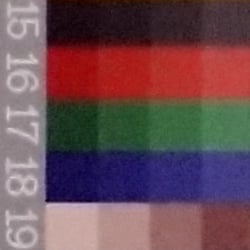
Saturation. The Sony A58's overall default color saturation is oversaturated by 9.6% at base ISO, which is about average these days. Saturation remains fairly consistent across the ISO range, except at ISO 6400 where it dips to 102.6%. Reds and dark blues are boosted the most, but not as much as we often see. Most other colors are pushed just a bit, though yellow and cyan are slightly undersaturated which is quite common. Overall, saturation levels are quite pleasing to our eyes, and you can of course tweak them more to your liking. Most consumer digital cameras produce color that's more highly saturated (more intense) than found in the original subjects. This is simply because most people like their color a bit brighter than life.
Skin tones. The Sony A58 does fairly well with Caucasian skin tones. Brighter flesh tones have a healthy pinkish tint, though darker areas are nudged toward orange. Still, pretty good results here. Where oversaturation is most problematic is on Caucasian skin tones, as it's very easy for these "memory colors" to be seen as too bright, too pink, too yellow, etc.
Hue. Like many cameras, the Sony A58 shifts cyan toward blue, red toward orange, orange toward yellow and yellow toward green, but shifts are relatively minor. (The cyan to blue shift is very common among the digital cameras we test; we think it's a deliberate choice by camera engineers to produce better-looking sky colors.) With an average "delta-C" color error of 5.17 after correction for saturation at base ISO, overall hue accuracy is about average, with accuracy only moderately lower at higher ISOs. Hue is "what color" the color is.
Saturation Adjustment
The Sony A58 has a total of seven saturation settings available, three above and three below the default saturation. This covers a pretty wide range of saturation levels. Saturation also had almost no effect on contrast, which is how it should work.
| Saturation Adjustment Examples | ||||
 |
 |
 |
 |
 |
| -3 | -1 | 0 | +1 | +3 |
The table above shows results with five of the seven saturation settings, including the default and the two extremes. Click on any thumbnail above, then click again to see the full-sized image.


Sensor
Exposure and White Balance
Indoors, incandescent lighting
Slightly warm casts with Auto and Incandescent, good with Manual, and a touch cool with Kelvin white balance settings. Average exposure compensation required.


Indoors, under normal incandescent lighting, color balance is a bit warm and orange with the Auto white balance setting, though results here are slightly better than average. Results with the Incandescent setting are a bit better but still somewhat warm and orange/yellow. The Manual setting is quite accurate, just slightly on the cool side. The 2,600 Kelvin setting which should match the color temperature of our lights is too cool and bluish. The Sony A58 required +0.3 EV positive exposure compensation here, about average for this shot, though images are just a touch bright. (Our test lighting for this shot is a mixture of 60 and 100 watt household incandescent bulbs, a pretty yellow light source, but a very common one in typical home settings here in the U.S.)
Outdoors, daylight
Very good results under harsh lighting, with good handling of contrast, color, and exposure.
Outdoors, the Sony A58 performed very well. No exposure compensation was required to keep the mannequin's face reasonably bright in our "Sunlit" Portrait shot, which is much better than average among the cameras we've tested. (Most cameras require about +0.7 EV here.) Contrast is a little high as you might expect under such harsh lighting, but the camera does a good job of holding onto detail in both the shadows and bright highlights, even without the help of DRO (see below). Both Auto and Manual while balance produced decent skintones, with lighter tones slightly pinkish while darker ones slightly warm, with a slight orange tint. Default exposure is quite good for our Far-field shot as well, just a touch underexposed but with very few highlights blown, again with DRO disabled. There are quite a few dark shadows in the trees, however only very dark shadows are noisy and posterized, but that's not usually an issue as we're talking *very* dark shadows. The Far-field shot with Auto white balance has very good color, just a touch on the cool side. Overall, a very good performance in harsh lighting, especially considering DRO was off for these shots.
See full set of test images with explanations
See thumbnails of all test and gallery images
Resolution
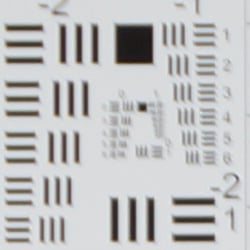
Very high resolution, ~2,500 lines of strong detail from both JPEGs and RAW files.


In-camera JPEGs of our laboratory resolution chart reveal sharp, distinct line patterns down to about 2,500 lines per picture height in both the horizontal and vertical directions. Some may argue for higher numbers, but aliasing and sharpening artifacts start to interfere at this resolution. Complete extinction of the pattern doesn't occur until about 3,200 lines. Some color moiré is evident in JPEGs, though that's not uncommon. Adobe Camera Raw wasn't really able to extract more lines of resolution here from a matching RAW file, and it generated stronger color moiré, so the Sony A58 does a good job holding on to high contrast detail at base ISO in its JPEGs. Use these numbers to compare with other cameras of similar resolution, or use them to see just what higher resolution can mean in terms of potential detail.
See full set of test images with explanations
See thumbnails of all test and gallery images
Sharpness & Detail
Good default sharpness, though fine detail is a touch soft. Mild to moderate noise suppression visible in the shadows and areas of low contrast.


Sharpness. The Sony A58 captures sharp, detailed images overall, though results are a touch soft at default settings, despite using a very sharp Carl Zeiss 24-70mm F/2.8 SSM lens at f/8 for the shot above left. There are some minor edge enhancement artifacts seen around high-contrast elements such as sharpening halos around the larger tree branches and pine cones, but they're not excessive and quite normal. Fine detail such as the smaller branches and pine needles show very little edge enhancement, but appear a little mushy due to noise reduction. Edge enhancement creates the illusion of sharpness by enhancing colors and tones right at the edge of a rapid transition in color or tone.
 Detail. The crop above right shows mild to moderate noise suppression in the darker areas of the model's hair. A number of low-contrast strands are smudged together, though higher contrast strands are still distinct. We saw similar results with fine detail in the pine needles being flattened a bit. Still, pretty good results here, especially for a high-resolution APS-C sensor. We did however notice some demosaicing errors in the form of blue or green pixels that look like chroma noise in the hair, as well as hints of the "jaggies," a type of aliasing artifact. This implies the A58 has a fairly weak optical low-pass filter, but you have to look pretty closely to spot them. Noise-suppression systems in digital cameras tend to flatten-out detail in areas of subtle contrast. The effects can often be seen in shots of human hair, where the individual strands are lost and an almost "watercolor" look appears.
RAW vs In-Camera JPEGs
As noted above, the Sony A58 produces in-camera JPEGs with very good detail, though fine, low-contrast detail is a touch soft. Quite a bit more detail can often be obtained from carefully processing RAW files with a good converter, as can be seen below.

In the table above, mousing over a link at the bottom will load the corresponding crop in the area above, and clicking on the link will load the full resolution image. Examples include (from left to right): an in-camera Fine JPEG, the matching RAW file processed through Sony's bundled Image Data Converter software at default settings, and finally the same RAW file converted with Adobe Camera Raw 8.1, then sharpened in Photoshop using unsharp mask at 300% with radius 0.3.
As you can see, the Sony IDC version at default settings has somewhat better detail (and slightly different color) the in-camera JPEG, though sharpening artifacts are a little more prominent. The Adobe Camera Raw conversion shows better detail than both the in-camera JPEG and the IDC conversion, less obvious sharpening halos, but also reveals a bit more noise. You can always turn up the luminance noise reduction (default of zero was used here), or process the files in your favorite noise reduction program or plugin if you want cleaner images. Bottom line: as is usually the case, the Sony A58 rewards RAW shooters with improved detail (and much better control over the final image) when processed with a good converter.
ISO & Noise Performance
Very good noise versus detail performance up to ISO 1,600.
|
Default High ISO Noise Reduction
|
 |
 |
 |
| ISO 100 | ISO 200 | ISO 400 |
 |
 |
 |
| ISO 800 | ISO 1,600 | ISO 3,200 |
 |
 |
 |
| ISO 6,400 | ISO 12,800 | ISO 16,000 |
The Sony A58's JPEG images are very clean up to ISO 400, though as mentioned previously some very fine, mostly low-contrast detail is lost to noise reduction already at base ISO. There are demosaicing errors in the hair above the mannequin's forehead, though that's pretty common these days, especially with a sharp lens. Stronger noise reduction at ISO 800 removes much of the colored pixels with just a slight increase in smudging, though the aliasing artifacts mentioned earlier are still visible. ISO 1,600 is slightly softer though detail is still very good, and the aliasing artifacts have practically vanished. ISO 3,200 is noticeably softer with stronger smudging and more noticeable noise "grain", but detail is still pretty good for the sensitivity. Image quality goes down rapidly from there, though. ISO 6,400 still shows some fine detail, but 12,800 and especially 16,000 suffer from much stronger blurring and more noticeable luma noise accentuated by the camera's sharpening. Chroma noise is also stronger at these high ISOs, producing blotchy purple and yellow patches. Overall, though, these are very good results especially considering the A58's price point and resolution.
As always, see the Print Quality section below for maximum recommended print sizes at each ISO, as printed performance often doesn't correlate well to what's seen on-screen at 100%.
A note about focus for this shot: We shoot this image at f/4, usually using one of three very sharp reference lenses (70mm Sigma f/2.8 macro for most cameras, 60mm f/2.8 Nikkor macro for Nikon bodies without a drive motor, and Olympus Zuiko 50mm f/2.0 for Four Thirds and Micro Four Thirds bodies). To insure that the hair detail we use for making critical judgements about camera noise processing and detail rendering is in sharp focus at the relatively wide aperture we're shooting at, the focus target at the center of the scene is on a movable stand. This lets us compensate for front- or back-focus by different camera bodies, even those that lack micro-focus adjustments. This does mean, though, that the focus target itself may appear soft or slightly out of focus for bodies that front- or back-focused with the reference lens. We know this; if you click to view the full-size image for one of these shots and notice that the focus target is fuzzy, you don't need to email and tell us. :-) The focus target position will have been adjusted to insure that the rest of the scene is focused properly.
Extremes: Sunlit, dynamic range and low light tests
Very high resolution with very good highlight and shadow detail. Good low-light performance, capable of capturing bright images in near darkness, though AF struggled at lower light levels.


Sunlight. The Sony A58 handled the deliberately harsh lighting in the test above very well. We preferred the default (0 EV) exposure here as the face is reasonably bright while almost no highlights were clipped in the white shirt. Some may prefer the +0.3 EV exposure for its brighter exposure in the face, though, while the +0.7 EV exposure is definitely too bright. It's really up to the photographer. Folks printing directly from the camera will likely want the +0.3 EV image, while people post processing will likely prefer the default exposure for its slightly better highlight retention. As mentioned previously, contrast is a little high, but highlight detail is very good at default exposure. There are some deep shadows however they contain good detail, though very deep shadows are posterized. However, that's not really an issue except perhaps for those trying to recover a severely underexposed image.
For best results, be sure to use fill flash in situations like the one shown above; it's better to shoot in the shade when possible. See below for results with Dynamic Range Optimization and High Dynamic Range features enabled.
Because digital cameras are more like slide film than negative film (in that they tend to have a more limited tonal range), we test them in the harshest situations to see how they handle scenes with bright highlights and dark shadows, as well as what kind of sensitivity they have in low light. The shot above is designed to mimic the very harsh, contrasty effect of direct noonday sunlight, a very tough challenge for most digital cameras. (You can read details of this test here. In actual shooting conditions, be sure to use fill flash in situations like the one shown here; it's better to shoot in open shade whenever possible.)
Dynamic Range Analysis
A key parameter in a digital camera is its Dynamic Range, the range of brightness that can be faithfully recorded. At the upper end of the tonal scale, dynamic range is dictated by the point at which the RGB data "saturates" at values of 255, 255, 255. At the lower end of the tonal scale, dynamic range is determined by the point at which there ceases to be any useful difference between adjacent tonal steps. Note the use of the qualifier "useful" in there: While it's tempting to evaluate dynamic range as the maximum number of tonal steps that can be discerned at all, that measure of dynamic range has very little relevance to real-world photography. What we care about as photographers is how much detail we can pull out of the shadows before image noise becomes too objectionable. This, of course, is a very subjective matter, and will vary with the application and even the subject matter in question. (Noise will be much more visible in subjects with large areas of flat tints and subtle shading than it would in subjects with strong, highly contrasting surface texture.)
What makes most sense then, is to specify useful dynamic range in terms of the point at which image noise reaches some agreed-upon threshold. To this end, Imatest computes a number of different dynamic range measurements, based on a variety of image noise thresholds. The noise thresholds are specified in terms of f-stops of equivalent luminance variation in the final image file, and dynamic range is computed for noise thresholds of 1.0 (low image quality), 0.5 (medium image quality), 0.25 (medium-high image quality) and 0.1 (high image quality). For most photographers and most applications, the noise thresholds of 0.5 and 0.25 f-stops are probably the most relevant to the production of acceptable-quality finished images, but many noise-sensitive shooters will insist on the 0.1 f-stop limit for their most critical work.
JPEG. The graph at right (click for a larger version) was generated using Imatest's dynamic range analysis for an in-camera Sony A58 JPEG file with a nominally-exposed density step target (Stouffer 4110). At the base ISO of 100 (the optimal ISO) with DRO and HDR settings turned off, the graph shows 11.4 f-stops of total dynamic range, with 7.99 f-stops at the "High" Quality level. Roll-off at the highlight end of the curve is gradual, and the low end extends fairly linearly, but the steps get rather spread out, indicative of a tendency of the deepest shadows to break up into discrete levels (posterization) if you try to brighten them too much. These are good results for in-camera JPEGs from a consumer model. Compared to the Nikon D3200 for example, the A58 scored slightly higher at the High Quality level (7.99 vs 7.65), but significantly lower in total dynamic range (11.4 vs 12.3 f-stops). Note though that this measurement has a margin of error of about 1/3 f-stop, so differences of less than 0.33 can be ignored.
RAW. The graph at right is from the same Stouffer 4110 stepchart image captured as a RAW (.ARW) file, processed with Adobe Camera Raw using the Auto setting, then manually tweaking from there. As can be seen, the score at the highest quality increased by over 1-1/3 stops from 7.99 to 9.37 f-stops compared to the in-camera JPEG, while total dynamic range also increased by a similar amount from 11.4 to 12.6. Again, these dynamic range scores are pretty good, but not quite as good as some leading competitors. Compared to the Nikon D3200, the A58 scored lower in total dynamic range (12.6 vs 13.3 f-stops), but slightly higher at the high quality level (9.37 vs 8.84 f-stops). It's worth noting here is that ACR's default noise reduction settings reduced overall noise somewhat (see the plot in the lower left-hand corner) relative to the levels in the in-camera JPEG, which would tend to boost the dynamic range numbers for the High Quality threshold. Also, the extreme highlight recovery being performed by ACR here would likely produce color errors in strong highlights of natural subjects.
Contrast Adjustment
We really like it when a camera gives us the ability to adjust contrast and saturation to our liking. It's even better when those adjustments cover a useful range, in steps small enough to allow for precise tweaks. Just as with its saturation adjustment, the Sony A58's contrast setting meets both challenges.
|
Minimum Contrast
|
|
 |
 |
| Contrast set to lowest, 0 EV |
Contrast set to lowest, 0 EV |
At its lowest contrast setting, the A58 does a really excellent job of toning down highlights and opening up shadows while maintaining natural-looking skin tones. Very good results here.
| Contrast Adjustment Examples | ||||
|
 |
 |
 |
 |
| -3 | -1 | 0 | +1 | +3 |
The table above shows five of the seven contrast setting, including the default and two extremes. It's pretty hard to evaluate small differences in contrast on small thumbnails like these, so click on any thumbnail to go to the full-size image.
One very nice feature of Sony's contrast adjustment is that it has very little effect on color saturation. Contrast and saturation are actually fairly closely coupled, it's a good trick to be able to vary one with out the other changing as well. As usual, Sony did a good job here.


Dynamic Range Optimization is Sony's name for their dynamic range enhancement technology. DRO divides the image into small areas, analyzes the range of brightness of each area, and adjusts the camera's image processing parameters accordingly to make the best use of the available dynamic range. DRO does not boost ISO like some systems, so increased noise is less of an issue, though existing noise may be more visible in raised shadows. Auto DRO is enabled by default on the Sony A58. You can also set the level manually, from 1 ("weak") to 5 ("strong"), or turn it off. As one would expect, DRO is only available for JPEG files.
The above thumbnails and histograms show the effects of the available levels of DRO on our "Sunlit" Portrait shot with no exposure compensation. Mouse over the links to load the associated thumbnail and histogram, and click on the links to visit the full resolution image. As you can see from the thumbnails and associated histograms, DRO boosts shadows and mid-tones without blowing additional highlights, yielding a more balance exposure. Auto DRO setting did a good job here, and the five manual levels give quite a bit of control over the effect.

Above, you can see the effect of DRO settings on our Far-field shot. The default Auto setting produced a very good exposure overall, despite the harsh lighting. Nice.


High Dynamic Range. The Sony A58's HDR mode takes three images in rapid succession, one nominally exposed , one underexposed, and one overexposed, then combines them into one high dynamic range JPEG automatically. Lighter areas from the underexposed image are combined with darker areas from the overexposed image to produce an image with compressed tonal range. The camera then saves a single composite image, as well as the nominally exposed image. The overlaid images are micro-aligned by the camera, but it can only correct for so much movement. If it can't micro-align successfully, an icon indicating HDR capture failed will appear. For best results, the subject should not move or blink, so it's not really intended for portraits. There is also a manual mode where you can select 1 EV ("weak") to 6 EV ("strong") difference in exposures.
Mouse over the links to load the associated thumbnail and histogram, and click on the links to visit the full resolution image. As you can see, the Auto setting did a decent job boosting shadows and mid-tones while reigning back highlights, however we prefer the lower manual settings for this subject. The higher the manual setting, the more highlights are toned-down and shadows opened up, but higher settings can produce flat and unnatural results with this scene. Still, it's nice that Sony provides six manual levels, giving quite a bit of control over the effect.
Above, you can see the effect of HDR settings on our Far-field shot. Watch out for ghosting and other artifacts caused by subject movement during the capture sequence, though, as you can see in the people and around the flag and leaves in some of the above shots.
| 1 fc MFNR |
1 fc 11 lux |
1/2 fc 5.5 lux |
1/4 fc 2.7 lux |
1/8 fc 1.3 lux |
1/16 fc 0.67 lux |
1/16 fc No NR |
|
|---|---|---|---|---|---|---|---|
| ISO 100 |
 2 s f2.8 |
 2 s f2.8 |
 4 s f2.8 |
 8 s f2.8 |
 15 s f2.8 |
 30 s f2.8 |
 30 s f2.8 |
| ISO 200 |
 1 s f2.8 |
 1 s f2.8 |
 2 s f2.8 |
 4 s f2.8 |
 8 s f2.8 |
 15 s f2.8 |
 15 s f2.8 |
| ISO 400 |
 0.5 s f2.8 |
 0.5 s f2.8 |
 1 s f2.8 |
 2 s f2.8 |
 4 s f2.8 |
 8 s f2.8 |
 8 s f2.8 |
| ISO 800 |
 1/4 s f2.8 |
 1/4 s f2.8 |
 0.5 s f2.8 |
 1 s f2.8 |
 2 s f2.8 |
 4 s f2.8 |
 4 s f2.8 |
| ISO 1600 |
 1/8 s f2.8 |
 1/8 s f2.8 |
 1/4 s f2.8 |
 0.5 s f2.8 |
 1 s f2.8 |
 2 s f2.8 |
 2 s f2.8 |
| ISO 3200 |
 1/15 s f2.8 |
 1/15 s f2.8 |
 1/8 s f2.8 |
 1/4 s f2.8 |
 0.5 s f2.8 |
 1 s f2.8 |
 1 s f2.8 |
| ISO 6400 |
 1/30 s f2.8 |
 1/30 s f2.8 |
 1/15 s f2.8 |
 1/8 s f2.8 |
 1/4 s f2.8 |
 0.5 s f2.8 |
 0.5 s f2.8 |
| ISO 12800 |
 1/60 s f2.8 |
 1/60 s f2.8 |
 1/30 s f2.8 |
 1/15 s f2.8 |
 1/8 s f2.8 |
 1/4 s f2.8 |
 1/4 s f2.8 |
| ISO 16000 |
n/a |
 1/80 s f2.8 |
 1/40 s f2.8 |
 1/20 s f2.8 |
 1/10 s f2.8 |
 1/5 s f2.8 |
 1/5 s f2.8 |
| ISO 25600 |
 1/125 s f2.8 |
n/a | n/a | n/a | n/a | n/a | n/a |
Low Light. The Sony A58 was able to capture bright images down to the lowest light level we test at (1/16 fc) at all ISO settings. Noise is well controlled up to ISO 3,200, though as expected, at higher ISOs there are moderate to high amounts of fine luminance noise and some blotchy chroma noise. A few hot pixels can be seen particularly with long exposure noise reduction turned off (the right-most column), but nothing out of the ordinary. We didn't detect any significant banding (pattern noise), perhaps just a hint of horizontal banding at the highest ISO where it's not usual. Some heat blooming (reddish tint) emanating from the bottom of the frame can be seen at the highest ISOs and lower light levels, but that's not unusual either.
Auto white balance did a very good job here, producing a fairly neutral, just slightly cool color balance.
Note that the left-most column in the above table contains images shot at one foot-candle using Sony's Multi-frame NR feature. See below for more details.
The Sony A58's autofocus system was only able to focus on the subject down to between the 1/4 and 1/8 foot-candle light level unassisted with an f/2.8 lens in our tests, which isn't as good as most true DSLRs. The A58 was however able to focus in complete darkness with its built-in focus assist lamp enabled.
How bright is this? The one foot-candle light level that this test begins at roughly corresponds to the brightness of typical city street-lighting at night. Cameras performing well at that level should be able to snap good-looking photos of street-lit scenes.
NOTE: This low light test is conducted with a stationary subject, and the camera mounted on a sturdy tripod. Most digital cameras will fail miserably when faced with a moving subject in dim lighting. (For example, a child's ballet recital or a holiday pageant in a gymnasium.) Thanks to their phase-detect AF systems, digital SLRs (SLTs) like the Sony A58 tend to do much better than point & shoots, but you still shouldn't expect a quick autofocus lock with moving subjects. (A useful trick is to just prop the camera on a convenient surface, and use its self-timer to release the shutter. This avoids any jiggling from your finger pressing the shutter button, and can work quite well when you don't have a tripod handy.)
| Low Light Multi-frame NR | ||
 |
 |
|
| Default NR, 1/60s, ISO 12,800 | Multi-frame NR, 1/60s, ISO 12,800 | |
 |
 |
|
Multi-frame Noise Reduction. This feature is similar to Sony's Hand-held Twilight mode which shoots a burst of six images with a single press of the shutter button and combines all six images into one composite image with reduced noise. But unlike Hand-held Twilight, Multi-frame NR gives you control over the ISO, aperture and shutter speed used, so you may still need to use a tripod depending on the exposure parameters you select. (We frankly don't see the value to this mode when using a tripod, as selecting a lower ISO and longer shutter speed will produce a cleaner image as well.) As you can see, the image captured with Multi-frame Noise Reduction (right) is cleaner than the standard image (left) despite both being shot at ISO 12,800. An added bonus is that ISO 25,600 equivalent is available with MF NR. As with HDR mode, though, static subjects are recommended.
Output Quality
Print Quality
Excellent 30 x 40 inch prints at ISO 100/200; a nice 11 x 14 at ISO 3200; and even prints a good 4 x 6 at its highest ISO of 16,000.
 ISO 100/200 prints are very nice at a whopping 30 x 40 inches, with excellent detail and vibrant colors. Great wall display prints are possible at 36 x 48 inches.
ISO 400 makes a very tight 24 x 36 inch print, with sharp detail, and wall display prints up to 30 x 40 inches.
ISO 800 yields a nice, crisp 16 x 20. The 20 x 30 inch print here is suitable for less critical applications where minor film-grain like noise is OK in some areas.
ISO 1,600 is capable of a good 13 x 19 inch print. There is minor noise now apparent in some shadowy areas, and a slight decrease in contrast in our target red swatch.
ISO 3,200 prints a good 11 x 14. There is now a fair amount of noise visible in some flat areas, but otherwise a nice print overall.
ISO 6,400 produces a nice 8 x 10 for this ISO. It is beginning to lose contrast detail in our tricky red swatch, as most cameras do here, but a very solid print.
ISO 12,800 prints a good 5 x 7, with colors still popping nicely. This is the same print size we rated as good at this ISO for the A58's acclaimed great uncle the RX1.
ISO 16,000 makes a good 4 x 6. This is significant because so many cameras we have reviewed lately do not yield a suitable 4 x 6 at their highest ISO.
We could say the Sony A58 does a very good job in the print quality department from JPEGs, but when you consider its body-only street price of somewhere under $600, it'd be fairer to say it does an excellent job. We don't take price or any other factors into consideration when evaluating prints, just how they look, but drawing a conclusion is another story. Simply put, if you are looking at stepping into your first DSLR, or if you need a solid back-up to your more advanced model, the A58 can be counted on in the JPEG image quality department across the ISO spectrum.
The images above were taken from our standardized test shots. For a collection of more pictorial photos, see our Sony Alpha SLT-A58 Photo Gallery .
Not sure which camera to buy? Let your eyes be the ultimate judge! Visit our Comparometer(tm) to compare images from the Sony Alpha SLT-A58 with those from other cameras you may be considering. The proof is in the pictures, so let your own eyes decide which you like best!
Performance
Timing and Performance
Excellent autofocus speed and shutter lag, but sluggish power-on, power-off and mode switching, and mediocre full-res burst mode.
| Startup/Shutdown | ||
|---|---|---|
| Power on |
~1.9 seconds
|
Time it takes to turn on and capture a shot. |
| Shutdown |
~1.4 seconds
|
How long it takes camera to turn off before you can remove the memory card. |
|
Buffer clearing time
|
4 seconds after 8 large/fine JPEGs*
|
Worst case buffer clearing time. -- This is the delay after a set of shots before you can remove the card.
|
|
7 seconds after 6 RAW files*
|
||
|
8 seconds after 5 RAW+ L/F JPEG files*
|
||
|
*Note: Buffer clearing times measured with a SanDisk Extreme Pro 95MB/sec UHS-1 SDHC card. Slower cards will produce correspondingly slower clearing times. Slow cards may also limit length of bursts in continuous mode. ISO sensitivity and noise reduction settings can also affect cycle times and burst mode performance.
|
||
Startup and shutdown times are much slower than most DSLRs. Buffer clearing times are good, but buffer is shallow.
| Mode Switching | ||
|---|---|---|
| Play to Record, |
~1.1 seconds
|
Time until first shot is captured. |
| Record to Play |
~3.0 seconds
|
Time to display a large/fine JPEG file immediately after capture. |
| Display |
~0.6 second
|
Time to display a large/fine JPEG file already on the memory card. |
Mode switching performance is sluggish (particularly Record to Play), though displaying a previously captured image is fast.
| Shutter Response (Lag Time) | ||
|---|---|---|
|
Full Autofocus |
0.126 second
|
Time from fully pressing shutter button to image capture. (All timing measurements made with a Sigma 70mm f/2.8 lens) |
|
Full Autofocus |
0.139 second
|
Time from fully pressing shutter button to image capture. |
|
Full Autofocus,
Single-area AF mode Auto Flash Enabled |
0.326 second
|
Time from fully pressing shutter button to image capture, with the lens already at the proper focal distance setting, Auto flash enabled. |
|
Continuous AF
|
0.132 second
|
This mode usually shows no speed increase with our static subject; we have no way to measure performance with moving subjects.
|
|
Manual focus
|
0.082 second
|
For most cameras, shutter lag is less in manual focus than autofocus, but usually not as fast as when the camera is "pre-focused."
|
|
Prefocused |
0.054 second
|
Time to capture, after half-pressing and holding shutter button. |
Looking at the Sony A58's ability to determine that it's properly focused when shooting the same target multiple times, its autofocus speed is excellent. The A58 required only 0.126 second for full AF using the center focus point in our tests. This decreased only slightly to 0.139 second in wide-area AF mode. With the flash enabled, the A58's full AF shutter lag increased to 0.326s to account for the preflash metering, which is still pretty good.
Continuous autofocus mode lag time was 0.132 second, and manual focus was quite fast at about 0.082 second. When prefocused, shutter lag was 0.054 second which is very fast for an SLR-class camera.
To minimize the effect of different lens' focusing speed, we test AF-active shutter lag with the lens already set to the correct focal distance. We also use the same Sigma 70mm f/2.8 macro with most interchangeable lens cameras (on all platforms except NX, Four Thirds/Micro Four Thirds and Nikon models lacking an in-body focus motor), to further reduce variation, and because our tests showed that focus-determination time with this lens was close to the fastest, across multiple camera bodies from different manufacturers. Being an older design with a non-ultrasonic motor, it wouldn't be the fastest at slewing from one focus setting to another, but that's exactly the reason we measure focus determination speed, which is primarily a function of the camera body, vs focus adjustment speed, which is primarily a function of the lens.
| Cycle Time (shot-to-shot) | ||
|---|---|---|
|
Single Shot mode
Large fine JPEG |
0.51 second
|
Time per shot, averaged over 6 shots, 3 seconds to clear*. |
|
Single Shot mode
RAW |
0.55 second
|
Time per shot, averaged over 2 shots, 3 seconds to clear*. |
|
Single Shot mode
RAW + L/F JPEG |
0.57 second
|
Time per shot, averaged over 2 shots, 4 seconds to clear*. |
|
Early shutter |
No
|
Some cameras refuse to snap another shot if you release and press the shutter too quickly in Single Shot mode, making "No" the preferred answer. |
|
Continuous Hi mode Large fine JPEG |
0.21 second (4.86 frames per second);
8 frames total; 4 seconds to clear* |
Time per shot, averaged over buffer depth of 8 shots, then slows to an average of 0.49s or 2.05 fps.
|
|
Continuous Hi mode
RAW |
0.21 second (4.85 frames per second);
6 frames total; 7 seconds to clear* |
Time per shot, averaged over buffer depth of 6 shots, then slows to an average of 1.15s or 0.87 fps.
|
|
Continuous Hi mode
RAW + L/F JPEG |
0.21 second (4.88 frames per second);
5 frames total; 8 seconds to clear* |
Time per shot, averaged over buffer depth of 5 shots, then slows to an average of 1.67s or 0.60 fps.
|
|
Tele-zoom Continuous mode
Small JPEG |
0.13 second (7.95 frames per second);
15 frames total; 4 seconds to clear* |
Time per shot, averaged over buffer depth of 15 shots, then slows to an average of 0.27s or 3.66 fps.
|
|
Flash Recycling |
2.1 seconds
|
Flash at maximum output. |
| *Note: Buffer clearing times measured with a SanDisk Extreme Pro 95MB/sec UHS-1 SDHC memory card. Slower cards will produce correspondingly slower clearing times. Slow cards may also limit length of bursts in continuous mode. ISO sensitivity and other settings such as DRO or NR can also affect cycle times and burst mode performance. |
||
Shot-to-shot cycle times are about average for an SLR-class camera, ranging from 0.51 to 0.57 second depending on the file type, though buffer depths are shallow, at which point cycle times slow down.
Full-resolution continuous mode speeds are about average these days for a consumer model at about 4.9 frames-per-second in Continuous Hi mode, no matter the file type. The A58 offers a faster, cropped "Tele-zoom Continuous Priority AE" mode that managed 7.95 frames per second in our tests, however it only captures small (5-megapixel) JPEG images.
Full-resolution buffer depths are quite shallow, with only 8 large/fine JPEG, 6 RAW and 5 RAW + large/fine JPEG files captured before the burst rate slows down, though that's not uncommon in entry-level models. You should be able to do better with typical subjects when shooting JPEGs (our target for this test is designed to be difficult to compress). Tele-zoom Continuous mode managed 15 small JPEGs before slowing down. Buffer clearing is relatively fast for the resolution, but keep in mind buffers are shallow.
The flash was able to recycle from a full discharge in 2.1 seconds, which is very fast.
| Download Speed | ||
|---|---|---|
| Windows Computer, USB 2.0 |
11,263 KBytes/sec
|
Typical Values: |
Download speeds were very fast, quick enough that you won't feel the need for a separate card reader, even with large memory cards. (Note that this test was performed with a SanDisk Extreme Pro 95 MB/sec UHS-1 SDHC card: Slower cards would likely show slower transfer times.)
Bottom line, the Sony A58 offers mixed performance. Autofocus and shutter lag are very fast, cycle-times and full-resolution burst speed are average, but startup and mode switching are sluggish, while buffers are shallow.
Battery
Battery Life
Very good battery life for an interchangeable lens camera with an EVF.
| Operating Mode | Number of Shots |
|---|---|
|
Electronic Viewfinder,
(CIPA standard) |
690
|
|
LCD Monitor,
(CIPA standard) |
700
|
The Sony A58 uses a custom rechargeable NP-FM500H lithium-ion battery for power, and ships with a charger. Battery life is pretty good for a consumer-level interchangeable lens camera equipped with an electronic viewfinder, and about average compared to traditional consumer DSLRs using an optical viewfinder. We recommend you pick up a spare battery and keep it freshly charged and on-hand for extended outings or shooting video.
The table above shows the number of shots the camera is capable of (on either a fresh set of disposable batteries or a fully-charged rechargeable battery as appropriate), based on CIPA battery-life and/or manufacturer standard test conditions.
(Interested readers can find an English translation of the CIPA DC-002 standards document here. (180K PDF document))
Image Quality
The crops below compare the Sony A58 to the Sony A57, Canon T5i, Nikon D3200, Pentax K-50 and Sony NEX-6.
Note that these images are best quality JPEGs straight out of the camera, at default settings including noise reduction. Each camera was shot with one of our very sharp reference prime lenses.
Sony A58 versus Sony A57 at ISO 100
 |
 |
 |
 |
 |
 |
Sony A58 at ISO 100 |
Sony A57 at ISO 100 |
The A57 had great image quality for the price, but the A58 takes it a few steps further. With roughly four more megapixels of data, the mosaic crop from the A58 here looks sharp and the pink fabric swatch has nice detail. A noticeable improvement to Sony's entry-level DSLR image quality. |
|
Sony A58 versus Canon T5i at ISO 100
|
 |
|
 |
|
 |
Sony A58 at ISO 100 |
Canon T5i at ISO 100 |
The Sony A58 is far superior to the T5i across all crops above, especially with the sharpness in the mosaic and the detail in the pink fabric swatch. The same goes for the red fabric swatch. |
|
Sony A58 versus Nikon D3200 at ISO 100
|
 |
|
 |
|
 |
Sony A58 at ISO 100 |
Nikon D3200 at ISO 100 |
The D3200 boasts roughly four more megapixels than the A58, but the first two crops have a smeared appearance compared to the Sony. The higher resolution does, however, help in the difficult red fabric swatch, an area that Nikon typically does particularly well with. |
|
Sony A58 versus Pentax K-50 at ISO 100
|
 |
|
 |
|
 |
Sony A58 at ISO 100 |
Pentax K-50 at ISO 100 |
The Pentax K-50 has roughly four less megapixels than the A58, and it shows in the fine detail department. The K-50 also does a relatively poor job with the red fabric swatch and renders the pink fabric swatch with a pumped and artificial magenta hue. |
|
Sony A58 versus Sony NEX-6 at ISO 100
|
 |
|
 |
|
 |
Sony A58 at ISO 100 |
Sony NEX-6 at ISO 100 |
Also with four less megapixels than the A58, the mirrorless NEX-6 still does a nice job against its cousin, with sharp detail and a good job with the red fabric swatch. The A58's increased resolution certainly shows its teeth (or, in this case, threads) in the pink fabric swatch. |
|
Moving onto ISO 1600 now, where noise processing starts to show its character.
Sony A58 versus Sony A57 at ISO 1600
 |
 |
 |
 |
 |
 |
Sony A58 at ISO 1600 |
Sony A57 at ISO 1600 |
The A58's strength against its predecessor is particularly evident above in the mosaic tiles, which are smeared and soft in the A57 but still fairly tight in the new A58. |
|
Sony A58 versus Canon T5i at ISO 1600
|
 |
|
 |
|
 |
Sony A58 at ISO 1600 |
Canon T5i at ISO 1600 |
The T5i loses most-all contrast detail in both the mosaic and the red fabric swatch, with the A58 a clear winner in image quality between the two. |
|
Sony A58 versus Nikon D3200 at ISO 1600
|
 |
|
 |
|
 |
Sony A58 at ISO 1600 |
Nikon D3200 at ISO 1600 |
The D3200 images just don't look to be in the same league as the A58's here, with pronounced noise apparent in the bottle crop, softness in the mosaic, and both noise and softness in the fabric crops. Not really a close call in any of them. |
|
Sony A58 versus Pentax K-50 at ISO 1600
|
 |
|
 |
|
 |
Sony A58 at ISO 1600 |
Pentax K-50 at ISO 1600 |
Again, the K-50 struggles with rendering the red fabric swatch, and pumps magenta into the pink swatch, as well as some artificial yellow into the mosaic frame. It also imparts more noise into the bottle crop than does the relatively clean A58. |
|
Sony A58 versus Sony NEX-6 at ISO 1600
|
 |
|
 |
|
 |
Sony A58 at ISO 1600 |
Sony NEX-6 at ISO 1600 |
As with base ISO, the NEX-6 does a nice job, going toe-to-toe with the A58, but the higher resolution DSLR comes out slightly ahead in most areas, especially fine detail. |
|
And, below at ISO 3200, the stakes really start to show in today's cameras.
Sony A58 versus Sony A57 at ISO 3200
 |
 |
 |
 |
 |
 |
Sony A58 at ISO 3200 |
Sony A57 at ISO 3200 |
Yet again the A58 has a better handle on rendering some detail, even at this ISO, than the A57. This should come as no surprise, but if you're thinking of trading up it's still nice to know, as it is not always the case for every successor camera. |
|
Sony A58 versus Canon T5i at ISO 3200
|
 |
|
 |
|
 |
Sony A58 at ISO 3200 |
Canon T5i at ISO 3200 |
The T5i really loses ground here, and just can't match stride with the A58 for image quality at this level. Most-all image crops are either smeared or noisy in comparison. |
|
Sony A58 versus Nikon D3200 at ISO 3200
|
 |
|
 |
|
 |
Sony A58 at ISO 3200 |
Nikon D3200 at ISO 3200 |
As with the T5i, the D3200 can't match stride at this ISO with the A58. Images are grainy in areas, soft in others, and not particularly usable in general. |
|
Sony A58 versus Pentax K-50 at ISO 3200
|
 |
|
 |
|
 |
Sony A58 at ISO 3200 |
Pentax K-50 at ISO 3200 |
Noise in the shadows and bottle for the K-50 become much more apparent here compared to the A58, and the differences in the fabric crop are more pronounced as well. |
|
Sony A58 versus Sony NEX-6 at ISO 3200
|
 |
|
 |
|
 |
Sony A58 at ISO 3200 |
Sony NEX-6 at ISO 3200 |
Similar showings from these two cousins at ISO 3200. As stated before, the higher resolution pays off for the A58 in some of the more detailed areas like the tiles. |
|
Detail: Sony A58 vs. Sony A57, Canon T5i, Nikon D3200, Pentax K-50 and Sony NEX-6
 |
 |
 |
 |
 |
 |
 |
 |
 |
 |
 |
 |
 |
 |
 |
 |
 |
 |
| Sony A58 ISO 100 ISO 3200 ISO 6400 |
Sony A57 ISO 100 ISO 3200 ISO 6400 |
Canon T5i ISO 100 ISO 3200 ISO 6400 |
Nikon D3200 ISO 100 ISO 3200 ISO 6400 |
Pentax K-50 ISO 100 ISO 3200 ISO 6400 |
Sony NEX-6 ISO 100 ISO 3200 ISO 6400 |
| Detail comparison. Sony emerges as the clear victor in this fine detail table, with both the A58 and the NEX-6 doing a better job at resolving detail across the ISO spectrum. The D3200, K-50 and T5i do a nice job at base ISO, but then quickly lose ground as ISO rises. By ISO 3200, the Sony cameras are the only two left standing. | |||||
Excellent 30 x 40 inch prints at ISO 100/200; a nice 11 x 14 at ISO 3200; and even prints a good 4 x 6 at its highest ISO of 16,000.
ISO 100/200 prints are very nice at a whopping 30 x 40 inches, with excellent detail and vibrant colors. Great wall display prints are possible at 36 x 48 inches.
ISO 400 makes a very tight 24 x 36 inch print with sharp detail, and wall display prints up to 30 x 40 inches.
ISO 800 yields a nice, crisp 16 x 20. The 20 x 30 inch print here is suitable for less critical applications where minor film grain-like noise is OK in some areas.
ISO 1600 is capable of a good 13 x 19 inch print. There is minor noise now apparent in some shadow areas, and a slight decrease in contrast in our target red swatch.
ISO 3200 prints a good 11 x 14. There is now a fair amount of noise visible in some flat areas, but otherwise a nice print overall.
ISO 6400 produces a nice 8 x 10 for this ISO. It is beginning to lose contrast detail in our tricky red swatch, as most cameras do here, but a very solid print.
ISO 12,800 prints a good 5 x 7, with colors still popping nicely. This is the same print size we rated as good at this ISO for the A58's acclaimed great uncle the RX1.
ISO 16,000 makes a good 4 x 6. This is significant because so many cameras we have reviewed lately do not yield a suitable 4 x 6 at their highest ISO.
We could say the Sony A58 does a very good job in the print quality department from JPEGs, but when you consider its body-only street price of somewhere under $600, it'd be fairer to say it does an excellent job. We don't take price or any other factors into consideration when evaluating prints, just how they look, but drawing a conclusion is another story. Simply put, if you are looking at stepping into your first DSLR, or if you need a solid back-up to your more advanced model, the A58 can be counted on in the JPEG image quality department across the ISO spectrum.
Field Test

The new Sony Alpha A58 is something of a 'tweener. It is, by default, the company's entry-level APS-C DSLR. At the same time, it offers a ton of photographic capabilities that would also appeal to enthusiast shooters. As such, it sits in a unique position in a fiercely competitive sector of the camera marketplace, replete with formidable rivals from the likes of Canon, Nikon and Pentax.
With the A58, Sony devised a camera that delivers virtually all of the high-tech features built into the enthusiast-targeted, 16.1-megapixel Sony SLT-A57 and the consumer-friendly, entry-level SLT-A37 -- plus a number of significant technological upgrades -- at an enticing price. What they came up with is an ingenious strategy, and a remarkably adept camera that delivers impressive value for both beginners and serious photographers alike. The Sony A58 is a lot more than a so-called "price point" camera.
Full disclosure: I own a Sony A57, so going into the review I was both excited by the new model, but also skeptical of what it might leave out. Let's take a look at how the Sony A58 stood up to such expectations.
Design. The A58 is nearly identical in size, weight and form to the recently discontinued A57, and its control array is quite similar except that the positions of two control buttons have been reversed -- the Digital Zoom button is now more conveniently located atop the camera behind the shutter button collar and the Exposure Compensation button is on the sloping rear deck, next to the AEL button. The Exposure Compensation button also magnifies the displayed image in Playback mode, while the AEL button reduces the magnification.
| In comparison: Sony A57 vs. Sony A58 |
 |
| Sony A57 top deck |
|
| Sony A58 top deck |
The mode dial to the left of the hot shoe has dropped the 3D setting which is no longer supported, in favor of Picture Effects which gives you access to the A58's eleven creative effect modes: Toy Camera, Pop Color, Posterization (Color or B&W), Retro Photo, Soft High-key, Partial Color (Red, Blue, Green or Yellow), High Contrast Monochrome, Soft Focus, HDR Painting, Rich-tone Monochrome, and Miniature.
The Tele-zoom Continuous Advance Priority mode now has a small "8" inscribed in the multi-frame icon, rather than a "12", denoting its reduced maximum framing rate. It also has a stronger 2x crop and a reduced resolution, compared to the equivalent mode on the A57.
Note that the 2x crop must be combined with the 1.5x crop of the image sensor. Hence, when shooting in Tele-zoom mode you have a 3x crop. The bundled DT 18-55mm lens is, effectively, a 54-165mm lens in this mode.
Other external differences worth noting: The A58 has a 2.7-inch 460k-dot LCD which tilts down 55 degrees and up 135 degrees, in place of the A57's 3-inch, 921k-dot tilt/swivel LCD. There's also a single contact standard metal hot shoe, in place of the narrower dedicated Sony/Minolta multi-contact hot shoe on the A57, and the A58's lens mount is fabricated of industrial plastic instead of stainless steel.


Sensor, processor and other key tech changes. It's clear that Sony had to shave a few bucks in production costs here and there to be able to offer the A58 at a street price of about $600, complete with an updated DT 18-55mm f/3.5-5.6 SAM II lens. By way of comparison, the A57 sold for about $800 when it was first introduced. Nevertheless, for most users, the technological upgrades in the A58 should more than make up for any deletions. These include a new 20.1-megapixel Exmor HD APS-C sensor (up from 16.1 megapixels on the A57 and A37) and an SVGA (1,440k-dot) OLED Tru-Finder EVF that -- based on my observations -- displays a wider color gamut and more subtle and accurate color gradations than the non-OLED Tru-Finder in the A57, along with the same impressive detail.

On the downside, since the A58 has the same BIONZ image processor as the A57 but upgraded resolution -- and thus, larger files sizes -- it delivers a reduced burst shooting rate of 5 frames per second. That's not terrible for an entry-level camera, though it is a compromise. Many savvy buyers may be turned off by the plastic lens mount, but it doesn't worry me that much. After all, many manufacturers have been using industrial-strength plastic mounts on lenses for years, and they're pretty sturdy and reliable in my opinion. Still, it's something to consider.
Perhaps the biggest sacrifice in terms of performance is the loss of Full HD movie recording at a 60p frame rate. But considering the A58 is bridging the gap between entry-level and mid-level models, it's not surprising, and the DSLR does still deliver 1080p video at 60i and 24p. Good video, at that. It's more important to me (and likely most still photography shooters) that the camera retained the 15-point continuous AF with three cross-type AF sensors from the mid-level A57. And that it still has multi-frame noise reduction, Handheld Twilight mode and other key features.
Handling. The Sony A58 handles very well. The fairly light, moderately-sized polycarbonate body is nicely contoured, and fits comfortably even in my smallish hands. The camera feels very solid and well balanced with the standard 18-55mm zoom, and also with the 18-135mm and 200mm lenses I mounted for comparison.

The handgrip is ideally shaped to wrap your fingers around for a secure grip. It's enhanced by an index-finger notch, a soft-textured leather-like covering, and a nicely contoured thumb rest on the back. The smooth light-touch shutter release, surrounding on-off collar, and various control buttons are sensibly positioned and clearly labeled so operation is generally intuitive and doesn't require a steep learning curve.
Sub-menu settings in the Menu or Function menus can easily be navigated and set using either the four-way toggle control and central AF/Enter button on the back, or by sliding your index finger forward to the Control Dial directly in front of the shutter release at the top of the grip. Press the ISO button and you can select manual ISO settings from ISO 100 to ISO 16,000 using either method, and lock in your setting by pressing the AF/Enter button.
I found Auto ISO a very convenient setting for shooting active subjects in rapidly changing light, and there's a second Auto ISO setting that provides multi-frame noise reduction when shooting at high ISOs. I found it to be quite effective in capturing crisp, low-noise images of stationary subjects in low light, but NR is obviously not what you want for shooting action.
EVF and LCD. The viewing system is one of the A58's most appealing features. The 100% view, high-res Organic LED electronic viewfinder is superb; I think it's the closest thing to a first-class optical viewfinder you're likely to experience in a camera of this class. Of course, it also delivers the EVF's advantages of being able to display a brighter viewing image in low light, and to preview exposure and effects changes.
The EVF's fast refresh rate means no smearing when following action subjects, and it's adjustable for individual eyesight over a wider-than-normal +/- 4 diopter range by turning a conveniently placed knurled dial at the right of the eyepiece. By turning the Finder/LCD setting to Auto, the viewing image will automatically appear on the EVF when you raise the camera to your eye and move down to the LCD when you lower the camera to observe the LCD monitor. You can also switch it manually by pressing the Finder/LCD button atop the camera.
While the 2.7-inch LCD isn't quite as large or as hi-res as the one in the A57 -- and it doesn't swivel -- for me, these things are relatively insignificant in actual use, unless you like to take "selfies" or habitually use the LCD to assess magnified images on the fly. I found that it's actually easier and more effective to do the latter using the EVF because of its higher resolution and superior color accuracy. In any case, the LCD monitor is decent; it was usually viewable and usable in bright, sunlit conditions.


Performance. I found the Sony A58 to be a very responsive photographic tool in almost all respects. Startup and mode switching times were sluggish, but these aren't as important measures as autofocusing speed in my opinion. The camera autofocuses and fires very rapidly even in low light, and with most low-contrast subjects, its shutter lag is practically non-existent. I mostly used Spot AF, which is the way I normally shoot, but I also tried Wide AF mode and found it to be very effective in focusing accurately and swiftly on my intended subject.
Sony claims the new 18-55mm SAM II kit lens focuses faster and more quietly than its predecessor, and in my field testing I indeed found it slightly quicker and definitely quieter to use, the latter a real plus when I shot a few Full HD 1080p video clips at 60i. Our lab testing, however, showed that the lens was soft in the corners, and exhibited significant barrel distortion at wide angle. Overall, I guess, the 18-55mm is just a run-of-the-mill kit lens. It automatically comes with the camera -- you can't buy the A58 body-only -- but your photography is going to be better served by purchasing a better Sony Alpha mount lens or two. The bundled lens simply doesn't extract the potential of the image sensor.
In combination with its excellent EVF, shooting action subjects with the A58 gives you the uncanny sensation of grabbing images out of the air, and part of this is no doubt due to the camera's impressive AF tracking ability and its three central cross-type AF sensor. I found these cross-type sensors focused accurately and swiftly with subjects having vertical, horizontal, or oblique line patterns. No AF system is perfect of course, but when manual focus was required or desired, I simply moved the switch on the side of the lens from AF to MF and turned the front lens ring, which has a soft rubberized surface to provide a good grip. With its exquisite detail and brightness, manual focusing via the EVF was easy and satisfying.

Although it's a characteristic common to all current Sony Alpha cameras which use Translucent Mirror Technology, it's worth noting that the A58 provides full-time phase-detection AF before, during and after the actual exposure. This results in faster, more decisive AF that's particularly noticeable when shooting HD video and bursts of stills in continuous mode. This not only results in sharper images of moving subjects at the camera's top full-res burst rate of 5 fps, but also at the 8 fps burst rate in Tele-Zoom Continuous Priority, albeit with a 2X crop factor (3x, once the sensor crop is taken into account), and at just five megapixel resolution.
Another performance improvement is the Sony A58's battery life. It lasts about 690 shots per charge, which I can tell you first-hand is much better than the A57. (About 140 shots per charge, according to the CIPA ratings.) That's a huge life saver when you're on an extended shoot, or are on a trip and you can't pay much attention to such things.
Overall, I was very satisfied with the performance of the A58. It delivers very good image quality in JPEG mode, with very low noise at ISOs ranging from 100 to 800 and reasonably good image quality at higher ISOs. Most of the images I shot at ISO 3200 and 6400 showed good detail, a slight decrease in color saturation, and moderate noise depending on lighting and subject contrast. With a few low-contrast, backlit subjects I shot in low light at ISO 3200 and 6400, digital grain was fairly high although the pattern was tight enough not to be objectionable for most uses. And if you shoot raw files, there's even more to be extracted from the A58's image sensor, although the step between raw and JPEG isn't as dramatic as with some cameras.
| Sony A58 - Shooting at higher sensitivities |
 |
| 1/60s; f/4; ISO 800 |
 |
| 1/60s; f/5.6; ISO 3200 |
 |
| 1/40s; f/5.0; ISO 6400 |
|
Above are image examples from the Sony A58 at ISOs 800, 3200 and 6400. Click on any image to view the full resolution image for closer inspection.
|
With a higher pixel density than the A57, the 20.1-megapixel A58 might be expected to exhibit lower image quality at ISO settings of 1600 and higher, but the difference is not very pronounced based on my observations, and the increase in image detail at lower ISOs was gratifying. Perhaps this is attributable to the magic of imaging software. I would rate the camera's high ISO performance as good, if not outstanding. It is certainly equal or superior to many of its entry-level competitors, but I wouldn't rate it in the same class as enthusiast-level DSLRs or full-frame prosumer models.
View the IR Lab's in-depth Sony A58's image quality test results by clicking here, and click here for side-by-side comparisons against the A58's top competitors.
Exposure and metering. I found exposure accuracy of the A58 to be commendable, and decidedly better than average for its class. I mostly used the multi-segment metering pattern that's easily selectable via the Function button, and occasionally used the spot pattern with high-contrast subjects or when correct exposure of a particular detail was important. Both modes worked flawlessly, and I was impressed with the camera's ability to deliver accurate overall exposures even with severely backlit subjects in multi-segment metering mode.
I tried the Smile/Face Detection mode with children and adults, both alone and in pairs, and it too worked very well. Face Registration also works as advertised based on my limited field experience. The latter provides a convenient way to get consistently sharp images of a particular person in a group, especially if they're all moving around.


Features. Other features which may not be unique to the A58 but were nonetheless appreciated included White Balance bracketing, which is great for shooting active subjects under mixed light sources, as well as a full range of creative Picture Effect modes. I particularly liked HDR Painting, which yields painterly effects, Pop Color (which makes colors pop), and Posterization. This last is very cool but, in my opinion, a little over the top for most people pictures. I didn't have a suitably-scenic vista to show off the auto Panorama stitching mode, but I can confirm that it works and it does let you choose the panning direction.
Note that none of these in-camera effects will work when the camera is set for RAW or RAW+JPEG image quality; you have to shoot them at the Fine JPEG setting.
Sony A58 Picture Effect Modes |
|
 |
 |
Retro Photo |
Pop Color |
 |
 |
Posterization |
Partial Color (red) |
One feature that did not work as well as I expected is Auto Object Framing, which is supposed to provide two images; the one you composed and a better-composed alternative image based on in-camera rule-of-thirds algorithms. In most cases, when this feature was turned on, the alternative rectangle did not appear and only one image was recorded. Occasionally when I attempted a really lousy composition (e.g. putting the subject smack in the center of a horizontal frame) the larger green frame did appear on the screen and two shots were captured. The Auto Portrait Framing feature in the A57 seemed to work more predictably, but I'm not sure why. (Note as I did, though, that this feature does not work in either manual or auto NR mode.)
On the plus side, the excellent performance in Handheld Twilight mode more than made up for any of these deficiencies. It combines multiple images to capture a sharper, more vivid -- but still realistic image -- of the scene, and it performed better than expected when a car with its lights on moved into the frame. I expected a blur, but instead the camera chose one image of the moving car from the sequence and sharpened it.

DRO and HDR. The Sony A58 offers several ways to maximize dynamic range. The Dynamic Range Optimizer (DRO) works in single shot mode, and can be configured to Auto or set to individual levels (1-5) depending on your individual shooting preference. Below are examples of Auto and Level 5 and, as you can see, level 5 really works hard to try and achieve a well-balanced image, rendering good exposure to different areas. This comes at the expense of higher contrast in the image of course, but it's nice to know it's there when you need it for certain shots. Meanwhile, HDR mode shoots 3 images at differing exposures and combines them into one image, and below you can see an example of HDR mode in the auto setting.
| Sony A58 - HDR / DRO modes | |
 |
 |
| DRO and HDR modes off | HDR (auto) |
 |
 |
| DRO (auto) | DRO (level 5) |
Video. While I talked earlier about how the Sony A58 sacrificed some video capabilities -- not being able to record at 60p frame rate as the A57 could -- it's still a very good movie-making machine.
Paired with the updated 18-55mm kit lens, it delivers relatively smooth and quiet video. And the A58's full-time continuous phase-detection AF works better in video than most competing cameras in its class. What's more, you can use full Program, Aperture- and Shutter-priority, or Manual controls to set movie exposure just how you want it.
| 1,920 x 1.080 Progressive, 24 fps, AVCHD, MTS format Download Original (63.6 MB) |
1,920 x 1.080 Progressive, 24 fps, AVCHD, MTS format Download Original (50.2 MB) |
Summary. Where the Sony A58 really shines is in delivering an impressive value in terms of features and performance per dollar. It's a great choice for beginners and enthusiasts alike who want a camera that provides a satisfying level of responsiveness, high image quality plus plenty of room to grow. When you consider that the A58 is offered at around $600 with Sony's latest 18-55mm SAM II zoom -- albeit not a lens that will derive nearly what the camera body is capable of -- you begin to realize how far we've come in the last few years with the quality of so-called entry-level models.
Despite some of the sacrifices Sony had to make to lower the cost, I'm thoroughly impressed with the A58 and its improved resolution, electronic viewfinder, and overall performance. In fact, I have to admit it's time to trade in my trusty A57!
Flash
Sony A58 Flash
Flash Test Results
Coverage and Range
Excellent flash range, but with narrow and uneven coverage at wide angle. Our standard indoor portrait shot required lower than average exposure compensation.


Coverage. Flash coverage is quite narrow and uneven at wide angle (18mm), leaving very dark corners in our flash coverage test image. Coverage is much more uniform at full telephoto (55mm), with only minor fall-off in the corners. Our telephoto test image has a pinkish tint to it, though (auto white balance was used.)
Exposure. Our Indoor Portrait test scene is bright with only +0.3 EV flash exposure compensation at ISO 200. The average amount of flash exposure compensation required for this scene is +0.7 EV, so the A58's flash system performed better than average here. The camera's Slow-Sync flash mode produced very bright results with no flash exposure compensation, though with a stronger orange cast from the ambient room lighting.
| Flash Range: Wide Angle | |||||
|---|---|---|---|---|---|
| 6 ft | 7 ft | 8 ft | 9 ft | 10 ft | 11 ft |
 1/60 sec f3.5 ISO 200 |
 1/60 sec f3.5 ISO 200 |
 1/60 sec f3.5 ISO 200 |
 1/60 sec f3.5 ISO 200 |
 1/60 sec f3.5 ISO 200 |
 1/60 sec f3.5 ISO 200 |
| 12 ft | 13 ft | 14 ft | 15 ft | 16 ft | |
 1/60 sec f3.5 ISO 200 |
 1/60 sec f3.5 ISO 200 |
 1/60 sec f3.5 ISO 200 |
 1/60 sec f3.5 ISO 200 |
 1/60 sec f3.5 ISO 200 |
|
| Flash Range: Telephoto | |||||
|---|---|---|---|---|---|
| 6 ft | 7 ft | 8 ft | 9 ft | 10 ft | 11 ft |
 1/60 sec f5.6 ISO 200 |
 1/60 sec f5.6 ISO 200 |
 1/60 sec f5.6 ISO 200 |
 1/60 sec f5.6 ISO 200 |
 1/60 sec f5.6 ISO 200 |
 1/60 sec f5.6 ISO 200 |
| 12 ft | 13 ft | 14 ft | 15 ft | 16 ft | |
 1/60 sec f5.6 ISO 200 |
 1/60 sec f5.6 ISO 200 |
 1/60 sec f5.6 ISO 200 |
 1/60 sec f5.6 ISO 200 |
 1/60 sec f5.6 ISO 200 |
|
ISO 200 Range. With the 18-55mm kit lens, flash exposures at wide angle started out bright at 6 feet, and actually increased or maintained brightness to 15 feet. While 16 feet isn't quite as bright, it's still well-exposed, so we'll call the range 16 feet at wide angle which is excellent. At full telephoto, flash exposures are bright out to 9 feet, dropping off from there.
| Manufacturer-Specified Flash Range | |
|---|---|
| Wide Angle | Telephoto |
 9.4 feet ISO 100 |
 5.9 feet ISO 100 |
Manufacturer Specified Flash Test. The Sony A58's built-in flash unit is rated with a Guide Number of 10 meters or 32.8 feet at ISO 100. That works out to about 9.4 feet at f/3.5 and 5.9 feet at f/5.6, the maximum apertures of the kit zoom lens. In the test shots above taken at those distances, the A58's flash produced bright flash exposures (even slightly overexposed at wide angle), which confirms Sony's flash power rating is credible. Again, note the pinkish cast with auto white balance.
Our standard test method for flash range uses a fixed setting of ISO 200, to provide a fair basis of comparison between cameras. We also shoot two shots using the manufacturer-specified camera settings, at the range the company claims for the camera, to assess the validity of the specific claims.
High ISO Noise Reduction
Sony A58 High ISO Noise Reduction
The Sony A58 offers three High ISO Noise Reduction settings: "High, "Normal" and "Low". The camera's user manual doesn't say when High ISO NR kicks in, so we've included crops from the base ISO in the tables below.
See for yourself how the Sony A58's "High", "Normal" and "Low" High ISO NR settings compare to RAW without noise reduction under daylight-balanced lighting. (Note that these RAW images also have no sharpening applied, so they're a little softer than camera JPEGs at low ISOs.) Click on any of the crops below to see the corresponding full-sized image.
| High ISO Noise Reduction Comparison Daylight-balanced illumination |
||||
|
"High"
|
"Normal"
|
"Low"
|
RAW (no NR)
|
|
|
I
S O 1 0 0 |
 |
 |
 |
 |
 |
 |
 |
 |
|
 |
 |
 |
 |
|
|
"High"
|
"Normal"
|
"Low"
|
RAW (no NR)
|
|
|
I
S O 2 0 0 |
 |
 |
 |
 |
 |
 |
 |
 |
|
 |
 |
 |
 |
|
|
"High"
|
"Normal"
|
"Low"
|
RAW (no NR)
|
|
|
I
S O 4 0 0 |
 |
 |
 |
 |
 |
 |
 |
 |
|
 |
 |
 |
 |
|
|
"High"
|
"Normal"
|
"Low"
|
RAW (no NR)
|
|
|
I
S O 8 0 0 |
 |
 |
 |
 |
 |
 |
 |
 |
|
 |
 |
 |
 |
|
|
"High"
|
"Normal"
|
"Low"
|
RAW (no NR)
|
|
|
I
S O 1 6 0 0 |
 |
 |
 |
 |
 |
 |
 |
 |
|
 |
 |
 |
 |
|
|
"High"
|
"Normal"
|
"Low"
|
RAW (no NR)
|
|
|
I
S O 3 2 0 0 |
 |
 |
 |
 |
 |
 |
 |
 |
|
 |
 |
 |
 |
|
|
"High"
|
"Normal"
|
"Low"
|
RAW (no NR)
|
|
|
I
S O 6 4 0 0 |
 |
 |
 |
 |
 |
 |
 |
 |
|
 |
 |
 |
 |
|
|
"High"
|
"Normal"
|
"Low"
|
RAW (no NR)
|
|
|
I
S O 1 2 8 0 0 |
 |
 |
 |
 |
 |
 |
 |
 |
|
 |
 |
 |
 |
|
|
"High"
|
"Normal"
|
"Low"
|
RAW (no NR)
|
|
|
I
S O 1 6 0 0 0 |
 |
 |
 |
 |
 |
 |
 |
 |
|
 |
 |
 |
 |
|
As you can see, some noise reduction is already applied at base ISO, as chroma noise is a little higher in the RAW crops, and even the Low setting reduced it. The difference between the three noise reduction settings is fairly subtle even at high ISOs, with just slightly higher noise levels as you reduce the setting, and NR remains quite strong even with the Low setting. We wish Sony would have offered a less heavy-handed setting, however we suspect the A58's target market won't mind that much.
It's quite evident that the Sony A58's image processor works hard to control noise at higher ISOs, as you can see fairly strong, coarse noise in the RAW crops. JPEGs are remarkably clean, though as you can see, fine and low-contrast detail suffers. Still, a pretty good performance for its class and price tag, as our print quality analysis attests to.
Technical Info
Sony A58 Technical Info
by Mike Tomkins

Sensor and image processing. Moving beneath the skin, the Sony Alpha SLT-A58 is based around a higher-resolution Exmor APS HD CMOS image sensor than those of its predecessors. Where the A37 and A57 were both 16.1 megapixel cameras, the Alpha A58 features a 20.1 effective megapixel sensor. The sensor is mounted on a movable platter that allows it to provide for SteadyShot Inside image stabilization.
Total resolution of the chip is 20.4 megapixels, and despite the bump in resolution (accompanied by a decrease in pixel pitch), Sony has retained the same sensitivity range of ISO 100 to 16,000 equivalents for its new camera. Of this range, everything from ISO 100 to 3200 equivalents is available under automatic control.
Perhaps explaining its ability to retain the same sensitivity range while increasing resolution, Sony notes that it has updated the BIONZ image processing algorithms used in the Alpha SLT-A58. The new algorithms apply variant levels of noise reduction and sharpening across the image, based on the degree of subject detail detected. According to the company, these algorithms are the same as those used in its flagship Alpha SLT-A99 model.

Note, though, that Sony says it's using the same algorithms, and not the same image processing hardware. That the Sony A58 is based around a less powerful image processor seems fairly clear from its burst-shooting performance, which not only trails the A57 by some distance, but also doesn't quite manage to match the capabilities of the A37 either.
Of course, that will in part be due to the higher-resolution image sensor, and all those extra pixels which must be handled in capturing, processing and writing each image. Still, the 4.9 frames per second burst rate which we measured in our lab is quite a bit less than the 5.5 fps we found for the A37. It's only a little more than half the 8 fps claimed by Sony for the A57, which hasn't been through our lab.
Buffer depth for the Sony A58 in our lab testing was eight fine JPEG, six RAW, or five RAW+JPEG frames. The A37, by contrast, managed ten JPEG fine, seven RAW, or six RAW+JPEG frames. And Sony rates the A57 as capable of up to 25 fine JPEG, 21 RAW, or 19 RAW+JPEG frames.
Note that all of these figures are at full resolution. In the tele-zoom mode the Alpha A58 falls in between the A57 and A37's performance, but does so because it records at significantly lower resolution. The A57 and A37 save tele-zoom images at 8.4-megapixel resolution, with a claimed rate of up to 12 or 7 fps respectively. The A58 saves at a lower resolution of 5 megapixels in tele-zoom mode, but Sony claims it is capable of up to 8 fps at this resolution.

EVF and LCD. One area in which the Sony A58 clearly bests both of its predecessors is its electronic viewfinder. While the SVGA resolution of the A58's viewfinder is said to be the same as that of the finder in the A37 and A57, and the size of the display used to create the viewfinder image is similar, the Sony A58 now uses an organic LED panel in place of the LCD panel from the earlier cameras. It also has a very generous dioptric correction range of -4.0 to +4.0 m-1 as in the A38, and a precise 100% field of view as seen in both earlier models.
Unfortunately, that upgrade may not be the only thing persuading you to take more advantage of the viewfinder. The Sony A58's LCD panel has been downgraded in several ways, compared to that of the A57. (It does, however, better the display found in the A37.)
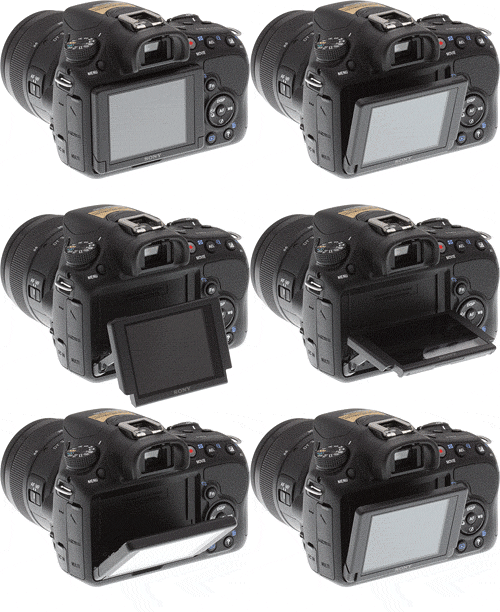
We've already noted the lack of a tilt-swivel articulation mechanism, replaced with a tilt-only mechanism. This allows a viewing range from 135 degrees upwards to 55 degrees downwards, and so cannot provide for portrait framing. The display itself is the same 2.7-inch size used in the A37. That's below both the size used for the A57, and the average for a modern interchangeable-lens camera.
And in place of the high-res, reduced glare Xtra Fine TruBlack display used in the A57, the Sony A58 uses a lower-res 460,800 dot Clear Photo LCD. That's the same tech as in the A37, albeit with double the resolution of that camera's monitor.

Autofocus. Autofocus is largely unchanged in the Sony A58. As with both its predecessors, the new model uses a 15-point phase detection autofocus sensor, and as is standard for Sony's Translucent Mirror cameras, this is available at all times -- even during movie capture. Three points at the center of the array are cross-types, sensitive to detail in both horizontal and vertical orientations.
There's still no dedicated autofocus assist lamp, with the Sony A58 relying on its popup flash strobe to provide assist illumination. One change, however, is a new Lock-On Autofocus function. This couples information from the phase-detection autofocus pixels with that from the main image sensor, allowing subjects to be tracked as they pass between autofocus points, or as they stray outside the area covered by the autofocus sensor. This Lock-on function allows the camera to better determine when the same subject has arrived under an AF point, and thereby to resume tracking the subject.
Exposure. Although it has a dedicated autofocus sensor, the Sony SLT-A58 meters exposures using the main image sensor. It considers the scene as 1,200 separate zones, and offers a choice of multi-segment, center-weighted, and spot metering modes. The working range for metering is -2 to 17 EV at ISO 100, with an f/1.4 lens. Shutter speeds on offer range from 1/4,000 to 30 seconds, plus bulb. In all respects, this is unchanged from the A37 and A57.

Flash. The built-in flash strobe is also relatively little-changed. It still has a guide number of 10 meters at ISO 100, but this is now accompanied by a rather wider 16mm coverage. Recharging is a little slower, at 4 seconds according to Sony, where the A57 could recharge its strobe in 3 seconds. X-sync is at 1/160 sec., and the A58 supports wireless flash.
Hot shoe. As noted previously, the external flash hot shoe has been entirely replaced. Gone is the Konica Minolta-derived proprietary hot shoe that's featured on most previous Sony Alpha cameras, replaced with the new Multi Interface hot shoe. This not only supports standard flashes, but also integrates 21 additional pins embedded at the front of the shoe for interfacing all manner of accessories to the camera.
If you have Konica Minolta-style strobes, you can still use them, but you'll need to buy an optional adapter.
Features. Like the Sony NEX-3N alongside which it was announced, the Sony A58 has an updated Auto Framing function. This examines pictures as they're captured, then decides if the composition can be improved. If so, the camera will crop the image so as to best match its internal composition rules, then use a pattern-matching digital zoom function to enlarge the image back to full resolution. The end result, suggests Sony, is an image that's more pleasing, yet not of obviously lower image quality to the photographer. Previously, Auto Framing worked only for portraits, keying off the camera's face detection functionality. In the Sony A58, it also works for non-portrait photos. According to Sony, it will now recognize the subject in macro and action photos, and crop to improve composition with these subjects as well.
Sony has also retained its 'Clear Image Zoom' function, a 2x digital zoom that relies on the rather clumsily-named 'By Pixel Super Resolution' algorithms to upsample images to a higher resolution than that at which they were captured. Sony claims Clear Image Zoom to offer better results than competing digital zoom techniques because it uses pattern matching to improve the quality of the guessed data.

Creative effects. Of course, the A58 also includes a variety of other creative options, all of which were present in its predecessor. The camera's Picture Effects function has 11 modes, and a total of 15 possible effects. These include options like Retro Photo, Toy Camera, and HDR Painting, catering to those who prefer to do their post-processing in-camera. There's also a High Dynamic Range mode that combines multiple shots in-camera to yield a single image with broader dynamic range, and Sony's Dynamic Range Optimizer function that tweaks the tone curve automatically or manually to bring out shadow detail without sacrificing highlights. Finally, there's a Sweep Panorama mode that automatically captures and stitches images as you sweep the camera past your chosen scene, then saves the result as a single panoramic image.

Video. Video capture in the Sony A58 is also largely similar to that in the A57, but with one important difference, as noted previously. The SLT-A58's video capture still tops out at Full HD (1,920 x 1,080 pixels), but is now limited to a choice of an interlaced 60i or progressive-scan 24p capture rate at this resolution, instead of the progressive-scan 60p rate of the Sony A57. It also has a lower bit rate of 24 Mbps maximum, rather than the 28 Mbps of the earlier camera.
Like the A57, the Sony A58 provides movie audio with both a built-in stereo microphone in front of the flash hot shoe, and a standard 3.5mm jack for stereo external microphones. You can also attach the ECM-XYST1M mic shown on the right, which mounts on (and interfaces via) Sony's Multi Interface Shoe. The A58 isn't compatible with the higher-end XLR-K1M Multi Interface Shoe-mounted mic, though.

Connectivity. In addition to the mic jack, there's a variety of other connectivity options behind rubber flaps on the left of the camera body, including a DC input, Micro USB port and Micro HDMI high-def video port.
Sony describes the USB port as a multi-terminal, and it accepts a new RM-VPR1 wired remote control that provides a remote shutter button with lock, a zoom control, and a video button. Note however that support for Sony's RMT-DSLR1 wireless remote has been dropped.

Storage and battery. The Sony A58 includes a single card slot on which to store images and movies. It's compatible with either the relatively commonplace Secure Digital cards (including SDHC and SDXC types), or with Sony's proprietary Memory Stick PRO Duo and PRO-HG Duo cards.
Power comes courtesy of an NP-FM500H InfoLithium M 7.2v 1600mAh rechargeable battery pack.

It's the same pack used in the A57, but according to Sony's rating, battery life has been improved dramatically. The Sony A57 was CIPA-rated to 550 shots through the viewfinder, or 590 shots with the LCD monitor. The A37 -- which used a different pack -- lagged even further behind, with 450 viewfinder or 500 LCD shots.
The claimed improvement in the Sony Alpha A58 is night-and-day in this area, with 690 shots on the viewfinder, or 700 when framing with the LCD monitor. And Sony's claim gels well with what we found in the field: battery life from the A58 is very good, especially for an EVF-equipped camera.
Accessories. Alongside the camera, Sony also introduced several new accessories. A wired remote commander -- the RM-VPR1 -- connects to the multi-terminal USB port, and is priced at around US$65.
For the multi-interface hot shoe, there's a new on-camera flash strobe, the HVL-F20M, offering wireless flash control, bounce capability, auto white balance compensation, and the ability to enable or disable flash by raising or lowering the flash head. The HVL-F20M flash strobe costs US$150, and has been available since May 2013.
Finally, there are three new Alpha-mount lens options. From most affordable to most expensive, these are the aforementioned DT 18-55mm F3.5-5.6 SAM II zoom (US$220), the Carl Zeiss Planar T* 50mm F1.4 ZA SSM prime (US$1,500), and the updated 70-400mm F4-5.6 G SSM II with faster autofocus and reduced flare / ghosting (US$2,200).
Conclusion
| Pro: | Con: |
|---|---|
|
|
Sony created its entry-level A58 DSLR by taking its well-regarded predecessors, the entry-level A37 and enthusiast-geared A57, adding some significant tech upgrades -- most notably its new 20.1-megapixel APS-C sensor -- and then making just a few compromises to deliver the new model at a price point that's a full $200 lower than the A57. In doing so, the A58 effectively replaces both previous models (which have been discontinued). But does the camera split the difference and sit somewhere in the middle of these two cameras, or does it outshine them both?
Well, in terms of JPEG image quality, it's clear that the Sony A58 has taken a huge step forward. The higher-resolution sensor helps it deliver stunning photo quality that's sharper and more detailed than its predecessors'. In fact, the A58's images stack up well against those from much more expensive, enthusiast-level DSLRs. You can even get excellent 30 x 40 inch prints at ISO 100 and 200 from the camera, a finding that truly surprised us. Other big steps forward include a bright-and-clear, 1.44M-dot Organic LED viewfinder, the addition of Sony's proprietary Multi Interface hot shoe, and improved battery life.
Otherwise, the A58 borrows a lot of its tech from the A57, including the 15-point continuous AF system (with three cross-type points) which allows the DSLR to autofocus quite quickly and accurately in most situations. The physical design and size of the two cameras remain roughly the same. So does the control layout, save for a few minor differences.
One of the biggest changes, however, is that the A58 uses a plastic lens mount rather than a metal one. And while people may be turned off by this -- with the fear that the material may be flimsier and more breakable -- it must be noted that many manufacturers successfully employ plastic mounts on lenses these days. It's a calculated risk on Sony's part, and we're going to give them the benefit of the doubt on this one until we see how the plastic mount on the A58 lasts over time.
Other sacrifices made on the A58 include the lack of a 60p frame rate while recording Full 1080p HD, as was available on the A57. Despite that, the A58 still is a very good movie maker, offering 60i/24p frame rates and overall video quality that surpasses most of its entry-level rivals.
The increased 20.1-megapixel resolution on the new model also has a downside, as the same BIONZ processor featured on the A57 now only delivers a maximum speed of five frames per second in continuous burst mode, and the image buffer is also correspondingly more shallow.
It's a challenge to weigh the pros and cons of the Sony A58, especially since it's not an across-the-board step up from the A57. However, we think the advances in image quality make the camera a tremendous value for beginners. In fact, we believe the A58 produces arguably the best straight-from-the-camera photos across the board -- including in low light, high ISO situations -- of any entry-level DSLR we've tested to date. With the A58, Sony has once again served notice to Canon and Nikon that it's a force to be reckoned with in the DSLR arena. If that doesn't make the camera a Dave's Pick, then we don't know what does.
Follow Imaging-Resource.com on Twitter!