

Overview
Updates:
02/12/2019: First Shots posted
03/06/2019: Performance posted

A few years back, Sony debuted two cameras which it said were the world's smallest to feature both a 30x zoom lens and a built-in viewfinder, the pocket-friendly HX90 and its near-identical sibling, the HX90V. Now, those all-rounder compacts have successors, in the form of the Sony HX99 and (in some markets, but not the USA) the closely-related HX95.
A very familiar body hides major changes inside
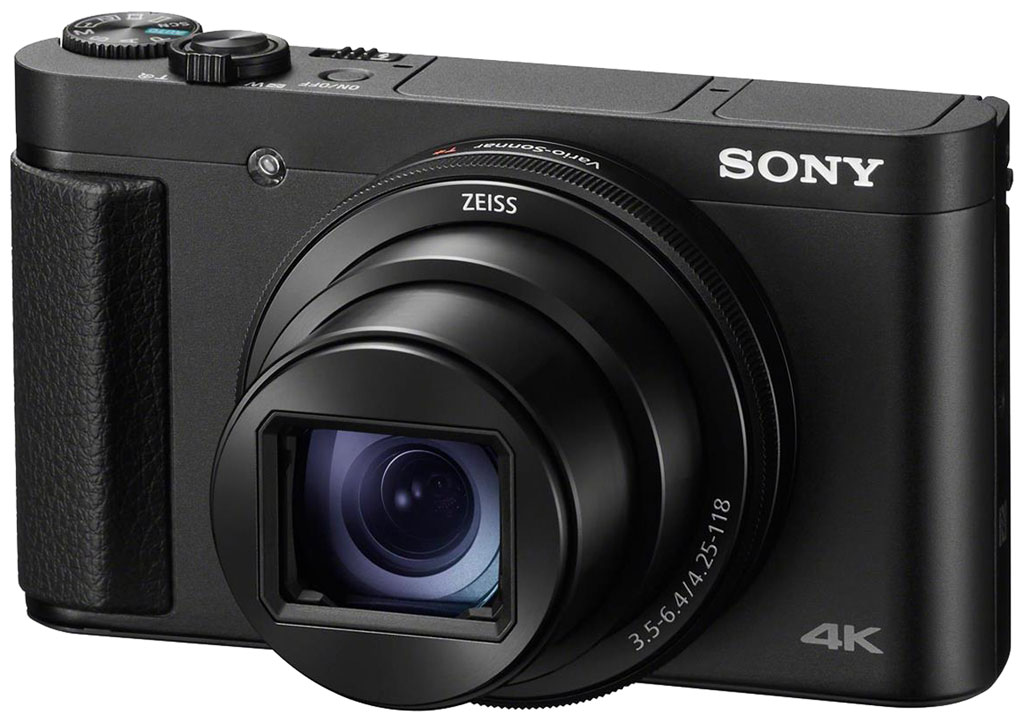
Externally, the new models look almost identical to those they replace, with differences only in some screen-printed markings and the texture of the front hand grip, which now matches the smaller rear thumbgrip texture. On the front, a 4K logo replaces the earlier 30x Optical Zoom badging, hinting at a change which we'll come to in a moment. And on the top deck, the Mode dial no longer distinguishes between iAuto and iAuto+ modes, combining both into a single position. The Panorama mode also loses its 'i' designation on the dial, and the extra position freed up by combining the Auto modes into a single item is used to add a second Memory Recall position to the dial.

But although the body is the same size and looks almost identical, there have certainly been some changes in the optical pipeline. The weight of the HX99 has grown by a scant two or three grams, and where the built-in long-zoom lens was previously a 30x zoom unit, it's been replaced by a slightly shorter 28x optical zoom. Yet curiously, Sony still says the HX99 has a 24-720mm equivalent zoom, which equates to a 30x range.
A brand-new lens with a slightly abbreviated zoom range
What this tells us is that the lens itself is new, and that even though its basic specifications look similar, the sensor may be new as well. And we know for sure that its output is handled by a new image processor, ably assisted by a standalone front-end LSI chip as in many of Sony's other recent cameras. So in other words, even though the HX99 looks quite similar to its predecessors, we can expect to see significant differences (and hopefully, improvements) on the image quality front.

So why do we believe the lens and perhaps sensor are new? As we noted, Sony now states that this is a 28x optical zoom, even as it lists a 30x equivalent zoom range. The company has also revealed that while the maximum aperture remains the same at wide-angle and telephoto, the actual focal range has changed noticeably. In place of the earlier 4.1-123mm f/3.5-6.4 lens, the Sony HX99 now uses a 4.25-118mm f/3.5-6.4 zoom.
(Note that while the maximum aperture at wide-angle and telephoto is identical, the available aperture somewhere in the middle of the range could easily differ between cameras, incidentally.)

A new processor, front-end LSI and perhaps sensor too
So the lens itself is certainly new, and a little quick math reveals that it's actually about a 27.8x optical zoom. So where does Sony get the 30x-equivalent zoom range of 24-720mm? The company could potentially be using a modest digital zoom at the telephoto end of the range. It could also be using a bit more of the sensor area at wide-angle, including pixels that ordinarily aren't used to create the final image at less-wide focal lengths. Sony doesn't specify a total pixel count for the sensor, and so we have no way to know which is the case (and it could even be both) until we lay our hands on the camera, though.
ISO sensitivity normally ranges from 80 to 3400, expandable to 6400. Using Multi-Frame Noise Reduction which composites four images captured in quick succession, up to ISO 12,800 equivalent is possible but without raw file support.
A touch-screen interface for quick and easy subject selection
So what else is new in the Sony HX99? Perhaps the next-most important change is the addition of a touch-screen overlay to the top-tilt style LCD monitor on the rear deck, which can be flipped upwards for selfie shooting. The touch panel allows not only touch focus and touch shutter functionality, but also can serve as a touch pad to control the active focus area when shooting through the dedicated viewfinder. (Which, incidentally, is still based around a 638.4k-dot, 0.2-inch Organic LED panel.)

A much bigger buffer and better movie resolution, too
Sony has also vastly increased the buffer size. Where previously, even with focus locked the HX90 and 90V were capable of a swift 10 frames per second but for only 10 frames, the HX99 is now capable of a whopping 155 Fine JPEGs in a focus-locked burst. There's also new 4K XAVC S-compressed video capture -- the HX90-series cameras topped out at Full HD in AVCHD-- as well as support for raw image capture, not just JPEGs. (That answers a frequent criticism of the earlier models.)
Battery life has fallen just slightly
Along with these changes, battery life has fallen just slightly, perhaps because of the power draw for the new front-end LSI chip and next-gen BIONZ X processor. Where previously, the HX90V was rated for 390 shots on a charge using the LCD monitor under standard CIPA testing conditions, the HX99 will manage around 20 frames fewer, at 370 per charge. That's from the same NP-BX1 lithium-ion rechargeable battery pack as before, incidentally. Storage options have changed, with support for an assortment of smaller MicroSD and Memory Stick Micro card types instead of SD and Memory Stick Duo cards.

What's the difference from the HX95?
Those of you in markets where both the HX99 and HX95 are available will doubtless want to know the differences between the two. There are only a couple of these: The HX99 sports a control ring around its lens which the HX95 lacks, and it also includes a touch-screen display that's absent in the lower-cost model. (Which means that if you want to use features like Touch Focus or Touch Shutter on the HX95, you'll need to do so by controlling the camera from your Android or iOS smartphone.)
Sony HX99 pricing and availability
Available from November 2018, the Sony HX99 is priced at US$450 or thereabouts in the US market. As noted at the outset, the HX95 is not available in the US market.
Performance
Timing and Performance
Very good performance for its class, but buffer clearing can be slow.
| Startup/Play to Record | ||
|---|---|---|
| Power on |
~2.3 seconds
|
Time it takes for LCD to turn on and lens to deploy and capture a picture. |
|
Play to Record, |
~1.3 seconds
|
Time until first shot is captured. |
Startup to first shot time was good for a compact long-zoom camera. Play to Record switching was reasonably fast.
| Shutter Response (Lag Time) | ||
|---|---|---|
|
Full Autofocus |
0.252 second
|
Time from fully pressing shutter button to image capture, zoom lens at wide angle position. |
|
Full Autofocus |
0.148 second
|
Time from fully pressing shutter button to image capture, zoom lens at telephoto position. |
|
Full Autofocus |
0.495 second
|
Time to capture while forcing flash to fire, zoom lens at medium focal length. |
|
Manual Focus |
0.029 second
|
For most cameras, shutter lag is less in manual focus than autofocus, but usually not as fast as when the camera is "prefocused". |
| Prefocused |
0.018 second
|
Time to capture, after half-pressing and holding shutter button. |
The Sony HX99's full autofocus shutter lag when shooting the same target multiple times was pretty fast for a compact camera. The HX99's full AF shutter lag clocked in at about 0.25 second at wide angle using center AF-S mode. Full AF shutter lag was even faster at full telephoto, at about 0.15 second. Enabling the flash raised shutter lag quite a bit to about 0.5 second, though, to account for the metering preflash. Manual focus shutter lag was quite fast at 29 milliseconds, and prefocused shutter lag was even faster at only 18 milliseconds.
| Cycle Time (shot to shot) | ||
|---|---|---|
| Single Shot mode |
0.71 second
|
Average time per shot. |
| Single Shot mode |
0.66 second
|
Average time per shot. |
| Early shutter |
No
|
Some cameras don't snap another shot if you release and press the shutter too quickly in Single Shot mode, making "No" the preferred answer. |
|
Speed Priority Continuous mode |
0.10 second
(10.0 fps); 103 frames total; 36 seconds to clear* |
Average time per shot. Slowed to an average of 0.32s or 3.1 fps when buffer is full with a lot of variation. |
|
Speed Priority Continuous mode |
0.10 second
(10.0 fps); 163 frames total; 28 seconds to clear* |
Average time per shot. Slowed to an average of 0.25s or 4.0 fps when buffer is full with a lot of variation. |
|
Speed Priority Continuous mode |
0.14 second
(7.3 fps); 50 frames total; 23 seconds to clear* |
Average time per shot. Slowed to an average of 0.17s or 6.0 fps when buffer is full with a lot of variation. |
|
Speed Priority Continuous mode |
0.14 second
(7.3 fps); 50 frames total; 41 seconds to clear* |
Average time per shot. Slowed to an average of 0.77s or 1.29 fps when buffer is full with a lot of variation. |
| Flash recycling |
5.9 seconds
|
Flash at maximum output. |
| *Note: Buffer clearing times measured with a Lexar 1000x 64GB UHS-II MicroSDXC memory card. Slower cards will produce correspondingly slower clearing times. Slow cards may also limit length of bursts in continuous mode. ISO sensitivity also affects cycle times and burst mode performance, with higher ISOs generally increasing cycle times and reducing burst performance. |
||
Shot-to-shot cycle times were good in single-shot mode, at about 0.7 second for Large/Extra Fine JPEGs or RAW + Large/Extra Fine JPEG files. We no longer test just RAW file cycle time in single-shot mode, as it's usually somewhere in between JPEG and RAW + JPEG.
The Sony HX99's Speed Priority continuous shooting mode burst rate was quite good when shooting just JPEGs, averaging exactly 10 frames per second in our tests. When shooting RAW files, the HX99's top burst speed slowed to 7.3 frames per second, but that's still pretty quick. Do note that Speed Priority continuous mode locks autofocus, exposure and white balance at the first frame of a burst, though. In Standard continuous mode, the HX99 managed 3.8 fps for best quality JPEGs and 3.2 fps for RAW and RAW + JPEG files.
Buffer depths were excellent at about 103 Extra Fine JPEGs, 163 Fine JPEGs, 50 RAW or 50 RAW + LEF JPEG files in Speed Priority mode. In the slower Standard continuous mode, there didn't appear to be a buffer limit during our testing. Buffer clearing was sluggish, though, taking between 23 and 41 seconds to clear after max-length bursts depending on the file type with our fast Lexar 1000x MicroSDXC card, though the HX99 does let you change settings and view just-shot images while the buffer is clearing.
The built-in flash took an average of 5.9 seconds to recharge after a full-power discharge, which is on the slow side.
Bottom line, the Sony HX99's performance in the lab was generally quite good for its class, with relatively quick startup, fast AF, low shutter lag and a speedy 10 fps full-res burst speed when shooting JPEGs. The camera does slow down to 7.3 fps when shooting RAW files, but that's still pretty fast. Buffer clearing was however quite sluggish, taking up to 41 seconds after a max-length burst of RAW + Extra Fine JPEGs with a fast card.
Battery
Battery Life
Good battery life for its size.
| Operating Mode | Number of Shots |
|---|---|
|
Still Capture
(CIPA standard, LCD Monitor) |
370
|
|
Still Capture
(CIPA standard, EVF) |
300
|
The Sony HX99 uses a custom NP-BX1 rechargeable lithium-ion battery for power, and the battery is charged in-camera via the USB port. CIPA-rated battery life is good for its class at 370 shots per charge when using the LCD monitor or 300 shots when using the electronic viewfinder. Still, we recommend you pick up a spare battery for extended outings.
The table above shows the number of shots the camera is capable of (on a fully-charged rechargeable battery as appropriate), based on CIPA battery-life and/or manufacturer standard test conditions.
(Interested readers can find an English translation of the CIPA DC-002 standards document here. (180K PDF document))