


Overview
- - -
Review Update:
Winner of our 2015 Camera of the Year awards for Best Premium Compact, the Sony RX100 IV packs a lot of performance into a pocket-sized camera. However, an updated model, the Sony RX100 V, is now available, which adds some stunningly impressive new performance and speed capabilities for burst shooting and continuous AF. Check out our RX100 V review here.
- - -
The evolution of the the large-sensor enthusiast compact continues with the Sony RX100 IV, a camera with some very worthwhile improvements over its predecessor, the RX100 III. Continuing the RX100-series that has defined the category, this handsome compact retains almost exactly the same pocket-friendly body as in the earlier model, but under the skin it's more capable than ever with greater performance and a much clearer viewfinder.

Most of the new features in the Sony RX100 IV come courtesy of its brand-new Sony Exmor RS image sensor, which replaces the earlier Exmor R chip in the RX100 III. Featuring an industry-first stacked CMOS sensor design with embedded DRAM, this allows not only a significant improvement in burst capture rate (now up to 16 frames per second at full resolution), but also provides for electronic shutter capability up to 1/32,000 second. And impressively, Sony is claiming that high-speed readout will translate to minimal rolling shutter (or jello) effect, even when using the electronic shutter!
Nor is that all. The new sensor also allows the Sony RX100 IV to provide for 4K video capture, and high frame-rate video at up to a staggering 1,000 frames per second. And there are upgrades in other areas, too -- for example, a brand-new Organic LED display in the popup electronic viewfinder that now has double the dot count of that in the earlier camera.
Sony has also included plenty of firmware tweaks in the RX100 IV. These include a new expanded flexible spot autofocus function, and an additional self-timer option of five seconds duration. And when shooting in Program or Aperture-priority modes, you can now access the longest shutter speed of 30 seconds that was previously restricted to only Shutter-priority or Manual shooting. Add in seven new Picture Profile options that allow you to control things like black level, gamma, black gamma, knee, and plenty more besides.
All of these new features sit alongside the same 24-70mm equivalent, f/1.8-2.8 optical zoom lens with SteadyShot image stabilization as in the earlier camera. Also retained are an ISO sensitivity range of 125 to 12,800 equivalents (extendable down to ISO 80), a BIONZ X-branded image processor, 3.0-inch LCD monitor with tilt articulation, and a built-in popup flash.
Priced at US$1,000 or thereabouts, the Sony RX100 IV began shipping from July 2015 in the US market.
Sony RX100 IV Slow Motion Video
Wow, this camera is a blast to use! (An actual blast, in a couple of our clips!) If you've never had a chance to play with super slow-motion video, you're in for a real treat!
Sony RX100 IV High Frame Rate Sample Video 1,920 x 1,080, MPEG, 480-960 fps Download Original (490.4MB MPEG) |
Given the pocketable nature of this little camera, the capabilities and image quality of the high frame rate (HFR) videos is quite impressive. Unlike most cameras, while there's some cropping depending on the frame rate and duration of the clip, the RX100 IV processes the video internally to deliver 1,920 x 1,080 video as the final product. So the highest-speed videos will look softer on playback, but the quality loss didn't detract from the fun we had with it in the slightest.
Sony RX100 IV slow motion: Capture frame rate ÷ file frame rate = Slow-mo factor
The Sony RX100 IV lets you choose the capture frame rate and the movie file frame rate separately, so you have a wide range of slow-motion effects available to you. The capture frame rate is pretty self-explanatory, it's the number of times per second the camera will be capturing new frames, with options of 240fps, 480fps, and 960fps. (If you set the camera to PAL video timing, the corresponding rates are 250fps, 500fps, and 1000fps.) The file frame rate is the frames/second that the resulting movie will be played back at, with options of 24/30/60fps in NTSC timing or 25/50fps in PAL mode.
The amount the action is slowed down is the ratio between the capture and file frame rates. For instance, at the low end of the scale, 240fps capture played back at 60fps would give a slowdown of 240/60 = 4x. At the other extreme, 960fps played back at 24fps gives a slow-motion factor of 960/24 = 40x. In between, there's quite a range of options, with choices of 4, 8, 10, 16, 20, 32 and 40x for NTSC videos. The corresponding factors for PAL timing are 5, 10, 20, and 40x. For more details on the various HFR modes available, see our Sony RX100 IV Technical Info page.
The video above has examples shot at 480 and 960 fps, played back at 24fps, so the slow-motion effects are 20x and 40x, respectively.
In the Box
The Sony RX100 IV retail box ships with the following items:
- Sony RX100 IV camera
- NP-BX1 lithium-ion rechargeable battery pack
- AC-UB10C USB charger (charges battery in-camera)
- Wrist strap
- Shoulder strap adapter
- Micro USB cable
- Instruction manual
- Warranty card
Recommended Accessories
- Extra NP-BX1 lithium-ion rechargeable battery pack for extended outings
- BC-TRX battery charger, so you can charge a spare battery while using the camera
- Large capacity SDHC/SDXC memory card. Given the high resolution and large file sizes of the RX100 IV, 32GB is a good tradeoff between cost and capacity for shooting stills. But if you plan to capture XAVC S video clips, a 64GB or larger SDXC card with UHS Speed Class U1 is required, and if you want to record 100 Mbps video, a 64GB or larger UHS Speed Class U3 card is required.
- AG-R2 attachment grip, or one of Richard Franiec's excellent accessory grips
- Small camera bag or medium to large pocket. ;-)
Optics
Lens Test Results
Zoom
A shorter than average zoom, with above average performance.


The Sony RX100 IV is equipped with a 8.8-25.7mm lens, offering a fairly limited optical zoom ratio of about 2.9x, translating to a 35mm-equivalent focal range of about 24-70mm. The lens is however very fast (bright), with a maximum aperture ranging from f/1.8 at wide angle to f/2.8 at telephoto, which is excellent for low-light shooting and provides reduced depth-of-field for better subject isolation. As is often the case with fast compact lenses, though, maximum aperture does fall-off rather quickly as you zoom, already reaching f/2.8 somewhere between 28 and 35mm equivalent. The following table reflects the maximum and minimum apertures as reported by the camera at some popular focal lengths:
|
Focal length (eq.)
|
24mm
|
28mm
|
35mm
|
50mm
|
70mm
|
|
Max. aperture
|
f/1.8
|
f/2.5
|
f/2.8
|
f/2.8
|
f/2.8
|
|
Min. aperture
| f/11 at all focal lengths | ||||
Far-field performance in general is quite good at f/5.6 as shown above, with very good sharpness and contrast across most of the frame, low chromatic aberration (the RX100 IV suppresses it) and only minor softening and coma distortion in the corners at full wide angle. Performance at full telephoto is also quite good with good sharpness and contrast across almost the entire frame, though some vignetting can be see in the extreme corners. See below for lab results on macro performance, geometric distortion, corner softness, etc.
Macro
A larger than average sized minimum coverage area, with very good detail. Flash throttled down well, but the lens casts a large shadow at minimum distance.


The Sony RX100 IV captured a larger than average sized minimum area measuring 3.83 x 2.55 inches (97 x 65 millimeters) at maximum wide angle. Sharpness over much of the frame is very good, but corners show quite a bit of softness even at f/8 (most lenses show some softening in the corners at macro distances). The flash did a good job throttling down, but the lens casts a large shadow in the bottom half of the frame. You'll likely want to use external lighting for the closest RX100 IV macro shots.
Geometric Distortion
Very low distortion in camera JPEGs, but very high in uncorrected RAW files at wide angle.
| Camera JPEGs |
| Pincushion distortion at wide angle is less than 0.1 percent |
 |
| Barrel distortion at telephoto is ~0.1 percent |
 |
Thanks to in-camera distortion correction, there's almost no geometric distortion in the RX100 IV's JPEG files. At full wide angle, we measured just 0.04% pincushion distortion. At full telephoto, barrel distortion is about 0.1%. This is the tendency for the lens to bend straight lines outward (like a barrel -- usually at wide-angle) or inward (like a pincushion -- usually at telephoto).
| Uncorrected RAW |
| Barrel distortion at wide angle is about 3.9 percent |
 |
| Complex pincushion distortion at telephoto is about 0.3 percent |
 |
To see how much correction is taking place in the camera, we converted RAW files from the above shots with dcraw, which does not correct for distortion. As you can see at wide angle, barrel distortion is extremely high, at about 3.9%, while telephoto shows low but complex "moustache-shaped" pincushion distortion at about 0.3%.
We expect to see fairly significant distortion in uncorrected RAW files in fast, compact lenses, as allowing this gives the lens designers greater flexibility in optimizing center sharpness and other aberrations, as well as in reducing cost, size, and weight. The downside is that the distortion correction contributes additional blurring to the corners of the frame where pixels are "stretched" during correction and where lenses are usually already a bit soft. Note that most RAW converters are capable of applying distortion correction automatically, as specified by the manufacturer in lens profiles embedded in RAW files.
Chromatic Aberration and Corner Sharpness
Very low to moderately low chromatic aberration in JPEGs. The lens produces some soft corners wide-open, though corner sharpness improves stopped-down.
|
Aperture: maximum
|
|
 |
 |
| Wide at f/1.8: Lower right C.A.: Moderately low Softness: Soft |
Wide at f/1.8: Center C.A.: Low Softness: Very sharp |
 |
 |
| Tele at f/2.8: Lower right C.A.: Low Softness: Soft |
Tele at f/2.8: Center C.A.: Very low Softness: Sharp |
Chromatic Aberration. Thanks to effective in-camera chromatic aberration suppression, there's moderately low to low C.A. to be seen in the corners at either wide angle or telephoto in JPEGs. As expected, though, uncorrected RAW files (see below) show much more C.A. than seen above.
Corner Softness. Wide-open at full wide angle, the lens in our sample showed a little decentering, with the right-hand corners showing more softness than the left-hand ones. The center is very sharp, and softness from the worst-case corner (lower right) doesn't extend very far into the frame. At full telephoto, it's the lower corners that are soft, even showing some image doubling, and the softness extends far into the frame from the bottom (the top corners are much better). The center is fairly sharp at full telephoto, though not as sharp as wide angle.
Vignetting. There's some vignetting (corner shading) as well, shown by how much darker the corner crops above are than those from the center, particularly at the telephoto end.
|
Aperture: f/5.6
|
|
 |
 |
| Wide at f/5.6: Lower right C.A.: Low Softness: Moderately soft |
Wide at f/5.6: Center C.A.: Very low Softness: Very sharp |
 |
 |
| Tele at f/5.6: Lower right C.A.: Very low Softness: Slightly soft |
Tele at f/5.6: Center C.A.: Very low Softness: Sharp |
F5.6: As is often the case, stopping down a few clicks significantly improved corner sharpness, contrast and chromatic aberration at both wide angle and telephoto, however the same corners were still softer than the others due to decentering. Sharpness in the center at wide angle remained about the same, however C.A. was reduced to almost nonexistent. Sharpness and C.A. in the center improved at full telephoto, though wide angle is still a bit sharper. We can also still see some minor vignetting at full telephoto, though it's no longer present at wide angle.
Chromatic Aberration Correction
| In-camera JPEG | Uncorrected RAW |
 |
 |
| Wide (f/5.6): Upper left CA: Low |
Wide (f/5.6): Upper left CA: Moderately high |
 |
 |
| Tele (f/5.6): Upper left CA: Low |
Tele: (f/5.6): Upper left CA: Moderately high |
As you can see in the crops from uncorrected RAW images on the right (taken from ARW files converted with dcraw), the RX100 Mark IV's lens produces moderately high and bright chromatic aberration at both maximum wide angle and full telephoto. But the RX100 IV's processor does a great job suppressing lateral chromatic aberration in camera JPEGs (crops on the left). Note that most RAW converters should also automatically suppress C.A. when converting the RX100 Mark IV's ARW files.
Overall, very good performance from the RX100 Mark IV's lens, especially considering how fast (bright) and wide it is.
Sony RX100 IV Viewfinder
Viewfinder Test Results
Coverage
Excellent accuracy from the LCD monitor and electronic viewfinder.


The Sony RX100 IV's LCD monitor and EVF both provide essentially 100% coverage at full wide angle and at telephoto. This is excellent performance, especially considering the amount of geometric distortion correction taking place at wide angle.
The images above were taken from our standardized test shots. For a collection of more pictorial photos, see our Sony Cyber-shot DSC-RX100 IV Photo Gallery .
Exposure
Color
Saturation & Hue Accuracy
Slightly below average saturation levels and hue accuracy.
 |
| In the diagram above, the squares show the original color, and the circles show the color that the camera captured. More saturated colors are located toward the periphery of the graph. Hue changes as you travel around the center. Thus, hue-accurate, highly saturated colors appear as lines radiating from the center. Click for a larger version. |
Saturation. The Sony RX100 IV pushes some colors likes strong reds, dark blues, dark greens, purples and some browns, but not as much as many camera, and it actually undersaturates light green, yellow and aqua tones moderately. The RX100 IV's overall mean color saturation of 108.5% (8.5% oversaturated) is a little lower than average these days, but the camera generally produces attractive yet realistic colors in its images. You can of course tweak saturation to your liking, or choose a non-default color mode. Most consumer digital cameras produce color that's more highly saturated (more intense) than found in the original subjects. This is simply because most people like their color a bit brighter than life.
Skin tones. Here, the Sony RX100 IV did fairly well, producing natural-looking Caucasian skin tones that were a bit on the warm side. Auto and manual white balance produced very similar results in simulated daylight. Where oversaturation is most problematic is on Caucasian skin tones, as it's very easy for these "memory colors" to be seen as too bright, too pink, too yellow, etc.
Hue. The Sony RX100 IV shifts aqua toward cyan, cyan toward blue, orange toward yellow, and yellow toward green by small to moderate amounts, but most other shifts are relatively minor. The cyan to blue shift is very common among the digital cameras we test; we think it's a deliberate choice by camera engineers to produce better-looking sky colors, and we don't find the resulting color objectionable. The RX100 IV's handling of yellows and yellow-orange colors is one of its weaknesses: Yellows are rendered closer to a yellow-green, and significantly undersaturated as well. With a mean "delta-C" color error of 5.93 after correction for saturation at base ISO, hue accuracy is just slightly below average, but still pretty good overall. Hue is "what color" the color is.


Sensor
Exposure and White Balance
Indoors, incandescent lighting
Auto setting produced reddish results, though Incandescent and Manual white balance worked well. Average exposure compensation required.


Indoors, under normal incandescent lighting, color balance was warm and reddish with the Auto white balance setting. Results with the Incandescent setting were pretty good, just a touch yellow. Color balance with the Manual setting was quite accurate. Note: The RX100 IV also has a Kelvin Temperature White Balance option, however we did not test that mode.) The Sony RX100 IV produced bright results (almost too bright) with +0.3 EV exposure compensation, which is about average required for this shot. (Our test lighting for this shot is a mixture of 60 and 100 watt household incandescent bulbs, a pretty yellow light source, but a very common one in typical home settings here in the U.S.)
Outdoors, daylight
Pleasing color and good exposure accuracy under harsh lighting.
Outdoors, the Sony RX100 IV performed very well for its class. +0.3 EV exposure compensation was required to keep the mannequin's reasonably face bright in our "Sunlit" Portrait shot, which is actually a bit less compensation than most cameras require. Contrast is a quite high as you might expect under such harsh lighting, but despite the bright appearance, the camera did a good job, holding on to the majority of highlights. Auto color balance performed well in our "Sunlit" Portrait shot, though Manual and Daylight white balance also produced very similar results. The Far-field shot with Auto white balance has very good color, just a touch cool. Default exposure is perhaps just slightly underexposed, but with very few highlights blown, and while there are some very deep shadows, detail in the shadows is surprisingly good for its class. However as expected, deep shadows do have moderate amounts luminance noise as well as some odd discoloration particularly in greens as the camera attempts to control chroma noise. Overall, though, very good performance in harsh lighting, especially considering DRO was off for these shots.
See full set of test images with explanations
See thumbnails of all test and gallery images
Resolution
~2,550 to ~2,600 lines of strong detail.


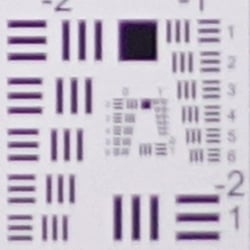
In camera JPEGs of our laboratory resolution chart revealed sharp, distinct line patterns down to about 2,600 lines per picture height in the horizontal direction, and about 2,550 lines per picture height in the vertical direction. Some may argue for more, but aliasing artifacts start to interfere at that point. Complete extinction of the pattern didn't occur until about 3,200 to 3,400 lines. Adobe Camera Raw produced similar results though complete extinction of the pattern didn't occur before the limits of our chart and color moiré was more visible. Use these numbers to compare with other cameras of similar resolution, or use them to see just what higher resolution can mean in terms of potential detail.
Sharpness & Detail
Crisp images with good detail, but area-specific noise reduction and sharpening can produce an overprocessed look, especially at higher ISOs.


Sharpness. The RX100 IV produces very crisp, sharp looking images with only minor sharpening haloes, but Sony's area-specific noise reduction and sharpening algorithms can lead to some unnatural or slightly crude looking results at higher ISOs. Edge enhancement creates the illusion of sharpness by enhancing colors and tones right at the edge of a rapid transition in color or tone.
Detail. The crop above right shows good detail for the class of camera, with moderate levels noise suppression in the darkest areas of the mannequins's hair, and almost no chroma noise. Quite a few individual strands are smudged together in areas of low contrast at base ISO, but performance here is actually quite good considering the size and resolution of the sensor. Noise-suppression systems in digital cameras tend to flatten-out detail in areas of subtle contrast. The effects can often be seen in shots of human hair, where the individual strands are lost and an almost "watercolor" look appears.
RAW vs In-Camera JPEGs
As noted above the Sony RX100 IV produces sharp, crisp and clean images, but fine detail can suffer as a result of aggressive default processing. Compare a base ISO in-camera JPEG to an Adobe Camera Raw conversion below to see what we mean.
|
Base ISO (125)
|
|
 |
 |
 |
 |
 |
 |
|
Camera JPEG, defaults
|
RAW via Adobe Camera Raw
|
In the table above, we compare an in-camera JPEG taken at base ISO using default noise reduction and sharpening (on the left) to a matching RAW file converted with Adobe Camera Raw 9.1 using default noise reduction with strong but tight unsharp masking applied in Photoshop (in this case 400% USM with a radius of 0.3 pixels and a threshold of 0).
As you can see, ACR produced quite a bit of additional detail that isn't present in the JPEG from the camera. Fine detail in the mosaic crop for example is more realistic and refined-looking from the ACR conversion, while the in-camera JPEG is much cleaner and more contrasty, but isn't as detailed or accurate. This is also true of the fabric crop, where ACR was able to resolve much of the thread pattern in the red-leaf swatch which the camera's JPEG engine presumably treats as noise, and also does a much better job reproducing fine detail in the pink fabric. But as is usually the case, more noise can be seen in the RAW conversion particularly in flat areas as shown in the bottle crop, thanks to ACR's light default noise reduction. You can of course apply stronger noise reduction (default ACR NR used here) to arrive at your ideal noise versus detail tradeoff. Color is improved as well, with ACR producing slightly warmer and more accurate colors while removing much of the yellow-to-green shift seen in the JPEG bottle crop. Bottom line: You can do noticeably better than the camera with a good RAW converter, provided you're willing to apply your own noise reduction and sharpening to taste.
ISO & Noise Performance
Very good high ISO performance for a camera its size.
|
High ISO Noise Reduction = Low
|
 |
 |
 |
| ISO 80 | ISO 125 | ISO 200 |
 |
 |
 |
| ISO 400 | ISO 800 | ISO 1600 |
 |
 |
 |
| ISO 3200 | ISO 6400 | ISO 12,800 |
ISO 80 and 125 produce very similar results, with very clean, crisp images containing almost no chroma noise. ISO 200 shows a very minor drop in image quality as noise reduction ramps, but fine detail is still quite good. ISO 400 shows an additional small step down in detail with very good overall image quality, but stronger sharpening attempts to compensate. At ISO 800, luminance noise is more noticeable, accentuated by fairly aggressive sharpening, but chroma noise is still welll-controlled and fine detail is fair. ISO 1600 is noticeably softer thanks to stronger noise reduction and more visible luma noise, but chroma noise is still very low and there's still some fine detail left. At ISO 3200, fine detail takes a larger hit, and the camera's aggressive processing produces images with a somewhat crystalline look in some areas. Image quality drops off very quickly from here, with ISOs 6400 and 12,800 looking more like impressionistic paintings than photos, with an almost hammered looked to flatter areas. Chroma noise in the form of diffuse purple and/or yellow blotches is also visible in darker midtones and shadows.
Overall, though, high ISO performance remains much better than average for a pocket camera, and noise performance is similar but perhaps slightly less heavy-handed compared to the RX100 III. (Note that we inadvertently had High ISO Noise Reduction set to Low instead of the default Normal setting for the above series, so these particular images aren't directly comparable to other cameras, unfortunately.) We're of course pixel-peeping to an extraordinary extent here, since 1:1 images on an LCD screen have little to do with how those same images will appear when printed. See the Print Quality section below for our evaluation of maximum print sizes at each ISO setting.
Note: We used to shoot this series at f/4 because of the relatively low light, but we now shoot it at f/5.6 or f/8 for 1"-type and larger sensors, as lens performance well away from center where we take the above crops is often not optimal at wider apertures. The added depth of field for a scene with this depth is also a better compromise than the potentially slightly sharper but shallower focus depth that a larger aperture would produce.
Extremes: Sunlit, dynamic range and low light tests
Pretty good dynamic range for its class. Good low-light performance, capable of capturing bright images in near darkness at all ISOs.


Sunlight. The Sony RX100 IV did fairly well under the deliberately harsh lighting in the test above. To keep facial tones reasonably bright, +0.3V compensation was required, which led to some clipped highlights in the mannequin's shirt and flowers, though not as many as we often see from smaller sensors. Some may prefer the +0.7 EV setting for its brighter overall exposure, but we found too many highlights were clipped. Detail is quite good in the shadows at +0.3 EV, though very deep shadows are a little grainy with some discoloration, though noise is fairly well controlled and fairly fine grained. Very good results in harsh lighting for such a compact camera, but consider using fill flash in situations like the one shown above; and it's better to shoot in the shade when possible.
Because digital cameras are more like slide film than negative film (in that they tend to have a more limited tonal range), we test them in the harshest situations to see how they handle scenes with bright highlights and dark shadows, as well as what kind of sensitivity they have in low light. The shot above is designed to mimic the very harsh, contrasty effect of direct noonday sunlight, a very tough challenge for most digital cameras. (You can read details of this test here.)
| Face Detection | ||
 |
 |
 |
| Aperture Priority, 0 EV Face Detection Off |
Aperture Priority, 0 EV Face Detection On |
Auto Mode, 0 EV |
Face Detection. Like most cameras these days, the Sony RX100 IV has the ability to detect faces (up to 8 in a scene), and adjust exposure and focus accordingly. As you can see from the examples above, face detection improved exposure in Aperture Priority at f/8, producing a slightly brighter face than without it by reducing the shutter speed from 1/50 to 1/40s. Full Auto mode is a also bit better than Aperture Priority without face detection, however it is still a bit dim. It selected a larger aperture of f/4 while using a relatively fast shutter speed of 1/160s, and automatically applied DRO (see below) to reduce overall contrast.


Dynamic Range Optimization is Sony's name for their dynamic range enhancement technology. DRO divides the image into small areas, analyzes the range of brightness of each area, and adjusts the camera's image processing parameters accordingly to make the best use of the available dynamic range. Auto DRO is enabled by default on the Sony RX100 IV. You can also set the level manually, from 1 ("weak") to 5 ("strong"), or turn it off. As one would expect, DRO is only available for JPEG files.
The above thumbnails and histograms show the effects of the various levels of DRO on our "Sunlit" Portrait shot with no exposure compensation. Mouse over the links on the right to load the associated thumbnail and histogram, and click on the link to visit the full resolution image. As you can see from the thumbnails and associated histograms, increasing DRO progressively boosts shadows and midtones while leaving highlights essentially intact, though boosting shadows does make noise slightly more visible. The Auto setting did a pretty good job overall, and the five manual levels give quite a bit of control over the effect.

Above, you can see the effect of DRO settings on our Far-field shot. The default Auto setting produced a nicely balanced exposure, despite the harsh lighting. A useful feature.
High Dynamic Range. The Sony RX100 IV's HDR mode takes three images in rapid succession, one nominally exposed , one underexposed, and one overexposed, then combines them into one high dynamic range JPEG automatically. Lighter areas from the underexposed image are combined in-camera with darker areas from the overexposed image to produce an image with compressed tonal range. The camera then saves a single composite image, as well as the nominally exposed image. The overlaid images are micro-aligned by the camera, but it can only correct for so much movement. If it can't micro-align successfully, an icon indicating HDR capture failed will appear. For best results, the subject should be static. There is also a manual mode where you can select 1 EV ("weak") to 6 EV ("strong") difference in exposures.
Mouse over the links above to load the associated thumbnail, and click on the link to visit the full resolution image. As you can see, the Auto setting did a decent job, similar to the 3 EV manual setting. Normally, the higher the manual setting, the more highlights are toned-down and shadows opened up, however the 4 EV setting oddly seemed to take a step back. As you can see, though, higher settings can produce flat and unnatural results. Watch out for ghost images and other artifacts from subject movement during the capture sequence, though, as can be seen in some of the shots above. (It seems the RX100 IV attempts to avoid ghosting by including a moving subject from only one of the frames, however this isn't always entirely successful.)
Dynamic Range Analysis (RAW mode)
While we once performed our own dynamic range measurements based on in-camera JPEGs as well as converted RAW images (when the camera was supported by Adobe Camera Raw), we've switched to using DxO Labs' results from their DxOMark website. As technology advanced, the dynamic range of modern high-end cameras in some cases exceeded the range of the Stouffer T4110 density scale that we used for our own measurements. DxO's approach based on RAW data before demosaicing is also more revealing, because it measures the fundamental dynamic range of the sensor, irrespective of whatever processing is applied to JPEGs, or to RAW data by off-the-shelf conversion software.
In the following, we use DxO's "Print" dynamic range results, which are scaled based on camera resolution. As the name suggests, this scaling corresponds to the situation in which you print at a given size, regardless of how many megapixels the camera might have. (In other words, if you've decided to make a 13x19 inch print, that's the size you're printing, whether the camera's resolution is 16 or 300 megapixels.) For the technically-minded, you can find a discussion of the reasoning behind this here on the DxOMark website. Also note that DxO Labs uses a signal-to-noise (SNR) threshold of 1 when defining the lower boundary of acceptable luminance noise in their dynamic range measurements, which corresponds to the "Low Quality" threshold of the Imatest software we used to use for this measurement.

Here, we decided to compare the RX100 IV (in orange) to its predecessor, the Mark III (yellow) as well as to the Canon G7X (red), which also uses a 1"-type 20-megapixel BSI sensor. You can always compare other models on DxOMark.com.
As you can see from the above graph (click for a larger image), the Sony RX100 Mark IV's dynamic range is very similar to the Mark III's, though it is slightly better, with up to about 0.4 EV advantage at medium ISOs; perhaps just discernible in real-world images. Maximum dynamic range is at base ISO, where the RX100 IV scores 12.6 vs 12.3 EV for the Mark III.
The Canon G7X's dynamic range is also very similar, but actually scored slightly higher than the RX100 IV at base ISO at 12.7 EV. That difference is however insignificant. It's interesting to note that DxO has detected that the Sony's are both applying some light spatial noise reduction to their RAW files at ISO 6400 and 12800 as indicated by the "smoothed" data points, while the Canon does not.
Overall, excellent dynamic range performance from the RX100M4 for a 1"-type sensor, and we're glad to see the faster stacked architecture actually helped rather than hindered dynamic range, however slightly. Click here to visit the DxOMark page for the Sony RX100 IV for more of their test results and additional comparisons.
| 1 fc 11 lux |
1/16 fc 0.67 lux |
1/16 fc No NR |
|
|---|---|---|---|
| ISO 125 |
 0.5s, f1.8 |
 8s, f1.8 |
 8s, f1.8 |
| ISO 3200 |
 1/50s, f1.8 |
 0.3s, f1.8 |
 0.3s, f1.8 |
| ISO 12800 |
 1/200s, f1.8 |
 1/13s, f1.8 |
 1/13s, f1.8 |
Low Light. The Sony RX100 IV performed very well in our low-light tests thanks to its fast lens, capturing bright images at the lowest light level (1/16 foot-candle), even at the base sensitivity setting (ISO 125). As expected for a 1"-type sensor, luma noise is a little high at ISO 3200, but fairly fine-grained, while chroma noise is well controlled. The RX100 IV's highest ISO of 12,800 is quite grainy with noticeable noise reduction artifacts, but that's no surprise.
Color balance is pretty good with Sony RX100 IV's Auto white balance setting, just a touch cool, even at highest ISO and lowest light level. We didn't notice any significant issues with hot pixels, pattern noise or heat blooming. (Some hot pixels can be seen with long exposure noise reduction disabled (rightmost column), but that's normal.)
The camera's AF system was able to focus unassisted to just above the 1/8 foot-candle light level in our tests, which is good. With AF assist lamp enabled, the RX100 IV could only focus down to about 1/4 foot candle, as the lamp overwhelmed the AF system. This of course will vary with subject and distance, though.
How bright is this? The one foot-candle light level that this test begins at roughly corresponds to the brightness of typical city street-lighting at night. Cameras performing well at that level should be able to snap good-looking photos of street-lit scenes.
NOTE: This low light test is conducted with a stationary subject, and the camera mounted on a sturdy tripod. Most digital cameras will fail miserably when faced with a moving subject in dim lighting. (For example, a child's ballet recital or a holiday pageant in a gymnasium.) For such applications, you may have better luck with a digital SLR camera, but even there, you'll likely need to set the focus manually. For information and reviews on digital SLRs, refer to our SLR review index page.
Output Quality
Print Quality
Very good 24 x 36 inch prints at ISO 80-125; a solid 11 x 14 at ISO 1600; a good 5 x 7 at ISO 6400.
 ISO 80 to 125 images look very good at 24 x 36 inches, with crisp detail and rich color reproduction. Print sizes up to 36 x 48 inches are fine for wall display purposes here.
ISO 200 prints also look good at 24 x 36 inches, with only a minor amount of softening occurring in fine detail such as our mosaic tile area of our Still Life test target.
ISO 400 yields a nice 20 x 30 inch print. There is a trace of softness in our target red swatch and a mild amount of noise in flatter areas, but nothing major.
ISO 800 images require a reduction in size to 13 x 19 inches in order to pass our "good" grade. Even at this size there is still a trace of noise in flatter areas of the target and a common softening in our tricky red fabric swatch, but otherwise a solid print overall.
ISO 1600 prints reveal too much noise at 13 x 19 inches to call good, but the 11 x 14 inch prints tighten up nicely, so we advise keeping it at or below that size here for your critical printing.
ISO 3200 delivers a good 8 x 10 inch print. There is no contrast detail remaining in our target red swatch, but that's very typical for all but larger sensors by this ISO.
ISO 6400 yields a good 5 x 7 inch print, which is not bad at all for a 1-inch type sensor, and the print shows a good amount of overall color saturation remaining.
ISO 12,800 prints a good 4 x 6, which yet again is not bad for this sensor size.
The Sony RX100 IV delivers print sizes that we expected, right in line with the predecessor model, the RX100 III. The Mark IV's big updates were primarily centered around the new stacked sensor, which is a technology more for improvements in speed than image quality. If you're debating between the two, the image quality difference is not a factor in terms of available print sizes.
The images above were taken from our standardized test shots. For a collection of more pictorial photos, see our Sony Cyber-shot DSC-RX100 IV Photo Gallery .
Not sure which camera to buy? Let your eyes be the ultimate judge! Visit our Comparometer(tm) to compare images from the Sony Cyber-shot DSC-RX100 IV with those from other cameras you may be considering. The proof is in the pictures, so let your own eyes decide which you like best!
Performance
Timing and Performance
Generally excellent performance, but buffer clearing can be slow.
| Startup/Play to Record | ||
|---|---|---|
| Power on |
~2.1 seconds
|
Time it takes for LCD to turn on and lens to deploy and capture a picture. |
|
Play to Record, |
~0.9 second
|
Time until first shot is captured. |
Startup to first shot time was about average for its class. Play to Record switching was quite fast.
| Shutter Response (Lag Time) | ||
|---|---|---|
|
Full Autofocus |
0.156 second
|
Time from fully pressing shutter button to image capture, zoom lens at wide angle position. |
|
Full Autofocus |
0.228 second
|
Time from fully pressing shutter button to image capture, zoom lens at telephoto position. |
|
Full Autofocus |
0.292 second
|
Time to capture while forcing flash to fire, zoom lens at medium focal length. |
|
Manual Focus |
0.018 second
|
For most cameras, shutter lag is less in manual focus than autofocus, but usually not as fast as when the camera is "prefocused". |
| Prefocused |
0.010 second
|
Time to capture, after half-pressing and holding shutter button. |
The Sony RX100 IV's full autofocus shutter lag when shooting the same target multiple times was very fast for a compact camera. The RX100 IV's full AF shutter lag clocked in at about 0.16 second at wide angle using center AF mode. Full AF shutter lag was a little slower at full telephoto, at about 0.23 second, but that's still quite good. Enabling the flash raised shutter lag to 0.29 seconds, to account for the metering preflash. Manual focus shutter lag was incredibly fast at 18 milliseconds, and prefocused shutter lag was even faster at only 10 milliseconds.
| Cycle Time (shot to shot) | ||
|---|---|---|
| Single Shot mode |
0.62 second
|
Average time per shot. |
| Single Shot mode |
0.61 second
|
Average time per shot. |
| Early shutter |
No
|
Some cameras don't snap another shot if you release and press the shutter too quickly in Single Shot mode, making "No" the preferred answer. |
|
Speed Priority Continuous mode |
0.06 second (16.00 frames per second);
40 frames total; 30 seconds to clear |
Time per shot, averaged over buffer size of 40 frames. We did not test buffer full speed. |
|
Speed Priority Continuous mode |
0.12 second (8.58 frames per second);
28 frames total; 14 seconds to clear |
Time per shot, averaged over buffer size of 28 frames. Then slows to an average of 0.62s or 1.65 fps when buffer is full. |
|
Speed Priority Continuous mode |
0.12 second (8.58 frames per second);
24 frames total; 20 seconds to clear |
Time per shot, averaged over buffer size of 24 frames. Then slows to an average of 0.91s or 1.10 fps when buffer is full. |
| Flash recycling |
4.5 seconds
|
Flash at maximum output. |
| *Note: Buffer clearing times measured with a SanDisk Extreme Pro 95MB/sec UHS-I SDHC memory card. Slower cards will produce correspondingly slower clearing times. Slow cards may also limit length of bursts in continuous mode. ISO sensitivity also affects cycle times and burst mode performance, with higher ISOs generally increasing cycle times and reducing burst performance. |
||
Shot-to-shot cycle times were good in single shot mode, at about 0.6 second for Large/Extra Fine JPEGs or RAW+Large/Fine JPEG files. Note that the Sony RX100 IV does not support capturing JPEGs using highest quality Extra Fine compression when shooting with RAW files, dropping JPEGs down to Fine quality. We no longer test just RAW file cycle time in single-shot mode, as it's usually somewhere in between JPEG and RAW+JPEG.
The Sony RX100 IV's Speed Priority Continuous shooting mode burst rate was outstanding when shooting just Extra Fine JPEGs, averaging exactly 16 frames per second in our test. When shooting RAW files, the RX100 IV's burst speed slowed to 8.6 frames per second for RAW or RAW+JPEG files, but that's still quite fast. Do note that Speed Priority Continuous mode locks autofocus at the first frame of a burst, though, however it can be setup to adjust exposure between frames. We didn't test the RX100 IV's standard continuous mode in the lab; Sony rates it at about 5.5 fps and continuous AF is supported.
Buffer depths were excellent at about 40 best quality JPEGs, 28 RAW or 24 RAW+JPEG files. Buffer clearing was sluggish, though, taking 30 seconds after a max-length burst of best quality JPEGs, 14 seconds for RAW, and 20 seconds for RAW+JPEG files with our 95MB/s UHS-I SDHC card.
The built-in flash took an average of 4.5 seconds to recharge after a full-power discharge, which is fair.
Bottom line, the Sony RX100 IV's performance was generally excellent with fast AF, very low shutter lag and an outstanding 16 fps full-res burst speed when shooting JPEGs. It does slow down to 8.6 fps when shooting RAW files, but that's still quite fast. Buffer clearing was however quite sluggish, taking up to 30 seconds after a max-length burst of Extra Fine JPEGs with a fast UHS-I card.
Battery
Battery Life
Fair battery life for its size.
| Operating Mode | Number of Shots |
|---|---|
|
Still Capture
(CIPA standard, LCD Monitor) |
280
|
|
Still Capture
(CIPA standard, EVF) |
230
|
The Sony RX100 IV uses a custom NP-BX1 rechargeable lithium-ion battery for power, and the battery is charged in-camera via the USB port. CIPA battery life is lower than its predecessors, but still fair for its class at 280 shots when using the LCD monitor, and 230 shots when using the electronic viewfinder. We strongly recommend you pick up a spare battery for extended outings.
The table above shows the number of shots the camera is capable of (on a fully-charged rechargeable battery as appropriate), based on CIPA battery-life and/or manufacturer standard test conditions.
(Interested readers can find an English translation of the CIPA DC-002 standards document here. (180K PDF document))
Image Quality
Below are crops comparing the Sony RX100 IV against the Sony RX100 III -- its immediate predecessor -- as well as the Canon G7X, Fuji X30, Nikon J5, and Panasonic LX100. All of the models in this comparison are either direct competitors to the RX100 IV in the premium, large-sensor compact camera market, or otherwise, such as with the Nikon J5, which shares a similarly sized 1-inch-type sensor.
NOTE: These images are best quality JPEGs straight out of the camera, at default settings including noise reduction and using the camera's actual base ISO (not extended ISO settings). Clicking any crop will take you to a carrier page where you can click once again to access the full resolution image as delivered straight from the camera. For those interested in working with the RAW files involved, click these links to visit each camera's respective sample image thumbnail page: Sony RX100 IV, Canon G7X, Fuji X30, Nikon J5, and Panasonic LX100 -- links to the RAW files appear beneath those for the JPEG images, wherever we have them. And remember, you can always go to our world-renowned Comparometer to compare the Sony RX100 IV to any camera we've ever tested.
Sony RX100 IV vs Sony RX100 III at Base ISO
 |  |
 |  |
 |  |
Sony RX100 IV at ISO 125 | Sony RX100 III at ISO 125 |
Despite the new sensor design in the RX100 IV, the resolution remains the same between these two models. The fine detail resolution is therefore very similar, though we can see slight differences, especially in the mosaic crop, with the Mark IV appearing a bit sharper. | |
Sony RX100 IV vs Canon G7X at Base ISO
|  |
|  |
|  |
Sony RX100 IV at ISO 125 | Canon G7X at ISO 125 |
Another pairing of 20.2MP cameras with 1-inch-type sensors seen here. JPEG processing differences are apparent when looking at the top bottle crop. Detail overall is great from both cameras at base ISO, though the mosaic detail from the Canon looks ever-so-slightly more natural. The fabric swatches look very similar, though the Sony handles the pink swatch a bit better. | |
Sony RX100 IV vs Fujifilm X30 at Base ISO
|  |
|  |
|  |
Sony RX100 IV at ISO 125 | Fujifilm X30 at ISO 100 |
The difference in resolution between these two cameras is very apparent in this comparison. Detail is quite good from the 12-megapixel 2/3-inch Fuji X30 sensor, but the Sony shows just what's capable from a larger, higher-res sensor. | |
Sony RX100 IV vs Nikon J5 at Base ISO
|  |
|  |
|  |
Sony RX100 IV at ISO 125 | Nikon J5 at ISO 160 |
Here we have another 20MP match-up, and detail resolution looks quite impressive from both cameras. The newer 1-inch-type sensor in the Nikon displays much better detail than we've seen in the past. The Sony edges out the Nikon, however, with crisper, sharper detail, and also handles the tricky fabric swatches a bit better. | |
Sony RX100 IV vs Panasonic LX100 at Base ISO
|  |
|  |
|  |
Sony RX100 IV at ISO 125 | Panasonic LX100 at ISO 200 |
Again we have a more striking difference in resolution (20.2MP vs 12.8MP), and while both do very well in their respective crops, the Sony RX100 IV shows more fine detail across the board by comparison, though on its own, the LX100 does a great job with fine detail here. Detail in the mosaic crop from the Panasonic is very clean and more natural-looking, while the Sony appears a bit more over-processed here by comparison. | |
Sony RX100 IV vs Sony RX100 III at ISO 1600
 |  |
 |  |
 |  |
Sony RX100 IV at ISO 1600 | Sony RX100 III at ISO 1600 |
Bumping up the ISO, we see a subtle but interesting change. The Mark IV, in the bottle crop, shows a bit more noise, but at the same time allows slightly more detail to come through than its predecessor. The same can be said ever-so-slightly on the mosaic crop. However, both cameras struggle with resolving detail in the fabric. | |
Sony RX100 IV vs Canon G7X at ISO 1600
|  |
|  |
|  |
Sony RX100 IV at ISO 1600 | Canon G7X at ISO 1600 |
Despite very similar sensors, the Sony edges out the Canon here in all three crops. Detail in the Sony images are crisper while maintaining good control of noise. | |
Sony RX100 IV vs Fujifilm X30 at ISO 1600
|  |
|  |
|  |
Sony RX100 IV at ISO 1600 | Fujifilm X30 at ISO 1600 |
The larger sensor in the Sony really shows its strength here compared to the Fuji. The Fuji's noise reduction processing is more apparent and really does a number on fine detail, especially in the fabric crops. | |
Sony RX100 IV vs Nikon J5 at ISO 1600
|  |
|  |
|  |
Sony RX100 IV at ISO 1600 | Nikon J5 at ISO 1600 |
| At ISO 1600, both cameras do well here in terms of noise control; the Nikon actually displays slightly less noise, though the Sony resolves more fine detail in the mosaic crop. The biggest difference here is in the fabric swatches, in which the Nikon has more difficulty resolving detail. | |
Sony RX100 IV vs Panasonic LX100 at ISO 1600
|  |
|  |
|  |
Sony RX100 IV at ISO 1600 | Panasonic LX100 at ISO 1600 |
The large resolution difference really makes this a difficult comparison. The Panasonic has a much lower resolution, but looking closely, you can see it has very well controlled noise at this higher ISO and also a very good amount of fine detail for this image resolution. The Sony, on the other hand, by comparison appears a bit softer and less detailed. | |
Sony RX100 IV vs Sony RX100 III at ISO 3200
 |  |
 |  |
 |  |
Sony RX100 IV at ISO 3200 | Sony RX100 III at ISO 3200 |
At ISO 3200, the RX100 IV shows slightly more noise again, like in the ISO 1600 comparison, and subsequently, shows a bit more fine detail in the mosaic crop than the RX100 III. Both cameras, however, really struggle with the fabric swatches, particularly the red one. | |
Sony RX100 IV vs Canon G7X at ISO 3200
|  |
|  |
|  |
Sony RX100 IV at ISO 3200 | Canon G7X at ISO 3200 |
Noise is pretty apparent here from both cameras, and really impacting fine detail. In the mosaic crop, in particular, the Sony just edges out the Canon with slightly more visible fine detail. Both cameras really have a tough time resolving any recognizable detail from the red fabric swatch, though the Sony handles the pink fabric slightly better. | |
Sony RX100 IV vs Fujifilm X30 at ISO 3200
|  |
|  |
|  |
Sony RX100 IV at ISO 3200 | Fujifilm X30 at ISO 3200 |
As with the earlier comparison, the larger sensor in the RX100 IV allows for much better handling of higher ISOs than the X30's smaller 2/3-inch sensor. The Sony displays less noise and more detail here in this comparison. | |
Sony RX100 IV vs Nikon J5 at ISO 3200
|  |
|  |
|  |
Sony RX100 IV at ISO 3200 | Nikon J5 at ISO 3200 |
The bottle crop from the Nikon is rather impressive, displaying crisper detail and less noise than the Sony's. However, the Sony takes the prize for more fine detail in the mosaic crop. Both cameras, on the other hand, struggle significantly with the fabric swatches at this ISO. | |
Sony RX100 IV vs Panasonic LX100 at ISO 3200
|  |
|  |
|  |
Sony RX100 IV at ISO 3200 | Panasonic LX100 at ISO 3200 |
Image resolution aside, the Panasonic, which is nevertheless based on a larger Four Thirds sensor, does a rather impressive job with well-controlled noise and lots of detail at this ISO. The Sony image appears noisier and with less fine detail by comparison. | |
Sony RX100 IV vs. Sony RX100 III, Canon G7X, Fujifilm X30, Nikon J5, and Panasonic LX100
 |  |  |  |  |  |
 |  |  |  |  |  |
 |  |  |  |  |  |
| Sony RX100 IV ISO 125 ISO 3200 ISO 6400 | Sony RX100 III ISO 125 ISO 3200 ISO 6400 | Canon G7X ISO 125 ISO 3200 ISO 6400 | Fujifilm X30 ISO 100 ISO 3200 ISO 6400 | Nikon J5 ISO 160 ISO 3200 ISO 6400 | Panasonic LX100 ISO 200 ISO 3200 ISO 6400 |
| Detail comparison. Comparing high-contrast detail, we can see that most, if not all cameras do well at base ISO. The Fuji X30, with the smallest sensor of the bunch, pulls up the rear with slightly less crisp fine detail. As the ISO increases, however, differences in resolution performance appear. The Sony RX100 IV definitely shows visible noise and softer detail at the higher ISO levels, but it's more or less on-par with the other 20MP 1-inch-type sensor cameras here, though the Nikon J5 struggles more at ISO 6400. Additionally, the Canon G7X resolves slightly more super-fine detail at the higher ISOs than the Sony cameras. The real standout, however, is the larger-sensored Panasonic LX100, which produces lots of fine detail all the way up the ISO scale, despite having a lower megapixel count than the competition. | |||||
Very good 24 x 36 inch prints at ISO 80-125; a solid 11 x 14 at ISO 1600; a good 5 x 7 at ISO 6400.
ISO 80 to 125 images look very good at 24 x 36 inches, with crisp detail and rich color reproduction. Print sizes up to 36 x 48 inches are fine for wall display purposes here.
ISO 200 prints also look good at 24 x 36 inches, with only a minor amount of softening occurring in fine detail such as our mosaic tile area of our Still Life test target.
ISO 400 yields a nice 20 x 30 inch print. There is a trace of softness in our target red swatch and a mild amount of noise in flatter areas, but nothing major.
ISO 800 images require a reduction in size to 13 x 19 inches in order to pass our "good" grade. Even at this size there is still a trace of noise in flatter areas of the target and a common softening in our tricky red fabric swatch, but otherwise a solid print overall.
ISO 1600 prints reveal too much noise at 13 x 19 inches to call good, but the 11 x 14 inch prints tighten up nicely, so we advise keeping it at or below that size here for your critical printing.
ISO 3200 delivers a good 8 x 10 inch print. There is no contrast detail remaining in our target red swatch, but that's very typical for all but larger sensors by this ISO.
ISO 6400 yields a good 5 x 7 inch print, which is not bad at all for a 1-inch sized sensor, and the print shows a good amount of overall color saturation remaining.
ISO 12,800 prints a good 4 x 6, which yet again is not bad for this sensor size.
The Sony RX100 IV delivers print sizes that we expected, right in line with the predecessor model, the RX100 III. The Mark IV's big updates were primarily centered around the new stacked sensor, which is a technology more for improvements in speed than image quality. If you're debating between the two, the image quality difference is not a factor in terms of available print sizes.
Field Test
Plenty of power in your pocket

New sensor design brings new features
The Sony Cyber-shot DSC-RX100 IV may look identical to the RX100 III, but there are numerous internal changes that lead to much improved capabilities and results, particularly for high speed photography and movie recording. The RX100 IV uses a new 1-inch-type CMOS sensor that features a stacked design, which allows for much higher speed shooting than the previous RX100 III.

Key Features
- 20.1 megapixel backside-illuminated Exmor RS 1-inch-type CMOS sensor with stacked design
- Native ISO range of 125-12,800, expandable to 80-25,600
- Compact camera body
- Pop-up XGA OLED electronic viewfinder
- 24-70mm equivalent f/1.8-2.8 lens
- 16fps continuous shooting
- 1/32000s electronic shutter
- 4K resolution video
- High-speed video recording

Small form factor causes some issues with camera handling
Like the three versions of RX100 before it, the RX100 IV is very small and light. The RX100 IV weighs only 10.5 ounces (298 grams) with a battery. When the camera is off and the lens is retracted, it can even be carried in a pants or jacket pocket. The electronic viewfinder is built-in, but uses a pop-up design, which helps to keep the camera small. A pocket-friendly camera comes with some compromises, however, such as not having much to hold onto and its buttons being small and close together.
With its smooth, matte finish, the camera looks great, however, this finish can be quite slippery. The RX100 IV doesn't have any front grip, which contributes to it being a difficult camera to get a good hold of. There is a Sony AG-R2 accessory grip available for purchase ($15 as of this writing) that looks like it would help improve the situation quite a bit. The included wrist strap, rather than a neck strap, didn't help to alleviate my worry about dropping the camera.

The lens has a control ring that has a diamond-knurled texture. The control ring itself is very narrow, as necessitated by the short length of the lens when retracted, but it means that there isn't a lot to hold onto when using the control ring to make adjustments. Additionally, the control ring rotates so smoothly that it can be difficult to use for making precise adjustments like selecting a shutter speed or aperture.
The 3-inch rear display is sharp and vibrant with 1,228,800 dots and can tilt 180 degrees upward and 45 degrees downward, but cannot swivel to the sides. The display has a sunny weather mode that greatly increases its usability in bright lighting conditions. However, with so many displays being touchscreen these days, especially on compact cameras, it's a surprising and unfortunate omission here on a camera packed with so many features.

The unique new sensor produces excellent images
The RX100 IV uses an all-new sensor that is the world's first stacked sensor. The sensor is a backside-illuminated 1-inch-type CMOS sensor, like previous RX100-series cameras, but this new Exmor RS sensor stacks memory and electronic components behind the light-sensitive surface. Compared to a traditional design, which doesn't stack components and also doesn't have the attached DRAM that the Exmor RS sensor does, the RX100 IV has 5x faster data readout. This improved performance allows for 4K video capture, a high-speed electronic shutter capable of 1/32000s shutter speeds, high-speed video recording, and a large reduction in the level of rolling shutter.
In my shooting, the RX100 IV produces excellent images, particularly at low ISO settings. Image files have accurate colors and excellent depth. I found that RAW files need a bit of sharpening, but JPEG files are sharp straight from the camera. RAW files provide a lot of flexibility for post-processing, including the ability to recover highlights and push shadow area detail very well. Both RAW and JPEG files exhibit an impressive dynamic range, which seems to be standard for Sony cameras these days.
24-70mm f/1.8-2.8 lens impresses throughout its range

Optical zoom on the Sony RX100 IV ranges from 24mm to 70mm equivalents. Click over to the Gallery Page to view the full-resolution images comprising this animation.
The RX100 IV's 24-70mm equivalent f/1.8-2.8 lens is excellent. The lens has a 10-element, 9-group design with 9 aspheric elements and includes a Zeiss T* coating. While a 2.9x optical zoom isn't a lot, and might not work well for everyone and the kinds of photography they do, the optical performance of the lens is impressive across its entire range. The lens is sharpest in the middle portion of its focal length range, from around 35-50mm, but it remains sharp at the extreme focal lengths as well. Distortion is well-controlled and aberrations are minimal and there are not any extreme cases of fringing. With that said, there is minor purple fringing around high-contrast fine details. I found that there is a decrease in sharpness around the edges of the frame when shooting wide open, but it's not dramatic. Vignetting is well-controlled across the focal length range.
RX100 IV Sharpness Comparison, 100% Center and Edge Crops (Click images for full-resolution file) |
|
 |
|
24mm f/1.8 Full Scene |
|
 |
 |
Center |
Right edge |
The lens can stop down to f/11 across the focal length range, but I found that sharpness is best between f/4.0 and f/8.0. If a large aperture is desired in bright conditions, rather than stopping the lens down, the RX100 IV has a built-in 3-stop neutral density filter that can be used to reduce the amount of light that reaches the sensor. The lens also produces a pleasing out-of-focus area with its seven-bladed aperture iris. The RX100 IV can focus fairly close as well, capable of close-focusing to just under 2 inches (5cm) at the wide ends of the lens and just under 12 inches (30cm) at the long end of the lens.

A small but capable camera out in the field
The RX100 IV generally handles well out in the field. The automatic shooting modes all work well and allow you to easily get excellent results. Despite being small and not having a wealth of external controls, the RX100 IV also allows as much manual control as you desire, including a fully manual exposure mode that utilizes both the lens control ring and control wheels on the camera for aperture and shutter speed control. If you want to manually focus as well, the lack of a second dial on the camera becomes problematic. In this case, you have to choose what the control dial on the back of the camera will control by pressing down on the control dial and switching between shutter speed and aperture.
There are a couple of particularly nice features to help improve usability and speed up making settings adjustments in the absence of a touch screen and without a lot of manual controls and dials. Firstly, there is the function (Fn) button, which brings up a table of 12 setting shortcuts, all of which can be customized. The default function arrangement worked fine for me and provided quick access to important camera settings such as white balance, autofocus mode, and the autofocus area mode. There is also a display mode called the "Quick Navi" screen. The Quick Navi screen provides an overview of relevant camera settings and provides the Fn menu along the right side of the display. Secondly, there's a customizable C button on the back of the camera below the control dial. You can assign any one of a very long list of functions to this button.

The built-in pop-up electronic viewfinder is a big upgrade from the RX100 III's electronic viewfinder. The 0.39" XGA OLED viewfinder has 2,359,296 dots, compared to the 1,440,000 dots of the RX100 III's electronic viewfinder. The viewfinder is deployed via a small switch on the left side of the camera body and requires you to pull part of it toward you to use, which then has to be pushed back in before you can push the viewfinder back down into the camera body. Although small and having only 0.59x magnification, the viewfinder works well and the pop-up design is impressive.

The RX100 IV offers standard exposure modes, including manual, aperture priority, shutter priority, and program modes on the mode dial. There is also Auto (which offers the choice between Intelligent Auto and Superior Auto), HFR (high frame-rate capture), Scene Selection, Panorama, and Memory Recall exposure modes on the mode dial as well. The RX100 IV works so well in its partially- and fully-automatic shooting modes due in large part to good metering performance. The RX100 IV offers multi-segment, center-weighted, and spot metering options. Unfortunately, spot metering is not tied to the AF point, but is rather fixed in the center of the frame. Multi-segment metering does a good job of evaluating the entire scene and choosing a good exposure. When the camera is not delivering the desired exposure, exposure compensation is easily accessed via either the function menu or by pressing down on the control wheel. White balance metering also performs well and the RX100 IV offers a large variety of white balance presets when more control is desired.

When shooting in fully automatic mode, the control ring can be used to change the focal length of the lens. There is a focal length scale that pops up when rotating the ring with labeled marks at 24, 28, 35, 50, and 70mm focal lengths. In other modes, the control ring is used to control different options, including aperture, shutter speed, ISO, focal length, or focus. It is difficult to be precise when using the control ring, as I mentioned earlier, because it rotates so smoothly and options are cycled through quickly.
Panorama mode works well on the RX100 IV. The camera does a good job at creating a seamless transition throughout the scene and the final images are processed quickly. The quality is quite good, although images are only 1,856 pixels tall when making a traditional horizontal panorama (the shortest dimension is 2,160 pixels when making a vertical panorama), so they aren't particularly high resolution. HDR shooting works well, too. HDR is activated through the function menu or the camera's menu when recording JPEG files. HDR can be set to auto or you can select an EV amount from 1 through 6 EV. The camera does a good job of quickly assembling an HDR image and it is easy to get a sharp image even when shooting hand-held.


The RX100 IV offers various Creative Styles and Picture Effects. The Creative Styles, such as vivid, neutral, black and white, and more, are all customizable. I liked using vivid with +1 Contrast, +1 Saturation, and +1 Sharpness to get vibrant and pleasing JPEG files straight from the camera. The black and white Creative Style works well too. The RX100 IV also offers Picture Effects, such as Toy Camera, Pop Color, Partial Color, High Contrast Monochrome, and more. I don't particularly care for these sorts of effects, but it's never a bad thing to have these options for those who enjoy them.

The RX100 IV's SteadyShot optical image stabilization works very well. I was able to handhold the camera and get sharp images at 24mm with shutter speeds as low as 1/10s. At 70mm, I was able to get sharp images at shutter speeds as low as 1/20s, but 1/30s shutter speeds delivered more consistently sharp results. The RX100 IV has improved Auto ISO capabilities that allow you to select minimum shutter speed. In addition to being able to select a minimum shutter speed, you can also change how quickly ISO changes as the necessary shutter speed for the conditions changes. Auto ISO can be set to faster/fast, which means that ISO sensitivity will change at shutter speeds faster than the 'standard' setting to prevent camera shake and blurring. If you're photographing subjects that don't require fast shutter speeds, you can set the auto ISO to slow/slower and the ISO sensitivity will change at shutter speeds slower than 'standard' so that you can shoot images with lower noise than the other auto ISO settings. The difference in shutter speed at which the ISO sensitivity starts to change between faster, fast, standard, slow, and slower is 1 EV. With the RX100 IV's great image stabilization, I wouldn't hesitate to opt for the slow/slower setting when not photographing moving subjects.
An area of concern that I have with using the RX100 IV is its limited battery life. When using the display, the RX100 IV is rated at 280 shots. When using the viewfinder, it's rated at only 230 shots. When recording occasional video, adjusting settings, and taking burst images, the battery drains quite. If I were planning to have the camera with me all day, I'd definitely invest in a spare battery to have fully charged and ready to go.
Quick and accurate autofocus in a variety of shooting conditions
The RX100 IV offers impressive autofocus performance. AF is quick and accurate across a variety of conditions, including low light. The Fast Intelligent AF System that the RX100 IV uses is upgraded from the RX100 III. The RX100 IV uses contrast detection autofocus, so situations of very low contrast can cause some issues and slow down autofocus performance, but the camera is generally quick and handled most of the situations I encountered very well.

There are numerous autofocus area options, including wide, center, flexible spot, expanded flexible spot, and lock-on AF, with the latter three offering adjustable size options. Wide autofocus area works well, with the camera choosing the subject and appropriate autofocus point(s) automatically from across the entire frame. I most often utilized the flexible spot AF area mode, however, changing the size and position of the spot as needed. Perhaps it's because I've used a large number of touchscreen cameras lately, but the use of a touchscreen for moving the AF area around the frame is often a quick and convenient way to shoot, and its a shame that the RX100 IV doesn't offer this convenience. Instead, you need to press the center button, move the autofocus point around the frame using the control wheel, and then press the center button again. While it's excellent that the autofocus points are numerous and cover such a large portion of the frame, it does mean that it can be a lengthy process to change the flexible spot from one area of the frame to another.

There are four autofocus drive mode options, AF-S, AF-C, DMF (direct manual focus), and manual focus. Given the camera's good autofocus performance, it's not surprising that the AF-S focus mode works very well. Continuous autofocus performance through the AF-C mode works well, too, managing to stay on the subject quite well during my testing when using flexible spot autofocus. Lock-on AF, on the other hand, is less impressive. It can work really well at times, but I found that it is too inconsistent to be relied upon. Lock-on AF (wide) works well when the camera is able to accurately identify the subject before you start shooting. If this is the case, focus stays on the subject quite well so long as it doesn't move too quickly or the lighting conditions do not change dramatically. Wide AF has a tendency to lock onto the brightest or highest contrast subject, so this is something to keep in mind particularly when continuously shooting. Center AF mode works fine, but the same performance can be achieved using Flexible Spot, which naturally has a lot more versatility. I found that when lock-on AF (wide) works well, it's similar to lock-on AF (flexible spot), but flexible spot is more consistent across a variety of conditions. When everything works correctly, lock-on AF is very impressive but a general lack of consistently fast performance is the only thing holding it back from being excellent.
In low light, the RX100 IV impressed me. Given the camera's use of contrast detection AF points, I expected low light AF performance to be a problem area, but like the camera's continuous autofocus performance, its low light autofocus performance was a pleasant surprise. Having not used any of the previous RX100 cameras, I can't speak to whether or not this is an area of improvement, but I found the RX100 IV to perform better than similar style cameras that I've used in the past at both being able to achieve focus in dim conditions and also the speed with which the RX100 IV can achieve focus in dim conditions.

Overall, the RX100 IV's autofocus performance is impressive. Despite using contrast-detection only, the RX100 IV performs well in both low-light and low-contrast conditions. Continuous autofocus performance is quite good as well, although not as consistently good as AF-S performance.
Impressive image quality at higher ISOs
Sony RX100 IV Noise Comparison (Click images for full-size files) |
|
 |
|
ISO 125 (Lowest Native ISO) |
|
 |
 |
ISO 80 |
ISO 125 |
 |
 |
ISO 200 |
ISO 400 |
 |
 |
ISO 800 |
ISO 1600 |
 |
 |
ISO 3200 |
ISO 6400 |
 |
 |
ISO 12800 |
ISO 25600 (Multi Frame NR, JPEG-only) |
The RX100 IV feels well-suited for low light shooting, as its high ISO performance is impressive when recording both RAW and JPEG files. With RAW images, visible noise starts to become apparent around ISO 800. Detail and contrast still remains very good at ISO 800, however. Visible noise gets quite a bit more apparent at ISO 1600 and contrast starts to noticeably decrease, particularly when looking at deep blacks. ISO 3200 just continues to increase the issues that I saw at ISO 1600, with noise becoming very noticeable and contrast continuing to decrease. ISO 3200 is the limit where I would use RAW files for large-format applications such as 16 x 20 prints or full-size digital files because the files retain a good amount of detail despite the high visible noise. ISO 6400 RAW files are very noisy and I wouldn't use them for anything beyond small web viewing because of the loss of detail. At ISO 12800, RAW files have little detail, excessive noise, and not a lot of contrast.

With "standard" in-camera noise reduction, JPEG files become overly smooth at higher ISOs. While the standard noise reduction manages to keep visible noise at acceptable levels for the entire native ISO range of 125-12800, images at and above ISO 1600 take on an odd, smooth appearance with drastically reduced detail and a blotchy appearance to areas that ought to have a consistent appearance, such as the sky. At ISO 3200 and above, JPEG files with standard noise reduction start to look as though they've had a kind of watercolor painting effect applied to them, which is not to my personal taste. When recording JPEG images, there is also an additional expanded ISO option available called Multi Frame NR that combines multiple shots into one ISO 25,600 file. I would not use this setting except for the purpose of documenting something I saw because there is almost no detail in the image files at ISO 25,600.
Sony RX100 IV Noise Reduction Comparison: ISO 3200 (Click images for full-res) |
||
 |
 |
 |
Noise Reduction "Off" |
Noise Reduction "Low" |
Noise Reduction "Standard" (default) |
JPEG images with no noise reduction applied to them retain good detail despite high levels of visible noise. For me, the best balance between reducing noise and maintaining an acceptable overall appearance is the "low" noise reduction setting. High ISO images captured with low noise reduction are only slightly less noisy than their RAW counterparts, but they still contain decent detail and contrast. If I were in a situation where I had to shoot above ISO 3200 and wanted to be able to use the files straight from the camera for large prints or to crop them extensively, I'd opt to use JPEG files with low noise reduction applied to them.

Like the RX100 III, the RX100 IV does not have a hot shoe. The built-in flash of the RX100 IV is quite handy, despite its small size with a range of approximately 0.4 to 10.2 meters at 24mm using auto ISO. At 70mm, the flash range is 0.4 to 6.5 meters. The flash works well as a fill flash, even in bright conditions and has a max flash sync of 1/2000s.

Overall, the RX100 IV handles well in low light and both the display and the EVF work great in dim light. As I discussed in the autofocus section, the RX100 IV's ability to autofocus in low light is quite good. Taking into account the f/1.8-2.8 lens and the RX100 IV's impressive results at high ISOs, I found that the RX100 IV is great in low light for a compact-class camera.

New sensor brings impressive speed
The RX100 IV uses the same BIONZ X image processor that is found in the RX100 III, but the new sensor allows for improved high-speed shooting performance. With better data throughput, the RX100 IV can continuously shoot full-size JPEG files at 16fps. There is a catch, however, as the RX100 IV cannot capture JPEG files at 16fps without locking the autofocus to whatever it was when the first frame was captured. Fortunately, exposure variables are unlocked in this Speed Priority Continuous Mode. When recording RAW and RAW+JPEG files in speed priority continuous mode, the RX100 IV can record bursts of 28 and 24 images respectively at 8.6fps, according to IR lab test results. With full autofocus capabilities, the RX100 IV can capture bursts at up to 5.5fps, which is nearly double the RX100 III's 2.9fps continuous shooting with full autofocus

Maximum shutter speed has also seen a dramatic increase with the new sensor design. The RX100 IV can capture images using its electronic shutter at shutter speeds up to 1/32000s. It's nice to have the electronic shutter capabilities when shooting at the bright, maximum aperture in very bright conditions. By default, the camera is set to automatically switch to the electronic shutter for shutter speeds exceeding the 1/2000s limit of the mechanical shutter, although you can use either shutter exclusively if desired.

The camera is quick to respond to changes in settings and the menus are responsive. The RX100 IV processes image files quickly as well. The camera can be a little slow to process large bursts, but most still images, including HDR images, are processed quickly. Standard video files are processed quickly, but high frame rate slow motion videos take however long the final video will be in length to process. For example, a 4 second (shooting time priority) clip at 960fps that will be displayed at 24p will take 2 minutes and 45 seconds to process.
4K and high frame video highlight an impressive set of features
Speaking of video, the RX100 IV offers numerous movie features and recording options that are both fun to use and good quality. The RX100 IV can record 4K (UHD) video at up to 30fps and Full HD video at up to 60fps. In addition, the RX100 IV offers some new, very interesting slow-motion video recording options, including slow-motion video at up to 960fps (1000fps if the camera is set to the PAL region).
The RX100 IV has a dedicated movie recording mode on the mode dial, but it can record video in standard shooting modes as well. There is a dedicated movie record button on the back of the camera to the right of the thumb grip that is used to start and stop movie recording throughout all shooting modes. In addition to the dedicated movie record button, the camera body has a stereo mic and HDMI out. HDMI can be used to output an uncompressed 4K video signal to an external device (even while recording 4K video it simultaneously, though the LCD screen on the camera will go black during recording).
As far as using the RX100 IV for video is concerned, it's user friendly. One issue that I experienced multiple times after recording an assortment of video clips is that the camera's internal temperature became too high and it shut down. It was sunny and 75 degrees outside, certainly not particularly unusual conditions for using a camera. I was able to start using the camera again after only a few minutes each time, but it was still concerning. The camera limits 4K record time to 5 minute clips at a time, most likely for heat-related issues, as well.
The camera performs very well when recording video overall. The camera meters exposure well and makes quick adjustments when lighting conditions change during recording. Exposure compensation can be used when recording video, if necessary. The focal length changes quietly and smoothly as well. Changes in aperture can be made during recording without any noticeable change in exposure, provided that the camera is set to an automatic mode. Autofocus performance is good, although in low-light the camera tends to hunt for focus. In good light, autofocus is quick and accurate. Unfortunately, you cannot use lock-on AF when recording video. The 4K videos that the RX100 IV produces are very sharp and impressive in detail. Although when shooting 4K video, or recording in XAVC format at all, the monitor brightness is locked at +/- 0, which can cause difficulties when recording video in bright conditions.
When using the High Frame Rate (HFR) mode on the mode dial, the RX100 IV can record various slow motion video. HFR clips are all captured at sub-1080p resolutions, but they are up-sampled to 1080p resolution and saved in the XAVC S format with selectable playback speed options of 24, 30, and 60fps. The clips are only 2 or 4 seconds long, but when played back, they are considerably longer because of the high frame rate of the capture. Frame rate capture options for NTSC come three-fold: 240, 480 or 960fps. You have the choice of quality or shoot time priority, with the duration of recording being 2 or 4 seconds respectively. Shoot time priority decreases the initial recording resolution in exchange for twice as long of a recording. For example, a video recorded with quality priority at 960fps is recorded at a resolution of 1,136 x 384 pixels whereas a shoot time priority video at 960fps is recorded at a resolution of 800 x 270 pixels. At these higher frame rates, video quality is noticeably low resolution, but the novelty of it is very high. It's a lot of fun to take slow-motion video.
Sony RX100 IV High Frame Rate Video Sample |
The RX100 IV is a very capable camera for video and packs a lot of performance and features into a small camera body. . Being able to capture high-quality video files in a wide variety of conditions at UHD resolutions is impressive. Further, for those using the RX100 IV as part of a multi-camera video shoot, or just those who want extensive control over video files, there are also a variety of Picture Profiles, including S-Log, available for use in both stills and video. Being able to capture video at frame rates approaching 1000fps is enjoyable, even if the actual quality isn't particularly high.
Mobile app delivers good features, but update the camera first
By default, the RX100 IV comes with the Smart Remote Embedded application, which offers remote control over its built-in Wi-Fi. The connection process over Wi-Fi is fairly standard, requiring me to start the application from within the camera's menu, select the camera via my mobile device's Wi-Fi settings, and then launch Sony's PlayMemories Mobile application. The connection process via NFC is supposed to be much simpler, letting you simply tap your NFC-enabled device and the camera together for an automatic app download and pairing between the mobile device and camera.
This default Smart Remote Embedded application does not offer much functionality at all, allowing only control of exposure compensation and focal length. You can't use touch focus, touch shutter, or change any other important camera settings. You can set a self-timer and change focus mode through the application's settings page, but that's about it.
If you want the Smart Remote Control application on the RX100 IV, which is much more functional than the default application, you have to download it to your camera via a Wi-Fi access point or install it to your camera from your PC. In either case, you have to have a Sony Entertainment Network account. The account and application are both free, but the fact that you have to go through the process rather than the camera having Smart Remote Control installed from the get-go is perplexing. There are additional applications that you can install as well, but many of them must be purchased, such as Time-lapse ($10), Star Trail ($10), Angle Shift Add-on ($5), and Motion Shot ($5).

Smart Remote Control is essentially the remote control application I'm used to seeing as standard on other cameras. It offers numerous controls over camera settings such as shutter speed, aperture, exposure compensation, and ISO via an on-screen slider menu. Focal length is controlled by tapping W or T on the right side of the mobile app's screen. Via the settings menu you can change white balance, self-timer, focus mode, touch shutter, review image size, live view quality, and location and display options. Default live view image quality is okay, but "image quality priority" is much better. In either case, the connection is consistent and on par with other mobile applications and cameras I've used. Touch focus and touch shutter are both nice options to have as well, which like many of above features, are absent in the default Smart Remote Embedded application. It is helpful that physical changes made to the exposure mode of the camera are also reflected in the application without having to restart the connection, which is an issue that I often have with other cameras and remote control applications.
Basically, the Smart Remote Embedded application is very limited and the Smart Remote Control application is good, so I would highly recommend downloading the Smart Remote Control application to your RX100 IV if you intend on using your mobile device to control the camera.

Sony RX100 IV Field Test Summary
The positives far outweigh the negatives

What I like:
- Compact camera body that can fit into a pocket
- Pop-up EVF is sharp and clever
- High-quality lens with a wide maximum aperture throughout the focal length range
- Very good image quality
- 4K video recording
- HFR video recording is a lot of fun to use even though the resolution is low
What I dislike:
- Despite the high quality of the lens, 24-70mm isn't a robust range
- A touchscreen would make the camera much easier to navigate and faster to use
- Battery drains rather quickly
- Default in-camera Wi-Fi app lacks features; need to install additional (free) app
The Sony RX100 IV continues in the excellent tradition of the RX100 series by delivering fantastic image quality, but also brings numerous new and exciting features to make the RX100 IV a great compact camera. While its street price of around $950 USD is quite high for a pocket cam, you get a lot of camera for the money. The new stacked sensor allows for a dramatic increase in speed throughout the camera. The RX100 IV possesses the versatility to be used as an excellent point and shoot, a fully-manual camera, or something in between the two extremes. While the built-in 24-70mm f/1.8-2.8 lens does deliver excellent results, its range is decidedly limited for my taste and what I like to shoot. If this focal length range will work for you and your photography, then I can't think of a better option in this class of camera than the RX100 IV.
Flash
Sony RX100 IV Flash

Flash Test Results
Coverage, Exposure and Range
A weak flash with somewhat narrow coverage. Typical for a compact, but range is helped by the fast lens.

Coverage. Flash coverage was somewhat uneven at wide angle, leaving very dark corners and edges in our flash coverage test image. Narrow coverage at wide angle isn't unusual, though, and some of the corner darkening is likely from the lens itself. We no longer test flash coverage at telephoto, as it is invariably better, making wide angle the worst case scenario.


Exposure. Our Indoor Portrait test scene came out quite dim in our normal flash test at f/4 and ISO 200, even with +1.0 EV flash compensation and a relatively slow 1/30s shutter speed. You'll likely want to raise ISO sensitivity further in similar situations. Slow-sync mode was brighter as you'd expect, with its slow shutter speed of 1/13s capturing more of the warm, ambient light.
| Manufacturer-Specified Flash Range |
|---|
| Telephoto |
 21.3 feet ISO 3200 |
Manufacturer Specified Flash Range Test. The Sony RX100 IV's flash range is rated 10.2m or 33.5 feet at wide angle, and 6.5m or 21.3 feet at telephoto, with ISO sensitivity set to Auto. 33.5 feet is too long for our lab but at the distance specified at full telephoto above, the Sony RX100 Mark IV produced a well-exposed flash target, though it boosted ISO to 3200 to achieve that result. We shoot this test shot using the manufacturer-specified camera settings, at the range the company claims for the camera, to assess the validity of the specific claims.
Technical Info
Sensor

Although it has the same size and effective resolution as that in the RX100 III, the Sony RX100 IV's 1.0"-type, 20.1-megapixel image sensor is brand new, and radically different in design to everything that precedes it. The Sony Exmor RS CMOS chip is still backside-illuminated, but it now features a stacked design that layers DRAM memory and A/D converters beneath the light-sensitive surface.
This design is, says Sony, a world's first, and it allows a significant improvement in performance. And not just in terms of burst shooting rate, either. It also allows for 4K video capture, an impressively swift 1/32,000-second electronic shutter function, *and* a huge reduction in the level of rolling shutter (or jello effect) when using the electronic shutter.
(Sony's marketing materials suggest that rolling shutter is basically eliminated, or is a least reduced to such a low level as to effectively make it a non-issue. We found that to be largely true for stills shot with the electronic shutter and for Full HD video shot at 60p as they both exhibited minimal jello effect even during fairly rapid panning. However, rolling shutter was still noticeable in 4K video as well as in Full HD video at slower frame rates, so don't be surprised if you see it in some situations.)
As in the Exmor R chip of the RX100 III, the Sony RX100 IV's Exmor RS image sensor has a 3:2 aspect ratio. While the effective resolution is unchanged, the total pixel count is increased just fractionally, from 20.9 megapixels in the earlier design to 21.0 megapixels in the new one.
Processor
Output from the Sony RX100 IV's brand-new image sensor is handled by the current-generation BIONZ X-branded image processor, which was also used by the earlier RX100 III.
Sensitivity
Together, the pairing of image sensor and processor produce the exact same ISO sensitivity range offered by the RX100 III.
For still imaging, the Sony RX100 IV offers everything from ISO 125 to 12,800 equivalents by default, with the option to extend the lower end of the range to ISO 80 / 100 equivalents. Movie capture allows the same standard sensitivity range, but not the extended sensitivities.
You can also reduce noise levels for relatively static subjects using a Multi-Frame Noise Reduction function. When enabled, this allows a maximum sensitivity of ISO 25,600 equivalent.
Performance
While the sensitivity range hasn't changed, there's been a big step forwards in terms of burst capture performance. Where Sony rated the RX100 III for a modest 2.9 frames per second, it now says that the RX100 IV will manage a much handier 5.5 frames per second, an improvement of almost 90%.
And that's in standard shooting. Enable Speed Priority Continuous mode, and the RX100 IV is manufacturer-rated for a seriously impressive 16 frames per second at full resolution. That's a 60% improvement over the already-swift rate of 10 fps set by the RX100 III. The catch in this mode is that autofocus is locked from the first frame, although the RX100 IV does at least continue to adjust exposure variables between frames in the Speed Priority burst.
In our lab testing the Sony RX100 IV performed as promised when shooting JPEGs, capturing full-resolution JPEGs at precisely 16 fps, for 40 frames. Outstanding. The framerate did however fall to 8.6 fps when shooting RAW files. See our Performance page for details.
(With the RX100 III in Speed Priority Continuous mode, we managed exactly 10 fps when shooting best quality JPEGs, and 6.7 fps with RAW or RAW+JPEG files.)

Lens
Perhaps the most significant feature Sony has retained intact from the predecessor camera is the Sony RX100 IV's 2.9x optical zoom lens. It's very bright, with a maximum aperture of f/1.8 at wide angle, falling to f/2.8 by the telephoto position. It's also a bit shorter than the lenses of the RX100 and RX100 II, however, with a 35mm-equivalent focal range of 24-70mm.
Just as in the earlier camera, it has a 10-element, nine-group design with no less than nine aspheric elements, including one crafted from two Advanced Aspheric elements cemented together. There's also a seven-bladed aperture iris, a Zeiss T* coating, and a built-in, three-stop neutral density filter that can be automatically or manually enabled or disabled.
Stabilization
And just as in the RX100 III, the Sony RX100 IV's lens also includes SteadyShot optical image stabilization for still images. When shooting movies, the more powerful Intelligent Active SteadyShot stabilization is use, and it's coupled with electronic compensation as well.
Focusing
The Sony RX100 IV uses contrast-detection autofocus, and has a minimum focusing distance of five centimeters at wide angle, or 30 cm at the telephoto position. Most autofocus options are the same as in the RX100 III, but there's one notable addition. As well as the Wide, Center, and small, medium or large Flexible Spot autofocus modes, there's also now an Expanded Flexible Spot AF mode. And of course, you can still opt for single, continuous or Direct Manual Focus servo modes, as well as fully-manual, fly-by-wire autofocus.
Viewfinder
Like the RX100 III before it, the Sony RX100 IV has a clever popup electronic viewfinder that adds relatively little to the size of the camera body, but which adds much to its versatility. It's not the exact same display, though. While the basic design is the same, including a switch on the left side of the body (when viewed from the rear) to manually deploy the finder, the Organic LED panel around which it has based is brand-new.
The total dot count of the display has been doubled, and now stands at 2,359,296 dots. That equates to a 1,024 x 768 pixel array, which should yield a 28% increase in linear resolution over the 800 x 600 pixel array in the earlier camera, all else being equal.
When the viewfinder is raised, the camera will power itself on automatically if need be. You then manually pull the rear element of the finder backwards a little to lock it in position. Sony rates the viewfinder at 100% coverage with 0.59x magnification and a 20mm eyepoint. It also has a five-step auto / manual brightness control, and a -4 to +3 diopter adjustment.
Monitor
On the rear side of the Sony RX100 IV is a 3.0-inch, 4:3 aspect Xtra Fine TFT LCD panel. It has the same dimensions and dot count -- 1,228,800 dots -- as that used in the RX100 III, and is quite likely the very same panel. It also still has a five-step brightness adjustment plus a Sunny Weather mode for better visibility in direct sunlight, however the Mark III's Auto brightness setting has been dropped.

Articulation
As in its predecessor, the Sony RX100 IV's LCD monitor is mounted on an articulation mechanism. It's not our favored side-swivel design, which is by far the most versatile option, but it's still much more useful than a fixed-position LCD. It allows the display to be tilted upwards a full 180 degrees for selfie shooting, or downwards by 45 degrees for shooting over your head.
Exposure
Exposure modes in the Sony RX100 IV are much as they were in the RX100 III, but with a couple of notable changes. One is the fact that there's now a single Auto mode on the mode dial, rather than the separate Intelligent Auto and Intelligent Auto+ modes seen previously. The other is a new HFR mode, for high frame-rate capture.
The program, priority and manual modes that you'd expect on an enthusiast-friendly camera remain, but there have been some tweaks here, too. You can can now access the slowest shutter speed of 30 seconds in program and aperture-priority shooting, not just in shutter priority and manual modes as before. There are also a variety of scene modes, a panorama mode, and a handy Memory Recall mode to quickly set the camera up for a common shooting situation.
Exposures are determined using multi-segment, center-weighted or spot metering modes, and shutter speeds range from 30 to 1/2,000 seconds with a mechanical shutter, or as fast as 1/32,000 second with an electronic shutter. There's also a bulb mode function and you can tune metered exposures with +/-3EV of exposure compensation in 1/3 EV steps.
Flash
If you need a little more light cast on your subject, a built-in flash strobe is provided. It's exactly the same as that in the RX100 III, with a range of 0.4 to 10.2 meters at wide-angle, or 0.4 to 6.5 meters at telephoto using auto ISO sensitivity.
Creative
We mentioned the panorama mode of the RX100 IV a moment ago, but there are quite a few other creative options to choose from, as well. Most of them will be immediately familiar to Sony camera owners, including dynamic range optimization, multi-shot modes like Handheld Twilight and Anti Motion Blur, bracketing for exposure, white balance and DRO, and so on. And of course, you can tune images to your tastes with picture effects and creative styles. What's new is a five-second option for the self-timer, in addition to the previous two or ten-second options with one, three or five shots captured once the timer expires.
Movie
The Sony RX100 IV has received a pretty significant upgrade in the movie department. Most notably, it can now record consumer-friendly 4K videos (3,840 x 2,160 pixels at up to 30p), where its predecessor topped out at Full HD (1,920 x 1,080 pixels). However, 4K footage is limited to just five minutes per clip, likely due to the difficulty of getting heat out of such a small body.
There's also now a wide selection of high frame-rate modes, with NTSC / PAL mode sensor readouts as follows:
-
1,824 x 1,026 pixels
-
240 / 250 fps (quality priority, two-second clip length)
-
-
1,676 x 566 pixels
-
480 / 500 fps (quality priority, two-second clip length)
-
240 / 250 fps (shoot time priority, four-second clip length)
-
-
1,136 x 384 pixels
-
960 / 1,000 fps (quality priority, two-second clip length)
-
480 / 500 fps (shoot time priority, four-second clip length)
-
-
800 x 270 pixels
-
960 / 1,000 fps (shoot time priority, four-second clip length)
-
HFR clips are upsampled to Full HD size (1,920 x 1,080) before being saved in XAVC S format with selectable playback speed options of 60p, 30p or 24p (50p or 25p in PAL mode).
The two and four-second capture length limits may not seem like much, but keep in mind capturing four seconds at 960 fps with a playback rate of 24 fps results in over 2.5 minutes of playback.
Standard speed movies include stereo audio, recorded courtesy of an on-board microphone on the top deck of the RX100 IV.

Wireless connectivity
Like its predecessor, the Sony RX100 IV includes both Wi-Fi and NFC wireless connectivity, allowing file transfer and remote control with Android or iOS smart devices, not to mention easy bump-pairing with Android.
Wired connectivity
As well as its wireless connectivity, the Sony RX100 IV also sports both a Micro (Type D) HDMI port for high-def video output, and a Multi Terminal Micro USB port that provides a USB 2.0 High Speed data connection to your computer. The Multi Terminal also supports an optional RM-VPR1 wired remote control and tethered remote shooting from a Windows or Mac computer running Sony's Remote Camera Control utility.
Storage
Images and movies are stored on a single slot compatible with either Secure Digital or Memory Stick Duo cards, and this is also compatible with SDHC, SDXC and UHS-I SD cards, not to mention PRO Duo, Pro Duo High Speed or PRO HG MS Duo cards.
Note that if you plan to capture XAVC S video clips, a 64GB or larger SDXC card with UHS Speed Class U1 is required, and if you want to record 100 Mbps video, a 64GB or larger UHS Speed Class U3 card is required.

Power
Power comes courtesy of a rechargeable NP-BX1 lithium-ion battery pack, the same type used in all earlier RX100-series cameras, and the battery is charged in-camera via the Multi Terminal Micro USB port. Sony rates battery life as 280 shots using the LCD monitor, or 230 shots with the electronic viewfinder, to CIPA standards. That's a fair bit less than the RX100 (330 shots), RX100 II (350 shots), and RX100 III (320 shots), but still fair for the class.
Tech2
Sony has retained almost exactly the same body design it used in the RX100 III for the followup Sony RX100 IV. Indeed, body dimensions are identical to those of the earlier camera, and weight is only increased by a scant eight grams.
Look closely, though, and there are a few subtle differences here and there.
Look at the front of the camera, and there's no way to tell the Sony RX100 IV apart from its predecessor. The lens still dominates the front deck, and there are no controls visible save for the front of the zoom rocker that protrudes from the top deck. There's still an AF assist lamp just above and to the right of the lens (as seen from the rear), and all of the same badges and markings remain just as they were in the RX100 III.
Once you move to the top deck, though, there are some subtle tweaks. Most notably, the control ring around the lens barrel now has a diamond-knurled texture, where in the past it had simple, longitudinal grooves. The change is largely cosmetic, but gives perhaps just a touch more grip as well.
Another change can be found on the mode dial. Where previously there were separate positions for Intelligent Auto and Intelligent Auto+ shooting (the latter allowing multi-shot capture), there's now a single combined Auto position. This frees up space for the new HFR position, providing access to the special high frame-rate modes that have been added in the Sony RX100 IV.
In other respects, the top deck, too, is unchanged -- at least, if you ignore the "RX100 IV", "Exmor RS" and "4K" branding.
No changes here. The controls, markings and features of the RX100 IV's back deck are all the same as those of the RX100 III.
As in the RX100 III, the LCD monitor is articulated, as you can see above. It tilts upwards 180 degrees for selfie shooting, or downwards 45 degrees for shooting over your head.
Other than the aforementioned change in the lens ring, there's again nothing new to see on the right-hand side of the Sony RX100 IV. Save for the Wi-Fi logo, Multi and HDMI connector flaps and wrist / neck strap eyelet, this side of the camera is pretty smooth and featureless.

We now come to the left side of the Sony RX100 IV. Just as on the other side, there are no changes of note here beyond the lens ring. The release switch for the popup electronic viewfinder remains just where it was, as does the NFC logo that indicates the location of the short-range antenna for pairing with Android phones and tablets.

Finally, we come to the bottom panel of Sony RX100 IV, which again remains identical to the Mark III, other than labelling.
Conclusion
Sony's supercharged premium pocket cam
Sony keeps upping the ante with their RX100-series of premium compact cameras. Now on its fourth-generation model, the Sony RX100 IV introduces a host of performance-oriented improvements and new features, including 4K video capture, 16fps continuous burst shooting and a very fun high frame rate (HFR) slow-mo video mode.
While the RX100 II introduced a new backside-illuminated sensor for improved low-light and high-ISO performance, the RX100 IV introduces yet another new sensor: a stacked CMOS design with embedded DRAM. This new 20.2MP chip is designed not so much for improved image quality, but rather vastly improved speed and throughput performance -- giving the RX100 IV it's impressive 4K and HFR slow-mo video capabilities, plus an electronic shutter with speeds up to 1/32,000s with very little rolling shutter artifacts!
Very good image quality, especially when using RAW
Image quality from the little RX100 IV is very good, though fine detail and critical sharpness is best when using RAW files. To our eye, JPEGs look a bit over-processed, especially at higher ISOs. And speaking of higher ISOs, despite not putting a strong emphasis on image quality improvements with its new sensor design, the RX100 IV nevertheless showed a slight improvement with higher ISO performance compared to the RX100 III. And like its predecessors, it still has much better high ISO performance than your typical enthusiast pocket cam thanks to its larger sensor and bright f/1.8-2.8 lens.
New sensor design leads to BIG video upgrades & new features
Where the RX100 IV really shines is with performance. In addition to very fast autofocus and very low shutter lag, the RX100 IV offers very fast 16fps burst shooting (with JPEGs only) and deep buffers despite the increase in burst rate compared to earlier models. When shooting RAW or RAW+JPEG, burst rate drops to a slower but respectable 8.6fps, which itself is an improvement over the 6.7fps RAW burst from the RX100 III.
Aside from still photos, the video shooting capabilities on the RX100 IV are where things really get interesting and fun. Despite its diminutive size, this pocket cam shoots and records excellent, high-quality 4K Ultra-HD footage and can also simultaneously record 4K video and output a clean, uncompressed 4K signal via HDMI. You can even record two video formats at the same time, kind of like RAW+JPEG, but instead with XAVC S + MP4 (or AVCHD + MP4).
See the unseen with High Frame Rate slow-motion videos
Perhaps the most fun new feature with the RX100 IV is the High Frame Rate video mode. You can capture super slow motion video at up to 960fps, and the camera itself crunches all the data and spits out processed slow-mo video -- no need to pull out the video editing software! The camera offers three different tiers of high-speed capture rates, up to 960 frames per second (NTSC; or 1000fps with PAL) and then also lets you set the playback frame rate down to 24p (for example: 960fps capture frame rate with playback set to 24fps would offer a final slow-mo factor of 40x slower).
The capture resolution for HFR videos is less than Full HD, unfortunately, with 960/1000fps offering at best 1,136 x 384 resolution. The videos are then up-sampled in-camera to a 1080p file. Yes, the image quality is noticeably affected and is nowhere near as crisp and detailed as a true 1080p video from this camera, but the image quality is good enough, we feel, and the simple fun-factor of recording these slow motion moments more than makes up for the lower resolution.
Similar design, but improved, higher-res EVF
On the physical side of things, not much was changed compared to the RX100 III. The overall size and design of the camera is practically identical with its slim, sleek bar-like shape, and the LCD screen still offers the full 180-degree front-facing tilt design. The RX100 IV keeps the nifty pop-up EVF, too, but the EVF's OLED screen gains double the resolution of the older model, making it all the more pleasing to use. The 24-70mm-equivalent lens also remains unchanged. And while we love the brighter f/1.8-2.8 aperture (compared to the f/1.8-4.9 of the longer-lensed Mark I and II models), we often found ourselves wanting a bit more reach, especially when shooting HFR videos of a small insect -- or a bullet through an apple -- for example.
Only a few frustrations
There are very few frustrations when using this camera, and the experience is fairly positive all around. However, we did find the battery life to be slightly underwhelming compared to the previous model -- though still decent for this class of camera. Close-focusing performance of the RX100 IV's lens is not as good as some of its competitors, as well, and we're still scratching our heads as to why Sony's yet to offer a touchscreen on an RX100-series camera. Oh, and this latest incarnation is the priciest RX100-series yet, with a retail price reaching just under the $1000 mark. (Ouch.)
RX100-series remains the top-dog among premium compacts
Overall, the Sony RX100 IV is an amazing feat of engineering and design. The amount of horsepower this little pocket cam offers is simply impressive. As with its predecessors, the image quality of the RX100 IV is very good, and a big step up compared to your average, small-sensored point-and-shoot. Its fast burst shooting capabilities and deep buffers make it easy to capture fast-paced action. And while it still uses just contrast-detect AF, the RX100 IV did surprisingly well with continuous AF performance and low-light AF. For video creators, the RX100 IV offers a host of significant improvements, including 4K, higher frame rates for full HD video plus awesome super-slow-mo video. Overall, with tons of performance and the excellent image quality we've come to expect, the Sony RX100 IV is quick, nimble and capable, though quite the pricey offering for a compact camera. Best of all, nevertheless, it simply slides back into your pocket when you're done!
All told, Sony squeezes so much good stuff into the slim yet robust RX100 IV that it's an easy Dave's Pick.
Pros
- Very high resolution gives crisp images with lots of detail at lower sensitivities
- 24-70mm eq. lens has generally very good optical performance for its type
- Very fast f/1.8-2.8 max. aperture offers better low light potential and subject isolation
- Much better high ISO performance than typical enthusiast pocket cameras; slightly improved over the Mark III
- Built-in 3-stop ND filter
- Very fast autofocus speeds
- Very low shutter lag
- Vastly improved burst speeds (16fps for JPEGs, 8.6fps RAW or RAW+JPEG)
- Buffers remain deep despite faster burst speeds
- Fun and useful multi-shot modes
- 4K video recording
- Dual Record mode lets you record to video formats simultaneously
- Super-fast high-speed video modes
- Up to 1/32,000 shutter speed with electronic shutter
- Electronic shutter display minimal rolling shutter effects with still photos
- Clean HDMI output while recording 4K internally
- Higher-res EVF
Cons
- Lens doesn't offer as much telephoto reach
- Macro performance not quite as good as some competitors
- JPEGs can look over-processed at higher ISOs
- Slightly below average saturation levels and hue accuracy
- Warm auto white balance indoors
- No hot shoe
- Battery life not as good as predecessor (but still fair for its size)
- Pricey
- Lack of a touchscreen
- Still can't capture RAW files and JPEGs at the "Extra Fine" highest quality setting
- Default Wi-Fi camera app lacks robust functionality; need to install additional (free) app
- Rolling shutter effects are apparent with 4K video (and other video resolutions & frame rates to a lesser degree)
Follow Imaging-Resource.com on twitter!