

Overview
Fuji announced the 10-24mm Æ’/4 R OIS lens at the end of 2013, but the world didn’t get its hands on it until several months later. The ultra-wide zoom lens offers an equivalent 15-36mm field of view, optical image stabilization, and a constant maximum aperture of Æ’/4.
The lens ships with a petal-shaped lens hood, takes 72mm filters, and is available now for around $1,000.
Sharpness
The Fuji 10-24mm Æ’/4 R OIS offers excellent results for sharpness across all its range of focal lengths, with a slight bias towards the wider angles, which is good, as it’s probably the reason people will get this lens.
Wide open at its widest angle (Æ’/4 at 10mm) the lens offers a generous central region of almost tack-sharp performance, with a very small area of corner softness. Stop down to Æ’/5.6 and the lens is almost tack-sharp across the entire frame. You’ll get results like this at almost all focal lengths, with the exception of 24mm, where sharpness is a little less impressive, and stopping down doesn’t improve it as much.
Diffraction limiting sets in at Æ’/11, but you won’t notice any practical difference until Æ’/16 or Æ’/22, where we note generalized softness across the frame.
Chromatic Aberration
We’ve noted in previous Fuji lens reviews that the X-E1 applies in-camera correction to CA, corner softness and distortion, and these corrections are even applied to RAW images in Adobe Camera RAW conversions.
The results for chromatic aberration tolerance are very good for the 10-24mm Æ’/4, no doubt aided by in-camera correction – however at the 20mm and 24mm focal lengths we do note an increase in CA as the lens is stopped down. It’s fair at 20mm and very noticeable at the 24mm focal length.
Shading (”Vignetting”)
Corner shading is essentially insignificant for the lens, again, aided by in-camera correction – the corners are around 1/4 EV darker than the center, at any focal length and aperture.
Distortion
Distortion is well controlled for the lens, no doubt corrected by the camera from what would be impressive barrel distortion at the wide end, and significant pincushion distortion at 24mm.
Autofocus Operation
The Fujinon 10-24mm uses an electrical autofocus system, which is very fast. The design is fly-by-wire, so there is no direct connection between the focusing ring and the autofocus system. Autofocus results are very quick, and near-silent. Also, attached 72mm filters will not rotate.
Macro
The 10-24mm isn’t a dedicated macro lens, offering only 0.16x magnification with a minimum close-focusing range of 24cm (around 10 inches).
Build Quality and Handling
The Fujinon XF 10-24mm Æ’/4 R OIS is a well-built lens, with an all-metal barrel construction and textured in a satin black finish. For a ultra-wide zoom lens, it isn’t all that heavy (just over 14 oz.), but mounted on the smaller X-mount bodies it does make for a package that’s not quite as compact as you might have hoped. The lens features optical image stabilization, which is activated or deactivated with a dedicated ”OIS” switch.
There are three rings for this lens: a zoom ring, a focusing ring, as well as an aperture ring, which is something of a rarity in modern digital camera lenses — though it’s been a standard feature on Fuji’s X-mount glass. The aperture ring sits closer to the lens body, around 3/8” wide. The lens features a selector, which allows the user to choose between auto-aperture mode, or manual aperture selection (you just have to remember that the “A” stands for Automatic, not aperture).
The zoom ring is 3/4” wide, with deep rubber ribs running parallel to the length of the lens. The zoom action is very smooth, going from 10mm to 24mm in a forty-five degree turn, with only a minor amount of force required to transition between focal lengths. The lens does not extend as it is zoomed out. Zoom creep was not a factor in our testing with this lens.
The focusing ring is about 1/2” wide, made of polycarbonate with deep grooves that offer excellent tactile feel. The lens uses a fly-by-wire system in its lens focusing operation, so the focusing ring is not actually directly connected to the lens elements in a mechanical way. Rather, turning the focusing ring moves the elements electronically. In practice this means the focusing ring will turn forever in either direction, and you’ll have to rely on the on-screen readouts to know if you have reached minimum or maximum focus.
There are no distance scales or depth-of-field information on the lens, but the X-E1 test camera we used offers a distance scale on its LCD or viewfinder readout.
Our testing of the OIS stabilization system showed around 2 stops of hand-holding improvement. Be sure to check our IS Test tab for more detailed information.
The petal-shaped, scalloped lens hood is made of plastic and attaches via standard bayonet mount. The hood is 1 3/4” long.
Alternatives
Fuji’s X-mount system is still (at the time of writing) in its relative infancy, and Fuji itself is still just starting to roll out a large set of lenses. More problematic for users looking for alternatives, is that Sigma and Tamron have not yet shown any interest in producing lenses in the X-mount.
Fujinon XF 14mm Æ’/2.8 R ~$900
Offers an extra stop of light-gathering ability, but corners are much softer at Æ’/2.8; at Æ’/4, the lenses are optically very similar.
Fujinon XF 18mm Æ’/2 R ~$600
Offers two extra stops of light-gathering ability, but the 10-24mm is overall much sharper.
Conclusion
There’s not a ton of choice for shooting wide-angle in the Fuji system – either this lens, or either of the 14mm or 18mm primes. That said, the 10-24mm Æ’/4 R OIS is a very capable performer, offering sharp results at every focal length with the possible exception of 24mm, plus the added versatility of a zoom design and OIS. If you want to shoot ultra-wide on a Fuji X-mount camera, there’s no alternative at this time that offers the same features.
Product Photos
 |
 |
 |
 |
 |
Sample Photos
Click here for Real-world Gallery Images on our Flickr page!
The VFA target should give you a good idea of sharpness in the center and corners, as well as some idea of the extent of barrel or pincushion distortion and chromatic aberration, while the Still Life subject may help in judging contrast and color. We shoot both images using the default JPEG settings and manual white balance of our test bodies, so the images should be quite consistent from lens to lens.


As appropriate, we shoot these with both full-frame and sub-frame bodies, at a range of focal lengths, and at both maximum aperture and Æ’/8. For the ”VFA” target (the viewfinder accuracy target from Imaging Resource), we also provide sample crops from the center and upper-left corner of each shot, so you can quickly get a sense of relative sharpness, without having to download and inspect the full-res images. To avoid space limitations with the layout of our review pages, indexes to the test shots launch in separate windows.
Description
(From Fujifilm lens literature) FUJIFILM North America Corporation has announced the new FUJINON XF10-24mm F4 R OIS, an ultra-wide 2.4x zoom lens with a 15-36mm equivalent that fits all FUJIFILM X-Series interchangeable lens cameras. With the introduction of the new XF10-24mm F4 R OIS, FUJIFILM now offers focal length options ranging from 15mm to 350mm (in 35mm equivalent).
The FUJINON XF10-24mm F4 R OIS features ultra-wide focal length capabilities that make it the perfect choice for shooting dynamic, high impact landscapes images with maximum detail from the foreground to far distances. With a maximum F4 aperture fixed through the focal range, the XF10-24mm F4 R OIS also provides outstanding low light image quality for stunning indoor pictures. Using precision-made, responsive, and finely-tuned metal aperture and focus rings, the XF10-24mm F4 R OIS ensures a superb handling experience that consistently delivers outstanding optical performance throughout its zoom range.
FUJINON XF10-24mm (15-36mm) F4 R OIS
- FUJIFILM X-Mount is compatible with all FUJIFILM interchangeable system cameras
- Powerful optical image stabilization minimizes shake and blur in low light
- Newly designed optical system uses 4 high-precision aspherical lenses and 4 extra low dispersion glass lenses which maximize performance of the FUJFILM X-Trans sensor
- HT-EBC*1 multi-layer coating to minimize ghosting
- Additional newly-developed coating added to the reverse side of the front lens to further reduce the ghosting that typically occurs when using deep concave lenses
- Enhanced resolving power at all apertures when used with an X-series camera*2 that incorporates a Lens Modulation Optimizer (LMO) function
- Seven-blade aperture diaphragm that helps create smooth and round bokeh effects
- Macro minimum working distance of 24cm
- 15mm equivalent has 91.6 degree of horizontal angle of view
- Inner focusing system drives smaller lenses in the middle or rear lens groups without
moving the larger lenses in the front lens groups for high-speed AF
The FUJINON XF10-24mm F4 R OIS lens will be available in March 2014 for US$999.95.
*1 High Transmittance Electron Beam Coating
*2 As of December 2013
Lab Test Results
Our standard lens lab tests, shot on a sub-frame (APS-C) body. Pick a focal length and aperture to see the result.
Sharpness (blur index)
Blur across the frame: lower and flatter is sharper. Change focal length and aperture to see how it improves when stopped down.

Chromatic aberration
Colour fringing in the corners at each focal length.

Vignetting (corner shading)
How much darker the corners are than the centre, by aperture and focal length.

Geometric distortion
Barrel (positive) or pincushion (negative) distortion across the zoom range.

Image Stabilization
Most people tend to think of image stabilization as being mainly for telephoto lenses. While it’s true that their longer focal lengths tend to magnify the effects of camera shake, image stabilization can provide a very useful assist at wider angle focal lengths as well; anyone who’s ever tried to blur the image of a waterfall, while keeping the surrounding landscape tack-sharp knows exactly what I’m talking about.
You don’t generally see optical image stabilization on wide-angle lenses, much less ultrawide-angle, simply because you can already shoot at pretty slow shutter speeds and get sharp results. That said, it’s a useful feature, and probably better to have it than not.
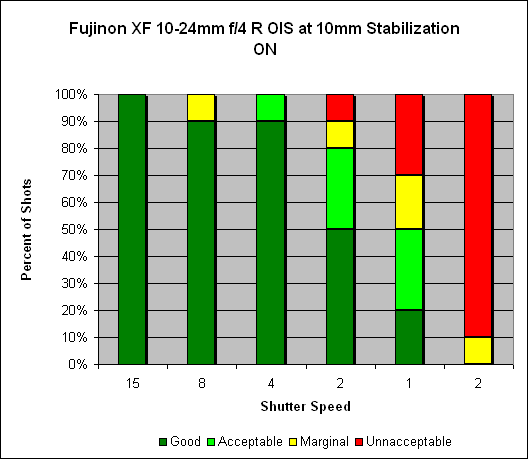
At 10mm, we see around two stops of improvement. With OIS turned off, we see 100% sharp shots at the 1/15 shutter speed, and 70% at 1/8s (the rule of thumb suggests the average shooter will get 100% stable shots at 1/10s at the 10mm focal length). With OIS activated, this turns into 90% sharp shots at 1/8 and 1/4s respectively.
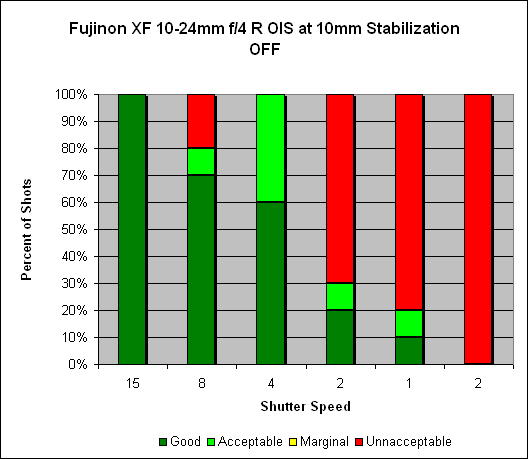 |
| Mouse over this chart to show results with IS activated. |
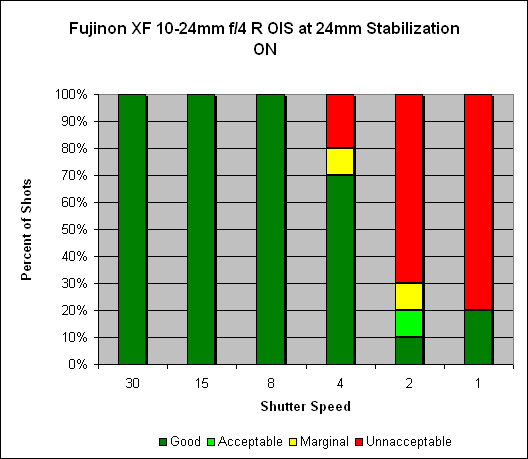
Zoomed in to 24mm, we also see two stops of improvement. Without OIS, we see 100% sharp shots at the 1/30 shutter speed; with OIS engaged, we have 100% sharp shots at speeds as slow as 1/8s (and 70% sharp at 1/4s).
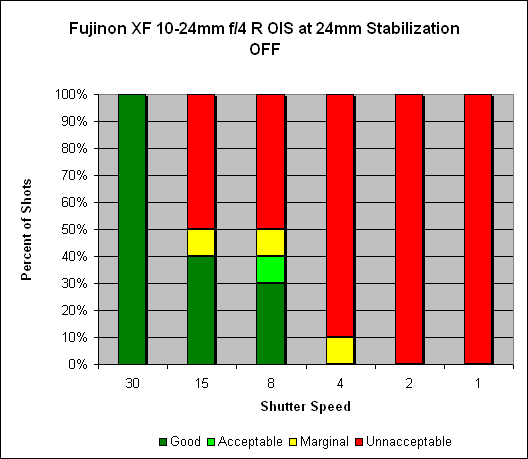 |
| Mouse over this chart to show results with IS activated. |
IS systems tend to provide more benefit to less-stable shooters than very steady ones, so most users will see the same or greater amounts of shake reduction as we measured here. You can read more about our IS test methodology here: SLRgear IS Test Methodology, v2.
Reader Reviews
- Image quality
- 9.2/10
- Build quality
- 9.5/10
- Recommend it
- 100%
- 10/10Recommendedby coma · December 7 2015
Pros: sharpness, build quality, contrast
Cons: no WR
It's a good lens and probably the best ultra wide zoom for mirrorless (even better than both the Olympus 7-14 pro as well as the Sony 16-35)
It's sharp and contrast is high. Stopped down you get beautiful stars.
Still, I prefer the 14mm for it's size - however a weather resistent f/2.8 ultra wide zoom would be appreciated.
- 10/10Recommendedby lensemaster · June 16 2015 · paid $750
Pros: lightweight, sharp image
Cons: none as of yet
OK, so given I'm a fan of Fuji & wide angle shots, so may be slightly skewed to the positive here. Almost perfect image quality, lightweight and easy to handle. Have only used it for 2 projects so far, so will update if it changes, but no cons as of now. Sound investment for any level of photography aficionado. Didn't notice the softness at ƒ/16 or ƒ/22. Ref:
http://facultyandstaffclub.ca
http://ihowtolosefatfast.com
http://abbeyfieldsaskatoon.ca
- 10/10Recommendedby rdonson · January 21 2015
Pros: Well built, OIS, versatility, good design
Cons: none for me
I use this lens on my X-T1. I shoot RAW and process in LR 5.7.1. This may mask some of the optical shortcomings mentioned but since I get the results I'm looking for it doesn't matter to me.
This lens has been a joy for me to use. I use it for outdoors architectural shots and for indoors to get the lines of the space I'm in. I never imagined I'd appreciate OIS on a super WA lens but I do. Hand holding is FUN!
With my processing workflow this has continually rewarded me with very good images. Its a delight. For me its rather compact and not overly heavy. In the hand its easy to use and very smooth to zoom and focus.
I also have Canon DSLRs and a case of L glass and I don't find this gives up anything to a comparable L lens.
Since purchasing the X-T1 for walkaround use I've become a Fuji fan. I appreciate the design, engineering and build quality not to mention the benefits of mirrorless.
- 8/10Recommendedby zwagner · October 31 2014 · paid $799
Pros: Nice range, 10mm!, solidly built, smooth focus/zoom rings, pretty sharp, decent with flare
Cons: wicked high vignetting, sizable distortion, edges decent but not fantastic, aperture ring wonky/no hard markings
This lens is a solid 8 for me. I love Fuji's lenses, and have used most of them. The fit and finish of them is usually outstanding, and the optical quality of their lenses is consistently very good, and sometimes outstanding. I would say this is not their best effort, but that doesn't mean it's a not a worthy offering. Good, useful zoom range combined with a fixed aperture, and ooooh that 10mm wide angle. You can definitely get some expansive shots with this lens. It's not the widest I've used (14mm equiv would be), but close enough and wide enough to really make some astounding images.
That said, I don't get all the reviewers who are saying this lens has no or low distortion. That is simply not the case. Fuji imbeds their raw files with lens correction data, and Lightroom and others automatically apply these corrections during processing. That doesn't mean the lens is awesome. That means Fuji is letting software do a lot of the work for them. Is that okay? Well the lens is $1k not on sale, so you make the choice.
I use Capture One Pro for my editing, and when you turn off the lens correction, this lens shows significant barrel at 10mm. I haven't taken a significant look at the other focal lengths, but I've seen it goes from significant barrel to some decent pincushion as it gets to the long end.
Also? Vignetting is huge. And it is all over the place in the focal range.
CA isn't too bad from what I've seen so far; definitely better than some of the other wide lenses I've used.
Sharpness is great in the center at most focal lengths (sharpness all over suffers some at 24mm), but towards the edges it gets blurry. If you shoot jpeg with Fuji's LMO turned on, you definitely will not notice it as much, but it's still there. Uncorrected it is significant. But stopping down to 5.6 improves things, and by f8, things are pretty solid across the frame (though the edges still lag the middle).
Also, though not as much of an issue for me, the aperture dial on my copy of the lens is loose. Not as in turning; that is fine, but you can move it from side to side a bit on the body, which is a little disconcerting and something I've never seen from my other Fuji lenses with aperture rings. Plus the fact they didn't put the aperture numbers on the dial is just lame. For this price, come on. All fixed aperture lenses should have hard markings, zoom or prime. Period.
In the end, a couple things could have changed my rating: 1; they could have made it cheaper. I got mine for 799, but it was on sale. 699-799 should be the starting range for this lens in the current state. 2; improved the optics/aperture ring. Were the optics better and the aperture ring more solid, or even one of those things, I could have bumped the rating a point. And if both were solid, I would have given it a 10. As it is, it's an 8.
Good effort, Fuji, just not your best.
- 10/10Recommendedby pacslr14 · July 27 2014 · paid $1346
Pros: OIS, well balanced on X-T1
Cons: bulky
Fabulous Super Wide Angle lens. Great for architecture photography. Very little distortion. Slight chromatic aberation , easily correctable.
- 9/10Recommendedby gert57 · April 16 2014 · paid $999
Pros: rather light, good balance on XE-1, sharp, OIS, low distortion
Cons: ratherbig (not toooo big)
Very versatile lens, from very wide to moderate normal. Very handy for city shooting and landscape work. Good color rendition, good sharpness, OIS very handy in low light shooting.
Reader reviews were submitted by Imaging Resource readers and are shown as written.