
DJI Launches RS 5 Gimbal Globally With AI Subject Tracking and Improved Stabilization


Imaging Resource is reader-supported. When you buy through links on our site, we may earn an affiliate commission. How this works.
On this page
Table of Contents
 Intelligent Subject Tracking Comes to the RS Series
DJI has officially launched the RS 5 gimbal for the global market, roughly two weeks after its initial debut in China. The staggered release follows DJI’s now-familiar approach of launching new products domestically before rolling them out internationally.
Positioned as a step forward for professional video shooters, the RS 5 introduces enhanced subject tracking, improved stabilization, and longer battery life. Together, these updates push the gimbal further into the commercial and production-focused segment.
Our editor, David Schloss, is currently reviewing the DJI RS 5 gimbal, with a full review expected in the coming days.
Intelligent Subject Tracking Comes to the RS Series
One of the standout additions to the RS 5 is its new intelligent subject tracking module, borrowing a feature previously seen on the RS 4 Mini. The module allows users to initiate subject tracking directly from the gimbal’s touchscreen, enabling automatic framing during live shooting.
The tracking module attaches magnetically and does not require adapters or additional accessories, keeping setup quick and streamlined. DJI says the system can track people, vehicles, pets, or other objects, with human subjects detectable from up to 10 meters away, even in crowded scenes. If a subject briefly leaves the frame, the system is designed to re-acquire tracking automatically once they reappear.
Improved Stabilization and Smarter Handling
The RS 5 debuts DJI’s fifth-generation RS Stabilization Algorithm, which the company claims delivers a 50 percent increase in peak motor torque. The updated system is intended to provide greater stability during fast-moving shots and improved performance when shooting in vertical orientation.
The gimbal also incorporates second-generation automated axis locks, which unlock automatically at power-on and re-lock when the gimbal is powered off or enters sleep mode. DJI’s third-generation Native Vertical Switch returns as well, allowing for faster transitions between horizontal and vertical shooting without additional accessories.
A new Electronic Briefcase Handle expands shooting flexibility, making it easier to capture both high and low-angle shots while offering electronic control over footage. DJI has also added an on-screen Z-axis indicator, which provides real-time guidance to help operators adjust their movement and pacing to minimize vertical shake while walking.
Payload Capacity, Battery Life, and Connectivity
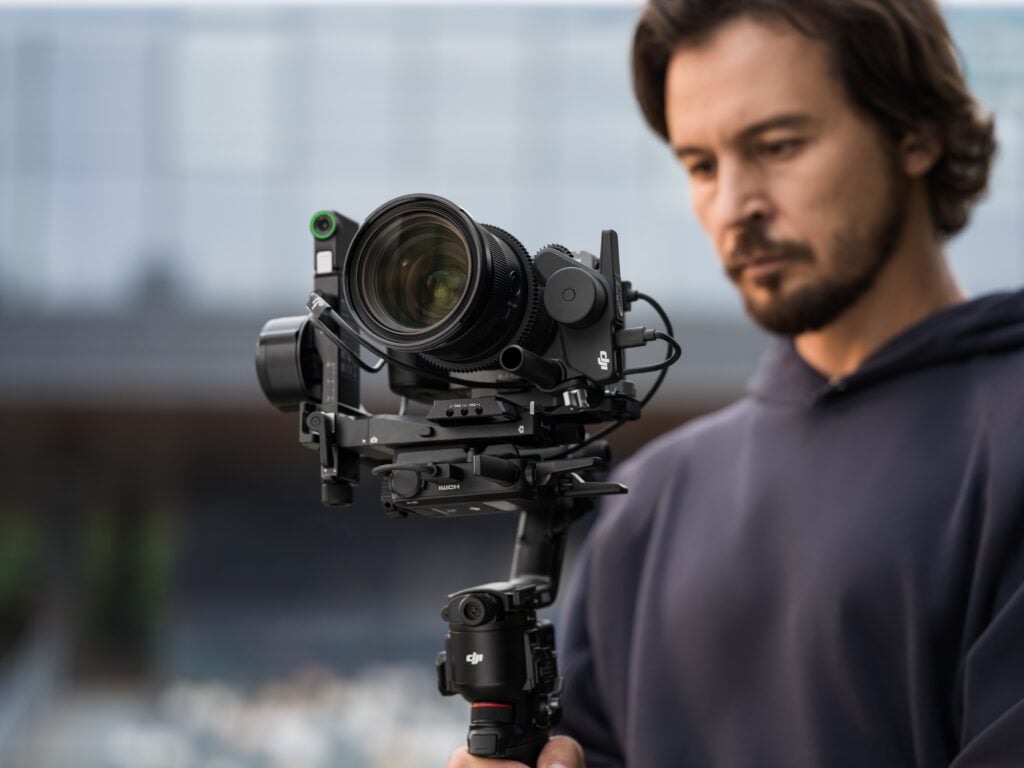
Weighing in at 1.46 kilograms, the RS 5 supports payloads of up to 3 kilograms, making it suitable for a wide range of mirrorless camera and lens combinations used in professional workflows. DJI rates the built-in battery for up to 14 hours of operation, with runtime extendable to as much as 30 hours when paired with the optional BG70 high-capacity battery grip.
Balancing has also been refined through new fine-tuning knobs on each axis arm, which use Teflon interlayers to allow smoother and more precise adjustments, particularly when working with heavier camera setups.
Connectivity sees a meaningful upgrade as well. Wireless camera control now supports Panasonic and Fujifilm systems, expanding beyond the previous generation’s Bluetooth shutter support, which was limited to Sony, Canon, and Nikon cameras.
The RSA communication port provides compatibility with the Electronic Briefcase Handle, RS Tethered Control Handle, and third-party ring handles, while the open RS SDK allows developers to build custom functions for the gimbal. Together, these options give creators flexibility to tailor the RS 5 to a wide range of shooting styles and production needs.
Pricing, Availability, and Ecosystem Support
The DJI RS 5 is now available globally through the DJI Online Store and B&H Photo, with a retail price of $569. Global prices may vary depending on the region.
As part of DJI’s broader ecosystem, the RS 5 is compatible with accessories such as the DJI Focus Pro Motors, allowing users to control focus and zoom via the gimbal’s control wheel. Support for the DJI SDR Transmission system enables high-definition live monitoring, remote camera and gimbal control, and collaborative workflows on set.
More in News
 NewsAdobe Partners With UMG and WMG to Bring Licensed Song Clips to Premiere Mobile3 Nov 2026
 NewsSony FX5 Starts Shipping in Europe, North American Deliveries Expected November 8–93 Nov 2026
 NewsAffinity for iPad Launches With Free Photo Editing, Vector Design, and Layout Tools3 Nov 2026
 NewsFujifilm X-T6 Rumored to Be Delayed Again3 Nov 2026
 NewsThe Insta360 Ace Pro 3 is rumored to be coming, but there’s one upgrade we really hope to see3 Nov 2026
 NewsCanon Warns Camera Prices Could Rise in 2027 if Memory Costs Remain High2 Nov 2026