
Nikon Unveils Flagship Sports Zoom With Built-In Teleconverter and VCM Autofocus

Imaging Resource is reader-supported. When you buy through links on our site, we may earn an affiliate commission. How this works.
On this page
Table of Contents
 Built-In Teleconverter Extends Reach to 420mm
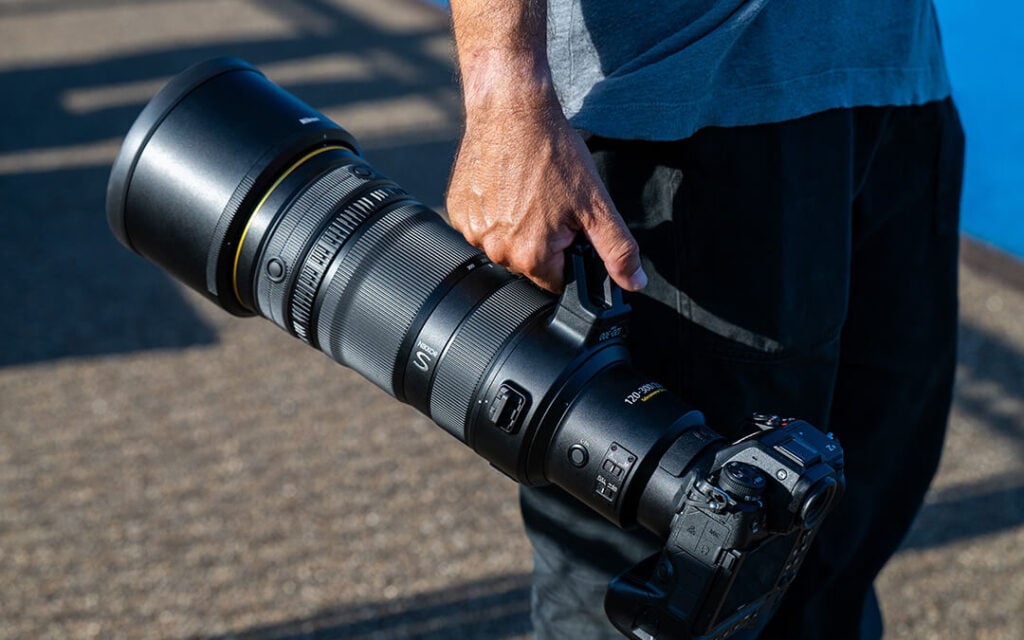
Nikon has officially announced the NIKKOR Z 120-300mm F2.8 TC VR S, a professional telephoto zoom lens designed for sports and action photography. The new S-Line lens combines a constant F2.8 maximum aperture with a built-in 1.4x teleconverter, extending its reach to 420mm without requiring photographers to change lenses.
Nikon first announced the lens’s development in May 2026. It serves as the Z-mount counterpart to the F-mount AF-S NIKKOR 120-300mm F2.8E FL ED SR VR, bringing the same general focal-length range to Nikon’s mirrorless system with a lighter design and an integrated teleconverter.
Nikon describes it as the world’s first interchangeable zoom lens with a constant F2.8 maximum aperture to feature a built-in 1.4x teleconverter, based on its research as of October 29, 2026.
Built-In Teleconverter Extends Reach to 420mm
The lens covers a 120-300mm focal-length range on full-frame Nikon Z cameras. Engaging the built-in 1.4x teleconverter extends that range to 168-420mm, giving photographers additional reach with the flick of a switch. When the teleconverter is engaged, the maximum aperture becomes F4.
The combination is intended for sports photographers who need to move between wider views of the action and tighter shots of athletes at a distance. Nikon specifically highlights applications such as tennis, soccer, motorsports, and indoor sports, including figure skating.
Using a DX-format crop mode with the teleconverter engaged extends the angle-of-view equivalent to approximately 630mm, providing further reach without an external teleconverter.
The constant F2.8 maximum aperture is particularly useful for indoor sports and other low-light situations. It allows photographers to maintain faster shutter speeds to freeze movement while keeping ISO sensitivity under control. The wide aperture also helps separate subjects from their backgrounds with shallow depth of field.
Optical Design and Coatings
The NIKKOR Z 120-300mm F2.8 TC VR S uses an optical construction comprising 30 elements in 24 groups. Its special elements include ED, fluorite, short-wavelength refractive, super ED, and aspherical elements, which are designed to control chromatic aberrations, color fringing, and distortion while maintaining sharpness and accurate color reproduction.
Nikon has also equipped the lens with Meso Amorphous Coat and ARNEO Coat. These technologies help suppress reflections, flare, and ghosting, particularly when shooting in backlit conditions or with strong light sources near the frame.
As part of Nikon’s S-Line, the lens is designed to deliver high resolution across the frame, with natural background blur and rendering intended to rival that of a prime lens.
Silky Swift VCM Autofocus
Autofocus is driven by Nikon’s Silky Swift Voice Coil Motor system, which combines a voice coil motor with a guide mechanism. Nikon says the system provides fast, precise, and smooth focusing, helping photographers track rapidly moving subjects.
The lens also uses an internal focusing system and an internal zoom mechanism. Its overall length remains constant during focusing and zooming, making it easier to balance on a tripod, monopod, or video rig.
Nikon has designed the lens to minimize focus breathing, which is beneficial for video work where changes in framing during focus transitions can be distracting.
Vibration Reduction and Professional Handling
The lens incorporates Nikon’s Vibration Reduction system, rated at up to 6.5 stops of compensation when used with a compatible camera supporting Synchro VR. This combines the lens’s optical stabilization with in-body stabilization to improve correction across the frame. Nikon’s rating is based on CIPA 2024 standards under specified test conditions.
Despite its built-in teleconverter, the lens weighs approximately 2,735g and measures 353.5mm long. That makes it around 515g lighter than the F-mount AF-S NIKKOR 120-300mm F2.8E FL ED SR VR.
The lens features a magnesium-alloy construction with extensive sealing against dust and moisture. Nikon notes that this resistance does not guarantee protection in every environment or shooting condition.
For professional use, the lens includes two customizable L-Fn buttons and a Memory Set button for quickly recalling a stored focus position. Its tripod foot incorporates an Arca-Swiss-compatible profile for easier mounting on compatible screw-type clamps. Nikon cautions against using lever-type clamps that may not secure the foot properly.
The supplied HB-120 bayonet hood is designed without protruding parts for easier attachment, removal, and storage. Photographers can use 112mm front screw-in filters or 46mm rear drop-in filters.
Pricing and Availability
The Nikon NIKKOR Z 120-300mm F2.8 TC VR S is listed at $13,996.95 and is available for preorder through B&H Photo. Shipping is expected to begin on November 12, 2026, according to the supplied retailer listing.
With its constant F2.8 aperture, built-in teleconverter, fast autofocus, and advanced stabilization, the lens gives professional sports photographers a versatile telephoto option without the need to carry a separate teleconverter.
Sample Images with the NIKKOR Z 120-300mm F2.8 TC VR S








More in News
 NewsLIFE Magazine to Publish Again 90 Years After Its Debut28 Oct 2026
 NewsApple Introduces Touchscreen MacBook Pro With M5 Pro and M5 Max28 Oct 2026
 NewsSony Unveils LYTIA 720 With 4K60p HDR Video and All-Pixel Autofocus28 Oct 2026
 NewsApple Announces New 14-Inch MacBook Pro With M6 Chip27 Oct 2026
 NewsGodox iM10 Is a Pocket-Sized Camera Flash Weighing Just 23g27 Oct 2026
 NewsThypoch Announces Sculptor AF 23mm F1.4, Its First Autofocus Prime27 Oct 2026