
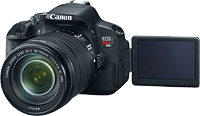
Touchscreen Canon T4i SLR, two new lenses unveiled, previewed!

Imaging Resource is reader-supported. When you buy through links on our site, we may earn an affiliate commission. How this works.
2012’s less than half gone, and it’s already been quite a year for Canon so far. It’s launched three new SLRs: a professional 1-series model, an enthusiast full-frame 5-series, and a special edition enthusiast APS-C model aimed at astronomers. It’s also debuted an entirely new concept, with the first large-sensor compact zoom camera. Today, Canon reveals its fourth new SLR of the year, with the unveiling of a new consumer Rebel-series flagship. We’ve just published a hands-on preview of the brand-new Canon EOS Rebel T4i (aka EOS 650D / EOS Kiss X6i), a model that follows in the footsteps of last year’s Rebel T3i. (That camera, and it’s sibling the Rebel T3 will both remain in the company’s lineup, while 2010’s Rebel T2i has now been officially discontinued.)
Externally, the Canon T4i looks pretty similar to the T3i. Size and weight are little changed, and most controls are in the same places, although the Movie mode jumps from the Mode dial to the Power switch, and the Display button vanishes.
Inside, the changes are much more significant. Key among these is a new image sensor. At 18 megapixels, it’s similar in resolution to that of the T2i and T3i, but it has an interesting new feature: on-chip phase detection autofocus capability. This isn’t intended to replace the dedicated phase detection sensor, and indeed the Canon T4i newly inherits the same dedicated sensor previously used in the EOS 60D. Instead, the on-chip PDAF function is used to supplement autofocus in Live View and Movie modes. The area covered is quite a bit smaller than that of the dedicated sensor, but since it can provide an indication of focus direction and distance, it reduces the hunting typical of video / live view AF on an SLR.
With two simultaneously-announced STM lenses, the Canon T4i will still allow contrast-detection autofocus over the remainder of the sensor area, letting the focus point seamlessly move between phase-detection and contrast-detection types as it roams the frame. This capability isn’t available with non-STM lenses, which are limited to PDAF at the center of the frame only. The new lenses are the EF-S 18-135mm f/3.5-5.6 IS STM zoom, and the EF 40mm f/2.8 STM pancake prime. The former is a variant of the existing 18-135mm, and is optimized for video use. The latter is optimized for size, and so doesn’t offer quite the same level of focus speed, smoothness and silence of the 18-135mm, but should still stand head and shoulders above existing Canon lenses in these regards, in terms of video / live view performance. Both lenses will also work on existing cameras, but without the advantage of phase-detect AF during live view / movie capture.
There are quite a few other important changes, as well. The Canon EOS T4i is the first Rebel-series model to receive a new DIGIC 5 image processor, said to be around five times faster than the previous DIGIC 4 chip. This extra performance is harnessed to allow both faster burst shooting performance of up to five frames per second, and a wider ISO sensitivity range of 100 to 12,800 equivalents (expandable to 25,600 equivalent; movie capture is limited to a maximum of 6,400 equivalent, however).
The T4i still features a side-mounted, tilt/swivel articulated LCD panel, but for the first time in a Canon DSLR, it now includes a touch screen overlay. Unlike past Canon compacts which featured a plastic, resistive touch screen, the Rebel T4i’s touch screen is a glass, capacitive type with multi-touch capability. This is the same kind of touchscreen typically used on smartphones, and proves a much more pleasant, accurate experience. Touch functions include shutter, autofocus, swiping between photos in playback, and pinching to zoom into captured photos.
There’s also now a stereo microphone on the top deck in front of the hot shoe, and support for high-speed, high-capacity UHS-I SDXC storage cards. Other changes include some new shooting modes including Handheld Night Scene, Multi-Shot Noise Reduction, and HDR Backlight Control; some new autofocus modes including face detection tracking, and new post-capture creative filters including watercolor painting and art bold.
The Canon EOS Rebel T4i and both new STM lenses are set to ship from the end of June, 2012. Body only, the Canon T4i will retail for around US$850. Two with-lens kits will be offered: one with a standard 18-55 kit lens at a price of US$950, and the other including the new 18-135 STM lens for US$1,200. (That represents a $200 discount over the retail price of US$550 for this lens, which in turn is priced $50 above the existing, non-STM version.) Finally, the 40mm STM prime will retail for about US$200.
More details on the camera and new lenses can be found in our hands-on Canon Rebel T4i preview.

Europe: EOS 650D
Japan / Other: Kiss X6i
(133 x 100 x 79 mm)
APS-C (approx. 1.06 in. diagonal)
18.50 megapixels (total)
18.00 megapixels (effective)
4608 x 3456 (15.9 megapixels)
5184 x 2912 (15.1 megapixels)
3456 x 3456 (11.9 megapixels)
3456 x 2304 (8.0 megapixels)
3072 x 2304 (7.1 megapixels)
3456 x 1944 (6.7 megapixels)
2304 x 2304 (5.3 megapixels)
2592 x 1728 (4.5 megapixels)
2034 x 1728 (3.5 megapixels)
2592 x 1456 (3.8 megapixels)
1728 x 1728 (3.0 megapixels)
1920 x 1280 (2.5 megapixels)
1696 x 1280 (2.2 megapixels)
1920 x 1080 (2.1 megapixels)
1280 x 1280 (1.6 megapixels)
29 – 88mm (35mm equivalent)
Has AF assist lamp
Manual focus possible
Modes: E-TTL II: Auto, Manual flash, Integrated Speedlite Transmitter; Red-Eye Reduction; Second Curtain Synchro
Range: Lens aperture dependent
Max. clip length: 1,799 seconds (1920×1080)

