Nikon CoolPix 885More Pixels, More Features, (a little) More Money - Nikon extends their sub-compact Digicam line!<<Reference: Datasheet :(Previous) | (Next): Print-Friendly Review Version>> CoolPix 885 Sample ImagesReview First Posted: 9/19/2001 |
| We've begun including links in our reviews to a Thumber-generated index page for our test shots. The Thumber data includes a host of information on the images, including shutter speed, ISO setting, compression setting, etc. Rather than clutter the page below with *all* that detail, we're posting the Thumber index so only those interested in the information need wade through it! |
| Outdoor
Portrait: (960 k)
The extreme tonal range of this image makes it a tough shot for many digicams, which is precisely why we set it up this way. (And why we don't use fill-flash on it.) The object is to hold highlight and shadow detail without producing a "flat" picture with muddy colors, and the Coolpix 885 handled the challenge very well. The shot at right has a +0.7 EV exposure compensation adjustment, which brightens the midtones while losing some highlight detail. (Decreasing the exposure compensation to +0.3 EV produced an image that we found much too dark.) We shot with the Auto (936 k), Daylight (977 k), and Manual (949 k) white balance settings, choosing the Daylight setting for our main shot (Auto appeared slightly cool, and Manual resulted in a greenish color balance). Overall color looks good, though skin tones are too magenta. The blue flowers have a fairly pronounced purple tint, a common problem among digicams. Resolution and detail both look good, with strong detail in the shadows (though noise is a bit high in the shadows). Interested readers can see the results of a range of EV adjustments
by checking the Coolpix 885's Thumbnail Page,
and examining files C85OUTDP0-4. These range from EV adjustments of
+0 to +1.3, in steps of roughly 0.3EV units each. |
||||||||||||||||||||||||||||
| Closer
Portrait: (746 k)
Results in this shot are similar to the image above. As we typically notice in this shot, resolution is much higher, with excellent detail in the face and hair. Color again looks good, though skin tones are a bit magenta for our tastes. The shadow areas show crisp details, although again with slightly elevated noise. Our main shot required no exposure adjustment, and still the highlight areas are slightly blown out. Interested readers can see the results of a range of EV adjustments
by checking the Coolpix 885's Thumbnail Page,
and examining files C85FACDP0-3. These range from EV adjustments of
+0 to +1.0, in steps of roughly 0.3EV units each. |
||||||||||||||||||||||||||||
Indoor
Portrait, Flash:
Good, balanced illumination by the flash, but required a fair bit of positive exposure compensation to produce a bright image. The Coolpix 885's flash illuminates the subject well, though our main
shot required a +1.0 EV adjustment to get the best exposure. An orange
cast in the image is the result of the background incandescent lighting,
and decreases with the brighter exposures. We also snapped an image
with the camera's Slow Sync (769 k) flash
mode, which uses a slower shutter speed to allow more ambient light
into the image. However, the longer exposure produces a much stronger
orange/magenta color cast, particularly on the model. |
||||||||||||||||||||||||||||
Indoor
Portrait, No Flash: (777 k)
Excellent results in manual and incandescent white balance modes. White balance "tweak" adjustment is very nice! We shot this image with the Auto (799 k), Manual (763 k), and Incandescent (777 k) white balance settings, noticing nearly accurate results with the Manual white balance. Given the Coolpix 885's color balance adjustment tool, and the slightly cool tone of the Manual white balance setting, we tried adjusting the Incandescent setting to achieve more natural results. Increasing the Incandescent white balance by +3 (777 k) produced the best overall color, while decreasing the white balance by -3 (785 k) resulted in a very orange image, similar to the Auto white balance results. We chose the +3 Incandescent white balance for our main shot, with an exposure adjustment of +1.0 EV. Following is our standard exposure series, as well as an ISO series. Interested readers can see the results of a range of EV adjustments by checking the Coolpix 885's Thumbnail Page, and examining files C85INTP30-34. These range from EV adjustments of +0 to +1.3, in steps of roughly 0.3EV units each. Here's a series of images shot with the different ISO speed options the Coolpix 885 provides. Image noise seems about average, but the red-channel noise looks lower than average, to our eyes. ISO Settings:
As mentioned, we really liked the "tweak" adjustments available for the 885's preset white balance options. This feature lets you fine-tune the white balance response of the camera to match your personal preferences. Here's a closer look at the range of the adjustment on the incandescent white balance setting. - Note that this is showing the full range of -3 to +3 units. The steps are quite subtle, making them more useful for fine adjustments.
|
||||||||||||||||||||||||||||
House
Shot: (1135 k)
Good color, good detail. Slightly high saturation, higher than average image noise. We chose the Auto (1135 k) white balance
setting for our main selection, as it produced the most accurate color
and white value. The Daylight (1100 k) setting
resulted in a warm, greenish image, and Manual
(1135 k) produced a slightly cool, bluish image. Overall color looks
good, though somewhat bright. The red bricks have a little too much
magenta, but remaining color is fairly accurate. Resolution looks good,
and details are sharp. Image noise is moderately high throughout the
frame, and is even noticeable in the red brick areas. |
||||||||||||||||||||||||||||
| Far-Field
Test (1069 k)
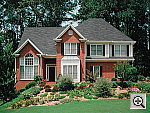
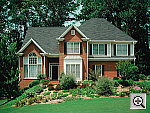
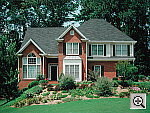
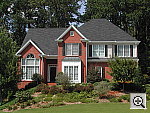
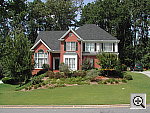
This image is shot at infinity to test far-field lens performance. NOTE that this image cannot be directly compared to the other "house" shot, which is a poster, shot in the studio. The rendering of detail in the poster will be very different than in this shot, and color values (and even the presence or absence of leaves on the trees!) will vary in this subject as the seasons progress. In general though, you can evaluate detail in the bricks, shingles and window detail, and in the tree branches against the sky. Compression artifacts are most likely to show in the trim along the edge of the roof, in the bricks, or in the relatively "flat" areas in the windows. This is our ultimate "resolution shot," given the infinite range of detail in a natural scene like this. The Coolpix 885 captured great detail throughout the frame, especially in the tree limbs and house front details. The fine foliage details are reasonably crisp, with good definition in branches and leaves. We also measure a camera's dynamic range here, and noticed that the Coolpix 885 was fooled by the bright glare of the sunny bay window, capturing only the strongest details. Alternatively, the shadow areas under the porch and in the shade of the small tree (at right) show much stronger detail, with the brick and shrubbery patterns clear and distinct. We did notice some fairly pronounced chromatic aberration in the upper left-hand corner of the frame though. The table below shows our resolution and quality series, followed by ISO, contrast, lightness, sharpness, and saturation series. Resolution Series:
ISO Series:
Contrast Series:
Brightness Option Series:
Sharpness Series:
Black & White mode:
|
||||||||||||||||||||||||||||
| Lens Zoom Range
Fairly typical zoom range, nothing unusual to note... We've received a number of requests from readers to take shots showing the lens focal length range of those cameras with zoom lenses. Thus, we're happy to present you here with the following series of shots, showing the field of view with the lens at full wide angle, the lens at full 3x telephoto, and the lens at full telephoto with 2x and 4x digital zoom enabled. The Coolpix 885's lens covers a range equivalent to a 38-114mm zoom on a 35mm film camera. Following are the results at each zoom setting.
|
||||||||||||||||||||||||||||
Musicians
Poster (1089 k)
Good color, but slightly high saturation, and a slight magenta cast. For this test, we shot with the Auto (1089
k), Daylight (1084 k), and Manual
(1131 k) white balance settings, choosing the Auto setting as the most
accurate. Daylight resulted in a slightly warm image, and the Manual
results were too cool. Actually, the Auto setting is a little warm as
well, but overall color looks best. Color saturation is a little strong,
and we noticed strong tints throughout the frame. The blue on the Oriental
model's robe looks about right, although a little bright (this is a
tough blue for many digicams to get right, and often has a purplish
tint). Resolution is high, with a lot of fine detail visible throughout
the image. We again noticed moderately high image noise. |
||||||||||||||||||||||||||||
Macro Shot
(1002 k)
Very good macro capability. The Coolpix 885 also performed well in the macro category, capturing
a minimum area of just 1.61 x 1.21 inches (40.82 x 30.62 millimeters).
Color, resolution, and detail all great. The brooch and coin details
are soft due to a limited depth of field, but the details of the dollar
bill are crisp. The Coolpix 885's flash (671
k) has some trouble throttling down for the macro area at such close
range, overexposing the entire top portion of the image. |
||||||||||||||||||||||||||||
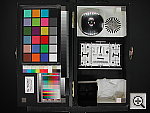
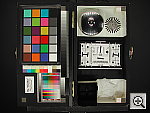
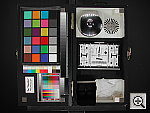
"Davebox"
Test Target (599 k)
Pretty good color, but the camera seems to have trouble with bright yellows, which come out rather undersaturated. We shot samples of this target using the Auto
(599 k), Daylight (618 k), and Manual
(583 k) white balance settings, choosing the Auto setting for our main
shot. The Manual setting also resulted in nearly accurate results, as
did the Daylight setting, once we tweaked the color balance adjustment
(see our Daylight series below). Overall exposure looks a little dark,
but the Q60 target shows good tonal distribution. Color is also good,
though the red values are slightly oversaturated. Detail is strong in
the shadow and highlight areas, and we noticed moderately high noise
throughout the image. We also snapped an image with the camera's Black
and White (XXX k) mode. Following are the Daylight color balance
and contrast series. Contrast Series:
Daylight Color Balance "Tweak" range:
|
||||||||||||||||||||||||||||
| Low-Light Tests
Good low-light performance, the Noise Reduction option really makes a big difference. Works well to the lowest levels we test (1/16 of a foot-candle, city night scenes are usually ~1 foot-candle). The Coolpix 885 performed very well in our low-light testing, capturing clear, bright, usable images at light levels as low as 1/16 foot-candle (or 0.67 lux) at all three ISO settings. Color looks good and well saturated, even at the darkest light levels. Noise is fairly high, even at ISO 100, without any noise reduction. We tried the Noise Reduction system at the 1/16 foot-candle light level at each ISO setting (100 (671 k), 200 (825 k), and 400 (1188 k)), and found much better results. (We strongly recommend using the 885's noise reduction for any low light shooting.) Noise was minimal at the ISO 100 setting with Noise Reduction, increasing to only a moderate level at the ISO 400 setting. The table below shows the best exposure we were able to obtain for each of a range of illumination levels. Images in this table (like all of our sample photos) are untouched, exactly as they came from the camera.
|
||||||||||||||||||||||||||||
| Flash Range Test
Pretty limited flash range, only 7.5 foot range with the lens at telephoto. (We'd really like to see a greater range.) In our testing, we found the Coolpix 885's flash brightest at eight feet from the test target. Flash power decreased with each additional foot of distance, becoming extremely dim at the 14 foot distance. Below is our complete flash range series, with distances from eight to 14 feet from the target.
|
||||||||||||||||||||||||||||
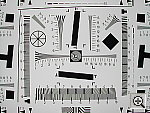
| ISO-12233
(WG-18) Resolution Test (703 k)
Typical resolution for a 3 megapixel camera. Lens distortion is about average, but chromatic aberration looks to be on the high side of average.
Optical distortion on the Coolpix 885 is about average at the wide-angle end, where we measured an approximate 0.7 percent barrel distortion. The telephoto end fared much better, as we measured only two pixels of barrel distortion. Chromatic aberration is low in its extent, showing only about two or three pixels of coloration on either side of the target lines, but what's there is quite bright. (This distortion is visible as a very slight colored fringe around the objects at the edges of the field of view on the resolution target.) We give Nikon generally good marks for geometric distortion, but the 885's lens seems have chromatic aberration on the high side of average among "prosumer" digicams. Resolution Series, Wide Angle
Resolution Series, Telephoto
|
||||||||||||||||||||||||||||
|
Viewfinder Accuracy/Flash Uniformity
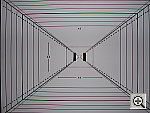
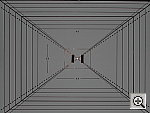
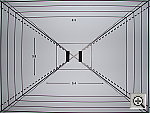
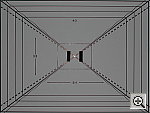
LCD viewfinder is quite accurate, but optical is pretty bad, way too "tight", shows too little of the final subject area. The Coolpix 885's electronic optical viewfinder was very tight, showing only 76 percent of the final frame at wide angle, and only 75 percent accuracy at telephoto. This is quite a bit less accurate than average. Images framed with the optical viewfinder were also slanted toward the lower left corner just slightly. The LCD monitor produced much more accurate results, showing 97 percent accuracy at wide angle, and 99 percent at telephoto. Given that we generally prefer LCD monitors to be as close to 100 percent accuracy as possible, the Coolpix 885 did an excellent job in this respect. Flash distribution is more even than usual at wide-angle, with only slight falloff mainly in the corners of the target. At the telephoto lens setting, flash coverage is more even throughout the frame, though much dimmer.
|




















Follow Imaging Resource: