



Overview
Nikon D3S Overview
Reviewed by Andrew Alexander, Zig Weidelich, Shawn Barnett, and Mike Tomkins
Review Posted: 04/16/2010
You know there was already something excellent about a camera when it gets only a minor upgrade after almost two years of service, something Nikon confirms with its introduction of the Nikon D3S professional digital SLR. You might disagree on whether the upgrade is major or minor, but some will cling to the resolution to say that there's little new about the Nikon D3S: "It's still 12.1 megapixels."
But a camera is more than resolution. Nikon more than any other camera company has taught us that a digital camera can perform better in low light than we've ever allowed ourselves to expect -- seeing more like our eyes see, so that we can get better pictures without flash. They taught us this with the Nikon D3, whose expanded ISO setting was an astonishing 25,600. Journalists rely on the D3's high ISO settings, making images that would have been impossible just a few years ago.
The Nikon D3S, however, is more sensitive. Its base ISO range is 200 to 12,800. And its expanded ISO settings go up to 102,400. The possibilities just multiplied.
In addition to greater sensitivity, the Nikon D3S offers the new essential feature of video capture. As on other Nikons, D-Movie captures 1,280 x 720 progressive scan at 24 frames per second. Files are saved in Motion JPEG AVI format, which allows easy on-camera editing, as well as extracting a still image from the video stream, all without affecting the original file. A monaural microphone is built into the front of the Nikon D3S, and a stereo mic input allows attachment of an external microphone. Regular movie shooting allows automatic gain setting between ISO 200 and 12,800, and an optional High-Sensitivity Movie Mode opens up ISO 6,400 to 102,400 for recording movies in very low light conditions.
 Functionally, most of what was great remains. The nine-frames-per-second burst, or 11 fps in the DX-crop mode continues delivering what users expect. The buffer has been doubled, though, and a new crop mode supports 1.2x image sizes, turning out 8.4 megapixel files. The 51-point AF system remains mostly the same, thankfully.
A new Quiet Shutter Release mode makes shooting in low-noise environments easier, and a few controls have been added or shifted to make using the Nikon D3S a little more intuitive.
The Nikon D3S is available now for US$5,199.95, about $200 more than the Nikon D3 when it shipped in 2007.
Nikon D3S Review
by Mike Tomkins, Shawn Barnett, and Andrew Alexander
The Nikon D3S single-lens reflex digital camera updates the company's previous D3 model to include an even wider sensitivity range, high-definition movie capture, dust reduction, and quite a few other new features besides.
Though it's largely the same size and weight, with dimensions of 6.3 x 6.2 x 3.4 inches (160 x 157 x 88mm) and a body-only weight of two pounds, twelve ounces (1,240g), the Nikon D3S has a few external refinements to talk about; but perhaps the best news for pros is that the Nikon D3S is familiar, so upgrading or adding a D3S to their arsenal isn't going to require a lot of retraining.
Look and feel. As with the D3, the D3S looks and feels quite sturdy, with excellent grip surfaces for both horizontal and vertical shooting, and canted dials for smoother human interaction.

New on the front of the Nikon D3S are three holes for the monaural microphone, appearing in the upper right in this picture, floating between the self-timer lamp and the Flash sync / Remote terminal cover.

There's essentially no noticeable difference on top, except that there's no longer a Live view position on the Drive mode dial, whose former position you can't really see in this image. That position has been changed to support the new Quiet Shutter Release mode ("Q"). Live view is now accessed on the back.

Nikon added an "info" button to the left button array, including a feature that was heretofore not found on their pro series cameras. The button calls up a rear status display that is also new to the pro line. The speaker that was to the left of the small Rear Control Panel LCD has moved to under the card door release cover below the AF Area mode switch. The small LCD has been shifted left, allowing room for the addition of a Live view button (marked Lv), just right of the microphone button. And that pretty well sums up the major physical differences on the Nikon D3S.

Sensor. Announced a little over two years ago, the D3 was an extremely important camera for Nikon, being its first offering to include a full 35mm-frame sized image sensor. In the company's parlance, the sensor format is designated "Nikon FX," to avoid the impression that its DX-format (or APS-C) sensors are somehow "sub-frame." In comparison to a Nikon DX camera of the same resolution (like the Nikon D300S), an FX-format model offers greatly-increased light gathering capability, which translates to better high ISO, or low-light performance. It also allows near-identical framing with that of a 35mm film camera when using the same focal length, and makes truly wide-angle photography more feasible given that there's no focal length multiplier in FX mode.
There's no such thing as a free lunch, though, and there are two main disadvantages for full-frame digital SLRs -- the first of which is that the cost to manufacture such a sensor is significantly higher than that of an APS-C camera. At the same time, taking full advantage of the larger sensor requires the use of larger, heavier FX-format lenses if the entire imager is to fit inside the image circle produced by the optics.
Unlike Canon, whose sub-frame lenses cannot mount on full-frame cameras, Nikon allows the use of DX-format lenses by simply cropping the active area of the FX-format sensor to match that of a DX-format camera, with a corresponding decrease in total resolution.

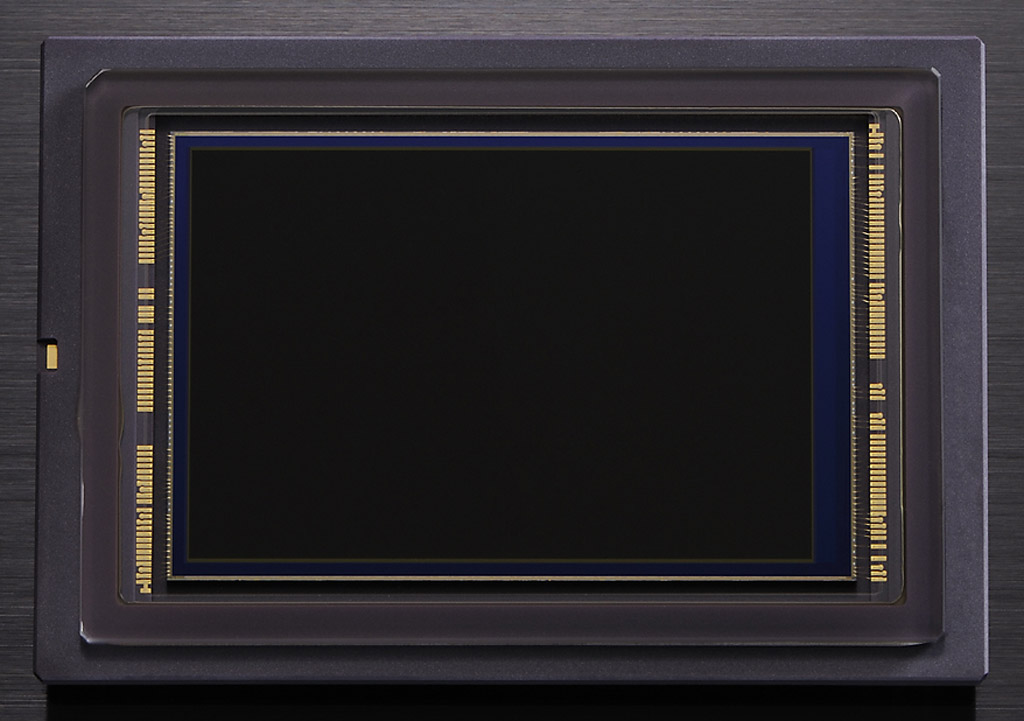
Inside, the Nikon D3S sports both a newly-developed image sensor and EXPEED image processor, which together have enabled the new video mode and increased sensitivity. Sensor resolution is unchanged from that of the D3, at 12.1 effective megapixels, and the new FX-format CMOS chip in the Nikon D3S also retains the same 36.0 x 23.9mm dimensions and 8.45µm cell size of its predecessor.
Maximum image resolution in the native 3:2 aspect ratio is 4,256 x 2,832 pixels, and there's also a 5:4 aspect ratio mode which allows image capture at up to 3,552 x 2,832 pixels, excellent for helping photographers frame in the popular 8x10-inch format. In addition, the Nikon D3S can record images in DX crop mode at up to 2,784 x 1,848 pixel resolution, and there's a new 1.2x crop mode which trades off a little resolution in favor of a slightly increased 35mm-equivalent focal length, avoids the very corners of the image (which tend to be the problem areas for lens-derived image defects), and yields slightly more manageable file sizes.
The Nikon D3S is based around a 16-bit imaging pipeline, and offers the choice of either 14-bit or 12-bit A/D conversion. Startup time is said to be 0.12 seconds, with shutter lag of 0.04 seconds, according to Nikon specifications. (We measured ~0.1 second and 0.043 second respectively.)
|
Shots remaining before buffer fills
(14-bit RAW, lossless compressed) | |
| D3 | D3S |
| 16 | 36 |
Buffer increase. As you'd expect, the Nikon D3S retains the impressive burst shooting capability of the D3, with a maximum of nine frames per second possible in FX-format shooting, and as much as eleven frames per second when set to DX-format. Thanks to a doubling of its buffer memory size, the Nikon D3S offers greatly increased burst depth as compared to the stock Nikon D3, however. (The upgraded buffer memory was made available as a paid option for D3 owners about a year after the camera first launched, so the native buffer memory of the D3S -- and hence its burst depth -- are identical to that of an upgraded D3).
For full-resolution FX-mode shooting depending on the compression type in use, burst depth should be in the region of 35 to 44 frames in Raw or TIFF formats, according to Nikon, while JPEG bursts of 119 to 130 shots should be possible. DX-mode full-res bursts meanwhile should reach 54 to 87 Raw or TIFF frames, and 130 JPEG frames. See the Performance tab for the numbers we got while testing the D3S.

Dust Reduction. One of the most significant changes in the Nikon D3S outside the imaging pipeline is the inclusion of Nikon's Dust Reduction system -- the first time the company has offered the technology in a full-frame camera with 100% viewfinder coverage. The system functions by vibrating the optical low-pass filter over the CMOS sensor at four distinct frequencies to shake free any dust particles that are adhering to the filter. This process can be initiated at the user's command, or automatically either when the camera is first switched on, or right before it powers off.
Lens mount. The Nikon D3S provides a Nikon F-mount with autofocus coupling and contacts. Like the D3 before it, the Nikon D3S is compatible with almost every F-mount lens made since 1977, although some lens types will have a few limitations.
LCD. On the rear panel of the Nikon D3S is a 3.0-inch diagonal low-temperature polysilicon LCD with a total resolution of 921,600 dots, which equates to 307,200 pixels in a 640 x 480 (VGA) array. The panel is identical to that used on the original D3, and offers a wide 170-degree viewing angle both horizontally and vertically, as well as 100% frame coverage. Those paying close attention will notice that the number of pixels claimed for the LCD has changed from 920,000 to 921,600, but they assure us that they were rounding down when they announced the D3, and this is a more accurate number.
Viewfinder. There's also an eye-level pentaprism viewfinder whose coverage is 100% when used in uncropped FX 3:2 or 5:4 aspect ratio modes, and 97% when in the 1.2x or DX cropped modes. When shooting in modes other than the native FX-format 3:2 aspect ratio, a translucent LCD in the viewfinder of Nikon's D3S partially masks the inactive portions of the frame. The viewfinder has 0.7x magnification at 50mm and -1 diopter, an 18mm eyepoint, a diopter adjustment range of -3 to +1, and ships by default with a Type B BriteView Clear Matte VI screen with AF area brackets installed.

Live view. Also retained from the Nikon D3 is that camera's Live View mode, although it now has its own dedicated button on the camera's rear panel rather than occupying a position on the Release Mode Dial. (Its space is taken over by the Quiet Shutter function previously seen on the Nikon D300S and D5000 models, which noticeably reduces noise levels by separating cocking and release of the shutter mechanism.)
The Live view mode in the Nikon D3S is similar to that of its predecessor, offering both hand-held and tripod modes. Hand-held mode uses phase-detection autofocusing, which includes a brief interruption to the live view display while the camera checks focus, and the Tripod mode uses contrast-detection autofocusing. Thanks to the new EXPEED image processor, contrast-detection AF performance is said to be around 30 to 40 percent faster than the D3. There's also a new flicker reduction function in Live View mode, which can be set to either 50 or 60Hz, preventing a common issue under some types of artificial lighting.
High ISO. One of the more impressive changes in the Nikon D3S enabled by its new image sensor and processor is the incredibly wide sensitivity range. Where the Nikon D3 already offered a useful standard range from ISO 200 to 6,400 equivalents, the D3S boosts the upper end of the range to ISO 12,800 equivalent. As with the D3, the lower end of the range can be expanded to include ISO 100, but the really significant changes are in the expanded upper range. The Nikon D3 allowed Hi-1 and Hi-2 positions with equivalent ISO sensitivities of 12,800 and 25,600 respectively. The Nikon D3S replaces these with Hi-1, -2 and -3 settings, which equate to ISO 25,600, ISO 51,200 and incredibly to a maximum of ISO 102,400!
Autofocus and metering. The Nikon D3S retains the same Multi-CAM 3500FX phase detection autofocus sensor as seen in the D3, which offers 51 focusing points, of which 15 are cross types. The Nikon D3S includes AF tracking capability, and allows fine-tuning of individual lenses to correct for front- or back-focus issues. Exposure modes include Program, Aperture- and Shutter-priority, and Manual.
Metering is performed with a 1,005 pixel RGB sensor, and shutter speeds range from 1/8,000 to 30 seconds. The shutter mechanism is retained from the Nikon D3, and is still rated at a lifetime of around 300,000 cycles. Also unchanged from the D3 are the camera's white balance options. These include Auto, twelve presets (including fully seven Fluorescent presets), as well as five Manual white balance positions, and the ability to directly specify a color temperature from 2,500 to 10,000 Kelvin. In addition, all white balance modes allow fine-tuning. +/- 5.0EV of exposure compensation is available in 1/3, 1/2 or 1EV steps. The Nikon D3S also includes a hot shoe and flash sync terminal, with iTTL flash metering, an X-sync of 1/250 second, and compatibility with the company's Creative Lighting System.

D-Movie. The Nikon D3S is the company's first full-frame dSLR to offer video recording, similar to a few other recent digital SLRs. Unlike many, however, Nikon has allowed both the ability to perform contrast detection autofocusing during movie capture, as well as to specify the shutter speed, ISO speed and aperture, before or during movie recording (although it should be noted that these changes will probably be noticeable in both the audio and video captured).
The Nikon D3S' video mode allows use of the camera's unusually high ISO sensitivities, although in its default configuration, the exact sensitivity selected remains under the camera's control. In its regular mode, the photographer selects from one of two ISO ranges -- either 200 to 12,800 equivalents, or 6,400 to 102,400 equivalents. This latter mode is called High Sensitivity Movie Mode. It is possible to enable full manual control, where any combination of aperture, shutter speed and ISO speed can be set, within certain limitations.
The maximum movie resolution offered in the Nikon D3S is 1,280 x 720 pixels (720p), with 640 x 424 and 320 x 216 pixel modes also available. All movies are captured at 24 frames per second, and audio can be recorded either with the camera's internal monaural microphone, or an external stereo mic using a 3.5mm jack. Audio sensitivity can be adjusted manually, with four sensitivity settings plus off and auto positions. It's also possible to trim both the start and end of movies in-camera, and to extract a still frame. Finally, Nikon has apparently worked on the jello-like rolling shutter artifacts which are commonplace in DSLR videos due to the manner in which they're captured, and the company is describing the effect as being about half as noticeable as in its past models.

The Nikon D3S stores images via dual-CompactFlash card slots like its predecessor, although Type-II CompactFlash cards and Microdrives can no longer be accepted in either slot. The Nikon D3S is UDMA compatible, and can store still images in several formats. Choices include .NEF Raw (Uncompressed, lossless compression, or lossy compression), TIFF, or JPEG, as well as both Raw and JPEG simultaneously.
Connectivity includes USB 2.0 High-Speed, as well as both standard definition NTSC/PAL and high-definition HDMI video output. The HDMI connector used is now a Type-C, rather than the Type-A found in the Nikon D3. There's also a 10-pin remote connection that also doubles as a connector for an optional GPS receiver, and a 3.5mm stereo microphone jack. Power comes from an EN-EL4a or EN-EL4 battery, with the former included in the product bundle.
Nikon D3S Field Test
by Andrew Alexander
I spent just over three weeks with the Nikon D3S, chiefly to put it through its paces as a video camera, but also to evaluate its still capabilities. Accordingly, I'll separate this report into two categories.
Field Test - Still Capture
As we've already indicated, the Nikon D3S is best described as an update to the D3, rather than a totally revised model. Many of the features which made the D3 an excellent platform have been maintained on the Nikon D3S, if not improved.
Buffer upgrade. Including the buffer upgrade in the Nikon D3S was a practical choice for Nikon, placating a user base which probably thought the buffer should have been more capable to begin with. With the Continuous-High shooting speed of nine frames per second in FX mode and 11 in DX crop mode, it was painfully easy to hit the buffer wall, only to wait precious seconds for the buffer to clear before another shot could be taken. In a professional situation, this delay really wasn't acceptable, and the only practical solution was to shoot at a slower speed, defeating the purpose of Continuous-High. With the increased buffer size, shooters have a bit more latitude when shooting at the camera's highest speed.

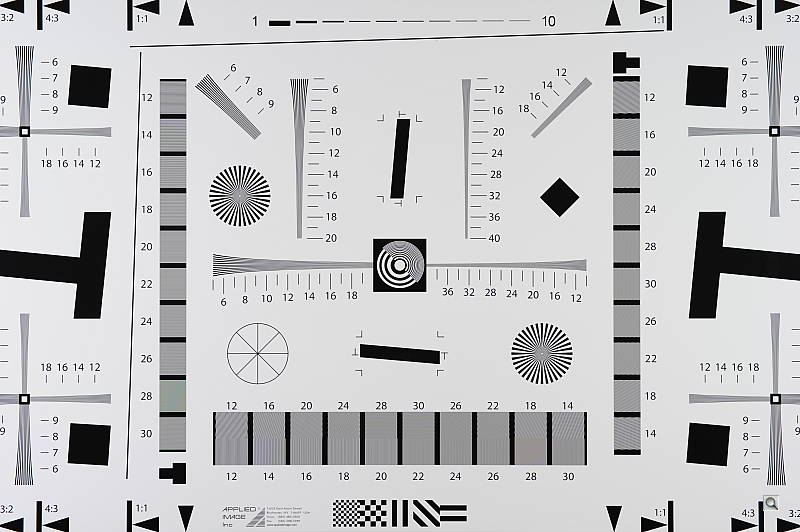
Still Life target at ISO 6,400.
Really High ISO. It's easy to focus on the big number -- ISO 102,400 -- but what's of real interest to most shooters is how the new sensor treats images at more reasonable ISO settings. The D3 opened the door to shooters interested in available light shooting; until its arrival, for most indoor events, an external flash was the only option. You could shoot at ISO 3,200, but the images were so noisy that you wouldn't want to present them. Now, ISO 3,200 has become commonplace. As you can see in the test images, the Nikon D3S raises the bar not only in the upper limits of ISO sensitivity, but it also improves upon the quality of its middle range. Where many D3 shooters would stick to ISO 1,600 to produce noiseless images in lower-light scenarios, they might now feel as comfortable with ISO 3,200 or even 6,400 in the Nikon D3S. At this point you're not limited to using f/2.8 lenses; you can stop down a bit to extend the depth of field on your subject, or to get optimal image sharpness.
For those shooters who truly need a camera that sees in the dark, the Nikon D3S fits the bill. Yes, without light to shoot by, it's noisy, but the fact that it can make an image at such a high ISO speed is remarkable indeed.
See our High ISO NR and High ISO RAW pages to see how the Nikon D3S compares to other professional dSLRs.
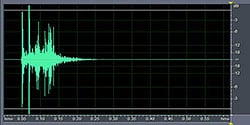


Quiet Shutter Release Mode. One of the changes made in the upgrade to the Nikon D3S was the introduction of the Quiet Shutter Release ("Q") mode, and there has been an equally quiet reaction to its introduction. The methodology is straightforward and simple: when Q mode is activated, the mirror will stay in its open position until the shutter button is released by the user, at which point it will return to its home position.
In practice, it's an interesting idea, but it's still fairly noisy, as the reduction in sound probably isn't dramatic enough to warrant its usage. We took some recordings of the shutter of the D3 and the Nikon D3S, with no lens attached, at a distance of about 12 inches. The results are to the right (click image to play wave file).
So what we're seeing in the Nikon D3S's Quiet Mode is a reduction in the overall "presence" of the noise generated by the shutter release, by breaking it into two parts. And the second part appears to be genuinely quieter than the D3.
We also noticed a fairly loud ringing sound after each shutter activation. After some investigation we determined that it's the aperture activator retraction springs in both the lens and D3S body that makes such a loud sound. Though other pro-grade cameras also make the sound, including the Canon 1Ds Mark III, we think it's louder on the Nikon D3S because of the heavy-duty spring required to retract the aperture mechanism in time for the 11 fps potential of this high-speed camera. The sound also varies by lens, with some lenses sounding louder than others.
Dust reduction. The Nikon D3S finally integrates the dust reduction systems found in its non-professional brethren, and it shouldn't come as a surprise that after using the camera for three weeks beside a D3, there's less dust to speak of on the D3S. It's not a perfect system, but it will extend the delay between manual sensor cleaning sessions.
Print quality. Printing JPEG images straight from the Nikon D3S strains the mind a bit. While we're used to seeing a pretty clear descent in image size as ISO rises, images from the 12-megapixel D3S don't start to need a size downgrade from 16x24 until ISO 12,800.
The only major flaw that appears in images in this range and size is increasing luminance noise in the shadows, which starts at about ISO 800. It looks very much like film grain, though, so it's not at all objectionable.
ISO 12,800 shots are usable at 16x24, but really look better at 13x19 inches.
ISO 25,600 shots have rather blobby noise in the shadows, and less detail, making them better at 11x14 inches. Contrast also seems to increase at this setting, with more plugged shadows and blacks.
ISO 51,200 is usable at 11x14, but considerably better at 8x10. Chroma noise has finally started to creep into the shadows at this size and ISO setting.
ISO 102,400, depending on the subject, is still usable at 8x10, but an almost choppy wave-like pattern has started to emerge in the shadows, along with more chroma noise. This becomes less noticeable at 5x7, and nearly disappears at 4x6, producing an astonishing image when you consider in what conditions it was captured.
Really a remarkable performance from the amazing Nikon D3S digital SLR camera.
Conclusion. There's not much to add that the D3 report didn't already cover; the Nikon D3S adds a few shooting features, the sensor's been improved, but most importantly, it doesn't break anything that worked.
Video Field Test
On my way back from picking up the Nikon D3S for review, I heard about a 72-hour film festival taking place where I live. The aim of the festival was the produce a 5-8 minute long film in just 72 hours, with a number of specific requirements to be inserted into the film. I thought there could be no better way to get an immediate grasp on the capabilities of the camera than to plunge into this challenge.
I should mention at this point that I have shot with a fair number of video cameras in corporate video production, but none have a sensor as large as the D3S. I had never been able to accomplish in video what is so easy to do with a dSLR and a fast prime: a sharp foreground subject, with an out-of-focus background. On the editing side, with traditional video cameras, we had to deal with digital video tape, where you had to spend hours capturing video from the camera to the editing computer. Both of these obstacles are removed with the Nikon D3S, and I was curious to see what the results could be.
My 8-minute short, Wish You Were Here. (Click to play video.)
After spending only a few days with the camera and assembling a cast and crew, we spent a Saturday shooting the scenes for our film. Having access to fast primes and both wide-angle and telephoto lenses opened up our capacity to visually tell a story. Most camcorders have one zoom lens that can't go wide enough or long enough, and to get into interchangeable-lens camcorders can get very expensive. I was struck by how seamlessly I was able to make the transition from photographer to videographer, primarily because I did not need to learn a new platform. If anything, what I needed to learn was a new form of camera movement, as the Nikon D3S handles much differently than a conventional camcorder. For some shots we used a tripod, but for most I was able to shoot hand-held, even with a 70-200mm lens, stabilized with VR.

Extended handheld shooting with the D3S will prove uncomfortable and unsteady. My own solution was to use a monopod, and jam it into my hip. There are already several third-party solutions that are more comfortable. (Gear shown above includes a Cool-Lux MD3000 Light and Sound bracket, Litepanels Micro LED On-Camera Light, and a Sony ECM-CG1 Gun Microphone.)
The other technique that most digital SLR video shooters will have to improve is their manual focusing technique. While almost an afterthought now in the world of still photography, in this early period of video-on-digital-SLR it is a necessity. I found on many occasions, especially when using very large apertures with their very thin depth-of-field, it was necessary to use the magnification feature in Live view to find a precise focusing point. Yes, the Nikon D3S can use contrast detection to autofocus during shooting, but unless you're using an AF-S lens, it's slow, noisy, and not at all perfect.
After ten hours of shooting, we wrapped our day of shooting, having everything we needed. We accumulated 161 .AVI files, representing just over 10 GB of files and almost two and a half hours of video.
The next day in the editing suite, the HD footage was glorious to behold, and a pleasure to work with. Colors were deeply saturated, and images were crisp and sharp. We were blessed with a sunny day to shoot, so our exteriors were great. The only significant problem we had (other than our tight deadline to produce the final cut) was with audio: because we couldn't monitor audio levels easily in the field, we found we had inconsistencies that we had to fix in post.
The shoot took a heavy toll on battery life. By the end of the shoot I had gone through two batteries and was halfway through the third. I had meticulously dumped my video from CompactFlash cards to a computer when we took breaks, but never managed to fill a single 8 GB card. By contrast, I was wondering if I would have to take a break to charge a battery.
See our Video page for more details on the Nikon D3S's video capabilities.
Appraisal. Nikon may have introduced its video mode for dSLRs with the D90, but it has certainly improved upon it in the Nikon D3S. For video, the addition of an external microphone port was absolutely necessary, as was moving to a higher bitrate for recording quality audio. Improved audio control options, including the ability to monitor audio as it's being recorded will be welcomed in future updates. As well, some content producers may not be satisfied with the 720p implementation of HD video, and may require full 1080p.
In the Box
- Nikon D3S body
- EN-EL4a Rechargeable lithium-ion battery
- MH-22 Quick Charger
- UC-E4 USB Cable
- EG-D2 Audio Video Cable
- AN-DC5 Camera Strap
- BF-1B Body Cap
- BS-2 Accessory Shoe Cap
- DK-17 Eyepiece
- BL-4 Battery Chamber Cover
- USB Cable Clip
- Software Suite CD-ROM
- User manuals, quick guides, warranty card
Recommended Accessories
- Large capacity CompactFlash memory card. But with the D3S, you should consider a couple of high speed UDMA cards to take full advantage of the camera's UDMA capability, offering transfer speeds as high as 45MB/second.
- SB-900 or SB-600 Speedlight Flash
- WT-4a Wireless Transmitter
- GP-1 GPS Unit
- Type E Focusing Screen
- DK-17M Magnifying Eyepiece
- EH-6 AC Adapter
- ML-3 or MC-36 Remote Control
- Capture NX 2 Software
- Camera Control Pro 2 Software
- Image Authentication Software
Nikon D3S Conclusion
| Pro | Con |
|---|---|
|
|
So the Nikon D3S is an amazingly capable professional digital SLR, retaining most of what was great about the Nikon D3, and adding astonishing improvements in low-light capability and a larger image buffer size. Enough stayed the same, though, that we've chosen to focus on the video aspect for this report. We've still written up all the controls and run all of our extensive suite of test shots, so be sure to visit the other tabs of this review for more on Design, Operation, Image Quality, Optics, and Performance, among others.
There's a small sense of deja vu when working with the Nikon D3S in a video context; when digital SLR cameras first became popular, no one had all the answers, and to some degree there was a lot of learning that came with each iteration of a new camera. It's no surprise to me that the owner's manual only devotes seven pages to recording movies, as it's not just new to Nikon, it's relatively new to the majority of the still-photography world.
At this moment, though, Nikon has provided a tool to filmmakers that they didn't have before, and while it is in some sense limited (compared to your average pro camcorder), the Nikon D3S still works extremely well, and is capable of recording in light so low that no camcorder can compete. The Nikon D3S is a Dave's Pick for stills or videos.
Design
Nikon D3S Design
Roll-over the various controls and features with your mouse for a brief description. Note: Rollovers are best viewed with the latest versions Firefox, Safari, or Opera browsers, or Internet Explorer 6 or earlier.

Nikon D3S Front View. New on the front of the Nikon D3S are three holes for the monaural microphone, appearing in the upper right in this picture, floating between the self-timer lamp and the Flash sync / Remote terminal cover.

Nikon D3S Left View. There's no noticeable difference on the left side, however, behind the larger rubber port cover, there's a new 3.5mm stereo microphone jack for better audio during video recording, and the mini HMDI port has changed from a Type-A to Type-C connector.

Nikon D3S Right View. No difference with the D3 here.

Nikon D3S Top View. There's essentially no noticeable difference on top, except that there's no longer a Live view position on the Drive mode dial, whose former position you can't really see in this image. Live view is now accessed on the back.

Nikon D3S Back View. Nikon added an "info" button to the left button array, including a feature that was heretofore not found on their pro series cameras. The button calls up a rear status display that is also new to the pro line. The speaker that was to the left of the small Rear Control Panel LCD has moved to under the card door release cover below the AF Area mode switch. The small LCD has been shifted left, allowing room for the addition of a Live view button (marked Lv), just right of the microphone button.

Nikon D3S Bottom View. The bottom features only the metal tripod mount and a rubberized surface.
Operation
Nikon D3S Operation
Like other Nikon DSLRs, the user interface on the Nikon D3S is straightforward and simple to use. The LCD menu is a six-tab system that divides up functions between Playback, Shooting, Custom Settings, Setup, Retouch and My Menu. While many of the camera's options can be accessed via the excellent "plain English" menu system, all the most common shooting controls are available via the camera's external buttons, dials and knobs. You can also program the operation of some of the buttons, to configure the camera for your particular shooting requirements. Programmable buttons include Fn, Preview AE-L/AF-L, and BKT. Even the Command dials and shutter button offer some customization. See Modes and Menus for details.
Nikon makes a big deal of their digital SLR's "cameraness," defined as how well/easily they function as cameras, and the D3S embodies that philosophy.
Nikon D3S Top Panel LCD


As with most higher-end Nikon DSLRs, the D3S's top-panel data readout LCD communicates a lot of information about current camera settings, and provides an interface for setting many camera functions, when used in conjunction with the various buttons and Command Dials. You can also use the main LCD to adjust many of the same settings, but using the top LCD saves power and can be more convenient when the camera is below eye level. The panel is illuminated by a green backlight which is activated by a third, spring-loaded lamp position on the power switch. You can also choose to illuminate LCD whenever the camera performs metering, via an option in the Custom menu (d8). The illustrations below show the meaning of the various icons and readouts in this display.

| 1 | Shutter speed | 14 | Frame count |
| Exposure compensation value | Preset white balance recording indicator | ||
| Number of shots in exposure and flash bracketing sequence | Manual lens number | ||
| Number of shots in WB bracketing sequence | 15 | "K" appears when memory remains for over 1000 exposures | |
| Number of intervals for interval timer | 16 | Flash value (FV) lock indicator | |
| Focal length (non-CPU lenses) | 17 | Flash sync indicator | |
| ISO sensitivity | 18 | Clock battery indicator | |
| 2 | Shutter-speed lock icon | 19 | GPS connection indicator |
| 3 | Flexible program indicator | 20 | Focus mode indicator |
| 4 | Exposure mode | 21 | Interval timer indicator |
| 5 | Flash mode | 22 | Multiple exposure indicator |
| 6 | Shooting menu bank | 23 | Aperture lock icon |
| 7 | Custom settings bank | Multiple exposure (series) indicator | |
| 8 | Memory card indicator (slot 1) | 24 | Image comment indicator |
| 9 | Memory card indicator (slot 2) | 25 | "Beep" indicator |
| 10 | Number of exposures remaining | 26 | Exposure compensation indicator |
| Number of shots remaining before memory buffer fills | 27 | Exposure and flash bracketing indicator | |
| Capture mode indicator | White-balance bracketing indicator | ||
| 11 | Aperture stop indicator | ADL bracketing indicator | |
| 12 | Aperture (f-number) | 28 | Exposure indicator |
| Aperture (number of stops) | Exposure compensation indicator | ||
| Bracketing increment | Exposure and flash bracketing progress indicator | ||
| Number of shots in ADL bracketing sequence | WB bracketing progress indicator | ||
| Number of shots per internal | ADL bracketing progress indicator | ||
| Maximum aperture (non-CPU lenses) | PC connection indicator | ||
| PC mode indicator | Tilt indicator | ||
| 13 | Battery indicator |
Nikon D3S Rear Control Panel LCD


Like other professional models, the Nikon D3S also has a rear Control Panel LCD. This LCD is illuminated at the same time as the Top Panel LCD. Just below the LCD are dedicated buttons for ISO, Image Quality and White Balance. Just to the right of the display is a button for activating memo recording and playback. The illustrations below show the meaning of the various icons and readouts in this display mode.

| 1 | Image quality (JPEG images) | 6 | "K" appears when memory remains for over 1,000 shots |
| 2 | "Remaining" indicator | Color temperature indicator | |
| 3 | Image size | 7 | Memory card slot indicators |
| 4 | ISO sensitivity indicator | Image quality | |
| Auto ISO sensitivity indicator | 8 | White balance bracketing indicator | |
| 5 | ISO sensitivity | 9 | Voice memo recording indicator (shooting mode) |
| ISO sensitivity (high/low gain) | 10 | Voice memo status indicator | |
| Number of exposures remaining | 11 | Voice memo recording mode | |
| Length of voice memo | 12 | White balance | |
| White balance fine-tuning | White balance fine-tuning indicator | ||
| White balance preset number | |||
| Color temperature | |||
| PC mode indicator |
Nikon D3S Main LCD
 Shooting Information
Like other more recent Nikon digital SLRs, the D3S has the ability to display shooting info and settings on the rear LCD. This display is activated by pressing the "info" button. A second press of the "info" button turns the bottom two rows of settings into an interactive menu, for quick access to more commonly used settings that don't have a dedicated button. The rear LCD is larger and in color, so some prefer to use it over the top LCD, at the expense of battery life. It's nice that Nikon gives you the choice. When shooting under dim lighting, you can opt for a light-on-dark version of the screen that doesn't glare so brightly at night. An Auto mode selects the version for you, based on ambient light measured via the camera's metering system. The illustrations below show the meaning of the various icons and readouts in this display mode.

| 1 | Exposure mode | 18 | Auto area AF indicator |
| 2 | Flexible program indicator | Focus points indicator | |
| 3 | Shutter speed lock icon | AF-area mode indicator | |
| 4 | Shutter speed | 3D-tracking indicator | |
| Exposure compensation value | 19 | Flash mode | |
| Number of shots in exposure and flash bracketing sequence | 20 | Flash sync indicator | |
| Number of shots in WB bracketing sequence | 21 | Release mode (single frame / continuous) indicator | |
| Focal length (non-CPU lenses) | Continuous shooting speed | ||
| 5 | Multiple exposure indicator | 22 | Clock battery indicator |
| 6 | Aperture lock icon | 23 | Flash value (FV) lock indicator |
| Multiple exposure (series) indicator | 24 | Interval timer indicator | |
| 7 | Aperture (f-number) | 25 | Image comment indicator |
| Aperture (number of stops) | 26 | Copyright information indicator | |
| Bracketing increment | 27 | Beep indicator | |
| Number of shots in ADL bracketing sequence | 28 | Vignette control indicator | |
| Maximum aperture (non-CPU lenses) | 29 | Exposure compensation indicator | |
| 8 | Aperture stop indicator | 30 | Battery indicator |
| 9 | Exposure indicator | 31 | ADL bracketing amount |
| Exposure compensation indicator | 32 | Image area indicator | |
| Exposure and flash bracketing progress indicator | 33 | Function (Fn) button assignment | |
| WB bracketing progress indicator | 34 | AE-L/AF-L button assignment | |
| ADL bracketing indicator | 35 | Picture control indicator | |
| 10 | Number of exposures remaining | 36 | Long exposure noise reduction indicator |
| 11 | "K" (appears when memory remains for over 1000 exposures) | 37 | Custom settings bank |
| 12 | Frame count | 38 | Focus mode indicator |
| Manual lens number | 39 | Memory card indicator (slot 2) | |
| 13 | PV button assignment | 40 | Memory card indicator (slot 1) |
| 14 | Color space indicator | 41 | GPS connection indicator |
| 15 | Active D-Lighting indicator | 42 | Exposure and flash bracketing indicator |
| 16 | High ISO noise reduction indicator | WB bracketing indicator | |
| 17 | Shooting menu bank |
Nikon D3S Virtual Horizon
 A really neat feature of the D3S (like the D3 before it) is the virtual horizon gauge, activated from the Setup menu. The display remains active as long as certain buttons aren't pressed (such as the shutter release). The display uses sensors in the body to detect the orientation of the camera and display a virtual horizon, similar to an aircraft instrument, though it only shows left/right tilt (or "roll"). This is useful for critical alignment of subjects such as buildings, the horizon, etc. With the use of the Fn button, the electronic analog scales in the viewfinder can also display the amount of tilt, so that you don't need to take your eye off the subject to check the camera angle. The virtual horizon is also available during Live View mode as one of the overlay options via the "Info" button. In Live View mode, the display is smaller and mostly translucent, so as not to obscure the preview.
Nikon D3S Playback mode
 Playback mode is entered by pressing the playback button. The D3S's playback mode provides a great deal of information about your pictures after you've shot them. A variety of playback displays can be cycled through using the up/down arrows on the multi-selector, including image with file information with optional highlight warning and focus point display, RGB histogram, three screens with overlaid shooting and image parameter information (and possibly two additional info screens - one when photographer or copyright information is embedded in images, and one which is available when an attached GPS device was used to geotag images), and an overview display with basic shooting data and luminance histogram. The screenshot animation at right shows the sequence when the down arrow is used. If you find this amount of information overwhelming, you can add or remove the displays as you see fit.
 As you'd expect, the Nikon D3S offers a comprehensive RGB histogram display mode. Histogram displays are common on professional digital cameras (and many amateur models now), regarded as almost mandatory by many pros for evaluating exposure levels. A histogram is simply a graph of how many pixels there are in the image at each brightness level. The brightness is the horizontal axis, running from black at the left to white at the right. The height of the graph shows the relative number of pixels having each brightness level. This sort of display is very handy for determining under- or overexposure. Ideally, the histogram would stretch across the entire width of the display, using the full range of brightness values available. An underexposed image will have a histogram with all the data lumped on the left-hand side, with nothing reaching all the way to the right. Likewise, an overexposed image will have all the data lumped on the right hand side. Clipped highlights are shown by blinking any highlights that are saturated in any of the color channels. It does this by taking the nearly-white areas on the LCD and toggling them between white and black, as can be seen in the screenshot above right (taken from a D300S, but identical to the D3S).
 As with the Highlights display mode, the blinking highlights in the histogram display mode can also be displayed separately for each color channel by selecting R, G, or B in the RGB Histogram display mode. The screenshots at right show an example of where this might be useful: The bright, strongly colored lamp shade (deliberately shot with an incorrect white balance, to produce the strong hue) showed only minor lost detail in the screenshot above, looking at the RGB or luminance highlights, but the shot at right shows that the red channel is badly blown. This is quite common: It's easy to lose detail in a strongly-colored object well before other, more neutral-colored highlights are lost.
 Finally, the shot at right shows a nice feature that is we're surprised isn't more common: You can zoom into the image and pan around the magnified display, and the RGB histogram will change to show only the portion of the image that you're looking at. In this mode, you lose the blinking highlights, but this strikes us as very useful for checking critical parts of the image, to see if you've held highlight or shadow detail in areas you really care about.
 Of course the Nikon D3S also lets you zoom out to quickly find and select images, or magnify them for closer inspection on its gorgeous 3-inch, 922K pixel LCD. You have the normal 4-, 9- or 72-image thumbnail displays, and you can magnify them up to approximately 27x for large, 20x for medium and 13x for small images. Both functions are controlled using the thumbnail / zoom button in concert with the rear control dial. Once magnified, you can scroll around the image using the thumbnail / zoom button and multi-selector to examine critical detail and framing. You can also program the multi-selector center button to automatically zoom in on the active focus point with a preset the initial zoom setting (low, medium, or high), to make focus verification faster and more convenient. The D3S does not offer the automatic playback mode face detection the D300S does.
Movies can be played by pressing the multi-selector's center button, and during movie playback both the down arrow and OK button serve as a pause / resume control. The left and right arrows allow cuing during playback, with subsequent presses adjusting the speed to 2, 4, 8 or 16x. While paused, these same buttons allow cuing through the video one frame at a time. Before movie playback is started, the OK button can be used to call up an edit screen, where the start and end points of the movie can be specified for trimming, with the same controls as during regular playback, and the result saved as a new file. Movies shorter than two seconds in length cannot be edited in-camera. The Nikon D3S also has the ability save a single frame of a movie as a JPEG still image.
To return the Nikon D3S to shooting mode, simply press the playback button again, or half-press the shutter button.
Optics
Nikon D3S Optics
Lens Compatibility
 The Nikon D3S accommodates a wide range of Nikkor lenses, via the standard Nikon "F" lens mount. The D3S's lens mount includes both a mechanical AF coupling for older lenses, and AF electrical contacts for the latest AF-S or AF-I Nikkor lenses with internal focus motors. With very few exceptions, you can use the D3S with any F Mount Nikkor lens ever made. There are some exceptions however. See the table below (provided courtesy of Nikon USA) for details.
Like all professional (D3X, D3, D2X, etc.) and most semi-pro Nikon SLRs (D700, D300S, D300, etc.), the D3S's lens mount includes an AI aperture ring coupler, a little metal vane located just outside the lens mount flange (at about 1 o'clock), that interfaces with old AI Nikkor manual focus lenses. This engages with the aperture ring on AI-style Nikkor lenses, and lets the D3S support aperture-priority metering mode and provide manual-exposure metering with them.


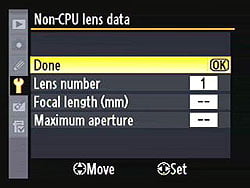
Non-CPU Lens Data: The camera being able to register data for up to 9 lens types.
Non-CPU Lenses
As mentioned above, non-CPU lenses can be used only in Aperture-priority or Manual exposure modes. The D3S can "register" up to nine non-CPU lenses. By specifying focal length and/or maximum aperture manually, access to a number of CPU lens functions is possible with a non-CPU lens. If the focal length is known, the camera can automatically power zoom SB-900, SB-800 and SB-600 flash units, and the focal length will be displayed (with an asterisk) in the playback info screen. If the maximum aperture is known, the aperture value is displayed in the top panel and viewfinder, flash level is adjusted for changes in aperture, and the aperture is listed (with an asterisk) in the playback info display. Specifying both focal length and maximum aperture enables Color Matrix metering, and improves the accuracy of center-weighted and spot metering, as well as i-TTL balanced fill-flash. The focal length field accepts values from 6 to 4,000mm, while the maximum aperture ranges from f/1.2 to f/22.
In a digital SLR camera, the Optics heading would seem to have more to do with the attached lens than the camera itself. The camera body is responsible for autofocus, though, so it makes sense to talk about autofocus technology here on the "Optics" tab of this review. In the case of the Nikon D3S it turns out that the camera-side of the equation has a lot more to do with image quality than is generally the case.
Nikon D3S Autofocus
The Nikon D3S carries the same autofocus system over from the D3 and D3X with a few changes. The only obvious difference we could spot were two additional settings for Focus Tracking with Lock-on in Custom Menu a4. The is a programmable delay the camera uses to attempt to reacquire the subject when it is temporarily obscured by objects passing in front of it. The D3 offered three delay settings (Short, Normal and Long) plus Off, while the D3S adds two intermediate settings.
Nikon claims initial autofocus acquisition and tracking have been improved over the D3, however we have no way to validate that claim. The company also claims contrast detect autofocus during Live View mode is 30% faster than the D3, though we weren't able to confirm or deny that claim, as we no longer have access to a D3 to compare. (See the D3S Live View page for more details on focus operation in Live View mode.)
Our testing did however show that the D3S was noticeably slower at recognizing accurate focus for a static subject in the normal phase-detection mode than was the D3. We have no explanation for this, but the results were confirmed in multiple tests. We'll try to ask Nikon about this, to see if they can shed any light on the differences in our measurements between the two cameras.
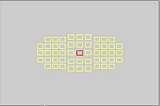
Like the Nikon D3X, D3, D700, D300S and D300, the D3S's Multi-CAM 3500 AF system sports no fewer than 51 "precision focus" AF points spread across the frame. (More on that "precision" designation below.) A total of 15 AF points are cross-point type, sensitive to both horizontal and vertical detail.
| Nikon D3S AF Point Selection Options | ||
 |
 |
 |
| 51-point | 21-point | 9-point |
The Multi-CAM 3500 AF system offers 9-area, 21-area, 51-area, and 51-area with 3D tracking modes. There's also an option that lets you choose a single active point from a selection of 11, as an aid to users transitioning from older bodies, or those using both old and newer bodies simultaneously.
The reference to "3D tracking" above alludes to the most unusual feature of the AF system, namely the use of the 1,005-pixel RGB exposure sensor to assist in tracking moving subjects. This is one of those innovations that make you wonder why someone didn't think of it earlier. It's evident that only Nikon was poised to make a move like this, as they're the only SLR maker using such a high resolution sensor in their evaluative AE system. As far as we know, they're also the only ones using an RGB sensor for evaluative metering, something with adds to its usefulness for object recognition.
Tracking autofocus systems are surprisingly adept at interpreting the rather limited data from a handful of AF sensors, and using it to intelligently track moving objects. If you think about it, the amount of information the AF system has at its disposal is very limited: All it has to work with are approximate subject distances at a handful of AF points across the frame. By interpreting changes in the data coming from each, the AF system attempts to pick a subject from the background, then determine the subject's direction and speed.
In fact, AF systems lack almost all the things that our own visual systems use to discriminate objects with: Color, tone, shape and subject size. It's really amazing that AF tracking works as well as it does.

Metering sensor. Nikon brings its venerable 1,005-area metering sensor to bear on an old problem: AF tracking.
With the D3, D700 and D300 series, the Nikon engineers have used the data from the 1,005 pixel RGB exposure sensor to help guide the camera's autofocus decisions. While the RGB sensor provides no distance information (D- and G-type lenses do), it has much more resolution than even the greatly expanded array of AF points on the new AF sensor. The AE system also incorporates a Diffractive Optical Element (DOE) designed to improve the effective resolution of the RGB sensor. The 1,005 element AE sensor also captures both tone and color information, which should make it easier to discern where objects are in the field of view and how they're moving.
The net result should be more sure-footed and accurate tracking of subjects as they move about the frame. The relatively high resolution of the RGB sensor should let the camera determine the subject's location more precisely, and therefore develop more accurate measurements and predictions of its motion.
In our discussions with Nikon staff, it also appears that the RGB sensor is contributing some tracking information even when the subject has moved outside the area covered by the AF sensors. At first this didn't seem to make sense. What good would it do to know where the subject is if there aren't any AF sensors there to tell the camera how far away it is, or how fast it's going? It turns out that there are a number of ways the AE sensor could help the AF system outside the active AF area; in my discussions with Nikon engineers, though, I learned that the primary purpose for out-of-area tracking is to reduce the time required by the AF system to re-acquire the subject.

As the diagram above shows, the 1,005 element RGB sensor covers a somewhat greater portion of the frame than do the 51 active AF points. (When I asked the engineers just what portion of the frame area the RGB AE sensor covered, however, they politely but firmly declined to say.) The wandering red line drawn on the figure shows the path followed by a hypothetical subject during a continuous burst of exposures. Note that a portion of the subject's path (the part between the two blue "X" marks) is outside the active AF area, yet still within the area covered by the 1,005 pixel sensor. In previous Nikon AF systems, and those of competing manufacturers, the AF system would have no idea where the subject was once it passed beyond the active AF area. As a result, it would take more time to re-acquire the subject when it re-entered the active AF area near the bottom of the frame. In the Nikon D3, D300 and D700 series though, the AF system will remain aware of the position of the subject, even if it doesn't know its range while it's outside the AF area. When it re-enters the AF area, the camera can quickly determine its range, and doesn't need to spend any processing cycles figuring out which AF point is covering it.
It's easy to imagine how this capability could help in the tracking of difficult subjects: While I'm sure it's less of a problem for pro shooters, I myself have often encountered situations in sports or wildlife shooting where it was a challenge to keep a rapidly- or erratically-moving subject framed within the AF area. If the camera were able to track such subjects when they wandered slightly outside the AF area, I'd expect I'd have had more "keepers" when I came back from the shooting sessions.
This edge-of-frame tracking ability isn't a panacea though. While the engineers declined to say just how much of the frame the RGB sensor covered (and I did press them on this point), it seems that it doesn't extend too far beyond the edges of the AF array. In our discussions, they were clear that the system could only track objects a small distance outside the AF area. They seemed much more emphatic about the impact of improved tracking accuracy within the active AF area than outside it. Still, the ability to reduce re-acquisition time, even in a limited percentage of cases, is a very worthwhile feature. In the case of the D300 series, the Matrix metering sensor is likely to cover almost the entire frame, so the D300/D300S have a slight advantage.
One question of course, is why Nikon waited so long to develop such an AF system. After all, the 1,005 element RGB sensor has been in use in Nikon SLRs for over 10 years now. When I asked the engineers about this, they said that a key factor was the speed of the CPU used for camera management, the chip that handles autofocus, autoexposure, and user interface operation, as opposed to image processing. The control processor used in recent Nikon SLRs is considerably faster than similar processors in earlier models, and now has sufficient throughput to do meaningful image processing with the 1,005 element sensor data in real-time, where earlier units did not. Secondarily, the newly-added Diffractive Optical Element brings greater imaging precision to the 1,005-element sensor, permitting more accurate discrimination and localization of objects within the AE area.
These days, most improvements in camera functionality are incremental, basically taking what had been done before, only now doing it a bit faster, a little more precisely, etc. In contrast, Nikon's use of RGB exposure sensor data to assist AF operation stands out as a more radical innovation, bringing an entirely new approach to the problem of AF tracking, different from any we've seen before. It's a very clever idea.
Nikon D3S AF "Fine Tuning"
The microscopic pixel dimensions of modern digital sensors have placed more extreme demands on autofocus accuracy than was ever the case in the film era. This has revealed a lot of shortcomings in autofocus systems, not the least of which have been the frequent "near-miss" mismatches between particular lens/camera combinations. A lens that focuses fine on one body may front-focus on another and back-focus on a third. Change bodies and the problem may move to another lens.
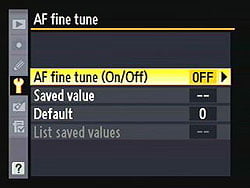
AF Fine Tuning: You can make micro-focus adjustments for up to 20 lenses, or adjust the body (default).
Ideally, there'd be a way to tell the camera to tweak its focus forward or back just a tad, depending on the lens you were using. In fact, this is just what the Nikon D3S provides: You can register up to 20 different lens "types" with the camera (more on "types" in a moment), and make micro-adjustments to the AF system for each.
This is an area where Nikon has followed Canon's lead. The Canon EOS-1D Mark III first introduced the idea of AF micro-adjustment when it was introduced back in late February 2007. Both can keep track of 20 different "registered" lenses.
What does lens "type" mean here? Basically, a lens "type" is a lens model. For instance, if you have a 70-200mm f/2.8 and a 100mm f/2.8 Micro, the camera would recognize each lens when it was attached to the camera, and automatically load the appropriate fine-tuning setting. If you had two 70-200mm f/2.8s though, the camera would have no way to distinguish between them, and would load the same fine-tuning settings for either one.
While there may be some photographers (particularly pros) who have more than 20 lenses in their kits, the 20-lens "fine-tuning library" will cover the needs of the vast majority of shooters. It also appears that the Nikon D3S's fine-tuning system can recognize lens types, regardless of who manufactured them. This is a huge step forward in focus accuracy, giving photographers the tools they need to maintain and calibrate their own equipment.
Nikon D3S Manual Focus
Of course, the Nikon D3S also supports manual focus, and with the big bright viewfinder, it's fairly easy to do despite the lack of split-image or microprism focusing aids found in manual focus film SLRs. An "electronic rangefinder" display consisting of a center dot and arrows on either side at the bottom left of the viewfinder information readout shows current focus status even in manual focus mode. When focus is achieved, the center dot illuminates. When the subject is not in focus, the arrows indicate which direction focus must be adjusted. The rangefinder works with any lens with a maximum aperture of f/5.6 or faster. One nice feature is that you can select which of the 51 focus points to confirm manual focus with. The electronic rangefinder is also active during autofocus operation, as visual confirmation of focus.
Dust Reduction
One of the most significant changes in the Nikon D3S outside the imaging pipeline and video support is the inclusion of Nikon's Dust Reduction system -- the first time the company has offered the technology in a full-frame camera with 100% viewfinder coverage. The system functions by vibrating the optical low-pass filter over the CMOS sensor at four distinct frequencies to shake free any dust particles that are adhering to the filter. This process can be initiated at the user's command, or automatically either when the camera is first switched on, or right before it powers off, or both.
Nikon's "Image Dust Off" software solution is also provided, where a dust reference photo can be taken and then utilized in Capture NX2 (optional) to remove dust in image post-processing. That said, we've found in-camera dust-removal systems less than perfectly effective. You're still going to need to use a sensor-cleaning kit fairly often, so the advantage of in-body dust removal is perhaps less than it might seem.
If you've got dust specks on your sensor (and sooner or later you will), you're going to need to clean it. There are a lot of products out there intended to address this need, but a distressing number of them work poorly (if at all), and many are grossly overpriced. Advertising hype is rampant, with bogus pseudo-scientific jargon and absurd product claims. And prices -- Did I mention prices? How about $100 for a simple synthetic-bristle brush?
So how do you know what product to use?
We don't pretend to have used everything currently on the market, but we can tell you about one solution that worked very well for us. The "Copper Hill" cleaning method is straightforward and safe, and in our routine usage here at Imaging Resource, highly effective. Better yet, the products sold by Copper Hill Imaging are very reasonably priced. Best of all, Nicholas R (proprietor of Copper Hill) has put together an amazingly detailed tutorial on sensor cleaning, free for all.
Sensor cleaning is one of the last things people think about when buying a d-SLR, but it's vital to capturing the best possible images. Take our advice and order a cleaning kit from Copper Hill right along with your d-SLR, so you'll have it close at hand when you need it: You'll be glad you did!
(While they've advertised on our sister site SLRgear.com from time to time, we receive no promotional consideration from Copper Hill for this note. We just think their sensor cleaning products are among the best on the market, and like their way of doing business. -- We think you will too. Click here to check them out.)
Lens Test Results
No "kit" lens, but the D3S's automatic chromatic aberration correction and vignette control in its JPEG files are effective, improves any lens you use with the camera.
| In-camera CA Correction | |
 |
 |
| Crop from RAW file (200%) |
Crop from JPEG (200%) |
As we found on the D3, the Nikon D3S's in-camera correction for chromatic aberration worked very well, as seen in the crops above. The image on the left is from a RAW file, converted through Adobe Camera Raw, with no lens correction applied, and just enough sharpening to approximate the look of the D3S's JPEGs, shot with the default sharpness setting. The crop is taken from the upper right hand corner of an image captured with the Nikon 24-120mm f/3.5-5.6D lens. It's an older lens, so it doesn't perform as well as most modern lenses in its class when it comes to C.A.
The image on the right is from the same area of an in-camera JPEG image. (The images were captured as a JPEG+RAW pair, so the pixel alignment between the two is exact.) You can still see just a smidgen of coloration along some of the edges, but that's really splitting hairs: For all intents and purposes, the CA is gone. (Note that the anti-CA processing is only applied to the in-camera JPEGs or TIFFs; the camera very rightly leaves the RAW files untouched.)
It's important to note that this CA correction isn't dependent on your using a Nikon lens: The camera figures out how much CA there is in each area of the image, and shifts the planes of red and blue pixel data to compensate for it. Note though, that this only works for lateral CA. Longitudinal CA isn't corrected out. (Happily though, with most good quality lenses, lateral CA is much more common than longitudinal.)
How great: A camera that makes your lenses look better than they are! (Now, if they could just make a camera that'd make me look like a better photographer than I am, they'd really have something! ;-)
| In-camera Vignette Control | |
 |
 |
| Off | Low |
 |
 |
| Normal | High |
Like all recent Nikon full-frame DSLRs, the D3S offers what the company calls "Vignette Control", which reduces corner shading caused by the lens. There are four settings available in the Shooting menu: Off (default), Low, Normal and High. The above shots were taken with a Nikkor 24-140mm f/3.5-5.6D lens at 24mm wide open. As you can see, even the High setting doesn't eliminate all the corner shading, but it's still much better than with it Off. Nikon says Vignette Control works for G- and D-type lenses, but DX and PC lenses are not supported. We're not sure if it'll work with third-party full-frame lenses. Like CA correction, the shading correction is applied only to JPEGs or TIFFs. Vignette Control does not apply to multiple exposures, DX format images or images created with Image Overlay, nor does it apply to movies. Its effect cannot be previewed in Live View mode.
We use a Sigma 70mm f/2.8 Macro lens in our laboratory testing, as our tests on SLRgear.com have revealed it to be one of the sharpest lenses we've tested.
The images above were taken from our standardized test shots. For a collection of more pictorial photos, see our Nikon D3S Photo Gallery .
Exposure
Nikon D3S Exposure
 Exposure Modes. As you'd expect from a digital SLR aimed at experienced photographers, the Nikon D3S eschews any hand-holding from Scene modes and the like, restricting its operating modes to the more traditional selection of Programmed Auto, Shutter Priority, Aperture Priority, and Manual. In Shutter Priority and Manual modes, shutter speeds from 1/8,000 to 30 seconds are available in 1/3 EV steps. The Manual mode also adds a Bulb setting for manually timed exposures whose length is limited only by available battery power.
A very nice touch that's common to other Nikon DSLRs is that, while in Program AE mode, you can rotate the Command dial to select different combinations of aperture and shutter speed settings than those normally chosen by the autoexposure system. (That is, if the automatic program would have chosen 1/125 second and f/5.6, you could instead direct the camera to use 1/60 at f/8 or 1/30 at f/11, to get greater depth of field.) Nikon calls this Flexible Program, and photographers familiar with other brands may know it as Program Shift. It's a very handy option for those times when you need some measure of increased control, but still want the camera to do most of the work for you. We personally use this capability more than Aperture- or Shutter-priority metering in some of our own shooting. The Nikon D3S also allows the step size to be set to the user's preference of either 1/3, 1/2 or 1EV steps, with three separate custom settings affecting the step size for different exposure variables. One custom setting controls ISO sensitivity step size, another the exposure compensation step size, and a third controls the aperture, shutter speed and exposure bracketing step size. If you generally want fine-grained control over shutter speed and aperture, but find yourself occasionally wanting to make quicker adjustments, the camera can be set using Custom Setting f4 to temporarily use a 1EV step size for these variables while the Function button is held down.
An interesting feature when using Manual exposure mode is the electronic analog exposure display visible in the optical viewfinder data readout. This shows the amount the camera thinks an image will be over- or underexposed, based on the settings you have selected, and helps you find the best exposure for the subject.
 Exposure Metering. Nikon has one of the most sophisticated and flexible metering systems currently on the market, and in the case of the Nikon D3S, its metering sensor covers a wide area of the frame with a 1,005-pixel RGB array. Like most SLRs, there are three main metering modes on the Nikon D3S: Matrix, Center-weighted, and Spot metering. Where Nikon's system differs is in the capability of these modes. Nikon's matrix metering (the default option on the D3S) is called 3D Color Matrix II, as it takes color as well as distance information from the lens into account.
By default, the Nikon D3S's Center-Weighted metering mode gives a greater weight (75%) to a 12mm diameter circle in the center of the frame, although if using a CPU lens this can be changed with Custom Setting b5 to use either an 8mm, 15mm or 20mm spot, or to average the entire frame. There's also an Average option which applies to both CPU and non-CPU lenses, which causes the D3S to average the entire frame when set to Center-Weighted metering. Finally, Spot meters a 4mm diameter circle (about 1.5% of the frame) centered on the active focus area. (Unless using a non-CPU lens or Auto-area AF, in which case the D3S behaves like most DSLRs in only metering the very center of the frame in Spot metering mode.)
 An even more unusual feature of the Nikon D3S comes courtesy of Custom Setting b6, which allows fine-tuning of the camera's metering system within a range of +/-1EV in extremely fine 1/6 EV steps. Three values can be set, allowing you to fine-tune Matrix, Center-weighted and Spot metering separately. This means that if you feel the camera to be under- or over-exposing scenes, you should be able to pull it back towards your preferred exposure without needing to dial in exposure compensation for most images. Another similarly useful feature for tuning the D3S to your tastes is Custom Setting c2, which allows the user to select how long the camera's metering system should be powered on during a period of inactivity. This lets you balance battery life against convenience, within a nine-step range from a miserly four seconds to a spendthrift 30 minutes, as well as an option to leave the metering system powered on at all times. Note that when running on A/C power, the metering system remains powered on all the time, for convenience's sake.
It's important to note that 3D Color Matrix Metering II does rely on the use of a Type-G or -D lens. With other CPU lenses, the
D3S falls back to Color Matrix Metering II, which doesn't take account of distance information in exposure calculations. Non-CPU lenses can use Color Matrix Metering if the focal length and maximum aperture are manually specified, but otherwise fall back to Center-weighted metering. The 1,005-pixel RGB sensor also serves to ascertain automatic white-balance, and provides assistance for focus tracking when the subject leaves the AF sensor area. Metering range is specified at 0 to 20 EV in Matrix or Center-Weighted, and 2 to 20 EV in Spot metering mode.
 Exposure Lock. Ordinarily, the AE-L/AF-L button locks both exposure and autofocus, useful for off-center subjects in tricky lighting. It can
also be disabled or programmed for AE lock, AF lock, or no fewer than ten other functions, via the custom menu.
Rather than requiring the button to be held for an AE-lock, you can also program
it to toggle the lock on and off either until the exposure meters power
off or optionally, until the shutter is released. The AE-L/AF-L button can also perform
one of four different functions when held while a command dial is turned -
either selecting the image area, the non-CPU lens number, the shooting menu bank
or the dynamic AF area - although by default the AE-L/AF-L button and command dials serve no function together.
Exposure Lock. Ordinarily, the AE-L/AF-L button locks both exposure and autofocus, useful for off-center subjects in tricky lighting. It can
also be disabled or programmed for AE lock, AF lock, or no fewer than ten other functions, via the custom menu.
Rather than requiring the button to be held for an AE-lock, you can also program
it to toggle the lock on and off either until the exposure meters power
off or optionally, until the shutter is released. The AE-L/AF-L button can also perform
one of four different functions when held while a command dial is turned -
either selecting the image area, the non-CPU lens number, the shooting menu bank
or the dynamic AF area - although by default the AE-L/AF-L button and command dials serve no function together.
 Exposure Compensation. Exposure compensation on the Nikon
D3S is adjustable from -5 to +5 exposure equivalents (EV) in 1/3, 1/2 or 1 EV step increments, and is controllable in Program, Aperture-priority, or Shutter-priority modes. Note that in Manual exposure mode, the EV button doesn't actually vary the exposure - it only biases the electronic analog exposure display that's shown in the optical viewfinder data readout. The Auto Bracketing feature on the Nikon
D3S can capture anywhere from two to nine sequential shots of the same subject with varying exposure values. Exposure settings for bracketing can vary from -9 to +9 EV (values are added to the already chosen exposure compensation value), with step sizes of 1/3, 1/2, 2/3, or 1 EV units. Through the Custom Settings menu, you can designate whether the bracketing sequence adjusts the ambient and/or flash exposure, white balance, or Active D-Lighting. When bracketing white balance, note that the shutter is tripped only once and the camera then saves the bracketed exposures from the same source data. When using ADL bracketing, anywhere from two to five frames can be captured. For two frame bracketing, one frame has ADL disabled, and the other has a user-preset strength. For three shots, the camera brackets with ADL Off, Low, and Normal. Four shots adds High, while Extra High is the fifth shot bracketed.
Exposure Compensation. Exposure compensation on the Nikon
D3S is adjustable from -5 to +5 exposure equivalents (EV) in 1/3, 1/2 or 1 EV step increments, and is controllable in Program, Aperture-priority, or Shutter-priority modes. Note that in Manual exposure mode, the EV button doesn't actually vary the exposure - it only biases the electronic analog exposure display that's shown in the optical viewfinder data readout. The Auto Bracketing feature on the Nikon
D3S can capture anywhere from two to nine sequential shots of the same subject with varying exposure values. Exposure settings for bracketing can vary from -9 to +9 EV (values are added to the already chosen exposure compensation value), with step sizes of 1/3, 1/2, 2/3, or 1 EV units. Through the Custom Settings menu, you can designate whether the bracketing sequence adjusts the ambient and/or flash exposure, white balance, or Active D-Lighting. When bracketing white balance, note that the shutter is tripped only once and the camera then saves the bracketed exposures from the same source data. When using ADL bracketing, anywhere from two to five frames can be captured. For two frame bracketing, one frame has ADL disabled, and the other has a user-preset strength. For three shots, the camera brackets with ADL Off, Low, and Normal. Four shots adds High, while Extra High is the fifth shot bracketed.
 ISO Sensitivity. The Nikon D3S's normal ISO ranges from 200 to 12,800 and can be extended down to ISO 100 (Lo 1), and up to ISO 102,400 (Hi 3). By default, ISO is adjustable in 1/3 EV steps (Lo 1, Lo 0.7, Lo 0.3, 200, 250, 320, 400, 500, 640, 800, etc.). Through Custom Setting b1, the D3S can be set to allow sensitivity adjustment in 1/2 EV steps (Lo 1, Lo 0.5, 200, 280, 400, 560, 800, etc.), or in 1EV steps (Lo 1, 200, 400, 800, etc.) Nikon's excellent Auto ISO feature is carried over as well, which allows you to set both the upper ISO limit (from ISO 400 to 102,400) as well as the minimum shutter speed (selectable from 1s to 1/4000s) required before ISO is increased automatically.
 White Balance. The Nikon D3S offers the usual white balance settings: Auto, six presets consisting of Incandescent, Fluorescent, Direct Sunlight, Flash, Cloudy, and Shade, a manual mode where white-balance is determined from a white or grey card or copied from an existing image, and a direct color temperature setting (2,500 to 10,000K). The Fluorescent preset has seven sub-settings consisting of Sodium Vapor (2,700K), Warm-white (3,000K), White (3,700K), Cool-white (4,200K), Day White (5,000K), Daylight (6,500K), and High Temperature Mercury Vapor (7,200K), and the manual setting allows five custom white-balance measurements (d-0 through d-4) to be stored.
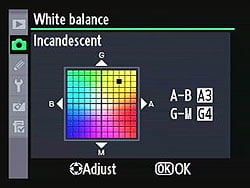 As with a number of other high-end SLRs these days, all the D3S's white balance presets and manual settings except for the direct color temperature settings are adjustable via a 2D fine-tuning grid display. The Nikon D3S also supports White Balance bracketing, where two to nine frames can be bracketed with Blue and/or Amber white balance bias increments of approximately 5, 10 or 15 mireds.
Active D-Lighting. D-Lighting has proven a popular post-processing feature in Nikon's consumer digital SLRs, as well as some of the company's point & shoot models. It's a quick software process that attempts to overcome underexposed images, and bring detail out of shadows. An improved version of Active D-Lighting appeared in the Nikon D3 and D300, including optimization of image contrast, helping to prevent overprocessing of shadows and flattening of overall image contrast. The Nikon D3S inherits the Active D-Lighting setup from the D3 with the addition of two extra settings. In addition to its predecessor's High, Normal, Low, and Off settings, the D3S includes an Extra-High setting, and the ability to automatically choose the Active D-Lighting strength on the fly.
|
D3S Active D-Lighting
|
|
 |
 |
|
Active D-Lighting
Off |
Active D-Lighting
Extra-High |
The effect of Active D-Lighting is highly dependent on the particular subject and lighting being shot, but for the most part is fairly subtle. The thumbnails above show its effect on our Outdoor Portrait test, where you can see it opening up the shadows somewhat, while simultaneously holding back the highlights a little. We like that it's generally subtle in its effect, as it's so easy to overdo automatic tonal adjustments like this. (See the Nikon D3S Image Quality tab for more detail on how well Active D-Lighting performs.)
 Picture Control. Nikon has standardized its Picture Control system so that camera settings for sharpening, contrast, brightness, saturation, and hue can be finely adjusted and ported to other Nikon digital SLRs that support the system. The D3 was the first camera compatible with the option, and all Nikon SLRs since follow the standard, including the D3S. There are four presets called Standard, Neutral, Vivid, and Monochrome, and up to nine custom presets can be defined, named, saved, and copied. Sharpness can be adjusted in ten steps or determined automatically for each image; while contrast, saturation, and hue can be adjusted in seven steps, and brightness is adjustable in three steps. Like sharpness, contrast and saturation also have Auto settings. There is also a five-step "Quick Adjust" setting which exaggerates or mutes the combined effect without having to adjust each slider individually. When Monochrome Picture Control is selected, hue and saturation are replaced by Filter Effects and Toning respectively. Filter Effects offers Off, Yellow, Orange, Red, and Green settings, while Toning offers B&W, Sepia, Cyanotype, Red, Yellow, Green, Blue Green, Blue, Purple Blue and Red Purple settings, with each of the colored settings offering seven adjustment steps. Of course, the Nikon D3S also offers sRGB and Adobe RGB settings, in a separate Color Space menu.
 Noise Reduction. The Nikon D3S offers four levels of high ISO noise reduction: Off, Low, Normal, and High. For Low, Normal, and High settings, noise reduction is performed at ISOs higher than 3,200. When set to Off, minimal noise reduction is still performed at ISOs of 16,000 (Hi 0.3) or above. High ISO noise reduction theoretically is not performed on RAW files (other than the embedded JPEG thumbnail), although there has been some data published by individuals on the Internet that suggests there may in fact be some NR applied in Nikon's NEF files. (We haven't investigated the issue thoroughly enough to take a position on it ourselves, though we are aware of the "median" filter Nikon applies to reduce the visibility of single hot-pixels in longer exposures.) The Nikon D3S also offers long-exposure noise reduction for exposures longer than 1 second. When set to On, the camera takes a second exposure for the same duration with the shutter closed, and subtracts the "dark frame" from the first, to further reduce hot-pixel and amp noise.
 Release Modes. The Nikon D3S's release modes are selected via the lockable release mode dial, which surrounds the button cluster to the left of the camera's prism. Release modes consist of Single Frame (S), Continuous Low-speed (CL), Continuous High-speed (CH), Quiet Shutter-release (Q), Self-timer, and Mirror Up (MUP). The Nikon D3S's Continuous mode is rated by Nikon for up to 9 frames per second when using the full sensor area, or as much as 11 fps in the 1.5x DX (24 x 16) crop mode. These figures apply only when both auto ISO sensitivity control and vibration reduction (if using a lens with this feature) are disabled, otherwise the frame rate may drop. Also, for DX crop burst shooting at rates above 9 fps, autofocus is fixed from the first shot in the burst, and exposure is also fixed if the subject is poorly lit. The number of shots that can be captured in a Continuous-mode burst before the camera slows down varies, depending on the file type and image size, as well as the amount of fine detail in the scene for compressed filetypes. Nikon says that up to 82 Large/Fine JPEGs or 38-43 12-bit Raw files, or 35-36 14-bit Raw files can be captured before the buffer fills, with the Raw burst depth depending on the compression type in use. Our tests with a deliberately difficult-to-compress image showed Nikon's specifications to be fairly close to the mark, with a buffer capacity of 41 12-bit or 36 14-bit RAW files, and around 90 large/Fine JPEGs. Of course, the number of consecutive shots could also be limited by available memory card space, if your card(s) are nearly full.
Quiet Shutter-release is similar to normal Single Frame mode; however, the camera reduces noise by disabling the beep sound when the camera focuses (the focus beep can also be disabled in the custom menu), and by delaying lowering of the mirror until the shutter button is released, separating the noise of this operation from that of the mirror being raised and the shutter fired. (The result is indeed a quieter shutter sound.) Self-Timer mode opens the shutter a programmable delay (2, 5, 10, or 20 seconds) after the shutter button is pressed. (Note that it is recommended to close the built-in eyepiece shutter to prevent stray light from affecting the exposure in Self-Timer mode. Also note that Bulb exposures in Self-Timer mode will have a duration of 1/5th second.) Finally, Mirror Up mode allows the mirror to be locked up with a first press of the shutter button or corded remote release, and fires the shutter on a second press (or automatically, after a delay of 30 seconds), allowing camera shake caused by mirror slap to be reduced when shooting on a tripod. There is also an Exposure Delay option in Custom Setting d9 which delays the exposure one second after the shutter button has been pressed and the mirror raised.
Interval Timer Mode. Another useful feature on the Nikon D3S is Interval Timer mode, which facilitates time-lapse photography by taking a series of images at preset intervals.
|
Nikon D3S Interval Timer Options
|
|
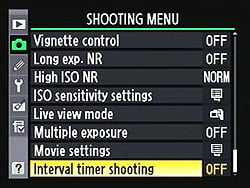 |
|
|
Interval Timer mode is accessed,
from the bottom of the shooting menu |
|
 |
 |
| Start time can be set (HH:MM), or you can choose "Now" |
Interval between shots can be set from 1 second to 24 hours |
 |
 |
| You can set anywhere from 1 - 999 Intervals, and from 1 - 9 shots each time the camera wakes up |
Once everything is configured, hit the OK button, and you're good to go! |
As shown above, you can set the starting time for the series, as well as the time interval between shots, the number of shots to be captured after each interval, and the total number of intervals after which capture should cease. You can set hours, minutes, and seconds between each shot, and you can set a start time using 24-hour notation (HH:MM) from 00:00 to 23:59. (Make sure the camera's timezone, date and time are correctly set!) You can also start immediately, using the "Now" option. This is a good way to capture a timeline of slower events, such as clouds passing across the sky, tidal changes, a flower opening, etc. As with the Self-timer mode, the eyepiece shutter should be placed over the viewfinder to prevent stray light from affecting the exposure. Exposure, flash, Active D-Lighting and white balance bracketing are all possible during interval shooting, and all will override the shots per interval setting to capture the required number of bracketed exposures. (White balance bracketing will capture only one exposure per interval, but then process that exposure differently so as to create the separate WB-bracketed still image files.) Interval capture can be paused and resumed through the camera's menu system, if needed.
 Multiple Exposure Mode. The Nikon D3S allows anywhere from two to 10 exposures to be captured separately, and then combined in-camera into a single multiple-exposure image. This function allows effects similar to those that might have been obtained by recocking the shutter while not advancing film, or intentionally winding back, then re-exposing an image on a film camera. Two modes are available, Series or Single Photo. As the name suggests, Series mode takes a series of multiple exposures. You must select Off to terminate multiple exposures. Single Photo mode takes one multiple exposure, then normal shooting resumes. Up to 30 seconds is allowed between exposures, in addition to the time set in Custom Setting c4, "Monitor Off Delay" if Image Review is enabled - so a maximum of 10 minutes and 30 seconds between exposures is possible if the camera has sufficient battery life remaining. As they're captured, the exposures can either be averaged by setting gain to "On", or the brightness values from each exposure simply added up. The Multiple Exposure mode can be combined with the Interval timer function to automatically capture all the shots of the multiple exposure if desired, and it's also possible to change white balance between exposures. Most other menu options are disabled during Multiple Exposure capture. Sadly, live view can't be used to capture multiple exposures, so there's no way to preview the effect and precisely align subjects by looking at the camera's LCD display.
 Retouch Menu. The Nikon
D3S has an extensive Retouch menu, which is starting to rival what basic image editing software packages can do on a computer - so much so that some users may not feel the need to use a computer for Nikon
D3S image editing at all. Retouch options include adjusting D-Lighting, red-eye correction, image cropping (trim), converting to monochrome, applying Skylight or Warm filter effects, adjusting color balance, image overlay for combining two RAW images into one JPEG, NEF (RAW) processing, resizing to small images (for TV, Web or email), side-by-side comparison,
and movie editing. Phew, that's quite the list!
Retouch Menu. The Nikon
D3S has an extensive Retouch menu, which is starting to rival what basic image editing software packages can do on a computer - so much so that some users may not feel the need to use a computer for Nikon
D3S image editing at all. Retouch options include adjusting D-Lighting, red-eye correction, image cropping (trim), converting to monochrome, applying Skylight or Warm filter effects, adjusting color balance, image overlay for combining two RAW images into one JPEG, NEF (RAW) processing, resizing to small images (for TV, Web or email), side-by-side comparison,
and movie editing. Phew, that's quite the list!
 RAW Processing SubMenu. RAW-format files are pretty common on SLRs these days: They capture all the data as it comes from the sensor, usually without any processing applied. Manipulated on a computer with RAW-processing software, they let you make major white balance adjustments, minor exposure tweaks, and perform noise-reduction processing beyond what the camera can manage on its own. Like many of their other high-end SLRs, the Nikon
D3S also lets you do this sort of processing right in the camera, via a sub-menu off the Retouch Menu.
RAW Processing SubMenu. RAW-format files are pretty common on SLRs these days: They capture all the data as it comes from the sensor, usually without any processing applied. Manipulated on a computer with RAW-processing software, they let you make major white balance adjustments, minor exposure tweaks, and perform noise-reduction processing beyond what the camera can manage on its own. Like many of their other high-end SLRs, the Nikon
D3S also lets you do this sort of processing right in the camera, via a sub-menu off the Retouch Menu.
The Nikon D3S's RAW processing menu gives you a lot of options. You can change the JPEG quality, image size, white balance, exposure compensation (within limits), Picture Control setting, high ISO noise reduction, color space and Vignette Control of a file, generating a new JPEG. (The original RAW file itself and any JPEG is left untouched; a new file is created.) This can be pretty handy if you need to make a quick change to white balance or minor exposure tweak in the field, before uploading an image to beat a deadline.
The images above were taken from our standardized test shots. For a collection of more pictorial photos, see our Nikon D3S Photo Gallery .
Not sure which camera to buy? Let your eyes be the ultimate judge! Visit our Comparometer(tm) to compare images from the Nikon D3S with those from other cameras you may be considering. The proof is in the pictures, so let your own eyes decide which you like best!
Performance
Nikon D3S Performance
Timing and Performance
Generally excellent speed for a pro SLR these days, though autofocus is somewhat sluggish for its class.
|
Startup/Shutdown
|
||
|
Power on
to first shot |
~0.3 second
|
Time it takes for camera to turn on. (Very fast, difficult to measure.)
|
|
Shutdown
|
~1.0 second
|
How long it takes camera to turn off before you can remove the memory card. (Slow, but includes sensor cleaning.)
|
|
Single-Shot clearing times
|
||
|
Buffer clearing time
Large Fine JPEG |
2 seconds
(after 50 frames) |
Worst case buffer clearing time. -- This is the delay after a set of shots before you can remove the card. Some cameras won't shut down until the buffer is cleared. (*See note about memory card speeds at bottom of table below.)
|
|
Buffer clearing time
12-bit RAW |
7 seconds
(after 60 frames) |
|
|
Buffer clearing time
12-bit RAW + L/F JPEG |
17 seconds
(after 58 frames) |
|
|
Continuous mode buffer capacity/clearing times
|
||
|
Buffer clearing time
L/F JPEG |
10 seconds
(after 100 frames) |
Worst case buffer clearing time. (*See note about card speeds below.)
|
|
Buffer clearing time
12-bit RAW (Lossless Compressed) |
14 seconds
(after 41 frames) |
|
|
Buffer clearing time
12-bit RAW (Lossy compressed) + L/F JPEG |
17 seconds
(after 36 frames) |
|
|
Buffer clearing time
14-bit RAW (Lossless Compressed) |
15 seconds
(after 36 frames) |
|
|
Buffer clearing time
L/F JPEG DX Mode |
5 seconds (after 130 frames) |
|
|
*Note: Buffer clearing times measured with a SanDisk Extreme Pro 32GB 90MB/s CompactFlash card. Slower cards will produce correspondingly slower clearing times. Slow cards may also limit length of bursts in continuous mode. ISO sensitivity and noise reduction settings can also affect cycle times and burst mode performance.
|
||
Startup time is average for a professional SLR, but shut-down is quite slow, likely due to sensor cleaning. Buffer clearing time depends on the image size and quality, burst length and the speed of memory card used, but is generally very fast.
|
Mode switching
|
||
|
Play to Record,
first shot |
~0.3 second
|
Time until first shot is captured.
|
|
Record to play
|
~0.9 second
|
Time to display a large/fine file immediately after capture.
|
|
Display
recorded image |
~0.1 second
|
Time to display a large/fine file already on the memory card.
|
Mode switching is quite fast, difficult to measure, except Record to play, which is a bit sluggish for its class.
|
Shutter Response (Lag Time)
|
||
|
Optical Viewfinder
|
||
|
Full Autofocus
Single Point (Center) AF |
0.197 second
|
Time from fully pressing shutter button to image capture using optical viewfinder, with Sigma 70mm f/2.8 EX DG Macro.
|
|
Full Autofocus
Single Point (Center) AF Release Priority |
0.043 second
|
Time from fully pressing shutter button to image capture using optical viewfinder, with Sigma 70mm f/2.8 EX DG Macro.
|
|
Full Autofocus
51-point Auto Area |
0.361 second
|
Time from fully pressing shutter button to image capture using optical viewfinder, with Sigma 70mm f/2.8 EX DG Macro.
|
|
Prefocused
|
0.043 second
|
Time to capture, after half-pressing and holding shutter button.
|
|
Continuous AF
Release Priority |
0.044 second
|
This mode usually shows no speed increase with our static subject; we have no way to measure performance with moving subjects.
|
|
Manual focus
Optical Viewfinder |
0.043 second
|
For most cameras, shutter lag is less in manual focus than autofocus, but usually not as fast as when the camera is "prefocused".
|
|
Live View
|
||
|
Full Autofocus
Single Point (center AF) Hand-Held Mode |
0.511 second
|
Time from fully pressing shutter button to image capture, using Live View "Hand-Held" (phase-detect) mode, with Sigma 70mm f/2.8 EX DG Macro.
|
|
Full Autofocus
Tripod Mode |
2.66 seconds
|
When using Live View "Tripod" (contrast-detect) mode, autofocus is performed using the AF-On button.
|
|
Prefocused
Tripod Mode |
0.423 second
|
Time from fully pressing shutter button to image capture, after prefocusing with AF-On button, using Live View "Tripod" (contrast-detect) mode.
|
In terms of the D3S's ability to determine that it's properly focused when shooting the same target multiple times (with no change of focus setting between iteration, to remove the impact of lens AF speed), its speed is a little slow for professional model. The D3S required 0.197 second using single-area center AF mode, and 51-point Auto Area AF lag measured 0.361 second, much slower than the 0.085-0.088 second we measured with the D3. As you would expect, switching to Release Priority did improve shutter response dramatically (to 0.043 second), but that also means the camera may not achieve focus before capturing the image.
We had similarly slow fulll AF results with the D3X (0.161 and 0.435 second respectively), so it's unlikely to be an issue with our sample of the D3S. To make sure it wasn't some sort of compatibility issue with the D3S and the Sigma lens we use at as our reference lens, we repeated the test with a Nikkor AF-S 24-70mm f/2.8 (the same lens we tested the D3 with), and a Nikkor AF-S 60mm f/2.8 Macro. However, we got very similar numbers with the Nikkors so the Sigma lens was not the issue. (SLRs normally determine focus with the Sigma 70mm very quickly; in fact the D3S, D3X and D300 were all slightly faster with it than the Nikkor 24-70mm f/2.8 lens.) We'll see if we can get another body from Nikon to test just to make sure we didn't have issues with the particular sample we had of the D3S , but we don't know if we'll be able to obtain a second sample or not.
When prefocused or manually focused, the D3S's shutter lag was extremely fast, at only 43 milliseconds. In continuous autofocus mode with release priority, shutter lag was also extremely fast, at only 44 milliseconds.
As expected, the D3S's two Live View modes add considerable delay, but the "Hand-Held" mode is faster than some other implementations we've tested recently. The "Hand-Held" mode which uses the same "mirror-down" phase difference AF method employed when using the optical viewfinder has full AF shutter lag of 0.511 second, which is pretty good for the mode.
The "Tripod" Live View mode lag was much slower, at 2.66 seconds, but focusing is performed separately using the AF-On button, so measuring the total lag is difficult. It's easy to see why Nikon chose to call this "Tripod" mode: It's really only going to be useful for still-life subjects, with the camera pretty immobile. The time it takes to achieve focus depends heavily on how far the lens elements have to travel. When a slower lens has to rack from infinity to close focus, the AF time in Tripod mode can easily stretch to 3 seconds or more. Nikon did say that they've tweaked the algorithm to improve contrast-detect AF speed over the D3, but we didn't test that on the D3.
Once prefocused, Tripod mode shutter lag is a reasonable 0.423 second. There's little point to shooting prefocused in Hand-Held mode, as the viewfinder is blacked out as long as the shutter button is held down in readiness.
To minimize the effect of different lens' focusing speed, we test AF-active shutter lag with the lens already set to the correct focal distance. We also use the same Sigma 70mm f/2.8 macro with every camera (on all platforms except Four Thirds/Micro Four Thirds and Nikon consumer models lacking an in-body focus motor), to further reduce variation, and because our tests showed that focus-determination time with this lens was close to the fastest, across multiple camera bodies from different manufacturers. Being an older design with a non-ultrasonic motor, it wouldn't be the fastest at slewing from one focus setting to another, but that's exactly the reason we measure focus determination speed, which is primarily a function of the camera body, vs focus adjustment speed, which is primarily a function of the lens.
|
Cycle time (shot to shot)
|
||
|
Single Shot mode
Large Fine JPEG |
0.34 second
|
Time per shot, averaged over >50 shots.
|
|
Single Shot mode
12-bit RAW |
0.34 second
|
Time per shot, averaged over >50 shots.
|
|
Single Shot mode
12-bit RAW + L/F JPEG |
0.34 second
|
Time per shot, averaged over 58 shots.
|
|
Early shutter
penalty? |
Sometimes
|
Some cameras refuse to snap another shot if you release and press the shutter too quickly in Single Shot mode, making "No" the preferred answer.
|
|
Continuous Hi mode
Large Fine JPEG Size Priority |
0.11 second
(9.01 frames/sec); 90 frames total; 10 seconds to clear* |
Time per shot, averaged over buffer of 90 shots, then slows to 0.22s or 4.56 fps with 18% variation.
|
|
Continuous Hi mode
12-bit RAW Lossless Compressed |
0.11 second
(9.05 frames/sec); 41 frames total; 14 seconds to clear* |
Time per shot, averaged over buffer of 41 shots, then slows to 0.34s or 2.95 fps with 35% variation.
|
|
Continuous Hi mode
14-bit RAW Lossless Compressed |
0.11 second
(9.05 frames/sec); 36 frames total; 15 seconds to clear* |
Time per shot, averaged over 36 shot buffer, then slows to 0.37s or 2.7 fps with 6% variation. (Unlike the D3S00/D300S and D3X, 14-bit RAW does not slow the continuous-mode frame rate.)
|
|
Continuous Hi mode
12-bit RAW (Lossless) + L/F JPEG |
0.11 second
(9.01 frames/sec); 36 frames total; 17 seconds to clear* |
Time per shot, averaged over buffer of 36 shots, then slows to 0.56s or 1.8 fps with 26% variation.
|
|
Continuous Hi mode
14-bit RAW (Lossless) + L/F JPEG |
0.11 second
(9.01 frames/sec); 34 frames total; 17 seconds to clear* |
Time per shot, averaged over buffer of 34 shots, then slows to 0.59s or 1.71 fps with 17% variation.
|
|
Continuous Hi mode
DX Mode L/F JPEG |
0.09 second
(11.02 frames/sec); >130 frames total; 5 seconds to clear* |
Time per shot, averaged over 130 shots, with no signs of slowing
|
|
Continuous Lo mode
Default 5 fps L/F JPEG |
0.20 second
(5.04 frames/sec); 70 frames total; 2 seconds to clear* |
Time per shot, averaged over 70 shots, with no signs of slowing
|
|
Flash recycling
|
n/a
|
Flash at maximum output.
|
|
*Note: Buffer clearing times measured with a SanDisk Extreme Pro 32GB 90MB/s CompactFlash card. Slower cards will produce correspondingly slower clearing times. Slow cards may also limit length of bursts in continuous mode. ISO sensitivity and noise reduction settings can also affect cycle times and burst mode performance.
|
||
Single-shot cycle time performance is very good for a pro SLR model, at about 0.34 second between JPEG or RAW shots, though slightly slower than the D3's 0.28 - 0.32 second range.
Continuous mode speeds are very similar to the D3's, which is to say very fast, in any mode including 14-bit uncompressed RAW, at just over 9 frames per second. Unlike the D300/D300S and D3X, the D3S did not slow down at all when shooting 14-bit vs 12-bit RAW files. Buffer depths have dramatically improved over the D3, more than doubling, though some of the increase may be due to using a newer, faster CompactFlash card with the D3S. In large/fine JPEG mode, the D3S's buffer depth was a whopping 90 frames, and varied between 36 and 41 frames in RAW mode, depending on the bit depth of the NEF files.
JPEG buffer depth shooting "normal" subjects is likely to be even greater than we measure with our deliberately difficult-to-compress test target, so your mileage (buffer capacity) may vary, but should generally be better than our measurements.
Like the D3, for really blazing speed with the D3S, you can shoot in "DX" mode, where the sensor area is cropped to match the "DX" size sensors in Nikon's sub-frame DSLRs. In this mode, the D3S met the 11 frame/second spec that Nikon gives it. This drops the resolution down to 2,784 x 1,848 (5.1 megapixels), but that's still a very usable resolution level, and the speed in this mode is unparalleled.
Like other recent pro-level SLRs, the Nikon D3S makes good use of very fast memory cards.
|
Download speed
|
||
|
Windows Computer, USB 2.0
|
3,789 KBytes/sec
|
Typical Values:
Less than 600=USB 1.1; 600-770=USB 2.0 Low; More than 770=USB 2.0 High |
Download speeds were fast (but not as fast as some), though fast enough that you probably won't feel the need for a separate card reader.
Bottom line, the Nikon D3S is extremely fast in most respects, with very fast frame rates, deep buffers for long bursts, and very low shutter lag, but full autofocus speed was slower than average for a professional model. Keep in mind however that our AF tests are on static subjects, and we have no way of objectively testing the D3S's autofocus acquisition and tracking performance with real-world subjects. Despite the slower-than-average full AF test results, we strongly suspect the D3S performs very well shooting active subjects and sports in the field, being competitive with anything else out there in its class.
Battery and Storage Capacity
Battery
Outstanding battery life for an SLR lithium-ion design.
| Test Conditions | Number of Shots |
|
Lithium-ion rechargeable battery,
|
4,200 |
|
Lithium-ion rechargeable battery,
Live View |
Unknown |
The Nikon D3S uses a custom rechargeable lithium-ion battery pack for power, and comes with both a single battery and charger. The rated 4,200 shots per charge using the optical viewfinder is well above average for a pro SLR, (but keep in mind the D3S does not have a built-in flash, so that's one reason why the number is so high). Unfortunately, Nikon does not seem to publish battery life results for when Live View mode is used, but it's a safe bet that it's considerably shorter. (Again, we don't have specific measurements, but did notice that the battery seemed to use up its charge much more rapidly when we were shooting in Live View mode. - And the remaining-capacity indicator would often dip noticeably when we switched Live View mode.)
The table above shows the number of shots the camera is capable of on fully-charged battery, based on CIPA battery-life and/or manufacturer standard test conditions.
(Interested readers can find an English translation of the CIPA DC-002 standards document here. (180K PDF document))
Storage
The Nikon D3S stores its photos on CompactFlash memory cards (dual slots are provided), and no card is included with the camera. The chart below shows how many images can be stored on a 2GB card at each size/quality setting. JPEGs with default Size Priority and RAW with lossless compression.
|
Image Capacity vs Resolution/Quality 2GB Memory Card |
Fine | Normal | Basic |
12-bit
RAW (LLC) |
14-bit
RAW (LLC) |
|
| 4,256 x 2,832 |
Images
(Avg size) |
276 7.4 MB |
548 3.7 MB |
1,076 1.9 MB |
98 21 MB |
89 23 MB |
|
Approx.
Comp. |
5:1 | 10:1 | 19:1 | 0.9:1 | 0.8:1 | |
| 3,184 x 2,120 |
Images
(Avg size) |
496 4.1 MB |
976 2.1 MB |
1,836 1.1 MB |
- | - |
|
Approx.
Comp. |
5:1 | 10:1 | 18:1 | - | - | |
| 2,128 x 1,416 |
Images
(Avg size) |
1,076 1.9 MB |
2,080 985 KB |
3,904 525 KB |
- | - |
|
Approx.
Comp. |
5:1 | 9:1 | 17:1 | - | - | |
We strongly recommend buying a large capacity CompactFlash. You should probably consider at least a 2GB card, if not a 4GB or 8GB one, to give yourself extra space for extended outings, especially if you plan on doing a lot of RAW or Movie shooting. (Check the shopping link above, cards are cheap these days, so there's no reason to skimp -- But do consider faster cards for this camera, to reduce buffer clearing times.)
Imaging
Nikon D3S Image Quality
Color
Saturation & Hue Accuracy
Fairly accurate and pleasing color with minor oversaturation of strong reds, blues and greens.
 |
| In the diagram above, the squares show the original color, and the circles show the color that the camera captured. More saturated colors are located toward the periphery of the graph. Hue changes as you travel around the center. Thus, hue-accurate, highly saturated colors appear as lines radiating from the center. Click for a larger image. |
Saturation. The Nikon D3S pushes reds, blues and some oranges and greens just a little, while undersaturating some cyans very slightly, but overall, saturation is very good, if a bit vibrant for a professional model. Most consumer digital cameras produce color that's more highly saturated (more intense) than found in the original subjects. This is simply because most people like their color a bit brighter than life. Pro-oriented models like the D3S tend to have more accurate saturation levels.
Skin tones. Here, the Nikon D3S also did quite well, producing natural-looking skin tones, though just slightly on the pink side. Where oversaturation is most problematic is on Caucasian skin tones, as it's very easy for these "memory colors" to be seen as too bright, too pink, too yellow, etc.
Hue. The Nikon D3S showed a few small color shifts relative to the correct mathematical translation of colors in its subjects, but had very good accuracy overall. Most noticeable was a slight shift in red toward orange, cyan toward blue, with some very minor shifts in greens, blues and purples as well. Hue is "what color" the color is.
Saturation Adjustment
The Nikon D3S has a total of seven saturation settings available, three above and three below the default saturation. This covers a very wide range of saturation levels, about as wide a range as you're likely to find photographically relevant, apart from special effects that are arguably better achieved in software. The fine steps between settings mean you can program the camera to just the level of saturation you prefer. Nice. (It's also nice that color saturation has little effect on greyscale contrast, something that's not always the case.)
| Saturation Adjustment Examples | ||
 |
 |
 |
| -3 | 0 | +3 |
The table above shows results with the default as well as the two extreme saturation settings. Click on any thumbnail above, then click again to see the full-sized image.


Sensor
Exposure and White Balance
Indoors, incandescent lighting
Very warm results with Auto and Incandescent white balance settings, though excellent color with the 2,600 Kelvin and Manual. Average positive exposure compensation required.


Indoors, under normal incandescent lighting, color balance was very warm with the Auto white balance setting; we really expect better from an SLR selling at this price point. (But, quite honestly, very seldom see it.) The Incandescent setting was a bit better, but still on the warm side. (Like other Nikon models, the D3S's Incandescent setting appears to be color-balanced for professional studio lighting, rather than the warmer household incandescent lights most US consumers have in their homes. This is normal for a professional SLR. You can use the D3S's excellent manual adjustment capabilities to tweak the incandescent setting to better match whatever lighting you're personally faced with.) The Manual setting produced the most accurate results, though the 2,600 Kelvin setting wasn't far off the mark either. Both seemed just a touch on the cool side to our eyes, but here again, the D3S gives you ample ability to fine-tune its white balance however you like. The Nikon D3S required an average amount of positive exposure compensation here, at +0.3 EV. (Most cameras required about +0.3 EV compensation for this shot.)
(Our test lighting for this shot is a mixture of 60 and 100 watt household incandescent bulbs, a pretty yellow light source, but a very common one in typical home settings here in the U.S.)
Outdoors, daylight
Good color overall, though a tendency toward a warm cast and slightly high contrast under harsh lighting. Average exposure compensation required.
Outdoors, the Nikon D3S tended toward a warmer color balance, though overall color was generally quite good. The D3S required +0.7 EV exposure compensation to keep the model's face from being too dim in the "Sunlit" portrait shot on the left. That's about average to what we're accustomed to seeing among digital cameras for this shot. The D3S's default contrast is a little high, producing a few washed-out highlights in the model's shirt and flowers, as well as some deep shadows below the bouquet, but the D3S does much better than the majority of cameras in this regard. The far-field shot of the house came out just about right, with very few clipped highlights and lost shadows at the D3S's default exposure setting. An excellent performance here. The D3S's contrast and Active D-Lighting settings do help tame the highlights quite a bit, see below for examples of this.
(And yes, we do know that pros would expose these shots differently, exposing to hold detail in the highlights, and then adjusting the tone curve on the computer to bring the rest of the image into balance. We shot these examples the way we did, in order to be consistent with the rest of our camera tests, including tests of consumer models. Consumers generally expose for the midtones, and let highlights and shadows fall where they may. You can check the Nikon D3S thumbnails index to see how the Indoor Portrait test looks with a range of exposure compensation settings.)
See full set of test images with explanations
See thumbnails of all test and gallery images
Resolution
High resolution, 1,700 lines of strong detail from in-camera JPEG, about the same from RAW files.


Our laboratory resolution chart revealed sharp, distinct line patterns down to about 1,700 lines per picture height both horizontally, and in the vertical direction. Extinction didn't occur until past 2,600 lines. We weren't able to extract any more resolution by processing the D3S's NEF files using dcraw (or ACR), though images were crisper compared to the in-camera JPEG, and pattern extinction was extended to about 3,400 lines. Use these numbers to compare with other cameras of similar resolution, or use them to see just what higher resolution can mean in terms of potential detail.
See full set of test images with explanations
See thumbnails of all test and gallery images
Sharpness & Detail
Fairly sharp images overall, with only slight edge-enhancement artifacts on high-contrast subjects. Exquisite detail with only minor noise suppression visible in the shadows.


Sharpness. The Nikon D3S captured fairly sharp images, though the very conservative default in-camera sharpening leaves details in camera-rendered JPEGs shot with the default settings looking just slightly soft overall. The good part of this is that there's very little in the way of sharpening artifacts left to interfere with subsequent sharpening on the computer. In the high contrast shot above, there's only a hint of edge enhancement artifact visible along the edges of the white house trim and roof, as well as some of the larger branches. Edge enhancement creates the illusion of sharpness by enhancing colors and tones right at the edge of a rapid transition in color or tone.
Detail. The crop above right shows really impressive detail with only minor noise suppression artifacts in the darkest areas of the model's hair. The camera's overall response here is much better than average. Noise-suppression systems in digital cameras tend to flatten-out detail in areas of subtle contrast. The effects can often be seen in shots of human hair, where the individual strands are lost and an almost "watercolor" look appears.
RAW vs In-Camera JPEGs
As noted above, the Nikon D3S produces fairly sharp, detailed in-camera JPEGs using a good prime lens (in this case, the Nikkor 50mm f/1.8D, stopped down). As is almost always the case, even more detail can be obtained from carefully processing RAW files than can be seen in the in-camera JPEGs. Take a look below, to see what we mean:

In the table above, mousing over a link at the bottom will load the corresponding crop in the area above, and clicking a link will load the full resolution file. Examples include in-camera Fine JPEG, RAW file processed through View NX using default settings, and RAW file processed through Adobe Camera Raw 5.6, then sharpened in Photoshop, using USM at 250%, radius=0.3 pixel. As you can see, View NX offers a tiny bit more detail than the in-camera JPEG, while the ACR conversion delivers even more detail, with less coarsening of the finest elements due to the sharpening operator.
ISO & Noise Performance
The new high ISO king! An improvement over the D3, especially at very high ISOs.
|
Default High ISO Noise Reduction
|
 |
 |
 |
| ISO 100 (Lo -1) | ISO 200 | ISO 400 |
 |
 |
 |
| ISO 800 | ISO 1,600 | ISO 3,200 |
 |
 |
 |
| ISO 6,400 | ISO 12,800 | ISO 25,600 (Hi +1) |
 |
 |
|
| ISO 51,200 (Hi +2) | ISO 102,400 (Hi +3) | |
Noise levels are remarkably low at the Nikon D3S's lower sensitivity settings, with smooth, detailed images up to ISO 1,600, where there is only a slight hint of "grain" visible in darker shadows. At ISO 3,200, noise is still very low with very little loss in fine detail. We start to see moderate levels of luminance noise at ISO 6,400, along with some chroma noise in the shadows, but detail is still quite good. Some loss of detail is evident at ISO 12,800 where high ISO noise reduction is smoothing away fine detail along with noisy pixels. We also see some yellow and purple blotches in darker areas. Noise and the effects of noise reduction become more obvious at 12,800, with stronger blurring, and increased "grain" and color blotches. Still, there is a moderate amount of detail left to work with. Not surprisingly, ISOs 25,600, 51,200 and especially 102,400 are quite noisy and soft looking onscreen, with blotches of chroma noise and little fine detail remaining after default high ISO noise reduction is applied. Still, the Nikon D3S does a bit better than the previous high ISO champ, the D3. The improvement is definitely noticeable at ISOs above 6,400.
As always, see the Print Quality section below, to see how we think this noise performance translates into practical print sizes at each ISO setting.
A note about focus for this shot: We shoot this image at f/4, using one of three very sharp reference lenses (70mm Sigma f/2.8 macro for most cameras, 60mm f/2.8 Nikkor macro for Nikon bodies without a drive motor, and Olympus Zuiko 50mm f/2.0 for Four Thirds and Micro Four Thirds bodies). To insure that the hair detail we use for making critical judgements about camera noise processing and detail rendering is in sharp focus at the relatively wide aperture we're shooting at, the focus target at the center of the scene is on a movable stand. This lets us compensate for front- or back-focus by different camera bodies, even those that lack micro-focus adjustments. This does mean, though, that the focus target itself may appear soft or slightly out of focus for bodies that front- or back-focused with the reference lens. If you click to view the full-size image for one of these shots and notice that the focus target is fuzzy, you don't need to email and tell us about it; we already know it. :-) The focus target position will simply have been adjusted to insure that the rest of the scene is focused properly.
Extremes: Sunlit and low light tests
Very high resolution with strong overall detail, slightly high default contrast. Excellent low-light performance, great exposures to the lowest limits of our test, and the autofocus worked that low as well, even without an AF-assist light.


Sunlight. The Nikon D3S produced slightly high contrast with a few washed-out highlights and deep shadows under the deliberately harsh lighting of the test above. However, highlight and shadow detail were both pretty good. The model's face was too dim at the +0.3 EV setting, so we preferred the image with +0.7 EV of exposure compensation, which resulted in some blown highlights in the shirt and flowers, but not to the extent we're used to seeing. Some may prefer the shot at +1.0 EV, but we felt it had a few too many blown highlights. The shot at +0.7EV almost perfectly preserved detail in the shirt; the only significantly blown out detail is in the red channel in the orange flower, and to a lesser extent in the red flower itself. At the other end of the tonal scale, there's good detail present pretty far into the shadows, although the very darkest shadow areas become somewhat plugged and posterized. That's nit picking though, you have to go really far into the shadows to see those problems. (In real life, of course, be sure to use fill flash in situations like the one shown above; it's better to shoot in the shade when possible.)
Because digital cameras are more like slide film than negative film (in that they tend to have a more limited tonal range), we test them in the harshest situations to see how they handle scenes with bright highlights and dark shadows, as well as what kind of sensitivity they have in low light. The shot above is designed to mimic the very harsh, contrasty effect of direct noonday sunlight, a very tough challenge for most digital cameras. (You can read details of this test here. In actual shooting conditions, be sure to use fill flash in situations like the one shown here; it's better to shoot in open shade whenever possible.)
Contrast Adjustment
We really like it when a camera gives us the ability to adjust contrast and saturation to our liking. It's even better when those adjustments cover a useful range, in steps small enough to allow for precise tweaks. As was the case with its saturation adjustment, the Nikon D3S's contrast setting meets both challenges very well.
|
Minimum Contrast
|
|
 |
 |
| Contrast set to lowest, +0.7 EV |
Contrast set to lowest, Auto Exposure |
At its lowest contrast setting, the Nikon D3S did a good job of preserving highlight detail, while maintaining fairly natural-looking skin tones, and holding nice detail in the shadows. The camera still lost some highlight detail in the model's shirt and flowers, though shadow detail improved greatly, with significantly less posterization and plugging. The D3S captured very good color outdoors, though again, just slightly on the warm side. Overall, very good results here.
| Contrast Adjustment Examples | ||
|
 |
 |
| -3 | 0 | +3 |
The table above shows results with the default as well as the two extreme contrast settings. While you can see the extremes, it's hard to really evaluate contrast on small thumbnails like these, so click on any thumbnail to go to the full-size image. The Nikon D3S's contrast adjustment worked well, with very little effect on color saturation. Contrast and saturation are actually fairly closely coupled adjustments, it's a good trick to be able to vary one with out the other changing as well. As usual, Nikon did a good job here, and the fine-grained contrast steps make it easy to select just the amount of contrast you want.
|
Active D-Lighting
|
||
|
 |
 |
|
Off (default)
|
Low
|
Normal
|
 |
 |
 |
 |
 |
 |
|
Highlight Retention
|
||
 |
 |
 |
|
Shadow Detail
|
||
 |
 |
 |
|
Shadow Detail, Brightened (significantly) in Photoshop
(Levels control, highlight slider down to 70) |
||
 |
|
 |
|
High
|
Extra High
|
Auto
|
 |
 |
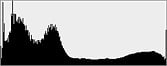 |
 |
 |
 |
|
Highlight Retention
|
||
 |
 |
 |
|
Shadow Detail
|
||
 |
 |
 |
|
Shadow Detail, Brightened (significantly) in Photoshop
(Levels control, highlight slider down to 70) |
||
Nikon's Active D-Lighting
The six shots above show the results with Active D-Lighting at "Off ", "Low", "Normal", "High", and the new "Extra High" and "Auto" settings, the full range of settings. As you can see from the crops, fewer highlights in the flowers and shirt are clipped as the setting is increased, and shadows are opened up, although a minor price is paid in the very deepest shadows, in the form of increased noise and some posterization. (There's no free lunch: If the camera is devoting more of its available dynamic range to rendering highlights, there's less left to handle the shadows.) Note that these are very deep shadows that we're looking at above. Lighter shadows show very little noise increase, at least that was visible to our eyes with this test subject.
This sort of tonal-range adjustment is very tricky to do and have the results come out natural-looking. Nikon's been refining their D-Lighting algorithms for several years now, and the results show it: Even the "Extra High" setting above produces a natural-looking image.
|
More Active D-Lighting Examples
|
||
|
Far Field
|
||
 |
 |
 |
| Off | Low | Normal |
 |
 |
 |
| High | Extra High | Auto |
|
Still Life
|
||
 |
 |
 |
| Off | Low | Normal |
 |
 |
 |
| High | Extra High | Auto |
The D3S's Active D-Lighting can result in undesired results when applied to subjects with a more normal tonal range. The white trim in the house shot has a slightly bluish tint to it at higher settings, and the Still Life shots look a tad overexposed and somewhat flat at the higher settings. Images with normal contrast will tend to look flat when dynamic-range extension technology is applied to them, simply because the range of available subject tones is being compressed into a smaller percentage of the available output tonal range. The new "Auto" setting is a welcome addition, since it seems to do a good job at determining what level to apply, at least in our three test cases.
Because digital cameras are more like slide film than negative film (in that they tend to have a more limited tonal range), we test them in the harshest situations to see how they handle scenes with bright highlights and dark shadows, as well as what kind of sensitivity they have in low light. The shot above is designed to mimic the very harsh, contrasty effect of direct noonday sunlight, a very tough challenge for most digital cameras. (You can read details of this test here.)
| 1 fc 11 lux |
1/2 fc 5.5 lux |
1/4 fc 2.7 lux |
1/8 fc 1.3 lux |
1/16 fc 0.67 lux |
1/16fc No NR |
|
|---|---|---|---|---|---|---|
| ISO 100 |
 1.3s f2.8 |
 2.5s f2.8 |
 5s f2.8 |
 10s f2.8 |
 20s f2.8 |
 20s f2.8 |
| ISO 200 |
 0.6s f2.8 |
 1.3s f2.8 |
 2.5s f2.8 |
 5s f2.8 |
 10s f2.8 |
 10s f2.8 |
| ISO 400 |
 0.3s f2.8 |
 0.6s f2.8 |
 1.3s f2.8 |
 2.5s f2.8 |
 5s f2.8 |
 5s f2.8 |
| ISO 800 |
 1/6s f2.8 |
 0.3s f2.8 |
 0.6s f2.8 |
 1.3s f2.8 |
 2.5s f2.8 |
 2.5s f2.8 |
| ISO 1600 |
 1/13s f2.8 |
 1/6s f2.8 |
 0.3s f2.8 |
 0.6s f2.8 |
 1.3s f2.8 |
 1.3s f2.8 |
| ISO 3200 |
 1/25s f2.8 |
 1/13s f2.8 |
 1/6s f2.8 |
 0.3s f2.8 |
 0.6s f2.8 |
 0.6s f2.8 |
| ISO 6400 |
 1/50s f2.8 |
 1/25s f2.8 |
 1/13s f2.8 |
 1/6s f2.8 |
 0.3s f2.8 |
 0.3s f2.8 |
| ISO 12800 |
 1/100s f2.8 |
 1/50s f2.8 |
 1/25s f2.8 |
 1/13s f2.8 |
 1/6s f2.8 |
 1/6s f2.8 |
| ISO 25600 |
 1/200s f2.8 |
 1/100s f2.8 |
 1/50s f2.8 |
 1/25s f2.8 |
 1/13s f2.8 |
 1/13s f2.8 |
| ISO 51200 |
 1/400s f2.8 |
 1/200s f2.8 |
 1/100s f2.8 |
 1/25s f2.8 |
 1/25s f2.8 |
 1/50s f2.8 |
| ISO 102400 |
 1/800s f2.8 |
 1/400s f2.8 |
 1/200s f2.8 |
 1/100s f2.8 |
 1/50s f2.8 |
 1/50s f2.8 |
Low light. The Nikon D3S performed very well on the low-light test, capturing usable images at the lowest light level (1/16 foot-candle), even with the lowest sensitivity setting (ISO 100). Noise naturally increases as ISO goes up and light levels go down, but remains remarkably low up to ISO 12,800. At ISO 25,600, noise is more noticeable but still reasonable. At ISOs 51,200 and 102,400 noise gets pretty ugly with strong chroma noise, bright red pixels and some horizontal banding. There is also what looks to be "heat color bloom" from a warm electrical component near the sensor emanating from the bottom left, which is visible as a purple tint at the highest ISOs. We couldn't get it to show up when we tried much longer exposures in complete darkness, though. Color balance had slightly warm cast to it despite using manual white balance. The rightmost column in the series above shows the results with the D3S's long-exposure NR turned off.
The camera's autofocus system was able to focus on the subject at less than the 1/16 foot-candle light level unassisted (and that's a good thing, as the D3S does not have a built-in AF assist lamp). Also (as always), keep in mind that the longer shutter speeds here absolutely demand the use of a tripod to prevent any blurring from camera movement. (A useful trick is to just prop the camera on a convenient surface, and use its self-timer to release the shutter. This avoids any jiggling from your finger pressing the shutter button, and can work quite well when you don't have a tripod handy.)
How bright is this? The one foot-candle light level that this test begins at roughly corresponds to the brightness of typical city street-lighting at night. Cameras performing well at that level should be able to snap good-looking photos of street-lit scenes.
NOTE: This low light test is conducted with a stationary subject, and the camera mounted on a sturdy tripod. Most digital cameras will fail miserably when faced with a moving subject in dim lighting. (For example, a child's ballet recital or a holiday pageant in a gymnasium.) Digital SLRs like the Nikon D3S do much better than point & shoots, but you still shouldn't expect a quick autofocus lock with moving subjects.
Output Quality
Print Quality
Excellent print quality from ISO 100 to 6,400, each able to make good quality 16x24-inch prints. ISO 12,800 shots were good at 13x19 inches, and ISO 102,400 made a decent 4x6-inch print.
 Printing JPEG images straight from the Nikon D3S strains the mind a bit. While we're used to seeing a pretty clear descent in image size as ISO rises, images from the 12-megapixel D3S don't start to need a size downgrade from 16x24 until ISO 12,800.
The only major flaw that appears in images in this range and size is increasing luminance noise in the shadows, which starts at about ISO 800. It looks very much like film grain, though, so it's not at all objectionable.
ISO 12,800 shots are usable at 16x24, but really look better at 13x19 inches.
ISO 25,600 shots have rather blobby noise in the shadows, and less detail, making them better at 11x14 inches. Contrast also seems to increase at this setting, with more plugged shadows and blacks.
ISO 51,200 is usable at 11x14, but considerably better at 8x10. Chroma noise has finally started to creep into the shadows at this size and ISO setting.
ISO 102,400, depending on the subject, is still usable at 8x10, but an almost choppy wave-like pattern has started to emerge in the shadows, along with more chroma noise. This becomes less noticeable at 5x7, and nearly disappears at 4x6, producing an astonishing image when you consider in what conditions it was captured.
Really a remarkable performance from the amazing Nikon D3S digital SLR camera.
Testing hundreds of digital cameras, we've found that you can only tell just so much about a camera's image quality by viewing its images on-screen. Ultimately, there's no substitute for printing a lot of images and examining them closely. For this reason, we now routinely print sample images from the cameras we test on our Canon Pro9000 Mark II studio printer, and on the Canon Pixma MP610 here in the office. (See the Canon Pixma Pro9000 Mark II review for details on that model.)
Viewfinder
Nikon D3S Viewfinder
 Like the D3 and D3X, the D3S's optical viewfinder is big, bright, and beautiful. The pentaprism design features 100% frame coverage, 0.7x magnification at 50mm and -1 diopter, an 18 mm eyepoint, and diopter adjustment range of -3 to +1. If you just look at the specs, you might think that the D3S's optical VF is a step backward from sub-frame bodies. After all, the D3S's viewfinder is rated at only 0.7x magnification factor, vs. the 0.86x of earlier pro models like the D2Xs. You have to stop and take into account the fact that that's 0.7x relative to a full-frame sensor though, so the net effect is something like a 70% bigger view of the world. This is immediately apparent when you look through the D3S's viewfinder: The view is very wide, and if you wear eyeglasses, you'll likely find that you need to press your lenses against the eyecup in order to take in the entire frame at once.
A built-in eye-piece shutter is provided for self-timer or live view mode. The Nikon D3S ships with a Type B BriteView Clear Matte VI focusing screen, but also accepts a Type E screen with etched grid-lines. (There's no provision for grid lines to be projected onto the viewfinder screen, as with some prosumer Nikon SLRs.)
Unlike Nikon's prosumer and consumer models, focus areas in the D3S's optical viewfinder are always displayed in red. Non-selected ones are very faint red (hardly visible), and the selected/active ones are bright red, with programmable brightness (Low, Normal, High or Extra High). It's very quick and easy to determine which focus area is in use.
The graphic and table below shows what information is displayed in D3S's viewfinder. It is unchanged from the D3.

|
1
|
12-mm reference circle for center-weighted
metering
|
15
|
"K" (appears when memory remains for over 1000
frames)
|
|
2
|
AF area brackets
|
16
|
Flash ready indicator
|
|
3
|
Focus points
|
17
|
FV lock indicator
|
|
Spot metering targets
|
18
|
Flash sync indicator
|
|
|
4
|
Focus indicator
|
19
|
Aperture stop indicator
|
|
5
|
Metering
|
20
|
Battery indicator
|
| 6 |
Autoexposure (AE) lock
|
21
|
Electronic analog exposure display
|
|
7
|
Exposure mode
|
Exposure compensation display
|
|
|
8
|
Shutter speed lock icon
|
Tilt indicator
|
|
|
9
|
Shutter speed
|
22
|
Exposure compensation indicator
|
|
10
|
Aperture lock icon
|
23
|
Exposure and flash bracketing indicator
|
|
11
|
Aperture (f-number)
|
|
|
|
Aperture (number of stops)
|
|
||
|
12
|
ISO sensitivity indicator
|
|
|
|
Auto ISO sensitivity indicator
|
|
||
| 13 |
ISO sensitivity
|
|
|
|
14
|
Frame count
|
|
|
|
Number of exposures remaining
|
|
||
|
Number of shots remaining before buffer fills
|
|
||
|
Preset white balance recording indicator
|
|
||
|
Exposure compensation value
|
|
||
|
PC mode indicator
|
|
Image Areas
The Nikon D3S is unusual in that you can not only use it as a full-frame SLR, but also as a reduced-frame one. In fact, there are now three cropped-frame modes available (up from two on the D3 and D3x), one with a 5:4 aspect ratio (corresponding to an area on the sensor of 30.0 x 23.9 mm), another with a 3:2 aspect ratio, but with the frame size reduced to match that of Nikon's DX-format cameras (a 23.5 x 15.6 mm frame, vs the full "FX" format size of 36.0 x 23.9 mm.), and a third, new 1.2x format (30.0 x 20.0mm). The 5:4 ratio is useful for the popular 8x10 print size, while the 1.2x mode offers a slightly increased 35mm-equivalent focal length, avoids the very corners of the image (which tend to be the problem areas for lens-derived image defects), and yields slightly more manageable file sizes. The "DX" frame size is handy for taking advantage of Nikon's many excellent DX-format lenses. In fact, the camera can be set to automatically switch to DX mode when a DX-format lens is attached to it. You can rapidly select between crop modes by pressing and holding the Fn button on the front of the camera while simultaneously turning the main command dial on the rear.
When the D3S is shooting in a format other than full-frame FX mode, a translucent LCD in the viewfinder partially masks the inactive portions of the frame. The illustrations below show the viewfinder display in the various modes.


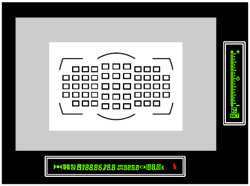
Viewfinder Test Results
Coverage
Excellent accuracy with both the optical viewfinder and LCD monitor's Live View mode.


The Nikon D3S's optical viewfinder and Live View LCD mode proved extremely accurate, with essentially 100% coverage when measured with our Sigma 70mm f/2.8 macro test lens. The coverage in Live View mode is also 100%. Excellent performance.
Live View
Nikon D3S Live View
"Live View" has become a fairly common feature on DSLRs, both at the consumer and professional level. For pros, it's probably less driven by the convenience of framing on an LCD than it is by the need for a viewfinder display when the camera is operated remotely. (Although Live View features that provide for highly magnified displays can be a considerable help in checking depth of field and focus accuracy.)
 Nikon debuted its Live View feature in its D3 and D300 models, both announced in August 2007, and the D3S retains the bulk of the D3's Live View functionality unchanged. As well as integrating the Virtual Horizon overlay which was added to the D3 after release via a firmware update, the D3S does have a few notable differences from the D3's live view mode, however. Most significantly, Live View is no longer restricted to its own position on the Release Mode dial. Instead, the D3S offers a dedicated Live View button on its rear panel, adjacent to the Microphone button at the right end of the rear control panel LCD. That also means all drive modes are available in Live View mode. (On the D3, release modes in Live View mode were menu driven, and limited to Single, Continuous Lo and Continuous Hi). We did however notice the frame rate in Continuous Hi mode seemed a lot slower than with the optical viewfinder. Finally, the D3S' new Movie mode (described on the Video page of this review) is accessed through the Live View function, by pressing either the Depth-of-Field Preview button or the center button of the multi-selector.
| Nikon D3S Hand-Held Live View Displays | |
 |
 |
|
In Hand-Held mode the LCD display echoes the optical viewfinder. You can move the AF point around the screen in Single point or Dynamic AF area modes, but the 51-point AF does not reveal chosen AF points. The Nikon D3S's Live View display includes a good bit of relevant shooting data, including shooting mode, crop mode, audio recording, time remaining, metering mode, shutter speed/aperture, exposure compensation, ISO, and more. |
Pressing the Info button cycles through the four available display modes. This display shows the minimum amount of information, only overlaying the focus area. Not shown are "no card" and low battery warning overlays, which appear on all displays when active. If the aspect ratio of the currently selected movie mode does not match still image aspect ratio, small markers near the corners of the screen indicate where the movie will be cropped in this display, as shown above. |
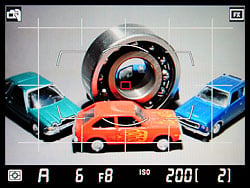 |
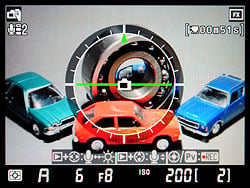 |
|
A framing guide overlay is available... |
...as well as the virtual horizon function. |
 As in the company's past DSLR models, Nikon's Live View mode provides two options for autofocus operation, dubbed Hand-Held mode and Tripod mode. With the mirror raised and shutter open, the light path to the usual SLR phase-detect AF sensor is interrupted, so normal AF can't be used. The Hand-Held mode addresses this problem by dropping the mirror to determine focus, and then opens it again to restore the Live View display. In this mode, either the shutter release or AF-ON button can be used to autofocus. Fully depressing the shutter release will focus and capture the image, just as it does when using the optical viewfinder.
On the plus side, the focusing operation itself is just as swift and reliable as in non-Live View shooting. The main disadvantage of this mode is that there is an interruption to the Live View feed, equivalent to the time taken to lower the mirror, perform the focusing operation and raise the mirror again. It's also possible that an unfamiliar photographer could be fooled into thinking that the mirror noise means that a photo has been captured, when in fact the camera has only focused -- something Nikon is careful to note in its manual. Also, the focus area on the LCD monitor does not change to green to indicate focus has been achieved, or blink red when it has not, like it does in Tripod mode (see below). So, unless you have focus beep on, or prefocus and check with magnification (see below), there is no positive indication of focus in Hand-Held mode before you take the shot. In situations where one has to keep intrusive noise to a minimum, the mirror cycle accompanying every AF operation might also be seen as a disadvantage, however the D3S's Quiet Shutter release mode is available. (See the Exposure page for details.)

In Hand-Held mode, you can select from the same focus areas available in the optical viewfinder. Like the optical viewfinder, the active focus area does not turn green when focused. (Unlike Tripod mode.) You can zoom in onto the selected focus point up to 13x to check critical focus.
You can magnify the image around the selected focus point by up to 13x, and the camera remembers the magnification after the image is captured, so you can quickly check if autofocus produced the results you intended.
Exposure is always just "estimated" in the preview for Hand-Held mode. Shutter speed, aperture and ISO displayed do no update real-time in response to changes in lighting after Live View mode was enabled, and there is no exposure meter like there is in the optical viewfinder. The effects of White Balance and Picture Control settings are shown on screen, but that's about the extent of simulation. For instance, you can dial-in negative exposure compensation, or select a very fast shutter speed in low light in Manual exposure mode, and the resulting preview image would look fine while the captured image would be underexposed. Automatic exposure settings do update during the autofocus operation however, since the metering sensor is also active during autofocus in this mode, so images captured in Hand-Held mode should have identical exposure compared to using the optical viewfinder under the same conditions. For a more accurate, real-time representation of the final image and automatic exposure settings, you'll need to use Tripod Mode and enable Exposure Preview (see below). Although all three metering modes are supported in both Live View modes (except when Exposure Preview is enabled), you cannot just change the metering mode and have the display immediately reflect that change. In Hand-Held mode, you either have to leave and re-enter Live View mode to change metering modes, or wait until after an autofocus operation or a frame has been captured, as that's when the metering sensor is exposed.
| Nikon D3S Tripod Mode Live View Displays | |
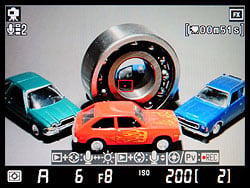 |
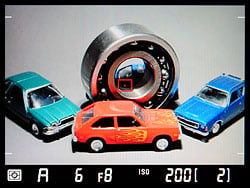 |
|
Tripod mode offers a similar display to Hand-held, however the AF area brackets are not shown, and the slightly larger contrast-detect focus area can be moved freely around the entire frame in small steps. The focus frame contains a dot when in the center position. |
Again, pressing the Info button cycles through the available display modes. This display shows the minimum amount of information, only overlaying the focus area, and the crop markers when the movie aspect ratio doesn't match the current still aspect ratio. |
 |
 |
|
Of course, the framing guide overlay is also available in Tripod mode... |
...as is the virtual horizon display. |
 |
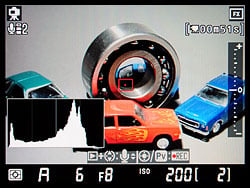 |
|
When the OK button is pressed, the D3S enters Exposure Preview mode where exposure is more accurately reflected, and an exposure meter is displayed along the right-hand side. |
A live luminance histogram is available (the other screens are still available) while Exposure Preview is enabled. Its position is fixed, and it's not translucent like the virtual horizon or metering scale. |
Nikon's second Live View autofocus option is Tripod mode. In this mode, the camera performs contrast-detect autofocus, just like any point & shoot digicam. That is, it simply reads data off the CMOS image sensor and evaluates how abruptly light to dark (or dark to light) transitions happen on the image plane. Autofocus is performed only by pressing the AF-ON button in this mode; half-pressing the shutter release does nothing, and full depressing it will not attempt to refocus before capture. Contrast-detect AF isn't nearly as fast as phase-detect (this is why the shutter response of most digicams is so much slower than that of most DSLRs), but the camera can focus without interrupting the Live View display (and without all the mirror flipping noise). As an added benefit, because it's working with data coming from the main image sensor, you can move the AF point anywhere you want within the frame area, right out to the extreme edges. You're also guaranteed that the selected focus area will be in focus if the camera is able to find focus: Because the focus determination is made with data from the main image sensor, there's no possibility of front- or back-focus, as could be encountered with conventional phase-detect AF systems.

In Tripod mode, you can move the AF point around the entire screen in small increments. When autofocus is achieved, the focus frame turns green. If autofocus failed, the focus frame blinks red.
Of course there's no such thing as a free lunch, and Tripod mode's potential disadvantage is made clear by Nikon's choice of name. The company has consistently emphasized that this mode is only for use with stationary subjects, and with the camera mounted on a tripod. Depending on the circumstances, Live View Tripod mode can stretch shutter lag to as long as several seconds, depending on the lens in use and how far the starting point is from the final focus distance. With a moving subject (or a handheld camera), it's quite likely that the contrast detection AF simply wouldn't be able to keep up with the motion, and would be left hunting, unable to achieve a focus lock.

You can also use the zoom button and command dial on the back of the camera to magnify around the focus area up to 13x for critical focus, and you can focus (manual or autofocus) while magnified.
Like Hand-Held mode, the D3S also offers the very useful 13x display zoom in Tripod mode, providing excellent focus discrimination when focusing manually. This is pretty key: Less than about 10x magnification really doesn't do the trick for getting the focus set right, but in playing with the camera at 13x, we felt we could pretty well nail the focus every time. What's particularly neat is that you can continue doing Contrast-Detect AF when the image is magnified, providing immediate feedback of exact focus. Also like Hand-Held mode, you cannot change metering modes while in Live View mode. Which ever mode was selected before entering Live View mode will be used, except when Exposure Preview is enabled, which always uses Matrix metering. (Though it meters data streaming from the image sensor, as the dedicated metering sensor is not exposed during previews.)
Very useful for studio shooting is the ability to preview exposure by pressing the "OK" button during Tripod mode. (As mentioned previously, Exposure Preview is not available in Hand-held mode.) This is more accurate that the exposure "simulation" provided in Hand-Held mode, allowing exposure to be checked and fine-tuned before the final image is ready to be captured. Shutter speed, aperture and ISO (if Auto ISO is enabled) values are adjusted in real-time in response to changing lighting, just like they do when using the optical viewfinder. The lens aperture is actually stopped down to the selected value in this mode, which also provides depth-of-field preview. (The DOF Preview button starts and stops movie recording in Live View mode.) There are a few limitations to this function, however. Only +/-3.0EV of exposure compensation can be previewed, although the camera will allow up to a +/-5.0EV range to be set -- greater values aren't reflected in the preview display. It's also obviously not possible to preview a bulb exposure, given that the camera won't know the exposure time until the photograph is actually captured. The effects of Vignette Control is also not previewed. Interestingly, where the Nikon D3 also didn't allow Exposure Preview with a flash strobe attached, Active D-Lighting or bracketing in effect, or the shutter speed at the X-sync value of 1/250 second, the D3S will allow preview in these circumstances - just with a proviso that the exposure may not accurately reflect that of the final image. As mentioned above, only Matrix metering is supported during Exposure Preview. If the metering mode switch was set to Center-Weighted or Spot before entering Live View mode, the metering icon in the Live View display changes to Matrix as soon as Exposure Preview is enabled.
With Live View mode comes the ability to control most, if not all aspects of the camera's functioning from a PC remotely, including focusing. Both the recent Nikons and Canons include the ability to control the camera from a computer remotely, and that includes receiving a Live View image from the camera. You can focus, adjust settings, and fire, all from a computer. What's more, you can do it via USB cable or Wi-Fi connection, with the optional Wi-Fi adapters. The Nikons require optional Camera Control Pro software to enable this feature. Software for this feature is bundled with Canon cameras. Of course, no software is needed to view the Live View display on a TV or monitor via the A/V or HDMI outputs.
All-in-all, the Nikon D3S's Live View mode is more capable than that of Nikon prosumer and consumer models such as the D300S and D90, and is easier to access with the dedicated Lv button than the D3 or D3X, but still isn't as seamless or as user-friendly as some competitors' implementations.
Video
Check out the links below for more sample images, videos and image quality analysis:
- Nikon D3S Optics page (Crops from images shot with the camera's kit lens, if sold as a kit)
- Nikon D3S Sample Images page (Index to all standard test shots, with explanations)
- Nikon D3S Thumbnails page (Thumbnails of all shots, including RAWs, with EXIF data)
- Nikon D3S Gallery page (Regular photos taken with the Nikon D3S)
Nikon D3S Video Capability
by Andrew Alexander
Given that the Nikon D3S is an upgraded version of Nikon's flagship D3, much of the functionality is the same between the two cameras. There is one major difference, however, in that the D3S is Nikon's first full-frame dSLR that can shoot video. Video producers are discovering that video-enabled digital SLR cameras are an inexpensive way to get a very "film-like" look, and these cameras are entering the production mainstream to shoot everything from commercials, television programs, and even feature films.
| Video Specifications | |
|---|---|
| Video Sizes: | 1280x720, 640x424, 320x216 |
| Frame Rate: | 24 fps |
| Video Compression: | Motion JPEG, variable bit rate |
| Video length: | 5 minutes (1280x720), 20 minutes (640x424, 320x216) |
| Max file size: | 2 GB |
| HDTV standard: | 720p |
| Audio Sampling: | 44,100 Hz, 16-bit stereo |
| Audio Compression: | Uncompressed (all modes) |
| Microphones: | Internal monaural, External port (3.5mm stereo) |
| Manual Control: | Yes |
Video Formats. The first thing worth noting about Nikon's implementation of video capture is that it is capable of shooting video at 24 frames per second -- period. So, filmmakers who are looking for that elusive "film-like" look need look no further; but it's worth noting that the camera can't be switched to the standard that is used in conventional broadcast television: 29.97 frames per second (fps). Fortunately, most video editing programs can convert 24 fps into 29.97 fps, with the viewer none the wiser.
| (Click to play video) |
The film-like look: Nikon D3S with Nikkor 105mm f/2 DC lens, set to f/2. Download original 22MB AVI file.
The Nikon D3S can shoot HD-quality video, though it is limited to the 720p format, instead of the larger 1080p format. In this mode, the Nikon D3S can shoot 5 minutes of video. In either of the two smaller modes, the Nikon D3S can shoot up to 20 minutes of video. The camera lets you select the destination slot for recording videos.
How much video can I shoot? Nowhere in the Nikon D3S manual will you find a chart showing how much video can be stored on a given CompactFlash card, though the camera does tell you approximately how much recording time you have space for on your currently installed card(s). Videos are encoded with a compression standard called Motion JPEG or M-JPEG, which is essentially a string of JPEG images for each frame of the video. Accordingly, the size of the video relates to how easily each frame can be compressed. A video of a white wall takes up very little space at all, while something extremely complicated will take up much more space. This is known as a variable compression scheme: it's unlikely that any two recordings, while sharing the same length of time, will share the same file size. While optimizing the amount of space on the CompactFlash card, this can be a bit misleading in terms of how much space is available for video recording on a given flash card. After doing some testing, the following table sets out the length of one-minute recordings at various quality levels and scenes.
| Frame size | Maximum length | File size of a 1-minute recording | |||
|---|---|---|---|---|---|
| Pure white | Static scene | Constant | Complex | ||
| 1280 x 720 | 5 minutes | 43 MB | 123 MB | 110 MB | 171 MB |
| 640 x 424 | 20 minutes | 21 MB | 54 MB | 45 MB | 40 MB |
| 320 x 216 | 20 minutes | 28 MB | 33 MB | 32 MB | 32 MB |
In these tables, "Pure white" refers to just that: a continuous shot of a white wall. "Static scene" refers to a continuous shot of a living room scene, where nothing moved in the shot. "Constant" refers to constant motion, where the camera was continuously moved in a random pattern for the duration of the minute. And "Complex" refers to a static shot of complex test pattern.
It may seem that there are some errors in the above chart, but it's true; through the magic of compression, the 320x216 setting actually produces a larger file than the 640x424 setting, though a white wall isn't that interesting. Also worthy of note is that a scene of constant motion clocked in at a lower size than a scene where nothing moved at all. Nikon indicates that the maximum file size for a video can be 2GB, but in our testing, the largest file size we could achieve was around 800MB, which was a 5-minute 720p video of a complex scene. With this information, we propose the following estimations:
| Frame size | On an 8 GB card: (maximum total recording time in minutes) | |||
|---|---|---|---|---|
| Pure white | Static scene | Constant | Complex | |
| 1280 x 720 | 190 | 66 | 74 | 47 |
| 640 x 424 | 390 | 151 | 182 | 204 |
| 320 x 216 | 292 | 248 | 256 | 256 |
So while it's not a definitive answer, that might provide some rough guidance when planning your shoot.

Accessories. The Nikon D3S, with attached external microphone and light. (Gear shown above includes a Cool-Lux MD3000 Light and Sound bracket, Litepanels Micro LED On-Camera Light, and a Sony ECM-CG1 Gun Microphone.)
Audio. In contrast to video recording, the Nikon D3S records audio as an uncompressed 16-bit stereo PCM file with a 44,100 Hz sampling rate, and a fixed bitrate of 1,411 kbps. This audio format is used regardless of whether the video quality is set to full 720p HD, 640x424 or 320x216. An internal mic is available for sound recording, but better sound quality can be obtained by plugging in an external microphone to a 3.5mm stereo jack. Sound is played back through an internal speaker.
Nikon has included one option for modifying sound recording, by letting the user select the sensitivity of the microphone. Options range from turning the microphone off to completely automatic sensitivity control; the Nikon D3S can also be set to use low, medium, or high sensitivity, which controls the loudness level at which the mic will pick up and record sound.
Movie settings menu.
For high-level application, what is really missing is levels control. There is no way to monitor the strength of the audio being recorded, either visually with a VU meter, or by plugging in a set of earphones and being able to "tune in" to what is being recorded. A word to the wise: plugging in a set of earphones to the A/V out jack will not accomplish this; quite the opposite, it will give you an earful of buzz. For casual use, automatic sensitivity control does an excellent job, and the ability to raise or lower the sensitivity is better than nothing. But for critical scenarios, expect to be doing a fair amount of dumping to the laptop and listening to takes, to ensure the audio was captured correctly -- or consider finding a secondary audio recording device.
Controls. Videos are recorded on the Nikon D3S by engaging the Live view mode, causing the scene to appear on the LCD. Pressing either the front upper function button (Pv) or the central button in the multi-selector pad starts and stops video recording. If recording in 1280x720 mode, bands on the top and bottom of the LCD screen mask out the portion of the scene that is not recorded.

16:9. The Nikon D3S LCD screen in 1280x720 mode, with the top and bottom of the screen masked out.
The Nikon D3S shows its roots as a digital SLR camera, and no fundamental ergonomic changes have been made to make it handle like a traditional camcorder. A plethora of third-party solutions have arisen to allow video-enabled dSLR cameras to be used more like shoulder-mount camcorders, and for good reason: it's hard to hold a dSLR still for a reasonable length of time. In addition, while the Nikon D3S can autofocus during video recording, its ability to do so is mediocre at best, and of extremely limited usefulness to videographers. In practice I found it much more effective to prefocus before shooting, and then manually focus as required.
In a photographic situation, one of the tasks of the photographer is to achieve the right combination of aperture, shutter speed and ISO that results in a properly exposed photograph (or at least, one that's exposed to the satisfaction of the photographer). It's the same scenario in a video context, except that instead of juggling those variables for a single instant in time, the shooter must be able to adjust at least one of those variables at any given moment to be able to respond to changing light levels. This is known generally as exposure control.
| (Click to play video) |
Exposure control. In this example I simply pointed the camera from a dim interior wall (f/32, ISO ~10,000) to a brighter exterior view (f/32, ISO ~1,000). It took the automatic gain control of the Nikon D3S about one second to do the 3-stop transition.
In the default configuration of the Nikon D3S, exposure control is handled solely by the camera, using ISO speed as the variable to create a properly exposed image. While the user has control over the aperture to control depth-of-field, and control over shutter speed to restrict subject blurring, ISO is used (again, by default) to ensure that the image is properly exposed. In Live view, it is possible to override these automatic settings by engaging the exposure preview mode (by pressing the "OK" button). This function superimposes the exposure compensation spectrum on the LCD's live view, and to some degree disengages the automatic functionality of the program. In Manual mode, the user may select whichever ISO setting they desire. In Program, Shutter, and Aperture-priority modes, the user can press the Autoexposure Lock (AE-L) button to commit the camera to a given exposure setting. In some cases this is desirable, and in some it is not; the camera's auto-ISO program has a wider fidelity than the user does, able to set extremely precise ISO settings (ISO 5600, anyone?) where the user is only able to set ISO settings in 1/3 EV increments. And, the adjustment requires both a button press and a dial rotation, both of which are liable to jar the camera while it's in use.
| (Click to play video) |
Aperture control. Aperture can always be selected in Live view, before or during the recording of a movie. In this case the automatic gain program of the Nikon D3S is increasing the ISO speed to compensate for the smaller aperture setting.
Aperture control. One of the primary advantages of shooting video on the Nikon D3S is being able to use fast primes to record scenes with extremely shallow depth of field. By comparison, conventional camcorders are limited to scenes with large depth of field owing to the relatively small image sensors they employ. On the Nikon D3S, the aperture can be selected at any time, whether video is being recorded or not; however, the transition from one aperture to another is both audible (there's a distinct click) and visible (an abrupt light change). While the audio may not be a factor if external mics are far away enough from the camera, the visual impact is jarring enough that it's noticeable, made potentially even more so by the physical movement of turning a command dial to effect the change. On conventional camcorders, iris adjustment is controlled by a smoother dial, and the aperture itself is stepless, making for a very smooth transition. In the short term this is just a factor that videographers will have to work around, but hopefully, in the future Nikon will add a suitable control interface that allows for more subtle changes in aperture.
| (Click to play video) |
 |
| 1/25 1/50 1/100 1/200 1/400 1/800 1/1600 1/3200 |
Shutter speed control. As the shutter speed is reduced, the yo-yo becomes crisper in each frame. (Click the links above to load a frame at the selected shutter speed.)
Shutter speed. The Nikon D3S also allows for the manual override of shutter speed. Of course, the whole notion of shutter speed is something of a fallacy in the act of video acquisition for this camera, as the shutter remains open through the entire process. In this instance, shutter speed is more appropriately the length of time in which the sensor is active for the recording of any given frame of video. The practical impact of adjusting shutter speed is to decrease the amount of blur exhibited by a subject that is being recorded as it moves through the frame.
The Nikon D3S instruction manual isn't clear on the subject, but you can adjust the shutter speed of video capture, either before or during the recording process. You can only do so if you have enabled exposure preview by pressing the "OK" button during Live View. The following video shows what happens when you adjust the shutter speed.
To understand what's happening, we start with the idea that the Nikon D3S is recording video at 24 frames per second. As in still photography, if you don't use a fast enough shutter speed to photograph a moving object, it will be blurred. The shutter speed can be made faster on the Nikon D3S (having the side effect of lowering the overall exposure) to accomplish this objective, and it can also to a certain degree be made slower. Slowing the shutter speed to below 1/25s does not seem to have a practical impact, as the shutter speed can't exceed the frame rate. A shutter speed slower than 1/25s doesn't seem to add to the blur factor of a moving subject; rather, it acts as increased exposure compensation by boosting the ISO speed. However, the stated ISO doesn't change. The fact that the camera can choose an ISO speed that's different from what's displayed is a bit problematic for me.
Hello Jello? The first generation of dSLR cameras with video recording functionality have been criticized for producing video where fast pans would distort the scene being recorded. The technical reason for this is beyond the scope of this review (if you'd like to read more about this phenomenon, you can read this article at Wikipedia). Nikon indicates that it has implemented a new algorithm to reduce the effect, and while it has not been completely eliminated, it has been significantly reduced.
| (Click to play video) |
Rolling shutter comparison. Nikon D3S on the left, D90 on the right. At the one-minute mark, I picked up both cameras and wave them around, where you can really see the improvement.
| (Click to play video) |
ISO control. The manual doesn't really say it, but full manual control is possible.
ISO speed. For video acquisition, the natural state of the Nikon D3S is in an automatic ISO program. With the aperture and shutter speed as set constants, the camera uses ISO as a variable to even out the exposure according to what's required by the light meter. At first, I was extremely skeptical of this operation, as I am used to manually setting gain (ISO) when I use a camcorder and using the aperture or shutter speed to regulate the exposure. In practice however, I was extremely impressed with the functionality of this system. Changes in exposure are subtle and have a high degree of fidelity. If anything, the limiting factor is the camera's meter, which sometimes doesn't assess the scene correctly, and over- or under-exposes the subject you're after. At that point the camera can be fine-tuned to get the exact exposure scenario you're after, either by directly adjusting the ISO speed or dialing in some exposure control (up to three stops either way).
Metering modes. The video recording mode of the Nikon D3S uses matrix metering, period. While you can select spot or center-weighted metering, the moment you enter Live view mode, the camera uses the matrix metering program. There is a slight visual discrepancy as Live view will show the selected metering mode in the lower right corner, yet this seems to be for visual reference only.

EXIF? The Nikon D3S playback screen for video - no EXIF data here.
EXIF data. While it's great that you can adjust the aperture, shutter speed and ISO speed variables for video recording, these useful pieces of data are not available in Playback. I find this unfortunate, as it's useful information, especially for someone learning the effects of those variables. I would imagine the technical reason for this omission would be that since it's possible to change any of those variables during video capture, there's no accurate way to track the variables, short of a text report recording what each setting was for each frame. For the most part, though, I doubt people will be changing aperture and shutter speed values because (at the moment) there's no graceful way to do it; you have to turn a dial, which makes a noise and jostles the camera. For that reason alone, I'd be satisfied with the video thumbnail showing me the aperture, shutter speed and ISO speed that were in use at the beginning of video acquisition.
Will you need new CompactFlash cards? To shoot video with the Nikon D3S, we've already shown that you'll need to use CompactFlash cards with reasonable capacity. However, you don't necessarily need to shell out for the fastest cards; I used an old 40x 1GB card, and it recorded two minutes of full 720p HD video just fine. However, the video did not play back smoothly on the camera, dropping a few frames as it played, and going completely silent after four seconds. When the file was copied to the computer and played, it played just fine.
In praise of VR lenses. Given that the form factor of a digital SLR camera does not naturally lend itself to the acquisition of video, anything that helps the shooter get a steady video is appreciated. Nikon's vibration reduction (VR) system is an optical image stabilization system, similar to those used in camcorders to counteract the movement of the camera during image acquisition. VR activates automatically when Live View is activated, and provides a very stable platform from which to shoot video. It's worth noting however that the internal mic on the Nikon D3S picks up the noise of a VR lens in use, so all the more reason to use an external microphone.
| (Click to play video) | |
| VR not enabled | VR enabled |
|
Vibration Reduction. Nikon D3S w/ 70-200mm f/2.8, set to 200mm. D3S set to DX crop mode, making the shot effectively 300mm. That background noise you hear is the camera's microphone picking up the VR. | |
No free lunch for DX mode. Many photographers make use of the DX mode on Nikon's FX camera bodies to get an extra 50% of "reach" with their lenses when required. While this is still possible in the Nikon D3S in a video context, it will bump you out of 720p mode and into 640x424 mode. This is true of any crop factor mode, be it DX, 5:4 or the new 1.2x mode. So you can use this feature to get that extra reach, but only if you're content with 640x424 or 320x216 modes.
High-Sensitivity Movie Mode. As previously mentioned, the Nikon D3S uses the variable of ISO speed to regulate exposure, with aperture and shutter speed as constants. In regular usage, the Nikon D3S selects an ISO speed between 200 and 12,800 to properly expose the scene, based on the metering mode used by the shooter. If the scene is relatively dark, the shooter can engage the High-Sensitivity Movie Mode option, which increases the ISO limits. When activated, the Nikon D3S selects an ISO speed between 6,400 and 102,400 (HI-3). There is obviously a marked increase in noise, but with the camera downsampling the image from 12 megapixels to essentially a one megapixel image (1280 x 720), noise is really only evident at the very high ISO settings.
ISO Noise comparison
 | |
| (Click to play video) |
Stills: 400 800 1600 3200 6400 12800 HI-1 HI-2 HI-3 |
|
ISO sensitivity. (Click the links above right to load a frame at the selected ISO.) |
|
In-camera processing. The Nikon D3S is able to apply picture controls during video acquisition, so you can shoot an image that is very saturated, or soft, or sharp, or monochromatic. By adding custom picture profiles, you can even emulate a specific tone curve. White balance can be adjusted, though automatic white balance is often right on. Active D-Lighting is not available, and neither is vignetting control. Furthermore, the Image Retouch menu options are not applicable to movie files; the only editing that can be done directly in the camera is to clip the start and end of a movie to produce a smaller file. You can also extract individual frames and save them as JPEGs. To help reduce flicker and banding when shooting under certain types of artificial lighting such as fluorescent or mercury vapor bulbs, the D3S has a Flicker Reduction frequency option in the Setup menu. The options are 50 or 60 Hz, to match your local AC power system.
Video Output. The Nikon D3S supplies two methods of video output; both HDMI and regular composite video. Attaching the camera to an HD television with an HDMI cable will disable the LCD screen, making it very difficult to shoot video, unless you can balance an HDTV in your other hand. The regular composite video on the other hand, does not disable the LCD screen, allowing the use of portable field monitors.
It's worth noting that the latest firmware update for the Nikon D3S (v.1.01) removes the option to use the on-camera LCD screen and an attached video monitor at the same time; attaching a video monitor will turn off the on-camera LCD.
Conclusion. As a video recording device, the Nikon D3S is a developing technology. It's not perfect, but when you figure out how to use it, it's capable of producing some truly impressive visuals.
Additional videos from Vimeo! We're pleased to showcase some videos that caught our fancy on Vimeo.com, all shot with the D3s:
Darrell Take 3 from Michael Prince on Vimeo. |
Home, sick. from Jordan Manley Photography on Vimeo. |
Nikon D3s - "Vancouver Through His Eyes" from deo studios on Vimeo. |
|
If you'd like to see even more videos created with the D3s on Vimeo, check out their Nikon D3s Vimeo Channel at: http://vimeo.com/channels/91953.
Flash
Nikon D3S Flash
 The D3S's flash capabilities are identical to those of the D3. Like most professional SLRs, the Nikon D3S doesn't have a built-in flash, but rather is designed to work with external strobe systems, or Nikon Speedlights. The camera features an external flash hot-shoe mounted on top of its pentaprism housing, as well as a secondary PC Sync socket on the front-right of the camera, under a protective cover.
  The Flash mode button on top left of the camera, together with the main (rear) command dial is used to access the five sync modes, which include Front Curtain Sync, Slow Sync, Rear Curtain Sync / Slow Rear Curtain Sync (in Aperture Priority and Program modes), Red-Eye Reduction, and Red-Eye Reduction with Slow Sync. Just as these modes sound, the Nikon D3S times the flash exposure to coincide with either the opening or closing of the shutter. Red-Eye Reduction simply means that a small pre-flash fires before the full-strength flash to eliminate the effects of Red-Eye in portraits. The Slow Sync setting times the flash with a slower shutter speed (as slow as 30s), which in turn allows more ambient light into the frame. The Nikon D3S's maximum X-sync speed is 1/250s, though shutter speeds as fast as 1/8,000s are possible in FP High-Speed sync mode with flash units that support that mode.
The SB-900 Speedlight
By far the most advanced flash unit announced by Nikon (or anyone else that we know of, for that matter) to date, the SB-900 offers a number of new features and enhancements compared to its predecessor, the SB-800. These include an expanded zoom coverage, auto-switching between FX and DX formats, user-uploadable firmware and improved user interface. See the complete list below.

The Nikon SB-900 offers a range of advanced features, including an advanced wireless control system by which multiple SB-900, SB-800 and SB-600 Speedlights can be controlled from a single master unit, with full wireless control over relative exposure levels between units, and full "i-TTL" through-the-lens metering. (Read our Nikon Creative Lighting System review, based on the original SB-800, for a description of how -- and how well -- it works. The article includes a video demonstrating an SB-800 and pair of SB-600s in action.) Other features include Auto FP high-speed sync, flash color information communication for improved color accuracy, a flash value ("FV") exposure lock, and modelling flash.

As with the SB-800, one of the most technologically impressive aspects of the SB-900 is its use of Nikon's Advanced Data Communication system, which uses rapid pulses of the flash units during the pre-flash metering period to pass setup and exposure information between multiple units. With this system, you can control four independent sets of compatible Speedlights wirelessly from the camera itself. The four groups consist of the Speedlight attached to the camera (the master), and three separate sets of remote units, each of which can consist of any number of SB-900, SB-800 and SB-600 units for the ultimate in lighting flexibility. Settings for each group of Speedlights are made via the control panel and large LCD panel on the Master unit attached to the camera. It deserves repeating that all Speedlights in all groups can operate in i-TTL mode for completely automatic flash exposures, including relative exposure differences dialed-in for each group from the Master controller. (You can also run different groups in different flash modes if you'd like, setting two groups to i-TTL, and another to Manual mode, for instance.)
When you press the shutter button, the Master fires each group of Speedlights in turn, collecting exposure information via the camera's TTL metering system. This exposure information is then integrated by the Nikon D3S, power levels are set for all groups, and the shutter and Speedlights are fired for the exposure itself. If it sounds like there's a lot going on, it's because there is, but the whole process takes only as much time as does the normal pre-exposure metering flash from a conventional "smart" strobe unit.
It's hard to overstate how effortless the SB-900 makes multi-flash setups. If you've ever had to climb up and down a ladder or crawl behind a set a few dozen times to get flash levels set properly, you'll immediately understand the benefit of being able to set the exposure levels for up to 3 groups of remote strobes, without leaving the camera.
Wireless TTL multi-flash functionality is only part of the story though, as the SB-900 offers a range of new features as well. Here's a list, compiled from Nikon's marketing materials:
- Streamlined Controls and Menus: The Rotary Select Dial sets key flash functions quickly -- a prominent Master and Remote control switch simplifies wireless operation. A larger LCD screen is easy to read, even in direct sunlight, and photographers can assign "My Menu" hotkeys for quicker access to commonly used functions.
- FX/DX Format Identification: Automatic FX/DX switching optimizes the light distribution angle, to increase range when shooting with DX camera bodies.
- Expanded Auto Power Zoom Coverage: The Nikon SB-900 provides zoom coverage from 17-200mm in the FX-format and 12-200mm coverage in the DX-format.
- Choose from 3 Light Distribution Patterns: Improve light quality by selecting Standard for general illumination, Center-weighted for portraits, or Even for groups or interiors.
- User-friendly Firmware Updating: Allows uploading of performance enhancement developments to the SB-900 with select Nikon digital SLR cameras.
- Color Gel Filter Identification: The SB-900 automatically identifies mounted color gel filters and adjusts the camera's auto white-balance setting with select Nikon digital SLR cameras.
- Faster Recycle Times: The Nikon SB-900 offers a quick recycle time of 4.0 seconds (at full power) with four Alkaline AA batteries, which drops to a mere 2.3 seconds (at full power) while using four rechargeable NiMH batteries -- about 25 percent faster than the SB-800 with its fifth battery attachment. The optional SD9 Battery Pack boosts flash recycle time to a mere one second (at full power). For faster recycling or all-day shooting, the SD9 accepts up to eight AA batteries.
- Improved AF Assist Beam: The Nikon SB-900 aids auto focus with a broader AF assist beam that covers a wide 20-105mm FX focal length range, that is matched to all of the Nikon D3S, D3, D700 and D300's 51 focus points.
- Enhanced Bounce and Swivel Range: The bounce and swivel capability of the Nikon SB-900 has been expanded to include: tilt up to 90 degrees, down minus 11 degrees, and a full 180-degree swivel left or right, allowing more creativity for on or off camera use, or as a remote Speedlight.
- Flash Tube Overheat Protection: An added measure of safety is provided for sustained high-speed bursts.
- Drip-proof Mounting Foot Cover (Water Guard): for enhanced moisture protection (optional).
It's no stretch to say that the Nikon SB-900 is by far the most impressive flash system we've seen to date. It makes wireless, TTL-metered, multi-flash photography easy, which is quite an accomplishment.
A full treatment of the Nikon wireless flash system's capabilities is beyond the scope of this review (which after all, is meant to be about the Nikon D3S), but you can read more about it in our Nikon Creative Lighting System review, which also contains a video describing how we used Nikon SB-800 and SB-600 flashes in combination with a pair of portable light boxes for on-the-scene product photography at PMA 2005.
High ISO Noise Reduction
Nikon D3S High ISO Noise Reduction
As noted elsewhere in this review, the Nikon D3S delivers a noticeable advance in high-ISO image quality over the D3, especially at very high ISOs. Its different noise-reduction settings also allow you quite a bit of flexibility in choosing how you want to make the trade-off between subject detail and noise levels. Noise levels are so low that the D3S only starts to apply high ISO NR at ISOs higher than 3,200. (The D3 applied it over ISO 2,000). Also note that "Off" isn't truly off for ISOs above 16,000 (6,400 for the D3) as the D3S still does some minimal NR at those very high ISOs when set to "Off". The combination of shooting with NR turned Off and using a good noise-filtering program after the fact can produce very clean images with lots of fine detail in them. (And of course, the D3S's NEF files have no high ISO noise-reduction processing applied to them at all, adhering to the true philosophy of RAW shooting.)
See for yourself how the various noise reduction settings work. Click on any of the crops below to see the corresponding full-sized image.
| High ISO Noise Reduction Comparison In-Camera JPEGs Simulated Daylight |
||||
|
Off
|
Low
|
Normal
|
High
|
|
| I S O 3 2 0 0 |
 |
 |
 |
 |
 |
 |
 |
 |
|
 |
 |
 |
 |
|
|
Off
|
Low
|
Normal
|
High
|
|
| I S O 6 4 0 0 |
 |
 |
 |
 |
 |
 |
 |
 |
|
 |
 |
 |
 |
|
|
Off
|
Low
|
Normal
|
High
|
|
| I S O 1 2 8 0 0 |
 |
 |
 |
 |
 |
 |
 |
 |
|
 |
 |
 |
 |
|
|
Off
|
Low
|
Normal
|
High
|
|
| I S O 2 5 6 0 0 |
 |
 |
 |
 |
 |
 |
 |
 |
|
 |
 |
 |
 |
|
|
Off
|
Low
|
Normal
|
High
|
|
| I S O 5 1 2 0 0 |
 |
 |
 |
 |
 |
 |
 |
 |
|
 |
 |
 |
 |
|
|
Off
|
Low
|
Normal
|
High
|
|
| I S O 1 0 2 4 0 0 |
 |
 |
 |
 |
 |
 |
 |
 |
|
 |
 |
 |
 |
The above crops show the effects of the 4 levels of high ISO noise reduction, under the HMI lighting we use to simulate standard daylight. As you can see, the high ISO noise reduction setting has no effect at ISO 3,200. At higher ISOs where noise reduction is active, the trade-off between detail and noise can easily be seen.
To see how Nikon D3S High ISO JPEGs compare to other professional SLRs (including its predecessor) at default noise reduction settings, see the crops below.
| Nikon D3S versus Nikon D3, Nikon D3X, Canon 1D Mark IV In-Camera JPEGS Default High ISO Noise Reduction Simulated Daylight |
||||
|
D3S
|
D3
|
D3X
|
1D Mark IV
|
|
| I S O 3 2 0 0 |
|
 |
 |
 |
|
 |
 |
 |
|
|
 |
 |
 |
|
|
D3S
|
D3
|
D3X
|
1D Mark IV
|
|
| I S O 6 4 0 0 |
|
 |
 |
 |
|
 |
 |
 |
|
|
 |
 |
 |
|
|
D3S
|
D3
|
D3X
|
1D Mark IV
|
|
| I S O 1 2 8 0 0 |
|
 |
N/A
(ISO 12,800 not supported) |
 |
|
 |
N/A
(ISO 12,800 not supported) |
 |
|
|
 |
N/A
(ISO 12,800 not supported) |
 |
|
|
D3S
|
D3
|
D3X
|
1D Mark IV
|
|
| I S O 2 5 6 0 0 |
|
 |
N/A
(ISO 25,600 not supported) |
 |
|
 |
N/A
(ISO 25,600 not supported) |
 |
|
|
 |
N/A
(ISO 25,600 not supported) |
 |
|
|
D3S
|
D3
|
D3X
|
1D Mark IV
|
|
| I S O 5 1 2 0 0 |
|
N/A
(ISO 51,200 not supported) |
N/A
(ISO 51,200 not supported) |
 |
|
N/A
(ISO 51,200 not supported) |
N/A
(ISO 51,200 not supported) |
 |
|
|
N/A
(ISO 51,200 not supported) |
N/A
(ISO 51,200 not supported) |
 |
|
|
D3S
|
D3
|
D3X
|
1D Mark IV
|
|
| I S O 1 0 2 4 0 0 |
|
N/A
(ISO 102,400 not supported) |
N/A
(ISO 102,400 not supported) |
 |
|
N/A
(ISO 102,400 not supported) |
N/A
(ISO 102,400 not supported) |
 |
|
|
N/A
(ISO 102,400 not supported) |
N/A
(ISO 102,400 not supported) |
 |
As you can see, the Nikon D3S is the top performer; not only within this group, but of all digital SLRs at this time. Its high ISO performance is an improvement over the D3, especially at very high ISOs, and easily beats the Canon 1D Mark IV. To see how much is due to clever processing versus actual sensor performance, see our Nikon D3S RAW page.
Imatest Results
Nikon D3S Imatest Results
We routinely use Norman Koren's excellent "Imatest" analysis program for quantitative, thoroughly objective analysis of digicam test images. I highly recommend it to our technically-oriented readers, as it's far and away the best, most comprehensive analysis program I've found to date.
My comments below are just brief observations of what we see in the Imatest results. A full discussion of all the data Imatest produces is really beyond the scope of this review: Visit the Imatest web site for a full discussion of what the program measures, how it performs its computations, and how to interpret its output.
Here's some of the results produced by Imatest for the Nikon D3S:
| sRGB Accuracy Comparison |
|||||
As expected, the Nikon D3S showed very good color accuracy, as well as fairly accurate saturation levels. Hue accuracy was quite good, with small hue shifts occurring in the cyans, reds, oranges and some greens and purples. Average "delta-C" color error was only 4.98 after correction for saturation, which is very good. (Delta-C is the same as the more commonly referred to delta-E, but delta-C takes into account only color differences, ignoring luminance variation.) Average saturation was 111.6% (11.6% oversaturated), a bit more vibrant than some professional SLRs (that seems to be the trend these days), but still very good. Mouse over the links below the illustration above to compare results with other professional models.
Adobe RGB Accuracy Comparison |
|||||
Like most other cameras, the Nikon D3S delivers more highly saturated colors when using the Adobe RGB color space (which provides a much wider gamut, or range of colors that can be expressed). Average saturation was 118.2%, which is higher than the sRGB results by 6.6%. Average saturation-corrected hue error was 5.19 "delta-C" units, just a little less accurate than the sRGB result, but still very good. Again, mouse over the links below the illustration above to compare results with other professional SLRs.
Nikon D3S Color Analysis

This image shows how the Nikon D3S actually rendered the colors of the MacBeth chart, compared to a numerically ideal treatment. In each color swatch, the outer perimeter shows the color as actually captured by the camera, the inner square shows the numerically correct color after correcting for the luminance of the photographed chart (as determined by a second-order curve fit to the values of the gray swatches), and the small rectangle inside the inner square shows the numerically correct color, without the luminance correction. This image shows the D3S's very good hue accuracy, as well as a gamma curve that results in an overexposure of some colors. (We've seen this in most cameras, increasing the "punch" of images by lightening bright colors a little, while actually keeping both the hue and saturation level very close to technically accurate values.)
The bottom row of the chart shows exaggerated white balance errors, revealing that the camera produced a very slightly cool color balance when using Custom white balance, with a WhiBal card as the reference. White balance is actually pretty close to ideal though (note that the examples above deliberately exaggerate the white balance error).
Nikon D3S Noise Analysis

Mouse over the ISO links to view the graph for that ISO sensitivity. There's a lot in this particular graph, a lot more than we have room to go into here. (This set of plots has also changed a few revisions back in Imatest. Some of the plots that were once shown here are now shown in other Imatest output. Since we largely focus on the Noise Spectrum plot, we only show the graphic above, which includes that plot.)
In comparing these graphs with those from competing cameras, we've found that the Noise Spectrum graph at lower right is the most important. Cameras that manage to shift their noise spectrum to higher frequencies have much finer-grained noise structures, making their noise less visually objectionable. In the graph above, this would show up as a noise spectrum curve that remained higher on the right side, representing higher noise frequencies.
At lower ISOs, we see that the luminance curve (in black) is relatively flat, indicating the D3S is keeping plenty of the noise energy at high frequencies, resulting in very fine noise "grain". Chrominance channels, especially the red and blue channels at ISO 100, and mostly red at ISO 200 through ISO 3200, contain more low-frequency energy than the luminance channel, indicating some color noise "blotchiness", spanning multiple pixels. That said, the overall noise levels here are so low that noise is all but invisible except when pixel peeping at deeper mid-tones and shadows, where it is visible, but still quite low. At ISO 6,400 through 51,200 chrominance noise tracks luminance noise much more closely, a result of the default high-ISO noise reduction. Notice also that the total noise levels increase with ISO. (Particularly evident in the pixel noise plot in the upper right corner of the illustration, and in the midtones and below in the graph in the lower left hand corner.) At the D3S's top ISO of 102,400, the red channel again contains more low frequency energy, which can be seen as red blotches in mid-tones an shadow areas. Still, this is by far the best high ISO performance of any SLR we've tested to date.

This chart compares the Nikon D3S' luminance noise performance at midtone grey density over a range of ISOs against that of other professional SLR models. While we continue to show noise plots of this sort because readers ask for them, we each time point out that the noise magnitude is only a small part of the story, the grain pattern being much more important. Here, we can see that the Nikon D3S's luminance noise magnitude follows that of its predecessor, the D3, extremely closely (the values are just slightly lower) up to ISO 6,400, while remaining lower than most of the competition for all ISOs. As mentioned elsewhere in the test results, the D3S really improves on the D3 in terms of noise at ISO 12,800 and above as indicated by the graph, making the D3S the current high-ISO noise champ. The D3S beats the new 16-megapixel Canon 1D Mark IV handily above ISO 1,600, though that's no surprise given the larger photosites of the D3S's 12-megapixel sensor. (Keep in mind these are at default noise reduction settings, so the shape of the curve can be influenced by the noise-reduction settings you employ. The Nikon D3S offers 4 levels of high ISO noise-reduction to choose from.)
Nikon D3S Dynamic Range Analysis
A key parameter in a digital camera is its Dynamic Range, the range of brightness that can be faithfully recorded. At the upper end of the tonal scale, dynamic range is dictated by the point at which the RGB data "saturates" at values of 255, 255, 255. At the lower end of the tonal scale, dynamic range is determined by the point at which there ceases to be any useful difference between adjacent tonal steps. Note the use of the qualifier "useful" in there: While it's tempting to evaluate dynamic range as the maximum number of tonal steps that can be discerned at all, that measure of dynamic range has very little relevance to real-world photography. What we care about as photographers is how much detail we can pull out of the shadows before image noise becomes too objectionable. This, of course, is a very subjective matter, and will vary with the application and even the subject matter in question. (Noise will be much more visible in subjects with large areas of flat tints and subtle shading than it would in subjects with strong, highly contrasting surface texture.)
What makes most sense then, is to specify useful dynamic range in terms of the point at which image noise reaches some agreed-upon threshold. To this end, Imatest computes a number of different dynamic range measurements, based on a variety of image noise thresholds. The noise thresholds are specified in terms of f-stops of equivalent luminance variation in the final image file, and dynamic range is computed for noise thresholds of 1.0 (low image quality), 0.5 (medium image quality), 0.25 (medium-high image quality) and 0.1 (high image quality). For most photographers and most applications, the noise thresholds of 0.5 and 0.25 f-stops are probably the most relevant to the production of acceptable-quality finished images, but many noise-sensitive shooters will insist on the 0.1 f-stop limit for their most critical work.
The graphic below shows the test results from Imatest for an in-camera JPEG file from the Nikon D3S with a nominally-exposed density step target (Stouffer 4110), and the D3S' contrast and other exposure-related settings at their default values.

Here, we can see that the tone curve shows excellent gradation in the highlights, but the shadow end trails off rather abruptly. A sharp tail-off at the shadow end usually signals plugged shadows and lost detail in images, but the D3S showed no such behavior. There's clearly more gradation at the highlight end of the tonal scale, but examining deep shadows on the D3S's test images showed excellent detail, in all but the very darkest shadows. Total dynamic range reported is 8.88 f-stops while dynamic range at the highest quality level is 7.96 f-stops. These are very similar results to the D3. Note that this test was done with Active D-Lighting disabled by default, at the native base ISO of 200. (We run Imatest on step-chart images using a range of ISOs, and choose the best results, which is usually the base ISO.)
Here we have plots of images taken at all available Active D-Lighting settings. As is usually the case, we found it made little difference to the Imatest scores at the highest quality level. In fact, Active D-Lighting lowered the score at the highest quality level because the boost in shadows increased noise. You can, however, see an improvement in scores at some of the lower quality levels, as well as total dynamic range with Active D-Lighting enabled. The High setting for instance increased total dynamic range from 8.88 to 9.48 f-stops compared to Active D-Lighting being disabled.

Processing the Nikon D3S' RAW (.NEF) files through Adobe Camera Raw (ACR) version 5.6 increased dynamic range by about 1.6 f-stops at the highest quality level (9.55 f-stops), compared to the in-camera JPEG (7.96 f-stops), while total dynamic range reported increased by about 2.3 f-stops from 8.88 to 11.2. These results were obtained by using ACR's automatic settings. Slightly better results are possible with manually tweaking. It's worth noting here that ACR's default noise reduction settings reduced overall noise (see the plot in the lower left-hand corner) relative to the levels in the in-camera JPEG, which would tend to boost the dynamic range numbers for the high quality threshold. Also, the extreme highlight recovery being performed by ACR here would likely produce color errors in strong highlights of natural subjects.
Dynamic Range, the bottom line:
The net result was that the Nikon D3S' JPEGs scored near the top of all SLRs we've tested in Imatest's dynamic range analysis. Nikon D3S RAW files converted with ACR scored even better, placing second, bested only by the Nikon D3X.
To get some perspective, here's a summary of the Nikon D3S' dynamic range performance, and how it compares to other digital SLRs that we also have Imatest dynamic range data for. (Results are arranged in order of decreasing dynamic range at the "High" quality level.):
| Dynamic Range (in f-stops) vs Image Quality (At camera's base ISO) (Blue = RAW via ACR, Yellow=Camera JPEG, Green=Current Camera) |
||||
| Model | 1.0 (Low) |
0.5 (Medium) |
0.25 (Med-High) |
0.1 (High) |
| Nikon D3X (Adobe Camera Raw 5.3b) |
-- | -- | 11.1 | 9.64 |
| Nikon D3S (Adobe Camera Raw 5.6) |
-- | -- | 10.7 | 9.55 |
| Nikon D700 (Adobe Camera Raw 4.5) |
12.1 | 11.6 | 10.6 | 9.51 |
| Nikon D5000 (Adobe Camera Raw 5.4b) |
-- | 11.6 | 10.8 | 9.50 |
| Sony A900 (Adobe Camera Raw 4.6b) |
-- | 12.1 | 10.7 | 9.36 |
| Pentax K-x (Adobe Camera Raw 5.6b) |
11.5 | 11.2 | 10.7 | 9.33 |
| Nikon D90 (Adobe Camera Raw 4.6b) |
12.1 | 11.8 | 10.7 | 9.27 |
| Fujifilm S3 Pro (Adobe Camera Raw 2) |
12.1 | 11.7 | 10.7 | 9.00 |
| Sony A230 (Adobe Camera Raw 5.5) |
11.7 | 11.1 | 10.1 | 8.95 |
| Nikon D40x (Adobe Camera Raw 4.1) |
12.0 | 10.9 | 10.3 | 8.90 |
| Nikon D300s (Adobe Camera Raw 5.5) |
-- | 11.3 | 10.4 | 8.89 |
| Canon 5D Mark II (Adobe Camera Raw 5.2) |
-- | 10.8 | 10.0 | 8.89 |
| Sony A330 (Adobe Camera Raw 5.4) |
-- | -- | 10.1 | 8.86 |
| Canon EOS-1Ds Mark III (Adobe Camera Raw 4.5) |
11.5 | 10.7 | 9.96 | 8.84 |
| Nikon D3 (Adobe Camera Raw 4.5) |
11.7 | 11.0 | 10.0 | 8.75 |
| Canon EOS-1D Mark III (Adobe Camera Raw 4.5) |
11.7 | 10.7 | 9.99 | 8.73 |
| Sony A380 (Adobe Camera Raw 5.5) |
11.8 | 10.9 | 10.1 | 8.62 |
| Nikon D3000 (Adobe Camera Raw 5.5) |
-- | 10.8 | 10.1 | 8.61 |
| Pentax K20D (Adobe Camera Raw 4.5) |
11.4 | 10.6 | 9.82 | 8.56 |
| 8.5 Stops | ||||
| Nikon D300 (Adobe Camera Raw 4.3.1) |
11.4 | 10.9 | 9.87 | 8.45 |
| Sony A200 (Adobe Camera Raw 4.3.1) |
11.6 | 10.4 | 9.82 | 8.43 |
| Nikon D60 (Adobe Camera Raw 4.4.1) |
11.6 | 10.5 | 9.74 | 8.31 |
| Nikon D40 (Adobe Camera Raw 4.1) |
11.9 | 10.9 | 9.89 | 8.30 |
| Canon EOS-1Ds Mark III (Camera JPEG) |
10.9 | 10.2 | 9.71 | 8.23 |
| Pentax K100D (Adobe Camera Raw 3.6) |
11.3 | 10.3 | 9.51 | 8.23 |
| Pentax K200D (Adobe Camera Raw 4.4.1) |
-- | 10.5 | 9.54 | 8.19 |
| Pentax K10D (Adobe Camera Raw 3.7) |
10.6 | 10.0 | 9.29 | 8.19 |
| Canon EOS 7D (Adobe Camera Raw 5.6) |
11.2 | 10.3 | 9.52 | 8.18 |
| Sony A100 (Adobe Camera Raw 3.4) |
11.3 | 10.5 | 9.69 | 8.16 |
| Canon EOS-1Ds Mark II (Adobe Camera Raw 3) |
11.2 | 10.3 | 9.40 | 8.14 |
| Canon EOS 50D (Adobe Camera Raw 4.6) |
11.2 | 10.5 | 9.49 | 8.06 |
| Nikon D40x (Camera JPEG) |
10.8 | 10.0 | 9.42 | 8.04 |
| Olympus E-P1 (Adobe Camera Raw 5.5) |
11.5 | 10.4 | 9.26 | 8.04 |
| Canon Rebel XSi (Camera JPEG) (ALO on by default) |
11.3 | 10.1 | 9.34 | 8.01 |
| 8.0 Stops | ||||
| Nikon D3S (Camera JPEG) |
-- | -- | -- | 7.96 |
| Fujifilm S3 Pro (Camera JPEG) |
-- | 9.90 | 9.40 | 7.94 |
| Sony A350 (Adobe Camera Raw 4.4) |
11.6 | 10.5 | 9.61 | 7.89 |
| Canon EOS-1D Mark III (Camera JPEG) |
-- | 10.2 | 9.70 | 7.88 |
| Canon Rebel XS (Adobe Camera Raw 4.5) |
-- | 10.3 | 9.27 | 7.88 |
| Nikon D3 (Camera JPEG) |
-- | -- | -- | 7.87 |
| Canon Digital Rebel XTi (Adobe Camera Raw 3.6) |
10.8 | 9.88 | 9.18 | 7.84 |
| Canon EOS 5D (Adobe Camera Raw 3) |
11.0 | 10.4 | 9.21 | 7.83 |
| Nikon D90 (Camera JPEG) |
-- | -- | -- | 7.77 |
| Panasonic DMC-GH1 (Adobe Camera Raw 5.4b) |
9.88 | -- | 9.30 | 7.76 |
| Canon Rebel T1i (Adobe Camera Raw 5.4b) |
11.2 | 10.2 | 9.16 | 7.73 |
| Pentax K-7 (Adobe Camera Raw 5.4) |
10.6 | 9.93 | 9.07 | 7.73 |
| Canon EOS 40D (Adobe Camera Raw 4.2) |
11.2 | 10.1 | 9.26 | 7.72 |
| Panasonic DMC-GH1 (Camera JPEG) |
8.77 | -- | -- | 7.70 |
| Canon Rebel XSi (Adobe Camera Raw 4.4.1) |
10.6 | 9.95 | 9.10 | 7.68 |
| Canon EOS 50D (Camera JPEG) (ALO STD by default) |
-- | -- | 8.90 | 7.68 |
| Nikon D700 (Camera JPEG) |
-- | -- | 9.05 | 7.67 |
| Canon 5D Mark II (Camera JPEG) (ALO STD by default) |
10.6 | 9.68 | 8.98 | 7.66 |
| Nikon D5000 (Camera JPEG) |
-- | -- | 8.96 | 7.65 |
| Canon EOS-5D (Camera JPEG) |
10.2 | 9.68 | 8.82 | 7.65 |
| Olympus E-3 (Adobe Camera Raw 4.3) |
10.3 | 10.1 | 9.29 | 7.64 |
| Nikon D60 (Camera JPEG) |
10.5 | 9.62 | 8.89 | 7.62 |
| Nikon D200 (Adobe Camera Raw 3) |
10.6 | 9.65 | 8.96 | 7.61 |
| Canon 7D (Camera JPEG) (ALO STD by default) |
-- | 9.70 | 8.54 | 7.54 |
| Nikon D80 (Adobe Camera Raw 3.6) |
11.1 | 10.4 | 9.42 | 7.51 |
| 7.5 Stops | ||||
| Nikon D300s (Camera JPEG) |
-- | -- | -- | 7.49 |
| Olympus E-500 (Adobe Camera Raw 3) |
10.7 | 9.97 | 8.90 | 7.46 |
| Olympus E-510 (Adobe Camera Raw 4.1) |
10.0 | 9.43 | 8.64 | 7.46 |
| Pentax K10D (Camera JPEG) |
-- | 9.49 | 8.88 | 7.44 |
| Nikon D300 (Camera JPEG) |
-- | -- | 8.70 | 7.44 |
| Olympus E-420 (Adobe Camera Raw 4.1.1) |
10.0 | 9.61 | 8.65 | 7.44 |
| Canon Rebel T1i (Camera JPEG) (ALO=STD by default) |
11.3 | 10.1 | 9.34 | 7.43 |
| Nikon D2Xs (Adobe Camera Raw 3.6) |
10.6 | 9.90 | 8.93 | 7.42 |
| Canon EOS 40D (Camera JPEG) |
10.6 | 9.52 | 8.78 | 7.42 |
| Nikon D3X (Camera JPEG) |
-- | -- | -- | 7.37 |
| Nikon D50 (Camera JPEG) |
10.7 | 9.93 | 8.70 | 7.36 |
| Sony A380 (Camera JPEG) (DRO Standard by default) |
-- | 9.54 | 8.84 | 7.32 |
| Panasonic DMC-G1 (Adobe Camera Raw 5.2) |
10.7 | 9.78 | 8.70 | 7.32 |
| Nikon D3000 (Camera JPEG) |
10.2 | 9.64 | 8.69 | 7.31 |
| Sony A900 (Camera JPEG) (DRO off by default ) |
10.2 | 9.75 | 8.49 | 7.31 |
| Sony A330 (Camera JPEG) (DRO Standardby default) |
10.1 | 9.37 | 8.59 | 7.30 |
| Sony A200 (Camera JPEG) (DRO on by default) |
10.4 | 9.43 | 8.91 | 7.29 |
| Canon EOS 20D (Camera JPEG) |
10.3 | 9.66 | 8.85 | 7.29 |
| Canon EOS 30D (Camera JPEG) |
10.3 | 9.50 | 8.57 | 7.29 |
| Nikon D40 (Camera JPEG) |
10.4 | 9.80 | 8.89 | 7.28 |
| Sony A230 (Camera JPEG) (DRO Standard by default) |
10.1 | 9.51 | 8.51 | 7.26 |
| Sony A900 (Camera JPEG) (DRO on) |
10.1 | 9.76 | 8.47 | 7.26 |
| Canon Rebel XS (Camera JPEG) |
10.3 | 9.4 | 8.61 | 7.22 |
| Olympus E-520 (Adobe Camera Raw 4.5) |
11.0 | 9.46 | 8.70 | 7.20 |
| Sony A350 (Camera JPEG) (DRO on by default) |
10.3 | 9.55 | 8.85 | 7.19 |
| Pentax K-x Camera JPEG |
9.99 | 8.94 | 8.31 | 7.18 |
| Panasonic DMC-GF1 (Adobe Camera Raw 5.5) |
10.2 | 9.62 | 8.62 | 7.16 |
| Nikon D80 (Camera JPEG) |
10.1 | 9.43 | 8.48 | 7.12 |
| Canon Digital Rebel XT (Camera JPEG) |
10.3 | 9.51 | 8.61 | 7.11 |
| Nikon D200 (Camera JPEG) |
-- | 9.07 | 8.36 | 7.11 |
| Olympus E-300 (Camera JPEG) |
10.8 | 9.26 | 8.48 | 7.07 |
| Olympus E-410 (Adobe Camera Raw 4.1) |
10.2 | 9.40 | 8.24 | 7.05 |
| Olympus E-500 (Camera JPEG) |
10.0 | 9.14 | 8.16 | 7.05 |
| Canon Digital Rebel XTi (Camera JPEG) |
9.83 | 9.10 | 8.27 | 7.04 |
| Canon EOS-1Ds Mark II (Camera JPEG) |
10.3 | 9.38 | 8.60 | 7.04 |
| Panasonic DMC-G1 (Camera JPEG) |
-- | 9.33 | 8.52 | 7.03 |
| Pentax K200D (Camera JPEG) |
-- | 9.50 | 8.30 | 7.01 |
| 7.0 Stops | ||||
| Panasonic DMC-GF1 (Camera JPEG) |
-- | 9.33 | 8.44 | 6.99 |
| Canon Digital Rebel (Camera JPEG) |
10.1 | 9.11 | 8.47 | 6.97 |
| Nikon D2Xs (Camera JPEG) |
9.82 | 8.98 | 8.23 | 6.97 |
| Panasonic DMC-L10 (Adobe Camera Raw 4.2) |
10.4 | 9.34 | 8.48 | 6.91 |
| Sigma DP1 (Camera JPEG) |
-- | 8.95 | 8.13 | 6.91 |
| Pentax *istDs (Camera JPEG) |
10.2 | 10.0 | 8.87 | 6.90 |
| Sony A100 (Camera JPEG) |
10.2 | 9.24 | 8.39 | 6.89 |
| Pentax K100D (Camera JPEG) |
10.3 | 9.30 | 8.39 | 6.73 |
| Pentax K20D (Camera JPEG) |
10.2 | 9.21 | 8.09 | 6.66 |
| Pentax K-7 (Camera JPEG) |
9.59 | 8.87 | 8.03 | 6.54 |
| 6.5 Stops | ||||
| Nikon D2x (Camera JPEG) |
-- | 8.93 | 7.75 | 6.43 |
| Olympus E-3 (Camera JPEG) |
9.32 | 9.06 | 8.50 | 6.42 |
| Panasonic DMC-L10 (Camera JPEG) |
-- | 8.94 | 8.00 | 6.38 |
| Olympus E-420 (Camera JPEG) |
9.18 | 8.82 | 7.93 | 6.37 |
| 6.0 Stops | ||||
| Olympus E-410 (Camera JPEG) |
-- | -- | 7.60 | 5.99 |
| Nikon D70s (Camera JPEG) |
9.84 | 8.69 | 7.46 | 5.85 |
| Nikon D70 (Camera JPEG) |
9.81 | 8.76 | 7.58 | 5.84 |
| Olympus E-520 (Camera JPEG) |
9.32 | 8.68 | 7.74 | 5.74 |
| Olympus E-P1 (Camera JPEG, Gradation = Normal) |
-- | 8.85 | 7.74 | 5.47 |
Comparing the Nikon D3S to the rest of the field, its dynamic range in camera-produced JPEGs much higher than average, even among professional models. Adobe Camera Raw managed to boost the DR pretty significantly, but as noted above, the extreme processing it's applying in the highlights would almost certainly result in color errors in strong highlights in highly-colored natural subjects; the actual dynamic range of the sensor is likely somewhere in between.
Nikon D3S Resolution Chart Test Results
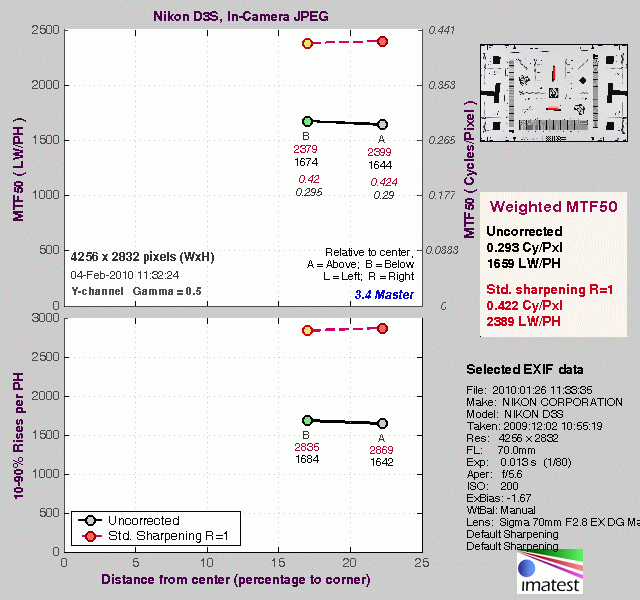
The chart above shows consolidated results from spatial frequency response measurements in both the horizontal and vertical axes. The "MTF 50" numbers tend to correlate best with visual perceptions of sharpness, so those are what we focus on here. The uncorrected resolution figures are 1,644 line widths per picture height in the horizontal direction (corresponding to the vertically-oriented edge), and 1,674 lines along the vertical axis (corresponding to the horizontally-oriented edge), for a combined average of 1,659 LW/PH. Correcting to a "standardized" sharpening with a one-pixel radius changed the resolution score by quite a bit, for an average of 2,389 LW/PH. The corrected numbers are quite good for a 12-megapixel SLR.
To see what's going on, refer to the plots below, which show the actual edge profiles for both horizontal and vertical edges, in both their original and corrected forms. Here, you can see that a very conservative amount of in-camera sharpening is applied in the horizontal direction with Imatest reporting undersharpening by 18.7%, while in the vertical direction, Imatest reports undersharpening of 17.4%. This is why standardized sharpening improved the D3S's MTF 50 numbers by so much. The conservative in-camera sharpening means that camera-produced JPEGs will take unsharp masking in Photoshop or other image-editing software better than most. Still, (as is almost always the case), you'll extract the most detail from the Nikon D3S's images by careful processing of its NEF RAW files.

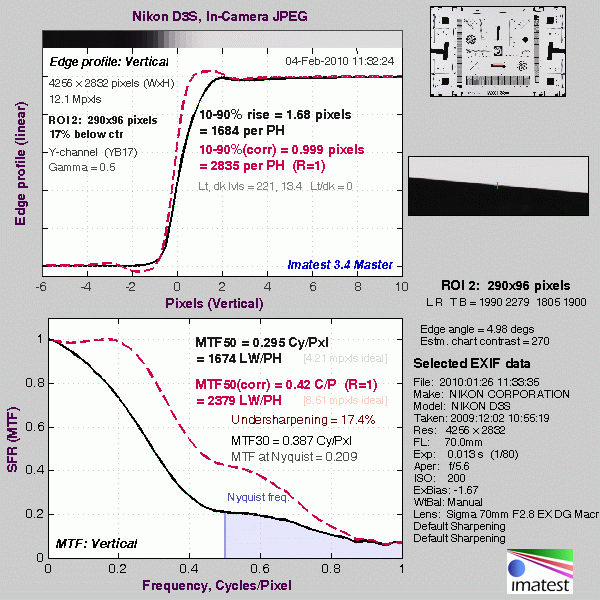
Note: We don't feature SFR-based LW/PH resolution numbers more prominently in our reviews (eg, outside the Imatest pages) because we've found that they're *very* sensitive to minor differences in in-camera image processing. Relatively small changes in the amount of in-camera sharpening can have a large effect on the resulting resolution numbers. Imatest attempts to compensate for this by adjusting to a "standard' sharpening, but this approach can't completely undo what happens inside the cameras, and so often gives inconsistent results. Sometimes the "standardized" sharpening happens to just match the shape of the edge profile with the in-camera sharpening applied, and you'll get wildly high results. At other times, it will tend to correct in the opposite direction. Unfortunately, ignoring the in-camera sharpening entirely can result in even greater discrepancies, particularly between models from different manufacturers. Turning off sharpening in the camera may or may not fully eliminate the sharpening, so simply turning off sharpening in the camera JPEGs isn't a reliable solution. It also wouldn't be the way most people shoot the cameras. We could process RAW files with no sharpening, but then that'd only suit the people working primarily or exclusively from RAW, and would open another can of worms as to what RAW converter was used, etc, etc.
The bottom line is that numbers for resolution only take you so far. Detail handling and edge acuity are very complex issues; ones that don't easily boil down to a single number. The best approach is to simply look look at the broad array of standardized test shots we take with each camera, to the point of downloading and printing them with whatever processing you'd use if you owned the camera and shot with it. See how the differences stack up for you visually, and make your decision on that, rather than on abstract resolution numbers.
RAW Files
Nikon D3S RAW Image Quality
We've recently started looking at RAW files converted with dcraw, an excellent freeware raw converter. dcraw usually offers timely support for the latest cameras, but more importantly, it does not apply any noise-reduction, sharpening or other corrections such as geometric distortion correction to the output files. (We found that Adobe Camera Raw still applies some limited noise-reduction when its NR settings are set to zero, and it also applies other corrections depending on the make and model of the camera). There will always be differences between RAW converters, in terms of the sort of de-mosaicing algorithms they use (the processes by which they convert the separate Red, Green, and Blue data sets to an array of full-color RGB pixels), but dcraw seems to use a fairly generic algorithm that delivers good sharpness with relatively few artifacts, and can be counted on to not apply any noise reduction if you don't want it to. (That said, looking at the ISO 25,600 and higher examples below, it's clear that dcraw's de-mosaicing approach does have some tendency to produce rectilinear artifacts in response to high noise levels.)
Below are crops from Nikon D3S RAW files compared to RAW files from pro grade digital SLRs, converted with dcraw.
| Nikon D3S versus Nikon D3, Nikon D3X, and Canon 1D Mark IV RAW (via dcraw), no Noise Reduction, no Sharpening, Simulated Daylight |
||||
|
|
Nikon
D3S |
Nikon
D3 |
Nikon
D3X |
Canon 1D
Mark IV |
| I S O 4 0 0 |
 |
 |
 |
 |
 |
 |
 |
 |
|
 |
 |
 |
 |
|
| I S O 8 0 0 |
 |
 |
 |
 |
 |
 |
 |
 |
|
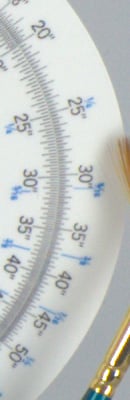 |
 |
 |
 |
|
| I S O 1 6 0 0 |
 |
 |
 |
 |
 |
 |
 |
 |
|
 |
 |
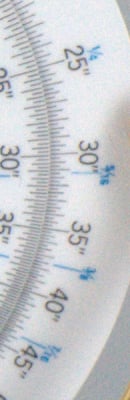 |
 |
|
| I S O 3 2 0 0 |
 |
 |
 |
 |
 |
 |
 |
 |
|
 |
 |
 |
 |
|
| I S O 6 4 0 0 |
 |
 |
 |
 |
 |
 |
 |
 |
|
 |
 |
 |
 |
|
| I S O 1 2 8 0 0 |
 |
 |
N/A,
ISO 12,800 not supported. |
 |
 |
 |
 |
||
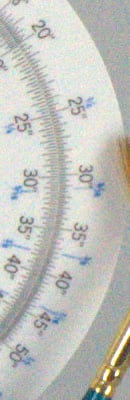 |
 |
 |
||
| I S O 2 5 6 0 0 |
 |
 |
N/A,
ISO 25,600 not supported. |
 |
 |
 |
 |
||
 |
 |
 |
||
| I S O 5 1 2 0 0 |
 |
N/A,
ISO 51,200 not supported. |
N/A,
ISO 51,200 not supported. |
 |
 |
 |
|||
 |
 |
|||
| I S O 1 0 2 4 0 0 |
 |
N/A,
ISO 102,400 not supported. |
N/A,
ISO 102,400 not supported. |
 |
 |
 |
|||
 |
 |
|||
|
|
Nikon
D3S |
Nikon
D3 |
Nikon
D3X |
Canon 1D
Mark IV |
Looking at the crops above, it's clear that the Nikon D3S is the new high ISO champ. The D3S does slightly better than the D3 at ISOs up to 6,400, then it pulls ahead of its predecessor significantly at ISOs 12,800 and above. The Nikon D3X and Canon 1D Mark IV do not perform as well in terms of noise, which is no surprise since they have a pixel pitch 5.9µm and 5.7µm respectively, while the D3 and D3S feature a 8.5µm pixel pitch. With only about 15% higher linear resolution, resampling the Mark IV's slightly larger 16-megapixel images down to the D3S's 12-megapixels won't come close to making up for the difference in high ISO performance. The Nikon D3S clearly outclasses the Canon 1D Mark IV in this respect.
Shooting Modes
Nikon D3S Modes and Menus
Capture Modes
 Like all professional Nikon digital SLRs since the D1, the Nikon D3S doesn't have a mode dial, but instead has a mode button. The current exposure mode is displayed on the LCDs and viewfinder, and can be changed by pressing this button and rotating the main (rear) command dial. Available exposure modes are: P (Programmed Auto), S (Shutter Priority), A (Aperture Priority) or M (Manual). Also like all pro-level Nikons, the D3S doesn't offer any scene modes.
Programmed Auto: Lets the camera control the shutter speed and aperture settings, although you can vary its choices by turning the Command dial (that is, you can increase or decrease the aperture the camera has chosen, and the camera will vary the shutter speed to maintain the same overall exposure value. Once you've chosen an offset in the aperture/shutter combination, the camera will continue to control the exposure automatically, while maintaining the aperture/shutter bias you've selected.) This ability to select a persistent bias for the exposure system is very useful, in many cases more so than conventional Aperture or Shutter Priority metering (see below). This is because the "tweaked" Program AE will track even radical changes in subject lighting, not being constrained to a single aperture or shutter speed.
Aperture Priority: Allows you to set the aperture value while the camera automatically selects the appropriate shutter speed. Available apertures will vary with the lens in use.
Shutter Speed Priority: Allows you to set the shutter speed value while the camera automatically selects the appropriate aperture. Shutter speeds range from 1/8,000 to 30 seconds in this mode.
Manual: Lets you select both the aperture value and shutter speed, and increases the shutter speed range to include a Bulb setting for exposures longer than 30 seconds. The currently selected flash sync speed can also be selected as the shutter speed in this setting.
Menus
Pressing the Menu button provides access to the camera's full menu system. In the tables below, we've highlighted cells in yellow and text in blue for new options compared to a D3 with firmware version v2.00.
Playback Menu

| Playback Menu Options | |||
|
Top-Level
Selection |
Second-Level
|
Third-Level
|
Notes
|
|
Delete
|
Selected
|
• Selected image(s)
|
Deletes pictures from the camera memory card. Hidden and protected images will not be deleted.
|
|
• All
|
• Slot 1
• Slot 2 |
||
|
Playback Folder
|
• NCD3S
• All • Current |
|
Select a folder for playback. The D3S is able to playback images from other Nikon DSLRs.
|
|
Hide Image
|
• Select/set
|
• Selection screen
|
Reveal or hide selected images.
|
|
• Deselect all?
|
• Reveal all hidden images?
- Yes - No |
||
|
Display Mode
|
• Done
|
• Basic photo info
- Focus point • Detailed photo info - Highlights - RGB histogram - Data |
Allows you to select what shooting information is displayed with the picture during playback.
|
|
Copy Image(s)
|
• Slot 1 Select image(s)
|
• Select folder screen
- Deselect all - Select all images - Select protected images |
Allows you to copy images from the card in slot 1 to the card in slot 2. This menu is greyed-out when only one card is installed.
|
|
• Slot 2 Select destination folder
|
• Select folder by number
• Select folder from list |
||
|
• Copy images?
|
• Copy?
- Yes - No |
||
|
Image Review
|
• On
• Off |
|
Allows you to choose if you want to see your picture displayed right after it is shot.
|
|
After Delete
|
• Show next
• Show previous • Continue as before |
|
Lets you choose which remaining picture will be displayed after a picture is deleted.
|
|
Rotate Tall
|
• On
• Off |
|
Allows pictures that were shot in portrait orientation to be rotated correctly on the LCD monitor.
|
|
Slide Show
|
• Start
|
• OK
|
Allows you to create a slide show of existing pictures with your choice of interval between pictures. Hidden pictures will not be displayed.
|
|
• Frame interval
|
• 2 s
• 3 s • 5 s • 10 s |
||
|
• Audio playback
|
• On:
- Frame interval - Length of voice memo • Off |
||
|
Print Set (DPOF)
|
• Select/set
|
• Select image screen
- Done - Data imprint - Imprint date |
Allows you to select which pictures to print on a DPOF compatible printer.
|
|
• Deselect all?
|
• Remove print marking from all images?
- Yes - No |
||
Shooting Menu

| Shooting Menu Options | |||
|
Top-Level
Selection |
Second-Level
|
Third-Level
|
Notes
|
|
Shooting Menu Bank
|
• A
• B • C • D |
• Rename screen
|
This allows you to set up 4 different menu banks and lets you customize these options to your liking. These options stay set when you turn the camera off. The names can be changed if needed. |
|
• Rename
|
• A
• B • C • D |
||
|
Reset Shooting Menu
|
• Yes |
|
Restores default settings to the shooting menu.
|
|
Extended Menu Banks
|
• On
• Off |
|
The On setting includes exposure mode, shutter speed (S and M) and aperture (A and M) in the settings for each memory bank.
|
|
Active Folder
|
• Select folder by number
|
• 100-999
|
Choose the active folder name where your images will be stored. Entering a new number creates a new folder.
|
|
• Select folder by list
|
• 101NCD3S
• 102NCD3S • etc. |
||
|
File Naming
|
• File naming screen
• sRGB example • Adobe RGB example |
• Input 3 characters
|
This is used to rename the file names used by sRGB and Adobe RGB.
|
|
Slot 2
|
• Overflow
• Backup • RAW Slot 1 - JPEG Slot 2 |
|
This is used to define how the Compact Flash slot 2 is to be used.
|
|
Image Quality
|
• NEF (RAW) + JPEG fine
• NEF (RAW) + JPEG normal • NEF (RAW) + JPEG basic • NEF (RAW) • TIFF (RGB) • JPEG fine • JPEG normal • JPEG basic |
|
Choose the type of file you want to capture.
|
|
Image Size
|
• Large
• Medium • Small |
|
Choose the images size you want to capture. Dimensions depend on Image Area below.
|
|
Image Area
|
• Auto DX crop
|
• On
• Off |
Choose the images size you want to capture. If you choose smaller than full frame format it will mask off the shooting area in the viewfinder.
|
|
• Choose image area
|
• FX format (36x24)
• 1.2x (30x20) • DX format (24x16) • 5:4 (30x24) |
||
|
JPEG Compression
|
• Size priority
• Optimal quality |
|
Compress images based on uniform file size or on the best quality.
|
|
NEF (RAW) recording
|
• Type
|
• Lossless compressed
• Compressed • Uncompressed |
Choose the type and bit depth of the Raw images you want to capture.
|
|
• NEF (RAW) bit depth
|
• 12-bit
• 14-bit |
||
|
White Balance
|
• Auto
• Incandescent • Fluorescent • Direct Sunlight • Flash • Cloudy • Shade • Choose color temp. • Preset manual |
• Adjustment screen (all modes except "Choose color temp" which allows you to choose color temp from 2,500K to 10,000K)
|
Adjusts the white balance to match the conditions you are shooting in. (Note: Fluorescent has 7 subtypes.)
|
|
Set Picture Control
|
• Standard
• Neutral • Vivid • Monochrome • C1 • C2 • C3 • C4 • C5 • C6 • C7 • C8 • C9 |
• Quick adjust
• Sharpening • Contrast • Brightness • Saturation • Hue Monochrome replaces: • Saturation • Hue with: • Filter Effects • Toning |
Picture controls allow the look of images to be tweaked, adjusting the intensity of sharpening, contrast, brightness, saturation and hue. All presets can be further adjusted by the user, and the quick adjust function varies the cumulative strength of the other sliders. The C1 through C9 options only appear when created by the user through the Manage Picture Control menu item, and can be renamed.
(Note: if Active D-Lighting is enabled, Contrast and Brightness settings are not available.) |
|
Manage Picture Control
|
• Save/edit
|
• Picture Control selection screen
|
Allows up to nine new picture controls to be created in-camera at any one time. Picture controls can be renamed, copied, and saved to or read from a flash card, allowing them to be shared between cameras. Up to 99 can be stored on a memory card at any one time. Only Slot 1 is supported.
|
|
• Rename
|
• Custom Picture Control selection screen
- Input screen |
||
|
• Delete
|
• Custom Picture Control selection screen
- Yes - No |
||
|
• Load/save
|
• Copy to camera
- Selection screen • Delete from card - Selection screen • Copy to card - Selection screen |
||
|
Color Space
|
• sRGB
• Adobe |
|
Color space determines the amount of color in your pictures.
|
|
Active D-Lighting
|
• Auto
• Extra high • High • Normal • Low • Off |
|
This will help preserve the details in light and dark areas of the picture. Shadows and highlights.
|
|
Vignette Control
|
• High
• Normal • Low • Off |
|
This option helps reduce corner shading or "vignetting" in JPEGs. Also tags NEFs for similar processing in Capture NX2 software.
|
|
Long Exp. NR
|
• On
• Off |
|
Turns on the Noise Reduction for images taken with a shutter speed of greater than one second.
|
|
High ISO NR
|
• High
• Normal • Low • Off |
|
Selects the amount of Noise Reduction when using an ISO of greater than 2,000.
|
|
ISO Sensitivity Settings
|
• ISO sensitivity
|
• Lo 1
• Lo 0.7 • Lo 0.3 • 200 • 250 • 320 • 400 • 500 • 640 • 800 • 1000 • 1250 • 1600 • 2000 • 2500 • 3200 • 4000 • 5000 • 6400 • 8000 • 10000 • 12800 • Hi 0.3 • Hi 0.7 • Hi 1 • Hi 2 • Hi 3 |
This adjusts many settings dealing with ISO sensitivity. See the manual for details. Note: These options are variable depending on the b1 Custom setting for ISO sensitivity step value.
|
|
• ISO Sensitivity auto control
|
• On
• Off |
||
|
• Maximum sensitivity
|
• 400
• 500 • 640 • 800 • 1000 • 1250 • 1600 • 2000 • 2500 • 3200 • 4000 • 5000 • 6400 • 8000 • 10000 • 12800 • Hi 0.3 • Hi 0.7 • Hi 1 • Hi 2 • Hi 3 |
||
|
• Minimum shutter speed
|
• 1/4000 s
• 1/3200 s • 1/2500 s • 1/2000 s • 1/1600 s • 1/1250 s • 1/1000 s • 1/800 s • 1/640 s • 1/500 s • 1/400 s • 1/320 s • 1/250 s • 1/200 s • 1/160 s • 1/125 s • 1/100 s • 1/80 s • 1/60 s • 1/50 s • 1/40 s • 1/30 s • 1/15 s • 1/8 s • 1/4 s • 1/2 s • 1 s |
||
|
Live View Mode
|
• Tripod
• Hand-held |
|
Allows you to select which mode of Live View you want to use. Release mode option has been removed. Now uses current release mode dial setting.
|
|
Multiple Exposure
|
• Multiple exposure mode
|
• On (series)
• On (single photo) • Off |
Allows you to do from 2 to 10 multiple exposures. The new On (series) option lets you take a series of multiple exposures until Off is selected.
|
|
• Number of shots
|
• 2 to 10 shots
|
||
|
• Auto gain
|
• On
• Off |
||
|
Movie Settings
|
• Quality
|
• 1280x720 (16:9)
• 640x424 (3:2) • 320x216 (3:2) |
Allows setup of the camera's movie recording. Maximum clip length is five minutes for 1280 x 720 pixel clips, or twenty minutes for lower resolutions.
|
|
• Microphone
|
• Auto Sensitivity (A)
• High Sensitivity (3) • Med Sensitivity (2) • Low Sensitivity (1) • Microphone Off |
Microphone sensitivity can be set to one of three levels, Auto, or off. This also applies to an external mic.
|
|
|
• Destination
|
• Slot 1
• Slot 2 |
Movies can be recorded to either of the two card slots. The selection screen lists an estimation of the recording time currently available on each card.
|
|
|
• High-sensitivity movie mode
|
• On
• Off |
High-sensitivity mode shoots movies at ISO 6400 to 102,400.
|
|
|
Interval Timer Shooting
|
• Choose start time
|
• Now
- Interval (hh:mm:ss) - Select intervals x no. of shots (nnn x n) • Start - On - Off |
Allows you to set the start time, the interval between shots and the number of shots to capture.
|
|
• Start time
- Time (hh:mm) - Interval (hh:mm:ss) - Select intervals x no. of shot (nnn x n) • Start - On - Off |
|||
Custom Settings Menu

| Custom Menu Options | |||
|
Top-Level
Selection |
Second-Level
|
Third-Level |
Notes
|
|
Custom Setting Bank
|
• A
• B • C • D |
• Rename screen
|
Custom settings can be stored in four separate custom banks. You can switch between them at any time and rename them.
|
|
• Rename
|
• A
• B • C • D |
||
|
Reset Custom Settings
|
• Yes
• No |
|
Restores custom settings to their default values.
|
|
A - Autofocus
|
• a1 AF-C priority selection
|
• Release
• Release + focus • Focus |
|
|
• a2 AF-S priority selection
|
• Release
• Focus |
|
|
|
• a3 Dynamic AF area
|
• 9 points
• 21 points • 51 points • 51 points (3D tracking) |
|
|
|
• a4 Focus tracking w/lock-on
|
• 5 (Long)
• 4 • 3 (Normal) • 2 • 1 (Short) • Off |
The D3S adds two intermediate settings (4 and 2) for Focus tracking with lock-on.
|
|
|
• a5 AF activation
|
• Shutter/AF-ON
• AF-ON only |
|
|
|
• a6 Focus point Illumination
|
• Manual focus mode
- On - Off • Continuous mode - On - Off • Focus point brightness - +2 Extra high - +1 High - 0 Normal - -1 Low |
|
|
|
• a7 Focus point wrap-around
|
• Wrap
• No wrap |
|
|
|
• a8 AF point selection
|
• AF51 51 points
• AF11 11 points |
|
|
|
• a9 AF-ON button
|
• AF-ON
• AE/AF lock • AE lock only • AE lock (Reset on release) • AE lock (hold) • AF lock only |
|
|
|
• a10 Vertical AF-ON button
|
• Same as AF-ON
• AF-ON • AE/AF lock • AE lock only • AE lock (Reset on release) • AE lock (hold) • AF lock only |
|
|
|
B - Metering/Exposure
|
• b1 ISO sensitivity step value
|
• 1/3 step
• 1/2 step • 1 step |
|
|
• b2 EV steps for exposure cntrl.
|
• 1/3 step
• 1/2 step • 1 step |
|
|
|
• b3 EV steps for exposure comp
|
• 1/3 step
• 1/2 step • 1 step |
|
|
|
• b4 Easy exposure compensation
|
• On (Auto reset)
• On • Off |
Controls whether the EV Compensation button needs to be pressed.
|
|
|
• b5 Center-weighted area
|
• 8 mm
• 12 mm • 15 mm • 20 mm • Average |
|
|
|
• b6 Fine tune optimal exposure
|
• Yes
- Matrix metering - Center-weighted metering - Spot metering • No |
Each metering mode can have its own ±1 EV adjustment from the default, in 1/6 EV steps. This does not appear as Exposure Compensation in EXIF, though it is flagged in another EXIF field.
|
|
|
C - Timers/AE Lock
|
• c1 Shutter-release button AE-L
|
• On
• Off |
|
|
• c2 Auto meter-off delay
|
• 4s
• 6s • 8s • 16s • 30s • 1 min. • 5 min. • 10 min. • 30 min. • No Limit |
|
|
|
• c3 Self-timer
|
• 2 s
• 5 s • 10 s • 20 s |
|
|
|
• c4 Monitor off delay
|
• Playback
- 4 s - 10 s - 20 s - 1 min. - 5 min. - 10 min. • Menus - 4 s - 10 s - 20 s - 1 min. - 5 min. - 10 min. • Information display - 4 s - 10 s - 20 s - 1 min. - 5 min. - 10 min. • Image review - 4 s - 10 s - 20 s - 1 min. - 5 min. - 10 min. |
The D3S lets you set the delay for different functions, while the D3 had one global setting.
|
|
|
D - Shooting/Display
|
• d1 Beep
|
• High
• Low • Off |
|
|
• d2 shooting speed
|
• Continuous high-speed
- 11 fps - 10 fps - 9 fps • Continuous low-speed - 9 fps - 8 fps - 7 fps - 6 fps - 5 fps - 4 fps - 3 fps - 2 fps - 1 fps |
|
|
|
• d3 Max. continuous release
|
• Select 1-130
|
|
|
|
• d4 File number sequence
|
• On
• Off • Reset |
|
|
|
• d5 Control panel/viewfinder
|
• Rear control panel
- ISO sensitivity - Exposures remaining • Viewfinder display - Frame count - Exposures remaining |
|
|
|
• d6 Shooting info display
|
• Auto
• Manual - Dark on light - Light on dark |
|
|
|
• d7 Screen tips
|
• On
• Off |
|
|
|
• d8 LCD illumination
|
• On
• Off |
|
|
|
• d9 Exposure delay mode
|
• On
• Off |
|
|
|
E - Bracketing/Flash
|
• e1 Flash sync speed
|
• 1/250 s (Auto FP)
• 1/250 s • 1/200 s • 1/160 s • 1/125 s • 1/100 s • 1/80 s • 1/60 s |
|
|
• e2 Flash shutter speed
|
• 1/60 s
• 1/30 s • 1/15 s • 1/8 s • 1/4 s • 1/2 s • 1 s • 2 s • 4 s • 8 s • 15 s • 30 |
|
|
|
• e3 Modeling flash
|
• On
• Off |
|
|
|
• e4 Auto bracketing set
|
• AE & flash
• AE only • Flash only • WB bracketing • ADL bracketing |
|
|
|
• e5 Auto bracketing (Mode M)
|
• Flash / speed
• Flash / speed / aperture • Flash / aperture • Flash only |
|
|
|
• e6 Bracketing order
|
• MTR > under > over
• Under > MTR > over |
|
|
|
F - Controls
|
• f1 Multi selector center button
|
• Shooting mode
- Select center focus point - Not used • Playback mode - Thumbnail on/off - View histograms - Zoom on/off - Low magnification - Medium magnification - High magnification • Live view - Start movie recording - Not used |
|
|
• f2 Multi selector
|
• Reset Meter-off delay
• Do nothing |
|
|
|
• f3 Photo info/playback
|
• Info (left/right) / Playback (up/down)
• Info (up/down) / Playback (left/right) |
|
|
|
• f4 Assign Fn button
|
• Fn button press
- Preview - FV lock - AE/AF lock - AE lock only - AE lock (Reset on release) - AE lock (Hold) - AF lock only - Flash off - Bracketing burst - Matrix metering - Center-weighted - Spot metering - Virtual horizon - Playback - Access top item in MY MENU - None • Fn button + dials - Choose image area (FX/1.2x/ DX/5:4) - 1 step spd/aperture - Choose non-CPU lens number - Focus point -selection - Shooting menu bank - Focus point selection - Shooting menu bank - Dynamic AF area - None |
|
|
|
• f5 Assign preview button
|
• Preview button press
- Preview - FV lock - AE/AF lock - AE lock only - AE lock (Reset on release) - AE lock (Hold) - AF lock only - Flash off - Bracketing burst - Matrix metering - Center-weighted - Spot metering - Virtual horizon - Playback - Access top item in MY MENU - None • Preview + command dials - Choose image area (FX/1.2x/DX/5:4) - 1 step spd/aperture - Choose non-CPU lens number - Shooting menu bank - Dynamic AF area - None |
|
|
|
• f6 Assign AE-L/AF-L button
|
• AE-L/AF-L button press
- Preview - FV lock - AE/AF lock - AE lock only - AE lock (Reset on release) - AE lock (Hold) - AF lock only - AF-ON - Flash off - Bracketing burst - Matrix metering - Center-weighted - Spot metering - Virtual horizon - Playback - Access top item in MY MENU - None • AE-L/AF-L + command dials - Choose image area (FX/1.2x/DX/5:4) - Choose non-CPU lens number - Shooting menu bank - Dynamic AF area - None |
|
|
|
• f7 Assign BKT button
|
• Auto bracketing
• Multiple exposure |
|
|
|
• f8 Customize command dials
|
• Reverse rotation
- Yes - No • Change main/sub - On - Off • Aperture setting: - Sub-command dial - Aperture ring • Menus and playback - On - Off |
|
|
|
• f8 Release button to use dial
|
• Yes
• No |
|
|
|
• f9 No memory card?
|
• Release locked
• Enable release |
|
|
|
• f10 Reverse indicators
|
• + 0 - display
• - 0 + display |
|
|
Setup Menu

| Setup Menu Options | |||
|
Top-Level
Selection |
Second-Level
|
Third-Level
|
Notes
|
|
Format Memory Card
|
• Slot 1
|
• Yes
• No |
Formats memory card(s).
|
|
• Slot 2
|
• Yes
• No |
||
|
LCD Brightness
|
• -3/+3 adjustment
|
|
Adjusts LCD brightness darker or lighter 3 arbitrary units each way.
|
|
Clean Image Sensor
|
• Clean now
|
• Cleaning activated
|
Cleans dust from the image sensor immediately, or configures when this should be done automatically.
|
|
• Clean at startup/shutdown
|
• Clean at startup
• Clean at shutdown • Clean at startup and shutdown • Cleaning off |
||
|
Lock Mirror Up for Cleaning
|
• Start
|
|
This locks the mirror up to allow manual cleaning of the imaging sensor.
|
|
Dust Off Ref Photo
|
• Start
• Clean sensor and then start |
• Take photo of bright featureless white object 10cm from lens. Focus will be set to infinity
|
Captures the reference data used to filter out dust electronically.
|
|
Video Mode
|
• NTSC
• PAL |
|
Selects the video output mode for display on a TV.
|
|
HDMI
|
• Auto
• 480P (progressive) • 576P (progressive) • 720P (progressive) • 1080I (interlaced) |
|
High Definition Multimedia Interface. Allows pictures to be played back on High Definition TVs and monitors with the appropriate cable (not supplied).
|
|
Flicker Reduction
|
• 50 Hz
• 60 Hz |
|
Select appropriate frequency to reduce flicker during live view or movie recording under mercury-vapor or fluorescent lighting.
|
|
Time zone and date
|
• Time zone
|
• Graphical time zone selector
|
Selects the time zone and date format that you want to use and sets the camera to use Daylight Savings time or not.
|
|
• Date and time
|
• YMD and HMS
|
||
|
• Date format
|
• YMD
• MDY • DMY |
||
|
• Daylight saving time
|
• On
• Off |
||
|
Language
|
• Czech
• Danish • German • English • Spanish • French • Indonesian • Italian • Dutch • Norwegian • Polish • Portuguese • Russian • Finnish • Swedish • Turkish • Traditional Chinese • Simplified Chinese • Japanese • Korean |
|
Selects the language that the camera will use.
|
|
Image Comment
|
• Done
|
|
Allows comments up to 36 characters to be added to the metadata of new images as they are taken.
|
|
• Input comment
|
• Data entry screen
|
||
|
• Attach comment
|
• Set
|
||
|
Auto Image Rotation
|
• On
• Off |
|
Decides if the camera will automatically orient your picture properly for viewing during playback.
|
|
Voice Memo Options
|
• Voice memo
|
• Off
• On (Auto and manual) - 5 s - 10 s - 20 s - 30 s - 45 s - 60 s • Manual only |
Setting for recording voice memos
. |
|
• Voice Memo overwrite
|
• Disable
• Enable |
Allows overwriting of a voice memo for the most recent photograph.
|
|
|
• Voice Memo button
|
• Press and hold
• Press to start/stop |
Allows you to specify how the Voice memo button is activated.
|
|
|
• Audio output
|
• Via speaker
- set volume 1-5 • HDMI/audio-video output • Off |
Allows you to select how the audio output is to be played back.
|
|
|
Battery Info
|
• Battery meter %
• Picture meter (nnn) • Calibration (Cal, --) • Battery age (0-4) |
|
Gives very detailed information about battery condition, age and shots fired on this battery.
|
|
Wireless Transmitter
|
• Mode
• Transfer settings • Device info • Device settings |
|
Select various settings for use with a wireless network. (Greyed out when no WT-4 attached.)
|
|
Image Authentication
|
• On
• Off |
|
Allows you to turn image authentication on for photos about to be taken for detection by Nikon's image authentication software.
|
|
Copyright Information
|
• Done
• Artist • Copyright • Attach copyright information checkbox |
|
Allows you attach a copyright strings to new image files as they are taken. Artist name can be up to 36 characters while Copyright can be 54 characters.
|
|
Save/Load Settings
|
• Save settings
• Load settings |
|
Allows you to Save and load camera settings to the memory card.
|
|
GPS
|
• Auto Meter off
|
• Enable
• Disable |
When a GPS unit is connected to the camera it can record latitude, longitude, altitude, time and heading information. See manual for specific GPS units the camera has been tested with.
|
|
• Position
|
|
||
|
• Use GPS to set camera clock
|
• Yes
• No |
||
|
Virtual horizon
|
• Shows horizon display
|
|
Displays a virtual horizon. This is based on data from the camera's orientation sensor.
|
|
Non-CPU Lens Data
|
• Done
|
|
Allows you specify data for lenses without CPU's to allow them to use some functions of CPU equipped lenses. Up to 9 lenses can be entered. See manual for full details.
|
|
• Lens number
|
• 1 thru 9
|
||
|
• Focal length (mm)
|
• 6 thru 4000
|
||
|
• Maximum aperture
|
• F1.2 thru F22
|
||
|
AF Fine Tune
|
• Af fine tune
|
• On
• Off |
Allows you to enter focus correction factors to fine tune focusing with lenses that you define via this menu. See manual for full details.
|
|
• Saved value
|
• + or - 20 units
|
||
|
• Default
|
• + or - 20 units
|
||
|
• List saved values
|
• Lens, Lens number
|
||
|
Firmware Version
|
• A
|
• Version
|
Displays which firmware version the camera is using.
|
|
• B
|
• Version
|
||
Retouch Menu
| Retouch Menu Options | |||
|
Top-Level
Selection |
Second-Level
|
Third-Level
|
Notes
|
|
D-Lighting
|
• Picture selection
|
• Normal
• High • Low |
Adjusts the D-Lighting to brighten shadows. |
|
Red-Eye Correction
|
• Picture selection
|
|
Allows you to remove Red-eye from your pictures. It saves the new picture and retains the old one.
|
|
Trim
|
• Picture selection
|
• Aspect ratio via command dial
- 16:9 - 3:2 - 4:3 - 5:4 - 1:1 • Select size by index button + command dial - 5 or 6 available sizes, depending on aspect ratio |
Allows you to crop a picture. It saves the new picture and retains the old one.
|
|
Monochrome
|
• Black-and-white
• Sepia • Cyanotype |
• Selection screen
|
Allows you to copy pictures to black and white, sepia or cyanotype.
|
|
Filter Effects
|
• Skylight
• Warming |
• Selection screen
|
Selects the time that an image is displayed on the LCD monitor after the picture is taken.
|
|
Color Balance
|
• Selection window
|
• Adjustment screen
|
Allows you to change the color balance via the color grid adjustment window. LRGB histograms are shown.
|
|
Image Overlay
|
• Selection window
|
• Image overlay screen
|
Allows you to take 2 Raw images and combine them into a third picture.
|
NEF (RAW) Processing |
- Selection window |
• Image quality • Image size • White balance • Exposure compensation • Picture Control • High ISO NR • Color space • Vignette Control • EXE (Execute) |
Creates JPEG copies of NEF Raw files, changing a wide range of exposure parameters in the process. |
|
Resize |
• Select image
|
• Selection window |
Creates a low-resolution version suitable for email or web use. Sizes are 1920x1080, 1280x856, 960x640 or 640x424 pixels. |
• Choose size
|
• 2.5M • 1.1M • 0.6M • 0.3M |
||
|
Side-By-Side Comparison
|
• Selection window
|
• Comparison screen
|
This option does not appear on the menu screen until you select an image that has already been retouched. Once it is selected you press the Menu button and this option will be there. It lets you compare your retouched image with your original image.
|
|
Edit Movie
|
• Choose start point
• Choose end point • Save selected frame |
• Selection window
|
Lets you make a new movie clip from any portion of an existing movie file, discarding uninteresting material at the beginning or end. You can also create a JPEG from a selected frame.
|
My Menu

(This screen shot shows some items already added.)
| My Menu Options | |||
|
Top-Level
Selection |
Second-Level
|
Third-Level
|
Notes
|
|
Add Items
|
• Playback menu
|
• Delete
• Playback folder • Hide image • Display mode • Copy image(s) • Image review • After delete • Rotate tall • Slide show • Print set (DPOF) |
|
|
• Shooting menu
|
• Shooting Menu Bank
• Reset Shooting Menu • Extended menu banks • Active Folder • File Naming • Slot 2 • Image Quality • Image Size • Image Area • JPEG Compression • NEF (RAW) recording • White Balance • Set Picture Control • Manage Picture Control • Color Space • Active D-Lighting • Vignette Control • Long Exp. NR • High ISO NR • ISO Sensitivity settings • Live View mode • Multiple Exposure • Movie settings • Interval Timer Shooting |
|
|
|
• Custom setting menu
|
• Custom Setting Bank
• Reset Custom Settings • A Autofocus • B Metering/exposure • C Timers/AE lock • D Shooting/display • E Bracketing/flash • F Controls |
|
|
|
• Setup menu
|
• Format memory card
• LCD brightness • Clean image sensor • Lock Mirror up for cleaning • Image Dust Off ref photo • Video mode • HDMI • Flicker reduction • Time zone and date • Language • Image comment • Auto image rotation • Voice memo options • Battery info • Wireless transfer • Image authentication • Copyright information • Save/Load settings • GPS • Virtual horizon • Non-CPU lens data • AF fine tune • Firmware version |
|
|
|
• Retouch menu
|
• D-Lighting
• Red-eye correction • Trim • Monochrome • Filter effects • Color balance • Image overlay • NEF (RAW processing • Resize • Side-by side comparison • Edit movie |
|
|
|
Remove Items
|
• Done
• Select Item |
• Select the item(s) you wish to delete, then select Done to delete.
|
This let you remove options from your customized list of options.
|
|
Rank Items
|
• Menu of items
- Move |
• Select item and move it using Up or Down on the multi-selector.
|
This lets you change the order of options in your customized list of options.
|
|
Choose Tab
|
• My Menu
• Recent settings |
|
This option lets you use the D3S 'My Menu' selection or the older 'Recent settings' selection, allowing the user to access the twenty most recent setting changes made.
|
Comparison
Nikon D3S Feature Comparison
The following table compares Nikon's current line-up of pro models. What we've done below is to present something of a hybrid comparison between these three models. A red cell means that a given camera performs below the other two, a green cell means that it performs better than the other two, and a yellow cell means it falls between the other two. In cases where two cameras share a superior capability, both their cells will be colored green. Sharp-eyed readers may find some areas where we haven't chosen to highlight a particular difference. Those cases are simply ones that we don't feel are significant in typical use of the camera.
| Nikon Pro SLR Camera Comparison | ||||
|
Manufacturer
|
Nikon | Nikon | Nikon | |
|
Model
|
D3 | D3S | D3X | |
| Imaging System |
Sensor Manufacturer
|
Sony(?) | Sony(?) |
Nikon design
fabricated by Sony |
|
Sensor Type
|
CMOS | CMOS |
CMOS
|
|
|
Color Filter Array
|
RGB | RGB |
RGB
|
|
|
Total Megapixels
|
12.87 | 12.87 |
25.7
|
|
|
Effective Megapixels
|
12.1 | 12.1 |
24.5
|
|
|
Pixel Pitch (µm)
|
8.45 | 8.45 | 5.94 | |
|
Effective Sensor Size (mm)
|
36.0 x 23.9 | 36.0 x 23.9 | 35.9 x 24.0 | |
|
Focal Length Multiplier (approx.)
|
1.0x (Nikon FX) |
1.0x (Nikon FX) |
1.0x (Nikon FX) |
|
|
Image Processor
|
EXPEED | EXPEED | EXPEED | |
| Viewfinder |
Type
|
Eye-level pentaprism | Eye-level pentaprism | Eye-level pentaprism |
|
Coverage
|
~100% | ~100% | ~100% | |
|
Magnification (-1 diopter with 50mm lens at infinity)
|
~0.7x | ~0.7x | ~0.7x | |
|
Eyepoint (mm)
|
18 | 18 | 18 | |
|
Dioptric Adjustment Range (diopters)
|
-3.0 to +1.0 | -3.0 to +1.0 | -3.0 to +1.0 | |
|
Focusing Screen
|
Type B BriteView Clear Matte VI | Type B BriteView Clear Matte VI | Type B BriteView Clear Matte VI | |
|
Depth of Field Preview
|
Enabled with depth-of-field preview button | Enabled with depth-of-field preview button | Enabled with depth-of-field preview button | |
|
Live View
(on LCD) |
Yes (2 Modes: Hand-held mode uses conventional AF sensor; Tripod mode uses contrast detect AF from image sensor) |
Yes (2 Modes: Hand-held mode uses conventional AF sensor; Tripod mode uses contrast detect AF from image sensor) |
Yes (2 Modes: Hand-held mode uses conventional AF sensor; Tripod mode uses contrast detect AF from image sensor) |
|
| Recording System |
Recording Media / Quantity / Slot Type
|
Dual Type I or II CF card / Microdrive slots (UDMA supported) |
Dual Type I or II CF card / Microdrive slots (UDMA supported) |
Dual Type I or II CF card / Microdrive slots (UDMA supported) |
|
Compatible File System
|
FAT 16 / FAT 32
|
FAT 16 / FAT 32
|
FAT 16 / FAT 32
|
|
|
Recording Formats
|
RAW 12-bit or 14-bit (uncompressed, lossless compressed or compressed NEF), JPEG, TIFF | RAW 12-bit or 14-bit (uncompressed, lossless compressed or compressed NEF), JPEG, TIFF | RAW 12-bit or 14-bit (uncompressed, lossless compressed or compressed NEF), JPEG, TIFF | |
|
Maximum Resolution
|
FX format (36 x 24): 4256 x 2832 5:4 format (30 x 24): DX format (24 x 16): |
FX format (36 x 24): 4256 x 2832 5:4 format (30 x 24): 1.2x format (30 x 20): DX format (24 x 16): |
FX format (36 x 24): 6048 x 4032 5:4 format (30 x 24): DX format (24 x 16): |
|
|
Reduced Resolutions
|
FX format (36 x 24): 3184 x 2120; 2128 x 1416 5:4 format (30 x 24): DX format (24 x 16): |
FX format (36 x 24): 3184 x 2120; 2128 x 1416 5:4 format (30 x 24): 1.2x format (30 x 20): DX format (24 x 16): |
FX format (36 x 24): 4544 x 3024; 3024 x 2016 5:4 format (30 x 24): DX format (24 x 16): |
|
|
RAW + JPEG Recording
|
Yes, Selectable JPEG resolution / compression | Yes, Selectable JPEG resolution / compression | Yes, Selectable JPEG resolution / compression | |
|
A/D Conversion
|
12- or 14-bit | 12- or 14-bit | 12- or 14-bit | |
|
Auto crop when DX lens mounted
|
Yes | Yes | Yes | |
| Color Space, Image Parameters & White Balance |
User-Selectable Color Space
|
Yes sRGB + Adobe RGB |
Yes sRGB + Adobe RGB |
Yes sRGB + Adobe RGB |
|
Processing Parameters
(Contrast, Sharpness, Saturation, Hue) / # of Increments |
9 options for sharpening, 7 for contrast, 7 for hue, 7 for saturation, 3 for brightness | 9 options for sharpening, 7 for contrast, 7 for hue, 7 for saturation, 3 for brightness | 9 options for sharpening, 7 for contrast, 7 for hue, 7 for saturation, 3 for brightness | |
|
Picture Control System
|
Yes | Yes | Yes | |
|
Active
D-Lighting |
Yes 3 settings, plus Off |
Yes 5 settings, plus Off |
Yes 5 settings, plus Off |
|
|
Preset WB settings
|
6 (Incandescent, Fluorescent, Direct Sunlight, Flash, Cloudy, Shade) | 6 (Incandescent, Fluorescent, Direct Sunlight, Flash, Cloudy, Shade) | 6 (Incandescent, Fluorescent, Direct Sunlight, Flash, Cloudy, Shade) | |
|
Manual Color Temperature Setting Range
|
2,500 ~ 10,000K in 250K increments | 2,500 ~ 10,000K in 250K increments | 2,500 ~ 10,000K in 250K increments | |
|
WB Adjustment Range
|
±3 steps in 1-step increments, roughly 10 mireds per step
|
±3 steps in 1-step increments, roughly 10 mireds per step
|
3 steps in 1-step increments, roughly 10 mireds per step
|
|
| Autofocus System |
Type
|
TTL phase detection by Nikon Multi-CAM3500FX autofocus module | TTL phase detection by Nikon Multi-CAM3500FX autofocus module | TTL phase detection by Nikon Multi-CAM3500FX autofocus module |
|
# of Focusing Points (Focusing Point Type)
|
51 points (15 cross-type, 36 line type) | 51 points (15 cross-type, 36 line type) | 51 points (15 cross-type, 36 line type) | |
|
Superimposed Focus Point
Display
|
Yes | Yes | Yes | |
|
AF Working Range
|
EV -1 ~ 19 (ISO 100) | EV -1 ~ 19 (ISO 100) | EV -1 ~ 19 (ISO 100) | |
|
AF Servo Modes
|
Single Servo AF-S, Continuous Servo AF-C; Focus Tracking automatically activated by subject's status |
Single Servo AF-S, Continuous Servo AF-C; Focus Tracking automatically activated by subject's status |
Single Servo AF-S, Continuous Servo AF-C; Focus Tracking automatically activated by subject's status |
|
|
AF Area Modes
|
1) Single-point AF, 2) Dynamic-area AF [number of AF areas: 9, 21, 51, 51 (3D-tracking)], 3) Automatic-area AF |
1) Single-point AF, 2) Dynamic-area AF [number of AF areas: 9, 21, 51, 51 (3D-tracking)], 3) Automatic-area AF |
1) Single-point AF, 2) Dynamic-area AF [number of AF areas: 9, 21, 51, 51 (3D-tracking)], 3) Automatic-area AF |
|
|
AF-assist Beam
|
Emitted by an optional dedicated Speedlight | Emitted by an optional dedicated Speedlight | Emitted by an optional dedicated Speedlight | |
|
Fine-tune front/back focus adjustment
|
Yes (settings for up to 20 lenses) | Yes (settings for up to 20 lenses) | Yes (settings for up to 20 lenses) | |
| Exposure Control |
Shooting Modes
|
4 - Program, shutter-priority AE, aperture-priority AE, manual mode. | 4 - Program, shutter-priority AE, aperture-priority AE, manual mode. | 4 - Program, shutter-priority AE, aperture-priority AE, manual mode. |
|
Metering Zones
|
1,005 | 1,005 | 1,005 | |
|
Metering Modes
|
1) 3D Color Matrix Metering II (type G and D lenses); color matrix metering II (other CPU lenses); color matrix metering available with non-CPU lenses if user provides lens data; metering performed by 1,005-segment RGB sensor 2) Center-weighted: Weight of 75% given to 8, 15, or 20mm dia. circle in center of frame 3) Spot: Meters 4mm dia. circle (about 1.5% of frame) centered on active focus area (on center focus area when non-CPU lens is used) |
1) 3D Color Matrix Metering II (type G and D lenses); color matrix metering II (other CPU lenses); color matrix metering available with non-CPU lenses if user provides lens data; metering performed by 1,005-segment RGB sensor 2) Center-weighted: Weight of 75% given to 8, 15, or 20mm dia. circle in center of frame 3) Spot: Meters 4mm dia. circle (about 1.5% of frame) centered on active focus area (on center focus area when non-CPU lens is used) |
1) 3D Color Matrix Metering
II (type G and D lenses); color matrix metering II (other CPU lenses); color
matrix metering available with non-CPU lenses if user provides lens data;
metering performed by 1,005-segment RGB sensor 2) Center-weighted: Weight of 75% given to 8, 15, or 20mm dia. circle in center of frame 3) Spot: Meters 4mm dia. circle (about 1.5% of frame) centered on active focus area (on center focus area when non-CPU lens is used) |
|
|
Metering System Working Range
|
1) EV 0 to 20 (3D Color Matrix or center-weighted metering) 2) EV 2 to 20 (spot metering) |
1) EV 0 to 20 (3D Color Matrix or center-weighted metering) 2) EV 2 to 20 (spot metering) |
1) EV 0 to 20 (3D Color
Matrix or center-weighted metering) 2) EV 2 to 20 (spot metering) |
|
|
Nikon Scene Recognition System
|
Yes | Yes | Yes | |
|
ISO Range / Extended
|
200 ~ 6,400 / down to 100 in Lo-1 mode; up to 25,600 in Hi -2 mode | 200 ~ 12,800 / down to 100 in Lo-1 mode; up to 102,400 in Hi -3 mode | 100 ~ 1,600 / up to 6,400 in Hi -2 mode | |
|
Exposure Compensation
|
+/- 5EV in 1, 1/2 or 1/3EV increments | +/- 5EV in 1, 1/2 or 1/3EV increments | +/- 5EV in 1, 1/2 or 1/3EV increments | |
|
Automatic Exposure Bracketing
|
2 to 9 exposures in increments of 1/3, 1/2, 2/3 or 1EV | 2 to 9 exposures in increments of 1/3, 1/2, 2/3 or 1EV | 2 to 9 exposures in increments of 1/3, 1/2, 2/3 or 1EV | |
| Shutter Speeds, Frame Rate, Shutter Lag |
Shutter Type
|
Electronically controlled vertical-travel focal-plane shutter | Electronically controlled vertical-travel focal-plane shutter | Electronically controlled vertical-travel focal-plane shutter |
|
Shutter Durability
|
~300K cycles | ~300K cycles | ~300K cycles | |
|
Shutter Speed Range
|
1/8000 ~ 30 sec. in steps of 1/3, 1/2 or 1 EV, bulb | 1/8000 ~ 30 sec. in steps of 1/3, 1/2 or 1 EV, bulb | 1/8000 ~ 30 sec. in steps of 1/3, 1/2 or 1 EV, bulb | |
|
Maximum Frames Per Second / Buffer depth
|
9 fps / 30 JPEG or 17 14-bit RAW frames at full resolution; up to 11 fps in 5.1MP DX Cropped mode (measured) |
9 fps / 90 JPEG or 36 14-bit RAW frames at full resolution; up to 11 fps in 5.1MP DX Cropped mode (measured) |
5 fps / 31 JPEG or 23 12-bit RAW frames at full resolution, slows to 2 fps in 14-bit RAW ; up to 7 fps in 10.4MP DX Cropped mode (measured) |
|
|
Full AF shutter lag (seconds)
|
0.085 (measured) |
0.197 (measured) |
0.161 (measured) |
|
|
Prefocused shutter lag (seconds)
|
0.043 (measured) |
0.043 (measured) |
0.045 (measured) |
|
|
Startup Time (seconds)
|
0.3 (measured) |
0.3 (measured) |
0.3
(measured) |
|
| Flash |
i-TTL / Advanced Wireless Lighting
|
Yes / Yes (with SB-800 Flash or SU-800 Wireless Commander) |
Yes / Yes (with SB-800 Flash or SU-800 Wireless Commander) |
Yes / Yes (with SB-800 Flash or SU-800 Wireless Commander) |
|
Built-in Flash / Guide Number at ISO 100.
|
No | No | No | |
|
Max flash x-sync speed. (sec.)
|
1/250
|
1/250
|
1/250
|
|
|
Flash Exposure Compensation
|
n/a | n/a | n/a | |
|
Slow-sync flash
|
1st or 2nd curtain | 1st or 2nd curtain | 1st or 2nd curtain | |
|
PC Sync Terminal
|
Yes | Yes | Yes | |
| Playback System |
LCD Size / Pixel Count
|
3.0 in LCD / 920,000 pixels | 3.0 in LCD / 920,000 pixels | 3.0 in LCD / 920,000 pixels |
|
Enlarged Playback / Scroll
|
Yes (up to 27x) / Yes
|
Yes (up to 27x) / Yes
|
Yes (up to 27x) / Yes
|
|
|
LCD Monitor Brightness Adjustment Range
|
Yes (7 steps)
|
Yes (7 steps)
|
Yes (7 steps)
|
|
|
Automatic Rotation for Vertical Shots
|
Yes | Yes | Yes | |
|
Video Out
|
Analog NTSC/PAL, HDMI | Analog NTSC/PAL, HDMI | Analog NTSC/PAL, HDMI | |
| Other Features |
Computer Connection
|
Yes, USB 2.0 High-Speed | Yes, USB 2.0 High-Speed | Yes, USB 2.0 High-Speed |
|
Direct Printing (PictBridge-compliant printers)
|
Yes | Yes | Yes | |
|
Menu Languages
|
15 (Chinese [Simplified and Traditional], Dutch, English, Finnish, French, German, Italian, Japanese, Korean, Polish, Portuguese, Russian, Spanish, Swedish)
|
20 (Chinese [Simplified and Traditional], Czech, Danish, Dutch, English, Finnish, French, German, Indonesian, Italian, Japanese, Korean, Norwegian, Polish, Portuguese, Russian, Spanish, Swedish, Turkish)
|
15 (Chinese [Simplified and Traditional], Dutch, English, Finnish, French, German, Italian, Japanese, Korean, Polish, Portuguese, Russian, Spanish, Swedish)
|
|
|
Camera Default Reset
|
Yes | Yes | Yes | |
|
Custom Functions (Quantity / Settings)
|
Yes (44) | Yes (46) | Yes (44) | |
|
Remote Control
|
Yes, 10-pin terminal | Yes, 10-pin terminal | Yes, 10-pin terminal | |
|
Info LCD Panel / Illumination
|
Yes (large top panel, smaller rear panel) / Yes (both panels)
|
Yes (large top panel, smaller rear panel) / Yes (both panels)
|
Yes (large top panel, smaller rear panel) / Yes (both panels)
|
|
|
Movie Mode, Formats, Audio
|
No | Yes, 1280x720@24 fps, 640x424@24fps, 320x216@24fps; AVI Motion JPEG, internal monaural mic, external stereo mic jack |
No | |
|
Ultrasonic dust-removal
|
No | Yes | No | |
|
Virtual Horizon digital level sensor
|
Yes | Yes | Yes | |
|
In-camera Lateral C.A. Correction
|
Yes | Yes | Yes | |
|
Self Diagnostic Shutter Monitor
|
Yes | Yes | Yes | |
| Body Structure |
Body Cover / Chassis
|
Magnesium Alloy, full environmental seals | Magnesium Alloy, full environmental seals | Magnesium Alloy, full environmental seals |
| Power System |
Battery
|
EN-EL4a | EN-EL4a | EN-EL4a |
|
Rated Shooting Capacity at 20C/68F (shots)
|
CIPA: 4,300 | CIPA: 4,200 | CIPA: 4,400 | |
| Dimensions & Weight |
Dimensions (WxHxD, mm)
|
159.5 x 157 x 87.5 | 159.5 x 157 x 87.5 | 159.5 x 157 x 87.5 |
|
Weight (body only)
|
1240 g | 1240 g | 1220 g | |
| Operational Environment |
Operating Temperature Range
|
0 ~ 40°C | 0 ~ 40°C | 0 ~ 40°C |
|
Operating Humidity Range
|
85% max. | 85% max. | 85% max. | |
| Lens Compatibility |
Lens Mount / Compatibility
|
1) Type G or D AF Nikkor: All functions supported 2) DX AF Nikkor: All functions supported except FX-format (36x24)/5:4 (30x24) image size 3) AF Nikkor other than type G or D (excluding lenses for F3AF): All functions supported except 3D Color Matrix Metering II 4) AI-P Nikkor: All functions supported except autofocus and 3D Color Matrix Metering II 5) Non-CPU AI Nikkor: Can be used in exposure modes A and M; electronic rangefinder can be used if maximum aperture is f/5.6 or faster; Color Matrix Metering and aperture value display supported if user provides lens data. Up to 9 non-CPU lenses can be registered. |
1) Type G or D AF Nikkor: All functions supported 2) DX AF Nikkor: All functions supported except FX-format (36x24)/5:4 (30x24) image size 3) AF Nikkor other than type G or D (excluding lenses for F3AF): All functions supported except 3D Color Matrix Metering II 4) AI-P Nikkor: All functions supported except autofocus and 3D Color Matrix Metering II 5) Non-CPU AI Nikkor: Can be used in exposure modes A and M; electronic rangefinder can be used if maximum aperture is f/5.6 or faster; Color Matrix Metering and aperture value display supported if user provides lens data. Up to 9 non-CPU lenses can be registered. |
1) Type G or D AF Nikkor: All functions supported 2) DX AF Nikkor: All functions supported except FX-format (36x24)/5:4 (30x24) image size 3) AF Nikkor other than type G or D (excluding lenses for F3AF): All functions supported except 3D Color Matrix Metering II 4) AI-P Nikkor: All functions supported except autofocus and 3D Color Matrix Metering II 5) Non-CPU AI Nikkor: Can be used in exposure modes A and M; electronic rangefinder can be used if maximum aperture is f/5.6 or faster; Color Matrix Metering and aperture value display supported if user provides lens data. Up to 9 non-CPU lenses can be registered. |
|
Auto switch to DX-format crop when DX lens mounted
|
Yes | Yes | Yes | |
Press Release
The Imaging Evolution Continues: The Nikon D3S Illuminates New Levels Of Power And Performance For Professional Photographers
Nikon Once Again Redefines Possibilities with D-SLR Photography with Six-Figure ISO Sensitivity for Stills and Video While Enhancing Overall Performance
MELVILLE, N.Y. (Oct. 14, 2009) – Today, Nikon Inc. announced the FX-format D3S D-SLR, providing professional photographers with a powerful tool that redefines the boundaries of digital SLR versatility, while maintaining the strength of superior image quality and high speed performance inherited from the ground breaking D3. The D3S enables not only new opportunities in low-light photography, but also provides photographers with added shutter speed and aperture freedom with a base ISO sensitivity range from ISO 200 to a remarkable 12,800. Additionally, expanded ISO equivalent settings up to a staggering 102,400 are available, enabling photographers to create images previously thought impossible.
The Nikon D3S builds upon the success of the Nikon D3—the professional digital SLR that set new standards for D-SLR performance and utilizes a newly designed, Nikon original 12.1-megapixel FX-format CMOS sensor that also integrates its amazing low-light ability to High Definition (HD) video, creating a uniquely capable multi-media tool to meet the needs of a changing imaging landscape.
“When the Nikon D3 was released, it ushered in a new era of professional digital imaging. Today, the D3S will further reinforce Nikon’s leadership role in the photographic industry as a pioneer in performance-driven technologies that will again break once-rigid picture-taking barriers,” said Edward Fasano, general manager for Marketing, SLR Systems Products at Nikon Inc. “The ruggedly constructed D3S was engineered to address the real-world needs of professional photographers and provides them with a tool that, when combined with their skills, delivers stunning images in a broad range of shooting conditions and assignment requirements.”
Creative Vision Beyond the Human Eye
The Nikon D3S, with a base ISO sensitivity from ISO 200 to 12,800 makes it possible to capture previously impossible images—image opportunities which were often ignored because of low light levels. Now, in even more demanding lighting conditions, photographers can select expanded sensitivity settings of ISO equivalent 25,600, ISO equivalent 51,200 and an incredible ISO equivalent sensitivity of 102,400 which reveals detail in extreme low-light environments that challenge even the human eye’s ability to discern subject content. In addition, a setting of ISO equivalent 100 is provided.
This industry-first, groundbreaking ISO sensitivity range will make the D3S the camera of choice for photographers who typically face extreme lighting challenges, such as indoor or nighttime sports, spot news, wedding receptions and ambitious nature photography. This broad ISO sensitivity also affords the ability to shoot at faster, action-stopping shutter speeds. D3S shooters will enjoy a major advantage in any situation where light is limited and the use of supplemental lighting is not an option. For the photojournalist, even the highest ISO setting delivers image quality to satisfy the needs of offset printing.
Big Pixels Equal Greater ISO Capabilities
The amazing low-light ability of the D3S, as well as its astounding image quality can be attributed in large part to the engineering behind the newly designed, Nikon original 12.1-megapixel FX-format CMOS sensor, which measures 36x23.9mm. While the pixel size and count that served the D3 were maintained to deliver the pinnacle of image quality, dynamic range, phenomenal tonal gradation and outstanding color, other aspects were engineered to add versatility through broader low-noise ISO sensitivity. Individual pixels measure a large 8.45 microns, which support enhanced sensitivity to light and other qualities leading to superior image fidelity. The D3S captures light and renders images in a way that no other Nikon camera has yet to achieve, with a higher signal-to-noise ratio and an unmatched dynamic range for both stills and HD video throughout its broadened ISO range.
D3S adds the extra benefit of an Image Sensor Cleaning function to reduce instances of image degradation resulting from dust accumulation on the optical low pass filter (OLPF) in front of the image sensor. The OLPF oscillates at four specific frequencies to release particles that would disrupt image quality. Sensor Cleaning can be set by the user to cycle automatically when the camera is powered on, turned off, or on demand.
Share the Vision with D-Movie Creativity
Whether on the frontlines or sidelines, the amazing ISO range of the D3S can also be applied while recording HD video clips to give unprecedented low-light ability for movie clips. The refined D-Movie mode for the FX-format offers smooth 1280x720 video at a cinematic 24fps, with a new algorithm that severely reduces the phenomenon of “rolling shutter” typical to D-SLRs while panning. The motion JPEG codec allows for easy extraction of single frames from a video clip and the ability to save it as a JPEG file, while the 720p HD format eases storage, provides faster wireless transfers, and offers video files that are generally easier to use in the field. Photographers can also trim movie clips on the fly by revising the start and end points, and save the edited clip as a copy while maintaining the original. Additionally, the D3S features a built-in monaural microphone, augmented by a stereo microphone input, which is perfect for hot-shoe microphone mounting or the use of wireless microphones for interviews or spot news.
Photographers and film makers alike will appreciate the full aperture control from a wide f/1.4 to f/16, as the FX-format sensor renders low-noise movie clips with outstanding clarity, aided by the large selection of renowned NIKKOR lenses to produce a dramatic depth of field. High Sensitivity Movie Mode allows the utilization of the entire ISO range to capture otherwise hidden details in challenging lighting conditions, more effectively than cameras with smaller sensors. Now, users can benefit from available natural light for applications such as telling a story in a journalistic style in the field or to create a gritty film noir masterpiece without CGI post production. While recording, users also have the ability to control exposure, and will enjoy the added benefits of improved contrast-detect type AF while in Tripod Live View mode.
Performance and Features Defining Versatility
The emergence of the D3 in 2007 provided photographers with a unique fusion of ruggedness, speed, versatility and image quality—characteristics which the D3S now takes even further. Photographers are able to capture images at 9 frames per second (fps) in the FX-format or at up to 11 fps in the DX crop mode, while data is transferred through a 16-bit pipeline for optimal processing speed. Additionally, the buffer has been increased, enabling continuous bursts approximately twice that of the D3 in the JPEG, TIFF or NEF (RAW) formats. Files can also be captured in either 12- or 14-bit compressed or uncompressed formats to maintain the images data integrity. Photographers can also select the new 1.2x crop mode for a modest telephoto effect, while minimally impacting resolution, as photos are captured at approximately 8.4 megapixels (9 fps).
The D3S digital SLR also features two UDMA compatible CompactFlash™ card slots that can be used for consecutive recording (overflow), simultaneous recording (backup), separating recording of RAW and JPEG files or even copying pictures between the two cards. One or both can also be designated for data-heavy D-Movie recording. Images can be displayed directly from the camera to a High Definition monitor using the camera's HDMI port and an optional cable.
The D3S features Nikon’s exclusive Multi-CAM 3500FX focus module, with 51 AF points, 15 cross type sensors and 36 horizontal sensors that easily track and lock onto moving subjects, delivering the same fast and accurate AF performance that helped make the D3 immediately successful. Users can select any of the AF points, making it easy to consistently attain accurate focus, frame after frame. Additionally, three AF-area modes – Single point, Dynamic-area AF and Auto-area AF – are available to maximize the use of the 51 focus points by selecting the most suitable one to match subject conditions. AF is also available in one of two Live View modes, including a phase detection handheld mode and a tripod mode. While in Live View, the graphic indication of a virtual horizon is also available, making it easier than ever to confirm camera orientation.
To alleviate another kind of noise, the D3S also features a Quiet Shutter Mode which substantially reduces the sound of the camera’s mirror-down cycle, which is perfect for shooting in sensitive environments, such as movie sets, meetings, ceremonies, or while photographing wildlife.
Technologies Engineered for Professionals
The D3S digital SLR’s speed and performance is the culmination of many Nikon core technologies including the latest generation of the EXPEED™ Image Processing System. The latest iteration of this system is specially designed to keep pace with the D3S’ blazing performance to provide amazing image quality, faster processing speeds and lower power consumption. This advanced system is able to achieve extremely precise color reproduction for a broad spectrum of hues, in addition to vivid saturation and smooth gradation. Nikon’s advanced noise processing function is engineered to minimize noise at all sensitivities and operate seamlessly without interfering with other image color parameters.
The D3S’ accelerated Scene Recognition System analyzes information from the 1,005-pixel RGB light sensor for use in auto exposure, auto white balance detection and autofocus calculations. The Scene Recognition System also assists autofocus by tracking subject position and automatically shifts the AF points used to match the subject’s movement within the frame.
Nikon's exclusive 3D Color Matrix Metering II assists in ensuring accurate exposures, even in the most challenging lighting conditions. Instantly evaluating each scene before capture, input data from the system's sensor is automatically referenced against an internal database of more than 30,000 images derived from actual photographs to calculate correct exposure values. Active D-Lighting (ADL), used in combination with 3D Matrix Metering II helps to determine proper exposure, and creates realistic contrast while compensating for lost shadows and highlights. Photographers can also use ADL bracketing for up to five frames of ADL compensation.
To further enhance each photographer's expression of personal style, Nikon’s Picture Control System allows selection of Picture Control settings including Standard, Neutral, Vivid and Monochrome. Additionally, adjustment can be made to Picture Controls to image sharpening, contrast, brightness, saturation, hue and more. Photographers then have the flexibility to save up to nine personalized Picture Controls on camera and 99 additional Picture Controls externally.
Ready for Work
Engineered for real-world functionality, the D3S is ruggedly constructed with moisture, dust and shock resistance that has become a hallmark of flagship Nikon D-SLRs, while preserving the usability and ergonomics that allow the camera to remain an extension of the photographer’s vision. Attention to detail goes so far as to include a self-diagnostic shutter system that is tested to 300,000 cycles for maximum accuracy and longevity. Rigid and precise magnesium alloy construction and the familiar form factor of the D3 extend consistent Nikon system synergy.
A bright and accurate viewfinder provides 100-percent coverage with 0.7x magnification. The body also houses Nikon’s acclaimed 921,000-dot, 3.0-inch super density LCD monitor which is viewable up to 170 degrees, and is safeguarded by a tempered glass cover. Thanks to incredibly efficient internal circuitry, the D3S can capture up to 4200* shots per single charge of the camera’s Lithium-ion battery.
System Strength Withstands the Test of Time
The D3S is fully compatible with Nikon’s Creative Lighting System (CLS) affording photographers a mobile lighting solution that is easy to manage. D3S is also compatible with Nikon’s GP-1 GPS receiver to gather information such as latitude, longitude, altitude and (satellite) date of shooting. Photographers can shoot tethered via USB, or use the WT-4A wireless transmitter to send images wirelessly when speed and mobility are essential. D3S users will also enjoy the system strength bolstered by a comprehensive selection of NIKKOR interchangeable lenses—long heralded for their optical superiority.
Price and Availability
The Nikon D3S digital SLR is scheduled to be available at Nikon Authorized dealers beginning in late November 2009 at an estimated selling price of $5,199.95**. For more information, please visit http://www.nikonusa.com, which links all levels of photographers to the Web's most comprehensive photo learning and sharing communities.
* Based on CIPA Standards
**Estimated selling price listed is only an estimate. Actual prices are set by dealers and are subject to change at any time
###