Nikon D3X Viewfinder
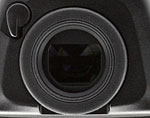 The D3X's
optical viewfinder is big, bright, and beautiful. The pentaprism design
features 100% frame coverage, 0.7x magnification at 50mm and -1
diopter, an 18 mm eyepoint, and diopter adjustment range of -3 to +1.
If you just look at the specs, you might think that the D3X's optical VF
is a step backward from that of the D2Xs. After all, the D3X's
viewfinder is rated at only 0.7x magnification factor, vs. the 0.86x of
earlier models. You have to stop and take into account the fact that
that's 0.7x relative to a full-frame sensor though, so the net effect
is something like a 70% bigger view of the world. This is immediately
apparent when you look through the D3X's viewfinder: The view is very
wide, and if you wear eyeglasses, you'll likely find that you need to
press your lenses against the eyecup in order to take in the entire
frame at once.
The D3X's
optical viewfinder is big, bright, and beautiful. The pentaprism design
features 100% frame coverage, 0.7x magnification at 50mm and -1
diopter, an 18 mm eyepoint, and diopter adjustment range of -3 to +1.
If you just look at the specs, you might think that the D3X's optical VF
is a step backward from that of the D2Xs. After all, the D3X's
viewfinder is rated at only 0.7x magnification factor, vs. the 0.86x of
earlier models. You have to stop and take into account the fact that
that's 0.7x relative to a full-frame sensor though, so the net effect
is something like a 70% bigger view of the world. This is immediately
apparent when you look through the D3X's viewfinder: The view is very
wide, and if you wear eyeglasses, you'll likely find that you need to
press your lenses against the eyecup in order to take in the entire
frame at once.
A built-in eye-piece shutter is provided for self-timer or live view mode. The Nikon D3X ships with a Type B BriteView Clear Matte VI focusing screen, but also accepts a Type E screen with etched grid-lines. (There's no provision for grid lines to be projected onto the viewfinder screen, as with some other Nikon SLRs.)
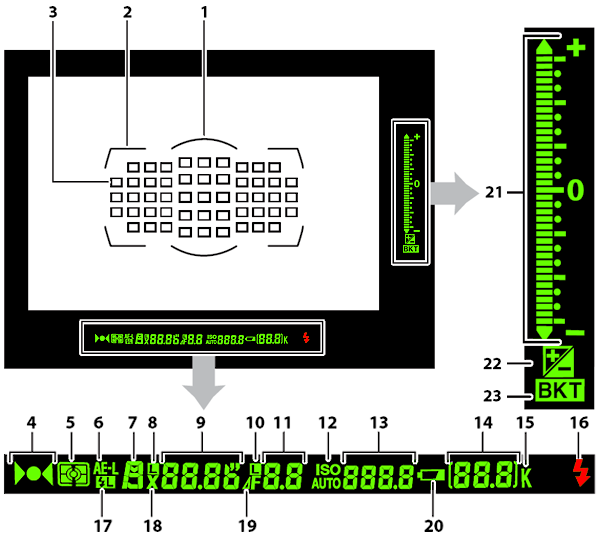
The graphic and table below shows what information is displayed in D3X's viewfinder.
|
1
|
12-mm reference circle for center-weighted
metering
|
15
|
"K" (appears when memory remains for over 1000 frames)
|
|
2
|
AF area brackets
|
16
|
Flash ready indicator
|
|
3
|
Focus points
|
17
|
FV lock indicator
|
|
Spot metering targets
|
18
|
Flash sync indicator
|
|
|
4
|
Focus indicator
|
19
|
Aperture stop indicator
|
|
5
|
Metering
|
20
|
Battery indicator
|
|
6
|
Autoexposure (AE) lock
|
21
|
Electronic analog exposure display
|
|
7
|
Exposure mode
|
Exposure compensation display
|
|
|
8
|
Shutter speed lock icon
|
Tilt indicator
|
|
|
9
|
Shutter speed
|
22
|
Exposure compensation indicator
|
|
10
|
Aperture lock icon
|
23
|
Exposure and flash bracketing indicator
|
|
11
|
Aperture (f-number)
|
|
|
|
Aperture (number of stops)
|
|
|
|
|
12
|
ISO sensitivity indicator
|
|
|
|
Auto ISO sensitivity indicator
|
|
|
|
|
13
|
ISO sensitivity
|
|
|
|
14
|
Frame count
|
|
|
|
Number of exposures remaining
|
|
|
|
|
Number of shots remaining before buffer fills
|
|
|
|
|
Preset white balance recording indicator
|
|
|
|
|
Exposure compensation value
|
|
|
|
|
PC mode indicator
|
|
|
Image Areas
The Nikon D3X is unusual in that you can not only use it as a full-frame SLR, but also as a reduced-frame one. In fact, there are two cropped-frame modes available, one with a 5:4 aspect ratio (corresponding to an area on the sensor of 30.0 x 23.9 mm), the other a 3:2 aspect ratio, but with the frame size reduced to match that of Nikon's DX-format cameras. (A 23.5 x 15.6 mm frame, vs the full "FX" format size of 36.0 x 23.9 mm.) While we wouldn't personally find the 5:4 ratio useful, it's quite possible that photographers working on specific assignments calling for a more square format would want to take advantage of that aspect ratio. The "DX" frame size is handy for taking advantage of Nikon's many excellent DX-format lenses. In fact, the camera can be set to automatically switch to DX mode when a DX-format lens is attached to it. You can rapidly select between crop modes by pressing and holding the Fn button on the front of the camera while simultaneously turning the main command dial on the rear. With a 24.5 megapixel sensor, the D3X has a more generous 10.5-megapixels available in DX mode (the D3 retained only 5.1-megapixels in DX mode).
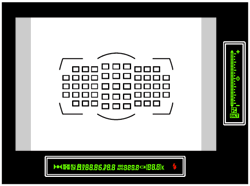
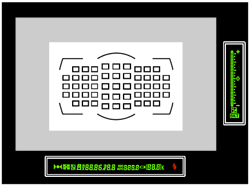
When the D3X is shooting in a format other than full-frame FX mode, a
translucent LCD in the viewfinder partially masks the inactive portions
of the frame. The illustrations below show the viewfinder display in
5:4 and DX modes.
 |
 |
| VF masked for 5:4 mode |
VF masked for DX mode |
AF Areas
Like its sibling the D3, the D3X features Nikon's Multi-CAM3500FX, a 51-point AF system. The fifteen points in the center of the frame (3 columns x 5 rows) act as cross-type sensors at apertures of f/5.6 and larger. This is quite a benefit for photographers needing to shoot with slower zoom lenses, or large teles on teleconverters. (Something that will more likely be required, given the lack of a crop factor when using the D3X in FX mode.) Strapping on Nikon's 1.4x teleconverter won't quite get you back to the same field of view as you'd have with the same lens on an APS-C body like the D300. - Many sports and nature photographers accustomed to the longer reach of their lenses on DX-format bodies are going to find themselves reaching for their teleconverters more frequently with the D3X.)
The Nikon D3X doesn't force you to use all 51 AF points if you don't want to though: Custom Menu option A8 lets you select between the full 51-point array and an 11-point arrangement that mimics the layout of the D2x's AF system. Shooters acquainted with the D2x may elect to use the 11-point AF layout out of familiarity, but we think most users will just stick with the full 51-point array. The illustrations below show the two AF arrays in the full FX-format viewfinder window.
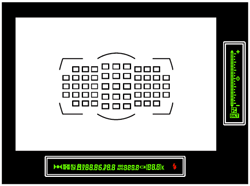 |
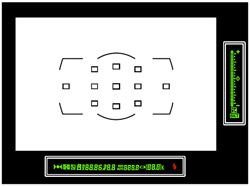 |
| Full 51-point AF array |
Reduced 11-point AF layout |
One last point about the D3X's AF system: The AF point display is provided by the same "overlay" LCD that does the frame masking. Points illuminate only when they're active, rather than always being present, as is the case when they're engraved onto the focusing screen. The advantage of the LCD-based approach is that there's nothing to obscure your view of the subject when the points aren't lit up. (A definite consideration with such a large number of AF points.)
Viewfinder Test Results
Coverage
Excellent accuracy with both the optical viewfinder and LCD monitor's Live View mode.
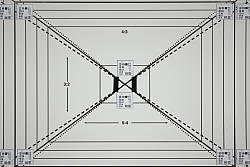 |
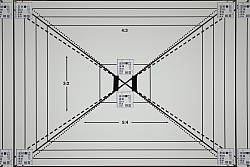 |
| 70mm, Optical | 70mm, Live View LCD |
The Nikon D3X's optical viewfinder proved extremely accurate, with about 99% coverage when measured with our Sigma 70mm f/2.8 macro test lens. The coverage of the LCD in Live View mode was about 100%. Excellent performance.
 Fujifilm GFX 50S Review
 Fujifilm X-T3 Review
 Olympus E-M5 III Review


Follow Imaging Resource