| "Sunlit" Portrait:
(This is my new "Outdoor" Portrait test - read more about it here.)
High resolution and strong detail, though slight color casts at each white balance setting. Good exposure, a really excellent job of controlling contrast from the harsh lighting.
- Exposure compensation: +0.7 EV, about average.
- Contrast/Tone: Good overall exposure and contrast. Low contrast setting does an excellent job of preserving highlight detail without flattening-out colors. Midtones are right where they should be, with very good highlight detail as well. A great job.
- White Balance: Auto is best overall, though a hint greenish. Daylight is quite warm, and the Manual setting reddish.
- Color accuracy: Good, but a slight cool/greenish cast overall, with more purple in the blue flowers than should be and a blue-green cast to the white shirt. Slightly cool yellows and reds also. The overall effect is still pretty pleasing though.
- Skin tones: Very good, quite natural.
- Resolution/sharpness: Good, slightly soft with the default sharpening setting, and slightly coarse details. (Could the camera be back-focusing slightly here? - The background looks a bit sharper than Marti's hair and facial features.)
- Shadow detail: Excellent, with low noise.
To view the entire exposure series from zero to +1.3 EV, see files D50OUTAP0.HTM through D50OUTAP4.HTM on the thumbnail index page.
Contrast Series:
The D50 does a much better than average job here, its contrast adjustment covering a wide range, with little impact on either exposure or color saturation. - It works just exactly as you'd expect it to, and covers a very wide range.
Saturation Series:
I'd like to see five steps of adjustment here as well, and there's a bit more interaction between saturation and contrast than I'd like, but on the whole, this control works better than the saturation adjustment on most cameras I test.
|
|
Closer Portrait: 
Good overall exposure, with strong resolution and detail.
- Exposure compensation: +0.3 EV, about average for this closer shot.
- Exposure/Tone: Contrast is slightly high, but midtones are right where they should be, and there's good detail. Very good, considering the very harsh lighting.
- Detail: Stronger detail, with good definition.
- Distortion: Good, zoom lens avoids strong geometric distortion close-in like this.
To view the entire exposure series from -0.3 to +1.0 EV, see files D50FACAM1.HTM through D50FACAP3.HTM on the thumbnail index page.
|
|
Indoor Portrait, Flash:
Normal Flash
+0.3 EV
|
 |
Slow-Sync Flash
+0.3 EV
|
 |
|
Night Portrait Mode
|
 |
Reasonably bright exposure with the default flash setting, but brighter results with the Slow-Sync mode and Night Portrait modes.
- Exposure: Fairly bright at the default exposure., but I felt +0.3 EV looked a bit better. Slow-Sync mode results in more even lighting and a brighter exposure, though a stronger yellow cast from the room lighting. Night Portrait mode turned in similar results.
- Flash balance with room lighting?: Pretty good, no artificial blue highlights from the flash.
- Color: Red skin tones, dark colors in bouquet.
To view the entire exposure series from -0.7 to +1.0 EV in the normal flash mode, see files D50INFM2.HTM through D50INFP3.HTM on the thumbnail index page.
To view the same exposure series in the Slow-Sync flash mode, see files D50INFSM2.HTM through D50INFSP3.HTM on the thumbnail index page.
|
|
Indoor Portrait, No Flash:
|
Auto White Balance
|
 |
|
Incandescent White Balance
|
 |
|
Manual White Balance
|
 |
Good exposure. Auto white balance has a hard time with the incandescent lighting, but manual white balance does an excellent job, producing very good color.
- Exposure: Good at +0.7 EV, slightly less than average.
- White Balance: Manual setting by far the best, a very nice color balance. (Very slightly yellow, but to an extent that just hints at the original color balance of the scene.) Incandescent and Auto settings both rather warm.
- Color: Skin tones a little red, blue flowers very purple, greens a little cool. Bottom line though, a very good job with a very tough light source.
To view the entire exposure series from zero to +1.7 EV, see files D50INMP0.HTM through D50INMP5.HTM on the thumbnail index page.
ISO Series:
The Nikon D50 produced surprisingly clean images at high ISO, visibly better than those from its "big brother," the D70s. Images shot at ISO 1600 make perfectly acceptable-looking 8x10 prints, and lower ISOs only get better. (I even made a 13x19 inch print from one of the D50's ISO 1600 shots, and while the noise was definitely visible at that size, the resulting print would have been very acceptable for wall display.) A very nice performance, even when compared to other d-SLRs.
|
|
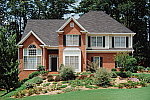
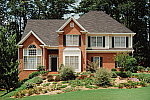
House Shot:
|
Auto White Balance
|
 |
|
Daylight White Balance
|
 |
|
Manual White Balance
|
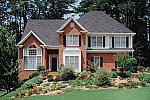 |
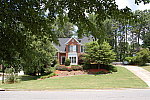
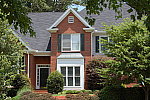
Good color, with high resolution and strong detail.
- Sharpness/Detail: Good detail, fairly sharp overall. Some over-sharpening however, with heightened contrast.
- Sharpness in Corners: Slight falloff with the kit lens, better than average for digicams, average or a bit below for d-SLR kit lenses.
- Color: Auto and Manual white balance settings both good, though Manual was a hint cool. Daylight setting much warmer.
- Detail lost to anti-noise processing?: Slight, in the brick patterns.
|
|
Far-Field Test 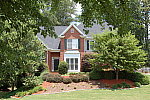
High resolution and a lot of fine detail. However, dynamic range is slightly limited, and there's a lot of blurring in the corners.
This image is shot at infinity to test far-field lens performance, and to present a near-infinite range of detail to the camera. NOTE that this image cannot be directly compared to the other "house" shot, which is a poster, shot in the studio.
- Sharpness/Detail: Good detail, though again, evidence of over-sharpening in the fine foliage above the roof.
- Sharpness in Corners: Poor, significant blurring in all four corners of the frame.
- Color: Good, though a little cool overall.
- Dynamic Range: Hard to tell, strongest highlights are blown out, but shadow detail is excellent.
- Detail lost to anti-noise processing?: Pretty slight, detectable in the shadowed brick patterns.
Resolution Series:
ISO Series:
As above, the Nikon D50 produces surprisingly clean images at high ISO, arguably better than its "big brother," the D70s. Images shot at ISO 1600 make perfectly acceptable-looking 8x10 prints, and lower ISOs only get better. Very nice performance, even when compared to other d-SLRs.
Sharpness Series:
The D50's default in-camera sharpening setting slightly coarsens fine detail, but overall does a decent job of sharpening the images. If you're interested in extracting maximum detail though, by far the best results are obtained by using the lowest sharpening setting and then applying strong/tight unsharp masking in Photoshop (tm) after the fact. At the lowest sharpness setting, the images respond unusually well to strong/tight unsharp masking (try 0.4 pixel radius, 350%), revealing exceptional fine detail. The higher sharpening settings tend to further coarsen the subject detail, to the point that I don't personally find them terribly useful. (Although they might be helpful on images that are intended only for output on inkjet printers at fairly small sizes.)
Contrast Series:
While it seemed to affect highlights and shadows more or less equally in the Sunlit Portrait test above, here the D50's contrast control seems to have much more effect on lower midtone and shadow tones. It seems that effective use of it requires monitoring the "highlights" and histogram displays on the D50's LCD, and tweaking exposure to maximize detail in the range of tones you're interested in.
Saturation Series:
As before, a good, photographically useful range of saturation adjustment, but I'd really like to see five steps covering the same range, rather than three that are offered.
Color Series:
These are examples of the three color spaces the D50 supports, standard sRGB (with slightly less saturated colors), Adobe RGB, and the sRGB color space with slightly more saturated colors that's its default.
Image Effects Series:
|
|
Lens Zoom Range
A good 3x zoom range with the kit lens, equivalent to a 27-83mm lens on a 35mm film camera.
The D50 accommodates a wide range of Nikkor lenses, so zoom range will naturally vary widely depending on the lens in use. Many users will purchase the D50 with its 18-55mm "kit" lens though, so the shots below show the focal length range of that optic.
|
|
Musicians Poster
|
Auto White Balance
|
 |
|
Daylight White Balance
|
 |
|
Manual White Balance
|
 |
Slightly warm color, but still good results. High resolution and strong detail.
- White Balance: Auto and Daylight white balance settings very similar and slightly warm, chose Auto for main shot. Manual setting cool and magenta.
- Color: Warm overall color, with yellow skin tones. Blue robe greenish in the highlights, though faint purple tints in shadows.
- Sharpness/Detail: Strong detail, pretty good sharpness. (Close to the limits of the poster though.)
|
|
Macro Shot
|
Standard Macro Shot
|
 |
|
Macro with Flash
|
 |
A small macro area with good detail with the "kit" lens. Flash performs well.
- Minimum Macro Area: 2.59 x 1.72 inches (66 x 44 millimeters), about average.
- Softness in corners?: About average. (Most cameras get fairly soft corners in macro mode.)
- Flash performance in macro mode?: Good, flash throttles down well.
|
|
"Davebox" Test Target
|
Auto White Balance
|
 |
|
Daylight White Balance
|
 |
|
Manual White Balance
|
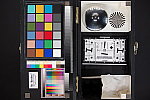 |
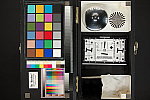
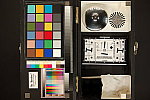
Good overall exposure and color, a very slight magenta cast. Somewhat oversaturated color in the default color mode.
- White balance: Manual setting slightly magenta, but best overall. Auto slightly warm, and Daylight even warmer.
- Color Accuracy: Like the D70S, the Nikon D50 really likes strong reds, as shown by the very high saturation of the red, magenta, and pink swatches here. Yellows and yellow-greens are slightly undersaturated though. In its default "Mode III" color mode, colors are quite saturated across the board. Mode I's color is a bit more subdued, particularly strong blues, and skin tones are less saturated, probably producing more natural-looking, softer tones. For those users with a color-managed environment (and therefore able to take proper advantage of it), the Mode II Adobe RGB color space produces the most accurate results of the three.
- Shadow detail and noise: Moderate detail in the briquettes, quite low noise. (Thanks to its unusually low noise levels, the D50's dynamic range is among the best on the market, among d-SLRs that I've tested.
Now, for the REAL technoids, Imatest!
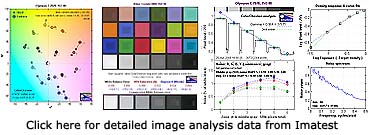
I routinely use Norman Koren's excellent "Imatest" analysis program for quantitative, thoroughly objective analysis of test images from the higher-end cameras I review. I've now also begun measuring dynamic range, as determined by Imatest and a Stouffer 4110 density scale, and this information is included on my Imatest analysis page as well.
The images series below duplicate examples of various camera controls we've already covered above. I include them here though, for our more analytically-minded readers, who'd like to see the effect of various camera controls with a well-known target like the MacBeth Color Checker (tm).
ISO Series:
Contrast Series:
Saturation Series:
Color Series:
Image Effects Series:
|
|
Low-Light Tests
Very good low-light performance, with very low image noise. Autofocus system works to a bit darker than 1/16 foot-candle, even with the AF-assist light disabled, an excellent performance.
- Exposure limit: 1/16 foot-candle at all ISOs, though shots are a hint dim. (About 1/16 as bright as typical city street lighting at night.)
- Autofocus Limit: To 1/16 foot-candle and darker.
- White Balance: A bit warm and pink toned, depending on the exposure.
- Noise Levels: Quite low, even at ISOs 800 and 1,600.
- Detail loss to anti-noise processing?: Minimal at one foot-candle, a bit more at the darker light levels.
- General Notes: The Nikon D50 is a really excellent low-light performer, with very low image noise levels, and an AF system that worked in our studio down to brightness levels of 1/16 foot-candle and darker. (1/16 foot-candle is the darkest we can measure with our Sekonic light meter, corresponding to a light level about four stops below that of typical city street lighting at night.) A very impressive performance for a value-priced d-SLR.
(Note: If you'd like to use a light meter to check light levels for subjects you might be interested in shooting, a light level of one foot-candle corresponds to a normal exposure of two seconds at f/2.8 and ISO 100.)
| |
1 fc
11 lux |
1/2 fc
5.5 lux |
1/4 fc
2.7 lux |
1/8 fc
1.3 lux |
1/16 fc
0.67 lux |
1/16fc
No NR |
ISO
200 |

1/1 sec
f3.5 |

1.6 sec
f3.5 |

4 sec
f3.5 |

8 sec
f3.5 |

15 sec
f3.5 |

15 sec
f3.5 |
ISO
400 |

1/2 sec
f3.5 |

1/1 sec
f3.5 |

2 sec
f3.5 |

4 sec
f3.5 |

8 sec
f3.5 |

8 sec
f3.5 |
ISO
800 |

1/4 sec
f3.5 |

1/2 sec
f3.5 |

1 sec
f3.5 |

2 sec
f3.5 |

4 sec
f3.5 |

4 sec
f3.5 |
ISO
1600 |

1/8 sec
f3.5 |

1/5 sec
f3.5 |

1/2 sec
f3.5 |

1 sec
f3.5 |

2 sec
f3.5 |

2 sec
f3.5 |
|
|
Flash Range Test
A bright flash, plenty of power all the way to 14 feet.
- Flash range at telephoto lens setting: 14 feet. (The images below get small, because the 18-55mm kit lens couldn't fill the frame with the target beyond about 9 feet.)
| 8 ft |
9 ft |
10 ft |
11 ft |
12 ft |
13 ft |
14 ft |

1/60 sec
f5.6 |

1/60 sec
f5.6 |

1/60 sec
f5.6 |

1/60 sec
f5.6 |

1/60 sec
f5.6 |

1/60 sec
f5.6 |

1/60 sec
f5.6 |
|
|
ISO-12233 (WG-18) Resolution Test 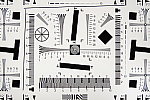
Good resolution, 1,200-1,400 lines of "strong detail." The 18-55mm kit lens shows slightly high barrel distortion at wide angle, virtually no distortion at telephoto. Moderate chromatic aberration at wide angle, though less at telephoto. Moderate softening in the corners at medium to telephoto focal lengths.
- Resolution: A little hard to call, 1,400 lines of "strong detail" visible, both horizontally and vertically, but there are quite a few artifacts, in the range of 1,200-1,300 lines. (For whatever reason, the D70S doesn't show nearly the level of artifacts that the D50 does.)
- Artifacts begin at: ~800 lines.
- Extinction point: ~1,800 lines.
- Barrel/Pincushion distortion: 0.9% barrel at wide angle, 0.04% at telephoto.
- Chromatic Aberration: Moderate at wide angle, low at telephoto.
- Corner Sharpness: Very good at wide angle, moderate softening at medium to telephoto focal lengths.
Resolution Series, medium focal length
Resolution Test, Zoom Series
3,008 x 2,000
(Fine,
Wide Angle) |
D50RESW
|
3,008 x 2,000
(Fine,
Telephoto) |
D50REST
|
Sharpness Series:
|
Viewfinder Accuracy/Flash Uniformity
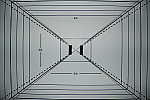
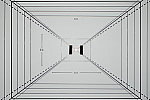
An accurate digital SLR viewfinder. Slight flash falloff at wide angle, none at telephoto.
- Optical Viewfinder Accuracy: Very good, 97 percent at wide angle and telephoto.
- LCD Viewfinder Accuracy: N/A, LCD only for image review and menu display.
- Flash Uniformity: Slight falloff at wide angle, none at telephoto.
|














Follow Imaging Resource: