Digital Cameras - Fuji FinePix E550 Test Images
| I've begun including links in our reviews to a Thumber-generated index page for the test shots. The Thumber data includes a host of information on the images, including shutter speed, ISOsetting, compression setting, etc. Rather than clutter the page below with *all*that detail, we're posting the Thumber index so only those interested inthe information need wade through it! |
| "Sunlit" Portrait: High resolution and strong detail (though soft), with nearly accurate
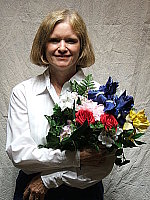
color. High contrast however. The extreme tonal range of this image makes it a tough shot for many digicams, which is precisely why I set it up this way, and why I shoot it with no fill flash or reflector to open the shadows. (The color temperature and main/fill balance in this shot closely match that of summer sunshine here in North Georgia.) The object is to hold both highlight and shadow detail without producing a "flat" picture with muddy colors, and the FinePix E550 produced good color, though high contrast. The shot at right was taken with a +0.3 EV exposure compensation adjustment, which results in somewhat dark midtones, but did a good job of preserving highlight detail. (I could perhaps have gone with the shot at +0.7 EV compensation, but I felt it just lost too much highlight detail in exchange for brighter midtones.) I chose the Auto white balance setting for the main series, though the Daylight setting also produced good results. (The Manual option resulted in a slight red cast.) Though just slightly warm, Marti's skin tones look natural here, but the always-difficult blue flowers are rendered somewhat darker than they are in real life. (This is actually a fairly light navy blue, with just hints of purple in it.) The strong yellows and greens are a hint dark, but still pretty accurate, though the red flowers are a little oversaturated. Resolution is high, and a lot of fine detail is visible in the flower bouquet. Detail is also strong in Marti's face, though details are overall slightly soft. (Full-resolution images from Fuji's SuperCCD cameras tend to look soft when viewed 1:1 onscreen, due to the interpolation used to convert from the diagonal sensor array to the rectangular screen pixels. If you print SuperCCD images at the same scale as those from non-SuperCCD sensors though, the SuperCCD images will generally show a slight edge in overall sharpness.) The deep shadows show a surprising amount detail, but also with a fair amount of noise. To view the entire exposure series from -0.3 to +1.0 EV, see files E55OUTBAM1.HTM
through E55OUTBAP3.HTM on the thumbnail index page.
|
||||||||||||||||||||||||||||||||||||
| Closer Portrait: 
Exceptional resolution and detail, but again high contrast. Exposure and color balance appear similar to the wider shot above, again with high contrast. Midtones are again a little dark, and the highlights are very bright on Marti's face. The shot at right was taken with a +0.3 EV exposure compensation adjustment. The E550's 4x zoom lens helps prevent any geometric distortion of Marti's features, which is an important consideration in close-up shots like this. Detail and resolution are extraordinary in this close-up shot. To view the entire exposure series from -0.3 to +1.0 EV, see files E55FACBAM1.HTM
through E55FACBAP3.HTM on the thumbnail index page.
|
||||||||||||||||||||||||||||||||||||
| Indoor Portrait, Flash:
Good results with the default exposure setting. Color is a little pink from the room lighting, but still very good overall. The E550's built-in flash illuminated the subject very well at its default
exposure setting, and produced a fairly bright exposure with good color.
This is a much better than average performance here, as most digicams
require a fair bit of exposure boost on this shot. (You could opt for
a slightly brighter shot with a +0.3 EV exposure
compensation adjustment, but the highlights were too overpowering for
my eye.) Skin tones are slightly pinkish, and the flowers look a little
dark (particularly the blue flowers), but color is quite good overall.
The background incandescent lighting results in a slight orange cast in
the shadows and on Marti's hair, but the effect isn't too strong. A nice
job. |
||||||||||||||||||||||||||||||||||||
| Indoor Portrait, No Flash:
Auto WB is a bit too warm, Manual a bit cool, but neither is bad. This shot is always a very tough test of a camera's white balance capability, given the strong, yellowish color cast of the household incandescent bulbs used for the lighting. Though slightly cool, the E550's Manual white balance setting handled the incandescent lighting best. The Auto and Incandescent settings resulted in warmer casts. The main exposure was taken with a +1.3 EV exposure compensation adjustment, which is just slightly hot. (It was actually a toss-up between the +1.0 EV and +1.3 EV exposure compensation adjustments.) Despite the cool cast, Marti's skin tones look good, and overall color is pretty accurate. The blue flowers in the bouquet are dark and purplish from the incandescent lighting, however. (Pretty much unavoidable, regardless of white balance, given the strong color cast of the room lighting.) There's a little more image noise in this shot than in those shot under brighter lighting, but it's still not bad at all. To view the entire exposure series from zero to +1.7 EV, see files E55INMP0.HTM
through E55INMP5.HTM on the thumbnail index page. ISO Series:
|
||||||||||||||||||||||||||||||||||||
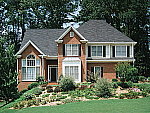
| House Shot:
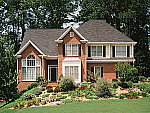
Good color and exceptional resolution, though details are soft and image noise is moderately high. I settled on the E550's Manual white balance
setting for this shot, as it produced the best overall color and most
accurate white value on the house trim. The Auto
setting resulted in a reddish cast, and the Daylight
setting was warm. Resolution is very high, and detail is strong in the
tree limbs and front shrubbery. This shot is a good example though, of
the danger of judging SuperCCD images based on their onscreen sharpness.
Because the 12 megapixel file is made from a 6 megapixel sensor image,
details here look soft on a computer CRT. When you stop and look carefully
at what details are actually visible though, you quickly see that there's
a tremendous amount of detail present. Thus, when you print an image like
this at the same size as one from a camera with a conventional 6-megapixel
CCD, you'll see that there's an enormous amount of detail here, even though
the larger SuperCCD image looks softer onscreen. Image noise is more evident
in this shot though, and some details in the bricks are a little smudged
from the anti-noise processing. |
||||||||||||||||||||||||||||||||||||
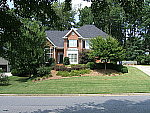
| Far-Field Test 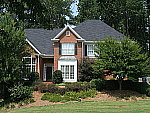
Excellent resolution and detail, but a somewhat limited dynamic range. This image is shot at infinity to test far-field lens performance. NOTE that this image cannot be directly compared to the other "house" shot, which is a poster, shot in the studio. The rendering of detail in the poster will be very different than in this shot, and color values (and even the presence or absence of leaves on the trees!) will vary in this subject as the seasons progress. In general though, you can evaluate detail in the bricks, shingles and window detail, and in the tree branches against the sky. Compression artifacts are most likely to show in the trim along the edge of the roof, in the bricks, or in the relatively "flat" areas in the windows. This is my ultimate "resolution shot,"
given the infinite range of detail in a natural scene like this, and the
E550 captures a lot of fine detail. The tree limbs over the roof and fine
foliage in front of the house show strong detail, with good shading and
depth in the leaf patterns. House details such as the bricks and trim
also show a lot of fine detail. As noted above, details are a little soft
throughout the frame due to the interpolation used to produce the 12 megapixel
final file, but the actual details recorded are on the high side for a
6-megapixel camera. The camera loses detail in the bright white paint
surrounding the bay window, a trouble spot for many digicams. Detail is
also only moderate in the shadow area above the front door, further evidence
of a limited dynamic range. Overall color looks very good. The table below
shows a standard resolution and quality series, followed by ISO and sharpness
series. Resolution Series:
ISO Series:
Sharpness Series:
|
||||||||||||||||||||||||||||||||||||
|
Lens Zoom Range A good 4x zoom range. I routinely shoot this series of images to show the field of view for each camera, with the lens at full wide angle, at maximum telephoto (4x, in this case), and at full telephoto with the digital zoom enabled. The E550's lens is equivalent to a 32.5-130mm zoom on a 35mm camera. That corresponds to a fairly wide angle to a good telephoto. Following are the results at each zoom setting.
|
||||||||||||||||||||||||||||||||||||
| Musicians Poster
Slightly warm color, but still good results. High resolution, though high image noise as well. This shot is often a tough test for digicams, as the abundance of blue
in the composition frequently tricks white balance systems into producing
a warm color balance, but the E550 handled it very well. Both the E550's
Auto and Daylight white balance settings
produced similar, slightly warm results. Both were pretty close to the
mark, but I felt the Daylight setting looked best overall. (The Manual
option resulted in a cooler, slightly magenta cast.) The warm cast results
in purple tints in the blue background, as well as in the deep shadows
of the blue robe. Skin tones are a little warm as well, but still fairly
natural. Resolution is very high, and a lot of fine detail is visible
in the embroidery on the blue robe, though high image noise decreases
definition. (The original data file for this poster was only 20MB though,
so cameras like the E550 are definitely capable of showing more detail
than the poster has in it.) |
||||||||||||||||||||||||||||||||||||
| Macro Shot
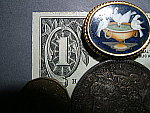
A small macro area with good detail in the dollar bill. Flash is partially blocked by the lens, however. The E550 captured a very small macro area, measuring only 2.38 x 1.79
inches (60 x 45 millimeters). Resolution is very high, and detail is very
strong in the dollar bill. A lot of fine detail is also present in the
coins and brooch, though these are softer due to a limited depth of field
when shooting this close. As is often the case with digicam macro modes
though, details are much softer in the corners of the frame. The E550's
flash is partially blocked by the lens, casting
a strong shadow that dominates the lower portion of the image. (Plan on
using external lighting for your closest macro shots with the E550.) |
||||||||||||||||||||||||||||||||||||
| "Davebox" Test Target
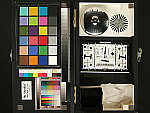
Nearly accurate color, with a pretty good exposure as well. The E550's Auto and Daylight white balance settings produced similar, slightly warm images here, so I chose the more accurate color balance of the Manual option for the main image. Though the Manual setting produced just a hint of a red cast, overall color looks very good in the large color blocks. Exposure is about right, as the E550 distinguishes the subtle tonal variations of the Q60 target well. The shadow area of the charcoal briquettes shows moderate detail, though high image noise obscures the finer details. Color here is very good. The E550 has the slight oversaturation that
consumers prefer, and that most consumer digicams therefore produce. As
usual, strong reds are the most highly saturated, other colors are much
more modestly so. It has a bit of a cyan-to-blue hue shift that I've also
seen in Canon models, apparently designed to produce more appealing sky
colors. All in all though, the E550's color is more accurate than average,
and quite appealing.
Color Series:
|
||||||||||||||||||||||||||||||||||||
|
Low-Light Tests Limited low-light performance, though should handle average city street lighting at night pretty well. Autofocus can't handle low light at all well though. The E550 produced clear, bright, usable images down to the 1/2 foot-candle (5.5 lux) light level at the 80, 100, and 200 ISO settings. Increasing the sensitivity to ISO 400 produced a reasonably bright image at the 1/4 foot-candle (2.7 lux setting), while the maximum sensitivity (ISO 800) produced a bright image at 1/8 foot-candle (1.3 lux). You could see the test target at 1/16 foot-candle (0.67 lux), but the image is pretty underexposed. Color balance was slightly warm with the Auto white balance setting, but not bad. Noise is moderate at the lower ISOs, and does increase at the 400 and 800 settings. However, it's actually not too bad considering the long exposures and low lighting. The E550's biggest problem for low-light shooting is its autofocus system - It can only focus reliably down to about one foot-candle, roughly the level of typical city street-lighting at night. This means that the camera can shoot at light levels a good bit lower than it can focus at. (It does have a manual focusing option, but that may not be much help either, as there's no distance readout to help you set the correct focal distance, so you'll have to rely on what you can see on the LCD screen. - Which may not be much, under dim shooting conditions.) The table below shows the best exposure I was able to obtain for each of a range of illumination levels. Images in this table (like all sample photos) are untouched, exactly as they came from the camera. (Note: If you'd like to use a light meter to
check light levels for subjects you might be interested in shooting, a
light level of one foot-candle corresponds to a normal exposure of two
seconds at f/2.8 and ISO 100.)
|
||||||||||||||||||||||||||||||||||||
|
Flash Range Test Very limited flash range when the lens is at the telephoto end of its range, better at wide angle focal lengths. In my testing, the E550's flash proved very weak, underexposing my test shot even at the 8 foot minimum distance. (Fuji themselves rate the E550's flash range at 14.8 feet at wide angle, but only 7.2 feet at telephoto.) Below is the flash range series, with distances from eight to 14 feet from the target.
|
||||||||||||||||||||||||||||||||||||
|
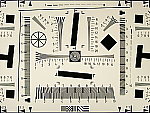
ISO-12233 (WG-18) Resolution Test
Very high resolution, 1,600+ lines of "strong detail," but significant artifacts at that level. High barrel distortion at wide angle, low distortion at telephoto, but corners become very soft at telephoto. The E550 performed very well on the "laboratory" resolution test chart. It started showing artifacts in the test patterns at resolutions as low as 1,000 lines per picture height on vertical edges, 1,200 lines on horizontal details. I found "strong detail" all the way out to 1,600+ lines, although there were a lot of artifacts visible at that level. "Extinction" of the target patterns didn't occur until right around the 2,000-line limit of the target. Optical distortion on the E550 was high at the wide-angle end, where
I measured approximately 0.9 percent barrel distortion. The telephoto
end fared much better, as I measured only 0.07 percent barrel distortion
there (about two pixels). Chromatic aberration is average to a little
above average, showing about five or six pixels of moderate coloration
on either side of the target lines at wide angle focal lengths. (This
distortion is visible as a very slight colored fringe around the objects
at the edges of the field of view on the resolution target.) The E550's
images are quite sharp from corner to corner at wide angle focal lengths,
soften somewhat in the corners at "normal" focal lengths, and
develop very soft corners at the telephoto end of the lens' zoom range. Resolution Series, 50mm
Resolution Test, Zoom Series
Sharpness Series
|
||||||||||||||||||||||||||||||||||||
|
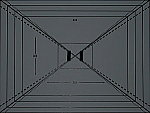
Viewfinder Accuracy/Flash Uniformity A tight optical viewfinder, but nearly dead-on accurate LCD monitor. The E550's optical viewfinder was rather tight, showing only 84 percent frame accuracy at wide angle, and only about 78 percent at telephoto. The LCD monitor fared much better, though was actually a little loose, showing just a hair more than what made it into the final frame. Since I prefer LCD monitors to be as close to 100 percent accuracy as possible, the E550's LCD monitor is essentially perfect in this regard, but its optical viewfinder could use a little help. Flash distribution is fairly even at wide angle, with just a little falloff at the corners and edges of the frame. At telephoto, flash distribution is more uniform, but very dim. |
||||||||||||||||||||||||||||||||||||










E550 Test Images
E550 Specifications
E550 "Picky Details"
Up to Imaging Resource digital cameras area


Follow Imaging Resource: