Casio EX-FH20 Exposure
Color
Saturation & Hue Accuracy
Average overall color accuracy, but some hue-shift visible in yellows and oranges.
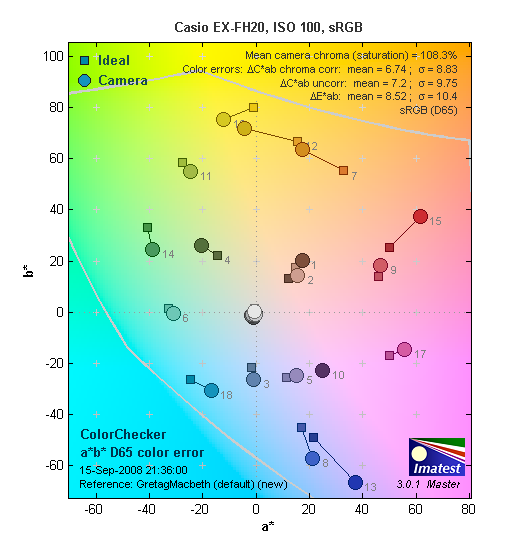 |
| In the diagram above, the squares show the original color, and the circles show the color that the camera captured. More saturated colors are located towards the periphery of the graph. Hue changes as you travel around the center. Thus, hue-accurate, highly saturated colors appear as lines radiating from the center. |
Skin tones. With the color balanced properly for the light source, the EX-FH20's Caucasian skin tones had a slightly pinkish tint, while darker skin tones were pushed toward yellow/orange. Where oversaturation is most problematic is on Caucasian skin tones, as it's very easy for these "memory colors" to be seen as too bright, too pink, too yellow, etc.
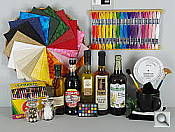
Hue. The Casio EX-FH20 showed a few color shifts relative to the correct mathematical translation of colors in its subjects. For example, yellows were pushed toward green, and oranges quite a bit towards yellow. Other smaller shifts are noticeable on the color chart at right. Overall hue accuracy was about average, but the shifts in the yellows and oranges were noticeable in some of our test shots. Hue is "what color" the color is.
 |
 |
 |
| See full set of test images
with explanations See thumbnails of all test and gallery images |
||
Sensor
Exposure and White Balance
Indoors, incandescent lighting
Nearly accurate color with the Manual white balance setting, just a hint cool. EV boost needed for proper exposure.
 |
 |
 |
| Auto White Balance +0.7 EV |
Incandescent White Balance +0.7 EV |
Manual White Balance +0.7 EV |
Color balance indoors under incandescent lighting was quite warm in Auto white balance mode, while both the Incandescent and Manual settings produced cooler, more neutral results. While some may prefer the warmer results of the Auto setting as being more representative of the original mood, the Manual and Incandescent settings have closer to accurate white valuesalbeit with a slight magenta cast. The EX-FH20 required a +0.7 EV exposure compensation boost to get a good exposure here, about 0.3 EV higher than average for this shot. Our test lighting for this shot is a mixture
of 60 and 100 watt household incandescent bulbs, a pretty yellow light source,
but a very common one in typical home settings here in the U.S.
Outdoors, daylight
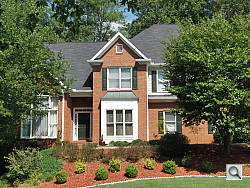
Slightly high contrast, but generally good exposure and color.
 |
 |
| Auto White Balance, +0.7 EV |
Auto White Balance, Auto Exposure |
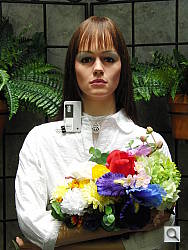
Outdoors, the Casio High Speed EXILIM EX-FH20 had a hard time with the deliberately harsh lighting of our test shots, producing high contrast with limited detail in both the shadows and highlights. Color was generally good, though the slight overexposure in the house shot did flatten detail in the red brick a little. The EX-FH20 does offer an adjustable contrast setting, however, which can help to pull highlights and shadows back to more acceptable levels.
See full set of test images with explanations
See thumbnails of all test and gallery images
Resolution
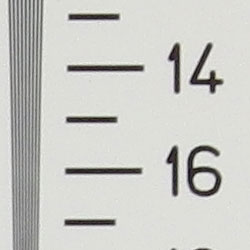
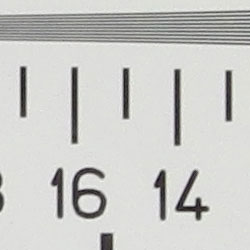
High resolution, 1,500 lines of strong detail.
 |
 |
| Strong detail to 1,500 lines horizontal |
Strong detail to 1,500 lines vertical |
Our laboratory resolution chart revealed sharp, distinct line patterns down to about 1,500 lines per picture height in both directions. Extinction occurred between 1,900 and 2,000 lines. Use these numbers to compare with other cameras of similar resolution, or use them to see just what higher resolution can mean in terms of potential detail.
See full set of test images with explanations
See thumbnails of all test and gallery images
Sharpness & Detail
Slightly soft images overall, with only minor edge-enhancement on high-contrast
subjects. Strong noise suppression limits detail in the shadows, and even
in the brighter areas.
 |
 |
| Definition of high-contrast elements is affected by noise suppression and there's evidence of minor edge enhancement. |
Subtle detail: Hair Noise suppression blurs detail in areas of subtle contrast, really all over this particular subject. |
Sharpness. The Casio High Speed EXILIM EX-FH20 captures reasonable fine detail, but isn't really up to the level you'd normally expect from a camera with a 9-megapixel sensor. Detail definition suffers from overall softness, noise suppression, and noise grain. Slight enhancement artifacts are visible on high-contrast subjects such as those in the crop above left. Edge enhancement creates the illusion of sharpness by enhancing colors and tones right at the edge of a rapid transition in color or tone.
Detail. The crop above right shows unusually high noise suppression for a low-ISO shot, with limited detail even in the lighter areas of hair. Noise-suppression systems in digital cameras tend to flatten-out detail in areas of subtle contrast. The effects can often be seen in shots of human hair, where the individual strands are lost and an almost "watercolor" look appears.
ISO & Noise Performance
Visible noise at the lowest sensitivity setting, with increased blurring and noise at the middle and higher settings.
 |
 |
 |
| ISO 100 | ISO 200 | ISO 400 |
 |
 |
ISO 800 | ISO 1,600 |
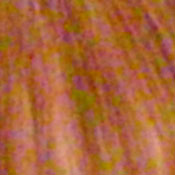
The Casio High Speed EXILIM EX-FH20 produced visible (on-screen) noise at the lowest ISO setting of 100, with slight blurring in the fine details even there. As ISO increased, so did the amount of blurring as the camera tried to suppress any noise artifacts. At ISO 400, noise grain is clearly visible on-screen, but noise suppression and the attendant loss of subtle detail is also quite pronounced. At ISOs 800 and 1,600, results are very blurry, and noise artifacts begin to interfere with color balance.
Extremes: Sunlit and low light tests
High resolution with strong overall detail, but slightly high contrast.
Very good low-light performance, capable of capturing bright images in near
darkness.
 |
|
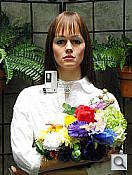 |
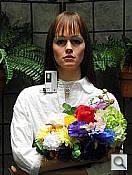
| +0.7 EV | +1.0 EV | +1.3 EV |
Sunlight:
The Casio High Speed EXILIM EX-FH20's exposure system responded to the deliberately harsh lighting in the test above with high contrast, resulting in hot highlights and deep shadows with limited midtones. Noise suppression is rather heavy-handed in the shadows, limiting detail and definition there quite a bit. At +0.7 EV, the highlights on the white shirt are really too hot, but the exposure at +0.3 EV is too dim overall. The EX-FH20 does have an adjustable contrast setting, which did a good job in balancing the exposure at the lowest setting. Still, be sure to use fill flash in situations like the one shown above; and really, it's better to shoot in the shade when possible.
 |
 |
 |
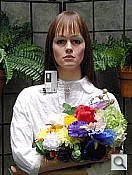
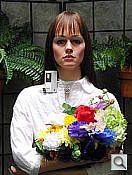
| Contrast -2 | Neutral Contrast | Contrast +2 |
Contrast Control
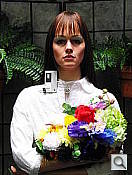
The Casio FH20 has a contrast adjustment option that helps quite a bit with harsh lighting conditions like those in this test. The FH20's contrast adjustment appears to affect both highlight and shadow ends of the tone curve (as it should), making it easy to use, since it doesn't require any exposure changes to take best advantage of it.
 |
 |
 |
| DR Exp Off | DR Exp +1 | DR Exp +2 |
Dynamic Range Expansion
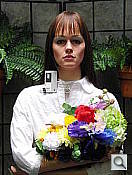
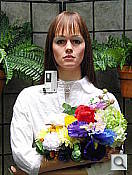
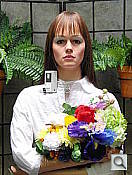
The Casio FH20 also has a dynamic range expansion option, that can help with difficult lighting. The DR expansion works differently than the Contrast control we saw above, in that it operates mainly on the dark parts of the image, working almost as a "fill light," to lighten the shadows. For best results in this shot, we ideally would have decreased the overall exposure, to bring down the highlights, then let the DR Expansion option open up the shadows. Visually, DR Expansion gives you an image with more normal-looking contrast in the midtones (note how contrast in the model's face is largely maintained), but with more detail visible in the shadows.
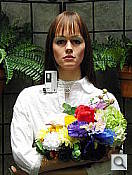
Because digital cameras are more like slide film than negative film (in that they tend to have a more limited tonal range), we test them in the harshest situations to see how they handle scenes with bright highlights and dark shadows, as well as what kind of sensitivity they have in low light. The shot above is designed to mimic the very harsh, contrasty effect of direct noonday sunlight, a very tough challenge for most digital cameras. (You can read details of this test here.)
| 1 fc 11 lux |
1/2 fc 5.5 lux |
1/4 fc 2.7 lux |
1/8 fc 1.3 lux |
1/16 fc 0.67 lux |
|
|---|---|---|---|---|---|
| ISO 100 |
 2 sec f2.8 |
 4 sec f2.8 |
 8 sec f2.8 |
 15 sec f2.8 |
 30 sec f2.8 |
| ISO 200 |
 1 sec f2.8 |
 2 sec f2.8 |
 4 sec f2.8 |
 8 sec f2.8 |
 15 sec f2.8 |
| ISO 400 |
 0.5 sec f2.8 |
 1 sec f2.8 |
 2 sec f2.8 |
 4 sec f2.8 |
 8 sec f2.8 |
| ISO 800 |
 1/4 sec f2.8 |
 0.5 sec f2.8 |
 1 sec f2.8 |
 2 sec f2.8 |
 4 sec f2.8 |
| ISO 1600 |
 1/8 sec f2.8 |
 1/4 sec f2.8 |
 0.5 sec f2.8 |
 1 sec f2.8 |
 2 sec f2.8 |
Low light:
The Casio High Speed EXILIM EX-FH20 performed very well in low lighting, as its exposure system was able to capture bright images at the lowest light level we test at, even at its lowest sensitivity setting, thanks to its maximum 30-second shutter time. Color balance was pretty good with the Auto white balance setting, though the camera's propensity toward higher noise levels at the higher ISO sensitivity settings did result in chroma noise interfering with color balance on occasion. The camera's AF system was able to focus unassisted down to just above the 1/8 foot-candle light level, and to total darkness with the AF assist.
How bright is this? The one foot-candle light level that this test begins at roughly corresponds to the brightness of typical city street-lighting at night. Cameras performing well at that level should be able to snap good-looking photos of street-lit scenes.
NOTE: This low light test is conducted with a stationary subject, and the camera mounted on a sturdy tripod. Most digital cameras will fail miserably when faced with a moving subject in dim lighting. (For example, a child's ballet recital or a holiday pageant in a gymnasium.) For such applications, you may have better luck with a digital SLR camera, but even there, you'll likely need to set the focus manually. For information and reviews on digital SLRs, refer to our SLR review index page.
Output Quality
Print Quality
Lower than average print quality for a 9-megapixel camera. Images usable for 13x19 inch prints for wall display, are sharp for closer viewing only to 8x10. ISO 800 usable to 5x7, but best at 4x6, ISO 1,600 rough even at 4x6.
 The Casio FH20 is an amazing speed demon, but comes up a little short when it comes to print quality. Its images are on the soft side for a 9-megapixel camera, but still do make great-looking 8x10 inch prints. The softness really makes itself felt only at larger print sizes: Prints of 13x19 inches are about the limit, even for wall display; for closer inspection, 8x10 inches is really about the limit.
At higher ISOs, print sizes are also a little limited relative to competing cameras with only normal-speed shooting capability. ISO 800 images are usable for 5x7 inch prints, but look their best at 4x6 inches. ISO 1,600 images look rough even at 4x6. ISO 400 is perhaps usable at 8x10 inches, but best at 5x7.
The Casio FH20's images made bright, colorful-looking prints, without the color seeming overdone or too saturated. Color looked quite natural, but we did see some hue shifts in the spectrum from orange through yellow. Oranges were a bit yellow and yellows had a somewhat greenish tinge to them.
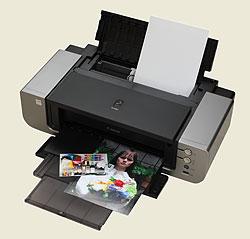
Testing hundreds of digital cameras, we've found that you can only tell just so much about a camera's image quality by viewing its images on-screen. Ultimately, there's no substitute for printing a lot of images and examining them closely. For this reason, we now routinely print sample images from the cameras we test on our Canon Pro9000 studio printer, and on the Canon iP5200 here in the office. (See the Canon PIXMA Pro9000 review for details on that model.)
The images above were taken from our standardized test shots. For a collection of more pictorial photos, see our Casio EXILIM EX-FH20 Photo Gallery .
Not sure which camera to buy? Let your eyes be the ultimate judge! Visit our Comparometer(tm) to compare images from the Casio EXILIM EX-FH20 with those from other cameras you may be considering. The proof is in the pictures, so let your own eyes decide which you like best!
 Fujifilm GFX 50S Review
 Fujifilm X-T3 Review
 Olympus E-M5 III Review


Follow Imaging Resource