| "Sunlit" Portrait:
(This is my new "Outdoor" Portrait test - read more about it here.)
High resolution and strong detail, with nearly accurate color. Contrast is a little high, with limited detail in the highlights and shadows.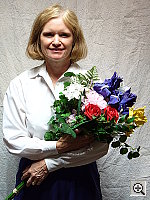
- Exposure compensation: +0.7 EV, about average.
- Contrast/Tone: High, quite a bit of highlight detail lost in order to keep midtones reasonably bright. (+0.3EV holds onto highlights, but midtones and shadows are very dark)
- White Balance: Auto and Manual settings both good (chose Auto for the main shot). Daylight a little warmer.
- Color accuracy: Good overall, but blues are purplish. Reds are a little hot, but OK.
- Skin tones: Pretty good, a little yellow, but generally natural-looking.
- Resolution/sharpness: High resolution, sharp details in the bouquet. Some detail lost in Marti's hair though, seemingly due to noise reduction processing.
- Shadow detail: A bit limited, fairly high noise levels.
To view the entire exposure series from zero to +1.0 EV, see files LZ2OUTAP0.HTM through LZ2OUTAP3.HTM on the thumbnail index page.
|
|
Closer Portrait: 
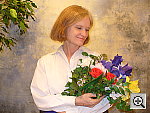
Higher resolution and stronger detail, though details are soft. Contrast is again high.
- Exposure compensation: +0.3 EV, about average.
- Exposure/Tone: High contrast again, making for very dark eyes, dark shadows in Marti's hair.
- Detail: Stronger fine detail.
- Distortion: Good, 6x zoom lens avoids distortion close-in like this.
To view the entire exposure series from zero to +1.0 EV, see files LZ2OUTFACAP0.HTM through LZ2OUTFACAP3.HTM on the thumbnail index page.
|
|
Indoor Portrait, Flash:
Normal Flash
+0.7 EV
|
 |
Slow-Sync Flash
+1.0 EV
|
 |
Slight underexposure with the flash in the normal setting, though brighter exposure with the Slow-Sync mode. Strong warm color cast, though.
- Exposure: Good at +0.7 EV, just holds onto highlight details. Default exposure quite dim. Slow-Sync mode results in more even exposure, at +1.0 EV (higher EV in this mode reduces the warm cast).
- Flash balance with room lighting?: A good match between the color of the flash and the color of the room lighting, although the image as a whole needed less color cast in slow-sync mode.
- Color: Slightly red skin tones, but pretty good color elsewhere, considering the light source.
To view the entire exposure series from zero to +1.0 EV in the normal flash mode, see files LZ2INFP0.HTM through LZ2INFP3.HTM on the thumbnail index page.
To view the exposure series from zero to +1.3 EV in the Slow-Sync flash mode, see files LZ2INFSP0.HTM through LZ2INFSP4.HTM on the thumbnail index page.
|
|
Indoor Portrait, No Flash:
|
Auto White Balance
|
 |
|
Incandescent White Balance
|
 |
|
Manual White Balance
|
 |
Very yellow with Auto and Incandescent white balance settings, good color with the Manual option. Slightly less than average exposure compensation required.
- Exposure: +0.7 EV adjustment needed, a bit less than average. (Although the camera's 1/8 second shutter speed in Program mode wouldn't let me go higher anyway.)
- White Balance: Manual very good, Auto and Incandescent settings rather warm.
- Color: Skin tones good, blue flowers a little dark and purple, but other colors about right. (Very good, given the tough light source.)
To view the entire exposure series from zero to +1.7 EV, see files LZ2INMP0.HTM through LZ2INMP5.HTM on the thumbnail index page.
ISO Series:
The Panasonic DMC-LZ2's image showed a fair bit of noise even at ISO 80 and 100, although most users won't notice this unless they look at the blue channel in isolation. Surprisingly, it doesn't increase all that much at ISO 200, although some roughness in areas of higher contrast is evident. At ISO 400, there's a lot of blotchy yellow/blue color noise, and a rough, almost "painterly" appearance in areas of high contrast and around the edges of objects. ISO 400 shots printed at 8x10 inches look almost like impressionist paintings. At 5x7, ISO 400 results are still rough, but may be acceptable for some users. At 4x6, ISO 400 shots show some color noise, but will be fine for most uses. ISO 200 photos look pretty good, even at 8x10.
|
|
House Shot:
|
Auto White Balance
|
 |
|
Daylight White Balance
|
 |
|
Manual White Balance
|
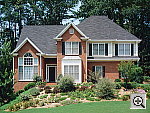 |
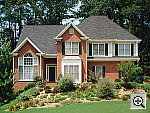
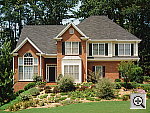
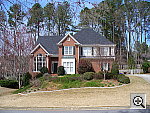
Accurate color, with high resolution and strong detail. Bad blurring in the corners though.
- Sharpness/Detail: Good for its class.
- Sharpness in Corners: Severe blurring in all four corners.
- Color: Manual white balance setting quite good, though Auto and Daylight settings too warm.
- Detail lost to anti-noise processing?: Some in the brick patterns, particularly in the shade.
|
|
Far-Field Test 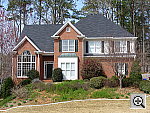
High resolution and strong detail, and a pretty good dynamic range. Once again, very soft corners though.
This image is shot at infinity to test far-field lens performance, and to present a near-infinite range of detail to the camera. NOTE that this image cannot be directly compared to the other "house" shot, which is a poster, shot in the studio.
- Sharpness/Detail: High resolution and a lot of fine detail.
- Sharpness in Corners: Not so good, pronounced blurring in all four corners.
- Color: Pretty accurate, good with Auto white balance.
- Dynamic Range: Not bad, but the day this was shot on didn't have particularly strong sun, so it wasn't as harsh a test of the camera's capabilities as usual..
- Detail lost to anti-noise processing?: Little or none in this particular shot, but moderate image noise is noticeable in the bricks and elsewhere.
Resolution Series:
ISO Series:
Color Effects Series:
|
|
Lens Zoom Range
Excellent 6x zoom range.
The Lumix DMC-LZ2's focal length range of 37-222mm equivalents is much larger than most point & shoot digital cameras. It corresponds to a moderate wide angle to a pretty good telephoto.
|
|
Musicians Poster
|
Auto White Balance
|
 |
|
Daylight White Balance
|
 |
|
Manual White Balance
|
 |
Slightly cool color with Manual white balance, warm with Auto and Daylight, but still pretty good results. High resolution and strong detail.
- White Balance: Manual setting best overall, though cool and magenta. Auto and Daylight white balance very similar, both a bit too warm.
- Color: Slightly magenta skin tones. Blue robe and background are purplish. Still, pretty good color.
- Sharpness/Detail: Very good, though with moderately high noise. (Close to the limits of the poster.)
|
|
Macro Shot
|
Standard Macro Shot
|
 |
|
Macro with Flash
|
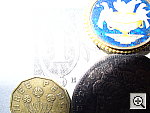 |
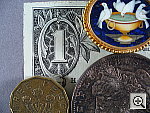
A very small macro area with great detail. Flash has trouble up close though.
- Minimum Macro Area: 2.07 x 1.55 inches (53 x 39 millimeters), very good.
- Softness in corners?: Some, but less than average. (Most cameras get fairly soft corners in macro mode.)
- Flash performance in macro mode?: Not very good, badly overexposed top left of the frame, lens shadows the lower right.
|
|
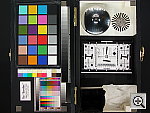
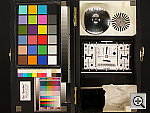
"Davebox" Test Target
|
Auto White Balance
|
 |
|
Daylight White Balance
|
 |
|
Manual White Balance
|
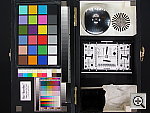 |
Slight color casts, good hue accuracy, high saturation, good exposure.
- White balance: Manual setting very good, just a hint magenta. Auto setting also close, but slightly warm (Daylight much warmer).
- Color Accuracy: Very good hue accuracy, but camera oversaturates most colors somewhat, bright primaries (red, green, and blue) quite a lot. Appealing color for consumers, more experienced users may find it a bit over-hyped.
- Shadow detail and noise: Limited detail in the briquettes, fairly high noise. (Corners of the frame quite blurry too.)
The images series below duplicate examples of various camera controls we've already covered above. I include them here though, for our more analytically-minded readers, who'd like to see the effect of various camera controls with a well-known target like the MacBeth Color Checker (tm).
ISO Series:
Color Effects Series:
|
|
Low-Light Tests
A mixed bag in the low light realm. Program exposure mode gives limited low-light performance, adequate for city night scenes but not much darker. Night scenery mode goes darker, but limits focusing to no closer than 16.4 feet. High image noise, but pretty good color.
- Exposure limit: In normal mode:1/2 foot-candle at ISOs 200 and 400. (About 1/2 as bright as typical city street lighting at night.) Just barely one foot-candle at ISOs 80 and 100. In Night Scenery mode: 1/8 foot-candle at ISOs 80 and 100, 1/16 foot-candle at ISOs 200 and 400.
- Autofocus Limit: ~1/4 foot-candle in normal programmed exposure mode, Night Scenery mode sets lens to hyperfocal distance, so no limit there.
- White Balance: Pretty good.
- Noise Levels: On the high side, particularly at lower light levels.
- Detail loss to anti-noise processing?: Some at one foot-candle, more noticeable at darker levels.
- General Notes: The Panasonic DMC-LZ2 is a bit of a mixed bag when it comes to low light shooting. In its normal programmed-exposure mode, it limits the maximum shutter time to one second, which severely restricts its low light capability. (Just barely good enough to handle well-lit city street scenes at night.) Its autofocus works down to a level about 1/4 as bright as most city night scenes. In Night Scenery mode, the camera can shoot down to 1/4 foot-candle but with less image noise because it sets the sensitivity to ISO 80. This mode limits the focusing range to 16.4 feet (5 meters) and out though. Noise levels in normal exposure modes are on the high side, but are quite good in Night Scenery mode.
(Note: If you'd like to use a light meter to check light levels for subjects you might be interested in shooting, a light level of one foot-candle corresponds to a normal exposure of two seconds at f/2.8 and ISO 100.)
| |
1 fc
11 lux |
1/2 fc
5.5 lux |
1/4 fc
2.7 lux |
1/8 fc
1.3 lux |
1/16 fc
0.67 lux |
ISO
80 |

1 sec
f2.8 |

1 sec
f2.8 |

1 sec
f2.8 |

1 sec
f2.8 |

1 sec
f2.8 |
ISO
100 |

1 sec
f2.8 |

1 sec
f2.8 |

1 sec
f2.8 |

1 sec
f2.8 |

1 sec
f2.8 |
ISO
200 |

1/1 sec
f2.8 |

1 sec
f2.8 |

1 sec
f2.8 |

1 sec
f2.8 |

1 sec
f2.8 |
ISO
400 |

1/3 sec
f2.8 |

1/1 sec
f2.8 |

1 sec
f2.8 |

1 sec
f2.8 |

1 sec
f2.8 |
Night
Scenery
(ISO
80) |

1.6 sec
f2.8 |

3.2 sec
f2.8 |

6 sec
f2.8 |

6 sec
f2.8 |

6 sec
f2.8 |
|
|
Flash Range Test
Dim at eight feet, and decreasing intensity with each additional foot of distance.
- Flash range at telephoto lens setting: Eight feet or less.
| 8 ft |
9 ft |
10 ft |
11 ft |
12 ft |
13 ft |
14 ft |

1/60 sec
f3.6
ISO 80 |

1/60 sec
f3.7
ISO 80 |

1/60 sec
f3.8
ISO 80 |

1/60 sec
f4.0
ISO 80 |

1/60 sec
f4.1
ISO 80 |

1/60 sec
f4.2
ISO 80 |

1/60 sec
f4.4
ISO 80 |
|
|
ISO-12233 (WG-18) Resolution Test 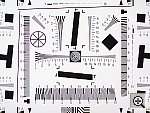
Good resolution, 1,350 lines of "strong detail." High barrel distortion at wide angle, better results at telephoto. High chromatic aberration, and fairly strong blurring in the corners.
- Resolution: 1,400 lines horizontally, 1,350 vertically.
- Artifacts begin at: ~900-1,000 lines.
- Extinction point: ~1,800 lines.
- Barrel/Pincushion distortion: 0.9 percent barrel at wide angle, 0.1 percent pincushion at telephoto (about three pixels).
- Chromatic Aberration: Moderate to high at wide angle, moderate to low at telephoto.
- Corner Sharpness: Some softness at wide angle, much stronger blurring at telephoto. Generally poorer performance than average in this parameter.
Resolution Series, medium focal length
Resolution Test, Zoom Series
2,560 x 1,920
(Fine,
Wide Angle) |
LZ2RESW
|
2,560 x 1,920
(Fine,
Telephoto) |
LZ2REST
|
|
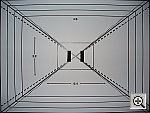
Viewfinder Accuracy/Flash Uniformity
An accurate LCD viewfinder. Very slight flash falloff at wide angle.
- Optical Viewfinder Accuracy: n/a, LCD viewfinder only
- LCD Viewfinder Accuracy: Very good, close to 100 percent accuracy at wide angle and telephoto.
- Flash Uniformity: Slight falloff at wide angle, but still quite good. Flash ineffective at telephoto, however.
|






Follow Imaging Resource: