


Overview
Canon Rebel T2i 550D
Overview
Reviewed by Mike Tomkins, Shawn Barnett and Zig Weidelich
Hands-on Preview: 02/08/2010
Updated to Full Review: 07/02/2010
The Canon EOS Rebel T2i takes the reins from the company's existing T1i model as the flagship of its consumer-oriented EOS Rebel camera series. Externally, the Canon T2i looks very much like its predecessor, being almost identical in overall size but with softer, more gently rounded shoulders. Under the skin, the Canon T2i brings a few features from Canon's prosumer EOS 7D model into a Rebel-class body, creating a baby brother to the 7D.
Sporting an 18-megapixel sensor similar to that of the 7D, the Canon Rebel T2i doesn't shoot quite as fast as its big brother, but its frame rate is slightly increased over the T1i, from 3.4 to 3.7 frames per second, despite the resolution increase. The most obvious external changes include a new 3:2 ratio LCD with 1.04 million dots of resolution, a dedicated live view / movie button, and a restyling of several other buttons to make them easy to locate and identify by touch.
Card compatibility on the Canon T2i includes SD, SDHC, and SDXC, and a new Eye-Fi status screen improves user awareness of these special wireless SD cards.
The Canon T2i's ISO ranges from 100 to 6,400, with a special high ISO option of 12,800. Movie mode also has expanded ability, covering 1080p recording at 24, 25, and 30 fps, rather than the T1i's more limited 20 fps. Manual video exposure is also available, as is an external mic input jack. The Canon T2i is also particularly unusual in also allowing single autofocus operations during movie recording.
The Canon EOS Rebel T2i shipped from February 2010, with kit pricing set at US$899, including the same EF-S 18-55mm f/3.5-5.6 IS kit lens that previously shipped with the T1i. The Canon EOS Rebel XSi has officially been discontinued, leaving the flagship T2i with two Rebel-class siblings -- the entry-level Rebel XS, and the mid-level T1i.
Canon Rebel T2i 550D
User Report
by Shawn Barnett and Mike Tomkins
Calling it a "Mini 7D," Canon introduced the Rebel T2i, the highest resolution consumer SLR, and the highest resolution SLR under $900, period. The 7D association comes primarily from Canon's use of an 18-megapixel sensor that Canon say is essentially the same spec as the sensor in the 7D, the only difference being that the readout speed has been cut in half. From there, the Canon T2i shares more with the Rebel T1i than with the 7D. The major exception to that is the movie mode, which now offers full manual exposure, and supports 1080p at 24, 25, and 30 frames per second, while the T1i only did 1080p at 20 fps.
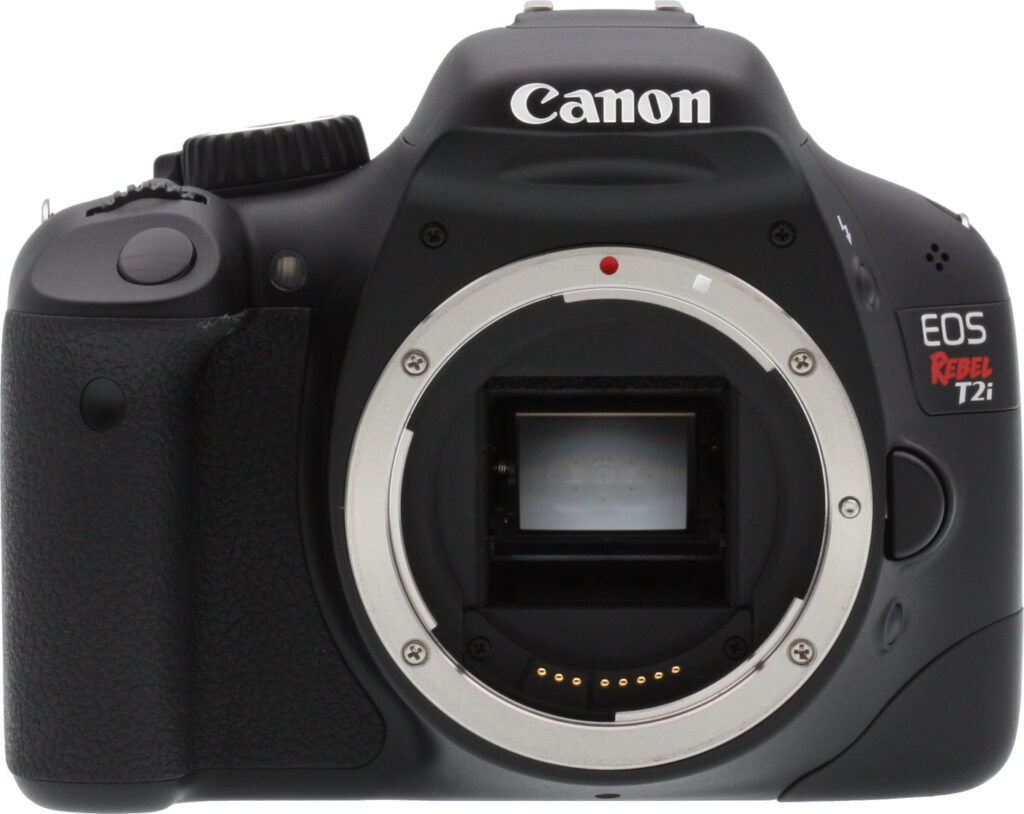
Walkaround. From the front the silhouette of the Canon T2i is very similar to the T1i, but there are a few unusual differences. Weight is 18.5 ounces (1.2 pounds; 525g) with the battery and a memory card, but without the lens. With the lens, battery, and card the Rebel T2i weighs 26 ounces (1.6 pounds; 736g). The Canon T2i's dimensions are 5.1 x 3.8 x 3.0 inches (130 x 97 x 76mm), perhaps a little shorter and a little thicker than the T1i.

Immediate differences from the front include a new knurl on the Canon T2i's Mode dial, even more rubber grip area, slight nudges of the IR remote window and Self-timer lamp, and the combining of the nameplates into one, rather than two separate badges on the right side. New is the strangely contoured panel on the lower right in the above image, perhaps to reinforce and soften the area where your palm rests when you're controlling the Canon T2i's lens. Nikon has for several years deliberately cut out this area to provide palm relief, so perhaps Canon is doing the same.

Very few differences appear on the top of the Canon T2i, except for a few contour changes to the body shell. The mode dial has a black background rather than a silver one, and as previously mentioned, now has fairly deep vertical grooves around its outside edge, rather than the shallower knurling of the T1i's dial. The order of the scene modes on the dial has also been changed, promoting the Flash Off mode to the top of the list, rather than the Portrait mode. The Canon T2i's 18-55mm IS lens is unchanged. It performs well for an inexpensive kit lens, but the Rebel T2i's 18-megapixel sensor demands superior optics to show its true potential.

Most of the retooling and rethinking can be found on the back of the Canon T2i. Though it's subtle, Canon's switch from a 4:3 screen to a 3:2 screen has a dramatic effect on where some of the controls land, and may contribute to the one millimeter reduction in the Canon T2i's height.
Button design has changed quite a bit on the Canon T2i, moving from primarily circular buttons with nothing printed on them to larger shaped buttons, some with words and icons printed on them. It does make the labels clearer, especially with reduced real estate for labels next to buttons because of the wide-aspect LCD. The variation in button shapes also makes them easier to identify without removing your eye from the viewfinder. Live View / Movie Recording has a new button in prime position for easy thumb activation, just right of the optical viewfinder. In its old place is the new Quick Menu button, an innovation borrowed from the Canon 7D. This allows easy adjustment to the Canon T2i's settings via the Status display, which transforms into a Quick Menu screen with a press of this button. (In Movie and Live View shooting, the same button calls up an abbreviated Quick Menu display that forms a column at the left of the LCD, rather than occupying the whole screen.) All other buttons are in the same positions relative to the T1i. The speaker holes on the rear, though, go from four holes to nine holes, presumably for better sound transmission.
 Sensor and processor. The Canon EOS T2i's design is based around a DIGIC 4 image processor and a newly developed CMOS image sensor that's very closely related to the chip previously seen in the EOS 7D. As with that camera, effective resolution is 18.0 megapixels -- a modest upgrade from the 15-megapixel imager of the T1i. Maximum image size in pixels is 5,184 x 3,456. Pixel pitch is 4.3µm, and gapless microlenses help boost light gathering capability.
Where the two imagers differ is in their readout method, and hence their speed. The EOS 7D's sensor has eight channel readout, key to that camera's eight frames per second burst shooting. The Canon Rebel T2i's sensor has four channel readout, which means a more modest 3.7 frames per second burst shooting -- but it's still a slight upgrade in speed from the 3.4 frames per second of the T1i. Unfortunately, the increased throughput caused by the faster burst speed and higher sensor resolution together conspire to greatly reduce the burst shooting depth as compared to the T1i. According to Canon, the Rebel T2i can capture six RAW or 34 large/fine JPEG frames in a burst, where the T1i was capable of nine RAW or 170 large/fine JPEG frames before shooting slowed.
14-bit A/D conversion. Just like the XSi and T1i, the Canon T2i uses 14-bit Analog-to-Digital conversion when creating JPEGs, for smoother color transitions, and RAW files are saved as 14-bit files. Converting from 14-bits worth of data means that the saved images are theoretically formed from four times the color information that was available to the Canon XTi, which was only able to generate 4,096 colors per channel. The Canon Rebel T2i can recognize 16,384 colors per channel, which should mean smoother tones and more accurate color overall. Though JPEGs will still be saved as 8-bit color, RAW images will benefit more fully from the 14-bit depth, making for more accurate 16-bit images in programs like Photoshop.
 Peripheral illumination correction. Brought over from the 50D, the Canon T2i's Peripheral illumination correction compensates for vignetting in the corners of a lens. The amount of correction changes depending on which lens is mounted; selecting the Peripheral Illumination Correction item from Record Menu 1 brings up a screen where you can see which lens the camera has detected, and whether correction data is available. You can also either enable or disable the function from the same screen.
Autofocus and metering. Another feature inherited from the EOS 7D is the Canon T2i's new metering sensor. Where the T1i used a 35-zone metering sensor, the Canon T2i now includes a 63-zone iFCL sensor, which stands for Intelligent Focus, Color, and Luminance metering. The name hints at how the sensor works: the iFCL chip has a dual-layer design with each layer sensitive to different wavelengths of light, allowing subject color to be taken into account when determining exposure. Information on focusing points is also taken into account in metering calculations, and it is in this area that the Canon T2i's iFCL chip differs from that of the EOS 7D, accounting for fewer focus points in the consumer Rebel camera than its prosumer sibling. Like the T1i before it, the Canon T2i offers nine-point focusing with a central cross-type f/2.8 focus point, rather than the 19-point AF of the 7D. The focusing screen, likewise, is of the etched variety, and not the fancy LCD overlay on the Canon 7D.
ISO Expansion. The Canon T2i has the same expanded sensitivity range as that of the T1i and 7D, from a minimum of ISO 100 to a maximum of ISO 12,800. A very useful change inherited from the EOS 7D - particularly for fans of HDR shooting -- is the T2i's expanded exposure compensation range. Where the T1i offered compensation from -2.0 to +2.0 EV, the T2i has a much wider +/-5.0EV exposure compensation range.
Creative Auto mode. First introduced on the Canon 50D, Canon's Creative Auto mode is also included in the Rebel T2i. Marked with a "CA" on the Mode dial, this mode is a cross between the Auto and Program modes. When set to CA mode, the Canon T2i allows the user to adjust the Flash, resolution, drive mode, and Picture Style. Setting aperture and exposure are converted to easier concepts of background blur (blurred or sharp), and exposure level (darker or brighter) with a slider that's adjusted with the Main dial. The more complex exposure decisions remain under the Canon T2i's control in CA mode. The exposure slider is the more useful, standing in as a more comprehensible EV adjustment.
Copyright info. Like the Canon 7D, you can input Copyright information right on the Canon T2i, as well as delete it at will. It was a first in that camera for Canon's prosumer line, and now it's on the consumer Rebel line as well.
LCD. The Canon T2i also features a new LCD panel, which now offers a 3:2 aspect ratio, matching that of the image sensor, rather than the 4:3 aspect ratio panel which was used on the T1i. The new panel still has a 3.0-inch diagonal, but increases the total pixel count slightly from somewhere in the region of 640 x 480 pixels to a ~720 x 480 pixel array. Each pixel still consists of three separate colored dots (red, green and blue), for a total count of just under 1.04 million dots. The Canon T2i's 160-degree LCD viewing angle isn't quite as wide as that of the 170 angle possible on the T1i, and the total display area is just slightly smaller, although neither reduction is terribly noticeable in use.
 Improved Movie mode. Another area where the Canon EOS Rebel T2i has inherited significant upgrades from the 7D is in its high definition video capabilities. The previous T1i model offered a maximum resolution of 1080p (1,920 x 1,080 pixels), but with a non-standard (and rather low) rate of 20 frames per second, making this mode perhaps of limited use. Lower-resolution options of 720p (1,280 x 720 pixels) and VGA (640 x 480) pixels had a more useful 30 frames per second rate, but all video modes were also hindered somewhat by offering only automatic exposure, and monaural audio from a built-in microphone. The Canon T2i corrects every one of these issues, with a new stereo microphone input jack, manual control of video exposure available, and a wide range of standard video frame rates on offer. At 1080p resolution, the user can select between 24, 25, and 30 frames per second. For 720p and VGA shooting, both 50 and 60 fields per second modes are available. Users can also edit movies in camera, including the ability to chop off beginning or ends of movies, but only in one-second increments.
Two features of the Canon T2i's video mode aren't available in the 7D, or for that matter any other Canon digital SLR to date. The first, dubbed "Movie Crop" mode, is available only when shooting at standard-definition VGA resolution. It works by simply cropping and recording the center-most 640 x 480 pixels from the sensor. This yields an effective 7x fixed zoom without interpolating the video. Of course, simply cropping the center of the image means that everything (including image noise) will be recorded at 1:1, so video has noticeably higher quality with the crop disabled. Still, for consumers who may well not be able to afford expensive telephoto lenses and only need standard-def output, it's an interesting feature.
The second movie feature specific to the T2i -- and rare among its DSLR brethren from any manufacturer -- is the ability to use autofocus during moving recording. Continuous autofocus isn't available, so you have to manually trigger single AF operations as needed with a half-press of the shutter button. The feature is something of a tradeoff, because the AF operation is clearly visible in the video, even if Canon's contrast detection AF implementation doesn't hunt around the point of focus as much as some we've seen. AF noise is also very clearly captured on the movie's audio track, at least when using the internal microphone and 18-55mm kit lens -- using quieter USM lenses can mitigate this somewhat, and AF noise can be avoided altogether by using a good directional mic on a shock mount. Pros will certainly want to stick with focusing manually (and can choose to disable AF during movie capture to prevent accidental operation), but in the consumer market at which Canon's Rebel cameras are aimed, it makes sense to give customers the choice as to whether they feel the convenience of AF is worth putting up with the drawbacks.
HDMI output. The Canon T2i also upgrades the HDMI high-definition video output connectivity of the T1i, adding Consumer Electronics Control (HDMI-CEC) compatibility. In layman's terms, this allows you to use your compatible high-def display's remote control to operate certain camera functions via the same cable through which the video signal is passed. Functions that can be controlled from the TV remote include single image playback, index display, shooting info display, image rotation, slide show, and movie playback.
 Lens. The Canon T2i comes with the same kit lens that shipped with the XSi and T1i: the image-stabilized 18-55mm EF-S lens that so impressed us at its debut. Equivalent to a 29-88mm lens on a full-frame 35mm camera, this is a good mid-range zoom lens that is quite light. Optical image stabilization technology delivers sharper shots even in low light. Canon claims you can shoot at up to four stops slower than normal and still get a stable shot. That means that if you can normally get a stable shot at 1/60 second, you should be able to squeeze off a 1/4 second shot and have it come out sharp. If you're a fairly steady shooter, it seems to be true. Your results may vary, and remember that image stabilization compensates for camera movement, not for subject movement, so when shooting in low light tell your subject to hold very still, or shoot with a faster shutter speed at a higher ISO.
 Storage and battery. The Canon Rebel T2i uses SD, SDHC, and SDXC memory cards. This latter standard should allow card sizes up to 2 terabytes, while SDHC is limited to 32GB.
Direct support for Eye-Fi wireless cards has found its way into the Canon T2i, complete with a dedicated status display that only appears if the card is installed. The new display shows when a card is connecting, has connected, is transmitting, and when a card has a problem connecting.
The Canon T2i uses a new battery, the LP-E8 -- a 7.2V, 1120 mAh lithium-ion battery with concealed electrical contacts. Expected battery life is 440 shots at 72F, and 400 shots at 32F, based on CIPA testing standards which dictate 50% flash usage. That's about a ten percent improvement over the T1i's battery life, but still below average for an SLR. The Canon T2i's new battery also means that the camera requires a new grip, the BG-E8. It duplicates the shutter release and control wheel, as well as AE lock and focus point buttons for vertical-format shooting. Those who have trouble with the smaller grip on the Canon Rebel series will find that the battery grip makes the camera more satisfying to use; and those who frequently shoot in portrait orientation will enjoy the vertical shutter release, which allows you to shoot with less strain. A new optional infrared remote, the RC-6 is also available for the Canon Rebel T2i, said to combine the features of the older RC-1 and RC-5 wireless remotes.
Shooting with the Canon Rebel T2i

Loads of resolution. Not surprisingly given its heritage, the T2i's sensor gathers loads of detail, and begs for a really good lens. The 18-55mm kit lens is impressive for its cost, but in this detail-rich garden shot, its limits appear to have been reached.
Thanks to a control layout that's very similar to that of the T1i, I found myself immediately at home shooting with the Canon Rebel T2i and its EF-S 18-55mm f/3.5-5.6 IS kit lens. Among the Canon T2i's external changes, I particularly appreciated the new 3:2 aspect ratio LCD. Viewing full images, there are no longer any black borders at the edges of the screen. This means a slightly larger review than was previously the case, even though the actual screen area has fallen just slightly. I understand that the viewing angle has also been reduced slightly, but this wasn't really noticeable -- the Canon T2i's display is still easily visible from a wide range of angles, perfect for everybody to huddle around and review group portraits.
The Canon T2i only has one new button, but the profiles of several other buttons have also been changed as part of accommodating the wider LCD display. I found the variation in button size and shape helpful, making it significantly easier to identify buttons by touch alone, and saving me removing my eye from the viewfinder so frequently. The new dedicated Live View / Movie Record button is perfectly situated, easily within reach when needed, but far enough from the thumb rest that I never accidentally bumped it. The place of the previous shared LV / Movie button has been taken by a Quick Menu function adopted from the previous EOS 7D design, and this proved extremely convenient for making quick settings changes without needing to dip into the T2i's menu system.
The only control element on the T2i that I felt could use some improvement was the Main dial, situated right behind the Shutter button. I found its resistance significantly too high, and as a result, had to press my fingertip against its knurled surface to make settings changes. When making a lot of adjustments with the dial -- shooting in Priority or Manual modes, for example -- my hand quickly tired, and my fingertip started to feel a little sore.

Blown highlights. I frequently needed to dial in anywhere from 1/3 to 2/3EV of negative exposure compensation when using evaluative metering. The default exposure for this shot rendered the white bricks with blown highlights, and the red channel was badly clipped on the truck's yellow and red paint. This shot required -2/3EV of exposure compensation.
In terms of image quality, the Canon T2i performed as well as I'd expected -- not surprisingly given the close relationship between its image sensor, and that of the prosumer EOS 7D. It was perhaps straining the optical limits of its 18-55mm kit lens, and I'd have loved the opportunity to shoot using some of Canon's higher-end glass, but unless viewed at 1:1 resolution I found its images to offer plenty of detail, and with relatively low noise. I did note a tendency to overexpose a little to my own tastes, though, with many shots needing somewhere between 1/3 and 2/3 EV of negative exposure compensation.
I found Canon's menu design on the T2i was among the clearest and easiest to understand compared to current digital SLRs, but I did find a few elements somewhat confusing. Several functions related to Live View are adjusted from a dedicated Live View function settings page, but it's not accessed from the Record menus, where I'd expect to find it. Instead, it's rather confusingly located in Setup Menu 2. Several of its options are also shared with the Canon T2i's Movie mode, whose controls appear in two menus that only appear when the camera's Mode dial is set to Movie mode. If these settings are adjusted in the Live View function settings page, they also change in the Movie menus (and vice versa), which could cause photographers a little confusion. I also thought the placement of the Histogram option in Playback Menu 2 was a little curious, given that it also affects the Live View mode's Histogram function. I believe the option might be better situated in the Setup menus. These quirks aside, though, I found the Canon T2i's menus easy to navigate, and the My Menu group was particularly useful for quickly recalling frequently changed settings.
Perhaps the big story of the Canon T2i is its Movie mode, which brings the feature set of Canon's prosumer EOS 7D model down to a much more affordable price point -- and even adds a couple of functions that aren't available in the 7D. I must confess that I'm not much of a movie shooter myself, but nonetheless was rather impressed with the range of control on offer. The ability to shoot video with completely manual exposure is still rather rare among DSLRs at any price point, and will likely prove very appealing to advanced amateur and pro videographers on a budget, affording them with complete control over the look of their movies. Likewise, the option to use an external microphone is desirable for advanced amateurs, although the T2i doesn't offer control over recording levels, and so pros will likely still need to rely on an external device for audio capture in more challenging environments. The ability to crop pixels from the center of the image sensor in standard-definition movie shooting helps consumers who can't afford expensive telephoto lenses to get closer to their subject.

AF during movie capture. If a big adjustment is needed, the kit lens is rather noisy, but for small adjustments like in this video, the ability to perform single AF operations is probably quick and quiet enough for many consumers. (Shot in standard definition VGA mode.) File Size: 52.7MB
The ability to perform single autofocus operations during movie capture is becoming more common, but I found my enthusiasm for the ability rather tempered by just how obtrusive AF noise was when using the Canon T2i's 18-55mm kit lens, at least if anything more than minor adjustments were needed. I wasn't able to try the feature with a current Canon USM lens, but did try using an aged film-era Canon USM lens which I had on hand, and while it was still clearly audible, I felt it at least produced a less high-pitched and objectionable noise. Perhaps current USM lenses would fare even better, and even the kit lens is fairly quiet if only a very small AF adjustment is needed. I still applaud Canon for offering the capability to focus, if for no other reason than that it allows amateur photographers to choose whether they're willing to put up with the drawbacks, rather than having the decision made for them. With modern video editing software it's relatively simple to crop out the AF operations after the fact, or simply overlay a different soundtrack on the video.
Equally useful for consumer videographers is the Canon T2i's movie crop function, available only when shooting in standard definition mode. Of course since this uses 1:1 resolution data from the image sensor, it will more prominently show off image noise and lens defects, but the result is still likely to prove more satisfactory than the powerful digital zooms to be found on most dedicated camcorders. Given that powerful telephoto lenses are priced out of the reach of most amateurs, I think the crop mode is a genuinely useful feature for the Rebel T2i's target market.
One minor issue I encountered in my movie shooting with the Canon T2i related to its microphone placement, and my own grip on the camera. I generally shoot two-handed for stability, but tend to change my grip slightly when shooting video with a DSLR. Ordinarily, my left hand grips the lens barrel, but given that I lack the smoothness to adjust focus or zoom to my satisfaction during video shooting, I've grown accustomed to moving my left hand away from the lens during video capture. Instead, I hold the left end of the camera body. My issue was that in doing so, I occasionally brushed my middle finger across the microphone, or even accidentally covered it altogether, disrupting my movie audio. Once I was aware of this, it was easy enough to consciously make myself grip the body in a more traditional style, but a different microphone placement could resolve the issue altogether. (It seems to me that beneath the pentamirror prism would be an ideal location which wouldn't likely be bumped or covered).

VGA video crop. The Canon T2i's video crop mode gets you much closer to the action, at the expense of image sharpness and noise. Panning at this speed took all my concentration, so before filming, I prefocused on the bridge support at the six second point in the video, using the camera's contrast detect AF. The resulting video is a bit soft, but probably acceptable to many consumers -- certainly when compared to the expense of a similarly powerful telephoto lens. File Size: 29.6MB
Another feature of the Canon T2i that I welcomed was its modest increase in burst shooting rate. The difference between the T1i's 3.4 frames per second, and the 3.7 fps of the T2i is certainly not night and day, but I thought it both noticeable and worthwhile. My reflexes are perhaps not the best, and so when shooting unpredictable subjects such as children and pets, I frequently take advantage of a camera's burst capabilities, quickly firing several shots when I think the moment right. Every little bit helps with this approach, and the only real downside of the increased burst speed is that it is accompanied by a significant reduction in burst depth. All but the most extreme JPEG shooters will likely still be fine, with roughly 34 large/fine shots possible before the camera slows down.
Raw shooters such as myself are likely to find the six-shot buffer rather limiting, however. I occasionally found myself wishing for the T1i's somewhat more useful nine-shot capability as I waited for their buffer to empty. (I should note that the burst depth in both Raw and JPEG modes does vary with subject detail, and so in some scenes you may find more or less shots are available. I also noticed that disabling the Auto Lighting Optimizer and Peripheral Illumination Correction functions gave a modest increase in JPEG burst depth.)
All things considered, the Canon T2i is a very enjoyable camera to use, with impressive image quality and a generous range of features for a consumer DSLR. As noted, I'm largely a stills shooter who just occasionally dips into video to document family outings, but were I more of a videographer, the Canon T2i's depth of control over video shooting would likely have me beside myself with excitement.
Canon T2i versus Canon T1i at ISO 1,600
 |
 |
 |
 |
 |
 |
|
Canon T2i at ISO 1,600 |
Canon T1i at ISO 1,600
|
|
The Canon T2i's 18-megapixel sensor is an improvement on the 15-megapixel T1i, with sharper detail and less noise overall at ISO 1,600. Pretty impressive. The red leaf fabric still gives the T2i trouble, though. |
|
Canon T2i versus Nikon D5000 at ISO 1,600
|
 |
|
 |
|
 |
|
Canon T2i at ISO 1,600 |
Nikon D5000 at ISO 1,600
|
|
Up against the Nikon D5000, the Canon T2i out-resolves its 12-megapixel competitor in most situations, and there's less shadow chroma noise. The Nikon still does better with the red leaf swatch, though, thanks to its better-controlled anti-noise suppression. |
|
Canon T2i versus Pentax K7 at ISO 1,600
|
 |
|
 |
|
 |
|
Canon T2i at ISO 1,600 |
Pentax K7 at ISO 1,600
|
|
The Pentax K7 isn't known for its superior high-ISO performance, but it's closer in resolution than most, and still does a fair job against the T2i. The Canon T2i's sensor out-resolves the K7, though, while maintaining better detail overall. |
|
Canon T2i versus Nikon D700 at ISO 1,600
|
 |
|
 |
|
 |
|
Canon T2i at ISO 1,600 |
Nikon D700 at ISO 1,600
|
|
The T2i does so well, it's only fair to put it up against the full-frame Nikon D700. While the resolution doesn't make it a match, it's easy to see the advantage of larger pixels over more pixels, especially when looking a the red swatch. The D700 gets less detail in the Mosaic area, sure, but when it comes to red leaf swatch, the D700 has more to true detail to work with, rendering the fabric more accurately than any other camera in this lineup. But remember, the Nikon D700 is still priced at $2,700, three times the price of the Canon T2i. |
|
Detail: Canon T2i vs. T1i, Nikon D5000, Pentax K7, and Nikon D700
 |
 |
 |
 |
 |
 |
 |
 |
 |
 |
|
Canon T2i |
Canon T1i
ISO 100 ISO 3,200 |
Nikon D5000
ISO 100 ISO 3,200 |
Pentax K7
ISO 100 ISO 3,200 |
Nikon D700
ISO 100 ISO 3,200 |
|
Detail comparison. An ISO 1,600 comparison is only so helpful. A camera's ISO 100 performance is also of value, as is a higher ISO, so I've pitted the same set of cameras against each other in the high-contrast detail department at 200 and 3,200. The Canon T2i produces the most crisp image from this area of the Still Life shot, but it is also employing a lot of sharpening, which leaves halos around the letters in this picture. Contrast is also more prominent in the T2i. The others do well, but the Canon T2i truly wins the day. Also consider that this test is not independent of lens quality, focus errors, and other variables, so again take this mostly as a comparison of what each camera was able to do with the best standardized optics we can muster. Each of these cameras used one of our standard Sigma 70mm f/2.8 EX DG Macro lenses. |
||||
See below for our conclusion.
In the Box
 The Canon T2i retail package contains the following items:
- Canon Rebel T2i digital SLR camera body
- EF-S 18-55mm f/3.5-5.6 IS lens
- Body cap
- Lens caps (front and back)
- Neck strap
- Eye cup
- LP-E8 battery pack and charger (International charger shown at right)
- Video cable
- USB cable
- Software CDs
- Instruction manuals and registration information
Canon Rebel T2i Conclusion
| Pro: | Con: |
|---|---|
|
|
Once again, Canon has raised the bar at the consumer level, providing even more still-image resolution, and a high-def video mode with full control over exposure, resolution and frame rate, plus the ability to use autofocus during videos. Though it comes at a noticeably lower price, the Canon T2i handily trumps the competition from Nikon and others, and offers some timely features worth noticing.
The Eye-Fi status display stands out as a great idea that seems rather obvious in hindsight, but technical achievements like the iFCL metering, which helps autofocus accuracy by detecting the type of light, are where the Canon T2i really impresses.
With its sensor derived from that of the prosumer EOS 7D, the Canon T2i shares excellent image quality, with plenty of detail, true-to-life color, and very good high ISO performance, especially when considering its high resolution. Photographers interested solely in stills will find the Canon T2i to be a very capable camera, but it's those looking for a video-capable DSLR who'll find it almost unrivaled for the price point.
Image quality is impressive, though we did find the Canon T2i's 18-megapixel sensor revealing more flaws in the 18-55mm IS kit lens, especially in terms of chromatic aberration, but corners were still sharper than we normally see from most kit lenses, so it's not all bad. Resolution was incredible, and detail is clean. Even as ISO goes up, more detail is retained than we're used to seeing. Indeed, the Canon T2i's entire ISO range produced a usable image size, with ISO 100 shots easily making sharp 20x30-inch prints, ISO 3,200 shots making sharp 11x14-inch prints, and even ISO 12,800 shots producing a good quality 5x7-inch print. That's impressive.
As with most digital SLRs on the market, shooting video with the Canon T2i isn't as easy as using a commercial camcorder, but with some effort the dedicated hobbyist can make some impressive videos.
Overall, it's pretty tough to go wrong with the Canon T2i, which makes it a sure Dave's Pick.
Design
Canon T2i Design
Roll-over the various controls and features with your mouse for a brief description. Note: Rollovers are best viewed with the latest versions Firefox, Safari, or Opera browsers, or Internet Explorer 6 or earlier.

Front. The new Canon T2i follows the design of the previous T1i pretty closely, with the most significant changes to be found on the camera's rear. The view from the front is near-identical, with the same controls in the same positions as on its predecessor. On the grip you can see the shutter button and the infrared sensor for use with the RC-1 remote controller. The separate EOS and Rebel badges from past models have been combined into a single badge at top right, and the lower right corner now features a smooth, hard, rubber bumper in place of the second badge. To the right of Canon T2i's lens mount is the lens release button.

Left. From the left you can see the AF/MF and Stabilizer switches on the kit lens, the flash pop-up button, and the Canon T2i's Depth-of-field Preview button. The strap lug is recessed into the shoulder and the port cover is below that. The port cover has increased in height, to accommodate one addition -- the T2i's new external stereo microphone jack.

Right. On its left side, the Canon T2i sports the same control placements and functions as were found on the T1i.

Top. The top deck of the Canon T2i retains similar styling to the T1i, the only notable differences being found on the Mode dial. The top of the dial is now black, rather than silver, and its outside edge featured deep grooves in place of the shallower knurling from the T1i. The order of the scene modes on the dial has also been changed, so that the Flash Off mode is now placed first, rather than the Portrait mode.

Back. The back of the Canon T2i is home to the most obvious changes since the T1i, mostly related to the new wide-aspect 3:2 LCD display, which matches the aspect ratio of the image sensor. It still has the same 3-inch diagonal as the T1i's 4:3 LCD, but increases pixel density just slightly, from 920k dots to 1,040k dots. Surface area is just slightly lower than the 4:3 aspect ratio, since for any given diagonal, a screen that's closer to being square will offer the maximum area. The decrease in size is barely noticeable though, especially since there's now no need for black borders around the edges of the screen when viewing a full still image. The new display occupies slightly more of the T2i's body width, and fitting this into the design necessitated some slight rearrangement of the remainder of the rear-panel.
The control layout is still very similar to that of the T1i, with only one extra button, and almost all of the existing controls retain the same function as previously. Visually it's quite a significant change, though, as Canon has taken the opportunity to adjust the shapes of several buttons which were previously all circular. Several buttons now have unique shapes that simultaneously maximize the available space, allow labels on the buttons themselves (rather than the adjacent body panel), and make it much easier to tell controls apart when shooting in low light. The newly added button to the right of the optical viewfinder accesses the T2i's Live View mode in almost every operating mode, with the sole exception being the Movie mode.
Since this feature was formerly shared by the Direct Print button, it now has a new feature in Record mode. Pressing the Quick Control / Direct Print button in all operating modes accesses the Quick Control function, previously seen on the EOS 7D. This allows direct adjustment of a variety of camera settings through the information display, although the options available for adjustment vary by operating mode. The display itself is similar to that of the T1i, but has been redesigned somewhat due to the change in LCD aspect ratio. (More on this under the Operation tab of this review.) The Canon T2i's card write LED is in the same location, right next to the SD card door, where it's easily seen, and therefore more likely to prevent you from accidentally removing a card in mid-write.

Bottom. The Canon T2i's bottom is similar to the T1i's, featuring only a battery door and metal tripod socket.
Operation
Canon T2i Operation
Like the T1i before it, the Canon T2i relies on its large, color LCD screen for all user interaction. This makes for a very clear, highly visible user interface, but probably does contribute to slightly shorter battery life, since the large LCD has to be fired up any time you want to change a setting. One feature we do like very much is the infrared proximity sensor that turns off the LCD screen when you hold the Canon T2i up to your eye.
Overall, the control layout places a few main controls (Power switch, Shutter button, Main dial, Mode dial, and ISO button) on the right side of the Canon T2i's top panel, with most of the other controls on the back of the camera. Let's take a closer look at some of the user-interface elements:
Canon T2i Rear-Panel LCD Display
The image below shows callouts for all the information shown on the Canon T2i's rear-panel display, by default. (Illustration courtesy Canon USA.)


There are four Screen color options on the Status display, adjustable in the first Settings menu, under Screen color. The color choices on the Canon T2i are different from those on the T1i, although not radically so. The screen also has a slightly wider aspect ratio, which has brought a rearrangement of some icon positions in the information display, as compared to the T1i. I found myself preferring color scheme 2 (top right in the group of shots above) in the daytime, thanks to its strong contrast. Color scheme 4 (bottom right) was similarly useful for shooting at night, reducing the contrast just slightly so as not to tire my eyes.
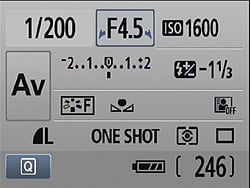
Whatever exposure parameter is currently being controlled by the Canon T2i's Main Dial is highlighted with arrows in the corners of its box, to indicate that it can be changed by rotating the dial. Here, we're adjusting the aperture, marked by the outlined box. Note the arrows. (They're pretty subtle; we would have liked to see them a bit more prominent.)

Like that of its predecessor, the rear-panel display on the Canon T2i is part of a Quick Control menu system. Instead of using the SET button to enter the Quick Control menu, there's now a Quick Control button dedicated to this purpose. Regardless of whether the LCD display was active or disabled, pressing the Quick Control button on the Canon T2i while in capture mode takes you to the Quick Control menu system, where you can adjust various settings shown on the rear-panel display. You navigate between the various setting options with the arrow keys, and the chosen setting will be highlighted as shown above. Once a setting has been selected, you can change it either by rotating the Canon T2i's Main Dial, or by pressing the SET button, and then using the arrow keys to choose from the available options. The Quick Control menu is dismissed with a second press of the Quick Control button.

Pressing any of the arrow keys to the right of the Canon T2i's LCD screen, or the Set button while making changes in the Quick Menu, immediately brings up a screen for the exposure parameter associated with that button. Once the option screen is displayed, you can use either the arrow keys or the Main Dial to scroll the cursor highlight through the options presented. You can continue to press the same arrow-key button, or turn the Main Dial in the same direction, and the highlight will scroll through all the options, wrapping around when it gets to the end of the list. When you've made the choice you want, pressing Canon T2i's Set confirms it and returns you to the main shooting display or Quick Menu, as appropriate.
Canon T2i Playback & Record Review Displays
Like the Rebel T1i, the Canon T2i shows each image as it's captured, though you can turn off this function through the Camera menu. The display mode in Record Review defaults to the same as was last used in Playback mode, or you can hit the DISP button to cycle to a different mode. Likewise, in Playback mode, you can cycle between the available display options by pressing the Canon T2i's DISP button repeatedly. (Display mode selection is persistent across both record and playback modes, no matter which mode you make the selection in.) You can also select between the normal luminance-based histogram and the RGB histogram option via a Playback-mode menu item. The screenshots below show the various displays and options available.
| Canon T2i Image Display Options | |
 |
 |
This is the default display in playback mode. The file number is displayed upper right, the shutter speed, aperture, and exposure compensation (if applicable) in the upper left, and the file sequence number and quality are shown below left. |
Pressing the DISP button cycles through the four available displays. This is the second option, image with no overlay. |
 |
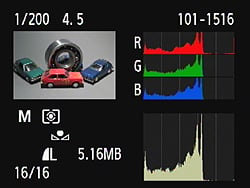 |
The Canon T2i's third playback display option shows a histogram and more detailed exposure information. A setting in Playback Menu 2 lets you choose between a conventional luminance-only histogram, or the separate red, green, and blue displays. If there are any blown highlights, they'll blink in this mode. |
The final playback display option shows both RGB and luminance histograms side by side, along with an intermediate level of exposure information. If there are any blown highlights, they'll blink in this mode. |
 |
 |
You can also zoom in on an image, up to 10x at the highest resolution. The small navigator window in the lower right-hand corner shows you what part of the larger image you're currently viewing. The arrow keys let you navigate around the full image, and the zoom in / zoom out keys increase or decrease the magnification level. |
|
 |
 |
If you press the Zoom Out button while viewing a single image on the LCD screen, it'll take you first to a 4-image thumbnail display, and then to a 9-image one, if you press it once again. The arrow keys let you navigate among the thumbnail images. The text above the thumbnails displays the same basic exposure info for the currently-selected image as does the default single-image display. Pressing the DISP button in this mode overlays the image size/quality and file number for the currently selected image, as in normal playback mode. |
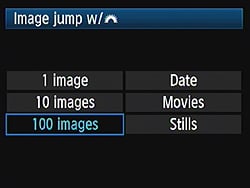
The Canon T2i handles "jumping" through images in the same manner as the T1i. Rapid scrolling through images is accomplished via the Main Dial (on the camera's top panel), and an option on the Playback menu sets options of jumping through images 1, 10, or 100 images at a time, or on jumping between shots captured on different dates, between groups of movies, or groups of still shots.
|
 |
 |
The jump menu setting only applies when you're in single-image playback mode, displaying a screen like that above when you use the Main Dial to scroll between stored images. In thumbnail display mode, the Main Dial always jumps ahead one screen of thumbnails at a time, regardless of the menu setting for the Jump option. |
Pressing the Delete button brings up this display, giving you the option to erase the current image, or cancel out of the delete option. The Delete display will show either the full image, a thumbnail plus histogram, or a screen of thumbnails with border highlighting the selected thumbnail, depending on the playback mode you've selected. |
Optics
Canon Rebel T2i Optics
Kit Lens
 First introduced with 2008's Rebel XSi model, the EF-S 18-55mm f/3.5-5.6 IS lens that's bundled with the Canon T2i is of unusually high optical quality. Though this light, compact image-stabilized lens sells for $200 on its own, the Canon T2i kit sells for only $100 more than the body-only price. In our testing over at SLRgear.com, this lens was quite impressive when compared to past versions of the standard Digital Rebel kit lens, with improved sharpness and reduced chromatic aberration. It's Canon's answer to the competing SLRs from Olympus, Pentax, Samsung, and Sony that use body-based, sensor-shift image stabilization, while Nikon and Canon use optical image stabilization. Serious shooters are often well-advised to just buy an SLR as body-only, and purchase a high quality lens separately. With the Canon T2i, enthusiasts may want to heed this advice, as the camera's 18-megapixel sensor is pushing the EF-S 18-55mm f/3.5-5.6 IS lens' optical performance to the limit.
Lens Compatibility
 Like other Canon DSLRs with sub-frame sensors (currently, the Canon Rebel XS, Rebel XSi, Rebel T1i, EOS 50D, and EOS 7D), the Canon Rebel T2i will work with pretty much any EF-mount lens ever made, as well as with the special EF-S lenses designed for cameras with APS-C size sensors. Designed with a smaller image circle (the area covered by the image on the film/sensor plane), EF-S lenses tend to be smaller and lighter than full-frame models with the same focal length and maximum aperture. EF-S lenses can't be used on full-frame Canon cameras (nor on their APS-H models with 1.3x crop factors, like the EOS-1D Mark III or Mark IV), but small-sensor cameras like the Canon T2i can use any full-frame lenses in Canon's arsenal..
The sub-frame sensor on the Canon Rebel T2i means that it has a smaller angle of view (by a factor of 1/1.6) than a full-frame camera with any given lens. While most properly called a "crop factor," the 1.6x ratio is more commonly referred to as the "focal length multiplier" since that's how it works in practice. Any lens used on the Canon T2i will have the same field of view as one with a 1.6x greater focal length would when attached to a 35mm camera. (For example, a 100mm lens on the T2i will show the same field of view as a 160mm lens on a camera with a 35mm frame size.) This means that the 18-55mm kit lens for the T2i has a coverage roughly equivalent to that of a 29-88mm lens on a 35mm camera.
The 18-55mm f/3.5-5.6 IS lens that ships with the Canon T2i is of only modest quality in terms of build, like most kit lenses, but optically it's pretty impressive, producing good focus fields from wide open to f/16. Still, a better lens is one of the first accessories new SLR owners typically buy. (See our sister site SLRgear.com for in-depth lab tests and user reviews of SLR lenses.)
The Canon T2i also offers Lens Peripheral Illumination Correction, which corrects for lens shading (commonly called "vignetting"), producing uniform exposure across the frame by compensating for the light falloff seen with some lenses in the corners of the frame. Lens Peripheral Illumination Correction first appeared in the Canon 5D Mark II, and was also included in the midrange Canon 50D and 7D. This setting is enabled by default.
Image Stabilization
The "IS" in the new kit lens' name stands for "Image Stabilization." This is a handy and increasingly common feature of both lenses and some camera bodies. The idea is that a motion sensor, computer chip, and movable optical element are built into the lens barrel. The motion sensor detects camera movement that could lead to blurred images with long exposure times. This data is processed by the computer chip, which in turn moves the floating optical element in such a way as to counteract the motion of the lens, thereby keeping the image stationary on the camera's image sensor. The net result is that you can shoot at much slower shutter speeds than you'd otherwise be able to, without getting blurred images as a result.
Image stabilization technology generally works very well, and Canon has been making IS equipment longer than most competing manufacturers. The net result is that the Canon T2i's IS-enabled kit lens does a great job of delivering sharp photos under dim lighting: In the case of the 18-55mm f/3.5-5.6 IS lens, you should be able to shoot at shutter speeds up to 16x (4 stops) slower than you can normally hand-hold without IS.
As mentioned above, some manufacturers have begun building sensor-shift image stabilization capability into their camera bodies, rather than their lenses. The advantage of this is obvious: Every lens you put on a camera with body-based stabilization becomes similar to an IS lens. A body-based IS system makes for a much less expensive lens collection, since you don't have to pay for IS technology in every lens you buy. There is a downside to body-based IS, though. Because their IS systems only affect the captured image, body-based systems don't stabilize the image seen in the optical viewfinder. (Of course, this limitation doesn't apply when using a Live View camera that captures its viewfinder image from the camera's main sensor.) In extreme cases, having a stabilized view through the viewfinder, like you get with the Canon T2i, can be a great aid to accurate framing and improving your own stability for sharper pictures.
So neither IS technology (lens-based or body-based) wins over the other on all points. If you plan on assembling a large collection of lenses, body-based IS will save you money, but at some possible cost in performance, and without the benefit of a stabilized view through the viewfinder. Lens-based IS can work better (not all IS systems are created equal), but will cost you more if you end up buying a lot of lenses. For the casual user who doesn't plan on acquiring a large lens collection, either approach will work, now that IS-enabled kit lenses are appearing as part of consumer-level SLR bundles.
Canon T2i Autofocus
 The Rebel T2i uses the same AF sensor as the previous XSi and T1i, which features enhanced precision at the center point. This AF sensor design achieves more precise focus when used with lenses with apertures of f/2.8 or larger.
SLR autofocus accuracy is governed in part by how far apart you can space the sensor elements for a single AF point from each other. The wider this "baseline," the more accurately the AF point can determine focus. What limits the AF baseline spacing in a camera system is the lens aperture. You can build sensors with wider baselines, but that also restricts the range of lenses they can be used with. By and large, camera manufacturers have set f/5.6 as the minimum aperture their AF systems will work with. Lenses with wide-open apertures smaller than f/5.6 just won't focus. But once the baseline spacing is set, using a faster lens doesn't improve focus accuracy any. That is, unless you add a larger baseline sensor, as is built into the Canon T2i's center AF point. (Note that only the center AF point shows this increased accuracy at f/2.8: The surrounding AF points are all conventional f/5.6 ones.)

The AF points on the Canon T2i cover about 60% of the frame width, and about 50% of the frame height. The illustration above shows the relative spacing between the various AF points, with the distances between them marked in millimeters, at the focal plane. (Illustration courtesy Canon USA.)
While the image sensor in the Canon T2i is closely related to that in the 7D (the principle difference being fewer readout channels, yielding a lower continuous-mode frame rate), the AF system is one area where the 7D justifies its higher price. In the 7D, there's 19 AF points, including an additional cross-type (diagonal) f/2.8 AF sensor for the central point, and all points are cross-type, meaning they're sensitive to both horizontal and vertical detail. Other than its central point, all of the Canon T2i's AF points are line-type, with most being sensitive to horizontal detail, but the top-center and bottom-center ones being sensitive to vertical lines.
AF-Assist Illuminator
Like previous digital Rebels, the Canon T2i uses the built-in flash head as its AF-assist illuminator, rather than a bright light built into the camera's body. This works well because the flash is quite bright, and probably has a greater range than do typical on-body incandescent illuminator bulbs. Following the lead of the T1i, you can disable the internal flash, yet still have the benefit of the flash-based AF-assist illuminator. You do this via the Flash Control menu, but note that this AF-illuminator-only setting for the flash head means you lose flash exposure capability until you explicitly turn it back on. If you attach a 550EX external flash unit to the Rebel T2i, its internal AF-assist illuminator can be used instead of the flash head itself, providing a useful working range of about 50 feet with a less obtrusive light source. For non-flash photography, Canon's ST-E2 wireless sync transmitter can also be used for AF assist, a handy trick. The ST-E2's AF-assist light has a useful range of about 25 feet. (Note though, that we haven't tested the ST-E2 ourselves, so we can't verify this performance independently.)
Dust Reduction Technology
 The Rebel T2i digital SLR camera includes Canon's EOS Integrated Cleaning System, first introduced on the EOS Rebel XTi camera. The camera's Self-Cleaning Sensor Unit shakes dust particles off of the low-pass filter in front of the sensor. The dust is then trapped by an adhesive along the base, preventing it from causing further nuisance. Cleaning is engaged each time the camera is powered up or shut down, or manually through the "clean now" function.
The second part of the cleaning system involves post processing with a compatible personal computer and the supplied Digital Photo Professional software. Here (via a menu option) the camera maps any spots that may remain on the sensor, saving it as Dust Delete Data and subsequently subtracting dust spots from the final image during post processing. A third option includes a manual sensor cleaning function which raises the mirror and allows users to clean dust that may have stuck to the low-pass filter.
Despite the new dust cleaning features, we haven't seen an automatic system capable of removing all dust. So while this is a nice feature to have, don't be fooled into thinking that you won't have to either learn how to clean your sensor or send it in for cleaning.
Everyone understands that lenses sometimes get dust on them and need to be cleaned, and there are a lot of lens-cleaning cloths, solutions and other accessories on the market that work well. But what do you do when your sensor gets dusty? Dust specks on the sensor tend to show up when shooting at very small apertures, appearing as dark blobs on your images. They're distracting at best, a terrible nuisance at worst, if you end up having to retouch every image to be rid of them.
Most of us are naturally leery of the idea of poking around inside the delicate innards of our DSLRs to wrestle with recalcitrant dust specks. Gently blowing the sensor surface (actually, the surface of the anti-aliasing filter) with compressed air gets rid of some dust, but there's invariably a lot that just stays stuck, no matter what. So what do you do?
If you've got dust specks on your sensor (and sooner or later you will), you're going to need to clean it. There are a lot of products out there intended to address this need, but a distressing number of them work poorly (if at all), and many are grossly overpriced. Advertising hype is rampant, with bogus pseudo-scientific jargon and absurd product claims. And prices - Did we mention prices? How about $100 for a simple synthetic-bristle brush?
So how do you know which product to use?
We don't pretend to have used everything currently on the market, we but can tell you about one solution that worked very well for us. The "Copper Hill" cleaning method is straightforward and safe, and in our routine usage here at Imaging Resource, very effective. Better yet, the products sold by Copper Hill Imaging are very reasonably priced. Best of all, Nicholas R (proprietor of Copper Hill) has put together an amazingly detailed tutorial on sensor cleaning, free for all.
Sensor cleaning is one of the last things people think about when buying a DSLR, but it's vital to capturing the best possible images. Take our advice and order a cleaning kit from Copper Hill right along with your DSLR, so you'll have it close at hand when you need it: You'll be glad you did!
(While they've advertised on our sister site SLRgear.com from time to time, we receive no promotional consideration from Copper Hill for this note. We just think their sensor cleaning products are among the best on the market, and like their way of doing business. -- We think you will too. Check them out.)
Canon T2i Optical Test Results
Kit Lens Test Results
Zoom
Good performance with the Canon 18-55mm IS (Image Stabilized) kit lens.


The Canon T2i is offered with an EF-S 18-55mm f/3.5-5.6 IS kit lens, with a typical optical zoom range of ~3x. The 35mm equivalent range is about 29-88mm, because of the T2i's 1.6x "crop factor". Sharpness is good (though not tack sharp) across most of the frame at 18mm, however extreme corners are slightly softer, and there's moderate chromatic aberration and some coma distortion visible in the corners as well. Results at full telephoto are good too, with good sharpness across the frame and very low levels of chromatic aberration. All in all, a good performance for a kit lens, though the Canon T2i's 18-megapixel sensor could certainly benefit from higher-quality optics.
Note that our original copy of the kit lens was front-focusing in our Far-field shots, contributing to the overall softness in its images. The above shots have been retaken with a second copy of the 18-55mm IS lens, which did not show the same issue.
Macro
A small macro area (for an SLR kit lens), with very good detail. Flash throttled down well.


The Canon T2i's macro performance will of course depend entirely on the lens in use. With the 18-55mm IS kit lens set to 55mm, the Canon T2i captured a small (for a non-macro SLR lens) minimum area measuring just 2.47 x 1.65 inches (63 x 42 millimeters). Resolution and detail was very good and the image didn't soften as much in the corners as we are accustomed to seeing. (Most lenses have some softening in the corners at macro distances.) The Canon T1i's flash also throttled down for the macro area very well. There was no detectable shadow from the lens barrel, resulting in a good exposure with the flash, though there was a bit of light falloff toward the bottom of the frame.
Geometric Distortion
Slightly higher than average barrel distortion at wide-angle, but low pincushion distortion at telephoto with the 18-55mm IS kit lens.
| Barrel distortion at 18mm is 0.9 percent |
 |
| Pincushion distortion at 55mm is 0.1 percent |
 |
The Canon EF-S 18-55mm IS lens produced about 0.9 percent barrel distortion at wide-angle, which is slightly above average and noticeable in some of its images. At the telephoto end, there was about 0.1% pincushion distortion, which is lower than average and hardly noticeable. Geometric Distortion is the tendency for the lens to bend straight lines outward (like a barrel -- usually at wide-angle) or inward (like a pincushion -- usually at telephoto).
The Canon T2i does not apply any geometric distortion correction to its JPEGs, as uncorrected RAW files have the same amount.
Chromatic Aberration and Corner Sharpness
Moderately high chromatic aberration at wide-angle, moderate at telephoto telephoto with the 18-55mm IS kit lens. Slight softening in some corners.

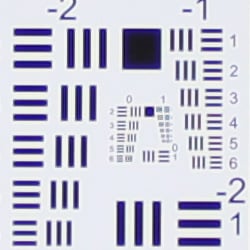
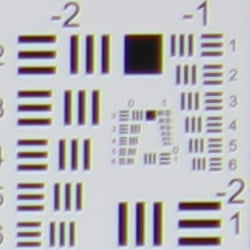

Chromatic Aberration. Chromatic aberration in the corners with the Canon T2i's 18-55mm kit lens is pretty evident (we'd call it on the high side of "moderate") at both wide-angle (18mm) and telephoto (55mm) settings. At wide-angle, it's brighter and therefore much more noticeable than at full telephoto. Color fringing is still quite evident in the center at wide-angle, but very low in the center at full telephoto.
Corner Softness. The Canon T2i's 18-55mm IS kit lens produced some soft corners in a few shots. At full wide-angle, corners on the right side of our test targets were somewhat soft compared to the center, but the blurring didn't extended very far into the frame. The left side, however, showed less softening in the corners. The center of the image was quite sharp. At full telephoto, all four corners were only slightly soft with the top right being the softest. The image was also slightly soft in the center. An average performance for a kit lens here, but keep in mind these shots are taken wide-open and sharpness generally improves when a lens is "stopped-down" a couple of f-stops below full aperture.
The images above were taken from our standardized test shots. For a collection of more pictorial photos, see our Canon EOS Rebel T2i (EOS 550D) Photo Gallery .
Exposure
Canon T2i Exposure
 The Canon T2i adopts the same exposure system which recently debuted in the company's flagship APS-C format digital SLR, the EOS 7D. Dubbed IFCL -- which stands for Intelligent Focus, Color, Luminance -- the new metering system takes into not only account subject luminance, but also both color information and focus distance. Because silicon light sensors are significantly more sensitive to longer-wavelength light, unless an exposure sensor's response is substantially tweaked via a filter system of some sort (which naturally decreases sensitivity), it will tend to underexpose red-colored objects or scenes, and overexpose ones dominated by blue or green hues. To prevent this issue, the T2i takes advantage of color information provided by its dual-layer autoexposure sensor, with the upper layer being sensitive to Blue/Green light, and the lower layer to Green/Red light. The Canon T2i should hence be able to markedly improve exposure accuracy in situations where the subject is dominated by colors at one end or the other of the color spectrum.
 The Canon T2i's autoexposure sensor divides the frame into 63 separate zones, the data from which can be evaluated in a variety of ways, depending on the AE mode you're operating in. AE and AF zones are aligned, allowing exposure information to be associated with specific AF sensors and the area around them.
The T2i's AE system also integrates distance information from the autofocus system into the exposure metering process, thanks to a rather clever assumption: If you've identified the subject as being located a certain distance away from the camera, nearby objects that are close to the same distance are most likely part of the subject, too. Thus, rather than simply relying on a spot AE reading centered on the primary AF point, or blindly combining exposure information from a cluster of AE points in some arbitrary geometric grouping around the active AF point, the Canon T2i instead gives stronger weighting to exposure sensor segments that lie beneath adjacent AF points showing a similar distance reading.
Although we've not had confirmation of this from Canon, we suspect that the color-sensitive capability of the new AE sensor plays a role here too: It seems highly likely that the T2i's exposure system takes color into account and considers contiguous areas of similar color to be an indication of the extent of the subject as well.
Metering Options
The Canon T2i's exposure metering options include 63-zone Evaluative, Center-weighted Average, Partial (9% of viewfinder at center), and Spot (4% of viewfinder) options. Metering sensitivity range is specified at 1-20 EV (at 23°C/73°F, with EF 50mm f/1.4 USM lens, ISO 100).
The Canon T2i's Exposure Compensation setting allows the user to increase or decrease the metered exposure by up to five stops positively or negatively, in one-third or one-half EV increments -- a much more useful range than the two stops either side of nominal exposure offered in the previous T1i model. Although Evaluative metering is linked to the active AF point (whether automatically or manually selected), Spot metering is fixed to the center of the viewfinder (unlike Nikon SLRs, which can spot meter at any selected AF point).

In Live View mode, evaluative metering is always used, however Canon does not specify how many zones. The sensitivity range for Live View metering is specified at 0-20 EV (again, at 23°C/73°F, with EF 50mm f/1.4 USM lens, ISO 100).When Face Detection AF is enabled in Live View mode, the Canon T2i biases the exposure in an attempt to properly expose for a detected face.
ISO Sensitivity Options
 The Canon T2i offers regular ISO equivalents of 100, 200, 400, 800, 1,600, 3,200 and 6,400. The EOS T2i also offers a high-range ISO setting enabled when ISO Expansion is turned on, which is equivalent to ISO 12,800. An Auto ISO mode adjusts the ISO as the camera deems necessary, from 100 to 6,400. When shooting in Creative Zone modes, it's possible to set an upper limit on the Auto ISO range. This upper limit can be set to any sensitivity between ISO 400 and ISO 6,400, but you can't specify the minimum shutter speed the camera should use before raising the ISO. The limit is ignored for flash photography, unless using bounce flash with an external Speedlite flash strobe. Auto ISO when using a flash defaults to ISO 400, but will throttle down as low as ISO 100 to prevent overexposure, and will range as high as ISO 1,600 for bounce flash, if allowed by the Auto ISO limit.
Automatic Exposure Bracketing
 An automatic exposure bracketing feature lets you set the Canon T2i's total exposure variation (across three shots) at anywhere from +/- one-third or one-half EV, up to +/- 2 EV. The nice part is that the automatic variation is centered around whatever level of manual exposure compensation you have dialed in. Thus, you could manually set a positive exposure compensation of 0.7 EV, and then have the camera give you a variation of +/- 2/3 EV around that point. (This also means that the bracketed exposures can go outside of the standard exposure compensation range, allowing one shot as far as 7 EV from the metered exposure.) The number of shots in a sequence is fixed to three, and the sequence order also can't be changed from 0, -, + (default, under, over).
AE/FE Lock (" * " button)
 The Canon T2i has the simplified AE Lock button from more recent models, which unbundles the AF Lock feature from the old button on the older EOS cameras like the 20D and 30D. Marked with an asterisk (*) symbol, the AE Lock button simply holds the exposure at one setting while you recompose the image. It's very useful when spot metering, but also when dealing with subjects where you want to draw your exposure from one place, while autofocusing on another. You may hold the AE Lock button down while depressing the shutter release multiple times to maintain the same exposure across multiple shots. Pressing the button with the pop-up flash activated or with an external flash mounted activates the FE Lock (Flash Exposure) function, which fires the flash and locks the proper exposure for the following frame.
Through the Custom Functions menu, the behavior of the AE / FE lock button can be changed. By default, a single press locks exposure until the shutter is released, or the T2i's metering system powers down, while focus is locked with a half-press of the shutter button. There are three alternatives to this behavior. The first swaps functions so that the AE / FE lock button locks focus, and a half press of the shutter button locks exposure. The second alternative uses the AE / FE lock button to cancel continuous autofocus in AI servo mode, and to recalculate focus / exposure which are locked by a shutter button half-press in One Shot or AI Focus modes. Finally, you can opt to dedicate the AE / FE lock button to both focus and exposure, locking both variables with a single press unless using AI Servo focus, in which case the AE / FE lock button is solely used to trigger continuous AF operation.
In Movie mode, there is similar functionality set through the Movie menu, but the last two options are subtly different, since continuous autofocusing isn't available for movies. Instead of canceling continuous autofocus in the second option, the AE / FE lock button prevents a single AF operation that would normally be triggered by pressing the shutter button, allowing still image capture without first refocusing. In the final option, the AE / FE lock button performs a single AF operation and locks focus when pressed, rather than operating autofocus continuously..
White Balance Options
 As you'd expect, the Canon T2i offers a full range of White Balance settings, including an Auto (3,000-7,000K) setting, six presets, and a Custom setting. There is however no direct temperature setting as there is on higher models like the EOS 7D. The six presets include Daylight (5,200K), Shade (7,000K), Cloudy (6,000K), Tungsten (3,200K), White Fluorescent (4,000K), and Flash (6,000K). The Custom setting bases color balance on a previous exposure, meaning you can snap an image of a white card and then base the color temperature on that image.
A White Balance bracketing option snaps only one image, but then writes three successive files from that single capture. Bracketing steps are from -/+ 3 steps. (Each step corresponds to five mireds of a color conversion filter, for a total range of +/- 15 mireds. This corresponds to about a +/- 500K shift at a normal daylight color temperature of 5,500K.)
 The Canon T2i's WB Bracketing is set on the same grid as the now familiar White Balance Correction control. Fairly sophisticated, the white balance correction tool lets you shift the color balance toward more or less green vs magenta or blue vs amber, using a +/-9 step grid format. You move a highlighted square through the grid to adjust the color balance, and bracketing adjustments spread the single square into a cluster of three.
Picture Styles
 As with other recent Canon DSLRs, the Canon T2i offers a Picture Style option through the LCD menu, which lets you select from Standard, Portrait, Landscape, Neutral, Faithful, Monochrome, or three User Defined settings. In each of the preset modes, the Contrast, Saturation, Sharpness, and Color Tone are set for specific conditions. For Monochrome, Saturation is replaced with Filter effect (options are: None, Yellow, Orange, Red or Green), and Color Tone is replaced with Toning Effect (None, Sepia, Blue, Purple or Green). The three User Defined options let you manually adjust each variable, then save it as a custom parameter. Of course, you can also set the camera's color space to sRGB or Adobe RGB.
Auto Lighting Optimizer (ALO)
 First seen on the Rebel XSi, Canon's Auto Lighting Optimizer (ALO) function lets you expose for the highlights, preserving detail there, while the camera adjusts the image to open up the shadows. This happens on the fly, as the files are being written to the memory card, so there's no post-capture intervention by the user required to take advantage of this function. We weren't terribly impressed with ALO on the XSi, however newer Canon models including the T2i offer four different settings for it, and the control on the T2i seems quite effective. The ALO setting is made via Record Menu 2, where you can select options of Disable, Low, Standard (the default), or Strong.
Highlight Tone Priority (HTP)
 Also included on the Canon T2i is Highlight Tone Priority (HTP for short), a feature that's been on Canon SLRs for some time now, and it's one that works quite well when dealing with subjects with important detail in strong highlights. (Think of the standard wedding dress shot, and you'll get the idea.) Digital cameras normally expose more like slide film: Once you hit a certain exposure level, detail just vanishes. This really becomes an issue when you're dealing with contrasty lighting and a subject with lots of highlights in it.
HTP's action is pretty subtle, but the results are very evident when dealing with strong highlights under harsh lighting. The way it works is to set the camera's base ISO up one notch, to 200, so it's only half-filling the sensor's pixels with charge during the exposure. The Canon T2i then alters its tone curve, basically compressing the top half (that would normally be blown out) into a smaller range, thereby preserving the highlight detail. You can do this yourself when working from RAW files, you just need to significantly underexpose most of the scene, and then fiddle with the tone curve to drastically reduce the contrast, but only in the extreme highlights. If that sounds difficult, it is; it can be a real time-sink, and very difficult to make the end result look natural. Canon's HTP does this for you automatically, though, and the results look just great: You have no sense that the camera has been making radical adjustments to its tone curve; you just see all the detail in the highlights that otherwise would be missing. HTP is controlled via Custom Function setting II-6, giving you options to Disable (the default) or Enable it.
Noise Reduction Options
 The Canon T2i offers two types of adjustable noise reduction. Long Exposure noise reduction can be performed for exposures one second or longer, and works by taking a second "dark frame" of equal duration with the shutter closed, and then subtracting it from the first frame. This reduces or eliminates most noise generated by the sensor during long exposures at low ISOs, but can make noise worse at higher ISOs (at ISO 1,600 and above). Available settings are Off, Auto and On, and are accessed from Custom Function II-4. The Off setting is the default. The T2i also offers the user four levels of high ISO sensitivity noise reduction. Options are Disable, Low, Standard and Strong, with Standard being the default. Though the name implies this noise reduction is only applied at high ISOs, the Canon T2i applies it to all ISOs. This explains why the T2i's chroma noise in shadows and darker tones is lower than most DSLRs at low ISOs, when using the default Standard setting. These settings are accessed in Custom Function II-5. High ISO noise reduction is not applied to RAW files.
Continuous Shooting Mode and Self-Timer
 The Canon T2i's Continuous Shooting mode is rated by Canon at 3.7 frames per second in high speed mode, for a total of 34 Large/Fine JPEG shots or 6 RAW before the buffer fills. When shooting JPEGs of a very complex scene with a lot of sharp, fine detail may also compress less and result in lower buffer capacities, as was seen in our testing.
The Canon T2i's Drive setting also accesses three Self-Timer modes, which open the shutter 10 or 2 seconds after the Shutter button is pressed, giving you time to dash around in front of the camera. The third mode will take a programmable amount of shots (2 to 10 shots), after a 10 second delay. A Remote Control mode works with the dedicated and wireless remote units as well.
The images above were taken from our standardized test shots. For a collection of more pictorial photos, see our Canon EOS Rebel T2i (EOS 550D) Photo Gallery .
Not sure which camera to buy? Let your eyes be the ultimate judge! Visit our Comparometer(tm) to compare images from the Canon EOS Rebel T2i (EOS 550D) with those from other cameras you may be considering. The proof is in the pictures, so let your own eyes decide which you like best!
Performance
Canon T2i Performance
Timing and Performance
Good to average speed for a consumer digital SLR.
| Startup/Shutdown |
||
| Power on |
~0.4 second
|
Time it takes to turn on and capture a shot. (Short enough that it's hard to measure.) |
| Shutdown |
2.7 seconds
|
How long it takes camera to turn off before you can remove the memory card. Sensor cleaning on shut-down enabled. |
|
Buffer clearing time
|
5 seconds
after 10 large/fine JPEGs* |
Worst case buffer clearing time. -- This is the delay after a set of shots before you can remove the card.
|
|
9 seconds
after 6 RAW files* |
||
|
9 seconds
after 3 RAW+L/F JPEG files* |
||
|
*Note: Buffer clearing times measured with a SanDisk Extreme III 30MB/sec 8GB SDHC card. Slower cards will produce correspondingly slower clearing times. Slow cards may also limit length of bursts in continuous mode. ISO sensitivity and noise reduction settings can also affect cycle times and burst mode performance.
|
||
The Canon T2i turned in a fast startup time, fast enough that it's difficult to measure. Sensor cleaning was enabled on start-up and shut-down. At start-up pressing the shutter button aborts sensor cleaning, as it should. The Canon T2i's buffer clearing times are good, but of course depend on the image quality and size, as well as the speed of the memory card.
| Mode Switching | ||
|---|---|---|
| Play to Record, |
~0.7 second
|
Time until first shot is captured. |
| Record to play |
~0.8 second
|
Time to display a large/fine file immediately after capture. |
| Display |
~0.4 second
|
Time to display a large/fine file already on the memory card. |
The Canon T2i's mode switching times are good, a little faster than average.
| Shutter Response (Lag Time) | ||
|---|---|---|
| Full Autofocus |
0.252 second
|
Time from fully pressing shutter button to image capture. (Except where otherwise noted, all AF timing measured with Sigma 70mm f/2.8 Macro lens.) |
|
Full Autofocus |
0.210 second
|
Time from fully pressing shutter button to image capture. |
|
Full Autofocus
Single-point AF TTL flash enabled Optical Viewfinder |
0.208 second
|
Time to capture while forcing flash to fire. Metering pulses from flash often slow shutter response.
|
| Prefocused |
0.096 second
|
Time to capture, after half-pressing and holding shutter button. |
|
Continuous AF Optical Viewfinder |
0.149 second
|
This mode usually shows no speed increase with our static subject; we have no way to measure performance with moving subjects. |
|
Manual Focus Optical Viewfinder |
0.162 second
|
For most cameras, shutter lag is less in manual focus than autofocus, but usually not as fast as when the camera is "prefocused". |
|
Full Autofocus
Live View "Quick Mode" (Phase Detect) |
0.991 second
|
Time from fully pressing shutter button to image capture. This is phase-detect autofocus, the camera drops the mirror to focus, then raises it to grab the shot. (Live View tested with 18-55mm kit lens, as the T2i would not focus properly with the Sigma 70mm lens.)
|
|
Full Autofocus
Live View "Live Mode" (Contrast Detect) |
1.720 seconds
|
Time from fully pressing shutter button to image capture. This is contrast-detect autofocus, the camera reads Live View data from the image sensor to determine focus.
|
|
Prefocused
Live View |
0.122 second
|
Time to capture, after half-pressing and holding shutter button..
|
The Canon T2i's full autofocus shutter response is about average for a consumer SLR, at 0.252 second using our standard single-point AF test. Switching to auto selection AF and allowing the camera to choose the focus point reduced shutter lag to 0.210 second. Interestingly, enabling the built-in flash decreased full AF lag just slightly to 0.208 second. "Prefocusing" the camera by half-pressing and holding down the shutter button before the final exposure results in a lag time of only 0.096 second. Shutter lag in Manual focus was slower, at 0.162 second, and in Continuous focus mode it was 0.149 second.
The Canon T2i's AF lag time in Live View mode was longer (as expected), but not as slow as some. We measured 0.991 second using "Quick Mode" (phase-detect AF), and 1.720 seconds using Live Mode (contrast-detect). We used the kit lens for the Live View tests, as the T2i always confirmed focus with the Sigma 70mm even though the resulting image was not in focus. Prefocused, the Canon T2i's shutter lag was pretty fast in Live View mode, at only 0.122 second.
To minimize the effect of different lens' focusing speed, we test AF-active shutter lag with the lens already set to the correct focal distance. We also use the same Sigma 70mm f/2.8 macro with every camera (on all platforms except Four Thirds/Micro Four Thirds and Nikon consumer models lacking an in-body focus motor), to further reduce variation, and because our tests showed that focus-determination time with this lens was close to the fastest, across multiple camera bodies from different manufacturers. Being an older design with a non-ultrasonic motor, it wouldn't be the fastest at slewing from one focus setting to another, but that's exactly the reason we measure focus determination speed, which is primarily a function of the camera body, vs focus adjustment speed, which is primarily a function of the lens.
| Cycle Time (shot to shot) | ||
|---|---|---|
| Single Shot mode |
0.44 second
|
Time per shot, averaged over 13 shots, 5 seconds to clear. |
|
Single Shot mode |
0.46 second
|
Time per shot, averaged over 7 shots, 9 seconds to clear. |
|
Single Shot mode
RAW + Large/Fine JPEG |
0.45 second
|
Time per shot, averaged over 5 shots, 9 seconds to clear. |
| Early shutter |
No
|
Some cameras don't snap another shot if you release and press the shutter too quickly in Single Shot mode, making "No" the preferred answer. |
|
Continuous mode |
0.27 second (3.64 frames per second);
10 frames total; 5 seconds to clear* |
Time per shot, averaged over 10 shot buffer capacity, then slowed to 0.67 second or 1.49 frames per second when buffer was full. |
| Continuous mode |
0.27 second (3.65 frames per second);
6 frames total; 9 seconds to clear* |
Time per shot, averaged over 6 shot buffer capacity, then slowed to 1.61 seconds or 0.62 frames per second when buffer was full. |
|
Continuous mode |
0.28 second (3.64 frames per second);
3 frames total; 9 seconds to clear* |
Time per shot, averaged over 3 shot buffer capacity, then slowed to 2.19 seconds or 0.46 frames per second when buffer was full. |
| Flash recycling |
3.2 seconds
|
Flash at maximum output. |
|
*Note: Buffer clearing times measured with a SanDisk Extreme III 30MB/sec 8GB SDHC card. Slower cards will produce correspondingly slower clearing times. Slow cards may also limit length of bursts in continuous mode. ISO sensitivity and noise reduction settings can also affect cycle times and burst mode performance.
|
||
Shot-to-shot cycle times in the Canon T2i's single-shot mode were average for an SLR, at about 0.45 second for any quality. Buffer length was 13 shots for JPEGs, but dropped to 7 for RAW and 5 for RAW+JPEG.
Continuous mode speeds were on the slower side of average for an enthusiast model, though perhaps understandable given the large files, at about 3.65 frames/second in any mode. Measured buffer depths were only 10 frames for large/fine JPEGs, 6 frames for RAW mode and 3 frames for RAW+JPEG. (Note that in our cycle time testing we shoot a target consisting of a fine-grained digital noise pattern, designed to be very hard to compress. This gives us worst-case buffer capacity numbers: You're likely to see greater buffer capacity when shooting more normal subjects.)
The Canon T2i's flash took 3.2 seconds to recharge after a full-power pulse, which is good.
| Download Speed | ||
|---|---|---|
| Windows Computer, USB 2.0 |
9,762 KBytes/sec
|
Typical Values: |
Connected to a computer or printer with USB 2.0, the Canon T2i's download speeds are fast.
Bottom line, the Canon T2i is average to slightly faster than average in most aspects of its operation. While continuous mode speeds aren't state-of-the-art, they are fast enough for most moving subjects, and shutter lag and cycle times are quite good. Buffer sizes are below average, but that's no surprise with 18-megapixel files. Good performance overall for a consumer model.
Battery and Storage Capacity
Battery
Below average battery life for a lithium-ion SLR design.
| Operating Mode | Number of Shots |
|---|---|
|
Lithium-ion Rechargeable Battery,
(CIPA standard, Optical Viewfinder) |
440
|
|
Lithium-ion Rechargeable Battery,
(CIPA standard, Live View LCD) |
180
|
The Canon T2i uses a custom rechargeable lithium-ion battery for power, and ships with a charger. Battery life is below average, even when using the optical viewfinder, so we recommend you pick up a spare battery and keep it freshly charged and on-hand for extended outings.
The table above shows the number of shots the Canon T2i is capable of (on a fully-charged rechargeable battery), based on CIPA battery-life and/or manufacturer standard test conditions.
(Interested readers can find an English translation of the CIPA DC-002 standards document here. (180K PDF document))
Storage
The Canon T2i accepts SD/SDHC/SDXC memory cards, and does not ship with a card. Canon recommends a Class 6 card or faster for recording HD movies.
| Image Capacity with 1GB Memory Card |
Fine | Normal | RAW | RAW + Fine JPEG |
|
|---|---|---|---|---|---|
|
5,184 x 3,456 |
Images (Avg Size) |
142
7.2 MB |
280
3.7 MB |
37
27.3 MB |
27
37.2 MB |
|
Approx.
Comp. |
8:1
|
15:1
|
1.1:1
|
-
|
|
|
3,456 x 2,304 |
Images (Avg Size) |
267
3.8 MB |
525
2.0 MB |
-
|
-
|
|
Approx.
Comp. |
6:1
|
12:1
|
-
|
-
|
|
|
2,592 x 1,728 |
Images (Avg Size) |
417
2.5 MB |
795
1.3 MB |
-
|
-
|
|
Approx.
Comp. |
6:1
|
10:1
|
-
|
-
|
|
We strongly recommend buying a fast, large capacity SD/SDHC/SDXC memory card for the Canon T2i: at least a 2GB card, preferably a 4 or 8GB one, to give yourself extra space for extended outings, or when shooting RAW files or video. (Check the shopping link above, cards are really cheap these days, so no reason to skimp.)
Imaging
Canon T2i Image Quality
Color
Saturation & Hue Accuracy
Very good saturation and excellent hue accuracy.
 |
| In the diagram above, the squares show the original color, and the circles show the color that the camera captured. More saturated colors are located towards the periphery of the graph. Hue changes as you travel around the center. Thus, hue-accurate, highly saturated colors appear as lines radiating from the center. Click for a larger image. |
Saturation. The Canon T2i produces images with saturation very similar to the T1i. Like the T1i (and most cameras), the Canon T2i pushes reds, oranges, blues, greens, dark browns and some purples a bit. The camera also undersaturates aqua a cyan a bit. The overall saturation of 111% (11% oversaturated) is quite typical for a consumer oriented SLR. Most consumer digital cameras produce color that's more highly saturated (more intense) than found in the original subjects. This is simply because most people like their color a bit brighter than life.
Skin tones. Flesh tones shot with the Canon T2i appeared quite natural, with appropriate saturation levels and accurate color, though slightly on the cool side. When white-balance was adjusted to match the lighting, skin-tones were warmer, with a "healthy looking glow". Where oversaturation is most problematic is on Caucasian skin tones, as it's very easy for these "memory colors" to be seen as too bright, too pink, too yellow, etc.
Hue. The Canon T2i's hue accuracy is very good, just a hair less accurate than the T1i, but still much better than average. There were the usual shifts in cyan toward blue, red toward orange, and orange toward green, but they are pretty minor. (The cyan to blue shift is very common among the digital cameras we test; we think it's a deliberate choice by camera engineers to produce better-looking sky colors.) Excellent hue accuracy overall. Hue is "what color" the
color is.
Saturation Adjustment
The Canon T2i offers a total of nine saturation settings, four above and four below the default saturation. This covers a very wide range of saturation levels, about as wide a range as you're likely to find photographically useful, apart from special effects that are arguably better achieved in software. As it should, the Canon T2i's saturation adjustment affects only the saturation, leaving the contrast of the image more or less unaltered. (In some cameras, saturation tends to affect contrast, and vice versa.) The fine steps between settings mean you can program the camera to just the level of saturation you prefer. Well done.
| Saturation Adjustment Examples | ||||
 |
 |
 |
 |
 |
| -4 | -2 | 0 | +2 | +4 |
The table above shows alternate settings including the default as well as the two extreme saturation settings. Click on any thumbnail above, then click again to see the full-sized image.
Sensor
Exposure and White Balance
Indoors, incandescent lighting
Auto and Incandescent settings both struggle with household incandescent lighting, though Manual white balance setting produced a much more neutral image. Average exposure compensation required.


Indoors, under incandescent lighting, the Canon T2i's Auto white balance setting really struggled to produce a decent-looking image. Unfortunately, this is quite common among cameras we've tested, but disappointing nonetheless. The Canon T2i's Incandescent setting did a little better, but the resulting image was still too warm for our tastes. (Some may feel that it successfully conveys the warmth of the original lighting, but we'd personally like a slightly more neutral treatment.) The Manual white balance option was by far the most accurate. The Canon T2i required a positive exposure compensation of 0.3 EV for this shot, which is average among the cameras we've tested for this shot. (Our test lighting for this shot is a mixture of 60 and 100 watt household incandescent bulbs, a pretty yellow light source, but a very common one in typical home settings here in the U.S.)
Outdoors, daylight
Color and saturation are very good, though a tendency towards slightly cool color balance and slightly high contrast under harsh lighting. About average exposure accuracy.


Outdoors, the Canon T2i tended toward a slightly cool color balance, as you can see by the skin tones in the above left shot, though overall color was generally excellent. The Canon T2i performed about average in terms of exposure, requiring the typical amount of positive compensation we're accustomed to seeing among digital cameras. The Canon T2i's default contrast is a little high, producing some washed-out highlights and dark shadows under the deliberately harsh lighting of our "Sunlit" portrait test shown above left, though the camera's contrast and highlight tone priority settings do help tame the highlights quite a bit. See below for examples of this. The Far-field House shot (above right) was also a touch cool, though exposure was quite accurate, with very few blown highlights or lost shadows.
See full set of test images with explanations
See thumbnails of all test and gallery images
Resolution
Very high resolution, 2,000 ~ 2,100 lines of strong detail.



Our laboratory resolution chart showed the Canon T2i's images with sharp, distinct line patterns down to about 2,100 lines per picture height horizontally and 2,000 lines vertically. Extinction of the pattern occurred at about 3,200 lines horizontally, and 3,100 lines vertically. We weren't able to do much better with Adobe Camera Raw converted .CR2 files. Use these numbers to compare with other cameras of similar resolution, or use them to see just what higher resolution can mean in terms of potential detail.
See full set of test images with explanations
See thumbnails of all test and gallery images
Sharpness & Detail
Good sharpness and loads of detail with a sharp lens. Some detail loss to noise reduction processing even at low ISOs, but surprisingly good for an 18-megapixel subframe sensor.


Sharpness. The Canon T2i's 18-megapixel sensor captures loads of image detail. Some minor edge-enhancement artifacts are visible around high-contrast edges, as shown in the crop above left. (The above crop of our Far-field House shot was taken with Canon's very sharp 16-35mm f/2.8L II USM lens at f/8, as our 18-55mm kit lens was somewhat soft.) Edge enhancement creates the illusion of sharpness by enhancing colors and tones right at the edge of a rapid transition in color or tone.
Detail. The crop above right shows some detail loss due to noise suppression, but less than we're accustomed to seeing. Very impressive for an 18-megapixel APS-C sensor. (The crop above of the hair taken with our very sharp Sigma 70mm f/2.8 reference lens.) Noise-suppression systems in digital cameras tend to flatten-out detail in areas of subtle contrast. The effects can often be seen in shots of human hair, where the individual strands are lost and an almost "watercolor" look appears.
RAW vs In-Camera JPEGs
As mentioned above, the Canon T2i does an excellent job of capturing sharp, detailed JPEGs when coupled with a sharp lens, but as is usually the case, slightly more detail can be preserved by carefully processing its RAW files.
 |
|||
In the table above, mousing over a link at the bottom will load the corresponding crop in the area above, and clicking on the link will load the full resolution file. Examples include in-camera Fine JPEG, RAW file processed through Canon's Digital Photo Professional (DPP) software using default settings, another DPP processed RAW file with additional sharpening in DPP, and finally, a RAW file processed through Adobe Camera Raw (ACR) version 5.6, then sharpened in Photoshop.
For the Canon EOS T2i's images, I found best results with sharpening set to 5 in the DPP converted file (default sharpening was softer than the camera JPEG, but shows excellent detail), while the ACR converted file was sharpened using 300% unsharp masking with an 0.3 pixel radius.
Manufacturer software often doesn't find as much detail as does Adobe Camera RAW, but Canon's DPP does better than most. The image processed through ACR does however show a little more detail, as well as more noise. The Canon T2i is clearly a camera that carries a lot of data in its RAW files when coupled with a sharp lens.
ISO & Noise Performance
Low noise and excellent detail at the lowest ISO settings; ISO 1,600 is very usable for average print sizes. Noise vs detail performance very good for the resolution.
|
Default High ISO Noise Reduction
|
||
 |
 |
 |
| ISO 100 | ISO 200 | ISO 400 |
 |
 |
 |
ISO 800 | ISO 1,600 | ISO 3,200 |
 |
 |
ISO 6,400 | ISO 12,800 |
The Canon T2i's images are quite clean at ISOs 100 and 200, with just a bit luminance noise seen in the shadows. We start to see a very fine, tight "grain" pattern at ISO 400, but detail is hardly affected, with no signs of chroma noise. The grain is slightly more evident at ISO 800, but detail remains very strong despite some minor blurring due to noise reduction. At ISO 1,600 we begin to see some moderate detail loss as noise reduction blurs subtly contrasting detail, as well as touch of chroma noise in darker areas, but results are still quite good. At ISO 3,200 noise grain becomes coarser and the blurring stronger, resulting in a noticeable drop in detail. Noise and the effects of noise reduction really become apparent at ISO 6,400 and especially at ISO 12,800, with strong blurring, bright noise pixels and chroma blotching. Overall, an excellent performance, particularly for a camera with an 18-megapixel APS-C size sensor.
We're of course pixel-peeping to an extraordinary extent here, since 1:1 images on an LCD screen have little to do with how those same images will appear when printed. See the Print Quality section below for our evaluation of maximum print sizes at each ISO setting.
A note about focus for this shot: We shoot this image at f/4, using one of three very sharp reference lenses (70mm Sigma f/2.8 macro for most cameras, 60mm f/2.8 Nikkor macro for Nikon bodies without a drive motor, and Olympus Zuiko 50mm f/2.0 for Four Thirds and Micro Four Thirds bodies). To insure that the hair detail we use for making critical judgements about camera noise processing and detail rendering is in sharp focus at the relatively wide aperture we're shooting at, the focus target at the center of the scene is on a movable stand. This lets us compensate for front- or back-focus by different camera bodies, even those that lack micro-focus adjustments. This does mean, though, that the focus target itself may appear soft or slightly out of focus for bodies that front- or back-focused with the reference lens. If you click to view the full-size image for one of these shots and notice that the focus target is fuzzy, you don't need to email and tell us about it; we already know it. :-) The focus target position will simply have been adjusted to insure that the rest of the scene is focused properly.
Extremes: Sunlit and low light tests
Very high resolution with strong overall detail, but slightly high default contrast. Highlight Tone Priority and contrast adjustment options do a great job of dealing with tough lighting, though, and highlight and shadow detail are very good even without them. Very good low-light performance, though metering and autofocus struggled a bit at the lowest light levels.


The Canon EOS T2i produced slightly high contrast with some washed-out highlights and deep shadows under the deliberately harsh lighting of the test above. However, highlight and shadow detail are actually pretty good. The model's face was a little dim at the +0.3 EV setting, so we preferred the image with +0.7 EV of exposure compensation, which resulted in some clipped highlights in the shirt and flowers, mostly in the blue and red channels, but not as much as we're used to seeing without some sort of dynamic range optimization setting (see below). Exposure compensation of +1.0 EV resulted in a too many clipped highlights for our tastes, though some shooters may prefer the later image for its brighter skin tones.
Because digital cameras are more like slide film than negative film (in that they tend to have a more limited tonal range), we test them in the harshest situations to see how they handle scenes with bright highlights and dark shadows, as well as what kind of sensitivity they have in low light. The shot above is designed to mimic the very harsh, contrasty effect of direct noonday sunlight, a very tough challenge for most digital cameras. (You can read details of this test here. In actual shooting conditions, be sure to use fill flash in situations like the one shown here; it's better to shoot in open shade whenever possible.)
|
Highlight Tone Priority Example
|
|
 |
 |
|
Off (default)
|
On
|
 |
 |
 |
 |
|
Highlight Retention
|
|
 |
 |
|
Shadow Detail, R.H.S. Brightened in Photoshop
(Levels control, highlight slider down to 50) |
|
Highlight Tone Priority
The Canon T2i's Highlight Tone Priority (HTP) option did an excellent job of preserving highlight detail, as shown above. Both shots above were captured at the same exposure, the only difference being that HTP was enabled for the shot on the right. (Which necessarily increases the ISO to 200; part of how HTP works.) The result is evident even in the histograms and thumbnails above; the full-size images clearly show the superior highlight preservation when HTP is enabled, while shadow detail is left relatively untouched. The right side of the Shadow Detail crops above have had their histogram levels adjusted equally in Photoshop to reveal the increase noise in the HTP-On case. The increase in noise is because the ISO is boosted from 100 to 200. Except in the very deepest shadows, though, overall noise is so low at ISO 200 that this is really a negligible trade-off for all but the most critical applications.
| Contrast Adjustment Examples | ||||
 |
 |
 |
 |
 |
| -4 | -2 | 0 | +2 | +4 |
The Canon T2i's contrast-adjustment control also does an excellent job with very difficult lighting like this. It offers a very broad range of control in usefully fine gradations, and does a good job of adjusting contrast without affecting color saturation in the process. (As noted earlier regarding saturation adjustment, something that not all cameras manage to do.)
| Automatic Lighting Optimization Examples | ||
 |
 |
 |
 |
 |
 |
| Low | Standard | High |
 |
||
 |
||
| Off | ||
Automatic Lighting Optimization
Like the T1i, the Canon T2i offers three selectable levels of ALO, plus Off. In fully automatic and Creative Auto exposure modes, ALO is automatically enabled. All four shots above were taken with the same exposure settings. As you can see, ALO has the effect of shifting shadows and mid-tones in the histograms to the right, lightening the overall image without clipping too many additional highlights.
| Face Detection | ||
 |
 |
|
| Off at 0 EV | On at 0 EV | |
Face Detection
Just like most Point & Shoot cameras these days, the Canon T2i has the ability to detect faces in Live View mode, and adjust exposure and focus accordingly. As you can see from the examples above, it work well, as the image with face detection enabled is much better exposed for the face, even though both images were shot without any exposure compensation.
Because digital cameras are more like slide film than negative film (in that they tend to have a more limited tonal range), we test them in the harshest situations to see how they handle scenes with bright highlights and dark shadows, as well as what kind of sensitivity they have in low light. The shot above is designed to mimic the very harsh, contrasty effect of direct noonday sunlight, a very tough challenge for most digital cameras. (You can read details of this test here.)
| 1 fc 11 lux |
1/2 fc 5.5 lux |
1/4 fc 2.7 lux |
1/8 fc 1.3 lux |
1/16 fc 0.67 lux |
1/16fc No NR |
|
|---|---|---|---|---|---|---|
| ISO 100 |
 2 sec f2.8 |
 4 sec f2.8 |
 8 sec f2.8 |
 12.3 sec f2.8 |
 32 sec f2.8 |
 32 sec f2.8 |
| ISO 200 |
 1 sec f2.8 |
 2 sec f2.8 |
 3.1 sec f2.8 |
 6.2 sec f2.8 |
 16 sec f2.8 |
 16 sec f2.8 |
| ISO 400 |
 0.5 sec f2.8 |
 1 sec f2.8 |
 1.5 sec f2.8 |
 4 sec f2.8 |
 8 sec f2.8 |
 8 sec f2.8 |
| ISO 800 |
 1/4 sec f2.8 |
 0.5 sec f2.8 |
 1 sec f2.8 |
 1.5 sec f2.8 |
 4 sec f2.8 |
 4 sec f2.8 |
| ISO 1600 |
 1/8 sec f2.8 |
 1/4 sec f2.8 |
 0.4 sec f2.8 |
 0.8 sec f2.8 |
 2 sec f2.8 |
 2 sec f2.8 |
| ISO 3200 |
 1/16 sec f2.8 |
 1/8 sec f2.8 |
 1/4 sec f2.8 |
 0.4 sec f2.8 |
 1 sec f2.8 |
 1 sec f2.8 |
| ISO 6400 |
 1/32 sec f2.8 |
 1/16 sec f2.8 |
 1/10 sec f2.8 |
 1/5 sec f2.8 |
 0.5 sec f2.8 |
 0.5 sec f2.8 |
| ISO 12800 |
 1/64 sec f2.8 |
 1/32 sec f2.8 |
 1/21 sec f2.8 |
 1/8 sec f2.8 |
 1/4 sec f2.8 |
 1/4 sec f2.8 |
Low light. The Canon T2i performed reasonably well on the low-light test, capturing bright images at the lowest light level (1/16 foot-candle), even with the lowest sensitivity setting (ISO 100). The camera's exposure metering system worked better than average at lower light levels, so Aperture priority mode was used, though exposure compensation of +0.3 EV was required down to 1/8 fc, and +0.7 EV for lowest light level. As expected, noise increases as ISO goes up and light levels go down, but noise remains surprisingly low up to ISO 1,600. At ISO 3,200 and above, noise is higher and a few bright pixels appear, but there is very little horizontal banding that we could detect. Color balance was pretty neutral with Canon T2i's Auto white balance setting (just a touch cool), even at high ISOs and lower light levels.
The Canon T2i's phase-detect autofocus system was able to focus on the subject to the 1/8 foot-candle light level unassisted, and in complete darkness with the AF assist enabled. That's not quite as good as many SLRs. (A lot of SLRs can focus unassisted to less than 1/16 foot-candle.) In Live View mode, the T2i's contrast-detect autofocus was able to focus down just below the 1/4 foot-candle level without assistance. That's fairly typical for contrast-detection AF.
As always, keep in mind that the longer shutter speeds here demand the use of a tripod to prevent any blurring from camera movement. (A useful trick is to just prop the camera on a convenient surface, and use its self-timer to release the shutter. This avoids any jiggling from your finger pressing the shutter button, and can work quite well when you don't have a tripod handy.)
How bright is this? The one foot-candle light level that this test begins at roughly corresponds to the brightness of typical city street-lighting at night. Cameras performing well at that level should be able to snap good-looking photos of street-lit scenes.
NOTE: This low light test is conducted with a stationary subject, and the camera mounted on a sturdy tripod. Most digital cameras will fail miserably when faced with a moving subject in dim lighting. (For example, a child's ballet recital or a holiday pageant in a gymnasium.) Digital SLRs like the Canon T2i do much better than point & shoots, but you still shouldn't expect a quick autofocus lock with moving subjects.
Output Quality
Print Quality
Sharp 20x30-inch images from ISO 100 to 400, ISO 800 shots make slightly softer 20x30s. ISO 1,600 shots are good at 16x24, ISO 6,400 shots are usable at 8x10, and ISO 12,800 images print well at 5x7.
 Printed results from the 18-megapixel Canon T2i are impressive, better than we expected from the high pixel density found on this relatively new sensor. Bear in mind that all test shots were printed from JPEG images taken straight from the camera, with the T2i's default noise reduction settings. You can get even more detail from the Canon T2i's RAW images when processed through Adobe Camera RAW or the included Digital Photo Professional software.
Starting at ISO 100, we were able to print excellent, very sharp 20x30-inch images. We're sure we could have gone larger, but that's the largest we'll print for the near future. Images were extremely clean and very sharp.
ISO 200 shots also looked great printed at 20x30, displaying essentially no difference from the ISO 100 image.
ISO 400 prints look astonishingly good, still at 20x30 inches, really very little different from the others. There's the slightest softening of detail in very fine subjects, but you have to squint to see it.
ISO 800 prints at 20x30 inches are only the slightest bit softer in places than ISO 400, a truly remarkable performance.
ISO 1,600 finally starts to show some trouble at 20x30, but only in our troublesome red swatch, which stumbles many a noise suppression system. Most other detail is pretty good, with only a slight hint of anti-noise processing here and there. This also marks the first hints of luminance noise in the shadows. Color also gets a slight bit dimmer, down from the relatively high default saturation in the Canon T2i's images. The red swatch remains a problem at 16x24, but gets less noticeable printed at 13x19 inches.
ISO 3,200 shots are usable at 13x19 inches, but really look better at 11x14 inches. The red swatch, for reference, gets a little worse at 3,200, but that usually happens at much lower ISOs.
ISO 6,400 images are usable if a bit grainy in the shadows at 11x14 inches. The red swatch has gone quite blurry at this point, not likely to be usable at any size. Reducing to an 8x10-inch size brings everything else into usability.
ISO 12,800 shots look quite good at 5x7 inches.
Overall, it's a mind-blowing performance from the Canon T2i. This is one fine image maker.
Testing hundreds of digital cameras, we've found that you can only tell just so much about a camera's image quality by viewing its images on-screen. Ultimately, there's no substitute for printing a lot of images and examining them closely. For this reason, we now routinely print sample images from the cameras we test on our Canon Pro9000 Mark II studio printer, and on the Canon Pixma MP610 here in the office. (See the Canon Pixma Pro9000 Mark II review for details on that model.)
Viewfinder
Canon T2i Viewfinder
 The Canon T2i is a digital SLR design, so the optical viewfinder offers a true, through-the-lens (TTL) display. A dioptric adjustment dial accommodates eyeglass wearers, letting them adjust the viewfinder optics between -3.0 to +1 diopters. Coverage and magnification are rated the same as the previous T1i model at 95% and 0.87x for a 50mm lens and -1 diopter, giving a larger viewfinder image than did the earlier XTi's 0.83x magnification. The viewfinder eyepiece has an eyepoint of approximately 19mm from the eyepiece lens center, also the same as the T1i, but a little lower than the XTi's 21mm eyepoint, and a little tighter than we'd like for eyeglass wearers.
A pair of horizontal infrared sensors just below the Canon T2i's viewfinder, which we've highlighted with a green rectangle in the image at right, detect your eye as it approaches the viewfinder, and deactivate the LCD information display if you have the LCD Auto-off option enabled. (The Auto-off option is found on Setup menu screen 1.)
Like most other consumer-oriented DSLRs, the Canon T2i viewfinder uses a pentamirror design. The advantage of a pentamirror is that it is light and inexpensive, but an all-glass pentaprism design delivers more light to the viewfinder eyepiece, thanks to its more efficient internal reflection. As a result, the Canon T2i's viewfinder image is not as bright as that of the EOS 7D, which uses a true pentaprism. However, as with the T1i, Canon says they've used a more efficient coating on the mirrors in the pentamirror, making for a brighter image when compared to the earlier XTi model. At 130ms, viewfinder blackout on the Canon T2i is the same as that of the T1i.
The illustration below (courtesy of Canon USA) shows all the elements in the Canon T2i's viewfinder, which is unchanged from the T1i. The extensive information available appears beneath the image area in a small strip, and reports all of the major camera settings, such as shutter speed, aperture, flash mode, EV compensation, etc.

Viewfinder Test Results
Coverage
Slightly below average accuracy from the optical viewfinder, but excellent coverage from the LCD in Live View mode.


Testing with a low-distortion mid-focal length macro lens to avoid the effect of lens distortion, we measured the Canon T2i's optical viewfinder at about 94% coverage accuracy. This is a little below the average of 95% for consumer SLRs. The resulting image was slightly tilted and offset with respect to the sensor, which is unfortunately quite common with optical viewfinders in consumer oriented models (and many prosumer models). Live View mode using the LCD was more accurate, at almost exactly 100% coverage, and of course wasn't tilted or offset.
Live View
Canon Rebel T2i Live View
 Like many SLRs these days, the Canon T2i features a Live View mode for its rear-panel LCD monitor. The Live View mode lets you use the LCD monitor as a large viewfinder, and offers an exposure simulation option which displays the expected outcome of your chosen exposure settings. A dedicated Movie / Live View button is used to activate or disable Live View mode on the Rebel T2i, and the function is available in all still image shooting modes. (In Movie mode, the live view feed cannot be disabled, and the same button instead acts to start or stop movie recording.)
The Canon T2i's Live View mode feature set is comprehensive, and the display offers a lot of information such as current settings, exposure, and composition aids (see illustration below, courtesy of Canon USA). The Canon T2i groups several settings related to Live View shooting in a Live View function settings screen, which is somewhat confusingly located in Setup Menu 2, rather than where one might expect to find it in one of the Record menus. Several options are duplicates of those in Movie Menu 2, so if they're changed in one menu, the equivalent variable will be changed on return to the other menu. A nice feature of Canon's Live View mode is that it doesn't immediately stop the live view feed when you entre the camera's menu system, or switch between operating modes. Some rival cameras will immediately terminate the live view stream and drop the camera's mirror in either instance, causing unnecessary wear and tear on the mirror and shutter mechanisms if you were intending to immediately continue live view shooting. The Live View mode also includes a greatly abbreviated equivalent of the Quick Control menu screen that's available when shooting using the viewfinder, accessed using the rear-panel Quick Control button. Instead of filling the screen, it is shown as a single column of icons at the left of the LCD display, and allows adjustment of White Balance, Picture Style, Auto Lighting Optimizer, Image Quality / Size, Drive Mode, and AF mode, as well as selection of the active AF point if using Quick mode autofocus.
The T2i's Live View mode offers three autofocus modes, selected through the Live View function settings screen or Quick Control menu: "Quick mode," which employs the camera's dedicated phase-detection sensor, as it would when using the optical viewfinder, plus two contrast-detection autofocus types -- "Live mode" and "Face Detection Live mode" -- which both operate on data streamed from the image sensor itself. Face Detection Live mode can detect multiple faces in the frame, but only selects (and indicates) one face on which the camera will set focus and exposure. The selected face can be changed by pressing the left and right arrow keys to jump through the detected faces in either direction. The contrast detection modes are slower than phase-detection focusing, but don't require the mirror briefly drop to redirect light to the phase-detection AF sensor, which interrupts the live view display in Quick mode. The contrast detection modes can also be more accurate, and allow the AF point to be positioned anywhere within the image frame (except for the extreme edges), rather than being limited to the T2i's nine fixed AF points. On the flip side, Quick mode AF can be noticeably faster, even when taking account of the time to cycle the mirror, especially when shooting in low-light or with low-contrast subjects. Quick mode is also better suited to moving subjects, which can make it challenging to achieve a focus lock using contrast detection AF. Manual focus is also supported, with image magnification to assist. In Live View mode, evaluative metering is always used to determine correct exposure, though exposure compensation is available.
You can enable one of two different overlays, which divides the screen with either a 2x2 grid, or a 5x3 grid, useful for precise image framing. You can also specify how long the camera's metering system should remain active without user interaction, within a six-step range from four seconds to thirty minutes. It's overruled by the Auto Power Off function, so whichever timer is shorter will apply. Finally, Live View shooting can be disabled altogether if you don't use it, preventing the mode being accidentally triggered by bumping the Movie / Live View button.
The EOS Utility software (included with the camera) allows you to shoot remotely via USB connection while viewing the Live View image on your computer. You can also display the Live View image on a TV via the provided A/V cable or on an HDTV with an optional HDMI cable. The Canon T2i comes equipped with a temperature sensor, and if the internal temperature exceeds an undisclosed threshold, Live View will be disabled to protect internal circuitry from overheating. A high temperature icon is displayed on the LCD monitor to warn the user that image degradation may be occurring, and that the camera may disable Live View until normal operating temperature is restored.

Like a larger version of the optical viewfinder display, the Live View display reports the exposure information along the bottom of the screen, with additional settings and info overlaid to the left and right, as well as the selected focus area(s). The amount of information displayed can be varied by pressing the INFO button, toggling through four display modes -- image only, image plus basic exposure information, image plus detailed exposure information, and image plus detailed exposure information and either an RGB or luminance histogram.
| Canon Rebel T2i Live View options | |
 |
 |
|
The Canon T2i offers a comprehensive set of options for Live View mode, enough to warrant its own page in the Record menu, rather confusingly accessed from Setup Menu 2, rather than the Record menus.
|
Varying amounts of information can be displayed in Live View mode. Pressing the INFO button adds information in stages, starting with no information, a display with minimal information across the bottom, another with more info overlaid on the left and right sides, and finally with an added RGB or luminance histogram, depending on which is selected in Playback Menu 2. (The histogram is not translucent or movable, so it unfortunately obscures a good portion of the display.)
|
 |
 |
|
A 2x2 grid can be overlaid to aid composition or alignment.
|
An alternate 5x3 grid overlay option (Grid 2) is also available.
|
 |
 |
|
The T2i's Live View mode offers an abbreviated equivalent of the Quick Control menu, accessed using the same Quick Control button as when shooting with the optical viewfinder. The arrow keys select which option to adjust, while the Main dial makes the adjustment.
|
Here, the effect of changing exposure by adjusting the shutter speed is simulated. (Note that info overlay has been disabled in this particular animation.)
|
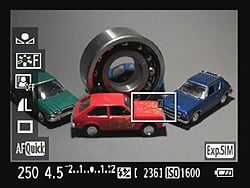 |
 |
|
When using contrast-detect ("Live") AF, the focus area is bounded by a white rectangle. It can be moved around the frame (except to extreme edges), to select the desired focus area. The focus area is highlighted in green when focused, just like a Canon point-and-shoot. If focus is not achieved, the box turns red. There is also a "Live face detection" mode, which can detect multiple faces. If the face selected by the camera (as indicated by a white frame) is not the face you intended, you can select another detected face by using the left and right arrow keys to move the frame.
|
Pressing the zoom button magnifies what's in the magnifying frame by 5x. Pressing the zoom button again zooms in to 10x, great for checking critical focus, or for manually focusing. You can move the magnified area around in the box, using the legend at bottom right as a guide. If "Face Detection Live AF" mode is enabled, magnifying the image is not possible, though you can always check critical focus by magnifying the captured image, or temporarily switching to Manual focus mode.
|
Video
Check out the links below for more sample images, videos and image quality analysis:
- Canon EOS Rebel T2i (EOS 550D) Optics page (Crops from images shot with the camera's kit lens, if sold as a kit)
- Canon EOS Rebel T2i (EOS 550D) Sample Images page (Index to all standard test shots, with explanations)
- Canon EOS Rebel T2i (EOS 550D) Thumbnails page (Thumbnails of all shots, including RAWs, with EXIF data)
- Canon EOS Rebel T2i (EOS 550D) Gallery page (Regular photos taken with the Canon EOS Rebel T2i (EOS 550D))
Canon T2i Video Recording
High-definition video capture has rapidly become a must-have feature in this year's digital SLRs, with advanced amateurs and budget-minded professionals alike excited by the possibility of using the same camera body and lenses for both still and movie shooting. Most digital SLR video modes to date have had limitations in terms of control and output formats that have tempered this excitement somewhat, however.
The Canon Rebel T2i's includes similar video functionality to that of Canon's semi-pro EOS 7D model, with an unusually robust feature set that gives the photographer more control over their movies, as well as the ability to record audio from an external source. Both shutter and aperture are available for manual control, and the T2i also provides multiple frame rate options, including three that match the HD television timing specs. Unlike most digital SLR video modes including the EOS 7D, the Canon T2i caters to advanced amateurs by allowing continuous autofocus during video recording, albeit with AF noise clearly picked up by the T2i's internal microphone. Pros will likely want to control focus manually regardless, but amateurs will need to decide whether the convenience of AF is worth the drawbacks.
Canon Rebel T2i Video: Image Size, Frame Rate, and Encoding
Video capability. The Canon Rebel T2i offers three resolution levels for video recording, with various frame rates available depending on encoding and resolution.
Individual movie clips captured by the Canon Rebel T2i are limited to a maximum of twelve minutes in the high definition 1080p and 720p modes, or 24 minutes in the standard definition VGA mode. (Canon didn't give a reason for this, but perhaps it's a matter of power consumption and sensor heating: We noticed that the body can get rather warm after an extended period of video shooting.) The Canon T2i records its movies as MOV files using variable bitrate MPEG-4 AVC / H.264 compression, which is much more conservative of memory card space than the Motion JPEG format used by some cameras, and avoids some of the severe image quality loss suffered by AVCHD cameras when faced with significant amounts of change in image content between frames. (AVCHD uses a subset of the H.264 standard, among other things mandating a limit in recording bandwidth, which translates into a lesser ability to convey rapidly-changing detail.) The choice of H.264 comes with the requirement of greater processing power, though -- not only from the camera when recording, but also when playing back or editing videos. The more sophisticated encoding used in the H.264 standard requires quite a bit of processor power to pull it apart and put it back together again, so frame-accurate editing of H.264 requires a fast processor and capable editing program.
Here's a list showing what to expect for file sizes with the Canon Rebel T2i's video recording:
|
Canon T2i Video Options |
||||
|---|---|---|---|---|
|
H.264 Format (.MOV file container) |
||||
|
Resolution |
Encoding |
Frame Rate |
Clip Length |
File Size
|
|
1,920 x 1,080 |
NTSC |
24p (23.976 fps) |
12 minutes |
~330 MB/min
|
|
NTSC |
30p (29.97 fps) |
|||
|
PAL |
24p (23.976 fps) |
|||
|
PAL |
25p (25 fps) |
|||
|
1,280 x 720 |
NTSC |
60p (59.94 fps) |
12 minutes |
~330 MB/min |
|
PAL |
50p (50 fps) |
|||
|
640 x 480 |
NTSC |
60p (59.94 fps) |
24 minutes |
~165 MB/min
|
|
PAL |
50p (50 fps) |
|||
Canon recommends using an SD card with at least a Class 6 rating to capture and playback movies.
Here are some examples of video from the Canon Rebel T2i, showing typical results under daylight conditions.
|
Canon Rebel T2i Video Samples
|
|
|---|---|
|
|
 |
 |
 |
 |
 |
 |
 |
 |
 |
 |
|
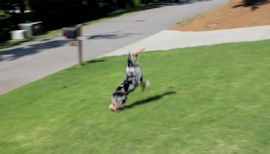
Canon Rebel T2i Video-Mode Focusing

Autofocus noise. The Canon T2i is unusual in allowing autofocus during movie recording, but with the bundled 18-55mm kit lens, noise from the focus motor can be very clearly picked up for all but the most subtle autofocus adjustments. (Shot in standard definition VGA mode.) File Size: 27.5MB
Unlike most other video-capable digital SLRs, the Canon Rebel T2i offers autofocusing during video recording -- but only in single servo mode. You can trigger a contrast-detect AF cycle either before or during a recording by half-pressing the shutter button, but depending on the lens and microphone in use, and the degree of focus adjustment required, AF noise is likely to be picked up on the audio track. (With the 18-55mm kit lens, and the T2i's internal microphone, AF noise is picked up very clearly as a high-pitched whine.) You can also manually focus the lens during a recording, and the true manual operation of AF on Canon's lenses means you can do this more or less silently, simply by being careful about turning the focus ring. (We recently tested the Olympus E-P1, which uses "fly by wire" focusing, whereby the focus ring only instructs the camera to move the lens elements rather than moving them directly via a mechanical coupling. This meant that small clicks could be heard on the audio track every time the E-P1 changed the focus setting, regardless of how slowly we turned the focus ring. With true manual operation of its lenses, the Canon Rebel T2i doesn't have this problem, although it's possible that a third-party or older Canon lenses might produce audible noise while their focus was adjusted.)
As we've noted in other SLR reviews, the good news with focusing for video is that you can get surprisingly good depth of field in video mode by stopping the lens down, thanks to the relatively low resolution of the video image. With a pixel resolution of only 2.1 megapixels in the Canon Rebel T2i's highest-resolution 1080p Full HD mode, 0.9 megapixels in 720p HD mode, and just 0.3 megapixels in VGA mode, images that would be unacceptably blurred as 18 megapixel still shots look perfectly fine as video frames. This not only provides greater depth of field at any given aperture, but is also more forgiving of diffraction limiting at very small lens apertures. Diffraction at small apertures means you'd usually want to avoid f/16 or f/22 for still images, but again, the results generally look perfectly fine at video resolutions. Bottom line, with the Rebel T2i's lens set to f/16 or f/22 (assuming you're shooting under fairly bright conditions), you'll be surprised by how little focus adjustment is needed during a typical video recording.
Canon Rebel T2i VGA Movie Crop


VGA Movie Crop. Another particularly unusual feature of the T2i is its movie crop mode. Both videos above were shot with the 18-55mm IS kit lens at its 55mm position, and from the same location. In the lower video, the camera crops the central 640 x 480 pixels from the image sensor, rather than downsampling data from across the sensor area. File Sizes: 27.5MB
Another feature of the Canon T2i's movie mode that's not available on the EOS 7D is its VGA Movie Crop function, and indeed, we believe it to be unique among SLR and SLD movie modes from any brand at the time of this writing. The Movie Crop function aims to solve a problem faced by consumers, namely that expensive telephoto lenses generally carry hefty price tags that place them far out of reach of the casual amateur. Ordinarily, the Canon T2i's movies are recorded using data from across the image sensor area. With Movie Crop mode enabled, however, the T2i instead crops only the centermost pixels from its sensor data for recording, and discards the rest. The feature is only available when recording at VGA (640 x 480 pixel) resolution, and yields an effective 7x magnification.
There's no free lunch, of course. While magnifying your subject to bring you close to the action, the Movie Crop mode also magnifies image defects. Since lens defects are generally most prominent towards the corners, the crop mode avoids the worst of these issues by using the sweet spot at the center of the lens. The effects of focus errors, diffraction limiting, and high ISO noise can prove another matter entirely. Videos shot in the VGA Crop mode are decidedly soft compared to the standard VGA mode, and can quickly get noisy if ambient lighting isn't ideal. For the T2i's target market, though, such defects will likely prove relatively acceptable, when compared to the cost of obtaining a lens of equivalent focal lengths.
Canon Rebel T2i Video Exposure Control
Many video-capable SLRs only offer automatic exposure in their movie modes, but the Canon Rebel T2i gives you a choice of either automatic or manual exposure modes. In Auto mode, the camera adjusts the shutter speed and aperture as needed for a correct exposure, keeping things simple. 3.0EV of exposure compensation is available in 1/3 EV steps, to ensure exposure is as intended. Auto exposure mode is the default when you first place the Mode dial in the Movie position, and Manual mode is accessed from the Movie Exposure option in Movie Menu 2. In Manual mode, simultaneous control of both the shutter speed, aperture, and (optionally) the ISO sensitivity is possible. This is great news -- the ability to control depth of field or freeze action is very useful, giving you significantly more creative control over your videos. (Given the slow default shutter times of most video-capable digital SLRs, the T2i included, a higher shutter speed to freeze fast motion is almost a necessity for good-quality video of anything moving.) Note, though, that although you can control shutter speed, this doesn't prevent the so-called "Jello effect", more properly known as rolling shutter artifacts. Like other digital SLRs, the progressive manner in which the Canon T2i clocks data off its sensor means that sudden camera or subject movements can cause distortion, although this is less of an issue for the T2i than in some cameras.
Canon Rebel T2i Video: Audio recording

External Mic. The Rebel T2i's Mic jack resides on the camera's left side under a rubber panel, alongside the camera's other various connectors.
Canon Rebel T2i Movie Recording User Interface
 The Canon Rebel T2i's video mode is accessed via a dedicated position on the camera's mode dial. A Live View / Movie button to the right of the viewfinder is used to start and stop recording when the Mode dial is in the Movie position, and acts as a Live View button in other modes. Setting adjustments in movie mode are made via two dedicated Movie menus, which are only available when the camera is in Movie mode. Still images can be captured in Movie mode, interrupting the movie for about 1 second, by pressing the Shutter button. Since this is also used to trigger an autofocus cycle with a half-press, an option in the Movie menu allows autofocusing to be temporarily disabled by holding the the * button, enabling a still image to be captured during movie recording without first triggering an AF cycle. Autoexposure is used, unless manual exposure is chosen. Flash is not supported.
In Playback mode, the Canon T2i allows you edit out or trim the first and/or last scenes of a movie, in one second increments. You can save the trimmed movie to a new file (if there is space on the card), or choose to overwrite the original. Movies can be played back at normal speed, or in slow-motion, with adjustable playback frame rate. There are "VCR" like controls for advancing to the next or last frame, or playing from the previous or first frame.
Canon Rebel T2i Video Quality
As compared to the video from other cameras we've tested, we found the Canon Rebel T2i's video to be relatively immune to motion-induced compression artifacts that we've seen when recording in AVCHD mode (as noted, the T2i uses the broader H.264 spec). Its rolling shutter artifacts also don't seem quite as pronounced on some cameras, although they're still very evident when you pan the camera quickly while recording.
Rolling Shutter Artifacts
Essentially every video capable digital SLR currently on the market exhibits motion-related distortions called rolling shutter artifacts. These are caused because the image data is captured and then read off the chip sequentially by rows, rather being captured all at once. In the case of the Canon Rebel T2i, with its variable frame rate, this means that image data for the last row of a given frame is captured and read out anywhere from 1/24th to 1/60th second after the data for the top row was captured. The effect on moving objects is similar to that of a focal plane shutter in an SLR, but more pronounced, because the video frame is read out much more slowly than the slit of a focal plane shutter moves across the sensor.
For a camera that scans video frames vertically (as all do that we're aware of), rolling shutter artifacts will be most noticeable for subjects that are moving rapidly side to side, or when the camera itself is being panned horizontally. Verticals in the scene will appear tilted to the right or left, depending on the direction of camera motion. As an example, consider the case of a camera being panned from left to right, with a flagpole or other vertical object in the middle of the scene when recording for a particular frame begins: If the top of the object was centered horizontally when the first line of the video frame is acquired, by the time the last line of the frame has been captured, the bottom of the object will have shifted to somewhere left of center: As a result, the vertical object would appear to be leaning to the right.
The visual impact of rolling shutter artifacts on the Canon Rebel T2i seemed a bit less noticeable than in some other recent digital SLRs, but as noted, it's still a factor.
Exposure Curve
The Canon T2i's video exposure system operates either in a normal programmed-exposure mode, where the camera selects aperture, shutter speed, and ISO, or you can select Manual exposure mode via a menu option. Manual exposure mode is entirely manual, in that you're responsible for setting all three exposure parameters; there's no option for shutter or aperture priority. This can be a little challenging, if your light source is subject to variation, but it does give you the ultimate in control, and is a feature offered by relatively few video-capable SLR/SLD cameras.
While most consumer-level video SLR/SLDs on the market weight their exposure curve towards shorter exposure times, the Canon T2i's follows a different path, with its programmed exposure heavily favoring lower shutter speeds; on the order of 1/60 to 1/30 second. It turns out that this was a very deliberate choice by Canon, as the motion blur from the slow shutter speed makes for much smoother-looking video on playback. While detail in rapidly moving subjects is indeed blurred, that blurring helps merge the image from one frame into the next, giving the impression of more continuous motion. By comparison, if a video recording of fast action is made using very high shutter speeds, the result can be very choppy-looking, with rapidly-moving parts of the image appearing as multiple, crisp images. This effect is particularly acute at low frame rates such as 24 or 30 frames/second.
Recognizing this, Canon opts for video shutter/aperture exposure curves in its SLRs that try as much as possible to keep the shutter speed from rising much above the inverse of the frame rate, whether 24, 30, or 60 frames/second. When shooting in bright, sunny conditions, this can result in very small lens apertures, that in turn result in soft images due to diffraction limiting. When shooting the videos seen on this page of Charlotte chasing her Frisbee, I noticed that the camera was using apertures as small as f/29, even when set to the lowest ISO available. With a top video resolution of just over 2 megapixels, diffraction limiting is much less of a concern than when shooting at the Canon T2i's maximum 18-megapixel still image resolution, but even at video resolution, images shot at f/29 are going to look pretty soft.
| Canon T2i Video Exposure Curve Examples
|
|
|---|---|
 |
 |
The Canon T2i's video exposure program is weighted toward slow shutter speeds. The significant blurring this produces with fast-moving subjects isn't nearly as evident in the live video as it is in the crop above: The video just looks "smooth" to the eye. |
While the motion blur may actually help the visual appeal of the Canon T2i's videos, the tiny apertures required by the slow shutter speeds when shooting under full sunlight result in images that are soft overall. This crop is from a video shot in programmed exposure mode, with an auto aperture value of f/29. Tons of DOF, but nothing is really crisp. |
 |
 |
In manual video exposure mode, you can select whatever combination of ISO, shutter speed and aperture you want. This crop is from a frame captured with a shutter speed of 1/1000th second. While the individual frames are very crisp, such a short shutter speed makes for rather choppy-looking motion. |
The high shutter speed lets you use a more reasonable aperture, though, which makes for much sharper images. As long as you don't have fast-moving subjects in the scene, you aren't likely to notice the choppy motion, so the faster shutter speed may be a worthwhile trade-off, to avoid diffraction limiting. |
The very smooth appearance of the Canon T2i's videos is perhaps worth the resolution trade-off when shooting under bright lighting, but a fairly strong neutral density (ND) filter should be considered an essential accessory, if you want to get the maximum video image quality when shooting in bright sunlight. Consider at least an ND 0.9 (3 stops of light reduction) for direct sunlight, and even more could be helpful. (ND filters are frequently sold in sets of three, with ND values of 0.3, 0.6, and 0.9. Such a set gives a total range of 1 to 6 stops of exposure reduction, in steps of 1 EV, and would make a good investment for a video enthusiast.)
Of course, the problem with an ND filter is that it makes the viewfinder image proportionately dimmer as well. A very dark ND filter could make it tricky to switch between video recording using the Live View display for framing and shooting stills with the optical viewfinder.
Low-light video with the Canon T2i
The Canon T2i takes full advantage of its high-ISO capability when recording videos: Its video auto-exposure curve will adjust the ISO as high as ISO 6,400, if necessary. You do pay a price, though, in that the video at ISO 3,200 is visibly noisy, and more so at ISO 6,400. That said, it's really pretty amazing that the Canon T2i's video is as clean as it is at such high ISOs.
One thing to note about low-light video recording with the Canon T2i: Exposure time is obviously limited by the frame rate. (You can't have a shutter speed of 1/30 second when the frame rate is 60 fps.) As a result, you'll get the best low-light results in one of the 1,080i resolution modes, because the frame rate at 720p and 480p resolutions is fixed at 60fps. The slower 30fps or 24fps frame rates of the 1,080i modes can make a real difference in how bright your videos are.
| Canon T2i Video: Low-light examples
|
|
|---|---|
 |
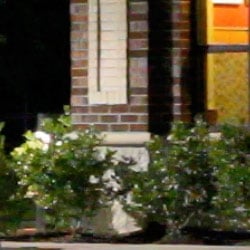 |
This crop is from a night scene under typical urban street lighting, captured in Auto mode. The camera indicated it was using ISO 3,200 for this clip, and the resulting video is surprisingly clean. Some noise is evident during playback, but it isn't nearly as bad as we had been expecting. |
In manual mode, at ISO 6,400, there's visibly more noise (more visible during playback than in the static frame crop above), but it'd probably be tolerable for amateur use. Given that this is fairly typical urban lighting, the Canon T2i should be able to handle just about anything most consumers or amateurs would care to throw at it. |
 |
 |
Switching to 720p mode results in much less light-gathering ability, thanks to the fixed 60fps frame rate. The shorter shutter time was just a reach too far for the T2i in this shot: The whole image is rather dark, and there's a lot more noise visible everywhere. |
Dropping to 480p resolution helps slightly with the noise, but this light level really requires the slower 1/30 second shutter speed afforded by 1,080i recording. |
Bottom line, while the Canon T2i may not have the low-light chops of its big brother the EOS 5D Mark II, it's a great performer within its price range.
Computer Requirements for Viewing HD Video
A typical computer these days has little trouble dealing with still images, but high-definition video can be another matter. Depending on the file format involved, it can take a pretty beefy computer to handle HD-resolution video playback without stuttering or dropping frames. The AVC / H.264 image compression used by the Canon Rebel T2i is one of the more compute-intensive formats, and its 1,920 x 1080 (1080p) resolution means there's a lot of data in each frame to deal with at full resolution. The net result is that you'll want a relatively recent and powerful computer to play full-res high-def video files from the Rebel T2i on your computer. At lower resolutions, the requirements will be more modest. We found that we could run the T2i's video acceptably at half size on an older G5 Power Mac with dual 2.3GHz processors, so long as nothing else was running simultaneously, so it definitely seems less processor intensive than full HD video from many other cameras, including some using Motion JPEG compression.
You can of course view your movies on a TV, either via the composite A/V Output, or on an HDTV via the HDMI output. Both terminals cannot be used simultaneously.
Canon T2i Video: Summary
With its broad range of options for resolution and frame rate (either 24 or 30 fps at 1,080i resolution, 60 fps at 720p and 480p), its choice of either auto or full-manual exposure control, its external audio input jack, and exceptional high-ISO capability, the Canon T2i is an unbeatable package for the video enthusiast shopping within its price range. For best results under direct sunlight, the enthusiast will want to pick up one or two neutral density filters to permit more reasonable lens apertures with auto exposure under direct sunlight, but the average consumer may not notice the softness produced by too-small lens apertures. At the other end of the exposure scale, the Canon T2i delivers excellent video quality in quite dim conditions, recording very usable video under typical nighttime city street lighting. Pure consumers (or still-photo enthusiasts just looking for easy, casual video recording) may miss the live (continuous) autofocus capability found in recent SLD-type models from Panasonic, Sony, and Olympus, but then the depth of field provided by the T2i's exposure curve gives enough depth of field to accommodate quite a range of subject motion. All in all, the Canon T2i delivers impressive video capabilities for its under-$1,000 price point.
Flash
Canon T2i Flash

The Rebel T2i's built-in flash has a guide number rating of 43 feet (13 meters) at ISO 100, translating to a range of about 12 feet at ISO 100 with the kit lens at wide-angle (at f/3.5) and about 7.5 feet at telephoto (at f/5.6) . The Canon T2i gives you a lot of control over flash exposure, allowing you to adjust flash and ambient exposure independently of each other, in one-half or one-third EV increments. This makes it easy to balance flash and ambient lighting for more natural-looking pictures. The Rebel T2i also uses E-TTL II control for both the built-in and compatible external flashes (according to Canon this includes the older 550EX flash, as well as the newer models), a standard that promises, and seems to deliver, better, more balanced exposures. (TTL refers to "Through The Lens" metering.)
Another nice touch is the Canon T2i's Flash Exposure Lock button, which fires the flash under manual control before the actual exposure, to determine the proper exposure setting. This struck us as very handy, akin to the more conventional autoexposure lock function for handling difficult ambient lighting conditions. A Flash Exposure Compensation feature controls the flash exposure +/- 2 stops in 1/2 or 1/3-stop increments.
As you'd expect, there is a dedicated flash hot-shoe on the Canon T2i's pentamirror housing, for use with external flash units. Like most consumer SLRs, the Canon T2i offers no PC-Sync connector for triggering studio strobes, etc. Maximum flash x-sync speed is 1/200-second.
 In common with almost all Canon SLRs (the sole exception being the EOS 7D), wireless remote flash is only possible when using an external Speedlite 580EX II (or the now-discontinued 580EX) flash strobe, or the Speedlite Transmitter ST-E2, mounted on the camera. Canon's Speedlite 270EX, 430EX II, and 580EX II (as well as certain of its historic flash models) also enable advanced features such as true FP (focal plane, referred to as HS) flash sync, flash exposure bracketing with external flash units, flash modeling, and E-TTL II exposure control. FP sync requires a flash unit to provide uniform light output for a relatively long period of time, long enough for the focal plane shutter curtain to fully traverse the sensor plane. Uniform, long-duration flash pulses like this permit use of shutter speeds as high as the 1/4,000-second maximum that the Canon T2i is capable of. This can be invaluable when you want to exclude ambient light from the exposure.
Flash Test Results
Coverage and Range
A moderately powerful flash with uneven coverage at wide-angle with the kit lens. Average positive exposure compensation required.


Coverage. The Canon T2i's flash coverage was quite uneven at wide-angle. (The 18mm example above was shot with the T2i's Lens Peripheral Illumination Correction enabled by default, so falloff due to the lens itself has been corrected.) The flash's coverage was much more even at telephoto.
Exposure. Indoors, under incandescent background lighting, the Canon T2i's flash performed quite well, requiring about average positive exposure compensation of +0.7 EV for a reasonably bright image. The camera's slow-sync flash mode only required a +0.3 EV boost, though the longer shutter time results in a warmer cast from the ambient background lighting.
| Flash Range: Wide Angle | |||||
|---|---|---|---|---|---|
| 6 ft | 7 ft | 8 ft | 9 ft | 10 ft | 11 ft |
 1/64 sec f3.5 ISO 100 |
 1/64 sec f3.5 ISO 100 |
 1/64 sec f3.5 ISO 100 |
 1/64 sec f3.5 ISO 100 |
 1/64 sec f3.5 ISO 100 |
 1/64 sec f3.5 ISO 100 |
| 12 ft | 13 ft | 14 ft | 15 ft | 16 ft | |
 1/64 sec f3.5 ISO 100 |
 1/64 sec f3.5 ISO 100 |
 1/64 sec f3.5 ISO 100 |
 1/64 sec f3.5 ISO 100 |
 1/64 sec f3.5 ISO 100 |
|
| Flash Range: Telephoto | |||||
|---|---|---|---|---|---|
| 6 ft | 7 ft | 8 ft | 9 ft | 10 ft | 11 ft |
 1/64 sec f5.7 ISO 100 |
 1/64 sec f5.7 ISO 100 |
 1/64 sec f5.7 ISO 100 |
 1/64 sec f5.7 ISO 100 |
 1/64 sec f5.7 ISO 100 |
 1/64 sec f5.7 ISO 100 |
| 12 ft | 13 ft | 14 ft | 15 ft | 16 ft | |
 1/64 sec f5.7 ISO 100 |
 1/64 sec f5.7 ISO 100 |
 1/64 sec f5.7 ISO 100 |
 1/64 sec f5.7 ISO 100 |
 1/64 sec f5.7 ISO 100 |
|
ISO 100 Range. The Canon T2i's flash was bright and fairly powerful. Set to its maximum 18mm wide-angle setting, the test shots showed no appreciable falloff in brightness out to about 12 feet. At full telephoto, flash intensity started out a little dim, but maintained good brightness until about 9 feet at 55mm.
| Manufacturer-Specified Flash Range | |
|---|---|
| Wide Angle | Telephoto |
 12.0 feet ISO 100 |
 7.5 feet ISO 100 |
Manufacturer Specified Flash Test. The Canon T2i's built in flash has a rated Guide Number of 13 meters or 43 feet at ISO 100. That works out to 12 feet at f/3.5 and 7.5 feet at f/5.6, the maximum apertures of the kit lens at wide-angle and telephoto respectively. In the two shots above, we can see that the Canon T2i's flash performs almost to specification, producing usable but slightly dim images at both zoom settings. At wide-angle, the exposure is only about 1/6 EV lower than ideal, while at telephoto it's underexposed by about 1/2 EV.
Note: Our standard test method for flash range uses a fixed setting of ISO 100, to provide a fair basis of comparison between cameras. We've now also begun shooting two shots using the manufacturer-specified camera settings, at the range the company claims for the camera, to assess the validity of the specific claims.
High ISO Noise Reduction
Canon EOS T2i High ISO Noise Reduction
The Canon T2i offers four settings for noise reduction: Disable, Low, Standard and Strong, and NR is applied at all ISOs. Its different noise-reduction settings also allow you quite a bit of flexibility in choosing how you want to make the trade-off between subject detail and noise levels. It's not clear that the "Disable" setting truly eliminates the noise processing altogether, but it is true that it leaves a lot of fine/subtle subject detail there for you to work with. The combination of shooting with NR "Disabled" and using a good noise-filtering program after the fact can produce very clean images with lots of fine detail in them.
See for yourself how the noise reduction works under both daylight and tungsten-balanced lighting. Click on any of the crops below to see the corresponding full-sized image.
| High ISO Noise Reduction Settings Comparison Daylight-balanced illumination |
||||
|
|
Disable
|
Low
|
Standard
|
Strong
|
|
I
S O 8 0 0 |
 |
 |
 |
 |
 |
 |
 |
 |
|
 |
 |
 |
 |
|
|
|
Disable
|
Low
|
Standard
|
Strong
|
|
I
S O 1 6 0 0 |
 |
 |
 |
 |
 |
 |
 |
 |
|
 |
 |
 |
 |
|
|
|
Disable
|
Low
|
Standard
|
Strong
|
|
I
S O 3 2 0 0 |
 |
 |
 |
 |
 |
 |
 |
 |
|
 |
 |
 |
 |
|
|
|
Disable
|
Low
|
Standard
|
Strong
|
|
I
S O 6 4 0 0 |
 |
 |
 |
 |
 |
 |
 |
 |
|
 |
 |
 |
 |
|
|
|
Disable
|
Low
|
Standard
|
Strong
|
|
I
S O 1 2 8 0 0 |
 |
 |
 |
 |
 |
 |
 |
 |
|
 |
 |
 |
 |
The above crops show the effects of the four levels of high ISO noise reduction, under our studio HMI lighting we use to simulate daylight. The Standard setting strikes a good balance between noise and detail, however subtle detail in the red cloth swatch already suffers quite a bit at ISO 1,600.
How does the Canon T2i compare with competing models? See the following table which compares at the default Noise Reduction setting.
| High ISO Comparison with Canon EOS 7D, Nikon D90, and Pentax K-7 (All default NR) Daylight-balanced illumination |
||||
|
|
Canon T2i
|
Canon 7D
|
Nikon D90
|
Pentax K-7
|
|
I
S O 8 0 0 |
|
 |
 |
 |
|
 |
 |
 |
|
|
 |
 |
 |
|
|
|
Canon T2i
|
Canon 7D
|
Nikon D90
|
Pentax K-7
|
|
I
S O 1 6 0 0 |
|
 |
 |
 |
|
 |
 |
 |
|
|
 |
 |
 |
|
|
|
Canon T2i
|
Canon 7D
|
Nikon D90
|
Pentax K-7
|
|
I
S O 3 2 0 0 |
|
 |
 |
 |
|
 |
 |
 |
|
|
 |
 |
 |
|
|
|
Canon T2i
|
Canon 7D
|
Nikon D90
|
Pentax K-7
|
|
I
S O 6 4 0 0 |
|
|
 |
 |
|
|
 |
 |
|
|
|
 |
 |
|
|
|
Canon T2i
|
Canon 7D
|
Nikon D90
|
Pentax K-7
|
|
I
S O 1 2 8 0 0 |
|
 |
N/A
ISO 12,800 Not Supported |
N/A
ISO 12,800 Not Supported |
|
 |
N/A
ISO 12,800 Not Supported |
N/A
ISO 12,800 Not Supported |
|
|
 |
N/A
ISO 12,800 Not Supported |
N/A
ISO 12,800 Not Supported |
|
Here, the Nikon D90 performs the best at higher ISOs, but also has the lowest resolution and therefore the largest photosites of the group. It also shows more sharpening artifacts, which can lead to rough edges. Canon T2i images are smoother looking at high ISOs, and there's no denying the extra resolution the T2i offers over the D90. The Canon T2i performs slightly better than its more expensive sibling, the Canon EOS 7D, and quite a bit better than the Pentax K-7.
Here's a comparison with some less expensive models:
| High ISO Comparison with Canon T1i, Nikon D5000, and Pentax K-x (All default NR) Daylight-balanced illumination |
||||
|
|
Canon T2i
|
Canon T1i
|
Nikon D5000
|
Pentax K-x
|
|
I
S O 8 0 0 |
|
 |
 |
 |
|
 |
 |
 |
|
|
 |
 |
 |
|
|
|
Canon T2i
|
Canon T1i
|
Nikon D5000
|
Pentax K-x
|
|
I
S O 1 6 0 0 |
|
 |
 |
 |
|
 |
 |
 |
|
|
 |
 |
 |
|
|
|
Canon T2i
|
Canon T1i
|
Nikon D5000
|
Pentax K-x
|
|
I
S O 3 2 0 0 |
|
 |
 |
 |
|
 |
 |
 |
|
|
 |
 |
 |
|
|
|
Canon T2i
|
Canon T1i
|
Nikon D5000
|
Pentax K-x
|
|
I
S O 6 4 0 0 |
|
 |
 |
 |
|
 |
 |
 |
|
|
 |
 |
 |
|
|
|
Canon T2i
|
Canon T1i
|
Nikon D5000
|
Pentax K-x
|
|
I
S O 1 2 8 0 0 |
|
 |
N/A
ISO 12,800 Not Supported |
 |
|
 |
N/A
ISO 12,800 Not Supported |
 |
|
|
 |
N/A
ISO 12,800 Not Supported |
 |
|
Here, the Canon T2i does well against its less expensive sibling, the Canon T1i, despite having smaller photosites. The Nikon D5000 still shows more detail in the red leaf fabric, but tends to show more sharpening artifacts, and a bit more chroma noise in the shadows. The Pentax K-x also struggles with red leaf detail at ISO 1,600 and above, but generally delivers pretty clean images if also a bit oversharpened.
Keep in mind these comparisons are at default settings, and that each manufacturer has its own definition of "normal" noise reduction. We'll be adding a RAW crop page once our standard RAW converter (dcraw) supports the T2i. Converting from RAW eliminates most if not all of the differences due to in-camera processing, and will give a much better indication of how the sensors compare in terms of noise performance.
Imatest Results
Canon T2i Imatest Results
We routinely use Norman Koren's excellent "Imatest" analysis program for quantitative, thoroughly objective analysis of digicam test images. I highly recommend it to our technically-oriented readers, as it's far and away the best, most comprehensive analysis program I've found to date.
My comments below are just brief observations of what we see in the Imatest results. A full discussion of all the data Imatest produces is really beyond the scope of this review: Visit the Imatest web site for a full discussion of what the program measures, how it performs its computations, and how to interpret its output.
Here's some of the results produced by Imatest for the Canon T2i:
The Canon T2i showed very good color accuracy overall. Hue accuracy was really excellent (among the very best we've seen), with what little hue shift occurred taking place mostly in cyan, sky blue, red and orange. Average saturation was slightly high at 111% (oversaturated by 11%, mostly in the blues, reds, oranges and dark greens), but not unusually so for a consumer model. Average "delta-C" color error was a very low 4.04 after correction for saturation, which is excellent. All in all, a very good color response for an SLR. Mouse over the links below the illustration above to compare results with competing models.

Using the Adobe RGB color space (which provides a much wider gamut, or range of colors that can be expressed), the Canon T2i delivers more highly saturated color, as is usually the case. The average saturation was 118.8% or 18.8% oversaturated. Average saturation-corrected hue error of 5.15 "delta-C" units, which is more accurate than most of the competition here. Again, mouse over the links below the illustration above to compare results with competing models.
Canon T2i Color Analysis

This image shows how the Canon T2i actually rendered the colors of the MacBeth chart, compared to a numerically ideal treatment. In each color swatch, the outer perimeter shows the color as actually captured by the camera, the inner square shows the numerically correct color after correcting for the luminance of the photographed chart (as determined by a second-order curve fit to the values of the gray swatches), and the small rectangle inside the inner square shows the numerically correct color, without the luminance correction. This image shows the Canon T2i's excellent hue accuracy, as well as a gamma curve that results in some overexposure of highly saturated swatches. (This seems to be a fairly common tactic, to produce "bright" color that's appealing to consumers, without further overdoing the saturation.)
The bottom row of the chart shows exaggerated white balance errors, revealing that the camera produced a fairly neutral color balance when using Custom white balance, with a WhiBal card as the reference.
Canon T2i Noise Analysis

There's a lot in this particular graph, a lot more than we really have room to go into here. (This set of plots has also changed a few revisions back in Imatest. Some of the plots that were once shown here are now shown in other Imatest output. Since we largely focus on the Noise Spectrum plot, we only show the graphic above, which includes that plot.)
In comparing these graphs with those from competing cameras, we've found that the Noise Spectrum graph at lower right is the most important. Cameras that manage to shift their noise spectrum to higher frequencies have much finer-grained noise structures, making their noise less visually objectionable. In the graph above, this would show up as a noise spectrum curve that remained higher on the right side, representing higher noise frequencies.
Above, we see the results at ISO 100, which is the Canon T2i's base ISO. The luminance curve is reasonably flat, but the red, blue and green color channels exhibit much higher noise values at lower frequencies. While overall noise levels are very low, the dominance of low frequencies in the color channels points to some low-level blotchiness. Some chroma noise blotches can be seen in darker midtone and shadows of the Canon T2i's ISO 100 images, but only with extreme pixel-peeping.

Here's the same set of noise data at ISO 3,200. Here, the Noise Spectrum graph is shifted towards the left-hand, lower-frequency side than it was at ISO 100. This indicates a coarsening of the "grain" of the image noise patterns by quite a bit, and indeed that's what we see when inspecting the T2i's ISO 3,200 images. The chrominance channels' noise spectrum follows that of the luminance channel much more closely, a result of the default high ISO noise reduction applied, but is still a bit higher at very low frequencies. This can be seen in high ISO images as large but subtle blotches of chroma noise in darker areas, spread across multiple pixels. That said, the Canon T2i does a better than average job at keep chrominance noise in check.

Here's the same set of noise data at ISO 6,400. Very similar to ISO 3,200, but overall noise levels are 50-100% greater.

Here's the same set of noise data at ISO 1,2800, the Canon T2i's maximum ISO. Very similar to ISO 6,400, but even higher noise levels overall. There's also a larger shift to the left, indicating a further coarsening of the grain pattern, and the low-frequency spike in the red channel is more pronounced.

This chart compares the Canon T2i's noise performance over a range of ISOs against that of other competing cameras, using default settings. (We also compared it to the Canon 7D, since it uses a similar sensor.) While we continue to show noise plots of this sort because readers ask for them, we each time point out that the noise magnitude is only a small part of the story, the grain pattern and the amount of detail preserved are much more important. In the case of the Canon T2i, the noise magnitude starts out slightly lower than all the competition at ISO 100, and remains lower than the competition except compared to the Nikon D90 at ISOs 3,200 and 6,400, where it is slightly higher. Keep in mind these are at default settings, so the shape and positions of the curves will be influenced by your settings. The Canon T2i offers four high ISO NR settings: Disable, Low, Standard and Strong. Although it's called high ISO NR, it is applied at all ISOs.
Canon T2i Dynamic Range Analysis
A key parameter in a digital camera is its Dynamic Range, the range of brightness that can be faithfully recorded. At the upper end of the tonal scale, dynamic range is dictated by the point at which the RGB data "saturates" at values of 255, 255, 255. At the lower end of the tonal scale, dynamic range is determined by the point at which there ceases to be any useful difference between adjacent tonal steps. Note the use of the qualifier "useful" in there: While it's tempting to evaluate dynamic range as the maximum number of tonal steps that can be discerned at all, that measure of dynamic range has very little relevance to real-world photography. What we care about as photographers is how much detail we can pull out of the shadows before image noise becomes too objectionable. This, of course, is a very subjective matter, and will vary with the application and even the subject matter in question. (Noise will be much more visible in subjects with large areas of flat tints and subtle shading than it would in subjects with strong, highly contrasting surface texture.)
What makes most sense then, is to specify useful dynamic range in terms of the point at which image noise reaches some agreed-upon threshold. To this end, Imatest computes a number of different dynamic range measurements, based on a variety of image noise thresholds. The noise thresholds are specified in terms of f-stops of equivalent luminance variation in the final image file, and dynamic range is computed for noise thresholds of 1.0 (low image quality), 0.5 (medium image quality), 0.25 (medium-high image quality) and 0.1 (high image quality). For most photographers and most applications, the noise thresholds of 0.5 and 0.25 f-stops are probably the most relevant to the production of acceptable-quality finished images, but many noise-sensitive shooters will insist on the 0.1 f-stop limit for their most critical work.
The image below shows the test results from Imatest for an in-camera JPEG file from the Canon T2i with a nominally-exposed density step target (Stouffer 4110), and the Canon T2i's settings at their default positions, except Auto Lighting Optimization, which was set to Off. (We'll try to come back and add results for ALO at the default "Standard" setting.)

These are good results for in-camera JPEGs, though a notch below the top performers when comparing numbers for the High quality threshold (7.53 f-stops). The tone curve shows excellent gradation in highlights but tails-off more abruptly in the shadow end. This can be seen when closely inspecting shots captured by the Canon T2i, where detail is held very nicely in strong highlights, but somewhat less so in the deepest shadows.
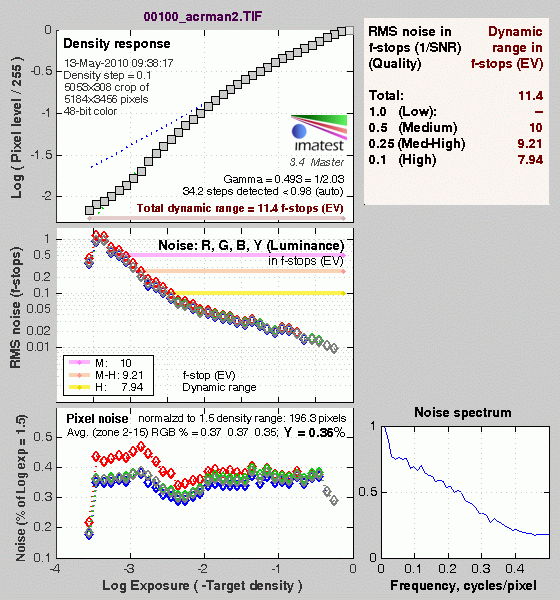
Processing the T2i's RAW (CR2) files through Adobe Camera Raw (ACR) version 5.7 improved dynamic range by about 0.4 f-stop at the best quality level, and almost 1.5 stops overall. ACR's automatic settings were used as a starting point, then the sliders were manually tweaked to get optimal results. Worth noting here is that ACR's default noise reduction settings reduced the pixel noise relative to the levels in the in-camera JPEG, which helps boost the higher quality Imatest scores. Also important to note is that the degree of manipulation performed by ACR here could result in color errors in strong highlights in real-world photographs. (The best performance you're likely to see in a real-world environment will likely be somewhere between the in-camera results and those from Adobe Camera Raw.)
Dynamic Range, the bottom line:
The net result was that the Canon EOS T2i's JPEGs and ACR converted RAW files scored about average in Imatest's dynamic range analysis when compared against other current APS-C sensor models. Results are very similar to the Canon 7D, with Imatest scores within about 1/3 f-stop of each other.
To get some perspective, here's a summary of the Canon T2i's dynamic range performance, and how it compares to other digital SLRs that we also have Imatest dynamic range data for. (Results are arranged in order of decreasing dynamic range at the "High" quality level.):
| Dynamic Range (in f-stops) vs Image Quality (At camera's base ISO) (Blue = RAW via ACR, Yellow=Camera JPEG, Green=Current Camera) |
||||
| Model | 1.0 (Low) |
0.5 (Medium) |
0.25 (Med-High) |
0.1 (High) |
| Nikon D3X (Adobe Camera Raw 5.3b) |
-- | -- | 11.1 | 9.64 |
| Nikon D3S (Adobe Camera Raw 5.6) |
-- | -- | 10.7 | 9.55 |
| Nikon D700 (Adobe Camera Raw 4.5) |
12.1 | 11.6 | 10.6 | 9.51 |
| Nikon D5000 (Adobe Camera Raw 5.4b) |
-- | 11.6 | 10.8 | 9.50 |
| Sony A900 (Adobe Camera Raw 4.6b) |
-- | 12.1 | 10.7 | 9.36 |
| Pentax K-x (Adobe Camera Raw 5.6b) |
11.5 | 11.2 | 10.7 | 9.33 |
| Nikon D90 (Adobe Camera Raw 4.6b) |
12.1 | 11.8 | 10.7 | 9.27 |
| Fujifilm S3 Pro (Adobe Camera Raw 2) |
12.1 | 11.7 | 10.7 | 9.00 |
| Sony A230 (Adobe Camera Raw 5.5) |
11.7 | 11.1 | 10.1 | 8.95 |
| Nikon D40x (Adobe Camera Raw 4.1) |
12.0 | 10.9 | 10.3 | 8.90 |
| Nikon D300S (Adobe Camera Raw 5.5) |
-- | 11.3 | 10.4 | 8.89 |
| Canon 5D Mark II (Adobe Camera Raw 5.2) |
-- | 10.8 | 10.0 | 8.89 |
| Sony A330 (Adobe Camera Raw 5.4) |
-- | -- | 10.1 | 8.86 |
| Canon EOS-1Ds Mark III (Adobe Camera Raw 4.5) |
11.5 | 10.7 | 9.96 | 8.84 |
| Nikon D3 (Adobe Camera Raw 4.5) |
11.7 | 11.0 | 10.0 | 8.75 |
| Canon EOS-1D Mark III (Adobe Camera Raw 4.5) |
11.7 | 10.7 | 9.99 | 8.73 |
| Sony A380 (Adobe Camera Raw 5.5) |
11.8 | 10.9 | 10.1 | 8.62 |
| Nikon D3000 (Adobe Camera Raw 5.5) |
-- | 10.8 | 10.1 | 8.61 |
| Pentax K20D (Adobe Camera Raw 4.5) |
11.4 | 10.6 | 9.82 | 8.56 |
| 8.5 Stops | ||||
| Nikon D300 (Adobe Camera Raw 4.3.1) |
11.4 | 10.9 | 9.87 | 8.45 |
| Sony A200 (Adobe Camera Raw 4.3.1) |
11.6 | 10.4 | 9.82 | 8.43 |
| Nikon D60 (Adobe Camera Raw 4.4.1) |
11.6 | 10.5 | 9.74 | 8.31 |
| Nikon D40 (Adobe Camera Raw 4.1) |
11.9 | 10.9 | 9.89 | 8.30 |
| Canon EOS-1Ds Mark III (Camera JPEG) |
10.9 | 10.2 | 9.71 | 8.23 |
| Pentax K100D (Adobe Camera Raw 3.6) |
11.3 | 10.3 | 9.51 | 8.23 |
| Pentax K200D (Adobe Camera Raw 4.4.1) |
-- | 10.5 | 9.54 | 8.19 |
| Pentax K10D (Adobe Camera Raw 3.7) |
10.6 | 10.0 | 9.29 | 8.19 |
| Canon 7D (Adobe Camera Raw 5.6) |
11.2 | 10.3 | 9.52 | 8.18 |
| Sony A100 (Adobe Camera Raw 3.4) |
11.3 | 10.5 | 9.69 | 8.16 |
| Canon EOS-1Ds Mark II (Adobe Camera Raw 3) |
11.2 | 10.3 | 9.40 | 8.14 |
| Canon EOS 50D (Adobe Camera Raw 4.6) |
11.2 | 10.5 | 9.49 | 8.06 |
| Nikon D40x (Camera JPEG) |
10.8 | 10.0 | 9.42 | 8.04 |
| Olympus E-P1 (ISO 200, Adobe Camera Raw 5.5) |
11.5 | 10.4 | 9.26 | 8.04 |
| Canon Rebel XSi (Camera JPEG) (ALO on by default) |
11.3 | 10.1 | 9.34 | 8.01 |
| 8.0 Stops | ||||
| Nikon D3S (Camera JPEG) |
-- | -- | -- | 7.96 |
| Fujifilm S3 Pro (Camera JPEG) |
-- | 9.90 | 9.40 | 7.94 |
| Canon T2i (Adobe Camera Raw 5.7) |
-- | 10.0 | 9.21 | 7.94 |
| Samsung NX10 (Adobe Camera Raw 5.7 beta) |
-- | -- | 9.18 | 7.91 |
| Sony A350 (Adobe Camera Raw 4.4) |
11.6 | 10.5 | 9.61 | 7.89 |
| Canon EOS-1D Mark III (Camera JPEG) |
-- | 10.2 | 9.70 | 7.88 |
| Olympus E-P2 (Adobe Camera Raw 5.6) |
-- | 10.2 | 9.44 | 7.88 |
| Canon Rebel XS (Adobe Camera Raw 4.5) |
-- | 10.3 | 9.27 | 7.88 |
| Nikon D3 (Camera JPEG) |
-- | -- | -- | 7.87 |
| Canon Digital Rebel XTi (Adobe Camera Raw 3.6) |
10.8 | 9.88 | 9.18 | 7.84 |
| Canon EOS 5D (Adobe Camera Raw 3) |
11.0 | 10.4 | 9.21 | 7.83 |
| Nikon D90 (Camera JPEG) |
-- | -- | -- | 7.77 |
| Panasonic DMC-GH1 (Adobe Camera Raw 5.4b) |
9.88 | -- | 9.30 | 7.76 |
| Canon Rebel T1i (Adobe Camera Raw 5.4b) |
11.2 | 10.2 | 9.16 | 7.73 |
| Pentax K-7 (Adobe Camera Raw 5.4) |
10.6 | 9.93 | 9.07 | 7.73 |
| Canon EOS 40D (Adobe Camera Raw 4.2) |
11.2 | 10.1 | 9.26 | 7.72 |
| Panasonic DMC-GH1 (Camera JPEG) |
8.77 | -- | -- | 7.70 |
| Canon Rebel XSi (Adobe Camera Raw 4.4.1) |
10.6 | 9.95 | 9.10 | 7.68 |
| Canon EOS 50D (Camera JPEG) (ALO STD by default) |
-- | -- | 8.90 | 7.68 |
| Nikon D700 (Camera JPEG) |
-- | -- | 9.05 | 7.67 |
| Canon 5D Mark II (Camera JPEG) (ALO STD by default) |
10.6 | 9.68 | 8.98 | 7.66 |
| Nikon D5000 (Camera JPEG) |
-- | -- | 8.96 | 7.65 |
| Canon EOS-5D (Camera JPEG) |
10.2 | 9.68 | 8.82 | 7.65 |
| Olympus E-3 (Adobe Camera Raw 4.3) |
10.3 | 10.1 | 9.29 | 7.64 |
| Nikon D60 (Camera JPEG) |
10.5 | 9.62 | 8.89 | 7.62 |
| Nikon D200 (Adobe Camera Raw 3) |
10.6 | 9.65 | 8.96 | 7.61 |
| Canon 7D (Camera JPEG) (ALO STD by default) |
-- | 9.70 | 8.54 | 7.54 |
| Canon T2i (Camera JPEG) |
-- | 9.44 | 8.45 | 7.53 |
| Nikon D80 (Adobe Camera Raw 3.6) |
11.1 | 10.4 | 9.42 | 7.51 |
| 7.5 Stops | ||||
| Nikon D300S (Camera JPEG) |
-- | -- | -- | 7.49 |
| Olympus E-500 (Adobe Camera Raw 3) |
10.7 | 9.97 | 8.90 | 7.46 |
| Olympus E-510 (Adobe Camera Raw 4.1) |
10.0 | 9.43 | 8.64 | 7.46 |
| Pentax K10D (Camera JPEG) |
-- | 9.49 | 8.88 | 7.44 |
| Nikon D300 (Camera JPEG) |
-- | -- | 8.70 | 7.44 |
| Olympus E-420 (Adobe Camera Raw 4.1.1) |
10.0 | 9.61 | 8.65 | 7.44 |
| Canon Rebel T1i (Camera JPEG) (ALO=STD by default) |
11.3 | 10.1 | 9.34 | 7.43 |
| Nikon D2Xs (Adobe Camera Raw 3.6) |
10.6 | 9.90 | 8.93 | 7.42 |
| Canon EOS 40D (Camera JPEG) |
10.6 | 9.52 | 8.78 | 7.42 |
| Olympus E-PL1 (Adobe Camera Raw 5.7) |
10.4 | 9.89 | 8.76 | 7.39 |
| Nikon D3X (Camera JPEG) |
-- | -- | -- | 7.37 |
| Nikon D50 (Camera JPEG) |
10.7 | 9.93 | 8.70 | 7.36 |
| Panasonic DMC-G2 (Adobe Camera Raw 5.7) |
10.3 | 9.87 | 8.77 | 7.35 |
| Sony A380 (Camera JPEG) (DRO Standard by default) |
-- | 9.54 | 8.84 | 7.32 |
| Panasonic DMC-G1 (Adobe Camera Raw 5.2) |
10.7 | 9.78 | 8.70 | 7.32 |
| Nikon D3000 (Camera JPEG) |
10.2 | 9.64 | 8.69 | 7.31 |
| Sony A900 (Camera JPEG) (DRO off by default ) |
10.2 | 9.75 | 8.49 | 7.31 |
| Sony A330 (Camera JPEG) (DRO Standard by default) |
10.1 | 9.37 | 8.59 | 7.30 |
| Sony A200 (Camera JPEG) (DRO on by default) |
10.4 | 9.43 | 8.91 | 7.29 |
| Canon EOS 20D (Camera JPEG) |
10.3 | 9.66 | 8.85 | 7.29 |
| Canon EOS 30D (Camera JPEG) |
10.3 | 9.50 | 8.57 | 7.29 |
| Nikon D40 (Camera JPEG) |
10.4 | 9.80 | 8.89 | 7.28 |
| Sony A230 (Camera JPEG) (DRO Standard by default) |
10.1 | 9.51 | 8.51 | 7.26 |
| Sony A900 (Camera JPEG) (DRO on) |
10.1 | 9.76 | 8.47 | 7.26 |
| Canon Rebel XS (Camera JPEG) |
10.3 | 9.4 | 8.61 | 7.22 |
| Olympus E-520 (Adobe Camera Raw 4.5) |
11.0 | 9.46 | 8.70 | 7.20 |
| Sony A350 (Camera JPEG) (DRO on by default) |
10.3 | 9.55 | 8.85 | 7.19 |
| Pentax K-x Camera JPEG |
9.99 | 8.94 | 8.31 | 7.18 |
| Panasonic DMC-GF1 (Adobe Camera Raw 5.5) |
10.2 | 9.62 | 8.62 | 7.16 |
| Nikon D80 (Camera JPEG) |
10.1 | 9.43 | 8.48 | 7.12 |
| Canon Digital Rebel XT (Camera JPEG) |
10.3 | 9.51 | 8.61 | 7.11 |
| Nikon D200 (Camera JPEG) |
-- | 9.07 | 8.36 | 7.11 |
| Olympus E-300 (Camera JPEG) |
10.8 | 9.26 | 8.48 | 7.07 |
| Olympus E-410 (Adobe Camera Raw 4.1) |
10.2 | 9.40 | 8.24 | 7.05 |
| Olympus E-500 (Camera JPEG) |
10.0 | 9.14 | 8.16 | 7.05 |
| Canon Digital Rebel XTi (Camera JPEG) |
9.83 | 9.10 | 8.27 | 7.04 |
| Canon EOS-1Ds Mark II (Camera JPEG) |
10.3 | 9.38 | 8.60 | 7.04 |
| Panasonic DMC-G1 (Camera JPEG) |
-- | 9.33 | 8.52 | 7.03 |
| Pentax K200D (Camera JPEG) |
-- | 9.50 | 8.30 | 7.01 |
| 7.0 Stops | ||||
| Panasonic DMC-GF1 (Camera JPEG) |
-- | 9.33 | 8.44 | 6.99 |
| Canon Digital Rebel (Camera JPEG) |
10.1 | 9.11 | 8.47 | 6.97 |
| Nikon D2Xs (Camera JPEG) |
9.82 | 8.98 | 8.23 | 6.97 |
| Panasonic DMC-L10 (Adobe Camera Raw 4.2) |
10.4 | 9.34 | 8.48 | 6.91 |
| Sigma DP1 (Camera JPEG) |
-- | 8.95 | 8.13 | 6.91 |
| Pentax *istDs (Camera JPEG) |
10.2 | 10.0 | 8.87 | 6.90 |
| Sony A100 (Camera JPEG) |
10.2 | 9.24 | 8.39 | 6.89 |
| Samsung NX10 (Camera JPEG, Smart Range, ISO 200) |
10.1 | 8.99 | 8.22 | 6.78 |
| Pentax K100D (Camera JPEG) |
10.3 | 9.30 | 8.39 | 6.73 |
| Panasonic DMC-G2 (Camera JPEG) |
9.72 | 9.18 | 8.15 | 6.68 |
| Pentax K20D (Camera JPEG) |
10.2 | 9.21 | 8.09 | 6.66 |
| Pentax K-7 (Camera JPEG) |
9.59 | 8.87 | 8.03 | 6.54 |
| 6.5 Stops | ||||
| Nikon D2x (Camera JPEG) |
-- | 8.93 | 7.75 | 6.43 |
| Olympus E-3 (Camera JPEG) |
9.32 | 9.06 | 8.50 | 6.42 |
| Panasonic DMC-L10 (Camera JPEG) |
-- | 8.94 | 8.00 | 6.38 |
| Olympus E-420 (Camera JPEG) |
9.18 | 8.82 | 7.93 | 6.37 |
| 6.0 Stops | ||||
| Olympus E-410 (Camera JPEG) |
-- | -- | 7.60 | 5.99 |
| Olympus E-PL1 (Camera JPEG, Gradation = Normal) |
-- | 8.63 | 7.45 | 5.89 |
| Samsung NX10 (Camera JPEG) |
9.32 | 8.48 | 7.46 | 5.88 |
| Nikon D70s (Camera JPEG) |
9.84 | 8.69 | 7.46 | 5.85 |
| Nikon D70 (Camera JPEG) |
9.81 | 8.76 | 7.58 | 5.84 |
| Olympus E-520 (Camera JPEG) |
9.32 | 8.68 | 7.74 | 5.74 |
| Olympus E-P2 (Camera JPEG, Gradation = Normal) |
10.1 | 8.83 | 7.78 | 5.58 |
| Olympus E-P1 (Camera JPEG, Gradation = Normal) |
-- | 8.85 | 7.74 | 5.47 |
Note that this test is repeatable to within 1/3 EV according to the Imatest website, so differences of less than 0.33 can be ignored.
Overall, dynamic range for the Canon T2i's in-camera JPEGs is about 1/2 stop below the best consumer-level digital SLRs, while its results from RAW files came up a stop or more low.
Canon T2i Resolution Chart Test Results
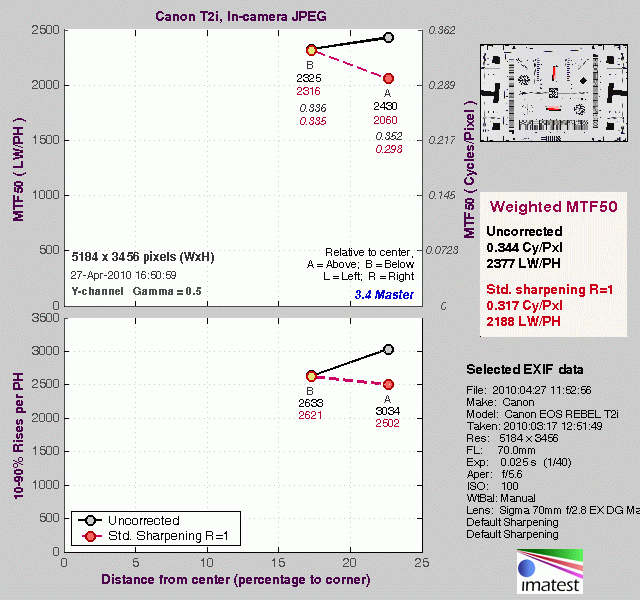
The chart above shows consolidated results from spatial frequency response measurements in both the horizontal and vertical axes. The "MTF 50" numbers tend to correlate best with visual perceptions of sharpness, so those are what I focus on here. The uncorrected resolution figures are 2,430 line widths per picture height in the horizontal direction (corresponding to the vertically-oriented edge), and 2,325 lines along the vertical axis (corresponding to the horizontally-oriented edge), for a combined average of 2,377 LW/PH. Correcting to a "standardized" sharpening with a one-pixel radius increased both vertical and horizontal resolution significantly, resulting in an average of 2,188 LW/PH, a little lower than the uncorrected value, indicating the default in-camera sharpening is slightly aggressive in the horizontal direction.
To see what's going on, refer to the plots below, which show the actual edge profiles for both horizontal and vertical edges, in both their original and corrected forms. Here, you can see that the Canon T2i's default in-camera sharpening is fairly strong (a large bump at the top end) in the horizontal direction, but almost ideal in the vertical direction. Imatest reports that the horizontal direction (vertical edge) is "oversharpened" by 7.38% while the vertical direction (horizontal edge) is "oversharpened" by just 0.08%. These numbers are probably a good default for the intended target market for the Canon T2i. That said, you should be able to extract more fine detail if you begin with a RAW file, rather than a JPEG.

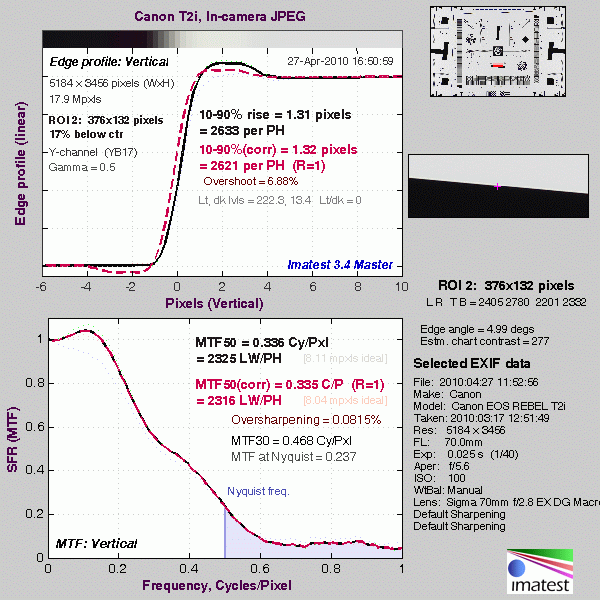
Note: We don't feature SFR-based LW/PH resolution numbers more prominently in our reviews (eg, outside the Imatest pages) because we've found that they're *very* sensitive to minor differences in in-camera image processing. Relatively small changes in the amount of in-camera sharpening can have a large effect on the resulting resolution numbers. Imatest attempts to compensate for this by adjusting to a "standard" sharpening, but this approach can't completely undo what happens inside the cameras, and so often gives inconsistent results. Sometimes the "standardized" sharpening happens to just match the shape of the edge profile with the in-camera sharpening applied, and you'll get wildly high results. At other times, it will tend to correct in the opposite direction. Unfortunately, ignoring the in-camera sharpening entirely can result in even greater discrepancies, particularly between models from different manufacturers. Turning off sharpening in the camera may or may not fully eliminate the sharpening, so simply turning off sharpening in the camera JPEGs isn't a reliable solution. It also wouldn't be the way most people shoot the cameras. We could process RAW files with no sharpening (as shown below), but then that'd only suit the people working primarily or exclusively from RAW, and would open another can of worms as to what RAW converter was used, etc, etc.
The bottom line is that numbers for resolution only take you so far. Detail handling and edge acuity are very complex issues; ones that don't easily boil down to a single number. The best approach is to simply look look at the broad array of standardized test shots we take with each camera, to the point of downloading and printing them with whatever processing you'd use if you owned the camera and shot with it. See how the differences stack up for you visually, and make your decision on that, rather than on abstract resolution numbers.
RAW Files
Canon EOS T2i High ISO RAW Image Quality
We've recently started looking at RAW files converted with dcraw, an excellent freeware raw converter. dcraw usually offers timely support for the latest cameras, but more importantly, it does not apply any noise-reduction, sharpening or other corrections such as geometric distortion correction to the output files. (We found that Adobe Camera Raw still applies some limited noise-reduction when its NR settings are set to zero, and it also applies other corrections depending on the make and model of the camera). There will always be differences between RAW converters, in terms of the sort of demosaicing algorithms they use (the processes by which they convert the separate Red, Green, and Blue data sets to an array of full-color RGB pixels), but dcraw seems to use a fairly generic algorithm that delivers good sharpness with relatively few artifacts, and can be counted on to not apply any noise reduction if you don't want it to.
Below are crops from Canon T2i high ISO RAW files compared to RAW files from other SLRs such as Canon 7D, Nikon D90 and Pentax K-7, converted with dcraw.
| High ISO RAW Comparison with Canon EOS 7D, Nikon D90 and Pentax K-7 RAW files converted with dcraw, no NR, no sharpening Daylight-balanced illumination |
||||
|
|
Canon T2i
|
Canon 7D
|
Nikon 90
|
Pentax K-7
|
|
I
S O 8 0 0 |
 |
 |
 |
 |
 |
 |
 |
 |
|
 |
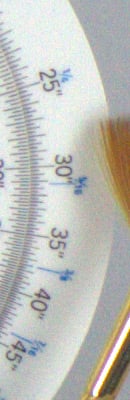 |
 |
 |
|
|
|
Canon T2i
|
Canon 7D
|
Nikon D90
|
Pentax K-7
|
|
I
S O 1 6 0 0 |
 |
 |
 |
 |
 |
 |
 |
 |
|
 |
 |
 |
 |
|
|
|
Canon T2i
|
Canon 7D
|
Nikon D90
|
Pentax K-7
|
|
I
S O 3 2 0 0 |
 |
 |
 |
 |
 |
 |
 |
 |
|
 |
 |
 |
 |
|
|
|
Canon T2i
|
Canon 7D
|
Nikon D90
|
Pentax K-7
|
|
I
S O 6 4 0 0 |
 |
 |
 |
 |
 |
 |
 |
 |
|
 |
 |
 |
 |
|
|
|
Canon T2i
|
Canon 7D
|
Nikon D90
|
Pentax K-7
|
|
I
S O 1 2 8 0 0 |
 |
 |
N/A
ISO 12,800 not supported |
N/A
ISO 12,800 not supported |
 |
 |
N/A
ISO 12,800 not supported |
N/A
ISO 12,800 not supported |
|
 |
 |
N/A
ISO 12,800 not supported |
N/A
ISO 12,800 not supported |
|
Here, we can see that the relative performance in this group echoes that of the JPEG results, though results are a little closer than you'd think. The 12.3-megapixel Nikon D90 comes out on top (but just barely) and the 18-megapixel Canon T2i follows a close second, except at ISO 6,400 where the T2i pulls ahead. Again, the Canon T2i performed better than its more expensive sibling, the Canon EOS 7D, showing less noise particularly in the red channel where it doesn't show nearly the number of bright clusters of red pixels the 7D does at higher ISOs. The T2i also does better than the 14.6-megapixel Pentax K-7. Impressive.
Here's a comparison with some less expensive SLRs:
| High ISO RAW Comparison with Canon T1i, Nikon D5000 and Pentax K-x RAW files converted with dcraw, no NR, no sharpening Daylight-balanced illumination |
||||
|
|
Canon T2i
|
Canon T1i
|
Nikon D5000
|
Pentax K-x
|
|
I
S O 8 0 0 |
|
 |
 |
 |
|
 |
 |
 |
|
|
 |
 |
 |
|
|
|
Canon T2i
|
Canon T1i
|
Nikon D5000
|
Pentax K-x
|
|
I
S O 1 6 0 0 |
|
 |
 |
 |
|
 |
 |
 |
|
|
 |
 |
 |
|
|
|
Canon T2i
|
Canon T1i
|
Nikon D5000
|
Pentax K-x
|
|
I
S O 3 2 0 0 |
|
 |
 |
 |
|
 |
 |
 |
|
|
 |
 |
 |
|
|
|
Canon T2i
|
Canon T1i
|
Nikon D5000
|
Pentax K-x
|
|
I
S O 6 4 0 0 |
|
 |
 |
 |
|
 |
 |
 |
|
|
 |
 |
 |
|
|
|
Canon T2i
|
Canon T1i
|
Nikon D5000
|
Pentax K-x
|
|
I
S O 1 2 8 0 0 |
|
 |
N/A
ISO 12,800 Not Supported |
 |
|
 |
N/A
ISO 12,800 Not Supported |
 |
|
|
 |
N/A
ISO 12,800 Not Supported |
 |
|
In this group, the 12.4-megapixel Pentax K-x performs the best of the bunch in terms of noise, however the Canon T2i does quite well against its predecessor, the 15.1-megapixel Canon T1i, as well as the 12.3-megapixel Nikon D5000. Very good performance from the Canon T2i, especially considering it has the highest resolution and therefore the smallest photosites of the group.
Menus
Canon Rebel T2i Modes and Menus
 The mode dial on the right side of the Canon T2i's top panel lets you select various exposure modes, with the same range of options presented as on the preceding Rebel T1i, but with a slight change in the order of scene modes on the dial, and returning to the silver-on-black color scheme from the Rebel XSi. Canon divides the dial into "Basic" and "Creative" zones, the Basic range encompassing the Full Auto setting and the six scene modes in what Canon refers to as the "Image" zone. The Canon T2i's Creative zone includes Creative Auto, plus Programmed exposure, Shutter priority, Aperture priority, full Manual control, and the Automatic Depth of Field mode. The Flash Off mode has been promoted to first place among the Scene modes on the dial, with the remainder still listed in the same order as previously. Finally, the Movie mode is at the "Basic" end of the mode dial's range, although we consider it to be an entirely separate mode, rather than part of the Canon T2i's Basic set.
Here's a description of each of the shooting modes:
 Automatic Depth of Field AE: Proceeding around the Mode Dial in a clockwise direction, the first option on the Canon T2i's Mode dial is the Automatic Depth of Field AE (or A-DEP) mode. Part of the Creative Zone, A-DEP mode is meant for taking pictures of large groups of people, landscapes with foreground detail, or any subject with elements of interest at varying distances from the camera. This mode puts the Canon T2i in control of both the shutter speed and aperture values, but you can adjust the other exposure variables. (Note that this mode cannot be used if the lens focus mode is set to manual.) When shooting in Automatic Depth of Field AE, the Canon T2i sets both the lens aperture and focus distance to achieve a sharp focus over a wide depth of field. It uses the autofocus system to measure the distance to the subjects covered by each of the nine autofocus zones, and then attempts to set the focusing distance and lens aperture so as to render all subject areas in sharp focus.
 Manual Exposure: This mode provides full control of all exposure variables, including independent control of both shutter speed and lens aperture. If the ISO sensitivity is specified manually, then the exposure is fully manual. If the ISO sensitivity is set to Auto, then the camera varies this variable to obtain a metered exposure with the user-specified shutter speed and aperture. In either case, there is no exposure compensation function. The Main dial adjusts shutter speed by default, and adjusts the aperture when turned while holding down the Exposure Compensation button. The shutter speed range also includes a Bulb setting, allowing long exposures for as long as you hold the Canon T2i's Shutter button down. (The rear display reports the elapsed time in minutes and seconds as the exposure progresses.) A display in the viewfinder reports whether the Canon T2i thinks your settings will result in under, over, or correctly exposed photos.
 Aperture-Priority AE: This mode allows you to manually set the lens aperture (with available apertures depending on the lens in use), while the Canon T2i selects the most appropriate shutter speed. You have control over all other exposure variables, including exposure compensation.
 Shutter-Priority AE: The opposite of Aperture-Priority mode, Shutter-Priority AE allows you to set the shutter speed anywhere from 1/4,000 to 30 seconds, while the Canon T2i chooses the best corresponding aperture setting. Again, you have control over all other exposure variables, including exposure compensation. The Bulb setting that's available in Manual Exposure mode isn't available in Shutter-priority AE mode.
 Program AE: In its Program AE mode, the Canon T2i controls both aperture and shutter speed automatically, and you have control over all other exposure variables, including exposure compensation. You can also bias the exposure to control depth of field or subject motion blur by turning the Main dial, selecting a different combination of aperture and shutter speed while maintaining the same exposure value. (This is commonly known as Vari-Program, or Program Shift in Canon parlance. The camera won't let you select a combination of exposure parameters that doesn't work, but you retain all the flexibility of shutter- or aperture-priority exposure modes.)
 Creative Auto Mode: For the final mode in the Creative Zone, Canon retains its Creative Auto (or "CA") mode, which we first saw on the 50D, and which made its Rebel-series debut in the T1i. The CA mode is something of a cross between the Program and Full Automatic modes. When set to CA mode, the Canon T2i allows the user to select from a subset of the flash and drive modes. You can also choose from a subset of four Picture Styles, with each given a user-friendly description such as "Smooth skin tones", or "Vivid blues and greens". Program shift and exposure compensation are both available, but must be accessed through the Quick Control screen, with five-step control for each option. They also have friendlier names -- "Background: Blurred <-> Sharp" for program shift, and "Exposure: Darker <-> Brighter" for exposure compensation. You can also select between Raw, JPEG (including several image size/quality options), or Raw + Large JPEG file formats. Through the menu system, you can also enable or disable Peripheral Illumination Correction. The rest of the more complex features remain under automatic control. The Canon T2i's rear-panel LCD display offers text help for each setting while in CA mode, for example prompting the user as to whether they want to blur the background with program shift, or make the picture brighter / darker with exposure compensation, etc. The exposure steps shown on the rear-panel display appear to represent 1/3-stop increments/decrements.
 Full Automatic Mode: The first mode in the Basic Zone, Full Automatic is indicated on the Canon T2i's Mode dial by a green rectangular outline. In this mode, the camera makes all exposure decisions with the exception of image quality. Autofocus mode is set to AI Focus. (AI Focus evaluates subject movement, sets either one-shot AF or AI Servo AF automatically.) Drive mode is set to Single Shot, ISO and white balance are set to Auto, and the metering mode is set to Evaluative. Both auto lighting optimizer and picture style are set to Standard.
 Flash Off Mode: Flash Off mode disables both the internal flash head and any external flash unit connected. Focus is set to AI Focus mode, drive mode is set to Single, and metering is set to Evaluative. The camera controls ISO and Auto white balance as well.
 Portrait Mode: This mode uses a large aperture setting to decrease the depth of field, which blurs the background to emphasize the subject. The Canon T2i's ISO is set to Auto, white balance to Auto, metering to Evaluative, AF mode to One Shot, and auto lighting optimizer to standard. Drive mode is set to Continuous Shooting, and picture style to Portrait.
 Landscape Mode: Landscape mode combines slower shutter speeds with smaller aperture settings to increase the depth of field when shooting broad vistas and sweeping landscapes. This mode is also good for night scenes without people in them. The Canon T2i's built-in flash is automatically disabled, even if it's already raised. Because this mode uses slower shutter speeds, a tripod may be needed in less-bright lighting conditions. Metering is set to Evaluative, both ISO and white balance are set to Auto, focus to One Shot, drive mode to Single Shot, and auto lighting optimizer to Standard. Unlike the previous scene modes, the picture style is changed to Landscape.
 Close-up Mode (Macro Mode): Turning the Canon T2i's Mode dial to the macro flower symbol sets the camera for capturing smaller subjects such as flowers, jewelry, and other small details. The autofocus mode is automatically adjusted to One Shot, the drive mode is set to Single Shot, and the metering mode is set to Evaluative. Both ISO and white balance are set to Auto, while both auto lighting optimizer and picture style are set to Standard. Close-up mode takes advantage of the current lens's minimum focal distance. However, an EOS dedicated macro lens and the Macro Ring Lite MR-14EX are recommended for better close-up photography. Also, note that unlike the macro mode on most consumer digicams, Macro mode on the Canon T2i has no effect on lens focusing range, as that parameter is entirely determined by the lens being used.
 Sports Mode: This mode uses a faster shutter speed to capture fast-moving subjects. The autofocus mode is automatically set to AI Servo. Drive mode is set to Continuous Shooting, ISO is set to Auto (and biased towards higher settings, to give faster shutter speeds), white balance is set to Auto, and metering mode is set to Evaluative. Both auto lighting optimizer and picture style are set to Standard. The Canon T2i's onboard flash isn't available in this mode because it can't cycle fast enough to keep up with the continuous exposure mode.
 Night Portrait Mode: This final Basic Zone mode is for taking pictures of people at sunset or at night, letting the flash illuminate the subject, while the longer exposure provides a brighter view of the surroundings. The Canon T2i's autofocus mode is automatically set to One Shot. Drive mode is set to Single Shot, metering mode to Evaluative, focus to One Shot, both ISO sensitivity and white balance to Auto, and both auto lighting optimizer and picture style to Standard. Since slower shutter speeds will be used, a tripod is recommended to prevent movement from the camera. The Canon T2i's built-in flash is automatically enabled and synced with the slower shutter speed, so subjects will need to remain still for a few moments after the flash fires to avoid ghost-like after-images. (For night exposures without the flash, Canon recommends shooting in Landscape mode.)
 Movie Recording Mode: When Movie mode is selected, the camera's mirror and shutter open, as in Live View mode, but the Live View / Movie button on the camera's back functions as the start/stop button for movie recording. Unlike most other movie-capable SLR cameras on the market, the Canon T2i can perform single autofocus operations during movie operation, albeit with focusing noise very clearly picked up on the audio track using the EF-S 18-55mm 1:3.5-5.6 IS kit lens. (Like most digital SLR video modes, continuous autofocus isn't available in Movie mode, though.) Another feature of the T2i's movie mode that's rather uncommon is that it allows fully manual control over aperture, shutter speed, and (optionally) ISO sensitivity. The T2i's internal microphone is monaural, but the camera also includes an external microphone jack compatible with stereo microphones. Movie recording capacity varies based on the size of memory card you're using, but is in all cases limited to a maximum of 29 minutes and 59 seconds. (That's thanks to European tax regulations, but as it turns out, the 4GB limit on video file sizes will in practice restrict you to shorter movie clips anyway.)
Playback Mode This mode is entered by pressing the Play button on the back panel. Playback mode lets you view, protect, or erase images and movies. Still images can be magnified, rotated, or set up for printing on DPOF-compatible devices. You can also view an index display of all images and movies, with either four or nine thumbnails per page. A slide show function is available, and allows the user to select whether the T2i should display just still images, just movies, or both together. It also allows the slide show to be restricted to just stills and movies from a specific date. The Info button toggles between displaying the image or movie alone, with a basic information display, with a detailed information display including luminance histogram (which can optionally be changed through the Playback menu to display separate RGB histograms instead), and finally a partial information display plus both RGB and luminance histograms.
Canon Rebel T2i Menu Details
Below are Canon T2i menu options and their descriptions.
Record Menu 1:

| Record Menu Options: Screen 1 | |||
Top-Level Selection |
Second-Level |
Third-Level |
Notes |
Quality |
- 5184 x 3456, Fine - 5184 x 3456, Normal - 3456 x 2304, Fine - 3456 x 2304, Normal - 2592 x 1728 Fine - 2592 x 1728, Normal - RAW + L/F JPEG - RAW |
Select image size and quality combination. |
|
Beep |
- On - Off |
Turns camera beep sounds on or off. |
|
Release shutter without card |
- Enable - Disable |
If enabled, the camera will fire the shutter even without a memory card installed. |
|
Image review |
- Off - 2 sec. - 4 sec. - 8 sec. - Hold |
Enables an automatic image review after each shot. During review, the Display and Delete buttons act as they would in Playback mode. "Hold" keeps the image displayed until the auto-power off is reached, or you operate any other control. |
|
Peripheral illumination correction |
-Enable -Disable |
If on, the camera corrects for corner shading "vignetting" in JPEGs, depending on which lens is detected (therefore, probably won't work with third-party lenses). If detected, the attached lens model is indicated on the LCD display, along with whether correction data for the lens model is available. |
|
Red-eye On/Off |
- On - Off |
If On, Red-eye reduction lamp illuminates with every flash exposure. |
|
Flash control |
-Flash Firing |
- Enable
- Disable |
Controls a vast array of flash settings for both the internal flash and any attached external flash unit. |
- Built-in Flash Func. Setting |
- Flash Mode - Shutter Sync - Flash Exp. Comp. - E-TTL II Meter |
||
- External Flash Func. Setting |
(if flash is attached, powered on, and supports function)
- Flash Mode - Shutter Sync - FEB - Flash Exp. Comp. - E-TTL II Meter - Zoom - Wireless Setting |
||
- External Flash C.Fn. Setting |
(if flash is attached and powered on, for each available custom function) - Enable - Disable |
||
- Clear Ext. Flash C.Fn. Set |
(if flash is attached and powered on)
|
||
Record Menu 2:
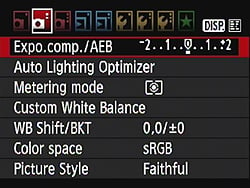
| Record Menu Options: Screen 2 | |||
Top-Level Selection |
Second-Level |
Third-Level |
Notes |
Exposure compensation / AEB (Auto Exposure Bracketing) |
- Select EV variable |
+/-5 EV in 1/3 or 1/2 steps; +/-7 EV scale when AEB is active, bracketing range is three frames in a +/-2 EV range. |
|
Auto Lighting Optimizer |
-Disable -Low -Standard -High |
Sets the ALO level. |
|
Metering mode |
- Evaluative - Partial - Spot - Center-weighted average |
||
Custom White Balance |
- Choose image for reference, then set white balance |
||
WB SHIFT/BKT |
- Set the color shift on a 2-dimensional grid (Green/Magenta, Blue/Amber, 19 steps on each axis) - Choose bracket (+/-3 Magenta and Green, +/-3 Blue and Amber) |
One level of correction is equal to 5 mireds of a color temperature conversion filter. |
|
Color space |
- sRGB - Adobe RGB |
||
Picture Style |
- Standard - Portrait - Landscape - Neutral - Faithful - Monochrome - User Def. 1 - User Def. 2 - User Def. 3 |
- Sharpness (arbitrary units from 0 to 7) - Contrast (9 units from - to +) - Saturation (9 units from - to +, except monochrome) - Color Tone (9 units from - to +, except monochrome) - Filter effect (monochrome only) - Toning effect (monochrome only) - Default set. (except for User Def. positions) |
All picture styles can be adjusted, including preset styles. Monochrome filter effects are None, Yellow, Orange, Red, or Green. Monochrome toning effects are None, Sepia, Blue, Purple, or Green. |
Record Menu 3:

| Record Menu Options: Screen 3 | |||
|
Top-Level
Selection |
Second-Level
|
Third-Level
|
Notes
|
Dust Delete Data |
- Cancel - OK |
Captures a reference image for the dust reduction system, showing where dust is present on the sensor. Dust shadows can then be automatically removed from the images when they're processed through Canon's software. The date that the Dust Delete Data was last captured is shown on the LCD display. |
|
|
ISO Auto
|
- Max.: 400
- Max.: 800 - Max.: 1600 - Max.: 3200 - Max.: 6400 |
Sets a maximum limit for the ISO Auto function. The limit only applies in Creative Zone modes. Basic Zone modes except Portrait will allow Auto ISO as high as ISO 3,200, unless flash is used, regardless of this setting. Portrait mode is fixed at ISO 100. When direct flash is used, Auto ISO is set to 400, unless this would result in overexposure, in which case Auto ISO can range as low as ISO 100. When external bounce flash is used, Auto ISO will ordinarily range as high as ISO 1,600, but will obey a lower limit from this setting.
|
|
Movie Menu 1:

| Movie Menu Options: Screen 1 | |||
|
Top-Level
Selection |
Second-Level
|
Third-Level
|
Notes
|
|
Movie Rec. Size
|
- 1920 x 1080 (30 / 25)
- 1920 x 1080 (24) - 1280 x 720 (60 / 50) - 640 x 480 (60 / 50) - Crop 640 (60 / 50) |
|
Selects the video resolution and frame rate. Available frame rates depend on Video System setting in Setup Menu screen 2. 30 and 60fps are available only for NTSC mode, 25 and 50 fps are only for PAL mode. 24 fps is available for both modes.
|
|
AF Mode
|
- Live mode
- Face Detect Live mode - Quick mode |
|
"Live" mode uses contrast-detect AF from image sensor data, "Face detect" mode adds face-detection, while "Quick" mode uses the dedicated phase-detect AF module. As well as autofocus, you can manually focus in Movie mode. Up to 10x magnification is available to assist in critical manual focusing before movie capture starts, but is not available during movie recording. This is a duplicate of the option in the Live View function menu, so if the setting is changed there, the value here will also change.
|
|
AF During Movie
|
- Disable
- Enable |
|
Enables or disables autofocus operation during movie recording. Even if enabled, only single autofocus operations are possible. Continuous autofocus isn't available for movie recording. AF operations with the kit lens are very clearly audible in the recorded audio track.
|
|
Movie Shutter / AE Lock Button
|
- AF / AE lock
- AE lock / AF - AF / AF lock, no AE lock - AE / AF, no AE lock |
|
Determines the effect of the Shutter and AE lock buttons. First option locks focus with shutter half-press, and exposure with * button. Second option locks exposure with shutter half-press, and focus with * button. Third option locks focus with shutter half-press, unless * button is held -- allowing a still image to be captured during movie recording without triggering an AF cycle. Final option meters but doesn't lock metering with a shutter half-press, and locks focus with the * button.
|
|
Remote Control
|
- Disable
- Enable |
|
Determines whether movie recording can be started and stopped with the optional RC-6 remote control. If enabled, shooting timing switch must be set to '2' to function as movie shutter button, and will otherwise function as still shutter button.
|
Movie Menu 2:
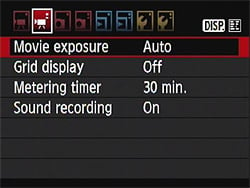
| Movie Menu Options: Screen 2 | |||
|
Top-Level
Selection |
Second-Level
|
Third-Level
|
Notes
|
|
Movie Exposure
|
- Auto
- Manual |
|
Unlike most video-capable DSLRs, the Canon T2i allows fully manual control of shutter speed, aperture and ISO sensitivity, both before and during movie capture. (The onboard microphone clearly picks up handling noises as controls are adjusted, however -- especially the Main Dial, which has a very firm clicking motion.) It is also possible to use Auto ISO with manual shutter speed / aperture, but exposure compensation isn't possible in this setup. In Auto mode, the camera chooses all three variables automatically, but allows +/-5.0 EV of exposure compensation instead.
|
|
Grid Display
|
- Off
- Grid 1 (2x2) - Grid 2 (5x3) |
|
Allows one of two different grids to be overlaid on the LCD before movie recording, to aid in precise alignment. (The 2x2 grid would also be useful in rule-of-thirds composition). The grids disappear as soon as movie recording starts. This is a duplicate of the option in the Live View function menu, so if the setting is changed there, the value here will also change.
|
|
Metering Timer
|
- 4 sec.
- 16 sec. - 30 sec. - 1 min. - 10 min. - 30 min. |
|
Determines how long the camera's metering system should remain active without user interaction.
This is a duplicate of the option in the Live View function menu, so if the setting is changed there, the value here will also change.
|
|
Sound Recording
|
- On
- Off |
|
Determines whether movies should be recorded with or without an audio track.
|
Highlight tone priority |
- Disable - Enable |
Available only when Movie exposure is set to Manual. If enabled, dynamic range is expanded for highlight areas above 18% gray. Lower ISO sensitivity limit is raised to ISO 200, and Auto Lighting Optimizer is disabled. |
|
Playback Menu 1:
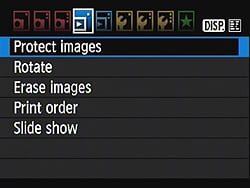
| Playback Menu Options: Screen 1 | |||
Top-Level Selection |
Second-Level |
Third-Level |
Notes |
Protect images |
- Set |
Sets or removes protection mark. Protected images can only be deleted by reformatting the memory card. |
|
Rotate |
- Set |
Rotates selected image clockwise, either 90 or 270 degrees. |
|
Erase images |
- Select and erase images - All images on card |
||
Print order |
- Sel. Image - All image |
Marks images on the memory card for later printing on a DPOF (Digital Print Order Format) compatible printer. |
|
- Set up |
- Print type - Date - File No. |
||
Slide show |
- Select images |
- All images - Stills - Movies - Date |
Sets up Slide Show feature. Users can choose to play both still images and movies, stills only, movies only, or stills and movies taken on a particular date. The Menu button stops playback. |
- Setup |
- Display time - Repeat |
||
- Start |
|||
Playback Menu 2:

| Playback Menu Options: Screen 2 | |||
Top-Level Selection |
Second-Level |
Third-Level |
Notes |
Histogram |
- Brightness - RGB |
RGB option displays individual histograms for each color channel, brightness shows only a single graph. |
|
Image jump w/ dial |
- 1 image - 10 images - 100 images - Date - Movies - Stills |
Selects how image jump works using the Main Dial.
|
|
Ctrl over HDMI |
- Disable - Enable |
If enabled, certain playback functions of the Canon T2i, such as selecting images and initiating a slideshow, can be controlled using the remote control of an attached HDMI CEC-compatible display. |
|
Setup Menu 1:

| Setup Menu Options: Screen 1 | |||
Top-Level Selection |
Second-Level |
Third-Level |
Notes |
Auto power off |
- 30 sec. - 1 min. - 2 min. - 4 min. - 8 min. - 15 min. - Off |
Amount of time to wait before automatically turning off to save power. |
|
Auto rotate |
- On (Camera, Display) - On (Display) - Off |
Camera, Display - vertical images are rotated on both the camera's LCD and on the computer (in applications that understand "Rotate" tags in the files' EXIF headers.) Display - vertical images are only rotated on the computer. |
|
Format |
- Cancel - OK - option for Low level format |
Erases all files on card, even protected ones. |
|
File numbering |
- Continuous - Auto Reset - Manual Reset |
Continuous numbers image files sequentially.
Auto Reset resets the numbering every time a card is formatted or a new card inserted. Manual Reset resets numbering at any time to 0001. |
|
LCD auto off |
- Enable - Disable |
Controls the sensor that turns off the LCD display when you bring the camera up to your eye. |
|
Screen color |
- Select from 4 screen color schemes - OK |
||
Setup Menu 2:

| Setup Menu Options: Screen 2 | |||
Top-Level Selection |
Second-Level |
Third-Level |
Notes |
LCD brightness |
- Set brightness level from darkest to brightest |
Seven brightness settings. |
|
Date/Time |
- Set Date - Set Time - Set Display Format |
||
Language |
- English - German - French - Dutch - Danish - Portuguese - Finnish - Italian - Ukrainian - Norwegian - Swedish - Spanish - Greek - Russian - Polish - Czech - Hungarian - Romanian - Turkish -Arabic - Thai - Simplified Chinese - Traditional Chinese - Korean - Japanese |
||
Video system |
- NTSC - PAL |
||
Sensor cleaning |
- Auto cleaning |
- Enable - Disable |
Auto cleaning options determines if sensor cleaning occurs automatically when power switch is turned off or on. |
- Clean now |
- Cancel - OK |
||
- Clean manually |
- Cancel - OK |
OK triggers mirror to lock up so you can clean the sensor manually. Use of the optional ACK-E8 AC adapter kit or a fully charged battery is recommended. Cleaning is not possible when using a portrait grip with AA / LR6 batteries. |
|
Live View function settings |
- Live View shoot |
- Enable - Disable |
Along with three types of autofocus ("Live" mode uses contrast-detect AF from image sensor data, "Face detect" mode adds face-detection, while "Quick" mode uses the dedicated phase-detect AF module), you can manually focus in Live View mode. Up to 10x magnification is available to assist in critical manual focusing. The Grid Display, Metering Timer, and AF Mode options are duplicates of the same options in Movie Menus 1 and 2, so if these settings are changed, the value there will also change. |
- Grid display |
- Off - Grid 1 (2x2) - Grid 2 (5x3) |
||
- Metering timer |
- 4 sec - 16 sec - 30 sec - 1 min. - 10 min. - 30 min. |
||
- AF mode |
- Live mode - Face Detect Live mode - Quick mode |
||
Setup Menu 3:

| Setup Menu Options: Screen 3 | |||
Top-Level Selection |
Second-Level |
Third-Level |
Notes |
Custom Functions |
- Goes to Custom Function menu (See Below) |
||
Copyright Information |
-Display copyright info -Enter author's name -Enter copyright details -Delete copyright information |
Copyright info can be embedded into image files. |
|
Clear Settings |
- Clear all camera settings - Clear all Custom Func. (C.Fn) - Cancel |
||
Firmware Version |
- Update firmware version |
Updates firmware version if a properly-prepared SD card is in place. Current version number is shown alongside item title in Setup menu screen. |
|
Custom Functions Menu:

| Custom Functions Menu Options | |||
Top-Level Selection |
Second-Level |
Third-Level |
Notes |
|
C.Fn I: Exposure
1: Exposure level increments |
- 0: 1/3 stop
- 1: 1/2 stop |
|
|
|
C.Fn I: Exposure
2: ISO Expansion |
- 0: Off
- 1: On |
|
When enabled, an ISO 'H' setting is added, corresponding to an ISO level of 12,800.
|
|
C.Fn I: Exposure
3: Flash sync. speed in AV mode |
- 0: Auto
- 1: 1/200-1/60 sec. Auto - 2: 1/200 sec. (fixed) |
|
Auto: Shutter speed may vary from 1/60 to 1/200 second.
1/200: Shutter speed is fixed at this setting. |
|
C.Fn II: Image
4: Long exp. noise reduction |
- 0: Off
- 1: Auto - 2: On |
|
Controls additional noise-reduction processing for exposures 1 second and longer. When set to On, Canon notes that noise may be higher than with Auto or Off options when using ISO 1,600 or higher.
|
|
C.Fn II: Image
5: High ISO speed noise reduct'n |
- 0: Standard
- 1: Low - 2: Strong - 3: Disable |
|
Enables additional noise-reduction. Applied at all ISOs, but particularly effective at reducing chroma noise at higher ISOs, or shadow noise at lower ISOs. When set to Strong, maximum burst depth will be greatly reduced.
|
|
C.Fn II: Image
6: Highlight tone priority |
- 0: Disable
- 1: Enable |
|
Enables Highlight tone priority, which helps retain highlight detail in JPEGs by expanding dynamic range in highlight areas above 18% grey. When enabled, ISO 100 position is disabled, and the ISO range is 200 - 6400. Cannot be used together with Auto Lighting Optimizer function.
|
|
C.Fn III: Auto focus / Drive
7: AF assist beam firing |
- 0: Enables
- 1: Disable - 2: Enable external flash only - 3: IR AF assist beam only |
|
Turns AF assist beam on or off, and determines whether it comes from the built-in flash or from an external strobe unit. IF AF assist beam only prevents less expensive strobes from firing a burst of low-power flashes to assist autofocusing.
|
|
C.Fn III: Auto focus / Drive
8: Mirror lockup |
- 0: Disable
- 1: Enable |
|
Raises the mirror with the first press of the shutter button, releases the shutter with the second. (Useful for reducing mirror shake when using a tripod and remote release with a long telephoto or macro lens.)
|
C.Fn IV: Operation / Others 9: Shutter/AE lock button |
- 0: AF/AE lock - 1: AE lock/AF - 2: AF/AF lock, no AE lock - 3: AE/AF, no AE lock |
Determines the effect of the Shutter and AE lock buttons: 0: * button locks exposure until shutter release or metering system powers down. Shutter half-press locks focus and (unless already locked) exposure in One Shot or AI Focus modes. In AI Servo mode, focus operates continuously while shutter button is half-pressed, and exposure lock isn't possible with shutter button half-press. 1: * button locks autofocus (or operates continuous autofocus while held, if in AI Servo mode), and shutter half-press locks exposure. 2: In AI Servo mode, Shutter button half-press triggers continuous AF operation, and simultaneously holding * button stops AF operation momentarily. Exposure is set when the shutter is released. In One Shot or AI Focus modes, shutter button half press locks focus and exposure, and simultaneously pressing and releasing the * button triggers a new AF and AE lock to be determined. 3: In all modes, shutter button half-press has no effect. In AI Servo mode, continuous autofocus operates while holding * button, and exposure is determined when shutter is released. In One Shot or AI Focus modes, focus and exposure are locked when * button is pressed. |
|
C.Fn IV: Operation / Others 10: Assign SET button |
- 0: Normal (disabled) - 1: Image quality - 2: Flash exposure comp. - 3: LCD monitor On/Off - 4: Menu display - 5: ISO speed |
Controls the functions of the SET button in record mode. |
|
C.Fn IV: Operation / Others 11: LCD display when power on |
- 0: Display on - 1: Previous display status |
Controls whether the LCD active state is remembered or forces it on when camera is powered-up or when exiting the Quick Control menu screen. |
|
C.Fn IV: Operation / Others 13: Add image verification data |
- 0: Off - 1: On |
Add image verification data On option appends data to verify an original image. Original Data Security Kit (OSK-E3) required to verify image is original is sold separately |
|
My Menu:

| My Menu Options | |||
Top-Level Selection |
Second-Level |
Third-Level |
Notes |
Register to My Menu |
- (Full list of options that can exist in My Menu) |
Register your own frequently used menu items and custom functions to appear in My Menu. |
|
Sort |
Changes the order of registered items in My Menu.
|
||
Delete item / items |
|||
Delete all items |
|||
Display from My Menu |
- Enable - Disable |
When Enabled, the My Menu tab is displayed first when pressing the Menu button.
|
|
Comparison
EOS 550D / Rebel T2i vs Other Canon SLRs
The chart below compares the Rebel T2i with other recent Canon cameras. What we've done below is presented something of a hybrid comparison between these three models. A red cell means that a given camera performs below the other two, a green cell means that it performs better than the other two, and a yellow cell means it falls between the other two. In cases where two cameras share a superior capability, both cells will be colored green.
| EOS 550D / Rebel T2i vs other Canon SLRs | ||||
|
Manufacturer
|
Canon
|
Canon
|
Canon
|
|
|
Model
|
EOS 450D
Digital Rebel XSi |
EOS 500D
Digital Rebel T1i |
EOS 550D
Digital Rebel T2i |
|
| Imaging System |
Sensor
Manufacturer |
Canon
|
Canon
|
Canon
|
| Sensor Type |
CMOS
|
CMOS
|
CMOS
|
|
| Color Filter
Array |
RGB
|
RGB
|
RGB
|
|
|
Total Megapixels
|
12.4
|
15.5
|
18.7
|
|
Effective
Megapixels |
12.2
|
15.1
|
18.0
|
|
|
Effective Sensor Size (mm)
|
22.2 x 14.8
|
22.3 x 14.9
|
22.3 x 14.9
|
|
|
Focal Length Multiplier (approx.)
|
1.6x
|
1.6x
|
1.6x
|
|
|
Image Processor
|
DIGIC III
|
DIGIC 4
|
DIGIC 4
|
|
|
A/D Resolution
|
14-bit
|
14-bit
|
14-bit
|
|
| Viewfinder |
Type
|
Eye-level pentamirror
|
Eye-level pentamirror
|
Eye-level pentamirror
|
|
Coverage
|
95%
|
95%
|
95%
|
|
|
Magnification (-1 diopter with 50mm lens at
infinity)
|
0.87x
|
0.87x
|
0.87x
|
|
|
Eyepoint (mm)
|
19
|
19
|
19
|
|
|
Dioptric Adjustment Range (diopters)
|
-3.0 to +1.0
|
-3.0 to +1.0
|
-3.0 to +1.0
|
|
|
Focusing Screen
|
Fixed, precision matte screen
|
Fixed, precision matte screen
|
Fixed, precision matte screen
|
|
|
Viewfinder
Info Display |
AF information (AF points, focus confirmation light), exposure information (shutter speed, aperture, AE lock, exposure level, ISO speed, exposure warning), flash information (flash ready, high-speed sync, FE lock, flash exposure compensation), monochrome shooting, white balance correction, maximum burst, SD memory card information
|
AF information (AF points, focus confirmation light), exposure information (shutter speed, aperture, AE lock, exposure level, ISO speed, exposure warning), flash information (flash ready, high-speed sync, FE lock, flash exposure compensation), monochrome shooting, white balance correction, Highlight Tone Priority (D+), maximum burst, SD memory card information
|
AF information (AF points, focus confirmation light), exposure information (shutter speed, aperture, AE lock, exposure level, ISO speed, exposure warning), flash information (flash ready, high-speed sync, FE lock, flash exposure compensation), monochrome shooting, white balance correction, Highlight Tone Priority (D+), maximum burst, SD memory card information
|
|
|
Depth of Field Preview
|
Enabled with depth-of-field preview button
|
Enabled with depth-of-field preview button
|
Enabled with depth-of-field preview button
|
|
| Recording System |
Recording Media / Quantity / Slot Type
|
SD / SDHC
|
SD / SDHC including Eye-Fi
|
SD / SDHC / SDXC
including Eye-Fi |
|
Compatible File System
|
FAT 16 / FAT 32
|
FAT 16 / FAT 32
|
FAT 16 / FAT 32
|
|
|
Recording Formats
|
RAW (14-bit CR2), JPEG
|
RAW (14-bit CR2), JPEG
|
RAW (14-bit CR2), JPEG
|
|
|
Maximum Resolution
|
4,272 x 2,848
|
4,768 x 3,174
|
5,184 x 3,456
|
|
|
Reduced Resolutions (JPEG only)
|
3,088 x 2,056;
2,256 x 1,504 |
3,456 x 2,304;
2,352 x 1,568 |
2,456 x 2,304
2,592 x 1,728 |
|
|
RAW + JPEG Recording
|
Yes,
JPEG large/fine only |
Yes,
JPEG large/fine only |
Yes,
JPEG large/fine only |
|
| Color
Space & White Balance |
User-Selectable Color Space
|
Yes
sRGB + Adobe RGB |
Yes
sRGB + Adobe RGB |
Yes
sRGB + Adobe RGB |
|
Processing Parameters
(Contrast, Sharpness, Saturation, Color Tone) / # of Increments |
8 options for sharpness, 9 options for contrast, saturation, and color tone.
6 Picture styles (Standard, Portrait, Landscape, Neutral, Faithful, Monochrome), plus 3 user defined |
8 options for sharpness, 9 options for
contrast, saturation, and color tone.
6 Picture styles (Standard, Portrait, Landscape, Neutral, Faithful, Monochrome), plus 3 user defined |
8 options for sharpness, 9 options for contrast, saturation, and color tone.
6 Picture styles (Standard, Portrait, Landscape, Neutral, Faithful, Monochrome), plus 3 user defined |
|
|
Preset WB settings
|
6 (Daylight, Cloudy, Shade, Incandescent, Fluorescent, Flash)
|
6 (Daylight, Cloudy, Shade, Incandescent,
Fluorescent, Flash)
|
6 (Daylight, Cloudy, Shade, Incandescent, Fluorescent, Flash)
|
|
|
Manual Color Temperature Setting Range
|
Not available
|
Not available
|
Not available
|
|
|
WB Adjustment Range
|
±9 steps in 1-step increments
5 mireds per step |
±9 steps in 1-step increments
5 mireds per step |
±9 steps in 1-step increments
5 mireds per step |
|
| Autofocus System |
Type
|
TTL-CT-SIR with a CMOS sensor
(TTL secondary image registration, phase detection) |
TTL-CT-SIR with a CMOS sensor
(TTL secondary image registration, phase detection) |
TTL-CT-SIR with a CMOS sensor
(TTL secondary image registration, phase detection) |
|
# of Focusing Points (Focusing Point Type)
|
9 points
(1 enhanced cross-type, 8 single-axis) |
9 points
(1 enhanced cross-type, 8 single-axis) |
9 points
(1 enhanced cross-type, 8 single-axis) |
|
| Superimposed
Focus Point Display |
Yes
|
Yes
|
Yes
|
|
|
AF Working Range
|
EV -0.5 ~ 18
|
EV -0.5 ~ 18
|
EV -0.5 ~ 18
|
|
|
AF-assist Beam
|
Yes, stroboscopic flash (Range: Approx. 4.0m / 13.1ft. at center, approx. 3.5m/11.5ft. off-center)
|
Yes, stroboscopic flash (Range: Approx. 4.0m
/ 13.1ft. at center, approx. 3.5m/11.5ft. off-center)
|
Yes, stroboscopic flash (Range: Approx. 4.0m / 13.1ft. at center, approx. 3.5m/11.5ft. off-center)
|
|
|
One-shot AF
|
Enabled in Portrait, Landscape, Close-up (Macro), Night Portrait, and A-DEP modes.
Selectable in Program, Shutter Priority, Aperture Priority and Manual modes. |
Enabled in Portrait, Landscape, Close-up (Macro), Night Portrait, and A-DEP modes.
Selectable in Program, Shutter Priority, Aperture Priority and Manual modes. |
Enabled in Portrait, Landscape, Close-up (Macro), Night Portrait, and A-DEP modes.
Selectable in Program, Shutter Priority, Aperture Priority and Manual modes. |
|
|
AI Servo (Tracking) AF
|
Enabled in Sports mode.
Selectable in Program, Shutter Priority, Aperture Priority and Manual modes. |
Enabled in Sports mode.
Selectable in Program, Shutter Priority, Aperture Priority and Manual modes. |
Enabled in Sports mode.
Selectable in Program, Shutter Priority, Aperture Priority and Manual modes. |
|
|
AI Focus AF
|
Enabled in Full Auto, CA, and Flash Off modes.
Selectable in Program, Shutter Priority, Aperture Priority, and Manual modes. |
Enabled in Full Auto, CA, and Flash Off modes.
Selectable in Program, Shutter Priority, Aperture Priority, and Manual modes. |
Enabled in Full Auto, CA, and Flash Off modes.
Selectable in Program, Shutter Priority, Aperture Priority, and Manual modes. |
|
| Exposure Control |
Shooting Modes
|
12 - Program AE (Full Auto, Portrait, Landscape, Close-up, Sports, Night Portrait, Flash Off, Program), Shutter-priority AE, Aperture-priority AE, Depth-of-field AE, Manual exposure, ETTL-II autoflash
|
14 - Program AE (Creative Auto, Full Auto, Portrait, Landscape, Close-up, Sports, Night Portrait, Flash Off, Program), Shutter-priority AE, Aperture-priority AE, Depth-of-field AE, Manual exposure, ETTL-II autoflash, Movie
|
14 - Program AE (Creative Auto, Full Auto, Portrait, Landscape, Close-up, Sports, Night Portrait, Flash Off, Program), Shutter-priority AE, Aperture-priority AE, Depth-of-field AE, Manual exposure, ETTL-II autoflash, Movie
|
|
Metering Zones
|
35
|
35
|
63
(iFCL with dual layer sensor) |
|
|
Metering Modes
|
Evaluative (linked to any AF point), center weighted average,
9% partial, 4% center spot |
Evaluative (linked to any AF point), center
weighted average,
8% partial, 3.5% center spot |
Evaluative (linked to any AF point), center
weighted average,
9% partial, 4% center spot |
|
|
Metering System Working Range
|
EV 1 ~ 20
|
EV 1 ~ 20
|
EV 1 ~ 20
|
|
|
ISO Range / Extended
|
100 ~ 1600 / --
|
100 ~ 3200 / 6400, 12800
|
100 ~ 6400 / 12800
|
|
|
Exposure Compensation
|
±2 EV in 1/2 or 1/3 EV increments
|
±2 EV in 1/2 or 1/3 EV increments
|
±5 EV in 1/2 or 1/3 EV increments
|
|
|
Automatic Exposure Bracketing
|
±2 EV in 1/2 or 1/3 EV steps, ±4 EV offset, 3 shots
|
±2 EV in 1/2 or 1/3 EV steps, ±4 EV offset, 3 shots
|
±2 EV in 1/2 or 1/3 EV steps, ±4 EV offset, 3 shots
|
|
|
Auto Lighting Optimization
|
Yes
|
Yes (4 levels)
|
Yes (4 levels)
|
|
|
Highlight Tone Priority
|
Yes
|
Yes
|
Yes
|
|
| Shutter
Speeds, Frame Rate, Shutter Lag |
Shutter Type
|
Mechanical, all speeds electronically controlled
|
Mechanical, all speeds electronically
controlled
|
Mechanical, all speeds electronically controlled
|
|
Shutter Speed Range
|
1/4000 ~ 30 sec. (1/2 or 1/3EV increments) and bulb
|
1/4000 ~ 30 sec. (1/2 or 1/3EV increments) and bulb
|
1/4000 ~ 30 sec. (1/2 or 1/3EV increments) and bulb
|
|
|
Maximum Frames Per Second / Buffer depth
|
3.5 fps / 13 large/fine JPEG frames
|
3.4 fps / 170 large/fine JPEG frames
|
3.7 fps / 34 large/fine JPEG frames
|
|
|
Shutter lag, full AF (sec.)
|
0.16
|
0.16
|
0.25
|
|
|
Shutter lag, prefocus (sec.)
|
0.089
|
0.089
|
0.096
|
|
|
Startup time (sec.)
|
~0.4
|
~0.3
|
~0.4
|
|
| Flash |
Built-in Flash / Guide Number at ISO 100.
|
Yes (13 meters / 43 feet)
|
Yes (13 meters / 43 feet)
|
Yes (13 meters / 43 feet)
|
|
Max flash x-sync speed. (sec.)
|
1/200
|
1/200
|
1/200
|
|
|
Flash Exposure Compensation
|
±2 EV in 1/2 or 1/3 EV increments
|
±2 EV in 1/2 or 1/3 EV increments
|
±2 EV in 1/2 or 1/3 EV increments
|
|
|
Slow-sync flash
|
1st or 2nd curtain
|
1st or 2nd curtain
|
1st or 2nd curtain
|
|
|
PC Sync Terminal
|
Hot shoe only
|
Hot shoe only
|
Hot shoe only
|
|
| Playback System |
LCD Size / Pixel Count
|
3.0 in. LCD / 230K dot
|
3.0 in. LCD / 920K dots
|
3.0 in. LCD / 1.04M pixels
(3:2 aspect ratio) |
|
Enlarged Playback / Scroll
|
1.5~10x / Yes
|
1.5~10x / Yes
|
1.5~10x / Yes
|
|
|
LCD Monitor Brightness Adjustment Range
|
7 steps
|
7 steps
|
7 steps
|
|
|
Automatic Rotation for Vertical Shots
|
Yes
|
Yes
|
Yes
|
|
| Other Features |
Computer Connection
|
USB 2.0 High-Speed
|
USB 2.0 High-Speed
|
USB 2.0 High-Speed,
|
|
Direct Printing (PictBridge-compliant printers)
|
Yes
|
Yes
|
Yes
|
|
|
Menu Languages
|
20 (English, German, French, Dutch, Danish, Portuguese, Finnish, Italian, Norwegian, Swedish, Spanish, Greek, Russian, Polish, Hungarian, Czech, Simplified / Traditional Chinese, Korean and Japanese)
|
20 (English, German, French, Dutch, Danish, Portuguese, Finnish, Italian, Norwegian, Swedish, Spanish, Greek, Russian, Polish, Hungarian, Czech, Simplified / Traditional Chinese, Korean, Japanese, Arabic, Romanian, Turkish, Ukrainian, Thai)
|
25 (English, German, French, Dutch, Danish, Portuguese, Finnish, Italian, Ukrainian, Norwegian, Swedish, Spanish, Greek, Russian, Polish, Czech, Hungarian, Romanian, Turkish, Arabic, Thai, Simplified Chinese, Traditional Chinese, Korean, Japanese)
|
|
|
Camera Default Reset
|
Yes
|
Yes
|
Yes
|
|
|
Custom Functions (Quantity)
|
Yes (13)
|
Yes (13)
|
Yes (12)
|
|
|
Remote Control
|
Compatible with Remote Switch RS-60E3, Remote Controller RC-5 / RC-1
|
Compatible with Remote Switch RS-60E3, Remote Controller RC-5 / RC-1
|
Compatible with Remote Switch RS-60E3; Remote Controller RC-6 , RC-5, RC-1
|
|
|
Info LCD Panel / Illumination
|
No / n/a
|
No / n/a
|
No / n/a
|
|
|
Ultrasonic CCD dust-removal function
|
Yes
|
Yes
|
Yes
|
|
|
Anti-Shake
(CCD shift) |
No
|
No
|
No
|
|
|
Live View
|
Yes
|
Yes
|
Yes
|
|
|
Movie Mode
|
No
|
Yes (MPEG-4)
1920x1080@20fps, 1280x720@30fps, 640x480@30fps |
Yes (MPEG-4)
1920x1080@30/25/24fps, 1280x720@60/50fps, 640x480@60/50fps |
|
|
Dedicated Movie/Live View Button
|
No
|
No
|
Yes
|
|
|
Manual Exposure during Movies
|
N/A
|
No
(Auto exposure only) |
Yes
(Aperture, Shutter-speed, ISO) |
|
|
Stereo Mic Jack
|
N/A
|
No
|
Yes
|
|
|
HDMI Output
|
No
|
Yes
|
Yes
(HDMI-CEC) |
|
|
Peripheral Illumination Correction
|
No
|
Yes
|
Yes
|
|
| Body Structure |
Body Cover/Chassis
|
Largely plastic / stainless steel frame
|
Largely plastic / stainless steel frame
|
Largely plastic / stainless steel frame
|
| Power System |
Battery Compatibility
|
Main: LP-E5
Backup: Built-in |
Main: LP-E5
Backup: Built-in |
Main: LP-E8
Backup: Built-in |
|
Rated Shooting Capacity at 20°C/68°F
|
100% AE: 600
50% Flash: 500 |
100% AE: 500
50% Flash: 400 |
100% AE: 550
50% Flash: 440 |
|
| Dimensions & Weight |
Dimensions (WxHxD, mm)
|
128.8 x 97.5 x 61.9
|
128.8 x 97.5 x 61.9
|
128.8 x 97.5 x 75.3
|
|
Weight (body only)
|
475 g / 16.8 oz.
|
480 g / 16.9 oz.
|
475 g / 16.8 oz.
|
|
| Operational Environment |
Operating Temperature Range
|
0 ~ 40°C / 32 ~ 104°F
|
0 ~ 40°C / 32 ~ 104°F
|
0 ~ 40°C / 32 ~ 104°F
|
|
Operating Humidity Range
|
< 85%
|
< 85%
|
< 85%
|
|
| Kit Lens |
Focal length/aperture
|
EF-S 18-55mm f/3.5-5.6 IS
|
EF-S 18-55mm f/3.5-5.6 IS
|
EF-S 18-55mm f/3.5-5.6 IS
|
| Lens Compatibility |
Lens Mount / Compatibility
|
EF / All EOS lenses, plus EF-S lenses
|
EF / All EOS lenses, plus EF-S lenses
|
EF / All EOS lenses, plus EF-S lenses
|
Press Release
The New Canon Rebel T2i Digital Slr Takes Aspiring Photographers Beyond The Still With Advanced Video Features
The Family Camera is Back, Introducing the EOS Rebel T2i Featuring a Large 18-Megapixel CMOS Sensor and Full HD Video Recording with Selectable Frame Rates up to 30 fps
LAKE SUCCESS, N.Y., February 8, 2010 – Canon U.S.A., Inc., a leader in digital imaging, today introduced the new flagship model for the Company's highly popular Rebel DSLR line: the Canon EOS Rebel T2i Digital SLR camera. Today's photo enthusiast is looking for a camera that will grow with them as they learn, and that is a perfect description of the new EOS Rebel T2i Digital SLR camera. Retaining all of the traditional characteristics that have made the EOS Rebel series beloved by entry-level photographers and an industry best-seller, the new Rebel T2i succeeds in bridging the gap between an entry-level camera and a true pro-sumer camera.
The Rebel T2i Digital SLR camera includes a variety of new features for photographic assignments as varied as grabbing that action shot from the sidelines or creating memorable family portraits, including: 3.7 fps shooting, an ISO range of 100-6400 (expandable to 12,800), a 63-zone Dual Layer Metering System, and Canon's DIGIC 4 Imaging Processor. There are some moments in our lives where video helps capture the moment better than a still image, and the Rebel T2i offers the best of both worlds with Full HD 1080p video as well as 18-megapixel still images. The Rebel T2i DSLR continues Canon's industry-leading trend in Full HD DSLR video capture with manual exposure control, selectable frame rates and a new external microphone input. There is also a new feature for standard definition recording, Movie Crop, which provides an approximate 7x additional zoom with no loss of image quality when shooting SD quality video.
"There is no question that HD video is the biggest trend in DSLR technology and because of this we are seeing the creativity of still photographers transferring to the moving image. Still photographers are using the various lenses and accessories they are already familiar with to create amazing video footage," stated Yuichi Ishizuka, executive vice president and general manager, Consumer Imaging Group, Canon U.S.A. "Taking that HD video quality and putting it in the hands of entry-level photographers with cameras like our new EOS Rebel T2i, we are seeing a new generation of creative digital artists emerge."
Lights, Rebel, Action – EOS HD Video Canon's EOS HD video capture has helped spark a major movement in digital imaging, empowering still photographers with the ability to experiment, learn and capture stunning high-definition video through a variety of creative lenses. Continuing this imaging revolution, the new EOS Rebel T2i puts entry-level photographers on the frontline equipped with all the latest EOS HD video features including full HD video at 1920x1080 resolution, selectable frame rates, full manual exposure control and the visual options of interchangeable lenses. Manual video exposure control provides novice filmmakers with the image control they are accustomed to in a still camera, all while shooting professional-level cinematic video. Professional photographers utilize creative lighting, adjustable depth-of-field and a variety of lenses to create powerful still images and video footage, and these are exactly the tools that the new Rebel T2i gives to budding photo and video enthusiasts. Adding a new professional-level feature for EOS cameras, the Rebel T2i includes an Auto ISO function that works in all Creative Zone exposure modes including Manual where users can set a limit to the highest ISO the camera will use, enabling them to retain the lighting and look they desire for a scene. By setting an Auto ISO range, videographers can retain dark shadow areas and avoid blowing out highlight areas in a scene while still retaining the benefit of automatic ISO adjustments. The Rebel T2i DSLR captures video in both NTSC (National Television System Committee) and PAL (Phase Altering Line) standards at selectable frame rates including Full HD 1920 x 1080 at 30 (29.97), 25 or 24 (23.976) fps, and HD 1280 x 720 or Standard Definition 640 x 480 quality video, at 60 (59.94) or 50 fps.
For easier video recording operation and familiar functionality for beginners, the Rebel T2i's autofocus can be operated before or during video recording by pressing the shutter button half-way down in video mode. Another feature debuting in the Rebel T2i is Canon's new Movie Crop mode, where the user can achieve 7x magnification when shooting SD video for a significantly increased "telephoto" effect. Unlike the digital zoom feature found in many compact digital cameras, Canon's new Movie Crop mode actually crops the image directly from the CMOS sensor at full SD resolution to preserve maximum image quality and provide additional zoom power. The new Movie Crop feature is especially helpful for achieving extra full resolution zoom power when filming youth sports, such as a child running to the furthest end of a field. For better sound quality when shooting video, the Rebel T2i DSLR includes an external stereo microphone jack, a first for an EOS Rebel model, in addition to its built-in monaural microphone. These audio and video features supplement a tremendous range of additional must-have video features in an entry-level Digital SLR camera.
For enhanced viewing pleasure and easy video sharing at home, the HDMI video-out capability of the Rebel T2i DSLR includes a new Consumer Electronics Control (CEC) compatibility which allows users to play back still or video files on a CEC-compliant HDTV, using the TV remote to control the camera when connected via HDMI interface.
Camera Feature Set The EOS Rebel T2i DSLR features a newly developed 18-million-pixel Canon CMOS imaging sensor providing outstanding resolution and light sensitivity for amazing poster-sized prints with fine detail and stunning color. The camera exhibits exceptional low-noise performance incorporating many of the same technologies used to reduce noise in professional cameras such as the EOS 7D. The Rebel T2i camera's basic ISO range is an amazing 100~6400, and via a Custom Function, it can be extended to ISO 12,800. The outstanding ISO range combined with its noise reduction technology allows the Rebel T2i to capture outstanding low-light pictures at events such as candlelit birthday celebrations or recitals where flash photography may be prohibited.
The camera provides 3.7 fps continuous shooting for still photos, making it the fastest shooting Rebel model to date and enabling users to capture that great image of a little leaguer's first swing. The camera features Canon's proprietary iFCL 63-zone dual-layer metering system offering intelligent Evaluative metering with much finer segmentation than any previous EOS Rebel model. The new Rebel T2i also has an expanded ± 5 EV exposure compensation range allowing for much more versatility when shooting in extremely bright or dark environments; or when shooting HDR (high dynamic range) images.
The Rebel T2i DSLR includes a number of professional-level user-selectable Canon image processing features to enhance the image quality of in-camera JPEG files, and to tag RAW images for processing later through Canon's Digital Photo Professional software (included with the camera). These features include Canon's Auto Lighting Optimizer to enhance shadow detail and add contrast to "flat" scenes, Highlight Tone Priority adding up to one stop of detail in bright highlight areas, Peripheral Illumination Correction for automatic correction of vignetting, High ISO Noise Reduction with four user-selectable settings, and Long Exposure Noise Reduction applied to exposures one second or longer. These Canon image enhancements provide new photographers with professional quality automatic image correction on JPEG files right out of the camera.
The EOS Rebel T2i digital camera includes a new enhanced 3-inch LCD monitor featuring 1.04 million dots with a wide 3:2 aspect ratio, wider than previous EOS models. The Rebel T2i camera's LCD monitor can display a full-screen video image utilizing the entire screen during playback. For maximum storage capacity the new EOS Rebel T2i Digital SLR camera is the first EOS model to support SDXC memory cards. With all the new and exciting features of the EOS Rebel T2i, the Rebel series continues to provide great Canon features such as Live View, a built-in pop-up flash, and the EOS integrated cleaning system, as well as compatibility with Canon EX-series Speedlites and Canon EF and EF-S lenses allowing users to fully explore multiple creative photographic possibilities. The new EOS Rebel T2i Digital SLR camera is also compatible with Canon's new BG-E8 battery grip and new RC-6 wireless remote control for both still images and video capture.
Pricing and Availability The Canon EOS Rebel T2i Digital SLR camera is scheduled to be delivered to U.S. dealers in early March, and will be sold in a body-only configuration at an estimated retail price of $799.99. It will also be offered in a kit version with Canon's EF-S 18-55mm f/3.5-5.6 IS zoom lens at an estimated retail price of $899.99.
About Canon U.S.A., Inc. Canon U.S.A., Inc., is a leading provider of consumer, business-to-business, and industrial digital imaging solutions. Its parent company, Canon Inc. (NYSE:CAJ), a top patent holder of technology, ranked fourth overall in the U.S. in 2009†, with global revenues of US $35 billion, is listed as number four in the computer industry on Fortune Magazine's World's Most Admired Companies 2009 list, and is on the 2009 BusinessWeek list of "100 Best Global Brands." Canon U.S.A. is committed to the highest levels of customer satisfaction and loyalty, providing 100 percent U.S.-based consumer service and support for all of the products it distributes. At Canon, we care because caring is essential to living together in harmony. Founded upon a corporate philosophy of Kyosei – "all people, regardless of race, religion or culture, harmoniously living and working together into the future" – Canon U.S.A. supports a number of social, youth, educational and other programs, including environmental and recycling initiatives. Additional information about these programs can be found at www.usa.canon.com/kyosei. To keep apprised of the latest news from Canon U.S.A., sign up for the Company's RSS news feed by visiting www.usa.canon.com/rss.
# # #
† Based on weekly patent counts issued by United States Patent and Trademark Office All referenced product names, and other marks, are trademarks of their respective owners. Specifications, availability, and pricing are subject to change without notice. Actual prices are determined by individual dealers and may vary. HDMI, HDMI logo and High-Definition Multimedia Interface are registered trademarks or trademarks of HDMI licensing, LLC.