


Overview
by Shawn Barnett, Dave Etchells and Zig Weidelich
Hands-on Preview: 08/27/08
Updates:
08/27/08: First test shots posted! See the Samples tab.
08/28/08: Added more test shots, including our low-light, flash and macro series.
10/08/08: Posted full test results from a production unit! See the Optics, Exposure and Performance tabs/subtabs for all the details.
10/10/08: Posted competitive comparisons and conclusions, brought to full review status.
10/20/08: Posted a number of video examples and observations on the Nikon D90 Video page.
Nikon has been cranking out new digital SLR camera upgrades like crazy these last two years, with the low, high, and pro end of the lineup getting update after update, but the mid-level SLR in particular has gone more than 18 months without an upgrade. While the Nikon D80 has a rich feature-set and maintained a high resale value throughout its tenure, it's due for an upgrade.
Though it's late to the party, the Nikon D90 arrives fashionably, just as its predecessor did in late 2006. It comes sauntering in with most of the current hot features that the D80 lacked, plus a new twist that will bowl them all over with its relevance and utility.
With a 12.3-megapixel sensor, the Nikon D90 rises to the resolution of the more professional D300. It also shares the same sensitivity as the D300, ranging from ISO 200 to 3,200, plus L1 (100) and H1 (6,400).
Another essential upgrade on the Nikon D90 is the move to a high resolution 3-inch LCD screen. The 920,000-pixel display has a 170-degree viewing angle and appears to be as nice as the new screens found on the D3 and D300. It makes checking focus and using Live view mode that much more pleasant.
New to the intermediate range for Nikon, the Live View feature offers some new tricks over the mode found on the Nikon D90's high-end predecessors, particularly including Face Detection. Surprisingly, there is no phase-detect autofocus available on the Nikon D90 when in Live view mode, only three contrast-detect modes: Face Priority, Wide Area, and Normal Area. Just as we've seen on consumer cameras, in Face Detection mode, a box surrounds detected faces and follows them around the screen. The Nikon D90 can track up to five faces. Live view is activated with a dedicated button just right of the LCD.
Though Face Detection is helpful in Live view mode, its utility goes further, as it's now an integral part of Nikon's Scene Recognition System (SRS). Thanks to the Nikon D90's 420-pixel matrix metering sensor, the SRS can combine color metering with autofocus sensor data and tune white balance and exposure with a particular bias toward getting faces exposed properly. In theory, this should also include making sure the Nikon D90 focuses on an eye rather than a nose or forehead. If true in practice, this is quite an advance. Face detection even comes into play in i-TTL Flash control.
The Nikon D90's 11-point phase-detect AF system is arrayed in a diamond pattern and now includes 3D focus tracking as found on the D3 and D300.
Since the dawn of Live view on SLRs, the obvious question has been, "Why no movie mode? If you can draw a live image off the sensor, why can't you record it?" Nikon is the first to answer the question with a resounding, "You can!" The Nikon D90 records movies as a Motion JPEG in AVI format at 24 frames per second at what they're calling "720p equivalent" resolution: 1,280 x 720. Other resolutions include 640 x 424, and 320 x 216. Though you have to focus manually, and aperture remains fixed during recording, audio for the videos is captured through the monaural mic on the camera.
 A new lens will ship with the Nikon D90 kit, as well: the Nikkor 18-105mm f/3.5-5.6 ED VR, with one extra-low dispersion element and one hybrid aspheric element to improve image quality.
The Nikon D90 began shipping to the US market in September, 2008, with a suggested retail price of $999.95, or $1,299.95 with the 18-105mm f/3.5-5.6 ED VR lens. (Note that you save about $100 buying the lens with the kit.)
Nikon D90 User Report
by Shawn Barnett and Dave Etchells
There are a lot of great digital SLRs on the market, and I've had the pleasure of using most of them. But I've never taken to a camera as quickly and easily as I did to the Nikon D80, announced in 2006. Within moments of using it, I could tell I had a winner in my hands. The fit, the operation, and the lens was just right for getting all the shots I saw around me, in one camera.
The Nikon D90 felt so much like the Nikon D80 that I had to check the badge to make sure I hadn't picked up the wrong camera. Even the new lens felt pretty much the same, if a little shorter. The dimensions of the Nikon D90's body are indeed identical, measuring 5.2 x 4.1 x 3.0in (132 x 103 x 77mm), and the weight is only 1.2 ounces (35g) heavier. But what you get for that extra weight is noticeable indeed.

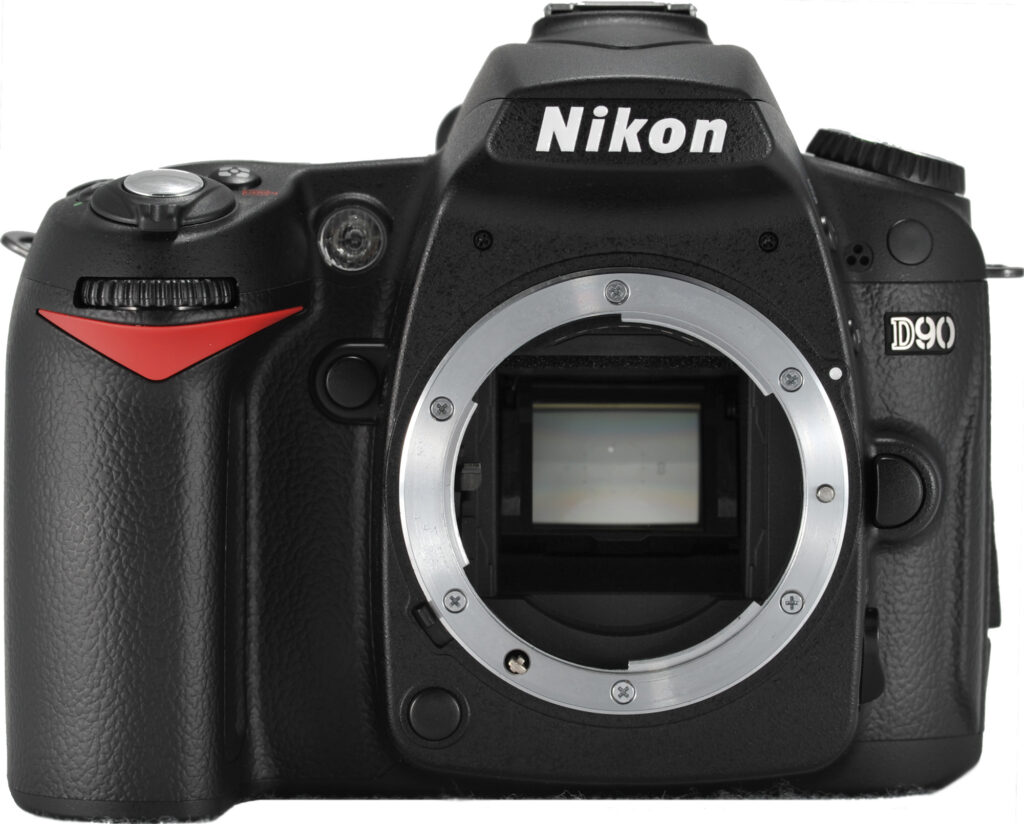
Look and feel. Though many elements are subtly restyled, the Nikon D90's front end has only one new feature: three holes for a microphone, just up and left of the D90 logo. This is, of course, for the new movie recording mode. All of the buttons are in the same locations and have essentially the same functions. Note also that the autofocus screw drive is still in place on the Nikon D90, meaning it will still drive old autofocus lenses as well as the new electronic lenses, something not included in the less-expensive Nikon D40, D40x, and D60.
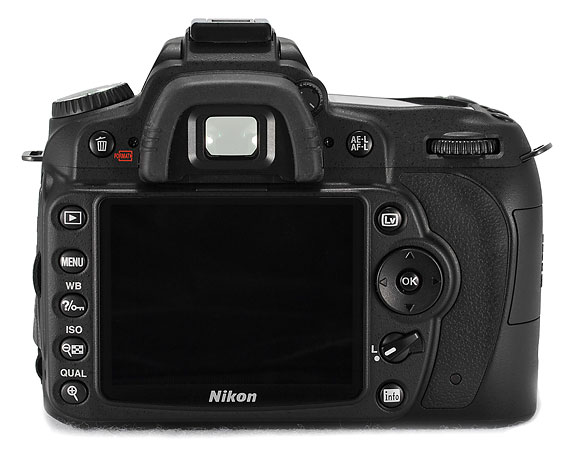
On the back, again the Nikon D90's controls are restyled and the LCD is larger, but most of the controls are in familiar positions. Right of the LCD is where you'll find the major differences. First is the Live view button, marked with the letters Lv. Just below that is the new navigation cluster, which, like the Nikon D700, has an OK button in the center. The arrow pad is locked by the switch just beneath it, and the Info button, again from the D700, takes up position where the OK button was on the Nikon D80. The Info button brings up a status display, and a second press brings up a new onscreen menu.
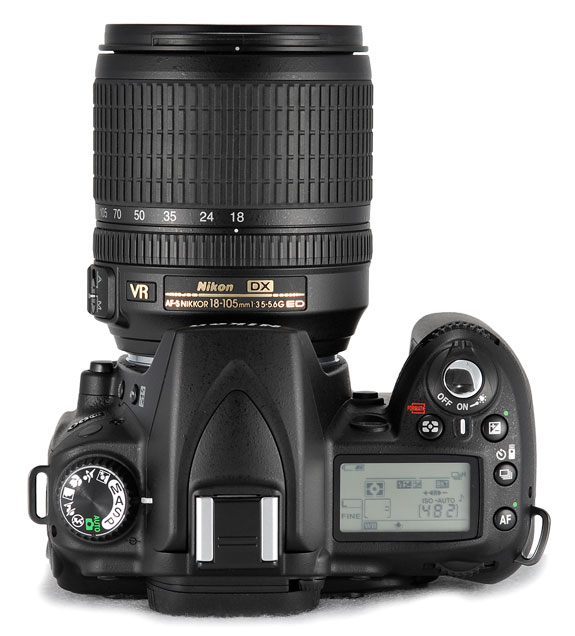
The top deck has nothing new, just a slight reshaping to the buttons and a new top status LCD layout. The significant upgrade here is the new 18-105mm lens. While it doesn't have the extra reach of the 18-135mm lens that came with the D80 bundle, it does have the benefit of Vibration Reduction, Nikon's optical image stabilization.
Holding and shooting. The Nikon D90 feels just about identical to the Nikon D80. It's smaller and lighter than the D300, but still has a good grip, with a good dent inside the grip for the tips of your fingers. It also feels more substantial than the Nikon D60, with more of what an enthusiast photographer wants from his camera. I was very happy with the new multi-controller, which includes the OK button in the middle, rather than in some location distant from the menu navigation tool.
 As on the new Nikon D700, the Nikon D90 also has a new Info button for bringing up the new rear Status display, and further activating the submenu. The submenu includes different items, but they're well-tuned to the enthusiast photographer. Options include changing Long Exposure Noise Reduction, High ISO Noise Reduction, Active D-Lighting, Set Picture Control, Assign Func. Button, and Assign AE-Lock/AF-Lock button. Whether many photographers will use all of these functions, it's good to have them here, rather than having to dig for them in the menu.

Easy access. Most important functions that I usually want to access quickly have their own button, including Flash Exposure Compensation and Bracketing.
Changing most other items of importance is done by a button, including ISO, White Balance, Image Quality (on the left of the LCD); and metering mode, EV compensation, Drive mode, and Autofocus mode (on the top deck); and even flash exposure compensation is integrated into the flash pop-up button, appearing on the left of the lens mount, just above the Bracket button. These are all critical functions that need their own button for fast access, and they're out where you can find them easily; in the case of the latter two, you'll have to learn their positions, since they're out of sight, but at least you won't have to dig in the menu to activate these features.
Having the power switch around the shutter button is always nice too, because you can turn the camera on without taking your eye away from the viewfinder. I frequently turn my digital SLR off as I walk around, and some models make you pull the camera from your face to even find the switch.

Continuous mode. 4.5 frames per second. (Click to view/download 395KB MPEG-4 file.)
Like all other Nikons, the shutter sound of the Nikon D90 is relatively quiet and tame. It's not whisper quiet, but there's not a lot of winding and whirring, just the necessary clicking to activate the mirror and shutter. Check the video at right to see what the Nikon D90 sounds like at its maximum frame rate of 4.5 frames per second.
According to company figures, the Nikon D90 speeds along in several areas over its predecessor, including startup time (0.15 compared to 0.18 on the D80), shutter lag (0.065 compared to 0.08), and optical viewfinder blackout time, which is down to 120 milliseconds from 150 milliseconds. That's of particular importance to me, because I like to keep my eye on the subject.
Optical viewfinder. Similar to the Nikon D80's viewfinder, the Nikon D90's 11-point autofocus system is arrayed in a diamond formation. Still called the Multi-Cam 1000, as on the D80, the Nikon D90's AF engine has been updated to include 3D focus tracking and the advantage of Face Detection, which will bias AF points to favor eyes over noses and other objects in a scene. As a test of this system, I held my hand up in front of my nose much like the Three Stooges used to do to protect their eyes from pokes by their fellow stooges, and had someone take a picture of me. The Multi-Cam 1000 consistently lit up the AF points right over my eyes, rather than choosing the closer object (my hand), which was a welcome surprise. If this system is applied to a camera with 51-point autofocus, it will realize its full power. Nikon D90 users will have to remember to keep their subject's eyes under the 11 AF points for it to work properly, but that's better than having to hope the camera will guess right. Better, of course, is to lock the AF point manually; but if you're in a hurry, you'll take what you can get.
LCD. Another significant treat for D80 upgraders, the LCD is the same bright, crisp, 920,000-pixel LCD screen found on the Nikon D300, D3, and D700. Three inches big, it makes checking your images more satisfying and sure; and autofocus in Live view mode is bound to be more accurate as well. The D80's screen was no slouch by any means, but higher resolution is higher resolution. Even menus benefit from the higher res, more color-rich screen. For one, they can use smaller fonts for more descriptive titles, and include more explanatory text via the help button.
A removable screen cover is still included with the Nikon D90, but the back glass is tempered to resist scratching. I've finally gotten used to using the screen protector, but be sure to carefully clean it before going out for a shoot in daylight, as the protector can transmit even more glare in daylight when it's dirty or smudged. The chief benefit of the screen cover is that if you scratch it, it's at most $20 to replace; the LCD glass, on the other hand, will cost a lot more.

Face detection. Just as we've seen on non-SLR digital cameras, the Nikon D90's Face detection helps determine focus, exposure, and white balance. (Click to view/download 1.7MB MPEG-4 file.)
Live view shooting. Activating Live view on other Nikon SLRs has included turning the Drive Mode dial to Lv and then pressing the shutter button to lock the mirror up; hardly intuitive. The Nikon D90, however, has a dedicated Live view button on the back, just right of the LCD, within easy reach of the thumb. With a single press of the Lv button, the mirror flips up and Live view framing begins. The difference with the Nikon D90 is that you can only focus in Contrast-detect mode, whereas the Nikon D300 and D700 allowed a choice between Handheld (Phase-detect) and Tripod mode (Contrast-detect mode). Phase-detect AF in a Live View SLR is always a noisy affair, as it generally involves dropping and raising the mirror twice (once to focus and once to take the shot), but it's generally faster than contrast-detect focusing, particularly as implemented on the D90. There's a good reason why Nikon refers to the contrast-detect AF mode as "Tripod mode," as it takes a long time for the camera to focus when using it; easily several seconds in some circumstances, and never less than about 2.3 seconds in our laboratory testing. Still, it works very well if you're not in a hurry, and by its very nature, is never subject to the front- or back-focusing that can plague phase-detect AF systems if they're even a tiny bit out of adjustment.
If face detection is activated, the Nikon D90 quickly begins tracking faces, placing a yellow box around each one, up to five at a time. Once focus is achieved, the box turns green. It's just as we've seen from almost all recent non-SLR digital cameras, but it's impressive on an SLR. Panasonic, for the record, was first with this feature. For more on Live View see the Live View subtab under the Operation tab.

Movie mode. Capturing a movie is as easy as pressing the OK button when in Live view mode. (Click to view/download 1.9MB MPEG-4 file.)
Nikon is first with something else: Movie recording in Live view mode. Just press the OK button to start recording. You have to set focus before you start shooting your movie, but you can still manual focus while you're shooting, as well as zoom. The movie will record the noise of the zoom ring to an extent, depending on which lens you're using and how fast you zoom, but it's still pretty impressive. A whole new generation, now of non-professionals, will learn what it means to "pull focus" as the moment of interest turns from one subject to another. It's a cinematic technique usually performed by someone other than the camera operator, who is too busy framing the image to attend to focus as well. But millions of Nikon D90 owners will be able to try a technique that few camcorder owners can.
Movie resolutions include 1280x720 (16:9), 640x424 (3:2), and 320x216 (3:2). Recording times are limited to five minutes per clip for HD mode, and 20 minutes per clip for the latter two modes. Nikon couldn't explain the reason for the limit as of this writing, but it's likely due to sensor heating issues that might start to degrade image quality. The frame rate is 24 frames per second, and audio is monaural, not stereo. Approximate maximum file sizes for two of the modes are 588MB for the 1,280x720-size movies, and up to 2GB for the 640x424 movies.
As a Nikon representative pointed out, it's particularly interesting that it's Nikon, a company that has never had a dedicated camcorder camera, that is first breaking down this barrier in the SLR world. It will be fun to watch what photographers will produce with a video recorder that can use a full range of quality Nikon glass.
Video Examples: Dave shot some examples of video with the D90, so you can see what the different resolution levels look like. Rather than take up a lot of screen space with a number of thumbnails here, check out our Nikon D90 Video page for a number of examples as well as Dave's observations about the D90's video recording.
 Viewing images. Playback mode's enhancements include a new calendar display, a 72-image thumbnail display, a 12, 9, and 4-thumb display; and a new enhancement to the Histogram view that locks the histograms to the displayed image as you zoom. In other words, the histograms show data for just the displayed portion of the image. The retouch menu has new features, including Cross screen and image overlay options, as well as the ability to rotate images in-camera, and create fisheye distortions. For more on this, see the Operation tab of this review.
Sensor. A step up from the D80's 10.2-megapixel sensor, the D90's 12.3-megapixel CMOS sensor may be the same as is found in the Nikon D300, but Nikon representatives were not sure as of this writing. Quoted dimensions are different, measuring 23.6 x 15.8mm, while our info on the D300 says it's 24x15mm. The Nikon D90's sensor has 12.9 megapixels total, but only 12.3 are effective. Output is 12-bit, so you won't get the same lovely 14-bit RAW images, nor the 14-bit Analog to Digital conversion that you get on the Nikon D300.
Sensor cleaning. Nikon's multi-frequency sensor cleaning is also employed in the D90, vibrating the optical low-pass filter glass perpendicular to the plane, rather than parallel as most sensor cleaning systems do. Due to the extreme variability in types of dust in the environment, don't expect any sensor cleaning system to remove everything, but it's certainly better than no cleaning system at all.
Scene Recognition System. Scene recognition is something that Nikon has been working on for years, and these last few models have seen incremental improvements to the system. With the Nikon D90 comes Face recognition.
Nikon's 3D Color Matrix Metering system employs a 420-pixel RGB light meter that covers most of the image area (the D300 and higher models use a 1,005-pixel RGB sensor). As in past models, the Color Matrix Metering system compares what it sees in the image to a database of 30,000 photos to make its metering decisions for each scene. They've added more to properly gauge factors like white balance and subject motion, and now they're tracking faces with SRS. The autofocus sensors are another piece of the SRS puzzle, each aspect informing and tuning the other. Finding and focusing on eyes rather than foreground objects, or even foreheads and noses, is one particular benefit of the overall integration. Another is improved 3D tracking of objects as they move across the image area. The RGB sensor may not be able to help focus on an object, but it can add a set of data for the Nikon D90 to use while tracking a subject with the autofocus system. For example, if a red object is traversing the frame from left to right, and growing in size as it does so, the SRS would add this information to the AF-sensor data to help it tune the focus more quickly.
Active D-Lighting. No longer new, Active D-Lighting keeps gaining enhancements. In addition to the Auto Active D-Lighting mode added with the Nikon D700, the Nikon D90 gains an Extra High setting to add even more punch to shadow detail. Note that JPEG files modified as they are captured with Active D-Lighting, so there's no unaltered "original" to refer back to: Consider whether you want top shoot RAW + JPEG to back up those files, or even use D-Lighting after capture if you think an image would benefit from the help.
 Picture Control. The Nikon D80's Optimize Image setting has been replaced with the Picture Control system found on other recent Nikon digital SLR cameras. Options include Standard, Neutral, Vivid, Monochrome, Portrait, and Landscape. Each Picture Control includes adjustments for Sharpening, Contrast, Brightness, Saturation, and Hue. Monochrome mode allows adjustment of Sharpening, Contrast, Brightness, Filter effects, and Toning. You can also apply Picture Control settings to movies, and Scene modes have complete control over adjusting which Picture Control setting they use, based on information from the Scene Recognition System.

Ports. Top to bottom are DC in, USB, HDMI, AV Out, and GPS/Remote control ports.
Outputs and inputs. New to the output stack is HDMI for easy connectivity to a high definition television, and an Audio/Video output connector (the D80 has a Video connector). Under a separate door you'll find the same Remote control port, but it's now dual-purpose, allowing connection of the new GP-1 GPS accessory, as well as the MC-DC1 Remote cord.

Battery grip.
Battery and storage. You can get up to 850 shots (CIPA standard) with an EN-EL3e battery; that doesn't include any Live view usage or video capture. You can enhance the Nikon D90's battery capacity with the Nikon MB-D80 Multi-power battery pack that was designed for the Nikon D80. If you have large hands or shoot in portrait mode a lot like I do, battery grips can really raise your comfort level. You can use two EN-EL3e batteries, or six AA batteries in the grip. Adding the battery grip does not increase frame rate, as it does on the Nikon D300 and D700, but it does add greater control if you don't mind the weight.
Image storage is via SD cards, which offer up to 32GB capacity at this point. Some are disappointed that Nikon switched to SD in this level of digital SLR camera, but other manufacturers have begun to follow suit, including Canon. On a practical basis, current SD cards provide plenty of storage (does anyone really need more than 32GB on a single card?), and modern SD cards are quite fast, if not quite up to the level of the latest UDMA CompactFlash cards. SD cards are also somewhat more robust, less prone to bent contact fingers in the camera or card reader jamming the card connector while also rendering the camera useless.
Bottom Line: D80 upgraders. Certainly, one large group of potential D90 buyers are current owners of the previous D80. Building on the strengths of its excellent predecessor, the Nikon D90 has an awful lot going for it.  It upgrades several specs and adds a number of new features over the D80. The key question is whether current D80 owners will find upgrading to the Nikon D90 a worthwhile move or not. To my mind, there are several factors that could drive this decision:
Higher Resolution - Maybe not so much. While the move from 6 to 10 megapixels in going from the D70 to the D80 was a significant and noticeable increase in resolution, the move from 10 to 12 is actually pretty minor. You'll see slightly more detail in the D90's shots, but not enough to justify upgrading. (IMHO, at least.)
High-ISO Performance - Some benefit, but again, perhaps not enough to justify an upgrade. Based on our tests, in-camera JPEGs from the D80 are actually a bit cleaner than those from the D90 at least at ISOs below 1,600. At ISO 3,200 and 6,400, though, the D90 does demonstrate noticeably better noise processing.
Video - Definitely! As we discuss elsewhere, the HD video produced by the Nikon D90 is far from perfect. If you really care about video, the best bet is still to get a camcorder. If you're like me though, you probably often find yourself bringing a pocket digicam along on a trip, just to have the ability to grab occasional "video snapshots." This is exactly what the D90's video mode lets you do, and having it could let you finally leave the digicam at home. (Dave says he'll probably upgrade his D80 for this very reason.)
Chromatic Aberration Correction - Definitely! To our minds, not enough has been made of this feature on the D90. Chromatic aberration is what causes the purple and green fringes you often see around the edges of high-contrast objects in the corners of the frame. CA is a particular issue in zoom lenses, particularly ones with long zoom ratios. Depending on the subject you're shooting, it may be more or less of a problem, as it's generally restricted to the corners and edges of the frame. I find it very distracting though, and have seen many otherwise good images ruined by it. The D90 corrects this to an amazing degree, turning lenses I'd otherwise consider marginal into excellent performers. To my mind, this alone could be reason enough for a D80 owner to upgrade to a D90 body. The kit lens for the D80 was Nikon's 18-135mm optic. This was a very sharp lens, but it also showed a lot of chromatic aberration in the corners. On the Nikon D90, this lens turns into a beautiful performer in nearly every respect. The D90's own 18-105mm optically stabilized kit lens also has only so-so CA performance on its own, but combined with the D90's distortion-reduction processing turns into a stellar performer.
Faster Shooting - Definitely! With a maximum continuous-mode frame rate of 4.5 frames/second, the Nikon D90 is 50% faster than the 3 frames/second of the D80.
Whether you decide to upgrade or not will obviously depend a lot on how and what you shoot and the state of your budget. If you don't care about Live View or movie recording, and aren't too bothered by chromatic aberration in your current lens collection, you can probably take a pass on this particular evolution of Nikon's prosumer DSLRs. On the other hand, if any of the above strike you as must-haves, the D90 is a bigger step forward than we're accustomed to seeing between generations of SLRs from a given manufacturer.
Bottom Line: Competitive Decisions For people buying their first DSLR, Canon is Nikon's arch-rival and their models will most likely be the ones most shoppers will be comparing the D90 to. With the D80, Nikon cleverly split Canon's price structure down the middle, offering more features at a higher price than more down-market Canon models (like the XTi), but keeping the total price well below that of Canon's next model up the line (the 40D). With the D90, they've followed the same strategy, although the upgraded features Canon has added to their new XSi does narrow the gap there somewhat, and (for a while at least), the fire-sale clearance pricing we've seen on their 40D brings it down to close to the same price as the D90. Here's a quick breakdown of how these cameras compare:
Compared to: Canon Rebel XSi - The Canon XSi is priced quite a bit below the D90, but in making the Canon/Nikon choice, many people will likely consider it, as it's the closest Canon model on the low side of the D90's price.  In this case, though, "closest" means a good $500 or so less expensive than the D90, comparing prices for the kits including lenses. Body-only, as this is being written in mid-October, 2008, the XSi is selling for about $350 less than the D90. (The D60 is the Nikon model closest in price to the XSi.) The XSi and D90 have essentially the same resolution and both have Live View features, but the similarities pretty much end there. Most obviously, the D90 has movie capability. The D90 also shoots faster in continuous mode (4.5 vs 3 frames/second), and goes dramatically higher in ISO (light sensitivity) rating, to a maximum of 6,400 vs 1,600 for the XSi. Then there's the automatic correction for chromatic aberration. Minor details include a significantly higher resolution LCD screen, viewfinder with LCD-based grid that can be turned on and off, extensive in-camera RAW file processing, and direct support for Nikon's wireless flash system. The D90's kit lens also has a significantly longer zoom range. In its favor, the Canon XSi offers a live histogram display in its Live View mode and has 14-bit RAW files and internal processing, which can provide smoother tonal transitions, particularly when processing images from RAW files with heavy exposure adjustment. It also comes with more capable RAW-processing software at no added cost. Any way you slice it though, the D90 delivers dramatically more capability, albeit at a considerably higher price.
Compared to: Canon EOS-40D - "For a limited time only..." As dealers clear their shelves to make way for the new EOS-50D, prices on the Canon 40D have plummeted recently,  bringing the cost of the 40D down to that of the D90, or even a bit below. (As of this writing in mid-October, 2008, the 40D was available body-only online for as little as $900, almost a hundred dollars less than the D90.) Relative to the 40D, the Nikon D90 offers its HD movie recording capability, contrast-detect autofocus in Live View mode, a couple of extra megapixels, one stop higher maximum ISO, the snazzy viewfinder with on-demand gridlines, its extensive in-camera RAW file processing, the automatic CA correction, and the direct, in-camera support for Nikon's wireless lighting system. On its side of the ledger, though, the EOS-40D offers faster continuous-mode shooting, at 6-6.4 frames/second, depending on the shooting mode, vs 4.5 for the D90. The Canon 40D also has 14-bit internal processing, a PC-type sync terminal for connecting to external flash systems, and full-capability RAW processing software included in the box. The D90 still sports more features, but the 40D's higher continuous-mode shooting speed and 14-bit processing might sway some users in its favor. A closer contest than that with the XSi, but the scales still seem to tip toward the D90. If you find the Canon 40D a compelling bargain, though, our advice is to move fast, as the 40Ds remaining in the market are likely to sell through quickly.
Compared to: Canon EOS-50D - Here's where the D90 will feel its stiffest competition from the Canon lineup, but as was the case with the previous D80/40D matchup, at a considerably higher price.  Here, the Canon 50D bests most of the D90's specifications, with 15 megapixels to the D90's 12, 6.3 frames/second to the D90's 4.5 and maximum ISO of 12,800 vs the D90's 6,400, and of course 14-bit image processing and no-added-cost full-capability RAW processing software. It also has shading (vignetting) correction which the D90 lacks. The only significant D90 features not found in the 50D are HD movie recording and chromatic aberration correction. The Canon 50D does have rather an odd choice for its kit lens, though, a 28-135mm image-stabilized model that equates to a 44.8-216mm equivalent range on a 35mm film camera. The wide end of that isn't very wide at all; we think most people would find his an awkward lens to work with: Most users are going to want something capable of going much wider. Leaving the lens out of the equation then, the body-only prices as of this writing in mid-October 2008 were running about $1,400 for the Canon 50D vs $990 for the D90.
All things considered, we once again see a Nikon prosumer SLR model placed squarely in between two Canon models, in terms of both price and capability. Even compared to the higher-end Canon product though, the D90's rich feature set does much to recommend it, making it a compelling proposition.
Nikon D90: In the Box
The Nikon D90 kit ships with the following items in the box:
- Nikon D90 body
- AF-S DX Zoom-Nikkor 18-105mm f/3.5-5.6 G ED VR Lens
- Body cap
- Front lens cap
- Camera strap
- Rubber eyecup
- USB cable
- Quick charger (MH-18a)
- AC power cord
- Li-ion battery (EN-EL3e)
- Accessory shoe cover
- Plastic LCD protector panel
- PictureProject CD ROM
- Quick start guide
- Instruction manual
- Warranty and registration card
Nikon D90: Recommended Accessories
- Large capacity SD/SDHC memory card. These days, a 2GB or 4GB card is inexpensive enough, and you'll want a large card if you plan on recording many HD movies. Good to buy a higher-speed card also, able to record fast enough to not limit movie duration simply due to card speed. (SanDisk Ultra/Extreme III, Kingston 133x or equivalent)
- Camera case for protection
- Accessory lenses
- Accessory flash: SB-400, SB-600, SB-800, SB-900 (SB-600 is most economical to do off-camera flash with Nikon's wireless lighting system.)
Nikon D90 Conclusion
| Pro: | Con: |
|---|---|
|
|
I'm starting to feel strange about saying Nikon's done it again, but it looks like they have. The Nikon D90 looks like a genuinely excellent camera for the intermediate photographer, and a great choice as a full-featured, light weight body for those who own a Nikon D200 or D300. The addition of video is ground-breaking, and will open up new possibilities that will be fun to explore, even though I wish it handled motion better than it does. Really, my only major disappointment for the intermediate market is the lack of a higher frame rate. I'd like to see at least five frames per second, if not six. But at least they raised it to 4.5 from the Nikon D80's three frames per second. Otherwise, there's little to complain about, and only more great features to praise.
As they did with the D80 before it, Nikon has cleverly positioned the D90 squarely within a gap in Canon's lineup: It's more expensive than the Canon XSi, but delivers many more features. At the same time, while it doesn't quite measure up to some specs of the Canon 50D (although coming close in many areas, surpassing it in some), it's also a good bit less expensive than that model. All in all, the Nikon D90 presents a truly compelling proposition for intermediate photographers - Or novices looking for a camera with plenty of capability to grow into. For Nikon shooters it offers a great step up from the previous D80 or previous entry-level Nikon DSLRs like the D50, D40, or D40x. For more advanced Nikon users, it makes a great second body for those whose main camera is one of Nikon's higher-end models, like the D200 or D300.
Bottom line, the Nikon D90 is an exceptionally well-rounded digital SLR offering, with just about everything an aspiring photographer will need, and quite a few of the advanced features found on the higher-priced SLRs in Nikon's line, but at a lower price. Very highly recommended, and an easy Dave's Pick.
Design
Nikon D90 Design
Roll-over the various controls and features with your mouse for a brief description.

Front View. Most of the Nikon D90 controls are the same as the Nikon D80. The only difference here besides subtle reshaping of various items is the addition of the microphone. Three holes show its position just upper left from the D90 logo.

Left View. The left of the D90 reveals some new ports, including the HDMI-out port, and in place of the Video-out port is the Audio/Video out port. The smaller rubber door for what was the remote control port now serves as a GPS-in port as well. Note that the Flash pop-up button also serves as a Flash exposure compensation button. Turning on the Bracketing function is as easy as pressing the BKT button and turning the Main and sub-command dials.

Right View. The SD card door and speaker are located on the right side. The SD card door opens with a pull to the rear, and then you press the SD card down to release it.

Top View. All of the functions and controls are the same on the top deck. It's a great layout that allows for quick changes to commonly used settings.

Back View. The back has the most changes from the Nikon D80. The Lv button is new, for switching into Live view mode. The OK button has taken up a new position inside the Multi-controller, and the Info button has taken its place. The Multi-controller Lock switch is now smaller and more efficient.

Bottom View. No changes here, just a battery door and tripod mounting socket.
Operation
Nikon D90 Operation
Top Panel Status LCD
 As with most higher-end Nikon DSLRs, the top-panel data readout LCD communicates a lot of information about current camera settings, and provides an interface for setting many camera functions, when used in conjunction with the various buttons and Command Dials. You can also use the main LCD to adjust many of the same settings, but using the top LCD saves power and can be more convenient when the camera is below eye level.
The illustrations below show the meaning of the various icons and readouts in this display.

1 |
Shutter speed
|
15
|
Flash compensation indicator
|
|
Exposure compensation value
|
16
|
"Clock not set" indicator
|
|
|
Flash compensation value
|
17
|
Flexible program indicator
|
|
|
White balance fine-tuning
|
18
|
Metering mode
|
|
|
White balance color temperature
|
19
|
Focus points
|
|
|
White balance preset number
|
AF-area mode
|
||
|
Number of shots in bracketing sequence
|
20
|
Autofocus mode
|
|
2 |
Battery indicator
|
21
|
Black-and-white indicator
|
3 |
Flash mode
|
22
|
Number of exposures remaining
|
4 |
Image size
|
Number of shots remaining before buffer fills
|
|
5 |
Image quality
|
Preset white balance recording indicator
|
|
6 |
White balance fine-tuning indicator
|
Capture mode indicator
|
|
7 |
White balance
|
ISO sensitivity value
|
|
8 |
ISO sensitivity compensation indicator
|
23
|
ISO sensitivity indicator
|
9 |
"K" (appears when memory remains for over 1000 exposures)
|
Auto ISO sensitivity indicator
|
|
10 |
"Beep" indicator
|
24
|
Bracketing progress indicator
|
11 |
GPS connection indicator
|
25
|
Bracketing indicator
|
12 |
Release mode
|
26
|
White Balance Bracketing indicator
|
13 |
Aperture (f-number)
|
27
|
Exposure compensation indicator
|
|
Bracketing increment
|
28
|
Multiple exposure indicator
|
|
|
14
|
Color temperature
|
|
|
Shooting Info Display
One of the most obvious differences between the Nikon D90 and the D80 that went before it is the new model's rear-panel shooting info display. This is somewhat reminiscent of the "Classic" version of the shooting display on the D60, but the information is arranged quite differently, and Nikon has expanded their use of the margin for quick access to some of the more frequently menu items.
| Nikon D90 Rear-Panel Shooting Info Display | |
 |
 |
| The rear-panel info display on the Nikon D90 bears some resemblance to those we've seen on recent models, but there's been considerable reorganization as well. | When shooting under dim lighting, you can opt for a light-on-dark version of the screen that doesn't glare so brightly at night. |
 |
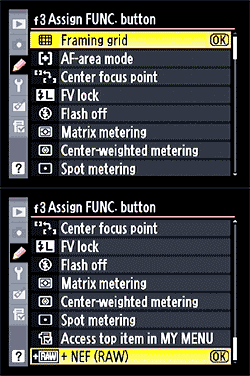 |
| The icon bar along the bottom provides quick access to items otherwise buried in the menu system. | The Nikon D90 gives you a lot of choices for what function to assign to the front-panel Func button. |
The illustrations below show the meaning of the various icons and readouts in this display mode.

1 |
Shooting mode
|
19
|
Flash mode
|
2 |
Flexible program indicator
|
Flash control mode for optional flash units
|
|
3 |
Shutter speed
|
20
|
Electronic analog exposure display
|
|
Exposure compensation value
|
Exposure compensation
|
||
|
Flash compensation value
|
Bracketing progress indicator
|
||
|
Color temperature
|
21
|
AC adapter indicator
|
|
|
Number of shots in bracketing sequence
|
22
|
Flash value (FV) lock indicator
|
|
4 |
Aperture (f-number)
|
23
|
Flash compensation indicator
|
|
Bracketing increment
|
24
|
Exposure compensation indicator
|
|
5 |
Release mode
|
25
|
Multiple exposure indicator
|
6 |
Continuous shooting speed
|
26
|
Bracketing indicator
|
7 |
Remote control indicator
|
27
|
Active D-Lighting bracketing amount
|
|
Self-timer mode indicator
|
28
|
Image comment indicator
|
|
8 |
ISO sensitivity indicator
|
29
|
Autofocus mode
|
|
Auto ISO sensitivity indicator
|
30
|
ISO sensitivity
|
|
9 |
"Beep" indicator
|
31
|
Number of exposures remaining
|
10 |
"K" (memory remains for over 1000 exposures)
|
32
|
GPS connection indicator
|
11 |
White balance
|
33
|
Auto-area AF/mode indicator
|
|
White balance fine-tuning indicator
|
3D-tracking indicator
|
||
12 |
AE-L/AF-L button assignment
|
Focus point
|
|
|
13
|
Function button assignment
|
34
|
Image size
|
|
14
|
Picture Control indicator
|
35
|
Image quality
|
|
15
|
Active D-Lighting indicator
|
36
|
"Clock not set" indicator
|
|
16
|
High ISO NR indicator
|
37
|
Camera Battery indicator
|
|
17
|
Long exposure NR indicator
|
MB-D80 battery type display
|
|
|
18
|
Metering mode
|
MB-D80 battery indicator
|
Live-View Display
The Nikon D90 is the first consumer-level DSLR from that company to offer a Live View function. Going everyone else one better, Nikon's also added a Movie recording option to the D90's Live View mode.
| Nikon D90 Live View Display | |
 |
 |
| The Live-View display on the Nikon D90 provides a fair bit of exposure information, including shutter speed, aperture, exposure compensation, ISO, card space remaining, image size/compression, white balance setting, program mode, etc. | As noted elsewhere, Contrast-Detect autofocus is the only focus mode available in Live View. The advantage though, is you can position the focus area wherever you want in the image. Here, we've moved it up to center on the Nikon logo on the camera. The focus rectangle turns green when focus is locked. |
 |
 |
| One of the advantages of Contrast-Detect autofocus is the ability to do cool things like Face Detection. | And the ultimate Live View feature: Movie recording. Just press the OK button (center of the 4-way controller) any time while in Live View mode, and you're recording a movie! |
Playback Screens
| Nikon D90 Playback Screens | |
 |
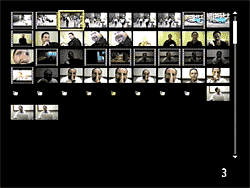 |
| Handy when dealing with gigabyte memory cards, a calendar display makes it easy to quickly browse images shot over a period of time. | A 72-image thumbnail display screen is newly added to the Nikon D90, making it easier to scroll through large numbers of images to find the ones you want. |
 |
 |
| The nine thumbnail display is familiar from earlier models. | Ditto the 4-thumbnail screen. (Note the "sprocket holes" designating movie files: A first for a DSLR!) |
 |
 |
| A variety of playback displays can be cycled through using the up/down arrows on the multi-selector, including image with shooting information, luminance histogram and file information. | Even movie clips get this shooting information screen. |
 |
 |
| Histogram displays are pretty standard these days. Here, we see histograms for brightness (luminance) and the red, green, and blue channels separately. | Here's something you may not have seen on a Nikon DSLR before: The histogram updates as you zoom in on the image! - We've long wondered why camera makers hadn't done this; now Nikon has. Cool! |
 |
 |
| The highlight clipping warning display blinks blown highlights to call them to your attention. | Of course the D90 also lets you magnify images for closer inspection on its gorgeous 3-inch, 922K pixel LCD. You can magnify them up to approximately 27x for large, 20x for medium and 13x for small images, using the zoom in button. Once magnified, you can scroll around the image using the multi-selector to examine critical detail and framing. |
Playback Menu
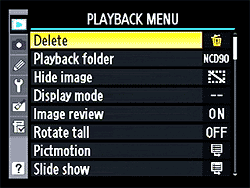
The Nikon D90's playback menu options are fairly conventional for the most part, but there are several features not found on the D80, and a greatly-expanded PictMotion (slide show with transitions and sound) menu, moved here from the Retouch Menu.
| Nikon D90 Playback Menu | |
 |
 |
| Much of what's here was also on the D80. The Nikon D90 adds display mode, image review, and Pictmotion. | |
 |
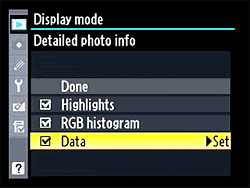 |
| Display Mode is a new option, that sets what information screens will be available as you scroll through them via the up/down arrows on the 4-way controller. This can make it quicker getting between different display screens you use, by avoiding having to scroll through ones you don't care about. | |
 |
 |
| This isn't new, but it's been moved from the Custom Settings Menu. With the new, much deeper CS Menu, it could have gotten buried pretty deeply. Personally, we'd look first for this on the Shooting Menu, since that's when you actually care about whether Image Review (immediate post-capture image display) is on or off. | |
 |
 |
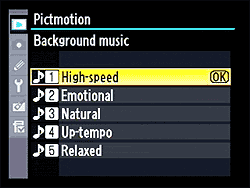
| Pictmotion is Nikon's name for slide shows synchronized with music and with "Ken Burns" effect animation. On the D90, it's shown as a separate menu item, to distinguish it from common fixed-interval slide shows. | You can select individual photos, all the images shot on a given date, or all images on the memory card. |
 |
 |
| Five different choices are available for background music. None of it will win a music award, but they're for the most part pretty unobjectionable as slide-show background music. | You can choose a number of transitions between images. The background music contains cues to the camera, so the slides seem to change in time with the music. |
Retouch Menu
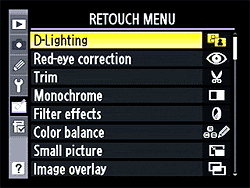
This is a feature that's been around on Nikon's consumer cameras since the D40, and one that has been the subject of ongoing enhancement. The items on this menu all represent image modifications that can be done after capture, while in Playback mode, and without the use of a computer. In all cases, applying any of the modifications to an image results in the creation of a new image; your original is always left untouched. Practicing professionals using the D3 or D300 will be more likely to rely on workstation-based software than in-camera one-at-a-time image tweaks like these, but it's conceivable that things like red-eye correction and D-Lighting might be useful to apply on a one-off basis. So this probably isn't a big feature for most users of these cameras, but given the negligible incremental expense of adding this menu to the camera, there's no reason not The Retouch Menu on the Nikon D90 offers a number of brand-new features. The table below shows a few of the more noteworthy features, both old and new.
| Nikon D90 Playback Mode Retouch Menu Options | |
 |
 |
| The Retouch Menu now spans two menu screens, with many more features than even the just-released pro-level D700 has. | |
 |
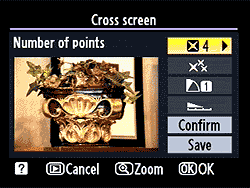 |
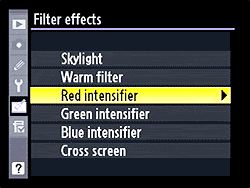
| The Filter Effects retouch option carries the four new options we saw on the D60: Red/Green/Blue intensifiers and Cross Screen (for creating star effects around strong point highlights.) | Cross Screen options include number of points on the highlight stars, number of stars (threshold for highlights to trigger star creation), angle of star rays, and length of rays. A little kitchy in practice (a little goes a long ways), but fun for some shots. |
 |
 |
| Image overlay is another function that, while entertaining, can be a little hard to find applications for. | |
 |
 |
| In-camera RAW processing is a feature we've seen on Nikon cameras for a little while now, but it deserves mentioning for its completeness: Pretty much any color or tone adjustment you could make when taking the original shot is available when developing NEF RAW files into JPEGs after the fact. Options include JPEG quality, image size, white balance, exposure compensation, and Picture Control. (Presumably including any adjustments you've made to the camera's individual Picture Control settings. | |
 |
 |
| A new Quick Retouch option attempts to make basic color and tone adjustments to produce better-looking photos. The shot of the ugly vase above isn't an ideal example for this, was the best we had available when we were playing with the prototype. A better example would be a grey, misty day: This function would brighten it up, clear away some of the haze. | |
 |
 |
| We're not sure what you might use image overlay for, but here's a feature we could use on far more of our shoots than we'd like to admit: A Straightening function that lets you rotate an image in small increments left or right. No excuses anymore for tilted horizon lines! | |
 |
 |
| And speaking of useful, the Nikon D90 also lets you correct pincushion and barrel distortion (within limits) right on the camera's back panel. If you have a lens that the camera knows about (presumably most Nikkor lenses), the camera can correct the distortion automatically. | |
 |
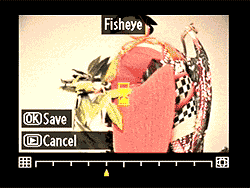 |
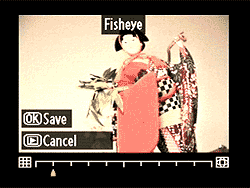
| Back in the "more fun than useful" category, you can also apply a fisheye effect to your photos, post-capture. (By the way, note that all these post-capture effects create new images on the card, rather than modifying the original.) | |
HDMI Output
 Like the D3, D300, and D700, the new Nikon D90 provides for HTDV output via an HDMI 1.3 mini connector on its left side, hidden behind a rubber flap. If you've not yet joined the legions of HDTV users, there's also a conventional mini phone jack socket for conventional NTSC/PAL analog output.
GPS Option!
 Simultaneous with the announcement of the D90, Nikon is also announcing the GP-1, a new GPS accessory. The GP-1 is a little gadget that mounts on the hot shoe, and plugs into a new, dedicated GPS port on the side of the camera, using the GP1-CA90 accessory terminal cord. (While it's being announced with the D90, the GP-1 can also be used with the D3, D300, D700, D2x, D2xs, D2Hs, and D200 by plugging it into the 10-pin accessory terminal on those cameras, using the GP1-CA10 accessory terminal cord.) We haven't yet seen a sample of the GP-1, but it sounds relatively compact, at 1.97 x 1.79 x 1.00 inches (50 x 45.5 x 25.5mm). Power comes from the camera body, but we don't yet know how big an effect it will have on camera battery life. When operating, the GP-1 will copy latitude, longitude, altitude and time data into the EXIF headers of any image files captured. At this point, we have very little information on the GP-1 (including its projected price in the US), but one spec caught our eye: The GP-1 on average requires only 35 seconds for satellite acquisition, only 5 seconds from a hot start. That "hot start" seems tied to a setting on the setup menu for the GPS: You can apparently set it up to power-down whenever the camera's exposure meter shuts off. This could potentially save a lot of battery power, but at the relatively minor cost of needing to wait 5 seconds before snapping a shot after activating the camera's exposure meter, for the GPS unit to wake up. An interesting accessory, one we think will find a lot of application in various commercial, insurance, and governmental settings, where photos need to be authoritatively tagged with specific location information.
Optics
Nikon D90 Optics
Lenses
Like other Nikon SLRs, the D90 accommodates a wide range of Nikkor lenses, via the standard Nikon "F" lens mount. With very few exceptions, you can use the Nikon D90 with any F Mount Nikkor lens ever made, but older non-CPU lenses will significantly limit your exposure options. (Like the D80, the Nikon D90 lacks the "Non-CPU Lens Data" menu item found in Nikon's higher-end DSLRs, as well as the indexing finger the D300 has for wide-open metering with older "AI" lenses. If you have any AI lenses you want to be able to use the camera's metering system with, you should go with the D300 rather than the D90.)
 New Kit Lens
As seems to becoming almost standard with Nikon, they've announced a new kit lens along with the D90. Their latest kit offering for the D90 is the AF-S DX 18-105mm f/3.5-5.6 G ED VR, with 15 elements in 11 groups one element using ED glass and one hybrid aspheric surface. (A hybrid aspheric lens consists of a normal spherical-section glass lens with a thin plastic layer bonded to it that provides a molded aspheric surface. They provide the benefits of aspheric surfaces (reduced distortion and aberration) at lower cost than all-glass aspherics.) Maximum aperture ranges from f/3.5-5.6 from wide angle to tele, while minimum aperture ranges from f/22-36.
The long list of alphabetic jargon in the lens's name deserves some translation for the non-Nikonians who might be reading this, so here it is:
- AF-S - "Silent Wave" (SWM) motor for fast, quiet focusing. This design also lets you adjust focus manually after the autofocus system has achieved focus, handy for manually tweaking focus to your liking in tricky situations.
- DX - designed to mate with Nikon's DSLRs, smaller and lighter because its image circle doesn't have to cover the full 35mmm film plane.
- 18-105mm - A fairly wide zoom range, 5.8x from wide to tele, equivalent to a 27-157.5mm lens on a 35mm camera.
- f/3.5-5.6 - A fairly average maximum aperture range, typical of most of Nikon's kit lenses.
- G - It has a CPU so it will work with Nikon's 3D Color Matrix Metering II system. The G also means no aperture ring, you set the aperture only through the camera's controls. Speaking of aperture, the diaphragm in this lens is a 7-blade rounded-opening design, for nice round catchlights and more appealing bokeh. (A more natural blur for out-of-focus objects.)
- ED - Uses Extraordinary Dispersion glass for better control of distortion, astigmatism, and chromatic aberration. As noted, there's also one aspheric surface, down from no fewer than 7 in the previous 18-135mm kit optic.
The new lens focuses quite closely, to a maximum repro ratio of 0.2x (1:5 macro), and accepts 67mm filters. This is a slightly reduced macro capability over the previous 18-135mm, which could get to 0.24x. It's nice that the lens takes a 67mm filter, that seems to be a fairly common size on Nikon's lenses, so you'll have a better chance of using the same filters on multiple lenses. As its VR designation indicates, this lens also incorporates Nikon's excellent Vibration Reduction (Image Stabilization) technology. The overall dimensions of the lens are 76mm diameter by 89mm long, and it weighs in at 420 grams. This lens adds $300 to the price of the body when purchased as a kit, but will cost $485 when purchased alone.
The new kit lens felt very nice in the hand. It zoomed smoothly, focused quickly, and construction was solid and tight. Optical performance was quite good, and VR is a welcome addition. Along with the test results presented below, see our full review of the Nikkor 18-105mm VR lens on our sister site, SLRgear.com.
Lens Compatibility
As noted above, functions and exposure modes available with a given lens will vary greatly with the lens type. More recent Nikkors (the G- or D-type models) include a microchip (CPU) that communicates focal-distance information to the camera. Lenses without the microchip won't support the 3D Matrix metering mode, and in fact all metering is disabled on the D90 when using a non-CPU lens. Most non-CPU lenses can be attached to the camera, but the shutter release will be disabled unless the camera is in Manual exposure mode, and AF, metering, electronic analog exposure display and TTL flash control can't be used.
For complete lens-compatibility information, see the tables below (courtesy of Nikon):


Kit Lens Test Results
Zoom
Very good performance with the 18-105mm VR (Vibration Reduction) kit lens.


The Nikon D90 digital SLR accommodates a wide range of Nikkor lenses. Here, we tested the performance of the new 18-105mm VR kit lens, which has a fairly generous (for a kit lens) optical zoom range of ~5.8x. Details are very good at wide angle, with better-than-average corner-to-corner sharpness (only slight softness in the extreme corners) and relatively low levels of coma distortion and blurring in the corners. Chromatic aberration is also quite low for a long ratio zoom (see below for why). Results at full telephoto are also very good, with good sharpness across the frame and very low levels of chromatic aberration, though pin-cushion distortion is quite evident. All in all, the Nikkor 18-105mm VR, does very well for a kit lens on a 12-megapixel sensor, and the added image stabilization will come in handy for low-light shooting.
Macro
A average area (for an SLR kit lens), with good detail. Flash throttles down well.


As with zoom performance, the Nikon D90's macro performance will depend entirely on the lens in use. However, with the 18-105mm VR kit lens set to 105mm, the D90 captured a fairly average minimum area (for a non-macro, long zoom SLR lens) measuring 4.23 x 2.81 inches (107 x 71 millimeters). Resolution is high, though details are a little soft overall, even at the center of the frame, with moderate softening in the corners. (Most lenses have some softening in the corners at macro distances.) The Nikon D90's flash throttled down for the macro area pretty well, and there was no detectable shadow from the lens barrel, resulting in a good exposure with the flash.
Distortion
Moderately high geometric distortion with the 18-105mm VR kit lens.
| Barrel distortion at 18mm is 1.1 percent |
 |
| Pincushion at 105mm is 0.5 percent |
 |
The Nikon D90's 18-105mm VR kit lens produced about 1.1 percent barrel distortion at wide-angle, which is higher than average among the cameras we've tested, and noticeable in its images. At the telephoto end, the 0.5 percent pincushion distortion is also above average and quite noticeable. This is the tendency for the lens to bend straight lines outward (like a barrel -- usually at wide-angle) or inward (like a pincushion -- usually at telephoto).
Chromatic Aberration
Very low in camera JPEGs, but moderately high at wide-angle in RAW files with the 18-105mm VR kit lens.


Chromatic aberration in the corners of camera JPEGs taken with the Nikon D90's kit lens is extremely low, and hardly noticeable at either wide angle or full telephoto. So low in fact, that it made us wonder if the D90 was correcting for it, even though Nikon hasn't advertised chromatic aberration correction as a feature for the D90. (This distortion is visible as a slight colored fringe around the objects at the edges of the field of view on the resolution target.)
RAW Files
As we suspected, there were moderate to high levels of C.A. in the corners of converted RAW files. So, it turns out the Nikon D90 does indeed compensate for lateral chromatic aberration in its JPEGs, just like its big brothers: the D3 and D300. As mentioned above, this feature was not listed in any of the pre-release D90 info received, nor was it mentioned on the Nikon USA website at the time of this writing. We were pleasantly surprised, to say the least.


Chromatic Aberration Reduction. As noted, the anti-CA system in the D90 seems to work identically to that in the D3 and D300. The crops above were taken from the corners of converted RAW files with the D90 and the new 18-105mm VR kit lens. It's a very good kit lens for the price, but there's some moderate to strong CA in the corners, as can be seen clearly in RAW files, as above.
In the previous set of in-camera JPEGs, you can still see a tiny amount of coloration along the vertical edges of the bold black bar, but that's really splitting hairs: For all intents and purposes, the chromatic aberration is gone. (Note that the anti-CA processing is only applied to the in-camera JPEGs; the camera very rightly leaves the RAW files untouched.)
It's important to note that this CA correction isn't dependent on your using a Nikon lens: The camera figures out how much CA there is in each area of the image, and shifts the planes of red and blue pixel data to compensate for it. Note, though, that this only works for lateral CA. Longitudinal chromatic aberration isn't corrected out. (Happily, with most good quality lenses, lateral CA is much more common than longitudinal.)
Corner Sharpness
Slight blurring in the corners of the frame at both zoom settings with the kit lens.
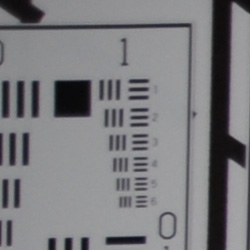
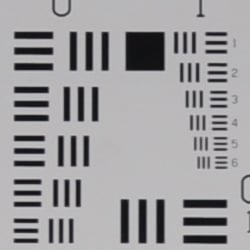


The Nikon D90's 18-105mm VR kit lens produced slightly soft corners in a few shots. At wide angle, corners on our test targets had a little softness compared to the center. At telephoto, corner softness was similar, but still much less than average for a kit lens. A very good performance here, especially considering these shots were taken at maximum aperture (corner softness usually improves when the lens is stopped-down a few f-stops). Impressive results for a 5.8x zoom kit lens.
The images above were taken from our standardized test shots. For a collection of more pictorial photos, see our Nikon D90 Photo Gallery .
Exposure
Nikon D90 Exposure
Nikon D90 Exposure/Capture Enhancements
The Nikon D90 offers a number of advancements over its predecessor the D80. We'll mention them here, and then discuss some of them in more detail below.
 12-megapixel sensor
The Nikon D90's 12.3 megapixel sensor isn't exactly a quantum leap beyond the D80's 10.1-megapixel chip, but a little extra resolution is always welcome. - As long as it doesn't bring higher image noise along with it. Nikon claims new, more advanced noise reduction processing on the D90; if so, the extra two megapixels of resolution will be a nice addition. Indicative of Nikon's confidence in their new noise-reduction algorithms is the D90's higher ISO range of 200-6,400. (The D80 ranged from ISO 100 to 3,200.) Like the D80 though, the D90's sensor and A/D system delivers 12 bits of raw image data, vs the 14 bits of the D300 and other higher-end Nikon DSLRs.
 High-endurance shutter mechanism
Like most consumer-level DSLRs, the D80's shutter carried no rating for total lifetime cycles. For the D90 though, Nikon is rating its shutter at 100,000 cycles. This isn't quite to the 150,000 to 300,000 cycle ratings of some pro-grade SLRs, but it's a pretty substantial number nonetheless. An explicit shutter lifetime rating is a first for Nikon in a consumer or prosumer-level SLR, and speaks well for the D90's long-term durability.
New, highly advanced exposure system
When they were announced in late August, 2007 (almost exactly a year ahead of the D90), the D3 and D300 marked a significant advance in exposure metering technology. Nikon's 3D Matrix Metering had long been an industry standard for exposure accuracy when faced with tough subjects and difficult lighting conditions, but the D3/D300's system took Matrix Metering to a new level. Changes in the optical path for their 1,005 element RGB exposure/white balance sensor greatly improved scene-recognition accuracy. This technology has now been brought forward to the Nikon D90. Although its RGB exposure/white balance sensor has fewer elements (420 vs 1,005), this improved scene-recognition technology promises improved exposure accuracy for the D90, beyond the already-excellent performance of the D80.
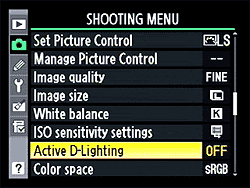
Active D-Lighting
D-Lighting is Nikon's name for their technology that balances exposure in highlights and shadows. On the D80 D-Lighting was a Retouch menu option, where it could be applied to images after they were captured. On the D3 and D300, the new D700, and now on the Nikon D90, D-Lighting is still an option on the Retouch menu, but can also be found on the Shooting menu as Active D-Lighting. Active D-Lighting does the same things D-Lighting has always done (typically, holding back highlights slightly, while boosting shadow brightness), but now does it on the fly, at the moment of capture. On the D90, though, Active D-Lighting's capabilities are expanded beyond those of the previous pro cameras through the addition of the Extra High option. (The pro cameras' Active D-Lighting options include Off, Low, Normal, High, and Auto.) Nikon told us that the advanced scene recognition used in the exposure system also informs the Active D-Lighting system, particularly in photos containing people's faces.
 |
 |
| No D-Lighting | D-Lighting |
|
These shots from the D60 show Active D-Lighting at work on the D60. Here, the terribly blown-out background is held at least somewhat in check, while midtones are smoothed out a bit. You still need to decide when to use it or not: In this case we might have wanted to blow out the background, to emphasize the subject more. It will be interesting to try a shot like this on the Nikon D90, to see if the face-detection in its exposure system would cause it to push the exposure a bit more on Marti's face.
|
|
We didn't get a chance to play with Active D-Lighting on the Nikon D90, but have been quite impressed by it on the D3, D300, and D700. We're generally not fans of cameras' monkeying with contrast and tonality on their own, but have to admit that Nikon's Active D-Lighting gets it right more often than not (to our eyes, at least). We also like that it leaves the NEF RAW files completely alone (its effects are only applied to in-camera JPEGs), so we always have an undisturbed original to tweak manually if we don't like what D-Lighting did with a subject.
| Nikon D90 Active D-Lighting Options | |
 |
 |
| Active D-Lighting appears on the Nikon D90 for the first time in a consumer DSLR. | As with several other features, Active D-Lighting on the D90 has been enhanced even over what's available on recent Nikon pro models. The Extra High option is new with the D90. |
Another nice feature: Active D-Lighting can be "bracketed" on the D90. Not in the usual sense of bracketing involving shooting with a range of settings (low, normal, and high, for example), but rather by simply grabbing one shot with Active D-Lighting off, and one with whatever setting you've chosen for it. If you're like us, and mistrust in-camera tonal tweaking, this is a very reassuring feature, and one that makes it more likely we'd use Active D-Lighting routinely.
Database-driven white balance
The D80 and D90 share the same 420-element RGB exposure/white balance sensor, but how they use is quite different. We mentioned above the new exposure system that uses the RGB sensor data for more accurate scene detection, letting it better match the exposure conditions it sees to its 30,000-image exposure database. The D90's different usage of RGB sensor data doesn't end with exposure determination though. Where the D80's white balance system uses the RGB sensor data to make a fairly conventional evaluation of color temperature, the D90 combines the RGB sensor's overall color information with the results of its scene matching to do a more intelligent job of light source identification. Beyond simply identifying the light source though, the scene database information can provide very direct information about the target color balance. One example of this is portrait shots: When the scene database recognizes that a portrait is being shot, its identification of the subject's face gives the white balance system a known color target. The actual color of the face in the scene then gives very direct information about the sort of light source illuminating it, letting the camera make a much more educated guess about its characteristics.
Here again, we'll have to wait for a production-level sample of the Nikon D90 to see how well this more advanced white balance system works. The real test will be how well it handles people shots under household incandescent lighting. The D80's auto white balance system (and those of most other DSLRs) does rather poorly under incandescent lighting. It will be interesting to see how the D90's white balance system handles difficult light sources; this could be an area of real differentiation between it and competing DSLRs.
Extensive Picture Control options
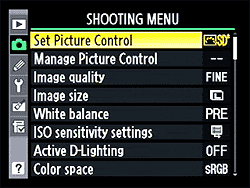
The D80 provided for user manipulation of the camera's imaging characteristics via the Optimize Image menu we'd seen over several generations of Nikon DSLRs now. More recently, Nikon has moved toward a Picture Control menu, as seen in their recent professional models. For the first time, the Nikon D90 will bring the Picture Control menu to a consumer DSLR, and with a few new options thrown in for good measure. The table below shows some of the new features:
| Nikon D90 Picture Control Menu Options | |
 |
 |
| Set Picture Control takes the place of Optimize Image on the Nikon D90's Shooting Menu. | Previous models only had options for Standard, Neutral, Vivid, and Monochrome. The Nikon D90 adds Portrait and Landscape mode. Portrait and Landscape modes invoke color tweaks to favor their respective subjects. |
 |
 |
| Where the D80's Optimize Image control provided only a single set of image adjustments, you can tweak image settings for each of the Picture Control options independently of each other. | This is a neat display (reached by pressing the Thumbnails button to the left of the LCD while in the Picture Control menu): It gives a quick, at-a-glance view of where each of the Picture Control options is currently set, in terms of contrast and saturation. |
 |
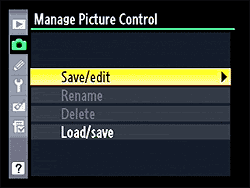 |
| In Monochrome Picture Control menu lets you choose color filters to apply before capture, just as you might have chosen color filters in B/W film days (a yellow filter for dramatic cloud/sky shots, for instance). You can also choose from among a number of hues to tone the resulting image with. (Thankfully including just plain black & white.) | Once you have a set of Picture Control tweaks dialed in just the way you want them, you can save it as a custom Picture Control option. A number of such custom presets can be saved. You can also load/save settings from/to the memory card, so you can easily set up a number of bodies with identical Picture Control options. |
"Smart" Exposure Program recognizes VR on/off
This is a minor point, but typical of the thoughtfulness Nikon applies to their cameras' operational details: When the D90 detects that a VR (Vibration Reduction) lens is attached, it automatically adjusts the program line of the exposure system to permit longer exposure times under dim lighting. With a VR lens attached, you'll thus be able to shoot at slower shutter speeds before the camera will want to pop up its flash. Slick.
The images above were taken from our standardized test shots. For a collection of more pictorial photos, see our Nikon D90 Photo Gallery .
Not sure which camera to buy? Let your eyes be the ultimate judge! Visit our Comparometer(tm) to compare images from the Nikon D90 with those from other cameras you may be considering. The proof is in the pictures, so let your own eyes decide which you like best!
Performance
Nikon D90 Performance
Timing and Performance
Excellent speeds for a prosumer digital SLR.
| Startup/Shutdown |
||
| Power on |
0.3 second | Time it takes to turn on and capture a picture. (Short enough that it's hard to measure.) |
| Shutdown |
0.4 second | How long it takes camera to turn off before you can remove the memory card. |
|
Buffer clearing time
|
4 seconds after 20 large/fine JPEGs* |
Worst case buffer clearing time. -- This is the delay after a set of shots before you can remove the card.
|
| 1 second after 20 small/basic JPEGs* | ||
| 6 seconds after 10 RAW files* | ||
| 9 seconds after 7 RAW+JPEG files* | ||
|
*Note:
Buffer clearing times measured with a SanDisk Extreme III SD card.
Slower cards will produce correspondingly slower clearing times. Slow
cards may also limit length of bursts in continuous mode. ISO
sensitivity and noise reduction settings can also affect cycle times
and burst mode performance.
|
||
Fast startup and shut-down times, fast enough that they're difficult to measure. Buffer clearing times are quite good, but depend on the image quality, size and speed of the memory card.
| Mode Switching | ||
|---|---|---|
| Play to Record, |
0.3 second | Time until first shot is captured. |
| Record to play |
0.6 second | Time to display a large/fine file immediately after capture. |
| Display |
0.3 second | Time to display a large/fine file already on the memory card. |
Mode switching times are very good.
| Shutter Response (Lag Time) | ||
|---|---|---|
| Full Autofocus |
0.208 second | Time from fully pressing shutter button to image capture. All AF timing measured with Sigma 70mm f/2.8 Macro lens. (Slower, gear-driven focus, but cameras seem to be able to determine focus speed very quickly with this lens.) |
|
Full Autofocus
Single-point AF iTTL flash enabled Optical Viewfinder |
0.249 second
|
Time to capture while forcing flash to fire. (Metering pulses from flash sometimes slow shutter response.)
|
|
Full Autofocus |
0.270 second |
Time from fully pressing shutter button to image capture. |
| Prefocused |
0.067 second | Time to capture, after half-pressing and holding shutter button. |
|
Continuous AF Optical Viewfinder |
0.074 second |
This mode usually shows no speed increase with our static subject; we have no way to measure performance with moving subjects. |
|
Manual Focus Optical Viewfinder |
0.067 second |
For
most cameras, shutter lag is less in manual focus than autofocus, but
usually not as fast as when the camera is "prefocused". |
|
Full Autofocus
Live View |
2.294 seconds
|
Time from fully pressing shutter button to image capture, using contrast-detect autofocus in Live View mode.
|
|
Prefocused
Live View |
0.519 second
|
Time to capture, after half-pressing and holding shutter button, in Live View mode.
|
Full autofocus shutter response is very good at 0.208 second, slightly faster than the D80. Enabling the built-in flash increased full AF lag just slightly to 0.249 second: That small an increase is excellent. "Prefocusing" the camera by half-pressing and holding down the shutter button before the final exposure results in a lag time of only 0.067 second, also a bit faster than the D80. Manual focus was just as fast as prefocused.
Lag times in Live View mode are quite a bit (a lot) slower, as only contrast-detect AF is supported on the D90 (unlike the D300, which also has a phase-detect Live View AF mode). Full AF in Live View required a very long 2.3 seconds to achieve focus. (Contrast-detect AF needs to adjust the lens slightly out of focus first, then back in again, to be able to tell that it's achieved proper focus.) Lenses with fast focus motors seem to make only a minor difference. When prefocused, Live View shutter lag is much faster at 0.519 second, but still almost 8x slower than using phase-detect AF with the optical viewfinder.
| Cycle Time (shot to shot) | ||
|---|---|---|
| Single Shot mode |
0.36 second | Time per shot, averaged over 20 shots, 1.5 seconds to clear. |
| Single Shot mode |
0.50 second | Time per shot, averaged over 20 shots, 1 second to clear. |
|
Single Shot mode |
0.35 second |
Time per shot, averaged over 13 shots, 6 seconds to clear. |
|
Single Shot mode
RAW + Large/Fine JPEG |
0.32 second |
Time per shot, averaged over 6 shots, 8.5 seconds to clear. |
| Early shutter |
No | Some cameras don't snap another shot if you release and press the shutter too quickly in Single Shot mode, making "No" the preferred answer. |
|
Continuous mode |
0.22 second (4.50 frames per second); 20+ frames total; 4 seconds to clear* |
Time per shot, averaged over 20 shots (buffer capacity was more than 20 shots) |
|
Continuous mode |
0.22 second (4.56 frames per second); 20+ frames total; 1 second to clear* |
Time per shot, averaged over 20 shots (buffer capacity was more than 20 shots) |
| Continuous mode |
0.24 second (4.13 frames per second); 10 frames total; 6 seconds to clear* |
Time per shot, averaged over buffer length of 10 frames |
|
Continuous mode |
0.24 second (4.23 frames per second); 7 frames total; 9 seconds to clear* |
Time per shot, averaged over buffer length of 7 frames |
| Flash recycling |
2.2 seconds | Flash at maximum output. |
|
*Note:
Buffer clearing times measured with a SanDisk Extreme III SD card.
Slower cards will produce correspondingly slower clearing times. Slow
cards may also limit length of bursts in continuous mode. ISO
sensitivity and noise reduction settings can also affect cycle times
and burst mode performance.
|
||
Shot-to-shot cycle times in single-shot mode were quite fast, at 0.36 second for large/fine JPEGs, 0.35 second for RAW frames, and, oddly only 0.32 second for RAW + LF JPEGs. We questioned the slight differences between modes, as we'd normally expect RAW+JPEG to take longer than JPEG alone, but for whatever reason, there was a lot of variation in the cycle times for the JPEG large/fine case, giving a standard deviation of +/- 0.07 second, or 20%. We also hit some significant slowdowns after 6 shots of our very hard-to-compress noise target, indicating a worst-case buffer capacity of 6 shots for RAW+JPEG mode. In JPEG-only modes, the camera captured a full run of 20 shots without having to slow for buffer clearing, while RAW-only slowed after 13 frames.
Continuous mode speeds are also quite good, our measured speeds coming in at around the camera's rated 4.5 frames/second for JPEGs, a little slower for RAW (4.13 frames/second for RAW and 4.23 frames/second for RAW + JPEG). Measured buffer depths were more than 20 frames for large/fine JPEGs, 10 frames for RAW mode and 7 frames for RAW+JPEG. (Note that in our cycle time testing we shoot a target consisting of a fine-grained digital noise pattern, designed to be very hard to compress. This gives us worst-case buffer capacity numbers: You're likely to see greater buffer capacity when shooting more normal subjects.)
The flash took about 2.2 seconds to recharge after a full-power pulse, which is very fast.
| Download Speed | ||
|---|---|---|
| Windows Computer, USB 2.0 |
6,327 KBytes/sec | Typical Values: |
Connected to a computer or printer with USB 2.0, download speeds are very fast.
Bottom line, the Nikon D90 is pretty fast in just about every aspect of its operation, improving on the D80's speed in virtually every respect, despite the increase in resolution. Continuous modes are fast enough for most moving subjects, and shutter lag and cycle times are pretty fast as well. The one exception is autofocus in Live View mode: It's definitely not a "sports" mode.
Battery and Storage Capacity
Battery
Excellent battery life for a lithium-ion SLR design.
| Operating Mode | Number of Shots |
|---|---|
|
Lithium-ion Rechargeable Battery,
(CIPA standard, Optical Viewfinder) |
850
|
The Nikon D90 uses a custom rechargeable lithium-ion battery for power, and ships with a charger. Although battery life is quite good, we recommend you pick up a spare battery and keep it freshly charged and on-hand for extended outings.
The table above shows the number of shots the camera is capable of (on a fully-charged rechargeable battery), based on CIPA battery-life and/or manufacturer standard test conditions.
(Interested readers can find an English translation of the CIPA DC-002 standards document here. (180K PDF document))
Storage
The Nikon D90 accepts SD or SDHC memory cards, and does not ship with a card.
| Image Capacity with 1GB Memory Card |
Fine | Normal | Basic | RAW | RAW + L/F JPG |
|
|---|---|---|---|---|---|---|
|
4,288 x 2,848 |
Images (Avg Size) |
137 7.5 MB |
271 3.8 MB |
534 1.9 MB |
67 15.3 MB |
45 22.8 MB |
|
Approx.
Comp. |
5:1 | 10:1 | 19:1 | 1.2:1 | - | |
| 3,216 x 2,136 |
Images (Avg Size) |
242 4.2 MB |
469 2.2 MB |
911 1.1 MB |
- |
- |
|
Approx.
Comp. |
5:1 | 9:1 | 18:1 | - | - | |
| 2,144 x 1,424 |
Images (Avg Size) |
534 1.9 MB |
1024 1.0 MB |
1924 532 KB |
- |
- |
|
Approx.
Comp. |
5:1 | 9:1 | 17:1 | - | - | |
We strongly recommend buying a large capacity SD/SDHC memory card at least a 1GB card, preferably a 4GB one, to give yourself extra space for extended outings, or when shooting RAW files and/or HD video. (Check the shopping link above, cards are really cheap these days, so no reason to skimp.)
Imaging
Nikon D90 Image Quality
Color
Saturation & Hue Accuracy
Better than average accuracy and pleasing color overall.
 |
| In the diagram above, the squares show the original color, and the circles show the color that the camera captured. More saturated colors are located towards the periphery of the graph. Hue changes as you travel around the center. Thus, hue-accurate, highly saturated colors appear as lines radiating from the center. Click for a larger image. |
Saturation. The Nikon D90 oversaturates some blues, reds and greens a bit, and actually undersaturates some cyans and purples. The net effect is pleasing and accurate color, actually somewhat more in keeping with the demands of professional users than that of other recent Nikon SLRs intended for consumers. If you'd like a bit brighter-looking color, it's easy enough to dial in a bit more saturation in the D90's Picture Styles menu; the steps there are a bit bigger than we'd optimally like to see, but the +1 or +2 saturation setting should please most people looking for slightly brighter color, without going too far. Most consumer digital cameras produce color that's more highly saturated (more intense) than found in the original subjects. This is simply because most people like their color a bit brighter than life. Professional models tend to be more restrained in their color rendering.
Skin tones. The Nikon D90 rendered skin tones just slightly warm/pink. Still, the results looked natural, well within what we'd consider an acceptable range. (Here, too, the D90's saturation adjustment may come into play for some users, letting them knock down the color on skin tones a little, if they find the default rendering a bit too saturated for their personal tastes.) Where oversaturation is most problematic is on Caucasian skin tones, as it's very easy for these "memory colors" to be seen as too bright, too pink, too yellow, etc.
Hue. With an average hue error after correction for saturation variation of only 4.21 delta-C units, the D90's hue accuracy is very good; closer to technically accurate than many (most?) DSLRs on the market. All in all, accurate and pleasing color. Hue is "what color" the color is.


Saturation Adjustment
The Nikon D90 lets you adjust the image saturation, contrast, and sharpness in seven steps each. As can be seen below, the saturation adjustment worked very well, providing a reasonably fine-grained adjustment over a useful range of control. (While we'd personally like to see just slightly smaller steps, the Nikon D90 gives an excellent degree of control.) The saturation adjustment also has almost no impact on contrast. That's how it should work, but we've often found interactions between saturation and contrast (and vice versa) on the cameras we test.
| Saturation Adjustment Examples | ||
 -3 |
 -2 |
 -1 |
 Default |
||
 +1 |
 +2 |
 +3
+3 |
Sensor
Exposure and White Balance
Indoors, incandescent lighting
Good color with the Manual and 2,600K white balances. About average positive exposure compensation required.*


The Nikon D90's auto white balance had a difficult time with the very warm color balance of the household incandescent bulbs used in this shot, and its incandescent white balance setting is obviously tuned for the cooler 3,200K color of professional studio lighting. The 2,600K and Manual settings produced much more accurate results. Skin tones and white values looked best with the manual option, as the 2,600K setting was just a hint cool (though still nearly accurate - and we could obviously have chosen a slightly higher setting if we'd wanted to fiddle with it more). The Nikon D90 required a +0.3 EV increase in exposure (with a Nikkor 24-70mm f/2.8G lens) to get best results, about average for this shot. Our test lighting for this shot is a mixture of 60 and 100 watt household incandescent bulbs, a pretty yellow light source, but a very common one in typical home settings here in the U.S.
* Note: These shots were captured with a Sigma 70mm f/2.8 macro lens, one of the sharpest lenses we've ever tested on SLRgear.com. We use Sigma 70mm lenses in most of our studio test shots because they are so sharp and are available on all major platforms with the exception of Four Thirds. For some reason, though, on some (but not all) Nikon bodies, the Sigma causes the camera's exposure system to overexpose by somewhere between two thirds of a stop and a full stop. The D90 is one such body, as the exposure compensation settings used in the images above are lower than normal for this shot, so the comments regarding exposure compensation required have been adjusted to match results we got with a Nikkor lens. Other than this exposure shift, the Sigma 70mm performs very well on Nikon bodies, so we continue to use it as our "reference" lens, due to its excellent optical qualities.
Outdoors, daylight
Good
exposure and color outdoors, though slightly high contrast at the
default setting. Very good highlight/shadow detail preservation,
though, and options like D-Lighting, Contrast, and Saturation are a
help when faced with tough conditions like these.
The Nikon D90 handled tough outdoor lighting under harsh sunlight pretty well, and produced good overall color and exposure. The default contrast setting was a bit on the high side, but shadow and highlight detail in the Portrait shot was excellent. The house shot was slightly overexposed, losing some of the highlights, but the camera's contrast and D-Lighting options helped in these harsh lighting conditions. (See the full range of contrast, saturation and D-Lighting options further down the page, in the "Extremes" section below.) Color looks good outdoors as well.
See full set of test images with explanations
See thumbnails of all test and gallery images
Resolution
Very high resolution, 1,700 lines of strong detail.

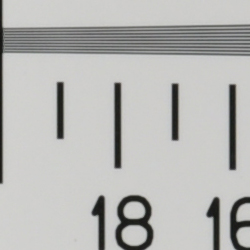


Our laboratory resolution chart revealed sharp, distinct line patterns all the way down to about 1,700 lines per picture height in both directions, which is excellent. (Some would doubtless argue for an even higher lines/picture height rating, but we judge the aliasing that appears shortly after 1,700 lines as an indication that 1,700 is about the limit of the camera's true resolution.) Extinction of the pattern occurred at around 2,500 lines. Use these numbers to compare with other cameras of similar resolution, or to see just what higher resolution can mean in terms of potential detail.
See full set of test images with explanations
See thumbnails of all test and gallery images
Sharpness & Detail
Very detailed images, though slightly soft overall. Minor edge-enhancement on high-contrast
subjects and minimal noise suppression.


Sharpness. The Nikon D90 captures a lot of fine detail, but its images are a bit on the soft side at default settings. Some very slight edge-enhancement artifacts are visible on high-contrast subjects such as the crop above left, but they're really pretty minimal. D90 images take sharpening in Photoshop and other software pretty well. You'll do somewhat better if you process the Nikon D90's images straight from the NEF RAW files. Overall though, detail is excellent.
Detail & Noise Suppression. The crop above right shows some noise suppression in the shadows at ISO 200, but individual strands of hair can be seen even in relatively low-contrast areas. Noise-suppression
systems in digital cameras tend to flatten-out detail in areas of subtle
contrast. The effects can often be seen in shots of human hair, where the
individual strands are lost and an almost "watercolor" look appears.
JPEG vs RAW
JPEG vs RAW Comparison |
|||
Mouse over the links in the box above to compare the difference in sharpness and detail from camera JPEG versus a RAW file processed with Nikon's View NX version 1.1.1 and Capture NX2 version 2.1.0. Camera settings for the JPEG settings were the defaults.
We've found that generally there is indeed a good reason to shoot RAW, because RAW files have more detail than makes it out in the camera-produced JPEGs. This seems also to be the case for the Nikon D90. Its in-camera JPEG processing is actually pretty good, but you can nonetheless produce a sharper, more finely-rendered image by manipulating the RAW files in a good third-party RAW converter - and Nikon's Capture NX2 seems to hold its own with Adobe Camera Raw, at least in terms of detail.
The camera's own JPEG processing and that of Nikon's View NX produce very similar-looking images (no surprise there), but Nikon Capture NX2 gives you more control over image-sharpening parameters and the result can be quite a significant increase in sharpness. It wasn't mentioned in the release notes for Capture NX2 version 1.2, but the sharpening operator now seems to be much less constrained than it was in earlier versions, now letting you set quite a tight operator.
The examples above also include a crop from an Adobe Camera Raw conversion, using the release beta of ACR version 4.6. As usual, we imported the RAW image into Photoshop via ACR with the sharpening in ACR turned off entirely, then applied very strong/tight unsharp masking in Photoshop.
ISO & Noise Performance
Good noise performance, with low noise levels and good detail up to ISO 1,600.
 |
 |
 |
| ISO 100 | ISO 200 | ISO 400 |
 |
 |
 |
| ISO 800 | ISO 1,600 |
ISO 3,200
|
 |
||
| ISO 6,400 | ||
| These crops taken from shots with High ISO NR set to "Normal", the default. |
||
Noise levels are quite low at the Nikon D90's lower ISO settings, and really quite reasonable even at ISO 800. At ISO 1,600 noise levels increase with more blurring in the fine details and visible "grain", but there is still quite a bit of detail. At ISO 3,200, blurring is stronger with more noise-reduction artifacts, but the grain pattern is still quite tight and results compete well with the performance of dSLRs in its price range from other manufacturers at that ISO level. ISO 6,400 is quite noisy with purple and yellow blotchiness, bright noise pixels as well as much stronger blurring of fine detail. (See our High-ISO comparison page for a detailed comparison between the D90 and D300's High-ISO performance.)
Extremes: Sunlit and low light tests
Very good detail in both highlights and shadows, high resolution and good overall exposure. Very good low-light capabilities as well.


Sunlight. The Nikon D90 did very well under the deliberately harsh lighting in the test above. The best exposure is probably that at +1.0 EV: The mannequin's skin tones are at a good level, and even the brightest parts of her shirt aren't really blown out. (Check the file in an image editor, there's detail in even the strongest highlights, if you play with the Levels or Contrast/Brightness adjustments.)
The image looks a little contrasty, but that's just representative of the lighting itself. The key is that highlight and shadow detail are both very well preserved, with good-looking midtones as well. - Not even the brightest highlights of the shirt are lost, while at the other end of the tonal scale, the very darkest shadows are only slightly plugged and posterized. Noise and noise suppression are quite low in the shadows, and fine detail in these areas looks very good. Still, the camera's adjustable contrast, saturation and D-Lighting adjustments do help fine tune the exposure for conditions like this. (As always though, we remind readers to be sure to use fill flash in situations like the one shown above; and it's better to shoot in the shade when possible.)
| Contrast Adjustment Examples | ||
 -3 |
 -2 |
 -1 |
 Default |
||
 +1 |
 +2 |
 +3 |
The series of shots above show the results of the different contrast settings, all shots captured at an exposure setting of +1.0 EV. While it can be difficult to evaluate small differences in contrast on small thumbnails like these, it's pretty easy to see the impact of the Contrast adjustment in the images above. At its lower settings, the D90 did a really excellent job of handling the deliberately horrific lighting of this shot. The deep shadows are a bit noisier than I'd like, but I'd also much prefer that the noise be left in there, rather than flattening it out and taking all the subject detail with it. It's important to note too, though, that the areas where the noise becomes evident are way, way down at the extreme shadow end of the tone curve; RGB brightness levels of 20 and below. Like the Saturation adjustment, the control for Contrast is quite effective, and interacts very little with color saturation.
| Active D-Lighting Examples | |||
 |
 |
 |
 |
| Low | Normal | High | Extra High |
 |
|||
|
Off
|
|||
Active D-Lighting The Nikon D90 offers four levels of Active D-lighting (vs the D300's three levels and none on the D80), plus the default Off setting. Nikon's Active D-Lighting does a good job at preserving highlights while bringing up detail in the deep shadows, though not surprisingly, more noise is visible in the darker areas of the test shots above. (Active D-Lighting's effect is a little in shots like those above, that have broad areas of both very bright highlights and very deep shadows - You'll notice more impact in shots that are over- or underexposed overall, or where the central subject is in shadow from significant backlighting.)
Because
digital cameras are more like slide film than negative film (in that
they tend to have a more limited tonal range), we test them in the
harshest situations to see how they handle scenes with bright
highlights and dark shadows, as well as what kind of sensitivity they
have in low light. The shot above is designed to mimic the very harsh,
contrasty effect of direct noonday sunlight, a very tough challenge for
most digital cameras. (You can read details of this test here.)
| 1 fc 11 lux |
1/2 fc 5.5 lux |
1/4 fc 2.7 lux |
1/8 fc 1.3 lux |
1/16 fc 0.67 lux |
1/16fc No NR |
|
|---|---|---|---|---|---|---|
| ISO 100 |
 1.3 sec f2.8 |
 4 sec f2.8 |
 8 sec f2.8 |
 15 sec f2.8 |
 25 sec f2.8 |
 25 sec f2.8 |
| ISO 200 |
 0.6 sec f2.8 |
 2 sec f2.8 |
 4 sec f2.8 |
 8 sec f2.8 |
 13 sec f2.8 |
 13 sec f2.8 |
| ISO 400 |
 0.3 sec f2.8 |
 1 sec f2.8 |
 2 sec f2.8 |
 4 sec f2.8 |
 8 sec f2.8 |
 8 sec f2.8 |
| ISO 800 |
 1/6 sec f2.8 |
 0.5 sec f2.8 |
 1 sec f2.8 |
 2 sec f2.8 |
 4 sec f2.8 |
 4 sec f2.8 |
| ISO 1600 |
 1/13 sec f2.8 |
 1/4 sec f2.8 |
 0.5 sec f2.8 |
 1 sec f2.8 |
 2 sec f2.8 |
 2 sec f2.8 |
| ISO 3200 |
 1/20 sec f2.8 |
 1/8 sec f2.8 |
 1/4 sec f2.8 |
 0.5 sec f2.8 |
 1 sec f2.8 |
 1 sec f2.8 |
| ISO 6400 |
 1/40 sec f2.8 |
 1/15 sec f2.8 |
 1/8 sec f2.8 |
 1/4 sec f2.8 |
 0.5 sec f2.8 |
 0.5 sec f2.8 |
Low light:
The Nikon D90 turned in a
very good performance here, capturing bright images at the lowest light
level even at the lowest sensitivity setting. Color balance is a bit
cool and purplish from the Auto white balance setting, especially at
the darkest light levels. The camera's handling of noise was very good,
with minimal noise artifacts and good detail up to ISO 1,600. Noise was
moderate at ISO 3,200, and a little high at ISO 6,400, along with quite
a few hot pixels. The AF system was able to focus unassisted down to
just below the 1/16 foot-candle light level, and to total darkness with
the AF assist enabled.
How bright is this? The one foot-candle light level that this test begins at roughly corresponds to the brightness of typical city street-lighting at night. Cameras performing well at that level should be able to snap good-looking photos of street-lit scenes.
NOTE: This low light test is conducted with a stationary subject, and the camera mounted on a sturdy tripod. Most digital cameras will fail miserably when faced with a moving subject in dim lighting. (For example, a child's ballet recital or a holiday pageant in a gymnasium.) Digital SLRs like the Nikon D90 do much better than point & shoots, but you still shouldn't expect a quick autofocus lock with moving subjects.
Output Quality
Print Quality
Excellent print quality, great color, good 20x30 inch prints, excellent 16x20 inch ones. ISO 3,200 images are surprisingly good at 8x10, even better at 5x7.
 Output from the Nikon D90 was good enough to produce good-looking 20x30 inch prints, and sharp 16x20 inch ones. As noted elsewhere in this review, the D90 rewards RAW shooters with really excellent detail when its NEF files are processed through a good RAW converter. The difference between camera JPEGs and those from RAW isn't as stark as with some cameras we've tested, but the results are well worth the effort if you care about extracting every last bit of information from your images.
High ISO images were better than we'd expected, the D90 clearly has an edge on the D80 in terms of high-ISO noise performance despite the new model's smaller pixels. We'd estimate the noise improvement as being somewhere around a half to two-thirds of a stop at the highest ISO levels (3,200 and 6,400); it's clearly better, but when we compare images shot with the D90 with those shot by the D80 at half the ISO, it seems that there's less than a full stop of difference. It's not far off that mark, though. Oddly, this advantage largely disappears at lower ISO settings, to the point that we think the D80 does better at ISO 1,600. Besides the noise levels themselves though, the D90's images at very high ISOs have quite noticeably improved color over those of the D80. Reducing color saturation is a common tactic used to mask noise, and the D90 does it far less than its predecessor.
The Nikon D90's noise processing at high ISOs varies quite a bit, depending on the setting you're using. With the D80, we liked its "Low" noise reduction setting the best, but with the D90, we found that images shot with the Low setting in some cases looked worse than ones shot using "Off". Our recommendation would be to shoot with the Normal setting for images being used straight from the camera, and use Off if you're going to be post-processing with a third-party noise reduction program. The High setting leaves images very clean, but also pretty soft, with a lot of fine detail gone. As noted, the Low setting was our favorite, it produced surprisingly clean images that still contained loads of fine detail.
Overall, the Nikon D90 does quite well at high ISOs. You could arguably use its ISO 3,200 shots to make 13x19 inch prints suitable for wall display, but they'll look much better as 8x10s. (Surprisingly clean, albeit with some loss of subtle detail. We think most readers would be quite pleased with 8x10s from the D90's ISO 3,200 images.) At ISO 6,400, the D90's images are too noisy to use for 8x10 inch prints, but they look just fine at 5x7 inches.
Color-wise, the Nikon D90 did very well. At its default settings, its colors (particularly reds) are a bit more saturated looking than those of the D80, but we think they'd fall within an acceptable range for most shooters. Green and orange shades in particular are also brighter than the D80's somewhat undersaturated handling of those colors, but the overall effect is pretty pleasing. (If you like less-saturated color, just take the saturation adjustment down a notch.) Hue accuracy is also good, better than that of the D80 by a nose. A very good performance overall.
Testing hundreds of digital cameras, we've found that you can only tell just so much about a camera's image quality by viewing its images on-screen. Ultimately, there's no substitute for printing a lot of images and examining them closely. For this reason, we now routinely print sample images from the cameras we test on our Canon Pro9000 studio printer, and on the Canon iP5200 here in the office. (See the Canon PIXMA Pro9000 review for details on that model.)
Viewfinder
Nikon D90 Viewfinder
 As with most DSLRs, the Nikon D90 has an optical viewfinder that lets you view your subject through the lens. Following a popular trend though, it also offers a Live View mode, in which the mirror flips up and the main image sensor continuously captures a live image of the subject, displaying it on the rear-panel LCD screen. (More on this in a bit.)
Apart from its Live View option, the optical viewfinder is basically the same as that on the previous D80 model. A diopter adjustment dial adjusts the focusing of the viewfinder optics to accommodate eyeglass wearers, and the viewfinder also has quite a high eyepoint (meaning you can see the full frame with your eye a good distance from the rear objective). The 19.5mm eyepoint is fairly good, but I personally (Dave speaking here) do still did still find myself pressing my eyeglass lens against the rubber eyecup in order to see the full frame clearly. The -2.0 to +1.0 diopter adjustment range of the viewfinder optics isn't nearly enough to accommodate my own very nearsighted (20:180) vision, but is more than ample to handle my "computer glasses", which are set to provide good focus for my eyes at a distance of about 18-24 inches. (Frankly, people as nearsighted as me are unlikely to ever walk around without some degree of vision correction, so the dioptric adjustment range of the D80 should be more than sufficient for most users.)
The graphic and table below shows what information is displayed in D90's viewfinder.

1 |
On-demand framing grid
|
17
|
Number of exposures remaining
|
2 |
Reference circle for Center-Weighted metering
|
Number of shots remaining before memory buffer fills
|
|
3 |
Battery indicator
|
White balance recording indicator
|
|
4 |
Black-and-white Indicator
|
Exposure compensation value
|
|
5 |
Focus points
|
Flash compensation value
|
|
6 |
Center focus point (normal frame)
|
Capture mode indicator
|
|
7 |
Center focus point (wide frame)
|
ISO sensitivity value
|
|
8 |
"No memory card" warning
|
18
|
"K" (appears when memory remains for over 1000 frames)
|
9 |
Focus indicator
|
19
|
Flash ready indicator
|
10 |
Flash value (FV) lock indicator
|
20
|
AE lock indicator
|
11 |
Shutter speed
|
21
|
Electronic analog exposure display
|
12 |
Aperture (f-number)
|
Exposure compensation
|
|
| 13 |
Battery indicator
|
22
|
Flash compensation indicator
|
| 14 |
WB bracketing Indicator
|
23 |
Exposure compensation indicator
|
| 15 |
Bracketing indicator
|
24 |
Auto ISO indicator
|
| 16 |
ISO sensitivity indicator
|
25 |
ISO sensitivity compensation indicator
|
While the D90's viewfinder optics match those of the D80 pretty closely, one notable change is that the AF points are no longer etched on the viewfinder screen, but rather appear courtesy of an overlay LCD. This is nice because when the AF points aren't being displayed, there's nothing to obscure your view of the subject. The D90's viewfinder screen is similar to that on the recently announced D700.
One big plus about the D90's viewfinder is its size: It's basically the same viewfinder as used on the D200/300, and is very noticeably larger than the viewfinders on other Nikon consumer SLRs. While I dislike having to press my eyeglasses up against the eyecup, all of us at IR really like having a larger viewfinder image to look at.
 Here's another, more subtle point about the Nikon D90's viewfinder: It uses a true pentaprism, rather than the pentamirror arrangement that's all but universal in consumer-level SLRs. The reason this is important is that pentaprisms are much brighter. This is because a convenient trick of optics lets prisms reflect 100% of the light passing through them, so no light is lost as it bounces around inside and then back out the eyepiece. Even the best mirrors typically pass only 96-98% of the light falling on them. In a pentamirror, with three reflections required to bounce the light into your eye, this means that anywhere from 6 to 12% of the light is lost, making for a noticeably darker viewfinder image.
When it comes to accuracy, the D90's viewfinder is rated to show 96% of the final image area, about as good as you'll get without going to a considerably more expensive SLR.
Viewfinder Test Results
Coverage
Very good accuracy with the optical viewfinder, excellent with the LCD monitor's Live View mode.


The Nikon D90s optical viewfinder proved fairly accurate, with just over 96% coverage when measured with our Nikon 105mm f/2.8 test lens. This is very good for a prosumer model, and matches the coverage Nikon claims. The camera's Live View LCD mode was extremely accurate however, with 100% accuracy.
Live View
Nikon D90 Live View
The Nikon D90 brings Live View to that company's prosumer DSLR line for the first time (unless you consider the D300 a prosumer model; we class the D300 as a fully professional model). As we'll see though, it goes quite a bit beyond most Live View implementations, and in one respect, is absolutely unique as of the time of its introduction in late August, 2008.

One welcome enhancement to the Nikon D90's Live View mode is its one-touch activation, via the Live View button. On the D300, Live View mode had to be selected via the Drive Mode wheel on the left side of the camera's top panel; a somewhat cumbersome arrangement. By contrast, the D90 sports a LV button on its rear panel, in very convenient reach of your thumb. Press it at any time and the mirror flips up and the camera immediately enters Live View mode. A nice surprise, it does a lot to make Live View a much more fluid part of your photography than it's been in the past.
| Nikon D90 Live View Data Display |
 |
| The Nikon D90's Live View display includes a good bit of relevant shooting data, including shooting mode, autofocus mode, image size, image quality, white balance, audio recording, time remaining, metering mode, shutter speed/aperture, exposure compensation, ISO, and more. |
The second nice surprise in the Nikon D90's Live View
mode was the full information display optionally available while
working in that mode. The Live Mode shooting info display shows you a
lot of what you'd normally see looking through the viewfinder, yet
manages to keep most of the information out of the way of the live
image area. Information displayed includes current metering mode,
shutter time, aperture, exposure compensation, ISO setting, shots
remaining, exposure mode, face detection active/inactive (more on this
in a bit), file mode (RAW or JPEG) and white balance setting. It also
shows microphone status and minutes/seconds of movie recording
available at the current resolution and quality settings. (Wait a
minute: Movie recording? Yes, that's not a typo, more on that
in just a bit as well.) One thing we miss in the D90, though, is the
live histogram display that's an option on the Nikon D3 and on some
competing SLRs from Nikon's arch-rival Canon.
In a new wrinkle, the Nikon D90 has only one autofocus mode in Live View, and it's not the traditional phase-detect AF. The D90's only option for autofocus in Live View mode is contrast detection. This is a fairly radical departure for Nikon (or any camera maker).
By way of explanation, the phase-detect/contrast-detect distinction is one of the fundamental differences that separates digicams from digital SLRs, and is the core reason that SLRs focus so much more quickly. Contrast-detection autofocus involves looking at the image from a camera's main image sensor and evaluating it to see how abruptly brightness values change from one pixel to the next. If an image is soft and fuzzy, brightness changes between adjacent pixels will be relatively slight, but if it's sharply focused, they'll be much greater. The point of ideal focus is found by moving the lens elements back and forth and determining whether the contrast signal gets stronger or weaker. Achieving focus this way necessarily involves some back-and-forth hunting, which can take a while to accomplish. By contrast (no pun intended), phase-detect AF uses a system of prisms, lenses, and a secondary sensor to determine not only whether the image is in focus or not, but by how much it's out of focus and in which direction. The camera can then adjust the focus setting to exactly the position needed in a single step. As a result, phase-detect AF systems are generally much faster than contrast-detect ones.
The catch with phase-detect AF though, is that it requires some of the light passing through the lens to be diverted to the focus sensor. This is fine in an SLR when the mirror is down between exposures, as part of the mirror is typically partially transmissive, with the light passing through it deflected by a secondary mirror down to the AF sensor, usually located in the bottom of the mirror box. When the mirror is raised in Live View mode, though, light from the lens can't get to the separate AF sensor. This accounts for the rather lengthy (and noisy) AF cycles in most Live View SLRs: To focus the camera the mirror has to be dropped, focus determined, and the mirror raised again, adding several tenths of a second to the normal non-Live View shutter lag. For example, the Nikon D700 full-frame SLR has a shutter lag of only 0.197 second when using the optical viewfinder and a single AF point. This increases to 0.573 second in Live View mode, all other settings being the same.
While it takes some time for the mirror to drop and re-open for phase-detect AF in Live View mode, the overall result can still be faster than when relying on contrast-detect autofocus. Taking the case of the D700 again, in contrast-detect AF mode, it takes roughly 1.1 seconds for it to determine that the lens is in focus, even when starting with the lens already focused on the target. (It can easily take several seconds for the camera to slew a lens from infinity to close focusing in this mode.)
With the above as background, you can see why we were surprised to find contrast-detect AF the only autofocus option available on the D90 in Live View mode. In playing with a D90 prototype though, AF in Live View mode felt faster than we'd been expecting. Clearly, not nearly as fast as when using the optical viewfinder and phase-detect AF, but it certainly felt faster than the D700 (and D300 and D3) using their "Tripod Mode" (contrast-detect) AF in Live View. Alas, when we tested a production model D90 in the lab, we found that the overall shutter lag (from pressing the shutter button, through focusing, all the way to capturing the image) was still very much on the long side: The fastest times we measured, with the lens already set at the correct focal distance for the subject, was on the order of 2.3 seconds. So the D90's contrast-detect AF in Live View mode clearly isn't something you're going to be using for sports shooting.
| Nikon D90 Live View Autofocus | |
 |
 |
| As shown here, one advantage of contrast-detect AF is that you can put the AF box wherever you like it. (In this case, we've put it top center.) When focus is locked, the focus box changes from red to green. | |
One advantage of contrast-detect autofocus though, is that you're
not restricted to focusing only on those areas where you happen to have
an AF point. As the pair of shots above shows, the D90 lets you put the
focus box anywhere in the frame you want to when in Live View mode.
| Nikon D90 Live View Autofocus | |
 |
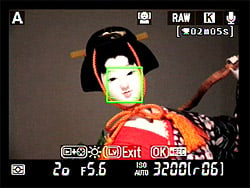 |
| Contrast-detect AF also opens the possibility of advanced modes like face-detection. Here, we see that the Nikon D90 will change both the location and size of the face-detect box to accommodate changes in subject size and position. | |
Face detection. Here's a look at the D90's face detection working with a live subject. Even in the prototype this was shot with, the camera had no problem tracking and locking onto a face as it moved around the scene. (Click to view/download 1.7MB MPEG-4 file.)
Besides the ability to position the AF area wherever you like it, the Nikon D90's contrast-detect AF in Live View mode also offers face detection and tracking. Up to 5 faces can be detected in an image, and the AF areas adjust to match the size of each face detected. The shots above show the AF box moving and changing size in response to the changing position and scale of a face in the scene. The face-detect box shows yellow when not in focus, and green when in focus (after half-pressing the shutter button). The video clip at right shows the D90 tracking a live face while zooming in and out and panning around.
Playing with face-detect autofocus in Live View mode, we were
pleased to see that the camera not only tracked the faces, but was also
intelligent enough to set focus based on the eyes of subjects, rather
than on their noses or mouths. (In portrait work, the eyes are the most
critical part of the face to render in sharp focus. Other parts of the
face can be soft but viewers will regard the shot as properly focused
if the eyes are crisp.)
Manual Focusing in Live View Mode
With appropriate magnification, Live View displays can be very useful when manually focusing SLR cameras. During manual focusing, the Live View display on the Nikon D90 can be magnified quite considerably, but it seems it's not quite all that you might expect from the specifications. In Live View mode, pressing the magnifying glass button on the camera's back lets you zoom in up to a maximum of 6.7x. If you do the math, this would correspond to a 1:1 (pixel to pixel) ratio between the pixels of the camera's very high-resolution LCD and the sensor. The viewfinder image at this magnification isn't sharp, though; it seems the camera is actually grabbing fewer pixels than that section of the sensor actually contains and then interpolating them to form the image. (You can check this by snapping a shot and then magnifying the resulting image to the same degree in playback mode. Doing this, you'll find the image is quite a bit sharper than what you saw on the LCD in Live View mode.) While the magnified Live View display is still usable for focusing, it isn't as sharp as it could be, nor as sharp as the Live View display on some of Canon's SLR models sporting this feature.
Video
Check out the links below for more sample images, videos and image quality analysis:
- Nikon D90 Optics page (Crops from images shot with the camera's kit lens, if sold as a kit)
- Nikon D90 Sample Images page (Index to all standard test shots, with explanations)
- Nikon D90 Thumbnails page (Thumbnails of all shots, including RAWs, with EXIF data)
- Nikon D90 Gallery page (Regular photos taken with the Nikon D90)
Nikon D90 Video
The Nikon D90's video capabilities are unusual enough (the first SLR to offer video recording) that we felt they deserved a page of their own, to cover them.
Resolution & Recording Time
The Nikon D90's movie resolutions include 1280x720 (16:9), 640x424 (3:2), and 320x216 (3:2). Recording times are limited to five minutes per clip for HD mode, and 20 minutes per clip for the latter two modes. Nikon couldn't explain the reason for the limit as of this writing, but it's likely due to sensor heating issues that might start to degrade image quality. The frame rate is 24 frames per second, and audio is monaural, not stereo. Approximate maximum file sizes of the two larger sizes both seem to be about 600-800MB. The shorter maximum recording time of the higher resolution option seems to about balance the longer recording time of the lower resolution, producing the same size files overall. Nikon says that recording will stop at 2 GB even if it's been less than the 5 or 20 minute time limit in the various modes, but we never made a file larger than 800 MB, regardless of subject choice. (Subjects with lots of fine detail will produce larger images, as the fine detail is harder for the motion JPEG processing used in the D90 to compress.)
The Nikon D90's movie recording is accessed from Live view mode: You just press the OK button to start or stop recording at any time. You have to set focus before you start shooting your movie, but you can still focus manually and adjust the zoom setting of the lens while you're shooting. The movie will record the noise of the zoom ring to an extent, depending on which lens you're using and how fast you zoom, but it's still pretty impressive. Of course, one of the big advantages of being able to record movies with a Nikon SLR is that you have the full spectrum of Nikon lenses available to you, ranging from ultrawide angle and fisheye lenses all the way to ultra telephotos. You can also obviously use special lenses like the new LensBaby Composer for special effects. (While the D90's video is more oriented toward the making of quick "video snapshots," we can imagine some pros using it just to be able to incorporate special effects like the LensBaby look into their productions.)
Frame Rate
The Nikon D90 captures images at 24 frames/second, the same frame rate used in the motion picture industry. This produces reasonably smooth motion, but we found that rapidly moving subjects close to the camera could look a little jumpy: The same as they do at your local cinema. If you've been using a digicam with a frame rate of only 15 frames/second (fairly common a generation or two back), the D90's 24 fps will be a welcome upgrade. On the other hand, if you've recently been using a digicam with 30 fps capture, you may find the D90's video a little jumpy. Once again, this probably isn't critical for "snapshot" videos, but another indication why the D90 really isn't a substitute for a dedicated camcorder.
Focusing
Prior to recording, you can let the camera set focus via one of two ways: First, you could half-press the shutter button before switching to Live View mode. This will use the camera's normal autofocus system, which is quite fast. (As is typical of SLR phase-detect AF systems.) Alternately, most people will probably switch to Live View mode and do their initial framing before half-pressing the shutter button. This uses the D90's contrast-detect focusing mode, which is rather slow: Expect it to take two or three seconds, longer if it has to move the lens elements a lot.
The lack of autofocus during movie recording with the Nikon D90 is something that may give many potential owners pause, as focus is so critical in still photography and dealing with moving subjects would seem to make it even more so. In practice, we were surprised to find it not nearly the issue we expected it to be. This may be because the lower resolution in video mode greatly increases the effective depth of field: Subjects that would be well out of focus when shot at the D90's maximum still-image resolution of 12 megapixels often looked just fine when viewed at even the maximum video resolution of 1,280 x 720. Lower resolutions only increase this effect. And it's not just the resolution, either, the video compression introduces quite a bit of softness on a frame-by-frame basis, further masking softness due to defocusing.
Still, the Nikon D90's manual-only focusing in movie mode means that a whole new generation of non-professionals will now learn what it means to "pull focus" while recording movies, as the point of interest move from one subject to another, or if the subject moves significantly closer to or further from the camera during a segment. "Focus pulling" is a cinematic technique often performed by someone other than the camera operator, who is usually too busy framing the image to attend to focus as well. But millions of Nikon D90 owners will be able to try a technique that few camcorder owners can.
In our own admittedly limited playing with the Nikon D90's video recording, we found that pulling focus during a recording was a skill that required some learning, particularly if there were things going on in the scene that needed paying attention to. If we knew the approximate locations where the subject would be at the start and end of a clip (think of a video of a Little Leaguer sliding into home), we could check the corresponding positions of the focus ring and then try to repeat them while the action was taking place. This was a little hard to do with only a ring to grab onto, as the tactile reference for the different focus positions was pretty weak; a lever would have made the starting and stopping positions much more evident and easier to remember. As more SLRs capable of video recording get out into the market (Canon recently announced the EOS-5D Mark II, which also offers HD-resolution video recording), we suspect we'll aftermarket gadgets will appear that will let you temporarily attach a lever of some sort to lens focus rings, for just this purpose.
If you don't know in advance how the subject is going to move, you can try to judge focus from the image on the D90's rear-panel LCD and adjust accordingly. The exceptional resolution and sharpness of the LCD makes this more practical than it might sound. Once again, some practice (and inherently good reflexes) are required, but given enough practice, it could work reasonably well.
Exposure
While not documented, it turns out you can control the aperture used for movies by selecting Aperture Priority or Manual exposure mode prior to entering Live View mode. Shutter speed and ISO sensitivity are always under the control of the camera. It appears that the D90's autoexposure during movie recording is performed by varying sensitivity and/or shutter speed in steps (1/3 EV?) rather than being continuously variable, which can lead to some abrupt, stepped changes in exposure. Only matrix metering is supported during movie capture, however exposure compensation can be adjusted up to +/- 3 EV while recording, and exposure can be locked using the AE-L/AF-L button. You can apply Nikon's Picture Controls as well as specify the color space for movies, as long as they are selected before recording begins. This is useful if you'd like to for instance record in monochrome, or with more saturated colors, etc.
Audio
The Nikon D90 has an internal microphone concealed behind three small holes on the front of the camera body. There is no provision for an external mic, nor do you have any control over the audio recording level: The camera's auto gain circuit (AGC) adjusts the mic sensitivity as needed to maintain a more or less constant recording level. We found the D90's microphone to be quite sensitive. It has no problem picking up even quiet conversation from across a room, as long as there are no background noises. Ah, but there's the rub: The mic will pick up all sorts of background noise if you're not careful. For a camera-mounted mic, there's not much else the engineers could do: The last thing you'd want in this case would be a mic with limited far-field pickup. Given that most users will likely be using the D90's video recording for short clips of memorable moments, its tendency to pick up every sound is probably a positive feature.
Rolling Shutter Artifact ("Jello Effect")
There was one aspect of the Nikon D90's video that we found less than wonderful, though, namely the way its progressive data readout from the sensor chip can produce distortions in the image when the camera or subject moves suddenly. The D90 records its movies at 24 frames/second, but the way it clocks data off its sensor chip means that it takes on the order of 1/24 second to read out each frame. By contrast, most camcorders grab each frame at a single moment in time, with all of the pixels in the image acquired simultaneously.
The consequence of this progressive capture is that any movement of the camera or subject between the beginning of a given frame's capture and the end of it will produce distortions in the shape of the image.
We first noticed this effect when panning rapidly to follow fast motion: Trees and buildings would lean opposite the direction of our panning. On the other hand, if you're panning slowly to take in a larger scene, you're not likely to notice the effect at all. More disconcerting, once we became sensitized to the phenomena, we noticed our video subjects "jiggling" slightly in response to even fairly minor camera shake as we were hand-holding the D90. Lens-based IS helps with this somewhat, but we'd be much happier if Nikon could figure out a way to grab the image data all at once and then read it off to the memory card before starting the next frame grab.
Video Examples: Dave shot some examples of video with the D90, so you can see what the different resolution levels look like. Click on any of the thumbnails below to bring up each video in a new window.
Three Video Sizes
Options include 1,280 x 720, 640x424, and 320 x 216 pixels, all at 24 frames/second
(Click on any thumbnail to launch/download the movie in a new window)


As noted earlier, the Nikon D90's video imagery is not only considerably lower resolution than its still images, but the heavy JPEG compression applied to the video frames further reduces detail. The upside of this is that the effective depth of field is quite a bit greater than you'd find in its still images at similar focal length and aperture. Note in some of the shots how little the apparent focus changes as wonder-dog Charlotte runs toward or away from the camera.
In the highest-res shot above, the lens was initially focused somewhere between Marti and the camera, so she's a little soft at the start of the clip. That said, I found it quite surprising how little apparent sharpness changed as Charlotte ran approached and receded from the camera.
Jello Effect
(Rolling Shutter Artifact)
Rapid camera motion can result in pretty severe distortion and apparent subject motion.

As mentioned earlier, the Nikon D90's "rolling shutter" can introduce pretty severe distortion in response to either camera or subject movement. The clip above is an extreme worst case: You'd probably never film with this kind of extreme camera motion, but it illustrates the nature of the problem pretty clearly. Notice how it's really not noticeable when panning slowly. Notice too, though, how even relatively minor hand movements at the end of the clip still create some distortion.
Pulling Focus
Manual focus while recording is challenging, but can be learned.

I didn't have much time to devote to sharpening my focusing skills with the Nikon D90 in video mode. (Nor, for that matter, my skills in tracking small, rapidly moving subjects. :-) Nonetheless, this clip shows that it's not too difficult to focus based simply on what you're seeing on the D90's excellent, high-resolution LCD screen.
Flash
Nikon D90 Flash

Like the D80 and D300, built into the D90 is an unusually capable pop-up flash unit, which operates in one of five main modes: Front-Curtain Sync, Red-Eye Reduction, Red-Eye Reduction with Slow Sync, Slow Sync, and Rear-Curtain Sync. Front-Curtain Sync fires the flash at the beginning of the exposure, with every shot. Red-Eye Reduction mode fires the (very bright) AF-assist light before the main flash exposure, to reduce the Red-Eye Effect in shots of people. Red-Eye Reduction with Slow Sync works in a similar fashion, but combines the flash with a slower shutter speed for night portraits. (This reduces the harsh effect of nighttime flash shots, allowing more of the ambient illumination into the picture.) Slow Sync mode works with shutter speeds as slow as 30 seconds to preserve color in night shots. Finally, Rear-Curtain Sync fires the flash at the end of the exposure, producing light trails that appear to follow (rather than precede) moving subjects. In all flash modes, the flash fires with every exposure. Closing the flash disables it completely. Holding down the Flash Mode button while turning the Sub-command dial adjusts the overall brightness of the flash from -3 to +1 EV in one-third-step increments.
Besides the main flash modes listed above, the D90's onboard speedlight can also be used in manual mode, as a repeating flash, or as a commander in Nikon's Creative Lighting System. (See below for more on that last item.) The D90's internal flash is fairly powerful, with a guide number of 12 meters or 39 feet at ISO 100 in auto mode, extending slightly to 13 meters (43 feet) in manual mode. (The greater range in manual mode is because it doesn't have to expend energy on the metering pre-flash.)
The built-in flash's normal X-Sync speed is 1/200s, but FP flash sync speeds as high as 1/4000s are available with optional SB-800, SB-600 or SB-R200 external flash units.

Repeating Flash Options
While we've never personally felt a need for a stroboscopic flash on a camera, we can imagine it being used for a variety of creative effects, as well as being highly useful for scientific applications. The D90's onboard speedlight can be used as a stroboscope, using the Repeating Flash option on custom setting menu e3. Through this menu, you can set the power level from 1/128 to 1/4 power, the number of flashes from 2-35, and the frequency of flash pops from 1 to 50 Hz (1-50 pops/second). As you might expect, the number of times you can have the flash fire varies inversely with the power of each pop: At the maximum 1/4 power, you can only get two pops in rapid succession. The maximum of 35 pops in sequence is only possible at the 1/128 power setting, moving up to 1/64 power decreases the maximum number to 25, and so on. Also note that you'll of course have to have a long enough shutter time to accommodate your flash series, so you'll likely have to visit custom setting menu e2, to change the maximum shutter time permitted with the flash.
Also included on the D90 is an external flash hot shoe, just behind the pop-up flash compartment. The hot shoe accommodates Nikon accessory flash units, as well as a wide range of third party flashes. The full range of flash sync modes remains available for compatible flash units, but third-party models may not support all modes. Unlike the D300, the D90 does not provide a PC sync terminal.
3D Color Matrix II Flash Metering
The "3D" aspect of the Nikon metering system is that it uses subject distance information from the lens (only available with lenses that contain CPUs) to guide its exposure decisions. This is particularly key with flash exposures, because flash illumination falls off quite strongly as the subject gets further from the camera. We at IR are huge fans of Nikon's flash technology, it's really a case of technology working perfectly in the service of creativity. The camera just quietly does its job, so you can focus on composition, color, interacting with your subjects, etc. It doesn't remove the creative decisions of how you want to light your subject, it simply removes the technical legerdemain from the equation. It won't by any means turn a duffer into a pro photographer, but it'll certainly take an average shooter a long way in that direction.
The D90 with Nikon's Creative Lighting System
Nikon has long been a leader in flash technology, but in late 2003, they significantly upped the ante, by announcing their Creative Lighting System. This system of flashes and supporting camera bodies lets the photographer control up to three separate groups of remote flash units, with an essentially unlimited number of individual strobes in each group. The exposure and operating mode of each group of flashes can be controlled independently, and exposure is metered through the lens (TTL) for all units.
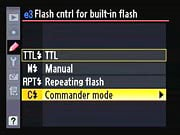

Flash Commander Mode
On the D90, the internal strobe can both act as a controller and also contribute to the exposure, it can control two groups of remote strobes, and can use any of the four available channels to communicate on. The screenshots above give some idea of the options available. The built-in flash can operate in either TTL or Manual exposure mode. In TTL mode, you can vary its exposure over a range of -3 to +3 EV. In Manual mode, you can vary its power from full power (1/1) to 1/128 power. Each of the two groups of remote flash units can be operated in either TTL, AA (Auto Aperture), or Manual mode. Auto Aperture mode is the exposure mode that will be familiar to users of non-TTL metered autoexposure flash units, in which you set the camera at a given aperture setting, and then the flash measures the light reflecting back at it and adjusts its output to produce a given level of reflected light. The remote flash groups can be adjusted over the same +/- 3EV exposure level or 1/1 - 1/128 power levels as the built-in flash unit.
This degree of control directly from the camera is really remarkable, and can save you some serious money if you're planning on taking advantage of Nikon's Creative Lighting System. If you don't need to control more than two groups of external strobes, you won't need to buy an SB-800, saving you at least $300 at retail. If you're interested in macro flash photography, you won't need the SU-800 controller that comes as part of Nikon's R1C1, going with the simpler R1 kit instead. - That'll save you a good $200-250 at retail. Likewise, compared to Canon's wireless flash system, there's no need for a separate controller with the D90, again saving you several hundred dollars.
A full treatment of this system is beyond the scope of this review of the D90, but we have a bit more detail on it posted as a separate article: See our Nikon Creative Lighting System review for more info.
Flash Test Results
Coverage and Range
A powerful flash, with fairly even coverage. Our standard shots required about average positive exposure compensation. *


Coverage. Flash coverage was slightly uneven at the widest angle setting of the 18-105mm kit lens, with some falloff at the edges and in the corners. We were happy to see that the lens didn't cast a shadow at wide angle, which is often the case with larger kit lenses. At telephoto, flash coverage was quite even.
Exposure. In the Indoor test, the Nikon D90's flash underexposed our subject just slightly at its default setting, requiring a +0.3 EV exposure compensation adjustment (with a Nikkor 24-70mm f/2.8G lens). Though results were still slightly dim there, the image at +0.7 EV appeared too unnaturally bright. The camera's Slow-Sync flash mode produced brighter and more even results, though with a strong pinkish-orange cast from the room lighting, as is appropriate for a pro-level camera: A pro would gel the strobe to match the color temperature of the room lighting on a slow-sync exposure. Making the auto white balance hew closer to the flash white balance on flash shots makes sense.
* Note: The second pair of shots were captured with a Sigma 70mm f/2.8 macro lens, one of the sharpest lenses we've ever tested on SLRgear.com. We use Sigma 70mm lenses in most of our studio test shots because they are so sharp and are available on all major platforms with the exception of Four Thirds. For some reason, though, on some (but not all) Nikon bodies, the Sigma causes the camera's exposure system to overexpose by somewhere between two thirds of a stop and a full stop. The D90 is one such body, as the exposure compensation settings used in the images above are lower than normal for this shot, so the comments regarding exposure compensation required have been adjusted to match results we got with a Nikkor lens. Other than this exposure shift, the Sigma 70mm performs very well on Nikon bodies, so we continue to use it as our "reference" lens, due to its excellent optical qualities.
| Flash Range: Wide Angle | |||||
|---|---|---|---|---|---|
| 6 ft | 7 ft | 8 ft | 9 ft | 10 ft | 11 ft |
 1/60 sec f3.5 ISO 100 |
 1/60 sec f3.5 ISO 100 |
 1/60 sec f3.5 ISO 100 |
 1/60 sec f3.5 ISO 100 |
 1/60 sec f3.5 ISO 100 |
 1/60 sec f3.5 ISO 100 |
| 12 ft | 13 ft | 14 ft | 15 ft | 16 ft | |
 1/60 sec f3.5 ISO 100 |
 1/60 sec f3.5 ISO 100 |
 1/60 sec f3.5 ISO 100 |
 1/60 sec f3.5 ISO 100 |
 1/60 sec f3.5 ISO 100 |
|
| Flash Range: Telephoto | |||||
|---|---|---|---|---|---|
| 6 ft | 7 ft | 8 ft | 9 ft | 10 ft | 11 ft |
 1/60 sec f5.6 ISO 100 |
 1/60 sec f5.6 ISO 100 |
 1/60 sec f5.6 ISO 100 |
 1/60 sec f5.6 ISO 100 |
 1/60 sec f5.6 ISO 100 |
 1/60 sec f5.6 ISO 100 |
| 12 ft | 13 ft | 14 ft | 15 ft | 16 ft | |
 1/60 sec f5.6 ISO 100 |
 1/60 sec f5.6 ISO 100 |
 1/60 sec f5.6 ISO 100 |
 1/60 sec f5.6 ISO 100 |
 1/60 sec f5.6 ISO 100 |
|
ISO 100 Range. The Nikon D90's flash was bright and powerful, with excellent intensity all the way to about 14 feet at ISO 100 at 18mm. At 105mm, flash intensity didn't fall until about 9 feet.
| Manufacturer-Specified Flash Range |
|---|
| 52mm, f/5.6 |
 10 feet ISO 200 |
Manufacturer Specified Flash Test. The D90's built-in flash is rated with a GN of 17m at ISO 200. That works out to a range of about 10 feet with an aperture of f/5.6. In the shot above, the D90 performs about as Nikon says it will, producing a good exposure at the distance rated. Our standard test method for flash range uses a fixed setting of ISO 100, to provide a fair basis of comparison between cameras. We've now also begun shooting two shots using the manufacturer-specified camera settings, at the range the company claims for the camera, to assess the validity of the specific claims.
High ISO Noise Reduction
Nikon D90 High ISO Noise Reduction
The Nikon D90 delivers a noticeable advance in high-ISO image quality over the former D80. Its different noise-reduction settings also allow you quite a bit of flexibility in choosing how you want to make the trade-off between subject detail and noise levels. It's not clear that the "off" setting truly eliminates the noise processing altogether, but it is true that it leaves a lot of fine/subtle subject detail there for you to work with. The combination of shooting with NR turned off and using a good noise-filtering program after the fact can produce very clean images with lots of fine detail in them. (And of course, the D90's NEF RAW files have no noise-reduction processing applied to them at all, adhering to the true philosophy of RAW shooting.)
See for yourself how the noise reduction works under daylight-balanced lighting. Click on any of the crops below to see the corresponding full-sized image.
| High ISO Noise Reduction Comparison Simulated Daylight |
||||
|
Off
|
Low
|
Normal
|
High
|
|
| I S O 8 0 0 |
 |
 |
 |
 |
 |
 |
 |
 |
|
 |
 |
 |
 |
|
|
Off
|
Low
|
Normal
|
High
|
|
| I S O 1 6 0 0 |
 |
 |
 |
 |
 |
 |
 |
 |
|
 |
 |
 |
 |
|
|
Off
|
Low
|
Normal
|
High
|
|
| I S O 3 2 0 0 |
 |
 |
 |
 |
 |
 |
 |
 |
|
 |
 |
 |
 |
|
|
Off
|
Low
|
Normal
|
High
|
|
| I S O 6 4 0 0 |
 |
 |
 |
 |
 |
 |
 |
 |
|
 |
 |
 |
 |
The above crops show the effects of the 4 levels of high ISO noise reduction, under our studio HMI lighting we use to simulate daylight. Note that some minimal NR is still performed at ISO 3200 and above when High ISONR set to "Off". The difference between the "Off " and "Low " settings is quite subtle below ISO 3200. In fact, to our eyes, there's little to distinguish between Off and Low at ISO 800 and 1,600: In some ways, images shot with Off look softer than those shot with the Low setting. (We did check the EXIF headers with Nikon Viewer NX, and confirmed that the full resolution camera files on the server here were indeed shot with the settings as shown in the file names.
But how does the D90 compare to the more expensive D300? See the crops below.
| High ISO Noise Reduction D90 vs D300 Comparison Simulated Daylight |
||||
| ISO 800 | ||||
|
Off
|
Low
|
Normal
|
High
|
|
| D90 | |
|
|
|
D300 |  |
 |
 |
 |
| D90 | |
|
|
|
| D300 |  |
 |
 |
 |
| D90 | |
|
|
|
| D300 |  |
 |
 |
 |
| ISO 1600 | ||||
| D90 | |
|
|
|
| D300 |  |
 |
 |
 |
| D90 | |
|
|
|
| D300 |  |
 |
 |
 |
| D90 | |
|
|
|
| D300 |  |
 |
 |
 |
| ISO 3200 | ||||
| D90 | |
|
|
|
| D300 |  |
 |
 |
 |
| D90 | |
|
|
|
| D300 |  |
 |
 |
 |
| D90 | |
|
|
|
| D300 |  |
 |
 |
 |
| ISO 6400 | ||||
| D90 | |
|
|
|
| D300 |  |
 |
 |
 |
| D90 | |
|
|
|
| D300 |  |
 |
 |
 |
| D90 | |
|
|
|
| D300 |  |
 |
 |
 |
The above crops compare the D90 (top row) versus the D300 (bottom row) of each set. We see very similar results, with the D300 having a slight but clearly discernible edge on detail at lower ISOs, and the D90 having slightly cleaner results than the D300 at ISO 3200 and 6400, but with a more processed look to them.
Imatest Results
Nikon D90 Imatest Results
We routinely use Norman Koren's excellent "Imatest" analysis program for quantitative, thoroughly objective analysis of digicam test images. I highly recommend it to our technically-oriented readers, as it's far and away the best, most comprehensive analysis program I've found to date.
My comments below are just brief observations of what we see in the Imatest results. A full discussion of all the data Imatest produces is really beyond the scope of this review: Visit the Imatest web site for a full discussion of what the program measures, how it performs its computations, and how to interpret its output.
Here's some of the results produced by Imatest for the Nikon D90:
| sRGB Accuracy Comparison |
|||
The Nikon D90 showed very good color accuracy overall. Hue accuracy was also quite good, with most of the hue shift occurring in the cyans, sky blues, and reds. Average saturation was 103.8% (oversaturated by only 3.8%, mostly in the blues, reds and dark greens). Average "delta-C" color error was an unusually low 4.21 after correction for saturation, which is excellent. All in all, a very good color response for an SLR. Mouse over the links below the illustration above to compare results with competing models.
Adobe RGB Accuracy Comparison |
|||
Using the Adobe RGB color space (which provides a much wider gamut, or range of colors that can be expressed), the Nikon D90 delivers more highly saturated color, with an average saturation of 109.7% and average saturation-corrected hue error of 4.49 "delta-C" units, which in this case is slightly more accurate than most of the competition here. Again, mouse over the links below the illustration above to compare results with competing models.
Color Analysis

This image shows how the Nikon D90 actually rendered the colors of the MacBeth chart, compared to a numerically ideal treatment. In each color swatch, the outer perimeter shows the color as actually captured by the camera, the inner square shows the numerically ideal color, after correcting for the luminance of the photographed chart (as determined by a second-order curve fit to the values of the gray swatches), and the small rectangle inside the inner square shows the numerically ideal color, without any luminance correction. This image shows the D90's very good hue accuracy, as well as a contrast curve that results in moderate overexposure of some highly saturated colors. (We've seen this in most cameras, increasing the "punch" of images by lightening bright colors a little, while actually keeping both the hue and saturation level very close to technically accurate values.)
Noise Analysis

There's a lot in this particular graph, a lot more than we have room to go into here. (This set of plots has also changed a little in the more recent versions of Imatest. Some of the plots that were shown here previously are now shown in other Imatest output. Since we largely focus on the Noise Spectrum plot, we'll only show the graphic above, which includes that plot.)
In comparing these graphs with those from competing cameras, I've found that the Noise Spectrum graph at lower right is the most important. Cameras that manage to shift their noise spectrum to higher frequencies have much finer-grained noise structures, making their noise less visually objectionable. In the graph above, this would show up as a noise spectrum curve that remained higher on the right side, representing higher noise frequencies. The champion at this was (and still is) the Canon EOS-1Ds Mark II, which produced remarkably fine-grained image noise, even at very high ISOs.
ABOVE, we see the results at ISO 100, which is as a low extension of the normal ISO range for the D90. The luminance curve is reasonably flat except for the lowest frequencies, however the red and blue color channels exhibit higher noise values, especially at lower frequencies. While the overall noise levels are very low, the dominance of low frequencies in the red and blue channels point to low-level blotchiness.

Here we see a slight improvement in overall noise levels at the D90's base ISO?of 200, however the graph is still skewed to the left, indicating a coarser "grain" in the small amount of noise that is present. The blue and red channels follow the green and luminance channels more closely than at ISO 100, but still show a bit more noise energy, especially at lower frequencies.

Above is the same set of noise data at ISO 3,200. Here, we can see the overall noise energy has gone up somewhat (the area under the curves is larger), and the Noise Spectrum graph is still shifted toward the left-hand, lower-frequency side. This time, the red channel has slightly more noise energy at lowest frequencies, though the channels are more closely matched than at ISOs 100 and 200, an effect of the D90's default high ISO noise reduction.

Here's the same set of noise data at ISO 6,400. Very similar to ISO 3,200, with a slightly larger area under the curve, indicating higher noise levels overall, but a similar grain pattern. (Good that there isn't a big shift toward low frequencies.)

This chart compares the Nikon D90's noise performance over a range of ISOs against that of other competing cameras, using default settings. While we continue to show noise plots of this sort because readers ask for them, we each time point out that the noise magnitude is only a small part of the story, the grain pattern being much more important. In the case of the Nikon D90, the magnitude of the image noise starts out slightly below most of the competition at ISO 100, but rises a bit faster than most up to ISO?800. Comparing D90 to D80 shots at ISO?800 confirms this, as the D80 shots look cleaner, but with less detail since its high ISO?NR starts more aggressively at ISO?800. At ISO 1,600, the D90's default high ISO?noise reduction kicks in more aggressively, keeping noise magnitude almost level out to 3,200, after which is climbs again at a higher rate to ISO 6400. (The D90 is the only camera in this group capable of ISO 6400). Keep in mind these are at default settings, so the shape and positions of the curves will be influenced by your settings.
Nikon D90 Dynamic Range Analysis
A key parameter in a digital camera is its Dynamic Range, the range of brightness that can be faithfully recorded. At the upper end of the tonal scale, dynamic range is dictated by the point at which the RGB data "saturates" at values of 255, 255, 255. At the lower end of the tonal scale, dynamic range is determined by the point at which there ceases to be any useful difference between adjacent tonal steps. Note the use of the qualifier "useful" in there: While it's tempting to evaluate dynamic range as the maximum number of tonal steps that can be discerned at all, that measure of dynamic range has very little relevance to real-world photography. What we care about as photographers is how much detail we can pull out of the shadows before image noise becomes too objectionable. This, of course, is a very subjective matter, and will vary with the application and even the subject matter in question. (Noise will be much more visible in subjects with large areas of flat tints and subtle shading than it would in subjects with strong, highly contrasting surface texture.)
What makes most sense then, is to specify useful dynamic range in terms of the point at which image noise reaches some agreed-upon threshold. To this end, Imatest computes a number of different dynamic range measurements, based on a variety of image noise thresholds. The noise thresholds are specified in terms of f-stops of equivalent luminance variation in the final image file, and dynamic range is computed for noise thresholds of 1.0 (low image quality), 0.5 (medium image quality), 0.25 (medium-high image quality) and 0.1 (high image quality). For most photographers and most applications, the noise thresholds of 0.5 and 0.25 f-stops are probably the most relevant to the production of acceptable-quality finished images, but many noise-sensitive shooters will insist on the 0.1 f-stop limit for their most critical work.
The image below shows the test results from Imatest for an in-camera JPEG file from the Nikon D90 with a nominally-exposed density step target (Stouffer 4110), and the D90's settings at their default positions, where Active D-Lighting is set to Off.
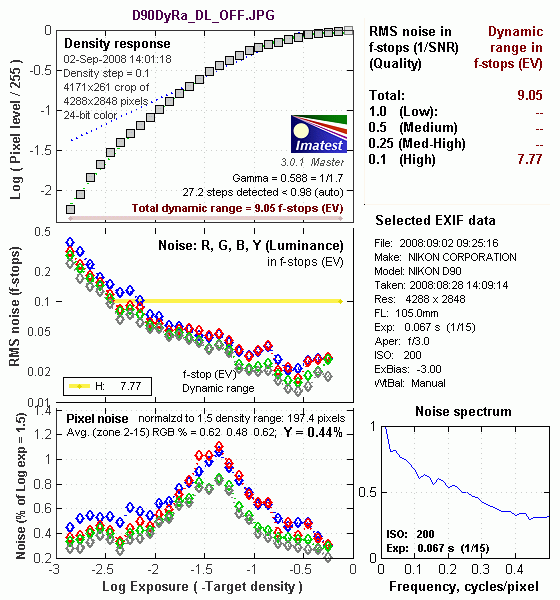
These are very good results for in-camera JPEGs, among the top performers in the high quality category (7.77 f-stops). The tone curve shows excellent gradation in highlights but tails-off very abruptly in the shadow end. This can be seen when closely inspecting shots captured by the D90, where detail is held very nicely in strong highlights, but somewhat less so in the deepest shadows.

Not surprisingly, the results with Active D-Lighting set to Low are a bit lower at the highest quality level, because shadow noise has increased slightly. The total dynamic range figure (irrespective of noise levels) has increased slightly from 9.05 to 9.77 f-stops.

Very similar to the Low setting, the Active D-Lighting Normal setting had slightly better results, with dynamic range at the highest quality increasing slightly to 7.75 f-stops, and the total dynamic range to 9.89 f-stops.

It's interesting that the Extra High setting actually reduced both dynamic range figures. This is because it's really just redistributing the available tonal scale, which involves boosting brightness levels in the shadows pretty substantially. This also boosts the noise, so the useful dynamic range is reduced.
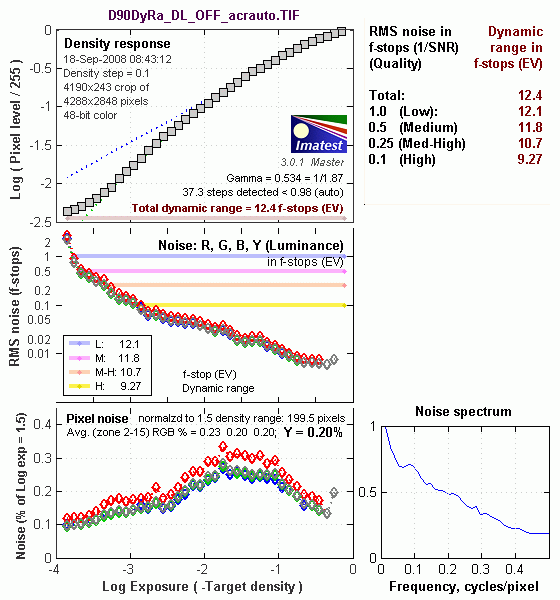
Processing the D90's RAW (NEF) files through Adobe Camera Raw (ACR) version 4.6 (beta) improved dynamic range by almost 2 stops at the best quality level, and by more than 3 stops overall. ACR's automatic settings were used., tweaking the sliders manually may result in slightly better results, but these numbers are already excellent. The response curve has an almost ideal "S" shape to it, where the shadow end of the curve trails off much more gradually than in-camera JPEGs. (Although the highlight side ends a bit more abruptly than we'd prefer.) Worth noting here is that ACR's default noise reduction settings also reduced the pixel noise relative to the levels in the in-camera JPEG. Also important to note is that the degree of manipulation performed by ACR here would likely result in color errors in strong highlights in real-world photographs. (The best performance you're likely to see in a real-world environment will likely be somewhere between the in-camera results and those from Adobe Camera Raw.)
Dynamic Range, the bottom line:
The net result was that the D90 JPEGs and ACR processed RAW files came in above most other DSLR models we've tested recently at the highest quality level, including the D300.
To get some perspective, here's a summary of the Nikon D90's dynamic range performance, and how it compares to other digital SLRs that we also have Imatest dynamic range data for. (Results are arranged in order of decreasing dynamic range at the "High" quality level.):
| Dynamic Range (in f-stops) vs Image Quality (At camera's base ISO) (Blue = RAW via ACR, Yellow=Camera JPEG, Green=Current Camera) |
||||
| Model | 1.0 (Low) |
0.5 (Medium) |
0.25 (Med-High) |
0.1 (High) |
| Nikon D700 (Adobe Camera Raw 4.5) |
12.1 | 11.6 | 10.6 | 9.51 |
| Sony A900 (Adobe Camera Raw 4.6b) |
-- | 12.1 | 10.7 | 9.36 |
| Nikon D90 (Adobe Camera Raw 4.6b) |
12.1 | 11.8 | 10.7 | 9.27 |
| Fujifilm S3 Pro (Adobe Camera Raw 2) |
12.1 | 11.7 | 10.7 | 9.00 |
| Nikon D40x (Adobe Camera Raw 4.1) |
12.0 | 10.9 | 10.3 | 8.90 |
| Canon 5D Mark II (Adobe Camera Raw 5.2) |
-- | 10.8 | 10.0 | 8.89 |
| Canon EOS-1Ds Mark III (Adobe Camera Raw 4.5) |
11.5 | 10.7 | 9.96 | 8.84 |
| Nikon D3 (Adobe Camera Raw 4.5) |
11.7 | 11.0 | 10.0 | 8.75 |
| Canon EOS-1D Mark III (Adobe Camera Raw 4.5) |
11.7 | 10.7 | 9.99 | 8.73 |
| Pentax K20D (Adobe Camera Raw 4.5) |
11.4 | 10.6 | 9.82 | 8.56 |
| 8.5 Stops | ||||
| Nikon D300 (Adobe Camera Raw 4.3.1) |
11.4 | 10.9 | 9.87 | 8.45 |
| Sony A200 (Adobe Camera Raw 4.3.1) |
11.6 | 10.4 | 9.82 | 8.43 |
| Nikon D60 (Adobe Camera Raw 4.4.1) |
11.6 | 10.5 | 9.74 | 8.31 |
| Nikon D40 (Adobe Camera Raw 4.1) |
11.9 | 10.9 | 9.89 | 8.30 |
| Canon EOS-1Ds Mark III (Camera JPEG) |
10.9 | 10.2 | 9.71 | 8.23 |
| Pentax K100D (Adobe Camera Raw 3.6) |
11.3 | 10.3 | 9.51 | 8.23 |
| Pentax K200D (Adobe Camera Raw 4.4.1) |
-- | 10.5 | 9.54 | 8.19 |
| Pentax K10D (Adobe Camera Raw 3.7) |
10.6 | 10.0 | 9.29 | 8.19 |
| Sony A100 (Adobe Camera Raw 3.4) |
11.3 | 10.5 | 9.69 | 8.16 |
| Canon EOS-1Ds Mark II (Adobe Camera Raw 3) |
11.2 | 10.3 | 9.40 | 8.14 |
| Canon EOS 50D (Adobe Camera Raw 4.6) |
11.2 | 10.5 | 9.49 | 8.06 |
| Nikon D40x (Camera JPEG) |
10.8 | 10.0 | 9.42 | 8.04 |
| Canon Rebel XSi (Camera JPEG) (ALO on by default) |
11.3 | 10.1 | 9.34 | 8.01 |
| 8.0 Stops | ||||
| Fujifilm S3 Pro (Camera JPEG) |
-- | 9.90 | 9.40 | 7.94 |
| Sony A350 (Adobe Camera Raw 4.4) |
11.6 | 10.5 | 9.61 | 7.89 |
| Canon EOS-1D Mark III (Camera JPEG) |
-- | 10.2 | 9.70 | 7.88 |
| Canon Rebel XS (Adobe Camera Raw 4.5) |
-- | 10.3 | 9.27 | 7.88 |
| Nikon D3 (Camera JPEG) |
-- | -- | -- | 7.87 |
| Canon Digital Rebel XTi (Adobe Camera Raw 3.6) |
10.8 | 9.88 | 9.18 | 7.84 |
| Canon EOS 5D (Adobe Camera Raw 3) |
11.0 | 10.4 | 9.21 | 7.83 |
| Canon EOS 50D (Camera JPEG) (ALO Off ) |
-- | 9.64 | 9.17 | 7.83 |
| Nikon D90 (Camera JPEG) |
-- | -- | -- | 7.77 |
| Canon EOS 40D (Adobe Camera Raw 4.2) |
11.2 | 10.1 | 9.26 | 7.72 |
| Canon Rebel XSi (Adobe Camera Raw 4.4.1) |
10.6 | 9.95 | 9.10 | 7.68 |
| Canon EOS 50D (Camera JPEG) (ALO STD by default) |
-- | -- | 8.90 | 7.68 |
| Nikon D700 (Camera JPEG) |
-- | -- | 9.05 | 7.67 |
| Canon 5D Mark II (Camera JPEG) (ALO STD) |
10.6 | 9.68 | 8.98 | 7.66 |
| Canon EOS-5D (Camera JPEG) |
10.2 | 9.68 | 8.82 | 7.65 |
| Olympus E-3 (Adobe Camera Raw 4.3) |
10.3 | 10.1 | 9.29 | 7.64 |
| Canon 5D Mark II (Camera JPEG) (ALO Off) |
-- | 9.67 | 8.96 | 7.62 |
| Nikon D60 (Camera JPEG) |
10.5 | 9.62 | 8.89 | 7.62 |
| Nikon D200 (Adobe Camera Raw 3) |
10.6 | 9.65 | 8.96 | 7.61 |
| Nikon D80 (Adobe Camera Raw 3.6) |
11.1 | 10.4 | 9.42 | 7.51 |
| 7.5 Stops | ||||
| Olympus E-500 (Adobe Camera Raw 3) |
10.7 | 9.97 | 8.90 | 7.46 |
| Olympus E-510 (Adobe Camera Raw 4.1) |
10.0 | 9.43 | 8.64 | 7.46 |
| Pentax K10D (Camera JPEG) |
-- | 9.49 | 8.88 | 7.44 |
| Nikon D300 (Camera JPEG) |
-- | -- | 8.70 | 7.44 |
| Nikon D2Xs (Adobe Camera Raw 3.6) |
10.6 | 9.90 | 8.93 | 7.42 |
| Canon EOS 40D (Camera JPEG) |
10.6 | 9.52 | 8.78 | 7.42 |
| Nikon D50 (Camera JPEG) |
10.7 | 9.93 | 8.70 | 7.36 |
| Panasonic DMC-G1 (Adobe Camera Raw 5.2) |
10.7 | 9.78 | 8.70 | 7.32 |
| Sony A900 (Camera JPEG) (DRO off by default ) |
10.2 | 9.75 | 8.49 | 7.31 |
| Sony A200 (Camera JPEG) (DRO on by default) |
10.4 | 9.43 | 8.91 | 7.29 |
| Canon EOS 20D (Camera JPEG) |
10.3 | 9.66 | 8.85 | 7.29 |
| Canon EOS 30D (Camera JPEG) |
10.3 | 9.50 | 8.57 | 7.29 |
| Nikon D40 (Camera JPEG) |
10.4 | 9.80 | 8.89 | 7.28 |
| Sony A900 (Camera JPEG) (DRO on) |
10.1 | 9.76 | 8.47 | 7.26 |
| Canon Rebel XS (Camera JPEG) |
10.3 | 9.4 | 8.61 | 7.22 |
| Sony A350 (Camera JPEG) (DRO on by default) |
10.3 | 9.55 | 8.85 | 7.19 |
| Nikon D80 (Camera JPEG) |
10.1 | 9.43 | 8.48 | 7.12 |
| Canon Digital Rebel XT (Camera JPEG) |
10.3 | 9.51 | 8.61 | 7.11 |
| Nikon D200 (Camera JPEG) |
-- | 9.07 | 8.36 | 7.11 |
| Panasonic DMC-G1 (Camera JPEG, iExposure = Low) |
-- | 9.29 | 8.50 | 7.09 |
| Panasonic DMC-G1 (Camera JPEG, iExposure = Standard) |
-- | 9.30 | 8.54 | 7.07 |
| Olympus E-300 (Camera JPEG) |
10.8 | 9.26 | 8.48 | 7.07 |
| Olympus E-410 (Adobe Camera Raw 4.1) |
10.2 | 9.40 | 8.24 | 7.05 |
| Olympus E-500 (Camera JPEG) |
10.0 | 9.14 | 8.16 | 7.05 |
| Canon Digital Rebel XTi (Camera JPEG) |
9.83 | 9.10 | 8.27 | 7.04 |
| Canon EOS-1Ds Mark II (Camera JPEG) |
10.3 | 9.38 | 8.60 | 7.04 |
| Panasonic DMC-G1 (Camera JPEG, iExposure = High) |
10.3 | 9.23 | 8.54 | 7.04 |
| Panasonic DMC-G1 (Camera JPEG, iExposure = Off) |
-- | 9.33 | 8.52 | 7.03 |
| Pentax K200D (Camera JPEG) |
-- | 9.50 | 8.30 | 7.01 |
| 7.0 Stops | ||||
| Canon Digital Rebel (Camera JPEG) |
10.1 | 9.11 | 8.47 | 6.97 |
| Nikon D2Xs (Camera JPEG) |
9.82 | 8.98 | 8.23 | 6.97 |
| Panasonic DMC-L10 (Adobe Camera Raw 4.2) |
10.4 | 9.34 | 8.48 | 6.91 |
| Sigma DP1 (Camera JPEG) |
-- | 8.95 | 8.13 | 6.91 |
| Pentax *istDs (Camera JPEG) |
10.2 | 10.0 | 8.87 | 6.90 |
| Sony A100 (Camera JPEG) |
10.2 | 9.24 | 8.39 | 6.89 |
| Pentax K100D (Camera JPEG) |
10.3 | 9.30 | 8.39 | 6.73 |
| Pentax K20D (Camera JPEG) |
10.2 | 9.21 | 8.09 | 6.66 |
| 6.5 Stops | ||||
| Nikon D2x (Camera JPEG) |
-- | 8.93 | 7.75 | 6.43 |
| Olympus E-3 (Camera JPEG) |
9.32 | 9.06 | 8.50 | 6.42 |
| Panasonic DMC-L10 (Camera JPEG) |
-- | 8.94 | 8.00 | 6.38 |
| Olympus E-420 (Camera JPEG) |
9.18 | 8.82 | 7.93 | 6.37 |
| 6.0 Stops | ||||
| Olympus E-410 (Camera JPEG) |
-- | -- | 7.60 | 5.99 |
| Nikon D70s (Camera JPEG) |
9.84 | 8.69 | 7.46 | 5.85 |
| Nikon D70 (Camera JPEG) |
9.81 | 8.76 | 7.58 | 5.84 |
| < 5.0 Stops | ||||
| Olympus E-510 (Camera JPEG) |
7.70 | 7.16 | 5.87 | 3.55 |
The results shown in the table are interesting. One of the first things that struck me when I initially looked at test data for a wide range of d-SLRs, was that here again, purely analytical measurements don't necessarily correlate all that well with actual photographic experience. There's no question that the Fuji S3 Pro deserves its place atop the list, as its unique "SR" technology does indeed deliver a very obvious improvement in tonal range in the highlight portion of the tonal scale. I was surprised to see the analytical results place the Olympus E-300 as highly as they did, given that our sense of that camera's images was that they were in fact noisier than those of many other d-SLRs that we looked at. In the other direction, I was quite surprised to see the Nikon D2x place as low on the listings as it did, given that we found that camera's shadow detail to be little short of amazing.
One thing that's going on here though, is that we tested each camera at its lowest (base) ISO setting, which should produce best-case noise levels. This is in fact what many photographers will be most interested in, but it does perhaps place some of the Nikons (like the D40 and D90) at a disadvantage, as their base ISO setting is 200, as compared to the ISO 100 settings available on most other models.
All that said, the Nikon D90 delivers excellent dynamic range performance, clearly one of the leading cameras currently on the market in this regard.
Nikon D90 Resolution Chart Test Results

The chart above shows consolidated results from spatial frequency response measurements in both the horizontal and vertical axes. The "MTF 50" numbers tend to correlate best with visual perceptions of sharpness, so those are what I focus on here. The uncorrected resolution figures are 1,329 line widths per picture height in the horizontal direction (corresponding to the vertically-oriented edge), and 1,400 lines along the vertical axis (corresponding to the horizontally-oriented edge), for a combined average of 1,365 LW/PH. Correcting to a "standardized" sharpening with a one-pixel radius increased both vertical and horizontal resolution significantly, resulting in an average of 2,075 LW/PH, somewhat below what we'd expect from a 12-megapixel DSLR.
To see what's going on, refer to the plots below, which show the actual edge profiles for both horizontal and vertical edges, in both their original and corrected forms. Here, you can see that the D90's default in-camera sharpening is fairly conservative (only a slight bump at the top ends, and no noticeable bump at the bottom ends of the black edge profile curves). Imatest reports that the horizontal direction (vertical edge) is "undersharpened" by 28.9% while the vertical direction (horizontal edge) is undersharpened by 26.3%. Professionals and serious amateurs prefer this to oversharpening, and the D90's images respond very well to the use of strong/tight sharpening post-exposure in Photoshop or other image editors. (That said, you should be able to extract still more fine detail if you begin with a RAW file, rather than a JPEG.)
.


Menus
Nikon D90 Modes and Menus
Nikon D90 Exposure Modes
 The mode dial on the right side of the D90's top panel provides access to its various exposure modes, the same arrangement of Auto, three semi-auto, and one Manual as found on all Nikon DSLRs, but with a total of six Scene modes (which Nikon calls "Vari-Programs"). Note that the D80's Night Landscape Scene mode has been replaced by the D90's more useful Flash Off mode. Here's a list of what's available:
 Auto: The camera sets everything. Used for snapshots or users who just don't want to be bothered with the details. The AF-assist light will come on if needed, and the camera selects the AF point covering the closest subject.
 Program: Puts the camera in charge of aperture and shutter speed, though all remaining camera settings are available. You can vary the combination of aperture and shutter speed the camera has selected by rotating the Command Dial.
 Shutter Priority: The user controls shutter speed, from 1/4,000 to 30 seconds, while the camera sets the aperture value.
 Aperture Priority: The opposite of Shutter Priority mode, this mode lets the user control the aperture, while the camera sets the shutter speed.
 Manual: Gives the user complete control over the exposure (both shutter and aperture settings), and provides access to the camera's Bulb shutter setting for exposures longer than 30 seconds.
 Night Portrait: Uses slow shutter speed with flash, balancing the two so that night portraits look natural even with flash. Closest-subject AF is used. Use a tripod to avoid blurring.
 Sports: Uses higher shutter speeds, camera switches to continuous focus while the shutter button is held down halfway, tracking the subject in the center focus area. If the subject leaves the central AF area, the camera will follow it and judge focus from the other focus areas. The beginning AF area can be chosen with the Multi-selector. Both flash and AF illuminator are turned off and will not fire.
 Close up: Reds and greens are pumped up, camera selects center focus point, but other points can be chosen with the Multi-Selector. The built-in flash will pop up and fire if the lighting is too dim, use of a tripod is recommended.
 Landscape: Boosts color saturation, contrast, and sharpening for city and forest landscape shots. Closest-focus AF is used, and the flash and AF-assist light are turned off in this mode.
 Portrait: Adjusts the lens aperture to soften background details to help the main subject stand out more clearly. Sharpness and color saturation are moderated somewhat, to give softer, more natural-looking skin tones. The built-in flash will pop up and fire if the lighting is too dim.
 Flash Off (Auto): In this mode, the flash is disabled, and the camera will vary the ISO up to a maximum of 3,200, to capture images using available light. The AF-assist light will come on if needed, and the camera selects the AF point with the closest subject. This mode is great for museums and other places where flash isn't permitted, more natural-looking indoor shots, etc. (Do note though, that you may need to use a tripod, as the shutter speeds are likely to be on the slow side, even at ISO 3,200.)
Nikon D90 Menus
The menu system on the D90 follows that of recent Nikons SLRs like the D60 and D300. Pressing the Menu button provides access to the camera's full menu system.
In the section below, rather than list and verbally describe each option, we'll present the top-level menu screens in the main text without comment, and provide links to pages showing most of D90 menu structure, page by page.
Nikon D90 Playback Menu

Nikon D90 full Playback menu layout
(note, large download for dialup users)
Nikon D90 Shooting Menu

Nikon D90 full Shooting menu layout
(note, large download for dialup users)
Nikon D90 Custom Settings Menu

Nikon D90 full Custom Settings menu layout
(note, large download for dialup users)
Nikon D90 Setup Menu

Nikon D90 full Setup menu layout
(note, large download for dialup users)
Nikon D90 "Retouch" Menu

Nikon D90 full "Retouch" menu layout
(note, large download for dialup users)
Nikon D90 "My Menu" Menu

Autofocus
Nikon D90 Autofocus System
The Nikon D90 uses the same Multi-CAM 1000 autofocus sensor as its predecessor the D80, but incorporates some of the advanced AE/AF integration first seen in the D3 and D300 professional models. It also offers 3D focus tracking for more accurate focus on moving subjects, the same technology found in its big brothers. In the paragraphs below, we'll look first at the general characteristics of the camera's AF system, and then talk a bit about the advances carried over from the D3 and D300.
Focusing Options
The D90 inherits the same Multi-CAM 1000 AF sensor module used in the D80, so many of its basic specs mirror those of the D80 quite closely. As we noted in the review section covering the viewfinder, the D90 has a total of 11 autofocus regions, arranged with 9 in an almost square matrix in the central area of the frame, with two additional ones positioned to the right and left of the central array. The central point of the array is a selectable normal/wide point, optionally able to look across a wider area in determining focus. Each of the 11 focus areas can be used individually, the center sensor can be switched to wide-frame operation for broader coverage, and an Auto-area AF mode measures all 11 focus areas, automatically determines which of them are on the primary subject and activates only those areas. As with the D80, only the center sensor is cross-type, able to respond to subject detail oriented either horizontally or vertically.
The D90 lets you choose either auto or manual focus via a small dial on the front of the camera, next to the lens. Setting the switch to "M" puts the camera into manual focus mode, "AF" places it in autofocus mode. Single AF (AF-S), Continuous AF (AF-C), and Auto-switching AF (AF-A) options can be selected by pressing the AF button on the right side of the camera's top panel repeatedly, to cycle through the choices. Single AF simply means that the camera sets focus only once, when the Shutter button is first pressed halfway, and is best for stationary objects. Continuous AF means that the camera continuously adjusts the focus, as long as the Shutter button is halfway pressed, and is best for moving objects. In AF Auto mode, the camera begins focus operations in single-focus mode, but switches to Continuous Dynamic AF if it detects motion within the active AF area.
There's an important difference between Single and Continuous Servo modes: In Single Servo mode, the shutter won't release unless the lens is focused, or the lens itself is set to manual focus. (Focus Priority) In Continuous Servo mode however, the camera will fire regardless of the state of focus. (Release Priority) If you want to be sure that the camera is focused when you snap the picture, use Single Servo mode. Use Continuous Servo for moving subjects, and/or times when the instant of shutter release is more important to you than sharp focus.
The AF Area Mode option (a1) on the Custom Settings Menu lets you select between Single Area, Dynamic Area, and Auto AF modes, and adds a new 3D Tracking mode, brought over from Nikon's recent pro-level SLRs. Single Area AF simply means that the camera judges focus based on one part of the subject, and the user can manually select the AF point by pressing the arrow keys. Dynamic Area AF employs all of the autofocus points, though you can still manually select the main point. When Dynamic Area focusing is enabled, the camera first focuses on the subject in the primary focus area. When the subject moves to a different AF area, the camera shifts the focus to "follow" the subject. This is great for irregularly moving subjects. (Sports and kids come to mind.) The Auto-area AF option means that the camera first focuses on the subject in whatever single AF area is selected, but will switch to Dynamic Area AF if it detects subject motion. The new 3D Tracking mode uses the 420-element RGB exposure/white balance sensor to aid in subject tracking. (See the section below on AE/AF integration for more details on this.)
In any of the AF modes, you can change the primary focus area by unlocking the focus area selector (the Four-Way Arrow pad on the back panel) and then shifting the focus area using the up, down, right, or left arrow directions on the control rocker. You can lock the focus area selection by turning the switch back to the lock position. By default, the D90 does not "wrap" the focus area selector as you scroll between focus areas. Custom Settings menu option a5 lets you opt for a "Wrap" function. What this means is that if you press the right arrow key again, after the right focus area is already selected, the selection will immediately jump to the left focus area. The same thing happens when moving the focus area selection vertically as well.
The center focus area of the D90 can be set to either a normal or wide zone, through Custom Settings Menu option a2. The wider zone could be better for initially acquiring a moving subject, particularly when combined with the Dynamic Focus option.
There are three methods by which you can lock focus on the D90. The first is to half-press the Shutter button to lock the focus, placing your subject in the selected focus area, halfway pressing the Shutter button, then realigning the composition and firing the shutter. (This is the default behavior of the Shutter button, but if the AE-L/AF-L button is set to AF Lock, it will override the shutter button as long as it's held down.) Alternatively, when using Single Servo AF, you can press the AF-L/AE-L button to lock focus (and exposure, unless that button is set for focus only in Custom Settings menu f4). Keeping this button pressed will lock focus and/or exposure, even if the Shutter button is released. This lets you recompose the photograph without keeping your finger on the Shutter button, but on the AE-L/AF-L button instead. (Reducing the chance that you'll accidentally trip the shutter when you don't intend to.) The front-panel FUNC button can also be set (via Custom Settings Menu option f3) to set focus temporarily.
There are several options available for the AE-L/AF-L button, which can be set via Custom Settings Menu f4. You can program it to lock either focus or exposure separately, or both together (the default). You can also change its operation so a single press locks and holds the exposure setting. (No need to keep the button pressed down.) Finally, you can set the AE/AF lock button so it alone controls the autofocus system, meaning the autofocus won't actuate when the shutter button is half-pressed, only when the AE/AF lock button is pressed instead.
AF Performance
We don't have any way to measure autofocus tracking performance directly, but on a subjective level, the AF system in the Nikon D80 did seem to be very fast and responsive. We particularly liked the Dynamic AF option, but could see where the Group Dynamic AF option of the D200 would be nice to have in some situations. (Group Dynamic AF handles the common situation where it's difficult to place a single AF point on a very active subject at the start of focus tracking. By having a larger area in which to position the subject, it becomes much easier to initially acquire focus.)
AF Assist
Like past Nikon DSLRs with built-in flashes, the D90's AF-assist light is a bright incandescent bulb that emits from the body near the handgrip. We thought to call particular attention to it, because some DSLRs use the flash as an AF-assist light. This would be fine, but they also require that the flash be used in the exposure, so there's no way to have AF assist for available-light shots. The D90 doesn't have this limitation.
AE/AF Integration - RGB sensor brings extra smarts
 When they were announced roughly a year before the Nikon D90, the D3 and D300 brought a new level of sophistication to autofocus algorithms, by taking advantage of information from their unusually high-resolution 1,005 RGB exposure and white balance sensor. For the first time, the D90 brings this advanced AF technology to a SLR aimed at the prosumer market. The technology isn't exactly equivalent to that of the higher-end models though: Where the D3 and D300 have 1,005 pixel RGB sensors, the equivalent chip in the D90 has only 420 pixels. - And, of course, the D90 has only 11 AF areas vs the 51 of the D3 and D300.
While 420 RGB pixels doesn't sound like a lot when compared to the megapixels of the main image sensor, that's a heck of a lot more elements than are found in the 11-point autofocus array. While AF systems have gotten pretty clever at understanding what the subject is doing as it moves across the frame and toward or away from the camera, a view that's limited to just 11 points severely restricts the camera's view of what's happening in terms of subject movement.
The key innovation in the D3/D300 AF system is that data from the RGB sensor is used to provide much higher resolution for keeping track of subject position. The color data also helps identify the subject of interest and separate it from the background or other scene contents. When an AF point initially acquires a lock on a particular subject, the camera immediately notes the pattern of light and color found at the corresponding point on the RGB array. Then, as the subject or camera moves, the camera can track the light/color pattern corresponding to the subject across the face of the RGB array. This provides much finer-grained position information than could ever be obtained from the sparse AF array. The RGB sensor doesn't provide any distance information, but by more precisely tracking subject information, it permits a much surer hand-off of the subject between AF points. Nikon calls this advanced, color-based approach 3D Focus Tracking. As noted above, 3D Tracking focus is one of the options on the a1 Custom Settings Menu screen.
Face Detection in Phase-Detect AF?
Here's a new wrinkle we were frankly a little surprised to hear about: The Nikon D90 can actually use face detection when in normal auto-area phase-detect AF mode. At first, this sounds like an impossibility, and it would be for a purely conventional phase-detect AF system. After all, how could the AF sensors tell whether they were focusing on a face or any other object? All they see is a signal that indicates how far in or out of focus their part of the subject is: There's nothing that would indicate what type of subject they're looking at.
This is where the 420-pixel RGB sensor comes into play again. It obviously doesn't have anywhere near the resolution of the main image sensor, but there's probably enough to give at least some idea of where a face might be in the image. We don't know the details of how the 420 pixels are arranged, but if they were in an array with a 3:2 aspect ratio to match the overall frame dimensions, that would be an array on the order of 25 x 17 pixels in size. Pretty paltry by camera image sensor resolution, but perhaps enough to detect a skin-colored blob against a differently-colored background. In closeup portraits, this is also probably enough resolution to figure out what part of the subject corresponds to an eye vs. a nose.
Of course, as noted before, the RGB sensor itself doesn't collect any distance information, and as such, can't directly control focus operation. In other words, you're still only going to be able to set focus based on areas covered by the AF points themselves. But what the RGB sensor data can do is to help the AF system decide which of the AF points to pay attention to.
Playing with a prototype of the Nikon D90, we found this to work surprisingly well. In auto-area AF mode, if we arranged objects to have several both covered by AF points and at equal distances from the camera, the camera pretty reliably chose the AF point lying over a face. Even more impressive, if we composed a portrait shot with several AF points on the subject's face, but only one over an eye, the camera picked the eye more times than not. (It seemed pretty accurate, but we'll have to spend more time with a production sample before we can give any idea of how reliable this AF system feature is. Nonetheless, what we saw struck us as both impressive and useful in actual shooting situations.
Comparison
Nikon D90 Feature Comparison
The chart below compares the D90with other current Nikon "prosumer" models. What we've done below is to present something of a hybrid comparison between these three models. A red cell means that a given camera performs below the other two, a green cell means that it performs better than the other two, and a yellow cell means it falls between the other two. In cases where two cameras share a superior capability, both their cells will be colored green. Sharp-eyed readers may find some areas where we haven't chosen to highlight a particular difference. Those cases are simply ones that we don't feel are significant in typical use of the camera.
| Nikon D90 vs other "prosumer" Nikon SLRs | ||||
|
Manufacturer
|
Nikon
|
Nikon
|
Nikon | |
|
Model
|
D80
|
D90
|
D300 | |
| Imaging System |
Sensor
Manufacturer
|
Sony | Sony | Sony |
|
Sensor Type
|
CCD | CMOS | CMOS | |
|
Color Filter
Array
|
RGB | RGB | RGB | |
|
Total Megapixels
|
10.75
|
12.9
|
13.1 | |
|
Effective
Megapixels
|
10.2 | 12.3 | 12.3 | |
|
Effective Sensor Size (mm)
|
23.6 x 15.8
|
23.6 x 15.8
|
23.6 x 15.8 | |
|
Focal Length Multiplier (approx.)
|
1.5x
(Nikon DX) |
1.5x
(Nikon DX) |
1.5x (Nikon DX) |
|
|
Ultrasonic Dust Reduction
|
No
|
Yes
|
Yes | |
|
Image Processor
|
Not stated
|
EXPEED
|
EXPEED | |
| Viewfinder |
Type
|
Eye-level pentaprism
|
Eye-level pentaprism
|
Eye-level pentaprism |
|
Coverage
|
95%
|
96%
|
100% | |
|
Magnification
(-1 diopter with 50mm lens at infinity) |
0.94x
|
0.94x
|
0.94x | |
|
Eyepoint (mm)
|
19.5
|
19.5
|
19.5 | |
|
Dioptric Adjustment Range (diopters)
|
-2.0 to +1.0
|
-2.0 to +1.0
|
-2.0 to +1.0 | |
|
Focusing Screen
|
Type-B BriteView clear matte screen Mark II,
with on-demand grid lines
|
Type-B BriteView clear matte screen Mark II,
with on-demand grid lines
|
Type-B BriteView clear matte screen Mark II, with on-demand grid lines | |
|
Depth of Field Preview
|
Enabled with depth-of-field preview button
|
Enabled with depth-of-field preview button
|
Enabled with depth-of-field preview button | |
|
Live View
(on LCD) |
No
|
Yes
(1 Mode: Uses contrast detect AF with face detection from image sensor) |
Yes (2 Modes: Hand-held mode uses conventional AF sensor; Tripod mode uses contrast detect AF from image sensor) |
|
| Recording System |
Recording Media / Quantity / Slot Type
|
Secure Digital card
(SDHC compatible) |
Secure Digital card
(SDHC compatible) |
Type I or II CF card / Microdrive (UDMA supported) |
|
Compatible File System
|
FAT 16 / FAT 32
|
FAT 16 / FAT 32
|
FAT 16 / FAT 32 | |
|
Recording Formats
|
RAW 12-bit (compressed NEF), JPEG
|
RAW 12-bit (compressed NEF), JPEG
|
RAW 12-bit or 14-bit (uncompressed, lossless compressed or compressed NEF), TIFF (32-bit), JPEG | |
|
Maximum Resolution
|
3872 x 2592
|
4288 x 2848
|
4288 x 2848 | |
|
Reduced Resolutions (JPEG only)
|
2896 x 1944;
1936 x 1296 |
3216 x 2136;
2144 x 1424 |
3216 x 2136; 2144 x 1424 |
|
|
RAW + JPEG Recording
|
Yes, selectable JPEG resolution / compression
|
Yes, selectable JPEG resolution / compression
|
Yes, selectable JPEG resolution / compression | |
| Color Space, Image Parameters & White Balance |
User-Selectable Color Space
|
Yes
sRGB (two variants) + Adobe RGB |
Yes
sRGB + Adobe RGB |
Yes sRGB + Adobe RGB |
|
Processing Parameters
(Contrast, Sharpness, Saturation, Hue) / # of Increments |
7 options each for sharpness and contrast, 4 options for saturation. 7-step hue adjustment.
|
9 options for sharpening, 7 options for contrast, 3 options for brightness, 7 options for saturation, 5-step hue adjustment.
|
9 options for sharpening, 7 options for contrast, 3 options for brightness, 7 options for saturation, 5-step hue adjustment. | |
|
Picture Control System
|
No | Yes | Yes | |
|
Active
D-Lighting |
No | Yes with new Auto and Extra High modes |
Yes | |
|
Preset WB Settings
|
Six presets with fine tuning; one Manual preset
|
Seven presets with fine tuning; one Manual preset
|
Seven presets with fine tuning; four Manual presets | |
|
Manual Color Temperature Setting Range
|
2,500 ~ 10,000K in increments of roughly 10
mired
|
2,500 ~ 10,000K in increments of roughly 10
mired
|
2,500 ~ 10,000K in increments of roughly 10 mired | |
|
WB Adjustment Range
|
±3 steps in 1-step increments
10 mireds per step |
±6 steps in 1-step increments
5 mireds per step |
±6 steps in 1-step increments 5 mireds per step |
|
| Autofocus System |
Type
|
TTL phase detection by Nikon Multi-CAM1000
autofocus module
|
TTL phase detection by Nikon Multi-CAM1000 autofocus module
|
TTL phase detection by Nikon Multi-CAM3500DX autofocus module |
|
# of Focusing Points (Focusing Point Type)
|
11 normal points or 1 wide point (1 cross-type, 2 horizontal-type, 8 vertical-type)
|
11 points, 1 wide or normal center point (1 cross-type, 2 horizontal-type, 8 vertical-type)
|
51 points (15 cross-type, 36 line type) | |
|
Superimposed
Focus Point Display
|
Yes | Yes | Yes | |
|
AF Working Range
|
EV -1 ~ 19 (ISO 100)
|
EV -1 ~ 19 (ISO 100)
|
EV -1 ~ 19 (ISO 100) | |
|
AF Servo Modes
|
AF-S (single one-shot),
AF-C (continuous tracking), AF-A (for auto selection of AF-S or AF-C modes). |
AF-S (single one-shot),
AF-C (continuous tracking), AF-A (for auto selection of AF-S or AF-C modes). |
AF-S (single one-shot), AF-C (continuous tracking). |
|
|
AF Area Modes
|
Single area, Dynamic area, Auto area.
|
Single area, Dynamic area, Auto area, 3D tracking
|
Single point (51 or 11), Dynamic Area [9 points, 21 points, 51 points, 51 points (3D-tracking)], Auto area. | |
|
AF-assist Beam
|
Yes
Bright incandescent lamp |
Yes
Bright incandescent lamp |
Yes Bright incandescent lamp |
|
|
Fine-tune Front/Back Focus Adjustment
|
No | No | Yes (settings for up to 12 lenses) | |
| Exposure Control |
Shooting Modes
|
11 - Program, shutter-priority AE, aperture-priority AE, Manual, Auto, Portrait, Landcape, Close up, Sports, Night Landscape, Night Portrait.
|
11 - Program, shutter-priority AE, aperture-priority AE, Manual, Auto, No Flash, Portrait, Landcape, Close up, Sports, Night Portrait.
|
4 - Program, shutter-priority AE, aperture-priority AE, manual mode. |
|
Metering Zones
|
420
|
420
|
1,005 | |
|
Metering Modes
|
1) 3D Color Matrix Metering II (type G
and D lenses); Color Matrix Metering II (other CPU lenses); metering
performed by 420-segment RGB sensor.
2) Center-weighted: Weight of 75% given to 6, 8, or 10 mm dia. circle in center of frame. 3) Spot: Meters 3.5 mm dia. circle (about 2.5% of frame) centered on active focus area. |
1) 3D Color Matrix Metering II (type G
and D lenses); Color Matrix Metering II (other CPU lenses); metering
performed by 420-segment RGB sensor.
2) Center-weighted: Weight of 75% given to 6, 8, or 10 mm dia. circle in center of frame. 3) Spot: Meters 3.5 mm dia. circle (about 2.5% of frame) centered on active focus area. |
1) 3D Color Matrix Metering II (type G and D
lenses); Color Matrix Metering II (other CPU lenses); color matrix
metering available with non-CPU lenses if user provides lens data;
metering performed by 1,005-segment RGB sensor. 2) Center-weighted: Weight of 75% given to 6, 8, 10, or 13mm dia. circle in center of frame. 3) Spot: Meters 3mm dia. circle (about 2.0% of frame) centered on active focus area (on center focus area when non-CPU lens is used). |
|
|
Metering System Working Range
|
1) EV 0 ~ 20 (Matrix or
center-weighted metering)
2) EV 2 ~ 20 (spot metering) (ISO 100 equivalent, f/1.4 lens, 20°C/68°F) |
1) EV 0 ~ 20 (Matrix or
center-weighted metering)
2) EV 2 ~ 20 (spot metering) (ISO 100 equivalent, f/1.4 lens, 20°C/68°F) |
1) EV 0 ~ 20 (Matrix or
center-weighted metering) 2) EV 2 ~ 20 (spot metering) (ISO 100 equivalent, f/1.4 lens, 20°C/68°F) |
|
|
Nikon Scene Recognition System
|
No | Yes | Yes | |
|
ISO Range / Extended
|
100 ~ 1600 / 3200
|
100 / 200 ~ 3200 / 6400
|
100 / 200 ~ 3200 / 6400 | |
|
Exposure Compensation
|
+/- 5EV in 1/2 or 1/3EV increments
|
+/- 5EV in 1, 1/2 or 1/3EV increments
|
+/- 5EV in 1, 1/2 or 1/3EV increments | |
|
Automatic Exposure Bracketing
|
2 or 3 shots, 1/3, 1/2, 2/3, 1 or 2 EV steps
|
2 or 3 shots, 1/3, 1/2, 2/3, 1 or 2 EV steps
|
2 to 9 exposures in increments of 1/3, 1/2, 2/3 or 1EV | |
| Shutter
Speeds, Frame Rate, Shutter Lag |
Shutter Type
|
Electronically controlled mechanical
|
Electronically controlled mechanical
|
Electronically controlled mechanical |
|
Shutter Speed Range
|
1/4000 ~ 30 sec. in steps of 1/3 or 1/2 EV,
bulb
|
1/4000 ~ 30 sec. in steps of 1/3 or 1/2 EV, bulb
|
1/8000 ~ 30 sec. in steps of 1/3 or 1/2 EV, bulb | |
|
Maximum Frames Per Second / Buffer depth
|
3 fps / 9 JPEG large/fine or 6 RAW frames
|
4.5 fps / >20 JPEG large/fine or 10 RAW frames
|
6.1 fps / 37 JPEG large/fine or 17 (12-bit) RAW fames (up to 8 fps with optional MB-D10 battery pack) |
|
|
Shutter lag, full AF (sec.)
|
0.25
|
0.21
|
0.23 | |
|
Shutter lag, prefocus (sec.)
|
0.083 |
0.067
|
0.057 | |
|
Approx. startup time (sec.)
|
0.2
|
0.3
|
0.3 | |
| Flash |
Built-in Flash / Guide Number (m) at ISO 100
|
Yes
(12, manual 13) |
Yes
(12, manual 13) |
Yes (12, manual 13) |
|
Max flash x-sync speed. (sec.)
|
1/200
|
1/200
|
1/250 (up to 1/320 at reduced GN) |
|
|
Flash Exposure Compensation
|
-3 to +1 EV, 1/3 or 1/2 EV steps
|
-3 to +1 EV, 1/3 or 1/2 EV steps
|
-3 to +1 EV, 1/3 or 1/2 EV steps | |
|
Slow-sync Flash
|
1st or 2nd curtain
|
1st or 2nd curtain
|
1st or 2nd curtain | |
|
PC Sync Terminal
|
Hot shoe only
|
Hot shoe only
|
Yes | |
|
Nikon Advanced Wireless Lighting Support
|
Yes, camera can act as wireless controller with multiple groups, modes and channels | Yes, camera can act as wireless controller with multiple groups, modes and channels | Yes, camera can act as wireless controller with multiple groups, modes and channels | |
| Playback System |
LCD Size / Pixel Count
|
2.5 in LCD / 230,000 pixels
|
3.0 in LCD / 920,000 pixels
|
3.0 in LCD / 920,000 pixels |
|
Enlarged Playback / Scroll
|
1.1 - 25x for large images, 19x for medium images, or 13x for small ones / Yes
|
1.1 - 27x for large images, 20x for medium images, or 13x for small ones / Yes
|
1.1 - 27x for large images, 20x for medium images, or 13x for small ones / Yes | |
|
LCD Monitor Brightness Adjustment Range
|
5 steps
|
7 steps
|
7 steps | |
|
Automatic Rotation for Vertical Shots
|
Yes
|
Yes
|
Yes | |
|
Video Out
|
Analog NTSC/PAL | Analog NTSC/PAL, HDMI | Analog NTSC/PAL, HDMI | |
| Other Features |
Computer Connection
|
Yes, USB 2.0 High-Speed, PTP-compliant
|
Yes, USB 2.0 High-Speed, PTP-compliant
|
Yes, USB 2.0 High-Speed, PTP-compliant |
|
Direct Printing (PictBridge-compliant printers)
|
Yes
|
Yes
|
Yes | |
|
Menu Languages
|
15 (Japanese, German, English, Spanish, Finnish,
French, Italian, Dutch, Polish, Portuguese, Russian, Swedish,
Traditional Chinese, Simplified Chinese, Korean)
|
15 (Japanese, German, English, Spanish, Finnish,
French, Italian, Dutch, Polish, Portuguese, Russian, Swedish,
Traditional Chinese, Simplified Chinese, Korean)
|
15 (Japanese, German, English, Spanish, Finnish, French, Italian, Dutch, Polish, Portuguese, Russian, Swedish, Traditional Chinese, Simplified Chinese, Korean) | |
|
Camera Default Reset
|
Yes
|
Yes
|
Yes | |
|
Custom Functions
(Quantity) |
Yes (32)
|
Yes (41)
|
Yes (48) | |
|
Multiple Exposures
|
Yes
(2~3 shots) |
Yes
(2~3 shots) |
Yes (2~10 shots) |
|
|
In-camera Image Retouching
|
Yes, D-lighting, Red-eye correction, Trim,
Monochrome, Filter effects, Small Picture, Image overlay
|
Yes, expanded over D300: additional filter effects options, new Distortion Control, Straighten and Fisheye Effect
|
Yes, expanded over D80 | |
|
Remote Control
|
Optional, compatible with MC-DC1 remote cord
or
ML-L3 wireless remote
|
Yes, 10-pin remote terminal for optional remote cords, or
ML-L3 wireless remote
|
Yes, 10-pin remote terminal for optional MC-20/30/36 remote cords or WT-4 wireless remote | |
|
Info LCD Panel / Illumination
|
Yes / Yes
(power switch) |
Yes / Yes
(power switch) |
Yes / Yes (power switch) |
|
|
Number of Command Dials
|
2
|
2
|
2 | |
|
Optional GPS Support
|
No | Yes, via optional GP-1 | Yes, via optional GPS Adapter Cord MC-35 | |
|
Programmable function button
|
Yes
|
Yes
|
Yes | |
|
In-camera Lateral C.A. Correction
|
No
|
Yes
|
Yes | |
|
D-Movie mode?
|
No | Yes, 3 modes: HD 1280x720 (16:9 ratio) - 5 min max, VGA 640x424 (3:2 ratio) - 20 min max, QVGA 320x216 (3:2 ratio) - 20 min max, with monaural audio |
No | |
| Body Structure |
Body Cover/Chassis
|
Largely Polycarbonate
|
Largely Polycarbonate
|
Largely Magnesium Alloy |
|
Environmental Seals
|
No | No | Yes | |
| Power System |
Battery Compatibility
|
EN-EL3e,
optional MB-D80 battery pack |
EN-EL3e,
optional MB-D80 battery pack |
EN-EL3e, optional MB-D10 battery pack |
|
Rated Shooting Capacity
(shots) |
50% Flash: 600
|
CIPA: 850
|
CIPA: 1000 | |
| Dimensions & Weight |
Dimensions (WxHxD, mm)
|
132 x 103 x 77
|
132 x 103 x 77
|
147 x 114 x 74 |
|
Weight (body only)
|
585 g
|
620 g
|
825 g | |
| Operational Environment |
Operating Temperature Range
|
0 ~ 40°C
|
0 ~ 40°C
|
0 ~ 40°C |
|
Operating Humidity Range
|
< 85%
|
< 85%
|
< 85% | |
| Kit Lens |
Focal Length / Aperture
|
18-135mm
f/3.5-5.6G ED |
18-105mm
f/3.5-5.6G VR |
- |
| Lens Compatibility |
Lens Mount / Compatibility
|
|
|
|
|
Meter Coupling
|
CPU
|
CPU
|
Combined CPU and AI
|
|
Press Release
NIKON D90 DIGITAL SLR ANSWERS THE CALL FOR CREATIVE FREEDOM WITH ADVANCED FEATURES THAT BENEFIT ALL LEVELS OF PHOTOGRAPHERS
It's All You Need: The 12.3 Megapixel Nikon D90 D-SLR Premieres with the New 18-105mm VR Lens to Give Photographers Superb Image Quality, Live View Shooting, Nikon's Scene Recognition System, and HD Movie Clip Recording
MELVILLE, N.Y. (Aug. 27, 2008) -- Nikon Inc. today announced the D90, a digital single lens reflex (SLR) camera that redefines the creative boundaries of digital photography allowing photographers to easily create stunning still images and High Definition (HD) movie clips with sound -- with the same camera. A host of Nikon core technologies were leveraged to develop the D90's scope of versatility, calling on years of photographic and optical expertise. Whether consumers are graduating from an advanced compact digital camera or are a seasoned D-SLR enthusiast, the Nikon D90 emphasizes brilliant image quality and versatility with its exclusive advanced Scene Recognition System, intuitive creative controls, blazing fast performance and the industry-first ability to create HD movie clips at 720p in the new D-Movie mode.
Inspired by Nikon's acclaimed flagship DX-format digital SLR camera, the D300 and building on the success of the wildly popular D80, the D90 delivers stunning image quality. The CMOS image sensor and 12.3 effective megapixels combined with Nikon's exclusive EXPEED image processing system deliver outstanding images with fine details, smooth tones, brilliant colors and low noise across a broad ISO range.
Photographers are able to easily compose stunning images using the Live View Mode on the large 3-inch 920-k dot high-resolution LCD screen. The 11-point auto focus (AF) system utilizes Nikon's exclusive Scene Recognition System and Face Detection to help make the best shot in a variety of environments. Matched with the new versatile AF-S NIKKOR 18-105mm Vibration Reduction (VR) image stabilization lens, and a burst rate of up to 4.5 frames per second, photographers can confidently capture fast action and precise moments as they unfold. Also helping to ensure no missed memories, the D90 offers fast handling with a power-up time of a mere 0.15ms and split-second shutter response measuring just 65ms, eliminating the frustration of pictures lost to shutter lag.
"The D90 delivers incredible imaging performance and control, setting a new standard for its class. This marriage of outstanding still image performance and HD movie clip capacity represents the dawn of a new age for D-SLR cameras. The D90's handling characteristics and long list of features are sure to deliver the photographic experience that Nikon photographers have come to expect from Nikon engineering," said Edward Fasano, general manager for marketing, SLR System Products at Nikon Inc. "Everyone at Nikon is especially eager to see the myriad of ways that imaginative D90 photographers will explore the world of cinematic 24fps HD video through the eyes of NIKKOR optics."
Legendary Image Quality
For shooting in a variety of lighting conditions, the D90 has a wide sensitivity range of ISO 200 to 3200 (expandable to Lo 1 ISO 100 and Hi 1 ISO 6400) to deliver incredible low-noise images. The camera also employs an Image Sensor Cleaning function that works to free image-degrading dust particles from the sensor's optical low-pass filter, helping to ensure spot-free images.
The new D90 companion lens, the AF-S DX Zoom-NIKKOR 18-105mm f/3.5-5.6G ED VR provides a versatile focal length, and the benefits of Nikon Vibration Reduction (VR) imaging stabilization technology. Nikon VR reduces the image blurring effects of camera shake allowing photographers to shoot hand-held at as many as 3 shutter speeds slower than would otherwise be possible*, assuring dramatically sharper images, even in challenging lighting conditions.
Borrowed from Nikon's professional line of digital cameras, the D90 is the most affordable camera to include Nikon's Scene Recognition System and adds newly-developed advanced Face Detection technology. The intelligent Scene Recognition System interprets color and brightness information of each individual shot from the 420-pixel RGB sensor, and applies changes to AF, auto exposure and auto white balance. The D90 can also detect up to five faces using the new Face Detection system, producing flattering portraits with astounding definition and accuracy. While in playback mode, simply press the zoom button and portraits captured with Face Detection can be immediately magnified to ensure proper focus on the subject and faces are displayed on the LCD screen within brackets for easy reference and subject tracking.
The D90 benefits from Nikon's comprehensive digital image processing engine, EXPEED, which provides smooth tones, rich colors and defined image details, as well as enhanced processing performance. Additionally, Nikon's exclusive 3D Color Matrix Metering II helps to ensure accurate exposures, even in the most challenging lighting conditions. Evaluating each scene, input data from the system's sensor is automatically referenced against an internal database of over 30,000 scenes derived from actual photographs to calculate correct exposure values. To push the creative boundaries even further, Variable Center-Weighted metering and Spot metering centered on the active focus area are also available, as are exposure compensation and auto exposure bracketing.
The Next Big Blockbuster
For the first time in digital SLR photography, Nikon introduces the addition of the D-Movie mode, allowing consumers to create their own HD movie clips (1280 x 720) with sound from their D-SLR camera. Photographers will appreciate the cinematic qualities that come from the 24fps frame rate, which matches theatrical film, whether producing vacation clips or creatively melding stills with video. Additionally, the large size of the D90's DX-format sensor, combined with the optical superiority and broad selection of NIKKOR lenses, provides shooters with the ability to capture amazing perspectives not possible with typical camcorders. D-movie clips also benefit from Nikon VR image stabilization, which is automatically activated during recording to aid the low-light capability that trumps many other hybrid devices. Users can record movie clips onto an inserted SD / SDHC card, created as Motion JPEG AVI files that are easily edited with widely available video editing software. The D90 also features an HDMI terminal, allowing viewing of both pictures and movies on High Definition televisions.
D90 Delivers Peak Performance
The D90's unprecedented start up time and imperceptible shutter lag derives from the same standards as the professional sports photographer choice, the Nikon D3. JPEG bursts can be shot as rapidly as 4.5 frames per second, allowing photographers to capture detailed action sequences or catch fleeting expressions that might otherwise be missed. Images are also processed and previewed rapidly at 120 ms, which is less time it takes to move an eye from the viewfinder to the screen. Users are also able to creatively stop the action with a maximum shutter speed of 1/4000 second or create long-time exposures down to 30 seconds.
Nikon's 11-point AF also offers best-in-class speed and performance, helping to ensure sharp focus at any focal length. Adopting a refined version of Nikon's advanced Multi-CAM 1000 AF Module, the AF system's center area wide-frame operation adds inherent focusing options that will instill greater confidence in getting the desired shot. Single-point AF is suggested for static subjects, dynamic-area AF for moving subjects, auto-area AF for spontaneous shooting and 3D-tracking (11 points) AF for when changing the composition after focusing on a subject.
Push Creative Boundaries to the Limit
No matter the level of experience, the D90 makes high-quality photography fun and easier for a remarkably broad range of picture-takers. Users can enjoy complete control over all manual features or let the camera optimize settings automatically. For the camera novice and photography enthusiasts, the D90 puts all of the tools to explore new creative possibilities at their fingertips through the simple menu driven interface. For those looking to enjoy the added performance and versatility of digital SLR photography, creative shooting is as simple as rotating the Mode dial with Advanced Scene modes on the camera. There are many options when it comes to realizing creative vision, such as Picture Control settings to provide an assorted palette of color effects that optimize color, saturation and hue through user-selected choices of Standard, Neutral, Vivid, Monochrome, Portrait, and Landscape. Popular editing tools such as Nikon's exclusive D-Lighting and image trimming, image overlay, and a wide assortment of color filters can also be applied to images after capture. The D90 also provides new options for in-camera image enhancement, including:
- Distortion Control: Adjusts lens aberration
- Straighten: This feature helps to correct linear inclination of an image for straight horizons and landscapes
- Fisheye Effect: In camera filter produces optical effects similar to a fisheye lens
Skillfully Capture Inspiring Images
The D90 has been engineered with the photographer in mind with an intuitive interface that places a variety of automatic and advanced features at the hands of the user. The camera is built to withstand the rigors of an urban excursion or backcountry safari while boasting an impressive shutter mechanism that is tested to 100,000 cycles for durability. Whether upgrading from a compact digital camera or already a seasoned hobbyist, the D90 D-SLR will help anyone take great pictures, thanks in part to the following new features:
- Battery life - new circuitry enhances power consumption, affording up to 850 shots in typical conditions on a single charge of the Lithium Ion battery (CIPA standard)
- Viewfinder - The bright viewfinder offers a luminous 0.94x magnification to more accurately compose images
- LCD screen - the high resolution 920,000-dot, 3-inch LCD screen gives a 170-degree angle of view to make both composing and sharing easy and fun
- New playback function - Users can show their images in either four, nine or 72 thumbnail images, or use a new calendar format to easily find photos; Users can also show their photos via Nikons pictmotion slideshow, including background music
- Built-in Flash - The built in Speedlight offers a guide number of approximately 18/56 (ISO 200) and can wireless control up to two groups of Speedlights in full iTTL mode
Nikon System Legacy
The D90 also offers unprecedented compatibility with Nikon's extensive selection of NIKKOR lenses, including DX NIKKOR lenses, which are designed for optimum performance with Nikon DX format digital SLR cameras. NIKKOR lenses offer legendary optical superiority and add to the D90's ability to deliver outstanding images. Paired with the D90 is the new AF-S DX Zoom-NIKKOR 18-105mm f/3.5-5.6G ED VR lens, which provides a versatile 5.8x optical zoom and VR image stabilization, for even sharper handheld picture taking. This lens offers a 27-157.5mm focal length in 35mm equivalent, a one-lens solution that offers a broad focal range to let photographers get up close and personal to their subjects from a distance, or wide for breathtaking landscapes. The built-in Silent Wave Motor ensures quick and quiet AF operation, while an aspherical element and ED glass deliver high resolution, high contrast images with minimal chromatic aberration and distortion.
Photographers will also enjoy advanced functionality anywhere in the world with system accessories designed for the adventurous globe trekker. When used with the Nikon GP-1 GPS Unit (available separately beginning November 2008), the D90 provides geotagging to images with latitude, longitude and altitude data imprinted on the images' metadata. Users can also prolong their adventure with the MB-D80 battery pack that accepts two EN-EL3e or six widely available AA-size batteries. Additionally, photographers can share and upload their images with a wireless interface optimized for the Eye-Fi ™ wireless enabled SD card wherever there is a wireless network.
The D90 is also fully compatible with Capture NX2 software (available for purchase separately), Nikon's highly versatile and elegantly simple new photo editing solution designed to help photographers tap into the full potential of NEF (RAW) images. Featuring an innovative user interface that provides easier access to powerful and visually intuitive enhancement tools, Capture NX2 affords photographers the ability to use revolutionary control points.
Price and Availability
The D90 will be available throughout the United States beginning September 2008 at an MSRP of $999.95* for body only and $1299.95** for body and lens outfit that includes the new AF-S DX Zoom-NIKKOR 18-105mm f/3.5-5.6G ED VR lens. The GP-1 GPS unit will be available in November 2008, and pricing will be announced near the time of its delivery to the marketplace. For more information, please visit www.nikonusa.com.
About Nikon
Nikon, At the Heart of the Image™. Nikon Inc. is the world leader in digital imaging, precision optics and photo imaging technology and is globally recognized for setting new standards in product design and performance for its award-winning consumer and professional photographic equipment. Nikon Inc. distributes consumer and professional digital SLR cameras, NIKKOR optics, Speedlights and system accessories; Nikon COOLPIX® compact digital cameras; COOLSCAN® digital film scanners; 35mm film SLR cameras; Nikon software products and Nikon sports and recreational optics. Nikon Corporation, the parent company of Nikon Inc., recently celebrated its 75th anniversary of NIKKOR optics and the 60th anniversary of Nikon cameras. For more information, dial (800) NIKON-US or visit www.nikonusa.com, which links all levels of photographers to the Web's most comprehensive photo learning and sharing communities.
# # #
*As determined in Nikon performance tests
** Estimated selling price listed is only an estimate. Actual prices are set by dealers and are subject to change at any time.