


Overview
Back in early 2010, Pentax launched the 645D, a medium-format digital SLR that it had been developing for the previous five years. It might have been a long time coming, but it was nonetheless exciting for it. The 645D leapfrogged rivals Canon, Nikon and Sony with two-thirds greater sensor area than a full-frame sensor, yielding a unique look and shallower depth of field. At the same time, it was vastly more affordable than offerings from medium-format makers like Hasselblad and Phase One, yet rugged enough to be used in the field.

The reason Pentax -- since taken over by Ricoh -- could offer its camera at a more attractive price-point than other medium-format products was pretty simple. Much of the design work for the 645D could be shared with the company's mass market, APS-C DSLRs, where Hasselblad and Phase One -- neither of which sells consumer SLRs -- had to bear the entire cost of development solely with their medium format products.
While Pentax lacked (and indeed, still lacks) a full-frame DSLR, the 645D served both as an aspirational model for the enthusiasts to look up to, and as something genuinely different to attract pros for whom that resolution and medium-format look was more important than high-speed capture. And boy, did it ever offer a lot of resolution by 2010 standards. (In fact, it's only recently that we've started to see cameras with smaller sensors catching up.) When we first put the 645D in our lab, we were amazed to find that it picked up details we'd never even noticed in our test scenes -- details that we couldn't even see with our own eyes, until we pulled out a magnifying glass to confirm them.

Just like the medium-format film cameras in whose footsteps it followed, the 645D was never going to be a mass-market camera. Medium-format is an even smaller niche than it was in the film days, but the 645D was nonetheless a very important camera for the company, and its followup -- the Pentax 645Z -- is no less important.
Just like its predecessor, the Pentax 645Z shares much with Ricoh's flagship APS-C DSLRs -- and with four years of development having taken place on the APS-C front since the 645D was launched, there was no shortage of new features for it to inherit. But the most important feature of them all is at its very heart, a brand-new, Sony-sourced 51-megapixel CMOS image sensor. It's coupled to a PRIME III image processor, as first seen in the K-3, and the 645Z also inherits that camera's 27-point SAFOX 11 autofocus and 86,000 pixel RGB metering systems.
The 645Z's new image sensor allows a spectacularly wide sensitivity range, especially by medium-format camera standards, covering everything up to ISO 204,800 equivalent. It also provides both live view and Full HD movie capture capabilities, neither of which its predecessor was capable of. And performance has taken a big step forwards, at least compared to other medium-format cameras. This still isn't a sports shooter, but it'll shoot at almost triple the speed of the 645D. You'll also be able to review photos post-capture in less than half the time.

Nor do the improvements stop there. The Pentax 645Z sports a larger, tilting LCD panel with higher resolution, an improvement that's doubly useful given the new live view function. And its shutter life has been doubled to 100,000 shots, giving you a lot more photos across which to spread the cost of your camera purchase.
Pentax has also gifted its new medium-format camera with the K-3's support for high-speed USB 3.0 SuperSpeed transfer and UHS-I compatible Secure Digital cards, as well as the clever Pentax-badged (but rather unappealingly-named) Flucard, which allows remote live view and remote control via Wi-Fi. And like the K-3, you can also shoot 4K interval movies with the 645D. These won't include sound, but Full HD movies will capture stereo audio either with an onboard mic or an external one, complete with automatic or manual levels control. And the list of new features goes on, as you'll find out in our Technical Info section. Let's take a closer look at the 645Z.
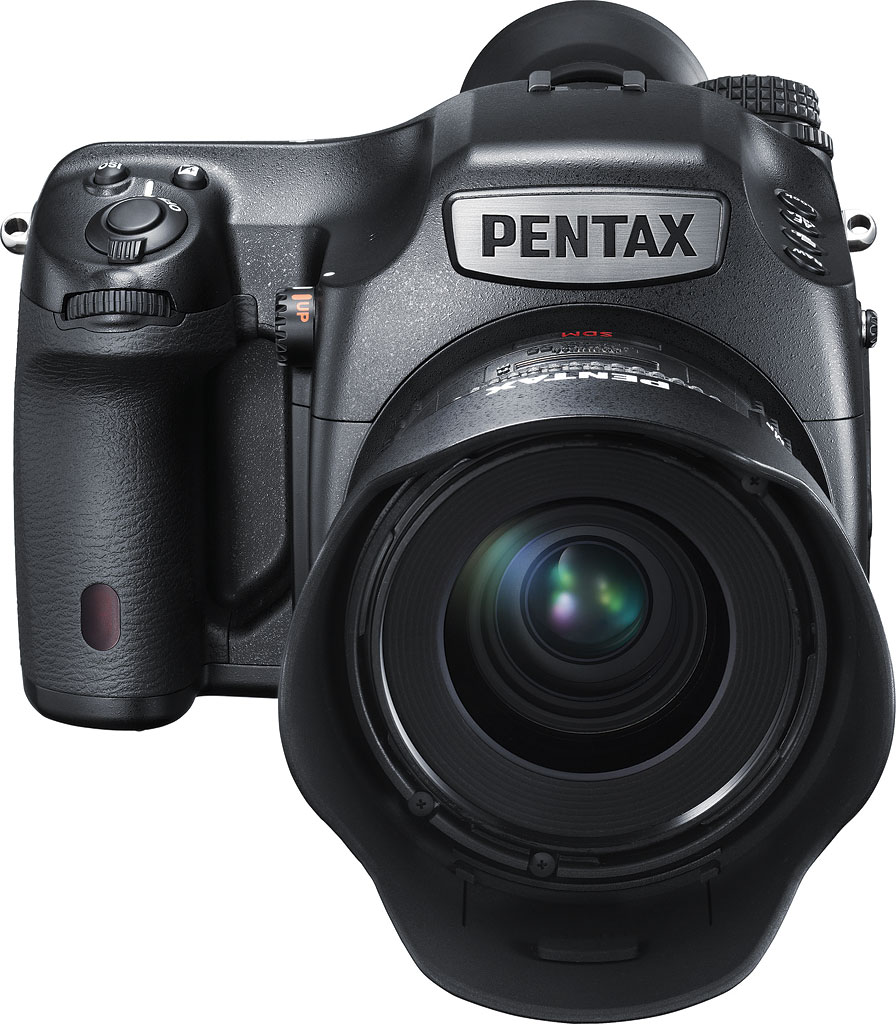
Walkaround. Seen from the front, the Pentax 645Z looks a whole lot like its predecessor, the 645D. In fact, the most notable difference is the brand-new, silver badge on the front of the viewfinder prism housing, which used to be black. Look a little beyond the surface, though, and this is clearly a new body. It's grown in depth by a tenth of an inch (4mm) and in weight by 2.5 ounces (71g), neither of which will be noticeable in the real world. Like its predecessor, this isn't a small camera -- but it's also not as large as you might think it from the photos.
In terms of height and width, the Pentax 645Z differs little from typical full-frame cameras like the Canon EOS 5D Mark III or Nikon D800. It's actually a little bit narrower and a fair bit shorter than professional cameras like the Canon EOS 1D X or Nikon D4S, in large part because it doesn't have a portrait grip.

Where the 645Z loses out in the comparison is in its depth and weight. The medium-format sensor that pays dividends in other areas needs a much larger mirror box, so as to provide room for the reflex mirror to swing aside before each exposure. That extra depth -- around 1 to 1.5 inches more than the 1D X and D4S -- is greatest at the lens mount, rather than the hand grip, giving the 645Z a chunky, blocky aesthetic. Weight is about a quarter more than the D4S (and similar to that of the 1D X), at 54.7 ounces (1,550g) loaded and ready to go.
But that's a small price to pay for a sensor that's about two-third larger in terms of surface area than a 35mm full-frame sensor. And on the plus side, it also gives the Pentax 645Z plenty of room for external controls that have been designed for use even with gloved hands. That's something you'll appreciate if you take advantage of its freezeproof design. It's also weather-resistant and dustproof, with 76 seals throughout, just like its predecessor.
And there's little question that this is a pro-grade body, either. It has a die-cast aluminum chassis beneath a magnesium-alloy exterior shell -- not a hint of polycarbonate in sight.

Seen from above, there are a few differences between the Pentax 645Z and the earlier 645D. There are three new User modes on the Mode dial, replacing the single mode of the earlier camera and making it easy to access multiple settings groups that you've configured ahead of time. The line of buttons down the left side of the body have also been tweaked, with the SD buttons replaced by AF Area and Lock buttons, and the order changed to move the Bracketing Mode button forwards. There's also a new stereo microphone whose two ports straddle the sides of the viewfinder prism housing, and a two-hole speaker a little further back on the right side of the housing.

Moving to the rear of the 645Z, you'll find the majority of the changes -- and they've largely been made to accommodate the new LCD monitor. It's both larger at 3.2 inches in diagonal, and adds a tilting mechanism for viewing over the head, at waist-level, or low to the ground.
The row of buttons that previously sat beneath the display are gone, with their four functions assumed by the arrow buttons of the four-way controller. The same buttons are also used to adjust the autofocus point location, courtesy of the same AF point button seen previously in the Pentax K-3. (This control also doubles as the card selection button in playback mode.)
The column of buttons that used to line the right of the LCD, meanwhile, have become a square cluster at the base of the camera's right rear. One of these, the Delete button, also gets a second purpose as a Movie Record button when the camera is in Movie mode. And since AF point selection is now achieved elsewhere, the dial to the right of the viewfinder that previously served this function now acts as a dedicated Still / Movie control dial.

Looking at the left of the left side of the 645Z's body, the standard-definition composite video output has been removed, and in its place is a new 3.5mm stereo microphone jack. The remaining ports under the same rubber flap are much the same, although the USB port is now a USB 3.0 SuperSpeed type, and the arrangement of the ports has changed. Note that there are also still two Secure Digital card slots under the door that sits above the connectivity compartment, and these are now UHS-I card compatible.

And finally, we move to the right side of the camera body, where there's but one change of note. The wired remote control terminal, previously found under a flap on the rear of the body, now sits in the handgrip. It's a logical move, given the lack of space elsewhere. If you're shooting with a remote, you're not going to need to hold the grip, after all.
And that about does it for the Pentax 645Z's physical changes. Let's take a look at what's inside the camera!
Optics
The Pentax 645Z does not normally ship with a lens, so we do not have any "kit lens" test results to share.
See below for our viewfinder accuracy test results.
Viewfinder Test Results
Accuracy
Very good accuracy from the optical viewfinder, excellent from the LCD monitor.


The Pentax 645Z's optical viewfinder tested at just over 98% coverage, which is very good, matching Pentax's specification. In Live View mode, the 645Z's LCD monitor showed 100% coverage, which is excellent.
The images above were taken from our standardized test shots. For a collection of more pictorial photos, see our Pentax 645Z Photo Gallery .
Exposure
Color
Saturation & Hue Accuracy
Vibrant colors with about average hue accuracy.
 |
||
|
ISO Sensitivity
|
||
| In the diagram above, the squares show the original color, and the circles show the color that the camera captured. More saturated colors are located toward the periphery of the graph. Hue changes as you travel around the center. Thus, hue-accurate, highly saturated colors appear as lines radiating from the center. Mouse over the links to compare results at different ISOs, and click a link for a larger image. | ||


Saturation. The Pentax 645Z produces images with fairly high mean saturation levels compared to most cameras at default settings, though that's no surprise from Pentax. The 645Z pushes dark red, dark blues, purples and greens a fair bit and some other colors slightly, but undersaturates aqua and cyan. Mean saturation is 119% (19% oversaturated) at the base ISO of 100, and remains above average across the ISO range, peaking at 122.8% at ISO 12,800. Most consumer digital cameras produce color that's more highly saturated (more intense) than found in the original subjects. This is simply because most people like their color a bit brighter than life.
Skin tones. The Pentax 645Z reproduces realistic Caucasian skin-tones with a nice, healthy-looking pink glow to them, though some darker skin tones have a small nudge towards orange. Still, better than average results here. Where oversaturation is most problematic is on Caucasian skin tones, as it's very easy for these "memory colors" to be seen as too bright, too pink, too yellow, etc.
Hue. The Pentax 645Z shifts orange toward yellow, yellow toward green, and cyan toward blue moderately, but most other hue shifts are quite minor. The 645Z's mean "delta-C" color error after correction for saturation is 5.59 for JPEGs at the base ISO of 100. That's about average these days, but color error gets worse at high ISOs, with a mean "delta-C" color error reaching as high is 9.01 at maximum ISO. Hue is "what color" the color is.


Sensor
Exposure and White Balance
Indoors, incandescent lighting
Very warm color with default Auto white balance, but only slightly warm with the Incandescent setting. Very good color balance with the Manual setting. Average exposure compensation required.


Indoors, under normal incandescent lighting, color balance is quite warm with the Auto white balance setting, using the default "Subtle Correction" option (there's also a "Strong Correction" option, however we did not test that). Results with the Incandescent setting are actually pretty good, just ever so slightly warm. The Manual setting produced very good results as well, perhaps just a touch cool. Note that the 645Z also has a Kelvin temperature setting as well as Color Temperature Enhancement (CTE) white balance mode which strongly intensified the orange/yellow cast in our indoor test shot on other Pentax bodies, however we didn't try those options with the Z. The Pentax 645Z required +0.3 EV exposure compensation here, about average for this test scene. (Our test lighting for this shot is a mixture of 60 and 100 watt household incandescent bulbs, a pretty yellow light source, but a very common one in typical home settings here in the U.S.)
Outdoors, daylight
Vibrant if slightly cool colors overall, but with high contrast. Above average exposure accuracy.
Outdoors, the Pentax 645Z performed well, with good though slightly cool color in the Far-field shot (at right). Skin tones are realistic in our "Sunlit" Portrait shot, with a healthy-looking push of pinks and reds which is preferable to too flat or yellow. Exposure accuracy is above average, as the camera required only +0.3 EV compensation for our "Sunlit" Portrait shot to keep facial tones reasonably bright. (+0.7 EV is more typical for this shot). Quite a few highlights are blown in the mannequin's white shirt and flowers, though, and there are some very deep shadows, thanks to high default contrast, however all but the deepest shadows are remarkably clean. The default exposure is slightly hot for the Far-field shot, and as a result there are some blown highlights, though shadow detail is excellent with low noise.
See full set of test images with explanations
See thumbnails of all test and gallery images
Resolution
Extremely high resolution, >4,000 lines of strong detail.



Our laboratory resolution chart reveals sharp, distinct line patterns all the way up to the 4,000 lines per picture height limit of our chart from both in-camera JPEG and ACR converted RAW files, though the in-camera JPEG shows some fairly strong aliasing in the form of luminance moiré starting at about 3,500 lines. The ACR conversion shows some color moiré which is practically nonexistent in the camera JPEG, however the conversion shows less luminance moiré, likely because lighter sharpening was applied. Bottom line, though, these are the highest resolution results we've recorded to date.
Use these numbers to compare with other cameras of similar resolution, or use them to see just what higher resolution can mean in terms of potential detail.
See full set of test images with explanations
See thumbnails of all test and gallery images
Sharpness & Detail
Slightly aggressive default sharpening with moderate edge-enhancement artifacts around high-contrast subjects. Only mild noise suppression visible in the shadows at base ISO.


Sharpness. The Pentax 645Z captures very sharp image with phenomenal detail, but relatively aggressive default sharpening is applied to in-camera JPEGs. For example, you can see fairly obvious sharpening "halos" along the lines and text in the crop above left. You can always turn down sharpening, though (the 645Z defaults to "Hard"), if you feel it's a bit high, and sometimes what looks like oversharpening on screen looks about right when printed. Edge enhancement creates the illusion of sharpness by enhancing colors and tones right at the edge of a rapid transition in color or tone.
Detail. The crop above right shows the fairly light anti-noise processing being applied at base ISO, mostly chroma noise reduction. As you can see, many strands of hair are distinct instead of being blurred by noise or heavy-handed noise reduction. Excellent results here, though you can see that some of the strands exhibit the "jaggies", the result of the lack of an anti-aliasing or optical low-pass filter. Noise-suppression systems in digital cameras tend to flatten-out detail in areas of subtle contrast. The effects can often be seen in shots of human hair, where the individual strands are lost and an almost "watercolor" look appears.

Aliasing artifacts. As mentioned previously, the Pentax 645Z captures phenomenally detailed and sharp images thanks to its amazing resolution and lack of an optical low pass filter, but that means it's also more susceptible to moiré, "jaggies" and other aliasing artifacts than cameras with an appropriate strength low pass filter.
As you can see in our Still Life shots, both color and luminance moiré patterns can be seen in the Samuel Smith bottle label (at right), and you can see aliasing artifacts in some of our other shots as well.
With the increasing trend of using either a very weak or no optical low pass filter, quite a few cameras produce similar artifacts these days when used with a sharp lens, and the 645Z's JPEG processing engine actually does a pretty good job at suppressing aliasing-related false colors in our Resolution target. But like anti-aliasing processing from other cameras it's not fool proof, and luminance moiré is much more difficult to suppress. That's something to be aware of especially if you shoot a lot of man-made subjects with repeating patterns, such as buildings, fabrics, etc. Techniques than can be used to reduce aliasing include shooting at a smaller aperture so that lens diffraction acts as an anti-alias filter, defocusing slightly, shooting at higher ISOs, and post-processing particularly with RAW files.
RAW vs In-Camera JPEGs
As noted above, the Pentax 645Z produces very sharp in-camera JPEGs with phenomenal detail. As is almost always the case, though, additional detail can be obtained from carefully processing RAW files, with fewer sharpening artifacts to boot. Take a look below to see what we mean:
| Base ISO (100) | |
 |
 |
 |
 |
 |
 |
|
Camera JPEG, defaults
|
RAW via Adobe Camera Raw
|
In the table above, we compare an in-camera, best quality JPEG taken at base ISO using default noise reduction and sharpening (on the left) to a matching RAW file converted with Adobe Camera Raw 8.6 using default noise reduction with some moderate and tight unsharp masking applied in Photoshop (250%, radius of 0.3 pixels, and a threshold of 0).
As you can see, the RAW conversion did indeed extract additional fine detail especially noticeable in the mosaic crop, despite having lower contrast and sharpening applied. You can also see that ACR more accurately rendered the color in our pink fabric, compared to the more magenta tint generated by the camera. Interestingly, there's better contrast in the red-leaf fabric as well. And because the 645Z's files at low ISOs are so clean, noise isn't really anything to be concerned with.
Still, the Pentax 645Z produces amazing JPEGs right out of the camera, though as is usually the case, you can produce even more detail when working with RAW files and a good converter.
ISO & Noise Performance
Excellent high ISO performance up to ISO 6400!
|
Default Noise Reduction
|
||
 |
 |
 |
| ISO 100 | ISO 200 | ISO 400 |
 |
 |
 |
| ISO 800 | ISO 1600 | ISO 3200 |
 |
 |
 |
| ISO 6400 | ISO 12,800 | ISO 25,600 |
 |
 |
 |
| ISO 51,200 | ISO 102,400 | ISO 204,800 |
The Pentax 645Z's images are incredibly detailed and clean at ISOs 100 through 400. ISO 800 shows a very slight decline in detail, but it's still amazingly good. Detail very gradually declines between ISO 1600 and 6400, showing slightly higher noise as ISO increases, but ISO 6400 is still excellent with a fine-grained luma noise, and very low chroma noise. ISO 12,800 is noticeably softer with coarser noise in the shadows and a hint of chroma blotching, but results are still quite good. Image quality starts to drop off quickly at higher ISOs, though. ISO 25,600 is soft and speckled, with obvious chroma blotching, and this rapidly becomes worse at ISO 51,200 and above, to the point where ISO 204,800 is so noisy with strong speckling and color shifts that it's not usable. In fact, offering ISOs above ISO 51,200 is just an exercise in specmanship.
Overall, though, excellent high ISO performance, and much better than its predecessor. We're of course pixel-peeping to an extraordinary extent here, since 1:1 images on an LCD screen have little to do with how those same images will appear when printed. See the Print Quality section below for our evaluation of maximum print sizes at each ISO setting.
A note about focus for this shot: We shoot this image at f/4. To insure that the hair detail we use for making critical judgements about camera noise processing and detail rendering is in sharp focus at the relatively wide aperture we're shooting at, the focus target at the center of the scene is on a movable stand. This lets us compensate for front- or back-focus by different camera bodies, even those that lack micro-focus adjustments. This does mean, though, that the focus target itself may appear soft or slightly out of focus for bodies that front- or back-focused with the reference lens. We know this; if you click to view the full-size image for one of these shots and notice that the focus target is fuzzy, you don't need to email and tell us. :-) The focus target position will have been adjusted to insure that the rest of the scene is focused properly.
Extremes: Sunlit, dynamic range and low light tests
High default contrast limits dynamic range in JPEGs. Excellent low-light performance, able to capture and autofocus at the lowest light levels we test at.


Sunlight. The Pentax 645Z struggled a bit with the deliberately harsh lighting of this test when shooting JPEGs. Contrast is quite high at its default setting, limiting dynamic range. We felt the +0.3 EV exposure is the best compromise here. Although skin tones around the eyes are a bit dark, we prefer it to the +0.7 EV exposure overall, because the latter has too many clipped highlights. There are very dark shadows as well, however they are quite clean. Bottom line though, the Pentax 645Z's high default contrast in JPEGs means it struggled with the wide dynamic range of this very harshly lit shot. A conversion of the matching RAW file however revealed excellent dynamic range, with only specular highlights blown and very good shadow detail.
Because digital cameras are more like slide film than negative film (in that they tend to have a more limited tonal range), we test them in the harshest situations to see how they handle scenes with bright highlights and dark shadows, as well as what kind of sensitivity they have in low light. The shot above is designed to mimic the very harsh, contrasty effect of direct noonday sunlight, a very tough challenge for most digital cameras. (You can read details of this test here.)
D-Range Settings
The Pentax 645Z offers four Shadow Correction levels (Auto, Low, Medium and High, plus Off) as well as two Highlight Correction levels (Auto and On, plus Off). As the names implies, Shadow Correction works to raise shadow levels while attempting to keep highlights and midtones as they are, and inversely, Highlight Correction attempts to reduce highlights without darkening shadows and midtones. Both can be used simultaneously. See the images below to see their effect on our high-contrast "Sunlit" Portrait test shot.
|
Outdoor Portrait D-Range Examples, 0 EV
|
|||
 |
D-Range Off |
||
| Shadow Low |
|||
| Shadow Medium |
|||
| Shadow High |
|||
| Shadow Auto |
|||
 |
Highlight On |
||
| Highlight Auto |
|||
Mouse over the links to see how the various settings for D-Range affects our "Sunlit" Portrait shot, and click on a link to get to the full-res image. (The effect can be a little subtle in shots like those above, so we decided to use a mouse-over to better show how each setting compares to Off.)
Shadow Correction. Above, we see a gradual lightening of shadows and midtones as the Shadow Correction setting is increased, with only a small impact to highlights except at the High setting where a significant number of highlights are blown. If you look closely at the shadow detail, you will notice a slight increase in noise as the setting is turned higher, but that's to be expected and noise levels are still very low. An ISO of 100 was used for all four settings of Shadow Correction, with no apparent limitations.
Highlight Correction. Highlight Correction works as expected when highlights are blown, toning them down to protect them while keeping shadows and midtones roughly the same. ISO 200 was used here, so noise can be more visible.
We looked into how Highlight Correction (HC) interacts with ISO, and here's what we found: If HC is set to Auto and sensitivity is set to Auto or ISO 200 or higher, and the camera decides that the function is needed, HC will operate. If it does so, ISO is bumped to at least 200 if set to Auto. If ISO is set to 100 manually, HC will never operate (or at least, we couldn't get it to do so, and presume it considers respecting manually-set sensitivity a higher priority than saving highlights) If HC is set to On, ISO 100 can still be dialed in manually, but the HC On option will silently disappear from the menu when you do so, and the On setting you made will change to Off. Once you dial the ISO back up to 200 or higher, your earlier setting is remembered and HC turns back on silently.
| Face Detection | |
 |
 |
| Aperture Priority, 0 EV, f/8 Face Detection Off |
Aperture Priority, 0 EV, f/8 Face Detection On |
Face Detection
Like most cameras these days, the Pentax 645Z has the ability to detect faces in Live View mode and adjust exposure and focus accordingly (no word on the number of faces it can detect in a scene, though). As you can see from the examples above, face detection dramatically improved exposure in Aperture Priority mode at f/8, by automatically reducing the shutter speed from 1/30s to 1/25s to brighten the face (in fact, a bit too bright).
HDR Capture
Like the K-3, the Pentax 645Z features an in-camera High Dynamic Range (HDR) capture mode where the camera takes three images (underexposed, normal, and overexposed) in quick succession and combines them into one image. If performed properly, this method should result in much higher dynamic range, without the additional noise penalty that comes with boosting sensitivity or lightening shadows. (In fact, it can reduce shadow noise by combining shadows from the overexposed shot.)
There are four HDR settings available: Auto, and HDR 1/2/3 providing three blend settings, and each setting has three possible exposure ranges (±1 EV, ±2 EV and ±3 EV with ±2 EV default). There's also an optional Auto Align feature for use when shooting without a tripod, which is enabled by default on the 645Z.
|
Far-field HDR Examples
|
|||
 |
|||
Mouse-over the links above to compare thumbnails, and click on them to access full-resolution versions.
The Auto settings worked reasonably well on our Far-field test shot, reducing highlights and bringing out shadow detail. HDR1 and 2 modes produced relatively realistic images though with an obvious HDR look, but HDR3 resulted in an unnatural, very HDR-ish image with strong halos. As with most HDR systems there is a slight focal-length crop with Auto Align active, and watch out for ghosting that can occur when subjects move between exposures such as the waving flag in some of the above shots.
Like the Pentax K-3, HDR is still supported when shooting the 645Z in RAW mode (in many cameras, the two modes are mutually exclusive), resulting in a RAW file is about three times as large as a standard shot. (The cameras are just bundling the individual captures into one file, to be processed later by Pentax's Digital Camera Utility software which can apparently blend or extract the separate RAW files.)
Dynamic Range Analysis (RAW mode)
While we once performed our own dynamic range measurements based on in-camera JPEGs as well as converted RAW images (when the camera was supported by Adobe Camera Raw), we've switched to using DxO Labs' results from their DxOMark website. As technology advanced, the dynamic range of modern high-end cameras in some cases exceeded the range of the Stouffer T4110 density scale that we used for our own measurements. DxO's approach based on RAW data before demosaicing is also more revealing, because it measures the fundamental dynamic range of the sensor, irrespective of whatever processing is applied to JPEGs, or to RAW data by off-the-shelf conversion software.
In the following, we use DxO's "Print" dynamic range results, which are scaled based on camera resolution. As the name suggests, this scaling corresponds to the situation in which you print at a given size, regardless of how many megapixels the camera might have. (In other words, if you've decided to make a 13x19 inch print, that's the size you're printing, whether the camera's resolution is 16 or 300 megapixels.) For the technically-minded, you can find a discussion of the reasoning behind this here on the DxOMark website. Also note that DxO Labs uses a signal-to-noise (SNR) threshold of 1 when defining the lower boundary of acceptable luminance noise in their dynamic range measurements, which corresponds to the "Low Quality" threshold of the Imatest software we used to use for this measurement.

Here, we compare the Pentax 645Z (in red) to its predecessor, the 40-megapixel 645D (in yellow), and also to the 50-megapixel Hasselblad X1D-50c (in orange) which uses a similar if not identical sensor. You can always compare to other cameras on DxOMark.com.
As you can see from the above graph (click for a larger image), the Pentax 645Z offers markedly better dynamic range across the board than its CCD-based predecessor. Peak dynamic range is over two stops higher at 14.7 EV at base ISO, versus 12.6 EV for the 645D, and the 645Z widens its lead slightly as ISO rises.
The Pentax 645Z and Hasselblad X1D-50c are pretty much neck-and-neck for ISOs in common between them, with the X1D-50c exhibiting just a slight advantage because of its slightly lower ISO sensitivity (peak dynamic range is 14.8 EV, which is a negligible difference).
Bottom line: Excellent dynamic range results from the Pentax 645Z's RAW files. Click here to visit the DxOMark review for the Pentax 645Z for more of their test results and additional comparisons.
| 1 fc 11 lux |
1/16 fc 0.67 lux |
1/16 fc No NR |
|
|---|---|---|---|
| ISO 100 |
 2s, f2.8 |
 30s, f2.8 |
 30s, f2.8 |
| ISO 3200 |
 1/15s, f2.8 |
 1s, f2.8 |
 1s, f2.8 |
| ISO 204800 |
 1/1000s, f2.8 |
 1/60s, f2.8 |
 1/60s, f2.8 |
Low Light. The Pentax 645Z performed well in our low light tests, able to capture bright images down to the lowest light level we test at, even at the lowest ISO setting. The darkest level equates to about 1/16 the brightness of average city street lighting at night, so the Pentax 645Z should be able to take well-exposed photos in almost any environment in which you can see well enough to walk around in.
Noise is practically nonexistent at ISO 100, and very well-controlled at ISO 3200, even at the lowest light levels. As expected, though, the highest ISO setting of 204,800 is quite noisy.
We didn't notice any significant issues with hot pixels or heat blooming, though horizontal pattern noise is visible at the highest ISO.
Automatic color balance is quite neutral on low light, just a little cool.
The camera's phase-detect autofocus system was able to focus on our subject down to below the 1/16 foot-candle light level unassisted with an f/2.8 lens which is excellent, and down to about 1/8 foot-candle in Live View mode which is very good. Note that Pentax 645Z does not have a built-in focus-assist light, however a mounted flash may provide that functionality.
How bright is this? The one foot-candle light level that this test begins at roughly corresponds to the brightness of typical city street-lighting at night. Cameras performing well at that level should be able to snap good-looking photos of street-lit scenes.
NOTE: This low light test is conducted with a stationary subject, and the camera mounted on a sturdy tripod. Most digital cameras will fail miserably when faced with a moving subject in dim lighting. (For example, a child's ballet recital or a holiday pageant in a gymnasium.) Digital SLRs like the Pentax 645D do much better than point & shoots, but you still shouldn't expect a quick autofocus lock with moving subjects.
Output Quality
Print Quality: Stunning print quality, able to print above 30 x 40 inches to ISO 400; ISO 1600 capable of a very nice 20 x 30; ISO 12,800 prints a good 8 x 10!
 ISO 100 through 400 prints look terrific at 30 x 40 inches and higher* with excellent detail and vibrant colors. Print size at these three lower ISOs is only constrained by the 645Z's massive resolution, the highest we've tested thus far.
ISO 800 yields a stunning 24 x 36 inch print: super crisp with excellent colors and virtually no apparent noise. 30 x 40's are fine here for less critical applications as well.
ISO 1600 produces 20 x 30 inch prints that have amazing detail in the mosaic tile area of our test target. The only hint that you're going up in ISO is a slight loss of contrast detail in the tricky red fabric swatch of our target, but this is typical of virtually all cameras (except for a few higher-end Nikons, which tend to handle that area better than others as ISO rises).
ISO 3200 prints a very good 16 x 20 inch print, and this is still quite an impressive feat at this ISO, as very few cameras we've tested can make this claim (the 645D didn't even go to ISO 3200). There is minor noise in the flatter areas of our target, like in the shadows behind the bottles, and most all detail is gone from our red fabric swatch, but otherwise a solid print.
ISO 6400 is where the 645Z touches back down to earth, allowing for a good 11 x 14 inch print. There are only minor issues similar to the ones found on the 16 x 20 at ISO 3200, but yet again still a nice size for this ISO. And the 8 x 10 really pops here and is excellent.
ISO 12,800 yields a very nice 8 x 10 inch print. Detail is now gone from our target red swatch but this is quite common at this ISO and higher. The print retains full color saturation and crisp detail in all other areas and, in fact, is one of the best 8 x 10's we've seen at this ISO to date.
ISO 25,600 yields an 8 x 10 that almost makes our "good" standard, and that would have put it into rare company indeed, as only three other cameras have been awarded with "good" 8 x 10's from our lab (the Nikon D4S and D800/E). The 5 x 7 inch print here is excellent though, with great color and detail for such a high ISO.
ISO 51,200 produces a good 4 x 6 inch print. Only a few cameras we've tested have gone higher than this.
ISO 102,400/204,800 do not yield good prints and these settings are best avoided for any applications.
As we've said on rare occasions with only a few other cameras that have come through our lab, your printer will love you for having a Pentax 645Z. Stunning images at ISO 100-400 limited only by resolution, a very nice 20 x 30 inch print at ISO 1600 (the highest ISO the 645D will allow) and even a really good 8 x 10 inch print at ISO 12,800. This is what you'd call "getting the job done" in the print quality department, and we weren't at all surprised by these results given how much we love the 645D. A solid upgrade, and well-done Pentax.
*[Note: we no longer provide print quality ratings for sizes larger than 30 x 40 inches, as we felt this wasn't particularly meaningful. At low ISOs, print sizes from high-quality cameras are pretty much limited only by their resolution, vs noise and noise-reduction processing. Going forward, we'll simply note "30x40 or larger" for cameras that achieve that level. As we see it, the real challenge comes at higher ISOs, where noise and noise-reduction processing become bigger factors, and maximum sizes would be more representative of sizes a majority of users would actually print at.]
The images above were taken from our standardized test shots. For a collection of more pictorial photos, see our Pentax 645Z Photo Gallery .
Not sure which camera to buy? Let your eyes be the ultimate judge! Visit our Comparometer(tm) to compare images from the Pentax 645Z with those from other cameras you may be considering. The proof is in the pictures, so let your own eyes decide which you like best!
Performance
Timing and Performance
Improved AF speeds, cycle times and burst performance compared to its predecessor.
| Startup/Play to Record | ||
|---|---|---|
|
Power on |
~1.5 seconds
|
Time it takes for camera to turn on and take a shot. |
|
Play to Record, |
~0.7 second
|
Time until first shot is captured. |
Startup to first shot was a bit sluggish for a DSLR, and noticeably slower than the 645D's ~0.7s startup time. Switching from Play to Record mode and taking a shot wasn't bad, but also significantly slower than the 645D (which tested at ~0.3s).
| Shutter Response (Lag Time) | ||
|---|---|---|
|
Full Autofocus |
0.158 second
|
Time from fully pressing shutter button to image capture. (All AF timing measurements taken with a Pentax 55mm f/2.8 D FA SDM lens.) |
|
Full Autofocus |
0.170 second
|
Time from fully pressing shutter button to image capture. |
|
Manual focus |
0.117 second
|
For most cameras, shutter lag is less in manual focus than autofocus, but usually not as fast as when the camera is "pre-focused." |
|
Pre-focused |
0.112 second
|
Time to capture, after half-pressing and holding shutter button. |
| Live View | ||
|
Full Autofocus |
1.174 seconds
|
Time from fully pressing shutter button to image capture. |
|
Pre-focused |
0.385 second
|
Time to capture, after half-pressing and holding shutter button. |
The shutter lag numbers above measure time from shutter button press to image capture, with the lens already set to the correct focal distance. This largely removes the issue of differences in lens focusing speed, and measures how fast the camera can measure and act on focus information. In this metric, the Pentax 645Z was quite fast. The 645Z required only 0.158 second for full AF and capture when using Spot (single center point) AF mode (our default full AF lag test). The lag increased only slightly to 0.170 second when using 27-point Auto-area AF mode. Manual focus lag time was faster as expected, at 0.117 second. When pre-focused, shutter lag was just slightly faster than manual focus at 0.112 second, which is slower than most DSLRs but still pretty responsive.
Unlike the 645D, the 645Z supports Live View mode, but as is usually the case, full autofocus lag was quite slow at almost 1.2 seconds with our 55mm f/2.8 SDM lens. This performance is likely to vary a lot, though, depending on the lens used. Pre-focused shutter lag wasn't too bad though, at 0.385 second.
Overall, the Pentax 645Z's autofocus is very fast, with slightly improved lag times compared to the 645D.
| Cycle Time (shot-to-shot) | ||
|---|---|---|
|
Single Shot mode |
0.35 second
|
Time per shot, averaged over 20 shots with no signs of slowing. |
|
Single Shot mode |
0.33 second
|
Time per shot, averaged over buffer depth of 10 shots. |
|
Single Shot mode |
0.33 second
|
Time per shot, averaged over buffer depth of 10 shots. |
|
Early shutter |
Yes
|
Some cameras refuse to snap another shot if you release and press the shutter too quickly in Single Shot mode, making "No" the preferred answer. |
| Continuous H mode |
0.33 second
(3.06 fps); 12 frames total; 14 seconds to clear* |
Time per shot, averaged over the buffer length of 12 shots, then slows to an average of 0.69 seconds (1.45 fps) for subsequent shots while buffer is full. |
|
Continuous H mode |
0.33 second
(3.06 fps); 10 frames total; 22 seconds to clear* |
Time per shot, averaged over the buffer length of 10 shots, then slows to an average of 1.29 seconds (0.77 fps) for subsequent shots while buffer is full. |
|
Continuous H mode |
0.33 second
(3.06 fps); 10 frames total; 30 seconds to clear* |
Time per shot, averaged over the buffer length of 10 shots, then slows to an average of 2.04 seconds (0.49 fps) for subsequent shots while buffer is full. |
|
Flash recycling |
N/A
|
Flash at maximum output. |
| * Note: Buffer clearing times measured with a SanDisk Extreme Pro 95MB/s UHS-I SDHC card. Slower cards will produce correspondingly slower clearing times. Slow cards may also limit length of bursts in continuous mode. ISO sensitivity and noise reduction settings can also affect cycle times and burst mode performance. |
||
Shot-to-shot cycle times were excellent at about a third of a second no matter the file type; quite an improvement over the 645D's 1.1 seconds.
Maximum continuous mode speed was also noticeably improved, at just over 3 frames per second for best quality JPEGs or RAW files, which is almost triple the 645D's 1.1 fps burst speed.
Buffer depths are however lower, ranging from 10 to 12 frames depending on the file type (the 645D managed 15 to 19 frames), but not a surprise given the faster burst rate and larger files. Note that you should be able to do better with typical real-world shots when shooting JPEGs, as our target was designed to be difficult to compress. Pentax claims up to about 30 JPEGs.
Buffer clearing was noticeably quicker than the 645D (likely due to to the 645Z's support for UHS-I cards), however it can still be quite lengthy at up to 30 seconds after a max-length burst of RAW+JPEG frames.
Bottom line, the Pentax 645Z is generally fast for its class. Compared to its predecessor, it's slightly faster at autofocus, much faster at cycle times and bursts speeds, and faster at buffer clearing as well. However Startup time and mode switching tested slower, and buffer depths weren't as deep. Still, the improvements over its predecessor are significant.
Battery
Battery Life
Fairly good battery life.
| Operating Mode | Number of Shots |
|---|---|
|
Still Capture,
(Optical Viewfinder, CIPA standard) |
650
|
The Pentax 645Z uses a custom D-LI90 rechargeable lithium-ion battery for power (the same type as the 645D), and ships with a charger. Battery life appears to be decent for such a large, very high-resolution sensor, but is lower than the 645D's 800 shot rating. Also keep in mind the Pentax 645Z does not have a built-in flash, which is normally enabled for 50% of shots when determining battery life to the CIPA standard. Pentax does not seem to publish battery life for Live View mode, but it will most certainly be significantly lower.
The table above shows the number of shots the camera is capable of (on either a fresh set of disposable batteries or a fully-charged rechargeable battery as appropriate), based on CIPA battery-life and/or manufacturer standard test conditions.
(Interested readers can find an English translation of the CIPA DC-002 standards document here. (180K PDF document))
Image Quality
Below are crops comparing the Pentax 645Z with the Pentax 645D, Nikon D810 and Sony A7R. Given the massive 51.4MP, it's difficult to find competing cameras that match this resolution, however we've matched the new 645Z up against it's predecessor -- naturally -- and also the two latest, highest-resolution full-frame cameras currently available -- the Nikon D810 and Sony A7R, which have 36.3 and 36.4 megapixel resolutions, respectively. We've also decided to change up our typical IQ Comparison layout to offer larger crops -- the 250 x 250-pixel square crops normally seen in our IQ tables just don't show much with a 51.4MP image at 100%.
NOTE: These images are best quality JPEGs straight out of the camera, at default settings including noise reduction and using the camera's actual base ISO (not extended ISO settings). All cameras in this comparison were shot with our very sharp reference lenses. Clicking any crop will take you to a carrier page where you can click once again to access the full resolution image as delivered straight from the camera. And remember, you can always go to our world-renowned Comparometer to compare the Pentax 645Z to any camera we've ever tested.
Pentax 645Z versus Pentax 645D at Base ISO
 |
Pentax 645Z at ISO 100 |
 |
Pentax 645D at ISO 200 |
 |
Pentax 645Z at ISO 100 |
 |
Pentax 645D at ISO 200 |
 |
Pentax 645Z at ISO 100 |
 |
Pentax 645D at ISO 200 |
The 51.4MP 645Z brings a new standard for pure image resolution and detail. Compared to the 40MP 645D, which in its own right is astounding at base ISO, the new 645Z outdoes it with sheer fine detail performance. As expected, both display virtually zero noise at this low ISO sensitivity. |
Pentax 645Z versus Nikon D810 at Base ISO
|
Pentax 645Z at ISO 100 |
 |
Nikon D810 at ISO 64 |
|
Pentax 645Z at ISO 100 |
 |
Nikon D810 at ISO 64 |
|
Pentax 645Z at ISO 100 |
 |
Nikon D810 at ISO 64 |
Obviously, there's a notable difference in resolution between 51 and 36 megapixels. Barring that however, the Nikon D810 holds its own compared to the 645Z in fine detail and noise. Interestingly, the base ISO of the D810 is actually 64 thanks to the new sensor and processor in this camera. The primary difference in these crops, from an IQ standpoint, is the slight appearance of moiré in the fine red fabric pattern that's not visible in the 645Z image. |
Pentax 645Z versus Sony A7R at Base ISO
|
Pentax 645Z at ISO 100 |
 |
Sony A7R at ISO 100 |
|
Pentax 645Z at ISO 100 |
 |
Sony A7R at ISO 100 |
|
Pentax 645Z at ISO 100 |
 |
Sony A7R at ISO 100 |
This comparison is very similar to the previous one with the D810. The A7R uses a similar 36MP full-frame sensor, and at base ISO, it shows very clean, crisp fine detail compared to the 645Z, despite the stark resolution disparity. We see again a slight hint of moiré artifacts with the red fabric that's not visible in the 645Z image. |
Most digital SLRs and CSCs will produce an excellent ISO 100 shot, so we like to push them and see what they can do compared to other cameras at ISO 1,600, and 3,200, and 6,400. Recent advances in sensor technology have made ISO 1,600 look a lot more like ISO 100, but there are still cameras whose quality starts to fall apart at this setting. We also choose 1,600 as a baseline of comparison because we like to be able to shoot at least at this level when indoors and at night.
Pentax 645Z versus Pentax 645D at ISO 1600
 |
Pentax 645Z at ISO 1600 |
 |
Pentax 645D at ISO 1600 |
 |
Pentax 645Z at ISO 1600 |
 |
Pentax 645D at ISO 1600 |
 |
Pentax 645Z at ISO 1600 |
 |
Pentax 645D at ISO 1600 |
Thanks to the new CMOS sensor, as opposed to the older CCD chip in the 645D, the noise performance at higher ISOs (and the simple ability to go to higher ISOs in the first place) is improved in the 645Z. Noise in the shadows is much less visible in the new model, yet fine detail is still excellent. Interestingly, we found that the 645D shows more fine detail in the red fabric pattern (along with some moiré still), whereas the 645Z's handling of the red fabric is a bit "smeary" and less detailed. |
Pentax 645Z versus Nikon D810 at ISO 1600
|
Pentax 645Z at ISO 1600 |
 |
Nikon D810 at ISO 1600 |
|
Pentax 645Z at ISO 1600 |
 |
Nikon D810 at ISO 1600 |
|
Pentax 645Z at ISO 1600 |
 |
Nikon D810 at ISO 1600 |
At ISO 1600, both the Pentax 645Z and Nikon D810 display similar low levels of noise in the shadow areas, and the fine detail remains very high from both cameras. Apart from the resolution, both cameras are quite similar in terms of noise and fine detail at this ISO. As with the 645D comparison above, the D810 displays a slightly better rendering of the red fabric pattern at this ISO level. |
Pentax 645Z versus Sony A7R at ISO 1600
|
Pentax 645Z at ISO 1600 |
 |
Sony A7R at ISO 1600 |
|
Pentax 645Z at ISO 1600 |
 |
Sony A7R at ISO 1600 |
|
Pentax 645Z at ISO 1600 |
 |
Sony A7R at ISO 1600 |
Compared to the other two ISO 1600 comparisons, it's easier to notice the noise reduction processing in the Sony images. It does a great job of reducing grain while still leaving lots of fine detail. Overall, both cameras still display lots of fine detail at this ISO level, but similarl to the previous comparison at this ISO, the 645Z struggles with the red fabric compared to the A7R. |
Today's ISO 3,200 is yesterday's ISO 1,600, so below are the same crops at ISO 3,200.
Pentax 645Z versus Pentax 645D at ISO 3200

Pentax 645Z versus Nikon D810 at ISO 3200
 |
Pentax 645Z at ISO 3200 |
 |
Nikon D810 at ISO 3200 |
 |
Pentax 645Z at ISO 3200 |
 |
Nikon D810 at ISO 3200 |
 |
Pentax 645Z at ISO 3200 |
 |
Nikon D810 at ISO 3200 |
The higher ISO capabilities of the 645Z undoubtedly trumps that of its predecessor, which couldn't shoot past ISO 1600. Compared to the Nikon D810, however, the full-frame DSLR displays less shadow noise than the Pentax. On the other hand, the amount of fine detail present in the 645Z photo at ISO 3200 is very impressive nonetheless -- and in some areas, particularly the fine detail in the various fabric patterns such as the orange fabric behind the bottle or the pink fabric. And the mosaic tile area is incredible for this ISO. |
Pentax 645Z versus Sony A7R at ISO 3200
|
Pentax 645Z at ISO 3200 |
 |
Sony A7R at ISO 3200 |
|
Pentax 645Z at ISO 3200 |
 |
Sony A7R at ISO 3200 |
|
Pentax 645Z at ISO 3200 |
 |
Sony A7R at ISO 3200 |
The noise reduction is a little more apparent on the A7R image at this ISO. You can see it show minor artifacts on finer-detailed areas such as the mosaic and pink fabric. It also makes the red leaf pattern less distinguishable, however, the 645Z still struggles with this area more. Fine detail from the 645Z is impressive, with the mosaic tile looking more natural at this ISO compared to the Sony. |
Detail: Pentax 645Z versus Pentax 645D, Nikon D810 and Sony A7R.
Base ISO |
ISO 12800 |
ISO 25600 |
|
Pentax
645Z Base ISO: 100 |
 |
 |
 |
Nikon
D810 Base ISO: 64 |
 |
 |
 |
Sony
A7R Base ISO: 100 |
 |
 |
 |
Pentax
645D |
 |
 |
|
| Detail comparison. High-contrast detail is also important, pushing the camera in different ways, so we like to look at it, too. Overall all four cameras have outstanding performance on high contrast detail at base ISO, which is far from surprising. At ISO 3200 and 6400 -- the normal high ISOs we use for these detail crops -- on the 645Z, the D810 and the A7R all look very good with crisp, sharp detail and very little noise. So good, in fact, that we felt the need to show even higher ISOs for this crop just to demonstrate a larger difference between cameras for high contrast detail. At ISO 12,800, we start to see some differences between the 645Z and the two full-frame cameras. The contrast fades slightly due to noise on the 645Z image and the crispness of the detail is lessened as well. Meanwhile, the two full-frame cameras look relatively the same as base ISO in terms of contrast. There's still some reduction in fine detail from both the Nikon and Sony at this ISO level though, and the Sony in particular starts to show some artifacts from noise reduction processing. Bumping up to ISO 25,600, more noise is apparent in the 645Z image, despite these shots using the default level of in-camera NR processing, the Pentax image is devoid of any NR artifacting, unlike the Sony image at this ISO. The Nikon shows less artifacts from NR, but there's a noticeable drop in fine detail overall and even the appearance of faint chroma noise. These are very high ISOs for typical shooting however, and the detail present is really incredible for all of these. |
|||
Pentax 645Z Print Quality
ISO 100/200/400 prints look terrific at 30 x 40 inches and higher* with excellent detail and vibrant colors. Print sizes at these three lower ISO's are only constrained by the 645Z's massive resolution -- the highest we've tested thus far.
ISO 800 yields a stunning 24 x 36 inch print: super crisp with excellent colors and virtually no apparent noise. 30 x 40's are fine here for less critical applications as well.
ISO 1,600 produces 20 x 30 inch prints that have amazing detail in the mosaic tile area of our test target. The only hint that you're going up in ISO is a slight loss of contrast detail in the tricky red fabric swatch of our target, but this is typical of virtually all cameras (except for a few higher-end Nikons, which tend to handle that area better than the others as ISO rises).
ISO 3,200 prints a very good 16 x 20 inch print, and this is still quite an impressive feat at this ISO, and very few cameras we've tested can make this claim (the 645D didn't even go to ISO 3200). There is minor noise in flatter areas of our target, like in the shadows behind the bottles, and most all detail is gone from our red fabric swatch, but otherwise a solid print.
ISO 6,400 is where the 645Z touches back down to earth, allowing for a good 11 x 14 inch print. There are only minor issues similar to the ones found on the 16 x 20 at ISO 3200, but yet again still a nice size for this ISO. And the 8 x 10 really pops here and is excellent.
ISO 12,800 yields a very nice 8 x 10 inch print. Detail is now gone from our target red swatch but this is quite common at this ISO and higher. The print retains full color saturation and crisp detail in all other areas and, in fact, is one of the best 8 x 10's we've seen at this ISO to date.
ISO 25,600 yields an 8 x 10 that almost makes our "good" standard, and that would have put it into rare company indeed, as only two other cameras have been awarded with "good" 8 x 10's from our lab (the Nikon D4S and D800E). The 5 x 7 inch print here is excellent though, with great color and detail for such a high ISO.
ISO 51,200 produces a good 4 x 6 inch print. Only a few cameras we've tested have gone higher than this.
ISO 102,400/204,800 do not yield good prints and these settings are best avoided for any applications.
As we've said on rare occasions with only a few other cameras that have come through our lab, your printer will love you for having a Pentax 645Z. Stunning images at ISO 100-400 are limited only by resolution, a very nice 20 x 30 inch print at ISO 1600 (the highest ISO the 645D will allow) and even a really good 8 x 10 inch print at ISO 12,800. This is what you'd call "getting the job done" in the print quality department, and we weren't at all surprised by these results given how much we love the 645D. A solid upgrade, and well-done Pentax.
*[Note: we no longer provide print quality ratings for sizes larger than 30 x 40 inches, as we felt this wasn't particularly meaningful. At low ISOs, print sizes from high-quality cameras are pretty much limited only by their resolution, vs noise and noise-reduction processing. Going forward, we'll simply note "30x40 or larger" for cameras that achieve that level. As we see it, the real challenge comes at higher ISOs, where noise and noise-reduction processing become bigger factors, and maximum sizes would be more representative of sizes a majority of users would actually print at.]
Field Test
Field Test Part II
Ricoh's mighty medium-format takes on the mile-high city
By Mike Tomkins | Posted: 09/10/2014

The Pentax 645Z arrived just in time for an already-planned trip to Denver, Colorado. And boy, was I ever thrilled to have it along for the ride!
I've shot with many professional DSLRs over the years, right back to when even the most expensive of pro gear consisted of digital innards shoe-horned into a repurposed film SLR body, but there was one type of camera that I'd never managed to get my hands on -- at least, away from the trade show floor. Until now, I've never had the chance to shoot a medium format DSLR. The Pentax 645Z is a first for me, and it's one I've been greatly anticipating. I don't think it's too much of a spoiler to say that it's living up to my expectations.
As I said on our news page when I posted my Pentax 645Z gallery a few days ago, this could never be considered a stealth camera. For a medium-format camera, it's actually reasonably compact, with similar width to a professional full-frame DSLR like the Canon 1D X or Nikon D3/D4-series, and since it lacks a portrait grip, it's significantly less tall than any of these. But with the best will in the world, there was little Ricoh could do to reduce its depth -- it has to fit in a medium-format mirror box, after all -- and so it's in this dimension that the Pentax 645Z stands out from other pro cameras. Depending on which of these pro cameras you choose to compare it to, the 645Z is about 30-50% deeper.
That makes it look much bulkier, although truth be told the difference really isn't that great. The 645Z's weight is almost indistinguishable from that of the Canon 1D X, despite its much larger sensor, and if you simplify and compare the outer bounds of each camera's dimensions, the Pentax is only about 5% larger than Canon's pro camera. And if you make a fairer comparison to something with similar sensor size and resolution -- say, a Phase One IQ250 digital back on a 645DF+ camera body, say, or Hasselblad's H5D-50c -- the Pentax 645Z is both quite a bit smaller and weighs significantly less as well.

But that squat, square profile draws attention, because it looks noticeably different to anything else most people will ever get the chance to see. Folks who would probably never show an interest in most camera gear spot that difference, and if they're even slightly interested in photography, they come up and talk to you about the camera. And that's with relatively compact lenses mounted, as well -- I can't begin to imagine how much attention you'd draw with, say, a 300mm or 400mm prime mounted.

After that first few days, the sun broke through, and the weather got progressively nicer for the rest of the trip.
Once I slotted a battery into the 645Z, I was in for a surprise. I was expecting, given that its larger sensor also means a larger mirror and viewfinder, that it would be quite a bit louder than an APS-C or full-frame DSLR, but it's not, really. In fact, I'd say some consumer DSLRs I've shot with have actually been louder! Again, it's not stealth -- the 645Z is certainly not a camera you'll sneak up with and take photos without anybody realizing -- but it's certainly not unduly loud either.
Now that 645 optics from the film days are back in production and available in the US market, there's a fair selection of glass available for 645 mount. Sure, it's predominantly older designs that predate Ricoh's 645 digital SLRs, but it works just fine with digital too. At the current time, you can choose from 17 optics -- of which three are DA or D FA digital-specific designs, and 14 are FA designs originally intended for film use.
Between them, you can cover everything from a 25mm wide angle to a 400mm telephoto. Not surprisingly for a camera format aimed at those seeking ultimate resolution and image quality, they're predominantly high-quality primes, although there are a few zooms to choose from as well. (And between the zooms, you can manage everything from a 33mm wide angle to a 300mm telephoto without any gaps in coverage.)
Along with the camera, I received an smc PENTAX-D FA645 55mmF2.8 AL[IF] SDM AW prime lens for test, a nice pairing that matched the all-weather design of the camera body with an array of seals in the lens as well. With a trip to Colorado looming, and no time for Ricoh to source further lenses for me, I checked in with our good friends at LensRentals. They have a fairly healthy selection of 645 lenses available, and while a good number of them were already rented, two were ready to be shipped to me in time for the trip: the smc PENTAX-FA645 75mmF2.8 and smc PENTAX-FA645 MACRO 120mmF4.

Although that left me with nothing wider than a 44mm-equivalent, perhaps not ideal for Colorado's sweeping mountain vistas, I was happy I'd be able to make do nevertheless. And of course, I brought along a tripod, too. My Feisol Traveler CT-3441S is rated as good for up to 22 pounds, far more than sufficient for the heaviest pairing I'd be shooting with, the 645Z with 120mm f/4 lens. (Together, these weigh just five pounds -- hefty for someone used to shooting a consumer or enthusiast DSLR, but not unreasonable compared to other pro cameras.)

At default settings, color is much as I expect from my APS-C Pentax DSLR: for the most part quite accurate, but with gently boosted saturation. Of course, you can tweak it to your tastes.
This was my first trip to Denver, originally planned to visit some close friends who'd moved out of state earlier in the year, so I didn't have too much idea where the best photo opportunities lay. A little while spent on Google, TripAdvisor, and a variety of other sites turned up some promising locations, though, and for a first visit I think I managed pretty well. (Both on the photo front, and getting to see some cool sights with my family and friends.)
Unfortunately, the first few days' weather weren't terribly cooperative, with lots of sudden, heavy rain showers and ever-present storm clouds. While I still got out and shot with the 55mm f/2.8, greatly appreciating the weather-sealed nature of body and lens, dreary skies meant relatively few shots like those I was looking for. Still, it gave me a great chance to familiarize myself with the camera, which had landed on my desk right before the trip when I was in full-on panic mode, trying to finish everything that had to be done before I left the office. And it gave me the chance to test that weather-sealing, too, which handled the rain with aplomb. (I expected no less, as I've shot with my APS-C Pentax DSLRs in the rain many times, and never experienced even the slightest concern.)
While I'm pretty familiar with Pentax's user interface and ergonomics as a long-time Pentax DSLR shooter, I was glad of that familiarization time. A fair few controls are shared with the company's APS-C DSLRs, but several do differ significantly -- especially the focus*, bracketing, and still / movie controls. And of course, there are some differences in the menu system, too.
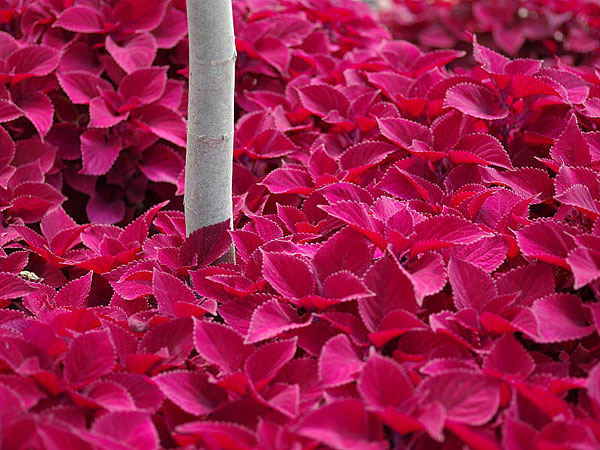 |
Autofocus is swift and accurate when shooting through the viewfinder. In live view mode, it also works quite well, but the dedicated phase-detection sensor handles low light better. One quirk: the AF points are clustered near the center of the frame. I often found myself having to reframe images even when using the outermost AF points. |
* (One difference in the focus controls applies only if you're not already shooting the Pentax K-3. The 645Z incorporates the new focus area selection button introduced on that camera. My own K-5 lacks that feature, so I had to teach myself to remember that control all over again, just as I did when I reviewed the K-3. And for those of you who read my Pentax K-3 review where I said I'd be buying one, yes, it's still on my shopping list. I've told myself I have to sell some camera gear I don't use any more before I'm allowed to buy it, though.)

This isn't a camera I'd want to use for shooting sports or particularly active subjects, but it did fine at keeping up with my hyperactive five-year old..
For the most part, I found myself liking the 645Z's control layout right off the bat. I'd like to see some differentiation in feel for the row of buttons that line the left shoulder of the mirror box, however. All four are the same size and shape, and that makes it harder to remember which is which, with the viewfinder raised to your eye. The viewfinder, though, is gorgeous. It's large, bright, and very clear, making it pretty easy to focus manually. And the huge, soft, screw-off rubber eyecup shields extraneous light pretty well.
The tilting LCD monitor beneath does project quite a way from the camera's rear deck, and presses a bit uncomfortably on the side of my nose when framing with the viewfinder, but I'm happy to put up with that for the versatility it adds. I found myself switching to live view mode and shooting with the LCD tilted up or down quite a bit, and it's quite refreshing to see a manufacturer that's not afraid to put an articulated display like this on a weather-sealed, pro-oriented camera.
Overall, the 645Z feels well laid out, and quite a comfortable transition if you're already used to shooting with one of Pentax's enthusiast DSLRs from the last few years.
Once the run of troubled weather finally broke a few days into my trip, I got out and shot with the 645Z every single day, taking it everywhere I went with my wife serving double-duty as patient mother and lens caddy. (Thanks, Bethany!) And boy did I ever have fun. Other than the weight being a bit greater than I'm used to, the burst performance understandably rather slower, and the autofocus point coverage quite tightly clustered around the center of the frame, the 645Z shoots much as you'd expect of a pro-grade camera.
 |
Having a large medium-format sensor helps out when you want to isolate subjects from their background with depth-of-field blur. You do have to watch out that you've actually managed to fit your whole subject within what can sometimes prove to be a razor-thin sweet spot of focus, though! |
It focuses swiftly and confidently, and it provides a generous burst depth that ensured I never felt I was left waiting for the camera. Most of the time, I was shooting three-frame raw+JPEG bracketed exposures, as I tend to do for reviews. While I'd certainly have appreciated faster burst shooting, this isn't really a camera I'd choose for sports, and the 3-fps burst capture rate at full resolution felt quite sufficient. I did find myself wishing for a quicker image review occasionally, though -- it can take quite a few seconds for images to appear onscreen after a short burst -- but if you can live without bracketing every shot as I did for insurance, that's not as much of an issue.

Although your telephoto options are somewhat limited by the larger-than-35mm sensor, currently-available Pentax lenses will take you out to 320mm-equivalent without converter. Here, I was shooting with the smc PENTAX-FA645 MACRO 120mmF4, which is effectively a 96mm optic when used on the Pentax 645Z.
And given the file sizes we're talking about here, those slight performance concerns are really very understandable. In fact, the file sizes were enough that my laptop -- a mid-range Sony VAIO from a couple of years ago chosen mostly for its very bright, outdoor-visible screen that lets me work outdoors -- actually struggled to deal with browsing large quantities of images. Here, I found the 645Z's dual card slots a great boon, as I simply shot JPEG to one card and raw to the other, never touching the raw card until I'd finished my image browsing and selection from the easier-to-handle JPEGs. If you're going to shoot raw and do much work in the field, though, I highly recommend a higher-end laptop to pair with this high-performing camera. (And if you're spending US$8,500 on a camera body, you can doubtless justify the expense of a suitable editing companion.)
Once I got those images onto a larger screen and looked at them... wow. This camera can capture a truly staggering amount of detail, and it does so with the Pentax look I know and, honestly, very much like. Although we've consistently commented on Pentax's handling of the red fabric swatch in our Still Life test scene, where it loses detail compared to some rivals, it's worth noting that we're using default color rendering in this test. I've never found it a significant issue in the real world, and even if it is -- well, there's a great range of control available to tweak the rendering to your own personal tastes.
I did find the default program line tends just slightly slower than I'm comfortable with in terms of shutter speed, though, just as it does with my K-5. That's easily fixed by either switching to the Sports program line or paying attention to shutter speed when shooting. (I did the latter, predominantly shooting in MTF mode and bumping ISO sensitivity to get a shutter speed I was comfortable handholding. When I didn't pay close-enough attention I sometimes got ever so slightly soft results when viewed 1:1, although they'd still be plenty good enough for printing.)
 |
I found myself wishing for a more telephoto lens when we drove out to Steamboat Springs. The reason: A black bear which appears only ~100 pixels tall (or 1.2% of the image height) in this shot of the Routt National Forest. I'd have loved to have gotten closer, but perhaps understandably, not on foot! |
Exposure metering was pretty consistent, with just a touch of negative exposure compensation needed to hold onto the highlights in JPEG mode. I don't see the need to tweak exposure consistently as a problem, to be honest -- it's when a camera's metering is all over the place that I'd have a complaint. Here, I'd just dial in a 1/3-stop of negative exposure compensation, and call it a day. (Well, truth be told, I'd shoot in raw mode, but I like to have a lot of control over my photos.)

Yes, the sky really was this blue. I had a hard time believing it myself! Perhaps it's the altitude?
And towards the end of the trip, we finally got some blue skies which I can only describe as startling. You may be tempted to question them, but don't. I'm not sure if it's a function of altitude -- we were in Steamboat Springs at close to 7,000 feet once the weather finally changed for the better -- but I'd say those deep blues actually reflect what I saw in person pretty darned well.
I've never seen skies quite this blue before -- it was truly spectacular. (And although we didn't have any other cameras with us for a side-by-side comparison, shots from our Apple and Sony smartphones that we shared on Facebook that day have much the same color, albeit with far, far lower resolution.)
And as we'll see in my next Field Test, coming soon, the 645Z's high resolution and pleasing images are coupled with what, by medium-format camera standards especially, is an absolutely epic ISO sensitivity range. That, coupled with the weather-sealing and movie capabilities really take this camera into a class of its own, as far as I'm concerned.
But I'll have more on all of that in the next Field Test, coming soon... watch this space!
 |
The Routt County Courthouse in picturesque Steamboat Springs. A six-hour roundtrip drive from where we were staying with friends in Westminster, CO didn't leave long in this pretty little town, but I got some of the most colorful shots of the trip while I was there. (And we passed a truly spectacular ~11,200 foot elevation enroute, right after we exited the western portal of the Eisenhower–Johnson Memorial Tunnel.) |
Field Test Part III
Straying outside of the medium-format comfort zone
By Mike Tomkins | Posted: 10/07/2014
When I published part I of my Pentax 645Z Field Test a little before the Photokina tradeshow, I promised that another report was on the way that would look at Ricoh's mighty medium-format camera in more challenging conditions. After a manic stretch of camera announcements and news coverage for the show -- plus a little time to recuperate -- I'm finally back and fulfilling my promise. It's time to take this medium-format DSLR outside of the traditional comfort zone for medium-format cameras!
Downtown, sun down
And boy, did I ever have some fun shooting the 645Z at night in downtown Denver, my extremely patient wife serving as lens caddy while I carried the 645Z and a Feisol Traveler CT-3441S tripod all over town looking for interesting shots. I'd have liked to have had a sturdier tripod with me, but the Feisol was small and light enough to fit in my carry-on, yet rated for a reasonably generous 22 pounds, and actually did a pretty good job.
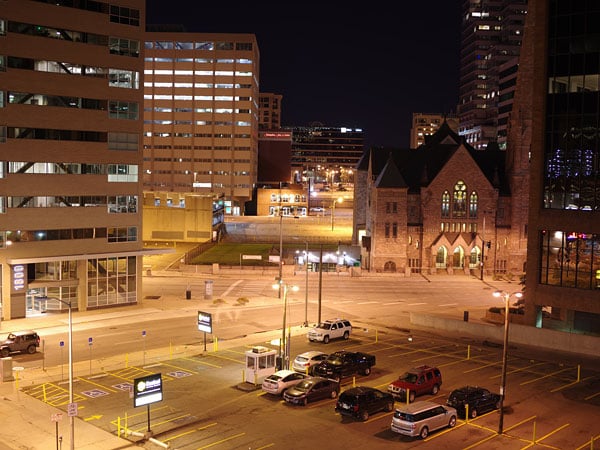 |
A quick ISO 100 shot under city street lighting from a car park in downtown Denver. I also shot the same scene at ISO 3200 equivalent, which you can see in the gallery here. Although the out-of-camera JPEGs do favor the base ISO shot, there's more detail to be found in the raw file, as we'll see in just a moment. |
I started the night off with a quick side-by-side comparison of base ISO and ISO 3200 -- which, bear in mind, is already a full-stop higher than the ISO 1600 limit of the earlier 645D -- and was immediately rather impressed. You can see the overall scene at ISO 100 above, and the ISO 3200 shot in the gallery.
Under a fairly complex mixture of city street lighting, white balance was perhaps just a touch pink, but that's easily corrected in the digital darkroom. And the comparison in terms of detail definitely looks good for the 645Z compared to its predecessor. While the 645D's ISO 1600 was quite usable, there was already a fairly noticeable step downwards in detail from the base ISO when viewed 1:1. With the 645Z in JPEG mode, even by ISO 3200 equivalent that difference is much less noticeable.
And yet more detail is there for the taking if I simply open the raw file and process it myself -- and with in-camera support for DNG raw, even my now rather aged copy of Photoshop CS5.1 happily opens the files straight out of the camera.


In the 1:1 crops above, you'll see ISO 100 at top, ISO 3200 out-of-camera at center, and a very quickly-tweaked ISO 3200 from DNG raw processed in Photoshop at the bottom. To my eye, it actually has just a little more detail than the out-of-camera shot at ISO 100. Just a slight touch of color and luminance noise reduction have been applied in this third crop.
I must admit that I was rather expecting this, as I'd already shot a little around the house while waiting for the rain to go away, and had bumped the ISO sensitivity up to 3,200 equivalent to get a reasonable shutter speed. Just like this city shot, there was more detail to be found in the picture of my son if I looked to the raw file, although the difference was hardly night and day-- even the out-of-camera shot had clearly visible thread detail in the fabric of his T-shirt. (Sadly, I focused a little far forward; the shot would've been better were the focus on his eye.)


So things were looking promising already, but how about some long exposures. That was the next thing I wanted to try, while there was still some traffic around. (It had been raining that day, so we'd gotten downtown quite a bit later than I'd hoped, after most sensible folk had already left for home.)
I wanted to get a shot or two with some light trails in them, for one thing. What little traffic there was remaining just wasn't cooperating, though -- every time I'd started to move my tripod a few cars and buses would show, and then just as quickly disappear before I set back up. And then I hit on a slower target -- a street cleaning vehicle of some kind with a pulsing strobe light on its roof that shows up as a pattern of long, yellow streaks.
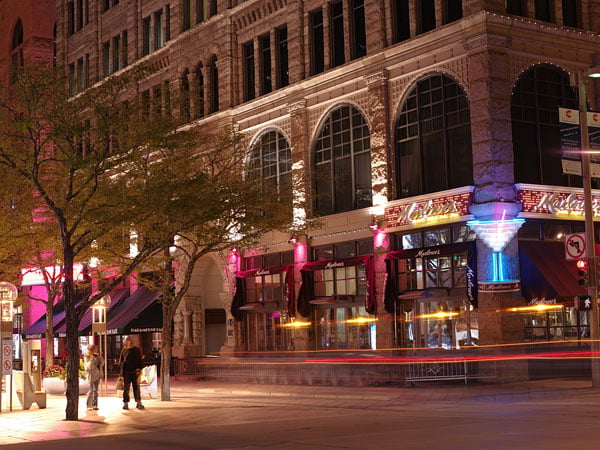
Perhaps not the most visually-interesting composition, but I liked the shot nonetheless, and the rough granite walls and carved archway in the background are absolutely packed with detail in this six-second exposure at base ISO.
While I was waiting for vehicles, I looked around for other interesting details. One, you can see in the shot above -- the entrance to a bar called Marlowe's. The tiny pinpoints of light pulsing behind its sign caught my attention, as did the small fairy lights surrounding the arches above. The 645Z rendered the mixture of different light sources quite nicely, although not surprisingly some negative exposure compensation was needed to render this low-light scene as I saw it.

I also rather liked the shot below of a glitter-painted pedal cab, sitting forgotten once the pedestrian district had largely emptied out. This particular image was shot with live view so I could get a lower perspective, and I focused using contrast-detection, which worked just fine. I did find with some lower-light shots, though, that contrast detection failed to get a lock while phase-detection worked just fine, even with fairly contrasty subjects. The phase-detection almost never let me down -- if I could see my subject, the camera could focus on it first time, nine times out of 10.

It wasn't long before I got fed up of setting up and breaking down the tripod, though, or lugging it around with camera still attached. No problem -- I'd gotten a fair few long-exposures already, so it was time to try some handheld shooting at higher sensitivity. My wife, Bethany, become lens and tripod caddy -- have I already mentioned her limitless patience? -- while I roamed in search of more interesting subjects in a near-deserted downtown.
I decided I'd start from the extreme, with an ISO 204,800 shot. I can still remember those heady days when loading a roll of ISO 3200 film into my completely manual film SLR seemed incredible to me, yet these days we take high-sensitivity shooting almost for granted. Still, when you crank the sensitivity of a camera all the way up to ISO 204,800 equivalent, you get a thrill not unlike what I once felt with ISO 3200 film.
 |
Blame the photographer for this one: The camera missed focus for the correctly-exposed shot, and I didn't check focus until the moment was gone. The result is that only an exposure that's 2/3 stop too high remains -- and yes, at ISO 204,800 it is blotchy, mottled and just plain ugly when viewed 1:1. Once I took a look at the raw file, though, I got something of a surprise, as you'll see in the crops below. |
You also dial your expectations back. Way back. As I set the sensitivity for the shot above, I did just that -- and I was wise to do so. No two ways about it, the out-of-camera JPEG is both noisy and very mottled / blotchy. Doubly so because this was one of the rare few times the phase-detection autofocus let me down -- a relatively low-contrast subject in the very dimly-lit entrance to a downtown restaurant. My better-exposed shots weren't usable, with focus well off. Hence, I had to live with a shot that was overexposed by two-thirds of a stop.
Once I opened the raw file, though, I got a bit of a surprise. Yes, it's still extremely noisy, especially if you dial the noise reduction sliders all the way back. Given the sensitivity we're talking about here, though, more detail remains than I think I had any right to expect. Text can be made out -- if not quite read -- in the menu in the window. The various credit card and other promotional stickers in the windows are surprisingly legible. Strands of hair can even be seen silhouetted against the menu display.
 |
 |
You can't quite read the menu in the window to the right of the door in this crop of the ISO 204,800 image above, even in the exposure-corrected raw version, let alone the JPEG (where much highlight detail has been lost to clipping from my initial over-exposure). It's far closer than I expected, though, and a fair bit of the original color remains, too. In fact, I've actually dialed the vibrance and saturation back a bit, because Photoshop's initial results from the DNG raw file yielded a rather cartoonish, garishly-overcolored result. I'd dearly love to run this shot through DxO Optics Pro 9 to see what its PRIME denoising engine can do, but sadly it doesn't support the Pentax 645Z yet. |
You can see a 1:1 crop comparison of the out-of-camera JPEG above, alongside a raw conversion where I've intentionally left quite a bit of noise so as to retain as much detail as possible. (Both have been dialed back by two-thirds of a stop to correct for the overexposure.)
Is either crop going to stand much 1:1 scrutiny? No, but the raw conversion is closer to usable than I had expected, and could probably be cleaned up a good bit more in Photoshop if I had some time to spare. I'd love to see what DxO Optics Pro 9's PRIME denoising engine could do with this shot, but sadly it doesn't yet accept raw files from the Pentax 645Z.
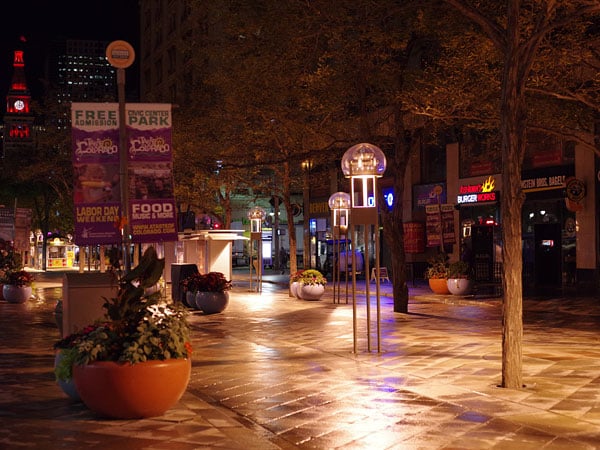
The net result is that while I'd only use the extremes of the Pentax 645Z's ISO sensitivity range in a very tight pinch, and I'd make sure to shoot in raw only, I might actually find myself using it were there no other option available. Frankly, I didn't expect to find myself saying that.
And that's at the extreme upper limit of the camera's sensitivity. Dial it back to more reasonable levels, and you can get some very nice results indeed. The shot above at ISO 6400 equivalent, for example, has visible grain when viewed 1:1, but it's film-like, unobtrusive, and cleans up very nicely in Photoshop.
 |
Another shot at ISO 6400, this time of a colorful neon sign. The colors for this shot are somewhat muted compared to how I remember them, but neon is quite a challenging subject that's easy to clip -- and that's what has happened here. The color is easily restored from the DNG raw file, yielding a more attractive result. |
And I felt quite happy to use higher sensitivities, as well. Everything up to ISO 51,200 equivalent was quite usable, although I found myself preferring to work from the raw files once I strayed past ISO 6400. By default, the 645Z's noise processing is a bit heavy-handed past that point, and while I could have dialed it back in-camera, I prefer the added control of shooting raw.


For my money, though, ISO 51,200 did serve as a pretty firm cutoff point. Beyond that, I did feel I was giving away too much detail, and so I only strayed beyond that limit when there was no other choice. Below is an example of an ISO 51,200 shot with 100% detail crops, and as you can see, you can still make out individual strands of hair on the pedal cab driver's head!




High ISO in better lighting
All of the above was in relatively dim lighting out on the city streets of Denver -- but what about under better (albeit still not terribly bright) lighting? For decades now, I've been a fan of author Clive Cussler, and have read most of his books, most of which weave classic cars that he personally owns into the plotlines. I was thrilled to find out, shortly before my trip, that Mr. Cussler has a museum showing a portion of his personal collection in Arvada, Colorado, and doubly so to find that the Cussler Museum allows photography on the premises.
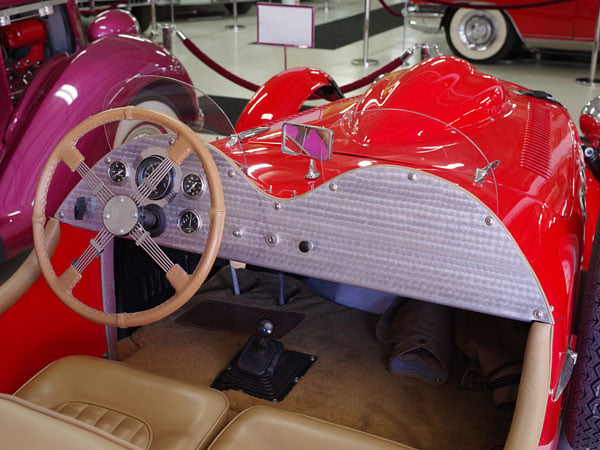 |
To get the ball rolling, I started with a cockpit shot of this beautiful 1952 Allard J2X, as featured in the Clive Cussler novel "Shock Wave". (As a rather nice touch, the Cussler Museum places a copy of the book alongside each car that appears therein.) At ISO 3200, this shot picked up the detail in the leather steering wheel very nicely. |
After a first couple of shots near the door, where at least some daylight was filtering in and allowing me to shoot at ISO 3200, I quickly ramped the ISO up to ISO 6400 for a more realistically hand-holdable shutter speed, and there I stayed for the remainder of the museum visit thanks to some very even lighting.
 |
This gorgeous 1960 Cadillac Eldorado Biarritz convertible was also quick to catch my eye. I'm a sucker for styling from the '50s and '60s! This shot was also at ISO 3200, but stopped down to f/6.3 was just barely hand-holdable with a shutter speed of 1/40th second and a 35mm-equivalent effective focal length of 44mm. |
Given its very high 51.4-megapixel sensor resolution, the Pentax 645Z managed to avoid moiré in almost all of my shooting, but in the shot below of a late-'20s Duesenberg, I spotted a little. If you look inside the trumpet of the horn at screen left, there's a small grille that, in my shot, appears somewhat rainbow-colored. Comparing two shots from my bracketed sequence side by side, the positions of the colors change because the camera itself moved between shots -- thereby neatly confirming the colors aren't there on the actual wire mesh.
For this particular shot, it's very easily fixed in Photoshop with the Color Replacement tool, but with some subjects moiré will likely prove more challenging. It's a simple fact of life on cameras that forego an anti-aliasing (or optical low-pass) filter, as most do these days.
 |
In this shot of a stunning 1929 Duesenberg Model J-140, as featured in the novel "Flood Tide" and one of my favorite cars in the museum, you can see the effects of a little moiré patterning. It's most visible in the grille mesh that sits in the middle of the horn trumpet at screen left, but there are also some hints of it elsewhere. |
You'll forgive me if I let the pictures do the talking at this point. Surrounded by some of my favorite books and over 100 stunning cars dating all the way back to a 1906 Stanley Steamer -- plus some surprises that will only make sense to Cussler fans -- I was just a little bit overcome. Words simply can't do it justice. The pictures tell the story far better than I can. (You'll find a couple more of them in my final thoughts, at the end of this Field Test.)
 |
Only one shot at the Cussler Museum required me to stray above ISO 6400. This deeply-shaded view under the hood of a 1921 Rolls Royce Silver Ghost was shot at ISO 12,800 equivalent, but for my troubles I was rewarded with quite a bit of fine detail in the distributor cap and cables at right, which sit nicely within the depth of field. And as usual, the DNG raw file contains just a little more detail than does the out-of-camera JPEG. |
HDR and raw, combined
Back when I reviewed the Pentax K-3 last April, I was thrilled by its ability to combine in-camera HDR capture with raw file storage. The Pentax 645Z inherits that same capability, and I'm no less happy to see it included here.
 |
I got some rather strange looks from passers-by while shooting this shot from low to the ground, tripod legs splayed to keep the camera steady, outside a local camera shop. It's not every day you see a camera shop in your own name, though. I shall have to enquire about royalties! This particular HDR shot used the strongest effect type, HDR mode 3, along with a 2EV step size -- and given that my Feisol Traveler tripod isn't the sturdiest with its legs splayed out, I left auto-alignment on. The Program autoexposure set a base of 1/33 second, f/2.8 and ISO 3200. |
There is a downside, in that I've yet to find any third-party software which can accept the HDR raw files created by these recent Pentax models, which essentially contain three separate raw images in a single image. (Every third-party app I've tried simply treats them as if they were a single raw file, rather defeating the purpose.)
The solution to this is to use Pentax's provided, Silkypix-based Digital Camera Utility software. Unfortunately I didn't receive a copy of the software CDs along with the camera, and as it turns out, while the version I received with the K-3 can view the 645Z's raw files, it can't process them.
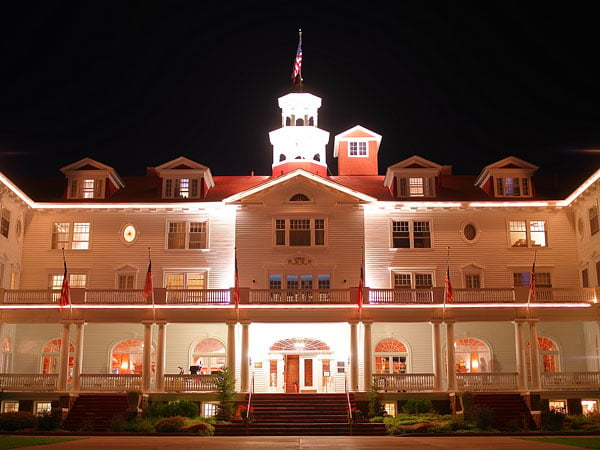 |
The Stanley Hotel in Estes Park, Colorado, inspiration for Stephen King's "The Shining". This image couples long-exposure, HDR and raw, all in one. The base exposure is five seconds at f/2.8, with the camera automatically shooting additional 2.5 and 10-second exposures to create the final HDR output at the mid-strength Mode 2 HDR setting. Given that it took close to 20 seconds just to capture all the shots, I left auto-alignment enabled even though I was shooting tripod-mounted. As a DNG raw file, the result weighs in at 172 megabytes; in JPEG mode it's a much more reasonable 22MB. When I zoomed in on the shot, I was impressed to find that you can not only read the tiny signs around the doorway, but also clearly make out details inside the lobby windows. |
However, from my experience with the K-3, I know that this setup made it much more likely for me to shoot in-camera raw in the first place, and in the process, sometimes saved me feeling that I needed to do a manual HDR merge. As a raw-only shooter, that's a big deal for me, because usually these kinds of features apply only in JPEG mode.
Note, though, that the 645Z's HDR raw files are truly stupendous in size. We're talking close to 180MB per image here, so if you plan on shooting a lot of HDRs and keeping raw copies, you'll want to invest in lots of storage as well. (You can expect to fit only around 80 HDR raws on a 16GB SD card, and even the largest SD card on the market will only fit 2-3,000 or so.)
Medium-format movie capture
And so we come to the final feature of the Pentax 645Z that I was particularly excited to try out -- movie capture. If you're used to consumer APS-C DSLR or mirrorless cameras, or even professional full-frame models, the ability to shoot Full HD (1,920 x 1,080 pixel) video might not seem that special. Heck, even your smartphone almost certainly can do so these days -- in fact, some will even shoot at 4K resolution.
The Pentax 645Z is extremely rare among medium-format cameras in providing not just live view, but also video capture. Specifically, you can shoot Full HD video at 30 frames per second (top) or 60 fields per second (bottom). As we'll see momentarily, the 30p rate has better quality, though.
|
But in the medium-format world, movie capture is a very rare beast. Even live view was impossible until the switch to CMOS sensors in current-generation medium-format models. Movie capture is nigh on unheard of, and there's a reason for that: the logistics of reading off the sensor data fast enough without overheating becomes progressively more challenging as its surface area increases. What's easy for a small-sensor compact and challenging for a full-frame 35mm sensor becomes exceptionally tough to achieve in a worthwhile manner on a full-frame sensor.
But be that as it may, Pentax and sensor partner Sony have pulled it off in this camera, offering a choice of progressive-scan 30 frames per second or interlaced 60 fields per second capture at Full HD resolution. While the feature set is fairly limited -- there's no full-time autofocus, for example -- it's still potentially a handy feature to have.
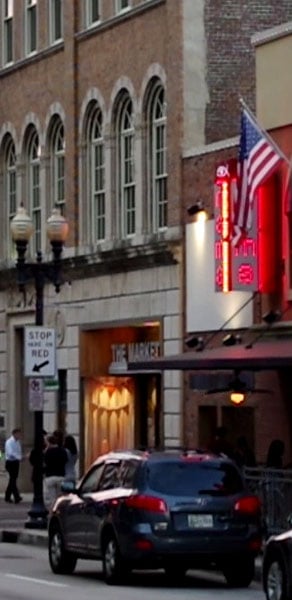

After shooting a variety of videos, I quickly came to the realization that the 60i interlaced mode is of relatively little utility, sadly. As you can see above, it's not just the fact that the video is interlaced, but that the image quality is significantly degraded. Moiré is also much stronger in 60i video, and that's bad news, as it stands out much more in moving video than it would in a still image. If the perception of smoother motion is needed, you'd be better off interpolating the halfway points between frames than degrading image quality to this degree.
Image quality at night was much like that in the day: At 30p, quality was fairly acceptable compared to other cameras that lack full-sensor readout, but at 60i resolution was significantly reduced and artifacts more prominent.
At night, the 645Z's video is fairly good, with minimal noise. As in the day, though, the 30p progressive-scan mode has much better quality than the interlaced 60i mode..
|
Of equally little utility was the Movie Shake Reduction function, which while it did steady motion somewhat, also introduced very unsightly artifacts into the video, both in the form of distortions and a shimmery, "shivering" look that's extremely distracting.
In the clips below, I did my best to walk and carry the camera in the same way. Note that I'd accidentally left spot metering on, so the brightness level changes somewhat, but that shouldn't affect the stabilization algorithms. Unfortunately, I didn't notice immediately, and didn't have time to get back for another go at the comparison before our review camera had to be returned.
The Pentax 645Z uses digital image stabilization during video capture, which does help keep the scene steadier, but also introduces some unattractive distortions and artifacts. Above, you can compare an unstabilized video (top) with a stabilized video (bottom).
Clips above are recompressed by YouTube. Download original, out-of-camera videos: Unstabilized or Stabilized |
Where the 645Z's medium-format sensor pays dividends is for shallow depth-of-field effects. With such a large sensor compared to APS-C or even full-frame cameras, you can really isolate subjects from their background, or throw the entire scene out of focus for artistic effect. Below, you can see a couple of extreme examples of this shot both at day and night, the first shortly before sunset with a very nearby foreground subject, and the second simply ending with the lens as far from focus as possible.
If you enjoy playing with depth of field, you'll have some fun with the Pentax 645Z's video. Top and bottom are examples of the effects you can achieve, day or night.
|
Although you can record audio either from an internal microphone or an external stereo mic, and audio levels can be adjusted manually in 20 steps, the Pentax 645Z sadly lacks headphone connectivity. Sound quality from the onboard mic is fairly good, however, with little hiss and fairly good sensitivity.
Sound quality is quite good, and you can connect an external microophone if you need to improve it. There's no headphone connectivity, however.
Clip above is recompressed by YouTube. Download original, out-of-camera video here. |
Final thoughts
The most painful part of every great review is that where I have to give the camera back. (And since we pick our subjects for review here at Imaging Resource very carefully, it's actually quite rare that I don't feel a small pang of sorrow as I pack a camera up for return.)
With the Pentax 645Z, though, that was magnified a hundred-fold. I've never shot extensively with a medium-format camera before, and it's unlikely I'll get to do so regularly any time soon. This camera is far, far beyond my budget, but if it's within yours -- and if you're willing to take the time to learn to extract the best from it -- then I envy you deeply.

In almost every respect, the Pentax 645Z looks, feels and shoots like a supremely well-considered photographic tool, and its image quality is absolutely top notch, especially around its base sensitivity. This camera doesn't just demand good glass, it simply devours it.
With a relatively short time to become accustomed to it (and surrounded as I was by unfamiliar subjects and a million happy distractions), I will freely admit I've only scratched the surface of what it's truly capable of. With more practice, experience and familiarity, though -- and perhaps in the hands of a photographer with better compositional skills than I -- it's pretty obvious to me that this camera can create truly spectacular artworks, and at a resolution that will allow prints of equally spectacular size.

I'd love the chance to get some more practice in, but sadly, just as I had to bid beautiful Denver, Colorado a fond farewell, I must also do the same for the Pentax 645Z. A tiny part of me is determined, though, that one day we shall meet again. It's time to start saving pennies! ;-)

High ISO Noise Reduction
Pentax 645Z High ISO Noise Reduction
Like other Pentax models, the 645Z offers an unusually flexible amount of control over noise reduction applied to its JPEGs. In addition to "Auto", you can adjust how much NR is applied ("Off", "Low", "Medium" or "High") at all ISOs, or you can select "Custom" which allows you to choose from the same four options at each ISO sensitivity setting in whole EV increments. That is, if you enable 1/3 EV ISO steps, you get one NR setting for ISO 100, 125, and 160, another for ISO 200, 250, and 320, etc. The same applies for 1/2 EV ISO steps, but with only two sensitivities sharing each setting (ie. ISO 100 and 140 share a setting, ISO 200 and 280 share one, etc.). Kudos to Pentax for continuing to provide such excellent control over noise reduction for JPEGs.
See for yourself how the Pentax 645Z's "Auto" and "Off" High ISO NR settings compare to RAW without noise reduction under daylight-balanced lighting. (Note that these RAW images have no sharpening applied, so they look softer than camera JPEGs at low ISOs.) Click on any of the crops below to see the corresponding full-sized image.
| High ISO Noise Reduction Comparison Daylight-balanced illumination |
|||
|
"Auto"
|
"Off"
|
RAW (no NR)
|
|
|
I
S O 1 0 0 |
 |
 |
 |
 |
 |
 |
|
 |
 |
 |
|
|
"Auto"
|
"Off"
|
RAW (no NR)
|
|
|
I
S O 2 0 0 |
 |
 |
 |
 |
 |
 |
|
 |
 |
 |
|
|
"Auto"
|
"Off"
|
RAW (no NR)
|
|
|
I
S O 4 0 0 |
 |
 |
 |
 |
 |
 |
|
 |
 |
 |
|
|
"Auto"
|
"Off"
|
RAW (no NR)
|
|
|
I
S O 8 0 0 |
 |
 |
 |
 |
 |
 |
|
 |
 |
 |
|
|
"Auto"
|
"Off"
|
RAW (no NR)
|
|
|
I
S O 1 6 0 0 |
 |
 |
 |
 |
 |
 |
|
 |
 |
 |
|
|
"Auto"
|
"Off"
|
RAW (no NR)
|
|
|
I
S O 3 2 0 0 |
 |
 |
 |
 |
 |
 |
|
 |
 |
 |
|
|
"Auto"
|
"Off"
|
RAW (no NR)
|
|
|
I
S O 6 4 0 0 |
 |
 |
 |
 |
 |
 |
|
 |
 |
 |
|
|
"Auto"
|
"Off"
|
RAW (no NR)
|
|
|
I
S O 1 2 8 0 0 |
 |
 |
 |
 |
 |
 |
|
 |
 |
 |
|
|
"Auto"
|
"Off"
|
RAW (no NR)
|
|
|
I
S O 2 5 6 0 0 |
 |
 |
 |
 |
 |
 |
|
 |
 |
 |
|
|
"Auto"
|
"Off"
|
RAW (no NR)
|
|
|
I
S O 5 1 2 0 0 |
 |
 |
 |
 |
 |
 |
|
 |
 |
 |
|
|
"Auto"
|
"Off"
|
RAW (no NR)
|
|
|
I
S O 1 0 2 4 0 0 |
 |
 |
 |
 |
 |
 |
|
 |
 |
 |
|
|
"Auto"
|
"Off"
|
RAW (no NR)
|
|
|
I
S O 2 0 4 8 0 0 |
 |
 |
 |
 |
 |
 |
|
 |
 |
 |
|
As you can see, the Pentax 645Z applies some chroma noise reduction already at its lowest sensitivity of ISO 100. Also notice the Off setting clearly does not eliminate noise processing altogether (especially in the red channel), but it does leave a bit more fine/subtle subject detail in JPEGs than Auto, when the Auto setting doesn't select Off. Still, we wish the Off setting was less aggressive with chroma noise, at is already impacts detail in our red-leaf swatch at low ISOs.
Note that Auto selects Off for ISOs 100-800, Low for 1600-6400, and Medium for ISO 12,800 and above.
Technical Info
by Mike Tomkins

Sensor. The most important new feature of them all for the Pentax 645Z is at its very heart, and shared by rivals Phase One and Hasselblad: The same 50+ megapixel image sensor seen in the recently-launched Hasselblad H5D-50C and Phase One IQ250. By way of comparison, the 645D used a 40-megapixel chip, so all other things being equal, linear resolution should have increased by about 14%. Sensor dimensions are 43.8 x 32.8mm, and as shown above right, that's quite a bit bigger than a 35mm full-frame sensor.
It's a Sony CMOS chip, which is in itself big news. The 645D used a Kodak-sourced CCD sensor, but in the runup to the one-time film giant's bankruptcy, it sold its image sensor business. The simultaneous switch to CMOS means that for the first time, the 645D is capable of offering a live-view feed on its rear-panel display, if you want an alternative to the TTL viewfinder. That's handy given the new articulated LCD panel, and it also allows for movie capture. But more on those in a minute.
For Pentax, due to slightly different masking from Hasselblad and Phase One, it's classed as a 51-megapixel chip, rather than the 50-megapixel rating in the rival cameras. It has exactly the same 5.3 micron pixel size, though, and the same manufacturer-claimed 14 stops of dynamic range. And just like in the original 645D, there's no antialiasing filter to rob the sensor of its finest resolution. That means you'll want to watch out for moiré / false color in fine patterns, but it also means you get the most out of the sensor. (And for pros, that's probably more important than occasional moiré.)
Processor. The new image sensor is coupled to a PRIME III image processor, as first seen in the Pentax K-3. Compared to the PRIME II processor of the 645D, Ricoh says the new variant is approximately five times faster. That extra horsepower manifests itself in a couple of ways.

Performance. Firstly, there's been a handy step forwards in terms of burst shooting speed. The Pentax 645Z still won't win any awards for burst rate, and it's clearly not a camera aimed at sports shooters. With a manufacturer-specified burst rate of three frames per second at full resolution, it still provides only half the performance of the company's entry-level APS-C DSLR in that area.
But then, given the extremely high resolution and the fact that you're talking about a medium-format image sensor, you really can't expect blazing performance. It's likely fast enough, though, and that's what counts. The 645Z's 3 fps is close to triple the 1.1 fps provided by the original 645D, and double or more the speed of Hasselblad and Phase One's competing medium-format models.
And despite the increase in speed and resolution, buffer depth has also doubled if you're shooting in JPEG mode, with a total of 30 JPEG frames now possible in a single 3fps burst. Raw shooters will manage 10 frames, down just slightly from the 11-frame buffer of the 645D.
One other performance improvement of note is that, where you had to wait a full 2.3 seconds to review each image you'd shot with the 645D, the Pentax 645Z will show its higher-res images to you in just 0.9 seconds after capture.
Sensitivity. Together, the sensor and processor also provide an absolutely whopping step forward in terms of sensitivity. With a range of ISO 100 to 204,800 equivalents on offer, the Pentax 645Z matches the Canon EOS-1D X and Nikon D4 -- but it does so with a much larger sensor, which should hopefully translate to better noise levels if you downsample your images to the same resolution as either camera. And that's comparing to full-frame. Compared to other medium-format models, there's simply no competition. The 645D topped out at just ISO 1,600, while Hasselblad and Phase One won't allow anything over ISO 6,400 from the same sensor.
It remains to be seen how the 645Z does in the real world, and we have to note that we've yet to see any high ISO output from the camera. If it does as well as we're hoping, though -- and Ricoh is clearly confident, not hiding any portion of this sensitivity range behind an ISO expansion function -- then this could be big news for low-light shooting with medium format.

Lens mount. As with its predecessor, the Pentax 645Z sports a 645AF lens mount compatible with DA645, D FA645, FA645 and A645 lenses. Courtesy of an optional adapter, you can also mount Pentax 67 lenses.
Lenses. While the mount itself is unchanged, there's a big development on the optics front. Although the 645D has been a great option for existing 645 shooters, the selection of lenses in the US market has been limited, to say the least. Only three new lenses have reached market since that camera began shipping, and while many other lenses were still in production and readily available in the Japanese market, they weren't really making it stateside.
That's now been rectified, and counting lenses originally designed for film, Pentax 645D and 645Z shooters now have a total of 17 lenses (12 primes and five zooms) to choose from, plus three more zooms still on the roadmap. Everything from 33mm to 300mm is covered without gaps by the zoom offerings, while the primes range from 25mm to 400mm. If you prefer to think in 35mm-equivalent focal lengths, that's everything from 26mm to 236mm-equivalents covered by the zooms, and 20mm to 315mm-equivalents by the primes.
And among these are five f/2.8 primes, while the zooms are all constant-aperture types with either an f/4.5 or f/5.6 maximum aperture. Drawbacks to the newly-available FA-series lenses are that they lack weather-sealing, SDM autofocus motors, or image stabilization. Instead, they're all screw-drive, unstabilized lenses. (In fact, there's only one stabilized lens available for the 645-series cameras, full stop -- the HD Pentax-D FA645 Macro 90mmF2.8ED AW SR.)
Lens correction. Like its predecessor, the Pentax 645Z sports in-camera lens correction, allowing it to correct for distortion and lateral chromatic aberration. However, it can now also correct for peripheral illumination and diffraction, taking it a step beyond the 645D's capabilities. The function works with DA645, D FA645 and FA645 lenses, but not with A645 or adapted 67 lenses.
Dust removal. If you regularly change lenses, you can expect dust to get inside your camera sooner or later. (Most likely, sooner.) Ricoh has retained the same DR II dust removal system used in the 645D for the new Pentax 645Z. It uses a piezoelectric element that vibrates the sensor cover glass at high frequencies, shaking free any stuck dust particles.
To help you decide when a more detailed cleaning is needed, the Pentax 645Z also retains its predecessor's dust alert function, which helps you to locate stubborn dust particles on the sensor for manual cleaning.

Metering. The Pentax 645Z sports a new metering sensor, or at least new to medium-format: Ricoh was able to share technology -- and development cost -- with its APS-C flagship DSLR, the Pentax K-3.
Gone is the 77-segment metering sensor first introduced with the K-7 back in 2009. In its place, the 645Z sports a much finer-grained 86,000 pixel RGB CCD metering sensor.
That's more than 1,100 pixels for every segment that was on the earlier sensor, which allows for much more precise metering. And since it's an RGB chip, it can also recognize color information, allowing it to help out with subject identification.
(More on that in a moment.)

Branded as the Real-Time Scene Analysis System, this metering system also has a wider working range of -1 to 21 EV with a 55mm f/2.8 lens at ISO 100. By comparison, the earlier sensor had a range of EV 2 to 21, making it rather less sensitive in low light.
Although the new sensor is much finer-grained, the choice of metering modes is unchanged from earlier cameras: Multi-segment, Center-weighted, or Spot. An exposure lock function is available, accessed with the AE-L button at the top right corner of the camera's rear, nestled in the top of the thumb grip. You can also specify up to +/-5EV of exposure compensation in 1/3 or 1/2EV steps, and bracket 2, 3, or 5 exposures.

Autofocus. Another area in which Ricoh has made a big step forward is in the 645Z's autofocus system. Here, too, tech was shared with the Pentax K-3: The 645Z inherits the exact same SAFOX 11 autofocus sensor used in that camera. As in the 645D, though, these points are clustered at the center of the frame, and don't extend near the edges. That's a function of the fact that the AF sensor assembly was designed for an APS-C sensor.
Still, SAFOX 11 represents the first major step forwards since the SAFOX VIII chip that was introduced 11 years ago with Pentax's very first digital SLR, the *ist D. The 645Z is only the second DSLR from Pentax not to use a variation on the SAFOX VIII layout.
SAFOX 11 provides much better autofocus granularity, thanks to an increase in the number of autofocus points to 27. Of these, the 25 central points in a 5x5 array are all cross-types, sensitive to detail in both the horizontal and vertical axes.

Only two points, located in the vertical center at far left and right of the array, are linear points sensitive only on one axis. The centermost sensor as well as the points directly above and below it are precision points, capable of focusing with an f/2.8 aperture.
In contrast, the 645D had an 11-point, SAFOX VIII-derived AF sensor, dubbed SAFOX IX+. That provided only 11 AF points, nine of them cross-types, and lacks any f/2.8 precision points. SAFOX 11 also functions better in low light, with a working range of -3 to +18EV, where SAFOX IX+ bottomed out at -1EV.
Autofocus controls. Just as it did in the K-3, Ricoh has rejigged the Pentax 645Z's autofocus controls, probably because of the added complexity of the new 27-point AF system. While it will take a little getting used to for 645D shooters, it will quickly become second nature. The Focus Mode dial sits just where it did, a little to the left of the viewfinder, and still selects either AF-S (single-servo) or AF-C (continuous-servo).
The corresponding dial on the right side of the viewfinder is no longer used to control AF point selection, however. Instead, you now use the AF area button on the top deck, located where the SD2 button used to be. And as in the K-3, you have quite a few more choices. As well as the default 27-point auto selection, you can opt for Spot, Select, Expanded Area (Small, Medium, or Large), and Zone Select modes.
One further control is also new, located just below and to the left of the four-way controller on the rear panel. The Change AF Point button selects whether the Four-way Controller should be used to adjust the AF point location, or should abide by the markings on its buttons.

Why all the extra points? You might wonder why, exactly, do you need all these new autofocus points? If you're not shooting on a tripod, you can just reframe and focus with one of the existing points, after all. Not so fast, though... If focus is critical, that technique could subtly shift it -- and with the possibility of more abbreviated depth of field that medium-format allows coupled with the high resolution of the 645Z, it's more likely to be an issue with this camera than most. For that reason, you'll do better to use a focus point as near to your subject as possible, minimizing any shift.
And with AF tracking, the extra points can also pay dividends, albeit perhaps not quite as often as in a more sports-oriented camera. Still, the more points you have, the easier it is for the camera to accurately track distance as your subject moves across the image frame. And that's where the tie-in with the RGB metering sensor comes in, as well. Since it can now provide color information -- and a whole lot finer detail -- to the camera, it can be used to help track the subject's location, and determine whether or not a given autofocus point is over the subject. In other words, we can expect quite a step forwards in tracking autofocus performance.
Of course, you can focus manually as well. And here, too, there's a decided improvement. You can now shoot in live view mode, and as in the K-3, there's a focus peaking display -- so if you find fine manual focus adjustment tricky, you're more likely to get focus right where you want it. (With that said, the 645D's viewfinder was already an uncommon joy for manual focus, and given it retains the same viewfinder, that will be true of the Pentax 645Z as well.)

Viewfinder. On a surprisingly short list of features held over from the original Pentax 645D, you'll find the 645Z's through-the-lens optical viewfinder. If you're a fan of optical viewfinders, you'll feel right at home here: It's big, it's bright, and it's a joy to focus through. It also has a fairly generous 21mm eye relief from the view window, or 24.1mm from the center of the lens.
For the optics geeks amongst us, it's a Keplerian telescopic trapezoid prism finder, a design that allows Pentax to keep size to a minimum. It has 98% coverage, so isn't quite as accurate as the finder in Pentax's APS-C cameras, but by medium-format standards it's pretty good. Magnification is 0.62x with a 55mm f/2.8 lens at infinity; note that you can't directly compare this figure against a full-frame or crop-sensor camera, however.
Like its predecessor, the Pentax 645Z offers a dioptric adjustment range of -3.5 to +2.0 m-1, so eyeglass wearers with eyesight within that range are well catered for. If you need a little help, a magnifier eyepiece is optionally available, and you can also switch the bundled Natural-Bright-Matte focusing screen for a AF Framed Matte, Golden Section Matte or Cross-Lined Matte screen should you desire.

Also, if you want to preview depth of field, you can do so either through the viewfinder or by letting the camera capture and display a preview image using Pentax's intuitive Aperture position on the Power dial, just as in the company's crop-sensor SLRs.
Larger, better LCD. The most obvious physical change on the Pentax 645Z, as compared to its predecessor, is its new rear-panel LCD monitor. This, too, is inherited from the Pentax K-3. It has a slightly greater 3.2-inch diagonal, and a 3:2 aspect ratio. Together, those changes translate to around a 9% increase in surface area, and resolution has simultaneously been increased by around 13%. The total dot count is now around 1037k, up from 921k in the earlier flagships. The increase in resolution more than offsets the larger surface area, so perceived resolution is much the same as it was.
The 645Z's LCD monitor has a gapless design, as introduced on the K-5 II and IIs, and retains the anti-reflective coating of earlier models. Compared to the air-gapped design used in the 645D, it has lower glare and better contrast. The brightness and color adjustments of that camera have also been supplemented with a new saturation adjustment, letting you tweak yet another variable to your own tastes.

Articulated LCD. As you've doubtless noticed, a lot of the changes in the Pentax 645Z are inherited from the K-3. This one, though, is unique in Pentax's lineup -- an articulated LCD monitor. It's a tilting screen, rather than our beloved, side-mounted tilt / swivel design, but it's still a lot more versatile than a fixed-position screen. And frankly, it's pretty impressive that Ricoh has been able to add articulation in a camera that's weatherproof, dustproof and freezeproof. We don't currently have any figures for tilt range, but do know that the screen allows for framing low to the ground, waist-level shooting, or shooting over a crowd.
Live View. Of course, an articulated LCD wouldn't be terribly useful without live view capability. For those of you who are skimming for key features, though, we'll call attention to this again. It's a big change from the viewfinder-only framing of the 645D, and one that's only possible because of the 645Z's new CMOS image sensor.

Movie capture. This is another huge change for the Pentax 645Z: It is, to the best of our knowledge, the first medium-format camera ever to allow Full HD movie capture. (That is to say, 1,920 x 1,080 pixels.) No crop is applied; instead, video is recorded across the whole sensor, providing the same depth-of-field effects and medium-format look of still imaging.
You have a choice of interlaced 60 / 50 fields-per-second or progressive-scan 30 / 25 / 24 frames per second capture, matching the most-commonly requested formats, and movies are saved with MPEG-4 AVC / H.264 compression in a .MOV container. A lower-resolution 720p (HD; 1,280 x 720 pixel) mode is also available, and this replaces the two interlaced framerates of Full HD with progressive-scan 60 / 50 fps options.

Sound is recorded using a built-in stereo microphone whose two ports straddle the sides of the viewfinder housing, and you can also opt for an external microphone courtesy of a 3.5mm input jack on the left side of the camera body. The Pentax 645Z includes a levels control function which lets you tweak levels manually based on an on-screen levels display, but sadly there's no headphone jack for levels monitoring. The camera can, of course, also control levels automatically.
4K interval movies. As well as the aforementioned high-definition movies, the Pentax 645Z can also shoot 4K interval movies, a feature inherited from the Pentax K-3. These movies are saved using MotionJPEG compression in an AVI container, and they don't include sound. They have a resolution of 3,840 x 2,160 pixels.
Info LCD. The huge monochrome info display on the top deck is similar to that of the earlier camera, but has been rearranged a little to reflect changes on the camera body, and to better show information about the dual flash card slots and the file types used for each. It still has a green backlight, which can be illuminated with a dedicated button at its rear right corner.

Exposure modes. The Pentax 645Z, as you might expect for a camera aimed at pros and enthusiasts, offers the de rigeur selection of Program, Aperture-priority, Shutter-priority and Manual exposure modes. If you're new to Pentax, though, you may find the terminology used to describe the priority modes on the dial to be a little unfamiliar, and several other modes to be a mystery. Shutter-priority and Aperture-priority are, in Pentax parlance, known as Tv and Av respectively -- Time value, and Aperture value. There are also Sv (effectively, Sensitivity priority) and TAv (Shutter-and-Aperture priority) modes. In Sv mode, you select a sensitivity, and the camera determines the combination of shutter speed and aperture by itself. TAv is the exact opposite -- you decide the shutter speed and aperture, and the camera attains the metered exposure using only sensitivity adjustment.
As well as these modes, you also get a Bulb mode for long exposures, an X-sync mode that fixes shutter speed at the camera's flash sync speed of 1/125 second, and three User modes that allow you to save any of the camera's settings in groups for quick recall.
Wondering where the Movie mode is? You'll find it accessed with a dedicated dial to the right of the viewfinder. And there are, of course, no hand-holding Scene modes. Nor do features like custom image modes or digital filters merit a Mode dial position. This is not a camera aimed at consumers, after all.
Drive modes. Although its performance won't rival an APS-C or full-frame camera, the Pentax 645Z is unusually swift by medium-format camera standards. You'll attain the maximum burst performance of three frames per second in Continuous High mode, and a Continuous Low mode offers a reduced speed of one frame per second. Burst depths are 30 JPEG, 10 raw or 12 TIFF frames in the Continuous High mode, and 300 JPEG, 25 raw or 15 TIFF frames in Continuous Low.
There's also a 2 or 12-second self-timer function, and a remote control mode with an optional 3-second delay or continuous operation. And if you're feeling creative, you'll find both interval and interval composite drive modes on offer, as well as a multiple exposure mode. Both allow up to 2,000 frames, with an interval of two seconds to 24 hours, or a choice of additive, average, or bright compositing in multiple exposure mode.
Shutter speeds. Like the Pentax 645D before it, the 645Z offers a range of shutter speeds from 1/4,000 to 30 seconds in 1/3 or 1/2EV steps, as well as a bulb mode for longer exposures. (No limit is stated in bulb mode.) Exposures are timed with an electronically-controlled vertical-run focal plane shutter.

Longer-life shutter. Before we move on from the exposure system, this is probably as good a place as any to note an improvement that could see your investment in the 645Z -- a professional camera which commands a professional pricetag -- spread out over a significantly longer period. Where the original 645D had a manufacturer-rated shutter life of some 50,000 frames, the Pentax 645Z's shutter mechanism is rated as capable of attaining around 100,000 frames in its lifetime. (And Ricoh notes that this figure has been attained with the shutter being tested in the camera body, not on a workbench.) With twice as many shots available from the shutter, you should hopefully be able to get twice as many images out of your 645Z -- and therefore pay about half as much per image over the life of the camera.
White balance. There's one other piece of the Pentax 645Z's exposure setup that's seen some improvement: There's now a Multi Auto white balance mode, as seen previously in the K-3. This aims to neutralize color casts from multiple different light sources in the same scene, and again works in concert with information from that 86,000-pixel metering sensor. It's an adoption from Pentax's new parent, Ricoh, whose cameras have had the feature for a while now under another name: Multi-P Auto.
As well as Automatic and Manual modes, the Pentax 645Z provides ten white balance presets (Daylight, Shade, Cloudy, Daylight Color Fluorescent, Daylight White Fluorescent, Cool White Fluorescent, Warm White Fluorescent, Tungsten, Flash, and Color Temperature Enhancement). This last option is used to retain and enhance the lighting tone -- for example, to enhance a sunset.
Also worth note is that, as with its predecessor, the Pentax 645Z doesn't just rely on its CMOS imager sensor and clever algorithms to determine color temperature. There's a dedicated light source detection sensor whose information is also taken into account.
Creative options. Although you might not associate a pro-grade camera with things like digital filters, the Pentax 645Z nonetheless contains several, inherited from the company's consumer SLR line. (And why not -- after all, it likely cost little to nothing for Pentax to port them over from its existing firmware, given that the K-3 shares the exact same processor.) Instagram-friendly options like toy camera and miniature effect, not surprisingly, didn't make the cut. Filters you can use on the 645Z include Monochrome, Extract Color, Color, Base Tweaking, and Soft Mode.
You can also shoot high dynamic range images, assembled in-camera from multiple, sequential exposures. The Pentax 645D offered the same function, but the 645Z extends it with automatic alignment allowing handheld shooting, and with more blending options to choose from.
And of course, the 645Z retains Pentax's Custom Image modes function, with presets including Bright, Natural, Portrait, Landscape, Vibrant, Muted, and Reversal Film. Each of the color modes provides a gamut radar, and allows the photographer to tune saturation, hue, high/low key, contrast, regular or fine sharpness. In Monochrome mode, you can apply filter effects (green, yellow, orange, red, magenta, blue, cyan, or infrared), toning (sepia warm/cool), high/low key, contrast, and regular or fine sharpness to your liking.

Flash. As you'd expect from a camera aimed at pros and deep-pocketed enthusiasts, there's no built-in flash strobe in the 645Z. Instead, medium-format strobists will be relying on external strobes and studio lighting when ambient light doesn't suffice. (But thanks to the high-sensitivity sensor, that should be the case a lot less often than before.)
The Pentax 645Z has an x-sync speed of 1/125 second, and strobes with high-speed sync will function at reduced power to 1/4,000 second. The camera includes both a P-TTL-compatible hot shoe and an X-sync socket. A dedicated X-sync position is included on the Mode dial, as well. Wireless flash is possible via an external strobe mounted on the hot shoe.

Level gauge. Just like its predecessor, the Pentax 645Z includes a dual-axis level gauge. You can view both axes on the rear-panel LCD monitor courtesy of a display somewhat reminiscent of an aircraft attitude indicator, and the side-to-side roll axis can also be confirmed through the viewfinder's status display. You can also opt for a more minimal display on the main LCD, allowing you to view framing at the same time.
Copyright tagging. Also held over from the 645D is the ability to optionally embed copyright data into the Pentax 645Z's raw or JPEG image files. You can enter both a photographer and copyright holder name from the camera body, and the headers of images will be tagged with both. It's not a permanent tag, and so you can't rely on it to protect your images from copyright theft, but it does make it so that you can easily identify who shot a particular image in your library.
Playback. The Pentax 645Z's slightly larger LCD monitor provides more space in which to review your images, and its playback-mode features have been adjusted appropriately. You can now view 1, 6, 12, 20, 35, or 80 images on-screen at once, and the playback zoom function provides everything up to a 16x enlargement. There's also a 1:1 display where each on-screen pixel corresponds to an image pixel, a function that was added in the Pentax K-3, and a quick zoom function is available.
As well as allowing you to apply digital filters to images post-capture, the Pentax 645Z also lets you develop raw files in-camera. Developed raw can be saved as JPEG or TIFF files, and you can adjust resolution, compression, color space, and many more settings prior to developing the raw file, just as you could in the 645D.

Storage. Like its predecessor, the Pentax 645Z has dual Secure Digital card slots. However, they're now compatible with higher-speed UHS-I cards, not just the higher-capacity SDHC and SDXC types. You have a few choices as to how the card slots can operate: Either mirroring each other with all data saved to both cards, sequentially with one card being used when the other is full, or segmenting by file type, with raw images on one card and JPEG on the other. You can also copy data between the two card slots manually.
Wi-Fi. While the 645Z lacks in-camera Wi-Fi support, if you'd like wireless connectivity, you can opt either for Eye-Fi cards, or for the Pentax-badged variant of Trek 2000's Flucard. The latter allows not just data transfer, but also remote control, including a live-view feed and support for aperture, shutter speed, ISO, focus point, and shutter release control.

Connectivity. Ricoh has also upgraded the connectivity options of the Pentax 645Z, just as it did previously with the K-3. The new 645-series flagship is among the rare few cameras featuring a USB 3.0 SuperSpeed data connection, which Ricoh says is three times faster than the USB 2.0 High-Speed connection of earlier models. It's located under a flap on the left side of the camera body.
Alongside it sit a Type-D Micro HDMI high-definition video output, a 3.5mm stereo microphone jack, a DC input. On the same side of the camera is a flash x-sync socket, while a hot shoe sits on the top deck, and a wired remote control terminal on the right side. As well ass the wired remote, the Pentax 645Z also works with infrared remotes, courtesy of dual receivers on its front and rear panels.
Note that the HDMI port does not allow an uncompressed live view feed.
GPS. Although the 645Z doesn't offer built-in GPS functionality, it is compatible with Pentax's hot-shoe mounted O-GPS1 accessory. This offers the ability to geotag your images with information about the capture location, including capture direction from an electronic compass. It can also be used to automatically correct the camera's internal clock. Since it doesn't have a sensor-shift stabilization system, the 645Z also doesn't support Pentax's clever Astrotracer function, which allows some models to freeze star motion during long exposures, preventing star trails from forming. Nor does it support the simple navigation function.

Power. The Pentax 645Z draws power from a proprietary D-LI90 lithium-ion battery pack, the same type used in the 645D, as well as all of the company's flagship DSLRs since the K-7, and its K-01 mirrorless camera. In the 645Z, this pack is capable of 650 shots on a charge, down from 800 shots in the original 645D. (That, at least in part, will be due to the greater processing requirements of the newer, higher-resolution camera.) Playback time is 400 minutes, down from 440 minutes in the 645D. No figure was available for movie recording life at press time.
Software. Ricoh includes an S-SW150 software CD-ROM in the package with the 645Z. This includes the Silkypix-based Digital Camera Utility 5, a utility for editing raw and JPEG files shot with the camera.
A separate utility called Image Transmitter 2 will be available soon. Much like the existing Image Transmitter software for the 645D, this allows you to shoot remotely and transfer images via a tether cable to your computer. However, you can also now view a remote live view feed, and change settings remotely.
Accessories. Quite a range of accessories will be available for the Pentax 645Z, many of them also compatible with the earlier model. Sadly, there's no portrait grip accessory, but you can select from a wide range of lenses, adapters and extension tubes, flash strobes, the O-GPS1 GPS receiver, Eye-Fi and Flucard SD cards, viewfinder eyepieces and attachments, focusing screens, wired and wireless remote controls, and more.

Conclusion
| Pro: | Con: |
|---|---|
|
|
Three years ago, we reviewed Pentax's first medium-format digital camera, the 645D, and found lots to love -- but also quite a few limitations that it shared with all of its medium-format competition. Fast-forward to today, and the Pentax 645Z keeps the best of its predecessor, while answering most of our criticisms. It's faster, shoots at far higher sensitivities, adds live view and movie capture, and plenty else besides.
No question about it: This is a much more complete camera, and yet it's actually priced lower than was its predecessor at launch. (Account for inflation, and the Pentax 645Z is an impressive 20% more affordable -- and the 645D was already much less expensive than competing medium-format cameras, which can run into the tens of thousands!)
Image quality of the followup Pentax 645Z is excellent, with absolutely spectacular detail, especially at base sensitivity. And the new, wider sensitivity range is very usable, allowing for 11 x 14-inch prints at up to ISO 6400, and 4 x 6-inch prints all the way up to ISO 51,200. As is typical with Pentax cameras, color is punchy and occasionally inaccurate at default settings, but let's face it, the Pentax 645Z shooter is very unlikely to stay with defaults.
There are no two ways about it, though, this is a fairly chunky camera, especially in terms of its depth. And thanks to that size, you will very likely attract attention when shooting with it which may rule it out for subjects where you need a bit of stealth. But for landscape, nature, product photography -- subjects that don't care how about the size of your camera -- the Pentax 645Z can shoot absolutely amazing photos. And importantly, while it's larger than the typical professional DSLR, the Pentax 645Z's weight is indistinguishable from that of smaller-sensored pro cameras like the Canon EOS 1D X. Compare it to cameras with a similar sensor size, and it's clear that the 645Z is relatively trim and light, by medium-format standards.
And compared to rivals in its category, the Pentax 645Z offers some features that are rare or downright unique, beyond its lower pricetag. Admittedly, its movie capture is not the rival of smaller-sensored cameras in terms of detail -- and if you enable the 60i frame rate, it's hard to call the result high-def -- but it's nice to be able to shoot short movie clips with the Pentax 645Z, take the camera with you anywhere rain or shine, and to have access to swift multi-point, phase-detection autofocus as well as sensitivities far in excess of medium-format rivals for handheld night shooting.
The Pentax 645Z's size and pricetag obviously mean it's not for everybody -- for many of us, a smaller-sensored APS-C or full-frame camera is a better choice -- but its insatiable hunger for detail helps it stand apart from pro-camera rivals. If you routinely print at extremely large sizes and need maximum detail, you need to be looking at a medium-fomat camera -- and this strikes us as far and away your best option at anything even resembling its price-point. Compared to its rivals in the medium-format space, the Pentax 645Z is significantly more versatile and affordable, and a clear Dave's Pick! We only wish we didn't have to give it back, now our review is complete...
Place your order with a trusted Imaging Resource affiliate to help keep our reviews coming!
Follow Imaging-Resource.com on Twitter!
Pros
- Phenomenal resolution and detail
- Great high ISO performance
- Rugged, weather-sealed body
- Huge, bright viewfinder
- Fast autofocus works well in low light
- Swift performance for a medium-format camera
- Good battery life
- Shoots Full HD video
Cons
- Quite bulky compared to an APS-C or full-frame DSLR
- Autofocus points clustered near center of frame
- Most lenses aren't weather-sealed or optimized for digital
- Prone to aliasing artifacts (but so are most high-end cameras these days)
- Attracts a lot of attention from passers-by