


Overview
Sony DSC-W30 Overview
by Stephanie Boozer
and Dave Etchells
Review Date: 4/30/06
Sony's Cyber-shot DSC-W30 updates the already popular Cyber-shot line with an ultra-thin, compact body built for travel. A 3x zoom lens, 2.0-inch color LCD monitor, and handful of preset Scene modes makes the Sony W30 very user friendly, with straightforward operation that novices will appreciate. The 6.0-megapixel CCD captures high-resolution images, and 32 megabytes of internal memory lets the camera hold a few shots without a memory card. Compact yet capable, the Sony W30 promises to be another winner from Sony. Read on for all the details!
NOTE: The Sony DSC-W30 is a near-twin of the Sony W50, which we have also reviewed. The only noticeable difference is that the W50 has a 2.5-inch LCD display, while the W30 has a 2.0-inch one. We did find some minor differences in the images between the two models though. (Our sample of the Sony W30 tended to produce slightly more neutral color balances than did the W50 we tested.) If you've already read the W50 review, you can save yourself some time here by jumping down to the Test Results section of this review, to see how the W30's images stacked up.
Sony DSC-W30 User Report
Thin and ultra-compact, the new Sony DSC-W30 digital camera (and its sibling the W50 model) updates the Cyber-shot line with convenient portability and fully automatic exposure control in a compact, rugged metal case. The W30 offers the excellent resolution of a 6.0-megapixel CCD and 32 megabytes of internal memory, as well as a large 2.0-inch color LCD monitor and useful range of preset exposure modes. Though the Sony W30 doesn't offer any direct manual exposure control, the camera's extensive LCD menu system does offer quite a bit of creative control with image contrast, sharpness, and color options. The 3x optical zoom lens zooms across a range equivalent to 38-114mm on a 35mm camera, and the camera's Macro focus mode gets exceptionally close at just two centimeters. The Sony W30 boasts an extended ISO range, with equivalent settings from 80 to 1,000. While the 800 and 1,000 settings do allow you to capture brighter images under dim lighting, they also bring with them much higher image noise as a consequence. Still, the wide range of ISO settings is a plus for a point-and-shoot digital camera.
Though the LCD monitor dominates the rear panel, Sony managed to keep all the main functions close at hand and fairly easy to operate. Grab the Sony W30 in your right hand and your middle and third finger naturally grab the raised ridge on the front of the camera. The series of raised bumps on the rear panel provides some thumb traction, though I noticed a tendency for my thumb to slide over the Display and Menu buttons. (However, both buttons require a bit of a firm push, so I had no problems with accidentally pressing them.) Conveniently above the thumb rest is the Mode dial, and below it is the Five-way navigator. I did require a two-handed grip to accurately turn the Mode dial, due to its low-profile design. (Dave can manage it with one hand, but I'd be nervous about dropping the camera if I tried to do so.) The camera's Zoom lever encircles the Shutter button, making it easy to quickly adjust zoom while holding the camera in shooting position.
 I also liked little interface niceties, such as the "virtual dial" that appears on the LCD screen when you rotate the mode dial. This display (see the screen shot at right) shows the currently-selected option and a brief explanation of what that mode is useful for.
The Sony W30 is a very responsive-feeling camera: Pressing the Power button on top of the body produces a swift reaction: The LCD comes on, the camera chimes, and the lens assembly bursts out of its silo quickly, letting the camera snap its first picture only 1.7 seconds after being turned on. A half-press on the shutter begins the focus operation. In low light, a bright orange LED illuminates the scene when necessary, so low-light focus isn't a worry. The fast Multi-point AF determines the closest object and focuses quickly, showing brackets around the areas that will be in focus. Shutter lag (the delay between pressing the shutter button and the camera taking the picture) is lower than that of most cameras on the market, with a range of 0.32-0.55 second. Everything about the camera feels like quality and performs competently. Included with the camera is a Sony LiIon rechargeable battery pack and charger, which has a pretty good battery life. I still suggest purchasing a backup battery pack, and keeping it freshly charged and on-hand for extended outings. The camera's internal 32 megabytes of memory will hold a few shots, but here again, I'd recommend picking up at least a 128-megabyte Memory Stick Duo card, or a Memory Stick PRO Duo card for the Fine quality movie recording mode.
The Sony DSC-W30 is an impressive offering, much like the rest of the W-series in the Cyber-shot line. It is handsomely constructed, with a feel of quality, is uncomplicated to operate, has good battery life, and is compact enough for most pockets or purses. Its ample LCD screen and quality lens should give most users a great experience capturing pictures they'll be proud to display. The one thing I really found to complain about with it was the image noise in high-ISO photos: I really don't know why Sony bothered putting ISO 800 and 1,000 options on the camera, as they're only remotely usable for snapshot-size prints, and even that will depend on the user's tolerance for noisy, muddy images. If you just forget about the ISO 800-1,000 sensitivity settings though, the Sony W30 is a great little camera -- Read on for all the details!
Beginning through intermediate users will be right at home with the W30, and advanced users will enjoy its excellent portability and handful of creative exposure tools. Although the W30 is a point-and-shoot digital camera, it has a lot of creative options and enough image adjustments to handle a wide variety of shooting situations. So, while it's designed to relieve you from complicated exposure decisions, advanced amateurs and business users will appreciate it for its quality, portability, and varied shooting options. Accessory lenses and filters (rarely found for compact cameras like the W30) make it more versatile for wide or telephoto use, and an optional underwater case lets you bring it along to the beach or on boating excursions with confidence. Overall, an excellent "all around" camera, with impressive speed and resolution.
Basic Features
- 6.0-megapixel CCD.
- 3x zoom lens (equivalent to a 38-114mm lens on a 35mm camera).
- Variable digital Smart Zoom (up to 13x at VGA resolution), or 2x Precision Digital zoom.
- Real-image optical viewfinder.
- 2.0-inch color LCD monitor.
- Automatic and Program exposure modes.
- Built-in flash with five modes and an intensity adjustment.
- 32MB internal memory.
- Sony Memory Stick Duo slot (no card included).
- USB 2.0 computer connection.
- Power from one rechargeable LiIon battery pack, charger included.
- Software for Mac and PC.
Special Features
- High Sensitivity, Twilight, Twilight Portrait, Snow, Beach, Landscape, and Soft Snap modes.
- Movie recording mode (with sound).
- Multi-Burst slow motion mode and Burst continuous shooting mode.
- Email (VGA) modes.
- Shutter speeds from 1/1,000 to 1/8 sec in Auto mode; 1/1,000 to one second in Program mode, and 1/1,000 to two seconds in Twilight mode.
- Aperture range from f/2.8 to f/13, depending on zoom position.
- Creative Color Mode menu.
- Image Sharpness and Contrast adjustments.
- Self-timer for delayed shutter release.
- Macro (close-up) lens adjustment.
- Spot, Center-Weighted, and Multi-Metering modes.
- Multi and Center AF modes, plus manual focus (5 distance presets).
- Auto ISO setting or 80, 100, 200, 400, 800, and 1,000 ISO equivalents.
- White balance (color) adjustment with six options.
- DPOF (Digital Print Order Format) and PictBridge printing compatibility.
In the Box
Included with the Sony DSC-W30 digital camera are the following items:
- Wrist strap.
- Rechargeable battery pack with charger.
- USB cable.
- AV cable.
- Software CD containing Sony Cyber-shot software and USB drivers.
- Quick-guide manuals and registration information.
Recommended Accessories
- Extra battery pack.
- Large capacity Memory Stick Duo or Memory Stick PRO Duo.
- Carrying case.
Optional Accessories
You don't normally think of accessory items like add-on lenses or an external flash with compact digital camera models, but Sony's compact "W" series is a bit of an exception in this area. Here's a complete list of Sony accessories for the DSC-W30, complete with shopping links for them:
|
Conclusion
| Pro: | Con: |
|---|---|
|
|
Featuring a 6.0-megapixel CCD, 3x optical zoom lens, and well-designed user interface, the Cyber-shot DSC-W30 updates the popular Cyber-shot line with a thin, compact body style perfectly suited for travel. Exposure remains under automatic control, something novices will appreciate, and its seven preprogrammed scene modes help with more tricky subjects. It's a very responsive camera, with low shutter lag in daylight conditions, and excellent shot to shot speeds. It also sports very good battery life, a very capable movie mode, and excellent download speed. Finally, Sony makes a line of accessory lenses, filters, a slave flash, and even an underwater case for it as well, greatly expanding your options beyond what you'd normal expect from a compact digicam model. The bright 2.0-inch color LCD monitor is excellent for framing and reviewing shots, and the overall design and layout of the W30 is user-friendly and hassle-free. If you're looking for a good "take anywhere" camera with great versatility and good color and tonality, the Sony DSC-W30 deserves a close look. (And if you'd like a the same camera with a larger 2.5-inch LCD, the Sony DSC-W50 is only about $20-30 more at retail.) We suggest that you ignore the ISO 800 and 1000 settings on the camera, as the image quality there is really marginal even for snapshot-size prints, but if you look at the Sony W30 as an ISO 400 camera, it competes very strongly, making it a Dave's Pick in its category.
Design
Sony DSC-W30 Design
 The Sony DSC-W30 is compact, stylish, and ready to go anywhere, with a very thin body style that's quite at home in shirt pockets and small purses. Its silvery body is about as wide as a typical business card, and about a quarter inch taller, top to bottom. Measuring just 3.62 x 2.37 x 0.91 inches (90 x 59 x 23 millimeters) and weighing 5.4 ounces (153 grams) with the batteries and a memory card installed, the Sony W30 is quite thin and light weight. When not in use, the telescoping zoom lens retracts neatly inside the body, and a small plastic leaf shutter automatically closes over the lens to protect it. Outfitted with the accompanying wrist strap, it's quick on the draw and easy to hold.

Despite its small size, the Sony W30 has just enough room for a good grip up front and one small spot for your thumb on the back. The 3x, 6.3-18.9mm zoom lens (equivalent to a 38-114mm zoom on a 35mm camera) is just left of center (when viewed from the back), with a small and very bright orange lamp on the upper right of it, to help with focusing in low-light conditions. (This lamp also blinks less brightly when the self-timer is in use, flashing faster to let you know when the camera is about to snap the picture.) The flash crowns the top right corner, and a tiny window for the optical viewfinder is upper left of the lens.

The right side of the camera (as viewed from the rear) has a small plastic door that opens to reveal the DC In terminal. Also on this side of the camera is the eyelet for attaching the wrist strap.

The left side is smooth and featureless.

The camera's top panel includes the Shutter button surrounded by the Zoom lever. To the left is the small Power button, surrounded by a green LED that lights when the camera is powered on. Also on the top panel is a raised grill covering the tiny microphone, on the far left side.

The Sony W30's rear panel holds the remaining camera controls and function buttons, along with a bright 2.0-inch color LCD monitor for previewing and playing back images, and the optical viewfinder window. The LCD display reports a variety of camera and exposure settings, including the aperture and shutter speed settings (a nice bonus for those interested in how the camera will expose the image) and a battery gauge. The optical viewfinder is located above the LCD monitor, and has two LED lamps along the right edge of the window, each of which reports the current status of various camera functions. The optical viewfinder has no dioptric adjustment, but eyeglass wearers will be pleased with the fairly high "eyepoint," allowing a little room for an eyeglass lens between the camera body and your eye. Right of the eyepiece is the Playback button. The camera's Mode dial is in the upper right corner, conveniently located right above a set of raised bumps for better thumb traction when holding the camera. Below the Mode dial are the Display and Menu buttons, and a Five-way Arrow pad, with small arrows pointing in four directions (Up, Down, Left, and Right) and a set button in the middle. Each serves multiple functions, navigating onscreen menus scrolling between captured images in Playback mode, or activating different camera functions (Flash, Exposure Compensation, Self-Timer, and Macro). Below this is the Resolution / Erase button. Directly beneath the LCD monitor is a small compartment that houses the AV Out and USB connector jacks, protected by a small plastic flap that remains tethered to the camera when opened. Finally, three tiny holes above the top left corner of the LCD monitor reveal the camera's speaker.

The W30's flat bottom holds the threaded (metal) tripod screw mount and the shared Memory Stick / battery compartment. While most users of the W30 probably won't care, it is impossible to change the batteries while the camera is mounted on a tripod.
Sony DSC-W30 External Controls

Power Button: Located left of the Shutter button on the camera's top panel, this button turns the camera on and off. A green LED surrounds the button, and lights when the camera is powered on.
Zoom Lever: Surrounding the Shutter button on top of the camera, this lever controls optical zoom and, when enabled via the Setup menu, Sony's Smart Zoom or Precision Zoom options.
In Playback mode, this button controls the digital enlargement of a captured image, which can go as high as 5x. (Very handy for checking focus or the expressions on people's faces in group shots.) Also in Playback mode, the wide-angle end of the button activates the Index Display mode, which displays nine thumbnail images on the screen at one time, making for faster browsing through your captured images.
Shutter Button (see image above): Surrounded by the Zoom lever, this button sets focus and exposure when halfway pressed, and fires the shutter when fully pressed.

Playback Button: To the right of the optical viewfinder eyepiece on the rear panel, this button enables the camera's Playback mode when pressed. A second press returns the camera to Record mode (as does a half-press of the Shutter button). 
Mode Dial: Crowning the top right corner of the rear panel, this ribbed dial sets the camera's operating mode, offering Auto, Program, High Sensitivity, Twilight, Twilight portrait, Snow, Beach, Landscape, Soft snap, and Movie modes.

Display Button: Below the Mode dial, this button controls the LCD display, cycling through the image with information display, the image with information and live histogram display, the image with limited information display, and no image display at all (in all Record modes). In Playback mode, it cycles through a similar series, but does not disable the LCD display.

Menu Button: Just beneath the Display button, this button activates the settings menu in any camera mode. The Menu button also turns off the menu display.

Five-Way Arrow Pad: Located in the lower right corner of the rear panel, this control features four arrow buttons, each pointing in a different direction (up, down, left, and right), and a Set or OK button in the middle (Sony describes it by its shape: a dot). In all settings menus, these arrow keys navigate through menu options. Pressing the center of the button confirms selections.
In any record mode, the Up button controls the Flash mode, cycling through Auto, Forced, Slow-Sync, and Suppressed modes. The Right arrow turns the Macro (close-up) mode on and off, and the Left arrow accesses the Exposure Compensation menu. The Down arrow accesses the Self-Timer modes (two- and 10-second options).
In Playback mode, the Right and Left arrows scroll through captured images. When Playback zoom is enabled, all four arrows scroll around within the enlarged view, while pressing the center button returns to the normal, 1x display.

Image Resolution / Erase Button: Lower left of the Five-way Arrow pad, this button displays the available resolutions in any record mode. Choices are 6M (2,816 x 2,112), 3:2 (2,816 x 1,872), 3M (2,048 x 1,536), 2M (1,632 x 1,224), VGA (640 x 480), and 16:9 (1,920 x 1,080). Movie resolutions are 640 x 480, and 160 x 112-pixels.
In Playback mode, this button lets you erase the currently displayed image.
Operation
Sony DSC-W30 Operation
Operating the Sony DSC-W30 is very straightforward, as the camera controls the basic exposure at all times. The Mode dial on the rear panel controls the main operating modes, with options for Auto, Program, High Sensitivity, Twilight, Twilight portrait, Snow, Beach, Landscape, Soft Snap, and Movie modes. In all image capture modes, the DSC-W30 provides an onscreen LCD menu (activated by the Menu button), with a variety of options for adjusting image quality or adding special effects. The four arrows of the Five-way arrow pad are used to scroll through menu options, while the button in the center of the pad functions as the OK button to confirm selections. Outside of the menu, the arrow pad adjusts flash, exposure compensation, macro, and self-timer modes. A separate Image Resolution button calls up the available resolution settings, removing this item from the main menu system, thereby making it much quicker to access when needed. The Zoom control surrounding the Shutter button adjusts both optical and digital zoom (when the latter is activated through the Setup menu).
 The Sony W30 incorporates two nice user-interface touches that we liked quite a bit. If the LCD is on in capture mode, rotating the Mode Dial causes a "virtual dial" to appear along the right edge of the LCD display. An optional function guide can also be enabled through the Setup menu, which displays concise help text on the LCD for camera functions. The combination of virtual dial and plain-English explanations of camera modes made for a very friendly user interface. Overall, we were impressed by Sony's judicious use of space, especially with the large number of external controls provided, the larger than average LCD, and the relatively short learning curve the W30's user interface entails.
Record-Mode Display In record mode, the LCD monitor displays the subject with a fair amount of overlaid information, indicating approximate battery life remaining (graphically), flash mode, focus mode (macro or normal), autofocus mode setting, any currently-selected exposure compensation setting, ISO setting, the current size/quality setting, and number of images that can be stored on the remaining Memory Stick space at the current size/quality. Half-pressing the Shutter button causes the camera to display the shutter speed and aperture setting it has chosen for the current lighting conditions. Pressing the Display button beside the LCD once adds a small "live" histogram display to the information, pressing it again removes the information overlay, and pressing it a third time turns the LCD off entirely. Pressing it a fourth time restores the default display.
Playback-Mode Display In Playback mode, the default image display shows the most recently captured image, with a modest information overlay present. Pressing the Display button once adds the exposure information and a small histogram to the overlay, pressing it again removes the information overlay entirely, and pressing it a third time returns to the default display. Pressing the wide-angle side of the zoom lever takes you to a display showing images on the Memory Stick in groups of nine small thumbnails. (You can navigate a yellow outline cursor over these thumbnails by using the four arrow keys. Pressing the telephoto side of the zoom lever will bring the currently-selected image up full-screen.) Pressing the telephoto side of the zoom lever when viewing an image full-size on the LCD screen will zoom in on the image, in 17 variable-sized increments up to a maximum magnification of 5x.
Sony DSC-W50 Modes and Menus
Scene Modes: Marked on the Mode dial with corresponding black icons, these modes are for capturing images in specific situations. Seven "scenes" are available, including High Sensitivity, Twilight, Twilight Portrait, Snow, Beach, Landscape, and Soft Snap. The High Sensitivity mode increases the ISO setting automatically, so you can shoot without the flash in dim conditions. (Albeit at the cost of much-increased image noise.) Both Twilight modes capture images in low light, although the Twilight Portrait mode automatically enables the Red-Eye Reduction flash mode, combining it with a slower shutter speed to let ambient lighting brighten the background as well. Because the camera employs a slower shutter speed in both Twilight modes, a tripod is highly recommended to prevent blurring from camera movement. Snow and Beach modes optimize the camera for bright situations and prevent color loss from overexposure. Landscape mode sets the focus at infinity and uses a smaller lens aperture to capture sharp details both near and far away. Soft Snap mode enhances skin colors while keeping a soft focus for a pleasing glow.
Program Mode: This mode is marked on the Mode dial with a black "P." In this mode, the camera selects shutter speed and aperture, while you control all other exposure variables.
Automatic Mode: Indicated on the Mode dial with a green camera icon, this mode puts the camera in control over the exposure and everything except Macro, Image Size and Quality, Zoom, Flash, and the Self-Timer.
Movie Mode: A filmstrip icon marks this mode on the Mode dial. In Movie mode, you can record moving images and sound, for as long as the Memory Stick or internal memory has space. Resolution and quality choices are 640 x 480-, or 160 x 112-pixels, with Fine and Standard options in 640 x 480 mode. While recording, a timer appears in the LCD monitor to let you know how many minutes and / or seconds are remaining on the Memory Stick, and how long you've been recording, so you'll have some idea of how much time you have left. Recording in 640 x 480 Fine mode is only available with a Memory Stick Pro Duo card.
The W30 offers a Multi Burst mode separate from the movie mode and selected in the menu in Auto, Program, and Scene modes, which captures an extremely rapid 16-frame burst of images, at a selectable rate of 7.5, 15, or 30 frames per second. Multi Burst shots are played back as a slow-motion animation on the camera, but appear as a single large file with 16 sub-images in it when viewed on a computer. (This would be a fun way to catch someone crossing a finish line during a race, or to analyze golf and tennis swings.) A Burst mode is also available, and captures a rapid series of images for as long as the Shutter button is held down. Frame rates and the maximum number of images depends on the image quality and resolution settings, as well as the amount of available memory space.
Playback Mode: Playback mode is accessed by pressing the Playback button on the rear panel. In this mode, you can scroll through captured images, delete them, write-protect them, and set them up for printing on PictBridge-compatible printers. You can also copy, resize, and rotate images.
Record Menu: Available in all three Record modes by pressing the Menu button, the Record menu offers the following options (some options are not available in all modes):
 Color Mode: Offers Normal, Rich, Natural, Sepia, and Black & White color modes.
- Focus: Sets focus control to Multi AF or Center AF, or one of five preset focus distances (0.5, 1.0, 3.0, and 7.0 meters, and Infinity).
- Metering Mode: Chooses between Multi-Metering, Center-Weighted, and Spot modes. Spot metering reads the exposure from the very center of the frame (identified by a cross hair target on the monitor). Spot metering is handy for backlit subjects, or any time the subject and background exhibit very high contrast. Center-Weighted also reads from the center of the frame, but from a larger area than Spot. Multi-Metering mode reads the entire frame to determine exposure.
- White Balance: Adjusts the overall color balance of the image, to suit the light source. Options are Auto, Daylight, Cloudy, Fluorescent, Incandescent, and Flash.
- ISO: Adjusts the camera's light sensitivity. Options are Auto, or 80, 100, 200, 400, 800, and 1,000 ISO equivalents. (See our notes below, in the Test Results section: The ISO 800 and 1000 settings are almost unusable, due to high image noise.)
- P.Quality: Sets compression between Standard and Fine.
 Mode: Sets capture mode, Normal (single), Burst, and Multi-burst.
- Interval: When in Multi-burst mode (grayed out otherwise), sets the capture interval between 1/7.5, 1/15, and 1/30.
- Flash level: When the flash is enabled (grayed out otherwise), sets flash power to plus, normal, and minus settings.
- Contrast: Alters the level of contrast in images with plus, normal, and minus settings.
- Sharpness: Controls the overall image sharpness and softness with plus, normal, and minus settings.
Playback Menu:
 Folder: Selects the folder for playing back images.
- Protect: Write-protects the current image (or removes protection), preventing it from being deleted or manipulated in any way except with card formatting.
- DPOF: Marks the current image for printing on a DPOF device. Also removes the print mark.
- Print: Prints the current image.
- Slide: Plays back images in an automatic slide show. You can set the time interval and whether or not the sequence of images repeats.
- Resize: Resizes the image to 2,618 x 2,112; 2,048 x 1,536; 1,632 x 1,224; or 640 x 480 pixels. (When an image is resized, the original image is left in place, and a new copy is made at the selected size.)
- Rotate: Rotates the image 90 degrees clockwise or counterclockwise.
- Divide: Allows you to trim material from the beginning or end of a recorded movie, or to extract an interesting bit of action from the middle of a longer clip.
- Trimming: Lets you crop an image and save it as a separate file from the original.
- Setup: Accesses the camera's Setup menu.
Setup Mode: This mode allows you to change a variety of camera settings, and is accessible through each of the camera menus by scrolling to the Setup icon and pressing the right arrow button.
- Camera:
 AF Mode: Sets the focus mode to Single, or Monitor. (Monitor is Sony's term for continuous autofocus.)
- Digital Zoom: Switches between the up to 13x Smart Zoom and Precision zoom, or turns digital enlargement off. (Smart Zoom values will depend on the resolution selected, 13x is the max at VGA resolution.)
- Function Guide: Turns the Function Guide on or off. If enabled, the guide displays text about camera functions when they are accessed.
- Red Eye Reduction: Enables or disables the Red Eye Reduction flash mode, affecting both Auto and Forced flash modes.
- AF Illuminator: Turns the AF Assist light on or off. If on, the light automatically illuminates in dark shooting conditions.
- Auto Review: Immediately plays captured image onscreen for two seconds.
- Internal Memory Tool (only available when no Memory Stick is present):
- Format: Formats the internal memory, erasing all files (even protected ones).
- Memory Stick Tool:
 Format: Formats the Memory Stick, erasing all files (even protected ones).
- Create REC Folder: Creates a new folder for recording images.
- Change REC Folder: Changes the folder that images are recorded to.
- Copy: Copies images from the internal memory to a Memory Stick.
- Setup 1:
 Beep: Controls the camera's beep sounds, turning them on or off. A Shutter option enables only the shutter beep noise.
- Language: Selects among Italian, French, Spanish, Chinese, Japanese, or English for the menu language.
- Initialize: Resets the camera to its default settings.
- Setup 2:
 File Number: Chooses between Series (continuing the shot number infinitely) or Reset, which resets the frame number by folder.
- USB Connect: Sets the USB connection type to PictBridge, PTP, Mass Storage, or Auto.
- Video Out: Sets the timing of the video output signal to either NTSC or PAL.
- Clock Set: Sets the camera's internal clock and calendar.
Optics
Sony DSC-W30 Optics
Lens
Zoom
A typical 3x optical zoom range, with good performance.


The Sony Cyber-shot DSC-W30 zooms over the equivalent of a 38-114mm range, which is fairly typical for its class. Overall performance is quite good, with good detail and sharpness at wide angle. The 2x Precision Digital zoom takes it out to 6x total, with the typical loss of resolution associated with Digital Zoom, although the W30 arguably does a better than average job.
Macro
A very small macro area, but severe blurring in the corners. Closest focusing distance is too close for the flash.


The Sony Cyber-shot DSC-W30's macro setting captures a very tiny minimum area of only 1.06 x 0.80 inches (27 x 20 millimeters). While the macro area is quite small though, details are somewhat soft throughout the frame, with sharp definition only in the very center of the frame. Most cameras have some softening in the corners in macro mode (evidence of the optical characteristic "curvature of field"), but the W30's blurring extends quite far into the frame. Sometimes, severe curvature of field of this sort is evidence of the camera being asked to focus closer than its minimum focusing distance, but a series of shots with the W30 at progressively greater focal distances showed the same phenomena.
The W30's flash had trouble throttling down for the macro area and was partially blocked as well, resulting in a very uneven exposure. (Plan on using external lighting for any macro shots with the DSC-W30.)
Distortion
Lower than average barrel distortion, slightly high pincushion.
This is the tendency for the lens to bend straight lines outward (like a barrel--usually at wide angle) or inward (like a pincushion--usually at telephoto). The DSC-W30's 0.5% barrel distortion at wide angle is less than average among the cameras we've tested, and not terribly obvious in most images. At the telephoto end, the DSC-W30's 0.4% pincushion is higher than average though.
| Barrel distortion at 38mm is 0.5% |
 |
| Pincushion at 114mm is 0.4% |
 |
Chromatic aberration
Moderate at wide angle (but small effect on images at edges, none at telephoto.
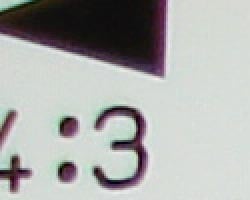
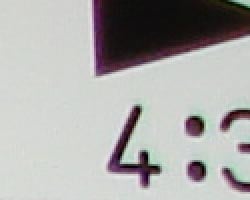
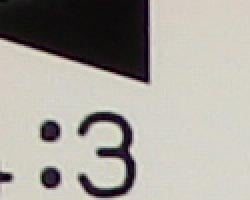
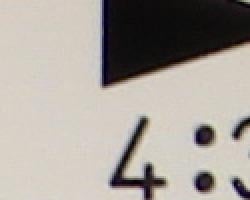
Chromatic aberration is low to moderate at wide angle, showing about 5-6 pixels of faint coloration on either side of the target lines, but decreases to very low levels at telephoto focal lengths. (This distortion is visible as a very slight colored fringe around the objects at the edges of the field of view on the resolution target.)
Corner Sharpness
Some softening in the left and right corners of the frame, strongest effect in the lower left corners. Better corner sharpness than average though.
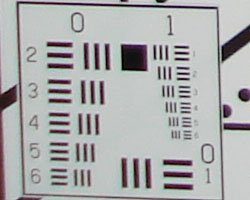
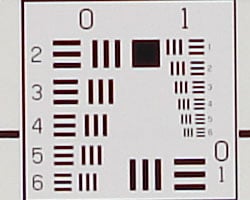
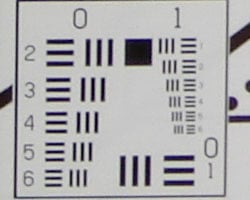
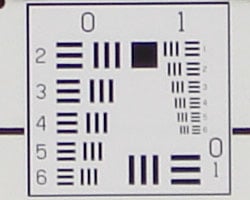
The DSC-W30 produced soft corners in a few shots, the lower left corner seeming to have the most visible effect. Overall though, the W30's corner sharpness was better than that of most cameras we test.
Viewfinder
Coverage
Optical viewfinder is tight and skewed to the top. Excellent accuracy from the LCD monitor.


The DSC-W30's optical viewfinder was quite tight, showing only about 81% frame accuracy at both wide angle and telephoto lens settings. However, the LCD monitor showed almost 100% accuracy at both wide and telephoto.
The images above were taken from our standardized test shots. For a collection of more pictorial photos, see our Sony Cyber-shot DSC-W30 Photo Gallery .
Exposure
Sony DSC-W30 Exposure
Color
Saturation & Hue Accuracy
Good overall color and hue accuracy, slight oversaturation in bright reds and blues, undersaturation in yellows and yellow-greens.
 |
| In the diagram above, the squares show the original color, and the circles show the color that the camera captured. More saturated colors are located towards the periphery of the graph. Hue changes as you travel around the center. Thus, hue-accurate, highly saturated colors appear as lines radiating from the center. |
Most consumer digital cameras produce color that's more highly saturated (more intense) than found in the original subjects. This is simply because most people like their color a bit brighter than life. The DSC-W30 does oversaturate the strong red and blue tones slightly, but undersaturates bright yellows and yellow-greens. We found its color pleasing on a wide range of typical subjects though. Where oversaturation is most problematic is on Caucasian skin tones, as it's very easy for these "memory colors" to be seen as too bright, too pink, too yellow, etc. Here, the W30 performed well, with only slight warmth.
The other important part of color rendition is hue accuracy. Hue is "what color" the color is. The DSC-W30 showed small color shifts relative to the correct mathematical translation of colors in its subjects, but overall had more hue-accurate color than most consumer cameras we test.


Sensor
Exposure and White Balance
Indoors, incandescent lighting
Warm casts with both Auto and Incandescent white balance settings. About average exposure compensation required.


Color balance indoors under incandescent lighting was just a bit warm and reddish in Auto white balance mode, while the Incandescent setting resulted in a more yellow color balance that actually looked more pleasing overall. The DSC-W30 required a +1.0 EV exposure compensation boost to get a good exposure, about average for this shot. Overall color is a bit dark and yellow here, making the blue flowers very dark and purplish. (A very common outcome for this shot.) Our test lighting for this shot is a mixture of 60 and 100 watt household incandescent bulb, a pretty yellow light source, but a very common one in typical home settings here in the US.
Outdoors, daylight
Good color balance overall, with fairly bright colors. Heightened contrast under bright outdoor conditions.


Outdoor shots showed better than average exposure accuracy, though with notably high contrast under harsh sunlight. Strong highlights tended to produce slight underexposures, as in the house shot above, with a limited midtone range, but exposure accuracy was still better than average when compared to many other consumer digital cameras. Overall color looked pretty good, with bright reds and blues that nonetheless didn't look too overdone.
See full set of test images with explanations
See thumbnails of all test and gallery images
Resolution
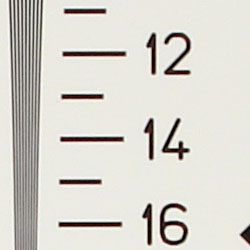
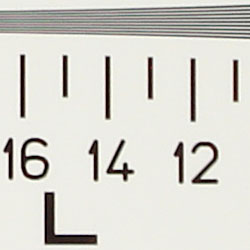
High resolution, 1,250 lines of strong detail.
Our laboratory resolution chart revealed sharp, distinct line patterns down to about 1,250 lines per picture height, with extinction at around 1,700. (The camera produced slight color artifacts at lower line frequencies though, visible in the full-sized res target shots.) Use these numbers to compare with other cameras of similar resolution, or use them to see just what higher resolution can mean in terms of potential detail. Beware that while you might be able to make out what looks like distinct lines at numbers higher than those we've mentioned here, the camera is just doing its best to continue interpreting the lines. If you zoom in and follow them from the wider portions, you'll see the lines converge and reappear several times, so the lines you see at 1,600 and higher are really only artifacts generated by the camera's imaging system.
See full set of test images with explanations
See thumbnails of all test and gallery images
Sharpness & Detail
Slightly soft images, though still fairly good detail definition, especially in bright lighting.


The Sony DSC-W30's images tend to have a slightly soft look when printed large, though high contrast detail like the fine branches against the sky above is well-preserved, with little or no evidence of oversharpening. (Edge enhancement creates the illusion of sharpness by enhancing colors and tones right at the edge of a rapid transition in color or tone.)
Noise-suppression systems in digital cameras tend to flatten-out detail in areas of subtle contrast. The effects can often be seen in shots of human hair, where the individual strands are lost and an almost "watercolor" look appears. The crop at far right shows this somewhat, with darker areas of Marti's hair showing limited, blurry detail, though individual strands are visible where a lighted strand passes in front of a darker shadow area. On balance, the W30 shows less detail loss to noise reduction at low ISO settings than average, but more at high ISOs.
ISO & Noise Performance
Moderate noise at the normal sensitivity settings, but very high noise and strong blurring at the higher settings.






The DSC-W30's lower ISO settings produced low to moderate noise, with only slightly blurred detail in the dark areas. (As noted above, better than average in this respect.) However, starting at ISO 400, image noise begins to dominate areas of fine detail. At ISOs 800 and 1,000, noise is so strong and blurring so significant, that resulting images are practically useless for printing. (Even at a print size of 4x6 inches, ISO 1000 shots are soft and muddy-looking.)
Extremes: Sunlit and low light tests
High resolution with good overall detail, but high contrast limits both highlight and shadow detail. Limited low-light capabilities, but sensitive enough to capture bright images under typical city street lighting.


Sunlight:
Because digital cameras are more like slide film than negative film (in that they tend to have a more limited tonal range), we test them in the harshest situations to see how they handle scenes with bright highlights and dark shadows, as well as what kind of sensitivity they have in low light. The shot above is designed to mimic the very harsh, contrasty effect of direct noonday sunlight, a very tough challenge for most digital cameras. (You can read details of this test here.)
The DSC-W30 had a hard time with the deliberately harsh lighting in the test above, producing very high contrast with washed-out highlights and deep shadows. Shadow detail is limited, with the effects noise suppression very evident in the form of smudged detail in deep shadow areas. The camera required a slightly less than average amount of positive compensation at +0.7 EV, making its metering a bit more accurate than most in this particular test. (In "real life" though, be sure to use fill flash in situations like the one shown above; it's better to shoot in the shade when possible.)
| 1 fc 11 lux |
1/2 fc 5.5 lux |
1/4 fc 2.7 lux |
1/8 fc 1.3 lux |
1/16 fc 0.67 lux |
|
| Night Mode (ISO 80) (2 sec max) |
 1.3 sec f2.8 |
 2 sec f2.8 |
 2 sec f2.8 |
 2 sec f2.8 |
 2 sec f2.8 |
| ISO 80 |  1 sec f2.8 |
 1 sec f2.8 |
 1 sec f2.8 |
 1 sec f2.8 |
 1 sec f2.8 |
| ISO 100 |  1 sec f2.8 |
 1 sec f2.8 |
 1 sec f2.8 |
 1 sec f2.8 |
 1 sec f2.8 |
| ISO 200 |  1/2 sec f2.8 |
 1 sec f2.8 |
 1 sec f2.8 |
 1 sec f2.8 |
 1 sec f2.8 |
| ISO 400 |  1/4 sec f2.8 |
 1/2 sec f2.8 |
 1 sec f2.8 |
 1 sec f2.8 |
 1 sec f2.8 |
| ISO 800 |  1/8 sec f2.8 |
 1/4 sec f2.8 |
 1/2 sec f2.8 |
 1 sec f2.8 |
 1 sec f2.8 |
| ISO 1000 |  1/10 sec f2.8 |
 1/5 sec f2.8 |
 1/2 sec f2.8 |
 1/1 sec f2.8 |
 1 sec f2.8 |
| High ISO Mode (ISO 1000) (1/8 sec max) |
 1/10 sec f2.8 |
 1/8 sec f2.8 |
 1/8 sec f2.8 |
 1/8 sec f2.8 |
 1/8 sec f2.8 |
Low light:
The Sony DSC-W30 had somewhat limited low-light shooting capabilities, with a maximum exposure time of two seconds and that only at its lowest ISO setting of 80. However, the camera is sensitive enough for shooting under average city street-lighting at night, about one foot-candle. (The leftmost column of images in the table above.) Overall color was pretty good with the Auto white balance setting, and the camera's autofocus system was able to focus on the subject down to the 1/4 foot-candle light level unassisted (about 1/4 as bright as typical street lighting). With the AF assist lamp enabled, the camera focused accurately down to the lowest light level we test at.
Flash
Coverage and Range
A limited flash range, and moderate orange cast with incandescent lighting. Our standard shots required the "+" flash exposure setting.


Flash coverage was rather uneven at wide angle, and still uneven at telephoto. In the Indoor test, the DSC-W30's flash underexposed our subject at its default setting, requiring use of the "+" flash setting to get reasonably bright results. Even here, the exposure is a little dim, with a noticeable orange cast. The Slow-Sync flash mode also needed the "+" setting, though it resulted in more even lighting (and a stronger orange cast).
| 8 ft | 9 ft | 10 ft | 11 ft | 12 ft | 13 ft | 14 ft |
 1/50 sec f5.2 ISO 100 |
 1/50 sec f5.2 ISO 100 |
 1/50 sec f5.2 ISO 100 |
 1/50 sec f5.2 ISO 100 |
 1/50 sec f5.2 ISO 100 |
 1/50 sec f5.2 ISO 100 |
 1/50 sec f5.2 ISO 100 |
Even at eight feet, our closest test range, the flash did not quite illuminate the DaveBox target adequately.
Output Quality
Print Quality
Good print quality, great color, crisp prints at 8x10 inches, usable ones at 11x14. ISO 400 images are soft and noisy at 8x10 inches, acceptable at 5x7, great at 4x6. Higher ISOs are only (barely) suitable for 4x6 inch snapshot prints.
Testing hundreds of digital cameras, we've found that you can only tell just so much about a camera's image quality by viewing its images on-screen. Ultimately, there's no substitute for printing a lot of images and examining them closely. For this reason, we now routinely print sample images from the cameras we test on our Canon i9900 studio printer, and on the Canon iP5000 here in the office. (See the Canon i9900 review for details on that model.)
The Sony W30 produced crisp prints at 8x10 inches, and somewhat softer but still acceptable ones at 11x14. As always though, the real test of print size came at the higher ISO settings. Here, the W30's ISO 400 images were soft and noisy when printed at 8x10 inches, acceptable at 5x7 and great at 4x6. ISO 200 shots were noisy but acceptable at 8x10. The highest ISO settings of 800 and 1000 were so noisy though, that we question their inclusion on the camera at all. Even in small 4x6 inch snapshot-sized prints, ISO 800 and 1000 shots were soft and muddy-looking.
Color-wise, the Sony W30 did pretty well, with bright but natural-looking color and good-looking skin tones.
Bottom line, low-ISO shots from the DSC-W30 look very good and hold together well at large print sizes, but its high-ISO images leave much to be desired.
The images above were taken from our standardized test shots. For a collection of more pictorial photos, see our Sony Cyber-shot DSC-W30 Photo Gallery .
Not sure which camera to buy? Let your eyes be the ultimate judge! Visit our Comparometer(tm) to compare images from the Sony Cyber-shot DSC-W30 with those from other cameras you may be considering. The proof is in the pictures, so let your own eyes decide which you like best!
Performance
Sony DSC-W30 Performance
Timing and Performance
Good speed for a consumer camera.
| Operation |
Time (secs) |
Notes |
|
Power On -> First shot
|
1.7 |
LCD turns on and lens extends forward.
|
|
Shutdown
|
1.3 - 57 |
First time is time to retract lens, second time is
worst-case buffer-clearing time.
|
|
Play to Record, first shot
|
1.0 |
Time until first shot is captured.
|
|
Record to play
|
0.3 / ~0 |
First time is that required to display a large/fine
file immediately after capture, second time is that needed to display
a large/fine file that has already been processed and stored on the
memory card.
|
|
Shutter lag, full autofocus
|
0.32 / 0.55 |
First time is at full wide-angle,
second is full telephoto.
|
|
Shutter lag, prefocus
|
0.014 |
Time to capture, after half-pressing shutter button.
|
|
Shutter lag, continuous autofocus
|
0.28
|
(Generally no increase in speed for static subjects, and we have no way to consistently measure performance with moving subjects.)
|
|
Shutter lag, manual focus
|
0.21
|
Manual focus is generally somewhat faster than autofocus, but not as quick as when you "prefocus" the camera.
|
|
Cycle Time, max/min resolution
|
1.25 / 1.17
|
First number is for large/fine files, second number is time for "TV" mode (640x480) images. Times are averages. In both modes, shoots this fast continuously, clearing the buffer after each shot.
|
|
Cycle Time, Flash exposures
|
4
|
(Flash at maximum power output)
|
|
Cycle Time, continuous mode, max/min resolution
|
0.70 / 0.65
(1.43 / 1.53 fps) |
First number is for large/fine files, second number is time for "TV" size images. Times are averages. Shoots 3 frames this fast in large/fine mode, then slows to about 2 seconds per shot. Buffer clears in 5 seconds. Shoot up to 98 frames this fast in TV mode, but takes up to 56 seconds to clear the buffer.
|
|
Cycle Time, continuous Multi Burst mode
|
0.033
(30 fps) |
Shoots sixteen 320 x 240 shots and stores them in a 4x4 array in one 1280 x 960 file. User can choose frame rate up to 30 fps.
|
|
Download speed
|
||
|
Windows Computer, USB 2.0
|
5,275 KBytes/sec
|
Typical Values:
Less than 600=USB 1.1; 600-770=USB 2.0 Low; Greater than 770=USB 2.0 High |
|
* Note - These timings were collected with a 2GB Sony Memory Stick PRO Duo memory card. Slower cards could result in shorter run lengths in continuous mode and longer buffer clearing times.
|
||
The DSC-W30's performance is quite good here, with a quick start up time of 1.7 seconds, a very fast shutter response when the lens is set to its wide angle position, and a better than average response at telephoto as well. If you "prefocus" the camera by half-pressing and holding down the shutter button before the final exposure, it's extremely fast, with a shutter delay of only 0.014 second, among the fastest on the market. Shot to shot cycle times are very good as well, at about 1.25 seconds for large/fine JPEGs, and it clears the buffer after each shot. Continuous-mode speed is where the camera slows down a bit, with its 0.70-second frame time and corresponding 1.43 frame rate. If you want to track really fast action though, the W30's Multi-Burst mode can capture 16 small (704-528 pixels, stored in a single large-size frame on the memory card) at either 7.5, 15, or 30 frames/second -- great for studying golf/tennis swings, etc. The flash takes about four seconds to recharge after a full-power shot, a little less than average for this class of camera. Connected to a computer, download speeds are so fast that we had a hard time believing the numbers we were seeing, but repeated tests gave similar results. Bottom line, the DSC-W30 is quite responsive, if a little lacking in its Continuous mode. (* Note - These timings were collected with a 2GB Sony Memory Stick PRO Duo memory card. Slower cards could result in shorter run lengths in continuous mode and longer buffer clearing times.)
Battery and Storage Capacity
Battery
Excellent battery life.
| Operating Mode | Battery Life |
| Still-image capture mode LCD on |
400 shots
|
| Still-image capture mode LCD off |
510 shots
|
The Sony Power-shot DSC-W30 uses a custom rechargeable LiIon battery for power. The table above shows the number of shots the camera is capable of based on CIPA battery-life and/or manufacturer standard test conditions.
We normally always recommend picking up a spare battery and keeping it freshly charged and on-hand for long outings, but the W30's battery life is good enough that few users are likely to feel the need for a second battery.
Storage
No card is included with the Sony Cyber-shot DSC-W30, although it accepts Memory Stick Duo cards; 32MB RAM is built into the camera.
|
Image Capacity with 32MB Internal Memory |
Fine | Normal | |
| 2,816 x 2,112 | Images | 10 | 19 |
| File Size | 3.2 MB | 1.7 MB | |
| 2,048 x 1,536 | Images | 20 | 36 |
| File Size | 1.7 MB | 924 KB | |
| 1,632 x 1,224 | Images | 32 | 61 |
| File Size | 1.0 MB | 548 KB | |
| 640 x 480 | Images | 196 | 491 |
| File Size | 171 KB | 68 KB | |
The Sony Power-shot DSC-W30 stores its photos on Memory Stick Duo memory cards or in approximately 32MB of internal memory, and no card is included with the camera. (We strongly recommend buying at least a 256MB card, preferably a 512MB one, to give yourself enough space for extended outings.)